Hubbry Logo
Puzzle video gamePuzzle video gameMain
Open search
Puzzle video game
Community hub
Puzzle video game
logo
8 pages, 0 posts
0 subscribers
Be the first to start a discussion here.
Puzzle video game
Puzzle video game
from Wikipedia
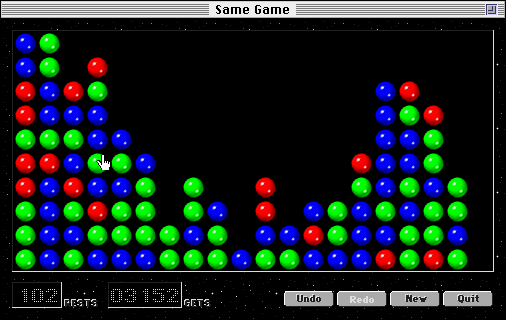
A 1994 Mac version of the 1985 tile-matching puzzle video game Chain Shot!

Puzzle video games make up a broad genre of video games that emphasize puzzle solving. The types of puzzles can test problem-solving skills, including logic, pattern recognition, sequence solving, spatial recognition, and word completion. Many puzzle games involve a real-time element and require quick thinking, such as Tetris (1985) and Lemmings (1991).

History

[edit]

Puzzle video games owe their origins to brain teasers and puzzles throughout human history. The mathematical strategy game Nim, and other traditional thinking games such as Hangman and Bulls and Cows (commercialized as Mastermind), were popular targets for computer implementation.

In Universal Entertainment's Space Panic, released in arcades in 1980, the player digs holes in platforms to trap creatures. It is a precursor to puzzle-platform games such as Lode Runner (1983), Door Door (1983), and Doki Doki Penguin Land (1985).[1][2][3]

Blockbuster, by Alan Griesemer and Stephen Bradshaw (Atari 8-bit, 1981), is a computerized version of the Rubik's Cube puzzle.[4] Snark Hunt (Atari 8-bit, 1982) is a single-player game of logical deduction, a clone of the 1970s Black Box board game.[5]

Elements of Konami's tile-sliding Loco-Motion (1982) were later seen in Pipe Mania from LucasArts (1989).

In Boulder Dash (1984), the goal is to collect diamonds while avoiding or exploiting rocks that fall after digging out the dirt beneath them.

Chain Shot! (1985) introduced removing groups of the same color tiles on a grid, causing the remaining tiles to fall into the gap.[6] Uncle Henry's Nuclear Waste Dump (1986) involves dropping colored shapes into a pit, but the goal is to keep the same color tiles from touching.[7][8]

Tetris (1985) revolutionized and popularized the puzzle game genre.[9][10] The game was created by Soviet game designer Alexey Pajitnov for the Electronika 60.[11] Pajitnov was inspired by a traditional puzzle game named Pentominos in which players arrange blocks into lines without any gaps.[9] The game was released by Spectrum Holobyte for MS-DOS in 1987, Atari Games in arcades in 1988, and sold 30 million copies for Game Boy.[12]

In Lemmings (1991),[13] a series of creatures walk into deadly situations, and a player assigns jobs to specific lemmings to guide the swarm to a safe destination.[12]

The 1994 MS-DOS game Shariki, by Eugene Alemzhin, introduced the mechanic of swapping adjacent elements to tile matching games. It was little known at the time, but later had a major influence on the genre.

Interest in Mahjong video games from Japan began to grow in 1994.[14][15]

Modern puzzle games

[edit]

In 2000, PopCap Games released Bejeweled, a direct clone of the 1994 tile-matching game Shariki with improved visuals. It sparked interest in the match-three mechanic which became the foundation for other popular games, including Puzzle Quest: Challenge of the Warlords (2007), Candy Crush Saga (2012), and Puzzle & Dragons (2012).[16]

After the release of Portal in 2007, there has been a rise in popularity of physics-based logic puzzle games.[17]

Sub-genres

[edit]

Physics game

[edit]
The Splatters, a physics-based Xbox Live Arcade game

A physics game is a type of logical puzzle video game wherein the player must use the game's physics and environment to complete each puzzle. Physics games use consistent physics to make games more challenging.[18] The genre is popular in online flash games and mobile games. Educators have used these games to demonstrate principles of physics.[19]

Physics-based logic puzzle games include The Incredible Machine, Portal, The Talos Principle, Braid, Fez, World of Goo, and Cut the Rope, as well as projectile collision games such as Angry Birds, Peggle, Monster Strike, and Crush the Castle.

Programming game

[edit]

Programming games require writing code, either as text or using a visual system, to solve puzzles. Examples include Rocky's Boots (1982), Robot Odyssey (1984), SpaceChem (2011), and Infinifactory (2015).

Exploration

[edit]

This sub-genre includes point-and-click games that often overlap with adventure games and walking simulators. Unlike logical puzzle games, these games generally require inductive reasoning to solve. The defining trait is that the player must experiment with mechanisms in each level before they can solve them. Exploration games include Myst, Limbo, and The Dig. Escape room games such as The Room involve detailed exploration of a single location.

Sokoban

[edit]

Sokoban games, such as its 1982 namesake title, or block-pushing games, involve pushing or pulling blocks on a grid-like space to move them into designated positions without blocking the movement of other blocks. Similar games include Baba is You and Patrick's Parabox.

Hidden object game

[edit]

A hidden object game, sometimes called hidden picture or hidden object puzzle adventure (HOPA), is a genre of puzzle video game in which the player must find items from a list that are hidden within a scene.[20] Hidden object games are a popular trend in casual gaming.[21][22]

Tile-matching

[edit]

In tile-matching video games, the player manipulates tiles in order to make them disappear according to a matching criterion. The genre began with 1985's Chain Shot! and has similarities to falling-block games such as Tetris. This genre includes games that require pieces to be swapped such as Bejeweled or Candy Crush Saga, games that adapt the classic tile-based game Mahjong such as Mahjong Trails, and games in which pieces are shot on the board such as Zuma. Puzzle games based on Tetris include tile-matching games where the matching criterion is to place a given number of tiles of the same type so that they adjoin each other. That number is often three, and the corresponding subset of tile-matching games is referred to as match-three games.

See also

[edit]

References

[edit]
Revisions and contributorsEdit on WikipediaRead on Wikipedia
from Grokipedia
Puzzle video games constitute a broad of video games in which the core revolves around solving puzzles, with the act of resolution serving as the primary objective and source of player satisfaction. These games challenge players' cognitive abilities, including , reasoning, problem-solving, and , often activating regions associated with such as the . Originating from ancient brain teasers and early computer experiments, the genre gained mainstream traction in the 1980s with the advent of accessible personal computing and arcade systems. A landmark title in the genre is , developed in 1984 by Soviet programmer and inspired by the physical puzzle, which involves rotating and stacking falling shapes to clear lines. Tetris revolutionized puzzle gaming through its simple yet addictive mechanics, achieving massive commercial success with over 520 million units sold as of 2025, and earning the Guinness World Record for the most ported in 2010. Subsequent innovations expanded the genre's scope, incorporating elements like real-time action, narrative integration, and physics simulation in titles such as Lemmings (1991), where players manipulate environments to guide lemming characters to safety, blending puzzle-solving with strategic oversight. Modern examples include Portal (2007), a first-person puzzle game that employs portal-based mechanics to navigate test chambers, highlighting the genre's evolution toward immersive, physics-driven challenges. Puzzle video games encompass diverse subgenres, including tile-matching (e.g., Tetris), logic-based enigmas requiring tool use and object manipulation (e.g., Lemmings), and hybrid forms that test spatial reasoning and , making them accessible yet intellectually demanding across platforms from mobile devices to consoles.

Definition and Characteristics

Core Elements

Puzzle video games are interactive digital experiences that primarily revolve around problem-solving, , or to advance through levels or achieve objectives, typically set in abstract or minimalistic environments that prioritize intellectual engagement over immersive storytelling or physical action. These games challenge players to manipulate elements within defined rules to reach a resolution, deriving satisfaction from the eureka moment of comprehension rather than competition or exploration. Central to puzzle video games are several defining elements that underscore their focus on mental acuity. Puzzle video games can promote analytical skills, though approaches and rewards vary across subgenres.

Gameplay Mechanics

Many puzzle video games employ simple and intuitive input methods to facilitate player interaction with puzzle elements, such as point-and-click selections using a or taps to choose objects, and drag-and-drop gestures to manipulate pieces into position, particularly in tile-matching subgenres. These mechanics allow players to experiment with arrangements or sequences without complex controls, emphasizing cognitive problem-solving over physical dexterity. Feedback loops are integral, providing immediate visual or auditory cues—such as animations for successful matches or color changes for invalid moves—to confirm actions and guide further attempts, thereby reinforcing learning and reducing ambiguity in the interaction cycle. Progression systems in puzzle games often structure gameplay as a series of levels unlocked sequentially upon solving prior puzzles, creating a sense of advancement and through gated content. This linear or branching progression ensures gradual skill building while maintaining player investment by tying unlocks to mastery demonstrations. Randomness and enhance puzzle variety by dynamically creating configurations, often using algorithms like or to produce solvable instances without manual design. These methods incorporate controlled randomness—such as randomizing initial layouts while validating solvability through or checks—to ensure fairness and replayability, preventing predictability in games with numerous levels. For example, in grid-based puzzles, procedural algorithms generate diverse board states that meet specific solution criteria, balancing novelty with accessibility. Balancing difficulty involves scaling complexity through dynamic adjustment techniques, where the game monitors player performance to modify puzzle parameters, such as increasing element counts or interconnections in subsequent levels. Hints serve as a core engagement tool, often triggered after repeated or on request, providing progressive guidance—from subtle visual highlights to explicit step-by-step solutions—to mitigate without undermining the challenge. states are designed to be non-punitive in many cases, allowing resets without loss to encourage experimentation, though some incorporate soft penalties like time deductions to heighten tension while preserving motivation. This equilibrium prevents disengagement by aligning challenge with player skill, fostering a where puzzles remain engaging rather than overwhelming. Time limits or resource constraints introduce by compelling efficient , such as limited moves in match-based puzzles that force of high-value actions over exhaustive trials. These elements affect by shifting focus from pure logic to optimization under pressure, potentially increasing but enhancing satisfaction upon success, as evidenced in studies showing time constraints boost perceived competence when surmountable.

History

Early Developments

The puzzle video game genre emerged in the 1970s through early text-based adventures that emphasized exploration and logic-based problem-solving. Colossal Cave Adventure, created by William Crowther in 1976 and expanded by Don Woods in 1977, is widely regarded as the first influential example, featuring a cave system where players navigated mazes, collected treasures, and solved environmental puzzles using simple text commands. This game drew inspiration from real-world spelunking in Kentucky's Mammoth Cave and introduced core mechanics like inventory management and riddle-solving that would define interactive fiction. Similarly, the 1977 version of Adventure incorporated fantasy elements and puzzle challenges, such as manipulating objects to overcome obstacles, laying the groundwork for narrative-driven puzzle experiences on mainframe computers. In the , arcade and platforms advanced spatial and transport puzzles, constrained yet innovative due to emerging hardware. , released in 1976 by but influential into the arcade era, required players to draw lines on a grid to trap opponents, fostering strategic spatial awareness that echoed in later puzzle designs like navigation games. The rise of affordable s, such as Japan's PC-8801, enabled more accessible titles; , developed by Hiroyuki Imabayashi and published by Thinking Rabbit in 1982, challenged players to push crates into storage spots without getting stuck, exemplifying the genre's focus on reversible actions and foresight. These games benefited from the era's 8-bit systems, which limited memory and processing power—typically 64 KB RAM and 4 MHz CPUs—forcing developers to prioritize elegant, minimalist mechanics over complex visuals. The marked a breakthrough in graphical puzzle integration, with exemplifying tile-matching's mass appeal. Invented by in 1984 on the Soviet Electronika 60 computer, involved rotating and stacking falling blocks to form lines, but it gained global popularity in 1989 through its Nintendo bundling, selling millions and demonstrating addictive, intuitive gameplay. This period also saw the shift to richer interfaces on PCs, as in (1993) by Sierra On-Line and Dynamix, where players built Rube Goldberg-style contraptions using physics simulations to achieve goals like launching balls or activating switches. Hardware constraints persisted into early 8-bit and transitioning 16-bit systems, promoting clever designs that maximized limited sprites (often 8x8 or 16x16 pixels) and color palettes (up to 256 colors) for clear, engaging challenges.

Modern Evolution

The puzzle video game genre experienced significant growth in the , fueled by the rise of casual gaming portals and browser-based accessibility. played a pivotal role in this boom, releasing Bejeweled in 2001 as a Flash-based match-three title that emphasized simple, addictive mechanics suitable for short play sessions. This game, along with other offerings, helped establish casual gaming as a mainstream phenomenon, with browser platforms enabling widespread distribution without requiring downloads or high-end hardware. Bejeweled's success, reaching over 500 million players globally, underscored the genre's appeal to non-traditional gamers and marked a shift toward polished, accessible puzzle experiences that prioritized relaxation over complexity. By the end of the decade, such portals had democratized puzzle gaming, contributing to the casual revolution that expanded the audience beyond core gamers. The 2010s brought a mobile revolution to puzzle games, driven by smartphones and (F2P) models that integrated monetization seamlessly into progression systems. King’s , launched in 2012, exemplified this shift, blending match-three puzzles with social features and in-app purchases for lives and boosters, generating billions in revenue while amassing over 3 billion downloads. The game's design encouraged habitual play through timed levels and daily rewards, influencing the broader adoption of F2P in mobile puzzles and solidifying the genre's dominance on app stores. By mid-decade, mobile platforms accounted for the majority of puzzle game engagement, with titles like demonstrating how touch interfaces enhanced intuitive controls and episodic content suited to on-the-go play. Post-2010, the indie scene profoundly influenced puzzle game innovation, particularly through platforms like , which lowered barriers for experimental titles and fostered creative diversity. Indie developers leveraged 's tools for direct-to-consumer releases, enabling puzzles that pushed boundaries in narrative integration and mechanics, such as those in (2008, but influential into the 2010s) and later works like The Witness (2016). This era saw a surge in indie puzzle games, with hosting thousands of entries that blended genres and emphasized artistic expression, contributing to the platform's role in revitalizing the indie ecosystem. Concurrently, (VR) and () integrations emerged in the early 2020s, offering immersive puzzle experiences; for instance, VR: A (2020) utilized spatial manipulation in VR to deepen tactile problem-solving. These technologies allowed puzzles to extend beyond 2D screens, incorporating physical interactions that heightened player immersion in experimental indie projects. As of 2025, puzzle games continue to evolve with AI-assisted generation techniques and cross-genre hybrids, alongside robust market performance. AI tools now automate level creation, enabling dynamic, personalized puzzles that adapt to player skill, as seen in systems that reduce development time while increasing replayability. Hybrid designs, such as puzzle-simulation blends in titles like block puzzle variants, merge core mechanics with narrative or social elements, driving innovation in casual spaces. reflects this vitality, with puzzle games comprising approximately 20-28% of global mobile downloads in 2024, led by simulation-puzzle crossovers that captured 9.7 billion installs. These trends, supported by AI efficiencies, position puzzle games as a of the $100 billion-plus mobile sector, emphasizing scalability and broad accessibility.

Subgenres

Tile-Matching Puzzles

Tile-matching puzzles form a prominent subgenre of puzzle video games where players manipulate a grid of colored or shaped tiles to align and eliminate matches, typically by swapping or rotating adjacent pieces to create lines, rows, or groups of three or more identical tiles. Once formed, these matches disappear from the board, often triggering cascading effects where remaining tiles shift—commonly via simulated —filling empty spaces and potentially creating additional for reactions. Scoring systems reward players for the size and speed of matches, with multipliers for consecutive eliminations that encourage to maximize points and clear levels efficiently. This core mechanic emphasizes and spatial reasoning, as boards start in randomized or semi-random states that require foresight to avoid deadlocks where no moves remain. The historical roots of tile-matching puzzles trace back to (1984), developed by for the Electronika 60 computer, which introduced the concept of aligning falling shapes to complete horizontal lines that clear from the playfield, establishing the foundational falling-block variant without direct swapping but with rotation mechanics. This progenitor influenced subsequent innovations, evolving into explicit match-3 swapping mechanics seen in Bejeweled (2001), created by and Brian Fiete for , where players exchange adjacent gems on a static grid to form horizontal or vertical lines of three or more, popularizing the genre in the casual gaming market through its accessible browser-based release. Over time, the subgenre expanded from arcade and PC origins to mobile platforms, driven by the simplicity that allows short play sessions while fostering addictive progression. Recent examples include Gardenscapes (2016, ongoing updates through 2025) by , which integrates match-3 with simulation elements for long-term engagement. Variations within tile-matching puzzles diversify the core mechanic, such as gravity-based drops in (also known as Bust-a-Move, 1994), developed by , where players launch colored bubbles from the bottom of the screen to match three or more in clusters that pop and cause upper bubbles to fall and potentially chain. Other iterations incorporate power-ups, like bombs or color shifters in games such as (2012) by , which extend matches by clearing larger areas or altering tile properties to facilitate harder levels. These adaptations maintain the alignment focus but introduce shooting or timed elements to vary pacing and strategic depth. A key design challenge in tile-matching puzzles lies in balancing solvability—ensuring every generated board allows at least one valid move—against replayability, often addressed through procedural generation algorithms that populate grids with tiles while enforcing constraints like minimum match opportunities or difficulty scaling via obstacle placement. These algorithms, such as constraint satisfaction solvers or search-based methods, iteratively validate board states to prevent unsolvable configurations, enabling infinite levels without manual design while preserving fairness and engagement. For instance, in match-3 titles, procedural techniques model tile distribution probabilities to create escalating challenges that adapt to player performance, as explored in broader puzzle generation research.

Physics-Based Puzzles

Physics-based puzzles constitute a subgenre of puzzle video games where players manipulate objects governed by simulated physical laws, such as , , and collisions, to accomplish objectives like stacking structures or redirecting trajectories. These rely on physics engines to model interactions realistically, enabling players to experiment with cause-and-effect chains that mimic real-world dynamics. For instance, players might construct contraptions using balls, levers, and pulleys to guide an object to a target, fostering through . A seminal example is (1993), developed by Sierra On-Line, which pioneered contraption-building puzzles by allowing players to assemble Rube Goldberg-style devices from a palette of everyday objects influenced by 2D physics simulations. This game emphasized chaining physical events, such as using a to lift a weight or a fan to propel a ball, to solve increasingly complex levels. Its influence extended to later titles, evolving the genre toward more intuitive and artistic interactions. Subsequent innovations include (2008) by 2D Boy, where players build towers and bridges by attaching goo balls that stretch and sway under gravity and tension, highlighting momentum and in a whimsical environment. Similarly, Crayon Physics Deluxe (2009) by Kloonigames lets players draw objects with a crayon tool, which then obey physics rules like and to reach stars, blending sketching with simulation for emergent puzzle solutions. These games demonstrate the subgenre's progression from rigid assembly to fluid, player-driven creation. A more recent title, Human Fall Flat (2016, with updates through 2025) by No Brakes Games, expands multiplayer physics manipulation for cooperative problem-solving. Technically, these puzzles often employ 2D physics libraries like , an open-source engine that handles , joints, and to simulate believable interactions without excessive computational cost. Developers face challenges in balancing realism—such as accurate momentum transfer—with fair difficulty, as overly precise simulations can lead to unpredictable failures that frustrate players, while simplified models risk undermining the sense of authenticity. Adjustments like tunable or help ensure puzzles remain solvable yet engaging. Variations within the subgenre distinguish rigidbody puzzles, where objects maintain fixed shapes and collide elastically (as in 's components), from those incorporating soft-body interactions, like the deformable goo strands in that allow bending and compression for more organic behaviors. This contrast enables emergent solutions, where players discover unintended but valid paths through the physics engine's flexibility, enhancing replayability and creative depth.

Logic and Programming Puzzles

Logic and programming puzzles in video games challenge players to employ and algorithmic structures to manipulate game elements, often through issuing commands that mimic pseudo-code or visual scripting. These typically involve controlling agents, sequences, or systems using conditional statements (e.g., if-then logic), loops, and branching paths to achieve objectives like assembly or transformation tasks. Unlike broader logic elements in early puzzle games, this subgenre emphasizes programmatic control for abstract problem-solving. Prominent examples include ' titles, which exemplify the subgenre's focus on machine-building through logic-based commands. In (2011), players design reactors to synthesize molecules by routing atoms along symbolic tracks, incorporating loops to repeat actions and conditional waldos for bonding decisions, simulating chemical automation with programming principles. Similarly, (2017) requires constructing alchemical machines to transmute reagents into products, using arm placements and track designs that enforce sequential logic and resource optimization, akin to writing efficient code for repetitive processes. Recent developments include (2018) by , with ongoing community challenges into 2025. These puzzles foster by introducing programming concepts without requiring full syntax knowledge, often via block-based or drag-and-drop interfaces that encourage , , and . Games like those from promote these skills in educational settings, where visual scripting helps learners grasp algorithms through iterative experimentation rather than text-based coding. Research supports their efficacy, showing that such mechanics enhance logical sequencing and problem in players. Challenges in this subgenre scale from basic deductions—such as single-sequence commands—to complex optimization puzzles that minimize steps, cycles, or resource use, demanding refinement of solutions for efficiency. In , for instance, players balance speed and space constraints across 53 puzzles, escalating from simple bonding to multi-reactor pipelines handling imaginary elements. This progression builds resilience in algorithmic design, as suboptimal solutions may work initially but fail under tighter metrics, mirroring real programming trade-offs.

Exploration and Adventure Puzzles

Exploration and puzzles represent a subgenre of puzzle video games where challenges are deeply embedded within expansive, interactive environments, requiring players to engage with the world to progress. The core mechanic revolves around environmental interaction, such as manipulating levers, decoding symbols, or examining artifacts, to reveal hidden paths, unlock secrets, or access new areas in both 2D and 3D worlds. This approach emphasizes player agency through observation and experimentation, often in richly detailed settings that encourage thorough investigation of surroundings. For instance, players might rotate mechanisms to align patterns or combine environmental clues to solve riddles, transforming the game world itself into a dynamic puzzle element. A seminal example is (1993), a point-and-click adventure that pioneered this subgenre by placing players on a mysterious where exploration drives puzzle-solving. In , players navigate pre-rendered 3D environments, interacting with objects like gears, books, and observatories to decipher interconnected puzzles that span multiple linked "Ages" or worlds, uncovering a narrative of family intrigue. This design set a benchmark for immersive exploration, selling over 500,000 copies in its first year and reaching one million by March 1995, highlighting the appeal of puzzles tied to discovery. Evolving from such foundations, The Witness (2016) expands the concept into a fully open-world 3D , where players draw lines on environmental panels to solve over 500 mazes integrated into the landscape, from mountain overlooks to underground caverns, promoting free-form wandering and incremental learning. A 2024 example is Lorelei and the Laser Eyes by , which integrates optical illusions and narrative exploration in a surreal mansion. These puzzles integrate seamlessly with adventure elements, serving as narrative barriers that gate story advancement while rewarding keen observation and trial-based experimentation. Rather than isolated challenges, they propel the plot forward; solving a mechanism might reveal a character's via a journal or open a portal to a new realm, fostering a sense of personal investment in the unfolding tale. This embedding distinguishes the subgenre, as puzzles often draw from lore or environmental context, requiring players to piece together thematic clues for progression. Building briefly on early roots from the , modern iterations like these emphasize immersive worlds over text parsing. Design in this subgenre prioritizes non-linear solutions and multiple paths, allowing players to approach challenges from various angles and revisit areas with newfound , in contrast to more rigid, linear puzzle structures. This flexibility encourages and holistic world understanding, where a single environmental feature might contribute to several puzzles, promoting emergent discovery over sequential gating. Developers often layer puzzles with escalating complexity, using the open environment to teach organically through visual and auditory cues, enhancing replayability and depth without frustrating dead-ends.

Hidden Object Puzzles

Hidden object puzzles constitute a subgenre of puzzle video games where players scan detailed, cluttered scenes to locate specific items from a provided list or outline. The core mechanic involves tasks, often under time constraints, with features such as hint systems to reveal object locations, penalties like point deductions or time losses for incorrect clicks, and progression through multiple scenes upon successful completion. These elements create a rhythmic cycle of , identification, and collection, emphasizing and attention to detail without requiring physical manipulation of the environment. The subgenre's historical development traces back to early digital adaptations in the , but it gained prominence in the 2000s through hidden object adventure (HOA) games that integrated narrative storytelling. A pioneering example is Alice: An Interactive Museum (1991), which drew from literary themes to embed object searches within interactive environments, though it remained niche. The genre surged with Mystery Case Files: Huntsville (2005) by , which blended hidden object searches with mystery plots, generating over $1 million in digital sales and establishing HOA as a casual gaming staple. This rise coincided with the expansion of downloadable games, allowing developers to layer puzzles with overarching stories of detection and intrigue. Recent titles like Hidden City (2014, active through 2025) by G5 Entertainment continue this trend with mobile-first, narrative-driven searches. Variations within hidden object puzzles range from pure search experiences, focused solely on item location, to puzzle-integrated formats where collected objects serve as tools for subsequent mini-puzzles, such as combining items to unlock areas. Mobile adaptations have proliferated since the 2010s, optimizing touch interfaces for quick sessions and incorporating models with energy systems or in-app purchases, as seen in titles like June's Journey (2019). These adaptations maintain core search mechanics while adding for replayability. The appeal of hidden object puzzles lies in their role as visual perception training, enhancing skills like figure-ground discrimination—the ability to isolate objects from complex backgrounds—which supports and relaxation. Design principles emphasize balanced clutter density to challenge players without overwhelming them, typically aiming for 20-30 hidden items per scene to sustain engagement for 5-10 minutes. Thematic consistency is crucial, ensuring objects align with the scene's context (e.g., Victorian-era items in a ) to foster immersion and logical discovery.

Design and Development

Puzzle Creation Techniques

Puzzle creation in video games involves a of manual design and algorithmic methods to ensure engaging and fair challenges. Developers often employ hand-crafting, where designers manually construct puzzles to achieve precise control over narrative integration and emotional impact, allowing for tailored difficulty and thematic consistency. In contrast, uses algorithms to automatically create puzzles, enabling infinite variety and replayability, particularly in games requiring large numbers of levels, though it risks producing unbalanced or trivial solutions without careful tuning. Increasingly, (AI) and generative AI tools are integrated into these processes, assisting in generating diverse puzzles, testing solvability, and adapting challenges to individual player behaviors for enhanced personalization and efficiency. As of October 2025, 90% of game developers reported using some form of AI in their workflows, transforming puzzle design by automating ideation and iteration while preserving creative control. A hybrid approach combines both, as seen in titles like , where procedural elements generate core layouts and hand-crafting refines key interactions for coherence. Tools such as Unity's Asset Store offerings, including the Puzzle Maker toolkit, facilitate puzzle creation by providing drag-and-drop editors for assembling components like grids and constraints, streamlining iteration for indie developers. Custom solvers, often built with scripting languages, allow designers to prototype mechanics rapidly within engines like Unity. To test solvability, developers apply algorithms, which systematically explore solution paths and retract invalid ones, verifying that puzzles have at least one solution and ideally a unique one to avoid ambiguity. This method is crucial for ensuring difficulty curves, where early puzzles introduce mechanics simply and later ones build complexity without dead ends; for instance, in , backtracking can filter out unsolvable instances during creation. Such verification prevents player frustration from impossible challenges, maintaining engagement. Iteration relies heavily on playtesting, where prototypes are observed to identify frustration points, such as overly opaque clues or excessive trial-and-error, followed by adjustments based on player feedback. variations—comparing puzzle versions with altered constraints—helps refine balance, ensuring progressive skill-building without revealing solutions prematurely. features, like color-blind modes that replace color-coded elements with patterns or icons, are integrated during this phase to broaden reach, as demonstrated in games addressing visual impairments through targeted testing. Balancing creativity involves structuring puzzles to teach incrementally, using dependency diagrams to map interrelations and prevent spoilers by gating revelations behind prior solutions. This ensures puzzles foster discovery while scaling difficulty, with playtesting confirming that creative twists enhance satisfaction without overwhelming players.

Player Engagement Strategies

Puzzle video games employ various strategies to sustain player interest, drawing on psychological principles and game design techniques to foster motivation and long-term play. Developers often integrate reward systems, such as achievements and star ratings for optimal puzzle solutions, to provide immediate feedback and a sense of accomplishment, encouraging players to replay levels for perfection. These systems leverage positive reinforcement, where tangible benefits like in-game currency or intangible badges motivate continued effort without overwhelming the core puzzle-solving experience. Narrative hooks further enhance engagement by embedding puzzles within compelling stories, creating emotional investment that propels players forward. For instance, progressive reveals plot elements upon puzzle completion, transforming isolated challenges into a cohesive journey that builds anticipation and curiosity. This approach taps into players' desire for discovery, making each solution feel integral to a larger arc rather than mere mechanical repetition. Social features, including leaderboards and friend comparisons, introduce competitive and communal elements to puzzle games, particularly in mobile formats. Leaderboards rank players by scores or completion times, fostering rivalry that prompts repeated attempts to climb rankings, while sharing achievements via social networks amplifies viral engagement. These not only extend play sessions but also build , as players collaborate or compete, increasing overall retention through social accountability. Psychological elements play a central , with developers inducing flow states—optimal experiences of immersion and focus—through escalating challenges that match player skill levels. Perceived challenge positively influences transitions, while fluctuations in difficulty prevent stagnation and promote progression to higher states, as modeled in analyses of mobile puzzle games. To avoid overload, designers balance "eureka" moments of insight by spacing them appropriately, ensuring frustration does not eclipse satisfaction and maintaining a steady flow without cognitive burnout. Monetization strategies, such as in-app purchases for hints in models, must balance revenue generation with fair play to preserve . Hints or boosters acquired via purchases or rewarded ads help players overcome stuck points without mandatory spending, mitigating drop-off while generating income; however, over-reliance on paywalls can disrupt flow and lead to churn if perceived as unfair. Retention tactics like daily challenges and meta-progression address high drop-off rates common in puzzle genres, where day 14 retention averages around 4% and day 30 falls to 2%. Daily challenges offer fresh, time-limited puzzles with exclusive rewards, boosting retention by up to 40% compared to games without them, by creating habitual logins. Meta-progression systems, such as unlocking new puzzle modes or through accumulated progress, provide long-term goals beyond individual levels, layering depth to sustain interest and counteract the genre's typical 5.35% day 30 retention benchmark.

Notable Examples and Impact

Iconic Titles

, released in 1984 by Soviet software engineer , stands as a foundational puzzle defined by its core mechanic of manipulating falling blocks to form complete lines on a grid, which then clear to score points. Developed on an Electronika 60 computer at the Academy of Sciences in , the game's simplicity belied its addictive depth, drawing from puzzles while introducing real-time decision-making under increasing speed. As a cultural export from the during the era, bridged ideological divides through its universal appeal, becoming one of the first s to achieve global ubiquity via ports to platforms like the Game Boy in 1989. Its innovation in blending spatial reasoning with escalating challenge influenced the tile-matching subgenre profoundly, establishing replayability through high-score mechanics and variants that persist today. Commercially, has sold over 520 million units worldwide, generating nearly $1 billion in revenue and cementing its status as the best-selling series. This massive impact popularized puzzle games as accessible entertainment, inspiring countless clones and integrations into broader gaming ecosystems. Portal, launched in 2007 by as part of compilation, revolutionized puzzle design through its integration of physics-based with a portal gun that allows players to create instantaneous wormholes between surfaces. The game's innovation lies in leveraging the Source engine's physics simulation to enable , where players propel objects or themselves through portals to navigate test chambers set in the Aperture Science facility. Narrative elements, infused with dry humor via the AI antagonist , enhance puzzle depth by tying progression to witty dialogue and escalating stakes, transforming rote challenges into a cohesive story-driven experience. This approach elevated puzzle games beyond abstraction, influencing hybrid genres that combine with character-driven . Portal achieved over 4 million physical and non-Steam sales by 2011, with total units estimated at over 14 million across platforms and gross revenue exceeding $140 million, underscoring its enduring commercial success and role in mainstreaming innovative indie-style titles within AAA bundles. The Legend of Zelda: Breath of the Wild, released in 2017 by , exemplifies open-world puzzle integration through its challenges, which blend physics manipulation, environmental exploration, and creative tool usage in a vast Hyrule landscape. Players solve over 100 shrines using mechanics like motion controls for aiming, rune abilities for elemental effects, and interactive objects that encourage emergent solutions, such as stacking blocks or using wind currents. This innovation shifted puzzle design toward non-linear, player-agency-focused experiences, where exploration reveals contextual clues rather than guided tutorials, profoundly impacting adventure puzzle subgenres by prioritizing discovery over linearity. The game's legacy includes redefining open-world freedom in puzzles, fostering community-shared strategies and mods that extend its mechanics. Breath of the Wild sold 33.34 million units as of September 2025, breaking launch records and driving Switch console adoption, thus amplifying puzzle elements' role in blockbuster titles. Monument Valley, developed by games and released in 2014 for mobile devices, innovated in puzzles by presenting Escher-inspired impossible architectures that players manipulate to guide Ida through shifting perspectives and impossible geometries. The core mechanic involves rotating staircases, platforms, and walls to create paths, exploiting visual paradoxes where what appears impassable becomes traversable, all rendered in a minimalist, hand-drawn aesthetic that emphasizes calm immersion over frustration. This mobile-first approach democratized artistic puzzle games, influencing indie titles focused on perceptual tricks and subtlety through environmental . Monument Valley's impact extends to proving premium mobile experiences' viability, with sales reaching 2.4 million units and revenue over $5.8 million in its first year, eventually grossing $25 million worldwide and earning for its elegant design.

Cultural and Educational Influence

Puzzle video games have permeated , notably through phenomena like the "," where prolonged play leads to intrusive mental imagery of game elements during wakefulness or sleep onset, as observed in a 2000 study where participants reported stereotypical visual images of falling blocks after intensive sessions. This cognitive spillover, first documented in the late and early , highlights how repetitive puzzle mechanics can reshape perceptual habits, influencing discussions on and even therapeutic interventions for trauma by disrupting memory reconsolidation. Additionally, competitive puzzle gaming has gained traction in , exemplified by the inaugural Red Bull World Final in December 2025, which will draw players from over 60 countries to compete in high-stakes matches, underscoring the genre's potential for spectator appeal beyond casual play. In education, puzzle games facilitate STEM learning by embedding programming concepts within interactive challenges; for instance, Code.org's curricula, such as Courses A-F for K-5 students, employ block-based puzzle activities like maze navigation to teach sequencing, , and logical problem-solving, reaching millions of learners annually through free resources. Research from the 2010s further substantiates cognitive benefits, with a 2013 study on demonstrating that 8 hours of play significantly improved problem-solving and spatial skills in young adults, as measured by pre- and post-tests on persistence, strategy, and tasks. These gains in spatial reasoning and executive function position puzzle games as tools for enhancing analytical abilities in educational settings. Regarding diversity and inclusion, puzzle games promote for neurodiverse players through simplified interfaces and adjustable difficulty, as explored in a 2023 study that developed guidelines for inclusive digital , emphasizing sensory-friendly mechanics like customizable audio and visual cues to accommodate conditions such as autism and ADHD. Indie puzzle titles further advance representation by featuring diverse protagonists and narratives; a 2017 analysis of 80 indie games revealed persistent underrepresentation of racial minorities but highlighted emerging titles that challenge stereotypes through culturally specific puzzles, fostering broader inclusivity in game development. Looking ahead, AI integration enables co-creation of dynamic puzzles, as in a 2025 adaptive game using genetic algorithms to generate personalized problem-solving challenges that evolve based on player performance, potentially revolutionizing procedural content for educational and therapeutic use. In applications, 2020s research supports puzzle games' role in ; a 2023 study found that sessions of puzzle reduced stress markers and boosted sustained , while a 2024 review of interventions noted improvements in anxiety and ADHD symptoms among youth through targeted designs.

References

Add your contribution
Related Hubs
User Avatar
No comments yet.