


Community hub
Recent from talks
Contribute something
Nothing was collected or created yet.
Wide-angle lens
View on Wikipedia

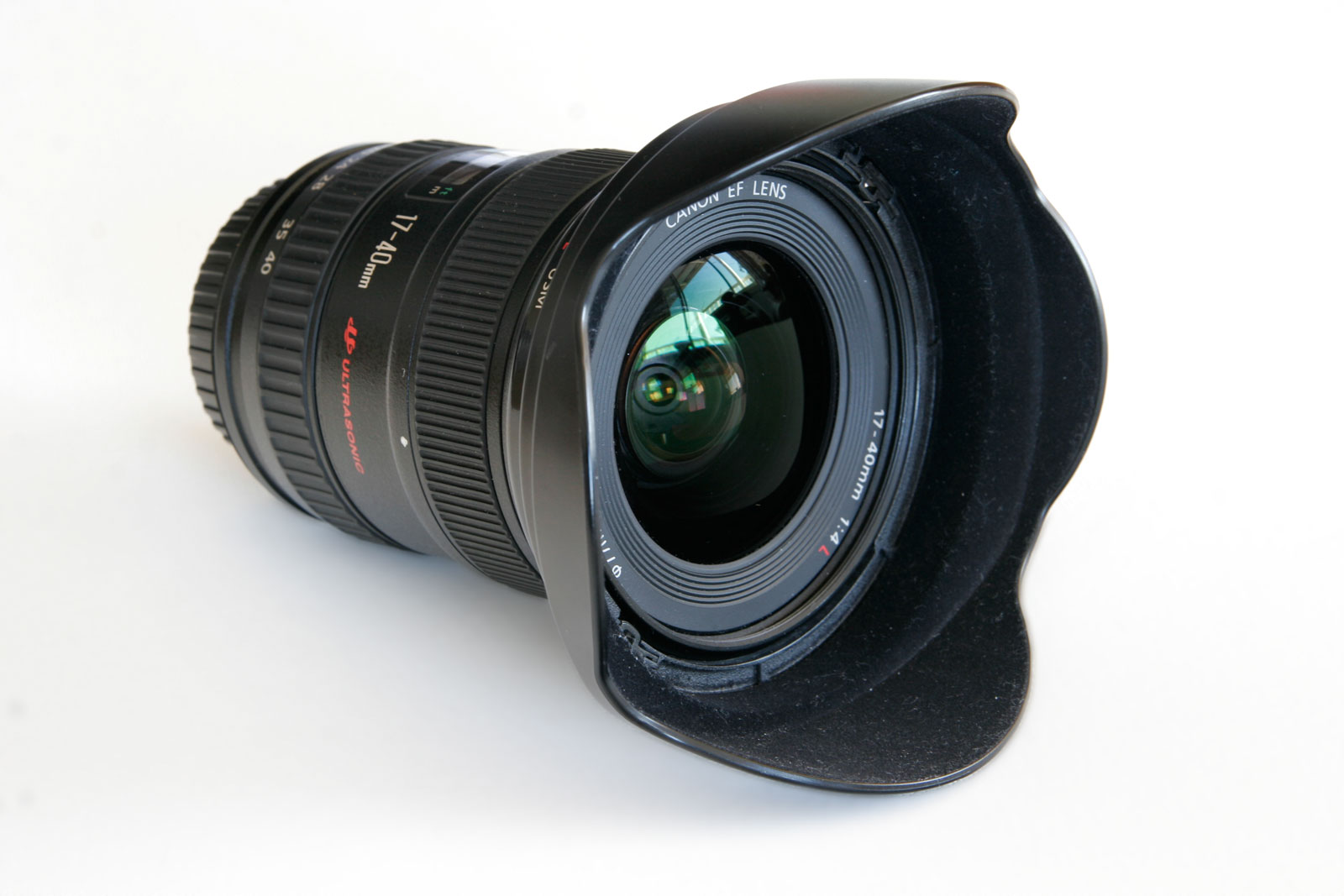
In photography and cinematography, a wide-angle lens is a lens covering a large angle of view.[a] Conversely, its focal length is substantially smaller than that of a normal lens for a given film plane. This type of lens allows more of the scene to be included in the photograph, which is useful in architectural, interior, and landscape photography where the photographer may not be able to move farther from the scene to photograph it.
Another use is where the photographer wishes to emphasize the difference in size or distance between objects in the foreground and the background; nearby objects appear very large and objects at a moderate distance appear small and far away.
This exaggeration of relative size can be used to make foreground objects more prominent and striking, while capturing expansive backgrounds.[1]
A wide-angle lens is also one that projects a substantially larger image circle than would be typical for a standard design lens of the same focal length. This large image circle enables either large tilt & shift movements with a view camera.
By convention, in still photography, the normal lens for a particular format has a focal length approximately equal to the length of the diagonal of the image frame or digital photosensor. In cinematography, a lens of roughly twice the diagonal is considered "normal".[2]
Characteristics
[edit]Longer lenses magnify the subject more, apparently compressing distance and (when focused on the foreground) blurring the background because of their shallower depth of field. Wider lenses tend to magnify the distance between objects while allowing greater depth of field.
Another result of using a wide-angle lens is a greater apparent perspective distortion when the camera is not aligned perpendicularly to the subject: parallel lines converge at the same rate as with a normal lens but converge more due to the wider total field. For example, buildings appear to be falling backward much more severely when the camera is pointed upward from ground level than they would if photographed with a normal lens at the same distance from the subject because more of the subject building is visible in the wide-angle shot.
Because different lenses generally require a different camera–subject distance to preserve the size of a subject, changing the angle of view can indirectly distort perspective, changing the apparent relative size of the subject and foreground.
Wide-angle lenses for 35 mm format
[edit]For a full-frame 35 mm camera with a 36 mm by 24 mm format, the diagonal measures 43.3 mm, and by custom, the normal lens adopted by most manufacturers is 50 mm. Also by custom, a lens of focal length 35 mm or less is considered wide-angle.
Ultra wide angle lenses have a focal length shorter than the short side of the film or sensor[citation needed]. In 35 mm, an ultra wide-angle lens has a focal length shorter than 24 mm.
Common wide-angle lenses for a full-frame 35 mm camera are 35, 28, 24, 21, 20, 18, and 14 mm, the latter four being ultra-wide. Many of the lenses in this range will produce a more or less rectilinear image at the film plane, though some degree of barrel distortion is not uncommon.
Ultra wide-angle lenses that do not produce a rectilinear image (i.e., exhibit barrel distortion) are called fisheye lenses. Common focal lengths for these in a 35 mm camera is 6 to 8 mm (which produce a circular image). Lenses with focal lengths of 8 to 16 mm may be either rectilinear or fisheye designs.
Wide-angle lenses come in both fixed-focal-length and zoom varieties. For 35 mm cameras, lenses producing rectilinear images can be found at focal lengths as short as 8 mm, including zoom lenses with ranges of 2:1 that begin at 12 mm.
Digital camera considerations
[edit]
As of 2015[update], many interchangeable-lens digital cameras have image sensors that are smaller than the film format of full-frame 35 mm cameras.[b] For the most part, the dimensions of these image sensors are similar to the APS-C image frame size, i.e., approximately 24 mm x 16 mm. Therefore, the angle of view for any given focal-length lens will be narrower than it would be in a full-frame camera because the smaller sensor "sees" less of the image projected by the lens. The camera manufacturers provide a crop factor (sometimes called a field-of-view factor or a focal-length multiplier) to show how much smaller the sensor is than a full 35 mm film frame. For example, one common factor is 1.5 (Nikon DX format and some others), although many cameras have crop factors of 1.6 (most Canon DSLRs), 1.7 (the early Sigma DSLRs) and 2 (the Four Thirds and Micro Four Thirds cameras). The 1.5 indicates that the angle of view of a lens on the camera is the same as that of a 1.5 times longer focal length on a 35 mm full-frame camera, which explains why the crop factor is also known as a focal-length multiplier. For example, a 28 mm lens on the DSLR (given a crop factor of 1.5) would produce the angle of view of a 42 mm lens on a full-frame camera. So, to determine the focal length of a lens for a digital camera that will give the equivalent angle of view as one on a full-frame camera, the full-frame lens focal length must be divided by the crop factor. For example, to get the equivalent angle of view of a 30 mm lens on a full-frame 35 mm camera, from a digital camera with a 1.5 crop factor, one would use a 20 mm lens.
Lens manufacturers have responded by making wide-angle lenses of much shorter focal lengths for these cameras. In doing this, they limit the diameter of the image projected to slightly more than the diagonal measurement of the photosensor. This gives the designers more flexibility in providing the optical corrections necessary to economically produce high-quality images at these short focal lengths, especially when the lenses are zoom lenses. Examples are 10 mm minimum focal length zoom lenses from several manufacturers. At 10 mm, these lenses provide the angle of view of a 15 mm lens on a full-frame camera when the crop factor is 1.5.
Construction
[edit]

There are two varieties of wide-angle lens: short-focus lenses and retrofocus lenses. Short-focus lenses are generally made up of multiple glass elements whose shapes are more or less symmetrical in front of and behind the diaphragm. As the focal length decreases, the distance of the rear element of the lens from the film plane or digital sensor also decreases.
This makes short-focus wide-angle lenses undesirable for single-lens reflex cameras unless they are used with the reflex mirrors locked up. On large format view cameras and rangefinder cameras, short-focus lenses are widely used because they give less distortion than the retrofocus design and there is no need for a long back focal distance.

The retrofocus lens solves this proximity problem through an asymmetrical design that allows the rear element to be farther away from the film plane than its effective focal length would suggest. (See Angénieux retrofocus.)
For example, it is not uncommon for the rear element of a retrofocus lens of 18 mm to be more than 25 mm from the film plane. This makes it possible to design wide-angle lenses for single-lens reflex cameras.
The axial adjustment range for focusing Ultra wide angle lenses and some Wide-angle lenses in large format cameras is usually very small. Some manufacturers (e.g. Linhof) have offered special focusing lens mounts, so-called 'wide-angle focusing devices' for their cameras that allow the lens to be focused precisely without moving the entire front standard.
Development
[edit]The first wide angle lens was developed in the 1850s by photographer Thomas Sutton. It involved a water filled lens creating panoramic visuals without the use of a rotating body.[3]
See also
[edit]Notes
[edit]- ^ Angle etween 64° and 84°, which in return translates to a 35–24mm lens in 35mm film format.[citation needed]
- ^ The few exceptions include the Canon EOS-1D X, EOS 5DS/5DS R, EOS 5D Mark III and EOS 6D; Nikon's D4S, Df, D810, D750 and D610; and Sony's α99 and α7 family. Discontinued full-frame cameras include the Canon EOS-1Ds, Canon EOS-1Ds Mark II, Canon EOS-1Ds Mark III, EOS 5D, EOS 5D Mark II, Nikon D4, Nikon D3, Nikon D800, Nikon D700, Nikon D600, Contax N Digital, Sony Alpha 900, Sony Alpha 850, Kodak DCS Pro SLR/c and Kodak DCS Pro SLR/n.
References
[edit]- ^ "Using wide angle lenses". Cambridge in Colour. Retrieved 27 December 2011.
- ^ Anton Wilson, Anton Wilson's Cinema Workshop, American Cinematographer, 2004 (Page 100) ISBN 0-935578-26-9
- ^ Thibault, Simon (2021-11-19). "Panoramic lens an historical perspective: from sky lens to consumer wide angle freeform optics". In Pfisterer, Richard N.; Rehn, Henning; Thibault, Simon; Clark, Peter P. (eds.). International Optical Design Conference 2021. SPIE. p. 25. doi:10.1117/12.2603635. ISBN 9781510650305.
External links
[edit] Media related to Wide-angle lenses at Wikimedia Commons
- The physics of Rectilinear and Equidistant wide angle lenses


Wide-angle lens
View on GrokipediaFundamentals
Definition and Scope
A wide-angle lens is a type of photographic lens characterized by a shorter focal length compared to a standard lens, which results in a broader field of view, typically exceeding 60 degrees diagonally.[8] This design allows the lens to capture more of the scene in a single frame, making it suitable for applications requiring expansive coverage, such as landscapes or architecture.[2] The focal length of a lens is defined as the distance from its optical center (principal point) to the image sensor or film plane when the lens is focused at infinity.[9] Shorter focal lengths inherently produce wider angles of view, with the exact relationship depending on the image format size.[10] In the 35 mm full-frame format, wide-angle lenses typically have focal lengths of 35 mm or shorter.[2] However, the classification varies across sensor or film formats due to differences in physical dimensions; for instance, in medium format systems like 6x6 cm, focal lengths around 50 mm or less provide comparable wide-angle perspectives to those on 35 mm format, as larger formats require proportionally longer focal lengths to achieve equivalent fields of view.[11]Comparison to Standard and Telephoto Lenses
Wide-angle lenses, typically with focal lengths shorter than 35mm on full-frame cameras, produce a distinctive perspective that exaggerates the size of foreground elements while making the background appear smaller and more distant, creating a sense of depth and expansiveness in the scene.[12] In contrast, standard lenses, around 50mm, offer a natural perspective that closely mimics the human eye's field of view, rendering subjects with minimal distortion and a balanced sense of space.[10] Telephoto lenses, with focal lengths exceeding 85mm, achieve the opposite effect by compressing perspective, making foreground and background elements appear closer together and flattening the overall composition.[13] This exaggeration in wide-angle lenses can lead to noticeable distortion, such as stretching facial features in close portraits, whereas telephoto lenses reduce such issues but may isolate subjects unnaturally from their surroundings.[12] A key optical difference lies in depth of field, which is inherently greater in wide-angle lenses due to their shorter focal lengths, allowing more of the scene—from foreground to infinity—to remain in sharp focus when stopped down.[14] Standard lenses provide a moderate depth of field, suitable for everyday shooting where selective focus is not extreme.[10] Conversely, telephoto lenses yield a shallower depth of field, even at comparable apertures, which isolates subjects against a blurred background, enhancing separation but limiting overall sharpness across the frame.[12] This property makes wide-angle lenses less ideal for scenarios requiring subject isolation, as their extensive depth of field keeps distant elements in focus.[15] These characteristics influence typical applications: wide-angle lenses excel in landscapes and architecture, where capturing expansive scenes and emphasizing foreground interest is desirable, such as including dramatic skies or building details.[10] Standard lenses are versatile for general photography, including street and travel shots, providing undistorted views akin to unaided vision.[12] Telephoto lenses, by contrast, are preferred for portraits, sports, and wildlife, where compression flatters subjects and blurs distractions, avoiding the unflattering distortions of wide-angle close-ups.[14]Optical Properties
Field of View and Angle of Coverage
The field of view (FOV) in a wide-angle lens refers to the angular extent of the scene that can be captured by the camera sensor, typically measured diagonally in degrees. This measurement quantifies how much of the observable world is included in the image, with shorter focal lengths producing wider FOVs compared to longer ones. For a given sensor size, the diagonal FOV θ can be calculated using the formula , where is the frame diagonal and is the focal length.[9] A key distinction exists between FOV and angle of coverage: the former is limited by the sensor's dimensions and represents the actual view recorded, while the latter describes the total angular spread of light that the lens projects onto the image plane, determined by the size of the image circle. If the image circle exceeds the sensor area, the full angle of coverage may not be utilized, potentially leading to vignetting on smaller formats, but the lens's inherent coverage remains a fixed property independent of the sensor.[16] Wide-angle lenses are categorized by their FOV ranges on full-frame sensors, with standard wide-angle options typically providing 60° to 90° diagonally—such as a 35 mm lens at approximately 63° or a 24 mm lens at about 84°—offering expansive yet natural perspectives for landscapes and architecture. Ultra-wide-angle lenses extend this to 90° to 120°, exemplified by a 20 mm lens yielding around 94° or a 14 mm lens reaching up to 114°, enabling dramatic inclusions of foreground elements in environmental photography.[17]Distortion and Aberrations
Wide-angle lenses, designed to capture a broad field of view, frequently introduce barrel distortion, a type of radial geometric aberration where straight lines in the scene bow outward, particularly near the image periphery. This distortion arises from the lens's effort to map a wide angular extent onto a flat image plane, causing magnification to vary with radial distance from the optical axis. A common approximation for this effect in the Brown-Conrady model is given by the equation , where represents the ideal undistorted radial distance from the principal point, is the observed distorted distance, and is the radial distortion coefficient (negative for barrel distortion).[18] Beyond geometric distortion, wide-angle lenses suffer from chromatic aberrations, notably lateral chromatic aberration at the edges, where different colors focus at slightly offset positions due to varying refractive indices for wavelengths of light. Off-axis rays in these lenses strike elements at steeper angles, amplifying the dispersion and producing color fringing around high-contrast edges.[19] Vignetting, another prevalent issue, manifests as a gradual darkening toward the image corners, driven by the cosine-fourth falloff of illuminance for oblique rays and partial obstruction by lens mounts or apertures in designs covering large fields.[20] Mitigation of these aberrations often involves optical design choices, such as aspherical lens elements that deviate from traditional spherical profiles to reduce barrel distortion and balance field curvature without increasing element count.[21] For residual effects, software-based post-processing applies parametric corrections, using lens-specific profiles to remap distorted pixels via inverse transformations and equalize brightness, enabling effective compensation in digital workflows.[22]Lens Types
Rectilinear Wide-Angle Lenses
Rectilinear wide-angle lenses are optical designs that employ a rectilinear projection to preserve straight lines in the captured image, rendering features like building edges as straight rather than curved. This projection minimizes barrel distortion, a common issue in wide-angle optics where lines bow outward, making these lenses ideal for applications requiring geometric accuracy, such as architectural and interior photography.[23][24][25] The primary design goal of rectilinear lenses is to achieve a natural perspective over a broad field of view while correcting for the nonlinear angle-to-distance relationship inherent in wide-angle imaging, ensuring that the image plane represents the scene proportionally without intentional curvature. By using complex arrangements of aspherical and low-dispersion elements, these lenses counteract aberrations that would otherwise compromise linearity, prioritizing realism in representation over maximized angular coverage.[26][27] For full-frame sensors, common focal lengths in rectilinear wide-angle lenses span 14mm to 35mm, providing diagonal fields of view from approximately 63° to 114° depending on the exact length. This range balances expansive scene capture with manageable distortion control, allowing photographers to include more of the environment without excessive edge warping.[28][29][25] Representative examples include the Canon EF 16-35mm f/2.8L III USM, a professional zoom lens optimized for edge-to-edge sharpness and minimal distortion in ultra-wide scenarios. Similarly, the Nikon AF-S NIKKOR 14-24mm f/2.8G ED exemplifies rectilinear design with its rectilinear projection that keeps straight lines intact across the frame, making it a staple for landscape and architectural work.[30][31][32][33]Fisheye Lenses
Fisheye lenses represent a specialized category of wide-angle optics that intentionally employ a curved projection to capture hemispherical or near-full-circle fields of view, typically up to 180 degrees, resulting in pronounced barrel distortion where straight lines appear curved toward the edges. This design contrasts with rectilinear wide-angle lenses by prioritizing expansive angular coverage over geometric fidelity, making fisheye lenses ideal for creative panoramic imaging and immersive perspectives.[26] The core of fisheye functionality lies in their projection models, which map three-dimensional scene angles onto a two-dimensional image plane in a non-linear fashion. In the equidistant projection, commonly used in scientific and photographic fisheye lenses, the radial distance from the image center to a point is proportional to the object angle , expressed aswhere is the effective focal length and is the angle in radians from the optical axis. This model ensures uniform angular scaling, facilitating accurate measurement of angular separations, as seen in applications like all-sky monitoring.[34][35] Another widely adopted projection is the equisolid angle type, which preserves the relative areas of objects across the field of view and is prevalent in modern photographic fisheye designs for its balanced distortion characteristics. The formula for this projection is
This approach minimizes variations in perceived size at the periphery compared to equidistant models, enhancing visual consistency in expansive scenes.[36][37] Fisheye lenses are categorized into variants based on image format and coverage: diagonal fisheye lenses provide a 180° field of view along the image diagonal, filling the entire rectangular frame with distorted content suitable for standard aspect ratios; in contrast, circular fisheye lenses project a 180° circular image within the frame, often resulting in vignette borders that emphasize the spherical effect. These variants allow flexibility in composition, with diagonal types suiting full-frame sensors for broader integration and circular types enabling isolated hemispherical views.[38][39] A notable example is the Samyang 8mm f/3.5 HD Fisheye, a manual-focus lens optimized for APS-C format cameras, delivering an approximately 180° diagonal field of view through 10 elements in 7 groups, including hybrid aspherical components to control aberrations while embracing the signature curvature.[40][41] In astrophotography, fisheye lenses excel at encompassing vast celestial expanses, such as the full Milky Way arc or entire night sky domes, by leveraging their extreme angular reach to create immersive, distortion-enhanced compositions that convey the scale of cosmic phenomena despite non-linear perspective.[42][43]