Hubbry Logo
search
logo
1645632

Yield surface

logo
Community Hub0 Subscribers
Read side by side
from Wikipedia
Surfaces on which the invariants , , are constant. Plotted in principal stress space.

A yield surface is a five-dimensional surface in the six-dimensional space of stresses. The yield surface is usually convex and the state of stress of inside the yield surface is elastic. When the stress state lies on the surface the material is said to have reached its yield point and the material is said to have become plastic. Further deformation of the material causes the stress state to remain on the yield surface, even though the shape and size of the surface may change as the plastic deformation evolves. This is because stress states that lie outside the yield surface are non-permissible in rate-independent plasticity, though not in some models of viscoplasticity.[1]

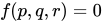
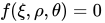
The yield surface is usually expressed in terms of (and visualized in) a three-dimensional principal stress space (), a two- or three-dimensional space spanned by stress invariants () or a version of the three-dimensional Haigh–Westergaard stress space. Thus we may write the equation of the yield surface (that is, the yield function) in the forms:

  • where are the principal stresses.
  • where is the first principal invariant of the Cauchy stress and are the second and third principal invariants of the deviatoric part of the Cauchy stress.
  • where are scaled versions of and and is a function of .
  • where are scaled versions of and , and is the stress angle[2] or Lode angle[3]

Invariants used to describe yield surfaces

[edit]
Surfaces on which the invariants , , are constant. Plotted in principal stress space.

The first principal invariant () of the Cauchy stress (), and the second and third principal invariants () of the deviatoric part () of the Cauchy stress are defined as:

where () are the principal values of , () are the principal values of , and

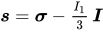
where is the identity matrix.

A related set of quantities, (), are usually used to describe yield surfaces for cohesive frictional materials such as rocks, soils, and ceramics. These are defined as


where is the equivalent stress. However, the possibility of negative values of and the resulting imaginary makes the use of these quantities problematic in practice.

Another related set of widely used invariants is () which describe a cylindrical coordinate system (the Haigh–Westergaard coordinates). These are defined as:


The plane is also called the Rendulic plane. The angle is called stress angle, the value is sometimes called the Lode parameter[4][5][6] and the relation between and was first given by Novozhilov V.V. in 1951,[7] see also [8]

The principal stresses and the Haigh–Westergaard coordinates are related by

A different definition of the Lode angle can also be found in the literature:[9]
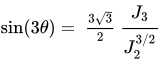
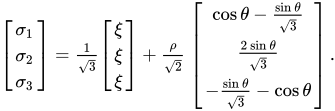
in which case the ordered principal stresses (where ) are related by[10]

Examples of yield surfaces

[edit]

There are several different yield surfaces known in engineering, and those most popular are listed below.

Tresca yield surface

[edit]

The Tresca yield criterion is taken to be the work of Henri Tresca.[11] It is also known as the maximum shear stress theory (MSST) and the Tresca–Guest[12][clarification needed] (TG) criterion. In terms of the principal stresses the Tresca criterion is expressed as

Where is the yield strength in shear, and is the tensile yield strength.

Figure 1 shows the Tresca–Guest yield surface in the three-dimensional space of principal stresses. It is a prism of six sides and having infinite length. This means that the material remains elastic when all three principal stresses are roughly equivalent (a hydrostatic pressure), no matter how much it is compressed or stretched. However, when one of the principal stresses becomes smaller (or larger) than the others the material is subject to shearing. In such situations, if the shear stress reaches the yield limit then the material enters the plastic domain. Figure 2 shows the Tresca–Guest yield surface in two-dimensional stress space, it is a cross section of the prism along the plane.

Figure 1: View of Tresca–Guest yield surface in 3D space of principal stresses
Figure 2: Tresca–Guest yield surface in 2D space ()

von Mises yield surface

[edit]

The von Mises yield criterion is expressed in the principal stresses as

where is the yield strength in uniaxial tension.

Figure 3 shows the von Mises yield surface in the three-dimensional space of principal stresses. It is a circular cylinder of infinite length with its axis inclined at equal angles to the three principal stresses. Figure 4 shows the von Mises yield surface in two-dimensional space compared with Tresca–Guest criterion. A cross section of the von Mises cylinder on the plane of produces the elliptical shape of the yield surface.

Figure 3: View of Huber–Mises–Hencky yield surface in 3D space of principal stresses
Figure 4: Comparison of Tresca–Guest and Huber–Mises–Hencky criteria in 2D space ()

Burzyński-Yagn criterion

[edit]

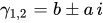
This criterion[13][14] reformulated as the function of the hydrostatic nodes with the coordinates and

represents the general equation of a second order surface of revolution about the hydrostatic axis. Some special case are:[15]

  • cylinder (Maxwell (1865), Huber (1904), von Mises (1913), Hencky (1924)),
  • cone (Botkin (1940), Drucker-Prager (1952), Mirolyubov (1953)),
  • paraboloid (Burzyński (1928), Balandin (1937), Torre (1947)),
  • ellipsoid centered of symmetry plane , (Beltrami (1885)),
  • ellipsoid centered of symmetry plane with (Schleicher (1926)),
  • hyperboloid of two sheets (Burzynski (1928), Yagn (1931)),
  • hyperboloid of one sheet centered of symmetry plane , , (Kuhn (1980))
  • hyperboloid of one sheet , (Filonenko-Boroditsch (1960), Gol’denblat-Kopnov (1968), Filin (1975)).

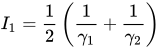
The relations compression-tension and torsion-tension can be computed to

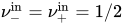
The Poisson's ratios at tension and compression are obtained using


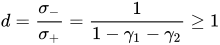
For ductile materials the restriction

is important. The application of rotationally symmetric criteria for brittle failure with

has not been studied sufficiently.[16]

The Burzyński-Yagn criterion is well suited for academic purposes. For practical applications, the third invariant of the deviator in the odd and even power should be introduced in the equation, e.g.:[17]

Huber criterion

[edit]

The Huber criterion consists of the Beltrami ellipsoid and a scaled von Mises cylinder in the principal stress space,[18][19][20][21] see also[22][23]

with . The transition between the surfaces in the cross section is continuously differentiable. The criterion represents the "classical view" with respect to inelastic material behavior:

  • pressure-sensitive material behavior for with and
  • pressure-insensitive material behavior for with

The Huber criterion can be used as a yield surface with an empirical restriction for Poisson's ratio at tension , which leads to .

Huber criterion with and modified Huber criterion with and in the Burzyński-plane: setting according the normal stress hypothesis (). The von Mises criterion () is shown for comparison. C - uniaxial compression, Cc - biaxial compression in the stress relation 1:2, CC - equibiaxial compression, CCC - hydrostatic compression, S or TC - shear, T - uniaxial tension, Tt - biaxial tension in the stress relation 1:2, TT - equibiaxial tension, TTT - hydrostatic tension.

The modified Huber criterion,[24][23] see also,[25] cf. [26]

consists of the Schleicher ellipsoid with the restriction of Poisson's ratio at compression

and a cylinder with the -transition in the cross section . The second setting for the parameters and follows with the compression / tension relation

The modified Huber criterion can be better fitted to the measured data as the Huber criterion. For setting it follows and .

The Huber criterion and the modified Huber criterion should be preferred to the von Mises criterion since one obtains safer results in the region . For practical applications the third invariant of the deviator should be considered in these criteria.[23]

Mohr–Coulomb yield surface

[edit]

The Mohr–Coulomb yield (failure) criterion is similar to the Tresca criterion, with additional provisions for materials with different tensile and compressive yield strengths. This model is often used to model concrete, soil or granular materials. The Mohr–Coulomb yield criterion may be expressed as:

where
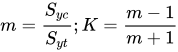
and the parameters and are the yield (failure) stresses of the material in uniaxial compression and tension, respectively. The formula reduces to the Tresca criterion if .

Figure 5 shows Mohr–Coulomb yield surface in the three-dimensional space of principal stresses. It is a conical prism and determines the inclination angle of conical surface. Figure 6 shows Mohr–Coulomb yield surface in two-dimensional stress space. In Figure 6 and is used for and , respectively, in the formula. It is a cross section of this conical prism on the plane of . In Figure 6 Rr and Rc are used for Syc and Syt, respectively, in the formula.

Figure 5: View of Mohr–Coulomb yield surface in 3D space of principal stresses
Figure 6: Mohr–Coulomb yield surface in 2D space ()

Drucker–Prager yield surface

[edit]

The Drucker–Prager yield criterion is similar to the von Mises yield criterion, with provisions for handling materials with differing tensile and compressive yield strengths. This criterion is most often used for concrete where both normal and shear stresses can determine failure. The Drucker–Prager yield criterion may be expressed as

where

and , are the uniaxial yield stresses in compression and tension respectively. The formula reduces to the von Mises equation if .

Figure 7 shows Drucker–Prager yield surface in the three-dimensional space of principal stresses. It is a regular cone. Figure 8 shows Drucker–Prager yield surface in two-dimensional space. The elliptical elastic domain is a cross section of the cone on the plane of ; it can be chosen to intersect the Mohr–Coulomb yield surface in different number of vertices. One choice is to intersect the Mohr–Coulomb yield surface at three vertices on either side of the line, but usually selected by convention to be those in the compression regime.[27] Another choice is to intersect the Mohr–Coulomb yield surface at four vertices on both axes (uniaxial fit) or at two vertices on the diagonal (biaxial fit).[28] The Drucker-Prager yield criterion is also commonly expressed in terms of the material cohesion and friction angle.

Figure 7: View of Drucker–Prager yield surface in 3D space of principal stresses
Figure 8: View of Drucker–Prager yield surface in 2D space of principal stresses

Bresler–Pister yield surface

[edit]

The Bresler–Pister yield criterion is an extension of the Drucker Prager yield criterion that uses three parameters, and has additional terms for materials that yield under hydrostatic compression. In terms of the principal stresses, this yield criterion may be expressed as

where are material constants. The additional parameter gives the yield surface an ellipsoidal cross section when viewed from a direction perpendicular to its axis. If is the yield stress in uniaxial compression, is the yield stress in uniaxial tension, and is the yield stress in biaxial compression, the parameters can be expressed as

Figure 9: View of Bresler–Pister yield surface in 3D space of principal stresses
Figure 10: Bresler–Pister yield surface in 2D space ()

Willam–Warnke yield surface

[edit]

The Willam–Warnke yield criterion is a three-parameter smoothed version of the Mohr–Coulomb yield criterion that has similarities in form to the Drucker–Prager and Bresler–Pister yield criteria.

The yield criterion has the functional form

However, it is more commonly expressed in Haigh–Westergaard coordinates as
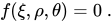
The cross-section of the surface when viewed along its axis is a smoothed triangle (unlike Mohr–Coulomb). The Willam–Warnke yield surface is convex and has unique and well defined first and second derivatives on every point of its surface. Therefore, the Willam–Warnke model is computationally robust and has been used for a variety of cohesive-frictional materials.

Figure 11: View of Willam–Warnke yield surface in 3D space of principal stresses
Figure 12: Willam–Warnke yield surface in the -plane

Podgórski and Rosendahl trigonometric yield surfaces

[edit]

Normalized with respect to the uniaxial tensile stress , the Podgórski criterion [29] as function of the stress angle reads

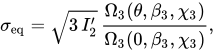
with the shape function of trigonal symmetry in the -plane

It contains the criteria of von Mises (circle in the -plane, , ), Tresca (regular hexagon, , ), Mariotte (regular triangle, , ), Ivlev [30] (regular triangle, , ) and also the cubic criterion of Sayir [31] (the Ottosen criterion [32]) with and the isotoxal (equilateral) hexagons of the Capurso criterion[30][31][33] with . The von Mises - Tresca transition [34] follows with , . The isogonal (equiangular) hexagons of the Haythornthwaite criterion [23][35][36] containing the Schmidt-Ishlinsky criterion (regular hexagon) cannot be described with the Podgórski criterion.

The Rosendahl criterion [37][38][39] reads
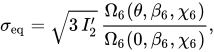
with the shape function of hexagonal symmetry in the -plane

It contains the criteria of von Mises (circle, , ), Tresca (regular hexagon, , ), Schmidt—Ishlinsky (regular hexagon, , ), Sokolovsky (regular dodecagon, , ), and also the bicubic criterion [23][37][40][41] with or equally with and the isotoxal dodecagons of the unified yield criterion of Yu [42] with . The isogonal dodecagons of the multiplicative ansatz criterion of hexagonal symmetry [23] containing the Ishlinsky-Ivlev criterion (regular dodecagon) cannot be described by the Rosendahl criterion.

The criteria of Podgórski and Rosendahl describe single surfaces in principal stress space without any additional outer contours and plane intersections. Note that in order to avoid numerical issues the real part function can be introduced to the shape function: and . The generalization in the form [37] is relevant for theoretical investigations.

A pressure-sensitive extension of the criteria can be obtained with the linear -substitution [23]

which is sufficient for many applications, e.g. metals, cast iron, alloys, concrete, unreinforced polymers, etc.

Basic cross sections described by a circle and regular polygons of trigonal or hexagonal symmetries in the -plane.

Bigoni–Piccolroaz yield surface

[edit]

The Bigoni–Piccolroaz yield criterion[43][44] is a seven-parameter surface defined by

where is the "meridian" function

describing the pressure-sensitivity and is the "deviatoric" function [45]

describing the Lode-dependence of yielding. The seven, non-negative material parameters:

define the shape of the meridian and deviatoric sections.

This criterion represents a smooth and convex surface, which is closed both in hydrostatic tension and compression and has a drop-like shape, particularly suited to describe frictional and granular materials. This criterion has also been generalized to the case of surfaces with corners.[46]

3D
In 3D space of principal stresses
'"`UNIQ--postMath-000000BA-QINU`"'-plane
In the -plane
Bigoni-Piccolroaz yield surface

Cosine Ansatz (Altenbach-Bolchoun-Kolupaev)

[edit]

For the formulation of the strength criteria the stress angle
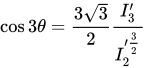
can be used.

The following criterion of isotropic material behavior

contains a number of other well-known less general criteria, provided suitable parameter values are chosen.

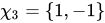
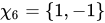
Parameters and describe the geometry of the surface in the -plane. They are subject to the constraints

which follow from the convexity condition. A more precise formulation of the third constraints is proposed in.[47][48]

Parameters and describe the position of the intersection points of the yield surface with hydrostatic axis (space diagonal in the principal stress space). These intersections points are called hydrostatic nodes. In the case of materials which do not fail at hydrostatic pressure (steel, brass, etc.) one gets . Otherwise for materials which fail at hydrostatic pressure (hard foams, ceramics, sintered materials, etc.) it follows .

The integer powers and , describe the curvature of the meridian. The meridian with is a straight line and with – a parabola.

Barlat's Yield Surface

[edit]

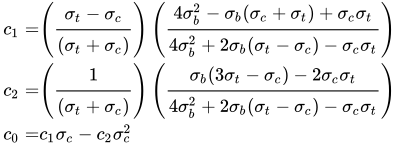
For the anisotropic materials, depending on the direction of the applied process (e.g., rolling) the mechanical properties vary and, therefore, using an anisotropic yield function is crucial. Since 1989 Frederic Barlat has developed a family of yield functions for constitutive modelling of plastic anisotropy. Among them, Yld2000-2D yield criteria has been applied for a wide range of sheet metals (e.g., aluminum alloys and advanced high-strength steels). The Yld2000-2D model is a non-quadratic type yield function based on two linear transformation of the stress tensor:

 :
The Yld2000-2D yield loci for a AA6022 T4 sheet.
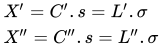
where is the effective stress. and and are the transformed matrices (by linear transformation C or L):
where s is the deviatoric stress tensor.

for principal values of X’ and X”, the model could be expressed as:

and:

where are eight parameters of the Barlat's Yld2000-2D model to be identified with a set of experiments.

See also

[edit]

References

[edit]
Revisions and contributorsEdit on WikipediaRead on Wikipedia
from Grokipedia
In continuum mechanics, the yield surface is a mathematical boundary in multi-dimensional stress or strain space that delineates the onset of plastic deformation in a material, separating the region of purely elastic response from that of inelastic behavior under applied loads.[1] It is typically formulated as a function $ f(\sigma, \kappa) = 0 $ in stress space, where $ \sigma $ represents the stress tensor and $ \kappa $ denotes internal state variables accounting for the material's deformation history, ensuring that stresses inside the surface produce only elastic strains while those on or outside trigger yielding.[2] This surface is inherently convex for metals exhibiting linear elasticity unaffected by prior plastic flow, a property rooted in stability principles and Drucker’s postulate, which guarantees unique and physically consistent plastic strain increments.[3] Common yield criteria define the shape of the yield surface to approximate experimental observations under multiaxial loading. The von Mises yield criterion, based on the distortional strain energy, posits yielding when the equivalent von Mises stress $ \sigma_{VM} = \sqrt{\frac{1}{2}[(\sigma_1 - \sigma_2)^2 + (\sigma_1 - \sigma_3)^2 + (\sigma_2 - \sigma_3)^2]} $ equals the uniaxial yield stress $ \sigma_Y $, resulting in an elliptical surface in principal stress space that effectively captures ductile metal behavior.[2] In contrast, the Tresca criterion relies on the maximum shear stress, with yielding occurring when $ \tau_{\max} = \sigma_Y / 2 $, yielding a hexagonal prism in stress space suitable for conservative design in brittle or conservative failure predictions.[1] These criteria enable prediction of plastic flow directions via the normality rule, where the plastic strain increment is proportional to the outward normal of the surface at the current stress point, as per the associated flow rule in classical plasticity theory.[3] The yield surface evolves during plastic deformation through hardening mechanisms, reflecting the material's increasing resistance to further yielding. Isotropic hardening expands the surface uniformly in all directions, preserving its shape while raising the yield stress, as observed in many polycrystalline metals under monotonic loading.[1] Kinematic hardening, conversely, translates the surface without changing its size, modeling the Bauschinger effect where reverse yielding occurs at lower stresses, common in cyclic loading scenarios.[1] Combined isotropic-kinematic models account for both, providing accurate simulations for complex applications like metal forming and structural analysis, where the surface's shape—often smooth but potentially featuring vertices—directly influences the material's anisotropic response and failure modes.[2]

Introduction

Definition and Concept

In the theory of elastoplasticity, the yield surface delineates the transition from reversible elastic deformation to irreversible plastic deformation in materials subjected to multiaxial stress states. It is represented as a five-dimensional hypersurface embedded in the six-dimensional space of the stress tensor components, defining the locus of stress states at which yielding commences.[4] This hypersurface encapsulates the material's capacity to withstand loads without permanent change, with its geometry reflecting the onset of plasticity under combined normal and shear stresses.[5] Stress points interior to the yield surface produce exclusively elastic responses, allowing full recovery of the original shape upon unloading. Points on the surface mark the initiation of plastic yielding, where permanent deformation begins alongside elastic strain. Exterior points are inadmissible in ideal plasticity models, as they would necessitate infinite plastic flow rates. The yield surface is characteristically convex, ensuring a unique direction for plastic strain increment via the normality rule and maintaining thermodynamic consistency in the material's response.[5][6] Common visualizations facilitate comprehension of this abstract geometry. Under plane stress assumptions, the yield surface reduces to a closed curve, or yield locus, in the two-dimensional plane of principal stresses σ₁ and σ₂. In full three-dimensional analyses, its projection onto the deviatoric plane—often the octahedral plane perpendicular to the hydrostatic axis—reveals the influence of shear components on yielding. The Haigh-Westergaard stress space offers a cylindrical coordinate system for the full five-dimensional surface, separating hydrostatic pressure effects from deviatoric distortions.[6][7][8] Yielding itself constitutes a form of material instability, wherein a critical stress combination triggers the onset of permanent deformation, marking the limit of elastic stability. This phenomenon underpins elastoplasticity, the constitutive framework for materials displaying both recoverable elastic behavior and non-recoverable plastic flow under sufficient loading. The yield surface's form is frequently expressed through stress invariants, which succinctly capture its rotational invariance and dependence on volumetric and distortional stress measures.[3][9]

Historical Development

The development of yield surface theory began in the 19th century with empirical observations on metal deformation. In 1864, Henri Tresca proposed a yield criterion based on the maximum shear stress, derived from experiments on extrusion and punching processes, marking the first formal description of yielding as a limit state in solids.[10] This idea was further explored in the 1870s by Adhémar Jean Claude Barré de Saint-Venant, who applied Tresca's maximum shear stress concept to analyze plastic flow in metals under torsion and extension, emphasizing its role in distinguishing elastic from plastic regimes.[11] Advancements in the early 20th century shifted toward energy-based interpretations for isotropic metals. In 1913, Richard von Mises introduced the distortion energy hypothesis, positing that yielding occurs when the deviatoric strain energy reaches a critical value equivalent to uniaxial tension, providing a more accurate prediction for ductile materials under multiaxial loading.[12] Heinrich Hencky clarified this in 1924 by formulating the equivalent stress in terms of the second invariant of the deviatoric stress tensor, offering a physical link to octahedral shear stress and solidifying the criterion's theoretical foundation.[13] These works facilitated a transition from purely empirical maximum stress rules to invariant-based descriptions invariant under coordinate rotations. For geomaterials like soils and rocks, pressure-dependent criteria emerged earlier. Charles-Augustin de Coulomb laid the groundwork in 1773 with a friction-based failure model for granular media, expressing shear resistance as a linear function of normal stress plus cohesion, initially applied to retaining walls and landslides.[14] Otto Mohr extended this in 1900 by introducing a graphical envelope of Mohr's circles to represent the nonlinear failure boundary in shear-normal stress space, enabling better visualization of triaxial test data.[15] In the 1950s, William Prager, collaborating with Daniel Drucker, generalized the Mohr-Coulomb model into a smooth conical yield surface in principal stress space, incorporating pressure sensitivity for soils while approximating von Mises behavior under low confinement.[16] Concrete-specific yield surfaces addressed triaxial compression and tension differences in the mid-20th century. In 1958, Borislav Bresler and Karl S. Pister developed a criterion using five independent strength parameters from uniaxial, biaxial, and triaxial tests, capturing the material's asymmetric response under multiaxial loading.[17] This was refined in 1974 by Kurt J. Willam and Edwin P. Warnke, who proposed a three-parameter smooth surface in deviatoric plane, calibrated to match experimental meridians in triaxial compression and tension for normal-weight concrete.[18] Anisotropic extensions recognized directional strength variations in processed materials. In the 1920s, Ludwik Burzyński introduced a hypothesis of material effort, decomposing strain energy into longitudinal, transverse, and shear components weighted by direction-dependent limits, applicable to rolled metals with differing tensile and compressive strengths.[19] More recently, in the 2000s, Frédéric Barlat and colleagues advanced this with the Yld2004-18p criterion, a plane-stress orthotropic model using linear stress transformations and 18 parameters to accurately predict yield loci in sheet metals from crystal plasticity simulations and r-value data.[20] A pivotal event in the 1970s was the integration of yield surfaces into finite element methods for computational plasticity, enabling numerical simulation of large-scale elasto-plastic boundary value problems in engineering structures.[21]

Theoretical Foundations

Representation in Stress Space

The stress state in a continuum is represented by the symmetric Cauchy stress tensor σ\boldsymbol{\sigma}, which possesses six independent components in three-dimensional space: the normal stresses σ11\sigma_{11}, σ22\sigma_{22}, σ33\sigma_{33} and the shear stresses σ12\sigma_{12}, σ23\sigma_{23}, σ31\sigma_{31}. This defines a six-dimensional stress space, but for yield surface analysis, the representation is typically reduced to the three principal stresses σ1σ2σ3\sigma_1 \geq \sigma_2 \geq \sigma_3 by diagonalizing the tensor, yielding a three-dimensional principal stress space where the axes align with the principal directions. This simplification eliminates shear components and focuses on the eigenvalues of σ\boldsymbol{\sigma}, enabling geometric interpretation of yielding without loss of generality for isotropic materials. To facilitate visualization and analysis, the principal stress space is often mapped into Haigh-Westergaard coordinates, a cylindrical system that decouples hydrostatic and deviatoric effects. The coordinate along the hydrostatic axis is ξ=I1/3\xi = I_1 / \sqrt{3}, where I1=σ1+σ2+σ3I_1 = \sigma_1 + \sigma_2 + \sigma_3 is the first stress invariant representing volumetric stress. The radial coordinate in the deviatoric plane is ρ=2J2\rho = \sqrt{2 J_2}, with J2J_2 as the second invariant of the deviatoric stress tensor capturing shear distortion. The angular position in this plane is given by the Lode angle θ\theta, which ranges from 00 to π/3\pi/3 and distinguishes triaxial tension (θ=0\theta=0), compression (θ=π/3\theta=\pi/3), and shear states in the octahedral plane. This parameterization highlights the cylindrical symmetry of many yield surfaces around the hydrostatic axis.[7][22] Yield surfaces in this space are visualized through projections that reveal their shape and orientation. The π\pi-plane, perpendicular to the hydrostatic axis at constant ξ\xi, projects the deviatoric section as a closed curve, illustrating the dependence of yield strength on the Lode angle for fixed hydrostatic stress. Meridional planes, which include the hydrostatic axis and a specific θ\theta (e.g., θ=[0](/page/0)\theta = [0](/page/0) for axisymmetric tension), display the surface's cross-section to show pressure-shear interactions, such as conical or parabolic forms in pressure-sensitive materials. These techniques aid in comparing experimental data with theoretical predictions across loading paths.[8][7] The general yield condition is formulated as f(σ)=0f(\boldsymbol{\sigma}) = 0, where ff defines the boundary between elastic and plastic regimes in stress space. To exploit the separation of volumetric and distortional behaviors, σ\boldsymbol{\sigma} is decomposed into hydrostatic pressure p=I1/3p = -I_1 / 3 (positive in compression) and deviatoric tensor s=σ+pI\mathbf{s} = \boldsymbol{\sigma} + p \mathbf{I}, yielding f(p,s)=0f(p, \mathbf{s}) = 0. This additive decomposition, rooted in the trace properties of σ\boldsymbol{\sigma}, allows yield functions to incorporate mean stress effects independently of shear.[23] Convexity of the yield surface f(σ)0f(\boldsymbol{\sigma}) \leq 0 is a fundamental requirement in rate-independent plasticity, ensuring a unique closest point projection during plastic loading and compliance with the maximum dissipation principle, which maximizes plastic work for irreversible deformation. This principle, derived from Drucker's stability postulate, implies that the normal to the surface defines the direction of plastic strain increments via the flow rule. Non-convex surfaces can permit ambiguous tangent hyperplanes, leading to unstable flow, multiple solutions in return mapping algorithms, and shear band localization in numerical simulations.[3][24]

Invariants and Yield Functions

In continuum mechanics, the yield surface is mathematically described using scalar invariants of the stress tensor, which provide a coordinate-independent representation of the stress state. These invariants allow the formulation of yield functions that define the boundary between elastic and plastic deformation in a manner consistent with physical principles. The primary invariants used are the first stress invariant I1I_1 and the second and third deviatoric invariants J2J_2 and J3J_3, derived from the Cauchy stress tensor σ\sigma. For isotropic materials, the yield function depends solely on these invariants, ensuring the criterion is independent of the coordinate system. The first invariant I1I_1 captures the hydrostatic component of the stress state and is defined as the trace of the stress tensor:
I1=tr(σ)=σkk=σ1+σ2+σ3, I_1 = \operatorname{tr}(\sigma) = \sigma_{kk} = \sigma_1 + \sigma_2 + \sigma_3,
where σ1,σ2,σ3\sigma_1, \sigma_2, \sigma_3 are the principal stresses. This invariant represents the volumetric or hydrostatic pressure p=I1/3p = -I_1 / 3 (positive in compression), which influences yielding in pressure-sensitive materials like soils and rocks but is often negligible for metals. The deviatoric stress tensor ss is then obtained by subtracting the hydrostatic part: s=σ(p)I=σ+pIs = \sigma - (-p) \mathbf{I} = \boldsymbol{\sigma} + p \mathbf{I}, where I\mathbf{I} is the identity tensor. The second deviatoric invariant J2J_2 measures the intensity of shear distortion and is given by
J2=12sijsij=16[(σ1σ2)2+(σ2σ3)2+(σ3σ1)2], J_2 = \frac{1}{2} s_{ij} s_{ij} = \frac{1}{6} \left[ (\sigma_1 - \sigma_2)^2 + (\sigma_2 - \sigma_3)^2 + (\sigma_3 - \sigma_1)^2 \right],
with J20J_2 \geq 0. A common normalization is the octahedral shear stress τoct=(2/3)J2\tau_{\mathrm{oct}} = \sqrt{(2/3) J_2}, which relates to the distortion energy in yielding.[25][26] The third deviatoric invariant J3J_3 accounts for the directional asymmetry in the deviatoric stress plane and is defined as the determinant of the deviatoric stress tensor: J3=det(s)J_3 = \det(s). It introduces dependence on the Lode angle θ\theta, related to the Lode parameter μ=(2σ2σ1σ3)/(σ1σ3)\mu = (2 \sigma_2 - \sigma_1 - \sigma_3)/(\sigma_1 - \sigma_3), where 1μ1-1 \leq \mu \leq 1. The Lode angle influences tension-compression asymmetry, with θ=0\theta = 0 corresponding to uniaxial tension (μ=1\mu = -1) and θ=π/3\theta = \pi/3 to uniaxial compression (μ=1\mu = 1); this effect is pronounced in materials exhibiting different yield strengths under triaxial loading. For isotropic hardening plasticity, the yield function takes the general form f(σ,k)=f(I1,J2,J3,k)=0f(\sigma, k) = f(I_1, J_2, J_3, k) = 0, where kk is a yield strength parameter that evolves with equivalent plastic strain εp\varepsilon^p, such as k=k(εp)k = k(\varepsilon^p). Many criteria, like the von Mises yield function, depend only on J2J_2, but inclusion of J3J_3 allows for more accurate modeling of shear-induced asymmetry.[27][28][29] These invariants ensure frame-indifference, as they are objective scalars unchanged under rigid body rotations, and respect material symmetry groups, such as isotropy, by transforming appropriately under symmetry operations. This objectivity is fundamental to constitutive modeling in plasticity, guaranteeing that the yield surface description is independent of the observer's frame.

Isotropic Yield Criteria for Metals

Tresca Yield Criterion

The Tresca yield criterion, proposed by French engineer Henri Tresca in 1864 to analyze the flow of solids in machine components under small forces, posits that plastic yielding in ductile materials initiates when the maximum shear stress reaches a critical value equal to half the uniaxial yield stress.[30] This maximum shear stress theory assumes that failure is governed by shear rather than normal stresses, reflecting the underlying mechanism of dislocation motion in metals.[31] The formulation of the criterion in terms of principal stresses σ1σ2σ3\sigma_1 \geq \sigma_2 \geq \sigma_3 is given by yielding occurring when the maximum principal shear stress equals k=σy/2k = \sigma_y / 2, where σy\sigma_y is the yield strength in uniaxial tension:
12max(σ1σ2,σ2σ3,σ3σ1)=k \frac{1}{2} \max(|\sigma_1 - \sigma_2|, |\sigma_2 - \sigma_3|, |\sigma_3 - \sigma_1|) = k
Equivalently, this simplifies to σmaxσmin=σy\sigma_{\max} - \sigma_{\min} = \sigma_y for the onset of yield under tension.[6][32] In the space of principal stresses, the yield surface forms an infinite hexagonal prism coaxial with the hydrostatic pressure axis (where σ1=σ2=σ3\sigma_1 = \sigma_2 = \sigma_3), exhibiting a regular hexagonal cross-section in the deviatoric plane that remains invariant under hydrostatic loading.[7] This geometry arises directly from the piecewise linear nature of the maximum difference between principal stresses, resulting in six flat faces corresponding to the pairs of principal stress differences.[32] The simplicity of the Tresca criterion facilitates analytical solutions in design and closely matches experimental observations for pure shear and uniaxial tension in ductile metals, where shear stress dominates deformation.[31] It provides a conservative estimate in many practical loading scenarios, aligning well with the insensitivity of metal yielding to hydrostatic pressure.[6] Despite these strengths, the criterion's sharp corners in the deviatoric plane lead to discontinuities, causing non-unique normal vectors and thus ambiguous plastic flow directions under associated flow rules at those points.[24] Furthermore, it overpredicts the yield strength in certain biaxial stress states relative to experimental data for ductile metals, as the faceted hexagon extends beyond observed yield loci in those orientations.[33] Compared to the von Mises criterion, which yields a smoother elliptical cross-section, the Tresca surface's angular facets can complicate numerical implementations.[34]

von Mises Yield Criterion

The von Mises yield criterion, also known as the maximum distortion energy criterion, posits that yielding in isotropic ductile materials occurs when the elastic distortion energy reaches the same value as that at yield in uniaxial tension. This hypothesis was originally proposed by Richard von Mises in 1913, deriving the criterion from the decomposition of total strain energy into dilatational (volumetric) and distortional (shear) components, with yielding governed solely by the latter.[35][36] The formulation of the criterion is expressed in terms of the second deviatoric stress invariant $ J_2 $, where yielding initiates when $ \sqrt{3 J_2} = \sigma_y $, with $ \sigma_y $ denoting the uniaxial yield stress. Equivalently, in principal stress coordinates $ \sigma_1, \sigma_2, \sigma_3 $, the criterion takes the form $ \frac{1}{\sqrt{2}} \sqrt{ (\sigma_1 - \sigma_2)^2 + (\sigma_2 - \sigma_3)^2 + (\sigma_3 - \sigma_1)^2 } = \sigma_y $. This equation defines the effective von Mises stress $ \sigma_{VM} = \sqrt{3 J_2} $, which must not exceed $ \sigma_y $ for elastic behavior.[37][38] Geometrically, the von Mises yield surface in principal stress space forms a right circular cylinder with its axis aligned along the hydrostatic stress direction (the line $ \sigma_1 = \sigma_2 = \sigma_3 $), reflecting independence from hydrostatic pressure. In the deviatoric plane (π-plane), perpendicular to the hydrostatic axis, the cross-section is a circle of radius $ \sigma_y / \sqrt{3} $, making the basic form insensitive to the third deviatoric invariant $ J_3 $. This cylindrical shape ensures a smooth, convex surface that bounds allowable stress states.[38][7] The criterion offers advantages in its differentiability, which facilitates unique associated flow rules in plasticity models, and its close alignment with experimental data for ductile metals under various multiaxial stress states, outperforming prismatic alternatives in most cases. However, it neglects hydrostatic pressure influences on yielding, assuming equal yield strengths in tension and compression, which limits applicability to materials sensitive to mean stress, such as certain polymers or rocks.[39][39] Extensions to the basic isotropic form include kinematic hardening, where the cylindrical yield surface maintains a constant radius but translates along the stress space in the direction of plastic straining, accounting for the Bauschinger effect in cyclic loading.[40]

Huber Criterion

The Huber criterion, proposed by Polish engineer Maksymilian Tytus Huber in 1904, establishes yielding in ductile materials when the octahedral shear stress τoct\tau_\mathrm{oct} reaches a critical value of 23σy\frac{\sqrt{2}}{3} \sigma_y, where σy\sigma_y is the uniaxial yield stress.[41] This formulation arises from considering the distortional strain energy as the measure of material effort, specifically tying failure to shear on octahedral planes.[42] Mathematically, it corresponds to the second deviatoric stress invariant satisfying J2=13σy2J_2 = \frac{1}{3} \sigma_y^2, marking the onset of plastic deformation under multiaxial loading.[43] Although later recognized as equivalent to the von Mises-Hencky criterion due to identical predictive outcomes, the Huber criterion retains distinct recognition in Polish engineering literature for its early emphasis on shear-based mechanisms.[42] Huber's work predated von Mises' 1913 publication and Hencky's 1924 contributions, yet it was independently developed and applied in Eastern European contexts, often cited separately to highlight its foundational role in energy-based yield hypotheses.[44] In principal stress space, the yield surface defined by the Huber criterion forms a right circular cylinder aligned with the hydrostatic axis, identical in geometry to the von Mises surface, with a radius of σy/3\sigma_y / \sqrt{3}.[43] Its projection onto the octahedral plane—a plane normal to the [111] direction—appears as a circle, reflecting the isotropic nature of the criterion and simplifying analysis of distortion under complex stresses. The octahedral planes correspond to the {111} planes in cubic crystals, which serve as primary slip planes in face-centered cubic metals like aluminum and copper, providing a physical rationale for the macroscopic distortion energy limit.[45][46] The criterion's strength is its ability to link microscopic slip processes in metallic crystals to observable bulk yielding, offering predictive accuracy for ductile materials under proportional loading without needing detailed microstructural data.[42] However, it shares the von Mises limitations, assuming no dependence on hydrostatic pressure, which restricts its applicability to pressure-sensitive materials like soils or rocks.[43]

Pressure-Dependent Yield Criteria

Mohr–Coulomb Yield Surface

The Mohr–Coulomb yield criterion describes failure in frictional materials such as soils and rocks when the shear stress on a potential failure plane reaches a limiting value that increases linearly with the normal stress on that plane. The basic formulation is given by $ |\tau| = c + \sigma \tan \phi $, where $ \tau $ is the shear stress, $ \sigma $ is the normal stress (positive in compression), $ c $ is the cohesion, and $ \phi $ is the internal friction angle. Yielding occurs when the Mohr circle representing the stress state becomes tangent to this linear failure envelope, identifying the most critical plane. In terms of principal stresses (with $ \sigma_I \geq \sigma_{II} \geq \sigma_{III} $, compression positive), the criterion for the dominant pair is $ \sigma_I - \sigma_{III} = (\sigma_I + \sigma_{III}) \sin \phi + 2c \cos \phi $. In three dimensions, the full yield surface is defined by the maximum over all three principal stress pairs, ensuring the most severe condition governs failure.[47] This criterion derives from Mohr's graphical representation of stress states using circles in the $ \sigma - \tau $ plane, building on Coulomb's 1776 hypothesis of frictional resistance along discrete failure planes. Mohr's 1900 analysis showed that shear failure initiates on planes oriented at an angle of $ 45^\circ + \phi/2 $ to the major principal stress direction, where the Mohr circle is tangent to the envelope $ \tau = c + \sigma \tan \phi $. This geometric construction captures the influence of confining pressure on shear strength, distinguishing it from pressure-insensitive criteria for metals. The associated flow rule implies dilation at angle $ \psi = \phi $, reflecting volume increase during shear in dense frictional materials.[47] In principal stress space, the Mohr–Coulomb yield surface forms an open-ended irregular hexagonal pyramid, with its axis aligned along the hydrostatic compression direction (isotropic stress line). The cross-section in the deviatoric (π) plane is an irregular hexagon, where the distance from the center varies with the Lode angle, being smaller in triaxial extension than in triaxial compression due to the pressure sensitivity. This asymmetry highlights the criterion's ability to model differing tensile and compressive strengths, with uniaxial compressive strength $ \sigma_c = 2c \cos \phi / (1 - \sin \phi) $ typically much larger than tensile strength.[47][48] The criterion excels in geomechanics for capturing pressure-dependent yielding, tension-compression asymmetry, and associated dilation in granular media like soils and rocks, making it a standard for stability analyses in mining and civil engineering. However, its non-smooth corners at the hexagonal vertices pose numerical challenges in finite element simulations, often requiring regularization. Additionally, the lack of dependence on the third stress invariant $ J_3 $ (intermediate principal stress effect) leads to overestimation of strength under certain triaxial states, as it assumes equal influence from all deviatoric paths. Variants with a tension cutoff plane $ \sigma_{III} = -T $ (where $ T = 2c \tan(45^\circ - \phi/2) $ is the positive tensile strength magnitude) cap the pyramid in tension, rendering the tensile limit independent of mean stress while preserving the open compressive apex.[47][48]

Drucker–Prager Yield Surface

The Drucker–Prager yield surface serves as a smooth, conical approximation to the Mohr–Coulomb yield criterion, enabling efficient numerical implementations in simulations of pressure-dependent materials such as soils and rocks.[49] Developed by William Prager in 1952 as an extension of Daniel C. Drucker's stability postulate, the criterion leverages stress invariants to describe yielding in a form amenable to finite element methods (FEM).[50] The yield function is expressed as
f=J2+αI1k=0, f = \sqrt{J_2} + \alpha I_1 - k = 0,
where I1I_1 denotes the first stress invariant, J2J_2 the second deviatoric stress invariant, and the material parameters α\alpha and kk are calibrated to Mohr–Coulomb cohesion cc and friction angle ϕ\phi:
α=2sinϕ3(3sinϕ),k=6ccosϕ3(3sinϕ). \alpha = \frac{2 \sin \phi}{\sqrt{3} (3 - \sin \phi)}, \quad k = \frac{6 c \cos \phi}{\sqrt{3} (3 - \sin \phi)}.
This formulation aligns the conical surface with the Mohr–Coulomb hexagon in triaxial compression states.[49] Geometrically, the surface appears as a right circular cone in principal stress space, with its apex at $ I_1 = k / \alpha $ along the hydrostatic stress line σ1=σ2=σ3\sigma_1 = \sigma_2 = \sigma_3. Depending on the calibration, the cone may be circumscribed (outer tangent) or inscribed (inner tangent) to the Mohr–Coulomb hexagonal pyramid, bounding the yield region conservatively.[50][49] Advantages of this criterion include its full differentiability, supporting associated flow rules for plastic strain computation without issues at non-smooth vertices, and its incorporation of hydrostatic pressure effects in a simple invariant-based framework ideal for FEM.[50][49] Limitations stem from the assumed circular deviatoric cross-section, which implies uniform shear strength and can lead to overprediction (circumscribed case) or underprediction (inscribed case) of shear capacity relative to the faceted Mohr–Coulomb surface in certain stress paths.[49] For two-dimensional simulations under plane strain conditions, variants adjust the parameters to mimic three-dimensional behavior; for instance, the effective friction is modified as tanβ=2sinϕ1sinϕ\tan \beta = \frac{2 \sin \phi}{1 - \sin \phi} in non-dilatant flow to match plane strain yielding.[51]

Yield Criteria for Concrete and Geomaterials

Bresler–Pister Yield Surface

The Bresler–Pister yield surface provides a failure envelope for concrete under multiaxial stress states, derived empirically from triaxial compression and tension-compression tests on plain concrete specimens. Developed by Boris Bresler and Karl S. Pister, the criterion extends the Rankine maximum principal stress hypothesis by introducing quadratic interactions among the principal stresses to better fit experimental data on combined loading. This approach accounts for concrete's pronounced difference in tensile and compressive capacities, where failure is often governed by tensile cracking in brittle materials like concrete. The original formulation emerged from analyses showing that simple maximum stress criteria underpredicted strengths in biaxial and triaxial regimes.[52] In principal stress space, with σ1\sigma_1 as the algebraically largest principal stress (typically in tension) and σ2,σ3\sigma_2, \sigma_3 the others, the yield function is expressed as:
f(σ1,σ2,σ3)=σ12ft2+σ22+σ32fc22ν(σ1σ2+σ2σ3+σ3σ1)ftfc f(\sigma_1, \sigma_2, \sigma_3) = \frac{\sigma_1^2}{f_t^2} + \frac{\sigma_2^2 + \sigma_3^2}{f_c^2} - 2\nu \frac{(\sigma_1\sigma_2 + \sigma_2\sigma_3 + \sigma_3\sigma_1)}{f_t f_c}
where yield initiates when f=1f = 1, ftf_t is the uniaxial tensile strength, fcf_c is the uniaxial compressive strength (with fcftf_c \gg f_t), and ν\nu is Poisson's ratio (typically 0.2 for concrete). This equation, adapted from the failure condition for use in associated plasticity models, defines an ellipsoidal surface tilted relative to the hydrostatic axis, opening wider in the compressive octant due to higher fcf_c. The ellipsoid's asymmetry highlights concrete's tension-weak behavior without relying on explicit hydrostatic pressure terms, distinguishing it from frictional criteria.[52][53] The criterion's advantages lie in its straightforward quadratic structure, which facilitates analytical solutions and numerical implementation in finite element analyses for reinforced concrete design. It effectively models the tension-compression asymmetry using only three material parameters, making it suitable for early computational tools lacking advanced invariant formulations. Notably, it was incorporated into initial reinforced concrete design codes and military engineering standards for predicting ultimate strengths under combined stresses. However, limitations include its neglect of intermediate principal stress influences, leading to inaccuracies in triaxial extension or shear-dominated states, and its principal stress-based form, which is not fully invariant and requires careful axis alignment. These shortcomings prompted evolution toward more sophisticated models incorporating third stress invariant effects.[54][55]

Willam–Warnke Yield Surface

The Willam–Warnke yield surface is a three-parameter model designed to predict the onset of yielding in concrete and similar cohesive-frictional materials under triaxial loading, incorporating dependence on the Lode angle to account for the influence of the third deviatoric invariant. This criterion builds briefly on quadratic approaches like Bresler–Pister by adding Lode angle effects for a more accurate deviatoric shape. Developed specifically for concrete, it separates the yield function into meridional (pressure-dependent) and deviatoric (Lode-dependent) components, enabling better representation of failure modes in compression, tension, and shear. The model was introduced by Karl J. Willam and Ernest P. Warnke in their 1974 work, derived from experimental triaxial test data on concrete specimens to fit both the compression/tension meridians and the deviatoric cross-sections. The formulation is expressed in Haigh-Westergaard stress space, where the hydrostatic axis is given by ξ=I1/3\xi = I_1 / \sqrt{3} (with I1I_1 the first stress invariant), the deviatoric radius by ρ=2J2\rho = \sqrt{2 J_2} (with J2J_2 the second deviatoric invariant), and the Lode angle θ\theta ranging from 0° (tension) to 60° (compression). The yield function takes the form
f=a1ρ2+a2ρ+a3+mb1I1b2=0, f = \sqrt{a_1 \rho^2 + a_2 \rho + a_3} + m b_1 I_1 - b_2 = 0,
where the coefficients a1,a2,a3a_1, a_2, a_3 define the shape of the deviatoric section as a function of θ\theta and pressure, while b1,b2b_1, b_2 and the multiplier mm (often related to compressive strength) are calibrated to match uniaxial tensile/compressive strengths and biaxial/triaxial data. This polynomial form for the deviatoric part ensures smoothness and convexity, avoiding sharp corners in the failure envelope. Geometrically, the yield surface manifests as a rounded triangular pyramid in principal stress space, opening irregularly with increasing hydrostatic pressure; the deviatoric cross-section is a smooth, nearly triangular curve that transitions from a more rounded shape in tension to sharper edges in compression, reflecting concrete's differential strength in these regimes. Key advantages of the Willam–Warnke criterion include its ability to capture the nonlinear curvature of the compression meridian and the asymmetry due to the Lode angle, providing improved predictions for high-strength concrete under multiaxial states compared to simpler isotropic models. It is particularly effective for simulating shear failure and hydrostatic sensitivity in structural applications. However, extending to a five-parameter version for greater flexibility in meridian shapes increases calibration complexity, and the model inherently assumes fixed ratios between tensile and compressive meridian curvatures, limiting adaptability to highly variable material data. The criterion has been widely adopted in commercial finite element codes, such as ABAQUS, where it underpins the concrete damaged plasticity model for nonlinear structural analysis of reinforced concrete elements under dynamic and static loads.

Podgórski and Rosendahl Trigonometric Yield Surfaces

The trigonometric yield surfaces developed by Podgórski and Rosendahl provide smooth, pressure-sensitive models for the yielding of geomaterials such as concrete and rock, incorporating trigonometric functions to capture the influence of the intermediate principal stress without singularities. These criteria extend traditional linear models like Mohr-Coulomb or Drucker-Prager by blending the effects of principal stresses through sinusoidal terms, resulting in closed, convex surfaces that better approximate experimental data from triaxial tests.111:2(188)) Podgórski's formulation, introduced in the 1980s, derives from plane stress failure loci and generalizes to three dimensions for isotropic media. The yield function is expressed in terms of ordered principal stresses σ₁ ≥ σ₂ ≥ σ₃ as:
f=(σ1σ3)[1+sin(π2(σ2σ3)(σ1σ3))]2k+α(σ1+σ3)=0 f = \frac{(\sigma_1 - \sigma_3) \left[1 + \sin\left(\frac{\pi}{2} \cdot \frac{(\sigma_2 - \sigma_3)}{(\sigma_1 - \sigma_3)}\right)\right]}{2k} + \alpha (\sigma_1 + \sigma_3) = 0
where k represents the shear yield strength and α is a pressure sensitivity parameter related to the material's friction angle. This sine term smoothly interpolates the contribution of the intermediate stress σ₂, transitioning the deviatoric section from a triangular shape at low pressures (resembling Tresca) to more rounded forms at higher pressures, avoiding sharp corners that can cause numerical issues in simulations. The derivation starts from biaxial and uniaxial test data to fit the locus, then extends to 3D using stress invariants for convexity assurance.111:2(188))[56] The Rosendahl variant, developed in the 1990s as an extension for 3D yielding in concrete and rock, modifies the Drucker-Prager criterion with a trigonometric adjustment emphasizing the Lode angle θ through a cos(3θ) term. This allows the deviatoric plane to vary smoothly from triangular to nearly circular shapes with increasing hydrostatic pressure, capturing axisymmetric flow in compression-dominated regimes. The geometry features rounded edges and a closed surface in principal stress space, ensuring differentiability for associated flow rules.111:2(188)) These trigonometric surfaces offer advantages over linear models by eliminating singularities at stress state transitions and providing superior fits to triaxial experimental data for geomaterials, where intermediate stress effects are pronounced. For instance, they predict higher yield strengths in balanced triaxial compression compared to Mohr-Coulomb, aligning with observed rock behavior under moderate confinement. However, parameter calibration remains challenging, requiring multiple tests to determine k and α accurately, and these criteria are less commonly implemented in commercial finite element software due to their relative complexity.[56][57]

Anisotropic and Advanced Yield Surfaces

Burzyński-Yagn Criterion

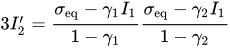
The Burzyński-Yagn criterion is an early pressure-sensitive yield model that can be extended to anisotropic materials exhibiting direction-dependent strength, often due to processes like rolling. It originates from an energy-based hypothesis considering both distortional and volumetric strain energies, generalized for anisotropy by incorporating directional tensile, compressive, and shear strengths. For the isotropic case, the yield surface is a second-order surface of revolution about the hydrostatic axis, formulated using invariants as 3I2=σeqγ1I11γ1σeqγ2I11γ23I_2' = \frac{\sigma_{\text{eq}} - \gamma_1 I_1}{1 - \gamma_1} \frac{\sigma_{\text{eq}} - \gamma_2 I_1}{1 - \gamma_2}, where I2I_2' is the second deviatoric invariant, σeq\sigma_{\text{eq}} the equivalent stress, I1I_1 the first stress invariant, and γ1,γ2\gamma_1, \gamma_2 material parameters controlling tension-compression asymmetry and pressure sensitivity. Anisotropic extensions modify this by direction-dependent coefficients, capturing orthotropy in polycrystalline metals through calibration with uniaxial and shear tests along principal axes.[58] Proposed by W. Burzyński in 1928, the criterion draws from experimental observations of pressure effects on yielding, deriving limits from uniaxial tension, compression, and shear.[59] It has been applied and modified in later works for anisotropic pressure-dependent solids.[60] In principal stress space, the yield surface appears as a distorted quadratic surface (e.g., paraboloid or ellipsoid), with facets reflecting interactions between normal and shear yielding in orthotropic directions, highlighting reduced symmetry compared to isotropic criteria like von Mises.[61] The criterion's advantages include its ability to capture initial anisotropy in rolled sheet metals using directional strength measurements and explicit tension-compression asymmetry, valuable for textured alloys.[62] It offers a framework for preliminary design where orthotropic effects dominate.[62] However, the quadratic nature can lead to non-smoothness in anisotropic extensions, causing discontinuities in the flow rule at certain points that complicate finite element simulations. It may also inadequately predict yielding under high shear or equi-biaxial tension due to its energy-based boundaries.[60][58] As a foundational model for pressure-sensitive anisotropy, it influenced subsequent criteria.[62]

Bigoni–Piccolroaz Yield Surface

The Bigoni–Piccolroaz yield surface is a phenomenological model for pressure-sensitive materials, offering versatility through Lode angle dependence and extensions to anisotropy. Proposed in isotropic form by Bigoni and Piccolroaz in 2004, it has been generalized to include anisotropic effects and surfaces with corners, suitable for materials with directional variations. The model separates hydrostatic and deviatoric effects, controlling tension-compression asymmetry and shear response.[63][64] The yield condition is $ f(p, q, \theta) = F(p) + \frac{q}{g(\theta)} = 0 $, where $ p = -\operatorname{tr}(\sigma)/3 $ is hydrostatic pressure, $ q = \sqrt{3 J_2} $ the von Mises stress, and $ \theta $ the Lode angle. The meridian function is $ F(p) = -M p_c \sqrt{(\phi - \phi_m)[2(1-\alpha)\phi + \alpha]} $ for $ \phi = (p + c)/(p_c + c) \in [0,1] $, and infinite otherwise; the deviatoric function is $ g(\theta) = 1 / \cos[\beta \pi/6 - (1/3) \cos^{-1}(\gamma \cos 3\theta)] $. Parameters include $ M $ (friction angle), $ p_c, c $ (compression/tension strengths), $ \alpha, m $ (meridian shape), $ \beta, \gamma $ (deviatoric shape). Anisotropic versions vary parameters across Lode angle sectors or incorporate directional tensors. This ensures a smooth, convex surface for stable simulations. In the deviatoric plane, the section is rounded triangular, with parameters tuning uniaxial tension/compression and shear ratios (e.g., higher $ \beta $ toward Tresca). Hydrostatic stress affects scaling via $ F(p) $, capturing compression strengthening. For meridians, it uses tension, compression, and interpolating curves for smooth transitions. The anisotropic extension builds on the trigonometric deviatoric function, adding orthotropy via variable coefficients.[63][64] Advantages include flexibility to recover criteria like Tresca, Mohr-Coulomb, or von Mises as limits, while ensuring smoothness and convexity via parameter constraints. It supports hardening and applies to foams, soils, and metals with Lode effects. However, up to seven (or more for anisotropic) parameters require extensive tests like triaxial across Lode angles, limiting routine use compared to Drucker-Prager.[63][65][66]

Cosine Ansatz (Altenbach-Bolchoun-Kolupaev)

The cosine ansatz, developed by Altenbach, Bolchoun, and Kolupaev (2011–2015), is a parametric yield criterion for orthotropic materials like textured composites and polycrystals under complex loading. It uses trigonometric functions to model directional yield variations, extending quadratic forms for better shear failure representation. It builds on early anisotropic ideas, incorporating periodic functions for material symmetries.[67] The yield function uses invariants: $ (3I_2')^3 \cdot \frac{1 + c_3 \cos 3\theta + c_6 \cos^2 3\theta}{1 + c_3 + c_6} = \left[ \frac{\sigma_{\rm eq} - \gamma_1 I_1}{1 - \gamma_1} \right]^{6-l-m} \left[ \frac{\sigma_{\rm eq} - \gamma_2 I_1}{1 - \gamma_2} \right]^l \sigma_{\rm eq}^m $, where $ \cos 3\theta = \frac{3\sqrt{3}}{2} \frac{I_3'}{I_2'^{3/2}} $, $ c_3, c_6 $ shape the deviatoric section (with convexity constraints like $ c_6 \geq (5/12) c_3^2 - 1/3 $), $ \gamma_1, \gamma_2 $ hydrostatic nodes, and $ l, m $ powers for meridian curvature. $ \sigma_{\rm eq} $ scales to yield stress, calibrated from orthotropic axis tests. This leverages three-fold symmetry for orthotropy.[67] Geometrically, it yields a closed, undulating surface in principal stress space, smooth in the deviatoric plane without sharp corners, promoting convex envelopes for flow rules. The cosine terms approximate Fourier series, ensuring convexity for suitable parameters.[67] Advantages include guaranteed convexity for numerical stability in finite element analysis, few parameters ($ c_3, c_6, \gamma_1, \gamma_2, l, m, \sigma_y $), efficient orthotropy modeling without heavy calibration, suiting composites. It extends Hill's quadratic criterion, improving shear predictions.[67] Limitations: Primarily for plane stress, less applicable to full 3D with out-of-plane effects; focuses on deviatoric anisotropy over strong pressure dependence, potentially needing combination with Drucker-Prager for geomaterials.[67]

Barlat's Yield Surface

Barlat's yield surfaces are a family of anisotropic criteria for sheet metals, especially in plane stress forming. Evolving from Yld89 (plane stress orthotropy), Yld91 incorporated six parameters from uniaxial tests and r-values for directional yield and strain ratios. Later, Yld2000 enhanced aluminum flexibility, and Yld2004-18p extended to 3D with 18 parameters from sheet tests.[68] The Yld91 function is $ \phi = |\phi_1' - \phi_2'|^a + |\phi_2' - \phi_3'|^a + |\phi_3' - \phi_1'|^a = 2k $, where $ \phi_i' $ are principals of one linear transformation of the deviatoric stress (with eight $ \alpha_k $ coefficients for orthotropy), and $ a = 6 $ or $ 8 $ (crystal-dependent); $ k $ relates to shear yield. A second transformation is used in some variants. In plane stress, it distorts the von Mises circle into an irregular ellipse capturing directional variations. Yld2004-18p uses two transformations for general stresses, yielding convex but irregular surfaces.[68] These excel in simulating earing in deep drawing for aluminum/steel sheets, reproducing yield loci from r-value data for better formability predictions. Convexity ensures finite element stability. The exponent $ a $ needs tuning via experiments or polycrystal models, and 3D variants increase computation. Recent extensions, such as a 2020 model for tension-compression asymmetry, improve textured alloy modeling.[69] Barlat's models are standard in automotive simulations for defect prediction.[70][71]

References

User Avatar
No comments yet.