


Community hub
Recent from talks
Contribute something
Nothing was collected or created yet.
ZB vz. 26
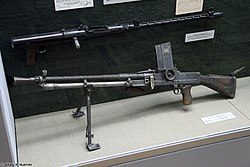
View on WikipediaThe ZB-26 was a Czechoslovak light machine gun developed in the 1920s, which went on to enter service with several countries. It saw its major use during World War II, and spawned the related ZB vz. 27, vz. 30, and vz. 33. The ZB vz. 26 influenced many other light machine gun designs including the British Bren light machine gun and the Japanese Type 97 heavy tank machine gun. The ZB-26 is famous for its reliability, simple components, quick-change barrel and ease of manufacturing.[3]
Key Information


This light machine gun in the Czechoslovak army was marked as the LK vz. 26 ("LK" means lehký kulomet, light machine gun; "vz." stands for vzor, Model in Czech). ZB vz. 26 is incorrect nomenclature because "ZB-26" is a factory designation (Československá zbrojovka v Brně), while "vzor 26" or "vz. 26" is an army designation.
Development
[edit]In around 1921 the military of the young Czechoslovak state embarked on a quest for a light machine gun of their own. Early trials included foreign designs such as Berthier, M1918 Browning automatic rifle, Darne machine gun, Hotchkiss M1914 machine gun, Madsen machine gun, St. Étienne Mle 1907, and several domestic designs. Of these, the most important was the Praha II, a lightweight, belt-fed weapon built at Česka Zbrojovka (CZ) Praha (Czech Arms factory in Prague).
Development of the ZB-26 began in 1923 after the Czechoslovak Brno arms factory was built. Since CZ-Praha was a relatively small factory with limited industrial capabilities, it was decided to transfer the production of the new automatic weapon to the more advanced Zbrojovka Brno, or ZB in short. This transfer resulted in a long series of court trials over royalties, between the owners of the design (CZ-Praha) and the manufacturer (ZB). Designer Václav Holek was charged by the Czechoslovak army with producing a new light machine gun. He was assisted by his brother Emmanuel, as well an Austrian and a Polish engineer, respectively named Marek and Podrabsky.[4] Holek quickly began work on the prototype of the Praha II and within a year the quartet had created an automatic light machine gun that was later known as the ZB.
Before long, the Holek brothers abandoned the belt feed in favor of a top-feeding box magazine and the resulting weapon, known as the Praha I-23, was selected.[3] Despite the past legal troubles, manufacture of the new weapon had commenced at the ZB factory by late 1926, and it became the standard light machine gun of the Czechoslovak Army by 1928.
Design
[edit]The ZB-26 is a gas-operated, air-cooled, selective-fire machine gun. It has a finned, quick-detachable barrel and fires from an open bolt. Its action is powered by a long-stroke gas piston, located below the barrel. The gas block is mounted at the muzzle end of the barrel and also serves as the front sight base. The action is locked by tipping the rear of the bolt (breechblock) upwards, and into a locking recess in the receiver. The return spring is located in the butt of the weapon, and is connected to the bolt carrier/gas piston via a long rod; additionally, there is a short spring buffer located around the return spring at the juncture of the receiver and butt, which softens the impact of the bolt group at the end of its rearward stroke.
Its charging handle is located at the right side of receiver and does not reciprocate when the gun is fired. The ammunition feed is from a top-mounted box magazine made from sheet steel, holding just 20 rounds in a two-row configuration. The magazine housing has a forward-sliding dust cover. Spent cartridges are ejected downwards. The ejection port is normally closed with its own dust cover which opens automatically once the trigger is pressed. The trigger unit permits both single shots and automatic fire, selectable through a safety/fire mode selector lever situated at the left side of the pistol grip. The gun fires from an open bolt and the spring-loaded firing pin is operated by a projection on the bolt carrier, once the bolt is fully in battery and locked. Because of the overhead magazine, the sight line is offset to the left, and the front sight is mounted on a base which protrudes upward and to the left from the gas block.
The rear sight is attached to the left side of receiver, and has a range adjustment mechanism controlled by a knurled rotating knob. Standard furniture consists of an integral folding bipod, which is attached to the gas cylinder tube, and a wooden butt with a spring-buffered buttplate and a folding shoulder rest plate. Although the ZB-26 was intended for the light machine gun role, it was also offered with a sustained-fire tripod, and provided with a sufficient supply of full magazines and spare barrels it could serve (to some extent) as a medium machine gun. The same tripod was also adaptable for the anti-aircraft role.
Deployment and service
[edit]The ZB-26 saw service with the Czechoslovak infantry from 1928, as well as being the primary or secondary armament on many later model Škoda armored vehicles. 45,132 were bought by Czechoslovakia during the interwar.[5] It is believed that the ZB factory turned more than 120,000 ZB-26 guns between 1926 and 1939 in a variety of calibers (the most popular being its original 7.92×57mm Mauser). It was exported to twenty-four European, South American and Asian countries, both in its original form and in the slightly improved ZB-30 version. Large batches of ZB light machine guns went to Bolivia, Bulgaria, China, Romania, Turkey and Yugoslavia. Lithuania and Yugoslavia were the first users to adopt the gun, before the Czechoslovak Army.[5] Exports continued until 1939, when Nazi Germany under Adolf Hitler took over Czechoslovakia. More were produced for export than for the Czechoslovak Army[6] 7,136 ZB-26 were produced in Czechoslovakia after the war, from 1945 to 1953.[5]

The Wehrmacht soon adopted the ZB-26 after the occupation of Czechoslovakia, renaming it the MG 26(t);[7] it was used in the same role as the MG 34, as a light machine gun. In the opening phases of World War II, the ZB-26 in 7.92 mm Mauser caliber was used in large numbers by elements of the German Waffen-SS, who at first did not have full access to standard Wehrmacht supply channels. In its most famous incarnation, the ZB-26 was modified by ZB and British technicians, entering service as the famous Bren gun.[8] Many more countries imported or produced the design under license, including China and Yugoslavia. Chinese Nationalist forces used the ZB-26 chambered for the 7.92×57mm Mauser round in their struggle with Communist Chinese and later Imperial Japanese forces. Likewise, the Chinese Red Army (as with any other captured weapon) turned the Nationalists' ZB-26 machine guns against them and the Japanese. According to Brno, from 1927 to 1939, a total of 30,249 ZB-26 were exported to China.[5] Various Chinese pro-Japanese forces, such as the Collaborationist Chinese Army[9] or the Inner Mongolian Army, used it.[10] During this time due to high demand, Chinese small-arms factories—state-owned as well as those controlled by various warlords—were producing the ZB-26 as the Type 26. During the Korean War, Chinese Communist forces employed the ZB-26/Type 26 against UN forces, and PVA ZB gunners developed a well-deserved reputation for long-range marksmanship.[citation needed] During the First Indochina War with French and later South Vietnamese forces, the ZB-26/Type 26 was found in the hands of both North Vietnamese Army and Viet Minh guerrillas.[11]
Variants
[edit]Czech variants
[edit]- Praha vz. 24 — Prototype produced at the Praga arms factory. Can be distinguished from the ZB-26 since the whole barrel is ribbed instead of up to half way.[5][12]
- ZB-26 (Vz. 26) — First production model. Produced since 1926 with continuous minor improvements until full scale production from 1928 onward.[12]
- ZB-27 (Vz. 27) — Updated ZB-26 with various small improvements to the components of the gas operated action and bolt, proposed to Portugal, Romania and United Kingdom. Further updates resulted in the ZB-30.[12][13]
- ZB-30 (Vz. 30) — Second production model (slightly longer, heavier, and higher cyclic RoF). Produced since 1932 with various improvements to the gas system, bolt design,...[12]
- ZB-30J — Variant of the ZB-30 developed for export to Yugoslavia, features an adjustable gas system for compatibility with both light and heavy ball 7.92mm Mauser ammunition. Also produced in 7mm Mauser for Venezuela.[12]
- ZGB-30 — Updated ZB-27 design at the request of the British for trials. Modified for use with cordite-filled ammunition and rimmed .303 British cartridges, later updated to the ZGB-33.[12]
- ZGB-33 — Variant of the ZB-30 for use with rimmed ammunition. Produced under license in the UK as the Bren light machine gun. Sold commercially since 1935 by ZB in .303 British to a handful of nations.[12]
- ZB-39 (Vz. 39) — Later production commercial model of the ZGB-33 that is nearly identical to the British produced Bren, with many internal parts even being interchangeable, except for the magazine. It was chambered in various different rounds and having different sights, including anti-aircraft sights. Sales of the ZGB-33 morphed into the ZB-39, such as the sales to Iraq and Bulgaria.[12][14]
- ZB-501 (Vz. 52) — Post-war derivative of the ZB-26.
Foreign variants
[edit]- Bren Mk I —
- Type 97 — A Japanese license built copy of the ZB-26 (chambered in 7.7×58mm Arisaka) and intended for use in Japanese tanks. It was not normally issued as an infantry light machine gun. Other than the cocking handle being moved from the right side of the receiver to the left it is essentially a duplicate of the Czech gun in operation.
- Fusil ametrallador Oviedo — A post-war Spanish clone of the ZB-26 / ZB-30.
More designations appear depending on the adopting army, though generally the gun retains its 'ZB 26' initials in one form or another.
Manufacturers
[edit]- ZB-26 manufacturers
- Zbrojovka Brno
- Military Technical Institute Kragujevac (License)[1]
- Gongxian Arsenal (License)
- ZB-30 manufacturers
- Zbrojovka Brno
- Cugir Arms Factory (License)[1]
- Military Technical Institute Kragujevac (License)[1]
Users
[edit]


 Afghanistan[15] — 2,000 Czech-made ZB-30 (chambered in 7.92mm Mauser) shipped in 1938.[16]
 Algeria — ZB-30 used by the National Liberation Army.
 Biafra[17]
 Bolivia[18] — 3,350 Czech-made ZB-30 (chambered in 7.65mm Mauser) between 1932 and 1937,[16] used in the Chaco War,[19] still in use in the 1960s[20]
 Brazil — 1,080 in 7mm Mauser received in 1930[16] for the Polícia Militar de Minas Gerais (Military Police of the state of Minas Gerais)[citation needed]. Adopted by the São Paulo Public Force[21]
 Bulgaria — Ordered 3,000 Czech-made ZB-39 "Bren" guns in the end of 1938,[14] designated as the kartěnice 39 (chambered in 8×56mmR using 25-round box magazine[22]).[23] 100 delivered before German occupation of Czechoslovakia. The rest were delivered after Germany allowing continued weapon sales.[24]
 Chile — 11 in 7mm received in 1928[16]
 China[25][26]
 China (ROC) — 30,249 received between 1927 and 1939.[16] Produced under license.[27] Clones made in Taku Naval Dockyard in 1927, later produced in Gongxian Arsenal, the 21st/51st Arsenals.[28]
 Croatia[citation needed]
 Czechoslovakia — Adopted by the Czechoslovak Army as the LK vz. 26.[28][29]
 Ecuador[30] — 200 supplied in 1930-1932[16]
 Egypt — 1,060 7.7mm ZGB-33 bought in 1937-1939[16]
 Ethiopia[18] — Used against the Italians
 Germany
 Indonesia — Free Aceh Movement[31]
 Imperial State of Iran — ZB vz. 30 produced under license[32] 6,000 ZB-26 received in 1934[16]
 Iraq — 850 7.7mm ZGB-33 received in 1936-1937[16]
 Japan — Used captured Chinese guns[33] 2,200 others were received in 1938-1939[16]
 Latvia — 600 7.7mm ZGB-33 ordered in 1940[16]
 Lithuania[5] — 3,138 VZ 26 machine guns between 1928 and 1937[16] (7,92 mm kulkosvaidis Brno 26 m.)
 Manchukuo[34]
 Namibia — Used by the People's Liberation Army of Namibia.[35]
 North Korea[36]
 Paraguay — Captured from Bolivian Army during Chaco War, some still in use for training.[citation needed]
 Peru[37]
 Romania[18] — 17,131 Czech-made ZB-30 were imported in 1933.[16][38] 10,000 ZB-30 were license-produced at Cugir,[39][40] with a production rate of 250 pieces per month as of October 1942.[41]
 Siam — Bought some in the early 1930s[16]
 Slovak Republic[42]
 Spain[2][43]
 Sweden — Used as the Kulsprutegevär m/39[44]
 Turkey[18][45]
 United Kingdom — 85 Czech-made ZGB-33 "Bren" in 7.7mm bought from 1935 to 1938[16]
 North Vietnam[46][47]
 Yugoslavia[5] — 1,500 Czech-made ZB-26 delivered[16]


Conflicts
[edit]- ZB-26
- Constitutionalist Revolution (1932)
- Chaco War (1932–1935)
- 2nd Italo-Ethiopian War (1935–1937)
- Spanish Civil War (1936–1939)
- Dersim Massacre (1937–1938)
- 2nd Sino-Japanese War (1937–1945)
- Sudeten German uprising (1938)
- World War II
- Ecuadorian–Peruvian War[37]
- Chinese Civil War
- Korean War
- Indochina War
- Vietnam War
- Laotian Civil War
- Biafran war
- Insurgency in Aceh[31]
- South African Border War
- Soviet–Afghan War
See also
[edit]Weapons of comparable role, performance and era
[edit]- FM 24/29
- Lahti-Saloranta M/26
- Madsen
- Mendoza RM2
- Type 96 — influenced by ZB vz. 26 design
- Type 99 — follow on to the Type 96
References
[edit]Citations
[edit]- ^ a b c d Zastava Arms (License).
- ^ a b c d e f g "Fusils-mitrailleurs Lehky Kulomet ZB vz.26 and vz.30". Encyclopédie des armes : Les forces armées du monde (in French). Vol. II. Atlas. 1984. p. 262.
- ^ a b ZB-26 (Forgotten Weapons).
- ^ Smith & Smith 1969, p. 125.
- ^ a b c d e f g ZB-26 (vhu.cz).
- ^ Grant 2013, p. 10.
- ^ Bishop 2002, p. 237.
- ^ Skřivan 2010, pp. 630–640.
- ^ Berger & Jowett 2024, pp. 46, 71.
- ^ Berger & Jowett 2024, pp. 51, 56.
- ^ Windrow 2018, pp. 24–25.
- ^ a b c d e f g h ZB-26 (weaponsystems.net).
- ^ ZB-27 (vhu.cz).
- ^ a b ZB 39 (iwm.org.uk).
- ^ Bhatia & Sedra 2008, p. 65.
- ^ a b c d e f g h i j k l m n o p Fencl 1991 (militaria.cz).
- ^ Jowett, Philip (2016). Modern African Wars (5): The Nigerian-Biafran War 1967-70. Oxford: Osprey Publishing Press. p. 23. ISBN 978-1472816092.
- ^ a b c d Grant 2013, p. 65.
- ^ Alejandro de Quesada (20 November 2011). The Chaco War 1932-35: South America's greatest modern conflict. Osprey Publishing. p. 24. ISBN 978-1-84908-901-2.
- ^ Guevara, Che (1994). El diario del Che en Bolivia: noviembre 7, 1966 a octubre 7, 1967. Havana?: Ciencas Sociales. ISBN 978-959-06-0177-4.
- ^ "O Museu de Polícia Militar de São Paulo". Armas On-Line (in Brazilian Portuguese). 25 June 2017. Retrieved 16 December 2022.
- ^ Bulgarian ZB-39 25-round magazine (mg34.com).
- ^ Bulgarian ZB-39 Bren.
- ^ Tsvetkov 2018, pp. 390–394.
- ^ Jowett 2005, p. 44.
- ^ Indigenous Machine Guns of China (Small Arms Defense Journal).
- ^ Smith & Smith 1969, pp. 295–296.
- ^ a b China's Favorite Machine Gun (chinaww2.com).
- ^ Manning 2017, p. 22.
- ^ "Zarumilla War 1941: Ecuadorian-Peruvian War of 1941". globalsecurity.org. Retrieved 2 February 2019.
- ^ a b Indonesia, p. 32.
- ^ Smith & Smith 1969, p. 320.
- ^ Smith & Smith 1969, p. 498.
- ^ Berger & Jowett 2024, p. 32.
- ^ "Their Blood Waters our Freedom". Youtube.com. 25 January 2020. Archived from the original on 21 December 2021. Retrieved 19 May 2020.
- ^ North Korean Small Arms (Small Arms Review).
- ^ a b Jowett 2018, p. 39.
- ^ Axworthy, Scafeș & Crăciunoiu 1995, p. 29.
- ^ Smith & Smith 1969, p. 535.
- ^ John Walter, Greenhill Books, 2004, Guns of the Third Reich, p. 86
- ^ Axworthy, Scafeș & Crăciunoiu 1995, p. 75.
- ^ Malmassari 2016, p. 415.
- ^ Smith & Smith 1969, p. 547.
- ^ Kg m/39 (gotavapen.se).
- ^ Smith & Smith 1969, p. 570.
- ^ Bishop 1996, p. 203.
- ^ Smith & Smith 1969, p. 719.
- ^ Vukšić 2003, p. 25.
Main sources
[edit]- Books
- Smith, Walter Harold Black; Smith, Joseph Edward (1969). Smith, Joseph Edward (ed.). Small Arms of the World: A Basic Manual of Small Arms (11 ed.). Harrisburg, Pennsylvania: The Stackpole Company. p. 125. ISBN 978-0-8117-1566-9.
- Axworthy, Mark; Scafeș, Cornel I.; Crăciunoiu, Cristian (1995). Third Axis, Fourth Ally: Romanian Armed Forces in the European War, 1941–1945. London: Arms and Armour Press. ISBN 978-1-85409-267-0.
- Bishop, Chris (1996). Bishop, Chris (ed.). Vital Guide to Combat Guns and Infantry Weapons. Airlife. ISBN 9781853105395.
- Bishop, Chris (2002). The Encyclopedia of Weapons of World War II. MetroBooks. ISBN 9781586637620.
- Vukšić, Velimir (July 2003). Tito's partisans 1941–45. Warrior 73. Osprey Publishing. ISBN 978-1-84176-675-1.
- Jowett, Philip (13 July 2005). The Chinese Army 1937-49: World War II and Civil War. Osprey Publishing. ISBN 9781841769042.
- Bhatia, Michael Vinai; Sedra, Mark (5 May 2008). Small Arms Survey (ed.). Afghanistan, Arms and Conflict: Armed Groups, Disarmament and Security in a Post-War Society. Taylor & Francis. ISBN 9781134054213.
- Davies, Matt (27 September 2006) [1970]. Indonesia's War over Aceh: Last Stand on Mecca's Porch (eBook ed.). London: Routledge. p. 32. doi:10.4324/9780203968802. ISBN 9781134193318.
- Grant, Neil (23 July 2013). Pegler, Martin (ed.). The Bren Gun. Weapon. Vol. 22. Osprey Publishing. ISBN 978-1782000822.
- Malmassari, Paul (2016). "Slovak Republic". Armoured Trains. Seaforth Publishing. p. 415. ISBN 9781848322653. Retrieved 30 March 2019.
- Manning, Robb (17 February 2017). Gun Digest Book of CZ Firearms. Gun Digest Media. ISBN 978-1440246227.
- Tsvetkov, Simeon (2018). Поръчки и доставки на леко стрелково оръжие от "Чешка Збройовка" (1938-1944 г.) [Orders and deliveries of small arms from "Czech Zbrojovka" (1938-1944)]. Vol. XXXIII. Veliko Tarnovo, Bulgaria: Proceedings of the Regional Museum of History.
- Jowett, Philip (28 June 2018). Latin American Wars 1900–1941: "Banana Wars," Border Wars & Revolutions. Men-at-Arms 519. Osprey Publishing. ISBN 9781472826251.
- Windrow, Martin (20 September 2018). French Foreign Légionnaire vs Viet Minh Insurgent: North Vietnam 1948–52. Combat 36. Osprey Publishing. ISBN 9781472828910.
- Berger, John; Jowett, Philip (28 February 2024) [2004]. Rays of the Rising Sun: Armed Forces of Japan's Asian Allies 1931-45 Volume 1 – China and Manchukuo. Helion & Company Limited. ISBN 9781804516959.
- Others
- Shea, Dan; Hong, Heebum (June 2012) [May 4, 2012]. "North Korean Small Arms (Democratic People's Republic of Korea)". Small Arms Review. Vol. 16, no. 2. Archived from the original on 2 February 2019. Retrieved 2 February 2019.
- Skřivan, Aleš (2010). "On the Nature and Role of Arms Production in Interwar Czechoslovakia" (PDF). The Journal of Slavic Military Studies. 23 (4): 630–640. doi:10.1080/13518046.2010.525488. S2CID 154648623. Archived from the original (PDF) on 3 March 2017.
Secondary sources
[edit]- With authors
- Fencl, Jiří (1991). "Nejprodávanější československá zbraň" [The best-selling Czechoslovak weapon]. militaria.cz (in Czech). Militaria, Elka Press. Retrieved 12 March 2019.
- McCollum, Ian (18 July 2011). "Czech ZB-26 manuals". forgottenweapons.com. Forgotten Weapons. Retrieved 1 September 2023.
- Janson, Olof (23 October 2017). "Light machine gun Kg m/1939 (BRNO ZB-26)". gotavapen.se. Archived from the original on 1 December 2017. Retrieved 1 August 2023.
- McCollum, Ian (26 October 2017). "ZB26: The Best of the Light Machine Guns". forgottenweapons.com. Forgotten Weapons. Retrieved 1 August 2023.
- McCollum, Ian (30 August 2023). "Romanian ZB-30 LMG: Improving the Already-Excellent ZB-26". forgottenweapons.com. Forgotten Weapons. Retrieved 1 August 2025.
- Popenker, Maxim (15 August 2023). "Indigenous Machine Guns of China". Small Arms Defense Journal.
- Without authors
- "1919-1941: Fabrika između dva svetska rata" [1919-1941: Factory between the two world wars]. zastava-arms.rs (in Bosnian). Archived from the original on 22 December 2017. Retrieved 18 October 2015.
- "ZB-26 (ZB-30 | ZGB-33)". weaponsystems.net.
- "Lehký kulomet ZB 26" [Light machine gun ZB 26]. vhu.cz (in Czech). Vojenský historický ústav Praha.
- "Čs. lehký kulomet ZB vz. 27" [Czech light machine gun ZB vz. 27]. vhu.cz (in Czech). Vojenský historický ústav Praha.
- "Bulharský lehký kulomet BREN – funkční řez" [Bulgarian BREN light machine gun – functional section]. vhu.cz (in Czech). Vojenský historický ústav Praha.
- "ZB 39". iwm.org.uk. Imperial War Museum.
ZB 39 MG. Bulgarian crest ground off, butt shaped like Bren but with ZB30 type fittings and sling swivel with flat-headed boss, corrugated magazine well cover, Bren Mk 1 bipod and cocking handle, ZB30 style sights, cupped gas deflector, bolt appears to be from British 7.62mm Bren
- "China's Favorite Machine Gun". chinaww2.com. 27 September 2014.
- "Vintage Surplus ZB-39 25 Round Magazine 8 x 56R 8MM 7.62x54 Bulgarian WWII". mg34.com. Retrieved 1 July 2025.
External links
[edit]
ZB vz. 26
View on GrokipediaHistory
Development
Following the end of World War I, the newly independent Czechoslovakia sought to modernize its military arsenal, particularly by developing a reliable light machine gun to equip infantry squads organized around a 13-man "battle cluster" structure influenced by contemporary French tactics.[1] The Czechoslovak Army required a versatile weapon that could provide sustained fire support at the squad level, drawing inspiration from established foreign designs such as the American Browning Automatic Rifle (BAR) for its squad automatic role and the Danish Madsen machine gun for its lightweight, magazine-fed portability.[3] This need arose amid the interwar rearmament efforts of the young republic, which aimed to reduce reliance on imported arms while leveraging the country's strong engineering heritage from the former Austro-Hungarian Empire.[6] The primary design responsibility fell to Václav Holek, a prominent Czech firearms engineer, who began work on the project in 1923 at Česká Zbrojovka (CZ) Praha, with assistance from his brother Emanuel Holek, before development was transferred to Zbrojovka Brno due to capacity constraints at CZ Praha, resolving associated royalty disputes and enabling scaled manufacturing.[1][6] Holek's team evolved earlier prototypes, such as the Praha II and the top-feeding Praha I-23, into a gas-operated light machine gun that emphasized simplicity, quick barrel changes, and ease of field maintenance.[6] Between 1924 and 1926, the ZB prototype underwent extensive army trials in Czechoslovakia, competing directly against imported models from manufacturers like Colt (BAR variants) and Madsen, as well as other domestic entries.[1][6] Evaluators praised the design for its superior reliability under varied conditions, reduced jamming compared to belt-fed competitors, and straightforward production using standard tooling, which promised lower costs than ongoing imports.[3] These tests, building on preliminary evaluations from 1923, confirmed the weapon's suitability for mass issuance, leading to its formal designation as the Lehký kulomet vzor 26 (light machine gun model 1926).[6] The Czechoslovak Army officially adopted the ZB vz. 26 in 1928 as its standard light machine gun, initiating production runs that prioritized domestic needs before exports.[1][3] Selection was driven by its cost-effectiveness—estimated at half the price of equivalent foreign purchases—combined with proven performance in trials that demonstrated high uptime and minimal logistical demands.[6] Initial orders equipped infantry battalions rapidly, marking a key step in Czechoslovakia's self-sufficiency in small arms production.[7]Production
Production of the ZB vz. 26 commenced at Zbrojovka Brno in late 1926, following the transfer of manufacturing rights from the smaller Česká Zbrojovka (CZ) in Prague, which lacked the capacity for mass production.[6] The Brno facility, established in 1923 as a state-owned arms works, was equipped with specialized tooling and assembly lines to enable efficient large-scale output of the light machine gun, incorporating Václav Holek's design refinements for streamlined fabrication. This setup allowed for the progressive integration of minor improvements during initial runs, transitioning to full-scale production by 1928.[2] Between 1926 and 1939, Zbrojovka Brno produced over 120,000 units of the ZB vz. 26 in various calibers, with historical estimates indicating peak annual output of approximately 15,000 to 20,000 units in the pre-World War II years.[6] The manufacturing process emphasized reliability through simple, robust components and ease of assembly, contributing to the weapon's reputation for durability in field conditions. Materials were sourced locally, including high-quality Czech steel for critical parts such as barrels and receivers, which supported consistent performance and reduced production costs.[8] Quality control measures focused on precision machining and functional testing, ensuring minimal defects in the gas-operated mechanism and quick-change barrel system. Initial distribution prioritized the Czechoslovak Army, which adopted the ZB vz. 26 as its standard light machine gun (LK vz. 26) by 1928, procuring a total of 45,132 units for infantry units through the interwar period.[8] Early export negotiations began shortly after, leading to contracts with over 20 countries across Europe, Asia, and South America; notable among these was a deal with China for 30,249 units delivered between 1927 and 1939.[6] These exports, totaling around 100,000 weapons, bolstered Zbrojovka Brno's international reputation and provided essential revenue for further development.[8]Design
Specifications
The ZB vz. 26 light machine gun measures 1,168 mm in overall length, with a barrel length of 672 mm, and weighs 9.65 kg when unloaded.[9][10] It employs a gas-operated mechanism with a tilting breechblock.[2] It is chambered for the 7.92×57mm Mauser cartridge and fed from 20-round detachable box magazines.[6][2] Key performance characteristics include a cyclic rate of fire of 500–600 rounds per minute, an effective range of approximately 800 meters (with bipod), and a muzzle velocity of approximately 760 m/s.[6][2][10][9] The weapon is equipped with iron sights consisting of a front blade and a rear leaf sight adjustable from 200 to 1,500 meters in 100-meter increments, along with an integral folding bipod mounted on the gas cylinder for enhanced stability during sustained fire.[2][6] It was issued with a basic maintenance kit comprising a sectional cleaning rod, brass brush, and oil dispenser for field stripping and upkeep.[10]| Specification | Details |
|---|---|
| Caliber | 7.92×57mm Mauser[6] |
| Overall Length | 1,168 mm[2] |
| Barrel Length | 672 mm[9] |
| Weight (unloaded) | 9.65 kg[9] |
| Magazine Capacity | 20-round detachable box[6] |
| Cyclic Rate of Fire | 500–600 rounds/min[9][2] |
| Effective Range | ~800 m (with bipod)[9] |
| Muzzle Velocity | ~760 m/s[2] |
| Sights | Iron (front blade, rear leaf adjustable to 1,500 m)[2] |
| Accessories | Folding bipod; basic cleaning kit (rod, brush, oiler)[6][10] |