


Community hub
Recent from talks
Contribute something
Nothing was collected or created yet.
84th United States Congress
View on Wikipedia
| 84th United States Congress | |
|---|---|
83rd ← → 85th | |
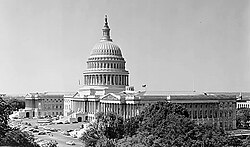
 United States Capitol (1956) | |
January 3, 1955 – January 3, 1957 | |
| Members | 96 senators 435 representatives 3 non-voting delegates |
| Senate majority | Democratic (initially with caucus) |
| Senate President | Richard Nixon (R) |
| House majority | Democratic |
| House Speaker | Sam Rayburn (D) |
| Sessions | |
| 1st: January 5, 1955 – August 2, 1955 2nd: January 3, 1956 – July 27, 1956 | |
The 84th United States Congress was a meeting of the legislative branch of the United States federal government, composed of the United States Senate and the United States House of Representatives. It met in Washington, D.C. from January 3, 1955, to January 3, 1957, during the third and fourth years of Dwight D. Eisenhower's presidency. The apportionment of seats in the House of Representatives was based on the 1950 United States census.
The Democratic Party won back majorities in both the House and Senate, thus giving them full control of Congress, although Republican Party briefly won the Senate after the last congressional session. The Democratic Party would continue to hold onto its house majority until the 104th Congress.
Major events
[edit]- January 28, 1955: Congress authorized the president to use force to protect Taiwan from the People's Republic of China
- February 10, 1955: The United States Navy helped the Republic of China evacuate Chinese Nationalist army and residents from the Tachen Islands to Taiwan.
- February 12, 1955: President Eisenhower sent the first U.S. advisers to South Vietnam.
- July 2, 1955: Senator Lyndon Johnson, Majority Leader of the United States Senate, suffered a major heart attack.
- September 24, 1955: President Eisenhower suffered a coronary thrombosis.
- November 5, 1955: Racial segregation was forbidden on trains and buses in U.S. interstate commerce.
- December 1, 1955: Rosa Parks was arrested for refusing to give up her seat on the bus to a white person.
- December 5, 1955: The American Federation of Labor and the Congress of Industrial Organizations merged to become the AFL–CIO.
- March 12, 1956: 96 Congressmen signed the Southern Manifesto, a protest against the 1954 Supreme Court ruling (Brown v. Board of Education) desegregating public education.
- November 6, 1956: United States elections, 1956:
- 1956 United States presidential election: Republican incumbent Dwight D. Eisenhower defeated Democratic challenger Adlai E. Stevenson in a rematch of their contest four years earlier.
- United States Senate elections, 1956: The party balance of the chamber remained unchanged as Republican and Democratic gains cancelled each other.
- United States House of Representatives elections, 1956: Republicans lost a net of two seats to the majority Democrats.
Major legislation
[edit]- January 29, 1955: Formosa Resolution
- March 31, 1955: Career Incentive Act
- June 28, 1955: Flood Control and Coastal Emergency Act, Pub. L. 84–99, 69 Stat. 194
- July 11, 1955: To provide that all United States currency shall bear the inscription "In God We Trust", Pub. L. 84–140, 69 Stat. 290, 31 U.S.C. § 5114(b)
- July 14, 1955: Air Pollution Control Act, Pub. L. 84–159, ch. 360, 69 Stat. 322
- July 23, 1955: Multiple Surface Use Mining Act, Pub. L. 94–167, ch. 730, 68 Stat. 708
- August 9, 1955: Reserve Forces Act, Pub. L. 84–305, 69 Stat. 598
- August 11, 1955: National Housing Act ("Capehart Act"), Pub. L. 84–345, 69 Stat. 646
- August 12, 1955: Poliomyelitis Vaccination Assistance Act, Pub. L. 84–377, ch. 863, 69 Stat. 704
- April 11, 1956: Colorado River Storage Project Act, Pub. L. 84–485
- June 29, 1956: Federal-Aid Highway Act of 1956, (National Interstate and Defense Highways Act), Pub. L. 84–627
- July 30, 1956: Health Research Facilities Act, Pub. L. 84–835, ch. 779, 70 Stat. 717
- August 8, 1956: Fish and Wildlife Act of 1956, ch. 1036, 70 Stat. 1119, 16 U.S.C. § 742a
Party summary
[edit]The count below identifies party affiliations at the beginning of the first session of this Congress, and includes members from vacancies and newly admitted states, when they were first seated. Changes resulting from subsequent replacements are shown below in the "Changes in membership" section.
The independent Wayne Morse, who caucused with Republicans in the second session of the previous Congress, began caucusing with the Democrats at the start of this Congress before ultimately becoming a Democrat himself.
Democrats would briefly lose control of the Senate after the last congressional session.
Senate
[edit]| Affiliation | Party (Shading indicates majority caucus)
|
Total | |||
|---|---|---|---|---|---|
| Democratic | Independent | Republican | Vacant | ||
| End of previous Congress | 47 | 1 | 48 | 96 | 0 |
| Begin | 48 | 1 | 47 | 96 | 0 |
| February 17, 1955 | 49 | 0 | 47 | 96 | 0 |
| February 28, 1956 | 48 | 95 | 1 | ||
| March 13, 1956 | 49 | 96 | 0 | ||
| April 4, 1956 | 48 | 95 | 1 | ||
| April 5, 1956 | 49 | 96 | 0 | ||
| April 30, 1956 | 48 | 95 | 1 | ||
| June 21, 1956 | 49 | 96 | 0 | ||
| November 6, 1956 | 46 | 47 | 93 | 3 | |
| November 7, 1956 | 47 | 49 | 96 | 0 | |
| Final voting share | 49% | 0% | 50% | ||
| Beginning of the next Congress | 49 | 0 | 46 | 95 | 1 |
House of Representatives
[edit]| Party (shading shows control) |
Total | Vacant | |||
|---|---|---|---|---|---|
| Democratic (D) |
Independent (I) | Republican (R) |
|||
| End of previous congress | 212 | 1 | 213 | 426 | 9 |
| Begin | 231 | 0 | 203 | 434 | 1 |
| End | 228 | 200 | 428 | 7 | |
| Final voting share | 53.3% | 0.0% | 46.7% | ||
| Beginning of next congress | 233 | 0 | 200 | 433 | 2 |
Leadership
[edit]Senate
[edit]
Richard Nixon (R)
.jpg)
Walter F. George (D)
Majority (Democratic) leadership
[edit]- Majority Leader and Democratic Conference chairman: Lyndon B. Johnson
- Majority Whip: Earle Clements
- Democratic Caucus Secretary: Thomas C. Hennings Jr.
Minority (Republican) leadership
[edit]- Minority Leader: William Knowland
- Minority Whip: Leverett Saltonstall
- Republican Conference chairman: Eugene Millikin
- Republican Conference Secretary: Milton Young
- National Senatorial Committee Chair: Barry Goldwater
- Policy Committee Chairman: Styles Bridges
House of Representatives
[edit]
Sam Rayburn (D)
- Speaker: Sam Rayburn (D)
Majority (Democratic) leadership
[edit]- Majority Leader: John W. McCormack
- Majority Whip: Carl Albert
- Democratic Caucus chairman: John J. Rooney
- Democratic Caucus Secretary: Edna F. Kelly
- Democratic Campaign Committee Chairman: Michael J. Kirwan
Minority (Republican) leadership
[edit]Caucuses
[edit]Members
[edit]This list is arranged by chamber, then by state.
Senate
[edit]Senators are popularly elected statewide every two years, with one-third beginning new six-year terms with each Congress. Preceding the names in the list below are Senate class numbers, which indicate the cycle of their election. In this Congress, Class 1 meant their term began in the last Congress, facing re-election in 1958; Class 2 meant their term began with this Congress, facing re-election in 1960; and Class 3 meant their term ended with this Congress, facing re-election in 1956.

.jpg)


House of Representatives
[edit]The names of representatives are preceded by their district numbers.


Changes in membership
[edit]The count below reflects changes from the beginning of this Congress.
Senate
[edit]- Replacements: 3
- Democratic: 1 net loss
- Independent Democratic: 1 net loss
- Republican: 2 net gain
- Deaths: 2
- Resignations: 1
- Interim appointments: 3
- Total seats with changes: 3
| State (class) |
Vacated by | Reason for change | Successor | Date of successor's formal installation[b] |
|---|---|---|---|---|
| Oregon (3) |
Wayne Morse (I) | Changed Political Parties February 17, 1955 | Wayne Morse (D) | February 17, 1955 |
| West Virginia (1) |
Harley M. Kilgore (D) | Died February 28, 1956 | William Laird III (D) | March 13, 1956 |
| South Carolina (2) |
Strom Thurmond (ID) | Resigned April 4, 1956, to trigger a contested primary as promised to voters | Thomas A. Wofford (D) | April 5, 1956 |
| Kentucky (2) |
Alben W. Barkley (D) | Died April 30, 1956 | Robert Humphreys (D) | June 21, 1956 |
| Kentucky (2) |
Robert Humphreys (D) | Successor elected November 6, 1956 | John Sherman Cooper (R) | November 7, 1956 |
| South Carolina (2) |
Thomas A. Wofford (D) | Successor elected November 6, 1956 | Strom Thurmond (D) | November 7, 1956 |
| West Virginia (1) |
William Laird III (D) | Successor elected November 6, 1956 | Chapman Revercomb (R) | November 7, 1956 |
House of Representatives
[edit]- Replacements: 5
- Democratic: no net change
- Republican: no net change
- Deaths: 9
- Resignations: 3
- Total seats with changes: 12
| District | Vacated by | Reason for change | Successor | Date of successor's formal installation[b] |
|---|---|---|---|---|
| Florida 6th | Vacant | Rep. Dwight L. Rogers died during the previous congress after having been re-elected. Successor elected January 11, 1955. |
Paul Rogers (D) | January 11, 1955 |
| Michigan 15th | John Dingell Sr. (D) | Died September 19, 1955. Successor elected December 13, 1955. |
John Dingell (D) | December 13, 1955 |
| Pennsylvania 30th | Vera Buchanan (D) | Died November 26, 1955. Successor elected January 24, 1956. |
Elmer J. Holland (D) | January 24, 1956 |
| New York 22nd | Sidney A. Fine (D) | Resigned January 2, 1956. Successor elected February 7, 1956. |
James C. Healey (D) | February 7, 1956 |
| Illinois 14th | Chauncey W. Reed (R) | Died February 9, 1956 Seat remained unfilled until next term. |
Vacant | |
| Pennsylvania 2nd | William T. Granahan (D) | Died May 25, 1956. Successor elected November 6, 1956. |
Kathryn E. Granahan (D) | November 6, 1956 |
| California 20th | John Carl Hinshaw (R) | Died August 5, 1956. Seat remained unfilled until next term. |
Vacant | |
| Tennessee 5th | Percy Priest (D) | Died October 12, 1956. Seat remained unfilled until next term. |
Vacant | |
| New Mexico at-large | Antonio M. Fernández (D) | Died November 7, 1956. Seat remained unfilled until next term. |
Vacant | |
| New Jersey 2nd | T. Millet Hand (R) | Died December 26, 1956. Seat remained unfilled until next term. |
Vacant | |
| New York 19th | Arthur George Klein (D) | Resigned December 31, 1956 after being elected to the New York Supreme Court. Seat remained unfilled until next term. |
Vacant | |
| New York 20th | Irwin D. Davidson (DL) | Resigned December 31, 1956. Seat remained unfilled until next term. |
Vacant | |
Committees
[edit]Lists of committees and their party leaders for members of the House and Senate committees can be found through the Official Congressional Directory at the bottom of this article. The directory after the pages of terms of service lists committees of the Senate, House (Standing with Subcommittees, Select and Special) and Joint and, after that, House/Senate committee assignments. On the committees section of the House and Senate in the Official Congressional Directory, the committee's members on the first row on the left side shows the chairman of the committee and on the right side shows the ranking member of the committee.
Senate
[edit]- Agriculture and Forestry (Chairman: Allen J. Ellender; Ranking Member: George D. Aiken)
- Appropriations (Chairman: Carl Hayden; Ranking Member: Styles Bridges)
- Armed Services (Chairman: Richard B. Russell; Ranking Member: Styles Bridges)
- Banking and Currency (Chairman: J. William Fulbright; Ranking Member: Homer Capehart)
- Contribution Investigation (Select)
- District of Columbia (Chairman: Matthew M. Neely; Ranking Member: J. Glenn Beall)
- Finance (Chairman: Harry F. Byrd; Ranking Member: Eugene D. Millikin)
- Foreign Relations (Chairman: Walter F. George; Ranking Member: Alexander Wiley)
- Foreign Aid Program (Special)
- Government Operations (Chairman: John Little McClellan; Ranking Member: Joseph McCarthy)
- Interior and Insular Affairs (Chairman: James E. Murray; Ranking Member: Eugene D. Millikin)
- Interstate and Foreign Commerce (Chairman: Warren G. Magnuson; Ranking Member: John W. Bricker)
- Judiciary (Chairman: Harley M. Kilgore; Ranking Member: Alexander Wiley)
- Labor and Public Welfare (Chairman: J. Lister Hill; Ranking Member: H. Alexander Smith)
- Political Activities, Lobbying and Campaign Contributions (Special)
- Post Office and Civil Service (Chairman: Olin D. Johnston; Ranking Member: Frank Carlson)
- Public Works (Chairman: Dennis Chavez; Ranking Member: Edward Martin)
- Rules and Administration (Chairman: Theodore F. Green; Ranking Member: William E. Jenner)
- Senate Reception Room (Special) (Chairman: [data missing]; Ranking Member: [data missing])
- Small Business (Select) (Chairman: John J. Sparkman)
- Whole
House of Representatives
[edit]- Agriculture (Chairman: Harold D. Cooley; Ranking Member: Clifford R. Hope)
- Appropriations (Chairman: Clarence Cannon; Ranking Member: John Taber)
- Armed Services (Chairman: Carl Vinson; Ranking Member: Dewey J. Short)
- Banking and Currency (Chairman: Brent Spence; Ranking Member: Jesse P. Wolcott)
- Benefits for Dependents of Armed Services Veterans (Select) (Chairman: Porter Hardy Jr.)
- Defense Production (Chairman: [data missing]; Ranking Member: [data missing])
- District of Columbia (Chairman: John L. McMillan; Ranking Member: Sid Simpson)
- Education and Labor (Chairman: Graham A. Barden; Ranking Member: Samuel K. McConnell Jr.)
- Foreign Affairs (Chairman: James P. Richards; Ranking Member: Robert B. Chiperfield)
- Government Operations (Chairman: William L. Dawson; Ranking Member: Clare E. Hoffman)
- House Administration (Chairman: Omar Burleson; Ranking Member: Karl M. LeCompte)
- Investigate the Incorporation of the Baltic States into the U.S.S.R. (Select) (Chairman: [data missing]; Ranking Member: [data missing])
- Interior and Insular Affairs (Chairman: Clair Engle; Ranking Member: A.L. Miller)
- Interstate and Foreign Commerce (Chairman: J. Percy Priest; Ranking Member: Charles A. Wolverton)
- Judiciary (Chairman: Emanuel Celler; Ranking Member: Chauncey W. Reed then Kenneth B. Keating)
- Merchant Marine and Fisheries (Chairman: Herbert C. Bonner; Ranking Member: Thor C. Tollefson)
- Post Office and Civil Service (Chairman: Tom J. Murray; Ranking Member: Edward H. Rees)
- Public Works (Chairman: Charles A. Buckley; Ranking Member: George A. Dondero)
- Rules (Chairman: Howard W. Smith; Ranking Member: Leo E. Allen)
- Small Business (Select) (Chairman: Wright Patman)
- Standards of Official Conduct
- Un-American Activities (Chairman: Francis E. Walter; Ranking Member: Harold H. Velde)
- Veterans' Affairs (Chairman: Olin E. Teague; Ranking Member: Edith Nourse Rogers)
- Ways and Means (Chairman: Jere Cooper; Ranking Member: Daniel A. Reed)
- Whole
Joint committees
[edit]- Atomic Energy (Chairman: Sen. Clinton P. Anderson; Vice Chairman: Rep. Carl T. Durham)
- Conditions of Indian Tribes (Special)
- Construction of a Building for a Museum of History and Technology for the Smithsonian
- Defense Production
- Disposition of Executive Papers
- Economic
- Immigration and Nationality Policy (Chairman: Sen. Arthur V. Watkins)
- Legislative Budget
- The Library (Chairman: Omar Burleson; Vice Chairman: Theodore F. Green)
- Navajo-Hopi Indian Administration
- Printing (Chairman: Sen. Carl Hayden; Vice Chairman: Rep. Omar Burleson)
- Reduction of Nonessential Federal Expenditures (Chairman: Sen. Harry F. Byrd; Vice Chairman: Rep. Daniel A. Reed)
- Taxation (Chairman: Rep. Jere Cooper; Vice Chairman: Sen. Paul H. Douglas)
Employees
[edit]Legislative branch agency directors
[edit]- Architect of the Capitol: J. George Stewart
- Attending Physician of the United States Congress: George Calver
- Comptroller General of the United States: Joseph Campbell
- Librarian of Congress: Lawrence Quincy Mumford
- Public Printer of the United States: Raymond Blattenberger
Senate
[edit]- Chaplain: Frederick Brown Harris, Methodist
- Parliamentarian: Charles Watkins
- Secretary: Felton McLellan Johnston
- Librarian: Richard D. Hupman
- Secretary for the Majority: Robert G. Baker
- Secretary for the Minority: J. Mark Trice
- Sergeant at Arms: Joseph C. Duke
House of Representatives
[edit]See also
[edit]- 1954 United States elections (elections leading to this Congress)
- 1956 United States elections (elections during this Congress, leading to the next Congress)
Notes
[edit]- ^ a b c d e f The Minnesota Democratic–Farmer–Labor Party (DFL) and the North Dakota Democratic-Nonpartisan League Party (D-NPL) are the Minnesota and North Dakota affiliates of the U.S. Democratic Party and are counted as Democrats.
- ^ a b When seated or oath administered, not necessarily when service began.
References
[edit]- Martis, Kenneth C. (1989). The Historical Atlas of Political Parties in the United States Congress. New York: Macmillan Publishing Company.
- Martis, Kenneth C. (1982). The Historical Atlas of United States Congressional Districts. New York: Macmillan Publishing Company.
External links
[edit]- Biographical Directory of the U.S. Congress
- U.S. House of Representatives: Congressional History
- U.S. Senate: Statistics and Lists
- House of Representatives Session Calendar for the 84th Congress (PDF). Archived from the original (PDF) on September 20, 2018. Retrieved June 6, 2016.
- Official Congressional Directory for the 84th Congress, 1st Session. 1809.
- Official Congressional Directory for the 84th Congress, 2nd Session. 1809.
- Pocket Congressional Directory for the 84th Congress. U. S. Govt. Print. Off.; for sale by the Supt. of Docs., U. S. Govt. Print. Off. 1951.
84th United States Congress
View on GrokipediaThe 84th United States Congress was the bicameral legislature of the United States federal government, comprising the Senate and the House of Representatives, that met from January 3, 1955, to January 3, 1957, spanning the final two years of President Dwight D. Eisenhower's first term.[1]
Democratic majorities controlled both chambers following the 1954 midterm elections, with the Senate divided 48 Democrats to 47 Republicans and one Independent, while the House seated 232 Democrats against 203 Republicans.[1][2]
Under divided government, the Congress advanced several Eisenhower administration priorities through bipartisan compromise, including the Federal-Aid Highway Act of 1956, which authorized $25 billion for constructing 41,000 miles of the Interstate Highway System, marking the largest public works project in U.S. history at the time.[3][4]
Other significant enactments encompassed the Formosa Resolution authorizing presidential use of armed forces to defend Taiwan amid the First Taiwan Strait Crisis, a three-year extension of reciprocal trade agreements to promote exports, and the Soil Bank program to curb agricultural surpluses by incentivizing farmers to retire cropland.[5][6][7]
Leadership featured Senate Majority Leader Lyndon B. Johnson of Texas and House Speaker Sam Rayburn of Texas for Democrats, with Republicans holding minority positions under Joseph W. Martin Jr. in the House.[7][2]
Despite these productivity markers, the session reflected regional tensions, as civil rights initiatives largely stalled due to opposition from Southern Democrats, culminating in the Southern Manifesto signed by 19 senators and 77 representatives protesting the Supreme Court's Brown v. Board of Education desegregation ruling.[5]
Sessions and Context
Organizational Dates and Presidential Relations
The first session of the 84th Congress convened on January 5, 1955, as mandated by Public Law 700 enacted by the 83rd Congress, which adjusted the standard January 3 start date (per the Twentieth Amendment) to avoid a weekend.[8] This session adjourned sine die on August 2, 1955, after addressing initial organizational matters, including the election of leaders and committee assignments.[9] The second session opened on January 3, 1956, and concluded on July 27, 1956, without additional special or extraordinary sessions during the Congress's term.[9] No lame-duck session occurred post-1956 elections, as the subsequent 85th Congress assumed duties promptly in 1957. The 84th Congress spanned the third and fourth years of President Dwight D. Eisenhower's presidency (1953–1961), creating a divided government scenario with Republican executive leadership facing Democratic majorities in both chambers (48–47–1 in the Senate and 232–203 in the House at the outset).[7] Eisenhower submitted 207 legislative requests across the two sessions, securing enactment of 96 (46.3%), a figure reflecting negotiation amid partisan differences but also bipartisan cooperation on priorities like national security and infrastructure.[5] In his January 7, 1955, State of the Union address, Eisenhower greeted the Congress collaboratively, emphasizing shared goals in economic stability and foreign policy despite the opposition's control.[10] Relations proved pragmatic rather than adversarial; Democratic leaders, including Speaker Sam Rayburn, accommodated Eisenhower's vetoes (e.g., on excess spending bills) while advancing mutual interests, such as the Formosa Resolution authorizing defense of Taiwan, passed overwhelmingly in January 1955.[11] This dynamic contrasted with prior Republican Congresses, yielding moderate productivity without the gridlock of later divided governments, though Eisenhower critiqued congressional delays in areas like budget reform.[5]Divided Government Dynamics
The 84th Congress (1955–1957) exemplified divided government, with Republican President Dwight D. Eisenhower confronting narrow Democratic majorities in both chambers following the 1954 midterm elections. In the Senate, Democrats held 48 seats to Republicans' 47, plus one Independent (Wayne Morse of Oregon, who initially aligned with Democrats); the House comprised 232 Democrats and 203 Republicans out of 435 total members.[1][2] These slim margins—yielding Democratic control by just one Senate vote and a 29-seat House edge—compelled cross-party collaboration, particularly as Eisenhower's personal popularity exceeded 70% in Gallup polls during much of the term, bolstering his influence over moderate and conservative Democrats.[5] Eisenhower's strategy emphasized bipartisanship and fiscal restraint, fostering productivity absent intense partisanship; congressional Democrats, led by figures like Senate Majority Leader Lyndon B. Johnson and House Speaker Sam Rayburn, cooperated on core administration priorities while advancing party agendas on social spending. This dynamic enabled the first federal budget surplus since 1951 in fiscal year 1956, achieved through Eisenhower's veto threats and Democratic concessions on expenditures, despite Democratic pushes for expanded public works and farm aid.[12] Key enactments reflected this interplay: the Formosa Resolution (Public Law 84-4, January 29, 1955) authorized U.S. defense of Taiwan against Chinese Communist threats, passing the Senate 83–3 and House 410–3 with overwhelming bipartisan support amid Cold War tensions; the Reciprocal Trade Agreements Act extension (Public Law 84-86, June 21, 1955) renewed executive tariff authority for three years, balancing Democratic protectionist elements with Eisenhower's free-trade stance.[7][5] Tensions arose over domestic policy, where Southern Democrats frequently joined Republicans to block expansive liberal initiatives, such as broader reciprocal trade cuts or unchecked farm subsidies, leading to compromises like the Soil Bank Program (Public Law 84-540, 1956) that curbed surpluses via voluntary acreage retirement payments. Eisenhower issued 73 vetoes across his presidency's this Congress, with only two overrides—a farm bill and an emergency aid package—demonstrating his leverage despite lacking unified control; these overrides highlighted Democratic frustrations with perceived executive overreach but did not derail major foreign or infrastructure goals, including the Federal-Aid Highway Act of 1956 (Public Law 84-627, June 29, 1956), which launched the 41,000-mile Interstate System through $25 billion in funding over 13 years, secured via Eisenhower's appeals to national security and economic growth.[5] Overall, the period underscored causal links between presidential moderation, congressional fragmentation (e.g., conservative Democratic blocs), and legislative output, yielding 906 public laws—above the postwar average—without the gridlock seen in more polarized eras.[7]Partisan and Ideological Composition
Senate Breakdown
The Senate in the 84th Congress comprised 96 members: 48 Democrats, 47 Republicans, and 1 Independent, conferring a narrow Democratic majority.[1] This composition resulted from the 1954 midterm elections, in which Democrats secured a net gain of one seat from the prior Republican edge in the 83rd Congress.[13] The Independent senator, Wayne Morse of Oregon, initially affiliated as a Republican but defected to Independent status on April 29, 1955, and caucused with Democrats, effectively yielding a 49–47 Democratic advantage thereafter.[1] Vice President Richard Nixon (R), as Senate president, retained authority to break ties, which occurred on several procedural votes but did not alter the majority dynamics. Democratic leadership was anchored by Majority Leader Lyndon B. Johnson of Texas, who wielded influence through coalition-building with moderate Republicans and Southern Democrats to advance priorities amid the slim margin.[7] Republican Minority Leader William F. Knowland of California coordinated opposition, emphasizing fiscal conservatism and anti-communist measures, though internal divisions between Eastern liberals and Western conservatives occasionally fragmented GOP unity.[14] Ideologically, the chamber featured a bloc of conservative Southern Democrats (often aligned with Republicans on civil rights and states' rights issues) and a contingent of liberal Northern Democrats pushing New Deal extensions, while Republicans spanned internationalist moderates like Senator Leverett Saltonstall of Massachusetts and staunch anti-New Dealers.[13]| Party | Initial Seats (Jan. 1955) | Post-Morse Switch (Apr. 1955) | Notes |
|---|---|---|---|
| Democrats | 48 | 48 (+1 caucusing Independent) | Majority party; included Southern conservatives.[1] |
| Republicans | 48 | 47 | Minority; VP tie-breaker available.[1] |
| Independent | 0 | 1 (caucusing with Democrats) | Wayne Morse (OR).[1] |
House of Representatives Breakdown
The House of Representatives of the 84th United States Congress (January 3, 1955 – January 3, 1957) comprised 435 voting members, with Democrats holding a majority of 232 seats and Republicans 203 seats at the start of the session.[2][5] This Democratic edge of 29 seats marked a shift from the previous 83rd Congress, where Republicans had controlled the chamber, following the 1954 midterm elections in which Democrats gained net seats amid economic concerns and Eisenhower administration challenges.[16] Sam Rayburn (D-TX), a veteran lawmaker with prior Speaker experience, was elected Speaker on January 5, 1955, reflecting the party's internal unity despite the narrow majority.[17][7] The minority leader was Joseph W. Martin Jr. (R-MA), who had served as Speaker in the prior Republican-led Congress.[16] No independent members held seats, and the partisan balance saw minimal changes during the Congress, with deaths and special elections maintaining the Democratic advantage.[2] Ideologically, the Democratic caucus included a substantial bloc of conservative Southern members whose voting patterns frequently aligned with Republicans on fiscal and civil rights matters, contributing to the era's conservative coalition that constrained liberal initiatives.[5] Republicans, bolstered by Midwestern and Northeastern elements, emphasized anti-communism and limited government, though internal divisions between moderates and conservatives occasionally surfaced.[15] This composition facilitated bipartisan cooperation on foreign aid and infrastructure but stalled progress on domestic reforms favored by Northern Democrats.[5]Factions and Coalitions
The Conservative Coalition, an informal alliance of conservative Republicans and Southern Democrats, exerted significant influence over the 84th Congress, particularly in blocking expansions of federal social programs and labor protections favored by Northern Democrats.[11] This coalition, which had dominated Congress since the late 1930s except for brief interruptions, succeeded in aligning on fiscal restraint measures supporting President Eisenhower's budget priorities, such as the sale of government-owned synthetic rubber plants, where sufficient Southern Democrats joined Republicans to secure passage.[11] On domestic issues like housing subsidies and public power projects, the coalition frequently mustered majorities to defeat or dilute liberal proposals, leveraging Southern Democrats' committee seniority—such as chairmanships held by figures like Senator Walter F. George (D-GA)—to control agendas.[18] Within the Republican majority, ideological divisions persisted between a dominant conservative wing, often rooted in Midwestern and Western states, and a smaller liberal faction concentrated in the Northeast, which occasionally crossed party lines on foreign aid and civil liberties.[18] Liberal Republicans, including senators like Leverett Saltonstall (R-MA), supported Eisenhower's internationalist policies and bipartisan foreign policy initiatives, forming ad hoc coalitions with Democrats to counter isolationist holdovers in their own party.[18] However, these liberals numbered fewer than 20 in the House and Senate combined, limiting their leverage against the party's conservative leadership under figures like Minority Leader William Knowland (R-CA) in the Senate. Southern Democrats, comprising approximately 22 of the 48 Senate Democrats and over 100 of the roughly 200 House Democrats, functioned as a semi-autonomous bloc, prioritizing regional interests like agriculture subsidies and opposition to civil rights measures over national party unity.[1] [2] This group routinely allied with Republicans to sustain vetoes or amendments against Northern Democratic priorities, such as strengthened fair employment practices, ensuring no major civil rights legislation advanced despite Eisenhower's mild support for voting rights protections.[19] Northern liberal Democrats, isolated as the congressional minority's minority, struggled to build counter-coalitions, often relying on procedural maneuvers that rarely overcame the entrenched conservative alliance.[11]Leadership Structure
Senate Leadership
The Senate of the 84th United States Congress (January 3, 1955 – January 3, 1957) operated under a slim Democratic majority of 48 seats to the Republicans' 47, with one Independent aligning variably, enabling Democrats to hold key leadership positions despite Republican President Dwight D. Eisenhower's administration.[1] Richard Nixon, as Vice President, served as President of the Senate, presiding over sessions and casting tie-breaking votes when necessary, though the Democratic edge minimized such instances. Walter F. George (D-GA), the longest-serving senator at the time, was elected President pro tempore on January 5, 1955, succeeding Republican Styles Bridges; this role positioned him to preside in the Vice President's absence and placed him third in the presidential line of succession.[20] George, known for his influence on foreign policy matters, retained the position through the Congress until his retirement in 1957.[21] Lyndon B. Johnson (D-TX) assumed the role of Majority Leader on January 3, 1955, following Democratic gains in the 1954 elections that flipped Senate control from the prior Republican majority; Johnson, who had been Minority Leader in the 83rd Congress, leveraged his position to coordinate Democratic priorities, including civil rights restraint and foreign aid support.[22] [23] Earle C. Clements (D-KY) served as Majority Whip, assisting Johnson in managing floor votes and party discipline.[24] William F. Knowland (R-CA) led the Republican minority as Minority Leader from January 3, 1955, having previously been Majority Leader in the 83rd Congress; Knowland focused on advancing Eisenhower's agenda, such as defense spending and anti-communist measures, while navigating the narrow partisan divide.[25] [23] Leverett Saltonstall (R-MA) acted as Assistant Minority Leader, effectively serving in a whip capacity to rally Republican support.| Position | Name | Party-State |
|---|---|---|
| President of the Senate | Richard Nixon | R-CA |
| President pro tempore | Walter F. George | D-GA |
| Majority Leader | Lyndon B. Johnson | D-TX |
| Majority Whip | Earle C. Clements | D-KY |
| Minority Leader | William F. Knowland | R-CA |
| Assistant Minority Leader | Leverett Saltonstall | R-MA |
House Leadership
Democrats secured a majority in the House of Representatives for the 84th Congress, holding 232 seats following the 1954 elections, which enabled them to organize the chamber under their leadership.[2] Sam Rayburn of Texas was elected Speaker on January 5, 1955, resuming the role he had held in prior Democratic majorities and leveraging his extensive experience since entering Congress in 1913.[17] As Speaker, Rayburn managed floor proceedings, appointed committee members, and influenced the legislative agenda amid divided government with Republican President Dwight D. Eisenhower.[7] John W. McCormack of Massachusetts served as Majority Leader, assisting Rayburn in coordinating Democratic strategy and bill scheduling.[2] Carl Albert of Oklahoma acted as Majority Whip, responsible for enforcing party discipline and ensuring attendance for key votes.[15] Republicans, in the minority with 203 seats, were led by Joseph W. Martin Jr. of Massachusetts as Minority Leader, who focused on opposing Democratic initiatives and advancing Republican priorities such as fiscal restraint.[2] Leslie C. Arends of Illinois continued as Minority Whip, a position he had held since 1943, aiding in rallying Republican members. The leadership structure facilitated bipartisan cooperation on foreign aid and highway funding, though tensions arose over domestic spending and civil rights measures.[13]| Position | Democrat | Republican |
|---|---|---|
| Speaker | Sam Rayburn (TX) | — |
| Majority/Minority Leader | John W. McCormack (MA) | Joseph W. Martin Jr. (MA) |
| Majority/Minority Whip | Carl Albert (OK) | Leslie C. Arends (IL) |
Legislative Output
Foreign Policy Enactments
The 84th Congress enacted several measures reinforcing U.S. commitments to counter communist expansion in Asia and bolster allied defenses through military and economic assistance. These actions reflected bipartisan consensus on containing Soviet and Chinese influence amid escalating Cold War tensions, including the First Taiwan Strait Crisis.[13] Key legislation authorized presidential flexibility in defending strategic allies and extended economic tools for foreign engagement, though debates arose over funding levels for aid programs.[26] The Formosa Resolution (H.J. Res. 159), enacted as Public Law 84-4 on February 7, 1955, empowered President Eisenhower to deploy U.S. Armed Forces as necessary to secure Formosa (Taiwan), the Pescadores Islands, and related positions from armed attack by forces under communist control.[27] Introduced in response to Chinese communist shelling of offshore islands held by Nationalist forces, the measure passed the House 409–3 on January 25, 1955, and the Senate 85–3 on January 28, 1955, before Eisenhower's signature.[28] It affirmed U.S. defensive obligations under the 1954 Mutual Defense Treaty with the Republic of China while avoiding a blanket commitment to retake the mainland, thereby deterring escalation without formal war declaration.[29] The resolution expired upon presidential determination of restored regional security but underscored congressional deference to executive crisis management.[30] The Mutual Security Act amendments of 1955 (Public Law 84-138, July 8, 1955) revised the 1954 framework to sustain military, economic, and technical aid to nations resisting aggression, allocating approximately $2.9 billion initially requested for fiscal year 1956, though Congress reduced military aid by about $1 billion amid fiscal conservatism.[31][32] This built on prior authorizations, prioritizing Europe, Asia, and the Middle East for arms transfers and development support to fortify anti-communist alliances like NATO and SEATO.[33] The second session's Mutual Security Act of 1956 (H.R. 11356) further refined these programs, emphasizing efficient allocation despite ongoing cuts reflecting Republican-led scrutiny of aid efficacy.[34] The Trade Agreements Extension Act of 1955 (H.R. 1, Public Law 84-86, June 21, 1955) prolonged presidential authority under the Reciprocal Trade Agreements Act until June 30, 1958, permitting tariff reductions of up to 25 percent overall or 5 percent annually to promote exports and multilateral trade liberalization.[35] Enacted after House passage on June 1 and Senate approval on June 9, it advanced Eisenhower's strategy of using economic interdependence to strengthen Western alliances and counter Soviet bloc autarky, despite protectionist amendments limiting scope.[36][37] This measure integrated foreign economic policy with security objectives, facilitating negotiations like the 1955 GATT review.[38]Domestic Infrastructure and Economy
The 84th Congress, operating under divided government with a Republican Senate majority and Democratic House control, prioritized infrastructure investments to support post-recession economic expansion and national mobility needs. Amid GDP growth averaging 4% annually from 1955 to 1956 and unemployment falling below 4%, legislative efforts emphasized public works to stimulate employment and commerce while adhering to President Eisenhower's fiscal conservatism, which favored user-funded mechanisms over deficit spending.[39] The Federal-Aid Highway Act of 1956 (Pub. L. 84-627), signed June 29, 1956, represented the session's landmark infrastructure achievement, authorizing approximately $25 billion for a 41,000-mile National System of Interstate and Defense Highways to be completed over 13 years.[40][41] Funding derived from a new Highway Trust Fund, replenished by raising the federal gasoline tax from 3 to 4 cents per gallon, tire taxes, and diesel surcharges, ensuring self-financing without general revenues—a compromise resolving Senate-House disputes over financing methods.[42] The system prioritized defense logistics, echoing Eisenhower's advocacy rooted in World War II convoy inefficiencies, while promising civilian benefits like reduced travel times and enhanced freight efficiency; construction began in 1956, generating thousands of jobs in engineering, materials, and labor sectors.[43] Congress also advanced housing and urban development through an omnibus bill (Pub. L. 84-513), authorizing 45,000 units of low-rent public housing by July 1957, expanding Federal Housing Administration mortgage insurance for private construction, and allocating funds for slum clearance and community facilities to address postwar urban migration and housing shortages.[13] These measures supported economic stability by bolstering construction employment, which accounted for over 5% of nonfarm jobs in 1955-1956. Agricultural policy intersected with economic stabilization via the Soil Bank Program in the Agricultural Act of 1956 (Pub. L. 84-466), which paid farmers to idle 28 million acres of cropland in 1956-1957 to curb surpluses from New Deal-era supports, aiming to elevate farm incomes amid declining commodity prices and prevent taxpayer burdens from storage costs exceeding $1 billion annually.[6] Participation incentives totaled $400 million in the first year, reflecting bipartisan consensus on supply management to foster rural economic viability without broad price supports Democrats favored. Environmental infrastructure saw incremental gains with the Water Pollution Control Act Amendments of 1956 (Pub. L. 84-660), boosting federal grants to states from $10 million to $20 million annually for abatement research and sewage treatment facilities, addressing industrial pollution from economic boom-era expansion.[7] Economic legislation remained restrained, with no major tax reforms enacted; instead, joint economic committee reports urged stable policies to sustain growth without inflation, aligning with Eisenhower's vetoes of excessive spending bills to preserve balanced budgets averaging a $3 billion surplus.Security and Military Reforms
The 84th Congress enacted the Reserve Forces Act of 1955 (Public Law 84-305), signed into law on August 9, 1955, which overhauled the structure and readiness of U.S. military reserve components to address post-Korean War deficiencies in reserve strength and training.[44] This legislation expanded the Ready Reserve to a target of 2.9 million personnel, reduced the standard military service obligation from eight to six years, and introduced a continuous screening process to classify reservists by skill, availability, and training status, ensuring only qualified individuals remained in active reserve status.[45] It also authorized the President to order up to one million reservists to active duty without a national emergency declaration, aiming to enhance rapid mobilization capabilities amid Cold War tensions.[46] On August 10, 1956, Congress approved H.R. 7049 (Public Law 84-1028), revising, codifying, and enacting into positive law Title 10 of the United States Code, which consolidated and standardized statutes governing the Army, Navy, Air Force, Marine Corps, and their reserve components into a unified framework previously scattered across multiple titles.[47] This codification eliminated redundancies, clarified command structures, and incorporated post-World War II and National Security Act amendments, facilitating more efficient administration of the armed forces while repealing obsolete provisions related to earlier organizational forms like the Department of War.[48] The effort, initiated by the House Committee on Revision of Laws, marked the first comprehensive overhaul of military organic laws since 1948, promoting interoperability among services.[47] Congress also passed H.R. 7289 (Public Law 84-364) on August 10, 1955, explicitly authorizing states to establish and maintain State Defense Forces as voluntary, state-controlled militias exempt from federal call-up, complementing the National Guard and filling gaps in homeland defense roles such as disaster response and civil support.[49] This measure codified under 32 U.S.C. § 109 the right of governors to organize such forces under state law, ensuring they remained distinct from federal reserves while prohibiting their use for federal purposes without consent, a response to concerns over over-reliance on federalized Guard units.[50] By 1956, several states had activated or expanded these forces, enhancing local security autonomy.[50] Additional reforms included extensions of selective service provisions, such as the continuation of the Doctors Draft until 1957 to address shortages in military medical personnel, enacted amid debates over reserve integration.[5] Defense appropriations bills, including a $2.1 billion military public works authorization for over 300 domestic bases, supported infrastructure reforms to modernize facilities for nuclear-age operations.[6] These measures collectively aimed to balance fiscal restraint under Eisenhower's "New Look" policy with strengthened deterrence, though partisan disputes led to cuts in some authorizations relative to requests.[51]Unpassed or Compromised Measures
Efforts to provide federal aid for school construction failed despite President Dwight D. Eisenhower's January 1955 proposal for a temporary $1.3 billion program over four years to alleviate postwar classroom shortages affecting millions of students.[5] The measure encountered resistance from Republicans wary of expanding federal involvement in local education and from debates over including aid to parochial schools, culminating in its defeat in the House on July 1955 by a vote of 215-151 after amendments altered its scope.[52][53] A proposed federal health reinsurance program, intended to encourage private insurers to cover high-risk groups by reinsuring catastrophic losses, also stalled without passage. Eisenhower endorsed the initiative in his 1955 health message as a voluntary market-based approach to broaden coverage without direct government insurance, but conservative lawmakers blocked it in committee, citing risks of it evolving into broader federal control over health care.[54][55] The Natural Gas Act amendments (H.R. 6645), aimed at exempting independent producers from Federal Power Commission price regulation following the 1954 Supreme Court Phillips Petroleum decision, passed the House in February 1956 by a 306-86 margin but faced Senate scrutiny over lobbying influences.[56] The Senate approved a modified version in June 1956, yet Eisenhower vetoed it on July 2, 1956, decrying undue special interests and ethical lapses in its advocacy; an override attempt failed in both chambers.[6][57] Agricultural policy saw compromise after Eisenhower vetoed the initial omnibus farm bill (H.R. 12) on April 16, 1956, objecting to its rigid price supports exceeding 90% of parity for basic crops amid surplus pressures. Congress responded with the Agricultural Act of 1956, enacted June 28, 1956, which introduced a voluntary soil bank program to retire acreage and curb production while providing flexible supports closer to administration preferences, though still incorporating Democratic elements for income stabilization.[6] Housing legislation emerged as a bipartisan compromise in the Housing Act of 1956, authorizing 45,000 public low-rent units for fiscal year 1957—far below the 200,000-plus annual rate favored by House Democrats but exceeding the zero new units sought by the Eisenhower administration, which prioritized private market solutions over subsidized construction.[5] Bids for statehood for Alaska and Hawaii again faltered, with bills passing the House but stalling in the Senate due to lingering territorial governance concerns and strategic military considerations.[5]Key Events and Controversies
Geopolitical Crises and Resolutions
The 84th United States Congress responded to the First Taiwan Strait Crisis by enacting the Formosa Resolution on January 29, 1955, which authorized President Dwight D. Eisenhower to employ U.S. armed forces to defend Taiwan (Formosa), the Pescadores Islands, and associated positions from attacks by Chinese Communist forces.[30] This measure followed intensified shelling by the People's Republic of China (PRC) on islands held by the Republic of China (ROC), including the Tachen Islands, amid broader Cold War containment efforts against communist expansion.[58] The House of Representatives approved the resolution 409 to 3 on January 28, 1955, while the Senate passed it unanimously earlier that month, reflecting strong bipartisan consensus on bolstering U.S. commitments under the recently ratified Mutual Defense Treaty with the ROC.[59] The resolution's passage enabled subsequent U.S. naval evacuations of ROC forces from the Tachen Islands in February 1955 and contributed to de-escalation, as PRC attacks subsided after U.S. demonstrations of resolve, including Seventh Fleet deployments.[30] In response to the Hungarian Revolution of October-November 1956, Congress facilitated the admission of over 200,000 refugees fleeing Soviet suppression by authorizing adjustments to immigration quotas and providing emergency funding for resettlement.[60] The uprising, triggered by protests against communist rule and culminating in a Soviet military crackdown on November 4, 1956, prompted the Eisenhower administration to request congressional support for humanitarian aid, leading to the expansion of parole authority and allocation of resources under the existing Refugee Relief Act framework.[61] This action, enacted via supplemental appropriations in late 1956, underscored congressional alignment with executive efforts to counter Soviet aggression through non-military means, including Radio Free Europe broadcasts and UN condemnations, though direct intervention was deemed infeasible due to nuclear risks.[60] Over 180,000 Hungarians were processed through U.S. facilities by mid-1957, marking one of the largest refugee operations since World War II.[61] Congress provided indirect support for the U.S. response to the Suez Crisis of October-November 1956, primarily through prior authorizations for foreign assistance that enabled economic pressure on Britain, France, and Israel to withdraw from Egyptian territory.[62] Following Egypt's nationalization of the Suez Canal on July 26, 1956, and the subsequent tripartite invasion, Eisenhower leveraged congressional-backed Mutual Security Act funds to threaten withholding IMF loans and oil shipments, compelling a ceasefire without enacting new crisis-specific resolutions.[62] This approach prioritized UN mediation and avoidance of alienating Arab states amid Cold War competition with the Soviet Union, with Congress deferring to executive diplomacy rather than initiating legislation, reflecting the era's pattern of granting broad presidential discretion in acute foreign emergencies.[62]Internal Partisan Clashes
In the Republican Party, which held slim majorities in both chambers during the 84th Congress, ideological tensions persisted between President Eisenhower's moderate "modern Republican" faction and the conservative right wing, often aligned with the legacy of the late Senator Robert A. Taft. Senate Majority Leader William F. Knowland, a prominent conservative, openly criticized Eisenhower's foreign policy in a December 10, 1955, speech, accusing the administration of yielding to Soviet pressures and contemplating premature tax cuts amid ongoing international crises.[63] Knowland viewed certain Eisenhower initiatives, such as expansions in foreign aid and international commitments, as overly liberal deviations from party orthodoxy. These frictions reflected broader intraparty divides over the scope of executive power in foreign affairs and domestic fiscal restraint, with conservatives wary of Eisenhower's internationalism.[64] The Eisenhower wing, previously a minority influence among congressional Republicans in the 83rd Congress, asserted greater dominance by 1955, enabling passage of key administration priorities like the Interstate Highway System while marginalizing hardline opposition.[56] Right-wing critiques of Eisenhower's policies, including deterrence strategies and power contracts like Dixon-Yates, surfaced but were largely subdued during the second session due to the 1956 elections, as party leaders prioritized unity to bolster Republican prospects.[6] Instances of defection occurred, such as 20 Midwestern Republicans joining Democrats in an unsuccessful April 1956 attempt to override Eisenhower's veto of H.R. 12, the Agricultural Act of 1956, which sought rigid price supports over the president's flexible soil bank alternative; the veto was sustained with overwhelming GOP support (173-20 in the House).[65] Conservatives occasionally thwarted or diluted administration goals, contributing to Eisenhower's weathering of intraparty right-wing attacks without major ruptures.[66] Within the Democratic minority, sectional divisions between Northern liberals and Southern conservatives hampered cohesion, particularly on civil rights measures. Southern Democrats blocked a 1956 civil rights bill in the Senate Judiciary Committee, frustrating Northern party members who favored anti-lynching provisions and voting rights protections, though the minority status limited these rifts' legislative impact. Ongoing debates over amendments like Representative Adam Clayton Powell Jr.'s fair housing rider to public works bills further exposed the north-south fault line, with Southerners prioritizing states' rights over federal intervention. These internal dynamics reinforced Democratic opposition to GOP initiatives but prevented unified advancement of party alternatives.[13] Overall, the 84th Congress experienced restrained internal partisan clashes compared to interparty battles, as electoral incentives and Eisenhower's popularity tempered factional escalations.[13]Anti-Communist and Domestic Security Debates
The 84th Congress sustained anti-communist investigations through the House Committee on Un-American Activities (HUAC) and the Senate Subcommittee to Investigate the Administration of the Internal Security Act (SISS), focusing on alleged communist infiltration in government, defense installations, labor unions, and cultural sectors amid Cold War escalations following the 1955 Geneva summit.[13] HUAC, chaired by Representative Francis E. Walter (D-PA), conducted hearings such as those on communist activities in the New York area and subversion in defense facilities, aiming to expose organized subversive efforts rather than isolated individuals, a shift from prior McCarthy-era tactics.[67] [68] A prominent HUAC hearing occurred on August 18, 1955, when folk singer Pete Seeger testified in New York regarding his past associations with communist-front organizations; Seeger refused to confirm or deny memberships, citing First Amendment protections against compelled disclosure of beliefs, rather than invoking the Fifth Amendment, which led to his indictment for contempt of Congress.[69] [70] His stance highlighted tensions between investigative authority and free speech, with Seeger convicted in 1961 after appeals upheld HUAC's jurisdiction over potential union infiltration threats.[71] Other probes included examinations of communist tactics in Seattle and Chicago's vital industries, yielding reports on propaganda and organizational subversion.[72] [73] In the Senate, SISS, under the Judiciary Committee, reviewed the implementation of prior laws like the Internal Security Act of 1950, requesting documents on cases such as the 1945 Amerasia espionage incident to assess ongoing threats from domestic communist networks.[74] [75] These efforts prompted debates on broadening federal loyalty-security programs for employees, with Republicans criticizing perceived "softness" toward communist avowals of peace and advocating sustained vigilance, while some Democrats and civil libertarians questioned the anonymity of intelligence sources and the proportionality of dismissals—over 2,000 federal workers were removed on security grounds by 1955 without public conviction data.[76] The Congress allocated a record $11.3 million for such probes, underscoring bipartisan consensus on the persistence of subversive risks despite McCarthy's 1954 censure.[77] Critics, including legal scholars, argued that HUAC and SISS inquiries risked eroding due process by relying on unverified informant testimony, yet proponents cited empirical evidence of espionage cases like Amerasia to justify measures preventing infiltration into sensitive areas.[78] No major new domestic security legislation passed, but hearings reinforced existing frameworks like the Subversive Activities Control Board, upheld by the Supreme Court in 1956 for requiring communist group registrations.[79] These debates reflected causal priorities of preempting internal threats over procedural absolutism, informed by documented Soviet espionage patterns.Membership Details
Senate Delegations
The Senate delegations of the 84th Congress consisted of two members from each of the 48 states, totaling 96 senators. Democrats occupied 48 seats, Republicans held 47, and one seat belonged to an Independent.[1] This configuration granted Democrats a narrow majority, augmented by the Independent senator from Oregon, Wayne Morse, who caucused with them for an effective 49–47 control.[1][13] The partisan makeup stemmed from the 1954 midterm elections, where Democrats netted two seats, flipping control from the Republican edge in the prior Congress.[13] Southern states contributed the bulk of Democratic seats, with unified Democratic delegations in states like Texas, Georgia, and Alabama, reflecting entrenched regional party dominance.[1] Republican strength lay in delegations from Midwestern and Western states such as Kansas, Iowa, and Wyoming, often with both seats held by Republicans.[1] Several states maintained split delegations, including California (Democrats and Republicans) and Illinois, underscoring competitive electoral dynamics in those regions.[13] No substantial shifts in state delegations occurred during the two-year term, as three Democratic vacancies were filled by Democrats, preserving the balance.[15]House Delegations
The House of Representatives in the 84th Congress comprised 435 voting members, apportioned across the 48 states according to population data from the 1950 decennial census, plus non-voting delegates from territories. Democrats held a majority with 232 seats to the Republicans' 203, regaining control lost in the 1952 elections through net gains of approximately 18 seats in the 1954 midterms amid Dwight D. Eisenhower's presidential tenure.[2][80] State delegations underscored stark regional divides in party affiliation, with Southern states—encompassing the former Confederacy—delivering near-unanimous Democratic contingents, often exceeding 90% of seats in states like Alabama (9 Democrats), Georgia (10 Democrats), and Mississippi (6 Democrats), reflecting the entrenched one-party Democratic dominance in the region.[81] These Southern Democrats, conservative on fiscal restraint, states' rights, and racial matters, frequently caucused with Republicans to form a bipartisan conservative coalition that constrained the Democratic leadership's agenda, particularly on civil rights and expansive federal spending.[82] In contrast, delegations from Northeastern and Midwestern industrial states exhibited competitive splits, enabling Republican strength in urban and suburban districts wary of New Deal expansions. For instance, New York sent 25 Democrats and 2 Republicans, while Pennsylvania's 27-member delegation split 17 Democrats to 10 Republicans, with Republicans faring better in states like Michigan (9 Democrats, 5 Republicans) and Ohio (15 Democrats, 11 Republicans). Western delegations varied, with California evenly divided at 14 Democrats and 14 Republicans among its 30 seats, highlighting emerging two-party dynamics outside the South.[83] This configuration amplified intra-party tensions within the Democratic caucus, as Northern liberals pushed for progressive reforms while Southern conservatives aligned with the Republican minority on key votes, contributing to legislative gridlock on divisive issues. Non-voting delegates included one Democrat from Puerto Rico and Republicans from Alaska (territorial) and Hawaii (territorial), though these lacked floor voting rights. Vacancies occurred sporadically due to deaths or resignations, filled via special elections, but did not alter the overall partisan balance significantly.[2]Non-Voting and Changes in Membership
The House of Representatives included one non-voting member during the 84th Congress: the Resident Commissioner from Puerto Rico, Antonio Fernós-Isern, who held the position from January 3, 1955, to January 3, 1957, without interruption or replacement, as the role carried a four-year term. No other territories or the District of Columbia seated non-voting delegates at the time, as statutory representation for places like Guam and the Virgin Islands did not begin until 1972, and the District of Columbia's delegate position lapsed after the 1870s until its revival in 1971.[84] In the Senate, two vacancies arose from deaths: Harley M. Kilgore (D-WV) died on February 28, 1956, prompting Governor William C. Marland to appoint himself to the seat on March 13, 1956, until a special election; Chapman Revercomb (R-WV) won that election on November 6, 1956, for the remainder of the term.[85] Alben W. Barkley (D-KY), former Vice President, died on April 30, 1956, from a heart attack; the vacancy persisted until John Sherman Cooper (R-KY) won a special election on November 6, 1956, shifting the seat to Republican control.[85] No resignations or other membership alterations occurred in the Senate. The House experienced greater turnover, with ten deaths overall—three in the first session and seven in the second—plus two resignations, totaling twelve seats affected but resulting in no net partisan shift after special elections and appointments.[15] Notable deaths included Vera Buchanan (D-PA-30) on January 30, 1955, filled by special election on May 17, 1955, won by Democrat James E. Van Zandt; and John D. Dingell Sr. (D-MI-15) on September 19, 1955, succeeded via special election on November 8, 1955, by his son, John D. Dingell Jr. (D).[86] Other vacancies, such as those from the deaths of Representatives like Aime J. Forand (D-RI-2) on January 18, 1956, and Erland Bartman Reeves (R-IL-24) on February 23, 1956, were resolved through state-mandated special elections, maintaining the Democratic majority's edge.[15] Resignations included cases like that of Albert Thomas (D-TX-8) briefly stepping aside before continuity, but overall, replacements preserved the chamber's 232 Democrat to 203 Republican composition by session's end.[15]Institutional Operations
Committee Assignments
In the Senate, Democrats held a slim majority of 49 seats to Republicans' 47, with one Independent caucusing with Democrats, enabling them to claim all standing committee chairmanships in accordance with Senate rules prioritizing the majority party.[7] Committee assignments were determined by the Democratic Steering Committee, chaired by Lyndon B. Johnson, emphasizing seniority among Democrats while allocating vice chairmanships or ranking positions to senior Republicans. Key standing committees and their chairs included Foreign Relations, led by Walter F. George (D-GA), who guided debates on international treaties and aid packages; Finance, under Harry F. Byrd (D-VA), overseeing tax and tariff policies; Appropriations, headed by Carl Hayden (D-AZ), managing federal spending allocations; and Armed Services, directed by Richard B. Russell Jr. (D-GA), focusing on military preparedness amid Cold War tensions.[20] Notable assignments reflected regional influences, with Southern Democrats dominating influential panels due to their seniority accumulated during prior Democratic majorities.| Senate Standing Committee | Chair (Party-State) |
|---|---|
| Appropriations | Carl Hayden (D-AZ) |
| Armed Services | Richard B. Russell Jr. (D-GA) |
| Finance | Harry F. Byrd (D-VA) |
| Foreign Relations | Walter F. George (D-GA) |
| Judiciary | James O. Eastland (D-MS) |
| House Standing Committee | Chair (Party-State) |
|---|---|
| Appropriations | Clarence Cannon (D-MO) |
| Armed Services | Carl Vinson (D-GA) |
| Ways and Means | Jere Cooper (D-TN) |
| Rules | Howard W. Smith (D-VA) |
| Judiciary | Emanuel Celler (D-NY) |
Staff and Administrative Roles
In the Senate, Felton M. Johnston served as Secretary, having been appointed on January 5, 1955, to oversee administrative operations including financial records, personnel, and procedural support.[89] Charles L. Watkins acted as Parliamentarian, advising on rules and precedents during floor proceedings. Joseph C. Duke held the position of Sergeant at Arms, responsible for security, decorum, and enforcement of chamber protocols.[90] Party secretaries included Robert G. Baker for the Democratic majority and J. Mark Trice for the Republican minority, handling caucus-specific administrative duties.| Senate Administrative Position | Holder | Term in 84th Congress |
|---|---|---|
| Secretary | Felton M. Johnston | January 5, 1955 – January 3, 1957 |
| Parliamentarian | Charles L. Watkins | Duration of Congress |
| Sergeant at Arms | Joseph C. Duke | Duration of Congress |
| House Administrative Position | Holder | Term in 84th Congress |
|---|---|---|
| Clerk | Ralph R. Roberts | January 5, 1955 – January 3, 1957 |
| Parliamentarian | Lewis Deschler | Duration of Congress[91] |
| Sergeant at Arms | Zeake W. Johnson Jr. | Duration of Congress[92] |
| Doorkeeper | William M. Miller | Duration of Congress |