


Community hub
Recent from talks
Contribute something
Nothing was collected or created yet.
Tamil calendar
View on Wikipedia

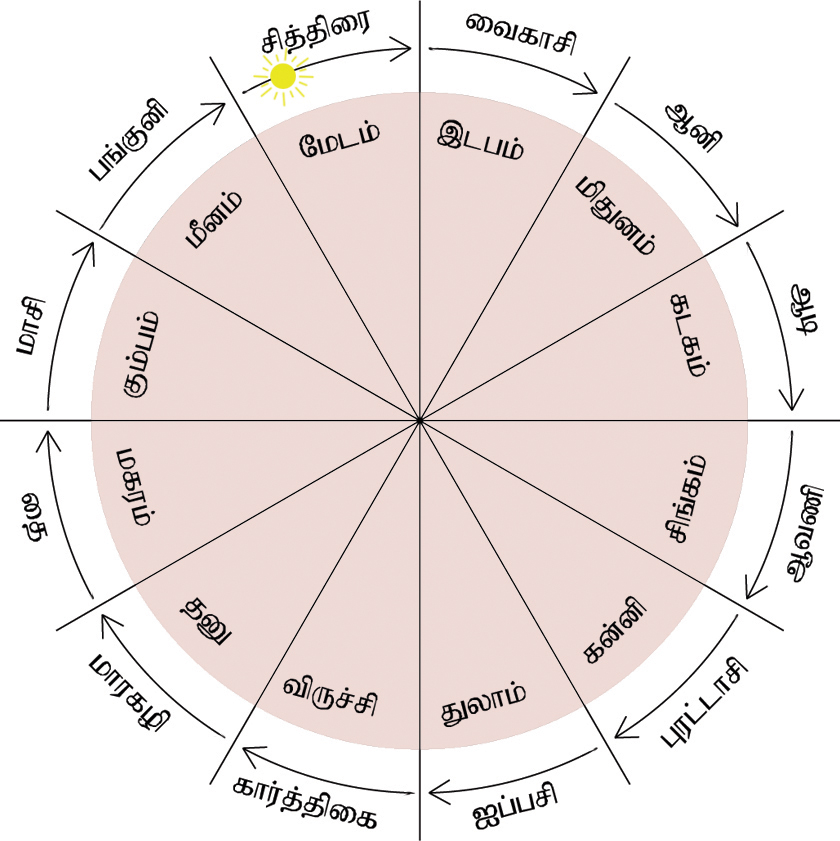
The Tamil calendar is a sidereal solar calendar used by the Tamil people.[1][2] It is used in the Indian subcontinent, and other countries with significant Tamil population like Sri Lanka, Malaysia, Singapore, Myanmar and Mauritius. It is used in contemporary times for cultural, religious and agricultural events, with the Gregorian calendar largely used for official purposes.[3]
History
[edit]There are several references to the calendar in early Tamil literature. Nakkeerar, the Sangam period author of the Neṭunalvāṭai, wrote in the third century CE that the Sun travels each year from Mesha/Chittirai in mid-April through 11 successive signs of the zodiac.[4] The same is referenced to by Kūdalūr Kiḻar in Puṟanāṉūṟu.[5][6] Tolkappiyam, the oldest surviving Tamil grammar text, divides the year into six seasons and Chittirai marks the start of the "ilavenil" (summer) season.[7] The fifth century CE treatise of Cilappatikaram mentions the 12 rāśis (zodiac signs) that correspond to the Tamil months.[8] The sixth century epic Manimekalai alludes to this to thhe Hindu solar calendar.[9]
Inscriptional evidences from Pagan in Myanmar from the 11th century CE and in Sukhothai in Thailand from the 14th century CE point to South Indian courtiers being tasked with defining the traditional calendar that followed a similar cycle.[10][11]
Description
[edit]The Tamil calendar is based on the Hindu system of calendrics that was used to calculate date and time.[12] The Tirukkanida Panchanga derived from astronomical data is used as a basis for the same.[13] The calendar is similar to traditional calendars followed in other parts of the Indian subcontinent, and Southeast Asia.[14]
The Tamil calendar follows a 60-year cycle similar to the other traditional calendars of India.[15] The Tamil New Year follows the Nirayana system, and usually falls on 13 or 14 April in the Gregorian year.[16] The new year starts on the date arrived by adding the days corresponding to the 23 degrees of trepidation (oscillation) to the vernal equinox, when the Sun begins its transition as per the Hindu sidereal calendar.[17][page needed] A Tamil calendar year might consist of 365 or 366 days in a year.[18]
Sixty-year cycle
[edit]The 60-year cycle is common to Hindu traditional calendars, with similar names and sequence of years. The earliest reference of the same is in Surya Siddhanta, dated between 4th and 9th century CE. There are parallels to the sexagenary cycle used in the Chinese calendar,[19][20][21] though which influenced the other has been subject to debate.[22]
After the completion of a cycle of sixty years, the calendar re-starts with the first year of a new cycle.[23] As per the Hindu Panchangam, it represents the year in which Shani Saturn (which takes 30 years to complete one cycle round the Sun) and Vyalan (Jupiter) (which takes 12 years to complete one cycle round the Sun) come to a same position after 60 years.[24][25]
The following list presents the current 60-year cycle of the Tamil calendar:[26]
| No. | Name | Transliteration | Gregorian Year | No. | Name | Transliteration | Gregorian Year | |
|---|---|---|---|---|---|---|---|---|
| 01. | பிரபவ | Prabhāva | 1987–1988 | 31. | ஹேவிளம்பி | Hēvilaṃbi | 2017–2018 | |
| 02. | விபவ | Vibhāva | 1988–1989 | 32. | விளம்பி | Vilaṃbi | 2018–2019 | |
| 03. | சுக்ல | Śuklā | 1989–1990 | 33. | விகாரி | Vikāri | 2019–2020 | |
| 04. | பிரமோதூத | Pramadutā | 1990–1991 | 34. | சார்வரி | Śarvarī | 2020–2021 | |
| 05. | பிரசோற்பத்தி | Prachopati | 1991–1992 | 35. | பிலவ | Plava | 2021–2022 | |
| 06. | ஆங்கீரச | Āṅgirasa | 1992–1993 | 36. | சுபகிருது | Śubhakṛt | 2022–2023 | |
| 07. | ஸ்ரீமுக | Śrīmukha | 1993–1994 | 37. | சோபக்ருத் | Śobhakṛt | 2023–2024 | |
| 08. | பவ | Bhava | 1994–1995 | 38. | க்ரோதி | Krodhī | 2024–2025 | |
| 09. | யுவ | Yuva | 1995–1996 | 39. | விசுவாசுவ | Viśvāvasuva | 2025–2026 | |
| 10. | தாது | Dhātu | 1996–1997 | 40. | பரபாவ | Parapāva | 2026–2027 | |
| 11. | ஈஸ்வர | Īśvara | 1997–1998 | 41. | ப்லவங்க | Plavaṅga | 2027–2028 | |
| 12. | வெகுதானிய | Vehudānya | 1998–1999 | 42. | கீலக | Kīlaka | 2028–2029 | |
| 13. | பிரமாதி | Pramāti | 1999–2000 | 43. | சௌம்ய | Saumya | 2029–2030 | |
| 14. | விக்ரம | Vikrama | 2000–2001 | 44. | சாதாரண | Sādhāraṇa | 2030–2031 | |
| 15. | விஷு | Viṣu | 2001–2002 | 45. | விரோதகிருது | Virodhikṛti | 2031–2032 | |
| 16. | சித்திரபானு | Citrabhānu | 2002–2003 | 46. | பரிதாபி | Paritapi | 2032–2033 | |
| 17. | சுபானு | Subhānu | 2003–2004 | 47. | பிரமாதீச | Pramādīca | 2033–2034 | |
| 18. | தாரண | Dhārana | 2004–2005 | 48. | ஆனந்த | Ānanda | 2034–2035 | |
| 19. | பார்த்திப | Partibhā | 2005–2006 | 49. | ராட்சச | Rākṣasaḥ | 2035–2036 | |
| 20. | விய | Viya | 2006–2007 | 50. | நள | Nala | 2036–2037 | |
| 21. | சர்வஜித் | Sarvajit | 2007–2008 | 51. | பிங்கள | Piṅgāla | 2037–2038 | |
| 22. | சர்வதாரி | Sarvadhārī | 2008–2009 | 52. | காளயுக்தி | Kālayukti | 2038–2039 | |
| 23. | விரோதி | Virodhī | 2009–2010 | 53. | சித்தார்த்தி | Siddhidātrī | 2039–2040 | |
| 24. | விக்ருதி | Vikṛti | 2010–2011 | 54. | ரௌத்திரி | Rautrī | 2040–2041 | |
| 25. | கர | Kara | 2011–2012 | 55. | துன்மதி | Dhūnmatī | 2041–2042 | |
| 26. | நந்தன | Nandhana | 2012–2013 | 56. | துந்துபி | Dundubhi | 2042–2043 | |
| 27. | விஜய | Vijaya | 2013–2014 | 57. | ருத்ரோத்காரி | Rudhirōtgāri | 2043–2044 | |
| 28. | ஜய | Jaya | 2014–2015 | 58. | ரக்தாட்சி | Rākṣasī | 2044–2045 | |
| 29. | மன்மத | Manmatha | 2015–2016 | 59. | க்ரோதன | Krodhanā | 2045–2046 | |
| 30. | துன்முகி | Dhuṇmūkī | 2016–2017 | 60. | அட்சய | Akṣayā | 2046–2047 |
Months
[edit]There are twelve months in the Tamil calendar, with 29 to 32 days per month.[27] Tamil months start and end based on the Sun's shift from one rasi to the other, and the names of the months are based on the nakshatra (star) that coincides with the start of the pournami (full moon) in that month.[28] The Tamil calendar month starts a few days after the corresponding Hindu calendar month as the Tamil calendar is a solar calendar, while the other is a lunisolar calendar.[29]
| Month (in Tamil) | English transliteration | Hindu Lunar calendar | Nakshatra | Gregorian calendar | Days |
|---|---|---|---|---|---|
| சித்திரை | Chittirai | Chaitra | Chittirai | April–May | 30–31 |
| வைகாசி | Vaikāsi | Vaisakha | Visakam | May–June | 31–32 |
| ஆனி | Āni | Jyestha | Anusham | June–July | 31–32 |
| ஆடி | Ādi | Asadha | Pooradam or Uthiradam | July–August | 31–32 |
| ஆவணி | Āvaṇi | Shravana | Thiruvonam | August–September | 31–32 |
| புரட்டாசி | Puraṭṭāsi | Bhadrapada | Pooratathi or Uthiratathi | September–October | 30–31 |
| ஐப்பசி | Aippasi | Asvina | Ashvini | October–November | 29–30 |
| கார்த்திகை | Kārtikai | Kartika | Kartikai | November–December | 29–30 |
| மார்கழி | Mārgaḻi | Margashirsha | Mirgashirsham | December–January | 29–30 |
| தை | Tai | Pausha | Pusham | January–February | 29–30 |
| மாசி | Māsi | Magha | Magham | February–March | 29–30 |
| பங்குனி | Panguni | Phalguna | Uttiram | March–April | 30–31 |
Seasons
[edit]A Tamil year is divided into six seasons, each of which lasts two months.[30][31]
| Season (in Tamil) | English transliteration | English translation | Hindu calendar | Common season | Tamil month(s) | Gregorian month(s) |
|---|---|---|---|---|---|---|
| இளவேனில் | Ila-venil | Light warmth | Vasanta | Spring | Chittirai, Vaikāsi | April–June |
| முதுவேனில் | Mudhu-venil | Harsh warmth | Grishma | Summer | Āni, Ādi | June–August |
| கார் | Kār | Dark clouds | Varsha | Monsoon | Āvaṇi, Puraṭṭāsi | August–October |
| குளிர் | Kulir | Cold | Sharda | Autumn | Aippasi, Kārtikai | October–December |
| முன்பனி | Mun-pani | Early mist | Hemanta | Winter | Mārgaḻi, Thai | December–February |
| பின்பனி | Pin-pani | Late mist | Shishira | Pre-vernal | Māsi, Panguni | February–April |
Days of a week
[edit]The days of week (Kiḻamai) in the Tamil calendar relate to the celestial bodies in the Solar System: Sun, Moon, Mars, Mercury, Jupiter, Venus, and Saturn, in that order. A week usually starts with Sunday, and ends in a Saturday.[32][33]
| Day (in Tamil) | English transliteration | Shaka Calendar | Deity | Celestial body | Gregorian Calendar |
|---|---|---|---|---|---|
| ஞாயிற்றுக்கிழமை | Nyayitru-kiḻamai | Ravivāra | Surya | Sun | Sunday |
| திங்கட்கிழமை | Tingat-kiḻamai | Somavāra | Chandra | Moon | Monday |
| செவ்வாய்க்கிழமை | Chevvai-kiḻamai | Mangalavāra | Mangala | Mars | Tuesday |
| புதன்கிழமை | Budhan-kiḻamai | Budhavāra | Budha | Mercury | Wednesday |
| வியாழக்கிழமை | Vyaḻa-kiḻamai | Guruvāra | Brihaspati | Jupiter | Thursday |
| வெள்ளிக்கிழமை | Velli-kiḻamai | Śukravāra | Shukra | Venus | Friday |
| சனிக்கிழமை | Sani-kiḻamai | Śanivāra | Shani | Saturn | Saturday |
Significance
[edit]The various days and months of the Tamil Calendar are of specific significance to Tamil Hindus. The Vakiya Panchangam is employed for calculation of sacred days, while the Tirugaṇita Panchangam is employed for astrological calculations.[34]
The months and their significant events and festivals are listed below.[29][35]
| Month | Events/festivals |
|---|---|
| Chittirai | Chitra Pournami, Meenakshi Tirukalyanam, Puthandu |
| Vaikāsi | Vaikasi Visakam |
| Aani | Aani Thirumanjanam, Mangani |
| Āadi | Chevvai (Tuesdays) and Velli (Fridays) dedicated to Mariamman; Aadi Amavasai, Aadi Perukku, Pooram |
| Āvaṇi | Avani Avittam, Gokulashtami, Vinayakar Chaturti |
| Puratāsi | Shani (Saturdays) dedicated to Vishnu; Navarathri |
| Aippasi | Deepavali |
| Kārtikai | Thingal (Mondays) dedicated to Shiva; Karthigai Deepam, Karthigai Pournami |
| Margaḻi | Hanuman Jayanti, Thiruvathirai, Vaikuntha Ekadasi[36] |
| Thai | Pongal, Thaipusam |
| Māsi | Maha Shivaratri, Masi Maham, Poochoriyal |
| Panguni | Panguni Uthiram, Rama Navami |
See also
[edit]References
[edit]- ^ S.K. Chatterjee, Indian Calendric System, Publications Division, Ministry of Information and Broadcasting, Government of India, 1998
- ^ Sewell, Robert and Dikshit, Sankara B.: The Indian Calendar – with tables for the conversion of Hindu and Muhammadan into a.d. dates, and vice versa. Motilal Banarsidass Publ., Delhi, India (1995). Originally published in 1896
- ^ Indian Epigraphy, D.C. Sircar, TamilNet, Tamil New Year, 13 April 2008
- ^ JV Chelliah (1985). "Neṭunalvāṭai (lines 160 to 162)". Pattupattu: Ten Tamil Idylls. Tamil Verses with English Translation. Thanjavur: Tamil University.
- ^ "Poem 229". The Four Hundred Songs of War and Wisdom: An Anthology of Poems from Classical Tamil, The Purananuru. Columbia University Press. 13 August 2013.
- ^ Vaiyapuri Pillai (1956). History of Tamil Language and Literature. Chennai. pp. 35, 151.
{{cite book}}: CS1 maint: location missing publisher (link) - ^ R.P.C Pavanantam Pillai, ed. (1917). Tolkappiyam Porulatikaram, Peraciriyam. Longmans, Creen and Co.
- ^ R. Parthasarathy. The Tale of an Anklet: An Epic of South India: The Cilappatikāram of Iḷaṅko Aṭikaḷ. New York city: Columbia University Press.
Canto 26. Canto 5 also describes the foremost festival in the Chola country – the Indra Vizha celebrated in Chitterai
- ^ Lakshmi Holmstrom (1996). Silappadikaram, Manimekalai. Madras: Orient Longman.
- ^ G.H. Luce. Old Burma – Early Pagan. Locust Valley, New York. p. 68.
- ^ A.B. Griswold (1967). Towards a History of Sukhodaya Art. Bangkok. pp. 12–32.
{{cite book}}: CS1 maint: location missing publisher (link) - ^ Wijk, Walther E. van (1922–1927). On Hindu Chronology, parts I–V. Acta Orientalia.
- ^ H.P. Blavatsky (1888). The Secret Doctrine: The Synthesis of Science, Religion and Philosophy. Theosophical University Press. pp. 49–51.
- ^ Underhill, Muriel M. (1921). The Hindu Religious Year. Kolkata: Association Press.
- ^ "The Tamil Calendar – 60-Year Cycle". Time and Date. Retrieved 1 October 2025.
- ^ "Tamil Calendar". Speaking Tree. Retrieved 1 October 2025.
- ^ Dershowitz, Nachum and Reingold, Edward M. (2008). Calendrical Calculations (third ed.). Cambridge University Press.
{{cite book}}: CS1 maint: multiple names: authors list (link) - ^ "South-Indian Chronological Tables (1889)" (PDF). Tamil Digital Library. Retrieved 1 October 2025.
- ^ Samuel Wells Williams (2005). The Middle Kingdom. New York city: Columbia University Press. pp. 69–70.
- ^ Paul Kekai Manansala (2006). Quests of the Dragon and Bird Clan. p. 236.
- ^ Terrien de Lacouperie (1894). Western Origin of the Early Chinese Civilization: From 2,300 BC to 20 AD. London: Asher and Co. p. 78.
- ^ George Gheverghese Joseph (2011). Crest of the Peacock: Non-European Roots of Mathematics. Princeton University Press. pp. 304–305.
- ^ "Indian Calendar Part 3 – The Panchangam". Anaadi Foundation. 17 July 2018. Retrieved 1 October 2025.
- ^ "Samvatsara – The Name of the Hindu Year". The Divine India. Retrieved 1 October 2025.
- ^ "Samvatsara". CulKey Foundation. Retrieved 1 October 2025.
- ^ Satguru Sivaya Subramuniyaswami (1997). Vedic calendar: Kadavul Hindu Panchangam. Kapaa, Hawaii: Himalayan Academy. pp. 5–6, 10.
- ^ "Tamil Months Calendar with names in Sanskrit, Malayalam & English". Hindu Devotional Blog. May 2009. Retrieved 1 October 2025.
- ^ "Cultural Chronicles in Calendar". The New Indian Express. Retrieved 1 October 2025.
On the full moon day … the nakshatra (star) that is regarded–be ascendant … hence the month is named
- ^ a b Kielhorn, Franz (1897). "Festal Days of the Hindu Lunar Calendar". The Indian Antiquary. XXVI: 177–187.
- ^ "Six Seasons: Same for South & North Indians". Tamil & Vedas. 21 July 2014. Retrieved 1 October 2025.
- ^ "Tamil Calendar – Seasons". SpeakingTree. Retrieved 1 October 2025.
- ^ "Tamil Calendar – Days of the Week". Time and Date. Retrieved 1 October 2025.
- ^ "Who Named the Days of the Week?". Tamil and Vedas. 23 April 2023. Retrieved 1 October 2025.
- ^ "Hindu Almanacs: Sentential and Mathematical in Sri Lanka" (PDF). Journal of Humanities and Social Sciences. 9 (2). December 2020. Retrieved 1 October 2025.
- ^ Underhill, Muriel M. (1921). The Hindu Religious Year. Kolkata: Association Press.
- ^ Achuthananda, Swami (27 August 2018). The Ascent of Vishnu and the Fall of Brahma. Relianz Communications Pty Ltd. p. 107. ISBN 978-0-9757883-3-2.
External links
[edit]| Systems | |||||
|---|---|---|---|---|---|
| In wide use | |||||
In limited use | |||||
| Historical | |||||
| By specialty |
| ||||
| Reform proposals | |||||
Displays and applications | |||||
Year naming and numbering |
| ||||
| Fictional | |||||


Tamil calendar
View on Grokipedia| Month Name | Approximate Gregorian Period | Key Significance/Festivals |
|---|---|---|
| Chithirai | Mid-April to mid-May | Tamil New Year (Puthandu), Chithirai festival at Madurai.[2][3] |
| Vaikasi | Mid-May to mid-June | Vaikasi Visakam (birth of Murugan).[2] |
| Aani | Mid-June to mid-July | Aani Thirumanjanam.[2] |
| Aadi | Mid-July to mid-August | Aadi Perukku (river worship), Aadi Pooram.[2] |
| Avani | Mid-August to mid-September | Vinayaka Chaturthi.[2] |
| Purattasi | Mid-September to mid-October | Navaratri.[2] |
| Aippasi | Mid-October to mid-November | Deepavali.[2] |
| Karthikai | Mid-November to mid-December | Karthigai Deepam.[2] |
| Margazhi | Mid-December to mid-January | Margazhi Utsavam.[2] |
| Thai | Mid-January to mid-February | Thai Pongal.[2] |
| Masi | Mid-February to mid-March | Maha Shivaratri.[2] |
| Panguni | Mid-March to mid-April | Panguni Uthiram.[2] |
Overview
Description
The Tamil calendar is a traditional sidereal solar calendar primarily used by Tamil-speaking communities in Tamil Nadu, India, and northern Sri Lanka, where it serves as a cultural and agricultural reference for determining seasons and events.[4][5] It tracks the apparent movement of the Sun through the zodiac constellations along the ecliptic, dividing the year into months based on the Sun's progression relative to these fixed stellar positions, rather than the Earth's orbit around the Sun as in tropical calendars.[6] This sidereal approach ensures alignment with the stars, reflecting ancient astronomical observations in South Indian traditions.[7] Astronomically, the calendar is founded on the sidereal solar year, which measures approximately 365.256 days—the time required for the Earth to complete one orbit relative to the fixed stars.[6] Each of the 12 months begins on the day of sankranti, the Sun's ingress or transition into a new zodiac sign, creating months of 29 to 32 days that vary slightly to maintain synchronization with solar transits. These varying lengths ensure the calendar aligns with the sidereal year without the need for leap days or extra months.[8][9] The year commences with the month of Chithirai around mid-April, coinciding with the Sun's entry into the Mesha (Aries) rashi, marking the start of the agricultural cycle in the region.[10] Unlike lunisolar calendars prevalent in much of India, such as the broader Hindu calendar, the Tamil calendar is purely solar and does not rely on lunar phases for its primary month divisions or year length, though lunar tithis are consulted separately for religious timings.[7][6] This distinction allows it to remain closely tied to seasonal and solar events without the periodic insertion of extra lunar months (adhikamasam) seen in lunisolar systems to align lunar cycles with the solar year.[11]History
The Tamil calendar has its ancient roots in the Sangam period, dating back to approximately the 3rd century BCE, where it developed from early Dravidian astronomical practices intertwined with Vedic influences. This era's literature reflects an agrarian society attuned to solar cycles for agricultural timing, marking the initial formation of a sidereal solar system distinct to South Indian traditions.[12] Early references appear in Sangam literature, notably the Tolkappiyam, the oldest extant Tamil grammar text, which categorizes the year into six seasons (tinai) based on climatic and ecological divisions, laying foundational concepts for calendrical structure. By the medieval period, works like the Thiruvilaiyadal Puranam (circa 18th century, drawing on earlier traditions) incorporate calendrical elements in narrating divine events tied to Tamil temporal systems. The adoption of a formalized solar sidereal framework solidified between the 8th and 10th centuries CE during the Chola dynasty, as evidenced in royal patronage of astronomical computations for temple rituals and state affairs.[13][14] The calendar's evolution involved integrating elements of Jyotisha (Vedic astronomy) with indigenous Tamil observational methods, such as tracking solar transits through local zodiacal signs, which caused divergence from the predominantly lunisolar calendars of North India. This synthesis emphasized precise solar year measurements suited to Tamil Nadu's equatorial climate and agricultural needs. Pre-colonial standardization emerged through extensive use in Pallava (6th–9th centuries CE) and Chola (9th–13th centuries CE) temple inscriptions and royal edicts, where dates were recorded using month names, nakshatras, and year designations to document grants, conquests, and festivals. By the 12th century, the 60-year samskar cycle—borrowed and adapted from broader Indian astronomical traditions—became firmly established in these records, providing a recurring framework for chronological reckoning.[14]Calendar Components
Months
The Tamil calendar divides the solar year into 12 months, each commencing on the day the Sun transits into a specific zodiac sign (rashi), an event termed Sankranti, ensuring alignment with the sidereal solar cycle of approximately 365.25 days.[6] This solar-based structure distinguishes it from lunisolar systems, with months varying in length—typically 30 or 31 days, occasionally 32—to accommodate the tropical year's fractional day without inserting extra months. The following table lists the 12 months, their approximate Gregorian equivalents, and corresponding Sankranti transits:| Month Name | Tamil Script | Gregorian Range | Starting Sankranti (Zodiac Sign) |
|---|---|---|---|
| Chithirai | சித்திரை | April 14–May 14 | Mesha (Aries) |
| Vaikasi | வைகாசி | May 15–June 14 | Vrishabha (Taurus) |
| Aani | ஆனி | June 15–July 16 | Mithuna (Gemini) |
| Aadi | ஆடி | July 17–August 16 | Karka (Cancer) |
| Avani | ஆவணி | August 17–September 16 | Simha (Leo) |
| Purattasi | புரட்டாசி | September 17–October 16 | Kanya (Virgo) |
| Aippasi | ஐப்பசி | October 17–November 15 | Tula (Libra) |
| Karthikai | கார்த்திகை | November 16–December 15 | Vrischika (Scorpio) |
| Margazhi | மார்கழி | December 16–January 14 | Dhanus (Sagittarius) |
| Thai | தை | January 15–February 13 | Makara (Capricorn) |
| Masi | மாசி | February 14–March 15 | Kumbha (Aquarius) |
| Panguni | பங்குனி | March 16–April 13 | Meena (Pisces) |