Hubbry Logo
Alfred TerryAlfred TerryMain
Open search
Alfred Terry
Community hub
Alfred Terry
logo
8 pages, 0 posts
0 subscribers
Be the first to start a discussion here.
Alfred Terry
Alfred Terry
from Wikipedia

Alfred Howe Terry (November 10, 1827 – December 16, 1890) was a Union general in the American Civil War and the military commander of the Dakota Territory from 1866 to 1869, and again from 1872 to 1886. In 1865, Terry led Union troops to victory at the Second Battle of Fort Fisher in North Carolina.

Key Information

Early life and career

[edit]

Although born in Hartford, Connecticut, Alfred Terry's family quickly moved to New Haven, where he spent most of his childhood. Terry graduated from the Hopkins School in New Haven in 1838. After attending Yale Law School in 1848, Terry became a lawyer and was appointed clerk of the Superior Court of New Haven County.

Civil War

[edit]

South Carolina

[edit]

When the Civil War started, Terry raised the 2nd Connecticut Infantry Regiment, and was appointed colonel. The regiment fought at First Bull Run, after which Terry and his regiment were transferred to South Carolina. On September 13, 1861, at New Haven, Connecticut, Col. Terry organized an elite and special regiment, 7th Regiment Connecticut Volunteer Infantry, a three-year regiment, naming Joseph Roswell Hawley, who assisted in raising the regiment, as lieutenant colonel. He was appointed brigadier general of volunteers in April 1862 and placed in command of the Morris Island Division of the X Corps. Terry was heavily involved in the siege operations against Charleston during 1863 and Morris Island, South Carolina. Troops under Terry's direct command were engaged at a skirmish at Grimball's Landing and later succeeded in capturing Fort Wagner in September 1863, but the following year the entire X Corps was sent north to Benjamin Butler's Army of the James in Virginia.

Virginia

[edit]

Terry's Morris Island Division was redesignated the 1st Division, X Corps, and fought at the Battle of Proctor's Creek and in the Bermuda Hundred Campaign around Richmond. Once the Siege of Petersburg began, Terry continued to fight in the battles north of the James River, notably at the Battle of New Market Heights. Upon the death of X Corps commander David B. Birney in October, Terry briefly assumed command of the corps before it was dissolved. His leadership was never in question, but he had not achieved the same battlefield glory that many of his counterparts had won by this time in the war.

Fort Fisher and North Carolina

[edit]
Maj. Gen. Alfred Terry (painting/excerpt 1890): leading the Union Army to capture Fort Fisher in January 1865.

Terry's greatest achievement of the war came when he was placed in command of the Fort Fisher Expeditionary Corps. Benjamin Butler had previously failed in an expedition against Fort Fisher at the end of 1864. Terry had gained the confidence of General Ulysses S. Grant and was now in command of the ground forces in a second expedition against the fort. Unlike Butler, Terry worked well with the Navy under the command of David D. Porter. On January 13, 1865, Terry sent a division of United States Colored Troops to hold off Confederate forces under Braxton Bragg to the north of Fort Fisher. He sent his other division under Adelbert Ames against the northern part of the fort. After hand-to-hand fighting, the Union troops took control of the fort. For his part in the Battle of Fort Fisher, Terry was promoted to major general of volunteers and brigadier general in the regular army. Reinforcements arrived in February and John M. Schofield arrived to take overall command of the campaign against Wilmington, North Carolina. After the fall of Wilmington, the Fort Fisher Expeditionary Corps was renamed the X Corps, with Terry remaining in command, and participated in the final stages of the Carolinas Campaign. He is generally considered one of the most capable generals with no previous military training to emerge from the war.

Postbellum activities

[edit]
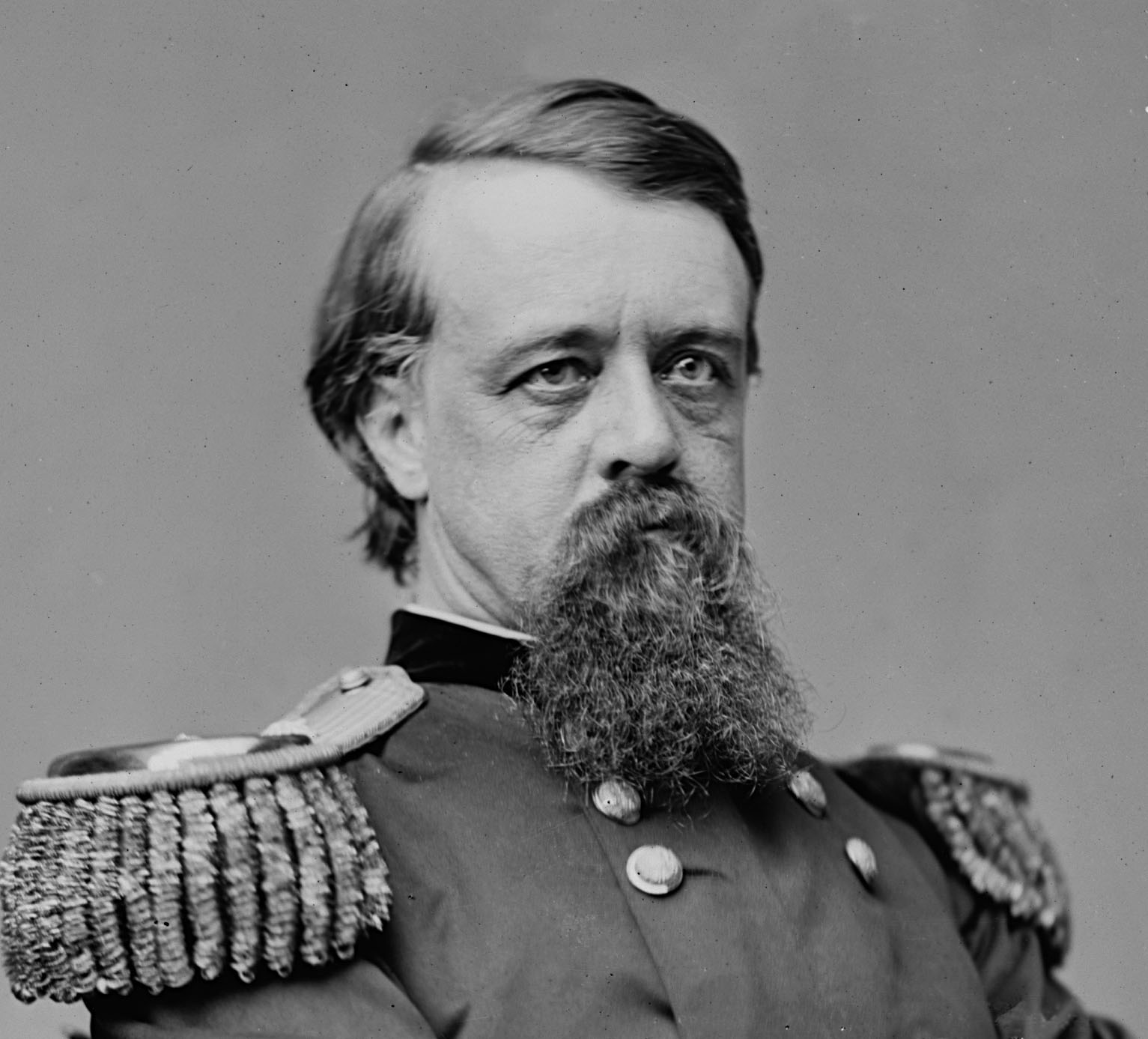
Alfred Terry after the war
Terry as he appears at the Cape Fear Museum in Wilmington, North Carolina, near which he captured Fort Fisher in 1865.

After the war, Terry remained in the military. He helped to negotiate the Treaty of Fort Laramie (1868), which ended Red Cloud's campaign against American troops in the region. Terry became a strong opponent of the Ku Klux Klan after being assigned as the last military governor of the Third Military District, based in Atlanta, where he served beginning on December 22, 1869.

Terry was the commander of the U.S. Army column marching westward into the Montana Territory during what is now popularly known as the Centennial Campaign of 1876–77. Two other columns marched toward the same objective area (George Crook's from the south and John Gibbon's from the west). A column of troops under his command arrived shortly after the Battle of Little Bighorn and discovered the bodies of Custer's men. His aide-de-camp, Robert Patterson Hughes, who was also his brother-in-law, investigated Custer's activities before and during the battle and authored a critical report.[1] In October 1877, he went to Canada to negotiate with Sitting Bull. He was still in command in Montana during the Nez Perce War and sent reinforcements to intercept Chief Joseph.

In 1878, Terry joined Maj. Gen. John Schofield on a presidential board asked to reexamine the conviction by court-martial of Fitz John Porter. The board found that Porter had been unfairly convicted of cowardice and disobedience.

In 1881, as the Northern Pacific Railway's transcontinental rail line was building across Montana, the new town of Terry, Montana was named in his honor.[2]

In 1886, Terry was promoted to major general and was given command of the Military Division of the Missouri, headquartered in Chicago. He retired from the Army on 5 April 1888. He died two years later in New Haven, Connecticut, where he is buried in Grove Street Cemetery.

General Terry was a First Class Companion of the Military Order of the Loyal Legion of the United States, a military society for officers of the Union Armed Forces and their descendants.

In 1897, construction commenced on Fort Terry, part of the Harbor Defenses of Long Island Sound.

Media portrayals

[edit]

In 1967, Terry was portrayed by Robert F. Simon (1908–1992) on the ABC television series Custer.

Terry is interpreted by Philippe Noiret in the 1974 Franco-Italian satirical Marco Ferreri movie Don't Touch the White Woman!, a farcical, counter-cultural, highly politicized and surreal re-enactment of the run up to the 1876 Battle of the Little Bighorn.

In 1991, Terry was portrayed by Terry O'Quinn in the television film Son of the Morning Star.

See also

[edit]

References

[edit]
[edit]
Revisions and contributorsEdit on WikipediaRead on Wikipedia
from Grokipedia
Alfred Howe Terry (November 10, 1827 – December 16, 1890) was a Union Army major general during the , best known for commanding the expeditionary force that captured , the Confederacy's last major Atlantic port, in January 1865. Born in , Terry studied law at and was admitted to the bar in 1849, establishing a practice in New Haven before the war. At the outbreak of hostilities, lacking formal military training, he raised and led the 2nd Connecticut Infantry Regiment as colonel, participating in the and subsequent operations along the Carolina coast, including the captures of and Fort Pulaski. Promoted to , he later commanded the X Corps in the Petersburg Campaign, contributing to the siege that weakened Confederate defenses. Following the war, Terry served as commander of the Department of Dakota from 1866 to 1869, managing frontier military affairs across , , and , where he negotiated the 1868 Fort Laramie Treaty with Lakota leaders to secure peace after . His post-war career included oversight of Reconstruction efforts in and involvement in the , after which he retired in 1888 due to health issues. Terry died in New Haven and was buried in .

Early Life and Pre-War Career

Birth and Family Background

Alfred Howe Terry was born on November 10, 1827, in . His parents were Alfred Terry (1802–1860), a graduate who practiced law in New Haven, and Clarissa Howe Terry (1803–1874); the family relocated to New Haven shortly after his birth, where Terry spent most of his childhood. The Terrys came from a prosperous background, with Terry's paternal grandparents including Nathaniel Matson Terry, a notable figure in affairs, and Catharine Wadsworth. Terry grew up in a large family, the eldest of at least eight siblings, including sisters Harriet Wadsworth Terry (1830–1911) and brothers Adrian Terry (1831–1906) and others; he maintained close ties with his family throughout his life. His father's and the family's Hartford-New Haven connections provided a stable, educated environment that influenced Terry's early development. Terry received his early education at local schools in , culminating in his graduation from the Hopkins Grammar School in 1838. In 1848, at age 21, Terry enrolled at to pursue legal studies, reflecting the era's emphasis on formal apprenticeship and academic preparation for the bar. He withdrew without earning a degree, a common practice then as law degrees were not prerequisites for admission, and instead completed his training through self-study and practical experience. Admitted to the bar in 1849, Terry commenced private practice in New Haven, establishing himself as a competent attorney before assuming clerical roles in the county courts. His legal training emphasized procedural knowledge and courtroom advocacy, honed further by his subsequent appointment as clerk of the Supreme and Superior Courts of New Haven County, where he managed dockets and assisted judges in routine judicial administration from the early onward. This position provided practical immersion in Connecticut's system, derived from English precedents and adapted to state statutes, without the benefit of modern specialized curricula. No evidence indicates advanced postgraduate study or affiliations during this period, underscoring Terry's reliance on over extended formal instruction.

Civic Roles in Connecticut

Following his admission to the Connecticut bar in 1849, after one year of study at and an apprenticeship in a law office, Alfred Howe Terry assumed civic positions in New Haven. He served as city clerk of New Haven from 1850 to 1854, managing municipal records and administrative duties during a period of local governance focused on urban expansion and infrastructure. In 1854, Terry was appointed clerk of the of New Haven County, a role he held until 1860, involving oversight of court proceedings, record-keeping, and support for judicial operations in civil and criminal cases. This position extended to clerk duties in the of , reflecting his expertise in legal administration amid the state's antebellum judicial system. Concurrently, Terry engaged in Connecticut's system, enlisting as a private in the local New Haven unit in 1849 and advancing to the rank of by 1860 through merit-based promotions. This volunteer service entailed training, organization, and readiness for state defense, aligning with civic expectations for community leadership in the absence of a . In summer 1860, he traveled to to study and fortifications, enhancing his qualifications for potential command. These roles underscored Terry's pre-war contributions to local governance and preparedness in .

American Civil War Service

Initial Mobilization and First Bull Run

At the outbreak of the Civil War following the Confederate attack on Fort Sumter on April 12, 1861, President Abraham Lincoln issued a call on April 15 for 75,000 three-month volunteers to suppress the rebellion, prompting rapid mobilization across Northern states including Connecticut. Alfred H. Terry, a 33-year-old New Haven lawyer and former militia officer with prior service in the Connecticut State Guard, was commissioned colonel of the 2nd Connecticut Infantry Regiment on May 6, 1861, and led its organization from volunteer companies recruited from towns such as Fairfield, Norwalk, and Stamford. The regiment mustered into federal service the next day, May 7, at Camp Buck near New Haven, with a strength of 798 officers and men equipped primarily with .58-caliber Springfield rifled muskets, though some companies received Sharps rifles for skirmishing. Departing Connecticut by rail on May 19, the unit arrived in Washington, D.C., on May 23, where it performed guard duty at the Capitol and Arlington Heights while undergoing drill and integration into Brig. Gen. Irvin McDowell's Army of Northeastern Virginia. As Union forces advanced toward Manassas Junction in mid-July 1861 to confront Confederate troops under , the 2nd formed part of Brig. Gen. Erasmus D. Keyes's 2nd Brigade in Brig. Gen. Daniel Tyler's 1st Division. On July 21, during the , Terry's regiment crossed Bull Run Creek at a ford north of the Stone Bridge around 8:00 a.m., supporting federal artillery and advancing under fire toward the Confederate left flank near the . The unit engaged in skirmishing and sustained volleys from Confederate , contributing to early Union pressure before the federal line collapsed amid reinforcements for the Confederates, including Brig. Gen. Thomas J. Jackson's brigade; the 2nd retreated in disorder with the army, incurring 27 casualties including killed, wounded, and missing. Terry maintained command cohesion during the rout back to Centreville, where the regiment regrouped overnight before withdrawing to Washington. The battle exposed deficiencies in Union training, logistics, and coordination, with the 90-day regiments like the 2nd Connecticut mustering out shortly thereafter due to expiring enlistments; Terry's unit returned to on August 7, 1861, and was officially discharged on August 12 after covering 206 miles of marching and limited combat exposure that highlighted the need for longer-term forces. Terry himself received commendations for his , though the yielded no decisive Union advantage and prompted a shift toward sustained volunteer for three-year terms.

Operations in South Carolina

In November 1861, Terry, commanding the 7th Connecticut Infantry Regiment as colonel, participated in the Union expedition to Port Royal Sound, , under Thomas W. Sherman and Commodore Samuel F. Du Pont. Following a Union naval victory on November 7 that captured forts Walker and Beauregard with minimal infantry involvement, Terry's regiment became the first Union troops to land on soil, raising the American flag at Bay Point on November 8 and securing the area amid abandoned Confederate positions. This operation established a Union foothold on the , enabling further coastal advances and contraband camps for freed slaves, though Terry's role focused on initial occupation rather than combat. Promoted to of volunteers in April 1862, Terry continued coastal operations, including support for the siege of Fort Pulaski in Georgia from bases in early 1862, where Union artillery reduced the fort on April 11 after sustained bombardment. In October 1862, as commander of the 2nd in the U.S. Tenth Corps, he led troops in the Second Battle of Pocotaligo (October 22), part of Major General Ormsby M. Mitchel's inland advance from Hilton Head toward the Charleston & Savannah Railroad. Encountering Confederate defenses under William S. Walker near a causeway and marsh, Terry's , including the 7th and 47th Infantry, faced heavy fire; after skirmishing that stalled the Union push, they withdrew under orders, suffering 44 casualties in his command while inflicting similar losses on the enemy. Throughout 1863, Terry commanded the Division of the X Corps during the prolonged , directing infantry assaults and entrenchments against Confederate strongholds. His forces contributed to the repulse of early attacks on Battery Wagner in but shifted to siege tactics, culminating in the evacuation and capture of Forts Wagner and Gregg on after two months of preparation and operations that neutralized the defenses. These actions, part of broader efforts under Quincy A. Gillmore, isolated Charleston Harbor's approaches but failed to force the city's immediate surrender, with Terry's division enduring malaria outbreaks and supply challenges amid subtropical conditions. By late 1863, his service emphasized methodical reduction of fortifications over decisive battles, paving the way for his transfer to in 1864.

Petersburg and Bermuda Hundred Campaigns

In spring 1864, Brigadier General Alfred H. Terry commanded the 1st Division of the X Corps in the newly formed under Benjamin F. Butler. The corps, transferred from operations, landed unopposed at Bermuda Hundred on the peninsula on May 5, with approximately 30,000 Union troops aiming to sever Confederate rail lines to Richmond and Petersburg while cooperating with George G. Meade's . Terry's division advanced inland as part of Butler's push toward Drewry's Bluff, but Confederate forces under General quickly concentrated to block the routes. On May 12, elements of division skirmished at Proctor's Creek (also known as the Battle of Wooldridge's Hill), where Union forces probed Confederate defenses south of Richmond, suffering light casualties in an inconclusive action that delayed 's momentum. Four days later, on May 16, the division fought in the larger , a against entrenched Confederates that repulsed 's army with over 4,000 Union casualties compared to fewer than 2,500 for the defenders; troops helped cover the disorganized , after which entrenched around Bermuda Hundred, effectively bottled up by Beauregard's improvised "cork" of field fortifications at Swift Creek and elsewhere. These failures stemmed from 's cautious tactics and poor coordination, preventing a decisive threat to Richmond despite initial numerical superiority. As the Petersburg Campaign shifted focus southward in mid-June 1864, Terry's division remained in the Bermuda Hundred lines, conducting demonstrations and raids to fix Confederate troops and support Ulysses S. Grant's operations against Petersburg, which involved over 100,000 Union soldiers by late June. The X , including Terry's command, participated in early efforts, such as reinforcing assaults on Confederate lines east of Petersburg from June 15–18, where Union forces captured portions of the Dimmock Line but at high cost exceeding 10,000 casualties in failed direct attacks. Throughout the prolonged , Terry's division supported diversions like the operations at Deep Bottom, tying down Robert E. Lee's reinforcements, though overall contributions were limited by Butler's hesitancy and terrain constraints. In one notable late action, on , Terry directed the 1st and 3rd Divisions of the X in the Battle of Darbytown Road, a reconnaissance probe south of Richmond that clashed with Confederate and , resulting in Union withdrawal after sustaining around 400 casualties without gaining ground.

Fort Fisher Assault and Capture

Following the failure of the expedition against in December 1864 under Major General , Lieutenant General selected Major General Alfred Terry to command the land forces for a renewed assault. Terry, leading a Provisional Corps drawn primarily from the , assembled approximately 8,000 to 10,000 troops for the operation, coordinated with David D. Porter's naval squadron of 58 ships. The objective was to seize , a massive earthwork fortification protecting the entrance and serving as the Confederacy's primary remaining port for blockade-running supplies into . On January 13, 1865, Terry's forces successfully landed troops on the beach between and the Confederate division under , positioned several miles north, despite rough seas that delayed some landings until January 14. Porter's fleet provided heavy bombardment starting that day, firing over 20,000 shells at the fort's defenses over the subsequent days, though the fort's low-profile earthworks absorbed much of the damage. Terry established a defensive line extending from the beach inland, using it to contain Hoke's unengaged forces while preparing the main assault on the fort's landward face. The decisive assault commenced on January 15, 1865, after intensified naval fire. Terry directed a combined effort involving assaults, naval landing parties, and units that breached the outer palisades using axes and explosives. Union troops, including sailors and marines from Porter's ships, stormed the land face in fierce amid trenches, bombproofs, and minefields, overcoming Confederate defenders led by Colonel William Lamb. By evening, Terry's forces captured the fort after hours of brutal fighting, with Confederate remnants surrendering; approximately 2,583 Confederates were captured, while Union casualties totaled around 1,059, including 184 killed and 749 wounded among Terry's army troops. The capture of Fort Fisher on January 15 marked a critical blow to Confederate logistics, effectively closing Wilmington to foreign aid and prompting the evacuation of remaining defenses upriver. Terry's tactical coordination with naval forces and decision to prioritize the land assault over risky powder ship tactics from the prior expedition were credited with the success, earning him promotion to major general of volunteers on January 16, 1865.

Subsequent North Carolina Operations

Following the capture of Fort Fisher on January 15, 1865, Major General Alfred H. Terry advanced his Provisional Corps northward along the Cape Fear River toward Wilmington, the Confederacy's remaining major Atlantic port. This movement aimed to sever the last significant Confederate supply line into the Deep South. On February 11, , Terry commenced operations against Confederate defenses south of Wilmington, including Sugar Loaf Battery and Fort Buchanan, while coordinating with Major General John M. Schofield's XXIII advancing from the northwest after near Beaufort. Confederate General , facing superior numbers, evacuated Wilmington on February 21, enabling Terry's troops to enter from the south and occupy the city unopposed on February 22. The fall of Wilmington closed the final Confederate port on the East Coast, depriving the army of vital imports. Terry's command was subsequently redesignated as the X Corps, which joined Schofield's consolidated force for inland operations to secure the Wilmington and Weldon Railroad and link with T. Sherman's advancing army. In early March, X Corps supported engagements at Wyse Fork (March 8–10) and Kinston (March 14), where Union forces repelled Confederate counterattacks under General . By March 21, 1865, the combined army reached Goldsboro, completing the strategic concentration in that contributed to the Confederacy's collapse.

Post-Civil War Military Commands

Reconstruction Duties and Brevet Promotions

Following the surrender of Confederate forces in April 1865, Terry assumed command of the Department of Virginia on June 14, 1865, overseeing military governance amid the transition from wartime occupation to civilian reconstruction. In this role, which extended until August 6, 1866, his troops enforced federal authority, suppressed potential disorders, and assumed responsibilities for law enforcement previously held by civilian officials, including the suppression of guerrilla activities and the protection of freedmen's rights under early presidential reconstruction policies. Terry's orders, such as General Order Number Four issued January 17, 1866, emphasized orderly demobilization of Union forces while maintaining stability to prevent resurgence of Confederate sympathy or violence. In January 1870, Terry was appointed the final commanding general of the Third Military District, encompassing Georgia, , and , under the congressional . He implemented "Terry's Purge" by removing 24 ex-Confederate members of the who failed the congressional test-oath of loyalty to the Union, replacing them with Republican candidates and reinstating 33 previously expelled African American legislators to ensure compliance with federal mandates for loyal . These actions, while advancing Republican control and political participation, drew opposition from former Confederates and Democrats, highlighting the coercive nature of enforcement in restoring state governments to Union standards. During this tenure, Terry actively opposed the Ku Klux Klan's emerging violence against freedmen and Republicans, deploying troops to curb intimidation and maintain order. For his Civil War service, particularly the capture of , Terry received a brevet promotion to in the United States , dated March 13, 1865, with formal recognition extended post-war as part of honors for meritorious conduct ending the conflict. This brevet, alongside his volunteer rank of confirmed January 15, 1865, elevated his standing without altering peacetime command authority, reflecting congressional acknowledgment of Union victories amid .

Department of Dakota Command

Alfred Howe Terry assumed command of the Department of Dakota on May 15, 1866, shortly after the conclusion of the , with headquarters initially established at , . The department's jurisdiction extended over the vast northern Plains region, including the Dakota Territory, , and portions of surrounding areas, encompassing military posts, frontier settlements, and interactions with Native American tribes such as the . His responsibilities included maintaining order, protecting settlers and railroads from potential threats, overseeing troop deployments, and coordinating surveys for infrastructure development, such as the , while adhering to federal policies on Native relations. Terry's tenure from 1866 to 1869 emphasized administrative stability and preparatory measures for frontier security, including the fortification of key outposts and the enforcement of treaties amid rising tensions over land use and resource encroachments. In 1867, he participated in the , which negotiated agreements that temporarily resolved conflicts from by securing safe passage for traffic and the abandonment of certain forts, reflecting a pragmatic approach to de-escalation through diplomacy backed by military readiness. Relieved of command in 1869 for Reconstruction duties in the Department of the South, Terry returned to the Department of Dakota in April 1872, resuming oversight until 1886 and becoming its longest-serving commander, totaling nearly 20 years across both periods. Under his renewed leadership, Terry focused on logistical enhancements, such as improving supply lines and garrison strengths at forts like and Randall, to support expanding civilian migration and economic activities while monitoring compliance with prior treaties. He advocated for measured responses to tribal unrest, prioritizing gathering and coordinated operations over unilateral , which informed subsequent campaigns against non-compliant groups. This administrative framework facilitated the department's role in broader U.S. expansion, though it faced challenges from environmental hardships, limited resources, and evolving federal directives on Native assimilation and land allocation. Terry's command ended in 1886 upon his promotion to head the Division of the , marking the culmination of his extensive oversight of Plains affairs.

Involvement in Great Sioux War

As commander of the Department of Dakota from 1872 to 1886, Brigadier General Alfred H. Terry bore primary responsibility for military operations against non-treaty Sioux and bands in the northern during the –1877. In early 1876, Terry coordinated with Major General , commanding the Division of the Missouri, to launch a multi-column spring offensive aimed at trapping hostile Lakota and Northern north of the and forcing their surrender or relocation to agencies. This strategy sought to prevent Indian forces from escaping northward while complementing Brigadier General George Crook's southward column from the Department of the Platte; Terry's planning emphasized securing agencies like Standing Rock and by disarming and dismounting agency Indians to isolate them from hostiles. Terry departed , , on May 1, 1876, at the head of the Dakota Column, comprising approximately 1,000 troops including the (12 companies under George A. Custer), elements of the 2nd Cavalry, 7th Infantry, and detachment, supported by . Delayed from an initial start by harsh winter conditions, the column advanced westward along the , linking with Colonel John Gibbon's Montana Column (four companies of the 2nd Cavalry, seven of the 7th Infantry, and ) near the mouth of the Bighorn River by late June. On June 22, 1876, at the mouth of the Rosebud River in , Terry issued written field orders to Custer directing the 7th Cavalry to scout and pursue a fresh trail northwestward, potentially toward the , while maintaining contact with Gibbon's force to effect a pincer of any large village; the orders granted Custer tactical discretion to strike if feasible but required reporting back upon ration exhaustion unless otherwise directed. During the on June 25–26, 1876, Terry remained with the main supply train and infantry, positioning the combined Terry-Gibbon force to block northern escape routes, while Custer's detached regiment engaged a massive Sioux-Cheyenne encampment. Terry reached the battlefield on June 27, confirming the annihilation of Custer's five companies (approximately 210 officers and men killed) and the survival of Major Marcus Reno's and Frederick Benteen's commands on nearby bluffs; he supervised hasty burials, cared for the 52 wounded, and initiated pursuit of the retreating village on June 28 before halting due to exhausted supplies and ammunition constraints. In the ensuing months, Terry led extended reconnaissance and pursuit expeditions through the Yellowstone and , establishing forward supply depots at the Tongue, Rosebud, and Bighorn Rivers by early August to sustain operations, though his forces encountered no major engagements with principal hostiles under or . By late summer, Terry briefly combined his depleted command with Crook's on August 10 near the Powder River but separated on August 25 owing to logistical strains, shifting focus to fortifying depots like the Tongue River Cantonment (housing 1,500 troops by September) and Glendive Crossing. In October 1876, he coordinated with Colonel to confiscate over 3,300 horses and ponies from agency Sioux, selling them to procure cattle for reservation sustenance and further isolating hostiles; this supported a transition to winter campaigning emphasizing agency control and agency Indian . Terry's oversight contributed to the gradual dispersal and surrender of non-treaty bands by 1877, though his direct field role yielded no decisive field victories amid the campaign's attritional nature.

Indian Wars and Frontier Policy

Peace Negotiations with Sioux Leaders

In 1866, Alfred Terry assumed command of the Department of Dakota, where he soon became involved in diplomatic efforts to secure peace on the Northern Plains. As a member of the authorized by on July 20, 1867, Terry helped negotiate treaties with various tribes to end ongoing conflicts and facilitate westward expansion. He collaborated with commissioners including Lieutenant General William T. Sherman, General , and civilian representatives like John B. Sanborn, focusing on terms that would confine tribes to reservations while providing annuities and supplies. The commission's work with Sioux leaders produced the Treaty of Fort Laramie, signed on April 29, 1868, at Fort Laramie in present-day . Under the treaty, signatory Sioux bands, including , , and , agreed to relinquish claims to much of their hunting grounds west of the , settling instead on the —a vast area in that included the —and ceasing raids on emigrant trails and settlements. In return, the pledged annual payments of goods valued at over $1 million collectively for the Plains tribes, agency protections, and recognition of the as unceded Sioux territory "forever." Terry's military expertise informed the negotiations, emphasizing enforceable boundaries and accountability to U.S. law, which contributed to a fragile peace that temporarily halted against federal outposts. Amid the Great Sioux War's aftermath in 1877, Terry participated in renewed commission efforts to compel non-treaty holdouts to submit. On September 11, 1877, he joined a delegation organizing in , aimed at persuading leaders like to abandon resistance and return to reservations. This included a notable October 17 meeting at Fort Walsh in present-day , , where Terry, alongside officials, urged to surrender, though the Hunkpapa chief rejected the overtures, citing broken prior promises and demanding . These talks, while unsuccessful with until 1881, pressured other bands—such as remnants under and —into surrendering to Terry's departmental forces by late 1877, effectively dismantling large-scale opposition. The outcomes underscored Terry's view, expressed in reports, that sustained military presence was essential to back diplomacy, as prior treaties had eroded due to resource discoveries and settler encroachments.

Black Hills Expedition Oversight

In 1874, as commanding general of the Department of Dakota, Alfred H. Terry authorized a military reconnaissance expedition into the Black Hills region, then reserved for Sioux occupation under the 1868 Treaty of Fort Laramie, which Terry himself had helped negotiate. The expedition, comprising approximately 1,000 personnel including the 7th Cavalry under Lt. Col. George A. Custer, scientists, and support elements, departed Fort Abraham Lincoln on July 6, 1874, following Terry's written orders issued on June 8 directing Custer to survey potential routes, timber resources, and sites for military posts while assessing the area's suitability for white settlement. Terry's oversight emphasized logistical coordination from his headquarters in Saint Paul, Minnesota, including provisioning wagon trains and ensuring infantry escorts, amid rumors of mineral deposits that had prompted scientific interest but also raised treaty compliance concerns. The expedition's discoveries, including confirmed gold deposits reported by Custer's party on August 2, 1874, were publicized through Custer's dispatches, triggering an influx of unauthorized miners despite Terry's initial directives to military units to enforce boundaries by expelling trespassers. Terry defended the mission as a legitimate survey authorized by higher command, responding to critics in official correspondence that it did not constitute a violation of Sioux rights, though the Fort Laramie explicitly prohibited unapproved U.S. presence in the unceded territory without tribal consent. Under his department's jurisdiction, Terry deployed limited detachments, such as elements of the 2nd , to monitor and occasionally remove prospectors from 1874 through 1875, but enforcement proved ineffective against the growing rush, with estimates of over 1,000 miners entering by late 1874. Terry's strategic oversight extended to post-expedition policy recommendations; in 1875, he served on a presidential commission tasked with negotiating the purchase of the from the , advocating for direct acquisition to resolve tensions while acknowledging the tribes' cultural attachment to the land, though the effort failed due to rejection of the $6 million offer. This reflected broader departmental challenges under Terry, where military resources—stretched across frontier duties—prioritized reconnaissance over strict border patrol, contributing to escalating grievances that presaged the Great Sioux War of 1876. Historians note that while Terry's orders aligned with War Department directives from Lt. Gen. , the expedition's outcomes underscored systemic pressures from eastern economic interests overriding treaty obligations.

Nez Perce Campaign Contributions

As commander of the Department of Dakota, which encompassed , Alfred H. Terry played a key coordinating role in the U.S. Army's response to the band's flight into during the 1877 war. Following reports of the under crossing into from , Terry relayed intelligence from and positioned departmental forces to block northern escape routes toward the British border or allies. On August 13, 1877, , acting on 's authority, instructed Terry to cooperate fully with Howard, including assigning any available troops temporarily to Howard's pursuit. Terry promptly dispatched Colonel John Gibbon's Montana Column—comprising elements of the 7th Infantry from Forts Ellis and Shaw, totaling about 183 officers and men, plus civilian volunteers—to intercept the Nez Perce along the Big Hole River. Gibbon's force, acting on orders relayed through Terry from Howard, marched from Fort Ellis on July 31, 1877, and surprised the Nez Perce encampment at dawn on August 9, initiating the Battle of the Big Hole. The engagement lasted until August 10, resulting in heavy Nez Perce casualties (estimated 60–90 killed) and wounding or capturing women and children, though Gibbon's command suffered 29 killed and 40 wounded, forcing a temporary withdrawal; this action disrupted the band's momentum and inflicted significant losses during their eastward traverse. Further contributing to the campaign's success, Terry directed Colonel Nelson A. Miles' 5th Infantry regiment from Fort Keogh to pursue the Nez Perce after their victory at Big Hole and subsequent clashes. Miles' command, numbering around 400 troops, shadowed the band through late September and early October 1877, engaging them in skirmishes near the Bear Paw Mountains and preventing a full escape into Canada. On October 5, 1877, Chief Joseph surrendered to Miles approximately 40 miles south of the border, citing exhaustion and the need to end suffering among his people; Terry's oversight of these Montana-based reinforcements formed a critical eastern cordon that complemented Howard's southern pursuit and General George Crook's Platte Department operations, ultimately containing the Nez Perce after a 1,170-mile flight spanning four months.

Controversies and Criticisms

Little Bighorn Disaster Accountability

Alfred Terry commanded the Dakota Column during the , coordinating a multi-pronged campaign to compel non-treaty and bands to return to reservations by enveloping their encampments with converging forces from , the , and the south under General . On June 22, 1876, Terry detached Lieutenant George Custer's —approximately 700 men—from the column with written orders to scout up the Rosebud River for the Indian trail discovered earlier by Major , pursue hostiles if located, and prevent their escape to the south or east while linking with John Gibbon's Column near the by June 26. The orders granted Custer substantial discretion, stating it was "impossible to give definite instructions" due to uncertain enemy positions and expressing "too much confidence in your zeal, energy, and ability to wish to impose upon you precise orders which might hamper your action," though Terry expected general conformance unless compelling reasons dictated otherwise. Custer's scouts located a massive village—estimated at 8-10 miles long with 1,500-2,500 warriors—along the Little Bighorn on , prompting him to launch an immediate attack without awaiting Terry and , dividing the regiment into three battalions under Major Reno, Captain Frederick Benteen, and himself to envelop the camp from multiple angles. Reno's and Benteen's elements survived after retreating to defensive positions, but Custer's five companies (about 210 officers and men) were overrun and annihilated, with no survivors from that wing; total U.S. losses reached 268 killed and 55 wounded. Terry's main force and 's column arrived on June 27, discovering the bodies amid signs of a hasty Indian withdrawal, having marched too slowly to provide timely support due to the terrain and prior coordination assumptions. In his official report dated June 27 and telegraphed July 8, Terry provided a factual account of the , detailing troop movements, —including Custer and 13 other officers—and the overwhelming Indian numbers, without explicitly assigning blame to subordinates or critiquing the tactical execution. Privately, however, Terry conveyed to Lieutenant General on July 2 that Custer had disobeyed implied directives by attacking prematurely before Gibbon's arrival, which Terry believed would have ensured victory through combined forces, and by rejecting offered Gatling guns and additional infantry that might have bolstered firepower. This reflected Terry's view that stricter adherence to the convergence plan could have mitigated the risk, though the guns' limited mobility in rugged terrain later proved a potential liability rather than an asset. Accountability debates centered on whether Terry's strategic framework—relying on synchronized columns against a mobile foe capable of rapid relocation—underestimated the hostiles' scale and resolve, leading to isolated exposure of Custer's regiment, or if Custer's independent decisions bore primary causal weight. Defenses of Custer, including analyses of the orders' phrasing, maintain that no disobedience occurred, as verbal reinforcements from Terry urged Custer to "use your own judgment and do what you think best if you strike the trail," aligning with precedents like Custer's 1868 Washita victory via divided pursuit. Critics, including some contemporaries and subordinates like Reno and Benteen, implied higher command lapses in and timing contributed, though no formal of targeted Terry, who instead ordered investigations into Reno's conduct and led subsequent pursuits that recaptured agencies and fragmented the hostile coalition by winter 1877. Terry absorbed public scrutiny to preserve Custer's heroic image, continuing without reprimand as Department of Dakota commander until 1886. Historical reassessments generally attribute the disaster's core causality to Custer's underestimation of village defenses and failure to consolidate before engaging, rather than Terry's overarching plan, which succeeded in broader war objectives despite the setback.

Gold Rush and Treaty Violations Debates

The Black Hills Expedition of 1874, ordered by General Alfred Terry as commander of the Department of Dakota, involved dispatching Lieutenant Colonel and the 7th Cavalry to escort a scientific survey team into the region, which the 1868 of Fort Laramie had reserved exclusively for occupancy. discoveries announced by Custer on August 2, 1874, triggered an influx of approximately 1,000 prospectors by late 1874, directly contravening Article 16 of the treaty, which prohibited unauthorized white settlement and required U.S. military expulsion of intruders. Terry, who had participated in negotiating the treaty two years earlier, initially directed troops to arrest and remove miners, deploying detachments from Fort and other posts to enforce the agreement amid reports of up to 400 intruders by December 1874. Despite these efforts, enforcement proved infeasible as miner numbers swelled to over 10,000 by mid-1875, straining Terry's limited resources of roughly 2,000 soldiers across the department, while political pressure from Washington prioritized economic interests amid the Panic of 1873. Terry's correspondence reflects reluctance to override treaty terms, yet he complied with orders for the 1874 expedition, which Sioux leaders viewed as an inherent breach due to its intrusive nature into sacred lands. In 1875, Terry served on the U.S. commission attempting to purchase the for $6 million, an offer rejected by Sioux delegates, after which the government on January 31, 1876, declared non-treaty-compliant bands as hostiles, effectively nullifying unceded portions of the reservation. Debates over Terry's accountability center on the army's : upholding the versus protecting settlers under broader federal policy favoring expansion. Critics from Native American and revisionist historical perspectives argue that Terry's expedition facilitated the rush by publicizing resources, and lax enforcement—exemplified by troops escorting miners rather than solely them by —enabled violations that provoked the Great . Proponents of Terry contend his actions reflected obedience to civilian directives, with genuine attempts at undermined by insufficient manpower and economic imperatives, as evidenced by departmental reports documenting over 1,000 arrests attempted but largely amid overwhelming migration. The U.S. Supreme Court's 1980 ruling in United States v. Sioux Nation affirmed the treaty breach as a taking without just compensation, implicitly critiquing military acquiescence but attributing primary culpability to legislative and executive policy over field commanders like .

Assessments of Frontier Military Efficacy

Historians have evaluated Alfred Terry's frontier military efficacy primarily through his command of the Department of Dakota from 1867 to 1886, where he oversaw operations against and other Plains tribes amid ongoing conflicts driven by treaty violations and resource pressures. Assessments portray Terry as a competent administrator and cautious strategist, leveraging Civil War-honed to sustain remote posts and supply lines, but critiqued for lacking the adaptability needed against highly mobile Native forces. His approach emphasized methodical advances with wagon trains and fortified depots, preserving troop strength better than more aggressive commanders like , who suffered heavy losses in the Powder River fights of March 1876. This caution, while minimizing casualties—Terry's Dakota column reported no major combat losses beyond Little Bighorn—delayed decisive engagements, allowing hostiles to evade encirclement. In the –1877, Terry's operational planning exemplified emerging concepts of converging columns under superior command, coordinating with Crook's southern force and John Gibbon's infantry to trap Lakota and villages along the . The strategy theoretically aimed to compress enemy mobility, but execution faltered due to poor inter-column communication, weather delays in winter pursuits, and underestimation of hostile numbers—Terry's intelligence estimated hundreds of warriors, whereas the Little Bighorn encampment held up to 3,000. Post-disaster, Terry reorganized by establishing the Tongue River Cantonment (later Fort Keogh) on August 25, 1876, as a forward base, enabling sustained pressure that contributed to the surrender of over 3,000 Lakota and by May 1877 after Nelson Miles' winter offensives. Military analysts credit this infrastructural persistence, rather than tactical flair, for U.S. success, aligning with Philip Sheridan's attrition doctrine of dismounting and starving non-reservation bands. Criticisms center on systemic Army shortcomings under Terry's implementation, including overreliance on outdated assumptions of Native dispersal and inadequate real-time , which exposed vulnerabilities in divided forces during the June 1876 Yellowstone expedition. Terry's October 1876 agency raids, confiscating 3,300 horses from Standing Rock and reservations between October 18–26, effectively isolated hostiles from reservation support but highlighted a shift to punitive over field engagements, reflecting limited offensive against warriors like Crazy Horse. Comparative studies note parallels to British failures in the , attributing Terry's missteps to colonial-era biases underestimating indigenous cohesion, though his deductive placement of Custer's column near the Little Bighorn on June 21 demonstrated reasoned positioning amid sparse intel. Overall, while not innovative, Terry's command stabilized the Dakota frontier by 1886, with empirical outcomes—fewer than 200 U.S. deaths across his tenure versus thousands of Native displacements—underscoring through resource dominance rather than battlefield dominance.

Later Life, Retirement, and Death

Final Commands and Promotions

Following the Great Sioux War, Terry continued as commander of the Department of Dakota, a role he had held intermittently since 1866, overseeing military operations across the northern plains from . His tenure marked the longest continuous command of any U.S. Army department in the post-Civil War era, spanning nearly two decades in total and emphasizing administrative stability amid diminishing frontier conflicts. On March 3, 1886, Terry received a promotion to in the regular U.S. , one of the few such advancements granted to officers without a background. This elevation led to his appointment as commander of the Military Division of the Missouri, headquartered in Chicago, Illinois, where he directed operations over a vast western territory including the . The position reflected recognition of his extensive service in frontier management, though active campaigning had largely subsided by then. Terry retired from the on April 5, 1888, at age 60, concluding a career that transitioned from Civil War field command to prolonged departmental oversight. His final promotions underscored the 's post-Reconstruction emphasis on experienced administrators for territorial defense rather than expansionist warfare.

Personal Health Decline

In early 1888, Alfred H. Terry's health sharply declined due to , a chronic kidney condition characterized by inflammation and . Reports from Washington indicated he was gravely ill, with recovery deemed unlikely, prompting immediate consideration for retirement from . This affliction, compounded by years of strenuous military service, rendered him disabled and unable to continue commanding the Department of the , where he had been promoted to in 1886. Terry formally retired from the U.S. Army in April 1888, relocating to , with family to manage his worsening symptoms under less demanding circumstances. Despite hopes for stabilization, the progressive nature of limited his public engagements and literary pursuits, including repeated requests for memoirs on his Civil War and frontier experiences, which illness ultimately prevented him from completing. His condition persisted as a debilitating factor until his death two years later.

Death and Burial

Terry suffered from a serious illness that disabled him and prompted his retirement from the U.S. Army in April 1888 after nearly four decades of service. He relocated to , where he resided until his death on December 16, 1890, at age 63. Terry's body was interred two days later, on December 18, 1890, in , New Haven, at lot location 21 Ivy Path. The cemetery, established in 1796, holds several notable military figures and reflects Terry's roots, though he had spent much of his career in distant postings.

Legacy and Historical Assessment

Achievements in Union Victory and Frontier Stability

Alfred H. Terry's most significant contribution to Union victory in the Civil War was his command of the land forces during the second assault on Fort Fisher, North Carolina, which culminated in its capture on January 15, 1865. Following Major General Benjamin Butler's failed attempt in December 1864, General Ulysses S. Grant appointed Terry to lead the Provisional Corps, coordinating with Rear Admiral David D. Porter's naval squadron. Terry's forces, numbering approximately 8,000 troops, successfully landed near the fort on January 13 despite challenging conditions, and after intense fighting involving hand-to-hand combat, secured the stronghold, resulting in over 2,000 Confederate casualties and prisoners compared to Union losses of about 1,300. This victory closed Wilmington, the Confederacy's last major port, disrupting blockade-running and supply lines, thereby hastening the war's end by isolating remaining Confederate forces and supporting General William T. Sherman's Carolinas Campaign. In the post-war era, Terry played a key role in frontier stability as commander of the Department of Dakota, serving from 1866 to 1869 and again from 1872 to 1886, the longest tenure in any such department. During his first term, he participated in the Indian Peace Commission, contributing to the negotiation of the Treaty of Fort Laramie on April 29, 1868, which ended Red Cloud's War by securing Sioux agreement to cease hostilities against American settlements and overland travel routes in exchange for annuities and territorial guarantees. This treaty temporarily stabilized the northern Plains by reducing intertribal and settler conflicts, facilitating safer expansion of railroads and mining operations while establishing military posts that deterred large-scale raids. Terry's methodical administration emphasized reconnaissance, supply line security, and alliances with friendly tribes, which helped maintain relative order across Minnesota, Dakota Territory, and Montana amid ongoing pressures from white settlement and resource extraction.

Criticisms from Native American Perspectives

Native American recollections of the Great Sioux War (1876–1877), compiled from Lakota and Cheyenne veterans, portray the U.S. military campaigns under General Alfred Terry's command as aggressive invasions intended to dismantle traditional lifeways and enforce confinement to reservations. Terry, as head of the Department of Dakota, coordinated the Yellowstone Expedition—a multi-column offensive launched in May 1876 to compel non-compliant and bands to report to agencies per a January 31, 1876, deadline set by the U.S. government, following the 1874 that violated the 1868 Fort Laramie Treaty. These accounts emphasize the expedition's scale, with Terry's force of over 1,000 troops, including infantry, cavalry, and Gatling guns, advancing into unceded Powder River hunting territories sacred to the tribes, viewed not as legitimate enforcement but as an existential threat to buffalo-dependent nomadic existence. Lakota leaders like interpreted Terry's pincer strategy—coordinating with columns under and to envelop villages—as a deliberate bid for total subjugation, unifying disparate bands in defensive resistance rather than unprovoked aggression. Veteran testimonies describe encounters with Terry's main column post-Little Bighorn (June 25–26, 1876), where the annihilation of Custer's detachment was celebrated as validation of their resolve, yet Terry's subsequent pursuits, such as the September 9, 1876, skirmish at Slim Buttes, are recounted as tactics that and buffalo herds, exacerbating famine during the 1876–1877 winter. These operations, persisting into 1877, forced surrenders like Crazy Horse's on May 6, 1877, at , marking the war's end but symbolizing, in Native narratives, the coerced abandonment of sovereignty over 60 million acres of ancestral lands. Critiques in these oral histories implicitly fault Terry's methodical logistics and alliances with rival and for tipping the balance against free-roaming warriors, whose hit-and-run tactics proved unsustainable against sustained federal pressure. The resulting reservation system, overseen by Terry until 1886, is depicted as cultural erasure, with survivors like Red Horse lamenting the loss of autonomy and the —Paha Sapa—as a profound betrayal, framing Terry's "pacification" efforts as integral to the nation's decline from self-sufficient hunters to dependent wards. While individual blame often centers on flashpoints like Custer, collective Native assessments hold commanders like Terry accountable for executing policies that prioritized settler expansion over treaty obligations, yielding empirical outcomes of depopulation and land cession by 1889.

Modern Reappraisals and Empirical Evaluations

Modern has increasingly reassessed Alfred Terry's role in the 1876 Great Sioux War, portraying him as a methodical whose converging-column aimed to encircle and compel and non-compliants to reservations through superior logistics and numbers, rather than impulsive engagements. , in his 2010 analysis of the Little Bighorn campaign, contends that Terry's orders granted George Custer operational discretion within the broader plan, attributing the defeat primarily to Custer's premature scouting and division of forces, while exonerating Terry from direct culpability for the tactical disaster. This view aligns with Robert M. Utley's evaluations, which emphasize the campaign's ultimate success in fracturing Native resistance by late 1876, as Terry's Dakota Column linked with other forces to pursue remnants, leading to over 1,000 submissions by January 1877 despite the June 25–26 setback. Empirical evaluations of Terry's frontier efficacy highlight the 1872 Yellowstone Expedition as a low-casualty reconnaissance that mapped 500 miles of territory and deterred immediate hostilities without major combat, demonstrating effective supply chain management for 1,500 troops across hostile terrain. In contrast to Custer's high-risk maneuvers, Terry's approach yielded a campaign attrition rate under 5% for U.S. forces in 1876–1877 operations, per logistical reconstructions, underscoring causal factors like railroad proximity and repeating rifles that enabled sustained pressure until Native coalitions fragmented. Quantitative reassessments of Sioux War outcomes, including post-Little Bighorn pursuits, credit Terry's coordination with generals like Nelson Miles for enforcing treaty compliance through winter campaigns that captured key leaders like Lame Deer in 1877, reducing active resistance by 80% within a year. Civil War reappraisals affirm Terry's proficiency in amphibious and siege operations, notably the January 15, 1865, capture of , where his 8,000-man assault secured the Confederacy's last major Atlantic port with fewer than 1,000 Union casualties, validated as the largest such landing until D-Day through joint army-navy integration. Recent military decision-making studies frame Terry's risk assessments under as empirically grounded, prioritizing encirclement over frontal assaults, which minimized losses in operations like the 1864 . These evaluations counter earlier narratives of Terry as merely administrative, establishing him as a whose caution yielded verifiable strategic gains amid asymmetric conflicts.

References

Add your contribution
Related Hubs
User Avatar
No comments yet.