Hubbry Logo
AntheridiumAntheridiumMain
Open search
Antheridium
Community hub
Antheridium
logo
8 pages, 0 posts
0 subscribers
Be the first to start a discussion here.
Antheridium
Antheridium
from Wikipedia
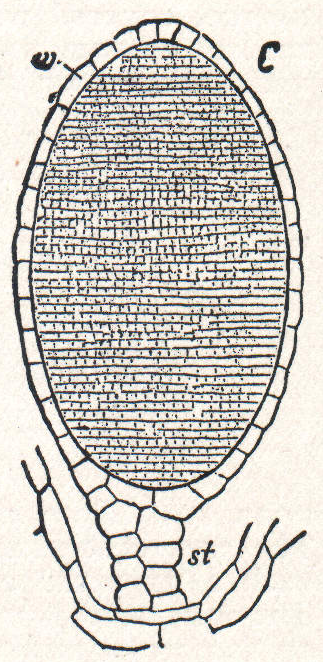
Here is a diagram of antheridium structure in a liverwort, which is representative of most antheridia structures throughout species. It is a thin cellular layer that encapsulates many sperm cells.
General structure of antheridia. Antheridia consist of a thin cellular layer that holds many sperm inside. Here, the diagram of a liverwort antheridium is shown.

An antheridium is a haploid structure or organ producing and containing male gametes (called antherozoids or sperm). The plural form is antheridia, and a structure containing one or more antheridia is called an androecium.[1][a]

Antheridia are present in the gametophyte phase of cryptogams like bryophytes and ferns.[2] Many algae and some fungi, for example, ascomycetes and water moulds, also have antheridia during their reproductive stages. In gymnosperms and angiosperms, the male gametophytes have been reduced to pollen grains, and in most of these, the antheridia have been reduced to a single generative cell within the pollen grain. During pollination, this generative cell divides and gives rise to sperm cells.

The female counterpart to the antheridium in cryptogams is the archegonium, and in flowering plants is the gynoecium.

An antheridium typically consists of sterile cells and spermatogenous tissue. The sterile cells may form a central support structure or surround the spermatogenous tissue as a protective jacket. The spermatogenous cells give rise to spermatids via mitotic cell division. In some bryophytes, the antheridium is borne on an antheridiophore, a stalk-like structure that carries the antheridium at its apex.[3]

[edit]
Micrograph of antheridium anatomy in Porella, a leafy liverwort

See also

[edit]
  • Hornworts have antheridia, in some cases arranged within androecia.
  • Microsporangia produce spores that give rise to male gametophytes.

Notes

[edit]

References

[edit]

Further reading

[edit]
Revisions and contributorsEdit on WikipediaRead on Wikipedia
from Grokipedia
An antheridium is a haploid male gametangium that produces and releases flagellated cells, known as antherozoids or spermatozoids, in the generation of non-seed including bryophytes, pteridophytes, and certain , as well as some fungi. This structure is essential for in these organisms, where the motile sperm swim through a film of to fertilize eggs produced in the female , facilitating the life cycle. Structurally, the antheridium is typically a sac-like or club-shaped organ composed of a single layer of sterile jacket cells enclosing a mass of spermatogenous cells that differentiate into numerous flagellated sperm. Upon maturation, often triggered by environmental moisture, the antheridium opens or bursts to liberate the sperm, which require water to reach the archegonium for syngamy. In bryophytes such as mosses and liverworts, antheridia are commonly clustered at the apices of gametophyte shoots or branches, while in ferns, they form on the ventral surface of the heart-shaped prothallus gametophyte. The presence of antheridia underscores the dependence of these plant groups on aquatic or humid habitats for reproduction, distinguishing them from seed plants that have evolved pollen-based fertilization. In charophyte algae, close relatives of land plants, antheridia similarly house developing spermatozoids within specialized structures, highlighting evolutionary continuity in male gamete production. This multicellular organization protects the delicate sperm until release, ensuring successful fertilization in the absence of advanced vascular systems.

Definition and Etymology

Definition

An antheridium is a haploid or organ that produces and contains male gametes, known as antherozoids or cells, in various non-seed , , and fungi. This reproductive organ is multicellular, typically featuring protective sterile layers that enclose the gamete-producing cells, ensuring the development and release of flagellated capable of motility in aqueous environments. As a key component of , the antheridium facilitates the fusion of male gametes with female gametes to form a diploid . The antheridium is exclusive to the generation in that exhibit , where the haploid alternates with the diploid phase. In this life cycle, the arises from haploid spores and bears the antheridia, which develop through mitotic divisions to maintain the haploid state of the gametes. This contrasts with seed , where male gametes are produced within grains rather than discrete antheridia. In distinction from its female counterpart, the —which produces a single immobile —the antheridium generates multiple motile cells and lacks the flask-like structure for egg retention. While archegonia and antheridia together enable fertilization in bryophytes, ferns, and related groups, the antheridium's design emphasizes sperm dispersal, often requiring water for successful transfer.

Etymology

The term "antheridium" originates from New Latin, formed as a of "anthera," which itself derives from the "anthēra," the feminine form of "anthēros" meaning "flowery" or "blooming," ultimately tracing back to "anthos" (ἄνθος), meaning "flower." The "-idium" is a ending borrowed from Greek "-idion," indicating a small or lesser version, thus evoking a "little anther" or flower-like structure. This linguistic construction highlights the organ's role as a specialized, reduced counterpart to the pollen-producing anther found in flowering plants. The word was first recorded in English botanical literature in 1818 by the American botanist in his work The Genera of North American Plants, where it described the male reproductive structures in cryptogams such as and lower plants. Coined in the early amid growing interest in the of non-seed plants, the term quickly gained traction among European botanists; for instance, Wilhelm Hofmeister employed it extensively in his seminal 1851 publication Vergleichende Untersuchungen, which elucidated the in cryptogams and distinguished these multicellular male gametangia from the more complex anthers of phanerogams (seed plants). In early botanical texts, "antheridium" served to analogize the function of sperm-producing organs in cryptogams to the anther's production in angiosperms, while emphasizing structural differences, such as the antheridium's simpler, often sessile form embedded in gametophytes rather than elevated on stamens. This usage helped systematize the study of plant sexuality in the pre-Darwinian era, bridging observations from and to clarify reproductive homologies across plant groups.

Morphology and Structure

General Morphology

The antheridium is a multicellular reproductive organ characterized by a sac-like or globular structure, which may be sessile or elevated on a stalk known as an antheridiophore in certain taxa. This compact organ serves as a protective for developing male gametes and is typically embedded within tissues or positioned externally for dispersal. The external architecture features a sterile layer composed of flattened cells, usually one cell thick, that envelops and safeguards the internal fertile tissue while providing . Beneath this lies the fertile region, consisting of spermatogenous cells that undergo mitotic divisions to produce spermatids, which differentiate into flagellated . Sperm release is facilitated by an apical operculum or cap-like structure at the antheridium's summit, which dehisces in response to water absorption, allowing hydrostatic pressure to expel the gametes as a cohesive . This water-triggered mechanism ensures synchronization with environmental moisture, essential for flagellated . Antheridia are generally microscopic, ranging from 50 to 200 micrometers in , though dimensions vary slightly across lineages.

Cellular Composition

The antheridium exhibits a radially symmetric , consisting of a single layer of sterile jacket cells that envelop a central core of fertile spermatogenous cells. These sterile cells form a protective around the internal tissue, safeguarding it from environmental stresses. The fertile cells occupy the core as a of spermatogenous tissue, where primary spermatogenous cells divide mitotically to produce spermatids. Spermatids differentiate into flagellated sperm cells equipped for .

Development

Formation

The formation of the antheridium begins in the haploid , typically on the in bryophytes or the prothallus in s, originating from superficial cells, typically at the apices in mosses or on the ventral surface in pteridophyte prothalli and thalloid bryophytes. A selected superficial initial cell enlarges and undergoes a periclinal division, separating an outer primary jacket cell from an inner primary spermatogenous cell; this initial division establishes the basic layered organization. Subsequent anticlinal and periclinal divisions in the jacket lineage produce a single-layered sterile protective sheath, while the spermatogenous cell divides to form a central mass of fertile cells that will differentiate into mother cells. Early differentiation into sterile and fertile regions occurs shortly after the initial divisions, with the jacket layer providing structural support and the central tissue committed to production; this compartmentalization is evident within the first few cell cycles. Environmental factors play a key role in triggering initiation, as adequate is required for expansion and , while quality and intensity—often short-day conditions—influence the commitment of cells to antheridial fate. also modulates the process, with cooler regimes (around 16°C) promoting induction in like mosses. In many species, such as mosses in the Funariaceae family, antheridia form within approximately one month (about 4 weeks) following germination from spores, aligning with the transition from to mature gametophore stages under suitable conditions. This timeline can vary slightly with environmental cues but generally reflects rapid development in moist, shaded habitats.

Maturation

During the maturation phase of antheridium development, spermatogenous cells, which arise from initial divisions in the central region of the structure, undergo repeated mitotic divisions—both transverse and vertical—to generate hundreds of spermatids, typically ranging from 128 to over 1,000 per antheridium depending on the species. These spermatids subsequently differentiate into biflagellated sperm cells, completing the production of motile male gametes within the enclosed chamber. In pteridophytes, similar processes occur but with potentially fewer sperm (e.g., 32-128 in some ferns); algal antheridia may lack a distinct operculum. The surrounding jacket layer, composed of sterile cells, elongates during this stage to encase the developing spermatogenous tissue, with specialized cells at the apex forming an operculum—a cap-like structure that seals the antheridium. Upon exposure to , the operculum and adjacent jacket cells become mucilaginous, absorb , and swell, leading to dehiscence through the rupture of connections and the formation of a terminal pore that releases the spermatids into the surrounding environment. Maturation is often indicated by visible changes, such as the conversion of chloroplasts in jacket cells to chromoplasts, resulting in a characteristic red or orange coloration, or by overall swelling of the antheridium in response to hydration. Full maturation typically occurs within days to weeks following initial formation, varying by species and environmental conditions in bryophytes and algae. Post-maturation, antheridia remain viable for only a short period, often hours to days, and require immediate cues like the presence of free to trigger release. However, mature antheridia exhibit tolerance, allowing rehydration and release of functional after drying.

Function in Reproduction

Sperm Production

Sperm production within the antheridium begins with the mitotic divisions of spermatogenous cells, which differentiate into spermatids. These divisions occur in the central cavity of the antheridium, where spermatogenous cells, derived from the antheridial initial, undergo successive mitoses to generate multiple spermatids per . In charophytes like , the spermatogenous cells in antheridial filaments divide mitotically, featuring prominent Golgi activity during early stages to support . Similarly, in Chara, mitotic divisions involve a quadripolar spindle during , leading to the formation of spermatid initials arranged in filaments. Spermatids then undergo transformation to become motile , involving the development of flagella and, in some cases, an eyespot for phototactic guidance. Centrioles in the spermatids elongate to form basal bodies, from which flagella emerge; in ferns like , each mature develops over 100 flagella for enhanced propulsion. In Chara, the nucleus migrates laterally, manchette form along it, and flagella develop at one end, while an eyespot appears during helical coiling of the ; the resulting biflagellate lacks a but is covered in scales. Biochemically, the transformation requires synthesis of specific proteins that enable flagellar beating and toward the egg. Protein synthesis, supported by active ribosomes and Golgi-derived vesicles, produces motors for axonemal sliding in flagella, facilitating rhythmic beating. In liverworts like , cAMP signaling regulates these proteins, coordinating calcium-mediated changes for chemotactic steering and motility. In Chara spermatids, cytoskeletal proteins like tubulins and integrate into the manchette and flagellar structures during differentiation. The number of sperm produced per antheridium varies by species, typically ranging from dozens to hundreds, such as 25–40 per filament in Chara corallina with multiple filaments per antheridium, or 150–200 in the moss Physcomitrella patens. This production is energetically demanding, relying on the photosynthetic activity of the surrounding gametophyte tissue or mobilization of stored carbohydrate reserves to supply ATP for mitotic cycles and organelle assembly. In male gametophytes, auxin transport via PIN proteins further directs to support this high-energy biogenesis.

Fertilization Process

The fertilization process begins with the release of motile, biflagellate from the mature antheridium, which occurs upon immersion in , allowing the sperm to escape through an operculum or by rupture of the antheridial wall. These actively swim through the aqueous medium toward the using their flagella, a mechanism essential for reaching the stationary . The directed movement of is primarily guided by , where they respond to chemical gradients of attractants secreted by the , such as sugars or organic acids in the neck canal . In some ferns, this process is facilitated by pheromones like antheridiogens, which, while primarily inducing antheridial formation in nearby gametophytes, contribute to the coordination of and enhance the efficiency of sperm guidance in moist environments. For instance, in species such as , sperm exhibit strong positive chemotaxis to malic acid salts present in archegonial exudates. Upon arriving at the , a single navigates the open neck canal, aided by the dissolution of canal cells into a viscous medium that facilitates entry while inhibiting . The then fuses with the in the venter, forming a diploid that initiates the development of the generation. This entire process, termed zooidogamy, strictly requires an external water medium to enable and transport, distinguishing it from siphonogamous fertilization in seed plants.

Occurrence in Plant Groups

In Algae

Antheridia are prevalent in various groups of , including the divisions and (charophytes), particularly in charophyte and other filamentous or colonial forms, where they serve as male reproductive organs producing flagellated antherozoids for . In these aquatic organisms, antheridia typically develop as multicellular structures embedded within the or along filamentous bodies, adapting to the watery environment by facilitating the release of motile that can swim directly to female oogonia. In charophytes such as Chara corallina, antheridia exhibit a highly complex, multicellular organization, originating from adaxial cells at nodal regions of lateral branches and consisting of a pedicel stalk, eight shield cells forming an outer envelope, a manubrium, and inner capillary cells that give rise to antherozoid mother cells. These structures are embedded in the thallus near oogonia, with shield cells featuring thick, protuberant walls that aid in dehiscence for sperm release, reflecting an adaptation to freshwater habitats where chemotaxis guides antherozoids to eggs. Similarly, in the filamentous green alga Oedogonium, antheridia form in series from vegetative cells on unbranched filaments, each antheridium developing from an antheridial mother cell that divides to produce two multi-flagellate antherozoids, often in dwarf male filaments for nannandrous species. Colonial green algae like Volvox display specialized antheridia that differentiate from aflagellate initials within the spheroidal colony, undergoing repeated divisions to form 16–128 spindle-shaped, biflagellate antherozoids enclosed in a protective before release into the surrounding . This colonial arrangement enhances synchronized production and dispersal in aquatic settings. The diversity of antheridia in ranges from simpler forms in unicellular or loosely colonial , where gamete-producing cells may lack distinct multicellular jackets, to more elaborate, jacketed structures in advanced charophytes, underscoring evolutionary adaptations for oogamous reproduction in freshwater and marine environments.

In Bryophytes and Pteridophytes

In bryophytes, antheridia develop on the dominant stage, which is adapted for terrestrial life through protective jackets and positioning that facilitates dispersal in moist conditions. In mosses such as , antheridia form at the apex of the male , often clustered in cup-like structures surrounded by leaves to retain moisture for flagellated release. These multicellular organs consist of a sterile jacket layer enclosing spermatogenous cells that differentiate into biflagellate , enabling swimming through water films on the plant surface. Liverworts exhibit specialized elevations for antheridia, enhancing dispersal in terrestrial habitats. In Marchantia polymorpha, antheridia are embedded in chambers on the upper surface of disc-shaped antheridiophores—stalked structures that elevate the organs above the thallus, allowing rain splash to distribute sperm over greater distances while protecting them from desiccation. This adaptation contrasts with simpler algal forms by providing mechanical elevation and enclosure, suited to variable humidity on land. Hornworts integrate antheridia directly into the thallus for compact protection. In genera like Anthoceros, antheridia are embedded within androecial regions—sunken cavities on the dorsal thallus surface—where they mature before archegonia, producing biflagellate sperm that rely on brief moisture for fertilization. This embedding shields the organs from drying winds, a key terrestrial feature, while the thallus's mucilage aids in water retention. In pteridophytes, antheridia occur on the free-living , reflecting vascular adaptations that support larger sporophytes but retain bryophyte-like requiring external water. Ferns like produce antheridia on the ventral surface of the heart-shaped prothallus, where they develop in response to environmental cues, with a single-layered jacket protecting multiflagellate . This positioning beneath the prothallus minimizes exposure to air, promoting survival in shaded, humid forest floors. Lycophytes, such as , display with reduced s, where antheridia form within the tiny, endosporic male gametophyte derived from microspores. In , these antheridia consist of a basal cell and spermatogenous cells producing biflagellate , embedded to conserve resources in drier microhabitats compared to homosporous ferns. This reduction enhances efficiency in terrestrial colonization by limiting the gametophyte's exposure. Terrestrial adaptations in these groups include elevated structures and chemical signaling for optimized reproduction. In liverworts like , antheridiophores raise antheridia for better splash-cup dispersal, while in ferns, antheridiogens—pheromones secreted by female prothalli—induce precocious male development in nearby gametophytes, promoting in patchy moist environments. Overall, antheridia in bryophytes and pteridophytes feature multilayered jackets and strategic placement, providing greater resistance than algal counterparts, though still dependent on for .

Evolutionary Aspects

Origin and Early Evolution

The antheridium, the male gametangium producing motile sperm, likely originated within charophyte , the closest algal relatives to land plants (embryophytes), during the Late period around 450 million years ago. Phylogenetic analyses indicate that streptophyte algae, including charophytes, developed complex multicellular reproductive structures as precursors to those in land plants, with the antheridium evolving from simpler algal gametangia to protect flagellated gametes in aquatic environments. This origin aligns with estimates placing the divergence of charophytes and land plants between 470 and 510 million years ago. Fossil evidence supporting early antheridium-like structures comes from marine charophyte , such as Tarimochara miraclensis from ~453–449 Ma deposits in , which exhibit nodal organization and cortical features implying advanced reproductive complexity, including potential precursors to antheridia inferred from comparisons with extant Charales. Although direct preservation of antheridia is rare due to their non-calcified nature, associated microfossils like dyad spores from Early Ordovician (~480 Ma) Australian assemblages suggest the onset of embryophyte-like , bridging algal and gametangia. The earliest unequivocal antheridia appear in (~410 Ma) from the , such as in gametophytes of Lyonophyton rhyniensis, confirming the structure's persistence into terrestrial lineages. The primary evolutionary driver for antheridium development was the transition from aquatic to terrestrial habitats, necessitating protected gametangia to prevent of biflagellate during the Ordovician-Silurian period. In charophytes, this involved enclosing within multilayered shields, adapting to fluctuating water availability and enabling fertilization in thinner water films. Multicellularity emerged as a key innovation, with sterile jacket cells surrounding fertile cells to provide structural integrity and osmotic regulation, a trait conserved in early land plant antheridia. Comparative morphology reveals homology between charophyte antheridia—such as the spherical, multicellular structures in Chara species—and antheridia, both featuring a sterile outer layer and internal sperm mother cells that undergo to produce numerous biflagellate . This parallels the co-evolution of oogonia (female gametangia) into archegonia, underscoring the antheridium's role in the that characterizes streptophyte reproduction.

Reduction in Seed Plants

In seed plants, encompassing both gymnosperms and angiosperms, the antheridium undergoes significant reduction as part of the broader evolutionary diminishment of the generation, which becomes dependent on the dominant for and . Unlike the multicellular, jacketed antheridia of bryophytes and pteridophytes that independently produce numerous flagellated , the male in seed plants is condensed into a grain—a structure derived from a microspore—that lacks a distinct antheridial chamber. This reduction facilitates aerial pollen dispersal and eliminates the need for external water in fertilization, marking a key for terrestrial reproduction. In gymnosperms, the antheridium is vestigial, represented by simplified generative cells within the rather than a fully formed organ. For instance, in cycads and Ginkgo, the male develops prothallial cells and a generative cell that divides to form large, multiflagellated (up to 40,000 flagella in cycads) after , but without the parietal jacket or central cell mass characteristic of ancestral antheridia. and gnetophytes further simplify this by producing non-motile nuclei via siphonogamy, where the directly delivers gametes to the female , reflecting a progressive loss of antheridial complexity from fossil gymnosperms to modern forms. This evolutionary streamlining reduces the male to 1–5 cells at pollen dehiscence, enhancing efficiency in wind-pollinated systems. Angiosperms exhibit the most extreme reduction, with the antheridium entirely absent; the male consists of just three cells in the mature grain—a vegetative cell and a generative cell that undergoes to yield two non-motile cells. These are transported through the to fertilize the and central cell in the embryo sac, bypassing any antheridial structure altogether. This minimal configuration, often described as a diplontic-like cycle due to the gametophyte's brevity, underscores the angiosperm of and supports their dominance in diverse ecosystems.

References

Add your contribution
Related Hubs
User Avatar
No comments yet.