Hubbry Logo
TingiTingiMain
Open search
Tingi
Community hub
Tingi
logo
8 pages, 0 posts
0 subscribers
Be the first to start a discussion here.
Tingi
Tingi
from Wikipedia
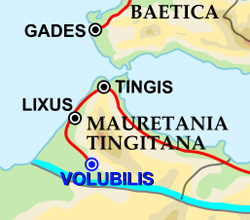
Location of Tingis in Roman Mauretania Tingitana

Tingis (Latin; Ancient Greek: Τίγγις Tíngis) or Tingi (Ancient Berber: ⵜⵉⵏⴳⵉ), was the ancient name of Tangier in Morocco and an important Carthaginian, Moor, and Roman port on the Atlantic Ocean. It was eventually granted the status of a Roman colony and made the capital of the province of Mauretania Tingitana and, after Diocletian's reforms, the diocese of Hispania.

Legends

[edit]
Ptolemy's 1st African map, showing Roman Mauretania Tingitana

The Greeks claimed that Tingis had been named for a daughter of the titan Atlas, who was supposed to support the vault of heaven nearby. They claimed that the Berber legends comported with the stories of Hercules's labors, which carried him to North Africa and the North Atlantic to retrieve the golden apples of the Hesperides. Having killed her husband Antaeus and again condemned her father to eternally supporting the firmament, Hercules slept with Tinja and fathered the Berber hero Syphax. Syphax supposedly founded the port of Tingis and named it his mother's honor after her death.[1] The gigantic skeleton and tomb of Antaeus were tourist attractions for ancient visitors.[1] The Caves of Hercules, where he supposedly rested on Cape Spartel, remain one today.

History

[edit]

Phoenician port

[edit]

A settlement in Tingis began, at the earliest, in the 10th century BC[2] by Phoenecians, before being settled around the beginning of the 6th century BC by Carthaginian colonists,[3] who variously recorded the name of their settlement as TNG (Punic: 𐤕𐤍𐤂), TNGʾ (𐤕𐤍𐤂𐤀), and TYNGʾ (𐤕𐤉𐤍𐤂𐤀).[4] The town is sometimes connected to the voyages of Hanno the Navigator.

Mauretanian city

[edit]
A coin of Tingi with a Punic legend

After the Punic Wars, Carthage lost control of the colony to the Roman-allied kings of Mauretania. Its name during this time appears in Greek and Roman sources variously as Tenga, Tinga, Titga, &c.[5] It maintained strong ties to its Carthaginian heritage, issuing bronze coins with Punic legends reading "City of Titga" (𐤁‬𐤏‬𐤋‬𐤕 𐤕𐤕𐤂𐤀, BʿLT TTGʾ), "City of Tinga" (𐤁‬𐤏‬𐤋‬𐤕 𐤕𐤉𐤍𐤂𐤀, BʿLT TYNGʾ), or "people of Tinga" (𐤌‬𐤁‬𐤏‬𐤋‬ 𐤕𐤉𐤍𐤂𐤀, MBʿL TYNGʾ). These bore Baal or (via interpretatio Graeca) Demeter's head obverse and wheat reverse.[6]

Roman provincial capital

[edit]
Surviving walls from Roman Tingis
Roman roads in Morocco

The town came under Roman rule in the 1st century BC. Q. Sertorius, took and held Tingis for a number of years in the 70s BC as part of his war against Sulla's regime in Rome. Tingis grew in importance as a free city[clarification needed] under Augustus and then as a colony under Claudius, who made it the capital of Mauritania Tingitana.[5] As a Roman colony, it bore the formal name Colonia Iulia Tingi,[7] the "Julian colony of Tingis". Under the early empire, it began to use Latin script, issuing its bronze coins with the legend IVL TIN; these bore Augustus and Agrippa's heads obverse and Baal's head reverse.[6]

Called Colonia Iulia Tingi on its coins, governed most likely under Latin law and at first attached administratively to Spain, it became under Claudius a Roman colony and chief city of the province of Mauretania Tingitana after it was set up. In 297 the city probably served Maximianus as a base during his campaign against the Moorish rebels, and it was very likely about this time that the Christians Marcellus and Cassienus were put to death. The former belonged to a Spanish community, the latter, however, probably to a local church which funerary inscriptions show existed in the 4th-5th c. although there is no mention of a bishopric until the 6th c. The limits of the ancient settlement are clearly marked by the necropolis discovered to the northwest (that of Marshan and Avenue Cenario), to the west (Mendoubia) and south (Bou Kachkach). Nothing remains of the substructures, which could still be seen on the seashore at the beginning of the century. There were also some baths underneath the Casbah, and confused remains of a monument—apparently a Christian basilica—have been uncovered in the Rue de Belgique. So far as the rest of the city is concerned one can only presume that the forum was situated on the site of the Petit Socco and what was perhaps a temple on the site of the Great Mosque, and that the decumanus maximus corresponded roughly to the Zenga Es Siaghine. Among the few antiquities that have been discovered, the only noteworthy finds, aside from inscriptions and a few mosaic fragments, are a statue of a woman of indifferent workmanship and a mutilated head of the emperor Galba.[8]

As a provincial capital, Tingis developed and prospered. In the 4th century, it surpassed Volubilis when that city was left south of the Roman lines and unprotected by Roman legions. Tingis at its peak reached 20,000 inhabitants, all thoroughly romanized and mostly Christian. Tingis was famed throughout the Roman Empire for its fishing conserve industry. Under Septimius Severus, two Roman roads were constructed from Tingis: one on the Atlantic coast to Sala Colonia and the second into the mountainous interior toward Volubilis.

During Diocletian's reform of Roman governmental structures in AD 296, Mauretania Tingitana became part of the Diocese of Hispania. Tingis remained the capital of the larger territory, maintaining its status and development.

Later history

[edit]
Justinian and his general Belisarius, as depicted in Ravenna.

The Vandals conquered and occupied Tingis around AD 425 before sweeping across the Roman Maghreb.

Between 534 and 682, Tingis was restored to Byzantine control. Tingis was fortified and a new church erected. However, its commercial strength had waned, a change attested by its decreased issuance of coins.

Tingis fell under the control of the Umayyad Caliphate as part of the Muslim conquest of North Africa in 702, after which it was reduced to a small town more commonly discussed under the name Tangier. Tariq ibn Ziyad organized the conquest of Spain from Tingis and nearby Septem in 706.

Religion

[edit]

The Christian history of Tingis started during the second half of the first century, under Claudius's rule.[9] Originally, the city was part of the larger province of Mauretania Caesariensis, which included most of the Roman Maghreb. Later the area was subdivided, with the eastern part keeping the former name and the newer part receiving the name of Mauretania Tingitana. It is not known exactly at what period there may have been an episcopal see at Tangier in ancient times, but in the late Middle Ages Tangier was a titular see (i.e., an honorific fiction for the appointment of curial and auxiliary bishops). For the historical reasons given above, one official list of the Roman Curia places the see in Mauretania Caesariensis.

Towards the end of the third century, Tingis was the scene of the martyrdom of St Marcellus, mentioned in the Roman Martyrology on 30 October, and of St. Cassian, mentioned on 3 December. Indeed, according to tradition, the martyrdom of St Marcellus took place on 28 July 298.

A small Christian community survived in Tangier as late as the 10th century. Due to its Christian past, Tangier—under the name Tingis—is still a titular see of the Roman Catholic Church.

See also

[edit]

References

[edit]
Revisions and contributorsEdit on WikipediaRead on Wikipedia
from Grokipedia
Tingi, known in antiquity also as Tingis, was the ancient name of the now called , a major port located at the western entrance to the in northern . Established as a Carthaginian in the early BCE, it functioned as a vital commercial hub facilitating trade across the Mediterranean and connecting with . The came under Roman influence in the 1st century BCE, achieving status as a under Claudius around 44 CE and serving as the capital of the province of . The origins of Tingi trace back potentially to Phoenician settlers as early as the 10th century BCE, though it flourished primarily under Carthaginian control as a strategic outpost for maritime commerce. Following the destruction of Carthage in 146 BCE, Tingi aligned with the Berber kingdom of Mauretania, maintaining a degree of autonomy before formal Roman annexation in 38 BCE. Under Roman administration, the city developed significant infrastructure, including fortifications, a theater, and a forum, underscoring its role as an administrative, military, and economic center in northwest Africa. Tingi's strategic position made it a contested site throughout antiquity, transitioning from Roman to Vandal control in the CE and briefly to Byzantine rule in the before the Arab conquest in 702 CE. Its enduring importance as a gateway between continents influenced subsequent Moorish, , Spanish, and Ottoman involvements, shaping its multicultural legacy. Archaeological remains, including Roman-era walls and mosaics, highlight its historical depth and continue to inform studies of ancient North African urbanism.

Geography and Name

Location and Strategic Importance

Tingi is located at coordinates 35°47′N 5°49′W, positioned on the northwestern coast of along the , the vital waterway linking the Atlantic Ocean to the . This strategic placement at the gateway between continents made Tingi a pivotal point for maritime navigation and commerce, controlling access to trade routes that facilitated exchanges between , , and the broader . The city's physical setting features a extending inland, backed by the rugged Mountains, which provided natural defenses and a diverse conducive to economic activity. The fertile of the surrounding supported robust , including the cultivation of grains such as and , while the adjacent coastline enabled thriving industries focused on . Tingi's natural harbor, sheltered within a that offered protection from Atlantic storms, served as an ideal hub for goods like grain from the interior, from local fisheries, and metals transported via regional networks. Due to its role as a bustling economic center and provincial capital in , Tingi's population is estimated to have reached approximately 20,000 inhabitants during the Roman era, particularly by the CE, reflecting its importance as a significant . Established initially as a Phoenician , the site's enduring logistical advantages underscored its growth into a key node in ancient Mediterranean trade systems.

Etymology and Legends

The name Tingi originates from the Ancient Berber term ⵜⵉⵏⴳⵉ (Tingi), reflecting indigenous linguistic roots in the region, with "Tin-" serving as a common feminine prefix in denoting a place or settlement. Greek sources, however, attributed the name's derivation to a mythical figure, linking it symbolically to the area's ancient lore rather than purely linguistic evolution. Under Roman influence, the name was Latinized to Tingis, preserving its phonetic form while integrating it into classical geography. Local Berber traditions, as recorded in accounts, describe the founding of Tingi through the legend of Tinjis (or Tinga), the daughter of the Titan Atlas and widow of the giant , whom slew during his famous labors. According to the myth, Tinjis subsequently consorted with , bearing him a son named , and upon her death from grief, the child honored her by establishing the city and naming it in her memory near the strategic strait. This narrative intertwines with broader mythology, positioning the site as a key location tied to the hero's exploits. An additional layer of the legend credits the historical King Syphax of with formalizing Tingi as a tribute to Tinjis, blending the mythical son with the real ruler to emphasize the city's revered origins. The myths further connect Tingi to ' tenth labor—defeating the monster in the far west—with the nearby serving as his legendary resting place after crossing the strait, symbolizing the passage between and . These ancient tales persist in modern Moroccan culture, where the continue to draw tourists as a tangible emblem of the site's mythological heritage, underscoring Tingi's enduring symbolic role as a gateway of legends.

History

Early Settlement and Phoenician Period

The Peninsula exhibits evidence of human activity dating from approximately 3000 to 500 BC, characterized by ritual landscapes that integrated burial practices with symbolic monuments. Key findings include 24 newly identified sites featuring painted shelters and cup marks, often clustered around crossroads; standing stones, such as the over 2.5-meter-tall at Roummane and others at Laqueleya; and cist burials, exemplified by the trapezoidal stone-lined grave at Daroua Zaydan radiocarbon-dated to 2119–1890 BC. These elements, alongside cave burials like those at Benzú (2127–1902 BC) and Hafa II (1610–1450 BC), indicate diverse funerary traditions—ranging from pit graves to tumuli—that likely served as territorial markers and reflected social complexity among prehistoric communities. Limited settlement evidence, such as the farming village at Kach Kouch from the late 3rd to early , suggests sustained habitation with ties to Mediterranean and Atlantic exchange networks. Phoenician settlers may have established Tingi as a as early as the to facilitate Atlantic maritime routes, with archaeological and textual evidence confirming a robust presence by the 8th–7th century BC. Identified in ancient sources as Tenga or Tingis and linked to colonies from Arados and , the site functioned as an early outpost amid arid coastal conditions. By the 6th–5th century BC, Tingi transitioned into a Carthaginian , marking the expansion of Punic influence across North Africa's Atlantic coast from Tingis southward to Mogador. The name Tingi derives from Berber linguistic roots, underscoring its pre-Phoenician indigenous associations. Economic activities at Tingi emphasized in metals, including tin and silver procured from Iberian sources, alongside from and locally produced salt, supporting broader Phoenician networks. This integrated Phoenician settlers with local Berber populations, as seen in the adoption of Phoenician cultural artifacts within Tangier-area necropoleis from the 8th–7th century BC onward. Following Carthaginian consolidation in the post-5th century BC, Tingi emerged as a vital link between the Iberian port of Gades (modern ) and Mediterranean hubs, enhancing Punic control over western corridors.

Mauretanian Kingdom

Following the Second Punic War (218–201 BC), Tingi transitioned from Carthaginian control to influence by local Berber rulers, marking the rise of the Mauretanian Kingdom in the region. By the late , the city was incorporated into the kingdom under King (r. c. 111–80 BC), who allied with Rome during the (112–106 BC) and received western as a territorial reward for betraying his son-in-law . Tingi emerged as one of Bocchus I's key capitals, serving as a strategic center in the western part of the kingdom. Around 30 BC, Emperor Augustus granted Tingi the status of a civitas libera (free city), permitting self-governance and exemption from direct Roman taxation while remaining under broader Roman influence as a client state. This autonomy facilitated local administration amid the Mauretanian kings' pro-Roman policies. In the 70s BC, during the Roman civil wars between the Sullans and Marians, the rebel general Quintus Sertorius briefly seized control of Tingi after defeating Sullan forces led by Ascalis and Paccianus in Mauretania, using the city as a base before returning to Hispania. Under subsequent rulers like Bogud (r. 49–38 BC), who controlled the western kingdom including Tingi, and his brother Bocchus II (r. 49–33 BC), who unified after Bogud's death, the city minted bronze coins featuring Punic-Berber legends, such as bearded male heads and grain ears symbolizing agricultural prosperity. These issues highlighted Tingi's role as a mixed Berber-Phoenician hub for trade and farming, supported by its pre-existing harbor infrastructure. The Mauretanian Kingdom retained semi-independence until 40 AD, when Emperor executed King and annexed the territory, dividing it into Roman provinces.

Roman Era

Tingi was annexed to the in 40 CE following Emperor Caligula's execution of the Mauretanian king , which destabilized the client kingdom and prompted direct Roman control. Under Emperor , the region was formally organized into the province of around 44 CE, with Tingi serving as a key settlement. Shortly thereafter, between 42 and 54 CE, elevated Tingi to the status of a Roman , naming it Colonia Iulia Traducta Tingi and granting its inhabitants full rights, which facilitated urban development and integration into imperial administration. Tingi functioned as the capital of from the province's establishment around 44 CE, governed by an equestrian procurator under imperial oversight, reflecting its strategic position near the . The city saw significant infrastructure investments, including the construction of forums, a theater, and aqueducts, which supported its role as an administrative hub and enhanced civic life. Militarily, Tingi was garrisoned with auxiliary troops to secure the province's northern frontier, and its walls were fortified to counter raids by local Moorish tribes. The city's economy peaked in the CE, driven by fishing, the production of (a fermented fish sauce), and maritime trade across the Mediterranean and Atlantic coasts, with principal exports including products that fueled regional . This prosperity supported a population estimated at residents, underscoring Tingi's transformation into a thriving Roman colonial center. Tingi played a pivotal role in Emperor Maximianus' campaign against the Moors in 297 CE, serving as a logistical base for operations that restored order and reinforced provincial defenses.

Post-Roman and Medieval Period

Following the collapse of Roman authority in the West, Tingi was captured by in 429 AD upon their crossing of the , marking the beginning of their occupation of the city as a strategic foothold in . , under King , utilized Tingi as a base for their expansion across , establishing a kingdom that endured until their defeat, during which the city served as an important naval and military outpost amid ongoing conflicts with local Berber groups and remnants of Roman forces. In 534 AD, Byzantine general reconquered from on behalf of Emperor , restoring Tingi to imperial control as part of the reorganized province of . The Byzantines fortified the city, repurposing existing Roman walls for defense against Berber revolts that plagued the region throughout the 6th and 7th centuries, though Byzantine hold remained tenuous due to resource shortages and persistent local resistance. Byzantine authority over Tingi persisted until 682 AD, when Arab forces began eroding imperial positions in the far west amid the broader Muslim expansion into the . Tingi fell to the around 705 AD under the command of , who extended Arab control westward after subduing Byzantine and Berber strongholds in . Renamed , the city transitioned into a key Islamic , facilitating and operations across the Strait of Gibraltar as Umayyad governors integrated it into the caliphal administration. During the medieval period, maintained its role as a vital nexus under successive Muslim dynasties, with the Idrisids incorporating the city into their emerging state from 788 AD onward, following Idris I's arrival and establishment of authority in the region. The gradual shift from Roman-era ruins to Arab-Berber settlements accelerated as the Idrisids promoted and urban development. Later, in 1077, the Almoravids under seized , consolidating it within their empire and enhancing its function as a commercial link between the and .

Religion

Pagan Worship

Pre-Christian religious practices in Tingi were profoundly shaped by indigenous Berber traditions, which centered on the of local deities and ancestral spirits deeply connected to the natural landscape. Berber religion emphasized animistic beliefs and the worship of mountain spirits and other natural features proximate to Tingi; these elements were integral to regional legends associating the site with ancient myths of creation and protection. Ancestral cults involved rituals honoring the dead through offerings at natural sites, reflecting a where spirits influenced , , and community well-being. The arrival of Phoenician traders and later Carthaginian settlers from the 8th century BCE introduced Punic religious elements that overlaid and blended with Berber practices in Tingi. Key cults included those of , the chief sky and fertility god, his consort , symbolizing motherhood and protection, and , the city-god and voyager equated with . Temples and open-air altars hosted rituals such as animal sacrifices and votive offerings to secure divine favor for maritime voyages, vital to Tingi's role as a bustling port; child dedication ceremonies, though controversial, paralleled broader North African Punic traditions. These practices persisted in cave sanctuaries and household shrines, adapting local Berber sites for Punic deities. From the 1st century CE, Roman administration fostered syncretism in Tingi's religious landscape, merging Punic-Berber elements with imperial cults. was assimilated to Optimus Maximus, to Juno Caelestis, and to Victor, forming a provincial version of the that emphasized Roman authority while honoring local identities. worship likely featured prominently due to Tingi's proximity to the , where hero cults involved libations and athletic dedications, drawing on myths of the demigod's labors at the . The strategic port location amplified veneration of sea-protecting aspects within these deities, such as syncretized with local water spirits. Archaeological evidence for these practices in Tingi remains limited, with few intact temple structures due to urban development and later overlays, but inferences arise from regional parallels across . Coins minted in Tingi during the Roman period often depict deities like and alongside imperial symbols, indicating civic worship. Inscriptions from nearby sites, including dedications to the Dii (Moorish gods) and , alongside votive stelae showing syncretic motifs, attest to ongoing rituals of sacrifice and pilgrimage; these materials highlight the coexistence of Berber, Punic, and Roman elements up to the 3rd century CE.

Christianity in Tingi

reached Tingi during the Roman period in , with the faith likely spreading along trade routes connecting the port city to other Mediterranean centers of early Christian activity by the late . Early communities are evidenced by the presence of believers amid the , reflecting the gradual establishment of the in provincial through Roman networks that tolerated diverse cults prior to Constantine's reforms. A pivotal moment in Tingi's Christian history was the martyrdom of St. Marcellus, a in the , who in 298 AD renounced his military service and the by refusing to participate in pagan sacrifices during celebrations for Emperor Maximian's birthday. Tried before the prefect Fortunatianus, Marcellus declared his faith in Christ and was promptly beheaded; his act of conscience also led to the martyrdom of St. Cassian, the court notary who declined to document the proceedings, resulting in his own execution shortly after. These events underscore the tensions faced by Christians in Tingi under late Roman pagan enforcement. By the , Tingi had emerged as a possible within the of , integrated into the broader ecclesiastical structure of the and later the . This institutional development is supported by archaeological remains, including the foundations of a Christian in the city's Rue de Belgique district and a featuring Christian funerary inscriptions and tombs, indicating a structured with liturgical and practices that endured through into the early medieval period, up to the . The growth of in Tingi was interrupted by the Vandal invasion in the , as the Arian Christian rulers suppressed Nicene through , of churches, and of . A revival occurred under Byzantine reconquest in 533 AD, restoring Catholic hierarchies and worship sites, but the faith waned following the Umayyad conquest of the city around 707 AD, which accelerated the shift to amid political and cultural transformations in .

Archaeology

Major Sites and Excavations

The principal archaeological features of ancient Tingi, spanning its Phoenician origins to the Roman era, are largely obscured by the continuous urban development of modern , limiting systematic excavations to scattered interventions primarily in the . These efforts have revealed layered strata from Phoenician settlements (circa ) through Punic and Roman occupations up to Byzantine influences, underscoring Tingi's evolution as a strategic port and provincial capital. Key digs, such as those between and at peripheral sites, exposed defensive structures and burial grounds, while urban constraints confined work to areas like the and medina, where Roman infrastructure overlays earlier Phoenician foundations. Surviving Roman fortifications, dating to the late 3rd to AD, represent some of the most visible remnants of Tingi's role as the capital of , built to defend against Moorish incursions around 297 AD under Emperor Maximianus. These walls, partially intact and integrated into the Kasbah's substructures, originally enclosed the city boundaries and extended along the seashore, with fragmentary sections still observable today. Public baths, uncovered beneath the Casbah through early 20th-century excavations, highlight Roman urban amenities, featuring systems that reflect the city's adoption of imperial engineering for daily life. of the forum, presumed located in the modern near Petit Socco, indicate a central civic space for administration and commerce, though preservation is minimal due to overlying medieval and contemporary buildings. The Punic-Roman necropolis at Hafa, situated on a cliff overlooking the , preserves 98 rock-cut tombs established by Phoenicians between 800 and 1000 BC and reused during Roman times for elite s. Of these, approximately 25 remain visible, with over 50 originally carved directly into the bedrock (measuring about 1.80 m long, 70 cm deep, and 60 cm wide), evidencing early funerary practices that transitioned from Punic cremations to Roman inhumations. Artifacts from associated burial grounds include fragments, Latin inscriptions honoring local officials, and a damaged marble head of Emperor (r. 68–69 AD), likely from a commemorative , which attests to Tingi's imperial connections during the . These finds, recovered from necropolises northwest, west, and south of the ancient city, illuminate social hierarchies and cultural continuity. Other notable sites include foundations of a possible early Christian in the Rue de Belgique district, identified through limited probes that suggest a 4th-century AD community amid Tingi's provincial functions. Traces of , such as inferred aqueduct alignments and theater outlines in the medina's subsurface, further demonstrate Roman investment in , though full exposure remains elusive due to dense overlay. Overall, these sites' lies in their documentation of Tingi's transformation from a Phoenician to a fortified Roman hub, with preservation efforts challenged by the site's integration into a living city.

Recent Discoveries

In 2025, archaeologists uncovered three ancient cemeteries on the Tangier Peninsula, featuring cist burials and stone-lined graves dated to approximately 4,000 years ago (circa 2000 BC), alongside rock art and standing stones that indicate Bronze Age ritual complexes spanning 3000–500 BC. These findings, concentrated in rock shelters and open landscapes, include geometric and anthropomorphic motifs in the rock art, as well as megalithic structures suggesting ceremonial use. The discoveries provide evidence of extensive prehistoric connectivity in trade and rituals between the and , evidenced by shared practices such as slab-covered tombs that parallel Iberian traditions. This mosaic of and elements points to complex, interconnected societies predating Phoenician arrival around 1100 BC, challenging earlier assumptions of isolated . Methodologies employed included of organic remains from the graves and geophysical surveys to map subsurface features without extensive excavation, as detailed in 2025 publications integrating these sites into broader Moroccan prehistoric networks. These approaches minimized disruption to the fragile sites while confirming chronological alignments with trans-regional patterns. For Tingi (modern ), the findings underscore that deeper Phoenician layers remain largely unexcavated beneath the urban core, offering potential for future controlled digs that could reveal transitions from these Bronze Age complexes into early trade routes.

References

Add your contribution
Related Hubs
User Avatar
No comments yet.