Hubbry Logo
SabrathaSabrathaMain
Open search
Sabratha
Community hub
Sabratha
logo
8 pages, 0 posts
0 subscribers
Be the first to start a discussion here.
Contribute something
Sabratha
Sabratha
from Wikipedia
Map of Sabratha

Key Information

Sabratha (Arabic: صبراتة, romanizedṢabrāta; also Sabratah, Siburata), in the Zawiya District[2] of Libya, was the westernmost of the ancient "three cities" of Roman Tripolis, alongside Oea and Leptis Magna. From 2001 to 2007 it was the capital of the former Sabratha wa Sorman District. It lies on the Mediterranean coast about 70 km (43 mi) west of modern Tripoli.[3] The extant archaeological site was inscribed as a UNESCO World Heritage Site in 1982.

History

[edit]
A coin of Sabratha with the Punic name ṣbrtʿn

Sabratha's port was established, perhaps about 500 BCE, as the Phoenician trading-post of Tsabratan (Punic: ‬𐤑𐤁‬𐤓𐤕‬𐤍, ṣbrtn, or ‬𐤑𐤁‬𐤓𐤕𐤏‬𐤍, ṣbrtʿn).[4][5] This seems to have been a Berber name,[6] suggesting a preëxisting native settlement. The port served as a Phoenician outlet for the products of the African hinterland. Greeks called it Sabrata (Ancient Greek: Σαβράτα), Sabaratha (Ancient Greek: Σαβαραθά), Sabratha (Ancient Greek: Σαβράθα) [7] and also Abrotonon (Ancient Greek: Ἀβρότονον).[8][9][10] After the demise of Phoenicia, Sabratha fell under the sphere of influence of Carthage.[11]

Following the Punic Wars, Sabratha became part of the short-lived Numidian kingdom of Massinissa before this was annexed to the Roman Republic as the province of Africa Nova in the 1st century BC. It was subsequently romanized and rebuilt in the 2nd and 3rd centuries CE.

Emperor Septimius Severus was born in nearby Leptis Magna, and Sabratha reached its monumental peak during the rule of the Severan dynasty he founded, expanding nearly twice its previous size. The city was badly damaged by earthquakes during the 4th century, particularly the quake of 365. It fell under control of the Vandal kingdom in the 5th century, with large parts of the city being abandoned. It enjoyed a small revival under Byzantine rule, when multiple churches and a defensive wall (although only enclosing a small portion of the city) were erected. The town was site of a bishopric.[12] Within a hundred years of the Muslim invasion of the Maghreb, trade had shifted to other ports and Sabratha dwindled to a village.

Archaeology

[edit]
Archaeological Site of Sabratha

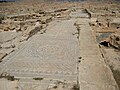
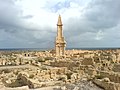
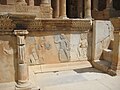
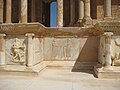
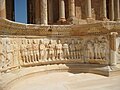
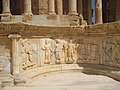
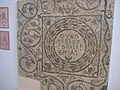
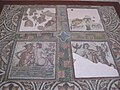
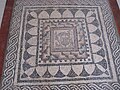
Besides its Theater that retains its three-storey architectural backdrop, Sabratha has temples dedicated to Liber Pater, Serapis and Isis. There is a Christian basilica of the time of Justinian and also remnants of some of the mosaic floors that enriched elite dwellings of Roman North Africa (for example, at the Villa Sileen, near Khoms). However, these are most clearly preserved in the colored patterns of the seaward (or Forum) baths, directly overlooking the shore, and in the black and white floors of the theater baths. There is an adjacent museum containing some treasures from Sabratha, but others can be seen in the national museum in Tripoli.

Theatre, 2006

In 186 AD, Emperor Commodus dedicated a temple in Sabratha honoring Hercules and his father, Marcus Aurelius. The temple featured a podium structure with porticoes and apsidal rooms at the southern ends. Excavations revealed wall fragments with marble-clad lower sections and painted upper parts.[13] One scene in the western apse showed Commodus being carried to heaven on an eagle, about to join the gods. The eastern apse's decoration is less clear, but fragments suggest an armed Dea Roma (a personification of Rome).[13]

Research history

[edit]

Sabratha has been the place of several excavation campaigns since 1921, mainly by Italian archaeologists. It was also excavated by a British team directed by Dame Kathleen Kenyon and John Ward-Perkins between 1948 and 1951.[14]

In 1943, during the Second World War, archaeologist Max Mallowan, husband of novelist Agatha Christie, was based at Sabratha as an assistant to the Senior Civil Affairs Officer of the Western Province of Tripolitania. His main task was to oversee the allocation of grain rations, but it was, in the words of Christie's biographer, a "glorious attachment", during which Mallowan lived in an Italian villa with a patio overlooking the sea and dined on fresh tunny fish and olives.[15]

Erosion and weathering damage

[edit]

According to an April 2016 report, due to soft soil composition and the nature of the coast of Sabratha, which is mostly made up of soft rock and sand, the Ruins of Sabratha are undergoing dangerous periods of coastal erosion. The public baths, olive press building and 'harbor' can be observed as being most damaged as the buildings have crumbled due to storms and unsettled seas. As the most common building material in Sabratah, calcarenite, is highly susceptible to physical, chemical and biological weathering (particularly marine spray), the long-term conservation of the monuments is endangered.[16] Rising sea levels can also compromise the integrity of the site.[17]

This erosion of the coast of Ancient Sabratha can be seen yearly with significant differences in beach layout and recent crumbled buildings. Breakwaters set in the vicinity of the harbor and olive press are inadequate and too small to efficiently protect the Ancient City of Sabratha.

Modern Sabratha

[edit]

The city is home to Sabratha University. Wefaq Sabratha is the football club, playing at Sabratha Stadium.

As noted in the 2021 documentary The Beatles: Get Back, directed by Peter Jackson, the Sabratha Theater was considered as a possible location where the Beatles could hold their final live concert as a group (they instead performed their last concert on the rooftop of their Apple Corps headquarters).[18]

Climate

[edit]

Sabratha has a hot semi-arid climate (Köppen climate classification BSh).

Climate data for Sabratha
Month Jan Feb Mar Apr May Jun Jul Aug Sep Oct Nov Dec Year
Mean daily maximum °C (°F) 17.2
(63.0)
18.8
(65.8)
20.9
(69.6)
23.7
(74.7)
25.9
(78.6)
29.2
(84.6)
31.3
(88.3)
32.1
(89.8)
30.2
(86.4)
27.5
(81.5)
23.6
(74.5)
18.8
(65.8)
24.9
(76.9)
Mean daily minimum °C (°F) 6.8
(44.2)
7.9
(46.2)
9.9
(49.8)
13.1
(55.6)
15.4
(59.7)
19.0
(66.2)
20.0
(68.0)
21.1
(70.0)
20.3
(68.5)
17.0
(62.6)
12.2
(54.0)
8.1
(46.6)
14.2
(57.6)
Average precipitation mm (inches) 45
(1.8)
26
(1.0)
17
(0.7)
11
(0.4)
4
(0.2)
1
(0.0)
0
(0)
0
(0)
8
(0.3)
23
(0.9)
33
(1.3)
51
(2.0)
219
(8.6)
Source: Climate-data.org[19]
[edit]
Part of the International Fairgrounds in Tripoli (under Italian rule)

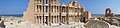
Panorama

[edit]

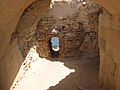
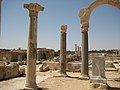
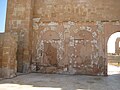
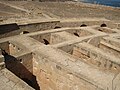
Archaeological site

[edit]

The theater

[edit]

Museum

[edit]

References

[edit]

Further reading

[edit]
[edit]
Revisions and contributorsEdit on WikipediaRead on Wikipedia
from Grokipedia
Sabratha is an ancient city located on the Mediterranean coast of northwestern , approximately 70 kilometers west of Tripoli, originally established as a Phoenician around the to serve as an outlet for products from the African hinterland. It evolved into a prominent Roman colony, flourishing as a commercial and agricultural center from the until its decline in , and is renowned for its well-preserved archaeological remains, including monumental public buildings that exemplify Punic-Roman architectural . Designated a in 1982 for its cultural significance under criterion (iii), the site has been on the List of World Heritage in Danger since 2016 due to threats from armed conflict, , and . As of 2025, threats persist, including urban encroachment, such as salt damage and humidity, and insufficient international preservation efforts. The city's early history reflects its role in Mediterranean trade networks, with Punic mud-brick structures dating to its Phoenician origins and a brief incorporation into the Numidian Kingdom under King Massinissa in the mid-2nd century BC. In , following the Roman victory in the Civil War, Sabratha was incorporated into the province of Nova established by , and gradually Romanized, receiving colonial status from (r. 138–161 AD). Its period of greatest prosperity occurred in the 2nd and 3rd centuries AD, marked by extensive urban expansion, monumental construction, and recovery from earthquakes in AD 306 and 310, though it suffered raids by the Austuriani tribes in 363–365 AD and later transitioned under Vandal and Byzantine rule until around 698 AD. Among Sabratha's standout architectural features is its late 2nd-century AD theater, likely built under Emperor (r. 180–192 AD), which seats approximately 5,000 spectators and boasts a three-tiered stage with ornate sculptures and columns in Doric, Ionic, and Corinthian orders. Other key structures include the Antonine Temple (dedicated c. 150–160 AD), featuring a colonnaded and ; the forum with the Capitolium temple complex rebuilt in during the late AD; and a 6th-century Byzantine adorned with intricate floors depicting birds, vines, and geometric patterns. The site also preserves evidence of industrial activities, such as fish-salting workshops, highlighting its economic reliance on maritime trade routes connecting it to the via the nearby port. As one of the "three cities" (Tripolis) of ancient alongside Oea (modern Tripoli) and , Sabratha illustrates the profound Roman influence on North African urbanism, economy, and culture, including the adoption of by the AD. Buried by sand dunes after its abandonment, the ruins were systematically excavated starting in the early by Italian and British archaeologists, revealing artifacts that provide invaluable insights into daily life, religious practices, and artistic traditions across millennia. Today, despite ongoing preservation challenges, Sabratha remains a testament to 's rich archaeological heritage and a key destination for understanding the interconnected history of the ancient Mediterranean world.

History

Founding and Punic period

Sabratha was established around the 7th century BC by Phoenicians originating from the city of Tyre as the trading port of Tsabratan (Punic ṣbrtʿn), functioning as a vital outpost for maritime commerce along the North African coast. The settlement's strategic location near fertile inland regions enabled it to serve as a hub for exchanging goods from the African interior with Mediterranean partners, including agricultural products like olive oil and luxury items such as textiles dyed in the prized purple murex extract, a hallmark of Phoenician enterprise. This trade network linked Sabratha to caravan routes extending into the Sahara, facilitating the flow of exotic commodities like ivory and spices toward Carthage and beyond. As part of the Punic emporia system, Sabratha formed one-third of the Tripolitanian triad alongside Oea (modern Tripoli) and , under the overarching influence of , which oversaw its economic and administrative affairs. During the (264–146 BCE), the city experienced limited direct conflict, maintaining a degree of neutrality that preserved its prosperity; in the Second Punic War (218–201 BCE), Sabratha avoided major engagements, continuing to thrive as a Carthaginian-dependent port until territorial shifts following Carthage's defeats. Following the Second Punic War, Sabratha was briefly incorporated into the Numidian Kingdom under King Massinissa in the mid-2nd century BC. This relative stability allowed ongoing commercial activities, with the city benefiting from Carthaginian protection and oversight amid the broader Roman-Carthaginian struggle. Punic-era architecture at Sabratha featured practical harbors enhanced for sheltered anchoring, alongside mud-brick buildings on stone foundations that housed markets and residential areas. Temples dedicated to core Phoenician-Punic deities, including Baal Hammon and Tanit, underscored the settlement's religious life, with sanctuaries incorporating tophet precincts for votive offerings. Cultural continuity with Tyre is evident in Semitic inscriptions on steles and artifacts, such as 5th–2nd century BCE votives where inhabitants identified as "citizens of Tyre," reflecting enduring colonial ties and ethnic identity. These elements highlight Sabratha's role as a culturally vibrant Punic enclave until the Roman conquest in 146 BCE.

Roman period

Following the Third Punic War and the destruction of in 146 BCE, Sabratha fell under Roman control as part of the province of . The city experienced gradual during the late , with its Punic heritage influencing early layouts, but significant integration occurred in the early Empire. Under , Sabratha received the status of around 7–6 BCE, marking a key step toward formal incorporation and allowing greater autonomy within the Roman system. By the Antonine period in the 2nd century CE, it was elevated to full colonial status as a colonia, granting its citizens Roman and fostering institutional development, such as the establishment of magistrates. The 2nd and 3rd centuries CE represented Sabratha's peak prosperity, particularly under the (193–235 CE), when Emperor —a native of nearby —promoted regional growth through administrative reforms and infrastructure investments. This era saw an economic boom fueled by agricultural exports, including grain and from the fertile Tripolitanian hinterland, alongside trade in ivory and other goods transported via trans-Saharan caravan routes to Mediterranean ports like Ostia. Severus's policies, including the extension of ius Latii (Latin rights) around 200 CE, enabled local elites to acquire , enhancing and civic participation. At its height, the city's population is estimated at approximately 14,300 inhabitants, supported by a cosmopolitan economy blending Roman oversight with local Punic and Berber traditions. Urban expansion during this period transformed Sabratha into a vibrant Roman center, with monumental constructions including an enlarged forum, for judicial and commercial functions, a grand theater seating thousands, public baths, and an extensive aqueduct system supplying water from inland sources. These developments reflected cultural , as Roman architectural styles incorporated Punic motifs and African in mosaics and sculptures, evident in the eight civic curiae that organized community life. However, this prosperity was disrupted by earthquakes around 306–310 CE, from which the city recovered, followed by the devastating triggered by the 365 CE , which partially destroyed the city, inundating its harbor and damaging key structures.

Post-Roman and medieval periods

Following the Vandal conquest of in 439 CE, Sabratha experienced significant decline and partial abandonment, as the Germanic invaders sacked the and disrupted its economic vitality during their rule until 533 CE. The Vandal occupation exacerbated existing vulnerabilities from earlier raids, such as the Austuriani attacks around 363–365 CE, leading to widespread destruction and reduced urban activity across . Archaeological evidence from the site indicates limited continuity of settlement, with much of the left in as networks faltered under Vandal control. The Byzantine reconquest under Emperor in 533 CE brought a brief revival, though on a diminished scale, with the city fortified by new walls that enclosed only the forum and adjacent blocks for defense against ongoing threats. This restructuring reflected the empire's efforts to secure the African periphery, incorporating Sabratha into the as a modest Christian center with newly constructed churches. However, encroaching sand from the coastal dunes began to bury portions of the site, signaling the onset of environmental challenges that compounded the reduced population and economic output. The Arab-Muslim conquest around 643 CE marked a pivotal shift, as forces under overran Byzantine defenses, leading to further depopulation and the redirection of trade routes toward inland oases and eastern ports. By this time, Sabratha was nearly abandoned, functioning thereafter as a small coastal settlement amid broader regional Islamization. During the medieval period, habitation remained sparse, primarily by Berber tribes such as the Zwagha, alongside limited presence; historical accounts from the 11th-century geographer note a in the town, suggesting modest Islamic activity possibly dating to the 9th–10th centuries, though archaeological traces are faint. Under Ottoman rule from 1551 CE, following the conquest of Tripoli, Sabratha persisted as a minor port within the of , overshadowed by larger centers and occasionally affected by regional piracy in the Mediterranean. The site's obscurity deepened over centuries, with progressive sand burial obscuring ruins by the and minimal contemporary records of its former significance until later archaeological interest.

Geography

Location and environment

Sabratha is situated at coordinates 32°47′32″N 12°29′3″E, approximately 70 km west of Tripoli in Libya's Zawiya District, on a coastal extending into the . This positioning provided ancient access to the sea, facilitating the development of harbors that supported trade and maritime activities. The site's topography consists of a flat known as the Gefara, characterized by sandy dunes and ancient quarries yielding stone, with the terrain rising gently southward toward the Tripolitanian plateau. This proximity to the plateau, specifically the Jebel Nafusa , contributes to regional on the plain, as precipitation is limited and aquifers are primarily recharged from higher elevations. Geologically, the area is formed on formations, which are prone to erosion due to their composition and exposure to coastal processes. Historically, Sabratha occupied the periphery of the more fertile Gebel Nafusa region, influencing its agricultural and settlement patterns. The local environment features proximity, supporting such as migratory birds along coastal flyways and scattered groves typical of Tripolitania's semi-arid landscape. However, modern threats include rising sea levels, which endanger the low-lying coastal site through increased flooding and erosion, and ongoing exacerbating aridity across Libya's northwest.

Climate

Sabratha features a hot (Köppen BSh), characterized by prolonged hot and dry summers alongside mild winters that receive the bulk of the region's limited rainfall. The annual average temperature is 21°C, with peak highs of up to 35°C occurring in and during the arid summer period, while winter lows typically hover around 10°C. Precipitation totals approximately 170 mm annually, concentrated primarily between and , fostering a marked seasonal contrast that defines the local hydrological cycle. Wind patterns in Sabratha are influenced by prevailing northwesterly winds, particularly during the cooler months, alongside episodic sirocco winds originating from the that bring intense heat and dust, thereby accelerating through heightened wave action and sand abrasion. These seasonal rains have historically sustained ancient in the surrounding areas, enabling Punic and Roman farmers to cultivate crops like olives, grains, and vines through and terrace systems during the wetter winter period. The site's geographic exposure to sea winds amplifies these meteorological dynamics, as detailed in the location and environment . Contemporary climate trends are amplifying risks to Sabratha's archaeological heritage, with rising temperatures and shifting humidity levels exacerbating salt spray intrusion and moisture-related degradation of stone structures, leading to increased cracking and fragmentation. Projections suggest a 7% decline in annual precipitation by 2050 under moderate emissions scenarios, intensifying overall aridity and compounding erosion pressures on the coastal ruins.

Archaeological site

Excavations and description

Sabratha was rediscovered in the by European travelers who documented its ruins amid shifting sand dunes. Systematic archaeological excavations began during the Italian colonial period, with major campaigns from onward under directors such as Renato Bartoccini, focusing on key Roman structures including the forum and theater through the 1930s. These efforts revealed much of the site's Roman overlay, though they prioritized monumental architecture over earlier Punic layers. Following , British missions led by and John Ward-Perkins conducted excavations from 1948 to 1951, emphasizing stratigraphic analysis and the documentation of mosaics, basilicas, and harbor features. These works provided detailed plans of the site's residential and public insulae, contributing to publications on , small finds, and urban development. Subsequent international collaborations have continued mapping and conservation assessments. The spans approximately 2 km along the coastline, with a core urban area of about 5 hectares organized on a classic Roman grid of cardo maximus and decumanus maximus axes. This layout integrated public forums, temples, and insulae within defensive walls, while two harbors—an inner basin for sheltered loading and an outer port—facilitated trade but have been silted since antiquity due to from the Wadi Caam river. Inscribed on the World Heritage List in 1982 for its outstanding testimony to Roman urbanism (criterion iii), the site covers 90.534 hectares but was added to the List of World Heritage in Danger in 2016 amid political instability threatening its integrity.

Major monuments

The most prominent monument at Sabratha is the Roman theater, constructed between 175 and 200 CE during the reigns of emperors and . This semicircular structure, the largest and best-preserved theater in , accommodated approximately 5,000 spectators across 25 vomitoria entrances and tiered seating carved into the hillside. Its striking three-story , rising 25 meters high, features 108 Corinthian marble columns adorned with elaborate sculptures and reliefs depicting mythological figures such as the Muses and the Three Graces, underscoring the theater's role in public entertainment and cultural display within the Roman province of Proconsularis. Among the site's temples, the Sanctuary of Liber Pater—equated with the Punic god Shadrapa and often associated with Hercules—stands out for its late-second-century CE construction, featuring a rectangular cella surrounded by altars and porticoes that facilitated rituals of fertility and protection. Nearby, the Temple of Serapis and Isis exemplifies Greco-Egyptian syncretism, with its second-century CE podium and columns blending Ptolemaic architectural motifs like pylons and sphinxes alongside Roman entablature, reflecting the influx of Eastern cults into North African Roman society. The Punic-Roman Temple of Baal, with roots in the city's Phoenician origins but adapted in the Roman era, includes a raised platform and sacrificial area that highlight the continuity of Semitic worship traditions amid imperial overlay. Other significant structures include the fourth-century CE Christian basilica, an early example of post-Constantinian religious , notable for its floors depicting geometric patterns and symbolic motifs that transitioned from pagan to Christian . The forum basilica and adjacent , dating to the second and third centuries CE, formed the civic core with a rectangular hall for legal proceedings and a house for municipal governance, their marble-veneered walls and columnar supports emblematic of Roman administrative efficiency. In the hunting baths, intricate from the second century CE portray African such as lions, elephants, and antelopes in dynamic pursuit scenes, illustrating the region's role in supplying beasts for Roman spectacles and the artistic celebration of local fauna. Artistic elements throughout the monuments enrich their historical context, with bilingual inscriptions in Latin and Punic—such as those on coins and dedications from the Augustan era—evidencing the site's multicultural fabric and linguistic persistence. Marble statues of emperors, including representations linked to (r. 193–211 CE), a Tripolitanian native whose reign spurred local prosperity, were prominently displayed in temples and public spaces, symbolizing imperial patronage and dynastic legitimacy.

Conservation and threats

The of Sabratha faces significant conservation challenges primarily due to its coastal location and ongoing political in . Key threats include exacerbated by and storm surges, which have already caused substantial retreat of the shoreline, with up to 21.5 meters of erosion documented since 1943. The site's stone structures are particularly vulnerable to from seawater salt intrusion, high relative humidity, and natural degradation processes such as wind-driven sand abrasion. Additionally, since the 2011 Libyan Civil War, the site has suffered from conflict-related damage, including and , with reports indicating systematic illicit trafficking of amid the power vacuum. Invasive alien terrestrial species and excessive vegetation growth further compromise structural integrity by accelerating deterioration of . Sabratha was inscribed on UNESCO's List of World Heritage in Danger in 2016 due to these escalating risks and has been retained on the list through 2025, reflecting persistent concerns over inadequate management and limited resources for protection. Recent assessments from 2023 to 2024 highlight resource constraints in , including insufficient funding and personnel for site monitoring, compounded by urban encroachment and land conversion pressures. Training initiatives for heritage conservators have been implemented in nearby sites, such as a 2024 project at supported by the to build capacity in restoration techniques, though direct application to Sabratha remains limited. A state of conservation report was submitted by to on 15 January 2025, outlining ongoing vulnerabilities and calling for enhanced international support. Conservation efforts include international collaborations aimed at stabilization and . Post-2016 initiatives, such as UNESCO's reactive monitoring missions, have focused on control and basic maintenance, with a 2024 joint project by addressing sand movement and threats at Libyan coastal sites like Sabratha. In April-May 2025, conducted field work at Sabratha as part of the MaLiCH project, focusing on control and structural assessments. In 2021, preliminary measures to mitigate impacts were noted in regional assessments, though full of drainage systems has been delayed by instability. These interventions have helped prevent further immediate collapse but underscore the need for sustained funding and security to address broader environmental pressures. Looking ahead, future risks include continued potential for war-related damage from Libya's unresolved conflicts and the proliferation of , which could exacerbate structural decay. Climate projections indicate that threats from and erosion at African heritage sites, including Sabratha, could more than triple by 2050 under high-emissions scenarios, potentially exposing a significant portion of the site's monuments to irreversible loss without adaptive measures like reinforced barriers and enhanced monitoring.

Modern Sabratha

Administration and demographics

Sabratha is situated in the Zawiya District of Libya's region, in the northwestern part of the country along the Mediterranean coast. Following the reorganization of Libyan administrative divisions, the former Sabratha wa Sorman District was incorporated into the larger Zawiya District, with Sabratha serving as a key coastal within it. Amid Libya's political fragmentation since the 2011 revolution, which led to competing national governments, a local council was established in Sabratha to manage municipal affairs, with its first elections held on October 7, 2012, marking a transition toward decentralized governance in the post-Gaddafi era. The town's population was recorded at 102,038 in Libya's 2004 census, reflecting steady growth from earlier Ottoman and colonial periods. By 2025, estimates based on the national population growth rate of approximately 1.5% annually place Sabratha's residents at between 120,000 and 150,000, driven by urbanization and regional migration patterns. Demographically, the population mirrors Libya's broader ethnic composition, with 97% identifying as Arab or Berber, alongside a notable presence of sub-Saharan African migrants who have settled or transited through the area due to its proximity to migration routes. For instance, on November 12, 2025, a migrant boat capsized off Sabratha, leaving 42 people presumed dead and 7 rescued after six days adrift, underscoring the ongoing Mediterranean migration crisis impacting the region. Libya's overall demographics feature a high youth component, with 32.3% of the population under 15 years old as of 2024, contributing to a youthful profile in Sabratha as well. The ongoing since 2011 has profoundly affected Sabratha's social fabric, causing displacement for thousands through violence, including the 2016 clashes against militants that forced fighters and civilians to flee to nearby Zawiya, exacerbating local tensions and . This conflict has compounded challenges like , which stands at 49.5% nationally for ages 15-24, limiting opportunities amid political instability. To address skill gaps, the Sabratha Higher Institute of Science and Technology, affiliated with the Ministry of Vocational and Technical Education, offers programs in and applied sciences to support workforce development. Historically, Sabratha evolved from a modest Ottoman-era village with administrative outposts into a modern town during Italian colonization from 1911 to 1943, when infrastructure investments spurred urbanization, laying the foundation for its post-independence expansion tied to the oil economy.

Economy and culture

The economy of modern Sabratha relies primarily on and , reflecting the coastal and fertile characteristics of the Zawiya District. Key agricultural products include olives and grains, which support local production and contribute to Libya's broader agricultural sector that comprises approximately 2% of the national GDP and employs about 6% of the workforce. Artisanal fishing along the Mediterranean coast provides essential livelihoods, with Libya's fisheries sector involving traditional methods like small-boat operations and contributing to and modest exports. Limited oil-related opportunities exist due to the nearby Zawiya , established in 1974, which has spurred population growth and economic activity in the region by processing crude and supporting export terminals. However, post-2011 political instability and conflict have severely challenged the local economy, disrupting production, infrastructure, and GDP contributions through oil sector interruptions and reduced agricultural output. Education in Sabratha is anchored by Sabratha University, formed in 2015 from predecessor colleges some dating to 1992 and previously affiliated with the University of Zawia (itself originating from a 1983 faculty of education), offering programs in humanities, sciences, arts, engineering, economics, and law to foster regional development. The Wefaq Sabratha Sports Club, established in 1957, actively participates in the , promoting community engagement through football and other athletic activities since its early involvement in national competitions. Cultural life in Sabratha blends ancient heritage with contemporary Libyan-Arab traditions, featuring annual heritage festivals such as the Festival of Sabratha, which celebrates the Roman archaeological site through reenactments, music, and community events to highlight historical legacy. Recent initiatives, such as the Managing Libya's Cultural Heritage project, conducted field work at Sabratha in April-May 2025, supporting preservation and educational efforts. Modern influences are evident in music, drawing from Arab-Andalusian, Berber, and pop genres with instruments like the oud, and in cuisine, which incorporates Mediterranean-Arab elements such as couscous, olive oil-based dishes, and seafood preparations. A notable cultural anecdote involves a unheld 1969 proposal for The Beatles to perform at the Roman theater, revisited in the 2021 documentary The Beatles: Get Back directed by Peter Jackson, underscoring Sabratha's global historical allure. Tourism in Sabratha holds significant potential due to its renowned archaeological site, a UNESCO World Heritage property since 1982, but ongoing security concerns have severely limited visitor access. Pre-2011, the site attracted over 20,000 tourists annually as part of Libya's growing sector with around 180,000 national visitors; post-revolution numbers plummeted to near zero amid conflict, representing a decline exceeding 90%, with Libya's overall tourism showing a 60% growth in inbound visitors in 2025, reaching approximately 100,000 annually. UNESCO-led recovery efforts, including site assessments and protection against looting and damage, aim to safeguard the monuments and revive sustainable tourism to boost local economic benefits.

References

Add your contribution
Related Hubs
Contribute something
User Avatar
No comments yet.