Hubbry Logo
Arròs negreArròs negreMain
Open search
Arròs negre
Community hub
Arròs negre
logo
8 pages, 0 posts
0 subscribers
Be the first to start a discussion here.
Arròs negre
Arròs negre
from Wikipedia
Arròs negre
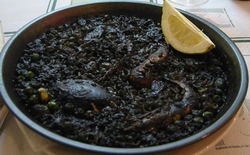
Arròs negre with crab, shrimp and squid
Alternative namesArroz negro, paella negra, black risotto
CourseMain course
Place of originSpain
Region or stateValencia, Catalonia
Serving temperatureHot
Main ingredientsWhite rice, cuttlefish or squid, cephalopod ink, cubanelle peppers
VariationsFideuà negra
Other informationAlso popular in Puerto Rico
  •   Media: Arròs negre

Arròs negre or arrós negre (Valencian: [aˈrɔz ˈneɣɾe], Spanish: arroz negro [aˈroθ ˈneɣɾo]) is a Valencian and Catalan dish made with cuttlefish (or squid) and rice, somewhat similar to seafood paella.[1][2][3][4] Some call it paella negra ("black paella"), although it is traditionally not called a paella even though it is prepared in a similar manner.

Arròs negre should not be confused with black rice, the collective name for several cultivars of heirloom rice that have a naturally dark color.

The traditional recipe for this dish calls for squid ink, cuttlefish or squid, white rice, garlic, green cubanelle peppers, sweet paprika, olive oil and seafood broth.[5] However, many cooks add other seafood as well, such as crab and shrimp.

The dish's dark color comes from squid ink which also enhances its seafood flavor.

In addition to Valencia and Catalonia, this dish is popular in Cuba and Puerto Rico where on both islands it is known as arroz con calamares ("rice with squid" in Spanish).[6][7] In the Philippines, it is considered to be a subtype of the Filipino adaptation of paelya and is known as paella negra (or paelya negra).[8][9] Black rice dishes with cuttlefish or squid ink are also made in Italy, Croatia and Montenegro, where they are known as "black risotto".

Fideuà negra ("black noodles" in Valencian) is a variation made with noodles instead of rice and is usually served with aioli.

See also

[edit]

References

[edit]
Revisions and contributorsEdit on WikipediaRead on Wikipedia
from Grokipedia
Arròs negre (Catalan/Valencian for ""; also known as arroz negro or ) is a traditional dish from the coastal regions of the and in . It is characterized by its striking black color, derived from or ink, and typically features cooked in a broth with or , along with a of onions, garlic, tomatoes, and peppers, seasoned with and sometimes . The ink provides both the color and a briny, flavor, making it a staple of eastern 's .

History

Origins in coastal Spain

Arròs negre emerged as a traditional fisherman's dish in the coastal regions of and during the 17th and 18th centuries, where it utilized readily available scraps to create a flavorful preparation. Local fishermen incorporated and squid , abundant in the Mediterranean waters off eastern , to color and season the , transforming what might otherwise be waste into a distinctive . This practice reflected the resourcefulness of maritime communities in Castellón, , and surrounding areas, where the dish's black hue from the became a hallmark. The exact origins are debated, with associations to both Valencian and Catalan fishing traditions, and possible influences from Italian dishes like riso al nero di seppia. The foundations of arròs negre trace back to the region's medieval rice cultivation, which began in the when settlers introduced farming to through advanced systems around the Albufera . This fertile provided short-grain varieties ideal for absorbing flavors, forming the staple base for the dish. culinary influences also contributed techniques for cooking with spices and broths, which later adapted to include squid ink for natural coloring and depth, evolving from broader paella-like preparations into the ink-specific variant. Early historical references to arròs negre describe it as a simple, ink-stained rice cooked with seafood, documented in Spanish culinary traditions by the 17th century as a way to enhance fish dishes with the sepia's natural ink. These accounts highlight its role in utilizing every part of the catch, similar to precursor rice dishes like paella that shared the one-pan cooking method but lacked the ink's bold pigmentation. By the 18th century, the dish had solidified as a coastal staple, emphasizing sustainability in Valencia's seafood-rich heritage.

Evolution and regional adoption

Arròs negre is associated with both Valencian and Catalan coastal communities, evolving through refined preparation techniques in the to incorporate like , , and sometimes clams or prawns, and becoming a in seaside restaurants. It is often paired with allioli. Following the and during Franco's dictatorship from 1939 to 1975, Catalan and Valencian cuisine, including arròs negre, persisted as elements of regional heritage despite cultural suppression. In the latter half of the , the dish gained wider recognition through the rise of Spanish tourism and regional food events, promoting its preparation with ingredients like and seafood stock.

Ingredients

Core components

Arròs negre, a traditional Valencian rice dish, relies on a select group of core ingredients that contribute to its distinctive flavor, texture, and appearance. The foundation is white short-grain rice, particularly the bomba variety, which is prized for its ability to absorb up to three times its volume in liquid while maintaining a firm, non-mushy texture essential for the dish's integrity. Bomba rice, originating from the Albufera region near Valencia, swells minimally during cooking, allowing it to hold the rich seafood flavors without breaking down. The primary protein comes from cuttlefish or squid, typically sourced fresh and cut into bite-sized pieces, which not only provide a tender, seafood-forward bite but also serve as the natural source for the dish's signature black ink. These cephalopods impart a subtle brininess that permeates the rice, enhancing the overall marine character. A robust seafood broth, simmered from fish heads, bones, and scraps such as those from monkfish or red mullet, forms the cooking liquid that infuses the rice with deep umami and salinity. This broth is crucial for replicating the coastal essence of the dish, drawing from Mediterranean fishing traditions. The flavor base is built through a sofrito of aromatics including , , cubanelle peppers (or similar mild green peppers), and ripe tomatoes, which are sautéed to create a concentrated, savory foundation. Sweet is added for its smoky depth and mild warmth, balancing the seafood's intensity without overpowering it. These elements together ensure the dish's authenticity, with the squid ink providing the characteristic dark hue that visually defines arròs negre.

Role and sourcing of squid ink

Squid ink, produced by the ink glands of cephalopods such as (Loligo spp.) and (Sepia officinalis), serves as the defining element in arròs negre, imparting its signature jet-black color and briny, flavor. The 's primary component is eumelanin, a derived from that constitutes approximately 15% of the wet weight, with each containing about 1 gram of this pigment. Additional constituents include proteins (5–8% of wet weight), free like glutamate (3–7%) and (over 50% of total ), and , which collectively contribute to the ink's savory, slightly salty taste profile. ink is preferred in for its milder, velvety flavor compared to the more pungent variety. In arròs negre preparation, squid ink is used sparingly due to its potent color and flavor, typically 3–4 sachets (12–16 grams) for four servings, dissolved into the cooking to ensure even distribution and prevent clumping. This quantity achieves the dish's deep black hue while enhancing the overall character without overpowering other elements. Historically, squid ink for arròs negre was sourced fresh from the ink sacs of wild-caught and harvested in Mediterranean fisheries, particularly along the coasts of and , where cephalopods abound. In modern practice, it is commonly obtained in pasteurized, commercial packets from sustainable fisheries in the Atlantic and Mediterranean regions, often from responsibly managed cuttlefish stocks to minimize environmental impact. Squid ink contains bioactive compounds with potential health benefits, including and that exhibit properties, such as dismutase-like activity to combat ; however, the small quantities used per serving limit significant nutritional intake.

Preparation

Traditional cooking process

The traditional cooking process for arròs negre begins by heating extra-virgin in a pan or wide skillet over medium-high heat and briefly sautéing pieces of cleaned and sliced or for 1-2 minutes until lightly colored, then setting them aside to infuse the oil with their briny essence. Next, prepare a sofrito base by sautéing finely chopped garlic, onion, green peppers, and tomatoes in the same pan over medium heat, followed by a pinch of smoked , stirring to avoid burning. This mixture is cooked for approximately 10-15 minutes, stirring occasionally, until it thickens into a rich, jam-like consistency that coats the pan. Bomba rice—a short-grain variety ideal for absorbing flavors without becoming mushy—is then added directly to the and toasted for 2-3 minutes, stirring to ensure each grain is evenly coated in the oil and infused with the base's aromas. The dish is infused with liquid by adding hot seafood in a 3:1 ratio to the (for example, 3 cups broth per cup of rice), which has been gently heated to maintain cooking temperature. The squid ink, previously dissolved in a small amount of the broth for even distribution, is stirred in thoroughly to achieve the signature deep color and subtle oceanic . The reserved or is returned to the pan toward the end of cooking. The mixture is brought to a , then reduced to a simmer and cooked uncovered for 18-20 minutes over medium-low heat, without stirring to encourage the formation of the prized —a crispy, caramelized crust at the bottom of the pan. Finally, the pan is removed from the , covered with a clean cloth or lid, and allowed to rest for 5 minutes. This resting phase permits the to fully absorb residual and meld flavors, resulting in tender grains with a cohesive texture.

Serving and presentation

Arròs negre is traditionally served family-style directly from the paellera pan, allowing diners to share the dish communally at the table. This presentation highlights the 's distinctive black color, derived from squid ink, and emphasizes its role as a social centerpiece in coastal Valencian gatherings. Lemon wedges are provided alongside the pan to squeeze over portions, offering a bright acidity that contrasts the dish's rich, briny flavors. Alioli, a creamy , is served on the side to temper the seafood's intensity and add a smooth, tangy element. A light sprinkle of finely chopped may also garnish the top for a subtle accent against the dark . The dish typically yields 4 to 6 portions, making it ideal for small groups, and is often accompanied by crusty for scooping and a crisp such as to complement its notes. In keeping with Valencian dining customs, arròs negre is eaten straight from the pan using wooden spoons, fostering a sense of togetherness and tradition during meals.

Variations

Spanish regional differences

In the , arròs negre is prepared primarily with as the main component, emphasizing its natural flavors alongside rice and squid ink, often cooked over an open wood fire to infuse a subtle smokiness while keeping additional minimal to avoid overpowering the dish's briny essence. The Catalan adaptation, prevalent in areas like and , expands the profile by incorporating prawns, mussels, and clams, creating a more diverse maritime taste that complements the squid ink's intensity, typically served in smaller, individual portions suitable for tapas-style dining. Variations may include artichokes or wild mushrooms for added earthiness. On the , particularly , the dish adopts a thicker, more robust consistency through increased use of tomatoes in the base, enhancing acidity and depth, with a popular variant known as fideuà negra substituting short noodles for to yield a pasta-based version that maintains the signature black hue and seafood elements.

International adaptations

In the , arròs negre evolved into paella negra during the Spanish colonial period, blending the original Valencian with local culinary influences such as the savory profile reminiscent of through the use of garlic-heavy . Some adaptations incorporate into the broth for a creamier texture and subtle sweetness that complements the briny squid ink, reflecting the archipelago's tropical ingredients and creating a fusion dish often served at festive gatherings. In and , arròs negre manifests as arroz con calamares en su tinta, a streamlined version that leverages canned in ink for convenience and accessibility, adapting to the islands' abundant while simplifying the traditional preparation. This iteration frequently pairs the with local staples like black beans for added earthiness or sweet plantains as a side, enhancing the dish's hearty appeal and mirroring the region's fusion of Spanish roots with African and indigenous flavors. Italy's risotto nero, particularly from the coastal region, reinterprets arròs negre as a creamier, stir--style preparation using starchy that absorbs a broth enriched with ink, resulting in a velvety consistency distinct from the drier Spanish original. Finished with grated for a nutty boost, this Venetian specialty highlights lagoon-sourced and has become a staple in seaside eateries, emphasizing slow stirring to develop the rice's starch for a luxurious texture. In the United States, arròs negre has inspired vegan adaptations in fusion restaurants since the early , using plant-based ingredients and natural colorants to mimic the dish's and black hue without animal products. These versions, often featuring mushrooms, artichokes, and vegetable stock, appear on menus at plant-based spots in cities like New York and , catering to dietary preferences while preserving the dish's dramatic appearance and brininess.

Cultural significance

Place in Mediterranean cuisine

Arròs negre occupies a significant role in as a testament to the region's coastal heritage, emphasizing fresh , , and minimal waste in traditional cooking. Originating from Valencian and Catalan shores, the dish exemplifies sustainability by incorporating squid ink—a natural byproduct of processing—thereby reducing food waste and promoting the full utilization of marine resources. This practice aligns closely with the principles of the , which prioritizes seasonal grains, , and harvested from local waters, fostering and preservation in coastal ecosystems. In multi-course Mediterranean meals, arròs negre enhances regional through thoughtful pairings with local wines and staples like olives. Crisp white varieties such as from Galicia or Verdejo from Rueda cut through the dish's umami-rich, briny profile, while olives—often from nearby groves—provide a contrasting salty bite that echoes the sea's flavors. These combinations not only elevate the meal's sensory experience but also reflect the interconnected agricultural landscapes of the Mediterranean, where wine, olives, and form a symbiotic culinary triad. The dish's cultural ties extend to broader intangible heritage recognitions, as it shares roots with Valencian traditions included in 's 2013 inscription of the on the Representative List of the of Humanity. This recognition highlights the diet's social and ritualistic elements, including communal preparations like arròs negre, which embody knowledge transmission across generations in , , , and other Mediterranean nations. In 2021, the Valencian government affirmed as an Asset of Intangible Cultural Interest, underscoring its role in preserving regional identity amid modern challenges. Economically, arròs negre bolsters fisheries across the Mediterranean, including those in the , by creating demand for locally caught cephalopods and their byproducts, thereby sustaining small-scale fishing communities and contributing to regional . These fisheries, vital to the area's , support livelihoods through sustainable practices that balance harvest with marine ecosystem health.

Modern popularity and adaptations

In recent years, arròs negre has experienced a surge in popularity among tourists seeking authentic , particularly through its inclusion in menus at -starred restaurants. Chefs like , whose eponymous restaurant in holds three stars, have elevated the dish with innovative presentations while preserving its traditional essence, drawing international food enthusiasts to regions like and . This exposure has contributed to increased in coastal areas, where arròs negre is showcased as a signature seafood rice specialty. The dish's prominence in such venues has also spurred growth in the export of squid ink products from , with companies reporting expanded markets in Europe and beyond due to rising global demand for Mediterranean ingredients. Media coverage and cultural events have further amplified arròs negre's appeal. Renowned chefs and television personalities, such as , have highlighted the dish in online videos and shows, describing it as a sophisticated alternative to more ubiquitous paellas and introducing it to international audiences. In , it features prominently at annual rice festivals like TastArròs in , where visitors sample traditional preparations amid live demonstrations and tastings that celebrate the region's rice heritage. Health-conscious adaptations have positioned arròs negre within contemporary wellness trends. With approximately 300 kcal per serving, the dish offers a relatively low-calorie option rich in seafood proteins and naturally gluten-free rice varieties, appealing to those following balanced diets or dietary restrictions. Modern recipes often emphasize fresh, seasonal ingredients to enhance its nutritional profile, including antioxidants from squid ink. Despite its rising profile, arròs negre faces sustainability challenges related to , which has intensified in the Atlantic due to unregulated global fleets.

References

Add your contribution
Related Hubs
User Avatar
No comments yet.