


Community hub
Recent from talks
Contribute something
Nothing was collected or created yet.
Silog
View on Wikipedia | |
| Type | Breakfast dish |
|---|---|
| Place of origin | Philippines |
| Main ingredients | Meat, rice, and egg |
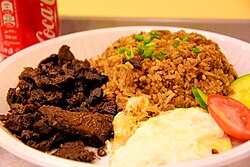
Silog is a class of Filipino breakfast dishes containing sinangag (garlic fried rice) and itlog ("egg"; in context, fried egg "sunny side up"). They are served with various accompanying savory dishes (ulam), usually fried meat dishes such as tapa, longganisa or ham. The name of the accompanying dish determines the portmanteau name of the silog; for example, the former three would be known as tapsilog, longsilog, and hamsilog.[1]
History
[edit]The first type of silog to be named as such was the tapsilog. It was originally intended to be quick breakfast or late-night hangover fare. It developed from tapsi, which referred to meals of beef tapa and sinangag with no fried egg explicitly mentioned, and diners which mainly or exclusively served such meals were called tapahan or tapsihan in Filipino.[2] The term tapsilog was originally established in the 1980s and came from the Tapsi ni Vivian ("Vivian's Tapsi") restaurant in Marikina. According to Vivian del Rosario, owner of Tapsi ni Vivian, she was the first to use the term tapsilog.[3][4]
Due to the popularity of this type of cuisine in the Philippines, some restaurants, fast food chains such as Jollibee and McDonald's Philippines and even hotels have included silogs on their breakfast menus, and some restaurants and fast food chains like Tapa King and Rufo's Famous Tapa exclusively or mainly serve this type of dish. Some diners like the first Tapsi ni Vivian in Marikina and Rodic's Diner in the University of the Philippines Diliman campus in Quezon City have also opened other branches after becoming recognized for their silog dishes.[5]
Types of silog
[edit].jpg)

Following the development of tapsilog, many other types of silog have been created, all based around garlic-fried rice and fried egg, and suffixed with -silog.[6][7] Due to the malleable nature of the dish, basically anything can be silog if served with fried rice and fried egg. Abbreviated examples (in alphabetical order) commonly seen in silog eateries and restaurants include:
- Adosilog – adobo, fried rice and fried egg.
- Bacsilog or baconsilog – bacon, fried rice and fried egg.
- Bisteksilog – beef steak, fried rice and fried egg.
- Chosilog – chorizo, fried rice and fried egg.
- Cornsilog – corned beef, fried rice and fried egg.
- Chicksilog or noksilog – fried chicken (piniritong manok or pritong manok), fried rice and fried egg.
- Daingsilog – daing na isda (dried fish), fried rice and fried egg.
- Bangsilog – dried (daing), marinated bangus (milkfish), fried rice and fried egg.
- Dangsilog – daing na danggit (dried rabbitfish), fried rice and fried egg.
- Hamsilog - ham, fried rice and fried egg.
- Hotsilog or dogsilog – hot dog, fried rice and fried egg.
- Lechsilog or lechonsilog – lechon kawali, fried rice and fried egg. Also spelled litsilog etc. due to the word lechon being adapted to Tagalog as litson.
- Longsilog – longganisa, fried rice and fried egg.
- Masilog or malingsilog - Ma-Ling brand Chinese luncheon meat, fried rice and fried egg.
- Porksilog – pork chop, fried rice and fried egg.
- Sisilog - sisig, fried rice and fried egg.
- Spamsilog – Spam brand luncheon meat, fried rice and fried egg.
- Tapsilog - tapa, fried rice and fried egg
- Tosilog or tocilog – tocino, fried rice and fried egg.
Beef pares, another common Filipino short-order diner dish, may sometimes be known as "paresilog", "paressilog", etc. if served with a fried egg, since both dishes traditionally include fried rice.
There is a similar dish from Malaysia, the nasi lemak, which is served in a variety of manners using meat, egg and rice with coconut milk.[8]
While a proper silog has sinangag or fried rice, some diners have tried passing off the "si" in silog to stand for sinaing, plain boiled rice, in order to cut costs. Sometimes the boiled rice is topped with fried garlic flakes and passed off as "garlic rice", though the term "garlic rice" is properly understood as rice stir-fried with garlic. More honest places will call this "kalog", from kanin, the general term for cooked rice. It is also possible to come across "silog" as its own menu option which is just fried rice and egg. If one wishes an additional fried egg, the order may sometimes have an additional "log"; i.e., tapsilog with extra egg is "tapsiloglog", etc. and this may be extended ad infinitum.
See also
[edit]References
[edit]- ^ "Tapsilog and other Silogs: garlic rice & egg are the ultimate pairing". Glutto digest. 28 March 2018. Retrieved May 26, 2019.
- ^ Lacorte, Germelina (April 13, 2013). "The man who brought 'tapsilog' to Davao". Inquirer.net. Retrieved August 28, 2022.
- ^ Rodriguez, Jon Carlos (March 1, 2014). "Meet the Pinay who started the 'tapsilog' craze". ABS-CBN News. Quezon City: ABS-CBN Corporation. Retrieved May 26, 2019.
- ^ Estrella, Serna (March 15, 2019). "A Brief History of the Tapsilog and Its Many Variations". pepper. Retrieved May 26, 2019.
- ^ Amoyan, Christele J. (June 6, 2014). "Bentesilog: Serving popular Pinoy breakfast all day long". Entrepreneur Philippines. Retrieved May 26, 2019.
- ^ "SILOG – VARIATIONS". Tagalog Lang. Retrieved May 26, 2019.
- ^ "Famous Silogs of the Philippines". ChoosePhilippines. August 29, 2013. Archived from the original on May 26, 2019. Retrieved May 26, 2019.
- ^ Michellon, Clémence (January 31, 2019). "Nasi lemak: What is the Malaysian dish and why is it being celebrated?". The Independent. Retrieved May 26, 2019.


| North America |
| ||||||||||||
|---|---|---|---|---|---|---|---|---|---|---|---|---|---|
| South America | |||||||||||||
| Europe | |||||||||||||
| Africa | |||||||||||||
| West Asia | |||||||||||||
| Central Asia | |||||||||||||
| South Asia |
| ||||||||||||
| East Asia |
| ||||||||||||
| Southeast Asia |
| ||||||||||||
| Other | |||||||||||||


Silog
View on GrokipediaOverview
Definition
Silog is a class of Filipino breakfast dishes consisting of sinangag (garlic fried rice), itlog (a fried egg, typically prepared sunny-side up), and a savory viand known as ulam, such as marinated meat or fish.[4][1] These elements form a balanced, hearty meal that emphasizes contrasting textures and flavors, with the fried rice providing a garlicky base, the runny egg adding richness, and the viand contributing protein and savoriness.[5][6] The dish is traditionally presented by arranging the components on a single plate, often with the egg positioned atop the mound of rice and the viand placed alongside, then served hot to preserve its warmth and crisp elements for immediate enjoyment.[4][1] This straightforward plating highlights the meal's everyday appeal in Filipino cuisine. The term "silog" itself is a portmanteau of sinangag and itlog, while specific varieties are named by combining a shortened form of the viand with "si" (from sinangag) and "log" (from itlog), as in tapsilog for tapa (cured beef), sinangag, and itlog.[4][1] This naming convention emerged in the 1980s as the dish gained popularity.[4]Etymology
The term "silog" is a portmanteau formed from the Tagalog words sinangag (garlic fried rice) and itlog (egg), combining the initial syllable "si" from the former and the final syllable "log" from the latter to denote a class of breakfast dishes featuring these core elements.[1] This linguistic construction reflects a broader pattern in Filipino culinary nomenclature, where the shortened name of a viand or protein is prefixed to "silog," yielding terms such as longsilog (from longganisa, a type of sausage) or tapsilog (from tapa, cured beef).[5] The portmanteau system emerged as a concise way to categorize and market these meals, drawing on the phonetic efficiency of Tagalog word formation.[2] The component sinangag derives from the Tagalog verb sangag, meaning "to fry" or "to toast," which traces back to Proto-Malayo-Polynesian *saŋəlaʀ, denoting stir-frying or cooking in a pan without added oil; the infix -in- transforms it into a noun describing the resulting fried rice dish, often enhanced with garlic. This evolution highlights how traditional rice preparation methods, initially involving boiling (sinaing), adapted to frying techniques influenced by local cooking practices in the Philippines.[7] In turn, itlog is the native Tagalog word for "egg," originating from Proto-Austronesian *qiCəluʀ, a root shared across Austronesian languages for this basic food item, underscoring the indigenous linguistic foundation of Filipino terminology despite broader Spanish colonial influences on the lexicon, such as loanwords for other ingredients.[8] Local dialects across the Philippines, including variations in Visayan and Ilocano, often retain similar Austronesian-derived terms for eggs, reinforcing the pan-archipelagic roots of silog naming conventions.History
Origins
Silog originated in the mid-1980s in the Philippines through the invention of tapsilog by Vivian del Rosario, the owner of the eatery Tapsi ni Vivian. In 1986, del Rosario established a modest canteen in a parking lot at the corner of Lauan and Molave Streets in Project 3, Quezon City, where she offered a simple, affordable meal combining tapa (cured beef), sinangag (garlic fried rice), and itlog (fried egg) as a quick breakfast option for working-class patrons.[9] The dish evolved from an informal "tapsi" – a basic pairing of cured beef tapa with fried rice – sold as a budget-friendly remedy for hangovers or a hasty morning meal, catering primarily to jeepney and tricycle drivers in the bustling urban area. This combination, utilizing simple ingredients, made it accessible and economical for everyday consumers.[10] Tapsilog's creation reflected broader culinary influences in Filipino food, with tapa rooted in Spanish colonial techniques of salt-curing meats introduced during the 16th to 19th centuries, while sinangag incorporated Chinese fried rice methods brought by traders who popularized soy-based marinades and stir-frying.[11] Del Rosario formalized the meal by coining the term "tapsilog" as a catchy portmanteau of its three elements, helping to draw in customers to her stall.[9] This early conceptualization paved the way for the expansion of silog variations beyond tapsilog.Popularization
Following its invention in the mid-1980s, silog rapidly gained traction as an affordable meal option through the proliferation of roadside eateries and small diners in urban areas like Metro Manila during the late 1980s and 1990s.[2] Establishments such as Rodic's Diner, which began serving tapsilog in the 1980s near the University of the Philippines Diliman campus, helped institutionalize the dish by catering to students, faculty, and nearby workers with its simple, hearty combination.[12] This period also saw the rise of specialized eateries focused on silog-style meals, exemplified by Tapa King, which opened its first outlet in 1987 in Makati City as a quick-service alternative to imported fast food, emphasizing homestyle beef tapa served with rice and egg.[13][14] By offering consistent, budget-friendly portions, such chains expanded silog's reach beyond informal stalls to more structured dining spots in the late 1980s and 1990s. In carinderias—ubiquitous neighborhood eateries—the dish evolved from occasional street fare to a daily breakfast staple, providing quick, filling options for laborers and families. This commercialization led to the development of over 20 silog variants by the early 2000s, as eateries experimented with local proteins to meet diverse tastes while maintaining the core formula of garlic fried rice and fried egg.[15]Preparation
Ingredients
Silog, a staple Filipino breakfast dish, fundamentally consists of sinangag (garlic fried rice) and itlog (fried egg), with the rice prepared using day-old cooked jasmine rice or other long-grain white rice varieties (typically 2-4 cups), minced garlic (4-6 cloves), cooking oil (2-4 tablespoons), and salt to taste, where the garlic is fried in oil to infuse the rice with aromatic flavor.[16][17] The itlog component features fresh eggs (1-2 per serving), fried sunny-side up in a small amount of oil to achieve a runny yolk that complements the dish's textures.[18][1] The viand, or ulam, provides the protein variation central to silog's adaptability, with common meat options including beef tapa—thinly sliced beef marinated in soy sauce, calamansi juice, and sugar for a savory-sweet profile before grilling or pan-frying; pork longganisa, a garlic-infused sausage often cured with vinegar for tanginess; and tocino, a sweet cured pork belly or shoulder sweetened with sugar and anise.[1][18] Seafood variations feature bangus (milkfish), typically marinated and fried to add a flaky, mildly fatty element.[1][19] Accompaniments enhance silog's freshness and balance, commonly including sliced tomatoes or cucumber for crisp acidity, atchara (pickled unripe papaya) to cut through richness with its sweet-tangy brine, and an optional vinegar dipping sauce known as sukang bawang, made by infusing vinegar with garlic and chili for a sharp, spicy contrast.[1][17]Cooking methods
The preparation of silog involves cooking its core components—sinangag (garlic fried rice), itlog (fried egg), and a viand—separately before assembly, typically taking 15 to 20 minutes for a complete meal when using pre-marinated or ready-to-cook viands.[20][21] Sinangag is made by first heating 2 to 3 tablespoons of cooking oil in a wide pan over medium heat, then adding 4 to 5 cloves of crushed or minced garlic once the oil is warm but not smoking, to avoid burning. The garlic is sautéed for 2 to 3 minutes until it turns golden brown and fragrant, releasing its aroma into the oil. Next, 3 to 5 cups of cold, day-old cooked white rice are added in batches if necessary, stirred gently to coat with the garlicky oil, and stir-fried over medium-high heat for 5 to 7 minutes until the grains separate and achieve a slightly crispy texture. The mixture is seasoned with ½ to 1 teaspoon of salt to taste, ensuring high heat is maintained throughout to prevent the rice from becoming mushy. Using leftover rice is essential for optimal texture, as fresh rice tends to clump.[22][20] For the itlog, 1 to 2 tablespoons of oil are heated in a non-stick pan over medium heat until shimmering. An egg is cracked directly into the pan, seasoned lightly with salt, and cooked sunny-side up for 2 to 3 minutes until the whites are fully set but the yolk remains runny. Optional basting involves spooning hot oil over the egg's surface during cooking to promote even setting of the whites and crispier edges, a technique common in Filipino frying for enhanced texture.[17][23] The viand is prepared by pan-frying pre-marinated or cured meat, such as beef tapa, in 1 to 2 tablespoons of oil over medium-high heat. For example, thinly sliced beef tapa is added to the hot pan and cooked for 3 to 5 minutes per side, turning once, until caramelized and the edges are browned, allowing any marinade liquids to reduce and glaze the surface. This method ensures a tender yet seared exterior without overcooking the interior.[21][20] To assemble, the sinangag is plated first, topped with the fried egg, and the viand is served alongside, often with a side of vinegar for dipping. This straightforward sequence highlights the dish's simplicity and allows each component's flavors to shine.[20][21]Varieties
Meat-based silogs
Meat-based silogs represent a core subset of traditional Filipino breakfast dishes, where the viand is derived from pork, beef, or processed meats, paired with sinangag (garlic fried rice) and itlog (fried egg) to create hearty, flavorful meals often enjoyed any time of day. These varieties emerged from colonial influences, blending indigenous cooking with Spanish curing techniques and American canned goods, resulting in savory-sweet profiles that balance umami, caramelization, and crisp textures.[24][4] Tapsilog, widely regarded as the inaugural silog dish, features tapa as its centerpiece—a thinly sliced beef sirloin marinated in soy sauce, sugar, and calamansi juice for tenderness and tang, then grilled or pan-fried until caramelized. Developed in the mid-1980s in Quezon City by restaurateur Vivian del Rosario, it combines this cured beef with garlic fried rice and a sunny-side-up egg, establishing the foundational silog formula that emphasizes quick preparation and bold seasoning.[10][24][21] Longsilog substitutes pork or beef longganisa sausage, which is minced meat mixed with garlic, vinegar, sugar, and pepper, formed into links, briefly boiled to render fat, and fried to a crispy exterior that highlights its savory-sweet equilibrium. This variety draws from regional sausage-making traditions, offering a juicy, garlicky bite that complements the rice and egg without overpowering the plate's simplicity.[17][25][26] Tosilog centers on tocino, a cured pork belly or shoulder sliced thin and marinated in pineapple juice, annatto for color, sugar, and soy sauce, then pan-fried to develop a glossy, candy-like glaze. Its origins trace to Spanish tocino adaptations, but the sweet profile evolved post-World War II with American sugar abundance, invented in the 1960s by Lolita Hizon in Pampanga, making it an indulgent yet accessible option in the silog lineup.[27][28][29][30][31] Additional meat-based iterations include hamsilog, which uses thinly sliced ham—often smoked or cured pork—fried until edges crisp, providing a salty contrast to the rice and egg. Spamsilog incorporates canned Spam, diced and fried to a golden, crunchy finish, reflecting mid-20th-century American military influences on Filipino pantries. Cornsilog, meanwhile, employs canned corned beef sautéed with onions and potatoes for a hash-like texture, delivering robust, spiced beef notes that evoke economical home cooking. Each maintains the silog structure while showcasing the viand's unique curing or processing method for distinct flavor emphasis.[4][32][33][15]Seafood and other variations
Seafood variations of silog highlight the abundance of Philippine marine resources, incorporating fried fish as the primary viand alongside the standard sinangag and itlog. Bangsilog features boneless milkfish (bangus), typically marinated in vinegar or soy sauce and deep-fried until crispy, providing a flaky, savory protein that pairs well with the garlicky rice.[34] This dish is a staple breakfast option, valued for its affordability and nutritional balance from the omega-rich milkfish. Another popular seafood iteration is dangsilog, made with small, salted, and sun-dried rabbitfish (danggit) that are pan-fried to achieve a crunchy texture, offering a salty, umami bite reminiscent of chicharon but from the sea.[35] Originating from coastal Cebu, danggit's drying process preserves the fish for extended shelf life, making it ideal for quick meals.[36] Beyond seafood, silog adapts to other proteins and vegetarian options, demonstrating its versatility in Filipino home cooking. Adosilog uses adobo—chicken or pork simmered in a tangy soy-vinegar sauce with garlic, peppercorns, and bay leaves—as the viand, transforming leftovers into a hearty plate that retains the dish's comforting essence.[37] For vegetarian adaptations, such as mushroom tapsilog using oyster mushrooms marinated in a savory-sweet sauce of soy, kalamansi, and sugar, providing a meat-free alternative that maintains the silog's structure while appealing to plant-based diets.[38] Modern twists like hotdogsilog incorporate grilled or fried hotdogs, often the sweet Filipino-style variety, sliced and served for a kid-friendly, processed protein option that's quick to prepare.[39] Regional influences add unique elements to silog preparations, enhancing its cultural diversity. In Cebu, silog may include pusô—heart-shaped packets of steamed rice woven from coconut fronds—in place of loose sinangag, offering a portable, textured alternative that's commonly paired with seafood viands during street eats or gatherings.[40] Mindanao variants sometimes feature coconut-infused rice, where sinangag is cooked or fried with coconut cream and garlic for a creamy, aromatic base that complements local seafood like danggit.[41] The silog format's flexibility allows it to incorporate household leftovers, from adobo to stir-fried veggies, ensuring minimal waste in everyday Filipino meals.[4]Cultural significance
Role in Filipino cuisine
Silog serves as a cornerstone of Filipino breakfast culture, commonly prepared and consumed in households, carinderias (small roadside eateries), and fast-food outlets across the Philippines. Its simplicity and quick preparation time make it ideal for busy mornings, often featuring garlic fried rice (sinangag) topped with a fried egg (itlog) and a choice of affordable proteins, providing a balanced, filling meal that sustains workers, students, and families throughout the day. Priced typically between PHP 90 and 150 per serving in local eateries (as of 2025), silog embodies economic accessibility, allowing it to remain a go-to option amid rising living costs.[42] The dish exemplifies the Philippines' colonial culinary heritage, fusing indigenous techniques with foreign elements introduced during centuries of trade and occupation. Sinangag draws from Chinese stir-frying methods adapted by early immigrants, while proteins like longganisa (sausage) trace to Spanish chorizo traditions brought by colonizers in the 16th century. American influences appear prominently in variants using canned goods such as Spam or corned beef, popularized post-World War II when U.S. military rations integrated into local diets, creating a hybrid that mirrors the nation's layered history.[43][44][1] Beyond the plate, silog fosters social bonds and practical ingenuity in everyday Filipino life. It frequently anchors family gatherings or shared meals, offering comfort after late nights or as a remedy for hangovers with its hearty, savory profile. Often enjoyed alongside strong brewed coffee or traditional tsokolate (thick hot chocolate made from tablea cacao tablets), it enhances communal rituals like merienda or post-celebration recovery. The use of day-old rice in sinangag highlights Filipino resourcefulness, transforming potential waste into a flavorful staple that underscores thriftiness in household cooking. Silog's cultural role was highlighted during the 2025 Filipino Food Month, themed “Sarap ng Pagkaing Pilipino, Yaman ng Ating Kasaysayan, Kultura, at Pagkatao,” underscoring its place in national culinary heritage.[45][46][47][48]Global adaptations
Silog has gained prominence in Filipino diaspora communities worldwide, particularly in the United States, Canada, and the Middle East, where it serves as a comforting staple adapted to local contexts. In the US, especially California, eateries like Silog in Torrance and Los Angeles offer modern takes on the dish, blending traditional garlic fried rice and egg with proteins such as beef tapa or longganisa, catering to the large Filipino-American population in areas like the South Bay. Similarly, Tselogs in Daly City provides 13 varieties of silog, emphasizing its role in Bay Area Filipino breakfast culture. In Canada, restaurants such as Epic Grill Silogs in New Westminster and Top Silog in Toronto highlight the dish's everyday appeal, often pairing it with Canadian breakfast elements to appeal to multicultural diners in cities with significant Filipino communities like Winnipeg and Halifax. In the Middle East, particularly the UAE, outlets like Silog Express in Dubai deliver affordable silog options to the substantial Overseas Filipino Worker population, adapting recipes to halal standards by substituting pork-based ulam with beef or turkey alternatives, such as turkey bacon in hamsilog variations to align with regional dietary preferences.[49][50][51][52][53] Beyond community eateries, silog appears in international fusion restaurants and global chains, showcasing its versatility in migrant adaptations. In the UK, Bintang Restaurant in London features a "Super Silog Breakfast" as an all-day option, fusing Filipino elements like longganisa made from lamb and beef with pickled atchara, all on a fully halal menu to suit diverse palates since its establishment in 1987. The Silog Project, organized by artists in migrant communities, further illustrates this through workshops that explore recipe adaptations and cultural storytelling, as seen in events at Preston Market emphasizing silog's role in sustaining heritage abroad. Fast-food chains like Jollibee, expanding internationally since the 2000s to over 1,700 locations across 17 countries (as of 2025), incorporate silog-inspired items like longsilog or corned beef silog on select global menus, helping popularize the dish among non-Filipino audiences.[54][55] Contemporary adaptations reflect health-conscious and cross-cultural influences, broadening silog's appeal post-2010s through social media and food blogs. In US Filipino-American cafes, versions substitute white rice with brown rice or quinoa for added nutrition, as in homemade tosilog experiments shared online, aligning with wellness trends while preserving the dish's simplicity. Social platforms have amplified its visibility, with influencers and blogs comparing silog to Southeast Asian counterparts like Malaysia's nasi lemak—both featuring rice, egg, and protein but differing in flavors (garlicky versus coconut-infused)—or Indonesia's nasi goreng for their shared fried rice base, fostering global curiosity and fusion experiments. These evolutions underscore silog's adaptability, turning a humble breakfast into a symbol of diaspora resilience.[56][57][58]References
- https://en.wiktionary.org/wiki/itlog