Hubbry Logo
Éliphas LéviÉliphas LéviMain
Open search
Éliphas Lévi
Community hub
Éliphas Lévi
logo
8 pages, 0 posts
0 subscribers
Be the first to start a discussion here.
Éliphas Lévi
Éliphas Lévi
from Wikipedia

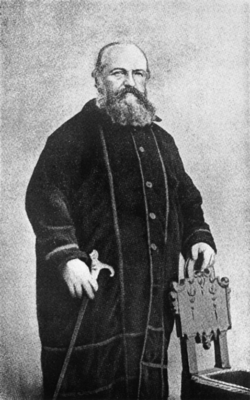
Éliphas Lévi Zahed, born Alphonse Louis Constant (8 February 1810 – 31 May 1875), was a French esotericist, poet, and writer. Initially pursuing an ecclesiastical career in the Catholic Church, he abandoned the priesthood in his mid-twenties and became a ceremonial magician. At the age of 40, he began professing knowledge of the occult.[1] He wrote over 20 books on magic, Kabbalah, alchemical studies, and occultism.

Key Information

The pen name "Éliphas Lévi" was an adaptation of his given names "Alphonse Louis" into Hebrew. Levi gained renown as an original thinker and writer, his works attracting attention in Paris and London among esotericists and artists of romantic or symbolist inspiration.[2][3] He left the Grand Orient de France (the French Masonic organization that originated Continental Freemasonry) in the belief that the original meanings of its symbols and rituals had been lost. "I ceased being a freemason, at once, because the Freemasons, excommunicated by the Pope, did not believe in tolerating Catholicism ... [and] the essence of Freemasonry is the tolerance of all beliefs."[4]

Many authors influenced Levi's political, occultic and literary development, such as the French monarchist Joseph de Maistre (whom he quotes in many parts of his Dogme et Rituel de la Haute Magie), Paracelsus, Robert Fludd, Swedenborg, Fabre d'Olivet, the Rosicrucians, Plato, Raymond Lull, and other esotericists.[5]

Life

[edit]

Early period

[edit]

Born Alphonse Louis Constant, he was the son of a shoemaker in Paris. In 1832 he entered the seminary of Saint Sulpice to study to enter the Roman Catholic priesthood. As a sub-deacon he was responsible for catechism. Later he was ordained a deacon, remaining a cleric for the rest of his life. One week before being ordained to the priesthood, he decided to leave the priestly path; however, the spirit of charity and the life he had in the seminary stayed with him through the rest of his life. Later he wrote that he had acquired an understanding of faith and science without conflicts.[6]

In 1836, on leaving the priestly path, he provoked his superiors' anger. He had committed to permanent vows of chastity and obedience as a sub-deacon and deacon, so returning to civil life was particularly painful for him; he continued to wear the clerical clothes, the cassocks, until 1844.

The possible reasons that saw Levi's departure from the Saint-Sulpice seminary, in 1836, are expressed in the following quote, by A. E. Waite: "He [Levi] seems, however, to have conceived strange views on doctrinal subjects, though no particulars are forthcoming, and, being deficient in gifts of silence, the displeasure of authority was marked by various checks, ending finally in his expulsion from the Seminary. Such is one story at least, but an alternative says more simply that he relinquished the sacerdotal career in consequence of doubts and scruples."[7]

He had to obviate extreme poverty by working as a tutor in Paris. Around 1838, he met and was influenced by the views of the mystic Simon Ganneau, and it may have been through Ganneau's meetings that he also met Flora Tristan.[8][9][10] In 1839 he entered the monastic life in the Abbey of Solesmes, but he could not maintain the discipline so he quit the monastery.

Upon returning to Paris, he wrote, La Bible de la liberté (The Bible of Liberty), which resulted in his imprisonment in August 1841.

The Eliphas Levi Circle ("(Association law 1901) was set up on April 1, 1975") gives the following summary of Levi's marriage and paternity: "At the age of 32 he met two young girls who were friends, Eugénie C and Noémie Cadiot. Despite his preference for Eugenie he also fell under the spell of Noémie whom he was obliged to marry in 1846 in order to avoid a confrontation with the girl’s father. Seven years later Noémie ran away from the marital home to join the marquis of Montferriet and in 1865 the marriage was annulled. Several children issued from this marriage, in particular twins who died shortly after birth. None of these children reached adult age, little Marie for example, who died when she was seven. Lévi had an illegitimate son with Eugénie C, born 29 September 1846, but the child never bore Lévi’s name. However he did know his father, who saw that he was educated. We know from reliable sources that the descendants of this son are living among us in France today."[11]

Writing at the beginning of the 20th century, A. E. Waite depicts Levi's marriage, perished offspring, and (possible) violation of the Saint Sulpice seminary rule, as follows:

I have failed to ascertain at what period he married Mlle. Noemy, a girl of sixteen, who became afterwards of some repute as a sculptor, but it was a runaway match and in the end she left him. It is even said that she succeeded in a nullity suit—not on the usual grounds, for she had borne him two children, who died in their early years if not during infancy, but on the plea that she was a minor, while he had taken irrevocable vows. Saint-Sulpice is, however, a seminary for secular priests who are not pledged to celibacy, though the rule of the Latin Church forbids them to enter the married state.[12]

Unexpectedly, in 1850, at the age of 40, Levi succumbed to a period of heightened financial and spiritual crisis, leading him, more profoundly, to find refuge in the milieu of mid-19th-century esotericism and the occult.[11]

The tenth key of the tarot, in The Key of the Mysteries

Later period

[edit]

In December 1851, Napoleon III organized a coup that would end the Second Republic and give rise to the Second Empire. Lévi saw the emperor as the defender of the people and the restorer of public order. In the Moniteur parisien of 1852, Lévi praised the new government's actions, but he soon became disillusioned with the rigid dictatorship and was eventually imprisoned in 1855 for publishing a polemical chanson against the Emperor. What had changed, however, was Lévi's attitude towards "the people." As early as in La Fête-Dieu and Le livre des larmes from 1845, he had been skeptical of the uneducated people's ability to emancipate themselves. Similar to the Saint-Simonians, he had adopted the theocratic ideas of Joseph de Maistre in order to call for the establishment of a "spiritual authority" led by an élite class of priests. After the disaster of 1849, he was completely convinced that the "masses" were not able to establish a harmonious order and needed instruction.[13]

Lévi's activities reflect the struggle to come to terms, both with the failure of 1848 and the tough repressions by the new government. He participated on the Revue philosophique et religieuse, founded by his old friend Fauvety, wherein he propagated his "Kabbalistic" ideas, for the first time in public, in 1855-1856 (notably using his civil name).[14]

Lévi began to write Histoire de la magie in 1860. The following year, in 1861, he published a sequel to Dogme et rituel, La clef des grands mystères ("The Key to the Great Mysteries"). In 1861 Lévi revisited London. Further magical works by Lévi include Fables et symboles ("Stories and Images"), 1862, Le sorcier de Meudon ("The Wizard of Meudon", an extended edition of two novels originally published in 1847) 1861, and La science des esprits ("The Science of Spirits"), 1865. In 1868, he wrote Le grand arcane, ou l'occultisme Dévoilé ("The Great Secret, or Occultism Unveiled"); this, however, was only published posthumously in 1898.[citation needed]

The thesis of magic propagated by Éliphas Lévi was of significant renown, especially after his death. That Spiritualism was popular on both sides of the Atlantic from the 1850s contributed to this success. However, Lévi diverged from spiritualism and criticized it, because he believed only mental images and "astral forces" persisted after an individual died, which could be freely manipulated by skilled magicians, unlike the autonomous spirits that Spiritualism posited.[15]

In regard to the purported supernatural occurrences reported by the practitioners of spiritualism, Levi was obviously credulous. He explained: "The phenomena which quite recently have perturbed America and Europe, those of table-turning and fluidic manifestations, are simply magnetic currents at the beginning of their formation, appeals on the part of Nature inviting us, for the good of humanity, to reconstitute great sympathetic and religious chains."[16]

His magical teachings were free from obvious fanaticisms, even if they remained rather obscure; and he had nothing to sell (notwithstanding his publications). He did profess himself to be: "A poor and obscure scholar [who] has found the lever of Archimedes, and he offers it to you for the good of humanity alone, asking nothing whatsoever in exchange."[16] He did not pretend to be the initiate of some ancient or fictitious secret society. He incorporated the Tarot cards into his magical system, and as a result the Tarot has been an important part of the paraphernalia of Western magicians.[17]

He had a deep impact on the magic of the Hermetic Order of the Golden Dawn and later on ex–Golden Dawn member Aleister Crowley. He was also the first to declare that a pentagram or five-pointed star with one point down and two points up represents evil, while a pentagram with one point up and two points down represents good.[citation needed] Lévi's ideas also influenced Helena Blavatsky and the Theosophical Society.[18]

As a ceremonial magus

[edit]

Of his initial experience with British esotericists, in 1854, Levi wrote: "I had undertaken a journey to London, that I might escape from internal disquietude and devote myself, without interruption, to science. [...] They asked me forthwith to work wonders, as if I were a charlatan, and I was somewhat discouraged, for, to speak frankly, far from being inclined to initiate others into the mysteries of Ceremonial Magic, I had shrunk all along from its illusions and weariness. Moreover, such ceremonies necessitated an equipment which would be expensive and hard to collect. I buried myself therefore in the study of the transcendent Kabbalah, and troubled no further about English adepts."[19]

It did not take long after his arrival in England, however, before his skills as a reputed magus were earnestly courted; and Levi obliged: An elderly British woman, who, on the agreement to strictest secrecy, "rigorous amongst adepts," provided him with "a complete magical cabinet" containing the necessary paraphernalia to apply his theories to the practice of magic in England.[20]

Theory of magic

[edit]

In the preface to The History of Magic, translator A. E. Waite enumerates what he believed to be the nine key tenets of magic as codified in Levi's earlier work, Doctrine and Ritual of Transcendental Magic. They are:

(1) There is a potent and real Magic, popular exaggerations of which are actually below the truth. (2) There is a formidable secret which constitutes the fatal science of good and evil. (3) It confers on many powers apparently super-human. (4) It is the traditional science of the secrets of Nature which has been transmitted to us from the Magi. (5) Initiation therein gives empire over souls to the sage and full capacity for ruling human wills. (6). Arising apparently from this science, there is one infallible, indefectible and truly catholic religion which has always existed in the world, but it is unadapted for the multitude. (7) For this reason there has come into being the exoteric religion of apologue [parable], fable and wonder-stories, which is all that is possible for the profane : it has undergone various transformations, and it is represented at this day by Latin Christianity under the obedience of Rome. (8) Its veils are valid in their symbolism, and it may be called valid for the crowd, but the doctrine of initiates is tantamount to a negation of any literal truth therein. (9) It is Magic alone which imparts true science.[21]

The three chief components of Levi's magical thesis were: Astral Light, the Will and the Imagination. Levi did not originate any of these as occult concepts.

Concerning the "Astral Light", Waite noted: "the Astral Light, which is neither more nor less than the odylic force of Baron Carl Reichenbach, as the French writer [Levi] himself admits substantially, [...]"[22] and: "This force he [Levi] usually terms the Astral Light, a name which is borrowed from Saint-Martin and the French mystics of the eighteenth century."[23]

Louis Claude de Saint-Martin had used the term "astral" to mean "psychic force"[24]

"Astral Light" was also indebted to the ideas of 18th-century proto-hypnotist, Franz Mesmer: "[Mesmer] evolved the theory of “animal magnetism.” This he held to be a fluid which pervades the universe, but is most active in the human nervous organization, and enables one man, charged with the fluid, to exert a powerful influence over another."[25]

Astral is an adjective meaning: "Connected to, consisting of, stars."[26] Levi used the term "Astral", not only as a synonym for "psychic force", but because he believed in the ancient and medieval practice of astrology. As Levi wrote himself: "Nothing is indifferent in Nature, a pebble more or less upon a road may crush or profoundly alter the fortunes of the greatest men and even of the greatest empires, much more then the position of a particular star can not be indifferent to the destinies of the child who is being, and who enters by the fact of his birth into the universal harmony of the sidereal [astrological] world."[27]

"Will" and "Imagination", as magical agents, were asserted three centuries before Levi, by Paracelsus:

The magical is a great hidden wisdom, and reason is a great open folly. No armour shields against magic for it strikes at the inward spirit of life. Of this we may rest assured, that through full and powerful imagination only can we bring the spirit of any man into an image. No conjuration, no rites are needful; circle-making and the scattering of incense are mere humbug and jugglery. The human spirit is so great a thing that no man can express it; eternal and unchangeable as God Himself is the mind of man; and could we rightly comprehend the mind of man, nothing would be impossible to us upon the earth. Through faith the imagination is invigorated and completed, for it really happens that every doubt mars its perfection. Faith must strengthen imagination, for faith establishes the will. Because man did not perfectly believe and imagine, the result is that arts are uncertain when they might be wholly certain.[28]

Whether the object of your faith be real or false, you will nevertheless obtain the same effects. Thus, if I believe in Saint Peter’s statue as I should have believed in Saint Peter himself, I shall obtain the same effects that I should have obtained from Saint Peter. But that is superstition. Faith, however, produces miracles; and whether it is a true or a false faith, it will always produce the same wonders.[29]

Eliphas Levi cautioned: "The operations of [magic] science are not devoid of danger. Their result may be madness for those who are not established on the base of the supreme, absolute, and infallible reason. They may over-excite the nervous system, producing terrible and incurable diseases."[30] "Let those, therefore, who seek in magic the means to satisfy their passions, pause in that deadly path, where they will find nothing but death or madness. This is the significance of the vulgar tradition that the devil finished sooner or later by strangling the sorcerers."[31]

Socialist background

[edit]

It was long believed that the socialist Constant disappeared with the demise of the Second Republic and gave way to the occultist Éliphas Lévi. However, according to historian of religions Julian Strube, who wrote his doctoral dissertation on Constant, this narrative was constructed at the end of the 19th century in occultist circles and was uncritically adopted by later scholars. Strube argues that Constant not only developed his occultism as a direct consequence of his socialist and post-clergical ideas, but he continued to propagate the realization of socialism throughout his entire life.[32]

According to the occultist Papus (Gérard Encausse) and the occultist biographer Paul Chacornac, Constant's turn to occultism was the result of an "initiation" by the eccentric Polish expatriate Józef Maria Hoene-Wroński. The two did know each other, as evidenced in Constant's 6 January 1853 letter to Hoene-Wroński, thanking him for including one of Constant's articles in Hoené-Wroński's 1852 work, Historiosophie ou science de l'histoire. In the letter Constant expresses his admiration for Hoené-Wroński's "still underappreciated genius" and calls himself his "sincere admirer and devoted disciple."[33] Nonetheless, Strube argues that Wronski's influence had been brief, between 1852 and 1853, and superficial. He criticizes Papus and his companions' research based on Papus' attempts to contact Constant on 11 January 1886–11 years after Constant's death.[34]

Later on, the construction of a specifically French esoteric tradition, in which Constant was to form a crucial link, perpetuated this idea of a clear rupture between the socialist Constant and the occultist Lévi. Strube in 2016 wrote that a different narrative was developed independently by Arthur Edward Waite, who was a near contemporary of Lévi. Strube opined that A. E. Waite knew insufficient details of Constant's life.[35]

Furthermore, Strube proposes that Lévi contemplated "magic" as a new order—an ideology (potentially a politically useful superstition) by which a new hierarchy would be articulated, as he interpret from Levi's statement: "Hereunto therefore we have made it plain, as we believe, that our Magic is opposed to the goetic and necromantic kinds. It is at once an absolute science and religion, which should not indeed destroy and absorb all opinions and all forms of worship, but should regenerate and direct them by reconstituting the circle of initiates, and thus providing the blind masses with wise and clear-seeing leaders."[36] Strube argues that "A journey to London that Lévi made in May 1854, did not cause his preoccupation with magic", and that "even though Lévi professed involvement in magical ritual. Instead, it was the aforementioned socialist-magnetistic dialectic that compassed Lévi's interest in magic."[37] Despite so, it is clear that Lévi's statement limits itself to magic and its kinds, where Lévi proposes to have merged science and religion and promotes his own methods by claiming to have applied a scientific approach in his research, contrasting it against the Goetic and Necromantic methods.

[edit]

Selected writings

[edit]
  • Lévi, Éliphas (1841a). La Bible de la liberté [The Bible of Liberty].
  • Lévi, Éliphas (1841b). Doctrines religieuses et sociales [Religious and Social Doctrines].
  • Lévi, Éliphas (1841c). L'assomption de la femme [The Assumption of Woman].
  • Lévi, Éliphas (1844). La mère de Dieu [The Mother of God].
  • Lévi, Éliphas (1845). Le livre des larmes [The Book of Tears].
  • Lévi, Éliphas (1848). Le testament de la liberté [The Testament of Liberty].
  • Lévi, Éliphas (1854–1856). Dogme et Rituel de la Haute Magie [The Doctrine and Ritual of High Magic]. Includes material on alchemy[38]
  • Lévi, Éliphas (1860). Histoire de la magie [The History of Magic].
  • Lévi, Éliphas (1861). La clef des grands mystères [The Key to the Great Mysteries].
  • Lévi, Éliphas (1862). Fables et symboles [Stories and Symbols].
  • Lévi, Éliphas (1865). La science des esprits [The Science of Spirits]. Paris: Germer Baillière, Libraire-éditeur.
  • Lévi, Éliphas (1868). Le grand arcane, ou l'occultisme dévoilé [The Great Secret, or Occultism Unveiled].
  • Lévi, Éliphas (1894). Le livre des splendeurs [The Book of Splendours].
  • Lévi, Éliphas (1895). Clefs majeures et clavicules de Salomon [Major Keys and Minor Keys of Solomon].
  • Lévi, Éliphas (1896). The Magical Ritual of the Sanctum Regnum.

See also

[edit]

Notes

[edit]

Further reading

[edit]
[edit]
Revisions and contributorsEdit on WikipediaRead on Wikipedia
from Grokipedia
Éliphas Lévi Zahed, born Alphonse Louis Constant (8 February 1810 – 31 May 1875), was a French esotericist and ceremonial magician whose synthesis of Kabbalistic, Hermetic, and magical traditions in key texts like Dogme et Rituel de la Haute Magie (1854–1856) played a pivotal role in reviving occult studies during the 19th century. Born in Paris to a modest shoemaker's family, Constant initially pursued a clerical path, entering seminary but later abandoning it amid political radicalism and personal disillusionment, adopting his pseudonym around 1853 to signify a Hebrew rendering of his birth name. His seminal work, comprising Dogme (doctrine) and Rituel (ritual), outlined a systematic approach to high magic, emphasizing the unity of religious doctrines under esoteric principles and featuring iconic imagery such as the androgynous Baphomet figure, which became emblematic of occult symbolism despite its invented nature for illustrative purposes. Lévi's ideas influenced subsequent movements like the Hermetic Order of the Golden Dawn and modern Western esotericism, though his claims of visionary experiences and transhistorical magical transmissions lacked empirical corroboration, resting instead on interpretive synthesis of ancient and medieval sources.

Biography

Early Life and Education

Alphonse Louis Constant, who later adopted the pseudonym Éliphas Lévi, was born on 8 February 1810 in to a working-class family of limited means. His father, Jean-Joseph Constant, worked as a shoemaker, while his mother, Jeanne, was described as devout and intellectually inclined. As a child, Constant exhibited frailty and a solitary disposition, showing early interest in and rather than physical pursuits or formal schooling. Constant displayed precocious intelligence and a religious from a young age, undergoing his around age twelve, which deepened his spiritual inclinations. Lacking substantial early secular education due to his family's circumstances, he was enrolled at age fifteen in a preparatory school at , designed to ready students for and the priesthood. By 1832, he had entered the proper, pursuing ordination in the Roman Catholic Church. Constant advanced to become a in 1835, demonstrating aptitude in theological studies, but ultimately abandoned the path to full priesthood amid emerging doubts about dogma and personal experiences that conflicted with institutional . During this period, he supplemented his livelihood through artistic endeavors, selling drawings and paintings to sustain himself outside support. His training nonetheless provided a foundational grounding in Catholic , scripture, and , which later informed his esoteric pursuits.

Political Involvement and Socialist Phase

Constant, having left the seminary in 1829, increasingly engaged with radical political circles influenced by and Saint-Simonian ideas, blending Christian theology with calls for social reform and equality. His early activism stemmed from a critique of conservatism, particularly on issues like sexuality and women's roles, framing as an extension of Christian charity. By the early , he associated with figures such as the mystic sculptor Simon Ganneau, whose influence prompted Constant to produce politically charged writings. In 1841, Constant faced imprisonment for incendiary journalism that agitated against social hierarchies and promoted radical egalitarian reforms. He articulated his views in pamphlets and books advocating communisme néo-catholique, a theocratic envisioning a priestly guiding societal reorganization under , drawing from pre-Marxist traditions that integrated religious with economic collectivism. Among his contributions was collaboration with feminist socialist on works addressing women's emancipation, reflecting his emphasis on universal human dignity over class exploitation. The Revolution of 1848 marked the peak of his political fervor; Constant immersed himself in revolutionary clubs, journals, and an unsuccessful bid for legislative office, propagating visions of a spiritually informed communal order. His agitation led to another arrest that year for subversive activities amid the short-lived Second Republic. Disillusioned by the revolution's collapse and the perceived of emerging socialist strains, Constant's output waned politically by the early 1850s, though a final in 1855 for residual writings underscored his persistent radicalism before pivoting to esoteric pursuits. This phase, rooted in a quest for causal social transformation via moral and metaphysical principles, later informed his framework's rejection of purely materialist ideologies.

Shift to Occult Studies

Following the suppression of the 1848 Revolution and his brief imprisonment for socialist agitation, Alphonse Louis Constant grew disillusioned with political activism as a means of societal transformation, redirecting his energies toward esoteric pursuits that had long fascinated him during his training. This pivot reflected a broader pattern among some French socialists of the era, who sought metaphysical frameworks to reconcile material progress with spiritual hierarchy after the failure of republican ideals. By 1853, Constant adopted the pseudonym Éliphas Lévi Zahed—a Hebraic rendering of his —to signify his immersion in Kabbalistic and hermetic traditions, signaling a deliberate break from his prior identity as a radical . In this phase, he synthesized earlier studies in Hebrew, , and —subjects explored since his years—with contemporary currents, viewing "high magic" as a disciplined of the will capable of transcending social upheaval. Lévi's formal entry into occult literature came with the publication of Dogme et Rituel de la Haute Magie (Doctrine and Ritual of High Magic), whose first volume appeared in 1855 and second in 1856, establishing foundational principles of drawn from symbolism, astrological correspondences, and kabbalistic emanations. That same year, 1854, he traveled to to lecture on magic, encountering English occult enthusiasts but struggling with language barriers and limited reception, an experience that refined his emphasis on universal esoteric principles over localized political reform. This transition positioned Lévi as a bridge between romantic and modern , prioritizing inner mastery and symbolic ritual as tools for human elevation.

Mature Career and Personal Life

In the mid-1850s, following his adoption of the pseudonym Éliphas Lévi Zahed, Constant focused his efforts on authoring foundational texts on philosophy, beginning with Dogme et Rituel de la Haute Magie (Dogma and Ritual of High Magic), published in two volumes in 1854 and 1856, respectively. This work synthesized elements of , , and , presenting them as a rational system accessible through disciplined will and symbolism. Subsequent publications included Histoire de la Magie in , which traced the historical development of esoteric traditions from antiquity to the , and La Clef des Grands Mystères (The Key to the Great Mysteries) in 1861, expanding on and transcendental doctrines. Lévi also produced Fables et Symboles in 1862 and contributed to esoteric periodicals, while traveling to in 1854 and 1861 to engage with British occult circles, including novelist , who facilitated English translations of his works. Lévi's mature career involved private instruction to a small group of disciples, numbering around twelve by the , whom he guided in and philosophical esotericism through lectures and correspondence in . Despite gaining recognition among European intellectuals, his writings faced and limited commercial success, reflecting the era's skepticism toward subjects amid rising . On a personal level, Lévi's 1846 civil marriage to Marie-Noémie Cadiot, an aspiring sculptor then aged approximately 18, produced a daughter, Marie, born around 1847, who died in 1854 at age seven. The union deteriorated amid mutual estrangement, leading to separation by 1853; Cadiot pursued her artistic career independently, later adopting the name Daphné and remarrying, while Lévi secured an in 1865 on grounds related to his unresolved clerical obligations from earlier training. In his later years, Lévi embraced an ascetic lifestyle marked by financial hardship, relying on patronage from pupils and occasional literary earnings while residing modestly in . His health progressively weakened during the and , confining him largely to the city and curtailing travel. He continued esoteric correspondence until his death on May 31, 1875, at age 65, from complications including respiratory issues, leaving behind a legacy of texts that influenced subsequent revivals despite his marginal economic status.

Death and Final Reflections

Éliphas Lévi, born Alphonse Louis Constant, died on 31 May 1875 in at the age of 65. His final years were marked by continued dedication to occult instruction and writing, conducted from a modest rented amid ongoing financial hardship. No specific medical is documented in primary accounts, though his advancing age and impoverished conditions likely contributed to his decline. Reports of a deathbed of his pursuits and with the emerged posthumously, primarily circulated by clerical sources claiming he received . These assertions, however, remain disputed and unverified by contemporaneous evidence or Lévi's own documented correspondences, with critics attributing them to efforts to reclaim a former seminarian for institutional narratives. Lévi's persistent engagement in esoteric teachings until his final months suggests no evident abandonment of his philosophical commitments. Lévi's final reflections, as articulated in late writings like "Stray Thoughts on Death and Satan," emphasized as an inexorable alignment with cosmic order rather than a terminus of . He argued that "the eternal memory preserves only the imperishable; all that passes in Time belongs of right to oblivion," framing material decay—including the preservation of corpses—as a violation of nature's laws and an affront to death's inherent modesty. True , in his view, inhered in the spirit's with universal reason and divine equilibrium, transcending physical remnants and affirming the primacy of willful equilibrium over temporal dissolution. These ideas reinforced his lifelong synthesis of Kabbalistic and Hermetic principles, underscoring the adept's role in perpetuating esoteric tradition beyond individual mortality.

Occult Theories and Practices

Foundations of High Magic

Éliphas Lévi established the foundations of high , or haute magie, as a systematic synthesis of esoteric traditions, presenting it as an exact of nature's hidden laws rather than mere or illusion. In Dogme et Rituel de la Haute Magie (–1856), he described high magic as the " of the ancient ," a sacerdotal and royal art that grants the adept relative omnipotence through the disciplined exercise of will over universal forces. This framework reconciles , , and , drawing from Kabbalistic, Hermetic, and ancient Egyptian sources to assert that "the visible is for us the proportional measure of the invisible," emphasizing universal analogies of unity, duality, and . Lévi positioned high magic as distinct from low or goetic practices, which he viewed as empirical abuses driven by base desires or fatality, incapable of true scientific rigor. Central to Lévi's doctrine is the astral light, conceptualized as a universal agent—a fluidic, plastic mediator akin to the soul of the world—that preserves impressions, enables visions, and transmits influences between the physical and spiritual realms. This force, more potent than physical energies like steam, is directed not by intervention but by the human operator's equilibrated will, which Lévi deemed the supreme magical instrument requiring moral purity, concentration, and emancipation from passion. Imagination serves as the projective faculty, incarnating ideas into forms via the astral light, while symbols—such as the , , and Tarot's 22 —function as keys encoding equilibrium and commanding subtle influences. Equilibrium itself emerges as the foundational law, balancing contraries like attraction and repulsion to prevent imbalance and ensure operative success, as Lévi illustrated through Kabbalistic sephiroth and Hermetic principles like "that which is above is like that which is below." Lévi's system integrates disparate traditions into a hierarchical structure: Kabbalah provides the dogmatic skeleton via texts like the Zohar, Hermeticism supplies analogical reasoning from Hermes Trismegistus, and ancient rites from Zoroaster, Orpheus, and Egyptian initiations offer ritual precedents, all unified under the Tarot as a "primitive Bible" linking Hebrew, Egyptian, and Christian esotericism. In La Histoire de la Magie (1860), he further framed high magic as a perennial science transformed by Christianity into sanctity, where true operations align with divine hierarchy and natural laws, contrasting illusory phenomena like table-turning or necromancy with verifiable phenomena rooted in will-directed magnetism. This approach demands initiation and intellectual discipline, warning that without equilibrium, attempts devolve into delusion or peril, as the astral light amplifies unchecked desires.

Kabbalah, Hermeticism, and Symbolic Systems

Lévi interpreted Kabbalah as the esoteric science of divine names, numbers, and correspondences, serving as the foundational key to high magic and unlocking hidden natural laws through symbolic interpretation. He synthesized it with Hermetic traditions, viewing both as expressions of a perennial philosophy where the macrocosm mirrors the microcosm, and human will aligns with cosmic forces via ritual and meditation. This approach departed from traditional Jewish Kabbalah by Christianizing its elements and integrating Neoplatonic and alchemical motifs, creating a syncretic system oriented toward practical occult application rather than orthodox mysticism. Central to Lévi's symbolic framework was the linkage of Kabbalistic structures to Hermetic iconography, notably correlating the 22 Hebrew letters with the of the , which he regarded as a visual of initiatory wisdom originating from ancient Egyptian-Hermetic sources. The Sephiroth of the represented emanative principles that magicians invoked to achieve equilibrium between spirit and matter, with symbols acting as vibratory keys to astral influences. In works like Dogme et Rituel de la Haute Magie (1856), he emphasized that mastery of these systems required intellectual discipline over dogmatic belief, positioning symbols as tools for transcending material limitations. Lévi's iconic symbols exemplified this integration: the pentagram, emblematic of the human form as microcosm, signified dominion over elements when upright (head elevated), but inversion denoted subjugation to base instincts in malefic operations. His depiction of Baphomet (1856), an androgynous goat-headed figure inscribed with Kabbalistic terms like Solve and Coagula, symbolized the alchemical union of opposites—male/female, light/dark—embodying the Hermetic axiom of polarity as essential to creative equilibrium and magical potency, not infernal worship. These constructs, drawn from Kabbalistic gematria and Hermetic analogies, influenced subsequent occult orders by providing a visual lexicon for evoking universal harmonies.

Views on Astral Forces and the Will

Éliphas Lévi described the astral light as a universal agent or fluidic force pervading nature, manifesting through phenomena such as caloric, light, electricity, and magnetism, and serving as the "great magical agent" central to occult operations. This force, equated with terms like the Tetragram, Azoth, Ether, Od, or the soul of the earth, acts as a plastic mediator that records impressions from thoughts, actions, and imaginations, thereby influencing visions, dreams, and even material phenomena like apparitions or table-turning. Lévi characterized it as a blind, equilibrium-seeking power capable of good or evil, symbolizing a vital caloric that fructifies the earth, akin to a serpent devouring its tail, and warned of its potential to preserve destructive impressions if not directed properly. In Lévi's system, the human will functions as the sovereign directive force over the astral light, enabling the adept to project intentions and manipulate this medium for thaumaturgic effects. A lucid and concentrated will, fortified by illuminated intelligence and mastery over passions, can isolate specific impressions within the astral light, attract targeted rays, and generate irresistible currents capable of altering health, seasons, or distant events. He emphasized that requires an unbreakable will exercised through isolation, sobriety, and projection, as "to work is to act upon the Universal Agent and subject it to our will." The , as the emblem of this dominion, represents the will's command over elements and spirits via the astral light, distinguishing high magic from passive or undirected phenomena. Misuse of the will, such as in , perverts the astral light's currents toward harm, underscoring the need for equilibrium to avoid backlash like madness or elemental disorders. Lévi integrated these concepts into practical medicine and , where the will applies to the astral light's source to heal or transform, as in directing its dissolving, coagulating, heating, or cooling properties to modify natural forces. In his view, the astral light's receptivity to will distinguishes adept from mere or , requiring to safely evoke its powers without succumbing to its fatal tendencies. This framework posits the will not as omnipotent alone but as omnipotent when equilibrated with the light's laws, allowing the magician to coagulate forms or command elementary spirits through persistent, purified intent.

Distinctions from Spiritualism and Materialism

Lévi rejected the passive central to 19th-century spiritualism, which he regarded as a form of involuntary akin to , exposing practitioners to unpredictable astral influences without protective rituals or willful direction. In works such as Dogme et Rituel de la Haute Magie (1856), he argued that spiritualist phenomena arise not from discrete departed souls but from the operator's subconscious projections interacting with the universal astral light—a subtle, pervasive medium of thought and —thus lacking the disciplined equilibrium of . This critique stemmed from his emphasis on the magician's sovereign will as the commanding agency, employing symbols like the to master rather than submit to ethereal entities, a method he contrasted with spiritualists' reliance on states and uncontrolled manifestations. Opposing 's reduction of reality to observable matter and mechanistic laws, Lévi advocated a hierarchical where the astral light serves as an intermediary between physical substance and divine , accessible through rational experimentation rather than blind or empirical denial. He positioned high as a "transcendental " that integrates post-Enlightenment with principles, countering materialist by demonstrating in invisible realms via the trained imagination and ceremonial acts. For Lévi, represented the "reason of the mass"—a lower, delusion ignoring higher correspondences—while authentic ascends to unity with the absolute through equilibrated opposites, as outlined in his kabbalistic interpretations. This framework preserved empirical rigor without discarding spiritual causation, distinguishing his system from both atheistic and uncritical supernaturalism.

Key Works and Contributions

Dogme et Rituel de la Haute Magie

Dogme et Rituel de la Haute Magie, published in two volumes by Germer Baillière in Paris during 1855 and 1856, constitutes Éliphas Lévi's primary treatise on ceremonial magic, synthesizing Kabbalistic, Hermetic, and Neoplatonic elements into a systematic framework for spiritual operation. The work asserts that true magic represents an exact science of universal equilibrium, accessible through disciplined intellect and will, rather than superstition or vulgar sorcery, positioning the magician as a priest of nature's hidden laws. Lévi draws on historical precedents from ancient Egypt, Chaldea, and medieval grimoires to argue that magic underlies all authentic religious traditions, unifying dogma across faiths via symbolic correspondences. The initial volume, Dogme (Doctrine), elucidates theoretical foundations across 22 chapters, each aligned with one of the Hebrew alphabet's letters and the Tarot's , establishing axioms such as the primacy of as a creative , the interpretive power of signs and , and the ontological reality of astral as a universal fluid mediating will and matter. Lévi contends that the magician must master pantacles (symbolic diagrams), perfumes, and wands as instruments of equilibrium, warning against disequilibrium leading to illusion or peril, while integrating Christian sacraments with operations to affirm magic's compatibility with Catholicism. Central to this doctrine is the concept of the "great magical agent," an immanent cosmic manipulable through analogy and polarity, exemplified in discussions of the and the scales of justice. Complementing the theory, the Rituel volume details practical applications in parallel 22 chapters, prescribing rituals for evocation, consecration, and divination, including the construction of the magical circle, the invocation of elemental spirits, and the fabrication of talismans charged via solar and lunar influences. Lévi emphasizes ethical constraints, restricting operations to "white" or theurgic magic aimed at illumination and harmony, with explicit rituals for the pentagram's projection to command spirits and the sword's use in exorcism. Notable is the ritual chapter on necromancy, reframed as communion with the dead through mirrors and fluids, and the iconic illustration of Baphomet, depicted as a goat-headed androgyne symbolizing astrological and alchemical opposites in balanced synthesis. This dual structure underscores Lévi's innovation in elevating from clandestine practice to philosophical discipline, influencing subsequent revivals by providing a blueprint for integrating symbolism, , and metaphysics, though critics later contested its empirical basis amid 19th-century . An expanded second edition appeared in 1861, incorporating refinements without altering core tenets.

The History of Magic and Other Texts

In 1860, Éliphas Lévi published Histoire de la Magie, a detailed historical account of traditions spanning ancient civilizations to the . The text synthesizes magical doctrines from biblical narratives, , Egyptian hermeticism, Greek philosophy, and medieval , positing magic as an ancient science rooted in the harmony of human will and cosmic forces rather than mere superstition or divine intervention. Lévi includes practical expositions on rituals, symbols, and initiatory mysteries, drawing from primary sources like the and to argue for a esoteric underlying apparent historical discontinuities. The book builds on Lévi's prior Dogme et Rituel de la Haute Magie by providing historical context for ceremonial practices, such as evocations and talismanic operations, while critiquing materialist interpretations of phenomena like apparitions as misapplications of . First printed in French, it was later translated into English by in 1913, influencing subsequent by framing magic as a rational pursuit accessible through disciplined and purity. Among Lévi's other texts, La Clef des Grands Mystères (1861) serves as a philosophical sequel, elucidating kabbalistic keys to universal mysteries and correspondences as tools for transcendent insight. Fables et Symboles (1862) compiles allegorical tales and emblematic interpretations, linking mythological motifs to hermetic principles. Later works include Le Grand Arcane, ou l'Occultisme Dévoilé (1868), which unveils advanced hermetic doctrines on transmutation and divine equilibrium, and La Science des Esprits (1865), examining spiritual phenomena through a lens of kabbalistic rather than spiritist . These publications collectively systematize Lévi's synthesis of , Eastern esotericism, and Western ritualism, totaling over a dozen volumes by his death.

Innovations in Tarot and Iconography

Éliphas Lévi significantly advanced the esoteric interpretation of by systematically linking its 22 cards to the 22 letters of the , positing this correspondence as a foundational key to Kabbalistic wisdom and magical practice. In his seminal work Dogme et Rituel de la Haute Magie (published in two volumes, 1854–1856), Lévi described not merely as a divinatory tool but as an ancient, allegorical "" encoding universal doctrines, drawing on earlier notions from while innovating through explicit Hermetic and Kabbalistic synthesis. This framework transformed from a folk into a structured symbolic system for initiates, emphasizing its role in unveiling hidden correspondences between microcosm and macrocosm. A particular innovation was Lévi's assignment of the Hebrew letter Shin to Le Mat (The Fool), which anchored subsequent continental Tarot-Kabbalah traditions and differentiated his approach from prior attributions. He illustrated these correspondences with detailed symbolic analyses, such as equating the cards to archetypal forces—e.g., The Magician as , representing creative will—and urged practitioners to use for meditative and ritual insight rather than casual fortune-telling. These ideas, grounded in Lévi's firsthand engagement with medieval grimoires and astrological texts, elevated Tarot's status in , influencing later systems like those of the Hermetic Order of the Golden Dawn, though Lévi himself prioritized intellectual synthesis over empirical verification of divinatory outcomes. In , Lévi's most enduring contribution was his 1856 depiction of , the androgynous "Sabbatic Goat," which he presented as a composite emblem of astral equilibrium, synthesizing opposites like mercy and severity, and shadow, within a Kabbalistic schema. Drawing partial inspiration from the card (Le Diable) in the —featuring bound figures and a horned figure—Lévi expanded it into a multifaceted inscribed with Hebrew , a , and alchemical motifs, intended to represent the universal solvent of antinomies rather than diabolism. This image, reproduced in Dogme et Rituel, became a cornerstone of visual language, informing card evolutions and sigils in , while underscoring Lévi's doctrine that true evokes the "astral light" as a plastic medium of will. His broader illustrations of trumps and magical emblems, often hand-drawn for esoteric manuscripts, prioritized synthetic symbolism over historical fidelity, reflecting a rationalist that critiqued both dogmatic and materialist .

Controversies and Criticisms

The Baphomet Symbol and Misinterpretations

Éliphas Lévi introduced the iconic image of in the frontispiece of his 1854–1856 work Dogme et Rituel de la Haute Magie, depicting it as a winged, hermaphroditic figure with a goat's head, human torso, cloven hooves, and an upright on its forehead, intended to symbolize the equilibrium of cosmic opposites such as light and darkness, male and female, and mercy and justice. Lévi explicitly described this "Sabbatic Goat" or "Goat of " as an embodiment of the astral light—a universal fluid mediating between spirit and matter—and a representation of arcane perfection, drawing on ancient Egyptian and Kabbalistic motifs to signify fertility, polarity, and the harmonious union of dualities rather than any malevolent entity. The figure's attributes, including the caduceus at its groin, torches on its horns, and the words "SOLVE" and "COAGULA" on its arms, underscored Lévi's doctrine of magical transmutation through willed balance, aligning with his broader theory of high magic as a science of correspondences. Despite Lévi's intent to portray as a neutral or positive of divine and universal harmony—explicitly distinguishing it from the inverted he associated with subversion and —the symbol has been widely misinterpreted as a direct emblem of or demonic worship. This distortion gained traction in the when and the adopted a modified version as their "" in 1966, inverting its context to represent atheistic individualism and carnality, thereby retroactively linking Lévi's image to modern despite his own Catholic-leaning esoteric framework that rejected infernal hierarchies. Popular media and conspiracy narratives further amplified this, conflating with medieval Templar accusations of or biblical scapegoats, ignoring Lévi's textual clarifications that positioned it as a pantheistic ideal rather than an adversary to . Such misinterpretations often stem from selective emphasis on the goat-head motif—evoking Pan or ' fertility deity in Lévi's view—while disregarding the upright pentagram's connotation of order and the figure's hermaphroditic form as a rejection of dualistic moral binaries in favor of synthetic unity. Scholarly analyses highlight how 19th-century anticlerical politics influenced Lévi's symbolism, using to critique dogmatic religion without endorsing , yet later appropriations by revivalists and countercultural groups overlooked this nuance, transforming it into a shorthand for rebellion against . Lévi himself never equated with evil forces, viewing it instead as a key to unlocking the "true" universal religion underlying faiths, a perspective rooted in his synthesis of and .

Alleged Late-Life Repudiation of Occultism

Towards the end of his life, claims emerged that Éliphas Lévi, born Alphonse Louis Constant, renounced his occult pursuits and reconciled with the Roman Catholic Church. Catholic clergy reportedly circulated accounts stating that on May 31, 1875, the day of his death in at age 65, Lévi summoned a priest for final confession, received the sacraments, and explicitly repudiated magic in favor of orthodox Christianity. These narratives portray his death—occurring in a chair amid physical agony from chronic illness—as a moment of contrition, aligning with traditions of deathbed conversions among former seminarians like Lévi, who had been ordained a in 1835 before abandoning clerical life. Such assertions, however, lack corroboration from primary contemporary records and have been explicitly denied by individuals present at his bedside, who rejected the notion of any formal . Lévi's final published and posthumous works, including La Clef des Grands Mystères (1861, expanded edition issued after his death), maintain that "high magic" harmonizes with Catholic doctrine, describing Jesus Christ as the "king of the Mages" and the Church as the "legitimate daughter" of this esoteric tradition, rather than its adversary. He argued that practicing did not oppose but complemented priestly authority, viewing the sacraments as veiled operations. This continuity in his thought, evident up to his declining health in the and when he largely withdrew to , suggests the repudiation story may reflect apologetic efforts by Catholic institutions to reclaim a prominent apostate, rather than verifiable fact.

Political and Religious Accusations

In the early 1840s, Alphonse Louis Constant (Éliphas Lévi) encountered legal repercussions for his involvement in radical socialist agitation during a period of following the . Convicted on charges of insurrectionary incitement through his journalistic writings and pamphlets advocating class struggle and republican ideals, he served an eight-month prison term beginning in August 1841, amid harsh conditions in Parisian facilities. His publication L'Évangile de la liberté (The Gospel of Liberty), which critiqued social hierarchies and promoted egalitarian reforms under a neo-Catholic framework, directly contributed to this sentence, reflecting authorities' view of such texts as threats to public order. Further political accusations arose in the 1850s under Napoleon III's Second Empire, characterized by stringent censorship of dissent. In 1855, Constant faced imprisonment for composing and disseminating a polemical chanson (satirical song) lampooning the emperor, interpreted by censors as seditious propaganda that could foment unrest; he appealed a one-year sentence but served approximately six months. These episodes stemmed from his self-described "communisme néo-catholique," a utopian blend of Christian socialism and anti-monarchical fervor, which positioned him as a recurring target for state suppression rather than unsubstantiated personal vendettas. Religiously, Constant's trajectory—from seminary training at Saint-Sulpice, where he advanced to sub-deacon in 1835, to espousing doctrines—provoked charges of apostasy and heresy from Catholic traditionalists, who viewed his syncretic fusion of , , and ritual magic as a profane distortion of Christian orthodoxy. Critics, including figures in circles, accused his works of implicitly endorsing devil worship or satanic inversion, particularly through symbols like , despite Constant's explicit rejections of such pacts and his assertions that true magic harmonized with dogmatic theology. Later esoteric commentators, such as , leveled partisan claims of "Jesuit politics" against him, alleging manipulative conservatism in his mature writings, though these reflect ideological rivalries more than empirical indictments. No formal ensued, but his from clerical vows and public advocacy fueled ongoing perceptions of spiritual within conservative religious institutions.

Legacy and Influence

Role in Reviving Western Esotericism

Éliphas Lévi (1810–1875) spearheaded the revival of Western esotericism in the mid-19th century by reframing occult practices as a rational science of the will, countering the prevailing materialism of the era. His Dogme et Rituel de la Haute Magie (1854–1856) synthesized Kabbalistic, Hermetic, and alchemical traditions into a structured doctrine of ceremonial magic, introducing concepts like the "astral light" as a universal medium for manifesting intent. This work, translated into English as Transcendental Magic in 1896, positioned magic not as superstition but as an empirical extension of natural laws, drawing on historical grimoires while adapting them for contemporary practitioners. Lévi's innovations extended to and tools, notably elevating the from a game to a profound symbolic system encoding esoteric wisdom, with each card linked to Hebrew letters and astrological principles. He also rehabilitated the —upright for divine order, inverted for material inversion—as a core talisman, embedding these in popular consciousness through accessible writings. In France, his efforts ignited an occult renaissance, inspiring disciples like Gérard Encausse (Papus) and Joséphin Péladan, who founded salons and orders blending esotericism with art and symbolism. Through English translations and direct citations, Lévi's framework influenced the Hermetic Order of the Golden Dawn, founded in 1888, whose rituals and grade system incorporated his magical theory and interpretations. Later occultists, including —who in 1920 claimed to channel Lévi's spirit—built upon these foundations, extending them into 20th-century movements like . Lévi's synthesis thus restored as a living tradition, fostering its persistence amid , though his eclectic attributions often prioritized interpretive unity over strict historical fidelity.

Impact on Later Occultists and Movements

Lévi's writings, particularly Dogme et Rituel de la Haute Magie (1854–1856), profoundly shaped the Hermetic Order of the Golden Dawn, established in 1888, by providing foundational concepts of , Kabbalistic correspondences, and the astral light as a medium for operations. Golden Dawn adepts, including Samuel Liddell Mathers and , integrated Lévi's synthesis of , , and ritual evocation into their graded initiatory system, viewing his work as a revival of ancient wisdom traditions adapted for modern practice. Aleister Crowley, founder of Thelema in the early 20th century, explicitly acknowledged Lévi's influence, claiming in Magick in Theory and Practice (1929) to be his reincarnation and citing eight points of correspondence between their lives and doctrines, including shared emphasis on the will as a magical force and the unity of microcosm and macrocosm. Crowley's system incorporated Lévi's ideas on the pentagram as a symbol of human dominion over spirits and the role of imagination in invoking astral entities, though Crowley critiqued Lévi's moralistic constraints on sexual magic. Lévi's reinterpretation of Tarot as a Kabbalistic key, detailed in La Clef des Grands Mystères (1861), influenced subsequent occultists like and (Papus), who developed esoteric Tarot decks and treatises building on his associations with the Hebrew letters. This framework indirectly informed Arthur Edward Waite's Rider-Waite deck (1909), which popularized Lévi's iconographic innovations, such as the androgynous figures symbolizing equilibrium, in 20th-century esotericism. Broader movements, including the (OTO, refounded 1906) and modern , drew from Lévi's emphasis on practical ritual over dogmatic faith, though his Christian-influenced universalism contrasted with later syncretic pagan revivals. His legacy persists in contemporary orders, where his astral light doctrine underpins theories of subtle energies, despite debates over its empirical basis rooted in 19th-century mesmerism rather than verifiable experimentation.

Enduring Debates on Efficacy and Truth Claims

Critics of Lévi's system argue that its core truth claims, such as the ancient Egyptian origins of the and its direct correspondence to Kabbalistic sephirot, rely on unsubstantiated rather than historical evidence, with decks emerging as mundane playing cards in 15th-century devoid of esoteric symbolism until 18th-century reinterpretations by figures like . Lévi's assertions of a perennial magical tradition unifying disparate religions and sciences have been characterized by scholars as inventive philosophical constructs projected onto fragmentary historical sources, lacking primary textual or archaeological corroboration. Such claims persist in circles due to their inspirational value, but empirical reveals them as products of 19th-century Romantic esotericism rather than faithful reconstructions. Debates on ritual efficacy highlight a divide between subjective practitioner reports of enhanced willpower, visionary experiences, or synchronicities—attributed by Lévi to mastery of the "astral light" and human will—and the absence of controlled, reproducible demonstrations of supernatural outcomes like spirit evocation or material transmutation. Academic analyses of ritual practices, including analogs, attribute perceived benefits to cognitive mechanisms such as priming, expectation, and reduced anxiety, with no causal evidence for ontological interventions beyond psychological effects. Skeptics, drawing from scientific standards requiring and repeatability, dismiss Lévi's rituals as unfalsifiable pseudopractices, while defenders invoke unfalsifiable "inner plane" results, echoing broader philosophical tensions between and without resolution through empirical testing. These debates underscore source credibility issues, with occult literature often prioritizing initiatory tradition over verifiable data, whereas scientific and historical scrutiny—unburdened by institutional biases toward supernaturalism—favors naturalistic explanations, rendering Lévi's system influential as but unsubstantiated as operative truth.

References

Add your contribution
Related Hubs
User Avatar
No comments yet.