
_-_Google_Art_Project.jpg/250px-Louis_de_Silvestre_-_Portrait_of_Augustus_III_of_Poland_(after_1733)_-_Google_Art_Project.jpg)


_-_Google_Art_Project.jpg/1558px-Louis_de_Silvestre_-_Portrait_of_Augustus_III_of_Poland_(after_1733)_-_Google_Art_Project.jpg)
Community hub
Recent from talks
Contribute something
Nothing was collected or created yet.
Augustus III of Poland
View on Wikipedia
Augustus III (German: August III.; Polish: August III Sas – "the Saxon"; Lithuanian: Augustas III; 17 October 1696 – 5 October 1763) was King of Poland and Grand Duke of Lithuania from 1733 until 1763, as well as Elector of Saxony in the Holy Roman Empire where he was known as Frederick Augustus II (German: Friedrich August II.).
Key Information

_-_Google_Art_Project.jpg)

He was the only legitimate son of Augustus II the Strong, and converted to Catholicism in 1712 to secure his candidacy for the Polish throne. In 1719 he married Maria Josepha, daughter of Joseph I, Holy Roman Emperor, and became elector of Saxony following his father's death in 1733. Augustus was able to gain the support of Charles VI by agreeing to the Pragmatic Sanction of 1713 and also gained recognition from Russian Empress Anna by supporting Russia's claim to the region of Courland. He was elected king of Poland by a small minority on 5 October 1733 and subsequently banished the former Polish king Stanisław I. He was crowned in Kraków on 17 January 1734.[1]
Augustus was supportive of Austria against Prussia in the War of Austrian Succession and again in the Seven Years' War (1756), both of which resulted in Saxony being defeated and occupied by Prussia. In Poland, his rule was marked by the increasing influence of the Czartoryski and Poniatowski families, and by the intervention of Catherine the Great in Polish affairs. His rule deepened the social anarchy in Poland and increased the country's dependence on its neighbours, notably Prussia, Austria, and Russia. The Russian Empire prevented him from installing his family on the Polish throne, supporting instead the aristocrat Stanisław August Poniatowski, the lover of Catherine the Great. Throughout his reign, Augustus was known to be more interested in ease and pleasure than in the affairs of state; this notable patron of the arts left the administration of Saxony and Poland to his chief adviser, Heinrich von Brühl, who in turn left Polish administration chiefly to the powerful Czartoryski family.
Royal titles
[edit]Royal titles in Latin: Augustus tertius, Dei gratia rex Poloniae, magnus dux Lithuaniæ, Russiæ, Prussiæ, Masoviæ, Samogitiæ, Kijoviæ, Volhiniæ, Podoliæ, Podlachiæ, Livoniæ, Smolensciæ, Severiæ, Czerniechoviæque, nec non-hæreditarius dux Saxoniæ et princeps elector etc.
English translation: August III, by the grace of God, King of Poland, Grand Duke of Lithuania, Ruthenia, Prussia, Masovia, Samogitia, Kiev, Volhynia, Podolia, Podlachia, Livonia, Smolensk, Severia, Chernihiv, and also hereditary Duke of Saxony and Prince-Elector, etc.
Biography
[edit]
Early life and education
[edit]Augustus was born 17 October 1696 in Dresden, the only legitimate son of Augustus II the Strong, Prince-Elector of Saxony and ruler of the Polish–Lithuanian Commonwealth who belonged to the Albertine branch of the House of Wettin. His mother was Christiane Eberhardine of Brandenburg-Bayreuth, daughter of Christian Ernst, Margrave of Brandenburg-Bayreuth. Unlike his father, Christiane remained a fervent Protestant throughout her life and never set foot in Catholic Poland during her 30-year service as queen consort. Despite the pressure from Augustus II, she was never crowned at Wawel in Kraków and purely held a titular title of queen.[2] This move was viewed by the Polish nobility as a provocation and from the beginning the prince was treated with prejudice in Poland.

From his early years, Augustus was groomed to succeed as king of Poland-Lithuania; best tutors were hired from across the continent and the prince studied Polish, German, French and Latin.[3] He was taught Russian, but was unable to speak it fluently,[4] as well as exact sciences including mathematics, chemistry and geography.[4] He also practiced equestrianism in his youth.[5] While his father spent time in Poland, the young Augustus was left in the care of his grandmother, Princess Anna Sophie of Denmark, who initially raised him Lutheran.[6] This was particularly unfavourable for the Poles, who wouldn't accept or tolerate a Protestant monarch. As a consequence, a troubled Augustus II organized a tour of Catholic countries in Europe for his son which he hoped would bring him closer to Catholicism and break the bond between him and his controlling grandmother. In Venice, the Polish entourage thwarted a kidnapping attempt organized by British agents of Queen Anne in order to prevent him from converting.[7][8] He also witnessed the coronation of Charles VI in 1711 after the death of his brother and predecessor, Joseph I.[5]
Augustus eventually converted to Catholicism in November 1712 while extensively touring Italy, and its cultural and religious heritage.[6] He was then under the supervision of the Jesuits, who certainly contributed to the cause. The public announcement of conversion in 1717 triggered discontent among the Protestant Saxon aristocracy.[9][10] Faced with a hereditary Catholic succession for Saxony, Prussia and Hanover attempted to oust Saxony from the directorship of the Protestant body in the Reichstag of the Holy Roman Empire, but Saxony managed to retain the directorship.[11]

On 26 September 1714, Augustus was warmly welcomed by Louis XIV at Versailles. Louis rejoiced when he heard that Augustus converted to Catholicism and permitted him to stay at the royal court and in Paris. The young prince participated in balls, masquerades and private parties that were hosted by the Sun King himself.[5] During this time, Augustus improved his knowledge of the French language and learnt how to approach politics and diplomacy.[5] In June 1715, he departed Versailles and travelled across France, visiting Bordeaux, Moissac, Toulouse, Carcassonne, Marseille and Lyon.[5] Apart from sightseeing, the purpose of this trip was to understand how cities and villages function. Being brought up in great wealth, Augustus was not entirely aware of how extensive poverty and poor living conditions could be in the countryside.
Marriage and wedding
[edit]
On 20 August 1719, Augustus married Maria Josepha of Austria in Vienna. She was the daughter of the deceased Emperor Joseph I and niece of Charles VI of the Holy Roman Empire, whose coronation young Augustus attended. This marriage wasn't coincidental; Augustus II the Strong orchestrated it to maintain the position of the Saxons within the Holy Roman Empire. The alliance with Catholic Charles would prove fruitful in case of hostile or armed opposition from the Protestant states within the Empire. Ten days earlier, on 10 August 1719, Maria Josepha was forced to renounce her claim to the throne of Austria in favour of her uncle's daughter, Maria Theresa. In accordance with the Pragmatic Sanction of 1713 issued by Charles, a female heir or the eldest daughter would be permitted to inherit the throne of Austria. Augustus II also hoped to place Saxony in a better position should there arise a war of succession to the Austrian territories.[12]

The wedding celebration in Dresden was one of the most splendorous and expensive of the Baroque era in Europe.[13] Over 800 guests were invited for a 2-week celebration. The main banquet was held in a chamber that was transformed into an artificial silver mine to astound the invitees. Apart from exotic dishes, over 500 deer were brought in from the Białowieża Forest for the feast. Approximately 4 million thalers were spent for this occasion.[13]
Succession
[edit]
Augustus II died suddenly on 1 February 1733, following a Sejm (Polish parliament) session in Warsaw. Augustus III inherited the Saxon electorate without any problems, but his election to the Polish throne was much more complicated. Shortly before the ailing king died, Prussia, Austria and Russia signed a pact known as the Treaty of the Three Black Eagles, which would prevent Augustus III and Stanisław Leszczyński from inheriting the Polish throne. The royal elections in Poland and the elective monarchy, in general, weakened the country and allowed other powers to meddle in Polish affairs. The neighbouring countries that signed the treaty preferred a neutral monarch like Infante Manuel, Count of Ourém, brother of John V of Portugal, or any living relative of the Piast dynasty. The agreement had provisions for all three powers to agree that it was in their best interest that their common neighbour, the Polish–Lithuanian Commonwealth, did not undertake any reforms that might strengthen it and trigger expansionism. The new king would also have to maintain friendly relations with these countries.
The treaty quickly became ineffective as Prussia began to support Leszczyński and allowed him safe passage from France to Poland through German lands. As a result, Austria and Russia signed on 19 August 1733 the Löwenwolde's Treaty, named after Karl Gustav von Löwenwolde. The terms of Löwenwolde's Treaty were direct; Russia opted for a quid pro quo – they would provide troops to ensure Augustus III was elected king and in turn, Augustus would recognise Anna Ivanovna as Empress of Russia, thus relinquishing Polish claims to Livonia and Courland.[14][15] Austria received a promise that as king, Augustus would both renounce any claim to the Austrian succession and continue respecting the Pragmatic Sanction of 1713.[16]
War of the Polish Succession
[edit]
Augustus on his candidacy to the Polish throne was opposed by Stanisław I Leszczyński (Stanislaus I), who had usurped the throne with Swedish support during the Great Northern War. Reigning from 1706 until 1709, Stanisław was overthrown after the Swedish defeat at Poltava. Returning from exile in 1733 with the support of Louis XV of France and Philip V of Spain, Stanisław sparked the War of the Polish Succession.
Throughout the spring and summer of 1733, France began mobilizing and stationing forces along its northern and eastern borders, while Austria massed troops on the Polish frontier, reducing garrisons in the Duchy of Milan for the purpose. Prince Eugene of Savoy recommended to the emperor a more warlike posture against its longtime rival, France. He suggested that the Rhine valley and northern Italy should be strengthened with more troops, however only minimal steps were taken to improve imperial defences on the Rhine. In July 1733, Augustus agreed to Austria's and Russia's terms per Löwenwolde's Treaty. During the election sejm in August, Russian troops counting 30,000 men under the command of Peter Lacy entered Poland to secure Augustus' succession. The election was de jure won by Stanisław, with 12,000 votes. Augustus received 3,000, however, he had the support of Poland's influential, wealthiest and most corrupt magnates, such as Michał Serwacy Wiśniowiecki.
The Franco-Spanish coalition declared war on Austria and Saxony on 10 October. The Italian states of Savoy-Sardinia and Parma also joined the struggle against Austrian rule in northern Italy. Most of the battles took place outside of Poland and the main focus of the war was personal interests and demonstration of superiority. The Russian-Saxon forces chased Stanisław until he was besieged at Gdańsk (Danzig) on 22 February 1734. In June, when the garrisons at Gdańsk surrendered, Stanisław fled to Königsberg and then back to France. The Pacification Sejm in 1736 de facto confirmed Augustus III as King of Poland and Grand Duke of Lithuania.
To this day, the aphorism and phrase od Sasa do Lasa (lit. from the Saxon to Leszczyński) exists in the Polish language and is used when describing two completely opposite things in everyday life.[17]
Reign and diplomacy
[edit]Poland
[edit]
As King, Augustus was uninterested in the affairs of his Polish–Lithuanian dominion, focusing instead on hunting, the opera, and the collection of artwork at the Gemäldegalerie Alte Meister. He spent less than three years of his thirty-year reign in Poland, where political feuding between the House of Czartoryski and the Potocki paralyzed the Sejm (Liberum veto), fostering internal political anarchy and weakening the Commonwealth. Augustus delegated most of his powers and responsibilities in the Commonwealth to Heinrich von Brühl, who served in effect as the viceroy of Poland. Brühl in turn left the politics in Poland to the most powerful magnates and nobles, which resulted in widespread corruption.[18] Under Augustus, Poland was not involved in any major conflicts which further lessened its position in Europe and allowed the neighbouring countries to take advantage of the disorder. Any opposition was violently crushed by Brühl, who used either Saxon or Russian forces that permanently stationed in the country.[18]
Brühl was a skillful diplomat and strategist; Augustus could only be reached through him if an important political feud arose. He was also the head of the Saxon court in Dresden and was fond of collectibles, such as gadgets, jewellery and Meissen porcelain, the most famous being the Swan Service composed of 2,200 individual pieces made between 1737 and 1741.[19] It has been described as possibly "the finest table service ever produced" and part of it are exhibited at the National Museum in Warsaw.[19] He also owned the largest collections of watches, vests, wigs and hats in Europe, though this cannot be accurately assessed.[20][21] Brühl was depicted by his rivals as a nouveau-riche materialist, who used his wealth to gain support. His lavish spending was immortalized by Augustus' reported question to the viceroy "Brühl, do I have money?"[18]
By 1748 Augustus III completed extending the Saxon Palace in Warsaw and made significant contributions in remodelling the Royal Castle. In 1750, von Brühl purchased a residence adjacent to the larger Saxon Palace and transformed it into a rococo masterpiece, which later became known as the Brühl Palace. Both buildings were completely destroyed by the Nazis during World War II.[22]
War of the Austrian Succession
[edit]
With the marriage to the Austrian princess Maria Josepha, Augustus was bound to accept the succession of her cousin, Maria Theresa, as Archduchess of Austria and Queen of Hungary and Bohemia. Saxony mediated between the friendly French faction and the Habsburg faction of Maria Theresa. Between 1741 and 1742 Saxony was allied with France, but changed sides with the help of Austrian diplomats.[23]
In the first days of December 1740, the Prussians assembled along the Oder river and on 16 December, Frederick II invaded Silesia without a formal declaration of war. The Austrian troops which then stationed in Silesia were poorly supplied and outnumbered as the Habsburgs concentrated their supreme force on Hungary and Italy. They held onto the fortresses of Glogau, Breslau, and Brieg, but abandoned the rest of the region and withdrew into Moravia. This campaign gave Prussia control of most of the richest provinces in the Habsburg monarchy, with the commercial centre of Breslau as well as mining, weaving and dyeing industries. Silesia was also rich in natural resources such as coal, chalk, copper and gold.

Saxony joined Austria in the Second Silesian War, which erupted after Prussia proclaimed its support of Charles VII as Holy Roman Emperor and invaded Bohemia on 15 August 1744. The true cause behind the invasion was Frederick's personal expansionist ideas and goals. On 8 January 1745, the Treaty of Warsaw united Great Britain, the Habsburg monarchy, the Dutch Republic and Saxony into what became known as the "Quadruple Alliance", which was aimed at securing the Austrian throne for Maria Theresa. Soon-after Charles VII died of gout in Munich, which weakened the Prussians. However, Prussia still maintained military superiority; the successful battles of Hennersdorf and Kesselsdorf opened the way to Dresden, which Frederick occupied on 18 December. The Treaty of Dresden was eventually completed on Christmas Day (25 December) and Saxony was obliged to pay one million rixdollars in reparations to the Prussian state. The treaty ended the Second Silesian War with a status quo ante bellum.
Maria Theresa was finally recognized in her inheritance with the Treaty of Aix-la-Chapelle in 1748, which proved a Pyrrhic victory for Augustus III; the conflict nearly bankrupted Saxony. Meanwhile, the affairs in Poland remained highly neglected.
Seven Years' War
[edit]
The Electorate of Saxony was involved in the Seven Years' War from 1756 to 1763. The Saxons were allied with Austria and Russia against Frederick the Great of Prussia, who saw Saxony as another potential field for expansion. Saxony was then merely a buffer zone between Prussia and Austrian Bohemia as well as Silesia, which Frederick attempted to annex in their entirety. Moreover, Saxony and Poland were separated by a strip of land in Silesia and Lusatia which made the movement of troops even more difficult. Frederick's plans also entailed annexing the Electorate of Hanover, but joining France would trigger an Austro-Russian attack and occupation. On 29 August 1756, the Prussian Army preemptively invaded Saxony, beginning the Third Silesian War, a theatre of the Seven Years' War. Saxony was bled dry and exploited at the maximum extent to support Prussia's war effort. The Treaty of Hubertusburg signed on 15 February 1763 ended the conflict with Frederick's victory and Saxony renounced its claim to Silesia.
Death
[edit]In April 1763, Augustus returned ill and frail from Poland to Dresden with his closest advisors, leaving Primate Władysław Aleksander Łubieński behind to take care of the affairs in the Commonwealth.[24] He died suddenly on 5 October 1763 in Dresden from apoplexy (stroke).[24] Unlike his father who rests at Wawel in Kraków, Augustus III was buried at Dresden Cathedral and remains one of the few Polish monarchs who were buried outside of Poland.
Augustus's eldest surviving son, Frederick Christian, succeeded his father as elector but died two and a half months later.
In the Commonwealth, on 7 September 1764, with the small participation of the szlachta initiated by the Czartoryski's and the strong support of Russia, Stanisław August Poniatowski was elected king of Poland and Grand Duke of Lithuania. Reigning under the name Stanisław II Augustus, Poniatowski was the son of the elder Stanisław Poniatowski, a powerful Polish noble and a onetime agent of Stanisław I; in youth he was a lover of Catherine the Great of Russia, and as such enjoyed strong support from that Empress's court.
Legacy
[edit]Patron of arts
[edit].jpg)
Augustus III was a great patron of the arts and architecture. During his reign the Baroque Catholic Church of the Royal Court in Dresden (present-day Dresden Cathedral) was built, in which he was later buried as one of the few Polish kings buried outside the Wawel Cathedral in Kraków. He greatly expanded the Dresden art gallery, to the extent that in 1747 it was placed in a new location at the present-day Johanneum, where it remained until 1855 when it was moved to the newly built Semper Gallery. In 1748 he founded the Opera House (Operalnia) in Warsaw and the Collegium medico-chirurgicum, the first medical school in Dresden.[25] During his reign, the extension of the Saxon Palace in Warsaw, begun by his father Augustus II, was completed, and the reconstruction of the eastern façade of the Royal Castle was ordered, thus creating the so-called Saxon Façade, an iconic part of the Vistula panorama of the Warsaw Old Town.

In 1733, the composer Johann Sebastian Bach dedicated the Kyrie–Gloria Mass in B minor, BWV 232 I (early version), to Augustus in honor of his succession to the Saxon electorate, with the hope of appointment as Court Composer, a title Bach received three years later.[26] Bach's title of Koeniglicher Pohlnischer Hoff Compositeur (Royal Polish Court Composer, and court composer to the Elector of Saxony) is engraved on the title page of Bach's famous Goldberg Variations. Augustus III was also the patron of composer Johann Adolph Hasse, who was granted the title of the Royal-Polish and Electoral-Saxon Kapellmeister by his father, Augustus II, in 1731,[27] and thanks to Augustus III the same title was obtained in 1716 by composer Johann David Heinichen.[28]
Personal life and criticism
[edit]
In 1732, a French priest named Gabriel Piotr Baudouin founded the first orphanage in Poland, situated in Warsaw's Old Town. The facility was later moved to the nearby Warecki Square (now Warsaw Insurgents Square), and in 1758 Augustus III decreed that the new institution be called Szpital Generalny Dzieciątka Jezus (The General Hospital of Infant Jesus). The newly established hospital expanded its operations into treating not only orphans but also the sick and the poor.[29] Augustus remained a charitable man throughout his life and donated to the hospital. His successor, Stanisław Augustus, also contributed to the cause.
Despite his charitable manner, Augustus was viewed in Poland as an impotent monarch, obese, plump, ugly and lazy sybarite with no interest in the affairs of the state.[30] Such harsh critique and opinion continues to this day. On the other hand, historian Jacek Staszewski was able to find a description of Augustus' character in the Dresden archives in the late 1980s; he was considered an honest and affectionate man, who was widely respected during his reign by both the Saxons and the Poles.[30] In his personal life, Augustus was a devoted husband to Maria Josepha, with whom he had sixteen children. Unlike his father who was a notorious womanizer, he was never unfaithful and enjoyed spending time with his wife, uncommon among the royalty in those days.[31] He also favoured hunting.
Depictions
[edit]Augustus III was portrayed by Ernst Dernburg in the 1941 film Friedemann Bach.
Issue
[edit]
On 20 August 1719, Augustus married Archduchess Maria Josepha of Austria, the eldest child of Joseph I, the Holy Roman Emperor. They had sixteen children, but only fourteen or fifteen are recognized by historians:[9][10]
- Frederick Augustus Franz Xavier (born Dresden, 18 November 1720 – died Dresden, 22 January 1721) died in infancy.
- Joseph Augustus Wilhelm Frederick Franz Xavier Johann Nepomuk (born Pillnitz, 24 October 1721 – died Dresden, 14 March 1728) died in childhood.
- Frederick Christian Leopold Johann Georg Franz Xavier (born Dresden, 5 September 1722 – died Dresden, 17 December 1763), successor to his father as Elector of Saxony
- Unknown stillborn daughter (Dresden, 23 June 1723)
- Maria Amalia Christina Franziska Xaveria Flora Walburga (born Dresden, 24 November 1724 – died Buen Retiro, 27 September 1760); married on 19 June 1738 to Charles VII, King of Naples, later King Charles III of Spain
- Maria Margaretha Franziska Xaveria (born Dresden, 13 September 1727 – died Dresden, 1 February 1734), died in childhood.
- Maria Anna Sophie Sabina Angela Franziska Xaveria (born Dresden, 29 August 1728 – died Munich, 17 February 1797); married on 9 August 1747 to Maximilian III Joseph, Elector of Bavaria
- Unknown child (1729–1730)
- Franz Xavier Albert August Ludwig Benno (born Dresden, 25 August 1730 – died Dresden, 21 June 1806), Regent of Saxony (1763–1768)
- Maria Josepha Karolina Eleonore Franziska Xaveria (born Dresden, 4 November 1731 – died Versailles, 13 March 1767); married on 9 February 1747 to Louis, Dauphin of France (1729–1765), son of King Louis XV (she was the mother of Kings Louis XVI, Louis XVIII and Charles X) of France
- Karl Christian Joseph Ignaz Eugen Franz Xavier (born Dresden, 13 July 1733 – died Dresden, 16 June 1796), Duke of Courland and Zemgale (1758–1763)
- Maria Christina Anna Teresia Salomea Eulalia Franziska Xaveria (born Warsaw, 12 February 1735 – died Brumath, 19 November 1782), Princess-Abbess of Remiremont[citation needed]
- Maria Elisabeth Apollonia Casimira Francisca Xaveria (born Warsaw, 9 February 1736 – died Dresden, 24 December 1818), died unmarried[citation needed]
- Albert Kasimir August Ignaz Pius Franz Xavier (born Moritzburg, near Dresden, 11 July 1738 – died Vienna, 10 February 1822), Duke of Teschen and Governor of the Austrian Netherlands (1781–1793)
- Clemens Wenceslaus August Hubertus Franz Xavier (born Schloss Hubertusburg, Wermsdorf, 28 September 1739 – died Marktoberdorf, Allgäu, 27 July 1812), Archbishop of Trier
- Maria Kunigunde Dorothea Hedwig Franziska Xaveria Florentina (born Warsaw, 10 November 1740 – died Dresden, 8 April 1826), Princess-Abbess of Thorn and Essen
Gallery
[edit]-
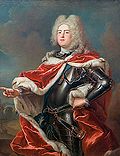 Portrait of Crown Prince Augustus
 -
 Augustus III in Sarmatian costume, by Louis de Silvestre, c.1737
 -
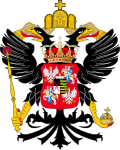 Coat of arms of Augustus III of Poland as vicar of the Holy Roman Empire
 -
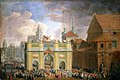 Entry of Augustus III into Warsaw by Johann Samuel Mock
 -
 Crown Regalia of King Augustus and Maria Josepha
 -
 6 groschen, 1763


,_AUGUSTUS_III_1763_-6_GROSCHEN_a_-_Flickr_-_woody1778a.jpg)
Ancestry
[edit] |
| Ancestors of Augustus III of Poland |
|---|
See also
[edit]- History of Saxony
- History of Poland (1569–1795)
- Rulers of Saxony
- List of Lithuanian rulers
- Dresden Castle – Residence of Augustus III
Notes and references
[edit]- ^ "Augustus III | king of Poland and elector of Saxony". Encyclopædia Britannica.
- ^ Clarissa Campbell Orr: Queenship in Europe 1660–1815: The Role of the Consort. Cambridge University Press (2004)
- ^ Jacek Staszewski, August III Sas, Wrocław, 2010, p. 27–29, 70 (in Polish)
- ^ a b Staszewski, Op. cit., p. 28
- ^ a b c d e "August III - przedostatni król i jego legenda | Łazienki Królewskie". lazienki-krolewskie.pl.
- ^ a b "August III Wettyn (król Polski 1733–1763)". TwojaHistoria.pl.
- ^ "Polski slownik biograficzny: Kopernicki, I.-Kozłowska". Skład główny w księg, Gebethnera i Wolffa. 21 March 1935.
- ^ Konopczyński, Władysław (21 March 1969). "Polski słownik biograficzny". Nakł. Polskiej Akademii Umiejętności.
- ^ a b Flathe, Heinrich Theodor (1878), "Friedrich August II., Kurfürst von Sachsen", Allgemeine Deutsche Biographie (in German), 7, Leipzig: Duncker & Humblot: 784–86.
- ^ a b Staszewski, Jacek (1996), August III. Kurfürst von Sachsen und König von Polen (in German), Berlin: Akademie-Verlag, ISBN 3-05-002600-6.
- ^ Kalipke, Andreas (2010). "The Corpus Evangelicorum". In Coy, J.P.; Marschke, B. Benjamin; Sabean D.W. (eds.). The Holy Roman Empire, Reconsidered. Berghahn. pp. 228–247.
- ^ Helen, Watanabe-O'Kelly (2004). "Religion and the Consort: Two Electresses of Saxony and Queens of Poland (1697–1757)". In Campbell Orr, Clarissa (ed.). Queenship in Europe 1660–1815: The Role of the Consort. Cambridge University Press. p. 265. ISBN 0-521-81422-7.
- ^ a b "Ostatnia polska królowa. Władczyni. o której nie powiedzieli Ci na lekcjach historii". WielkaHistoria. 30 July 2019.
- ^ That effectivity meant supporting the rule of Ernest Biron, a Russian court favourite. Corwin, Edward Henry Lewinski (1917) The Political History of Poland Polish Book Importing Company, New York, page 288, OCLC 626738
- ^ Ragsdale, Hugh (1993) Imperial Russian foreign policy Cambridge University Press, Cambridge, England, page 32–33, ISBN 0-521-44229-X
- ^ Corwin, Edward Henry Lewinski (1917) The political History of Poland Polish Book Importing Company, New York, page 286–288, OCLC 626738
- ^ "Od Sasa do Lasa". werandacountry.pl. 17 April 2015.
- ^ a b c "Zdanie, które podobno mówi wszystko o rządach Augusta III Sasa. Ale czy słusznie?". TwojaHistoria.pl. 16 January 2019.
- ^ a b "Swan Service | porcelain tableware". Encyclopædia Britannica.
- ^ Różycki, Bogusław Wojciech (22 March 2011). Zachodnie kresy Rzeczpospolitej: wzdłuż granicy na Odrze i Nysie : przewodnik. Oficyna Wydawnicza "Rewasz". ISBN 9788362460113.
- ^ Watra-Przewłocki, J. (22 March 1918). "Historya Polski ilustrowana". Nakł. i drukiem Wydawn. Braci Worzałłów.
- ^ "Fundacja Warszawa 1939". Fundacja Warszawa 1939.
- ^ Browning, Reed S. (1994). War of the Austrian Succession. Alan Sutton. ISBN 978-0-750-90578-7.
{{cite book}}:|website=ignored (help) - ^ a b "250. rocznica śmierci króla Polski Augusta III Wettyna". dzieje.pl.
- ^ "Collegium medico-chirurgicum". Stadtwiki Dresden. Retrieved 28 November 2019.
- ^ "Missa in B Minor ("Kyrie" and "Gloria" of the B Minor Mass)". World Digital Library. 1733. Retrieved 8 August 2013.
- ^ "Johann Adolph Hasse Museum". KomponistenQuartier. Archived from the original on 25 March 2019. Retrieved 28 November 2019.
- ^ "Słuchajmy Heinichena..." Radio Kraków. Retrieved 28 November 2019.
- ^ "Szpital Kliniczny Dzieciątka Jezus - O Szpitalu". dzieciatkajezus.pl. Archived from the original on 24 July 2010. Retrieved 22 March 2020.
- ^ a b August III Sas: Amazon.co.uk: Staszewski, Jacek: 9788304050341: Books. ASIN 830405034X.
- ^ "August III Sas - Staszewski Jacek - Ossolineum - Księgarnia internetowa czytam.pl". czytam.pl.
External links
[edit]
- . Encyclopædia Britannica. Vol. III (9th ed.). 1878. p. 85.
- Bach, Johann Sebastian, "Mass in B Minor", Cue points, Oregon Bach festival, archived from the original (Adobe Flash) on 23 July 2011, retrieved 21 August 2011.

Augustus III of Poland
View on GrokipediaEarly Life and Background
Birth, Family, and Upbringing
Frederick Augustus, who would reign as Augustus III of Poland and Frederick Augustus II of Saxony, was born on 17 October 1696 in Dresden, the capital of the Electorate of Saxony.[1] He was the only legitimate son of Frederick Augustus I, Elector of Saxony (Augustus II the Strong as King of Poland), and his wife Christiane Eberhardine of Brandenburg-Bayreuth.[6] His father had numerous illegitimate children but prioritized Frederick Augustus as heir due to his legitimate birth. The marriage of his parents, arranged in 1693, deteriorated after his father's conversion to Catholicism in 1697 to pursue the Polish crown, leading Christiane Eberhardine—devoutly Lutheran—to separate from her husband and retire to her estates in Pretzsch, where she raised her son in the Protestant faith for several years.[6][1] Despite his early Protestant upbringing, Frederick Augustus secretly converted to Catholicism in 1712, publicly affirming it in 1717, to secure his prospects for the hereditary Saxon electorate and potential Polish succession, mirroring his father's strategic religious shift.[1] His education in Dresden emphasized princely virtues, including mastery of multiple languages such as German, French, and Polish, alongside military and diplomatic training, grooming him from youth for dual roles in Saxony and Poland.[7]Education and Formative Influences
Frederick Augustus, later Augustus III of Poland and Frederick Augustus II of Saxony, was born on 17 October 1696 in Dresden, the capital of the Electorate of Saxony.[8] As the only legitimate son of Elector Frederick Augustus I (Augustus II the Strong) and his wife Christiane Eberhardine of Brandenburg-Bayreuth, he was positioned from birth within the dynastic framework of the House of Wettin, which sought to maintain and expand influence through the elective Polish monarchy.[8] His parents' union, marked by religious discord—his father having converted to Catholicism in 1697 to claim the Polish crown while his mother remained a staunch Lutheran—profoundly influenced his early environment; the couple separated soon after his birth, with Christiane Eberhardine withdrawing to her castle in Pretzsch and raising the prince in the Protestant faith.[1] To secure eligibility for the Polish throne, which constitutionally favored Catholic candidates, Frederick Augustus secretly embraced Catholicism in 1712 at the age of fifteen, though his formal public conversion occurred later, aligning with his grooming for succession.[1] [9] This religious pivot, mirroring his father's opportunistic conversion, underscored the pragmatic dynastic imperatives that dominated his formative years amid the opulent yet unstable Baroque court of Dresden, characterized by his father's absolutist tendencies, lavish patronage of arts, and military adventurism in northern European conflicts.[1] The young prince's exposure to this milieu, including the cultural splendor of projects like the Dresden Zwinger, instilled a preference for splendor and continuity in governance over innovative reform, traits evident in his later reign.[10]
Inheritance of Saxony
Frederick Augustus, born in 1696 as the sole legitimate son of Elector Frederick Augustus I of Saxony (known as Augustus II in Poland) and Christiane Eberhardine of Brandenburg-Bayreuth, was designated heir to the Saxon electorate from birth.[11][12] The marital separation of his parents in 1694—stemming from Augustus II's conversion to Catholicism for Polish ambitions, while his wife and son initially remained Protestant—did not alter his status as successor under Wettin primogeniture, though it led to his upbringing primarily in Saxony under Protestant tutelage until his own conversion in 1712.[13] Upon Augustus II's death on 1 February 1733 in Warsaw, Frederick Augustus immediately acceded to the Electorate of Saxony as Frederick Augustus II, with the transition occurring without dispute or rival claimants, as confirmed by contemporary accounts of the unaltered dynastic line.[13][14] This inheritance preceded the contested Polish election later that year, allowing him to leverage Saxon resources in pursuing the Polish crown, supported by Austria and Russia.[15] The electorate's administrative continuity was maintained through existing councils, though Frederick Augustus II's personal governance emphasized cultural patronage over his father's militaristic style.[16]Path to the Polish Crown
Marriage and Dynastic Alliances
In 1719, Frederick Augustus II, Crown Prince of Saxony and later Augustus III of Poland, married Archduchess Maria Josepha of Austria, daughter of Holy Roman Emperor Joseph I, in Vienna on 20 August.[17][18] The union was orchestrated by his father, Augustus II the Strong, to forge a strategic alliance with the Habsburg dynasty, aiming to enhance Wettin influence within the Holy Roman Empire and support dynastic ambitions, including potential claims to the imperial throne.[19] The wedding ceremonies extended into a month-long Baroque spectacle in Dresden, featuring operas, parades, and fireworks, with the newly expanded Zwinger pavilion serving as a key venue for festivities.[20] This Habsburg connection proved instrumental in dynastic politics, providing Augustus III with crucial Austrian backing during the 1733 Polish succession crisis.[18] Allied with Emperor Charles VI—Maria Josepha's uncle—the marriage aligned Saxony's interests with those of the Habsburgs, contrasting with French support for rival candidate Stanisław Leszczyński and facilitating Augustus's election as king amid the ensuing War of the Polish Succession.[21] The couple's fourteen children further extended these alliances; for instance, their son Frederick Christian succeeded as Elector of Saxony, while daughters such as Maria Amalia wed into the Spanish Bourbon line and Maria Josepha into the Bavarian Wittelsbach house, embedding Wettin ties across European courts.[18]Electoral Rule in Saxony Prior to 1733
Frederick Augustus, the sole legitimate son of Elector Frederick Augustus I (Augustus II the Strong), was born on 17 October 1696 in Dresden and groomed from youth for leadership in both Saxony and the anticipated Polish succession. His education emphasized military discipline, diplomacy, and administrative skills, reflecting the dual demands of the personal union between Saxony and Poland under his father. http://fmg.ac/Projects/MedLands/SAXONY.htm A pivotal step in his preparation came with his marriage to Archduchess Maria Josepha of Austria on 20 August 1719 in Vienna, arranged to forge an alliance with the Habsburgs against potential rivals like France and Russia in the contest for Poland. This union secured promises of Austrian backing for his royal ambitions and infused Saxon coffers with a dowry of 1,000,000 thalers, bolstering the Electorate's finances amid ongoing recovery from the Great Northern War's devastations. http://fmg.ac/Projects/MedLands/SAXONY.htm During Augustus II's prolonged sojourns in Poland and amid the elector's advancing age and health ailments in the 1720s, the crown prince assumed growing oversight of Saxon governance, including fiscal reforms and court patronage that sustained Dresden's status as a Baroque cultural hub. He maintained the Electorate's standing army of approximately 20,000 men, a legacy of his father's militarization efforts, positioning Saxony as a formidable player in Central European affairs. https://www.internationales.sachsen.de/en/regional-co-operations-3929.html These experiences equipped Frederick Augustus with practical command over Saxony's absolutist-leaning administration, characterized by centralized royal control tempered by noble estates' influence, setting the stage for his seamless accession as Frederick Augustus II on 1 February 1733 following his father's death in Warsaw. http://fmg.ac/Projects/MedLands/SAXONY.htmContested Election and War of the Polish Succession
The death of Augustus II on 1 February 1733 triggered preparations for a royal election in the Polish-Lithuanian Commonwealth, where the nobility (szlachta) selected the monarch through the elective sejm.[22] The Convocation Sejm, meeting from 27 April to 11 May 1733, established election procedures and confirmed the realm's pacta conventa, emphasizing the tradition of free election despite growing foreign interference. Two primary candidates emerged: Frederick Augustus II, Elector of Saxony since 1733 and son of Augustus II, supported by Russia and Austria to maintain the personal union with Saxony; and Stanisław Leszczyński, the former king (1704–1709) and father-in-law of Louis XV of France, favored by pro-French Polish factions seeking independence from Russian dominance.[23] The Election Sejm convened on 28 August 1733 near Warsaw, but divisions quickly surfaced. On 12 September, a majority of electors proclaimed Leszczyński as Stanisław I, reflecting widespread noble preference for a native candidate unburdened by Saxon ties.[23] However, Russian forces under Field Marshal Peter Lacy, numbering approximately 20,000 troops, advanced into Polish territory from 11 August onward, pressuring magnates and dispersing opponents.[24] On 5 October, a minority faction of about 3,000 electors, shielded by Russian troops, elected Frederick Augustus II as Augustus III at a site outside Warsaw, invalidating the prior vote through military coercion.[25] This dual election ignited civil conflict, with Leszczyński's supporters forming confederations while Augustus III's partisans, backed by Russian occupation, secured key cities. The resulting War of the Polish Succession (1733–1738) extended beyond Poland, pitting the Franco-Spanish-Bavarian alliance against the Russo-Austrian-Prussian coalition, though fighting in the Commonwealth focused on enforcing Augustus III's claim. Russian armies occupied Warsaw and Kraków, enabling Augustus III's coronation on 17 January 1734 in Kraków by primate Teodor Potocki, despite boycotts by Leszczyński adherents.[25] Leszczyński, retreating to Gdańsk (Danzig), withstood a six-month siege from October 1733 to June 1734 before surrendering to Russian forces, after which he fled to Königsberg and later France; the city's capitulation involved heavy bombardment, causing significant civilian casualties and destruction.[24] Polish resistance remained fragmented, with pro-Leszczyński confederates like the Dzików Confederation achieving limited successes before Russian suppression consolidated Augustus III's control by mid-1734. In Europe, French invasions of the Rhineland and campaigns in Italy (e.g., occupation of Lorraine in 1733 and battles like Parma in 1734) aimed to pressure Augustus's allies but yielded limited gains, as Russian-Austrian forces prioritized Polish stabilization over broader commitments. A preliminary accord in 1735 via the Treaty of Vienna tentatively recognized Augustus III, ceding Italian territories to Spain but deferring Polish finality.[26] The war concluded definitively with the second Treaty of Vienna on 18 November 1738, affirming Augustus III's kingship and elective legitimacy, while granting Leszczyński the Duchy of Lorraine (upon the death of Duke Leopold in 1729, held in abeyance) as compensation, ensuring his renunciation of Polish claims only after his lifetime.[22] This outcome entrenched Russian influence over Polish elections, diminishing the szlachta's autonomy and foreshadowing further partitions.[27]Reign as King of Poland and Elector of Saxony
Domestic Administration in Poland
Augustus III's domestic administration in Poland was characterized by prolonged absenteeism and heavy reliance on intermediaries, reflecting his preference for governing from Dresden. Over his 30-year reign from 1733 to 1763, he spent only about 24 months in Polish territory, limiting direct oversight and exacerbating the Commonwealth's decentralized structure.[28] Authority was largely delegated to his chief minister, Heinrich von Brühl, who wielded influence as de facto viceroy while maneuvering among competing magnate factions such as the Czartoryskis and Potockis.[9] Brühl's approach prioritized short-term alliances over systemic governance, often deferring to noble elites who controlled regional administration through voivodeships and private armies, perpetuating inefficiency in tax collection and justice.[29] Legislative paralysis defined the era, with the Sejm convened approximately 18 times yet disrupted by the liberum veto in nearly all sessions; only one Sejm—the 1746 gathering—avoided dissolution and passed minor fiscal measures, insufficient to address mounting deficits or administrative decay.[30] Noble resistance, rooted in defense of golden freedoms and magnate privileges, thwarted royal initiatives, such as Brühl's sporadic pushes for revenue enhancement via customs reforms in the 1740s, which faltered amid vetoes and confederations. This inertia sustained serfdom's entrenchment, with peasants comprising over 80% of the population under noble dominion, yielding negligible state revenues—Poland's crown lands generated under 1 million złoty annually by mid-century—while corruption eroded what little central control remained.[30] Judicial and fiscal systems remained fragmented, with royal courts handling few cases amid noble tribunals' dominance; Brühl's favoritism toward allies like the Czartoryskis amplified factionalism, as evidenced by their control over key chancellorships post-1740s. No comprehensive reforms materialized, contrasting with Saxony's more centralized model, leaving Poland vulnerable to internal anarchy and external pressures. Economic stagnation persisted, with grain exports fluctuating around 200,000–300,000 lasts yearly but yielding minimal infrastructure investment, as royal expenditures prioritized Saxon court luxuries over Polish needs.[9]Attempts at Reform and Noble Resistance
During the reign of Augustus III, administrative and fiscal reforms were pursued primarily through his chief minister, Heinrich von Brühl, who effectively governed Poland in the king's stead from Dresden. These efforts aimed to enhance royal authority, streamline taxation to fund military obligations tied to Saxony's foreign entanglements, and introduce elements of Saxon bureaucratic efficiency into the Commonwealth's fragmented institutions. However, such initiatives directly challenged the nobility's entrenched privileges, including tax exemptions and control over local governance, provoking widespread resistance. Brühl's strategy often involved suppressing dissent through Saxon troops or alliances with Russian forces, yet this coercion failed to overcome the structural barrier of the liberum veto, which empowered any single deputy to dissolve legislative sessions.[31] The Pacification Sejm of 1736 stands as the sole legislative assembly under Augustus III to conclude without disruption and enact laws, but its outcomes were confined to confirming the king's election, disbanding rival confederacies from the War of the Polish Succession, granting amnesty to opponents, and nominating a pro-Saxon candidate for the Duchy of Courland—measures geared toward consolidation of power rather than systemic overhaul. Subsequent Sejms, numbering over a dozen, routinely collapsed under the veto; of these, sixteen saw its formal invocation, blocking budgets, army modernization, and administrative rationalization essential for addressing Poland's economic stagnation and defensive vulnerabilities. Brühl's early collaboration with reform-inclined magnates like the Czartoryski family yielded temporary stability and office appointments, but by the 1750s, factional splits and noble intransigence halted further progress, as the "Familia" shifted toward independent agendas incompatible with Saxon dominance.[31][32] Noble opposition stemmed from a causal commitment to "Golden Liberty," wherein szlachta (about 10% of the population) prioritized individual veto rights and election of kings over collective state-building, viewing monarchical strengthening as a prelude to absolutism akin to Saxon practices. This resistance was exacerbated by inter-factional rivalries—e.g., Potocki clans versus Czartoryskis—and external influences, as vetoes aligned with Russian or French interests to maintain Poland's paralysis. Empirical outcomes underscore the futility: no enduring fiscal reforms materialized despite war-driven needs (e.g., post-1740 Austrian Succession strains), leaving the Commonwealth's treasury depleted and army at roughly 18,000 men, ill-equipped against neighbors. Brühl's diplomatic maneuvering, including payoffs to deputies, prolonged stasis but entrenched dependency on foreign guarantors, foreshadowing partitions.[33][31]Governance and Priorities in Saxony
As Elector Frederick Augustus II from 1733 to 1763, Augustus III governed Saxony through extensive delegation to his chief minister, Heinrich von Brühl, who wielded de facto control over administration, diplomacy, and finances. Brühl, rising from court page to prime minister by 1738, centralized authority by curbing the influence of the Saxon estates and prioritizing royal prerogatives, though this approach fostered corruption and favoritism among officials.[34] The elector's frequent absences due to Polish obligations left Brühl to manage daily affairs, including tax collection and judicial oversight, with policies emphasizing fiscal extraction to support court expenditures estimated at over 10 million thalers annually by the 1750s.[4] Cultural patronage formed a core priority, building on his father's legacy to position Dresden as a Baroque jewel of Europe. Augustus III commissioned the completion of the Zwinger palace complex and initiated construction of the Dresden Cathedral (Hofkirche) in 1738, engaging architects like Gaetano Chiaveri to erect a Catholic stronghold amid a Protestant populace.[35] He amassed vast art collections, acquiring Raphael's Sistine Madonna in 1754 for 20,000 thalers, and supported the Meissen porcelain manufactory, which under state monopoly produced luxury goods exporting over 100,000 pieces yearly by mid-century, bolstering prestige but straining resources.[36] Brühl complemented this by commissioning operatic works and inviting painters such as Bernardo Bellotto to document the city's splendor, fostering an environment where artistic output, including annual court operas, consumed up to 15% of the budget.[37] Economic policies focused on exploiting Saxony's mining sector in the Erzgebirge, yielding silver and tin revenues peaking at 1.5 million thalers in the 1740s, alongside textile exports and porcelain innovation. However, Brühl's administration pursued no structural reforms, relying on monopolies and tariffs that stifled broader trade growth, while subsidies to Poland—totaling millions in troop levies and loans—exacerbated deficits. Military priorities aligned Saxony with Habsburg Austria, maintaining a standing army of 20,000 by 1740, but this entanglement diverted funds from infrastructure, leaving the electorate vulnerable; the Seven Years' War (1756–1763) alone inflicted damages exceeding 40 million thalers through Prussian occupation and requisitions.[4] Overall, governance emphasized monarchical display over sustainable development, contributing to fiscal exhaustion by Augustus III's death.[37]Foreign Policy and Military Engagements
Heinrich von Brühl, as Augustus III's principal advisor, dominated the formulation and execution of foreign policy for both the Electorate of Saxony and the Polish-Lithuanian Commonwealth, prioritizing containment of Prussian power through Habsburg alignment. This approach stemmed from dynastic interconnections, including Augustus's 1719 marriage to Habsburg Archduchess Maria Josepha, and strategic calculations against Frederick II's expansionism, which threatened Saxon interests in the Holy Roman Empire. Brühl's diplomacy focused on multilateral coalitions to bolster Austria, avoiding unilateral Polish initiatives due to the Commonwealth's internal paralysis from noble veto powers and fiscal constraints.[34] Key bilateral relations reflected this framework: with Austria, Saxony pursued deepened military and diplomatic coordination as an imperial counterweight to Prussia; with Russia, ties rested on the 1733 electoral backing by 30,000 Russian troops and a subsequent agreement securing dynastic succession to Augustus's heir, though this entrenched Moscow's informal protectorate over Polish elections and vetoed anti-Russian reforms. Prussian antagonism intensified over border enclaves like Oława and electoral rivalries, with Brühl rejecting overtures from Berlin in favor of encirclement strategies. Ottoman and Swedish relations remained peripheral, with no major engagements, as Polish neutrality was invoked to shield the Commonwealth from peripheral conflicts.[9][38][34] Militarily, Saxony's standing army—reorganized under royal oversight but often mismanaged—served as the primary instrument of foreign engagements, committing forces to auxiliary roles in imperial campaigns aligned with Vienna, while Poland's depleted levies (capped by sejm resistance at under 20,000 effectives) enforced declarative neutrality to avert noble backlash and Russian ire. This bifurcation exposed vulnerabilities: Saxon expeditions drained resources without Polish fiscal support, fostering dependency on subsidies and leading to territorial occupations when coalitions faltered. Brühl's risk-averse yet alliance-bound posture preserved short-term stability but eroded long-term autonomy, as great-power maneuvers increasingly treated the dual realm as a contested buffer.[34]Role in the War of the Austrian Succession
Despite initially adhering to the Pragmatic Sanction of 1713 and recognizing the Habsburg succession of Maria Theresa upon Emperor Charles VI's death on October 20, 1740, Elector Frederick Augustus II of Saxony (also Augustus III of Poland) shifted toward opposition to Austrian dominance. In September 1741, Saxony acceded to the anti-Austrian League of Nymphenburg, allying with France, Bavaria, Prussia, and Spain to challenge Habsburg power, motivated by territorial ambitions in Bohemia and prospects for elevating his son to the imperial throne.[39] This entry committed Saxon forces to the coalition, though active campaigning remained limited until later. Saxony's major military engagement occurred in 1744 amid deteriorating relations with Austria. On June 20, 1744, Frederick Augustus II formalized an alliance with King Frederick II of Prussia, prompting a joint invasion of Bohemia on August 15, 1744, with approximately 60,000 Prussian and 20,000 Saxon troops under Prussian command. The allies captured Prague on September 16, 1744, but supply shortages and Austrian reinforcements under Prince Charles of Lorraine forced a withdrawal by mid-October, yielding no territorial gains and exposing Saxony to retaliation.[40] In response, Austrian forces invaded Saxony in November 1745, advancing toward Dresden and prompting Frederick Augustus II to seek Prussian aid while his Saxon army, led by Field Marshal Johann Georg Rutowski, maneuvered defensively. On December 15, 1745, at the Battle of Kesselsdorf near the Elbe River, a Prussian relief force of 30,000 under Prince Leopold of Anhalt-Dessau clashed with 50,000 Austrians commanded by General Bathyan, resulting in a hard-fought Prussian victory that halted the invasion despite heavy casualties on both sides (Prussian losses around 3,000–4,000; Austrian over 5,000).[41] This battle preserved Saxon independence temporarily, as Austrian troops withdrew to avoid encirclement. The conflict's toll on Saxony—financial exhaustion, army decimation, and brief occupation—led Frederick Augustus II to extricate his electorate via the Treaty of Dresden on December 25, 1745, recognizing Prussian control of Silesia, affirming Frederick II's royal title in Prussia, and pledging neutrality for the war's remainder.[42] As king of Poland-Lithuania, he maintained Polish neutrality throughout, avoiding direct entanglement of Commonwealth forces, though the Saxon commitments strained his dual realm's resources without yielding strategic advantages or imperial elevation for his lineage.[43]Involvement in the Seven Years' War
As Elector Frederick Augustus II of Saxony, Augustus III aligned his electorate with the Habsburg-led coalition against Prussia, adhering to defensive pacts stemming from the diplomatic reversals of 1756, including Austria's overtures to France and Russia that drew in Saxony through longstanding Viennese ties and mutual guarantees against Prussian aggression.[44] This positioning, driven by Augustus's pro-Austrian inclinations and advisor Heinrich von Brühl's influence, rejected Frederick II's overtures for neutrality or alliance, committing Saxon forces to the anti-Prussian front despite the electorate's military vulnerabilities.[44] The Seven Years' War commenced for Saxony with Frederick II's preemptive invasion on 29 August 1756, as Prussian forces numbering around 60,000 rapidly overran the electorate to forestall coordinated Allied action.[45] The Saxon army, approximately 17,000 strong under Field Marshal Jacob Heinrich von Flemming and later August III von Rutowski, withdrew to the entrenched camp at Pirna overlooking the Elbe River, where it endured a prolonged siege amid supply shortages and failed Austrian relief efforts led by Maximilian Ulysses von Browne.[45] On 18 October 1756, the Saxons capitulated, with most troops compelled to join Prussian ranks under threat of reprisals against their families and homeland.[45] Augustus III, who had been in Poland attending to royal duties, received word of the incursion while en route back to Dresden and promptly retreated eastward to Polish territory, initially to Tczew near Danzig before relocating to Warsaw and later Königsberg under Russian aegis.[45] Saxony fell under direct Prussian occupation, governed as a conquered province with requisitions funding Frederick's campaigns, widespread billeting, and punitive measures that inflicted severe hardship on the populace and treasury.[46] Escaped Saxon elements and reformed units subsequently campaigned with Austrian armies, participating in engagements such as the victory at Kolin on 18 June 1757, though overall Saxon contributions were hampered by leadership disarray and resource depletion. Augustus's remote oversight, reliant on Brühl's directives, drew contemporary reproach for timidity and strategic missteps that prolonged Saxon suffering without decisive gains.[47] The conflict's European phase concluded with the Treaty of Hubertusburg on 15 February 1763, restoring Saxony's sovereignty and pre-war borders without indemnity to Prussia, enabling Augustus III's return to Dresden in April.[46] Poland-Lithuania, formally neutral per Sejm declarations despite the king's dual role, avoided direct belligerency but hosted transit of Russian troops en route to Prussian fronts, underscoring the personal union's tensions.[48] The war exacerbated Saxony's fiscal ruin and administrative inertia under Augustus, contributing to post-war instability that outlasted his reign.[49]Personal Life and Character
Family Dynamics and Issue
Augustus III, then Crown Prince Frederick Augustus of Saxony, married Archduchess Maria Josepha of Austria on 20 August 1719 in Vienna, a union arranged by his father Augustus II to forge Habsburg alliances amid electoral and Polish ambitions.[19] Maria Josepha, born 8 December 1699 as the youngest daughter of Emperor Joseph I, brought significant Habsburg dowry and prestige, though she had renounced her succession rights to the Austrian throne as a condition of the marriage.[50] The couple's relationship, while politically motivated, appears to have been marked by mutual respect and Augustus's relative fidelity, diverging from his father's notorious promiscuity; no prominent mistresses or acknowledged illegitimate children are recorded for Augustus III, unlike the hundreds attributed to Augustus II.[51] Maria Josepha, deeply pious and devoted to Catholic devotion, exerted considerable influence over family religious life, promoting conversions and charitable works in largely Protestant Saxony despite resistance from local Lutherans. She bore fifteen children between 1720 and 1740, though epidemics like smallpox claimed many in infancy or youth, with only about ten reaching adulthood. Augustus, more inclined toward hunting, music, and courtly pursuits, delegated household management to his wife, who maintained a strict moral environment centered in Dresden's royal residences; this dynamic fostered a stable but insular family atmosphere, with limited Polish involvement due to the king's absentee rule.[52] The legitimate issue included eight sons and seven daughters, though survival rates were low:| Child | Birth–Death | Notes |
|---|---|---|
| Frederick Augustus | 1720–1721 | Died in infancy. |
| Frederick Christian | 5 September 1722 – 17 December 1763 | Eldest surviving son; succeeded as Elector of Saxony; married Maria Antonia of Bavaria (1730–1780), with issue including future Elector Frederick Augustus III.[50] |
| Maria Amalia | 29 August 1724 – 27 September 1760 | Married Joseph I, Elector of Bavaria (later Emperor); childless. |
| Maria Anna Carolina | 15 November 1728 – 19 February 1797 | Became abbess of Remiremont; unmarried. |
| Maria Josepha | 4 November 1731 – 7 March 1767 | Married Louis, Dauphin of France (1729–1765); mother of three French kings (Louis XVI, Louis XVIII, Charles X). |
| Charles Christian Emanuel | 13 December 1733 – 16 June 1796 | Pursued ecclesiastical career; administrator of bishoprics of Münster and Paderborn; unmarried. |
| Maria Christina | 7 December 1735 – 19 November 1782 | Married Albert, Duke of Teschen; issue included several children. |
| Maria Elisabeth | 14 February 1736 – 24 December 1818 | Unmarried; suffered from disabilities. |
| Maria Brigitta | 10 October 1737 – 1738 | Died in infancy. |
| Maria Anna Josepha | 29 September 1739 – 1739 | Died in infancy. |
Habits, Interests, and Daily Routine
Augustus III displayed a marked preference for leisure and cultural pursuits over the demands of governance, delegating much of the administrative burden in both Saxony and Poland to his chief minister, Heinrich von Brühl, who wielded extensive influence under his patronage.[34] This approach reflected a personal indolence that contemporaries noted, prioritizing ease amid the opulent court life in Dresden.[53] His primary interests included hunting, which he pursued enthusiastically as a princely diversion combining social entertainment with displays of status; he shared this fervor with his wife, Maria Josepha, engaging in courtly hunts that underscored their shared aristocratic values.[20][54] Augustus also favored opera and music, supporting Italian-style performances at the Dresden court and commissioning works such as Johann Sebastian Bach's celebratory cantatas for his name day, which often evoked themes of hunting and princely delight.[55] Details of his daily routine remain sparsely documented, but it centered on these recreations rather than state duties, typically involving courtly rituals, artistic engagements, and hunts when in residence at Dresden, where he spent the majority of his reign—totaling less than three years in Poland over three decades.[34] This absenteeism and focus on personal indulgences contributed to perceptions of his rule as detached, with governance handled through proxies like Brühl amid ongoing European conflicts.[56]Religious Piety and Conversion's Long-Term Effects
Augustus III demonstrated a personal commitment to Catholicism following his conversion in 1712, which he undertook at age 16 to position himself as heir to the Polish throne. Influenced by his wife, Maria Josepha of Austria, a devout Habsburg Catholic whom he married in 1719, he integrated religious observance into his routine, including regular attendance at Mass and support for Jesuit institutions in both Saxony and Poland.[9] His piety manifested in architectural patronage, notably commissioning the Dresden Hofkirche (Catholic Court Church) in 1739, designed by Gaetano Chiaveri as a Baroque symbol of Catholic resurgence in predominantly Lutheran Saxony. This project, completed under his reign, housed royal tombs and emphasized the court's Catholic identity amid a Protestant populace.[35] In Poland, Augustus III petitioned Pope Clement XIII in 1762 to establish the Feast of the Sacred Heart as a national observance, reflecting his devotion to emerging Counter-Reformation devotions and aiming to deepen Catholic fervor in the Commonwealth. The conversion's long-term effects reinforced the Wettin dynasty's Catholic orientation, enabling sustained personal union between Catholic Poland-Lithuania and Saxony until 1763, but it diminished Saxony's influence among Protestant Holy Roman Empire estates, ceding leadership to Brandenburg-Prussia. In Saxony, Augustus III upheld his father's 1697 guarantees of Lutheran religious freedom for subjects, averting revolt but perpetuating a bifurcated realm with a Catholic court fostering Baroque Catholic arts—evident in Dresden's ecclesiastical buildings—while the nobility and peasantry remained Protestant. This religious duality persisted in the Albertine Wettin line, contributing to cultural hybridity but also underlying tensions that weakened unified state identity post-1763.[57]Death, Succession, and Immediate Consequences
Final Years and Decline
Following the Treaty of Hubertusburg on February 15, 1763, which concluded the Seven Years' War, Elector Frederick Augustus II returned to a devastated Saxony in April, where Prussian forces had occupied and plundered the electorate, leaving its economy in ruins with massive debts accumulated under the policies of his chief minister, Heinrich von Brühl.[58][59] Brühl, who had effectively governed both Saxony and Poland on the elector's behalf, died on February 14, 1763, exacerbating the administrative vacuum amid postwar reconstruction challenges, including widespread destruction of infrastructure and agriculture that hindered any immediate recovery.[60] In Poland-Lithuania, the final years of Augustus III's reign saw a marked erosion of central authority, with the Czartoryski-led "Familia" faction consolidating power through alliances with Russia, monopolizing influence after the war and marginalizing Saxon proxies like Brühl, thereby accelerating the Commonwealth's internal fragmentation and paving the way for foreign interference in the impending royal election.[38] Augustus himself, increasingly incapacitated by chronic gout and obesity that confined him to a wheelchair or sedan chair, withdrew from active governance, delegating decisions to a diminished court while residing primarily in Dresden.[61] Augustus III died on October 5, 1763, in Dresden at age 66, from unspecified natural causes likely related to his longstanding health ailments, just months after the peace treaty and weeks before Brühl's passing, leaving both realms in precarious states without effective leadership transitions.[62]Death and Funeral
Augustus III died on 5 October 1763 in Dresden at the age of 66.[8] His death occurred suddenly during a period of declining health exacerbated by the strains of the Seven Years' War and longstanding ailments including gout.[1] The funeral arrangements reflected his deep ties to Saxony rather than Poland; he was interred in the Katholische Hofkirche (Dresden Cathedral) in the Wettin family crypt, breaking with the tradition observed by his father, Augustus II, who was buried in Wawel Cathedral, Kraków.[8][63] No elaborate Polish state funeral was conducted in Warsaw or Kraków, underscoring Augustus III's absentee rule and the court's orientation toward Dresden as the center of his governance and patronage. The ceremony in Dresden involved standard Catholic rites for an elector, with participation from Saxon nobility and clergy, though wartime devastations limited extravagance.[8]Succession Crisis in Poland and Saxony
Augustus III's death on 5 October 1763 precipitated divergent succession outcomes across his dual realms, exacerbated by Saxony's recent subjugation in the Seven Years' War and Poland's elective monarchy vulnerable to foreign meddling. In the hereditary Electorate of Saxony, Frederick Christian, the king's eldest surviving son born 5 September 1722, acceded unopposed as elector on the same day, initiating modest administrative reforms amid postwar reconstruction.[62][64] His abrupt death from smallpox on 17 December 1763—just 73 days into his reign—shifted the electorate to his underage son, Frederick Augustus (born 1750), under a regency dominated by the boy's mother, Maria Antonia of Bavaria, and Bavarian advisors, marking a period of internal stabilization rather than expansionist ambitions.[64][65] Saxony nominally advanced a claim to the Polish throne via Prince Franz Xavier, Augustus III's brother and a potential Wettin continuation of the personal union, but the electorate's depleted resources—evidenced by war indemnities and territorial concessions under the 1763 Treaty of Hubertusburg—precluded vigorous pursuit, effectively ceding influence to external powers.[38] This restraint reflected causal realities of power asymmetry: Prussia's lingering threat and Russia's ascendancy deterred assertive Saxon diplomacy, prioritizing domestic recovery over a contested elective crown.[66] In Poland-Lithuania, the vacancy ushered in a 11-month interregnum, during which the convocation sejm formalized procedures for a free election, but great-power rivalries transformed it into a diplomatic contest. Russia, leveraging its military superiority and Catherine II's personal stake, championed Stanisław Poniatowski—a 32-year-old magnate and former imperial favorite—against rivals backed by France (favoring Czartoryski affiliates) and residual pro-Habsburg elements.[31][62] The electoral assembly at Wola near Warsaw on 7 September 1764, attended by roughly 5,000 szlachta amid 12,000–18,000 Russian troops, devolved into coercion: Repnin's orchestration, including bribes exceeding 1 million rubles and arrests of opponents, secured Poniatowski's acclamation as Stanisław II August, bypassing traditional unanimity and exposing the Commonwealth's institutional fragility to causal interventions by neighbors indifferent to its sovereignty.[67][68] This outcome, while averting immediate civil war, entrenched Russian veto power, as contemporaneous diplomatic records attest to the eclipse of Polish agency in favor of partitioned stability.[62]Legacy and Assessments
Political Impact on the Polish-Lithuanian Commonwealth
Augustus III's election to the Polish throne on 5 October 1733, supported by Russian military intervention and Austrian backing during the War of the Polish Succession (1733–1738), imposed a foreign candidate over the domestically favored Stanisław Leszczyński, marking the onset of heightened external influence in Commonwealth affairs.[59] His coronation in Kraków on 17 January 1734 formalized this outcome, but the contested process deepened divisions among the nobility and entrenched reliance on great power patronage for royal legitimacy.[59] Throughout his 30-year reign (1734–1763), Augustus III exercised minimal direct governance over the Commonwealth, residing primarily in Dresden and delegating authority to his Saxon minister Heinrich von Brühl, who functioned as de facto viceroy and introduced a ministerial system that bypassed traditional Polish institutions.[59] This absenteeism and Saxon administrative infiltration provoked resentment among Polish magnates and szlachta, who viewed it as an erosion of national autonomy, though Saxon influence remained superficial due to cultural and political mutual distrust between the elites.[59] Brühl's dominance, particularly from the 1750s, prioritized Saxon interests and short-term stability over structural reforms, fostering corruption and inefficiency in Warsaw's court.[59] Internal politics under Augustus III witnessed the consolidation of magnate factions, including the pro-Russian Czartoryskis and Czartoryski rivals like the Potockis, who exploited the liberum veto to obstruct Sejm sessions—over 100 convocations failed between 1733 and 1763—preventing fiscal or military modernization. Efforts at army expansion and tax reforms in the 1740s collapsed amid noble opposition and Russian vetoes, leaving the Commonwealth's forces stagnant at around 18,000 permanent troops by mid-century, ill-equipped against emerging threats.[59] This paralysis amplified economic disparities, with illusory prosperity masking underlying stagnation in grain exports and serf-based agriculture, while urban centers like Gdańsk declined relative to competitors. Foreign policy alignments, including Saxon-Polish support for Austria in the War of the Austrian Succession (1740–1748) and the Seven Years' War (1756–1763), exposed the Commonwealth to Prussian invasions and Russian occupations without reciprocal benefits, as neutrality declarations proved unenforceable.[59] Russian dominance grew unchecked, with interventions like the 1762 deployment of 20,000 troops to Warsaw underscoring the king's inability to assert sovereignty, ultimately catalyzing post-reign confederations and the First Partition of 1772.[59] Historians attribute this era's "uneasy peace" and institutional decay directly to Augustus III's weak leadership, which failed to counterbalance magnate anarchy or foreign encroachments, precipitating the Commonwealth's terminal vulnerability.Consequences for Saxony and the Holy Roman Empire
Augustus III's reign as Elector Frederick Augustus II imposed significant strains on Saxony through the demands of the Polish-Lithuanian throne, including financial subsidies to Warsaw and military interventions that exacerbated economic vulnerabilities. The personal union diverted Saxon resources toward Eastern European entanglements, contributing to a gradual erosion of the electorate's influence within the Holy Roman Empire and its economic standing relative to rising powers like Prussia. By prioritizing Polish affairs and Habsburg alliances, Saxony neglected internal reforms, fostering dependency on court patronage over industrial development, though manufacturing sectors like textiles and porcelain persisted amid fiscal pressures.[59] The Seven Years' War (1756–1763) represented the nadir of these consequences, as Saxony's alignment with Austria prompted Prussian invasion in August 1756, leading to the occupation of Dresden and much of the electorate. Frederick the Great's forces bombarded the Saxon capital on September 13, 1756, destroying key infrastructure and imposing heavy contributions estimated at over 10 million thalers, while the Saxon army suffered catastrophic losses, including the death of nearly 20,000 troops. The Treaty of Hubertusburg on February 15, 1763, restored pre-war borders without reparations from Prussia, but Saxony emerged demographically depleted—with population losses exceeding 100,000—and economically ravaged, its debt ballooning to 40 million thalers and agricultural output halved in occupied regions. Augustus III's death on October 5, 1763, shortly after the peace, ended the union, allowing his successor Frederick Christian (ruling December 1763) and then Frederick Augustus III to pursue reconstruction, including administrative centralization and neutrality policies that averted immediate further conflicts but could not fully reverse the electorate's diminished military capacity.[59][69] Within the Holy Roman Empire, the union's termination severed Saxony's ties to Polish electoral politics, refocusing it on imperial dynamics but from a weakened position. Augustus III's pro-Habsburg stance, including his role as imperial vicar from 1742 to 1745 and vote for Joseph II as King of the Romans in 1764 (posthumously influenced), aligned Saxony with Vienna against Protestant interests, alienating traditional allies and eroding its status as a leading Protestant electorate. This orientation, combined with war-induced exhaustion, relegated Saxony to a secondary role in imperial assemblies, where Prussian ascendancy post-1763 marginalized smaller states; by the Empire's dissolution in 1806, Saxony's electorate had transitioned to kingdom status under Napoleonic favor, but its earlier decline under Augustus III's dual rule had already curtailed its diplomatic leverage.[59][70]Cultural Patronage and Artistic Support
As Elector Frederick Augustus II of Saxony, Augustus III sustained and expanded the cultural legacy established by his father, emphasizing painting, architecture, and collections in Dresden. He and his father curated extensive art cabinets, amassing systematic collections that formed the basis of the Dresden State Art Collections.[71] His focus on cultural endeavors prioritized artistic connoisseurship over political administration, which he delegated to ministers like Heinrich von Brühl.[72] Augustus III actively patronized painters, notably inviting Bernardo Bellotto to Dresden in 1747 and appointing him court painter in 1748. Bellotto produced detailed vedute, including views of Neumarkt in Dresden (1747) and Königstein Fortress (1756), documenting the Saxon landscape and urban splendor under royal commission.[73][74] These works enhanced the court's prestige and preserved visual records of the era's architecture. He also supported the continuation of court artists like Louis de Silvestre, maintaining a vibrant painting tradition. In architecture, Augustus III commissioned the Dresden Hofkirche (Cathedral), with construction starting in 1738 under architect Gaetano Chiaveri and completing in 1751, serving as the Catholic court church.[35] The project reflected his emphasis on Baroque grandeur and religious piety. While the Zwinger complex originated under his father, Augustus III utilized it for cultural events, including his 1719 wedding festivities, underscoring ongoing investment in Dresden's artistic infrastructure.[75] His reign saw the Gemäldegalerie Alte Meister bolstered through acquisitions, positioning Dresden as a European art hub.[76] The Meissen porcelain manufactory, founded by Augustus II in 1710, thrived under Augustus III's oversight, producing luxury items like hard-paste porcelain figures by Johann Joachim Kändler around 1753, supported by sustained royal funding and promotion of Saxon industry.[77][78] This patronage extended to music and theater at the Dresden court, though painting and collections dominated his personal interests. Overall, his efforts, concentrated in Saxony rather than Poland, elevated Dresden's status as a Baroque cultural center despite political challenges like the Seven Years' War.[72]