Hubbry Logo
Austrian PartitionAustrian PartitionMain
Open search
Austrian Partition
Community hub
Austrian Partition
logo
8 pages, 0 posts
0 subscribers
Be the first to start a discussion here.
Austrian Partition
Austrian Partition
from Wikipedia
The Austrian Partition
The Commonwealth
Elimination
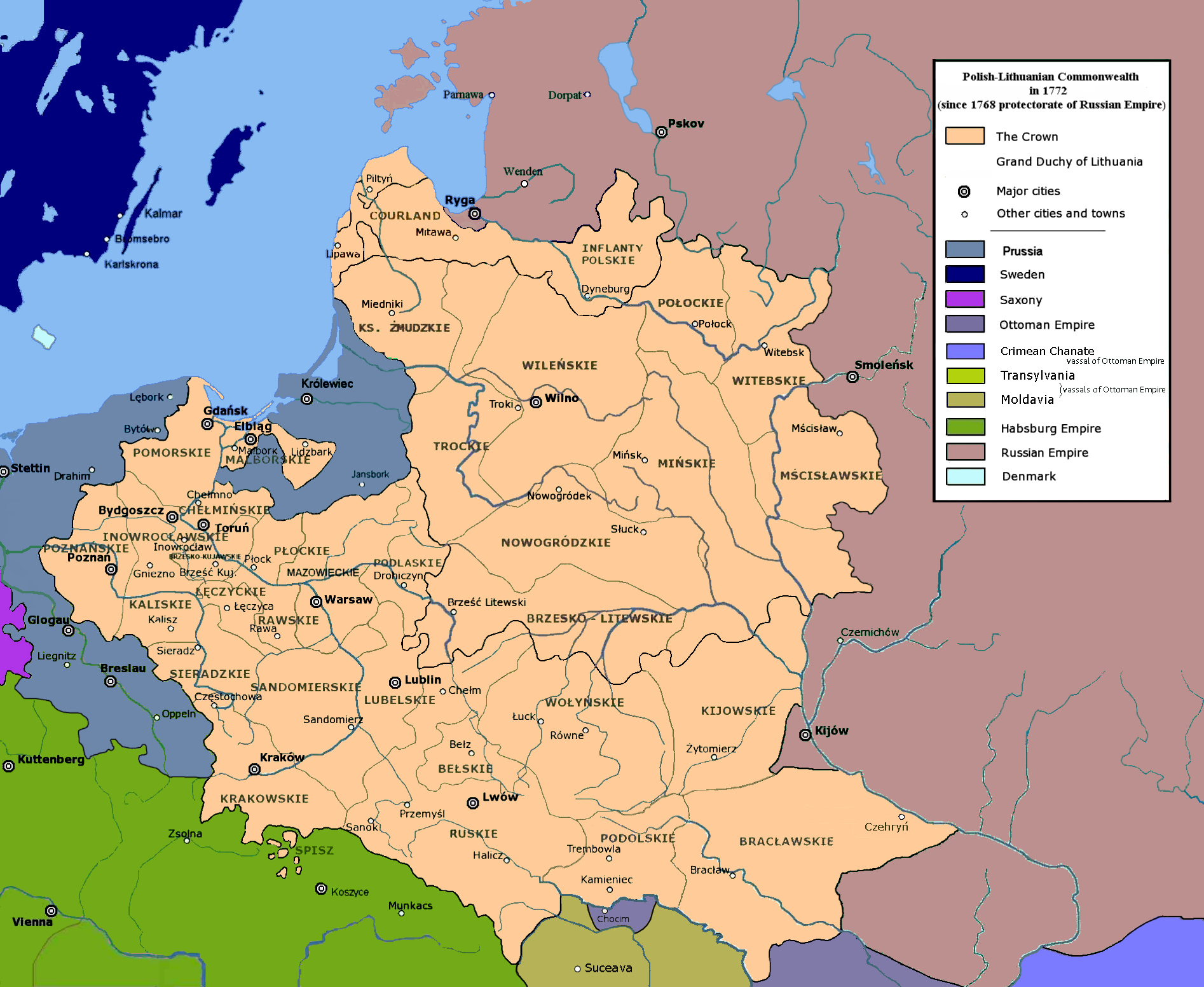
The three partitions of the Polish–Lithuanian Commonwealth. The Russian Partition (pink and brown), the Austrian Partition (green), and the Prussian Partition (blue)

The Austrian Partition (Polish: zabór austriacki) comprises the former territories of the Polish–Lithuanian Commonwealth acquired by the Habsburg monarchy during the Partitions of Poland in the late 18th century. The three partitions were conducted jointly by the Russian Empire, the Kingdom of Prussia and Habsburg Austria, resulting in the complete elimination of the Polish Crown. Austria acquired Polish lands during the First Partition of 1772, and Third Partition of Poland in 1795.[1] In the end, the Austrian sector encompassed the second-largest share of the Commonwealth's population after Russia;[note 1] over 2.65 million people living on 128,900 km2 (49,800 sq mi) of land constituting the formerly south-central part of the Republic.[3]

History

[edit]

The territories acquired by Austrian Empire (later the Austro-Hungarian Empire) during the First Partition included the Polish Duchy of Zator and Duchy of Oświęcim, as well as part of Lesser Poland with the counties of Kraków, Sandomierz and Galicia, less the city of Kraków. In the Third Partition, the annexed lands included so called "Western Galicia": northern Lesser Poland (voivodeships of Lublin and Sandomierz) and southern Masovia. Major historical events of the Austrian Partition included: the formation of the Napoleonic Duchy of Warsaw in 1807, which was followed by the 1809 Austro-Polish War aided by the French, and the victorious Battle of Raszyn resulting in Austrian temporary defeat (1809) marked by the recapture of Kraków and Lwów by the Duchy. However, the fall of Napoleon, leading to abolition of the Duchy at the Congress of Vienna (1815) allowed Austria to regain control. The Congress created the Free City of Kraków protectorate of Austria, Prussia and Russia, which lasted for a decade. It was abolished by Austria, after the crushing of Kraków Uprising in 1846. The formation of the Polish Legions by Piłsudski initially to fight alongside the Austro-Hungarian Army,[4] helped Poland regain its sovereignty in aftermath of World War I.

Society

[edit]
Edward Dembowski during the Kraków Uprising against the Austrian rule, 1846

For most of the 19th century, the Austrian government made few or no concessions to their Polish constituents,[5] their attitude being that a "patriot was a traitor – unless he was a patriot for the [Austrian] Emperor."[6] However, by the early 20th century – just before the outbreak of World War I and the collapse of Austria-Hungary – out of the three partitions, the Austrian one had the most local autonomy.[7] The local government called the Governorate Commission (Polish: Komisja Gubernialna) had considerable influence locally, Polish was accepted as the official regional language on Polish soil, and used in schools; Polish organizations had some freedom to operate, and Polish parties could formally participate in Austro-Hungarian politics of the empire.[7]

Austria-Hungary also de facto encouraged (the flourishing[8]) Ukrainian organizations as a "divide and rule" tactic.[9][10] This led to accusations by Poles that "Austria-Hungary had invented Ukrainians".[10] Ukrainians maintained schools (from elementary to higher levels)[note 2] and newspapers[note 3] in the Ukrainian language.[8][12] After 1848 Ukrainians also moved into Austrian politics with their own political parties.[8] Austria-Hungary gave Ukrainians more rights than Ukrainians living in the Russian Empire.[13] Decades after it had ceased to exist its former Ukrainian citizens had positive emotions about Austria-Hungary.[13]

Economy

[edit]

On the other hand, economically, Galicia was rather backward, and universally regarded as the poorest of the three partitions.[7] There was much corruption during the elections, and the region was seen by the Viennese government as the low priority for investment and development.[7] It was a vast, but constantly struggling region with inefficient agriculture and little industry. In 1900, 60% of the village population (age 12 and over) could not read or write.[7] Education was obligatory until the age of 12, but this requirement was often ignored.[7] Between the years 1850 and 1914 it is estimated that about 1 million people from Galicia (mostly Poles) emigrated to United States.[7] "Galician poverty" and "Galician misery" to this day have survived in Polish as expressions of hopelessness (adage: bieda galicyjska or nędza galicyjska).[7][14]

Administrative division

[edit]

The Austrian Empire divided the former territories of the Commonwealth it obtained into:

Two important and major cities of the Austrian partition were Kraków (German: Krakau) and Lwów (German: Lemberg).

In the first partition, Austria received the largest share of the formerly Polish population, and the second largest land share (83,000 square kilometres (32,000 sq mi) and over 2.65 million people). Austria did not participate in the second partition, and in the third, it received 47,000 square kilometres (18,000 sq mi) with 1.2 million people. Overall, Austria gained about 18 percent of the former Commonwealth territory (130,000 square kilometres (50,000 sq mi)) and about 32 percent of the population (3.85 million people).[15] From the geographical perspective, much of the Austrian partition corresponded to the Galicia region.

See also

[edit]

Explanatory notes

[edit]

References

[edit]

Further reading

[edit]
Revisions and contributorsEdit on WikipediaRead on Wikipedia
from Grokipedia
The Austrian Partition refers to the territories of the Polish–Lithuanian Commonwealth annexed by the Habsburg Monarchy during the three partitions of Poland in 1772, 1793, and 1795, primarily forming the Kingdom of Galicia and Lodomeria. In the initial partition of 1772, Austria acquired approximately 83,000 square kilometers of land south of Kraków, including Lwów (Lviv), Zamość, and eastern Little Poland, with a population of around 2.65 million. Subsequent annexations in 1795 added western Galicia, including Kraków, expanding the total area to about 128,900 square kilometers. Unlike the more repressive Russian and Prussian partitions, Habsburg administration in Galicia provided relative autonomy to Polish elites, particularly after the 1867 Austro-Hungarian Compromise, which enabled Polish-language education, administration, and cultural institutions. This environment fostered a revival of Polish national consciousness, with Kraków's and Lwów University serving as centers for intellectual and patriotic activity, contributing to the preservation of Polish identity amid foreign rule. The partition's policies, emphasizing local self-government and , contrasted with systematic and Germanization elsewhere, allowing Galicia to become a hub for Polish political movements that later aided the re-establishment of independent in 1918. The partitions themselves represented a blatant violation of , driven by the neighboring powers' expansionist ambitions and Poland's internal weaknesses, such as the paralyzing its ; Austria's participation stemmed from strategic needs to counterbalance Prussian and Russian gains rather than ideological affinity. While economically underdeveloped and marked by peasant until reforms in the 1840s, Galicia's relative under Austrian rule—compared to the outright suppression in other sectors—enabled socioeconomic divergence observable in long-term data on trust, , and .

Historical Background

Origins of Polish Vulnerability

The Polish-Lithuanian Commonwealth's political system, characterized by the noble democracy, inherently fostered internal paralysis through the liberum veto, a procedure allowing any single deputy in the to nullify legislation and dissolve sessions. Originating as a theoretical safeguard for noble equality in the mid-17th century but increasingly abused by the 18th, it blocked essential reforms in taxation, , and central authority, as foreign powers or rival factions bribed deputies to veto measures threatening their interests. By the mid-18th century, this mechanism had rendered the dysfunctional, with over half of sessions disrupted by vetoes, preventing the Commonwealth from addressing its mounting fiscal deficits and military obsolescence despite repeated royal and magnate appeals for change. This institutional flaw cascaded into economic and defensive vulnerabilities, as the inability to enact consistent taxation left the state treasury chronically underfunded, unable to sustain even minimal administrative or military functions. The Commonwealth's , reliant on noble estates and serf labor, generated insufficient revenue without coercive reforms, resulting in a where royal domains yielded negligible surpluses and noble resistance to land taxes exacerbated debt accumulation. Military decay followed suit: the , once formidable in the , dwindled to an ineffective force of approximately 18,000–24,000 troops by the , plagued by , poor pay, and outdated tactics, in stark contrast to neighboring Prussia's 180,000-man , Russia's exceeding 500,000, and Austria's 200,000+. These internal shortcomings invited foreign interference, as Russia exploited the veto-induced gridlock to back compliant factions, culminating in the manipulated election of Stanisław August Poniatowski on September 7, 1764, under the presence of 10,000–20,000 Russian troops that intimidated opposition and secured the outcome for Catherine the Great's favored candidate. The of 1768–1772 further illuminated these divisions, as conservative nobles, outraged by Russian-dictated religious toleration edicts and perceived royal subservience, formed an armed league on February 29, 1768, at Bar in to restore "faith and liberty." Lacking centralized command and unified strategy, the confederates fragmented into regional bands, engaging in guerrilla actions that devolved into civil strife rather than coordinated resistance, ultimately requiring Russian forces to suppress the uprising by 1772. This episode not only failed to expel foreign influence but amplified domestic anarchy, as veto-protected magnates prioritized personal vendettas over national defense, rendering the incapable of self-preservation against opportunistic neighbors.

The First Partition of 1772

The diplomatic prelude to Austria's participation in the First Partition stemmed from Habsburg concerns over Russian expansion following successes against the , which threatened the regional balance of power. Initially, Empress opposed the dismemberment of on both moral and strategic grounds, preferring to avoid complicity in weakening a neighbor amid distractions from the uprising and Ottoman conflicts. Prussian King Frederick II, seeking to secure his own gains and prevent from allying exclusively with , mediated to include the Habsburgs, while Russia exerted pressure by concluding a preliminary partition agreement with Prussia on February 17, 1772, effectively forcing Austria's hand to avoid exclusion. On August 5, 1772, representatives of Russia, Prussia, and Austria signed the partition treaty in Saint Petersburg, whereby Austria annexed approximately 83,000 square kilometers of southern Polish territory, including the voivodeships of Lwów (modern Lviv), parts of Kraków and Sandomierz south of the Vistula River, and Red Ruthenia (eastern Galicia). This included resource-rich areas such as the salt mines of Wieliczka and Bochnia near Kraków, which provided immediate economic value through control of vital salt production. The annexed lands, sparsely populated but agriculturally fertile, extended Habsburg influence toward potential trade routes, though direct Black Sea access remained limited. The Polish Sejm, under duress from occupying Russian forces, ratified the partition on September 30, 1773, during the so-called Partition Sejm session. Habsburg motivations were rooted in realpolitik: securing compensatory territory to counterbalance Prussian and Russian acquisitions, bolstering defensive frontiers weakened by prior conflicts like the War of the Austrian Succession, and exploiting Poland's internal anarchy characterized by the liberum veto and noble factionalism. Maria Theresa viewed the partition pragmatically as a necessary evil to preserve Habsburg influence, despite personal qualms, while future Emperor Joseph II later rationalized the gains as an opportunity to impose enlightened administration on "barbarous" regions lacking development. These annexations, formalized as the Kingdom of Galicia and Lodomeria, prioritized strategic and economic assets over ideological conquest.

The Third Partition of 1795

The Kościuszko Uprising, erupting on March 24, 1794, represented a desperate Polish effort to reverse the Second Partition of 1793 and expel Russian dominance, but its defeat by Russian forces under at the Battle of Maciejowice on October 10, 1794, and the subsequent capture of , exposed the remaining territories to final dismemberment. Internal divisions among the Polish nobility, exacerbated by the failure to fully implement reforms from the 1791 Constitution despite abolishing the , undermined unified resistance, allowing Russian reconquest to proceed unhindered. On October 24, 1795, , , and formalized the Third Partition through a tripartite treaty in St. Petersburg, extinguishing the Polish-Lithuanian Commonwealth entirely and allocating its remnants without Polish consultation. , motivated more by strategic consolidation against Ottoman and Prussian threats than aggressive expansion, acquired approximately 25,000 square kilometers of southern Polish lands, including , , and areas south of the Vistula River, extending its prior holdings in Galicia. This partition brought Austria's total acquisitions from the to around 130,000 square kilometers, constituting roughly 18 percent of the original territory but incorporating a disproportionate share of the due to denser settlement in the annexed regions. The Polish elite's post-constitutional disunity, marked by ongoing noble privileges and incomplete centralization, precluded effective power consolidation, inadvertently facilitating Austria's defensive territorial buffering without necessitating direct military initiative in the uprising's aftermath.

Geography and Demographics

Territorial Boundaries and Composition

The Austrian Partition commenced with the acquisition of southern Polish territories in the First Partition of 1772, encompassing approximately 83,000 square kilometers that formed the nucleus of the Kingdom of Galicia and Lodomeria. This initial strip extended along the northern foothills of the Carpathian Mountains, from the vicinity of Tarnów in the west to beyond Lwów (Lviv) in the east, incorporating key areas such as the palatinates of Lwów, Stanisławów, and parts of Sandomierz. The nomenclature "Lodomeria" invoked medieval Hungarian claims to Volhynian principalities, providing a veneer of historical legitimacy despite the absence of continuous Habsburg control over these lands. Subsequent expansions during the Third Partition of 1795 broadened the province's boundaries, integrating additional central-southern regions including and its environs, , and reinforcing holdings around to create a more defensible and contiguous expanse abutting Prussian and Russian zones. The resulting territory, spanning roughly 30,000 square miles by 1795, prioritized strategic depth over ethnic homogeneity, serving as a buffer against Ottoman threats and a conduit linking Habsburg core lands to eastern frontiers. ![Map of the Partitions of the Polish-Lithuanian Commonwealth][float-right] Topographically, the province featured undulating plains and river valleys drained by tributaries like the San, Wisłoka, and Dunajec, which supported alluvial soils conducive to grain cultivation, while the southern Carpathian ranges— including passes such as the Dukla and Łupków—offered vital transit corridors for military logistics toward and the . Natural resources underpinned the strategic calculus: the ancient salt deposits, layered in evaporites within the Carpathian Foredeep, represented a monopolizable asset long extracted but sporadically managed under prior Polish administration; dense Carpathian and forests supplied timber for and fuel; and subsurface petroleum seeps near Borysław hinted at untapped potential, though pre-partition exploitation remained minimal due to the 's fragmented magnate-dominated , which favored rent extraction over infrastructural investment.

Ethnic and Religious Makeup

The Austrian Partition, encompassing the Kingdom of Galicia and , exhibited a markedly multi-ethnic composition, with Poles constituting the plurality at approximately 58.6% of the in 1910, concentrated primarily in the western regions and urban centers such as , where they dominated the , clergy, and administrative elites. (referred to administratively as ) formed a substantial rural in the eastern districts, comprising around 40% overall but exceeding 60% in eastern subregions, underscoring a spatial ethnic divide that Polish-centric historical narratives often underemphasize. accounted for about 11% or roughly 856,000 individuals, densely settled in shtetls and pivotal to commerce, intermediary trade, and artisanal economies across both Polish and Ukrainian areas. Smaller groups included (around 3%, mainly colonists in rural pockets) and , with the disproportionately Polish despite the peasant base being overwhelmingly Ukrainian in the east. Religiously, the population split along ethnic lines, with Roman Catholicism predominant among Poles (serving as a marker of their cultural and noble identity), Greek Catholicism anchoring Ukrainian communal life and ecclesiastical structures in the east, and Judaism defining the Jewish communities' insularity and economic roles. The Habsburg regime, following Joseph II's Edict of Tolerance in 1781, extended relative religious freedoms, bolstering the Greek Catholic Church as a counterweight to Polish Roman Catholic influence and fostering Ukrainian ecclesiastical autonomy, though underlying tensions persisted over church lands and linguistic rites. The 1846 Galician peasant uprising, known as the "Slaughter," starkly revealed these ethnic fissures, as Ukrainian serfs primarily targeted Polish landlords—killing over 1,000 nobles and officials—framing the conflict not merely as class antagonism but as resentment against perceived Polish ethnic domination, despite shared nominal Polish-Lithuanian heritage claims. By 1910, stability masked emerging Ukrainian national awakening, evidenced by increased Ruthenian self-identification and demands for cultural recognition, signaling a shift from estate-based to ethno-linguistic consciousness amid persistent demographic patterns. ![Śmierć Edwarda Dembowskiego during the 1846 Galician events]float-right

Governance and Administration

Habsburg Reforms Under

Following the acquisition of the Kingdom of Galicia and Lodomeria in the First Partition of 1772, Habsburg rulers under the banner of pursued administrative rationalization to consolidate control over the underdeveloped province, displacing the influence of Polish magnates through centralized bureaucracy and Vienna-appointed officials. The gubernatorial system established a Gubernium in Lemberg (), headed by governors such as Johann Anton von Pergen from 1772, who implemented a novel administrative framework prioritizing imperial oversight and displacing local noble autonomy. This structure enforced uniform governance, including the introduction of German as the administrative language and the appointment of non-local officials to curb magnate power. Under Joseph II (r. 1780–1790), reforms intensified with cadastral surveys via the Theresian Cadastre (Theresianische Kataster), initiated under and expanded for precise land valuation and ation, covering Galicia's properties to establish a rational base independent of noble intermediaries. These efforts, enforced by governors like Pergen, yielded sharper assessments; upon Habsburg incorporation, fiscal impositions rose markedly, with per capita duties reformed into permanent levies that boosted state revenues through systematic enumeration rather than arbitrary collections. The 1781 Serfdom Patent further advanced rationalization by abolishing personal bondage (Leibeigenschaft), permitting peasant mobility, marriage without lordly approval, and hereditary land use rights, while capping but not eliminating robot labor obligations to maintain agrarian output under state-defined terms. These measures enhanced imperial extractive capacity, with cadastral data enabling predictable budgets and eroding diet-based fiscal privileges, though Joseph's radicalism invited overreach critiques for disrupting local customs without proportional yields in loyalty. Peasant resistance emerged from unfulfilled expectations, as persistent burdens fueled grievances; this tension erupted in the 1846 Galician Slaughter, where rural unrest against nobles—stoked by incomplete —underscored the reforms' causal role in heightening class antagonisms despite administrative gains.

Evolution to Autonomy After 1867

Following the , which restructured the into a dual state, the province of Galicia received expanded autonomy through arrangements that empowered Polish elites with control over the Galician Diet and local administration. This , formalized in the late 1860s, permitted the Diet to legislate on internal matters such as and , with Polish designated as the primary language of instruction and deliberation, thereby securing Polish loyalty to in exchange for cultural and political primacy. The shift enhanced local buy-in among the Polish nobility and , who viewed it as a bulwark against elsewhere, fostering administrative stability absent in the more repressive Russian Partition. Administrative dualism characterized the system, wherein imperial authorities in maintained centralized authority over military affairs, , and finances—allocating common expenditures at a fixed ratio—while delegating , , and to Polish-dominated provincial bodies. This structure enabled Polish cultural dominance, including the expansion of Polish-language schools and universities, which by the 1890s enrolled over 1.5 million pupils across Galicia's primary and secondary systems. Empirical outcomes included elevated rates, with Galicia achieving around 56% male literacy by the 1900 census, surpassing the roughly 28% in Russian Poland's corresponding territories, due to consistent funding and enforcement of compulsory schooling under locally trusted . However, the concessions exacerbated Ukrainian (Ruthenian) marginalization, as Polish officials controlled electoral districts and appointments, limiting Ukrainian representation to under 20% in the Diet despite comprising nearly 45% of the population. This favoritism provoked Ukrainian protests in the , including petitions and demonstrations against Polish linguistic hegemony in schools and courts, which highlighted ethnic imbalances and spurred the formation of Ukrainian political societies demanding proportional seats. While Vienna occasionally mediated—such as granting limited Ruthenian-language rights in eastern districts in 1873—these measures failed to fully mitigate tensions, underscoring devolution's drawback of entrenching majority dominance over institutional trust for minorities. Overall, the bolstered Polish-led stability, evidenced by reduced unrest compared to pre-1867 absolutism, yet at the cost of interethnic friction that tested the system's cohesion.

Economy

Agrarian Structure and Serfdom

The agrarian economy of Austrian Galicia, encompassing the territories acquired in the First Partition of 1772, relied heavily on a manorial system inherited from the Polish-Lithuanian Commonwealth, characterized by large estates worked through folwark production and peasant robot (corvée labor) obligations averaging three to six days per week. This structure bound serfs to the land, limiting mobility and incentivizing minimal subsistence farming on small allotments while lords extracted surplus grain for export, perpetuating low productivity amid soil exhaustion and rudimentary techniques. Emperor Joseph II's Serfdom Patent of November 1, 1781, granted peasants personal freedom, allowing marriage, occupation choice, and relocation without lordly consent, while capping at three days weekly and prohibiting arbitrary punishment; however, these measures fell short of abolishing hereditary land bondage or fully eliminating labor dues, as implementation was uneven and noble privileges preserved core feudal extraction. Polish szlachta landowners, dominant in , resisted deeper reforms to safeguard their estates, lobbying against redistribution and viewing robot as essential to their economic leverage, thus stalling transitions to wage labor or seen elsewhere in Habsburg domains. The Revolutions of 1848 prompted full emancipation via Governor Franz Stadion's decree of April 22 in Galicia, terminating robot and transferring land ownership to peasants in exchange for redemption payments subsidized by the state, yet this yielded fragmented holdings averaging under 7 hectares, fostering a proliferation of landless laborers (parcels) comprising up to 40% of the rural population by 1900. Agricultural yields remained stagnant, with rye output at 7-9 quintals per hectare in the late 19th century—roughly half European averages—due to overpopulation, dwarf-dominated farming, and szlachta retention of prime demesne lands without incentivized investment. In contrast to the , where Stein-Hardenberg reforms from 1807 redistributed communal lands into consolidated freehold farms boosting efficiency and output growth, Austrian Galicia's szlachta-driven conservatism preserved inefficient latifundia, hindering mechanization and yield advances until the early . This noble intransigence, prioritizing privilege over rationalization, causally entrenched and impeded broader economic modernization.

Industrial Development and Persistent Poverty

The Austrian partition of Poland, encompassing Galicia, experienced nascent industrial growth centered on resource extraction rather than diversified . Oil production in the fields emerged as a key sector, with output reaching about 4% of global production by the late and constituting 90% of the Habsburg monarchy's total oil yield. This boom, driven by local entrepreneurs and rudimentary techniques, peaked around 1909–1913 when the fields supplied roughly 5% of world . provided another pillar, with communal woodlands supplying timber for export and local use, sustaining peasant economies through firewood and construction materials amid dense Carpathian forests covering much of the territory. Efforts to expand textiles or faltered due to chronic capital shortages, inadequate , and reliance on agrarian labor, limiting . Structural barriers perpetuated widespread , particularly in rural areas where over 70% of the subsisted on smallholdings plagued by exhaustion and subdivision. In the 1890s, hovered below subsistence levels for most, with only 0.78% of exceeding the minimum taxable threshold of 1,200 crowns annually, reflecting extreme indigence tied to latifundia dominance and cycles—seven major ones between 1847 and 1889. This distress fueled mass emigration, with approximately 800,000 to 1 million residents departing for the between 1880 and 1914, often via or to destinations like the and , depleting labor and remittances offering scant relief. Following the 1867 Austro-Hungarian Compromise, which devolved partial autonomy to Polish-led institutions in Galicia, Habsburg authorities channeled investments through state banks and infrastructure loans to spur modernization, including railway extensions linking oil fields to markets. Yet, inefficiencies arose from corruption and patronage in the Galician Diet's administration, where diverted funds from broad-based development, exacerbating disparities. Comparatively, while the achieved higher industrialization through state-directed railways and factories—yielding persistent GDP advantages—the Austrian approach permitted greater ethnic Polish participation in resource sectors like , fostering localized booms absent in the more repressive Russian partition, though overall output lagged due to weaker central enforcement.

Society and Culture

Interethnic Dynamics

In Austrian Galicia, interethnic dynamics were shaped by structural power imbalances, with Polish elites leveraging administrative dominance to marginalize (Ukrainians), who formed the rural majority in eastern districts but lacked equivalent institutional influence. Following the 1867 Austro-Hungarian Compromise, which granted Galicia semi-autonomy, Polish nobles secured control over provincial governance and local bureaucracies, enabling policies that prioritized Polish language and culture in official spheres at the expense of Ruthenian interests. This intensified after 1868, as Polish-led institutions sidelined Ruthenian representation despite nominal concessions, fostering resentment among Ruthenian intellectuals and who advocated for ethnic separation into distinct administrative crowns. Tensions erupted notably during the 1848 Spring of Nations, when riots in pitted Polish revolutionaries against nationalists organized under the , which demanded partition of Galicia along ethnic lines to counter Polish hegemony. Austrian authorities initially exploited these divisions to suppress Polish unrest, but the underlying rivalry persisted, with viewing Polish dominance as a continuation of pre-partition subjugation, while Poles perceived activism as a threat to their loyalist stance toward . Such realist asymmetries—rooted in Polish landownership and Habsburg favoritism toward elites—limited socioeconomic mobility, perpetuating a cycle of grievance without widespread revolt. Jews, numbering around 10–12% of Galicia's population by the late and concentrated in urban trades, leasing, and , occupied an intermediary economic niche that bred envy among both Polish and Ruthenian peasants. Habsburg reforms, including II's 1789 Tolerance Edict, granted Jews civil equality and access to professions, alleviating some legal barriers but heightening frictions over perceived exploitative roles like estate management and moneylending. Economic hardships, such as the 1898 agrarian crises, triggered anti-Jewish riots in over 400 western Galician communities, involving attacks on Jewish property amid accusations of , though imperial troops quelled the violence within weeks. Overall, interethnic stability in Austrian Galicia surpassed that of the Russian , where systemic pogroms in 1881–1882 and 1905–1906 claimed thousands of Jewish lives amid unchecked mob violence and state complicity. Galicia's outbreaks remained localized and episodic, restrained by Habsburg policing and legal frameworks, though underlying resentments reflected causal economic disparities rather than ideological fanaticism. In 1787, Emperor Joseph II imposed the Josephine Code, a pioneering codified set of regulations governing personal status, marriage, and family law across Habsburg territories including Galicia, which standardized legal relations and curtailed the discretionary powers of local nobility in private disputes. This reform marked one of the earliest unified civil law frameworks in modern for these domains, promoting uniformity over feudal customs and reducing instances of arbitrary noble justice by subjecting such matters to imperial oversight. Further legal advancements under abolished judicial and emphasized , centralizing authority and diminishing manorial courts' dominance in civil proceedings. Educational initiatives began with the establishment of a network of normal schools under and Joseph II, aimed at training teachers for and expanding among the populace in Galicia. Following the Austro-Hungarian and subsequent Galician , University transitioned to Polish as the primary of instruction by 1871, enabling the cultivation of a Polish-speaking through expanded access to higher education. Reforms also targeted the Greek Catholic Church, with Josephinist interventions revitalizing seminaries by enforcing higher educational standards for clergy, elevating their social role and facilitating broader cultural and intellectual development among . These measures yielded measurable civilizing effects, evidenced by empirical studies demonstrating superior accumulation in the Austrian partition compared to Russian and Prussian counterparts. For instance, contemporary student performance in standardized tests remains higher in former Austrian Galicia, attributable to enduring norms favoring and upward mobility fostered by these reforms, countering claims of wholesale cultural suppression with data on sustained gains and institutional participation. Such outcomes reflect causal pathways from legal and educational to increased , particularly for non-noble strata previously hindered by patrimonial justice systems.

Strategic and Military Dimensions

Role in Habsburg Defense Strategies

The Austrian Partition of Poland, formalized after the Third Partition in 1795, positioned Galicia as a critical abutting the , functioning primarily as a strategic buffer to shield and core Habsburg territories from eastern incursions. This geographic placement aligned with Habsburg efforts to consolidate acquired lands into a cohesive defensive perimeter, leveraging the region's terrain—encompassing Carpathian foothills and open plains—for fortification and early warning against Russian expansionism, which had driven the partitions themselves. The utility of this buffer was tested during the 1809 , when Russian forces under Prince Golitsyn invaded Galicia but encountered limited Austrian resistance, highlighting both the province's vulnerability and its role in diverting enemy attention from central . Austrian troops, including local recruits, engaged in defensive operations around key points like Lemberg (), though the incursion ended with minimal decisive clashes due to Russia's restrained commitment amid its alliance with ; this episode underscored Galicia's integration into broader Habsburg contingency planning, where it absorbed initial thrusts to buy time for reinforcements from and . Following the 1867 Austro-Hungarian Compromise, universal conscription enacted in 1868 transformed Galicia into a vital manpower reservoir, mandating three years of active service for males aged 21–24, with reserves extending to age 42. Despite Polish majorities in western districts, the eastern Ruthenian (Ukrainian) populations provided substantial enlistees, forming dedicated regiments such as the 11th, 30th, and 45th , which bolstered the Common Army's eastern corps districts (e.g., and Lemberg). By the early , these units contributed disproportionately to the empire's 37 peacetime infantry divisions, reflecting deliberate Habsburg policy to harness ethnic diversity for imperial security rather than cultural homogeneity. This framework exemplified rational empire-building, prioritizing logistical depth over assimilation; Galicia's agrarian output supplemented supply lines, while its recruits—numbering in the tens of thousands annually—offset shortages in German-speaking core areas, ensuring the Habsburg forces maintained parity against Russian capacities estimated at over 1 million by 1910.

Involvement in

The Austro-Hungarian province of Galicia, encompassing much of the Austrian partition of Poland, became a primary theater of the Eastern Front from the war's outset. Russian forces invaded on August 18, , rapidly overrunning Austro-Hungarian defenses and capturing by early September, inflicting approximately 400,000 casualties on the in the ensuing , including 100,000 dead, 220,000 wounded, and 100,000 captured. This early collapse exposed the vulnerability of multi-ethnic Habsburg units drawn heavily from Galician Poles and (), many of whom suffered disproportionate losses due to inadequate equipment and command cohesion. The , launched by Russian General Aleksey Brusilov on June 4, 1916, further ravaged Galician fronts, penetrating deep into Habsburg territory across and northern Galicia and shattering Austro-Hungarian armies with over 500,000 casualties in the initial phase alone, contributing to a total of around 1 million losses by September. Galician recruits bore much of this burden, with the offensive's success eroding Habsburg morale and accelerating desertions among Slavic troops, as Russian advances reached within striking distance of key fortresses like . These cataclysmic engagements, combined with logistical strains, depleted Galicia's manpower and resources, setting the stage for the empire's terminal disintegration. Wartime ethnic dynamics exacerbated fractures within Galician society. Polish Legions, formed under in as volunteers loyal to in exchange for autonomy promises, clashed ideologically with the , a parallel unit of Galician Ruthenian volunteers established the same month to counter fears while advancing Ukrainian . These rival formations, totaling several thousand fighters each, highlighted competing nationalisms—Poles envisioning a reconstituted commonwealth, Ukrainians seeking distinct statehood—fostering mutual distrust that undermined Habsburg loyalty and fueled post-offensive mutinies. By late , cumulative wartime devastation—encompassing hundreds of thousands of Galician dead and widespread economic ruin—precipitated Austria-Hungary's collapse, directly enabling the proclamation of the West Ukrainian National Republic on November 1, , which asserted sovereignty over amid the power vacuum. This declaration, backed by remnants, marked the effective termination of Austrian partition rule, as imperial authority evaporated without formal transfer, yielding to local ethnic bids for self-determination.

Legacy and Controversies

Comparative Outcomes Versus Russian and Prussian Partitions

In economic terms, the Austrian partition, encompassing Galicia, exhibited lower levels of industrialization compared to the Prussian and Russian partitions, with per capita income in Galicia lagging behind (the Russian partition) due to its predominantly agrarian structure and limited capital inflows. However, empirical measures of , such as rates and , were comparatively higher in the Austrian territories by the late , fostering long-term advantages in adaptability and institutional readiness. For instance, historical analyses of school infrastructure and enrollment reveal that Austrian Galicia provided more accessible than Russian , where facilities were under-resourced and access restricted, contributing to persistent gaps in observable even in post-partition metrics. Serfdom abolition proceeded earlier under Habsburg reforms, with Joseph II's 1781-1785 edicts curtailing hereditary bondage and corvée obligations in Austrian Poland, preceding full emancipation in 1848, whereas Russia delayed comprehensive reform until 1861 empire-wide and 1864 in Congress Poland. Prussian lands saw serfdom end in 1807 following Napoleonic reforms, enabling faster agricultural modernization but tied to assimilation pressures. This temporal precedence in the Austrian case reduced feudal burdens sooner, allowing greater peasant mobility and land redistribution compared to the Russian partition's prolonged enserfment, which exacerbated rural stagnation and fueled unrest. Post-1918 institutional continuity favored the Austrian partition, where Habsburg had permitted Polish-language administration and a provincial diet in Galicia, facilitating seamless integration into the Second Polish Republic with pre-existing bureaucratic frameworks and local governance experience. In contrast, the Prussian partition's legacy included eroded Polish administrative capacity due to enforced Germanization, which prioritized linguistic and over ethnic , resulting in higher and identity dilution among Poles. The Russian partition, marked by centralized and suppression of local institutions following uprisings in 1830 and 1863, left fragmented structures requiring extensive rebuilding, with heavier economic extraction via tariffs and hindering recovery. These divergences stem from the Habsburg system's decentralized approach, which accommodated ethnic pluralism and organic institutional evolution, versus the unitary centralism in and that imposed top-down uniformity at the expense of local resilience.

Debates on Cultural Suppression and Modernization Benefits

In the initial decades following the in 1772, Austrian authorities pursued Germanization policies in Galicia, promoting German as the administrative language and encouraging settlement by German colonists to bolster Habsburg control and economic development. These efforts included restrictions on Polish and Ruthenian (Ukrainian) cultural expressions, with education and official documentation prioritized in German, fostering resentment among local elites. After the granted Poles administrative autonomy in Galicia, Polonization intensified, as Polish officials dominated institutions and schools, marginalizing Ukrainian linguistic and cultural rights; Ukrainian activists, such as those in the , protested this dominance, demanding separate provinces for Polish and Ukrainian-majority areas to preserve their identity. During the , Austrian censorship targeted radical Polish and Ukrainian publications, suppressing nationalist agitation amid peasant uprisings against nobles, which the Habsburgs exploited to weaken Polish influence by arming peasants against the . Ukrainian grievances persisted into the late , with Polish control over the Galician Diet and bureaucracy leading to underrepresentation of , who comprised about 45% of the population but faced barriers in higher education and ; this dynamic fueled debates over whether such suppression stifled Ukrainian national awakening or merely reflected demographic realities in a multiethnic crownland. Counterarguments highlight modernization benefits from Austrian reforms, including the abolition of in 1848, which emancipated peasants and dismantled feudal obligations entrenched under the Polish-Lithuanian , alongside the 1867 constitution's extension of legal equality and to all subjects, reducing arbitrary noble privileges. These changes fostered civic habits like petitioning and associational life, with Habsburg investment in elevating literacy rates and integrating Galicia into broader imperial administrative norms. Post-1989 empirical studies underscore long-term advantages in former Austrian Galicia, revealing higher levels of social trust, , and institutional efficiency compared to Russian- and Prussian-partitioned areas, attributable to Austrian legacies of relative parliamentary freedoms and bureaucratic rather than autocratic centralization elsewhere. This persistence of "civic capital" suggests that, despite cultural suppressions, Habsburg rule imposed disciplines absent in the pre-partition , where noble dysfunction—exemplified by the and unchecked power—had paralyzed governance and invited foreign partitions. Analysts contend that these reforms' net progress in building modern state capacities outweighed losses for Polish elites, as evidenced by Galicia's stronger post-communist adaptation versus more repressive partitions, though Ukrainian perspectives emphasize enduring scars.

References

Add your contribution
Related Hubs
User Avatar
No comments yet.