Hubbry Logo
Prussian PartitionPrussian PartitionMain
Open search
Prussian Partition
Community hub
Prussian Partition
logo
8 pages, 0 posts
0 subscribers
Be the first to start a discussion here.
Prussian Partition
Prussian Partition
from Wikipedia
The Prussian Partition
The Commonwealth
Elimination
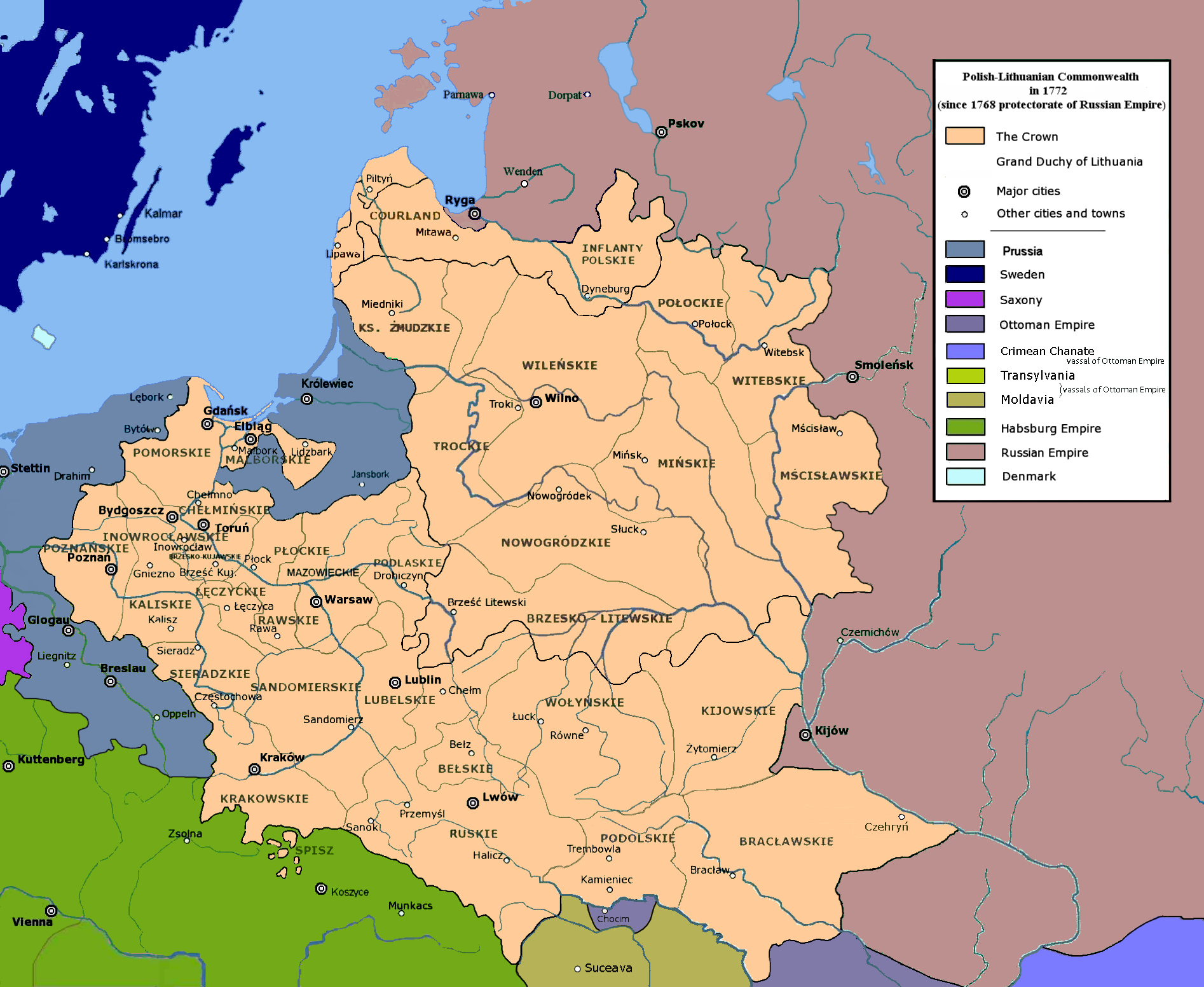
The three partitions of the Polish–Lithuanian Commonwealth. The Russian Partition (red), the Austrian Partition (green), and the Prussian Partition (blue)

The Prussian Partition (Polish: Zabór pruski), or Prussian Poland, is the former territories of the Polish–Lithuanian Commonwealth acquired during the Partitions of Poland, in the late 18th century by the Kingdom of Prussia.[1] The Prussian acquisition amounted to 141,400 km2 (54,600 sq mi) of land constituting formerly western territory of the Commonwealth. The first partitioning led by imperial Russia with Prussian participation took place in 1772; the second in 1793, and the third in 1795, resulting in Poland's elimination as a state for the next 123 years.[2]

History

[edit]

The Kingdom of Prussia acquired Polish territories in all three military partitions.[2]

The First Partition

[edit]

The First Partition of Poland in 1772 included the annexation of the formerly Polish Prussia by Frederick II who quickly implanted over 57,000 German families there in order to solidify his new acquisitions.[3] In the first partition, Frederick sought to exploit and develop Poland economically as part of his wider aim of enriching Prussia.[4] and described it as an "artichoke, ready to be consumed leaf by leaf".[5] As early as 1731 Frederick had suggested that his country would benefit from annexing Polish territory.[6] By 1752, he had prepared the ground for the partition of Poland–Lithuania, aiming to achieve his goal of building a territorial bridge between Pomerania, Brandenburg, and his East Prussian provinces.[7] The new territories would also provide an increased tax base, additional populations for the Prussian military, and serve as a surrogate for the other overseas colonies of the other great powers.[8]

Frederick did not justify his conquests on an ethnic basis; he pursued an imperialist policy focused on the security interests of his state.[9] However, Frederick did use propaganda to justify the partition and his economic exploitation of Poland, portraying the acquired provinces as underdeveloped and in need of improvement by Prussian rule; these claims were sometimes accepted by subsequent German historiography and can still be found in modern works.[10] Frederick wrote that Poland had "the worst government in Europe with the exception of Turkey".[11] After a prolonged visit to West Prussia in 1773, Frederick informed Voltaire of his findings and accomplishments: "I have abolished serfdom, reformed the savage laws, opened a canal which joins up all the main rivers; I have rebuilt those villages razed to the ground after the plague in 1709. I have drained the marshes and established a police force where none existed. … [I]t is not reasonable that the country which produced Copernicus should be allowed to moulder in the barbarism that results from tyranny. Those hitherto in power have destroyed the schools, thinking that uneducated people are easily oppressed. These provinces cannot be compared with any European country—the only parallel would be Canada."[12] However, in a letter to his favorite brother, Prince Henry, Frederick admitted that the Polish provinces were economically profitable:

It is a very good and advantageous acquisition, both from a financial and a political point of view. In order to excite less jealousy I tell everyone that on my travels I have seen just sand, pine trees, heath land and Jews. Despite that there is a lot of work to be done; there is no order, and no planning and the towns are in a lamentable condition.[13]

Frederick's long-term goal was to displace the Poles from the conquered region[14] and colonize it with Germans, whom he considered better workers.[15] To accomplish this goal, Frederick invited thousands of German colonists into the conquered territories by promises of free land.[16] He also engaged in the plunder of Polish property, gradually appropriating starostwie (Polish Crown estates) and monasteries[17] and redistributed them to German landowners.[8] He also aimed to expel the Polish nobles—who were viewed as wasteful, lazy, and negligent[18]—from their land by taxing them at a rate higher than other regions of Prussia,[8] which increased their financial burden and reduced their power.[19] In 1783, Frederick also passed legislation allowed buyouts of noble land.[20] This legislation allowed the free alienation of Polish nobles' estates so that this property could be purchased by German colonists.[21] This resulted in a greater percentage of noble land being transferred to bourgeoise owners than in any other part of Hohenzollern land.[22] Ultimately, Frederick settled 300,000 colonists in territories he had conquered.[8]

Frederick undertook the exploitation of Polish territory under the pretext of an enlightened civilizing mission that emphasized the supposed cultural superiority of Prussian ways.[23] He saw the outlying regions of Prussia as barbaric and uncivilized,[24] He expressed anti-Polish sentiments when describing the inhabitants, such as calling them "slovenly Polish trash".[25] He also compared the Polish peasants unfavorably with the Iroquois,[11] and named three of his new Prussian settlements after colonial areas of North America: Florida, Philadelphia and Saratoga.[16] The Poles remaining in the territories were to be Germanized.[8]

The Polish language was marginalized.[26] Teachers and administrators were encouraged to be able to speak both German and Polish,[27] and recognizing that his kingdom now had Polish inhabitants, Frederick also advised his successors to learn Polish. [27] However, German was to be the language of education.[28] The introduction of compulsory Prussian military service would also Germanize the Poles.[29] And, the rural Poles were to be mixed with German neighbors so these Poles could learn "industriousness", "cleanliness, and orderliness" and acquire a "Prussian character". By such means, Frederick boasted he would "gradually...get rid of all Poles".[30]

The Second Partition

[edit]

In the Second Partition of Poland in 1793, the Kingdom of Prussia annexed Gdańsk (Danzig) and Toruń (Thorn), part of the Crown of Poland since 1457. The incursion sparked the first Greater Poland Uprising in Kujawy under Jan Henryk Dąbrowski. The revolt ended after General Tadeusz Kościuszko was captured by the Russians.

The Third Partition

[edit]
Jan Henryk Dabrowski entering Poznań in 1806

The subsequent third partitioning of 1795 marked the Prussian annexation of Podlasie region, with the remainder of Masovia, and the capital city of Warsaw (handed over to the Russians twenty years later by Frederick III).[31]

The battle of Miloslaw during the fourth Greater Poland Uprising (1846)

The second Greater Poland Uprising against Prussian forces (also under General Dąbrowski) broke out in Wielkopolska (Greater Poland) in 1806, ahead of the Prussian total defeat by Napoleon who created the Duchy of Warsaw in 1807. However, the fall of Napoleon during his Russian Campaign lead to the dismantling of the Duchy at the Congress of Vienna (1815) and the return of Prussian control.[2]

The third Greater Poland Uprising under Ludwik Mierosławski occurred in 1846. The Uprising was designed to be part of a general uprising against all three states that had partitioned Poland.[32] Some 254 insurgents were charged with high treason in Berlin. Two years later, during the Spring of Nations, the fourth Polish uprising broke out in and around Poznań in 1848, led by the Polish National Committee. The Prussian army pacified the area and 1,500 Poles were imprisoned in Poznań Citadel. The Uprising showed to Polish insurgents that there was no possibility whatsoever to try to negotiate Polish statehood with the Germans. Only sixty years later, the Greater Poland Uprising (1918–1919) in the Prussian Partition helped Poland regain its freedom in the aftermath of World War I.[26]

Ethnicity

[edit]

Apart from ethnic Germans and Poles, the Prussian Partition was also inhabited by ethnolinguistic minorities. Minority groups included Kashubs in West Prussia, Czechs and Moravians in Silesia, Jews, and others.[33]

Society

[edit]
Growth of Prussia. Yellow are the territories gained by Prussia during the partitions of Poland

In the late 19th century, non-Germans in the Prussian partition were subject to extensive Germanization policies (Kulturkampf, Hakata).[34] Frederick the Great brought 300,000 colonists to territories he conquered to facilitate Germanization.[35]

That policy, however, had an opposite effect to that which the German leadership had expected: instead of becoming assimilated, the Polish minority in the German Empire became more organized, and its national consciousness grew.[34] Of the Three Partitions, the education system in Prussia was on a higher level than in Austria and Russia, irrespective of its virulent attack on the Polish language specifically, resulting in the Września children strike in 1901–04, leading to persecution and imprisonment for refusing to accept the German textbooks and the German religion lessons.[2][34]

In 1902, after unveiling a statue of Frederick in Posen, Wilhelm offered a speech where he denied German interferences with Polish religion and tradition.[36] He also demanded that the "many races" of Prussia first and foremost hold themselves to be good Prussians. Observers indicated that Wilhelm's speech had little impact on alleviating concerns amongst the populace in the region.[36]

Economy

[edit]

From the economic perspective, the territories of the Prussian Partition were the most developed out of the three partitions, thanks to the policies of the government.[34] The German government supported efficient farming, industry, financial institutions and transport.[34]

Administrative division

[edit]

In the First Partition, Prussia received 38,000 km² and about 600,000 people.[37] In the second partition, Prussia received 58,000 km² and about 1 million people. In the third, similar to the second, Prussia gained 55,000 km² and 1 million people. Overall, Prussia gained about 20 percent of the former Commonwealth territory (149;000 km²) and about 23 percent of the population (2.6 million people).[38] From the geographical perspective, most of the territories annexed by Prussia formed the province of Greater Poland (Wielkopolska).

The Kingdom of Prussia divided the former territories of the Commonwealth it obtained into the following:

It should also be noted that most of East Prussia, including its capital Königsberg (now Kaliningrad), was already part of the Kingdom of Prussia prior to the partitions of Poland. Upon the first partition of Poland, the Prince-Bishopric of Warmia was annexed by Kingdom of Prussia and added to the province of East Prussia. Over time the administrative divisions changed. Important Prussian administrative areas set up from Polish lands included:

See also

[edit]

References

[edit]
Revisions and contributorsEdit on WikipediaRead on Wikipedia
from Grokipedia
The Prussian partition encompassed the territories of the annexed by the Kingdom of Prussia in the partitions of 1772, 1793, and 1795, which collectively erased the Commonwealth from the map of and placed over one million ethnic Poles under Prussian rule. In the first partition, Prussia secured () excluding the free cities of and , along with the Netze District to establish a contiguous corridor linking its East Prussian exclave to the core. The second partition added (including ), , and the previously excluded cities of and , expanding Prussian holdings into fertile agricultural heartlands. The third partition incorporated remaining central territories such as parts of Masovia, though subsequent Napoleonic adjustments temporarily reduced some gains before restoration at the . These acquisitions addressed long-standing Prussian strategic vulnerabilities, particularly the isolation of , while capitalizing on the Commonwealth's internal dysfunction—exemplified by the that rendered its ineffective and invited foreign intervention under the guise of stabilization. Prussian administration introduced efficient bureaucracy, infrastructure development, and that spurred industrialization and in the annexed regions, outperforming the stagnation in Russian- and Austrian-held partitions due to stronger property rights and investment incentives. However, policies of German settlement and , intensified after unification in the era, provoked Polish nationalist resistance, including uprisings and cultural preservation efforts that highlighted enduring ethnic majorities in areas like Posen and . The partition's legacy persisted until 1918, shaping demographic patterns and irredentist claims in the post-World War I settlements.

Prelude and Causes

Internal Weaknesses of the Polish-Lithuanian Commonwealth

The , enshrined in the Commonwealth's political tradition, empowered any single deputy in the to veto and thereby invalidate an entire legislative session's proceedings, rendering collective decision-making nearly impossible. Originating as a theoretical safeguard for noble equality in the , its frequent invocation after 1652 transformed it into a tool for obstruction, with sessions increasingly disrupted by individual or factional interests, culminating in a petrified by the that blocked essential reforms in taxation, , and . This mechanism, combined with the privileges of the (nobility constituting roughly 8-12% of the population), entrenched factionalism, as magnate families vied for dominance through client networks and bribes, prioritizing personal estates over national cohesion and inviting foreign meddling to tip domestic balances. Economic structures exacerbated these political frailties, with the dominance of the manorial-serf economy binding over 70% of the population to obligatory labor (corvée) on noble demesnes, often 3-5 days weekly by the mid-18th century, which suppressed peasant mobility, agricultural innovation, and urban development while channeling surplus grain exports toward noble consumption rather than state investment. Absent a centralized taxation system—replaced by irregular, noble-approved levies—the treasury generated minimal revenue, estimated at under 10 million złoty annually in the 1760s, insufficient for infrastructure or industrialization amid rising European competitors. This stagnation manifested in demographic pressures, including recurrent famines from crop failures in the serf-bound agrarian system, and a failure to transition to wage labor or manufacturing, leaving the economy vulnerable to external shocks like the continental blockades of the Seven Years' War (1756-1763). Military incapacity stemmed directly from these fiscal and political shortcomings, as the dwindled to approximately 16,000-24,000 troops by 1764, reliant on outdated cavalry-heavy formations and noble levies that proved ineffective against professionalized neighbors fielding forces tenfold larger ( maintained over 80,000, upwards of 300,000). Funding shortages, exacerbated by veto-blocked budgets, prevented modernization, with even basic maintenance chronically under-resourced, as evidenced by unpaid garrisons and equipment decay during the 1768 uprising. Reform efforts under King (reigned 1764-1795), including early pushes for fiscal centralization and a professional force during the Convocation Sejm of 1764, faltered against noble resistance and foreign vetoes, such as Russia's imposition of the 1768 partition treaty limiting army size to 23,000. The pivotal (1788-1792) enacted the , which abolished the , , and serfdom's worst abuses while authorizing a 100,000-man army funded by land taxes on nobility, but implementation collapsed when conservative szlachta factions formed the on 14 May 1792, petitioning Russian intervention to restore their privileges and triggering invasion, occupation, and the second partition of 1793. These repeated failures underscored causal links between institutional paralysis and predatory exploitation by absolutist neighbors, as internal chaos precluded unified defense or adaptation.

Prussian Strategic Motivations and Diplomatic Maneuvering

Prussia's pursuit of territorial gains in the Polish-Lithuanian Commonwealth stemmed from King Frederick II's realist assessment of the region's power dynamics, viewing the Commonwealth as a fragmented entity ripe for exploitation to enhance Prussian cohesion and security. Frederick prioritized acquiring Royal Prussia (West Prussia), a corridor of approximately 36,000 square kilometers that would link the disconnected Prussian provinces of Brandenburg and East Prussia, thereby resolving a longstanding geographical vulnerability exposed during conflicts like the Seven Years' War (1756–1763). This strategic imperative was underscored by the economic potential of the region's fertile lands and Vistula River access, which promised revenue from agriculture and trade without the overextension of demanding major ports like Danzig initially. Frederick's private correspondence and diplomatic memos portrayed the Commonwealth's "anarchic" governance and economic stagnation as justifying Prussian intervention, framing acquisition as a means to impose order and extract resources efficiently, though such rhetoric masked raw opportunism amid the Commonwealth's internal paralysis. Diplomatic maneuvering centered on forging opportunistic alliances with and to legitimize the carve-up, circumventing unilateral aggression that could provoke broader European backlash. Following Russia's victories in the , which heightened Austrian fears of Russian overreach, Frederick proposed partitioning the in late 1770 as a diplomatic salve, suggesting Russia take eastern territories while Prussia and Austria claimed compensatory shares to maintain equilibrium. This culminated in the secret Convention of on January 4, 1772, whereby Austria acceded to the Russo-Prussian pact, followed by the formal partition treaty signed on August 5, 1772, delineating spheres: Prussia received (minus Danzig and Thorn), Russia took eastern Belarusian lands, and Austria annexed Galicia. Prussian envoys, including Foreign Minister Ewald Friedrich von Hertzberg, conducted parallel negotiations to ensure minimal resistance, coordinating troop deployments of about 12,000 Prussian soldiers alongside Russian and Austrian forces for the September 1772 occupation, presented publicly as a stabilizing measure against "chaos" to preempt Polish mobilization or foreign intervention. Empirical indicators of Prussian intent included pre-partition military preparations and efforts emphasizing the partitions' role in European stability. Frederick augmented border garrisons and logistics in from 1770 onward, signaling readiness for swift , while state dispatches justified the moves as countering Russian without altruistic motives—evident in Prussia's rejection of deeper Polish controls to avoid alienating merchants. Official Prussian declarations post-1772 highlighted "civilizing" backward Polish administration, yet reveals these as post-hoc rationalizations for geopolitical gains, as Frederick's earlier overtures prioritized spoils over systemic improvement, aligning with his Machiavellian of balancing powers through calculated predation rather than ideological uplift.

The Partition Processes

First Partition (1772)

The was enacted through a secret treaty signed on August 5, 1772, in by representatives of the Kingdom of Prussia, the , and the . This agreement delineated the division of Polish-Lithuanian Commonwealth territories, with Prussian forces occupying the designated areas shortly thereafter. Prussia's share consisted primarily of northern Royal Prussia, excluding the free cities of (Danzig) and (Thorn), along with the Prince-Bishopric of ; these lands spanned approximately 36,000 km² and included around 600,000 inhabitants, predominantly Polish-speaking. The acquisition connected Prussian to the core territories, fulfilling long-standing strategic objectives of Frederick II. Prussian officials portrayed the annexed regions as economically stagnant under rule, emphasizing untapped potential in and . To legitimize the partition domestically, Russian troops maintained a presence in , coercing the convocation of the , which ratified the territorial cessions on September 30, 1773. In the immediate aftermath, prioritized revenue extraction by imposing substantial customs duties on River traffic, thereby controlling over 80% of the Commonwealth's foreign trade volume and accelerating economic pressure on the remaining Polish state.

Second Partition (1793)

The adoption of the Constitution of May 3, 1791, by the Four-Year Sejm sought to centralize authority, abolish the , and enfranchise townsmen, prompting Russia to invade Poland in May 1792 to enforce the conservative Targowica Confederation's restoration of the status quo ante. , under King Frederick William II, initially maintained neutrality but capitalized on Poland's preoccupation with the eastern front by dispatching troops into in late 1792, encountering minimal opposition. Frederick William II positioned as a mediator in the Russo-Polish conflict, demanding territorial compensation from for facilitating a settlement that preserved Russian dominance while allowing Prussian gains. On January 23, 1793, and concluded the Treaty of Saint Petersburg, whereby annexed approximately 58,000 square kilometers of Polish territory, including (with as a key center), the cities of and , and adjacent areas of and , predominantly inhabited by Poles. These acquisitions were formalized into the new Province of , expanding Prussian holdings significantly beyond the First Partition. The partition compelled the convocation of the Grodno Sejm under Russian military occupation from June to November 1793, which dissolved the reformist Four-Year Sejm, ratified the territorial cessions, and nullified the 1791 Constitution on November 23, effectively suppressing Polish internal reforms. This assembly, lacking free deliberation due to foreign troops and coerced delegates, marked a further erosion of Polish sovereignty ahead of the final partition.

Third Partition (1795)

The failure of the in late 1794, suppressed through joint and Prussian military intervention, created the conditions for the final division of the Polish-Lithuanian Commonwealth. With Polish resistance crushed and the central government in disarray, Prussian King Frederick William II coordinated with Tsarina Catherine II of and Emperor Francis II of to partition the residual territories, aiming to preclude any revival of Polish statehood that could destabilize their borders. Prussian diplomats portrayed the move as essential to quelling anarchy and establishing stable governance in the vacuum left by the uprising's chaos. On October 24, 1795, representatives of the three powers signed a in St. Petersburg, formalizing the Third Partition and erasing the entirely. received key central regions, including , the districts of and , and areas along the middle River, integrating them into the existing Province of and forming . This acquisition elevated 's cumulative territorial gains from the partitions to approximately 141,000 km², encompassing diverse urban and rural lands previously under Polish control. The partition's completion involved the coerced abdication of King Stanisław August Poniatowski on November 25, 1795, at , under Russian occupation and Prussian acquiescence, which symbolized the definitive end of the Commonwealth's institutions without further legislative pretense. Unlike prior partitions, which had involved nominal ratifications, this agreement proceeded directly to annexation, reflecting the partitioning powers' consensus that Polish sovereignty was irretrievably compromised. The Prussian share prioritized strategic river access and administrative centers, solidifying Hohenzollern influence in the region amid broader European power balances.

Acquired Territories

Geographical Extent and Key Regions

The Prussian Partition encompassed western territories of the annexed in 1772, 1793, and 1795, primarily connecting fragmented Prussian holdings and securing access to the . In the First Partition, Prussia gained —excluding the free cities of (Danzig) and (Thorn)—comprising the voivodeships of , , and , alongside the Netze District from northern Greater Poland's , , and voivodeships. These regions included the River delta and Notec River basin, bridging to . The Archbishopric of was also incorporated into . Ethnic composition varied across these zones, with Poles forming the majority in rural agricultural areas, German speakers dominant in urban enclaves like Thorn and Elbing, inhabiting the coastal Pomerelian lands, and Jewish communities present in market towns. The featured Polish-majority countrysides interspersed with German settlements, while West Prussia's coastal strips held mixed Slavic-German populations influenced by prior Teutonic and Hanseatic legacies. The Second Partition extended holdings to include and , plus the bulk of , delineating from voivodeships including Brześć Kujawski, , , , Łęczyca, , , and . In 1795, the Third Partition added eastern fringes like , parts of Masovia, and the area as , alongside northern voivodeship as New Silesia, incorporating Podlasian plains with Polish and Belarusian rural majorities. These acquisitions formed contiguous provinces such as and Posen, spanning diverse lowlands, rivers, and inland plateaus.

Initial Incorporation and Border Adjustments

Following the signing of the partition treaty on August 5, 1772, Prussian forces promptly occupied the allocated territories, including (excluding Danzig and Thorn), the , and districts along the Netze River, totaling approximately 36,000 square kilometers. This military deployment, involving several thousand troops, secured the regions with limited opposition, as the Polish-Lithuanian Commonwealth's army was depleted from the recent conflict (1768–1772), which had weakened central authority and left local defenses disorganized. Prussian garrisons were established in key towns such as (Bydgoszcz) and (Kwidzyn) to maintain order and facilitate the transition to direct administration under Frederick the Great's directives. Initial stabilization efforts emphasized administrative takeover, with Prussian officials replacing Polish counterparts and requiring oaths of allegiance from local landowners and to affirm loyalty to the Prussian crown. These measures, enforced amid the Commonwealth's political paralysis, encountered sporadic unrest, such as isolated protests by nobility in , but no widespread rebellion materialized due to the lack of unified Polish resistance and the partitioning powers' coordinated occupation. The Polish Sejm's ratification of the partition on September 30, 1773, under Russian pressure, further legitimized Prussian control, enabling the deployment of civil servants to inventory assets and collect revenues. Border adjustments commenced through joint commissions established post-occupation to precisely demarcate , resolving ambiguities in the regarding courses and enclaves, such as adjustments along the Netze to incorporate strategic buffer zones. These commissions, involving , , Russian, and Polish representatives, conducted surveys and negotiations through 1773–1774, minimizing disputes and solidifying the new without major territorial swaps at this stage. Empirical records indicate fewer than a dozen minor incidents of skirmishes, underscoring the efficiency of Prussian pacification against the backdrop of disarray.

Administrative Framework

Prussian Bureaucratic Integration

Following the First Partition of 1772, Prussia reorganized the acquired territories—primarily into the Province of and later expansions into —by imposing its centralized cameralist administrative model, which prioritized uniform efficiency and royal oversight over inherited local autonomies from the Polish-Lithuanian . These provinces were subdivided into departments (Kreise) managed by district commissioners, with overarching provincial chambers (Kriegs- und Domänenkammern) headed by presidents appointed directly from , ensuring streamlined reporting and execution of policies without the Commonwealth's noble veto privileges. The supreme coordinating body, the General Directory in Berlin—established in 1723 and retaining broad authority under Frederick II—exercised direct supervision over provincial finances, domains, and internal administration in the new areas, forwarding edicts and monitoring compliance to integrate them into the kingdom's fiscal-military state apparatus. This structure contrasted sharply with the decentralized, estate-based governance of the former , enabling rapid implementation of royal directives through a that bypassed local . Prussian civil service recruitment for the partitioned provinces emphasized qualified personnel loyal to the Hohenzollern , drawing predominantly from established German-speaking officials to fill administrative roles amid a shortage of trained locals, thereby fostering a cohesive bureaucratic culture. While some Polish nobles were initially retained in lower capacities due to immediate needs, the influx of Prussian bureaucrats—totaling hundreds dispatched post-1772—ensured dominance of German administrators, who applied meritocratic principles tempered by royal patronage and rigorous training at institutions like the Knights' Academy. This approach markedly curbed the and factionalism prevalent in offices, where offices were often hereditary or purchasable; Prussian mechanisms, including concealed internal audits and collective decision-making in chambers, minimized embezzlement, as evidenced by the General Directory's sustained low-incidence reporting of irregularities compared to pre-partition Polish provincial records. By 1794, legal unification advanced through the promulgation of the Allgemeines Landrecht für die Preußischen Staaten (General State Laws for the Prussian States), a comprehensive code that standardized civil, procedural, and across all provinces, including the recent acquisitions. Effective from June 1, 1794, after over a decade of drafting under Frederick William II, the ALR—spanning approximately 19,000 articles—replaced patchwork provincial customs with uniform regulations on contracts, property, and official duties, applying equally to West and to facilitate bureaucratic predictability and royal control. This codification, rooted in Enlightenment yet preserving monarchical absolutism, supplanted Commonwealth-era , enabling seamless enforcement by Prussian officials and reducing jurisdictional disputes that had hindered prior integrations.

Reforms in Law, Taxation, and Local Governance

Following the First Partition of 1772, Prussian authorities in abolished the local Polish sejmiki and noble-dominated tribunals, which had enabled arbitrary judgments and frequent legal nullifications through mechanisms like the , replacing them with a tiered court system modeled on Prussian practices, featuring district courts subordinate to higher appellate bodies such as Oberlandesgerichte. This judicial restructuring, extended progressively to subsequent acquisitions like in 1793, emphasized procedural uniformity and accessibility for non-nobles as judges, aligning with Frederick II's domestic reforms that opened bureaucratic roles beyond aristocratic exclusivity. The change curtailed the influence of veto powers in adjudication, fostering greater legal predictability, though full codification awaited the Allgemeines Landrecht of 1794, which was gradually applied to the Polish provinces to supersede residual customary laws. Tax reforms dismantled key noble immunities from the era, imposing the Prussian Generalkontribution—a direct land and —alongside levies on essentials like and monopolies on salt and , effective from cabinet orders in 1773 for . Nobles previously exempt under Polish fiscal anarchy were now liable, broadening the tax base and enabling centralized collection via royal domains and intendants; yields from , for example, rose from negligible pre-partition contributions to supporting military expenditures, as the efficient Prussian bureaucracy minimized evasion compared to the 's decentralized and often uncollected dues. These progressive elements, including commodity-specific duties experimented with under Frederick II, yielded higher net revenue while funding , though they sparked initial resistance from local elites accustomed to fiscal privileges. Local governance underwent centralization through division into Kreise (districts), each supervised by a royal-appointed Landrat responsible for tax enforcement, , and , with implementation starting in by 1773 and expanding after 1793. Self-administration was confined to communal assemblies (Gemeinden) under strict oversight, preferentially allocating roles to German-speaking landowners and officials to ensure administrative loyalty and cultural alignment, while Polish szlachta privileges like exclusive local jurisdictions were eroded but not fully eliminated, preserving some estate-based influence amid integration challenges. This framework, verifiable in Prussian archival ledgers, enhanced order by supplanting the fractious sejmiki with accountable hierarchies, reducing banditry and fiscal shortfalls, though it prioritized state control over broad participation, contributing to long-term stability in revenue and .

Ethnic and Demographic Dynamics

Pre-Partition Population Composition

The territories annexed by during the partitions of Poland-Lithuanian , particularly in the First Partition of 1772, encompassed regions with a predominantly rural of ethnic Poles adhering to Catholicism. These areas, including , the Netze District, and , featured villages where Polish serfs formed the economic base under feudal obligations, as reflected in contemporaneous administrative and documentation. Urban centers exhibited greater diversity, with dominated by non-Polish elements amid disparities between agrarian hinterlands and quarters. Jewish communities, numbering in the thousands across , accounted for a notable minority engaged in , handling a substantial share of regional exports by the . Kashubs, a Lechitic Slavic group culturally akin to Poles, concentrated in coastal Pomerelian enclaves, while smaller minorities such as appeared in border zones. Regional disparities were evident in , where German Lutheran settlements prevailed in southern districts alongside Polish Catholic majorities further north, based on pre-partition settlement patterns. Ecclesiastical tallies from the , drawn from Catholic diocesan oversight, underscored the density of Polish parishioners in rural parishes, estimating aggregate figures in of thousands for these territories.

Policies Toward Poles, Germans, and Minorities

The Prussian administration in the partitioned Polish territories pursued demographic engineering to consolidate German dominance, prioritizing the influx of ethnic German settlers while imposing selective restrictions on Poles. Established by the Prussian Diet in 1886, the Royal Prussian Settlement Commission targeted the provinces of Posen and West Prussia, receiving an initial allocation of 100 million marks (later expanded) to acquire estates—primarily from indebted German owners but also Polish ones—and redistribute them preferentially to German families as a bulwark against Polish land consolidation. Between 1886 and 1918, the commission purchased over 800 estates totaling around 600,000 hectares and enabled the settlement of approximately 21,900 German farming families, often in model villages designed for rapid integration and loyalty to the state. These efforts reflected a pragmatic recognition of economic incentives like subsidies and low-interest loans to attract migrants from overcrowded eastern German regions, though coercive elements emerged in 1904 with laws curbing Polish bids on commission lands to prevent counter-settlement. Policies toward ethnic Poles emphasized containment of their influence, particularly among the , whose large estates were viewed as centers of potential resistance. From the late , higher taxation rates were levied on Polish nobles to compel land sales, with explicitly aiming to displace them as inefficient stewards in favor of German purchasers who could modernize agriculture. By the 1880s, amid rising Polish economic assertiveness through cooperative buying, the state enacted expulsion clauses in tenant laws and prioritized German applicants for state lands, effectively restricting Polish nobility's expansion while tolerating smallholder Poles under . Empirical outcomes showed mixed success: while German inflows offset some losses, the Polish population's higher natural growth and limited net shifts, with Germans comprising roughly 35-40% in combined Posen-West Prussia by 1900, down slightly from mid-century peaks in certain districts due to these dynamics. Among minorities, benefited from relative economic , filling intermediary roles in , moneylending, and urban that aligned with Prussian modernization needs in rural Polish areas. Unlike Poles, faced fewer blanket land ownership bans post-1812 , enabling their integration as creditors and merchants serving both communities, though early 19th-century regulations confined many to towns and required "usefulness" proofs for residency extensions. , concentrated in , received differentiated treatment as a pragmatic divide-and-rule tactic: Prussian officials promoted Kashubian as distinct from Polish—often portraying it as a rustic, non-national of fishermen and laborers—to erode Slavic unity, allowing limited local linguistic usage in petitions or schools while subjecting them to the same Germanization pressures as Poles in higher administration. This approach yielded partial loyalty from some Kashubian elites, though broader assimilation efforts persisted.

Economic Modernization

Agricultural Reforms and Land Management

The Prussian administration in the acquired Polish territories implemented agrarian reforms modeled on the Stein-Hardenberg initiatives, which prioritized the abolition of to enhance labor mobility and productivity. , characterized by obligatory labor dues and restricted peasant rights inherited from the Polish-Lithuanian Commonwealth, was progressively dismantled starting with the 1807 Edict on in core Prussian lands, with extensions to the provinces of (later Posen) and by 1816; full legal emancipation, granting peasants personal freedom and heritable land tenure subject to redemption payments to landlords, was completed by 1823 across these regions. These reforms replaced the inefficient manorial system of the , where serf labor stifled innovation, with a framework encouraging individual initiative and market-oriented farming. Peasants received plots averaging 10-15 s in the Posen region, financed through state-mediated annuities over , fostering in tools and drainage; this contrasted with the pre-partition stagnation, where yields per hectare for —a staple —languished below 6-7 quintals due to three-field rotations and exhaustion. Agricultural output surged as a result, with yields in Prussian Poland rising by approximately 20-30% in the decades post-emancipation through adopted practices like four-field rotations and leguminous crops, which restored and enabled surplus production. Prussian export records indicate shipments from Danzig (via the River) increased from under 30,000 tons annually in the to over 150,000 tons by the , reflecting enhanced in the partitioned lands. Economic metrics underscore the reforms' efficacy: Prussian partition territories recorded GDP per capita levels 20% above those in Russian Poland by (4,449 vs. 3,770 international dollars), driven largely by agrarian modernization rather than industry, with state promotion of model farms and credit societies amplifying gains. This outperformance stemmed from causal incentives—freed peasants' stakes in versus coerced labor—evident in Prussian fiscal showing agricultural taxes doubling in real terms by without proportional acreage expansion.

Infrastructure Development and Trade Expansion

The Bromberg Canal, constructed between 1773 and 1774 under the direction of Frederick the Great immediately following the First Partition of Poland, spanned 26 kilometers and linked the Noteć and Brda rivers, thereby connecting the Oder and Vistula river systems for inland navigation. This waterway reduced transport costs for goods such as timber, grain, and manufactured items, stimulating commerce between Prussian core territories and newly acquired regions in West Prussia, with Bromberg (Bydgoszcz) emerging as a key transshipment hub. Concurrently, Prussian authorities invested in hardened chaussee roads during the late 18th and early 19th centuries, including routes from Posen (Poznań) toward Berlin, which improved overland connectivity and supported the movement of raw materials and finished products, laying foundational logistics for economic integration. Following the in 1815, the Prussian Partition territories—encompassing the Grand Duchy of Posen and parts of —were incorporated into Prussia's unified customs framework, culminating in full alignment with the customs union by the 1830s. This tariff-free access to larger German markets spurred manufacturing growth, particularly in textiles, machinery, and food processing in urban centers like Posen and Thorn (Toruń), where industrial output expanded due to reduced barriers and increased demand from Prussian consumers. Empirical analyses of border discontinuities reveal that Prussian-administered areas experienced accelerated market integration and capital inflows compared to adjacent Russian or Austrian zones, with causal evidence linking customs liberalization to heightened intra-Prussian trade volumes. By 1900, these and policies yielded measurable prosperity gains, including rates in Prussian exceeding those in the Russian and Austrian partitions by factors tied to rail and —Prussian provinces averaged higher populations relative to rural areas, driven by manufacturing employment. Export figures from Posen and , dominated by processed agricultural goods and early industrial products, outpaced counterparts in other partitions, with Prussian ports and inland routes handling volumes that reflected efficient connectivity and policy-induced specialization, underscoring the direct role of state-led investments in fostering regional economic vitality over extraction.

Social and Cultural Policies

Education, Religion, and Germanization Efforts

In the Prussian Partition territories, which included provinces like Posen (Poznań) and with predominantly Polish-speaking Catholic populations, the authorities implemented compulsory elementary education modeled on the Prussian system established earlier in core German lands. By 1816, regulations mandated that every commune maintain a , enforcing for children aged 5 to 13 or 14, with instruction conducted primarily in German to facilitate administrative integration and . This shifted from the pre-partition Polish-Lithuanian Commonwealth, where literacy rates hovered around 20-30% among the and but were far lower among peasants due to limited schooling , toward broader access that raised overall enrollment and basic skills by the mid-19th century. Empirical studies of post-partition legacies indicate that Prussian-administered areas achieved higher adult —approaching 90% by 1900—compared to Russian or Austrian partitions, attributing this to enforced and standardized curricula emphasizing reading, arithmetic, and vocational training. Germanization efforts extended to curriculum content, which incorporated Prussian history, , and state loyalty, while restricting Polish-language materials to minimize ethnic distinctiveness; technical and vocational schools, such as those for and industry introduced in the 1830s-1840s, prioritized practical skills over classical Polish studies, yielding measurable gains in . These reforms contrasted with the Commonwealth's parish schools and noble academies, which suffered from inconsistent funding and noble exemptions, resulting in widespread illiteracy among rural populations exceeding 70% in some regions. By the late , secondary gymnasia and real schools in partitioned Polish areas offered advanced in sciences and , often in German, fostering a cadre of bilingual professionals despite linguistic impositions. Religiously, Prussian policy favored in a territory where Catholics comprised over 70% of the population, promoting state-supervised seminaries and encouraging conversions through incentives like career advancement for Protestant and educators. The , intertwined with Polish identity, faced oversight via royal nomination of bishops and control over parish appointments, aiming to align religious instruction with Prussian values. This intensified during the (1871-1878), Otto von Bismarck's campaign against , which expelled , required , and imprisoned or exiled around 185 Polish priests and bishops, including Mieczysław Ledóchowski, for resisting state interference in ecclesiastical matters. While targeting Catholic influence broadly, these measures disproportionately affected Polish , viewed as potential nationalist vectors, yet Prussian religious policies also standardized parish schools under state curricula, indirectly boosting in reading scripture and . Overall, these initiatives imposed cultural mechanisms that eroded Polish linguistic and but delivered systemic benefits, including reduced illiteracy and to modern schooling, as evidenced by long-term economic indicators in Prussian outperforming other partitions.

Suppression of Polish Institutions and Resulting Tensions

Following the spillover effects of the November Uprising in Russian Poland (1830–1831), Prussian authorities heightened scrutiny on Polish activities in the Province of Posen, implementing restrictions on gatherings and publications perceived as fomenting separatism, though formal bans on centralized societies were enforced more stringently after the 1848 unrest. The Greater Poland Uprising of 1848, triggered by revolutionary fervor across Europe, saw Poles form a National Committee and mobilize irregular forces numbering around 1,000–2,000, but Prussian regular army units, better equipped and disciplined, quelled the rebellion within weeks; key engagements, such as the Prussian assault on Polish camps at Książ Wielkopolski on April 29, 1848, resulted in rapid defeats and the dissolution of Polish militias by early May. This efficient suppression underscored Prussian military superiority, with over 500 Polish insurgents killed or captured, leading to the revocation of the Grand Duchy's limited autonomy and direct integration into Prussian provincial administration. Under Otto von Bismarck's chancellorship, countermeasures against Polish nationalism escalated during the Kulturkampf (1871–1878), which intertwined state control over the Catholic Church—predominantly Polish in the eastern provinces—with efforts to dismantle nationalist networks; laws like the May Laws of 1873 enabled the expulsion or imprisonment of clergy refusing state oversight, affecting hundreds in Polish areas, while broader anti-Polish policies culminated in the 1885–1890 deportations targeting non-citizen Polish laborers and activists, expelling approximately 30,000 individuals to curb irredentist agitation. These measures, including censorship that contributed to the decline of Polish periodicals by withdrawing postal privileges for nationalist content, provoked Polish backlash through clandestine societies and "organic work"—self-sustaining economic cooperatives like the Poznań Towarzystwo Oświaty Średniej—to preserve cultural identity amid repression. Prussian actions drew contemporary criticisms of authoritarian overreach, with Polish elites decrying the erosion of , yet Bismarck and Prussian conservatives defended them as pragmatic necessities to neutralize existential threats from Polish separatism, especially as the 1863 January Uprising in Russian Poland inspired cross-border sympathies and potential alliances against partition states. This tension between highlighted the partitions' inherent , where effective Prussian dominance—bolstered by demographic engineering and legal assimilation—stifled overt but fueled latent ethnic friction without eradicating Polish cohesion.

Long-Term Consequences and Debates

Persistent Socio-Economic Legacies

The territories incorporated into during the partitions demonstrated enduring economic advantages post-1918, characterized by higher industrialization levels and infrastructure density compared to Russian or Austrian partitions. Prussian investments in railways and factories during the late persisted, enabling better market integration and contributing to elevated output in interwar ; for instance, former Prussian areas exhibited denser rail networks that facilitated industrial relocation and growth after reunification. This infrastructure legacy accounted for a significant portion of the economic , with Prussian-partition regions achieving higher rates and shares by the 1920s and 1930s. Comparative GDP metrics underscore these disparities into the mid- and beyond. In interwar , former Prussian lands registered the highest wealth and development among partitions, with real GDP in these regions growing faster amid national convergence efforts from 1924 to 1938. By the late , residual effects manifested in 10-13% higher incomes and personal income tax revenues in Prussian legacy areas relative to others, linked to sustained advantages from partition-era policies. These patterns reflect institutional persistence rather than mere geography, as evidenced by higher productivity in and industry. Demographic upheavals post-World War II, including the expulsion of approximately 2 million Germans from former Prussian territories between 1945 and 1947, disrupted ethnic compositions but did not erase socio-economic gradients. Polish resettlements from eastern regions introduced mixed cultural influences, yet Prussian administrative legacies—emphasizing efficiency, rule adherence, and disciplined labor—endured through local governance and social norms, fostering what some analyses describe as a residual "work ethic" conducive to modernization. This contributed to modern developmental divides, such as higher GDP per capita in western provinces like Greater Poland (e.g., Poznań Voivodeship) versus central or eastern areas tracing to Russian partitions, with partition borders correlating to contemporary economic clusters.

Historiographical Views on Justification and Outcomes

Polish historiography traditionally interpreted the partitions as a consequence of internal moral and political failings, such as societal sins or disarray, which rendered the Commonwealth vulnerable to external pressures, though this evolved into nationalist emphases on predatory aggression by neighbors like . Revisionist perspectives, including those of Andrzej Nowak, counter by underscoring structural defects like the liberum veto's paralysis of decision-making, feeble royal authority, and persistent military underinvestment, arguing these invited partitions as a predictable outcome of state incapacity rather than unmitigated victimhood. These views prioritize causal chains of institutional decay over moralizing narratives, recognizing that the Commonwealth's and noble privileges eroded central authority, enabling opportunistic statecraft by absolutist powers. Prussian justifications, articulated by Frederick II in pre-partition correspondence, framed the acquisitions as restorative measures for a disorganized that had "forfeited any right" to sovereignty through chronic , while securing territorial links between disjointed provinces and compensating for prior subsidies to . Frederick portrayed Polish lands as ripe for enlightened administration, aligning with imperatives of power equilibrium amid Austria's encroachments. Such rationales, often dismissed in Polish sources as self-serving , gain partial empirical support from post-partition outcomes, where Prussian zones exhibited accelerated industrialization, denser rail networks, and enduring economic edges over Russian and Austrian counterparts, evidenced by higher modern anti-authoritarian voting patterns tied to legacy infrastructure. Contemporary debates eschew romanticized failure-of-democracy tropes, instead applying causal realism to attribute partitions to absent amid 18th-century predatory dynamics, where in one realm facilitated consolidation in others without implying . Polish national historiography, while credible in documenting repression, exhibits tendencies toward underemphasizing endogenous weaknesses to sustain cohesion narratives, contrasting with Prussian records' focus on modernization imperatives validated by disparate regional trajectories. This historiography underscores that partitions reflected not anomalous villainy but systemic vulnerabilities exploited by competent actors, with Prussian efficiency yielding verifiable developmental gains absent in less interventionist partitions.

References

Add your contribution
Related Hubs
User Avatar
No comments yet.