Hubbry Logo
BamyanBamyanMain
Open search
Bamyan
Community hub
Bamyan
logo
8 pages, 0 posts
0 subscribers
Be the first to start a discussion here.
Bamyan
Bamyan
from Wikipedia

Bamyan (Pashto[a], Dari[b]: بامیان), also spelled Bamian or Bamiyan, is the capital of Bamyan Province in central Afghanistan.[2][3][4][5] Its population of approximately 100,000 people makes it the largest city in the Hazarajat region of Afghanistan.[1] Bamyan is at an altitude of about 8,366 feet (2,550 m) above sea level. The Bamyan Airport is located in the middle of the city. The driving distance between Bamyan and Kabul in the southeast is approximately 180 kilometres (110 mi). The Band-e-Amir National Park is to the west, about a half-hour drive from the city of Bamyan.

Key Information

Bamyan is referred to by some as the "Shining Light" and "Valley of Gods".[6] There are several tourist attractions near the city, including the destroyed Buddhas of Bamyan, which were carved into cliffs on the north side of Bamyan city in the 3rd to 5th centuries CE, dating them to the pre-Islamic Hephthalite rule. They were part of a UNESCO World Heritage Site and tragically destroyed by the Taliban in 2001. Other attractions close to the city include Shahr-e Gholghola and Zuhak. In 2008, in a maze of caves in the Bamiyan Valley were found the world's oldest oil paintings.[7] At the end of the 10th century, there was a Buddhist culture in which several thousand Buddhist monks lived in caves carved into the mountain. The 53 meters known as the Salsal and 35 meters known as Shahmama were the high-standing Buddha statues and best-known monuments left by the Buddhists, which were destroyed by the Taliban in 2001.[8] Furthermore, there are several cultural sites left from both the Buddhist and the later Islamic era of the valley. While the Taliban were out of power from 2002 to 2021, considerable efforts were made to preserve the cultural monuments in the valley. The city of Bamyan has four districts and a total land area of 3,539 hectares.[9] The total number of dwellings in this city is 4,435.[9]

The Bamyan valley marked the most westerly point of Buddhist expansion and was a crucial hub of trade for much of the second millennium CE. It was a place where East met West and its archaeology reveals a blend of Greek, Turkic, Persian, Chinese, and Indian influences. The valley was one of Afghanistan's most touristic places.[10]

The city of Bamyan joined the UNESCO Creative Cities Network as a Crafts and Folk Art city in 2017.[11] "UNESCO noted the Bamiyan Valley is the most monumental expression of western Buddhism".[6] Bamiyan is now listed by UNESCO as a World Heritage Site in Danger.[12]

On 15 August 2021, Bamyan was seized again by Taliban fighters, becoming the twenty-ninth provincial capital to be captured by the Taliban as part of the wider 2021 Taliban offensive.

Name

[edit]

The name "Bamiyan" is derived from Middle Persian Bamikan.[13]

Geography

[edit]

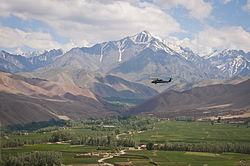
The 2,500 m high valley is about 230 km northwest of Kabul and separates the Hindu Kush mountain range from the Koh-e Baba mountains. On the north side, there is an approximately 1.5 kilometers long, high, almost vertical sandstone cliff that was formed by a glacier. The Buddha statues and most of the caves in the valley were carved into this rock face. In the valley itself and on the slopes, there are numerous ruins from earlier times.

Koh-i-Baba (Baba Mountain, meaning the father mountain)

"Bamiyan is located between the Indian subcontinent (to the southeast) and Central Asia (to the north), which made it an important location close to one of the most important branches of the Silk Route".[14] Situated on the ancient Silk Route, the town was at the crossroads between the East and West when all trade between China and the Middle East passed through it. The Hunas made it their capital in the 5th century. Because of the cliff of the Buddhas, the ruins of the Monk's caves, Shahr-e Gholghola ('City of Sighs', the ruins of an ancient city destroyed by Genghis Khan during the Siege of Bamyan, and its local scenery, it is one of the most visited places in Afghanistan. The Shahr-e Zuhak mound ten miles south of the valley is the site of a citadel that guarded the city, and the ruins of an acropolis could be found there as recently as the 1990s.[15]

The town is the cultural center of the Hazara ethnic group of Afghanistan. Most of the population lives in downtown Bamyan. The valley is cradled between the parallel mountain ranges of the Hindu Kush and the Koh-i-Baba.

Mountains cover ninety percent of the province, and the cold, long winter, lasting for six months, brings temperatures of three to twenty degrees Celsius below zero. Mainly Daizangi Hazara people live in the area. Transportation facilities are increasing, but sparse. Notably, Bamyan is now connected by road to Kabul through Parwan province and Maidan Wardak. The connection between Maidan Shar and Bamyan – 136 km long – makes it possible to reach Kabul in a 2-hour drive. The connection is almost completed missing just 15 km of paving.

The main crops are wheat, barley, mushung, and baquli, grown in spring. When crops are damaged by unusually harsh weather, residents herd their livestock down to Ghazni and Maidan provinces to exchange for food.

Climate

[edit]

Bamyan has a continental Mediterranean climate (Köppen Dsa), with freezing winters and very warm, dry summers. Precipitation mostly falls in late winter and spring[16]

Climate data for Bamyan
Month Jan Feb Mar Apr May Jun Jul Aug Sep Oct Nov Dec Year
Record high °C (°F) 12.0
(53.6)
12.5
(54.5)
20.6
(69.1)
28.7
(83.7)
29.4
(84.9)
31.2
(88.2)
33.2
(91.8)
32.2
(90.0)
31.4
(88.5)
26.2
(79.2)
20.6
(69.1)
13.0
(55.4)
33.2
(91.8)
Mean daily maximum °C (°F) 1.0
(33.8)
2.0
(35.6)
7.9
(46.2)
15.6
(60.1)
19.9
(67.8)
24.1
(75.4)
26.3
(79.3)
26.1
(79.0)
22.9
(73.2)
17.4
(63.3)
11.0
(51.8)
5.1
(41.2)
14.9
(58.9)
Daily mean °C (°F) −6.4
(20.5)
−4.8
(23.4)
1.4
(34.5)
8.6
(47.5)
12.4
(54.3)
16.3
(61.3)
18.4
(65.1)
17.4
(63.3)
12.8
(55.0)
7.8
(46.0)
1.6
(34.9)
−2.8
(27.0)
6.9
(44.4)
Mean daily minimum °C (°F) −10.1
(13.8)
−6.1
(21.0)
−3.8
(25.2)
2.9
(37.2)
5.7
(42.3)
8.5
(47.3)
10.0
(50.0)
8.8
(47.8)
4.2
(39.6)
0.0
(32.0)
−4.9
(23.2)
−8.6
(16.5)
0.5
(33.0)
Record low °C (°F) −30.5
(−22.9)
−28.4
(−19.1)
−21.2
(−6.2)
−6.5
(20.3)
−2.5
(27.5)
0.6
(33.1)
5.4
(41.7)
3.0
(37.4)
−2.6
(27.3)
−7.9
(17.8)
−14.5
(5.9)
−25
(−13)
−30.5
(−22.9)
Average precipitation mm (inches) 43.5
(1.71)
59
(2.3)
81.4
(3.20)
84.8
(3.34)
59.1
(2.33)
9.5
(0.37)
3.1
(0.12)
1.7
(0.07)
3
(0.1)
11.8
(0.46)
28.9
(1.14)
39.5
(1.56)
425.3
(16.7)
Average rainy days 0 0 2 7 6 1 1 0 0 2 2 0 21
Average snowy days 5 7 6 2 0 0 0 0 0 0 1 3 24
Average relative humidity (%) 43 54 52 52 52 46 45 45 43 44 48 52 48
Mean monthly sunshine hours 196.7 174.6 210.7 239.4 356.9 372.9 357.8 325.3 276.7 245.5 198.0
Source 1: Hong Kong Observatory[17]
Source 2: NOAA (1960–1983)[18]

History

[edit]
Statue of a bearded man with cap, probably Scythian, Bamyan c. 3–4th century.
Head, from Bamyan c. 6–7 century.

The city of Bamyan was part of the Kushan Empire in the early centuries CE. After the Kushan Empire fell to the Sassanids, Bamyan became part of the Kushansha, vassals to the Sassanids. The Buddhist pilgrim Fa Xian visited Bamyan in the fifth century and recorded that the king summoned the monks of the region for vows and prayers. Fa Xian also records landslides and avalanches in the mountains and the presence of snow during winter and summer. This latter statement suggests climatic change which could have contributed to the historical and economic importance of the area for the years to come. Another Buddhist traveller, Xuanzang, passed through Bamyan in the seventh century. His record shows that the Bamiyan Buddhas and cave monastery near it were already built. He also records that Buddhism in the region was in decay with the people being "hard and uncultivated".[19]

The Hephthalites conquered Bamyan in the 5th century. After their Khanate was destroyed by the Sassanids and Turks in 565, Bamyan became the capital of the small Kushano-Hephthalite kingdom until 870, when it was conquered by the Saffarids. Favoured by its location on one of the main trade routes from the West to China and India, the valley was of great strategic importance. It became a stop for trade caravans, a well-known artistic site and was also a major Buddhist center for centuries. It later fell to the Ghaznavids in the 11th century. Bamiyan was Islamized under the reign of Sultan Mahmud. This was around the time of the first millennium AD. At that time, the center of the city of Bamiyan was moved from the northwest of the valley, where the cliff with the Buddha statues is located, further to the southeast. Some of the fortifications in the valley also date from this period.[20] During the Ghurids rule, Bamiyan was the capital of a large kingdom for about 60 years, namely from 1155 to 1212, which stretched north to the Oxus River (today's Amu Darya).[20][19] In 1221 the city and its population were said to be completely wiped out by Genghis Khan during the siege of Bamyan. It is claimed that he was taking revenge for his slain grandson. Bamiyan was unable to recover from this event for a long time. Even decades later, the city was still devastated, according to a report by a Persian historian.[21] Several decades passed before a town appeared in the valley again, but it could only acquire regional importance. The Qarlughids established their capital in the city soon thereafter. There is some evidence that Bamyan was somewhat populated and reconstructed during the Timurid period in the 15th century.

From the age of the Timurids, there is said to have been a city again in Bamiyan. However, the general decline in coast-to-coast trade during this time meant that the city could no longer grow to its old size and could no longer achieve supra-regional importance.

Bamiyan is also mentioned again in the history books during the Mughal Empire, especially in connection with Aurangzeb, who had the 53 m tall Buddha statue shot at with cannons during his looting.

During the time of the Afghan monarchy, Bamiyan was a bulwark in the central mountain region. At that time, however, the area was still claimed by the Uzbek Miren ruling in the north. They demanded tribute payments, mainly in the form of deliveries from slaves from the Hazara tribes of the surrounding mountains.

In 1840, the region was under conflict because of the First Anglo-Afghan War when the British routed Dost Mohammad Khan and his forces.[19] The first European to see Bamyan was William Moorcroft (explorer) about 1824. During 1998–2001, Bamyan has been the center of combat between Taliban forces and the anti-Taliban alliance; mainly Hizb-i-Wahdat – amid clashes among the warlords of the local militia. Bamyan is also known as the capital of Daizangi.

Buddhas of Bamiyan

[edit]
Drawing of the Buddhas of Bamiyan by Alexander Burnes, as he saw them during his visit in Bamiyan in 1832

Ashoka, the ruler of the ancient Indian Maurya dynasty, according to an old inscription, was sent in 261 BC. to convert the area. This was just before the Greco-Bactrian Kingdom declared independence in the northern Hindu Kush region.

Under the rule of the Kushana dynasty, Buddhism gradually established itself in the Hindu Kush area. Between the 2nd and 4th centuries AD, a number of Buddhist sites arose along the trade routes at that. Bamiyan itself was to become the largest and most famous of these Buddhist sites. However, the exact point in time when Buddhism found its way into Bamiyan itself is not known.

This Buddhist art was significantly influenced by the earlier Gandhara culture, which was developed further in the south, and the Indian Gupta culture was the result of this cultural creation being unique of its kind.[22] The Gandhara culture was already in retreat or largely collapsed when Buddhism experienced a revival here.

The two large Buddha statues were constructed on the large rock facing the north side of the valley in the 6th century. Corridors and galleries were carved into the rock around the figures and hundreds of prayer halls and caves were created, some of which were decorated with rich wall paintings.

The number of caves currently present in Bamiyan is estimated to be around 1,000.[23] The time of origin is dated to the period from 450 to 850 AD. Some of the murals have been identified as the oldest known oil paintings in the world, dating to the 7th century. An earlier chronicle estimates the number at 12,000 caves, a number that is exaggerated for the Bamiyan Valley alone, but seems appropriate for the entire region, including around 50 km of surrounding valleys. The oil painting of Bamyan Buddha is related to the 5th to 9th century and those paintings were made of oil, hundreds of years before the technique was "invented" in Europe. The scientists discovered that 12 out of the 50 caves were painted with oil painting technique, using perhaps walnut and poppy seed drying oils.[24]

In late ancient times, the adjoining room was mainly in the hands of tribes who were counted among the Iranian Huns and were in conflict with the Sassanid Empire. After 560, the Gök Turks became the dominant power in Transoxania.

Xuanzang, a Chinese monk, visited the valley around 630 AD and was welcomed by King Bamiyan. He spent around 15 days in the valley and described the Buddha statues present in the valley, as well as the location of some temples, whereby his information was confirmed by science as very exact. Based on further statements by Xuanzang, it is assumed that at least half of the one thousand caves known today must have been inhabited. Almost a hundred years later, in 727, the Korean monk Hyecho (Hui Chao) described Bamiyan as an independent and powerful kingdom, despite the presence of Muslim-Arab troops in the north and south of the region.

On the cliff face of a mountain nearby, three colossal statues were carved 4,000 feet apart. One of them was 175 feet (53 m) high standing statue of Buddha, the world's tallest. The ancient statue was carved during the Kushan period in the fifth century.

The statues were destroyed by the terrorist organization known as Taliban in March 2001, trying to justify their actions by stating that they were an "affront to Islam".

At one time, two thousand monks meditated in caves among the sandstone cliffs.[citation needed] The caves were also a big tourist attraction before the long series of wars in Afghanistan. The world's earliest oil paintings have been discovered in caves behind the destroyed statues. Scientists from the European Synchrotron Radiation Facility have confirmed that the oil paintings, probably of either walnut or poppy seed oil, are present in 12 of the 50 caves dating from the 5th to 9th century.[25] The murals typically have a white base layer of a lead compound, followed by an upper layer of natural or artificial pigments mixed with either resins or walnut or poppy seed drying oils. Possibly, the paintings may be the work of artists who traveled on the Silk Road.[26]

The caves at the base of these statues were used by the Taliban for storing weapons. After the Taliban were driven from the region, civilians made their homes in the caves. Recently, Afghan refugees escaped the persecution of the Taliban regime by hiding in caves in the Bamiyan valley. These refugees discovered a fantastic[clarification needed] collection of Buddhist statues as well as jars holding more than ten thousand fragments of ancient Buddhist manuscripts, a large part of which is now in the Schøyen Collection. This has created a sensation among scholars, and the find has been compared with the discovery of the Dead Sea Scrolls.

From 2003 to 2013, a Provincial Reconstruction Team was based in Bamyan, first manned by U.S. forces, and, since April 2003, by New Zealand Defence Force personnel which made up the Provincial Reconstruction Team. The 34th Division in the area, part of the 4th Corps, was affiliated with Karim Khalili.[27] Bamiyan was one of the first pilot centers for the Afghan New Beginnings Programme of Disarmament, demobilization and reintegration. On 4 July 2004 disarmament began in Bamiyan,[28] and on 15 July 2004 disarmament was continued in Bamiyan including soldiers from the 34th and 35th Divisions of the then Afghan Army, often referred to as the Afghan Military or Militia Forces.[29]

Demography

[edit]

As of 2014, the population of the city of Bamyan is approximately 70,000.[1] The population of the entire Bamiyan province is estimated 425,500.[30]

Bamyan's festivals and bazaars

[edit]

Potato flower festival

[edit]

The potato Flower Festival is a famous festival in Bamyan as Agricultural for people which is organized by farmers and government organization and promote local Product. The Potato Flower Festival ( Gol-e- Kachalo in Dari) which celebrated for the first time in 2017 and people make many different foods from only potatoes and music is also part of the Festival.[31] More than 80 percent of the population in Bamyan depends on agriculture products and potato is their main product. Furthermore, Bamyan produces 60 percent of the potatoes in Afghanistan. [2]

Dambura musical festival

[edit]

Dambura is one of the Famous traditional music equipment which is guitar-like is made from mulberry wood, which is popular and largely used by classic singers and folklore, musicians mainly played in central. traditional Dambura festival is held each year in a bid to help improve the tourism industry of Bamyan province.[32]

Bamyan art bazaar

[edit]

"Bamyan art bazaar" which made by Afghan women in Bamyan where they display and sell their handicrafts to internal and foreign tourists who visit the province. Carpets, rugs, felts, embroidery, pottery and other local women's products can be mostly found in the art market shops. All the sellers are women and the products they sell are either their own or bought from women providing at homes.[33] The city of Bamiyan is the only urban settlement in the entire Bamiyan Province. It became the center of the then-newly created Bamiyan Province in 1964. The city grew rapidly, but at the same time suffered from the lack of a zoning plan. Bamiyan's bazaar at that time had around 300 to 400 shops and its market was very busy twice a week.[21]

Natural beauty of Bamyan

[edit]

Afghanistan established its first national park on April 22, 2009, to promote and protect the natural beauty of a series of intensely blue lakes created by natural dams high in the Hindu Kush. Band-e-Amir is a chain of six lakes in the mountainous desert of central Afghanistan. The lakes formed from mineral-rich water that seeped out of faults and cracks in the rocky landscape. Over time, the water deposited layers of hardened mineral (travertine) that built up into walls that now contain the water. According to the Wildlife Conservation Society, which helped the Afghan government set up the park, Band-e-Amir is one of the few travertine systems in the world.[34] Bamyan Despite being one of the country's poorest and least developed regions, Bamiyan remains one of the safest areas of Afghanistan today. For those who helped create the national park in 2009 after decades of delay due to war, the peaceful Band-e-Amir National Park tells an entirely different story of a country whose recent historical narrative has been defined by violence. Band-e-Amir National Park is located in central Afghanistan's Bamiyan province, .The WCS, along with a number of international agencies and funding partners including USAID and the United Nations Development Programme, assisted the local Afghan government in helping to establish and manage the park.[35] in Band-e-Amir the deep blue color of the lakes is due to the clarity of the air as well as the purity of the water. The high mineral content of the lakes also causes the intense and varying colors of the lake waters. In addition, Band-e- Amir made from six lakes; Of the six lakes, Band-e Panir is the smallest, with a diameter of approximately 100 m (330 ft). The largest is Band-e Zulfiqar, which measures some 6.5 km (4 mi) in length. The most accessible of the lakes is Band-e-Haibat, literally translated as Dam of Awe.[36]

Historical sites

[edit]
Shahr-e Zuhak
Restoration work in 2008

The numerous remains of monasteries, painted caves, statues and fortifications have been on the UNESCO list of world cultural heritage since 2003. At the same time, they were also entered on the Red List of World Heritage in Danger.

The protected world heritage sites include in detail:

  • The famous Bamiyan Buddha statues from the 6th century. Around the niches of the two 53 and 35 meter high, destroyed statues, at least 900 caves are carved into the rock, decorated with frescoes and stucco work.
  • The Islamic fortress Schahr-i Suhak about 15 km east of the cliff from the time of the Ghaznavids and the Ghurids (10th to 13th centuries).[37]
  • The remains of Qallai Kaphari about 12 km east of the cliff with protective walls, towers, and castles.
  • The fortified castle Schahr-e Gholghola on a hill in the middle of the valley (6th to 10th centuries).[38]
  • The Kakrak valley about 3 km southeast of the cliff contains over 100 caves from the 6th to 13th centuries, the remains of a 10 meter high Buddha statue and an altar with paintings from the Sassanid Empire.
  • The caves in the Foladi Valley about 2 km southwest of the cliff, especially the ornate Qoul-i Akram and Kalai Ghamai caves.

Sports in Bamyan

[edit]

"Ski championships" have been held in Bamiyan since 2011. It is a one-time race with a mass start. The first skiers were equipped with modern equipment in 2011. However, locals also used "replicas" of skis to move around in the mountains, for example in search of runaway pets.

Skiing in Bamyan

On November 4, 2016, a marathon took place in Bamiyan, in which women athletes participated for the first time.

International sister cities

[edit]

See also

[edit]

Notes

[edit]

References

[edit]
[edit]
Revisions and contributorsEdit on WikipediaRead on Wikipedia
from Grokipedia
Bamyan is a in central encompassing the , a tectonic basin in the Hindu Kush mountains that functioned as a pivotal Buddhist center along the from the 1st to 13th centuries CE. Located approximately 120 km northwest of at elevations of 2,500–3,000 meters, the region features semi-arid with severe winters and is strategically positioned at passes linking to the basin and . The valley's includes extensive rock-cut caves, monastic ensembles, and sanctuaries adorned with Greco-Buddhist, Indian, Hellenistic, and Sasanian artistic influences, culminating in two colossal standing statues—55 meters and 38 meters tall—carved into the cliffs during the 5th–6th centuries. These monuments, part of a larger complex of over 1,000 caves and fortified Islamic-era structures like Shahr-i Zuhak and Shahr-i Ghulghulah, exemplify the syncretic religious and artistic developments of ancient . In March 2001, the regime, under Omar's order, demolished the Buddhas using anti-tank mines, artillery, and dynamite, citing their status as idolatrous figures incompatible with Islamic principles. Designated a in due to its outstanding , the Bamiyan Valley remains fragile, with ongoing conservation efforts focused on stabilizing cliffs and preserving paintings despite threats from instability and development; debates persist over reconstruction, emphasizing research-driven approaches rather than full restoration. The site's destruction highlighted tensions between ideological and global heritage preservation, underscoring Bamyan's enduring role as a crossroads of civilizations in Afghanistan's multicultural history.

Name and Etymology

Linguistic Origins and Historical Usage

The name Bāmīān (modern Bamiyan) originates from the Middle Persian form Bāmīkān, as recorded in Zoroastrian texts such as the Bundahišn (TD2, p. 88.2) and the Geography attributed to Pseudo-Moses of Khorene. This etymology aligns with the region's position in the Iranian linguistic sphere during the Sasanian era, predating widespread Arabic influence following the 7th-century Islamic conquests. Early historical references to the name appear in 5th-century Chinese Buddhist sources, rendered as variants including Fan-yang-na, Fan-yen, or P'o-ye-na, denoting it as one of 55 kingdoms in like the Mahāsaṃnipāta-sūtra's Candragarbha chapter. These accounts highlight Bamiyan's role as a crossroads kingdom on routes linking , , and , with the pilgrim (c. 400 CE) implying its prominence through descriptions of regional monastic networks. By the 7th century, the Tang-era traveler (629–645 CE) provided the earliest detailed eyewitness usage, transcribing the name as Po-lo-yen-na and describing Bamiyan as an independent polity with over a thousand monasteries housing 6,000 , centered around colossal images carved into cliffs. The Korean Huichao (727 CE) similarly employed Fan-yen-na, noting its Hephthalite rulers and continued Buddhist dominance. In post-conquest from the onward, the name stabilized as Bāmīān, appearing in works by geographers like Yaʿqūbī and historians such as Ṭabarī (III, p. 1335), who referenced local rulers titled šēr (lion-king). This form persisted through Timurid, Mughal, and eras, with 19th-century European explorers like William Moorcroft (1819–1825) adopting phonetic variants such as "Bameean" in their surveys of the valley's archaeological remains. The continuity underscores Bamiyan's enduring toponymic identity amid successive cultural shifts from Buddhist to Islamic dominance.

Geography

Topography and Location

Bamyan Province is situated in the central highlands of Afghanistan, roughly 130 kilometers northwest of Kabul. The provincial capital, Bamyan city, is positioned at coordinates approximately 34°49′N 67°49′E, with an elevation of about 2,550 meters above sea level. The topography of Bamyan is dominated by the Bamiyan Valley, a expansive basin enclosed by the high mountains of the Hindu Kush range in the central highlands. This valley, opening into a large basin bordered to the north by the Band-e Amir mountain range, features long, high rocky cliffs to the north and numerous caves along the foothills. The province exhibits rugged, semi-mountainous terrain at the western extremity of the Hindu Kush, where the range bisects the area, creating steep slopes, elevated plateaus, and dramatic highland landscapes. Elevations in the valley average around 2,800 meters, with surrounding peaks contributing to a stark, often bare mountainous environment. The Bamiyan River traverses the valley, originating from high mountain tributaries and carving through the basin to form fertile lower reaches amid the arid highlands.

Natural Landscapes and Resources

The Bamiyan Valley lies enclosed between the high mountains of the in Afghanistan's central highlands, opening into a large basin bordered by rugged peaks and cliffs. This topography features stark rock formations and alpine meadows, with the valley floor at elevations around 2,500 meters above . The surrounding landscape includes dramatic gorges and terraced slopes, contributing to its isolation and scenic isolation amid the range. A prominent natural feature is Band-e-Amir , Afghanistan's first designated established in 2009, encompassing approximately 600 square kilometers of mountainous terrain with a series of seven turquoise lakes formed by mineral-rich waters and dams. These lakes, situated at about 3,000 meters altitude, exhibit unique geological structures including natural dams created by deposits, surrounded by red-hued cliffs and supporting diverse flora such as and trees. The park's ecosystems host wildlife including , wolves, and migratory birds, though habitat pressures from persist. Bamyan Province holds significant mineral resources, notably the Hajigak deposit, one of the largest in with estimated reserves exceeding 1.8 billion tons of ore grading 60-62% iron content. deposits are abundant in districts like Kahmard, supporting local needs but remaining underexplored for commercial scale. Agriculturally, the province relies on highland farming, with potatoes as a key crop due to the cool climate, alongside , , and cultivated on terraced fields irrigated by seasonal . from glacial streams and springs sustain these activities, though aridity limits yields without supplemental irrigation.

Climate

Climatic Characteristics

Bamyan Province lies at elevations ranging from 2,200 to over 3,000 meters in the central highlands of , resulting in a cold semi-arid to cool desert climate classified as Köppen BWk, characterized by significant diurnal and seasonal temperature variations, low humidity, and limited precipitation. The high altitude moderates summer heat while intensifying winter cold, with annual average temperatures around 7°C, influenced by its position in the rain shadow of the Hindu Kush mountains, which restricts moisture from westerly winds. Winters, spanning December to March, are severe, with January averages featuring daytime highs near 0°C and nighttime lows around -12°C; frost occurs frequently, and snowfall accumulates up to 18 cm in , contributing to a short limited by frozen ground. Summers, from to , remain mild due to , with July highs reaching 27°C and lows about 12°C, accompanied by dry conditions and negligible , yielding zero muggy days annually. Transitional springs and autumns see rapid shifts, with March winds averaging 12 km/h, enhancing aridity. Precipitation totals approximately 130 mm annually, predominantly as in winter and in spring, with as the wettest month at about 30 mm and extended dry periods from June to October receiving less than 10 mm monthly; this sparsity, combined with high rates, supports sparse vegetation adapted to conditions. data derive from reanalysis models like MERRA-2, calibrated against regional stations, accounting for sparse local observations in remote highland areas.

Environmental Impacts

Bamyan province, situated in Afghanistan's central highlands, experiences intensified by climate variability, including recurrent droughts that have led to plummeting levels and widespread as of 2025. Residents report significant declines in underground water reserves, attributed to prolonged dry spells and excessive extraction for , exacerbating risks to local ecosystems and human livelihoods. Rangeland degradation constitutes a primary concern, driven by anthropogenic factors such as conversion of natural pastures to cropland and , compounded by climatic stressors like deficient winter snowfall, irregular floods, and reduced patterns observed since the early 2000s. These processes have accelerated and , diminishing vegetation cover and pasture productivity essential for nomadic herding communities. Deforestation and broader , linked to drought-induced die-off of forests and overuse of woody resources for fuel, further degrade Bamyan's fragile highland ecosystems, with rivers originating in the region showing diminished flows due to altered . Local farmers perceive and adapt to these changes through measures like soil bunding for , though systemic limits efficacy.

History

Ancient and Pre-Buddhist Periods

The Bamyan Valley exhibits evidence of early human activity through its geological formations, which date to the era, including mid-Eocene lacustrine limestones of the Dokani formation (approximately 50 meters thick) and subsequent sandstones and conglomerates of the Zohāk formation (up to 1,000 meters thick). These provided a stable basin for settlement, reshaped by processes into alluvial terraces suitable for habitation. Archaeological surveys have identified sites underlying later Buddhist layers, indicating continuous occupation for at least 5,000 years. Artifacts from the Early , such as sealstones comparable to those spanning regions from the Aegean to the Indus Valley, have been recovered and are held in collections like the Musée Guimet in , pointing to trade or cultural connections in prehistoric . By the Achaemenid period (c. 550–330 BCE), the Bamyan region formed part of the Persian Empire's eastern satrapies, likely integrated into administrative structures linking and due to its position along mountain passes. Alexander the Great's campaigns incorporated the area into his conquests around 330 BCE, after which it transitioned to Seleucid Hellenistic rule, though specific local settlements from this era remain sparsely documented amid broader imperial transitions. Prior to widespread Buddhist influence in the 1st century CE, the valley's role appears to have been primarily as a strategic transit point rather than a major urban center.

Buddhist Golden Age and Monumental Heritage

The Bamiyan Valley served as a major hub of Buddhism from the 1st century CE, with its peak development occurring between the 4th and 8th centuries under influences from the and subsequent rulers, fostering artistic and religious innovations along the . This era saw the construction of extensive monastic complexes carved into the cliffs, including approximately 1,000 man-made caves used for meditation, worship, and residence by monks, many adorned with frescoes depicting figures and blending Indian, Hellenistic, Roman, and Sasanian stylistic elements. The valley's strategic location facilitated pilgrimage and cultural exchange, positioning it as a key center for Gandharan Buddhist art characterized by monumental rock-cut sculptures and wall paintings. Central to this heritage were the two colossal standing statues hewn directly from the cliffs of the Bamiyan Cliff: the larger Western measuring 55 meters in height and the smaller Eastern one at 38 meters, likely constructed between the 3rd and 6th centuries CE as symbols of serenity and enlightenment. Accompanying these were smaller seated figures and additional niches, such as the 10-meter-tall statue in the nearby Kakrak Valley, part of over a dozen significant sanctuaries dating from the 6th to 13th centuries. These monuments, part of eight core heritage zones, exemplified advanced engineering techniques, including wooden armatures for application and vibrant decorations originally featuring gold, , and pigments. Archaeological evidence from the s reveals a thriving of hermits and scholars, with artifacts indicating sustained Buddhist practice until the , when Islamic expansions gradually supplanted the faith. The monumental legacy underscored Bamiyan's role in transmitting Buddhist iconography across , influencing later cave temple traditions in and elsewhere, while its destruction in 2001 highlighted vulnerabilities to ideological despite prior endurance through invasions. Surviving mural fragments and structural remnants continue to provide insights into this syncretic artistic peak, verified through excavations revealing layers of paint and inscriptions from the 5th to 7th centuries.

Islamic Era and Cultural Shifts

The Islamic era in Bamyan commenced with the Ghaznavid conquest around 970 AD, when rulers from extended their domain northward, introducing as the dominant faith to the previously Buddhist stronghold. This marked a pivotal transition, as Ghaznavid forces subdued local Buddhist principalities, initiating the Islamization of the region's elites and institutions. Despite the political shift, pre-existing Buddhist monastic complexes and monumental sculptures, such as the giant statues carved into cliffs, were not systematically demolished at this stage, allowing a period of religious coexistence or tolerance under early Muslim governance. Subsequent dynasties reinforced Islamic rule and cultural transformation. The Ghurids, originating from the adjacent Ghor , asserted control over Bamyan by the , integrating it into their expanding that eventually reached northern . Under Ghurid patronage, Islamic architectural elements emerged, evidenced by fortified structures like Shahr-i-Zohak and Shahr-i-Gholghola, which served defensive purposes amid regional power struggles. These edifices reflect a militarized Islamic landscape supplanting earlier Buddhist sanctuaries, with populations gradually converting through intermarriage, taxation incentives favoring , and missionary activities by Sufi orders. Cultural shifts manifested in the erosion of Buddhist practices and the ascendancy of , later influenced by Shia elements among following Mongol incursions in the 13th century. While persisted marginally into the 9th-10th centuries before full subjugation, Islamic legal and social frameworks supplanted monastic economies, redirecting resources toward construction and madrasas, though specific examples in Bamyan remain sparse compared to urban centers like . This era's legacy includes a syncretic heritage where Buddhist sites transitioned into multifunctional ruins, underscoring Islam's adaptive imposition without immediate total erasure of antecedent .

19th-20th Century Conflicts and Modernization Attempts

In the late 19th century, the region of Hazarajat, encompassing Bamyan, experienced severe conflict during Amir Abdur Rahman Khan's campaign against the Hazara population from 1891 to 1893. Declaring jihad against the Hazaras for resisting central authority and taxation, the Amir mobilized Pashtun tribal militias and regular forces, leading to the conquest of key areas including Bamyan by 1892. This resulted in widespread massacres, with estimates indicating that 50 to 60 percent of the Hazara population—potentially over 200,000 individuals—were killed, enslaved, or displaced, alongside the confiscation of Hazara lands redistributed to Pashtun settlers. Following the conquest, was incorporated into the Afghan state through coercive administrative measures, including the appointment of loyalist governors and the stationing of garrisons to suppress resistance. The Amir's policies fragmented Hazara social structures by favoring compliant mirs (local leaders) and imposing heavy taxation, which perpetuated economic subjugation and periodic revolts into the early . These efforts prioritized state consolidation over development, leaving Bamyan's rudimentary, with reliance on caravan trails rather than engineered roads. In the , under successive monarchs from to Mohammed Zahir Shah, the Afghan government pursued limited modernization in , primarily through divide-and-rule tactics to maintain control rather than equitable integration. Administrative reforms under Zahir Shah, including the 1964 constitution, nominally extended citizenship rights, but Hazaras faced systemic discrimination, such as prohibitions on using the term "Hazara" in official publications and underrepresentation in and . Rural areas like Bamyan saw minimal investment, with few schools or health facilities established before 1970, exacerbating isolation and poverty among the predominantly Shia population. Urban Hazara migration to provided some labor opportunities, yet overall, these attempts reinforced Pashtun-centric governance, hindering genuine socioeconomic advancement.

Soviet Invasion, Civil War, and Taliban Ascendancy

The Soviet invasion of , commencing on December 25, 1979, prompted strong resistance in , a core area of the region inhabited primarily by the Hazara ethnic group. Local Hazara factions rapidly organized under the Shura-e-Ittefaq (Council of Coordination), which established provisional administrative and military structures to manage the territory, recruit fighters, and counter Soviet-backed Afghan government forces. The central government's authority was confined to urban centers like Bamyan city, while seized rural mountainous , leveraging the terrain for guerrilla operations that deterred large-scale Soviet ground incursions. Soviet responses included aerial bombings and economic blockades, exacerbating and mass displacement—precipitating one of the largest Hazara exoduses since the late —though combat intensity remained lower than in eastern or southern provinces due to logistical challenges. The Shura's proto-state experiment fostered Hazara political cohesion but unraveled by 1984 amid internal clerical rivalries and external pressures from both Soviet forces and rival alliances. Following the Soviet withdrawal on February 15, 1989, Bamyan transitioned into the mujahideen phase, where power vacuums led to factional strife after the communist regime's collapse in April 1992. Hazara leaders consolidated under Hezb-e Wahdat-e Islami, formed in 1989, which secured dominance over Bamyan and adjacent central highlands, establishing it as a Shia Hazara stronghold amid Sunni-dominated rivalries. Clashes with groups like Pashtun Ittihad-e Islami entailed widespread abductions, disappearances, and killings, with thousands affected in inter-factional violence that fragmented alliances and prolonged instability. The Taliban's emergence in in 1994, fueled by Pashtun grievances against warlords, accelerated their national ascendancy through disciplined offensives backed by . By September 1996, they seized , but Bamyan persisted as a Hezb-e Wahdat bastion under leaders like (killed in Taliban custody in March 1995), resisting incursions amid broader Hazara-targeted reprisals. Taliban advances into Hazara territories intensified , exemplified by the August 1998 conquest, where systematic door-to-door executions claimed thousands of Hazara civilians. Full Taliban control over Bamyan was achieved in May 1999 after prolonged sieges, enabling hundreds of Hazara executions and paving the way for further cultural desecrations, including the 2001 destruction of the ancient statues as symbols of non-Islamic heritage. This conquest solidified Taliban dominance over approximately 90% of by 2000, though it entrenched sectarian animosities rooted in the group's Deobandi Sunni ideology and Pashtun ethnocentrism.

Post-2001 Reconstruction and Taliban Resurgence

Following the ouster of the Taliban regime in late 2001, Bamyan Province experienced relative stability compared to other Afghan regions, enabling targeted reconstruction initiatives. New Zealand led a Provincial Reconstruction Team (PRT) in Bamyan from 2003 until its withdrawal in April 2013, focusing on security, infrastructure development, and capacity building for local governance. The PRT facilitated the construction of roads, schools, and a major solar energy system capable of powering approximately 2,500 households in Bamyan town upon completion. Additionally, international organizations contributed to heritage preservation; UNESCO allocated over $1.8 million between 2002 and 2021 for site management, including emergency stabilization of the cliffs where the Bamiyan Buddhas once stood. Development efforts emphasized rural economic activation and basic services. The (JICA) supported a project to formulate promotion and action plans for agriculture and infrastructure in Bamyan, verifying effectiveness through pilot implementations. The expanded programs from 2002, addressing relief and long-term development in , and livelihoods tailored to the Hazara population's needs. Tourism emerged as a growth sector, bolstered by Bamyan's UNESCO World Heritage status and perceived safety, attracting visitors to sites like despite ongoing national instability. However, challenges persisted, including inconsistent electricity supply—protested by locals since 2009—and limited central government funding under Presidents Karzai and Ghani. The Taliban resurgence culminated in their uncontested capture of Bamyan on August 9, 2021, amid the rapid collapse of Afghan National Security Forces following the U.S. withdrawal. Prior to this, Bamyan had seen minimal direct Taliban activity due to strong local resistance from the Shia Hazara community, though Islamic State Khorasan Province (ISKP) conducted targeted attacks against Hazaras, such as bombings in Shia areas. Under Taliban rule, governance tensions escalated, with Pashtun-dominated Taliban authorities imposing restrictions on Hazara religious and educational practices, including bans on girls' secondary education. Security deteriorated post-takeover, exemplified by an ISKP-claimed gun attack on tourists in Bamyan city on May 17, 2024, killing three Spanish visitors and one Afghan guide. These developments reversed prior gains in women's rights and civil rebuilding, as noted in provincial assessments from 2003 onward.

Demographics

Population Composition

The population of Bamyan Province is estimated at approximately 425,500 residents. This figure reflects data from security and cultural studies programs, though Afghanistan lacks a comprehensive recent census, leading to variations in estimates ranging from 400,000 to 500,000 across governmental and international reports. Ethnically, the province is overwhelmingly Hazara-dominated, with constituting about 67.4% of the population. , often religiously affiliated subgroups tracing descent from the and integrated within Hazara communities, account for 16%, while make up 15.7%. Smaller groups include at 0.5%, at 0.2%, and at 0.1%, reflecting the province's position as a Hazara ethnic stronghold amid Afghanistan's diverse national mosaic. Demographic pressures, including historical displacement and recent Taliban governance since 2021, have influenced composition, with facing targeted restrictions but maintaining numerical primacy in the central highlands. Urban centers like Bamyan city host around to inhabitants, primarily from these core groups, underscoring rural-urban continuities in ethnic distribution.

Ethnic and Religious Dynamics

Bamyan Province is ethnically dominated by the Hazara people, who constitute approximately 67.4% of the population according to data from the Naval Postgraduate School's Program for Culture and Conflict Studies. Other groups include Sadat at 16%, Tajiks at 15.7%, Tatars at 0.5%, Qizilbash at 0.2%, and Pashtuns at a minimal 0.1%. The Hazara presence reflects the province's location in the region, historically their cultural and demographic stronghold, with tribal subgroups such as Dai Zangi Hazaras and Yak Walong Hazaras prominent. This composition contrasts sharply with national trends, where Pashtuns form the plurality and Hazaras nationally represent around 20% of Afghanistan's population. Religiously, the province is overwhelmingly Shia Muslim, primarily practiced by the Hazara majority, making Bamyan one of the few areas in Sunni-dominated where Shia adherents hold a clear preponderance. and other minorities are generally Sunni Hanafi, but their smaller numbers limit Sunni influence. This religious profile stems from the ' distinct ethnoreligious identity, which has fostered unique cultural practices, including veneration of Shia imams and observance of , though these have faced suppression under past Sunni extremist regimes. Ethnic and religious dynamics in Bamyan have been marked by internal cohesion among Hazaras juxtaposed against external Sunni Pashtun pressures, particularly intensified during Taliban rule. The Taliban, adhering to a Deobandi Sunni interpretation hostile to Shiism, historically targeted Hazaras in Bamyan, killing around 500 during their 1990s control of the area as part of broader campaigns against perceived apostasy. Since the Taliban's 2021 resurgence, Hazaras face elevated risks of discrimination and violence in Taliban-governed territories, including arbitrary arrests, restrictions on religious gatherings, and targeted attacks by affiliated groups like IS-Khorasan, which exploit sectarian divides. In Bamyan's relatively homogeneous setting, overt intra-provincial conflict remains low, but Taliban administrative impositions—such as enforcing Sunni-centric edicts—have strained local Shia practices and heightened emigration among educated Hazaras. These tensions underscore causal factors like ideological incompatibility between Shia Hazara traditions and Taliban Sunni orthodoxy, compounded by the group's Pashtun ethnic favoritism, leading to systemic marginalization despite Bamyan's peripheral status.

Economy

Primary Sectors: Agriculture and Mining

forms the backbone of Bamyan Province's economy, providing the primary livelihood for most households through rain-fed and irrigated farming in its high-altitude valleys. The sector focuses on staple crops such as potatoes, , , and beans, alongside fruits like apples, apricots, and grapes from orchards, with production prominent due to the province's cool suitable for cultivation. In 2019, agricultural initiatives introduced high-yield, disease-resistant varieties adapted to local arid conditions, boosting harvests at demonstration farms and supporting over 4,000 new high-density orchards that diversified vegetable and fruit output. Irrigation rehabilitations, including systems upgraded around 2011, have sustained yields for thousands of farmers by improving water access amid recurrent droughts, though climate variability—such as rising temperatures and erratic —prompts measures like crop diversification and , as reported by surveys of 194 farmers across four districts from 2016 to recent years. Male-dominated labor patterns prevail, with economic instability and reduced external aid exacerbating vulnerabilities, yet the sector accounts for the bulk of production and consumption linkages. Mining represents an emerging but underdeveloped sector in Bamyan, with substantial untapped reserves including the Hajigak deposit in Yakawlang , estimated at 1.8 billion tonnes of high-grade ore, positioning it as Afghanistan's largest such resource. Artisanal and small-scale operations extract from sites like the Kalech mine, while and other occur sporadically. In the solar year ending early 2025, authorities identified nearly 70 new deposits province-wide, spanning various commodities. Recent developments include January 2025 contracts awarded to private firms for five lead-zinc blocks, with extraction revenues earmarked for provincial under administration, though large-scale exploitation at Hajigak remains stalled by deficits, issues, and prior foreign hesitancy. These activities highlight mining's potential to supplement but underscore ongoing challenges in formalizing operations amid artisanal practices and regulatory flux.

Tourism Potential and Constraints

Bamyan Province holds significant tourism potential due to its designation as a World Heritage site encompassing the Cultural Landscape and Archaeological Remains of the Bamiyan Valley, featuring dramatic cliffs, ancient caves, and remnants of Buddhist heritage despite the 2001 destruction of the colossal statues. The region's natural attractions, including the Hindu Kush mountains and high-altitude plateaus, draw interest from adventure and cultural tourists seeking unspoiled landscapes. , Afghanistan's first established national park in 2009, showcases six turquoise lakes formed by mineral dams, attracting visitors for hiking, boating, and photography; pre-2021 figures showed attendance rising from 25,000 in 2009 to 169,900 in 2018, with over 100,000 local and foreign visitors recorded by 2023. Sustainable tourism here could generate local income through guiding, handicrafts, and homestays, leveraging Bamyan's relative stability compared to other Afghan provinces. However, tourism faces severe constraints under Taliban governance since 2021, including a blanket ban on women entering Band-e Amir National Park imposed on August 26, 2023, which has drawn international condemnation for limiting access and contradicting prior female ranger employment. Security risks persist despite overall stabilization, with foreign governments issuing advisories against non-essential travel due to potential militancy and arbitrary detention; while international tourist arrivals to Afghanistan grew from 691 in 2022 to nearly 9,000 in 2024, Bamyan's remote location exacerbates vulnerabilities. Infrastructure deficits, such as rudimentary roads, scarce accommodations, and unreliable electricity, hinder accessibility, requiring multi-day overland journeys from Kabul. Cultural heritage sites risk further degradation from neglect and unregulated development, as noted by UNESCO and heritage experts concerned over Taliban's capacity for preservation amid budgetary shortfalls. Taliban policies promoting tourism visas and site promotion have enabled niche "danger tourism," yet systemic issues like , frozen assets, and ethnic tensions in the Hazara-dominated province limit scalability and deter mainstream visitors. Economic benefits remain marginal, with low visitor volumes failing to offset , and reliance on informal guides exposes locals to exploitation risks without formal oversight.

Economic Challenges Under Current Governance

The economy of Bamyan Province has contracted sharply since the Taliban's takeover in August 2021, mirroring national trends where GDP shrank by approximately 27% in the following year due to the abrupt halt of international aid flows amounting to $8 billion annually, which previously supported development projects including in rural areas like Bamyan. Local livelihoods, heavily reliant on and limited mining, have been undermined by the Interim Taliban Administration's (ITA) inability to access frozen assets and formal international financing, exacerbating rates that reached 85% nationwide by 2024, with Bamyan's remote, aid-dependent communities facing acute food insecurity affecting over half the . International sanctions and the ITA's lack of recognition have severed formal channels, hindering Bamyan's of agricultural like potatoes and , as well as minerals such as and from underdeveloped deposits, forcing reliance on informal, low-value cross-border that yields minimal revenue and invites exploitation by local powerbrokers. Banking restrictions prevent access to global financial systems, stalling potential investments in or , while chronic droughts—intensified by the absence of technical —have reduced crop yields by up to 40% in including Bamyan since , without government-led mitigation efforts. Tourism, a prospective sector leveraging Bamyan's archaeological sites and , remains severely constrained by policies and global travel warnings; in August 2023, the regime banned unaccompanied women from entering , citing violations, which deterred family and female travelers and limited visitor numbers to a trickle despite tentative ITA promotion efforts. Gender-based edicts further restrict women's participation in the , including in and nascent services, contributing to an estimated 20% drop in labor productivity in female-dependent rural economies like Bamyan's, where Hazara communities bear disproportionate burdens amid broader humanitarian isolation. These governance-induced barriers perpetuate a cycle of stagnation, with no verifiable large-scale development projects initiated by the ITA in the as of 2025.

Culture and Society

Traditional Practices and Festivals

The Hazara inhabitants of Bamyan maintain social customs centered on communal gatherings that incorporate poetry recitation, instrumental music using the dambura (a two-stringed lute), and gender-segregated dancing, with distinct styles for men and women reflecting and highland influences. These practices preserve oral traditions and , often tied to Shia Islamic observance and pre-Islamic Zoroastrian elements adapted over centuries. Nowruz, marking the Persian New Year and spring equinox on March 21, features family preparations of the haft-mewa (seven fruits) table, picnics, , and dances; in Bamyan, gatherings historically occur near the ancient Buddha niches with dambura performances and traditional games. Since the Taliban's 2021 return to power, Nowruz lacks official public holiday status, public and dancing are restricted, and celebrations have shifted to subdued private or household settings amid and bans on instrumental performances. Ashura, observed on the 10th of Muharram to commemorate Imam Hussein's martyrdom at Karbala in 680 CE, involves mourning processions (ta'zieh reenactments), chest-beating, and sermons in Shia-majority areas like Bamyan, drawing large crowds to shrines and mosques for collective grief and solidarity. Under Taliban governance, 2021 and subsequent observances have been markedly subdued, with reduced public processions, internet restrictions in some regions, and heightened security due to past attacks on Hazara gatherings, though core rituals persist in homes and mosques. The Eids—al-Fitr concluding Ramadan with three days of prayers, feasting on sweets and meats, and charitable giving, and al-Adha honoring Abraham's sacrifice with animal slaughter and distribution to the needy—remain central, emphasizing communal prayers at dawn and family visits, adapted to Bamyan's rural agrarian cycles. Yalda Night, the winter solstice on December 21, entails extended family vigils with pomegranates, watermelons, nuts, and recitations from poets like Hafez, symbolizing light's triumph over darkness and rooted in ancient Iranian customs observed among Hazaras. Hazara Culture Day, informally marked on , highlights ethnic heritage through displays of embroidered traditional attire, folk dances, and , with events in Bamyan echoing programs that reinforce unity amid historical marginalization.

Artistic Heritage and Contemporary Expressions

The Bamyan Valley's artistic heritage centers on its extensive network of rock-cut caves and niches dating from the 5th to 9th centuries CE, which served as Buddhist monastic sites and sanctuaries exemplifying the Gandharan school of art blending Greco-Roman, Persian, and Indian influences. These caves feature remnants of wall paintings and murals depicting figures, bodhisattvas, and narrative scenes, with stylistic connections to contemporaneous sites in , , characterized by vibrant pigments and iconographic motifs such as the Sleeping , Solsol (Sun God) representations, and compositions. The monumental standing statues, carved into cliffs around the CE and once the largest of their kind at 38 and 55 meters tall, further highlighted this tradition before their destruction in 2001. Galleries linking the caves preserved seated Buddha sculptures and fortified elements from later Islamic periods, underscoring Bamyan's role as a Silk Road crossroads for artistic exchange. Archaeological evidence points to gigantism in sculptural forms, reflecting socio-historical processes of Buddhist patronage under Kushan and Hephthalite rulers, with local interventions aiding preservation efforts amid obliteration risks. Contemporary artistic expressions in Bamyan, predominantly among the Hazara population, emphasize traditional crafts such as embroidered textiles and jewelry incorporating turquoise, persisting despite Taliban governance constraints since 2021 that have suppressed music, poetry recitals, and visual arts deemed un-Islamic. Facilities like the Bamyan Culture and Art House serve as limited hubs for blending heritage motifs with modern creativity, fostering dialogue through workshops, though operations remain curtailed under policies echoing prior iconoclasm. Annual cultural festivals, when permitted, feature Hazara poetry and theater drawing from ancient narratives, highlighting resilience in private or diaspora contexts amid broader Afghan artistic exile. These efforts face ongoing threats, with Taliban aversion to non-conforming expressions documented in bans on instruments and public performances, prioritizing ideological conformity over heritage continuity.

Government and Administration

Provincial Structure and Local Governance

Bamyan Province constitutes one of Afghanistan's 34 provinces, centrally administered under the Taliban-led Islamic Emirate of Afghanistan since August 2021. The province is subdivided into seven districts—Bamyan (the provincial center), Kahmard, Panjab, Saighan, Shibar, Waras, and Yakawlang—each managed by a district governor appointed directly by the central Taliban leadership in Kabul. These districts encompass approximately 18,163 square kilometers of rugged highland terrain, with administrative boundaries reflecting historical divisions predating the current regime but maintained for operational control. District-level administration focuses on tax collection, dispute resolution, and enforcement of Taliban directives, including restrictions on women's public participation and media activities. At the provincial apex, governance is headed by an appointed reporting to the Prime Minister's office and ultimately to Supreme Leader . As of September 2025, Abdullah Sarhadi, a commander with prior insurgency experience, serves as , a position he has held since November 2021; his tenure has involved blocking unauthorized religious gatherings and extending media bans on depictions of living beings. The structure eschews democratic elections or local autonomy, prioritizing loyalty to ideology over representative institutions, with officials selected for adherence to interpretations rather than ethnic or regional representation—despite Bamyan's predominantly Hazara population. Local governance below the district level relies on appointed sub-governors and shuras (councils), where traditional elders mediate minor disputes under oversight, but without formal legal recourse independent of central edicts. This centralized model, inherited from the 1996–2001 rule and reinforced post-2021, limits fiscal devolution, with provincial budgets controlled from and revenue from or checkpoints funneled upward. Reports indicate inefficiencies in service delivery, such as infrastructure maintenance, due to the absence of competitive bidding or mechanisms.

Security and Law Enforcement Realities

Bamyan Province has maintained relative stability since the Taliban's consolidation of control in August 2021, with significantly fewer reports of insurgent violence compared to eastern or southern Afghan regions, where groups like ISIL-Khorasan (ISKP) remain active. Overall nationwide conflict-related incidents dropped sharply post-takeover, enabling some economic activities like to resume under constrained conditions, though localized ethnic frictions pose ongoing risks. security forces, comprising fighters repurposed as provincial police, patrol key areas including the and archaeological sites, prioritizing counter-extremism and internal order over pre-2021 structures. Law enforcement in Bamyan operates under the 's interpretation of , administered through local commanders, district shuras (councils), and the Ministry for the Propagation of Virtue and Prevention of Vice, which enforces dress codes, gender segregation, and moral conduct. Hazara-majority communities, historically targeted by forces during the , report uneven application, with authorities mediating disputes but often favoring Pashtun Kuchi nomads in land and resource conflicts—a pattern rooted in ethnic Pashtun dominance within ranks. For instance, on October 2, 2023, armed Kuchi groups in felled trees at a public school to seize property, facing minimal intervention despite local protests. Such biases have escalated into forced evictions, as seen on July 28, 2025, when courts ruled in favor of Kuchi claimants, displacing an entire village in Bamyan amid allegations of systematic land grabs targeting minority groups. These incidents highlight causal vulnerabilities: Hazaras' Shia faith and non-Pashtun ethnicity foster distrust, compounded by recruitment favoring co-ethnics, leading to perceptions of partial enforcement that undermines broader security. No major terrorist attacks have struck Bamyan since , but underlying tensions risk sporadic violence if unresolved, with governance prioritizing ideological conformity over impartial adjudication.

Controversies

Iconoclasm and the Destruction of Cultural Artifacts

On February 26, 2001, Taliban leader Mullah Muhammad Omar issued a decree ordering the destruction of all statues across Afghanistan, explicitly targeting the ancient Buddha figures in Bamyan as representations of idolatry prohibited under the Taliban's interpretation of Islamic law. This edict followed consultations with religious scholars and overrode earlier Taliban policies that had allowed the statues to remain intact despite internal debates on their permissibility. Destruction commenced on March 2, 2001, with forces employing anti-aircraft guns, tank shells, and artillery to bombard the two colossal statues—one measuring 55 meters and the other 38 meters in height—carved into the Bamyan cliffs during the CE. When initial bombardment proved insufficient, was packed into voids within the structures, leading to their complete collapse over approximately 25 days, with the process finalized by early . The justified the act as fulfilling religious duty to eradicate symbols of shirk (polytheism), dismissing international appeals from and Muslim-majority nations to preserve the site. This iconoclastic campaign extended beyond the Buddhas to other cultural relics in Bamyan, including defacement of mural paintings in surrounding caves depicting Buddhist motifs, though the statues' drew global condemnation for obliterating irreplaceable testimony to the region's pre-Islamic Buddhist heritage. The event exemplified the Taliban's enforcement of a puritanical Deobandi-influenced that prioritized doctrinal purity over historical preservation, resulting in the permanent loss of monumental artifacts that had endured for over 1,500 years.

Ethnic Persecution and Hazara Marginalization

The , who form the ethnic majority in , have faced systemic ethnic and rooted in their Shiite Muslim identity and perceived Mongoloid features, distinguishing them from the Sunni Pashtun majority in . Historical pogroms in the late under resulted in the deaths of up to 60% of the Hazara nationwide, with widespread enslavement, , and land seizures by Pashtun militias, drastically reducing their demographic presence and confining many survivors to marginal highland areas like Bamyan. This era established a pattern of economic exclusion, as confiscated lands were redistributed to Pashtun settlers and nomadic Kuchis, limiting Hazara access to arable valleys and fostering long-term poverty in Bamyan, one of Afghanistan's least developed provinces lacking basic such as reliable , which locals often interpret as deliberate . Under Taliban rule from 1996 to 2001, in Bamyan experienced intensified targeting, including forced , summary executions, and restrictions on religious practices, as the Sunni Deobandi ideology of the viewed Shiites as apostates. The 's capture of Bamyan in 1999 led to the imposition of harsh edicts banning Hazara cultural expressions and education for girls, exacerbating marginalization amid broader atrocities like the 1998 massacre of thousands of elsewhere, which signaled the regime's intent. Following the U.S.-led intervention in 2001, interim gains in Hazara were offset by persistent land disputes with Kuchis and underinvestment in Bamyan, where Pashtun-centric governance perpetuated social stigmatization and economic neglect. Since the Taliban's resurgence in August 2021, Hazara marginalization in Bamyan has deepened through policies favoring Pashtun settlers, including judicial rulings that evict Hazara communities to allocate land to nomadic Kuchis; in July 2025, an entire Hazara village in Bamyan was forcibly removed following a court decision in favor of Kuchi claimants, intensifying fears of systematic dispossession. The regime's failure to curb attacks by the Islamic State Khorasan Province (ISKP), which has conducted over a dozen bombings targeting Hazara sites since 2021—including schools and mosques in Bamyan and adjacent areas—has resulted in hundreds of civilian deaths, with reports indicating Taliban complicity or deliberate inaction due to shared Sunni antipathy toward Shiites. Independent analyses describe these patterns—encompassing killings, , and denial of services—as meeting criteria for , with Hazaras comprising nearly all of Afghanistan's documented sectarian victims under current rule.

Heritage Preservation Debates and Taliban Policies

Following the 's return to power in August 2021, their approach to in Bamyan has shown pragmatic shifts aimed at economic benefits and international rehabilitation, including promises to safeguard sites like the Buddhas' niches despite the 2001 destruction of the statues themselves under Omar's order to eradicate idols. In December 2021, the reopened the Afghan National Museum in , which houses pre-Islamic artifacts previously damaged during their prior rule, signaling a departure from earlier to promote revenue from heritage sites. By April 2025, officials publicly affirmed intentions to preserve Afghanistan's ancient heritage, including Buddhist relics in Bamyan, as a means to mend their global image tarnished by the Buddhas' demolition, with statements emphasizing protection over further destruction. However, these policies coexist with persistent threats and skepticism from preservation experts, who cite unregulated development and looting as undermining claims of stewardship; for instance, in summer 2022, construction activities in the Bamiyan Valley exploited heritage for economic gain but risked structural damage to archaeological remains. Illegal excavations beneath the Buddhas' niches in early 2022 prompted warnings of potential collapse for the site's fragile cliffs, highlighting lax enforcement under governance despite UNESCO's designation of the and Archaeological Remains of the Bamiyan Valley as a in 2003. halted direct preservation initiatives in Bamiyan by 2021 amid control, urging global vigilance due to fears of systematic or renewed ideological attacks, though no large-scale dynamiting has recurred as in 2001. Debates on heritage preservation center on reconstruction versus conservation, with international advocates divided: proponents of rebuilding the Buddhas using modern techniques like laser-scanned concrete replicas argue it would restore cultural tourism and symbolize resilience against extremism, potentially generating millions in annual revenue for Bamyan's economy. Opponents, including some Afghan scholars and Muslim clerics, contend reconstruction would provoke religious sensitivities by reinstating "idols" antithetical to Islamic doctrine, advocating instead to leave the empty niches as a stark memorial to iconoclasm's consequences and focus resources on stabilizing existing caves and murals. The Taliban have not endorsed reconstruction, aligning with their doctrinal aversion to figurative monuments, though their recent rhetoric prioritizes site maintenance to attract visitors without altering the post-destruction landscape. These tensions reflect broader causal realities: ideological rigidity historically drove destruction, while current policies appear driven by fiscal pragmatism amid Afghanistan's isolation, yet empirical evidence of unchecked looting—estimated at thousands of artifacts smuggled since 2021—undermines assurances of effective protection.

Recent Developments

Infrastructure and Development Initiatives

In September 2025, the administration launched three development projects in , including the repair, gravelling, and construction of culverts and retaining walls along a 61-kilometer road stretching from the Do Rahi area. These efforts aimed to improve connectivity in rural districts, where unpaved roads have historically hindered access to markets and services. In 2025, the Bamiyan Municipality initiated three urban-focused projects financed through local revenues: asphalting of city roads, installation of street lighting for improved nighttime safety, and construction of a recreational to enhance spaces. Water infrastructure has seen multiple small-scale initiatives, reflecting priorities for and potable supply in the arid region. In May 2025, seven projects were inaugurated, encompassing four networks, retaining walls to prevent , and canals to support in vulnerable villages. Separately, in April 2025, began on ten networks in the district at a total cost of 22 million Afghanis (approximately $250,000 USD at prevailing rates), targeting remote communities with limited access to clean water sources. These projects, often executed by provincial authorities, address chronic shortages exacerbated by decades of conflict and minimal international aid since 2021. Energy development includes a 20-megawatt initiative funded by , promoted by Taliban officials in Bamyan to expand electricity access beyond intermittent grid supplies from neighboring countries. Independent efforts, such as the Village Dam project completed in late 2024 by local engineers—measuring 15 meters high, 60 meters wide, and 300 meters long—have supplemented and micro-hydropower in isolated areas, though such NGO-supported works remain limited amid broader sanctions restricting foreign . Overall, these initiatives prioritize basic rural and urban upgrades but face challenges from economic isolation, with no large-scale international funding resuming post- takeover; progress relies on domestic budgets and selective bilateral ties, yielding incremental rather than transformative improvements. Following the Taliban's return to power in August 2021, tourism to Bamyan has seen a modest uptick as part of broader niche interest in Afghanistan, driven by adventure seekers drawn to the province's dramatic valleys, lakes, and archaeological remnants, including the niches of the destroyed Buddha statues. The Taliban has actively promoted tourism by simplifying visa processes for foreigners, issuing electronic visas, and highlighting sites like Bamyan as cultural draws, despite their prior iconoclasm. Visitor numbers to Afghanistan overall rose from 691 in 2021 to 2,300 in 2022 and 7,000 in 2023, with Bamyan frequently cited as a key destination among these limited arrivals, though province-specific figures remain unavailable from official sources. This trend reflects "danger tourism," where small groups and solo travelers, often from Europe and facilitated by specialized operators, prioritize uncrowded historical and natural sites over conventional safety. In 2024 and early 2025, reports indicate continued visits to Bamyan, with some tourists accessing areas like Band-e-Amir National Park via overland routes from Kabul, though infrastructure limitations—such as poor roads and scarce accommodations—constrain scale. Taliban officials claim tourism generates economic benefits, including foreign currency, but the influx remains negligible compared to pre-2021 levels and is dwarfed by domestic Afghan travel. Associated risks are severe, primarily from , , and civil unrest, as evidenced by an Islamic State-Khorasan Province (ISKP) attack on May 17, 2024, in Bamyan town that killed three Spanish tourists and their Afghan guide. Governments including the and maintain "do not travel" advisories for , citing pervasive threats from ISKP bombings, potential wrongful detention by authorities, and arbitrary enforcement of strict Islamic codes that could ensnare foreigners. Health infrastructure is minimal, with no reliable emergency care, and travel logistics expose visitors to vehicle accidents on unpaved routes amid harsh terrain. Cultural and ethical risks include indirect support for the regime through revenue, which funds governance amid ongoing Hazara in Bamyan, and potential backlash against locals harboring or guiding foreigners. While security has reduced intra-Afghan conflict compared to the prior republic era, residual insurgent threats persist, and female tourists face heightened scrutiny under , despite reported leniency for visitors. These factors underscore that growth, while real in absolute terms, operates in a high-volatility environment where incidents can abruptly escalate personal dangers.

References

Add your contribution
Related Hubs
User Avatar
No comments yet.