


Community hub
Recent from talks
Contribute something
Nothing was collected or created yet.

| Part of a series on |
| Finance |
|---|
 |


| Part of a series on financial services |
| Banking |
|---|
 |


In finance, a loan is the tender of money by one party to another with an agreement to pay it back. The recipient, or borrower, incurs a debt and is usually required to pay interest for the use of the money.
The document evidencing the debt (e.g., a promissory note) will normally specify, among other things, the principal amount of money borrowed, the interest rate the lender is charging, and the date of repayment. A loan entails the reallocation of the subject asset(s) for a period of time, between the lender and the borrower.
The interest provides an incentive for the lender to engage in the loan. In a legal loan, each of these obligations and restrictions is enforced by contract, which can also place the borrower under additional restrictions known as loan covenants. Although this article focuses on monetary loans, in practice, any material object might be lent.
Acting as a provider of loans is one of the main activities of financial institutions such as banks and credit card companies. For other institutions, issuing of debt contracts such as bonds is a typical source of funding.
Types
[edit]Secured
[edit]A secured loan is a form of debt in which the borrower pledges some asset (i.e., a car, a house) as collateral.
A mortgage loan is a very common type of loan, used by many individuals to purchase residential or commercial property. The lender, usually a financial institution, is given security – a lien on the title to the property – until the mortgage is paid off in full. In the case of home loans, if the borrower defaults on the loan, the bank would have the legal right to repossess the house and sell it, to recover sums owing to it. Loan modification can avoid defaults.[1]
Similarly, a loan taken out to buy a car may be secured by the car. The duration of the loan is much shorter – often corresponding to the useful life of the car. There are two types of auto loans, direct and indirect. In a direct auto loan, a bank lends the money directly to a consumer. In an indirect auto loan, a car dealership (or a connected company) acts as an intermediary between the bank or financial institution and the consumer.
Other forms of secured loans include loans against securities – such as shares, mutual funds, bonds, etc. This particular instrument issues customers a line of credit based on the quality of the securities pledged. Gold loans are issued to customers after evaluating the quantity and quality of gold in the items pledged. Corporate entities can also take out secured lending by pledging the company's assets, including the company itself. The interest rates for secured loans are usually lower than those of unsecured loans. Usually, the lending institution employs people (on a roll or on a contract basis) to evaluate the quality of pledged collateral before sanctioning the loan.
Unsecured
[edit]Unsecured loans are monetary loans that are not secured against the borrower's assets. These may be available from financial institutions under many different guises or marketing packages:
- Credit cards
- Personal loans
- Bank overdrafts
- Credit facilities or lines of credit
- Corporate bonds (secured or unsecured)
- Peer-to-peer lending
The interest rates applicable to these different forms may vary depending on the lender and the borrower. These may or may not be regulated by law. In the United Kingdom, when applied to individuals, these may come under the Consumer Credit Act 1974.
Interest rates on unsecured loans are nearly always higher than for secured loans because an unsecured lender's options for recourse against the borrower in the event of default are severely limited, subjecting the lender to higher risk compared to that encountered for a secured loan. An unsecured lender must sue the borrower, obtain a money judgment for breach of contract, and then pursue execution of the judgment against the borrower's unencumbered assets (that is, the ones not already pledged to secured lenders). In insolvency proceedings, secured lenders traditionally have priority over unsecured lenders when a court divides up the borrower's assets. Thus, a higher interest rate reflects the additional risk that in the event of insolvency, the debt may be uncollectible.
Demand
[edit]Demand loans are short-term loans[2] that typically do not have fixed dates for repayment. Instead, demand loans carry a floating interest rate, which varies according to the prime lending rate or other defined contract terms. Demand loans can be "called" for repayment by the lending institution at any time.[3] Demand loans may be unsecured or secured.
Subsidized
[edit]A subsidized loan is a loan on which the interest is reduced by an explicit or hidden subsidy. In the context of college loans in the United States, it refers to a loan on which no interest is accrued while a student remains enrolled in education.[4]
Concessional
[edit]A concessional loan, sometimes called a "soft loan", is granted on terms substantially more generous than market loans either through below-market interest rates, by grace periods, or a combination of both.[5] Such loans may be made by foreign governments to developing countries or may be offered to employees of lending institutions as an employee benefit (sometimes called a perk).
Bridge loan
[edit]A bridge loan is a short-term loan used to "bridge the gap" between the time you need to buy a new asset and the time you sell an existing one. This is often used when a buyer is insolvent such as needing quick cash flow or when they are planning to buy a new asset before selling an old asset such as a buyer wanting to buy a new house before selling there home. Bridge loans require collateral such as a home for an individual or inventory or commercial real estate for a business, in order to secure a bridge loan as the bank insures that they will get the property if it doesn’t sell quickly. Benefits of a bridge loan include quicker access to funding while drawbacks include higher interest rates.[6]
Target markets
[edit]Loans can be categorized according to whether the debtor is an individual person (consumer) or a business.
Personal
[edit]Common personal loans include mortgage loans, car loans, home equity lines of credit, credit cards, installment loans, and payday loans. The credit score of the borrower is a major component in underwriting and interest rates (APR) of these loans. The monthly payments of personal loans can be decreased by selecting longer payment terms, but overall interest paid increases as well.[7] A personal loan can be obtained from banks, alternative (non-bank) lenders, online loan providers and private lenders.
Commercial
[edit]Loans to businesses are similar to the above but also include commercial mortgages and corporate bonds and government guaranteed loans Underwriting is not based upon credit score but rather credit rating.
Loan payment
[edit]The most typical loan payment type is the fully amortizing payment in which each monthly rate has the same value over time.[8]
The fixed monthly payment P for a loan of L for n months and a monthly interest rate c is:
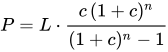
For more information, see monthly amortized loan or mortgage payments.
Abuses in lending
[edit]Predatory lending is one form of abuse in the granting of loans. It usually involves granting a loan in order to put the borrower in a position that one can gain advantage over them; subprime mortgage-lending[9] and payday-lending[10] are two examples, where the moneylender is not authorized or regulated, the lender could be considered a loan shark.
Usury is a different form of abuse, where the lender charges excessive interest. Credit card companies in some countries have been accused by consumer organizations of lending at usurious interest rates and making money out of frivolous "extra charges".[11]
Abuses can also take place in the form of the customer defrauding the lender by borrowing without intending to repay the loan.
United States taxes
[edit]Most of the basic rules governing how loans are handled for tax purposes in the United States are codified by both Congress (the Internal Revenue Code) and the Treasury Department (Treasury Regulations – another set of rules that interpret the Internal Revenue Code).[12]: 111
- A loan is not gross income to the borrower.[12]: 111 Since the borrower has the obligation to repay the loan, the borrower has no accession to wealth.[12]: 111 [13]
- The lender may not deduct (from own gross income) the amount of the loan.[12]: 111 The rationale here is that one asset (the cash) has been converted into a different asset (a promise of repayment).[12]: 111 Deductions are not typically available when an outlay serves to create a new or different asset.[12]: 111
- The amount paid to satisfy the loan obligation is not deductible (from own gross income) by the borrower.[12]: 111
- Repayment of the loan is not gross income to the lender.[12]: 111 In effect, the promise of repayment is converted back to cash, with no accession to wealth by the lender.[12]: 111
- Interest paid to the lender is included in the lender's gross income.[12]: 111 [14] Interest paid represents compensation for the use of the lender's money or property and thus represents profit or an accession to wealth to the lender.[12]: 111 Interest income can be attributed to lenders even if the lender does not charge a minimum amount of interest.[12]: 112
- Interest paid to the lender may be deductible by the borrower.[12]: 111 In general, interest paid in connection with the borrower's business activity is deductible, while interest paid on personal loans are not deductible.[12]: 111 The major exception here is interest paid on a home mortgage.[12]: 111
Income from discharge of indebtedness
[edit]Although a loan does not start out as income to the borrower, it becomes income to the borrower if the borrower is discharged of indebtedness.[12]: 111 [15] Thus, if a debt is discharged, then the borrower essentially has received income equal to the amount of the indebtedness.
Example: X owes Y $50,000. If Y discharges the indebtedness, then X no longer owes Y $50,000. For purposes of calculating income, this is treated the same way as if Y gave X $50,000.
For a more detailed description of the "discharge of indebtedness", look at Section 108 (Cancellation-of-debt income) of the Internal Revenue Code.[16][17]
See also
[edit]- 0% finance
- Annual percentage rate (a.k.a. Effective annual rate)
- Auto loan
- Bank, Fractional-reserve banking, Building society
- Debt, Consumer debt, Debt consolidation, Government debt
- Default (finance)
- Finance, Personal finance, Settlement (finance)
- Interest-only loan, Negative amortization, PIK loan
- Legal financing
- Leveraged loan
- Loan agreement
- Loan guarantee
- Loan sale
- Loans and interest in Judaism
- Margin (finance)
- Pay it forward
- Payday loan
- Refund Anticipation Loan
- Sponsored repayment
- Smart contract
- Student loan
- Syndicated loan
- Title loan
References
[edit]- ^ Glancy, David; Kurtzman, Robert J.; Loewenstein, Lara (2022). "Loan Modifications and the Commercial Real Estate Market". Finance and Economics Discussion Series (2022–050): 1–71. doi:10.17016/FEDS.2022.050. ISSN 1936-2854.
- ^ Signoriello, Vincent J. (1991). Commercial Loan Practices and Operations. Bankers. ISBN 978-1-55520-134-0.
- ^ CCH Incorporated (April 2008). Federal Estate & Gift Taxes: Code & Regulations (Including Related Income Tax Provisions), As of March 2008. CCH. pp. 631–. ISBN 978-0-8080-1853-7. Archived from the original on 2021-04-14. Retrieved 2020-11-18.
- ^ Subsidized Loan - Definition and Overview Archived 2012-03-04 at the Wayback Machine at About.com. Retrieved 2011-12-21.
- ^ Concessional Loans, Glossary of Statistical Terms Archived 2013-10-31 at the Wayback Machine, oecd.org, Retrieved on 5/5/2013
- ^ Schmitt, Kirsten Rohrs. "What Is a Bridge Loan and How Does It Work, With Example". Investopedia. Retrieved 2025-10-18.
- ^ "Average new-car loan a record 65 months in fourth quarter". Reuters. August 6, 2017. Archived from the original on 2017-08-06. Retrieved 2017-08-06.
- ^ Guttentag, Jack (October 6, 2007). "The Math Behind Your Home Loan". The Washington Post. Archived from the original on November 10, 2012. Retrieved May 11, 2010.
- ^ "Predators try to steal home". CNN Money. 18 Apr 2000. Archived from the original on 8 March 2018. Retrieved 7 Mar 2018.
- ^ Horsley, Scott; Arnold, Chris (2 Jun 2016). "New Rules To Ban Payday Lending 'Debt Traps'". National Public Radio. Archived from the original on 8 March 2018. Retrieved 7 Mar 2018.
- ^ "Credit cardholders pay Rs 6,000 cr 'extra'". The Financial Express (India). Chennai, India. 3 May 2007. Archived from the original on January 20, 2019. Alt URL Archived 2019-01-20 at the Wayback Machine
- ^ a b c d e f g h i j k l m n o p Samuel A. Donaldson, Federal Income Taxation of Individuals: Cases, Problems and Materials, 2nd Ed. (2007).
- ^ See Commissioner v. Glenshaw Glass Co., 348 U.S. 426 (1955) (giving the three-prong standard for what is "income" for tax purposes: (1) accession to wealth, (2) clearly realized, (3) over which the taxpayer has complete dominion).
- ^ 26 U.S.C. 61(a)(4)(2007).
- ^ 26 U.S.C. 61(a)(12)(2007).
- ^ 26 U.S.C. 108(2007).
- ^ EUGENE A. LUDWIG AND PAUL A. VOLCKER, 16 November 2012 Banks Need Long-Term Rainy Day Funds Archived 2017-07-10 at the Wayback Machine
| International | |
|---|---|
| National | |
| Other | |

Fundamentals
Definition and Core Concepts
A loan is a contractual arrangement in which a lender provides money, property, or other assets to a borrower, who agrees to repay the principal amount plus interest over a specified period or on demand.[9] This distinguishes loans from gifts or equity investments, as repayment is obligatory, with interest compensating the lender for the opportunity cost of capital and risk of default.[1] Central to loans are the principal—the initial amount disbursed—and interest, the fee for borrowing, expressed as a percentage rate applied to the outstanding balance.[10] Interest may accrue simply on the principal or compound periodically, increasing the total debt if unpaid.[11] The loan term defines the repayment duration, typically ranging from months to decades, affecting payment size and total cost; longer terms reduce periodic payments but elevate cumulative interest.[10] Repayment structures vary, with amortizing loans requiring fixed installments that allocate portions to interest and principal, gradually reducing the balance.[11] In such loans, early payments primarily cover interest due to higher initial balances, shifting toward principal over time.[12] The periodic payment for an amortizing loan is calculated as , where is the principal, the periodic interest rate, and the number of payments.[11] This formula derives from the present value of an annuity, ensuring full repayment by maturity.[13]Economic Rationale from First Principles
Loans emerge from the fundamental human trait of positive time preference, whereby individuals value a unit of consumption today more highly than an identical unit in the future due to factors such as uncertainty about future circumstances, impatience, and the opportunity for immediate satisfaction.[14] This preference creates a divergence between those with current surpluses of resources, who are willing to forgo present consumption only if compensated, and those with deficits, who seek immediate access to resources for consumption or production. The loan contract bridges this gap by transferring present goods from savers to borrowers in exchange for a promise of greater future repayment, with interest serving as the premium reflecting the saver's time preference rate.[15] From first principles, interest cannot be zero in equilibrium because savers would otherwise retain funds for personal use rather than lend them out, as the subjective utility of present goods exceeds that of future equivalents absent compensation.[14] Borrowers, facing their own time preferences, agree to pay interest to secure funds now, enabling investments or expenditures that would otherwise be infeasible without accumulated personal savings.[16] The market interest rate thus equilibrates the supply of voluntary savings—determined by aggregate time preferences—with the demand for loanable funds, which arises from anticipated productivity gains in time-extended production processes.[17] This arrangement promotes efficient capital allocation by directing scarce savings toward projects with the highest marginal returns, such as longer production chains that yield greater output per input, as theorized in analyses of roundabout methods of production.[16] Without loans, economic activity would be constrained to hand-to-mouth operations limited by individual savings rates, curtailing specialization, technological advancement, and overall productivity growth.[17] Empirical cross-country evidence supports that developed loan markets enhance investment responsiveness to growth opportunities, channeling capital more effectively than reliance on self-financing alone.[18] Consequently, loans facilitate the temporal structure of production, allowing societies to convert present sacrifices into amplified future abundance, grounded in the causal reality that deferred consumption funds transformative economic activities.[16]Historical Development
Origins in Ancient Civilizations
The earliest recorded instances of lending practices appear in ancient Mesopotamia, where clay tablets from Sumerian city-states such as Uruk and Lagash, dating to approximately 3000–2000 BCE, document loans of grain, silver, and other commodities, often secured by pledges or future harvests.[19] These transactions facilitated trade and agriculture in a temple-centered economy, with temples acting as repositories and lenders using surplus resources. By the Old Babylonian period, the Code of Hammurabi, inscribed around 1750 BCE, codified lending rules, capping interest at 33⅓% annually for grain loans and 20% for silver, while prohibiting excessive rates and mandating forfeiture of principal and interest for violations.[4] The code also addressed risk, exempting debtors from repayment if acts of god, such as floods, destroyed collateral crops, reflecting an early recognition of force majeure in contracts. Periodic royal edicts, including Hammurabi's own andurarum decrees, canceled certain private debts to avert social unrest from debt bondage, though these targeted citizen debts to elites rather than commercial obligations.[20] In ancient Egypt, lending emerged within a redistributive economy dominated by state granaries and temples, with evidence from Middle Kingdom papyri (c. 2000 BCE) showing loans of grain or tools to farmers and artisans, often without explicit interest to maintain communal stability during Nile flood failures.[21] Private lending among elites involved debens (a unit of copper or grain value) as collateral, but systematic interest-bearing debt appears limited until the New Kingdom (c. 1550–1070 BCE), where records indicate rates up to 100% on short-term advances, secured by land or labor pledges that could lead to servitude.[22] Egyptian practices emphasized reciprocity over profit, with pharaonic interventions periodically forgiving peasant debts to prevent famine-induced defaults, underscoring lending's role in buffering agricultural volatility rather than capital accumulation.[20] Lending in ancient Greece, from the Archaic period onward (c. 800–500 BCE), involved trapezitai (bankers) and temples extending credit for maritime trade and warfare, with interest rates typically 10–12% per annum on secured loans, as evidenced by inscriptions from Delos and Athens.[23] Solon's seisachtheia reforms in 594 BCE canceled agrarian debts and abolished debt slavery (hektemoroi), addressing oligarchic exploitation that had concentrated land among lenders, though commercial lending persisted.[4] In Rome, the Twelve Tables (c. 450 BCE) regulated nexum loans, limiting interest to 8⅓% monthly (effectively 100% annually initially) and curbing creditor abuses like bodily seizure for default.[24] By the Republic, argentarii provided diverse loans—unsecured mutuum for consumption and secured hypotheca for commerce—with rates capped at 12% under imperial edicts, including Justinian's in 533 CE, while temples like Apollo's issued state-backed advances.[25] Roman law formalized negotiable instruments, enabling debt assignment and influencing later commercial practices.[26]Evolution Through Medieval and Early Modern Periods
In medieval Europe, the Catholic Church's prohibition on usury—defined as any interest charged on loans—severely constrained direct lending among Christians, rooted in interpretations of biblical passages such as Luke 6:35, which urged lending without expectation of return.[27] This ban, formalized in canon law by the 12th century, aimed to prevent exploitation but stifled capital flows, pushing Christians toward indirect mechanisms like partnerships (commenda) or sales with delayed payment to embed returns without explicit interest.[28] Jewish communities, exempt from Christian doctrine, filled much of the lending void, providing loans secured by pledges or land, though this fueled antisemitic expulsions and pogroms as debts mounted.[29] Rural credit persisted via informal pledges and annuities, with English records from the 13th-14th centuries showing small-scale loans backed by livestock or harvests at implicit rates of 20-50% annually, reflecting high risk in agrarian economies. Italian city-states like Florence and Venice pioneered innovations to circumvent usury restrictions, developing bills of exchange by the 12th century as dual-purpose instruments for trade finance and disguised loans.[30] These allowed merchants to "exchange" currency at one fair (e.g., Champagne) for payment at another (e.g., Genoa), with differentials effectively yielding 15-20% returns, evading theological scrutiny by framing transactions as sales rather than mutuum loans.[31] Banking families such as the Bardi and Peruzzi in 14th-century Florence extended large-scale credit to monarchs, lending over 1 million gold florins to England's Edward III for the Hundred Years' War, though defaults in 1345 triggered bankruptcies and economic ripples across Europe.[32] Such sovereign loans, often secured by future tax revenues, highlighted the period's reliance on merchant capital for warfare, with interest disguised via currency manipulations or fees.[33] Transitioning to the early modern period (c. 1500-1800), evolving state needs for war finance spurred formalized public debt and banking, as centralized monarchies like Spain and France issued annuities and juros—perpetual bonds paying 5-7% yields funded by excise taxes.[34] The Protestant Reformation, particularly John Calvin's 1545 endorsement of moderate interest (up to 5-10%) as compensation for opportunity costs, eroded Catholic prohibitions in northern Europe, enabling Dutch and English lenders to openly charge rates aligned with market risks.[27] Public banks emerged, such as Amsterdam's Wisselbank in 1609, which facilitated loans through deposit-backed bills and stabilized trade credit amid mercantile expansion.[35] Sovereign borrowing scaled dramatically; by 1789, Britain's funded debt exceeded £240 million, serviced via parliamentary taxes and attracting private investors with yields around 3-4%, marking a shift from ad hoc royal loans to institutionalized capital markets driven by fiscal-military imperatives.[36] These developments prioritized causal links between state power, warfare costs, and credit innovation over doctrinal purity, laying groundwork for modern finance despite persistent defaults and inflationary pressures.[37]Industrial and Contemporary Milestones
The Industrial Revolution, commencing in Britain around 1760 and spreading to continental Europe and North America by the early 19th century, spurred significant advancements in lending practices to finance mechanization, factory expansion, and infrastructure. Entrepreneurs required capital for machinery and working capital, leading to the proliferation of country banks that lowered procurement costs and facilitated innovation; for instance, these banks increased patent acquisitions among industrialists and merchants by providing targeted loans.[38] Sovereign debt mechanisms enabled nobility to redirect funds from low-yield land to high-profit industrial ventures, accelerating structural economic shifts despite wartime financing strains on private credit markets.[39] In the United States, agricultural credit expanded to support larger farms, new equipment, and crop innovations, marking a transition from artisanal to large-scale production reliant on borrowed funds.[40] By the mid-19th century, institutional mortgage lending emerged as a key innovation, particularly in urbanizing areas. In New Haven, Connecticut, a market shift around 1837 democratized access beyond elites, with savings banks and insurance companies extending loans to broader borrowers secured by real estate.[41] Building and loan associations, originating in the 1830s in the U.S., pooled member savings to fund home purchases, becoming the primary institutional mortgage providers until the Great Depression and enabling working-class homeownership through serial share redemption models.[42] The National Bank Act of 1864 restricted commercial banks from mortgage lending, channeling activity to life insurers and mutual savings banks, which grew urban mortgage markets amid rapid industrialization.[43] The 20th century witnessed the mass democratization of consumer loans, driven by rising incomes and production capacities. U.S. consumer credit outstanding reached $7 billion in the 1920s, fueled by installment plans for automobiles and appliances, though speculative lending contributed to the 1929 crash.[44] The Federal Credit Union Act of 1934 established federally chartered credit unions, expanding small-dollar lending to underserved groups akin to commercial banks.[45] Post-World War II, the GI Bill of 1944 provided zero-down-payment mortgages to veterans, catalyzing suburban expansion and homeownership rates that climbed from 44% in 1940 to 62% by 1960, supported by long-term fixed-rate loans standardized in the 1930s via federal agencies like the FHA.[46] Revolving credit transformed personal borrowing with the invention of the modern credit card in 1950, when Frank McNamara launched Diners Club after forgetting his wallet at a New York dinner, initially for restaurant charges before expanding to retail.[47] Bank-issued cards proliferated in the 1950s and 1960s, with nearly 100 U.S. banks entering the market by 1968, enabling widespread unsecured consumer debt.[48] Contemporary developments include the rise of nonbank lending since the 1970s, where nonbanks' share of total loans grew from minimal levels to 63% by 2009 before stabilizing around 37% post-2016, reflecting deregulation and securitization.[49] Payday loans emerged in the early 1990s amid small-loan deregulation, targeting short-term cash needs but often at high effective rates exceeding 400% APR.[50] Digital platforms since the 2010s have further evolved lending through peer-to-peer models and algorithmic risk assessment, though empirical data underscores persistent challenges in default rates tied to economic cycles.[51]Classifications
Secured versus Unsecured Loans
Secured loans require the borrower to pledge collateral, such as real estate, vehicles, or savings accounts, which the lender can seize and liquidate in the event of default to recover the outstanding balance.[52] This collateral reduces the lender's risk exposure, as empirical data from lending institutions shows recovery rates on secured defaults averaging 50-70% of principal through asset sales, compared to near-zero immediate recovery for unsecured debts without legal proceedings.[53] In contrast, unsecured loans rely solely on the borrower's promise to repay, assessed via credit scores, income verification, and debt-to-income ratios, with no specific asset tied to the obligation.[54] The primary distinction arises from risk allocation: secured lending mitigates lender losses causally through enforceable claims on tangible assets, enabling lower interest rates—often 2-5 percentage points below unsecured equivalents—as compensation for risk is diminished.[55] For instance, as of October 2025, average unsecured personal loan rates stand at 12.25% for borrowers with credit scores above 700, while secured variants, such as those backed by vehicles or deposits, frequently range from 7-10% due to collateral's protective effect.[56] Unsecured loans, however, demand higher rates, averaging 14-20% or more, to offset default probabilities estimated at 5-10% annually by credit bureaus, absent asset recourse.[57] Qualification thresholds reflect this: unsecured approvals typically require FICO scores of 670 or higher, with rejection rates exceeding 40% for sub-600 scores, whereas secured loans accommodate scores as low as 500-580 by substituting asset value for personal credit reliability.[58] Default consequences diverge sharply. In secured cases, lenders invoke security interests under Uniform Commercial Code provisions in the U.S., foreclosing or repossessing collateral promptly—e.g., auto repossessions recover 60% of loan value on average within 90 days per Federal Reserve data.[59] Unsecured defaults trigger collections, lawsuits, and judgments, but recovery relies on wage garnishment or liens, yielding effective returns below 20% after legal costs and time delays of 6-24 months.[53] This structure incentivizes borrowers differently: collateral introduces personal loss aversion, empirically lowering delinquency rates by 15-25% in secured portfolios versus unsecured, as documented in lender risk models.[60]| Aspect | Secured Loans | Unsecured Loans |
|---|---|---|
| Collateral Required | Yes (e.g., home, car, certificate of deposit) | No |
| Interest Rates (2025 Avg.) | Lower (7-12%) due to reduced risk | Higher (12-20%+) to compensate for defaults |
| Qualification Criteria | More lenient; credit scores 500+ viable with strong collateral | Strict; typically 670+ FICO, stable income proof |
| Loan Amounts | Higher limits (up to asset value, e.g., $100,000+) | Lower caps ($1,000-$50,000 typical) |
| Default Recovery | Asset seizure (50-70% recovery) | Legal action (10-20% effective recovery) |
Repayment and Term Structures
Loans are classified by repayment structure based on the schedule for principal and interest payments. Fully amortizing loans require periodic payments that cover both interest and a portion of principal, gradually reducing the outstanding balance to zero by the end of the term; the standard formula for monthly payment on principal at periodic interest rate over periods is . [65] Within amortizing structures, equal principal repayment maintains fixed principal portions per period with declining interest due to the reducing balance, while equal installment (annuity) repayment features constant total payments with initially higher interest and lower principal components that shift over time.[66][67] Interest-only loans defer principal repayment, with payments covering solely accrued interest during the term, after which the full principal becomes due, often via refinancing or sale of assets; this structure lowers initial cash outflows but risks principal accumulation if not addressed at maturity.[68] Balloon or bullet loans combine elements of amortizing and interest-only, featuring smaller periodic payments (potentially interest-only or partial amortization) followed by a substantial lump-sum principal payment at term end, typically within 5 to 7 years, to accommodate projects with deferred cash flows.[69][70] Classification by term length reflects duration and purpose, with short-term loans generally under one year for immediate needs like working capital or bridging finance, often involving balloon payments.[71] Medium- or intermediate-term loans span 1 to 5 years, balancing repayment feasibility with asset acquisition or expansion funding.[72] Long-term loans exceed 5 years, up to 25 or more, suited for durable assets like real estate where extended amortization aligns with revenue generation.[71][73] These durations influence total interest costs and risk exposure, as longer terms amplify sensitivity to rate changes absent fixed pricing.[74]Specialized Variants
Specialized variants of loans cater to niche markets, specific borrower needs, or regulatory frameworks, often incorporating customized risk mitigation, guarantees, or compliance features distinct from standard secured or unsecured structures. These include government-backed programs for small businesses, targeted credit for underserved groups, and industry-specific financing that leverages specialized underwriting. For instance, the U.S. Small Business Administration (SBA) offers the 7(a) loan program with subtypes like SBA Express, which provides expedited approval up to $500,000 for general small business needs, and Export Express for export-related working capital, both featuring reduced documentation and SBA guarantees covering up to 85% of principal.[75] Similarly, the 504 program finances fixed assets like real estate through certified development companies, with loans up to $5.5 million as of 2025, emphasizing long-term, fixed-rate debt for job creation.[75] Special Purpose Credit Programs (SPCPs), authorized under the Equal Credit Opportunity Act, enable lenders to offer favorable terms to economically disadvantaged groups, such as low- to middle-income borrowers in designated communities, with examples including reduced fees or down payments verified through demographic data analysis.[76] These programs, implemented by institutions like community banks, aim to address credit access gaps but require rigorous documentation to comply with fair lending laws, as outlined by the Consumer Financial Protection Bureau in 2023 guidance.[76] In commercial contexts, bridge loans provide short-term, high-interest financing—typically 6-12 months—for real estate or business transitions, secured by the asset and often used by investors awaiting permanent funding, with rates averaging 8-12% as of 2024 per industry benchmarks.[77] Debt Service Coverage Ratio (DSCR) loans, a variant for investment properties, base approval on property cash flow rather than personal income, allowing non-traditional borrowers like real estate investors to qualify with DSCR thresholds of 1.25 or higher, increasingly popular amid rising interest rates.[77] Microloans, capped at $50,000 by the SBA's Microloan Program, target startups and underserved entrepreneurs, particularly women and minorities, through nonprofit intermediaries with technical assistance, boasting repayment rates above 80% due to hands-on support as reported in program data through 2024.[75] Industry-focused variants, such as healthcare or renewable energy loans, incorporate sector-specific covenants; for example, USDA-backed rural energy loans offer up to 90% guarantees for projects like solar installations, with terms extending 20-40 years to match asset lifespans.[78] These specialized forms enhance capital access but carry higher administrative costs and scrutiny from regulators like the FDIC, which notes specialization risks in concentrated lending portfolios.[79]Mechanics and Calculations
Interest and Pricing Mechanisms
Interest in loans represents the compensation to the lender for the time value of money, the opportunity cost of forgoing alternative investments, inflation risks, and the potential for borrower default. From economic fundamentals, this pricing reflects the lender's required return to cover funding costs—such as deposits or wholesale borrowing—and administrative expenses, adjusted for the loan's duration and repayment structure. Empirical data from banking analyses show that without such mechanisms, capital allocation would inefficiently favor low-risk borrowers, stifling broader economic lending.[80][81] Loans typically employ either simple or compound interest calculations, with the choice influencing total borrower costs. Simple interest applies solely to the principal amount, computed as , where is the principal, the annual rate, and the time in years; this method prevails in short-term personal loans or certain auto financing, yielding lower cumulative charges over time compared to compounding.[82][83] Compound interest, more common in mortgages and credit products, accrues on both principal and prior interest, following , where denotes compounding periods per year; this exponential growth amplifies costs, as evidenced by a $10,000 loan at 5% annual rate compounding monthly reaching $10,511.62 after one year, versus $10,500 under simple interest.[82][84] Pricing mechanisms integrate a base rate—often tied to benchmarks like the federal funds rate or 10-year Treasury yield—with overlays for risk and profitability. Lenders add a risk premium calibrated to borrower-specific factors, including credit scores (e.g., FICO above 740 typically secures rates 1-2% below those for scores under 620), debt-to-income ratios, and collateral quality; this risk-based approach, formalized in models like cost-plus or price leadership, ensures higher yields for riskier credits to offset expected losses, with data indicating premiums of 2-5% for subprime loans versus near-zero for prime.[85][86][87] Market competition and macroeconomic conditions further modulate rates, as seen in 2022-2023 when U.S. Federal Reserve hikes elevated base costs, pushing average personal loan rates from 10.28% to 12.65%.[80][88] The Annual Percentage Rate (APR) provides a standardized measure of total borrowing costs, encompassing nominal interest plus fees like origination (1-6% of principal) and processing charges, expressed as an effective annualized rate. Unlike the nominal rate, which ignores compounding frequency and extras, APR facilitates comparisons; for instance, a 7% nominal mortgage rate with 2 points in fees might yield a 7.25% APR, reflecting true expense per regulatory disclosures.[89][89] Lenders must disclose APR under the Truth in Lending Act, though variations in fee inclusion can still obscure full pricing transparency.[89]In amortizing loans, interest pricing interacts with repayment via formulas deriving periodic payments from principal, rate, and term, underscoring how front-loaded interest payments heighten early costs.
Amortization and Repayment Schedules
Amortization involves the gradual reduction of a loan's principal balance through a series of periodic payments, each comprising interest on the outstanding balance and a portion allocated to principal repayment. This process ensures the debt is fully extinguished by the loan's maturity date in fully amortizing structures, with the interest component dominating early payments due to the higher initial balance, while principal reduction accelerates over time as the balance declines.[13][66] The standard formula for calculating the fixed periodic payment on an amortizing loan derives from the present value of an annuity, expressed as , where is the principal, is the periodic interest rate, and is the number of periods.[90] This closed-form solution arises from summing the geometric series of discounted payments equaling the initial loan amount, ensuring each payment covers accruing interest plus incremental principal. For monthly payments on an annual rate, is divided by 12 and by the loan term in years.[90] Repayment schedules tabulate these breakdowns sequentially: starting with the initial balance, each period's interest is computed as outstanding balance times , principal repaid as minus interest, and updated balance as prior balance minus principal portion. For a $100,000 loan at 6% annual interest over 10 years (120 monthly payments), the fixed approximates $1,110.21, with the first payment allocating about $500 to interest and $610 to principal, shifting to roughly $1,100 principal by the final payment.[13][91]| Period | Payment | Interest | Principal | Balance |
|---|---|---|---|---|
| 1 | $1,110.21 | $500.00 | $610.21 | $99,389.79 |
| 2 | $1,110.21 | $496.95 | $613.26 | $98,776.53 |
| ... | ... | ... | ... | ... |
| 120 | $1,110.21 | $5.53 | $1,104.68 | $0.00 |