
Big Dipper
View on Wikipedia

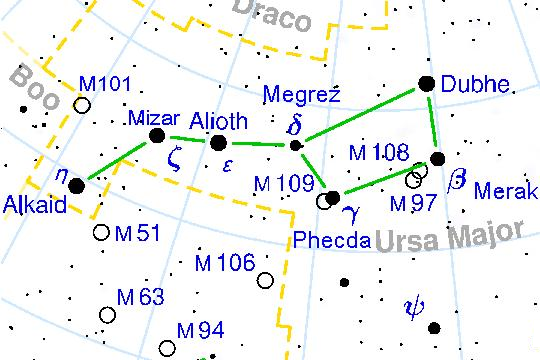
The Big Dipper (Canada, US) or the Plough (UK, Ireland)[1][2] is an asterism consisting of seven bright stars of the constellation Ursa Major;[3][4][5][6] six of them are of second magnitude and one, Megrez (δ), of third magnitude. Four define a "bowl" or "body" and three define a "handle" or "head". It is recognized as a distinct grouping in many cultures. The North Star (Polaris), the current northern pole star and the tip of the handle of the Little Dipper (Little Bear), can be located by extending an imaginary line through the front two stars of the asterism, Merak (β) and Dubhe (α). This makes it useful in celestial navigation.
Names and places
[edit].jpg)
The constellation of Ursa Major (Latin: Greater Bear) has been seen as a bear, a plough, a wagon, or a ladle. The "bear" tradition is Indo-European (appearing in Greek, as well as in Vedic India),[7] but apparently the name "bear" has parallels in Siberian or North American traditions.[8][9][10]
European astronomy
[edit]
The name "Bear" is Homeric, and apparently native to Greece, while the "Wain" tradition is Mesopotamian. Book XVIII of Homer's Iliad mentions it as "the Bear, which men also call the Wain".[11] In Latin, these seven stars were known as the "Seven Oxen" (septentriones, from septem triōnēs).[12] Classical Greek mythography identified the "Bear" as the nymph Callisto, changed into a she-bear by Hera, the jealous wife of Zeus.
In Ireland and the United Kingdom, this pattern is known as the Plough (Irish: An Camchéachta – the bent plough). The symbol of the Starry Plough has been used as a political symbol by Irish Republican and Irish left wing movements. Former names include the Great Wain (i.e., wagon), Arthur's Wain[13] or Butcher's Cleaver. The terms Charles's Wain and Charles his Wain are derived from the still older Carlswæn.[14] A folk etymology holds that this derived from Charlemagne, but the name is common to all the Germanic languages and the original reference was to the churls' (i.e., the men's) wagon, in contrast to the women's wagon, (the Little Dipper).[15][16] An older "Odin's Wain" may have preceded these Nordic designations.[14]
In German, it is known as the "Great Wagon" (Großer Wagen) and, less often, the "Great Bear" (Großer Bär). Likewise, in the North Germanic languages, it is known by variations of "Charles's Wagon" (Karlavagnen, Karlsvogna, or Karlsvognen), but also the "Great Bear" (Stora Björn), and to the Norse pagans, it was known as Óðins vagn; "Woden's wagon".[17] In Dutch, its official name is the "Great Bear" (Grote Beer), but it is popularly known as the "Saucepan" (Steelpannetje). In Italian, it is called either the "Great Wagon" (Grande Carro) or "Orsa Maggiore" ("Greater Bear"). Romanian and most Slavic languages also call it the "Great Wagon".
In Hungarian, it is commonly known as "Göncöl's Wagon" (Göncölszekér) or, less often, "Big Göncöl" (Nagy Göncöl) after a táltos (shaman) in Hungarian mythology who carried medicine that could cure any disease. In Finnish, the figure is known as Otava with established etymology in the archaic meaning 'salmon net', although other uses of the word refer to 'bear' and 'wheel'.[18] The bear relation is claimed to stem from the animal's resemblance to—and mythical origin from—the asterism rather than vice versa.[19][20]
In Lithuanian, the stars of Ursa Major are known as Didieji Grįžulo Ratai ("The Big Back Wheels"). Other names for the constellation include Perkūno Ratai ("The Wheels of Perkūnas"), Kaušas ("The Bucket"), Vežimas ("The Carriage"), and Samtis ("The Ladle").[citation needed] In Latvian, it is known as Lielie Greizie Rati ("The Great Crooked Wagon") or Lielais Kauss ("The Great Cup").[21]
In the Sámi languages of Northern Europe, the constellation is identified as the bow of the great hunter Fávdna (the star Arcturus). In the main Sámi language, North Sámi it is called Fávdnadávgi ("Fávdna's bow") or simply dávggát ("the bow"). The constellation features prominently in the Sámi anthem, which begins with the words Guhkkin davvin dávggáid vuolde sabmá suolggai Sámieanan, which translates to "Far to the north, under the Bow, the Land of the Sámi slowly comes into view." The Bow is an important part of the Sámi traditional narrative about the night sky, in which various hunters try to chase down Sarva, the Great Reindeer, a large constellation that takes up almost half the sky. According to the legend, Fávdna stands ready to fire his Bow every night but hesitates because he might hit Stella Polaris, known as Boahji ("the Rivet"), which would cause the sky to collapse and end the world.[22]
Arabian astronomy
[edit] |
The Arabic names بَنَاتُ نَعْشٍ الكُبْرَى (Banāt Naʿsh al-Kubrā), بَنُو نَعْشٍ (Banū Naʿsh), and آلُ نَعْشٍ (Āl Naʿsh) refer to the constellation known in Western astronomy as the Big Dipper, which is part of Ursa Major. The term “Banāt Naʿsh” translates to “the daughters of the bier (funeral litter),” reflecting an ancient Arab mythological interpretation of the star pattern. In this context, the four bright stars forming the “bowl” of the Big Dipper represent a funeral bier, while the three stars forming the “handle” symbolize mourners or daughters following behind in a funeral procession. This naming convention is deeply rooted in Arabic oral traditions and ancient Bedouin star lore, where celestial objects were often associated with narratives that mirrored life, death, and human experiences. Such names highlight the rich entomological and mythological traditions of pre-Islamic and early Islamic Arab culture, where stars were used for navigation, storytelling, and timekeeping.
Asian traditions
[edit]
In Chinese astronomy and Chinese constellation records, The Big Dipper is called "Beidou" (Chinese: 北斗; pinyin: Běi Dǒu), which literally means Northern Dipper. It refers to an asterism equivalent to the Big Dipper. The Chinese name for Alpha Ursae Majoris is Beidou Yi (Chinese: 北斗一; pinyin: Běi Dǒu yī; lit. 'Beidou One') and Tianshu (Chinese: 天樞; pinyin: Tiān Shū; lit. 'Star of Celestial Pivot').[23] The asterism name was mentioned in Warring States period (c. 475–221 BCE) stellar records, in which the asterism is described to have seven stars in the shape of a dipper or a chariot.[24][failed verification]
The Chinese astronomy records were translated to other East Asian cultures in the Sinosphere. The most prominent name is the "Northern Dipper" (北斗) and the "Seven Stars of the Northern Dipper" (Chinese and Japanese: 北斗七星; pinyin: Běidǒu Qīxīng; Cantonese Yale: Bak¹-dau² Cat¹-sing¹; rōmaji: Hokuto Shichisei; Korean: 북두칠성; romaja: Bukdu Chilseong; Vietnamese: Bắc Đẩu thất tinh).[25][26] In astrology, these stars are generally considered to compose the Right Wall of the Purple Forbidden Enclosure which surrounds the Northern Celestial Pole, although numerous other groupings and names have been made over the centuries. Similarly, each star has a distinct name, which likewise has varied over time and depending upon the asterism being constructed.[27] The personification of the Big Dipper itself is also known as "Doumu" (斗母) in Chinese folk religion and Taoism, and Marici in Buddhism.
In Vietnam, the colloquial name for the asterism is Sao Bánh lái lớn (The Big Rudder Stars), contrasted with Ursa Minor, which is known as Sao Bánh lái nhỏ (The Little Rudder Stars).[28] Although this name has now been replaced by the Sino-Vietnamese "Bắc Đẩu" in everyday speech, many coastal communities in central and southern Vietnam still refer to the asterism as such and use it to navigate when their fishing vessels return from the sea at night.[29]
In Shinto religion, the seven largest stars of Ursa Major belong to Amenominakanushi, the oldest and most powerful of all kami.[citation needed]
In Malay, it is known as the "Boat Constellation" (Buruj Biduk); in Indonesian, as the "Canoe Stars" (Bintang Biduk).[30]
In Burmese, these stars are known as Pucwan Tārā (ပုဇွန် တာရာ, pronounced "bazun taja"). Pucwan (ပုဇွန်) is a general term for a crustacean, such as prawn, shrimp, crab, lobster, etc.[31]
In Thai, they are known as the "Crocodile Stars" (ดาวจระเข้). 47 Ursae Majoris is also named Chalawan, the mythological crocodile from Thai folklore.[32]
While its Western name comes from the star pattern's resemblance to a kitchen ladle, in Filipino, the Big Dipper and its sister constellation the Little Dipper are more often associated with the tabo, a one-handled water pot used ubiquitously in Filipino households and bathrooms for purposes of personal hygiene.[citation needed]
In the earliest Indian astronomy, the Big Dipper was called "the Bear" (Ṛkṣa, ऋक्ष) in the Rigveda, but was later more commonly known by the name of Saptarishi, "Seven Sages."[7]
Inuit traditions
[edit]In Inuit astronomy, the same grouping of stars is referred to as "the Caribou" (Tukturjuit). Many of the stars within the constellation "were used as hour hands on the night sky to indicate hours of the night, or as calendar stars to help determine the date in fall, winter, or spring."[33]
In North America
[edit]The asterism name "Big Dipper" is mostly used in the United States and Canada. However, the origin of the term is disputed.[34] A popular myth claimed the name originated from African-American folk songs; however, a more recent source challenges the authenticity of the claim.[35]
In an 1824 book on the history of the constellations' mythology, Jacob Green contrasted the "Dipper or Ladle" descriptors used in the United States with "Charles's Wagon or Wain" which were common in England.[36] Descriptions of "the dipper" appear in American astronomy textbooks throughout the 19th century.[37][38][39]
Stars
[edit]Within Ursa Major the stars of the Big Dipper have Bayer designations in consecutive Greek alphabetical order from the bowl to the handle.

.jpg)
| Bayer designation |
Proper Name |
Apparent magnitude |
Distance (l yrs) |
|---|---|---|---|
| α UMa | Dubhe | 1.8 | 124 |
| β UMa | Merak | 2.4 | 79 |
| γ UMa | Phecda | 2.4 | 84 |
| δ UMa | Megrez | 3.3 | 81 |
| ε UMa | Alioth | 1.8 | 81 |
| ζ UMa | Mizar | 2.1 | 78 |
| η UMa | Alkaid | 1.9 | 104 |
In the same line of sight as Mizar, but about one light-year beyond it, is the star Alcor (80 UMa). Together they are known as the "Horse and Rider". At fourth magnitude, Alcor would normally be relatively easy to see with the unaided eye, but its proximity to Mizar renders it more difficult to resolve, and it has served as a traditional test of sight. Mizar itself has four components and thus enjoys the distinction of being part of an optical binary as well as being the first-discovered telescopic binary (1617) and the first-discovered spectroscopic binary (1889).

 3D red cyan glasses are recommended to view this image correctly.
Five of the stars of the Big Dipper are at the core of the Ursa Major Moving Group. The two at the ends, Dubhe and Alkaid, are not part of the swarm, and are moving in the opposite direction. Relative to the central five, they are moving down and to the right in the map. This will slowly change the Dipper's shape, with the bowl opening up and the handle becoming more bent. In 50,000 years the Dipper will no longer exist as we know it,[citation needed] but be re-formed into a new Dipper facing the opposite way. The stars Alkaid to Phecda will then constitute the bowl, while Phecda, Merak, and Dubhe will be the handle.
Guidepost
[edit]
Not only are the stars in the Big Dipper easily found themselves, they may also be used as guides to other stars outside of the asterism. Thus it is often the starting point for introducing Northern Hemisphere beginners to the night sky:
- Polaris, the North Star, is found by imagining a line from Merak (β) to Dubhe (α) and then extending it for five times the distance between the two Pointers.
- Extending a line from Megrez (δ) to Phecda (γ), on the inside of the bowl, leads to Regulus (α Leonis) and Alphard (α Hydrae). A mnemonic for this is "A hole in the bowl will leak on Leo."
- Extending a line from Phecda (γ) to Megrez (δ) leads to Thuban (α Draconis), which was the pole star 4,000 years ago.
- Crossing the top of the bowl from Megrez (δ) to Dubhe (α) takes one in the direction of Capella (α Aurigae). A mnemonic for this is "Cap to Capella."
- Castor (α Geminorum) is reached by imagining a diagonal line from Megrez (δ) to Merak (β) and then extending it for approximately five times that distance.
- By following the curve of the handle from Alioth (ε) to Mizar (ζ) to Alkaid (η), one reaches Arcturus (α Boötis) and Spica (α Virginis). A mnemonic for this is "Arc to Arcturus then speed (or spike) to Spica."
- Projecting a line from Alkaid (η) through the pole star will point to Cassiopeia.
Additionally, the Dipper may be used as a guide to telescopic objects:
- The approximate location of the Hubble Deep Field can be found by following a line from Phecda (γ) to Megrez (δ) and continuing on for the same distance again.
- Crossing the bowl diagonally from Phecda (γ) to Dubhe (α) and proceeding onward for a similar stretch leads to the bright galaxy pair M81 and M82.
- Two spectacular spiral galaxies flank Alkaid (η), the Pinwheel (M101) to the north and the Whirlpool (M51) to the south.
Cultural associations
[edit]The "Seven Stars" referenced in the Bible's Book of Amos[40] may refer to these stars or, more likely, to the Pleiades.
Whilst the Arabs recognised the larger constellation of Ursa Major as being a bear, perhaps due to Greek influence, they had traditionally always recognised the Big Dipper and Ursa Minor as being counterparts. Both were imagined as funeral processions with the ladle of either seen as a coffin and its handle as a train of mourners. The Big Dipper is known as banāt an-na'sh al-kubrā meaning literally "the greater daughters of the bier". However daughters here means those pertaining to it, i.e. the mourners and thus is better translated as "the greater funeral procession", whilst Ursa Minor is known as "the lesser funeral procession". There is also a legend that the body on the bier is the father of those following it, who was killed by Polaris and whom the funeral procession is in pursuit of.[41]
In traditional Hindu astronomy, the seven stars of the Big Dipper are identified with the names of the Saptarshi.
In addition, the asterism has also been used in corporate logos[42] and the Alaska flag. The seven stars on a red background of the Flag of the Community of Madrid, Spain, are the stars of the Big Dipper Asterism. The same can be said about the seven stars pictured in the bordure azure of the Coat of arms of Madrid, capital city of Spain.[43]
The asterism's prominence on the north of the night sky produced the adjective "septentrional" (literally, pertaining to seven plow oxen) in Romance languages and English, meaning "Northern [Hemisphere]".
"Follow the Drinkin' Gourd" is an African American folk song first published in 1928. The "Drinkin' Gourd" is thought to refer to the Big Dipper. Folklore has it that escaped southern slaves in the United States used the Big Dipper as a point of reference to go north.[44][45]
A mythological origin of the asterism was described in a children's story which circulated in the United States in various versions.[46][47] A version of this story taken from the pacifist magazine Herald of Peace was translated into Russian and incorporated into Leo Tolstoy's compilation A Calendar of Wisdom.[48][49]
The Constellation was also used on the flag of the Italian Regency of Carnaro within the Ouroboros.
In the Disney cartoon "Gravity Falls", the main protagonist Dipper Pines's nickname came from the birthmark on his forehead, which takes the shape of the Big Dipper constellation.[50]
The Big Dipper is a heavily associated motif in the manga and anime series "Fist of the North Star", where it is the named titular martial art Hokuto Shinken.[citation needed]
-
 The Starry Plough, used by Irish nationalists and Irish leftists.
 -
 The flag of Alaska, showing the Big Dipper and Polaris.
 -
 Flag of the former unrecognized state of the Italian Regency of Carnaro.
 -
 The historical coat of arms of Madrid, showing either the small or big dipper on a bear.
 -
 The coat of arms of Sweden, showing Big Dipper above the Napoleonic Eagle.
 -

-
 The flag of the Missile Administration of North Korea, showing Big Dipper on hoist side.
 -
 The logo of the National Aerospace Technology Administration of North Korea.
.svg)


.svg)


.svg)

See also
[edit]- Abenaki mythology
- Amenominakanushi
- Apkallu
- Beidou - Chinese global satellite navigation system named after the Big Dipper
- Saptarishi
- Seven Sages of Greece
- Swastika symbols
- Taidi
References
[edit]- ^ Stern, David P. (23 April 2008). "Finding the Pole Star". Goddard Space Flight Center. Archived from the original on 5 March 2016. Retrieved 31 August 2013.
- ^ Rao, Joe (9 May 2008). "Doorstep Astronomy: See the Big Dipper". space.com. Retrieved 31 August 2013.
- ^ Holbrook, J. C.; Baleisis, Audra (2008). "Naked-eye Astronomy for Cultural Astronomers". African Cultural Astronomy. Astrophysics and Space Science Proceedings. pp. 53–75. Bibcode:2008ASSP....6...53H. doi:10.1007/978-1-4020-6639-9_5. ISBN 978-1-4020-6638-2.
- ^ Olson, R. J. M.; Pasachoff, J. M. (1992). "The 1816 Solar Eclipse and the Comet 1811I in Linnell's Astronomical Album". Journal for the History of Astronomy. 23: 121. Bibcode:1992JHA....23..121O. doi:10.1177/002182869202300204. S2CID 125474099.
- ^ John C. Barentine (4 April 2016). Uncharted Constellations: Asterisms, Single-Source and Rebrands. Springer. pp. 16–. ISBN 978-3-319-27619-9.
- ^ Nemiroff, R.; Bonnell, J., eds. (21 April 2013). "Big Dipper". Astronomy Picture of the Day. NASA.
- ^ a b Witzel, Michael (2001), "Autochthonous Aryans? The Evidence from Old Indian and Iranian Texts" (PDF), Electronic Journal of Vedic Studies, 7 (3): 72, archived from the original (PDF) on 23 May 2013
- ^ "But whence came the same idea into the minds of our North American Indians? Was it by accident? or is it evidence of a common origin in the far antiquity of Asia? The conformation of the seven stars in no way resembles the animal, — indeed the contrary; yet they called them Okuari and Paukunawa, words for a "bear", before they were visited by the white men, as is attested by Le Clercq in 1691, by the Reverend Cotton Mather in 1712, by the Jesuit missionary La Fitau in 1724, and by the French traveler Charlevoix in 1744. And Bancroft wrote in his history of our country: [...] In justice, however, to their familiarity with a bear's anatomy, it should be said that the impossible tail of our Ursa was to them either Three Hunters, or a Hunter with his two Dogs, in pursuit of the creature; the star Alcor being the pot in which they would cook her. They thus avoided the incongruousness of the present astronomical ideas of Bruin's make-up, although their cooking-utensil was inadequate. The Housatonic Indians, who roamed over that valley from Pittsfield through Lenox and Stockbridge to Great Barrington, said that this chase of the stellar Bear lasted from the spring till the autumn, when the animal was wounded and its blood plainly seen in the foliage of the forest." Allen (1899), p. 423.
cf. Richard H. Allen (28 February 2013). Star Names: Their Lore and Meaning. Courier Corporation. pp. 423–. ISBN 978-0-486-13766-7.
{{cite book}}: CS1 maint: ignored ISBN errors (link) - ^ Bradley E Schaefer, The Origin of the Greek Constellations: Was the Great Bear constellation named before hunter nomads first reached the Americas more than 13,000 years ago!, Scientific American, November 2006, reviewed at The Origin of the Greek Constellations Archived 1 April 2017 at the Wayback Machine;[unreliable source?] Yuri Berezkin, The cosmic hunt: variants of a Siberian – North-American myth. Folklore, 31, 2005: 79–100.
- ^ Julien d'Huy reconstructs the following Palaeolithic state of the story: "There is an animal that is a horned herbivore, probably an elk. One human pursues this ungulate. The hunt proceeds to the sky. The animal is alive when it is suddenly transformed into a constellation-- It forms the Big Dipper" d'Huy Julien, Un ours dans les étoiles: recherche phylogénétique sur un mythe préhistorique, Préhistoire du sud-ouest, 20 (1), 2012: 91–106; A Cosmic Hunt in the Berber sky: a phylogenetic reconstruction of Palaeolithic mythology, Les Cahiers de l'AARS, 15, 2012.
- ^ Homer. "Book XVIII". The Iliad. Translated by Samuel Butler.
- ^ "Merriam-Webster dictionary". Retrieved 6 June 2017.
- ^ Scott, Walter (1805). The Lay of the Last Minstrel. James Ballantyne. Canto First. XVII.
- ^ a b Hinckley Allen, Richard (1963). "Star Names: Their Lore and Meaning – "Ursa Major"".
- ^ Bågenholm, Gösta. "Astro ordlista: Karlavagnen" [Astrological glossary: The Big Dipper]. 150 ord och begrepp inom astronomisk navigation (in Swedish). Archived from the original on 3 December 2005.
"Som pendang till Karlavagnen kallas Lilla björn (latin Ursæ Minoris) för kvinnovagnen..." — as an appendix to the Men's Wagon, the Little Bear is called the Women's Wagon
- ^ Hellquist, Elof (1922). Svensk etymologisk ordbok [Swedish etymological dictionary] (in Swedish).
Karlavagnen: "I stället sammansatt" ... – "Instead composed from the appellative karl [man] in opposition to Icelandic kvennavagn [women's wagon]"
- ^ Cleasby, Richard; Vigfússon, Guðbrandur (1874). An Icelandic-English Dictionary. Oxford: Clarendon Press. p. 674.
{{cite book}}: CS1 maint: publisher location (link) - ^ Kaisa, Häkkinen (2007). Nykysuomen etymologinen sanakirja (in Finnish) (4th ed.). WSOY. ISBN 978-951-0-27108-7.
- ^ Hämäläinen, Pirjo (11 November 2013). "Otavassa on orjan merkki". Kansan Uutiset (in Finnish). Retrieved 21 April 2014.
- ^ Mykrä, Sakari. "Kahdensadan nimen kontio". Suurpedot.fi (in Finnish). Archived from the original on 9 February 2013. Retrieved 21 April 2014.
- ^ Turkina, Eizenija (1982). "257 (Latvian-English dictionary : Latviesu-anglu vardnica)". runeberg.org (in Latvian). Retrieved 14 February 2025.
- ^ Naturfagsenteret.no: Stjernehimmelen (https://www.naturfagsenteret.no/c1515376/binfil/download2.php?tid=1509706)
- ^ "Beidou". AEEA (Activities of Exhibition and Education in Astronomy) 天文教育資訊 (in Chinese). 15 June 2006. Archived from the original on 2 November 2014. Retrieved 26 November 2021.
- ^ "Gan and Shi's Celestial Book". foreignercn.
- ^ "Tự điển - bắc đẩu thất tinh".
- ^ "古人对北斗七星的认识". Sohu News. 14 March 2017.
- ^ See their individual pages.
- ^ Huỳnh, Tịnh Của (1895). Đại Nam quấc âm tự vị [Dictionnaire annamite] (in Vietnamese).
Sao bánh lái: "các vì sao chòm, giống hình cái bánh lái ghe" ... – "asterisms which resemble the rudder of a wooden boat."
- ^ Phương Giang (6 February 2019). "Về từ nghìn trùng khơi". Báo Quảng Nam. Archived from the original on 25 February 2021. Retrieved 12 May 2020.
- ^ KBBI Archived 27 May 2014 at the Wayback Machine.
- ^ Abel, Paul; May, Brian (15 January 2015). How to Read the Solar System: A Guide to the Stars and Planets. Pegasus Books. ISBN 978-1-60598-755-2.
- ^ "ดาวจระเข้". นิตยสารสาระวิทย์ โดย สวทช. (in Thai). 19 July 2022. Archived from the original on 13 September 2024. Retrieved 6 February 2025.
- ^ Penprase, Bryan E. (2011). "Northern Circumpolar Sky from Around the World: The Arctic Inuit Sky". The Power of Stars. New York, NY: Springer. pp. 42–46. ISBN 978-1-4419-6802-9.
- ^ "The Big Dipper". futurism. 8 April 2014.
- ^ Kelley, James B. (2008). "Song, Story, or History: Resisting Claims of a Coded Message in the African American Spiritual "Follow the Drinking Gourd"". The Journal of Popular Culture. 41 (2). Wiley: 262–280. doi:10.1111/j.1540-5931.2008.00502.x. ISSN 0022-3840.
- ^ Jacob Green (1824). Astronomical recreations, or, Sketches of the relative position and mythological history of the constellations. Philadelphia: Anthony Finley. p. xiv. Retrieved 18 August 2023.
- ^ Amos Pettengill (1826). A view of the heavens. p. 48. Retrieved 17 August 2023.
- ^ L. N. Fowler (1848). Familiar Lessons on Astronomy; Designed for the Use of Children and Youth in Schools and Families. p. 115.
- ^ Hannah Mary Bouvier (1857). Bouvier's familiar astronomy; An introduction to the study of the heavens. p. 213. Retrieved 17 August 2023.
- ^ Amos 5:8.
- ^ "Lane's Lexicon Arabic to English p. 2816".
- ^ Allen P. Adamson; Martin Sorrell (2007). Brandsimple: how the best brands keep it simple and succeed. Palgrave Macmillan. p. 101. ISBN 978-1-4039-8490-6. For an example see Iridium Satellite LLC.
- ^ Juan López-de-Hoyos (1583). Declaración de las armas de Madrid. El Observatorio D.L. (1995). ISBN 84-86353-43-2.
{{cite book}}: ISBN / Date incompatibility (help) Read the exact paragraph in which this issue is described in the Spanish version of coat of arms of Madrid. - ^ Joel Bresler. "Collection Story". Follow the Drinking Gourd: A Cultural History. followthedrinkinggourd.org. Retrieved 18 June 2011.
- ^ "Follow the Drinking Gourd". Owen Sound's Black History. Retrieved 18 June 2011.
- ^ Sara Eliza Witse (1885). Stories for kindergartens and primary Schools. pp. 62–67. Retrieved 17 August 2023.
- ^ Carolyn Sherwin Bailey (1906). For the Children's Hour. pp. 132–133. Retrieved 17 August 2023.
- ^ Leo Tolstoy (1919). The Pathway of Life. pp. 102–103. Retrieved 17 August 2023.
- ^ Peter Sekirin (2000). Divine and Human and Other Stories. Zondervan. p. 20. ISBN 9780310223672. Retrieved 17 August 2023.
- ^ Revealed in Season 1, Episode 7 of Gravity Falls, "Double Dipper".
- ^ "Flags of the traditional countries of Brittany". Geobreizh.bzh. 22 May 2020. Retrieved 9 December 2024.


Big Dipper
View on GrokipediaAstronomical Fundamentals
Definition as an Asterism
The Big Dipper is an asterism comprising seven bright stars that form a distinctive ladle-like pattern, recognized primarily in the northern celestial hemisphere.[8][1] This pattern is a subset of the official constellation Ursa Major, defined by the International Astronomical Union (IAU) as a specific region of sky, but the asterism itself represents an informal grouping observed by stargazers for its recognizable shape rather than any shared physical properties among the stars.[9][7] The term "asterism" denotes such prominent star patterns that may span parts of one or more constellations, distinguishing them from the 88 IAU-recognized constellations which serve as formal sky divisions for astronomical cataloging.[8] These seven stars—known as Dubhe, Merak, Phecda, Megrez, Alioth, Mizar, and Alkaid—mark the "bowl" and "handle" of the dipper, with apparent magnitudes ranging from 1.8 to 2.4, making the figure easily visible to the naked eye under dark skies.[1] Despite their visual alignment from Earth's perspective, the stars are at significantly different distances, from approximately 58 light-years for Mizar to over 100 light-years for Alkaid, and belong to separate stellar populations with no gravitational binding.[10] Their coincidental arrangement results from line-of-sight projection, a common feature of asterisms, and proper motions will gradually distort the pattern; simulations indicate that in roughly 100,000 years, the configuration will no longer resemble a dipper.[1] This ephemerality underscores the subjective, observer-dependent nature of asterisms in contrast to the enduring stellar evolution within constellations.[11]Visibility and Circumpolar Motion
The Big Dipper asterism is visible from Earth's latitudes between approximately 90°N and 30°S, though its prominence varies with location and time of year.[1] In the Northern Hemisphere, it appears year-round for observers north of about 40°N, where atmospheric conditions and light pollution permit.[12] Optimal evening visibility occurs in April, when the asterism reaches its highest point in the sky after sunset.[1] Above 41°N latitude, the Big Dipper qualifies as circumpolar, meaning all seven principal stars remain above the horizon at all times, never rising or setting due to Earth's rotational axis alignment with Polaris.[13] This threshold arises from the asterism's southernmost star, Alkaid, having a declination of about +49°, requiring an observer's latitude to exceed 90° minus that value for perpetual visibility.[14] South of this latitude but still in the Northern Hemisphere, the asterism dips below the horizon periodically but remains observable seasonally.[15] The circumpolar motion manifests as a counterclockwise rotation around Polaris over 23 hours and 56 minutes, matching sidereal day length, with the "bowl" orientation shifting from upright in spring to inverted in autumn.[16] This apparent daily circling, driven by Earth's rotation, aids in time estimation and direction-finding, as the pointers toward Polaris maintain a consistent angular separation of roughly 30°.[10] Observers at higher latitudes witness a tighter orbit closer to the celestial pole, enhancing reliability for navigation.[17]Stellar Components
The Seven Principal Stars
The Big Dipper asterism consists of seven bright stars in the constellation Ursa Major, identified by their Bayer designations as α UMa (Dubhe), β UMa (Merak), γ UMa (Phecda), δ UMa (Megrez), ε UMa (Alioth), ζ UMa (Mizar), and η UMa (Alkaid). These stars outline the shape of a ladle, with Dubhe and Merak forming the pointer stars at the bowl's inner edge, Phecda and Megrez completing the bowl, and Alioth, Mizar, and Alkaid forming the handle.[18][1] The stars exhibit a range of spectral types from hot blue B3 V (Alkaid) to cooler orange giant K0 III (Dubhe), with apparent magnitudes between 1.77 (Alioth) and 3.31 (Megrez). Distances vary from approximately 79 light-years (Merak) to 123 light-years (Dubhe), reflecting that only five—Merak, Phecda, Megrez, Alioth, and Mizar—share a common proper motion as members of the Ursa Major Moving Group, a loose stellar association at an average distance of about 80 light-years, while Dubhe and Alkaid are foreground and background outliers, respectively.[19][20][21][22][23][24][25][26]| Star | Bayer Designation | Apparent Magnitude | Spectral Type | Distance (light-years) |
|---|---|---|---|---|
| Dubhe | α UMa | 1.79 | K0 III | 123 |
| Merak | β UMa | 2.37 | A1 IVps | 79.7 |
| Phecda | γ UMa | 2.44 | A0 Ve | 83.2 |
| Megrez | δ UMa | 3.31 | A3 V | 81 |
| Alioth | ε UMa | 1.77 | A1 p | 82.6 |
| Mizar | ζ UMa | 2.23 | A2 V | 83 |
| Alkaid | η UMa | 1.86 | B3 V | 104 |