


Community hub
Recent from talks
Contribute something
Nothing was collected or created yet.
Ugali
View on Wikipedia
 Ugali and sukuma wiki (collard greens) | |
| Type | Staple |
|---|---|
| Place of origin |
|
| Main ingredients | Maize meal (also known as mielie meal, or ground white maize) |
| Similar dishes | Banku, fufu |

Ugali, also known as posho, nsima, papa, pap, mogobe, sadza, isitshwala, akume, amawe, ewokple, akple, and other names, is a type of corn meal made from maize or corn or mahindi flour in several African countries: Kenya, Uganda, Tanzania, Zimbabwe, Zambia, Lesotho, Eswatini, Angola, Mozambique, Namibia, Democratic Republic of the Congo, Malawi, Botswana and South Africa, and in West Africa by the Ewes of Togo, Ghana, Benin, Nigeria and Ivory Coast.[1] It is cooked in boiling water or milk until it reaches a stiff or firm dough-like consistency.[2] In 2017, the dish was added to the UNESCO Representative List of the Intangible Cultural Heritage of Humanity, one of a few foods on the list.[3]
Names
[edit]

This dish is eaten widely across Africa, where it has different local names:
- Agidi – Igbo, Nigeria
- Akple – Ewe, Akumè – Mina – Togo
- Aseeda – Sudan
- Akawunga- Uganda
- Busuma [Bukusu] – Kenya
- Bando – Soga, Uganda
- Bidia – DR Congo[4]
- Bugali – Burundi, DR Congo, Sudan, South Sudan, Rwanda
- Bogobe/Bušwa – BaPedi
- Buhobe – Lozi[5]
- Buru – Kenya, Luo
- Busima – Bagisu, Uganda
- Chenge – Kenya, Luo
- Chima – Mozambique
- Couscous de Cameroon – Cameroon
- Dona
- Fitah – Sudan, South Sudan, Congo
- Kabato – Ivory Coast
- Fufu – Sierra Leone, Nigeria
- Funge de milho – Angola (northern)
- Isitshwala – Ndebele(Matabele)
- Isishwala – South Africa, Bhaca people
- Kawunga – Ganda, Uganda
- Kimnyet – Kalenjin, Kenya
- Kuon – Kenya, Luo
- Kwen wunga – Alur, Uganda
- Lipalishi – Eswatini
- Mdoko – Zulu, South Africa
- Mieliepap – Lesotho,[4] South Africa[4][6]
- Mogo – Kenya, Luo
- Moteke – DR Congo[4]
- Mutuku – South Africa[4]
- Nfundi – Congo[4]
- Ngima – Kamba, Kikuyu, Embu, Kenya
- Nkima – Kenya, Meru
- Nshima – DR Congo Kasai region, Zambia[7]
- Nsima – Malawi,[4] Zambia[4]
- Obokima – Kenya, Kisii
- Obusuma – Kenya, Nyole tribe[8]
- Eko – Nigeria, Yoruba
- Oshifima – Namibia Ovambo
- Phaletšhe – Botswana, Namibia, South Africa (Setswana)
- Pap – Botswana, Namibia, South Africa[9]
- Papa/Bogobe – Lesotho,[4] South Africa[4]
- Pâte or Wô [French] – Togo, Benin
- Phuthu/phalishi – Zulu people, South Africa[10]
- Pirão – Angola (southern)
- Posho – Uganda[11]
- Saab – Ghana, Kusasi
- Sadza – Shona[4][12]
- Sakora – Nigeria
- Sakoro – Ghana
- Sembe – Tanzania, Kenya slang
- Shadza – Kalanga
- Shima
- Shishima – Zambia
- Sima – Kenya, Chewa,[13] Tumbuka, and Ngoni[5]
- Soor – Somalia,[4] Zambia[4]
- Tuozafi (or T.Z.) – Ghana
- Tuwo – Hausa, Nigeria
- Ubugali – Rwanda
- Ubwali – Bemba[5]
- Ugali – Kenya,[4] Malawi, Mozambique, Tanzania,[4] Uganda,[4] Yao, Swahili
- Um'ratha – Ndebele people, South Africa
- Upswa – Mozambique[4]
- Bohobe – Sotho, South Africa, Lesotho
- Vhuswa – Venda people, South Africa
- Vuswa – Tsonga people, South Africa
- Wari – Mijikenda tribes, Kenyan Coast
- Xima – Mozambique[4]
Etymology
[edit]The word ugali is an African term derived from Swahili; it is also widely known as nsima in Malawian languages such as Chichewa and Chitumbuka. In parts of Kenya, the dish also goes by the informal name of sembe or ugali. In Zimbabwe it is known as sadza in Chishona or isitshwala in Ndebele[14] The Afrikaans name (mielie) pap comes from Dutch, in which the term means "(corn) porridge".
History
[edit]
Ugali was introduced in Africa shortly after the Portuguese had introduced maize. Maize was introduced to Africa from the Americas between the 16th and 17th centuries. Before this, sorghum and millet were the staple cereals in most of Sub-Saharan Africa. African farmers readily accepted maize as its cultivation was very similar to that of sorghum but with significantly higher yields. Eventually, maize displaced sorghum as the primary cereal in all but the drier regions. The full replacement of these crops with maize took place in the latter half of the twentieth century.[15] In Malawi, they have a saying "chimanga ndi moyo" which translates to "maize is life".[16] Nshima/nsima is still sometimes made from sorghum flour though it is quite uncommon to find this. Cassava, which was also introduced from the Americas, can also be used to make nshima/nsima, either exclusively or mixed with maize flour. In Malawi nsima made from cassava (chinangwa) is localized to the lakeshore areas; however, when maize harvests are poor, cassava nsima can be found all over the country.[17]
Varieties
[edit]African Great Lakes
[edit]Ugali (when it is cooked as porridge, it is called uji) is served with sweet potatoes, ripe bananas, Irish potatoes and even bread. Solid ugali is usually served with traditional vegetables, stew or sukuma wiki (also known as collard greens).[18] It is the most common staple starch featured in the local cuisines of the African Great Lakes region and Southern Africa. When ugali is made from another starch, it is usually given a specific regional name.[19]
The traditional method of eating ugali (and the most common in rural areas) is to roll a lump into a ball with the right hand and then dip it into a sauce or stew of vegetables or meat. Making a depression with the thumb allows the ugali to scoop, and wrap around pieces of meat to pick them up in the same way that flatbread is used in other cultures. Leftover ugali can also be eaten with tea the following morning.[20]
Ugali is relatively inexpensive and thus easily accessible to the poor, who usually combine it with a meat or vegetable stew (for example, sukuma wiki in Kenya) to make a filling meal. Ugali is easy to make, and the flour can last for a considerable time in average conditions.
Ghana
[edit]


Sagtulga (Dagbani: saɣituliga, Hausa:tuo zaafi), or diehuo, is a popular main dish for the people of Ghana. Sagtulga is a main meal eaten with soupy accompaniments such as okro soup. It is most common in the country's northern regions: Northern, Upper East, and Upper West. The dish is usually eaten for dinner, yet some people (for example, farmers and manual workers) have it for breakfast or lunch. It is usually eaten with blended Corchorus olitorius leaves (Dagbani: salinvogu, Hausa: ayoyo, molokai)[21] and okro (Abelmoschus esculentus)[citation needed] with stew on the side.
The dish consists of cooked maize dough with a little dried cassava dough and water without salt.[22] Traditionally, it is prepared with millet dough,[23] which is indigenous to Ghana's north.[24]
It is mainly eaten with green vegetable soup made from bitter leaves, or sometimes freshly pounded cassava leaves. It can be accompanied with a variety of soups, including okra and groundnut soup.
Kenya
[edit]In Luhya culture, it is the most common staple starch, but it is also a key part of Luhya wedding traditions; obusuma prepared from millet (known as obusuma bwo bule) was traditionally included among delicacies on a bride's high table. Obusuma can also be prepared from other starches like sorghum or cassava (obusuma bwo 'muoko). Obusuma is commonly served with tsimboka, or etsifwa, eliani (vegetables), inyama (meat), inyeni (fish), thimena (whitebait) or omrere (jute leaves). For distinguished guests or visitors, it is usually served with ingokho (chicken).

Ugali is prepared from ground white corn similar to how tamales are made from yellow corn in Central America. In most homes the ugali makes up most of the meal, with vegetables or meat as accompaniments. In wealthier homes, or for special occasions, the ugali is served with abundant savory vegetables and meats in spicy gravy. It resembles mashed potatoes served in American homes. In Kenya, a smidgen of thick ugali is grasped in hand and the thumb is depressed in the center to form a spoon for scooping—a form of edible silverware. While the thumb and fingers may get a bit messy with this method, the way of eating food is culturally significant in the region.
Malawi, Zambia
[edit]
Nsima is a dish made from maize flour (white cornmeal) and water and is a staple food in Zambia (nsima/ubwali) and Malawi (nsima).[25]
The maize flour is first boiled with water into a porridge,[26] and, in Zambia, left to simmer for a few minutes before it is 'paddled', to create a thick paste with the addition of more flour. This process requires the maker to pull the thick paste against the side of a pot with a flat wooden spoon (nthiko in Malawi, m'tiko/umwiko in Zambia) quickly whilst it continues to sit over the heat. Once cooked the resulting nshima/nsima is portioned using a wooden/plastic spoon dipped in water or coated in oil called a chipande (Malawi), and chipampa (Zambia). In Malawi each of these portions is called a ntanda.[26]
Nsima is always eaten with side dishes, known as "relish". These can be mushrooms such as kabansa, tente, chitondo, and ichikolowa; protein sources such as game, beef, poultry, fish, groundnuts (peanuts), chikanda (orchid and peanut dish), beans; and vegetables such as pumpkin leaves, bean leaves, white garden eggs known as impwa in Zambia (these are small oblong shaped white solanum fruit), amaranth leaves, mustard leaves, cabbage, etc. In Zambia, side dishes are called ndiyo in Nyanja/Chewa and umunani in Bemba. Ndiwo in Malawi refers to the protein dishes and the vegetable sides are known as masamba. The protein dishes are usually grilled, or in the form of stew. In both Malawi and Zambia, nsima is often eaten with dried fish (utaka, Malawi) or dried vegetables. Hot peppers or condiments like homemade hot pepper sauces from peri-peri or Kambuzi chili peppers or commercial chili sauces like Nali Sauce are usually served with the nshima meal.
Traditionally, diners sit around a table or on the floor surrounding the meal. The diners have to wash their hands as nshima/nsima is eaten with bare hands. This is done with a bowl of water. Alternatively the host or one of the younger people present pours water from a jug over the hands of the elders or guests into a bowl. Eating is done by taking a small lump into one's right palm, rolling it into a ball and dipping it into the relish. Using the right thumb to indent the nshima ball is a technique used by advanced nshima diners in order to easily scoop the relish or sauce of the dish. In Zambia, umuto (Bemba language) refers to the drippings/broth/sauce of a side dish or stew; and the act of scooping an ample amount of it with a nshima ball is called inkondwa. The statement, "umuto wankondwa" loosely translates to "sauce to allow for inkondwa". As with many African traditions, age is very important. Washing before the meal, eating, and washing after the meal generally starts with the oldest person, followed by everyone else in turn by age.
Nsima is relatively cheap and affordable for most of the population, although occasionally prices have risen due to shortages, contributing to economic and political instability.
Nigeria
[edit]In Nigeria, akamu, ogi or koko has a consistency similar to that of American pudding.[27] Ogi/akamu in Nigeria is generally accompanied with "moin moin", a bean pudding, or "akara", which is a bean cake. There is also the thicker variety, called eko among the Yorubas and agidi among the Igbos. The pudding is cooked on heat until it is thick. It is traditionally wrapped in leaves with botanical name Thaumatococcus daniellii.[28] Yorubas call it ewe eran while the Igbos call it akwukwo elele.[29] It is usually paired with a variety of vegetable soups and sauces for a light meal or it can be eaten with beans or their byproducts.
South Africa
[edit]Pap, /ˈpʌp/, also known as mieliepap (Afrikaans for maize porridge) in South Africa, is a traditional porridge similar to polenta and a staple food of the African peoples of Southern Africa (the Afrikaans word pap is taken from Dutch and means merely "porridge") made from mielie-meal (coarsely ground maize). Many traditional Southern African dishes include pap, such as smooth maize meal porridge (also called slap pap or soft porridge), pap with a very thick consistency that can be held in hand (stywe pap or firm porridge) and a more dry crumbly phuthu pap (Afrikaans: krummelpap[30]). Phuthu dishes are usually found in the coastal areas of South Africa.[31]
A variety of savouries can be used to accompany pap, made from green vegetables, and flavored with chili.
South Africans in the northern parts of South Africa eat it as the breakfast staple, with milk, butter, and sugar, but also serve it with meat and tomato stew (usually tomato and onion) at other meals. When they have a braai, bogobe or stywe (stiff) pap with a savoury sauce like tomato and onion or mushroom is an important part of the meal. Phutu pap is popularly served with boerewors, a combination that later became known as pap en wors (also called "pap en vleis", which can include other braaied or stewed meats).[32]
In the Cape Province of South Africa, it is almost exclusively seen as a breakfast food. Since mielie-meal is inexpensive, poor people combine it with vegetables. It can be served hot or, after it has cooled, it can be fried. Phutu porridge is sometimes enjoyed with chakalaka as a side dish with braais.[33]
In the northern provinces pap is usually soft and made using a fermented maize batter, which prevents the pap from spoiling quickly given that northern provinces are much hotter than the south.

Uphuthu is a South African method of cooking mielie-meal whereby the end product is a finely textured coarse grain-like meal which is typically enjoyed with an accompaniment of vegetables and meat in KwaZulu-Natal and Eastern Cape regions of South Africa or as the star of the dish with amasi or maas in the Gauteng regions. Some cultures add sugar to uphuthu and amasi to enjoy it as a sweet treat that resembles cereal; however, the corn-based stable is typically enjoyed as is with amasi.
Phuthu or uphuthu (/ˈpʊtuː/), also incorrectly spelled as putu or phutu, is a traditional preparation method of maize meal in South African cuisine. It is a crumbly or grainy type of pap or porridge, eaten by most cultural groups in South Africa. Phuthu is often eaten with meat, beans, gravy and sour milk.
The texture and consistency of uphuthu is often a deciding factor in what dishes will accompany it. For example, amasi or maas is usually prepared with a more finely textured phuthu, whereas stews and curries are often served with a more clumped variety, leaning towards stiff-pap. Finely-textured phuthu has a tendency of being severely dehydrated (dry), depending on the cook's skill in working the dish. Such a severely dehydrated phuthu would often be served with stews, leafy vegetables, and many other savoury dishes containing moisture. Conversely, such dehydrated phuthu would not be suited to a dish of amasi or maas, because the steeping or soaking process would result in a paste-like dish, whereas amasi is preferred to be chewy.
Zimbabwe
[edit]_(Phaleche)_7.jpg)
Sadza in Shona or isitshwala in isiNdebele is a cooked maize meal that is the staple food in Zimbabwe.[34]
Sadza is made with finely ground dry maize/corn maize (mealie-meal). This maize meal is referred to as impuphu in Ndebele or hupfu in Shona. Despite the fact that maize is an imported food crop to Zimbabwe (c. 1890), it has become the chief source of carbohydrate and the most popular meal for indigenous people. Locals either purchase the mealie meal in retail outlets or produce it in a grinding mill from their own maize.
Zimbabweans prefer white maize meal. However, during times of famine or hardship, they resorted to eating yellow maize meal, which is sometimes called "Kenya", because it was once imported from that nation. Before the introduction of maize, sadza was made from mapfunde finger millet. In recent times, young people in Zimbabwe tend to prefer rice to sadza or isitshwala.[35] The Grain Millers Association of Zimbabwe (GMAZ) National Chairman Tafadzwa Musarara commented that the future working class will be eating less sadza and more rice and bread as alternatives.[36]
Sadza is typically served on individual plates, but traditionally sadza was eaten from a communal bowl, a tradition that is still maintained by some families mainly in the rural areas. It is generally eaten with the right hand without the aid of cutlery, often rolled into a ball before being dipped into a variety of condiments such as sauce/gravy, sour milk, or stewed vegetables.[37]
Notable foods eaten with sadza include:
Meat is known as nyama in Shona.
- Red meat – includes beef, mutton, goat and game meat
- Cow hoof – mazondo, amanqgina
- Oxtail
- Other foods including intestine (tripe), offal, zvemukati (includes mathumbu, maphaphu, isibindi, utwane, ulusu, umbendeni; in Shona known as matumbu), sun-dried vegetables known as mfushwa and many more
- White meat – includes huku – chicken meat, fish
- Fish (hove in Shona), including the small dried fish kapenta
- Mopane worms/madora – edible moth caterpillar
- Spring greens – known as imibhida in the Ndebele language, muriwo in the Shona language
- Sugar beans – known as nyemba in Shona
- Cabbage
- Derere – okra
- Cleome gynandra (ulude in Ndebele)/nyevhe in Shona
- Pumpkin – leaves known as muboora in Shona
- Soured milk natural yogurt (known as amasi in Ndebele or Nguni languages in South Africa, mukaka wakakora in Shona, or lacto)
- Soya chunks
- Soups and stews
Similar dishes
[edit]Similar dishes are polenta from northern Italy, gh'omi (ღომი) from Georgia, and grits in the southern United States.
Fufu, a starch-based food from West and Central Africa, may also be made from maize meal, in which case it may be called fufu corn. In the Caribbean, similar dishes are cou-cou (Barbados), funchi (Curaçao and Aruba), and funjie (Virgin Islands). It is known as funche in Puerto Rican cuisine and mayi moulin in Haitian cuisine.[38]
Dishes similar to pap include banku, isidudu, and umngqusho.[citation needed]
Gallery
[edit]-
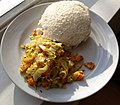 Ugali and cabbage
 -
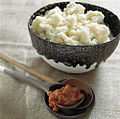 Phutu, pictured with tomato-based relish in the foreground
 -
 A meal of sadza (right), greens, and goat offal. The goat's small intestines are wrapped around small pieces of large intestines before cooking.
 -
 Ugali and usipa (small fish), staples of the Yawo people of the African Great Lakes


See also
[edit]
References
[edit]Citations
[edit]- ^ "Ugali - a Kenyan cornmeal". Taste Of The Place. 16 October 2017. Retrieved 23 August 2018.
- ^ "How to prepare ugali/posho". Yummy. 4 May 2015. Retrieved 23 August 2018.
- ^ "UNESCO - Nsima, culinary tradition of Malawi". ich.unesco.org. Retrieved 26 June 2021.
- ^ a b c d e f g h i j k l m n o p q r McCann 2009, p. 137.
- ^ a b c Tembo, Mwizenge S. "Nshima and Ndiwo: Zambian Staple Food". Hunger For Culture. Archived from the original on 24 February 2017. Retrieved 18 February 2018.
- ^ "Mealiepap, n." Dictionary of South African English. Dictionary Unit for South African English, 2018.[1] 25 February 2019
- ^ "Kitwe man confesses to killing colleague over nshima after 2 years of guilt". Zambia: News Diggers!. 16 November 2024. Retrieved 3 March 2025.
- ^ "Kenya Information Guide Home page". Retrieved 24 June 2013.
- ^ "Pap, n." Dictionary of South African English. Dictionary Unit for South African English, 2018. [2] 25 February 2019.
- ^ "Putu, n." Dictionary of South African English. Dictionary Unit for South African English, 2018.[3] 25 February 2019.
- ^ "Ugandan food recipes - POSHO (UGALI) – Wattpad". www.wattpad.com. Retrieved 23 August 2018.
- ^ "Sadza, n." Dictionary of South African English. Dictionary Unit for South African English, 2018. [4] 25 February 2019
- ^ Gough, Amy (2004). "The Chewa". The Peoples of The World Foundation. Retrieved 18 February 2018.
- ^ "Tanzanian Ugali / Nguna Recipe". Gayathri's Cook Spot. 1 September 2015. Retrieved 23 August 2018.
- ^ McCann 2009, p. 139.
- ^ "Food & Daily life". Our Africa. Retrieved 7 May 2015.
- ^ Emma Kambewa (November 2010). "Cassava Commercialization in Malawi" (PDF) (MSU International Development Working Paper). Archived from the original (PDF) on 4 March 2016.
- ^ "Ugali & Sukuma Wiki". Rehema Home. Retrieved 6 June 2023.
- ^ "HOW TO COOK THE PERFECT UGALI / Nairobi Kitchen". HOW TO COOK THE PERFECT UGALI / Nairobi Kitchen. 15 July 2017. Retrieved 19 May 2020.
- ^ App, Daily Nation. "Fancy a piece of ugali cake with your tea?". mobile.nation.co.ke. Retrieved 29 May 2020.
- ^ "Corchorus olitorius Jew's Mallow, Nalta jute PFAF Plant Database".
- ^ "Ayoyo soup and tuo zaafi". infoboxdaily.com. Archived from the original on 27 May 2015. Retrieved 27 May 2015.
- ^ Webb, L.S. (2000). Multicultural Cookbook of Life-Cycle Celebrations. Cookbooks for Students Series. Oryx Press. p. 64. ISBN 978-1-57356-290-4. Retrieved 2 October 2018.
- ^ "An Introduction to Northern Ghana's Super Foods Shea, Millet & Fonio | Circumspecte". Circumspecte. 25 July 2016. Retrieved 20 June 2017.
- ^ "Nsima". CooksInfo. Retrieved 29 May 2020.
- ^ a b "Nsima: The staple food of Malawi". experiencemalawi.com. Archived from the original on 6 May 2015. Retrieved 7 May 2015.
- ^ Kulp, Karel (28 March 2000). Handbook of Cereal Science and Technology, Second Edition, Revised and Expanded. CRC Press. ISBN 978-0-8247-8294-8.
- ^ "Moi-moi leaf plant prevents kidney, liver damage". The Guardian Nigeria News - Nigeria and World News. 8 November 2018.
- ^ "Moi-moi leaf plant prevents kidney, liver damage". 8 November 2018.
- ^ "Putu pap / Krummelpap / Crumbly porridge | Rainbow Cooking".
- ^ "Phutu Recipe (African Maize Flour Porridge)". EpersianFood. 7 April 2020. Archived from the original on 12 May 2021. Retrieved 29 May 2020.
- ^ "TINK". frankline-ozekhome.squarespace.com. Archived from the original on 6 February 2021.
- ^ Rosengarten, David (3 October 2012). "Foods of South Africa: The Roots". Wine4Food. Retrieved 29 May 2020.
- ^ "Traditional Plain Zimbabwean Sadza Recipe". Ethnic Foods R Us. Retrieved 24 May 2020.
- ^ "Students fed up with Isitshwala and cabbage – #Asakhe – CITE". Retrieved 24 February 2024.
- ^ "'Young Zimbabweans prefer rice to isitshwala' – #Asakhe – CITE". Retrieved 24 February 2024.
- ^ "Sadza". worldfood.guide.
- ^ Kadet, Anne (31 July 2018). "New York City's 'Little Haiti' Makes a Big Impression". wsj.com. Wall Street Journal. Retrieved 18 December 2023.
General and cited sources
[edit]- McCann, James C. (2009). Stirring the Pot: A History of African Cuisine. Athens, Ohio: Ohio University Press. ISBN 9780896802728.
- South African Cuisine
- Basic phutu recipe
- What is Phuthu
Further reading
[edit]The following books, set in Zimbabwe, discuss the characters eating the Zimbabwean staple, sadza:
- Dangarembga, Tsitsi (1988). Nervous Conditions. Ayebia Clark Publishing. is a semi-autobiographical novel focused on the story of a Rhodesian family in post-colonial Rhodesia (present-day Zimbabwe), during the 1960s.
- In Douglas Rogers' book The Last Resort: A Memoir of Zimbabwe (September 2009), Naomi, an elderly Malawian woman whom Rogers calls "Mrs. John", brings her husband, John Muranda, the other John, John Agoneka, and Rogers bowls of warm sadza, which Rogers explains "Mrs. John" cooks daily, over a wood fire outside the Murandas' home. (Crown/Random House, LLC, ASIN: B002PXFYIS, Chapter 4, page 23).
External links
[edit]
Ugali
View on GrokipediaTerminology
Names
Ugali, a staple maize-based dish prevalent across East, Central, and Southern Africa, is known by a variety of names that reflect the linguistic diversity of the regions where it is consumed. These terms highlight its cultural significance as a unifying yet locally adapted food, with designations drawn from indigenous Bantu and other African languages.[10] The most prominent names include ugali in Swahili-speaking areas of Kenya, Tanzania, and Uganda; nshima among the Bemba people of Zambia; sadza in Shona communities of Zimbabwe; posho in Uganda; isitshwala among the Ndebele of Zimbabwe; and pap in Afrikaans and Sotho contexts of South Africa.[6][2][11][12][13][14]| Region/Language | Name | Description |
|---|---|---|
| Swahili (Kenya, Tanzania, Uganda) | Ugali | Stiff maize porridge, central to daily meals.[6] |
| Bemba (Zambia) | Nshima | Thick cornmeal staple, often served with relishes.[2] |
| Shona (Zimbabwe) | Sadza | Maize flour-based dish, a national staple.[11] |
| Uganda | Posho | Cornmeal mush, commonly paired with beans.[12] |
| Ndebele (Zimbabwe) | Isitshwala | Thick porridge akin to sadza, used in Ndebele cuisine.[13] |
| Afrikaans/Sotho (South Africa) | Pap | Coarse maize meal porridge, versatile for breakfast or mains.[14] |
Etymology
The term "ugali" originates from Swahili, where it is formed by the class prefix "u-" combined with the root "-gali," referring to the staple food or stiff porridge.[19] This structure reflects Bantu language patterns, in which noun classes like "u-" denote abstract or mass nouns, linking "ugali" to broader Bantu linguistic roots for porridges made from ground grains. Although deeper derivations of "-gali" are not extensively documented in standard linguistic sources, its usage aligns with pre-colonial Bantu terms for dense, dough-like staples prepared from indigenous grains such as millet or sorghum before maize adoption. Comparatively, related terms for similar stiff porridges in other Bantu languages highlight shared etymological patterns. "Nshima," prevalent in Zambia and Malawi, derives from Bemba "nshima," denoting a pounded or thick porridge, with cognates in Chichewa as "nsíma."[20] In Zimbabwe, "sadza" comes from Shona, where it broadly signifies "food" but specifically refers to the maize-based staple, underscoring its role as a daily sustenance.[21] In Uganda, "posho" derives from colonial English "posho," referring to a worker's food ration.[22] Extending to West African analogs, "fufu" stems from Twi (an Akan language spoken in Ghana), where "fufuo" means "to mash" or "mix," describing the pounding process to create a smooth, swallowable dough from cassava, plantains, or yams.[23] Colonial influences further shaped terminology for these dishes through the introduction of maize. Portuguese traders brought maize (from Portuguese "milho") to East and Southern Africa in the 16th century, leading to its incorporation into local vocabularies; for instance, Swahili "mahindi" for maize derives from "milho" via coastal trade routes, influencing how "ugali" and similar terms evolved to describe preparations using this New World crop.[24] This linguistic borrowing reflects the dish's adaptation from indigenous grain porridges to maize-based staples across Bantu-speaking regions.Historical Development
Pre-Maize Traditions
Before the introduction of maize in the 16th century, indigenous communities across East and Central Africa relied on locally cultivated grains such as sorghum and various millets to prepare thick porridges that served as dietary staples.[25] These porridges, made by grinding the grains into flour and stirring them into boiling water to form a stiff, dough-like consistency, were well-suited to the region's savanna ecosystems and provided essential carbohydrates and nutrients for daily survival.[15] Sorghum (Sorghum bicolor) and pearl millet (Pennisetum glaucum) were particularly dominant in drier areas, while finger millet (Eleusine coracana) thrived in higher-altitude zones, reflecting adaptations honed over millennia by Bantu-speaking peoples who migrated and settled in these regions starting around 1000 BCE.[25] Specific examples of these traditions include the preparation of porridges from finger millet, known as wimbi in Swahili, among the Iteso people in eastern Uganda and parts of western Kenya, where the grain was ground and cooked into a thick paste called atap, often enriched with milk among wealthier households.[26] In other East African communities, such as the Luo in Kenya, similar thick porridges called kuon were made from finger millet flour and eaten with relishes.[26] In Rwanda and Burundi, pre-colonial porridges from sorghum and millet, known locally as ubugari or similar stiff mashes, formed the core of meals in Bantu agricultural societies.[25] These dishes shared a common texture—firm and moldable for scooping accompaniments like vegetable stews or meats—demonstrating regional consistencies in preparation techniques that predated European contact by centuries.[15] These grain-based porridges held profound cultural importance, functioning as everyday sustenance that supported community health and labor-intensive lifestyles while also playing roles in social and ritual contexts.[25] Among East African groups like the Turkana, sorghum porridges symbolized ancestral connections and were central to harvest ceremonies that renewed spiritual ties to the land and deities.[27] In Central African societies, such as those in Burundi, the production and sharing of millet porridges during communal farming fostered social bonds and reciprocity, extending to fermented versions used in commemorative events.[25] As precursors to modern ugali, these traditions established the foundational serving styles and communal eating practices that persisted with the later adoption of maize.[15]Introduction and Spread of Maize
Maize (Zea mays), a crop originating in the Americas, was introduced to East Africa by Portuguese traders in the 16th and 17th centuries, initially along coastal regions to provision their trading forts and settlements.[28] This introduction marked the beginning of a transformative dietary shift, as maize was cultivated for its potential as a reliable food source in tropical climates, gradually integrating into local agricultural systems that had previously relied on indigenous grains.[29] Building briefly on pre-existing traditions of preparing porridges from millet and sorghum, maize offered a new base for similar staple dishes, facilitating its cultural assimilation.[30] The crop's spread accelerated in the 18th and 19th centuries, moving inland from coastal ports through trade networks and migration routes, reaching areas like Tanzania by the late 17th century and further interior regions by the mid-19th century.[29] By the early 20th century, maize had become the dominant staple in East and Central African diets, particularly in Kenya, Tanzania, Uganda, Rwanda, Burundi, and the Democratic Republic of the Congo, where it supplanted traditional grains in many farming systems and daily consumption.[31] This rapid diffusion was documented in colonial agricultural reports and ethnographic studies, highlighting maize's role in supporting population growth and food security amid expanding settlement.[32] Several factors drove maize's adoption and ubiquity across East and Central Africa, including its superior yield potential compared to indigenous staples like millet and sorghum, often producing two to three times more calories per hectare under similar conditions.[30] Colonial administrations further promoted cultivation through policies such as Kenya's Maize Control Board, established in the 1920s, which regulated markets, provided price incentives, and encouraged monocropping to meet export demands and local needs.[31] Additionally, maize's relative resistance to famine—due to its high productivity and storability—made it a preferred crop during periods of drought or shortage, solidifying its position as the foundation for ugali in countries like Kenya, Tanzania, Uganda, Rwanda, Burundi, and the Democratic Republic of the Congo.[29]Preparation
Ingredients
The primary ingredient in ugali is white maize flour, a finely milled cornmeal derived from white maize kernels, which is preferred for its smooth texture and ability to form a cohesive, stiff dough essential to the dish's characteristic consistency. This preference for white maize over yellow varieties stems from its post-processing qualities, including a soft, pale color that aligns with cultural and aesthetic standards in East African cuisine, where it constitutes the staple for daily consumption. Water forms the foundational liquid component, boiled to create the porridge base, with a standard ratio of about 1 part flour to 2 parts water by volume yielding the firm, moldable texture typical of stiff ugali.[33] In areas where maize availability is limited, alternatives such as sorghum or millet flour may substitute or blend with white maize flour, with white sorghum grains favored for their similar color and milling properties that maintain the dish's visual appeal.[34] Fermented cassava flour is occasionally incorporated in variants, particularly in coastal or Tanzanian preparations, to introduce a subtle sourness while partially replacing maize for enhanced regional adaptability.[35] Salt is rarely added in traditional recipes, as ugali is prepared unsalted to complement the bold flavors of stews or greens served alongside, though a pinch may be included in some modern or household variations for subtle seasoning.[7]Cooking Methods
The traditional method of preparing ugali involves a boiling technique that transforms maize flour and water into a stiff, dough-like consistency. Water is first brought to a vigorous boil in a heavy-bottomed pot over medium-high heat, typically using a ratio of about 2 parts water to 1 part fine white maize flour by volume.[1] The flour is then gradually added in a thin, steady stream while vigorously whisking or stirring to prevent lumps from forming, continuing until the mixture thickens sufficiently to switch to a wooden spoon for further incorporation.[1][36] The heat is reduced to medium-low, and the mixture is simmered for 10 to 15 minutes, stirring frequently to ensure even cooking and to break up any remaining lumps against the pot's sides, until it pulls away cleanly and forms a smooth, moldable ball.[1][36] Stirring is a critical technique in achieving the desired texture, traditionally performed with a sturdy wooden spoon known as a mwiko in Swahili, which allows for confident, continuous mixing to fold the flour into itself and create a lump-free result.[36] In rural areas of Kenya and other East African regions, this process often occurs over a three-stone fire, where three stones support the cooking pot above an open flame fueled by firewood or charcoal, providing sustained heat in resource-limited settings.[37] Modern adaptations cater to urban lifestyles by utilizing electric stoves, which follow the same boiling and stirring steps but benefit from precise temperature control to reduce cooking time slightly.[1] Specialized electric ugali cookers, such as those produced by Kenyan brands like Syinix, automate the stirring and heating process in a non-stick bowl, producing ready ugali in under 15 minutes with minimal manual intervention.[38] Microwave methods are also employed in some households, involving mixing the flour and water in a microwave-safe container and cooking on high for adjusted intervals, typically 5 to 7 minutes with periodic stirring to mimic the traditional texture.[39]Regional Variations
East African Varieties
In Kenya, ugali is typically made from white maize flour, resulting in a stiff, dough-like texture that serves as a versatile base for meals. This form is a daily staple consumed in nearly 80% of households, often paired with sukuma wiki, a nutritious side of sautéed collard greens cooked with tomatoes and onions.[40][41][1] Tanzanian ugali shares the core preparation of cooking maize flour in boiling water. In coastal areas influenced by Swahili and Indian Ocean cuisines, accompaniments may incorporate coconut milk for added richness and subtle sweetness, enhancing pairings with seafood or bean stews like maharage ya nazi.[1][42][43] The dish is traditionally served communally in large portions, forming the center of meals with vitu vya mbalimbali—diverse accompaniments like meats, vegetables, and relishes that promote shared dining.[44] In Uganda, the equivalent dish called posho is a thick porridge emphasizing its role as a hearty filler. It is commonly enjoyed with groundnut sauce, a creamy peanut-based gravy enriched with onions, tomatoes, and greens, providing protein and flavor contrast.[45] Rural western regions feature variations using millet flour instead of maize, yielding a nuttier taste and coarser grain suited to local agriculture and traditional preferences.[46] In Rwanda and Burundi, ugali is known as bugali or ishu and is similarly prepared from maize flour, though sorghum or cassava flour variations are common, especially in rural areas where these crops predominate. It is often paired with bean stews or greens, reflecting agricultural availability.[47] In the Democratic Republic of the Congo, the dish is called bidia or bugali, made primarily from maize but incorporating cassava flour in some regions, resulting in a slightly chewier texture. It serves as a staple alongside fish or vegetable relishes from local markets.Southern and Central African Varieties
In Southern and Central Africa, ugali-like dishes often feature a dense, moldable consistency compared to their East African counterparts, primarily using maize meal as the base ingredient introduced during colonial times.[48] These staples are typically prepared by boiling water and gradually stirring in finely ground maize flour to achieve a thick, dough-like texture suitable for hand-forming into balls.[2] Zambian nshima, a prominent example from Central Africa, is crafted from mealie meal—refined white maize flour—and cooked to a soft yet firm consistency that allows it to be easily molded by hand during meals.[49] It serves as the core of most meals, commonly paired with relishes such as dried kapenta fish, which provides a protein-rich complement to the carbohydrate-heavy porridge.[48] This dish underscores nshima's role as a daily essential, consumed across urban and rural settings for its simplicity and filling nature.[2] In Zimbabwe, sadza represents a Southern African variant, recognized as the national dish and made predominantly from white maize meal boiled into a stiff, cohesive mass.[48] Sadza is traditionally eaten with muriwo, a relish of cooked greens, emphasizing its integration into everyday and ceremonial diets as a versatile staple.[48] South African pap, influenced by Afrikaans terminology derived from Dutch words for soft food, often takes a softer, porridge-like form rather than a rigid dough, prepared from coarsely or finely ground maize meal.[50] This adaptability allows for both spoonable and crumbly varieties, such as phutu, and it is frequently served with chakalaka—a spicy vegetable relish of tomatoes, beans, and peppers—to add bold flavors to the mild base.[48] Pap's prevalence highlights its status as a cultural mainstay, bridging diverse communities in the region.[51]Cultural Significance
Culinary Role
Ugali serves as a versatile staple in East African cuisine, primarily consumed as a neutral base that complements a wide array of flavorful accompaniments. It is typically prepared to a firm, dough-like consistency, allowing it to be pinched into small balls by hand, which are then shaped with a thumb indentation to scoop up stews, vegetables, or proteins without the need for utensils. This hand-eating method enhances the communal dining experience and is a practical adaptation in regions where cutlery may not always be available.[7][52][1] In Kenyan meals, ugali is frequently paired with nyama choma, grilled meats such as goat or beef, which provide a smoky, savory contrast to its mild texture. In Tanzania, it is commonly served alongside ndizi na nyama, a stew of green bananas and beef that adds a subtle sweetness and tenderness. These pairings highlight ugali's role in balancing bold flavors, with the cornmeal absorbing sauces and juices to create a cohesive, satisfying dish.[53][54][55] Ugali integrates into daily meal structures across East Africa, often forming the carbohydrate foundation for the primary evening meal, where it sustains families through its filling nature. Lighter, softer versions may appear at breakfast, especially among athletes or laborers seeking quick energy, paired with simple sides like tea or greens. Typical portion sizes range from 200 to 300 grams per person, providing approximately 150 to 250 calories depending on preparation, which supports its status as an economical daily essential.[56][57][58][59] In urban settings like Nairobi, ugali has evolved into modern fusions, such as ugali pizza hybrids, where the cornmeal base is topped with beef, vegetables, and sauces to appeal to younger diners and fast-food trends. These innovations blend traditional preparation with contemporary flavors, appearing in street food stalls and social media-inspired recipes, while maintaining ugali's core simplicity.[60]Social and Traditional Importance
Ugali plays a central role in fostering social unity across East and Southern African communities, where it is often prepared and consumed communally from a single large pot during family meals or village gatherings, symbolizing equality and togetherness. This practice reinforces social bonds, as participants use their hands to form balls of the dough-like staple to scoop accompaniments, a method that encourages interaction and shared experience. In many households, ugali is eaten twice daily in this manner, yet the act itself promotes cohesion amid daily life. As of September 2025, surveys indicate declining ugali consumption in Kenyan households, with a shift toward rice and chapati reflecting urbanization and changing preferences, though it remains culturally vital.[61] The dish holds particular significance in rituals and ceremonies, such as weddings and funerals, where large quantities of ugali are served to honor traditions and support mourners or celebrants. For instance, among the Luhya people of Kenya, ugali accompanies meat and vegetables at funeral feasts, providing sustenance during communal mourning periods that last several days. Similarly, in Kalenjin wedding rituals, the groom may prepare and serve ugali as part of dowry exchanges, marking his readiness to provide for the family. These uses highlight ugali's role in life-cycle events, bridging generations and strengthening community ties.[62][63] In 2017, the UNESCO Representative List of the Intangible Cultural Heritage of Humanity recognized the nsima culinary tradition of Malawi—a maize-based dish akin to ugali—as a vital element of cultural identity in the region, emphasizing its contribution to social cohesion through daily practices and rituals. This inscription, which encompasses knowledge of preparation and consumption, underscores ugali's broader importance in East and Southern Africa for preserving intangible heritage amid modernization. The recognition promotes efforts to transmit these traditions to younger generations, safeguarding their unifying cultural value.[64] Gender dynamics in ugali's handling reflect traditional divisions, with women typically responsible for its preparation in household settings, as seen among the Maasai where they source ingredients and cook to feed the family. In certain ceremonies, however, men take on serving roles, such as distributing portions during events to demonstrate provision and respect. Ugali's economic accessibility further enhances its social embeddedness, as maize flour is inexpensive and widely available, making it an essential staple for low-income families across the region and ensuring its ubiquity in both everyday and ceremonial contexts.[65][63][66]Nutritional Profile
Composition
Ugali's composition is dominated by maize flour, the primary ingredient, which determines its overall nutritional makeup when cooked into a stiff porridge with water. Standard white maize flour used in ugali typically contains approximately 77% carbohydrates (primarily starch), 7% protein, and 3-4% fat, resulting in an energy density of 350-360 kcal per 100 g of dry flour. These macronutrients reflect the flour's role as a carbohydrate staple, with protein levels varying slightly based on maize variety and processing. Dietary fiber is also present at approximately 6.2 g per 100 g, contributing to its role in digestive health.[67] Micronutrients in unfortified maize flour include B-vitamins such as thiamin (about 0.3 mg per 100 g) and niacin (approximately 1.9 mg per 100 g), along with iron (approximately 2.4 mg per 100 g), though bioavailability is low without additional processing or fortification. Magnesium and phosphorus are also present at moderate levels (approximately 93 mg and 272 mg per 100 g, respectively), contributing to basic mineral intake.[67] Differences between white and yellow maize varieties influence specific micronutrient profiles; yellow maize flour provides provitamin A carotenoids (beta-carotene, approximately 113 μg per 100 g), enhancing potential vitamin A contribution, whereas white maize lacks these compounds and offers minimal vitamin A precursors.[68]Health and Dietary Considerations
Ugali serves as a high-energy staple, primarily due to its carbohydrate content, which provides sustained fuel for physically demanding activities such as manual labor in agricultural communities across East Africa.[69] This makes it particularly valuable for populations engaged in labor-intensive work, where it contributes to meeting daily caloric needs efficiently.[70] As a maize-based dish, ugali is naturally gluten-free, rendering it suitable for individuals with celiac disease or gluten sensitivity.[71] Its fiber content supports digestive health, and when consumed alongside vegetables or greens, it promotes better nutrient absorption and overall gut function.[72] However, reliance on ugali as a primary food source raises concerns about nutritional imbalances, as it offers limited protein and micronutrient diversity, potentially contributing to protein-energy malnutrition if not paired with varied accompaniments like legumes or meats.[3] Additionally, the glycemic index of maize-based ugali, typically ranging from 67 to 70, can lead to rapid blood sugar elevations, posing risks for diabetes management in susceptible populations.[73] To address micronutrient deficiencies, Kenya initiated voluntary fortification of maize flour with vitamin A and other nutrients in the early 2000s, followed by mandatory standards in 2012, aiming to enhance ugali's role in preventing conditions like vitamin A deficiency among consumers.[74] Despite these efforts, compliance varies, underscoring the need for ongoing monitoring to ensure public health benefits.[75]Similar Dishes
African Equivalents
Ugali, a firm maize-based porridge central to East African cuisine, shares functional similarities with several other staples across the continent, serving as a neutral base for accompanying relishes, stews, or soups. While ugali is maize-based, its African counterparts vary: some, like traditional fufu, incorporate pre-colonial local ingredients such as starchy roots, while others like banku and nsima trace their prominence to the historical introduction and spread of maize in Africa since the 16th century. These dishes often yield distinct textures and flavors adapted to regional agricultural resources and culinary traditions, ranging from pounded, elastic doughs to fermented pastes.[76] In West Africa, fufu represents a prominent equivalent, functioning as a versatile staple consumed by hand to scoop up soups or stews much like ugali. Primarily made from pounded starchy roots such as cassava, yams, or plantains, fufu achieves a softer, more elastic and stretchy consistency compared to ugali's rigid firmness, allowing it to be molded into balls for eating. This pounding process, often involving fermentation, imparts a subtle sourness absent in plain ugali, and fufu's smoothness and ease of swallowing are key desirable traits in its preparation, particularly in regions like Nigeria and Sierra Leone where cassava dominates. Despite these textural differences, both dishes emphasize simplicity and satiety as daily caloric sources for millions.[77][78][2] Ghanaian banku offers another maize-influenced parallel, prepared as a fermented dough from a blend of corn and cassava that develops a tangy, sour flavor through natural lactic acid bacteria during the fermentation stage. Unlike ugali's straightforward boiling of maize flour into a stiff porridge, banku is shaped into fist-sized portions and often wrapped in corn husks or plantain leaves for steaming or serving, resulting in a slightly chewy texture that pairs well with peppery soups or grilled fish. This fermentation not only enhances digestibility but also distinguishes banku's acidic profile from ugali's neutral taste, reflecting West African preferences for preserved, flavorful staples in humid climates. Banku, like ugali, remains a communal meal component, underscoring maize's widespread adoption across sub-Saharan Africa since the 16th century.[79] Further south, Malawian nsima closely mirrors ugali in composition and role, consisting of maize flour cooked with water into a thick, porridge-like staple that forms the bulk of meals when paired with vegetable relishes or proteins. Often softer than the denser East African ugali due to variations in flour-to-water ratios and stirring techniques, nsima is nearly identical to the Zambian nshima variant, promoting a shared cultural thread in Southern and Central African diets. In Malawi, it frequently accompanies peanut-based sides, such as groundnut stews enriched with tomatoes and greens, which add nutty depth contrasting ugali's typical pairings with greens or meats in East Africa. This emphasis on legumes like peanuts highlights regional nutritional adaptations while maintaining nsima's status as an affordable, filling everyday food.[76][2][80]International Comparisons
Ugali bears notable resemblances to Italian polenta, a traditional dish from northern Italy made by boiling cornmeal in water to create a versatile starch. Both serve as neutral, filling bases for flavorful accompaniments such as stews, meats, or vegetables, underscoring maize's role as a post-Columbian dietary staple across continents. However, polenta is generally prepared to a creamier or semi-firm consistency and frequently enhanced with ingredients like cheese, butter, or herbs for added flavor, contrasting ugali's denser, dough-like texture achieved through vigorous stirring without seasonings.[81][82] In Latin American cuisine, ugali's boiled maize preparation echoes the masa harina dough central to dishes like arepas and tamales, both derived from nixtamalized corn for improved nutrition and digestibility. Arepas, a staple in countries such as Venezuela and Colombia, transform this cornmeal into grilled or fried patties that function as portable breads or sandwich holders, offering a crisp exterior and soft interior unlike ugali's uniform firmness from boiling. Tamales, widespread in Mexico and Central America, wrap seasoned masa around fillings before steaming in corn husks, adapting the same corn base into a more elaborate, filled format while retaining its starchy utility.[82][83] Further afield, the Punjabi dish makki di roti from northern India and Pakistan utilizes maize flour in a flatbread form, providing a drier alternative to ugali's moist porridge while fulfilling a comparable role as an everyday staple paired with curries or greens. This unleavened bread is kneaded into dough, rolled thin, and cooked on a hot griddle, yielding a slightly chewy texture that absorbs sauces akin to how ugali scoops up stews, demonstrating maize's integration into diverse agrarian diets following its global dissemination.[84]References
- https://en.wiktionary.org/wiki/nshima
- https://en.wiktionary.org/wiki/sadza