


Community hub
Recent from talks
Contribute something
Nothing was collected or created yet.
Chewa language
View on Wikipedia
| Chewa | |
|---|---|
| Chichewa | |
| Native to | Malawi |
| Region | Southeast Africa |
| Ethnicity | Chewa |
Native speakers | 7 million (2007)[1] |
| Latin script Mwangwego script Chewa Braille | |
| Official status | |
Official language in | |
| Language codes | |
| ISO 639-1 | ny |
| ISO 639-2 | nya |
| ISO 639-3 | nya |
| Glottolog | nyan1308 |
N.30 (N.31, N.121)[2] | |
| Linguasphere | 99-AUS-xaa – xag |
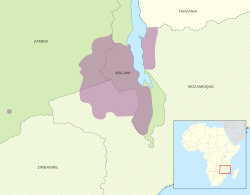
 Areas where Chewa is the dominant language (purple). Solid green signifies a nation where Chewa is a national language, striped green signifies a nation where Chewa is a recognized minority language. | |

| Person | Mchewa |
|---|---|
| People | Achewa |
| Language | Chichewa |
Chewa ( /ˈtʃeɪwə/) is a Bantu language spoken in Malawi and a recognised minority in Eastern Zambia and Tete province of Mozambique. The prefix chi- infront of Chewa means "the language of the" Chewa people. In Malawi, the name was officially changed from Chinyanja to Chichewa in 1968 at the insistence of President Hastings Kamuzu Banda and is still the name most commonly used in Malawi today.[3]
Chewa belongs to the same language group (Guthrie Zone N) as Tumbuka, Sena[4] and Nsenga. Throughout the history of Malawi, only Chewa and Tumbuka were official languages of Malawi used by government officials and in school curricula, along with English. However, the Tumbuka language suffered a lot during the rule of President Hastings Kamuzu Banda, since in 1968 as a result of his one-nation, one-language policy it lost its status as an official language in Malawi. As a result, Tumbuka was removed from the school curriculum, the national radio, and the print media.[5] With the advent of multi-party democracy in 1994, Tumbuka programmes were started again on the radio.[6]
Distribution
[edit]Chewa is the most widely known language of Malawi, spoken mostly in the Central and Southern Regions of the country.[7] It is also spoken in Eastern Province of Zambia, as well as in Mozambique, especially in the province of Niassa. It was one of the 55 languages featured on the Voyager spacecraft.[8]
History
[edit]The Chewa were a branch of the Maravi people who lived in the Eastern Province of Zambia and in northern Mozambique as far south as the River Zambezi from the 16th century or earlier.[9][10]
The name "Chewa" (in the form Chévas) was first recorded by António Gamitto, who at the age of 26 in 1831 was appointed as second-in-command of an expedition from Tete to the court of King Kazembe in what became Zambia. His route took him through the country of King Undi west of the Dzalanyama mountains, across a corner of present-day Malawi and on into Zambia.[11] Later he wrote an account including some ethnographic and linguistic notes and vocabularies. According to Gamitto, the Malawi or Maravi people (Maraves) were those ruled by King Undi south of the Chambwe stream (not far south of the present border between Mozambique and Zambia), while the Chewa lived north of the Chambwe.[12]
Another, more extensive, list of 263 words and phrases of the language was made by the German missionary Sigismund Koelle who, working in Sierra Leone in West Africa, interviewed some 160 former slaves and recorded vocabularies in their languages. He published the results in a book called Polyglotta Africana in 1854. Among other slaves was one Mateke, who spoke what he calls "Maravi". Mateke's language is clearly an early form of Nyanja, but in a southern dialect. For example, the modern Chichewa phrase zaka ziwiri 'two years' was dzaka dziŵiri in Mateke's speech, whereas for Johannes Rebmann's informant Salimini, who came from the Lilongwe region, it was bzaka bziŵiri.[13] The same dialect difference survives today in the word dzala or bzala '(to) plant'.[14]
Apart from the few words recorded by Gamitto and Koelle, the first extensive record of the Chewa language was made by Johannes Rebmann in his Dictionary of the Kiniassa Language, published in 1877 but written in 1853–4. Rebmann was a missionary living near Mombasa in Kenya, and he obtained his information from a Malawian slave, known by the Swahili name Salimini, who had been captured in Malawi some ten years earlier.[15] Salimini, who came from a place called Mphande apparently in the Lilongwe region, also noted some differences between his own dialect, which he called Kikamtunda, the "language of the plateau", and the Kimaravi dialect spoken further south; for example, the Maravi gave the name mombo to the tree which he himself called kamphoni.[16]
The first grammar, A Grammar of the Chinyanja language as spoken at Lake Nyasa with Chinyanja–English and English–Chinyanja vocabulary, was written by Alexander Riddel in 1880. Further early grammars and vocabularies include A grammar of Chinyanja, a language spoken in British Central Africa, on and near the shores of Lake Nyasa by George Henry (1891) and M.E. Woodward's A vocabulary of English–Chinyanja and Chinyanja–English: as spoken at Likoma, Lake Nyasa (1895). The whole Bible was translated into the Likoma Island dialect of Nyanja by William Percival Johnson and published as Chikalakala choyera: ndicho Malangano ya Kale ndi Malangano ya Chapano in 1912.[17] Another Bible translation, known as the Buku Lopatulika ndilo Mau a Mulungu, was made in a more standard Central Region dialect about 1900–1922 by missionaries of the Dutch Reformed Mission and Church of Scotland with the help of some Malawians. This has recently (2016) been reissued in a revised and slightly modernised version.[18]
Another early grammar, concentrating on the Kasungu dialect of the language, was Mark Hanna Watkins' A Grammar of Chichewa (1937). This book, the first grammar of any African language to be written by an American, was a work of cooperation between a young black PhD student and young student from Nyasaland studying in Chicago, Hastings Kamuzu Banda, who in 1966 was to become the first President of the Republic of Malawi.[19][20] This grammar is also remarkable in that it was the first to mark the tones of the words. Modern monographs on aspects of Chichewa grammar include Mtenje (1986), Kanerva (1990), Mchombo (2004) and Downing & Mtenje (2017).
In recent years the language has changed considerably, and a dichotomy has grown between the traditional Chichewa of the villages and the language of city-dwellers.[21]
Phonology
[edit]Vowels
[edit]Chewa has five short vowel sounds: a, ɛ, i, ɔ, u; these are written a, e, i, o, u. Long vowels are sometimes found, e.g. áákúlu 'big' (class 2), kufúula 'to shout'.[22] When a word comes at the end of a phrase, its penultimate vowel tends to be lengthened,[23] except for non-Chewa names and words, such as Muthárika or ófesi, in which the penultimate vowel always remains short.[citation needed] The added 'u' or 'i' in borrowed words such as láputopu 'laptop' or íntaneti 'internet' tends to be very short.[24]
| Front | Central | Back | |
|---|---|---|---|
| Close | i, (iː) | u, (uː) | |
| Open-mid | ɛ, (ɛː) | ɔ, (ɔː) | |
| Open | a, (aː) |
Vowels are generally lengthened in the penultimate syllable of a prosodic phrase.[25]
Consonants
[edit]Chewa consonants can be simple (directly preceding a vowel) or may be followed by w or y:
- b, kh, g, f, m, s etc.
- bw, khw, gw, fw, mw, sw etc.
- bz, tch, j, fy, ny, sh etc.
In the orthography, the place of by is taken by the affricate bz, the place of gy is taken by j, and that of sy by sh.
Voiced and aspirated consonants, as well as [f] and [s], can also be preceded by a homorganic nasal:
- mb, ngw, nj, mv, nz etc.
- mph, nkhw, ntch, mf, ns etc.
It is debated whether these are consonant clusters /NC/, /Cy/ and /Cw/, or whether Chichewa has prenasalized, palatalized and labialized consonants /ᴺC/, /Cʲ/, /Cʷ/. The most straightforward analysis is that they are clusters.[26] The consonant inventory under a cluster analysis is as follows:
| Bilabial | Labio- dental |
Alveolar | Post- alveolar |
Palatal | Velar | Glottal | ||
|---|---|---|---|---|---|---|---|---|
| Nasal | m /m/ |
n /n/ |
ny /ɲ/ |
ng' /ŋ/ |
||||
| Stop | tenuis | p /p/ |
t /t/ |
k /k/ |
||||
| aspirated | ph /pʰ/ |
th /tʰ/ |
kh /kʰ/ |
|||||
| implosive | b /ɓ/ |
d /ɗ/ |
||||||
| voiced | (b) /b/ |
(d) /d/ |
g /ɡ/ |
|||||
| Affricate | tenuis | ts /t͡s/ |
ch /t͡ʃ/ |
|||||
| aspirated | tch /t͡ʃʰ/ |
|||||||
| voiced | dz /d͡z/ |
j /d͡ʒ/ |
||||||
| Fricative | voiceless | f /f/ |
s /s/ |
sh /ʃ/ |
(h) /h/ | |||
| voiced | (ŵ) /β/[28] |
v /v/ |
z /z/ |
|||||
| Semivowel | w /w/ |
y /j/ |
||||||
| Liquid | la/ra [l ~ 𝼈] |
|||||||
Consonants in parentheses are marginal or found mainly in loanwords. The lateral is an approximant [l] word-initially and a flap [𝼈] medially.[source that it's reflexive?]
If the more complex syllable onsets are analyzed as single consonants, the inventory is as follows:
| Labial | Alveolar | Velar/Palatal | Glottal | |||||||||
|---|---|---|---|---|---|---|---|---|---|---|---|---|
| plain | palatal-ised | labial-ised | plain | palatal-ised | labial-ised | plain | palatal-ised | labial-ised | ||||
| Nasal | m /m/ |
my /mʲ/ |
mw /mʷ/ |
n /n/ |
ny /ɲ/ |
ng' /ŋ/ |
ng'w /ŋʷ/ |
|||||
| Stop | tenuis | p /p/ |
py /pʲ/ |
pw /pʷ/ |
t /t/ |
ty /tʲ/ |
tw /tʷ/ |
k /k/ |
kw /kʷ/ |
|||
| aspirated | ph /pʰ/ |
phw /pʷʰ/ |
th /tʰ/ |
thy /tʲʰ/ |
thw /tʷʰ/ |
kh /kʰ/ |
khw /kʷʰ/ |
|||||
| Pre-nasalized aspirated |
mph /ᵐpʰ/ |
mphw /ᵐpʷʰ/ |
nth /ⁿtʰ/ |
nthy /ⁿtʲʰ/ |
nthw /ⁿtʷʰ/ |
nkh /ᵑkʰ/ |
nkhw /ᵑkʷʰ/ |
|||||
| voiced | b /ɓ/ |
bw /ɓʷ/ |
d /ɗ/ |
dy /ɗʲ/ |
dw /ɗʷ/ |
g /ɡ/ |
gw /ɡʷ/ |
|||||
| (b) /b/ |
(d) /d/ |
|||||||||||
| Pre-nasalized voiced |
mb /ᵐb/ |
mbw /ᵐbʷ/ |
nd /ⁿd/ |
ndy /ⁿdʲ/ |
ndw /ⁿdʷ/ |
ng /ᵑɡ/ |
ngw /ᵑɡʷ/ |
|||||
| Affricate | tenuis | ts /t͡s/ |
tsw /t͡sʷ/ |
ch /t͡ʃ/ |
||||||||
| aspirated | ps /pʃʲ/ |
tch /t͡ʃʰ/ |
||||||||||
| Pre-nasalized aspirated |
mps /ᵐpsʲ/ |
ntch /ⁿt͡ʃʰ/ |
||||||||||
| voiced | bz /bʒʲ/ |
dz /d͡z/ |
(dzw) /d͡zʷ/ |
j /d͡ʒ/ |
||||||||
| Pre-nasalized voiced |
mbz /ᵐbzʲ/ |
(ndz) /ⁿd͡z/ |
nj /ⁿd͡ʒ/ |
|||||||||
| Fricative | voiceless | f /f/ |
(fy) /fʲ/ |
fw /fʷ/ |
s /s/ |
sh /ʃ/ |
sw /sʷ/ |
(h) /h/ | ||||
| Pre-nasalized | mf /ᶬf/ |
ns /ⁿs/ |
nsw /ⁿsʷ/ |
|||||||||
| voiced | (ŵ) /β/ |
v /v/ |
(vy) /vʲ/ |
vw /vʷ/ |
z /z/ |
(zy) /zʲ~ʒ/ |
zw /zʷ/ |
|||||
| Pre-nasalized voiced |
mv /ᶬv/ |
nz /ⁿz/ |
nzw /ⁿzʷ/ |
|||||||||
| Lateral approximant ~ flap | l/r [l ~ 𝼈] |
lw/rw [lʷ ~ 𝼈ʷ] |
||||||||||
| Approximant | w /w/ |
y /j/ |
||||||||||
The spelling used here is that introduced in 1973,[29] which is the one generally in use in the Malawi at the present time, replacing the Chinyanja Orthography Rules of 1931.[30]
Notes on the consonants
- In most words, Chewa b and d (when not prenasalised) are pronounced implosively, by sucking slightly.[31] However, there is also a plosive b and d, mostly found in foreign words, such as bála 'bar', yôdúla 'expensive' (from Afrikaans duur) (in contrast to the implosive b and d in native words such as bála 'wound' and yôdúla 'which cuts').[32] A plosive d is also found in kudínda 'to stamp (a document)' and mdidi 'confident step'.
- The affricate sounds bv and pf were formerly commonly heard but are now generally replaced by v and f, e.g. (b)vúto 'problem', (p)fúpa 'bone'. In the Mtanthauziramawu wa Chinyanja dictionary produced by the University of Malawi, the spellings bv and pf are not used in any of the headwords, but bv is used two or three times in the definitions.
- The combination bz is described by Atkins as an "alveolar-labialised fricative".[33] The combination sounds approximately as [bʒ] or [bʒʲ]. Similarly ps is pronounced approximately as [pʃ] or [pʃʲ].
- The sounds written ch, k, p and t are pronounced less forcibly than the English equivalents and generally without aspiration. Stevick notes that in relaxed speech, the first three are sometimes replaced with the voiced fricatives [ʒ], [ɣ] and [β], and t can be heard as a voiced flap.[34] In the combination -ti (e.g. angáti? 'how many'), t may be lightly aspirated.
- h is also used in Chewa but mostly only in loanwords such as hotéra 'hotel', hátchi 'horse', mswahála 'monthly allowance given to chiefs'.
- j is described by Scotton and Orr as being pronounced "somewhat more forward in the mouth" than in English and as sounding "somewhere between an English d and j".[35]
- l and r are the same phoneme,[36] representing a retroflex tap [𝼈], approximately between [l] and [r]. According to the official spelling rules, the sound is written as 'r' after 'i' or 'e', otherwise 'l'. It is also written with 'l' after a prefix containing 'i', as in lilíme 'tongue'.[37][38]
- m is syllabic [m̩] in words where it is derived from mu, e.g. m'balé 'relative' (3 syllables), mphunzitsi 'teacher' (4 syllables), anáḿpatsa 'he gave him' (5 syllables). However, in class 9 words, such as mphátso 'gift', mbale 'plate', or mfíti 'witch', and also in the class 1 word mphaká 'cat', the m is pronounced very short and does not form a separate syllable. In Southern Region dialects of Malawi, the syllabic m in words like mkángo 'lion' is pronounced in a homorganic manner, i.e. [ŋ̍.ká.ᵑɡo] (with three syllables), but in the Central Region, it is pronounced as it is written, i.e. [m̩.ká.ᵑɡo].[39]
- n, in combinations such as nj, ntch, nkh etc., is assimilated to the following consonant, that is, it is pronounced [ɲ] or [ŋ] as appropriate. In words of class 9, such as njóka 'snake' or nduná 'minister' it is pronounced very short, as part of the following syllable. However, [n] can also be syllabic, when it is contracted from ndi 'it is' or ndí 'and', e.g. ń'kúpíta 'and to go'; also in the remote past continuous tense, e.g. ankápítá 'he used to go'. In some borrowed words such as bánki or íntaneti the combinations nk and nt with non-syllabic n can be found but not in native words.
- ng is pronounced [ŋɡ] as in 'finger' and ng’ is pronounced [ŋ] as in 'singer'. Both of these consonants can occur at the beginning of a word: ngoma 'kudu', ng'ombe 'cow or ox'.
- w in the combinations awu, ewu, iwu, owa, uwa (e.g. mawú 'voice', msewu 'road', liwú 'sound', lowa 'enter', duwa 'flower') although often written is generally not pronounced.[40] Combinations such as gwo or mwo are not found; thus ngwábwino (short for ndi wábwino)[41] 'he is good' but ngóípa (short for ndi wóípa) 'he is bad'; mwalá 'stone' but móto 'fire'.
- ŵ, a "closely lip-rounded [w] with the tongue in the close-i position",[42] was formerly used in Central Region dialects but is now rarely heard, usually being replaced by 'w'. ("It is doubtful whether the majority of speakers have [β] in their phoneme inventory" (Kishindo).)[43] The symbol 'ŵ' is generally omitted in current publications such as newspapers.[44] In the dialects that use the sound, it is found only before a, i, and e, while before o and u it becomes [w].[45] To some linguists (e.g. Watkins) it sounds similar to the Spanish [β].[45]
- zy (as in zyoliká 'be upside down like a bat') can be pronounced [ʒ].[46]
Tones
[edit]Like most other Bantu languages, Chewa is a tonal language; that is to say, the pitch of the syllables (high or low) plays an important role in it. Tone is used in various ways in the language. First of all, each word has its own tonal pattern, for example:[47]
- munthu [mu.ⁿtʰu] 'person' (Low, Low)
- galú [ɡă.𝼈ú] 'dog' (Rising, Mid)
- mbúzi [ᵐbû.zi] 'goat' (Falling, Low)
- chímanga [t͡ʃí.ma.ᵑɡa] 'maize' (High, Low, Low)
Usually there is only one high tone in a word (generally on one of the last three syllables), or none. However, in compound words there can be more than one high tone, for example:
- chákúdyá [t͡ʃá.kú.ɗʲá] 'food' (High, High, High; derived from chá + kudyá, 'a thing of eating')
A second important use of tone is in the verb. Each tense of the verb has its own characteristic tonal pattern (negative tenses usually have a different pattern from positive ones).[48] For example, the present habitual has high tones on the initial syllable and the penultimate, the other syllables being low:
- ndí-ma-thandíza 'I (usually) help'
The recent past continuous and present continuous, on the other hand, have a tone on the third syllable:
- ndi-ma-thándiza 'I was helping'
- ndi-ku-thándiza 'I am helping'
Tones can also indicate whether a verb is being used in a main clause or in a dependent clause such as a relative clause:[49][50]
- sabatá yatha 'the week has ended'
- sabatá yátha 'the week which has ended (i.e. last week)'
A third use of tones in Chewa is to show phrasing and sentence intonation. For example, immediately before a pause in the middle of a sentence the speaker's voice tends to rise up; this rise is referred to as a boundary tone.[51] Other intonational tones are sometimes heard, for example a rising or falling tone at the end of a yes-no question.[52][53]
Grammar
[edit]Noun classes
[edit]Chewa nouns are divided for convenience into a number of classes, which are referred to by the Malawians themselves by names such as "Mu-A-",[54] but by Bantu specialists by numbers such as "1/2", corresponding to the classes in other Bantu languages. Conventionally, they are grouped into pairs of singular and plural. However, irregular pairings are also possible, especially with loanwords; for example, bánki 'bank', which takes the concords of class 9 in the singular, has a plural mabánki (class 6).[55]
When assigning nouns to a particular class, initially the prefix of the noun is used. Where there is no prefix, or where the prefix is ambiguous, the concords (see below) are used as a guide to the noun class. For example, katúndu 'possessions' is put in class 1, since it takes the class 1 demonstrative uyu 'this'.[56]
Some nouns belong to one class only, e.g. tomáto 'tomato(es)' (class 1), mowa 'beer' (class 3), malayá 'shirt(s)' (class 6), udzudzú 'mosquito(es)' (class 14), and do not change between singular and plural. Despite this, such words can still be counted if appropriate: tomáto muwíri 'two tomatoes', mowa uwíri 'two beers', malayá amódzi 'one shirt', udzudzú umódzi 'one mosquito'.[57]
Class 11 (Lu-) is not found in Chewa. Words like lumo 'razor' and lusó 'skill' are considered to belong to class 5/6 (Li-Ma-) and take the concords of that class.[58]
- Mu-A- (1/2): munthu pl. anthu 'person'; mphunzitsi pl. aphunzitsi 'teacher'; mwaná pl. aná 'child'
(1a/2): galú pl. agalú 'dog'. Class 1a refers to nouns which have no m- prefix.
The plural a- is used only for humans and animals. It can also be used for respect, e.g. aphunzitsi áthu 'our teacher'
(1a/6): kíyi pl. makíyi 'key'; gúle pl. magúle 'dance'
(1a): tomáto 'tomato(es)'; katúndu 'luggage, furniture'; feteréza 'fertilizer' (no pl.) - Mu-Mi- (3/4): mudzi pl. midzi 'village'; mténgo pl. miténgo 'tree'; moyo pl. miyoyo 'life'; msika pl. misika 'village'
(3): mowa 'beer'; móto 'fire'; bowa 'mushroom(s)' (no pl.) - Li-Ma- (5/6): dzína pl. maína 'name'; vúto pl. mavúto 'problem'; khásu pl. makásu 'hoe'; díso pl. masó 'eye'
Often the first consonant is softened or omitted in the plural in this class.
(6): madzí 'water', mankhwála 'medicine', maló 'place' (no sg.) - Chi-Zi- (7/8): chinthu pl. zinthu 'thing'; chaká pl. zaká 'year'
(7): chímanga 'maize'; chikóndi 'love' (no pl.) - I-Zi- (9/10): nyumbá pl. nyumbá 'house'; mbúzi pl. mbúzi 'goat'
(10): ndevu 'beard'; ndíwo 'relish'; nzerú 'intelligence' (no sg.)
(9/6): bánki pl. mabánki 'bank' - Ka-Ti- (12/13): kamwaná pl. tianá 'baby'; kanthu pl. tinthu 'small thing'
(12): kasamalidwe 'method of taking care'; kavinidwe 'way of dancing' (no pl.)
(13): tuló 'sleep' (no sg.) - U-Ma- (14): usíku 'night time'; ulimi 'farming'; udzudzú 'mosquito(es)' (no pl.)
(14/6): utá pl. mautá 'bow'
Infinitive class:
- Ku- (15): kuóna 'to see, seeing'
Locative classes:
- Pa- (16): pakamwa 'mouth'
- Ku- (17): kukhosi 'neck'
- Mu- (18): mkamwa 'inside the mouth'
Concords
[edit]Pronouns, adjectives, and verbs have to show agreement with nouns in Chichewa. This is done by means of prefixes, for example:
- Uyu ndi mwaná wángá 'this is my child' (class 1)
- Awa ndi aná ángá 'these are my children' (class 2)
- Ichi ndi chímanga chánga 'this is my maize' (class 7)
- Iyi ndi nyumbá yángá 'this is my house' (class 9)
Class 2 (the plural of class 1) is often used for respect when referring to elders. According to Corbett and Mtenje, a word like bambo 'father', even though it is singular, will take plural concords (e.g. bambo anga akuyenda, ndikuwaona 'my father is walking, I see him'); they note that to use the singular object-marker -mu- would be 'grossly impolite'.[59]
The various prefixes are shown on the table below:
| noun | English | this | that | pron | subj | object | num | rem | of | of+vb | other | adj | |
|---|---|---|---|---|---|---|---|---|---|---|---|---|---|
| 1 | mwaná | child | uyu | uyo | yé- | a- | mú/ḿ- | m/(mu)- | uja | wá | wó- | wína | wám- |
| 2 | aná | children | awa | awo | ó- | a- | -á/wá- | a- | aja | á | ó- | éna | áa- |
| 3 | mutú | head | uwu | uwo | wó- | u- | -ú- | u- | uja | wá | wó- | wína | wau- |
| 4 | mitú | heads | iyi | iyo | yó- | i- | -í/yí- | i- | ija | yá | yó- | ína | yái- |
| 5 | díso | eye | ili | ilo | ló- | li- | -lí- | li- | lija | lá | ló- | lína | láli- |
| 6 | masó | eyes | awa | awo | ó- | a- | -wá- | a- | aja | á | ó- | éna | áa- |
| 7 | chaká | year | ichi | icho | chó- | chi- | -chí- | chi- | chija | chá | chó- | chína | cháchi- |
| 8 | zaká | years | izi | izo | zó- | zi- | -zí- | zi- | zija | zá | zó- | zína | zázi- |
| 9 | nyumbá | house | iyi | iyo | yó- | i- | -í/yí- | i- | ija | yá | yó- | ína | yái- |
| 10 | nyumbá | houses | izi | izo | zó- | zi- | -zí- | zi- | zija | zá | zó- | zína | zázi- |
| 12 | kamwaná | baby | aka | ako | kó- | ka- | -ká- | ka- | kaja | ká | kó- | kéna | káka- |
| 13 | tianá | babies | iti | ito | tó- | ti- | -tí- | ti- | tija | tá | tó- | tína | táti- |
| 14 | utá | bow | uwu | uwo | wó- | u- | -ú- | u- | uja | wá | wó- | wína | wáu- |
| 15 | kugúla | buying | uku | uko | kó- | ku- | -kú- | ku- | kuja | kwá | kó- | kwína | kwáku- |
| 16 | pansí | underneath | apa | apo | pó- | pa- | -po | pa- | paja | pá | pó- | péna | pápa- |
| 17 | kutsogoló | in front | uku | uko | kó- | ku- | -ko | ku- | kuja | kwá | kó- | kwína | kwáku- |
| 18 | mkatí | inside | umu | umo | mó- | m/mu- | -mo | m/mu- | muja | mwá | mó- | mwína | mwám'- |
There are 17 different noun classes, but because some of them share concords there are in fact only 12 distinct sets of prefixes.
Examples of the use of concords
[edit]In the examples below, the concords are illustrated mainly with nouns of classes 1 and 2.
Demonstratives 'this' and 'that'
[edit]- uyu ndaní? 'who is this?'; awa ndaní? 'who are these?' (or: 'who is this gentleman?' (respectful))
- mwaná uyu (mwanáyu) 'this child'; aná awa (anáwa) 'these children'
- mwaná uyo (mwanáyo) 'that child'; aná awo (anáwo) 'those children'
The shortened forms are more common.
Pronominal yé, (w)ó etc.
[edit]Prefixed by a supporting vowel, or by ná 'with' or ndi 'it is', these make the pronouns 'he/she' and 'they':
- iyé 'he/she'; iwó 'they' (or 'he/she' (respectful))
- náye 'with him/her'; náwo 'with them' (or 'with him/her' (respectful))
- ndiyé 'it is he/she'; ndiwó 'it is they'
For classes other than classes 1 and 2, a demonstrative is used instead of a freestanding pronoun, for example in class 6 ichi or icho. But forms prefixed by ná- and ndi- such as nácho and ndichó are found.
yénse, yékha, yémwe
[edit]The three pronominal adjectives yénse 'all', yékha 'alone', yémwe 'that same' (or 'who') have the same pronominal concords yé- and (w)ó-, this time as prefixes:
- Maláwi yénse 'the whole of Malawi'
- aná ónse 'all the children'
- yékha 'on his/her own'
- ókha 'on their own'
- mwaná yemwéyo 'that same child'
- aná omwéwo 'those same children'
In classes 2 and 6, ó- often becomes wó- (e.g. wónse for ónse etc.).
The commonly used word álíyensé 'every' is compounded from the verb áli 'who is' and yénse 'all'. Both parts of the word have concords:
- mwaná álíyensé 'every child'
- aná awíri álíonsé 'every two children'
- nyumbá ílíyonsé 'every house' (class 4)
- chaká chílíchonsé 'every year' (class 7)
Subject prefix
[edit]As with other Bantu languages, all Chewa verbs have a prefix which agrees with the subject of the verb. In modern Chewa, the class 2 prefix (formerly ŵa-) has become a-, identical with the prefix of class 1:
- mwaná ápita 'the child will go'; aná ápita 'the children will go'
The perfect tense (wapita 'he/she has gone', apita 'they have gone') has different subject prefixes from the other tenses (see below).
améne 'who'
[edit]The relative pronoun améne 'who' and demonstrative améneyo use the same prefixes as a verb:
- mwaná améne 'the child who'
- aná améne 'the children who'
- mwaná améneyo 'that child'
- aná aménewo 'those children'
- nyumbá iméneyo 'that house'
- nyumbá ziménezo 'those houses'
Object infix
[edit]The use of an object infix is not obligatory in Chewa (for example, ndagula means 'I have bought (them)'). If used, it comes immediately before the verb root, and agrees with the object:
- ndamúona 'I have seen him/her'; ndawáona 'I have seen them' (sometimes shortened to ndaáona).
The object infix of classes 16, 17, and 18 is usually replaced by a suffix: ndaonámo 'I have seen inside it'.
The same infix with verbs with the applicative suffix -ira represents the indirect object, e.g. ndamúlembera 'I have written to him'.
Numeral concords
[edit]Numeral concords are used with numbers -módzi 'one', -wíri 'two', -tátu 'three', -náyi 'four', -sanu 'five', and the words -ngáti? 'how many', -ngápo 'several':
- mwaná mmódzi 'one child'; aná awíri 'two children'; aná angáti? 'how many children?'
The class 1 prefix m- becomes mu- before -wiri: tomáto muwíri 'two tomatoes'.
The number khúmi 'ten' has no concord.
Demonstratives uja and uno
[edit]The demonstrative pronouns uja 'that one you know' and uno 'this one we are in' take the concords u- and a- in classes 1 and 2. For semantic reasons, class 1 uno is rare:
- mwaná uja 'that child (the one you know)'; aná aja 'those children' (those ones you know)
- mwezí uno 'this month (we are in)' (class 3); masíkú ano 'these days'; ku Maláwí kuno 'here in Malawi (where we are now)' (class 17).
Perfect tense subject prefix
[edit]The same concords w- (derived from u-) and a-, combined with the vowel a, make the subject prefix of the perfect tense. In the plural the two prefixes a-a- combine into a single vowel:
- mwaná wapita 'the child has gone; aná apita 'the children have gone'
Possessive concord
[edit]The concords w- (derived from u-) and a- are also found in the word á 'of':
- mwaná wá Mphátso 'Mphatso's child'; aná á Mphátso 'Mphatso's children'
The same concords are used in possessive adjectives -ánga 'my', -áko 'your', -áke 'his/her/its/their', -áthu 'our', -ánu 'your (plural or respectful singular), -áwo 'their'/'his/her' (respectful):
- mwaná wángá 'my child'; aná ángá 'my children'
-áwo 'their' is used only of people (-áke is used for things).
Wá 'of' can be combined with nouns or adverbs to make adjectives:
- mwaná wánzérú 'an intelligent child'; aná ánzérú 'intelligent children'
- mwaná ábwino a good child'; aná ábwino 'good children'
In the same way wá 'of' combines with the ku- of the infinitive to make verbal adjectives. Wá + ku- usually shortens to wó-, except where the verb root is monosyllabic:
- mwaná wókóngola 'a beautiful child'; aná ókóngola 'beautiful children'
- mwaná wákúbá 'a thieving child'; aná ákúbá 'thieving children'
-ína 'other' and -ení-éní 'real'
[edit]The same w- and a- concords are found with the words -ína 'other' and -ení-éní 'real'. In combination with these words the plural concord a- is converted to e-:
- mwaná wína 'a certain child, another child'; aná éna 'certain children, other children'
- mwaná weníwéní 'a real child'; aná eníéní 'real children'
Double-prefix adjectives
[edit]Certain adjectives (-kúlu 'big', -ng'óno 'small'; -(a)múna 'male', -kázi 'female'; -táli 'long', 'tall', -fúpi 'short'; -wisi 'fresh') have a double prefix, combining the possessive concord (wá-) and the number concord (m- or mw-):
- mwaná wáḿkúlu 'a big child'; aná áákúlu 'big children'
- mwaná wáḿng'óno 'a small child'; aná ááng'óno 'little children'
- mwaná wámwámúna 'a male child'; aná áámúna 'male children'
- mwaná wáḿkázi 'a female child'; aná áákázi 'female children'
Historic changes
[edit]Early dictionaries, such as those of Rebmann, and of Scott and Hetherwick, show that formerly the number of concords was greater. The following changes have taken place:
- Class 2 formerly had the concord ŵa- (e.g. ŵanthu aŵa 'these people'), but this has now become a- for most speakers.
- Class 8, formerly using dzi- (Southern Region) or bzi/bvi/vi- (Central Region) (e.g. bzaká bziŵíri 'two years'),[60] has now adopted the concords of class 10.
- Class 6, formerly with ya- concords (e.g. mazira aya 'these eggs'),[61] now has the concords of class 2.
- Class 11 (lu-) had already been assimilated to class 5 even in the 19th century, although it still exists in some dialects of the neighbouring language Tumbuka.
- Class 14, formerly with bu- concords (e.g. ufá bwángá 'my flour'),[62] now has the same concords as class 3.
- Class 13 (ti-) had tu- in Rebmann's time (e.g. tumpeni utu 'these small knives'). This prefix still survives in words like tuló 'sleep'.
In addition, classes 4 and 9, and classes 15 and 17 have identical concords, so the total number of concord sets (singular and plural) is now twelve.
Verbs
[edit]Formation of tenses
[edit]Tenses in Chichewa are differentiated in two ways, by their tense-marker (or tense-infix), and by their tonal pattern. Sometimes two tenses have the same tense-marker and differ in their tonal pattern alone. In the following examples, the tense-marker is underlined:[63][64]
- ndi-ku-gúla 'I am buying'
- ndí-ma-gúla 'I usually buy'
- ndi-ma-gúla 'I was buying', 'I used to buy'
- ndí-dzá-gula 'I will buy (tomorrow or in future)'
- ndí-ká-gula 'I will buy (when I get there)'
One tense has no tense-marker:
- ndí-gula 'I will buy (soon)'
Tenses can be modified further by adding certain other infixes, called 'aspect-markers', after the tense-marker. These are -má- 'always, usually' -ká- 'go and', -dzá 'come and' or 'in future', and -ngo- 'only', 'just'. These infixes can also be used on their own, as tense-markers in their own right (compare the use of -ma- and -dza- in the list of tenses above). For example:
- ndi-ku-má-gúlá 'I am always buying'[65]
- ndi-ná-ká-gula 'I went and bought'[66]
- ndí-má-ngo-gúla 'I just usually buy'[67]
Compound tenses, such as the following, are also found in Chichewa:[68]
- nd-a-khala ndí-kú-gúla 'I have been buying'
Subject-marker
[edit]Chichewa verbs (with the exception of the imperative mood and infinitive) begin with a prefix agreeing grammatically with the subject.[69] This prefix is referred to by some grammarians as the 'subject-marker'.[70]
- (ife) ti-ku-píta 'we are going'
- mténgo w-a-gwa (for *u-a-gwa) 'the tree has fallen'[71]
The subject-marker can be:
- Personal: ndi- 'I', u- 'you (singular)', a- 'he, she', ti- 'we', mu- 'you (plural or polite)', a- 'they'; 'he/she (respectful or polite). (In the perfect tense, the subject-marker for 'he, she' is w-: w-a-pita 'he has gone'.)[72]
- Impersonal: a- (class 1, 2 or 6), u- (class 3 or 14), i- (class 4 or 9), li- (class 5), etc.
- Locative: ku-, pa-, mu-
An example of a locative subject-marker is:
- m'madzí muli nsómba 'in the water there are fish'[73]
Both the 2nd and the 3rd person plural pronouns and subject-markers are used respectfully to refer to a single person:[74]
- mukupíta 'you are going' (plural or respectful)
- apita 'they have gone' or 'he/she has gone' (respectful)
Except in the perfect tense, the 3rd person subject marker when used of people is the same whether singular or plural. So in the present tense the 3rd person subject-marker is a-:
- akupíta 'he/she is going'
- akupíta 'they are going', 'he/she is going' (respectful)
But in the perfect tense wa- (singular) contrasts with a- (plural or respectful):
- wapita 'he/she has gone'
- apita 'they have gone', 'he/she has gone' (respectful)
When the subject is a noun not in class 1, the appropriate class prefix is used even if referring to a person:
- mfúmu ikupíta 'the chief is going' (class 9)
- tianá tikupíta 'the babies are going' (class 13)
Object-marker
[edit]An object-marker can also optionally be added to the verb; if one is added it goes immediately before the verb-stem.[75] The 2nd person plural adds -ni after the verb:
- ndí-ma-ku-kónda 'I love you' (ndi = 'I', ku = 'you')
- ndí-ma-ku-kónda-ni 'I love you' (plural or formal)
The object-marker can be:
- Personal: -ndi- 'me', -ku- 'you', -mu- or -m'- 'him, her', -ti- 'us', -wa- or -a- 'them', 'him/her (polite)'.
- Impersonal: -mu- (class 1), -wa- (class 2), -u- (class 3 or 14), etc.
- Locative: e.g. m'nyumbá mu-ku-mú-dzíwa 'you know the inside of the house';[76] but usually a locative suffix is used instead: nd-a-oná-mo 'I have seen inside it'
- Reflexive: -dzi- 'himself', 'herself', 'themselves', 'myself', etc.
When used with a toneless verb tense such as the perfect, the object-marker has a high tone, but in some tenses such as the present habitual, the tone is lost:[77]
- nd-a-mú-ona 'I have seen him'
- ndí-ma-mu-óna 'I usually see him'
With the imperative or subjunctive, the tone of the object-marker goes on the syllable following it, and the imperative ending changes to -e:[78]
- ndi-pátse-ni mpungá 'could you give me some rice?'
- ndi-thándízé-ni! 'help me!'
- mu-mu-thándízé 'you should help him'
Variety of tenses
[edit]Chewa has a large number of tenses, some of which differ in some respects from the tenses met with in European languages. The distinction between one tense and another is made partly by the use of infixes, such as -na- and -ku-, and partly by the intonation of the verb, since each tense has its own particular tonal pattern.
Near vs. remote
[edit]There are five time-frames (remote past, near past, present, near future, and remote future). The distinction between near and remote tenses is not exact. The remote tenses are not used of events of today or last night, but the near tenses can sometimes be used of events of earlier or later than today:
- ndi-ná-gula 'I bought (yesterday or some days ago)' (remote perfect)
- nd-a-gula 'I have bought (today)' (perfect)
- ndi-ku-gúla 'I am buying (now)' (present)
- ndí-gula 'I'll buy (today)' (near future)
- ndi-dzá-gula 'I'll buy (tomorrow or later)' (remote future)
Perfect vs. past
[edit]Another distinction is between perfect and past.[79][80] The two perfect tenses imply that the event described had an outcome which still obtains now. The two past tenses usually imply that the result of the action has been reversed in some way:
Recent time (today):
- nd-a-gula 'I have bought it' (and still have it) (Perfect)
- ndi-na-gúla 'I bought it (but no longer have it)' (Recent Past)
Remote time (yesterday or earlier):
- ndi-ná-gula or ndi-dá-gula 'I bought it' (and still have it) (Remote Perfect)
- ndí-ná-a-gúla or ndí-dá-a-gúla 'I bought it (but no longer have it)' (Remote Past)
When used in narrating a series of events, however, these implications are somewhat relaxed: the Remote Perfect is used for narrating earlier events, and the Recent Past for narrating events of today.[81]
Perfective vs. imperfective
[edit]Another important distinction in Chewa is between perfective and imperfective aspect. Imperfective tenses are used for situations, events which occur regularly, or events which are temporarily in progress:
- ndi-nká-gúlá 'I used to buy', 'I was buying (a long time ago)'
- ndi-ma-gúla 'I was buying (today)', 'I used to buy (a long time ago)'
- ndí-zi-dza-gúla 'I will be buying (regularly)'
In the present tense only, there is a further distinction between habitual and progressive:
- ndí-ma-gúla 'I buy (regularly)'
- ndi-ku-gúla 'I am buying (currently)'
Other tenses
[edit]One future tense not found in European languages is the -ká- future, which 'might presuppose an unspoken conditional clause':[82]
- ndí-ká-gula 'I will buy' (if I go there, or when I get there)
There are also various subjunctive and potential mood tenses, such as:
- ndi-gulé 'I should buy'
- ndi-zí-gúlá 'I should be buying'
- ndi-dzá-gúlé 'I should buy (in future)'
- ndi-nga-gule 'I can buy'
- ndi-kadá-gula 'I would have bought'
Negative tenses
[edit]Negative tenses, if they are main verbs, are made with the prefix sí-. They differ in intonation from the positive tenses.[83] The negative of the -ná- tense has the ending -e instead of -a:
- sí-ndí-gula 'I don't buy'
- sí-ndi-na-gúle 'I didn't buy'
Tenses which mean 'will not' or 'have not yet' have a single tone on the penultimate syllable:
- si-ndi-dza-gúla 'I won't buy'
- si-ndi-na-gúle 'I haven't bought (it) yet'
Infinitives, participial verbs, and the subjunctive make their negative with -sa-, which is added after the subject-prefix instead of before it. They similarly have a single tone on the penultimate syllable:
- ndi-sa-gúle 'I should not buy'[84]
- ku-sa-gúla 'not to buy'
Dependent clause tenses
[edit]The tenses used in certain kinds of dependent clauses (such as relative clauses and some types of temporal clauses) differ from those used in main clauses. Dependent verbs often have a tone on the first syllable. Sometimes this change of tone alone is sufficient to show that the verb is being used in a dependent clause.[85][49] Compare for example:
- a-ku-gúla 'he is buying'
- á-kú-gúla 'when he is buying' or 'who is buying'
Other commonly used dependent tenses are the following:
- ndí-tá-gúla 'after I bought/buy'
- ndí-sa-na-gúle 'before I bought/buy'
There is also a series of tenses using a toneless -ka- meaning 'when' of 'if', for example:[86][87]
- ndi-ka-gula 'when/if I buy'
- ndi-ka-dzá-gula 'if in future I buy'
- ndi-ka-má-gúlá 'whenever I buy'
- ndí-ka-da-gúla 'if I had bought'
Verb extensions
[edit]After the verb stem one or more extensions may be added. The extensions modify the meaning of the verb, for example:
- gul-a 'buy'
- gul-ir-a 'buy for' or 'buy with' (applicative)
- gul-ir-an-a 'buy for one another' (applicative + reciprocal)
- gul-ik-á 'get bought', 'be for sale' (stative)
- gul-its-a 'cause to get bought, i.e. sell' (causative)
- gul-its-idw-a 'be sold (by someone)' (causative + passive)
The extensions -ul-/-ol- and its intransitive form -uk-/-ok- are called 'reversive'. They give meanings such as 'open', 'undo', 'unstick', 'uncover':
- tseg-ul-a 'open (something)'
- tseg-uk-á 'become open'
- thy-ol-a 'break something off'
- thy-ok-á 'get broken off'
- mas-ul-a 'undo, loosen'
- mas-uk-á 'become loose, relaxed'
Most extensions, apart from the reciprocal -an- 'one another', have two possible forms, e.g. -ir-/-er-, -idw-/-edw-, -its-/-ets-, -iz-/-ez-, -ul-/-ol-, -uk-/-ok-. The forms with i and u are used when the verb stem has a, i, or u. u can also follow e:
- kan-ik-á 'fail to happen'
- phik-ir-a 'cook for someone'
- gul-its-a 'sell'
- sungun-ul-a 'melt (transitive)'
- tseg-ul-a 'open'
The forms with e are used if the verb stem is monosyllabic or has an e or o in it:[88]
- dy-er-a 'eat with'
- bwer-ez-a 'repeat'
- chok-er-a 'come from'
Extensions with o are used only with a monosyllabic stem or one with o:
- thy-ok-á 'get broken off'
- ton-ol-a 'remove grains of corn from the cob'
The extension -its-, -ets- with a low tone is causative, but when it has a high tone it is intensive. The high tone is heard on the final syllable of the verb:
- yang'an-its-its-á 'look carefully'
- yes-ets-á 'try hard'
The applicative -ir-, -er- can also sometimes be intensive, in which case it has a high tone:
- pit-ir-ir-á 'carry on, keep going'
Verbs with -ik-, -ek-, -uk-, -ok- when they have a stative or intransitive meaning also usually have a high tone:
- chit-ik-á 'happen'
- sungun-uk-á 'melt (intransitive), get melted'
However, there are some low-toned exceptions such as on-ek-a 'seem' or nyam-uk-a 'set off'.[89]
Oral literature
[edit]In 1907, Robert Sutherland Rattray, who learned the Chinyanja language with the help of Alexander Hetherwick (author of A Practical Manual of the Nyanja language), published Some Folklore Stories and Songs in Chinyanja, a collection of texts in the Chinyanja language,[90] accompanied by English translations, reflecting the language heard in what was then Central Angoniland in the British Central Africa Protectorate, now Malawi. The texts include cultural and historical narratives, along with folktales, including several stories about Kamba, the trickster tortoise, and Kalulu, the trickster rabbit (hare). These are some of the riddles:[91]
- "Kantu kosanyamulika 'i? Chitunzilunzi." "A little thing, yet that cannot be lifted. A shadow." (#7)
- "Ndamanga nyumba ndi mzati umodzi, n'chiani? Boa." "I built a hut with only one post to prop up the roof. What is that? A mushroom." (#11)
- "Nyumba yopanda komo. Dzira." "A hut without a doorway. An egg." (#19)
- "Mtengo adula lero, m'mawa mwache yuamba kupuka. Tsitsi." "A tree which you cut down today, and the next it begins to sprout. Hair." (#23)
- "Kungatarikitsa, lero lomwe ukafika, n'chiani? Mtima." "However far away it be, this very day this thing reaches there. Memories." (#24)
- "Pita uku, nanenso, ndipite uko, tikomane. Mkuzi." "You go in this direction, I go in that, and we must meet. Belt." (#25)
At the end of the riddle section, Rattray includes a version of the conundrum about the man who must cross a river with a goat, a leopard, and some maize, a traditional African form of the river-crossing puzzle.[92]
Literature
[edit]Story-writers and playwrights
[edit]The following have written published stories, novels, or plays in the Chewa language:
- William Chafulumira[93]
- Samuel Josia Ntara or Nthala[94]
- John Gwengwe[95]
- E.J. Chadza
- Lula Pensulo[96]
- Steve Chimombo
- Whyghtone Kamthunzi
- Francis Moto
- Bonwell Kadyankena Rodgers
- Willie Zingani
- Barnaba Zingani
- Jolly Maxwell Ntaba[97]
Poets
[edit]Town Nyanja (Zambia)
[edit]| Town Nyanja | |
|---|---|
| Native to | Zambia |
| Region | Lusaka |
Nyanja-based | |
| Language codes | |
| ISO 639-3 | None (mis) |
| Glottolog | None |
none[2] | |
An urban variety of Nyanja, sometimes called Town Nyanja, is the lingua franca of the Zambian capital Lusaka and is widely spoken as a second language throughout Zambia. This is a distinctive Nyanja dialect with some features of Nsenga, although the language also incorporates large numbers of English-derived words, as well as showing influence from other Zambian languages such as Bemba. Town Nyanja has no official status, and the presence of large numbers of loanwords and colloquial expressions has given rise to the misconception that it is an unstructured mixture of languages or a form of slang.
The fact that the standard Nyanja used in schools differs dramatically from the variety actually spoken in Lusaka has been identified as a barrier to the acquisition of literacy among Zambian children.[98]
The concords in Town Nyanja differ from those in Chichewa described above. For example, classes 5 and 6 both have the concord ya- instead of la- and a-; class 8 has va- instead of za-; and 13 has twa- instead of ta-.[99] In addition, the subject and object marker for "I" is ni- rather than ndi-, and that for "they" is βa- (spelled "ba-") rather than a-.[100]
Sample phrases
[edit]| English | Chewa (Malawi and Mashonaland(Zimbabwe))[101] | Town Nyanja (Lusaka)[102] |
|---|---|---|
| How are you? | Muli bwanji? | Muli bwanji? |
| I'm fine | Ndili bwino | Nili bwino / Nili mushe |
| Thank you | Zikomo | Zikomo |
| Yes | Inde | Ee |
| No | Iyayi/Ayi | Iyayi |
| What's your name? | Dzina lanu ndani?[103] | Zina yanu ndimwe bandani? |
| My name is... | Dzina langa ndine... | Zina yanga ndine... |
| How many children do you have? | Muli ndi ana angati? | Muli na bana bangati? ('b' = [ŵ]) |
| I have two children | Ndili ndi ana awiri | Nili na bana babili |
| I want... | Ndikufuna... | Nifuna... |
| Food | Chakudya | Vakudya |
| Water | Madzi | Manzi |
| How much is it? | Ndi zingati? | Ni zingati? |
| See you tomorrow | Tionana mawa | Tizaonana mailo |
| I love you | Ndimakukonda | Nikukonda |
References
[edit]- ^ Mikael Parkvall, "Världens 100 största språk 2007" (The World's 100 Largest Languages in 2007), in Nationalencyklopedin
- ^ a b Jouni Filip Maho, 2009. New Updated Guthrie List Online
- ^ Kishindo (2001), p.265.
- ^ Kiso (2012), pp.21ff.
- ^ Kamwendo (2004), p.278.
- ^ See Language Mapping Survey for Northern Malawi (2006), pp.38–40 for a list of publications.
- ^ Mchombo (2006).
- ^ "Voyager Greetings". Archived from the original on 25 October 2016. Retrieved 2 January 2016.
- ^ Marwick (1963)
- ^ Newitt (1982).
- ^ Marwick (1964).
- ^ Marwick (1963), p.383.
- ^ Goodson (2011).
- ^ Downing & Mtenje (2017), p. 46.
- ^ Rebman (1877), preface.
- ^ Rebmann (1877) s.v. M'ombo.
- ^ The UMCA in Malawi, p 126, James Tengatenga, 2010: "Two important pieces of work have been accomplished during these later years. First, the completion by Archdeacon Johnson of the Bible in Chinyanja, and secondly, the completed Chinyanja prayer book in 1908."
- ^ Bible Society of Malawi newsletter, 24 February 2016 Archived 15 February 2020 at the Wayback Machine.
- ^ Watkins (1937), p. 7.
- ^ Wade-Lewis (2005).
- ^ Batteen (2005).
- ^ Atkins (1950), p.201.
- ^ Downing & Mtenje (2017), pp. 228–9.
- ^ Downing & Mtenje (2017), p. 95: "A high vowel is very short and not very vowel-like, so inserting one leads to minimal deviation from the pronunciation of the word in the source language."
- ^ Downing & Mtenje (2017), p. 12.
- ^ Downing & Mtenje (2017: 93)
- ^ Downing & Mtenje (2017: 42–43)
- ^ Sources are contradictory as to whether ŵ is a fricative or a semivowel.
- ^ See Kishindo (2001), p.267.
- ^ Atkins (1950), p.200.
- ^ Scotton & Orr (1980), p.15; Atkins (1950), p.208.
- ^ Downing & Mtenje (2018), p. 43.
- ^ Atkins (1950), p.208.
- ^ Stevick (1965), p.xii.
- ^ Scotton & Orr (1980), p.18.
- ^ Atkins (1950), p.207; Stevick et al. (1965), p.xii; Downing & Mtenje (2018), p. 43, quoting Price (1946).
- ^ Kishindo (2001), p.268.
- ^ See also Chirwa (2008).
- ^ Atkins (1950), p.209.
- ^ Atkins (1950), p.204.
- ^ Downing & Mtenje (2017), p. 99.
- ^ Atkins (1950), p.205.
- ^ Kishindo (2001), p.270.
- ^ The Nation online news in Chichewa Archived 9 February 2019 at the Wayback Machine; Zodiak Radio online news in Chichewa Archived 9 February 2019 at the Wayback Machine.
- ^ a b Watkins (1937), p.13.
- ^ Mchombo (2004), p.10.
- ^ Mtanthauziramawu wa Chinyanja (2002).
- ^ Mtenje (1986), pp.195; 203–4; 244ff; Mtenje (1987), p.173.
- ^ a b Stevick et al. (1965), p.147.
- ^ Mchombo (2004), pp.17–18.
- ^ Kanerva (1990), p.147.
- ^ Hullquist (1988), p.145.
- ^ Downing & Mtenje (2017), p. 263.
- ^ E.g. Mtanthauziramawu wa Chinyanja.
- ^ Paas (2015).
- ^ Kunkeyani (2007), p.154.
- ^ Paas (2015) s.v.
- ^ Mtanthauziramawu wa Chinyanja.
- ^ Corbett & Mtenje (1987), p. 10.
- ^ Scott & Hetherwick (1929), s.v. Ibsi; Rebmann (1877) s.v. Chiko, Psiwili/Pfiwili; Watkins (1937), p. 37.
- ^ Rebmann (1877) s.v. Aya, Mame, Mano, Yonse; cf Goodson (2011).
- ^ Rebmann (1877), s.v. Ufa; Watkins (1937), pp. 33–4.
- ^ Maxson (2011), pp.39ff, 77ff.
- ^ For tones, Mtenje (1986).
- ^ Maxson (2011), p.126.
- ^ Maxson (2011), p.115.
- ^ Salaun, p.49.
- ^ Kiso (2012), p.107.
- ^ Maxson (2011), pp.19ff.
- ^ Hyman & Mtenje (1999a).
- ^ Maxson (2011), p.52.
- ^ Maxson (2011), p.36.
- ^ Salaun, p.16.
- ^ Maxson (2011), pp. 21, 23.
- ^ Maxson (2011), pp.26ff.
- ^ Maxson (2011), p.64.
- ^ Downing & Mtenje (2017), pp. 143, 162.
- ^ Downing & Mtenje (2017), pp. 142, 145.
- ^ Watkins (1937), pp. 55–6.
- ^ Maxson (2011), p. 77.
- ^ Kiso (2012), pp. 110–111.
- ^ Maxson (2011), p. 116.
- ^ Mtenje (1986), p. 244ff.
- ^ Stevick et al. (1965), p.222.
- ^ Mchombo (2004), pp. 17–18.
- ^ Salaun, p.70
- ^ Kanerva (1990), p.24.
- ^ Salaun, p.78.
- ^ Hyman & Mtenje (1999b).
- ^ Rattray, R. S. (1907). Some Folklore Stories and Songs in Chinyanja. The Chinyanja texts begin on p. 17.
- ^ Rattray 1907, pp. 71-73 (English, pp. 153-156).
- ^ Rattray 1907, p. 73 (English p. 156).
- ^ "Chafulumira, William" Archived 31 July 2018 at the Wayback Machine. Dictionary of African Christian Biography.
- ^ "WorldCat list of Ntara's publications". Archived from the original on 31 July 2018. Retrieved 31 July 2018.
- ^ "Whither Vernacular Fiction?" Archived 31 July 2018 at the Wayback Machine. The Nation newspaper 26 May 2017.
- ^ https://archive.org/details/@lula_pensulo [bare URL]
- ^ "Jolly Maxwell Ntaba" Archived 31 July 2018 at the Wayback Machine. The Nation newspaper 4 April 2014
- ^ Williams, E (1998). Investigating bilingual literacy: Evidence from Malawi and Zambia (Education Research Paper No. 24). Department for International Development.
- ^ Gray, Lubasi, & Bwalya (2013), p. 11
- ^ Gray, Lubasi & Bwalya (2013) p. 16.
- ^ Paas (2016).
- ^ Phrases from Gray et al. (2013).
- ^ Maxson (2011), p. 112.
Bibliography
[edit]- Atkins, Guy (July 1950). "Suggestions for an Amended Spelling and Word Division of Nyanja". Africa: Journal of the International African Institute. 20 (3): 200–218. doi:10.2307/1156786. JSTOR 1156786.
- Batteen, Christopher (2005). Syntactic Constraints in Chichewa/English code-switching (PDF) (Report). Archived from the original (PDF) on 4 March 2016.
- Bickmore, Lee (2021). Town Nyanja Verbal Tonology (PDF). Annual Conference on African Linguistics 51-52. University of Florida. Archived from the original (PDF) on 1 April 2022.
- Chirwa, Marion N. (2008). Trill maintenance and replacement in Chichewa : a study on newsreaders' speech from three radio stations in Malawi (MA thesis). University of Cape Town. hdl:11427/10191.
- Corbett, Greville G.; Mtenje, Alfred D. (1987). "Gender Agreement in Chichewa". Studies in African Linguistics. 18 (1): 1–38. doi:10.32473/sal.v18i1.107479. Archived (PDF) from the original on 1 January 2017.
- Downing, Laura J.; Mtenje, Al D. (2017). The Phonology of Chichewa. Oxford University Press. doi:10.1093/oso/9780198724742.001.0001. ISBN 9780198724742.
- Goodson, Andrew (2015) [2011]. "Appendix I: Salimini's Chichewa" (PDF). In Paas, Steven (ed.). Johannes Rebmann: A Servant of God in Africa before the Rise of Western Colonialism. pp. 239–250. Archived from the original (PDF) on 9 August 2018.
- Gray, Andrew; Lubasi, Brighton; Bwalya, Phallen (2013). Town Nyanja: a learner's guide to Zambia's emerging national language.
- Hetherwick, Alexander (1907). A Practical Manual of the Nyanja Language (2nd ed.). Society for Promoting Christian Knowledge. Archived from the original on 21 May 2024. Retrieved 25 August 2012.
- Henry, George (1904). A grammar of Chinyanja, a language spoken in British Central Africa, on and near the shores of Lake Nyasa (2nd ed.). Aberdeen: G. & W. Fraser. Archived from the original on 21 May 2024.
- Hullquist, C. G. (1988). Simply Chichewa. Makwasa, Malaŵi: Malamulo Pub. House. LCCN 91980803. OL 1698904M.
- Hyman, Larry M.; Mchombo, Sam (1992). "Morphotactic Constraints in the Chichewa Verb Stem". Proceedings of the Eighteenth Annual Meeting of the Berkeley Linguistics Society: General Session and Parasession on The Place of Morphology in a Grammar. pp. 350–364. Archived from the original on 5 August 2017.
- Hyman, Larry M.; Mtenje, Al D. (1999a). "Prosodic Morphology and tone: the case of Chichewa". In Kager, René; van der Hulst, Harry; Zonneveld, Wim (eds.). The Prosody-Morphology Interface. Cambridge University Press. pp. 90–133. doi:10.1017/CBO9780511627729.005. ISBN 978-0-521-62108-3.
- Hyman, Larry M.; Mtenje, Al D. (1999b). "Non-Etymological High Tones in the Chichewa Verb". Malilime: The Malawian Journal of Linguistics. 1.
- Katsonga-Woodward, Heather (2012). Chichewa 101. CreateSpace Independent Publishing Platform. ISBN 978-1-4801-1205-6.
- Kanerva, Jonni M. (1990). Focus and Phrasing in Chichewa Phonology. New York: Garland. ISBN 0824018893.
- Kishindo, Pascal (2001). "Authority in Language: The Role of the Chichewa Board (1972–1995) in Prescription and Standardization of Chichewa". Journal of Asian and African Studies. 62: 261–283. doi:10.15026/20144. hdl:10108/20144.
- Kiso, Andrea (2012). Tense and Aspect in Chichewa, Citumbuka, and Cisena (PDF) (PhD thesis). Stockholm University. ISBN 978-91-7447-542-5. Archived (PDF) from the original on 13 April 2021.
- Kunkeyani, Thokozani (2007). "Semantic Classification and Chichewa Derived Nouns" (PDF). SOAS Working Papers in Linguistics. 15: 151–157. Archived from the original (PDF) on 9 August 2017.
- Laws, Robert (1894). An English–Nyanja dictionary of the Nyanja language spoken in British Central Africa. James Thin. Retrieved 25 August 2012.
- Lehmann, Dorothea (1977). An outline of Cinyanja Grammar. Lusaka, Zambia: Bookworld. ISBN 978-9982-24-015-4.
- Mapanje, John Alfred Clement (1983). On the Interpretation of Aspect and Tense in Chiyao, Chichewa, and English (PDF) (PhD thesis). University College London. Archived (PDF) from the original on 4 March 2016.
- Marwick, M. G. (1963). "History and Tradition in East Central Africa Through the Eyes of the Northern Rhodesian Cheŵa". Journal of African History. 4 (3): 375–390. doi:10.1017/S0021853700004308.
- Marwick, M. G. (January 1964). "An Ethnographic Classic Brought to Light". Africa: Journal of the International African Institute. 34 (1): 46–56. doi:10.2307/1157361. JSTOR 1157361.
- Maxson, Nathaniel (2011). Chicheŵa for English Speakers: A New and Simplifed Approach. N. Maxson. ISBN 978-99908-979-0-6.[self-published source]
- Mchombo, Sam A. (2004). The Syntax of Chichewa. Cambridge Syntax Guides. Cambridge: Cambridge University Press. doi:10.1017/CBO9780511486302. ISBN 978-0-521-57378-8.
- Mchombo, S. (2006). "Nyanja". In Brown, Keith; Ogilvie, Sarah (eds.). The Concise Encyclopedia of Languages of the World. Elsevier. pp. 791–794. ISBN 978-0-08-087775-4. Archived from the original on 21 May 2024.
- Missionários da Companhia de Jesus (1963). Dicionário Cinyanja–Português (in Portuguese and Nyanja). Junta de Investigaçôes do Ultramar.
- Mtanthauziramawu wa Chinyanja/Chichewa: The first Chinyanja/Chichewa monolingual dictionary. Blantyre, Malawi: Dzuka Pub. Co. 2000. ISBN 9990817812.
- Mtenje, Al D. (1986a). Issues in the Non-Linear Phonology of Chichewa (PDF) (PhD thesis). Vol. 1. University College London. pp. 1–166. Archived from the original (PDF) on 4 March 2016.
- Mtenje, Al D. (1986b). Issues in the Non-Linear Phonology of Chichewa (PDF) (PhD thesis). Vol. 2. University College London. pp. 167–358. Archived from the original (PDF) on 4 March 2016.
- Mtenje, Al D. (1987). "Tone Shift Principles in the Chichewa Verb: A Case for a Tone Lexicon". Lingua. 72: 169–207. doi:10.1016/0024-3841(87)90033-7.
- Newitt, M. D. D. (1982). "The Early History of the Maravi". The Journal of African History. 23 (2): 145–162. doi:10.1017/S0021853700020508. JSTOR 182054.
- Paas, Steven (2016). Oxford Chichewa Dictionary (5th ed.). Cape Town: Oxford University Press. ISBN 978-0-19-041659-1.
- Rebman, John (1968) [1877, Church Missionary Society]. A Dictionary of the Kiniassa Language. Gregg.
- Riddel, Alexander (1880). A Grammar of the Chinyanja Language as Spoken at Lake Nyassa: With Chinyanja–English and English–Chinyanja Vocabularies. Edinburgh: J. Maclaren & Son. Archived from the original on 21 May 2024. Retrieved 25 August 2012.
- Salaun, N. (1993). Chicheŵa Intensive Course (3rd ed.). Lilongwe: Likuni Press. ISBN 9990822190.
- Scott, David Clement; Hetherwick, Alexander (1929). Dictionary of the Nyanja Language. London: Lutterworth Press.
- Scotton, Carol Myers; Orr, Gregory John (1980a). Learning Chichewa. Peace Corps Language Handbook Series. Vol. 1. Washington, DC: Peace Corps. ERIC ED206157. – For recordings, see External links below.
- Scotton, Carol Myers; Orr, Gregory John (1980b). Learning Chichewa. Peace Corps Language Handbook Series. Vol. 2. Washington, DC: Peace Corps. ERIC ED206158. – For recordings, see External links below.
- Simango, Silvester Ron (2000). "'My Madam is Fine': The Adaptation of English loanwords in Chichewa" (PDF). Journal of Multilingual and Multicultural Development. 12 (6). Archived from the original (PDF) on 10 September 2008.
- Stevick, Earl; Hollander, Linda, eds. (1965). Chinyanja Basic Course (PDF). Washington, DC: Foreign Service Institute. Archived from the original (PDF) on 7 March 2016.
- Wade-Lewis, Margaret (2005). "Mark Hanna Watkins". Histories of Anthropology Annual. 1: 181–218. doi:10.1353/haa.0.0001.
- Watkins, Mark Hanna (1937). "A Grammar of Chichewa: A Bantu Language of British Central Africa". Language. 13 (2): 5–158. doi:10.2307/522167. JSTOR 522167.
- Woodward, M. E. (1895). A vocabulary of English–Chinyanja and Chinyanja–English as spoken at Likoma, Lake Nyasa. Society for Promoting Christian Knowledge.
External links
[edit]

- President Lazarus Chakwera speaking in Chichewa (1 April 2020).
- Tola Akindipe, George Kondowe, Learn Chichewa on Mofeko
- Online English–Chichewa Dictionary
- My First Chewa Dictionary kasahorow
- Chichewa at Omniglot
- English / Chichewa (Nyanja) Online Dictionary
- Buku Lopatulika Bible, 1922 version digitalized
- Complete Bible (Buku Lopatulika, 1922, revised 1936) in Nyanja, chapter by chapter
- Buku Lopatulika Bible, 2014 version
- Johnson's 1912 translation of Genesis 1–3 into the Likoma dialect, in various formats
- Johnson's translation of the Book of Common Prayer in the Likoma dialect (1909).
- Holy Quran in Chichewa
- Recordings of pages of Scotton & Orr's Learning Chichewa Archived 11 October 2017 at the Wayback Machine
- Willie T. Zingani, Idzani muone "Come and see" Chichewa book in pdf form.
- Bonwell Kadyankena Rodgers, [1]. Agoloso Presents – Nkhokwe ya Zining'a za m'Chichewa.pdf.
- Bonwell Kadyankena Rodgers, [2]. Agoloso Presents – Mikuluwiko ya Patsokwe.pdf.
- OLAC resources in and about the Nyanja language
- Zodiak Radio live radio in English and Chichewa
- M.V.B. Mangoche A Visitor's Notebook of Chichewa Elementary phrasebook.
- Complete recording of Buku Loyera New Testament[permanent dead link] (without text)

Chewa language
View on GrokipediaClassification and distribution
Linguistic affiliation
The Chewa language, also known as Chichewa or Nyanja, belongs to the Bantu subgroup within the Niger-Congo language phylum, specifically in the Benue-Congo branch that encompasses the expansive Bantu expansion across sub-Saharan Africa.[5] This affiliation places it among approximately 500 Bantu languages characterized by shared innovations such as noun class systems, agglutinative morphology, and tonal phonology derived from Proto-Bantu roots.[6] Within the Bantu classification, Chewa is situated in the Central Bantu zone N according to Malcolm Guthrie's 1967–1971 referential framework, under unit N31, which groups it with closely related varieties like those spoken by the Nsenga and Senga peoples.[7] [6] This zone reflects geographic and lexical proximities to other southeastern Bantu languages, including Sena (N40) and Tumbuka (N20), though Chewa's core lexicon and grammatical concord patterns distinguish it as part of the Nyasa or Chichewa-Nyanja cluster.[8] Subsequent refinements, such as those by Maho (2009), subdivide N31 into sub-units (e.g., N.31a for standardized Chichewa), affirming its internal coherence while noting dialectal continua with neighboring lects.[9] Chewa's Niger-Congo ties are evidenced by reconstructible Proto-Niger-Congo features like serial verb constructions and associative plurals, though Bantu-specific developments—such as the loss of certain Proto-Benue-Congo consonants—mark its divergence, supporting a model of southward migration and areal adaptation from a West-Central African homeland around 3,000–5,000 years ago.[5] Linguistic databases and comparative studies consistently uphold this hierarchy, with no major unresolved disputes in primary classifications.[10]Geographic spread and speaker numbers
The Chewa language, also known as Chichewa or Nyanja, is primarily spoken in southern Africa, with Malawi serving as its epicenter where it functions as the national language. In Malawi, it is the most widely spoken tongue, used by approximately 11.3 million people as a first language, representing the majority of the country's population of over 20 million.[11] This dominance stems from its adoption as a lingua franca, extending into urban and rural areas across the central and southern regions.[11] In Zambia, Chewa is known as Nyanja and is prevalent in the eastern provinces and Lusaka, spoken by about 14.7% of the population, equating to roughly 3 million speakers in a nation of approximately 20 million.[12] It holds status as one of the country's major languages, often used in media and daily communication in urban centers. Mozambique hosts a smaller but significant Chewa-speaking community, primarily in Tete Province bordering Malawi and Zambia, with estimates of around 1.8 million speakers.[13] In Zimbabwe, the language is spoken by ethnic Chewa communities in the eastern districts near Mozambique, numbering approximately 330,000.[14] Overall, the total number of first-language Chewa speakers across these countries and minor diaspora communities in South Africa and beyond is estimated at 17.7 million.[11] These figures derive from national censuses and linguistic surveys, though exact counts vary due to dialectal overlaps with related Bantu languages like Sena and Nsenga, and the fluid use of Chewa as a second language in multicultural settings.[11] Migration and urbanization continue to influence its spread, particularly in Zambian cities where Nyanja serves as a trade language.[15]Dialects and varieties
The Chewa language, also referred to as Chichewa in Malawi, Nyanja or Chinyanja in Zambia and Mozambique, exhibits dialectal variation primarily along geographic lines, with high mutual intelligibility maintained across regions despite phonological, lexical, and grammatical differences.[4][16] In Malawi, the standard variety of Chichewa is derived from the central dialect spoken in areas around Lilongwe, which forms the basis for national education, media, and orthographic norms since its promotion in the post-independence era.[17] Regional dialects include southern variants influenced by contact with languages such as Chiyao and Chilomwe, featuring distinct lexical items and phonetic shifts.[18] Northern and urban varieties in Malawi show leveling effects from multilingual urban environments, incorporating elements from migrant speech patterns.[19] Zambia's Chinyanja varieties encompass rural conservative forms and the urban Town Nyanja of Lusaka, the latter distinguished by heavy incorporation of English loanwords, Bemba influences, and simplified morphology adapted to a lingua franca role among diverse populations.[17][16] Town Nyanja, spoken by over 1 million in the capital region as of recent estimates, diverges notably from rural dialects in vocabulary and syntax, reflecting 20th-century urbanization.[16] In Mozambique's Tete Province, local Cinyanja dialects retain core Bantu structures but exhibit substrate effects from Shona-related languages and Portuguese, with approximately 100,000 speakers reported in border areas.[20] Dialects across these regions differ in tone patterns, with some preserving whistled fricatives or bilabial approximants absent in the standard central form, as documented in phonological analyses.[21] Ongoing language contact and migration continue to drive variation, though standardization efforts prioritize the Malawian central dialect for broader comprehension.[22]Historical development
Pre-colonial origins
The Chewa language, also known as Chichewa or Chinyanja, traces its origins to the Bantu branch of the Niger-Congo language family, with proto-Bantu speakers emerging in West-Central Africa near the Cameroon-Nigeria border approximately 5,000 years ago.[23] This proto-language underwent diversification during the Bantu expansion, a series of migrations spanning from around 4,000 to 1,000 years ago, as agricultural innovations like ironworking and crop cultivation enabled population movements eastward into the Great Lakes region and southward across sub-Saharan Africa.[24] Genomic and linguistic evidence indicates that these migrations involved admixture with local hunter-gatherer groups, influencing phonetic, lexical, and grammatical features in descendant languages like Chewa.[24] The specific lineage of Chewa diverged within the Nyanja subgroup of Eastern Bantu languages (Guthrie zone N), likely during intermediate settlements in Central Africa before final dispersals into the Malawi-Zambia corridor.[25] Historical linguistics reconstructs shared innovations, such as noun class systems and agglutinative morphology, pointing to a proto-Nyanja ancestor that adapted through contact with neighboring Bantu varieties during the late medieval period.[25] The term "Nyanja," meaning "lake," reflects early association with aquatic environments around Lake Malawi, where environmental factors like fishing and farming shaped vocabulary and idioms.[22] Pre-colonial development intensified with the Maravi migrations—ancestors of the Chewa—from the Luba-Lunda kingdoms in the Congo basin, occurring between the 14th and 16th centuries.[22] These groups, numbering in the thousands based on oral genealogies and settlement patterns, established polities in present-day Malawi, Zambia, and Mozambique, fostering linguistic consolidation amid intergroup interactions and trade.[26] Archaeological correlates, including iron tools and pottery from sites like Namaso, align with this influx around 1500 CE, supporting oral traditions of clan-based expansions without evidence of large-scale conquests displacing prior inhabitants.[26] The language's tonal system and Bantu root structures remained stable, evolving primarily through lexical borrowing from local substrates rather than fundamental restructuring prior to external contacts.[25]Colonial influences
Missionaries from the Church of Scotland and other Protestant groups introduced the first written forms of Chewa (known as Chichewa or Chinyanja in colonial contexts) in the late 19th century, adapting the Roman alphabet for orthography to facilitate Bible translation and evangelism. Alexander Hetherwick, arriving at the Blantyre Mission around 1883, led efforts in linguistic documentation and translation, including reviews of New Testament drafts that standardized key grammatical and spelling conventions based on the Kasungu and other central dialects.[27] [28] These initiatives, building on earlier 19th-century work by figures like Johannes Rebmann, prioritized phonetic representation suited to European missionaries' needs, resulting in an initial orthography that emphasized simplicity for literacy in religious texts.[29] Under British colonial rule in Nyasaland (established as a protectorate in 1891), the administration endorsed missionary-driven language policies, using Chewa as the primary medium of instruction in vernacular primary schools for standards 1–4 in central and southern districts by the early 20th century. By 1902, at least eight missions operated printing presses producing Chewa materials, reducing reliance on diverse local tongues to streamline administration and education amid over 10 indigenous languages.[30] This policy, inherited directly from missionary practices, promoted Chewa's dialectal convergence—favoring southern varieties—for textbooks and governance, though it marginalized northern languages like Chitumbuka and sidelined Yao due to associations with Islam.[30] English supplanted vernaculars from standard 5 onward, reinforcing colonial hierarchies while inadvertently elevating Chewa's prestige as a regional lingua franca.[30] These colonial interventions standardized Chewa for practical utility in evangelism and low-level bureaucracy, with early grammars and dictionaries emerging from missionary collaborations, but they imposed external phonological interpretations that sometimes diverged from oral traditions.[11] In adjacent territories like Northern Rhodesia (modern Zambia), similar British policies supported Chewa in mission schools, though without Nyasaland's centralized focus, contributing to cross-border dialectal influences.[11] Overall, missionary-colonial synergy transformed Chewa from a primarily spoken language into a codified one, setting precedents for post-independence reforms despite limited indigenous input.[30]Post-independence standardization and policies
In Malawi, following independence from British colonial rule in 1964, President Hastings Kamuzu Banda's government prioritized Chichewa (a standardized form of Chewa) as a unifying national language amid ethnic linguistic diversity. In 1968, the Congress of National Unity endorsed a policy adopting Chinyanja—renamed Chichewa—as the national language, with English retained as the official language for government and higher education; this mandated Chichewa's use as the medium of instruction in primary schools from Standard 1 to Standard 4 nationwide, aiming to standardize communication and literacy.[31][30] The policy effectively demoted rival languages like Tumbuka from official educational roles, reflecting a deliberate choice for Chewa's central dialect as the basis for standardization to promote national cohesion, though it drew criticism for marginalizing northern linguistic minorities.[32] To institutionalize these efforts, the Chichewa Board was established in 1972 under the Ministry of Youth and Culture, tasked with developing orthographic norms, compiling dictionaries, standardizing grammar, and creating terminology for modern domains like science and administration; it produced key resources, including grammar guidelines released in 1991, building on pre-independence missionary orthographies but enforcing a unified Latin-based script favoring the Lilongwe variety.[33][34] Post-Banda, the 1994 democratic transition and 1996 Language Policy in Education relaxed exclusivity by permitting mother-tongue instruction in other local languages where feasible, yet Chichewa retained its national status and dominance in broadcasting and primary curricula, with over 80% of primary schools using it as the initial medium by the early 2000s.[32][35] In Zambia, where Chewa is known as Nyanja and spoken by about 30% of the population as a first or second language, post-1964 independence policies under President Kenneth Kaunda designated English as the sole official language while promoting seven national languages—including Nyanja—for mother-tongue education in grades 1 through 4 to address linguistic barriers to unity and development; this 1965-1977 framework standardized Nyanja orthography and materials, extending colonial-era missionary scripts with government-backed primers and teacher training.[36][37] Standardization efforts focused on unifying eastern and urban dialects, producing bilingual resources, though implementation faced challenges from resource shortages and Bemba's rising dominance in urban areas. In Zimbabwe, after independence in 1980, Chewa—spoken by eastern border communities—was classified as a minority language under education policies emphasizing English, Shona, and Ndebele as primary media, but with provisions for viable minority tongues in early schooling; orthographic standardization aligned with regional Bantu norms, supported by curriculum development in the 1990s.[38] The 2013 Constitution elevated Chewa to one of 16 official languages, formalizing its policy status and enabling localized standardization for literacy programs, though speaker numbers (under 100,000) limited widespread implementation. In Mozambique's Tete Province, post-1975 independence policies favored Portuguese as official but encouraged indigenous languages like Chewa in community education, with minimal centralized standardization due to its minority status (fewer than 100,000 speakers).[38]Writing system and orthography
Historical scripts and early literacy
Prior to European contact, the Chewa language, like other Bantu languages of the region, was transmitted orally with no indigenous writing system or evidence of literacy practices among Chewa speakers.[31] Archaeological and oral historical records indicate reliance on mnemonic devices, proverbs, and ritual performances such as Gule Wamkulu for cultural preservation, but these did not involve graphic scripts.[39] The earliest known transcriptions of Chewa (then often termed Chiua or Nyanja) appeared in the 1830s through the work of Portuguese explorer António Gamitto during his expedition to the Kazembe kingdom in present-day Zambia and Malawi. Gamitto documented ethnographic observations, vocabulary, and phrases using a rudimentary Latin-based orthography adapted from Portuguese conventions, as detailed in his 1854 publication O Muata Cazembe.[3] These records served exploratory and administrative purposes rather than promoting widespread literacy among Chewa communities. Systematic early literacy emerged in the late 19th century via Christian missionaries, particularly Scottish Presbyterians from the Free Church of Scotland Mission established at Livingstonia in 1875. Missionaries such as Robert Laws and Alexander Hetherwick developed Latin-script orthographies for Nyanja/Chewa to facilitate Bible translation, hymnals, and vernacular primers, enabling basic reading instruction in mission schools. By the 1880s, initial literacy materials like the Nyanja Reader were produced, focusing on religious content to convert and educate local populations, though orthographic inconsistencies persisted until early 20th-century standardization efforts.[31][40] This missionary-driven literacy laid the foundation for Chewa's written form but was limited to elite or converted individuals, with broader access constrained by colonial education policies prioritizing English.[41]Modern orthographic standards
The modern orthography of Chichewa employs the Latin alphabet and was formalized in 1973 through the New Chichewa Orthography Rules issued by the Chichewa Board, an institution established under Malawi's national language policy to standardize usage.[3] [33] This system built on earlier colonial-era guidelines, such as the 1931 Chinyanja Orthography Rules, but introduced consistent conventions for vowel length, consonant representation, and syllable structure to support literacy and education in Malawi, where Chichewa serves as the national language.[3] Revisions followed in 1980 and a further updated edition in 1990, maintaining the core framework while refining spelling for clarity in print and teaching materials; these updates were overseen by the Chichewa Board until its functions transitioned to the Centre for Language Studies at the University of Malawi.[42] [43] Chichewa orthography recognizes five vowels—a, e, i, o, u—each capable of short or long realization, with length phonemically marked by doubling (e.g., aa for /aː/, ii for /iː/).[44] No diphthongs exist; adjacent vowels form separate syllables. Consonants draw from the basic Latin set (b, d, f, g, h, j, k, l, m, n, p, s, t, v, z) plus digraphs and trigraphs for Bantu-specific sounds: ch for /tʃ/, ny for /ɲ/, ng' (with apostrophe) for word-initial /ŋ/, ng for /ŋ/ elsewhere, mb for prenasalized /ᵐb/, and similar clusters for other nasals (e.g., nd, nz).[3] The alveolar lateral approximant or flap [l ~ ɾ] follows positional rules: spelled r after front vowels i or e (e.g., miri 'rivers'), l otherwise or after prefixes with i (e.g., mali 'money'); this convention reflects dialectal variation while prioritizing etymological consistency over phonetic uniformity.[45] Semivowels w and y appear in consonant-like roles before vowels, as in bwino 'good'. Tones, a core phonological feature, receive no orthographic marking, relying on context for disambiguation, as Chichewa's high-low tone system influences meaning but standardized writing prioritizes simplicity for mass literacy.[45] Capitalization follows English conventions for proper nouns and sentence starts, with no additional diacritics or special characters beyond the apostrophe for glottal stops or initial ng'. These standards facilitate cross-border use in Zambia and Mozambique, though minor dialectal adaptations persist, and the Centre for Language Studies continues monitoring implementation to address evolving usage in media and education.[46]Reforms and challenges
In Malawi, the Chichewa Board formalized the New Chichewa Orthography Rules in 1973, establishing a standardized Latin-based script that emphasized phonemic consistency, such as distinct representations for aspirated and unaspirated consonants, and replaced the prior Chinyanja orthography influenced by missionary conventions.[3][33] This reform aimed to support national language policy post-independence, promoting literacy through simplified grapheme-to-phoneme mappings aligned with Bantu phonological patterns.[47] The rules underwent minor revisions in the 1980 edition, refining spelling conventions without substantive alterations to core principles.[33] Regional harmonization efforts emerged in the early 2000s via the Centre for Advanced Studies of African Society (CASAS), with workshops in Lilongwe (November 2000), Johannesburg (April 2001), and Maputo (November 2001) yielding a Unified Standard Orthography for South-Central African Languages, encompassing Chichewa/Nyanja alongside related Zone N and P Bantu varieties in Malawi, Mozambique, Zambia, and Zimbabwe.[48][49] This initiative reconciled national discrepancies—such as Malawi's initial preference forPhonology
Vowel system
The Chewa language, also known as Chichewa, possesses a five-vowel phonemic inventory: /i, e, a, o, u/.[50][51] These vowels are typically realized phonetically as [i, ɛ, a, ɔ, u], with the mid vowels /e/ and /o/ lowering to open-mid [ɛ] and [ɔ] in most contexts.[52] Vowel length is not phonemically contrastive in the core system, though marginal minimal pairs exist, such as in certain loanwords or emphatic forms; long vowels are orthographically doubled (e.g., áákúlu 'big', class 2).[51][53] Phonetic lengthening occurs systematically on the penultimate vowel in phrases, a prosodic rule independent of tone.[54] A key phonological process is vowel height harmony (VHH), which affects affix vowels to match the height feature of the stem's first vowel: high root vowels (/i, u/) trigger high affix vowels (e.g., applicative -ir-), while mid root vowels (/e, o/) trigger mid affix variants (e.g., -er-).[55][51] This harmony is stem-controlled and operates left-to-right, except across certain boundaries, reflecting a binary height distinction [+high] versus [-high] rather than a full ATR system.[52] Nasalization of vowels follows prenasalized consonants but does not alter the height system.[21]Consonant inventory
The consonant inventory of Chichewa, a Bantu language of the Niger-Congo family, includes 22–25 basic phonemes depending on dialectal variation, encompassing stops (including aspirated and prenasalized forms), fricatives, affricates, nasals, a lateral approximant, a flap, and glides.[56] [57] This inventory reflects continuities with Proto-Bantu, such as homorganic nasal-consonant (NC) clusters treated as prenasalized stops, while featuring innovations like implosive realizations of non-prenasalized /b/ and /d/.[57] The orthography is largely phonemic, aligning closely with IPA symbols, though some distinctions (e.g., aspiration marked as ph, th, kh) require diacritics or digraphs.[52] Non-prenasalized voiced stops /b/ and /d/ are typically realized as implosives [ɓ] and [ɗ] in most contexts, a feature distinguishing Chichewa from many Bantu languages where they are explosive; prenasalized counterparts /mb/ and /nd/ surface as voiced explosives [ᵐb] and [ᵐd].[57] Voiceless stops /p, t, k/ occur plain or aspirated (/pʰ, tʰ, kʰ/), with aspiration phonemic in certain positions like class 5 noun prefixes but subject to morphological alternations (e.g., loss before class 6 ma-).[57] Affricates and fricatives include labialized forms like /pf/ and /bv/, while velar fricatives are absent except in aspirated contexts.[45] Nasal place assimilation is obligatory in NC clusters, yielding [ᵐp, ⁿt, ᵑk, ᵐb, ⁿd, ᵑɡ].[57] The following table summarizes the consonant phonemes by place and manner of articulation, with orthographic forms in parentheses where differing from IPA:| Manner | Labial | Alveolar | Postalveolar | Velar |
|---|---|---|---|---|
| Voiceless stops | p | t | k | |
| Aspirated stops | pʰ (ph) | tʰ (th) | kʰ (kh) | |
| Voiced stops | ɓ (b) | ɗ (d) | g | |
| Prenas. voiceless | ᵐp (mp) | ⁿt (nt) | ᵑk (nk) | |
| Prenas. voiced | ᵐb (mb) | ⁿd (nd) | ᵑɡ (ng) | |
| Nasals | m | n | ɲ (ny) | ŋ (ng) |
| Fricatives | f, v | s, z | ʃ (sh) | |
| Affricates | p͡f (pf), b͡v (bv) | t͡s (ts), d͡z (dz) | t͡ʃ (ch) | |
| Lateral | l | |||
| Flap | ɾ (r) | |||
| Glides | w | j (y) |
Tone and prosody
Chichewa maintains a contrastive lexical tone system comprising high (H) and low (L) level tones, with high tones actively participating in phonological processes while low tones function as a default or unspecified element.[58] [52] Lexical distinctions arise from tonal melodies on roots, as in the minimal pair mtéengo 'tree' (H on the first syllable) versus mteengo 'price' (L or toneless), with tones realized most clearly in isolation, such as imperatives.[52] High tones manifest phonetically as peaks in fundamental frequency (f₀), whose alignment with syllable duration is modulated by segmental influences, including f₀-lowering depressor effects from voiced stops and prenasalized consonants, which impose a hierarchy of perturbation (e.g., voiceless > prenasalized voiceless > nasal > prenasalized voiced > voiced).[58] [59] Tonal operations encompass spreading (e.g., doubling from a single H to adjacent syllables), plateauing within clitic clusters, and contextual shifts or retractions, frequently triggered by grammatical morphemes like tense-aspect-mood markers that assign H to domains such as pre-stem positions.[52] [59] Contour tones emerge on bimoraic vowels as sequences of H and L but derive from underlying level tones rather than constituting independent units.[58] Prosodically, Chichewa structures utterances into a single intonational phrase (IP) level, typically coextensive with clause boundaries, though subject phrases may vary with topicality.[59] Phrasal prominence arises via penultimate lengthening, which cues prosodic edges without underlying vowel length contrasts—all apparent long vowels stem from this phrasal effect.[59] [52] Intonational contours include declarative final lowering, yes-no question rise-falls on the ultimate-penultimate syllables, elevated register in wh-questions without obligatory melodies, and continuation rises for non-final topics or relatives.[59] Emphasis or focus relies on global pitch register expansion rather than specialized tonal or durational markers.[59]Grammar
Noun classes and agreement systems
The noun class system in Chewa (Chichewa) divides nouns into approximately 18 grammatical classes, primarily distinguished by prefixes that signal singular/plural number and class membership, influencing agreement across the noun phrase and clause.[5] These prefixes often pair classes semantically, such as classes 1/2 for humans (singular mu-, plural a-; e.g., munthu 'person', plural anthu), classes 3/4 for trees and large objects (singular mu-, plural mi-; e.g., mténgo 'tree', plural miténgo), and classes 7/8 for diminutives or manner nouns (singular chi-, plural zi-; e.g., chisoti 'hat', plural zisoti).[5] [60] Classes 9/10 frequently lack overt prefixes (N- or nasal) for animals or borrowed terms (e.g., mphika 'pot', plural mphika), while augmentative or abstract classes like 14/6 use u-/ ma- (e.g., ukwati 'marriage', plural ma-, though class 6 often absorbs).[60] Locative classes (16 pa- 'on/at', 17 ku- 'at/to', 18 mu- 'in/within') derive from nouns and lack inherent number.[60]| Class Pair | Singular Prefix | Plural Prefix | Semantic Tendency | Example |
|---|---|---|---|---|
| 1/2 | mu- | a- | Humans | munthu/anthu 'person/people'[5] |
| 3/4 | mu- | mi- | Trees, large items | mkóndo/mikóndo 'spear/spears'[5] |
| 5/6 | li- (or zero) | ma- | Fruits, liquids | dzína/maina 'name/names'[60] |
| 7/8 | chi- | zi- | Diminutives, tools | chisoti/zisoti 'hat/hats'[5] |
| 9/10 | N- (nasal) | zi- or N- | Animals, loans | njuchi 'bees' (class 10)[8] |
| 12/13 | ka-, ti- | ti- | Diminutives | kadodo/tidodo 'small bird'[60] |
| 14/6 | u- | ma- | Abstracts | udzu 'grass' (plural ma- in 6)[60] |
Concordial morphology
In Chichewa, concordial morphology manifests through a system of prefixes that ensure agreement between nouns and dependent elements such as verbs, adjectives, possessives, and demonstratives, reflecting the noun's class, number, and sometimes semantic properties. This agreement is obligatory for grammaticality, with prefixes drawn from a set of 18 noun classes typical of Bantu languages, where classes often pair singular and plural forms (e.g., classes 1/2 for humans).[8] Noun class prefixes on the head noun itself (e.g., mu- for class 1 singular) parallel the concords, but some classes like 9/10 lack overt prefixes and rely on initial consonants for identification.[8] Subject concords (SM) are prefixes on the verb that agree with the subject's noun class and function dually as agreement markers and pronominal elements, enabling subject pro-drop in discourse contexts. Object markers (OM) are optional preverbal prefixes that agree with the direct or indirect object, often incorporating a pronominal reference to a topicalized or dislocated noun phrase, with animacy influencing their use (e.g., more frequent for human objects). Adjectival and possessive concords prefix modifiers to match the head noun's class, as in mkango wa-ngu ("my lion," class 3 possessive concord wa-).[8] The following table summarizes key noun classes, their nominal prefixes, and representative subject/object concords:| Class | Nominal Prefix | Example Noun | Subject Concord | Object Concord |
|---|---|---|---|---|
| 1 | mu- | munthu (person) | a-, u- | mu- |
| 2 | a- | anthu (people) | a- | wa- |
| 3 | mu- | mkango (lion) | u- | u- |
| 4 | mi- | mikango (lions) | i- | i- |
| 5 | li- | lipoti (report) | li-, i- | li- |
| 6 | ma- | malipoti (reports) | a- | a- |
| 7 | chi- | chipewa (hat) | chi- | chi- |
| 8 | zi- | zipewa (hats) | zi- | zi- |
Syntactic features
Chichewa syntax is characterized by a basic subject-verb-object (SVO) word order in declarative clauses, with subject-verb agreement obligatorily marked by prefixes on the verb that reflect the noun class of the subject.[8] [61] Object agreement, when present, is realized through optional object markers (OMs) suffixed to the verb, enabling flexible positioning of full noun phrase objects either pre- or post-verbally for topicalization without altering grammatical relations.[8] This morphological control over word order variations distinguishes Chichewa from languages relying on case marking, as positional shifts serve pragmatic functions like focus or topic prominence rather than core argument structure.[61] Noun phrases exhibit head-initial order, with possessives, adjectives, and relative clauses following the head noun but preceding it in some associative constructions, governed by class agreement prefixes on modifiers.[61] Relative clauses are formed by prefixing an agreement marker to the verb, maintaining SVO order internally, and attach post-nominally to the head, with no resumptive pronouns required unless the relative subject is extracted.[61] Passivization demotes the agent to an optional oblique position marked by the preposition ndí, while promoting the patient to subject position with corresponding agreement shifts, preserving basic SVO linearity.[62] Question formation allows wh-words like aní ('who') or chí ('what') to remain in situ within their base positions or front to clause-initial position, with no verb movement or auxiliary inversion; in situ placement is preferred in matrix questions, while fronting correlates with focus intonation.[63] Applicative constructions introduce a beneficiary or instrument as a primary object via verbal suffixation, permitting double object structures where the applied object precedes the theme in linear order, reflecting thematic hierarchy over strict SVO rigidity.[64] These features underscore Chichewa's reliance on morphological agreement and prosodic cues for syntactic relations, rather than rigid positional encoding.[61]Verbal system
Tense-aspect-mood formations
The verbal morphology of Chichewa encodes tense, aspect, and mood primarily through prefixes following the subject marker (SM) and preceding the verb root, with a final vowel (FV) suffixing the root; certain aspects may appear as post-root suffixes.[65] The basic template is SM-TAM-root-FV, where TAM markers interact with tone to distinguish nuances such as recent versus remote events.[65] [66] Tense distinctions include past, present, and future, often overlapping with aspect. Past tenses differentiate temporal distance: the recent (hodiernal) past uses -na- (e.g., ndi-na-bwer-a "I came recently"), the perfect or hodiernal past employs -a- (e.g., nd-a-kuman-a "I met him this morning"), and remote past may use -da- in some dialects (e.g., ndi-da-pit-a "I went yesterday").[65] [66] Present tense markers include -ku- for progressive actions (e.g., ndi-ku-dya "I am eating") and zero-marking (∅) for simple or stative presents (e.g., ndi-lemb-a "I write").[65] Future tenses feature -dza- for distant events (e.g., ndi-dza-gul-a "I will buy later") and ∅ with high tone on the SM for near future (e.g., á-∅-gul-a "he will buy today").[65] [66] Tone further refines these, such as high tone extension for remote past (ndi-náà-bwer-a).[66] Aspect markers convey the internal structure of events, frequently combining with tense prefixes. Perfective aspect, indicating completion, is marked by -a- in affirmatives (e.g., ndi-a-bwer-a "I have come") or ∅ in some present perfectives.[65] [66] Imperfective aspects include progressive -ku- (ongoing, e.g., a-ku-sent-a "she is peeling") and habitual -ma- for present recurrence (e.g., ndi-ma-fotokoz-a "I always explain"), with past habitual using -ma- or -nka- (e.g., ndi-nka-yend-a "I used to walk").[65] [66] Post-root suffixes handle specialized aspects like persistive -be (continuation, e.g., a-ku-gwira-be "he is still working") and repetitive -nso.[65] Mood is less morphologically elaborate but includes subjunctive forms with -e as FV for exhortations or desires (e.g., ndi-bwer-e "let me come").[65] Negation prefixes si- before the SM, suppressing -a- in perfects (e.g., si-ndi-na-kuman-e "I haven't met him").[65]| Category | Marker | Example | Function |
|---|---|---|---|
| Past Tense | -na- | ndi-na-bwer-a | Recent past[65] |
| Past Tense | -a- | nd-a-kuman-a | Perfect/hodiernal past[65] |
| Present Progressive | -ku- | ndi-ku-dya | Ongoing action[65] |
| Habitual | -ma- | ndi-ma-fotokoz-a | Present habitual[65] [66] |
| Future | -dza- | ndi-dza-gul-a | Distant future[65] |
| Subjunctive Mood | -e (FV) | ndi-bwer-e | Exhortative[65] |
Subject and object marking
In Chewa (also known as Chichewa, Bantu N.31), subject and object marking occurs via class-agreeing prefixes on the verb, forming part of an agglutinative template where the subject marker (SM) precedes the tense-aspect (TA) complex, followed by the optional object marker (OM), the verb root, extensions, and final vowel (FV). This head-marking strategy encodes agreement with noun class features of the subject and object NPs, enabling flexible word order while maintaining grammatical relations through verbal affixes rather than strict constituent position.[8][6] Subject markers obligatorily reflect the class of the subject NP, fusing person, number, and class information. For core participant classes, the forms are as follows:| Person/Number | SM Prefix | Example Verb Form (with root -lemba "write") |
|---|---|---|
| 1SG | ndi- | ndi-na-lemba "I wrote" |
| 2SG | u- | u-na-lemba "you (sg.) wrote" |
| 3SG (Class 1) | a- | a-na-lemba "he/she wrote" |
| 1PL | ti- | ti-na-lemba "we wrote" |
| 2PL | mu- | mu-na-lemba "you (pl.) wrote" |
| 3PL (Class 2) | a- | a-na-lemba "they wrote" |
Extensions and derivations
In Chichewa, verbal extensions are derivational suffixes attached to the verb root to modify its valency, aspectual properties, or lexical meaning, forming a derived verb stem before the final vowel -a. These extensions, characteristic of Bantu languages, include argument-increasing types like the causative and applicative, which add participants, and argument-decreasing types like the passive and stative, which reduce or demote them; neutral extensions like the reciprocal do not alter argument count. Extensions often stack in a fixed templatic order, with increasing suffixes preceding decreasing ones, as in causative-applicative-passive sequences, reflecting syntactic hierarchy rather than arbitrary rules.[6][71] The causative extension, realized as -its- or -ets- (depending on vowel harmony with the root), introduces a causer as the new subject while promoting the original subject to object, increasing transitivity. For example, from the root sék- 'laugh', sék-ets-a means 'make laugh'. It typically precedes other extensions, such as in sék-ets-edw-a 'be made to laugh' (causative + passive).[6][71] The applicative extension, -ir- or -er-, adds a beneficiary, instrument, or locative as an object without demoting the original subject, as in phík-ir-a 'cook for' from phík-a 'cook'. It promotes peripheral arguments to core status and can co-occur with causatives but follows them in order.[6] The passive extension, -idw- or -edw-, suppresses the agent (demoting it to oblique) and promotes the object to subject, reducing transitivity; for instance, phík-idw-a 'be cooked' from phík-a 'cook'. It follows valency-increasing extensions, yielding forms like phík-ets-edw-a 'be made to cook'.[6][71] The stative extension, -ik- or -ek-, derives inchoative or resultative meanings, eliminating an external agent and focusing on a state; phík-ik-a 'be/get cooked' from phík-a 'cook' implies a non-volitional process. Unlike the passive, it does not allow agent promotion.[6] The reciprocal extension, -an-, requires a plural subject and expresses mutual action, reducing transitivity; phwány-an-a 'smash each other' derives from phwány-a 'smash'. It often combines with applicatives for complex reciprocals.[6] Additional extensions include the reversive -ul-, which inverts directional or completive actions without valency change, as in tsek-ul-a 'open' from tsek-a 'close'. Derivations via extensions can further yield nouns by replacing the verb stem's final -a with -i (agentive, e.g., m-phunzíts-i 'teacher' from phunzíts-a 'teach') or -o (patientive), prefixed by appropriate class markers, though these nominal forms fall outside core verbal morphology.[6]Sociolinguistics
Language status and policy debates
Chichewa, the standardized form of Chewa, was designated Malawi's national language in 1968 under President Hastings Kamuzu Banda's administration, with policies mandating its use in primary education, state media, and public administration to promote national unity amid ethnic diversity.[72] English retained official status for legislation, higher courts, and international affairs, creating a diglossic framework where Chichewa dominated informal domains but yielded to English in formal ones.[73] This approach, however, drew criticism for suppressing minority languages such as Tumbuka and Yao, fostering perceptions of Chewa ethnic favoritism and linguistic exclusion, as non-Chewa speakers faced barriers in education and civil service.[72][30] Following Malawi's 1994 transition to multiparty democracy, language policy liberalized, with Parliament approving the promotion of five additional indigenous languages (Tumbuka, Sena, Lomwe, Chiyao, and Chisukwa) to quasi-official status alongside Chichewa in 1996, though implementation remained largely symbolic due to resource constraints and persistent English dominance.[30] Debates intensified over whether to elevate Chichewa to co-official status with English, as proposed in legislative discussions, but opponents argued it would entrench central region hegemony and hinder multilingual equity, rendering such elevation politically unfeasible as of 2019.[74] In education, a 2010 policy shift to English as the primary medium of instruction (partially reversed in practice) sparked contention, with evidence showing poorer literacy outcomes for Chichewa-first speakers compared to bilingual models, yet advocates for English cited global competitiveness.[75][76] In Zambia, Chewa—locally termed Nyanja—holds no national official status, with English serving as the sole official language since independence; however, it was among seven regional languages granted standardized orthographies in 1977 for local use in early education and media.[77] Urban "Town Nyanja" variants in Lusaka and the Copperbelt function as lingua francas but lack formal policy support, incorporating heavy loans from Bemba and English, which has prompted minor discussions on standardization to preserve intelligibility without elevating it over other vernaculars.[77] Zimbabwe's 2013 Constitution recognized Chewa as one of 16 official languages, enabling its limited use in parliament, signage, and primary schooling in Chewa-speaking eastern districts, though English and Shona/Ndebele predominate nationally with scant debate on further promotion due to its minority speaker base of under 100,000.[78] In Mozambique's Tete Province, Chewa enjoys informal minority recognition but no dedicated policy, remaining subordinate to Portuguese in administration and education.[79] Chewa exhibits robust vitality across its ~12 million speakers, unclassified as endangered by global assessments, sustained by intergenerational transmission and media presence, though policy inertia in non-Malawian contexts limits institutional expansion.[80]Urbanization and linguistic change
Urbanization in Chewa-speaking regions of Malawi, Zambia, and Zimbabwe has intensified contact with English and neighboring languages, fostering code-switching and lexical borrowing as adaptive responses to multicultural urban environments. In Malawian cities like Lilongwe and Blantyre, speakers alternate between Chewa and English within sentences, particularly in syntactic heads, to accommodate domains lacking native equivalents, such as technology and commerce. [81] [82] This practice reflects broader multilingualism driven by rural-to-urban migration, where over 20% of Malawi's population resided in urban areas by 2018, up from 10% in 1987, amplifying exposure to English via employment and media. [83] Lexical borrowing from English dominates Chewa's loanword inventory, accounting for more than 67% of documented cases, with urban contexts accelerating adoption in areas like administration and innovation. [84] Urban Chewa varieties demonstrate shallower phonological adaptation of these loans—retaining English features like stress and consonants—compared to rural forms, where integration aligns more closely with Bantu phonotactics, signaling prestige associated with urban modernity. [85] [86] In Zambian and Zimbabwean urban centers such as Lusaka and Harare, Chewa integrates into hybrid vernaculars, blending with Nyanja variants or Shona-influenced speech alongside English, especially in primary socialization among migrants. [87] [88] Migration-fueled urbanization correlates with these shifts, as rural Chewa speakers adopt mixed forms for social cohesion, though this contributes to dialectal divergence and potential dilution of conservative rural norms. [89] Empirical studies indicate limited erosion of core Chewa vitality but highlight ongoing variation, with urban youth showing higher English proficiency and mixing rates. [90]Modern applications and vitality
Chichewa, the predominant variety of the Chewa language, is spoken by an estimated 12 million people as of 2023, primarily in Malawi, with additional speakers in Zambia, Mozambique, and Zimbabwe.[1][91] Its vitality remains robust, supported by official national language status in Malawi since 1968 and widespread intergenerational transmission in rural and urban home settings, where it functions as a lingua franca across ethnic groups.[11][80] Unlike many Bantu languages facing decline, Chichewa exhibits institutional stability, with no classification as endangered by linguistic surveys, owing to its role in compulsory primary education and media.[2] In government administration, Chichewa is employed alongside English for official communications and parliamentary proceedings in Malawi, facilitating accessibility for the majority population.[80][92] Educationally, it has served as the primary medium of instruction in standards one through four since the 1969/70 school year, promoting literacy rates among young speakers, though English dominates higher grades and secondary levels.[93][35] Mass media applications include daily newspapers from outlets like The Nation, radio broadcasts on public stations, and television programming, which reinforce its spoken and written domains.[90] Emerging digital applications include mobile apps for language learning, phrasebooks, and translation tools, such as Nyanja-to-English translators available on platforms like Google Play since 2024, aiding diaspora communities and tourists.[94][95] However, its online presence lags behind global languages, with limited natural language processing resources, reflecting resource constraints for low-density digital corpora.[90] Urbanization introduces code-mixing with English, particularly among youth, yet core vitality persists through family use and policy promotion, countering potential shift in elite sectors.[73]Cultural and literary roles
Oral traditions and folklore
Chewa oral traditions, conveyed through the Chichewa language, comprise diverse folklore genres such as proverbs (miyambi), riddles (zirapi), folktales (nthano), myths, and legends, which transmit cultural wisdom, ethical principles, and historical narratives across generations.[96] These elements emphasize experiential learning, social cohesion, and moral instruction, often featuring repetition, idiomatic expressions, and audience interaction to enhance memorability and linguistic proficiency.[96] Proverbs encapsulate distilled insights into human behavior and societal expectations, functioning as rhetorical tools in everyday advice or dispute resolution. For instance, "There is no virgin in a labour ward" illustrates how practical experience erodes naivety, drawing from observable life events to counsel prudence.[96] Riddles, structured as enigmatic questions, sharpen reasoning and vocabulary; a common example is "My house has no door," answered as an egg, which prompts reflection on natural forms.[96] Folktales typically involve anthropomorphic animals and follow a narrative arc concluding in explicit morals, with trickster figures like Kalulu the hare exemplifying cunning in contests against steadier opponents such as Fulu the tortoise.[96] Myths address cosmological origins, as in the account of the chameleon and lizard, where the chameleon's delay in delivering an immortality message to humanity ensures death's persistence.[96] Documentation initiatives, including a UNESCO project from 2005–2008, have preserved these traditions by recording 156 proverbs and 153 folktales via audio-visual interviews with 59 elders, transcribing them into books distributed to libraries and integrating them into youth storytelling sessions attended by over 200 children.[97] Such efforts underscore folklore's educational value in reinforcing norms and countering erosion from urbanization, while collections like Wisdom of the People: 2000 Chinyanja Proverbs compile over 2,000 entries to systematize linguistic and cultural heritage.[98]Written literature and key figures
Samuel Josia Ntara (1905–1976), a Malawian educator and pioneer of Chichewa prose, authored Mbiri ya Achewa (History of the Chewa), initially composed in the 1930s and published in 1944, which compiles oral traditions into a structured historical narrative tracing Chewa migrations and chiefly lineages from the 16th century onward.[99] This work, later translated into English in 1973 with commentary by historian Harry W. Langworthy, marked an early milestone in indigenous Chichewa historiography, bridging oral and written forms amid colonial-era literacy efforts.[100] Subsequent literary output expanded modestly post-Malawi's 1964 independence and the 1968 elevation of Chichewa to national language status, fostering novels, short stories, and poetry focused on social realities and cultural preservation. Whyghtone Kamthunzi emerged as a prominent contributor in the late 20th century, shifting from English to Chichewa after noting the scarcity of vernacular publications, producing works that emphasized local themes and narrative innovation.[101] Other figures, including educators like William Chafulumira (1908–1981), advanced prose through adaptations of folktales, though the corpus remains smaller than English-language Malawian literature, reflecting resource constraints and bilingual publishing trends.[99] Academic authors such as Francis Moto have since integrated linguistic analysis with creative writing, publishing Chichewa texts on identity and development in the 1990s and 2000s.Role in media and education
In Malawi, Chichewa serves as the official medium of instruction for the first four years (Standards 1–4) of primary education, with English introduced as a subject from Standard 1 onward.[102][103] This approach, rooted in post-independence language policy from 1968, prioritizes mother-tongue instruction to build foundational literacy before shifting to English as the primary medium from Standard 5.[30] Empirical studies confirm that early Chichewa literacy enhances subsequent English reading and writing skills, countering arguments for immediate English immersion.[76][104] The language is also mandatory in elementary teacher training colleges, though English dominates secondary and tertiary levels.[35] In Zambia, where Chewa is known as Nyanja and holds regional official status in the east and Lusaka areas, it functions as a medium of instruction in early primary grades in select mission and community schools, alongside English.[105][106] National policy designates Nyanja as one of seven Zambian languages for regional use in education, facilitating local comprehension but yielding to English by upper primary.[106] In Zimbabwe, Chewa plays a limited role in education, primarily as a supplementary language in communities with Chewa-speaking minorities, without formal national policy support.[90] Chichewa's prominence extends to media, where radio remains the dominant platform for information dissemination in Malawi, reaching over 80% of households.[107] The state-run Malawi Broadcasting Corporation (MBC) airs Radio 1 programs extensively in Chichewa, alongside English and other local languages like Tumbuka and Yao, covering news, education, and cultural content.[108] Private outlets, including Zodiak Broadcasting Station and community stations like Chivomerezi FM, broadcast predominantly in Chichewa, emphasizing talk shows, music, and development programs tailored to rural audiences.[109][110] In Zambia, Nyanja features in urban and eastern radio broadcasts, supporting cross-border listenership, while in Zimbabwe, Chewa content appears sporadically on community frequencies accessible to ethnic enclaves.[111] This media presence reinforces Chichewa's vitality amid urbanization, though print and digital outlets increasingly favor English.[112]Sample expressions
Common greetings in Chichewa, the language of the Chewa people primarily spoken in Malawi, Zambia, and Mozambique, emphasize politeness and context-specific forms throughout the day. "Moni" serves as a general greeting equivalent to "hello," applicable to individuals or groups as "moni onse."[113] Morning inquiries use "Mwadzuka bwanji?" meaning "How did you wake up?" with a typical response of "Ndadzuka bwino" or "I woke up well."[114] Afternoon greetings shift to "Mwaswera bwanji?" or "How did you spend the day?" reflecting daily routines in rural and urban settings.[115] Basic responses and expressions include "Ndili bwino" for "I am fine," often followed by "kaya inu?" to reciprocate the inquiry.[116] "Zikomo" universally means "thank you," while "Zikomo kwambiri" intensifies it to "thank you very much," commonly used in transactions or hospitality exchanges.[116] Affirmations and negations are straightforward: "Ine ndikuvomera" or simply "Ee" for "yes," and "Ayi" for "no."[113] Simple declarative sentences demonstrate verb conjugation patterns, as in "Ndiwosangalala" for "He/she is happy," where the prefix indicates third-person singular.[67] Commands derive from infinitive forms, such as "Idyani" from "kudya" (to eat), imperative for "eat."[67] These structures highlight the language's Bantu roots, with noun classes influencing agreement, as seen in possessive forms like "madzi anga" for "my water."[116]| Chichewa Phrase | English Translation |
|---|---|
| Moni | Hello |
| Muli bwanji? | How are you? |
| Ndili bwino | I am fine |
| Zikomo | Thank you |
| Mwaswera bwanji? | How did you spend the day? |
| Ndiwosangalala | He/she is happy |