


Community hub
Recent from talks
Contribute something
Nothing was collected or created yet.
Boone, Iowa
View on Wikipedia
Boone (/ˈbuːn/ BOON) is a city in Des Moines Township, and county seat of Boone County, Iowa, United States.[3]
Key Information


It is the principal city of the Boone, Iowa Micropolitan Statistical Area, which encompasses all of Boone County. This micropolitan statistical area, along with the Ames, Iowa Metropolitan Statistical Area comprise the larger Ames-Boone, Iowa Combined Statistical Area. The population of the city was reported as 12,460 at the 2020 census.[4]
History
[edit]
Coal mining played an important part in the early history of the Boone area. Local blacksmiths were already mining coal from the banks of Honey Creek south of what became Boone in 1849.[5]
Boone was platted as a town in 1865 by John Insley Blair. It was incorporated the following year, when the Chicago and North Western Transportation Company railroad station was built there. The town was originally named "Montana";[6] it was renamed to Boone in 1871.[7] The nearby town of Boonesboro was also chartered in 1866; Boonesboro was annexed to Boone in 1887.[7] The present name is a tribute to Nathan Boone, son of explorer Daniel Boone.[8]
Commercial mining was spurred by the arrival of the railroad. In 1867, Canfield and Taylor opened a mine just west of town. Their mine shaft was 242 feet deep, and they hauled coal to the railroad by wagon. In 1874, a railroad spur was built to the mine. This mine was taken over by the railroad, and operated for 30 years. There were coal seams in the Boone area; the upper vein, about 3 feet thick, was always worked using longwall mining, while the lower vein was always mined using room and pillar mining.[9] In 1912, United Mine Workers Local 869 in Boone had 554 members, close to 10% of the population at the time.[10]
The grocery chain Fareway originated in Boone. The company maintains their business offices in town also.[11]

The first Casey's General Store was founded in Boone, Iowa in 1968.[12]
Other larger businesses that have had or still maintain facilities in Boone include Gates Rubber, Heinrich Envelope, Archway Bakery, Lowe-Berry Seeds, Coca-Cola Bottling, Quinn Iron & Wire Works (now Besser Quinn Machine & Foundry), Mid-States Steel, Sunoco Products, Specialty Leather Productions, Randy's Frozen Meats, PDM Distribution, ProLiant Biologicals, APC, Thermomass Composite Tech, CDS Global, Patterson Logistics and Stoll Bottling.[13]
Geography
[edit]According to the United States Census Bureau, the city has a total area of 9.02 square miles (23.36 km2), all land.[14]
Ledges State Park is located four miles south of Boone and is a popular destination.
Climate
[edit]According to the Köppen Climate Classification system, Boone has a hot-summer humid continental climate, abbreviated "Dfa" on climate maps.
| Climate data for Boone, Iowa, 1991–2020 normals, extremes 1904–present | |||||||||||||
|---|---|---|---|---|---|---|---|---|---|---|---|---|---|
| Month | Jan | Feb | Mar | Apr | May | Jun | Jul | Aug | Sep | Oct | Nov | Dec | Year |
| Record high °F (°C) | 68 (20) |
77 (25) |
88 (31) |
95 (35) |
110 (43) |
106 (41) |
111 (44) |
111 (44) |
103 (39) |
95 (35) |
82 (28) |
72 (22) |
111 (44) |
| Mean maximum °F (°C) | 50.8 (10.4) |
55.6 (13.1) |
72.0 (22.2) |
82.8 (28.2) |
88.6 (31.4) |
92.4 (33.6) |
94.2 (34.6) |
92.8 (33.8) |
90.1 (32.3) |
84.0 (28.9) |
69.1 (20.6) |
54.9 (12.7) |
95.9 (35.5) |
| Mean daily maximum °F (°C) | 28.2 (−2.1) |
33.3 (0.7) |
46.3 (7.9) |
60.0 (15.6) |
71.0 (21.7) |
80.7 (27.1) |
84.2 (29.0) |
82.2 (27.9) |
76.1 (24.5) |
63.2 (17.3) |
46.9 (8.3) |
33.8 (1.0) |
58.8 (14.9) |
| Daily mean °F (°C) | 18.7 (−7.4) |
23.3 (−4.8) |
35.9 (2.2) |
48.4 (9.1) |
59.7 (15.4) |
69.6 (20.9) |
73.5 (23.1) |
71.5 (21.9) |
63.9 (17.7) |
51.0 (10.6) |
36.8 (2.7) |
24.8 (−4.0) |
48.1 (9.0) |
| Mean daily minimum °F (°C) | 9.1 (−12.7) |
13.3 (−10.4) |
25.6 (−3.6) |
36.7 (2.6) |
48.5 (9.2) |
58.6 (14.8) |
62.7 (17.1) |
60.8 (16.0) |
51.7 (10.9) |
38.8 (3.8) |
26.8 (−2.9) |
15.8 (−9.0) |
37.4 (3.0) |
| Mean minimum °F (°C) | −13.7 (−25.4) |
−8.5 (−22.5) |
4.1 (−15.5) |
21.2 (−6.0) |
33.4 (0.8) |
45.0 (7.2) |
51.8 (11.0) |
50.7 (10.4) |
36.4 (2.4) |
23.6 (−4.7) |
9.9 (−12.3) |
−5.2 (−20.7) |
−17.6 (−27.6) |
| Record low °F (°C) | −35 (−37) |
−35 (−37) |
−22 (−30) |
−1 (−18) |
21 (−6) |
35 (2) |
40 (4) |
35 (2) |
23 (−5) |
−6 (−21) |
−11 (−24) |
−25 (−32) |
−35 (−37) |
| Average precipitation inches (mm) | 1.20 (30) |
1.41 (36) |
2.26 (57) |
4.06 (103) |
5.17 (131) |
5.38 (137) |
4.80 (122) |
4.92 (125) |
3.32 (84) |
2.97 (75) |
2.08 (53) |
1.57 (40) |
39.14 (993) |
| Average snowfall inches (cm) | 9.9 (25) |
9.3 (24) |
5.0 (13) |
1.3 (3.3) |
0.0 (0.0) |
0.0 (0.0) |
0.0 (0.0) |
0.0 (0.0) |
0.0 (0.0) |
0.6 (1.5) |
1.9 (4.8) |
7.9 (20) |
35.9 (91.6) |
| Average precipitation days (≥ 0.01 in) | 8.9 | 8.5 | 9.5 | 12.5 | 14.4 | 12.8 | 10.4 | 10.9 | 9.2 | 9.4 | 7.7 | 8.8 | 123 |
| Average snowy days (≥ 0.1 in) | 6.1 | 5.8 | 2.8 | 1.0 | 0.0 | 0.0 | 0.0 | 0.0 | 0.0 | 0.3 | 1.4 | 5.2 | 22.6 |
| Source 1: NOAA[15] | |||||||||||||
| Source 2: National Weather Service[16] | |||||||||||||
Demographics
[edit]| Census | Pop. | Note | %± |
|---|---|---|---|
| 1880 | 3,330 | — | |
| 1890 | 6,520 | 95.8% | |
| 1900 | 8,880 | 36.2% | |
| 1910 | 10,347 | 16.5% | |
| 1920 | 12,451 | 20.3% | |
| 1930 | 11,886 | −4.5% | |
| 1940 | 12,373 | 4.1% | |
| 1950 | 12,164 | −1.7% | |
| 1960 | 12,468 | 2.5% | |
| 1970 | 12,468 | 0.0% | |
| 1980 | 12,602 | 1.1% | |
| 1990 | 12,392 | −1.7% | |
| 2000 | 12,803 | 3.3% | |
| 2010 | 12,661 | −1.1% | |
| 2020 | 12,460 | −1.6% | |
| U.S. Decennial Census[17][4] | |||

2020 census
[edit]As of the census of 2020,[18] there were 12,460 people, 5,410 households, and 3,228 families residing in the city. The population density was 1,371.6 inhabitants per square mile (529.6/km2). There were 5,935 housing units at an average density of 653.3 per square mile (252.2/km2). The racial makeup of the city was 92.8% White, 1.2% Black or African American, 0.3% Native American, 0.6% Asian, 0.0% Pacific Islander, 0.9% from other races and 4.2% from two or more races. Hispanic or Latino persons of any race comprised 2.6% of the population.
Of the 5,410 households, 26.9% of which had children under the age of 18 living with them, 44.8% were married couples living together, 7.1% were cohabitating couples, 27.9% had a female householder with no spouse or partner present and 20.2% had a male householder with no spouse or partner present. 40.3% of all households were non-families. 34.1% of all households were made up of individuals, 14.6% had someone living alone who was 65 years old or older.
The median age in the city was 41.2 years. 24.0% of the residents were under the age of 20; 5.1% were between the ages of 20 and 24; 25.4% were from 25 and 44; 25.3% were from 45 and 64; and 20.2% were 65 years of age or older. The gender makeup of the city was 48.6% male and 51.4% female.
2010 census
[edit]At the 2010 census,[19] there were 12,661 people, 5,380 households and 3,278 families living in the city. The population density was 1,403.7 inhabitants per square mile (542.0/km2). There were 5,917 housing units at an average density of 656.0 units per square mile (253.3 units/km2). The racial makeup of the city was 96.7% White, 0.8% African American, 0.3% Native American, 0.4% Asian, 0.5% from other races, and 1.3% from two or more races. Hispanic or Latino of any race were 2.0% of the population.
There were 5,380 households, of which 29.4% had children under the age of 18 living with them, 47.3% were married couples living together, 9.7% had a female householder with no husband present, 3.9% had a male householder with no wife present, and 39.1% were non-families. 32.1% of all households were made up of individuals, and 12.5% had someone living alone who was 65 years of age or older. The average household size was 2.32 and the average family size was 2.92.
The median age was 38.1 years. 23.5% of residents were under the age of 18; 9.3% were between the ages of 18 and 24; 25% were from 25 to 44; 26.1% were from 45 to 64; and 16.2% were 65 years of age or older. The gender makeup of the city was 48.9% male and 51.1% female.
2000 census
[edit]At the 2000 census,[20] there were 12,803 people, 5,313 households and 3,363 families living in the city. The population density was 1,433.9 inhabitants per square mile (553.6/km2). There were 5,585 housing units at an average density of 625.5 units per square mile (241.5 units/km2). The racial makeup of the city was 98.34% White, 0.32% African American, 0.22% Native American, 0.21% Asian, 0.35% from other races, and 0.56% from two or more races. Hispanic or Latino of any race were 0.87% of the population.
There were 5,313 households, of which 30.2% had children under the age of 18 living with them, 51.0% were married couples living together, 9.8% had a female householder with no husband present, and 36.7% were non-families. 31.5% of all households were made up of individuals, and 13.8% had someone living alone who was 65 years of age or older. The average household size was 2.34 and the average family size was 2.94.
24.3% of the population were under the age of 18, 9.5% from 18 to 24, 27.2% from 25 to 44, 21.4% from 45 to 64, and 17.6% who were 65 years of age or older. The median age was 38 years. For every 100 females, there were 89.3 males. For every 100 females age 18 and over, there were 85.4 males.
The median household income was $43,256. Males had a median income of $32,106 and females $22,119. The per capita income was $22,611. About 5.4% of families and 8.4% of the population were below the poverty line, including 10.9% of those under age 18 and 5.8% of those age 65 or over.
Transportation
[edit] |
Boone is located on U.S. Route 30. The original Lincoln Highway ran through the center of town, but a new four-lane highway was built in the late 1960s that bypassed the center of Boone to the south. There is also a network of paved country roads radiating out in all directions.
Boone is served by the mainline of the Union Pacific, which purchased the Chicago & North Western Railroad (C&NW) in 1995. Boone was a division and crew change point on the railroad under the Chicago & North Western and some of that business remains today. There is a moderate-sized rail yard to the east of the downtown area. The locomotives no longer sound their horns in the town proper due to modifications to the various points where streets intersect with the rail line.[21]
Boone was also the exact midpoint on the Fort Dodge, Des Moines & Southern Railroad, an electric interurban line converted to diesel in 1955 after a flood on the Des Moines River devastated the Fraser hydroelectric power plant that supplied power to the railroad. It connected with the C&NW downtown. It was purchased by the C&NW in 1968 and subsequently abandoned. The western part of the line to Fraser has been resurrected as the Boone and Scenic Valley Railroad, a tourist line.[22]
The Chicago, Milwaukee, St. Paul and Pacific Railroad also ran a branch line into Boone from the southeast. It likewise connected with the C&NW. The line was trimmed back to Luther in the late 1960s and completely abandoned a few years later.
Economy
[edit]
- Unemployment rate
- 3.6% (6.0% USA)
- Recent job growth
- -5.8%
- Future job growth
- 21.1% (33.5% USA)
- Sales taxes
- 7.00% (7.30% USA)
- Income per capita
- $32,273 ($37,638 USA)
- Median Household income
- $61,997 ($69,021 USA)[23]
Education
[edit]The Boone Community School District, which operates public schools, covers almost all of the Boone city limits. Boone High School is the comprehensive high school of that district. A small piece of the city limits is within the United Community School District,[24] which operates an elementary school. United CSD sends secondary students to Boone CSD and Ames CSD.[25]
The Sacred Heart parish operates a parochial school for kindergarten through 8th grade. Trinity Lutheran Church operates a school for students 3 years old to 8th grade.[26] The Des Moines Area Community College (DMACC) has a campus in the south central part of the town. It was established when DMACC purchased the former Boone Junior College in 1969 and was the second campus added during the initial period of expansion.[27]
Arts and culture
[edit]Festivals and events
[edit]Pufferbilly Days, an annual event celebrating Boone's railroad heritage, is held at the end of the summer and is one of Iowa's top five community festivals with over 30,000 attendees.[28]
The IMCA Super Nationals are held at the Boone Speedway, occurring during the week of Labor Day.[29]
Boone is also a site of the annual Farm Progress Show. Originally the show rotated from one farm to another in Iowa, Illinois and Indiana before the permanent sites were established at Boone, Iowa and Decatur, Illinois. The show now alternates between these two permanent sites on an annual basis.[30]
Tourist attractions
[edit]Vincenzo Miserendino's final and largest statue of Theodore Roosevelt, which was eight times life-size was commissioned in 1941, and was scheduled to arrive in Boone, Iowa, in 1943. However, before casting, its 4,000 pounds of bronze was appropriated for World War II. Miserendino commented that Theodore Roosevelt himself would have approved of that decision to put the service of the country first. Later, in 1946, the Roman Bronze Corporation of Corona, New York City, produced the casting in Miserendino's original mold.[a] On January 6, 1948, it was placed in McHose Park.[b] Residing on three large granite blocks, the 6' 3" statue depicts Roosevelt rising out of a mountainous landscape with his hand outstretched as if addressing a crowd. Below the statue are ten bas reliefs of Roosevelt's outdoor accomplishments.[31]
Boone & Scenic Valley Railroad & the James H. Andrew Railroad Museum are other points of interest. The B&SVRR allows visitors to view Boone and the Boone river valley area via train, riding behind various historic train equipment. Thomas the Tank Engine makes annual visits to B&SVRR, at the Day Out with Thomas event, usually in September.[32] The railroad also hosts several "dinner" trains, a regular weekly train excursion as well as a special Christmas themed event. The James H. Andrew museum, located on site, highlights railroad history with a variety of exhibits and authentic railroad related artifacts.[33]
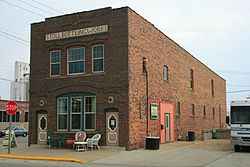
Boone County Historical Center, a museum housed in the former Champlin Memorial Masonic Temple.[34][35]
Parks and recreation
[edit]J.B. McHose Park and Shelter is the largest park in Boone, and features shelters, baseball fields, tennis courts, a sand volleyball area, a basketball court, playgrounds, nature trails, an equestrian trail, fishing pond, Teddy Roosevelt monument, bike trail, disc golf course, and a swimming pool.[36]

Notable people
[edit]- Mamie Geneva Doud, First Lady of the United States, wife of President Dwight D. Eisenhower, was born here.[37]
- Norman Arthur Erbe, Republican Governor of Iowa from 1961 to 1963; born and resided in Boone.[38]
- Kate Stevens Harpel (1867-1950), teacher, school board member, physician[39]
- Jerry McNertney, MLB player for Seattle Pilots/Milwaukee Brewers, St. Louis Cardinals, and Pittsburgh Pirates[40]
- Hap Moran, All-American basketball player from Boone High School and New York Giants football star[41]
- Chad Rinehart, offensive lineman for San Diego Chargers and All-American for University of Northern Iowa[42]
- Darlene Rose, missionary in Papua New Guinea during and after World War II, survived imprisonment in Japanese War Camp[43]
- Ed Updegraff, golfer, U.S. Senior Amateur and Walker Cup champion; also a physician[44]
- Curtis D. Wilbur, lawyer, judge and 43rd United States Secretary of the Navy[45]
- Ray Lyman Wilbur, third president of Stanford University, also United States Secretary of the Interior; born in Boone[46]
Notes
[edit]- ^ Miserendino died in 1943 before the 1946 casting of Roosevelt.
- ^ James Buritt McHose was an admirer of Theodore Roosevelt. On July 25, 1924, McHose and his wife, Ella, gave nearly 200 acres of land on the southwest side of Boone to the city for a park which is named in their honor. When McHose died in June of 1927 at the age of 78, shortly after the park's dedication, his last will and testament specified that a statue of Roosevelt be placed in the park. John W. Jordan, the attorney for McHose's will, oversaw the Roosevelt statue project for the park.
References
[edit]- ^ "2020 U.S. Gazetteer Files". United States Census Bureau. Retrieved March 16, 2022.
- ^ a b U.S. Geological Survey Geographic Names Information System: Boone, Iowa
- ^ "Find a County". National Association of Counties. Archived from the original on May 31, 2011. Retrieved June 7, 2011.
- ^ a b "2020 Census State Redistricting Data". census.gov. United states Census Bureau. Retrieved August 12, 2021.
- ^ "About - County History - Boone County Government - Iowa". www.boonecounty.iowa.gov. Retrieved October 25, 2023.
- ^ "Bird's eye view of the city of Montana, Boone Co., Iowa 1868". historymap.com. Retrieved November 25, 2012.
- ^ a b "County History". Boone County, Iowa. Retrieved November 25, 2012.
- ^ Savage, Tom (August 2007). A Dictionary of Iowa Place-Names. University of Iowa Press. p. 41. ISBN 978-1-58729-759-5.
- ^ James H. Lees, History of Coal Mining in Iowa, Chapter III of Annual Report, 1908, Iowa Geological Survey, 1909, pages 575–579.
- ^ Tally Sheet, Proceedings of the 23rd Annual Convention of the United Mine Workers of America Jan. 16 – Feb. 2, 1912, Indianapolis; Volume 2, page 182A.
- ^ "History - Reflecting on 75 Years". Fareway. Fareway. Retrieved February 4, 2018.
- ^ "Community Pride, Hometown Heart". Casey's General Store. Casey's General Store. Retrieved February 4, 2018.
- ^ "Manufacturing". Boone County Iowa. Boone Co. Chamber of Commerce - IA. Retrieved July 26, 2018.
- ^ "US Gazetteer files 2010". United States Census Bureau. Archived from the original on January 12, 2012. Retrieved May 11, 2012.
- ^ "U.S. Climate Normals Quick Access". National Oceanic and Atmospheric Administration. Retrieved July 23, 2022.
- ^ "NOAA Online Weather Data". National Weather Service. Retrieved July 23, 2022.
- ^ "Census of Population and Housing". Census.gov. Retrieved June 4, 2015.
- ^ "2020 Census". United States Census Bureau.
- ^ "U.S. Census website". United States Census Bureau. Retrieved May 11, 2012.
- ^ "U.S. Census website". United States Census Bureau. Retrieved January 31, 2008.
- ^ Feder, Barnaby J. (March 11, 1995). "Company News; Union Pacific to Buy Chicago and North Western". The New York Times. ISSN 0362-4331. Retrieved April 5, 2015.
- ^ "HISTORY OF THE BOONE & SCENIC VALLEY RAILROAD". Boone and Scenic Valley Railroad.
- ^ "Boone, Iowa Economy". www.bestplaces.net.
- ^ Geography Division (December 18, 2020). 2020 CENSUS - SCHOOL DISTRICT REFERENCE MAP: Boone County, IA (PDF) (Map). U.S. Census Bureau. Retrieved September 27, 2025. - Text list - See also: "Boone". Iowa Department of Education. Retrieved September 27, 2025. - United CSD map
- ^ "Grades 7-12". United Community School District. Archived from the original on December 2, 2020. Retrieved September 6, 2020.
- ^ "Trinity Lutheran Church of Boone, Iowa – Trinity's presence on the internet". Retrieved October 7, 2021.
- ^ DMACC staff. "College History". Des Moines Area Community College. DMACC. Retrieved May 10, 2023.
- ^ "Pufferbilly Days". Boone County Chamber of Commerce. Retrieved February 1, 2022.
- ^ "IMCA Super Nationals". IMCA. Retrieved August 31, 2019.
- ^ "Celebrating Over 50 Years of Farm Progress Show Success". Kansas Farmer. Informa USA Inc. Retrieved February 9, 2018.
- ^ Caswell, Suzanne (April 24, 2013). "The statue of Teddy Roosevelt". Iowa Living Magazines. Retrieved January 23, 2016.
- ^ Staff. "Day Out with Thomas". Boone & Scenic Valley Railroad and James H. Andrew Railroad Museum. Iowa Railroad Historical Society. Retrieved October 4, 2019.
- ^ Staff. "James H. Andrew Museum". Boone & Scenic Valley Railroad. Iowa Railroad History Society. Retrieved October 4, 2019.
- ^ "Mt. Olive Lodge No. 79 - history". Archived from the original on November 5, 2013. Retrieved September 28, 2013.
- ^ "Boone County Historical Society webpage". Archived from the original on October 23, 2013. Retrieved September 28, 2013.
- ^ "Locations / J.B. McHose Park & Shelter / Boone, IA". www.boonegov.com. Retrieved October 7, 2021.
- ^ Staff. "Mamie Geneva Doud Eisenhower". The White House. The White House. Retrieved March 17, 2022.
- ^ Staff. "Governor Norman Arthur Erbe". National Governors Assoc. National Governors Assoc. Retrieved March 17, 2022.
- ^ Goldthwait, Nathan Edward (1914). History of Boone County, Iowa. Chicago: Pioneer Publishing Company. pp. 377–78. Retrieved October 12, 2025.
 This article incorporates text from this source, which is in the public domain.
- ^ Staff. "Jerry McNertney Stats". Baseball Almanac. Baseball Almanac, Inc. Retrieved March 17, 2022.
- ^ Kelley, Mo. "Is He the Greatest". Kelley's Korner. Mo Kelley. Retrieved March 20, 2022.
- ^ Staff. "Chad Rinehart Biography". ESPN. ESPN Enterprises Inc. Retrieved March 20, 2022.
- ^ Rose, Darlene Deibler. Evidence Not Seen: A Woman's Miraculous Faith in the Jungles of World War II. San Francisco: Harper & Row, 1990. Print.
- ^ White, Maury. "Ed Updegraff". Register Sports Hall of Fame. Des Moines Register. Retrieved March 20, 2022.
- ^ Staff. "Curtis D. Wilbur (1924-1929)". UVA / Miller Center. University of Virginia. Retrieved March 20, 2022.
- ^ Staff. "Ray L. Wilbur (1929-1933)". UVA / Miller Center. University of Virginia. Retrieved March 20, 2022.

External links
[edit]

- Official Boone City website
- Boone County Chamber of Commerce
- Vintage Life magazine photos
- Chisholm, Hugh, ed. (1911). . Encyclopædia Britannica (11th ed.). Cambridge University Press.
Municipalities and communities of Boone County, Iowa, United States | ||
|---|---|---|
| Cities |  | |
| Townships | ||
| Unincorporated communities | ||
| Ghost town | ||
| Footnotes | ‡This populated place also has portions in an adjacent county or counties | |
| International | |
|---|---|
| National | |
| Other | |

Boone, Iowa
View on GrokipediaBoone is a city in central Iowa, United States, serving as the county seat of Boone County.[1] As of the 2020 United States census, its population was approximately 12,460, with recent estimates indicating a slight annual decline.[1] Founded in the mid-19th century, the city developed primarily due to the expansion of railroads and coal mining, which facilitated transportation and economic activity in the region.[2] Today, Boone's economy reflects its agricultural roots, with surrounding farmland supporting grain production and related infrastructure such as elevators, alongside manufacturing and retail sectors.[3] Notable among its historical distinctions, Boone is the birthplace of Mamie Doud Eisenhower, First Lady of the United States from 1953 to 1961 as the wife of President Dwight D. Eisenhower, born there in 1896.[4] The city also marks the origin of Casey's General Stores, with the chain's first location established in 1968 from a converted gas station, evolving into a regional convenience retailer emphasizing prepared foods like pizza.[5] These elements underscore Boone's role as a modest Midwestern hub blending industrial heritage, rural productivity, and cultural landmarks.
History
Founding and early settlement (1851–1880s)
Boone County was established by the Iowa Territorial Legislature in 1847 and named in honor of Nathan Boone, the youngest son of frontiersman Daniel Boone, who had surveyed parts of the region during military expeditions. Initial settlement in the county occurred in May 1846, when John Pea and his family arrived at Pea's Point near the present site of Boonesboro, marking the first permanent Euro-American presence amid vast prairies and timber stands. Early pioneers acquired land through federal auctions or pre-emption claims under Iowa's territorial laws, which allowed occupants to purchase improved tracts at $1.25 per acre after proving cultivation, incentivizing individual effort over communal or subsidized development.[6][7] Boonesboro, platted in 1851 on the west branch of the Des Moines River, emerged as the county's first organized community and provisional seat, selected by commissioners for its central location and access to water-powered milling potential. Settlers there, numbering in the dozens initially, endured frontier challenges such as isolating winters, disease from poor sanitation, and manual labor to fell oaks and walnuts for fencing and fuel while breaking sod for corn and wheat cultivation—essential steps yielding subsistence farms averaging 40-80 acres per family. Self-organized governance prevailed, with residents electing local officials and bidding resources like donated lots to secure county functions, reflecting market-driven competition absent large-scale government intervention. By 1857, a modest frame courthouse stood in Boonesboro, underscoring grassroots infrastructure built via private donations and volunteer labor.[6][8] Anticipation of private railroad expansion catalyzed further settlement; in 1865, railroad investor John Insley Blair platted Montana (later Boone) 1.5 miles east of Boonesboro after a dispute with Boonesboro leaders over station placement, positioning it for efficient track alignment and commerce. Incorporated in 1866, Montana quickly drew hundreds of migrants—reaching about 1,500 residents by that year—through land sales tied to rail prospects, as families cleared adjacent tracts for diversified agriculture including livestock grazing on native grasses. This growth stemmed from voluntary migration and entrepreneurial land speculation, not federal homestead grants until the 1862 Act's later application, enabling basic amenities like blacksmith shops and stores via settler capital. The town renamed itself Boone in 1871 to align with the county's nomenclature, fostering identity amid ongoing agrarian expansion that transformed wooded fringes into productive fields by the late 1880s.[6][9][8]Railroad expansion and economic boom (1880s–1920s)
The expansion of the Chicago and North Western Railway (C&NW) during the 1880s solidified Boone's role as a regional rail hub, with construction of extensive yards and infrastructure that facilitated freight and passenger traffic across central Iowa.[6] By the early 1880s, the C&NW had established a depot in Boone, supporting the line's westward push that connected local agriculture to national markets and attracted workers for maintenance and operations.[10] This private investment in tracks, bridges, and yards lowered transportation costs dramatically—reducing freight rates for grain and livestock from Iowa farms by enabling efficient bulk shipments to Chicago and beyond—directly spurring economic activity without reliance on government subsidies.[11] The resulting connectivity fostered independent farming enterprises, as producers could viably export corn, hogs, and cattle, transforming subsistence operations into commercial ventures integrated into broader supply chains.[12] A notable incident underscoring the risks and human element of this era occurred on July 6, 1881, when 15-year-old Kate Shelley heroically intervened during a severe storm that washed out the Honey Creek trestle near Moingona, just west of Boone. Observing a work engine plunge into the flooded creek, Shelley traversed the perilous, rain-slicked Des Moines River high bridge—a 500-foot wooden trestle 50 feet above the torrent—to reach the Boone station and alert dispatchers, preventing the oncoming Midnight Flyer passenger train from disaster and saving an estimated 200 lives.[13] Her actions highlighted the precarious safety conditions of early rail infrastructure but also amplified Boone's prominence, as the event drew national attention and reinforced the C&NW's commitment to bridge reinforcements, including eventual steel replacements in the 1890s.[14] This rail-driven momentum fueled a population and industrial surge, with Boone's residents growing from 2,189 in 1880 to 11,729 by 1920, per U.S. Decennial Census records, as jobs in railroading, related manufacturing (e.g., machine shops and foundries), and commerce proliferated.[15] The influx supported ancillary sectors like coal mining in nearby areas, which supplied fuel for locomotives, and grain elevators for handling exports, creating a self-sustaining economic cluster grounded in market incentives rather than centralized planning.[6] By the 1920s, Boone's economy exemplified how targeted infrastructure capital—yielding over 400% population increase in four decades—catalyzed localized prosperity through cost efficiencies and entrepreneurial response to demand signals.[16]Mid-20th century developments and challenges (1930s–1970s)
![Birthplace of Mamie Eisenhower.jpg][float-right] During the Great Depression, Boone experienced severe economic strain akin to broader Iowa trends, with farm commodity prices plummeting—corn falling to as low as eight cents per bushel in the early 1930s—leading to widespread bankruptcies and foreclosures among local farmers.[17] Boone County's agricultural base, reliant on corn and livestock, saw residents like farmer Elmer Powers documenting the era's hardships through diaries that reflected persistent determination amid financial distress and dust bowl conditions.[18] Population dipped slightly from 12,373 in 1930 to 11,753 in 1940, underscoring the local toll, though private adaptations such as diversified small-scale farming and community self-reliance mitigated total collapse without heavy dependence on expansive external aid.[15] World War II spurred mobilization on Boone's home front, with residents contributing through scrap metal drives that repurposed local monuments and materials for national war efforts, including an arch dismantled for its bronze content.[19] While no major factories in Boone converted directly to war production—unlike larger Iowa sites such as Ankeny's John Deere plant—community support sustained the effort via agricultural output and volunteerism, helping stabilize the local economy amid wartime rationing.[20] Postwar recovery benefited from the GI Bill, which facilitated veterans' education at Boone Junior College, established in 1927 with initial enrollment of about 60 students but experiencing record postwar spikes due to returning servicemen accessing tuition and stipends.[21] This private-institutional response, combined with low-interest loans for housing, supported modest population rebound to 12,373 by 1950, emphasizing individual initiative over centralized programs. In the 1950s and 1960s, U.S. Route 30 improvements through Boone addressed growing traffic congestion, as evidenced by 1959 footage highlighting bottlenecks and paving the way for rerouting south of the city in the mid-1960s to enhance efficiency.[22] Suburbanization remained limited in this rural hub, tempered by agricultural mechanization that enlarged farms—average northern Iowa operations reaching 250 acres by the 1950s—displacing labor and prompting outmigration from surrounding countryside, though the city population held steady at around 12,468 through 1970.[23] Boone's ties to national figures, including Mamie Eisenhower's Boone birthplace and her role as First Lady from 1953 to 1961 amid her husband's postwar presidency, bolstered local morale without overshadowing grassroots economic adjustments by farmers adopting tractors and chemicals to boost yields.[6] These shifts underscored resilience through technological adaptation in the private agricultural sector, sustaining Boone amid broader rural depopulation trends.[24]Late 20th and 21st century evolution
During the 1980s and 1990s, Boone faced economic pressures from the broader deindustrialization of the railroad sector, which saw U.S. rail employment drop by over 40% since 1980 due to consolidation, automation, and shifts in freight patterns.[25] As a former rail hub, the city experienced corresponding job losses, contributing to rural stagnation amid national trends of urban migration and mechanization in transportation and agriculture. These structural changes, rather than isolated policy failures, drove workforce displacement, with local adaptation relying on diversification into service-oriented industries to mitigate decline. By the 2000s, expansions in education and healthcare provided partial offsets, with institutions like Boone Community Schools and Boone County Hospital anchoring employment growth amid fading manufacturing ties.[26] Population stabilized around 12,460 as of the 2020 U.S. Census but entered a slight annual decline of -0.1% through the early 2020s, reflecting persistent rural out-migration and automation's erosion of traditional jobs.[27] Projections estimate the city's population near 12,500 by 2025, underscoring limited sustainability without robust private-sector innovation.[28] In the 2020s, local initiatives emphasized business retention and workforce training to counter these dynamics, including partnerships with Iowa State University's CyBIZ Lab for economic consulting starting in 2020 and chamber-led programs focusing on recruitment and skill development.[29] [30] A 2022 state grant of $410,000 supported healthcare apprenticeships through Boone schools, aiming to align local labor with service demands, though such government-funded efforts risk entrenching dependency absent complementary market signals like ag-tech adoption—evident in Iowa's broader shift to precision tools for efficiency.[31] Empirical metrics suggest these steps have slowed but not reversed decline, prioritizing causal drivers like technological displacement over unsubstantiated subsidies.Geography and environment
Physical location and topography
Boone is situated at coordinates 42°03′N 93°53′W in Boone County, central Iowa, approximately 16 miles west of Ames.[32] [33] The city encompasses 9.02 square miles, all land, positioned adjacent to the Des Moines River, which borders its eastern extent and influences local hydrology.[34] [9] The terrain consists of gently rolling plains characteristic of Iowa's Des Moines Lobe glacial landscape, with elevations averaging about 1,130 feet above sea level.[35] [36] This topography, formed by glacial till, supports extensive farmland use surrounding the city, as the moderate slopes and fertile soils facilitate drainage and cultivation without extreme gradients impeding mechanized agriculture.[37] Proximity to the Des Moines River has exposed the area to periodic flooding, including significant inundation during the 1993 Midwest floods that affected central Iowa waterways.[38] Flood risks are mitigated by engineered drainage tiles, ditches, and private levees that channel excess water, reducing impacts on urban and agricultural lands compared to unmitigated riverine settings.[9] Boone's placement west of Interstate 35, which passes through nearby Ames, and alongside active rail corridors enhances accessibility for freight and passenger movement across the plains.[39]Climate data and environmental factors
Boone experiences a humid continental climate classified as Köppen Dfa, characterized by hot, humid summers and cold, snowy winters, with significant seasonal temperature swings influencing local agriculture such as corn and soybean cultivation.[40] Average high temperatures reach approximately 85°F (29°C) in July, the warmest month, while January highs average around 30°F (-1°C), with lows dipping to 13°F (-11°C), based on records from the Boone Municipal Airport station.[41] Annual precipitation totals about 35 inches (890 mm), predominantly as rain from May to September, supporting farming but requiring drainage management to prevent periodic flooding in low-lying areas.[42]| Month | Avg High (°F) | Avg Low (°F) | Precipitation (in) |
|---|---|---|---|
| Jan | 30 | 13 | 1.0 |
| Feb | 34 | 16 | 1.0 |
| Mar | 46 | 27 | 2.2 |
| Apr | 60 | 38 | 3.5 |
| May | 71 | 49 | 4.7 |
| Jun | 80 | 59 | 4.6 |
| Jul | 85 | 65 | 4.2 |
| Aug | 83 | 62 | 4.0 |
| Sep | 75 | 52 | 3.3 |
| Oct | 63 | 40 | 2.8 |
| Nov | 47 | 28 | 2.0 |
| Dec | 34 | 17 | 1.4 |
| Annual | 59 | 37 | 35.0 |
Demographics
Population trends and historical census data
The population of Boone grew from approximately 3,000 residents in 1900 to a peak of 12,803 in 1980, reflecting expansion driven by railroad-related economic activity and rural-to-urban migration in central Iowa.[15] This growth occurred amid broader regional development, with the city serving as the county seat for Boone County, which had a 2020 population of 26,715.[50] Subsequent decennial censuses indicate stagnation and minor decline, with figures holding steady at 12,472 in both 2000 and 2010 before dipping to 12,468 in 2020, consistent with depopulation trends in many Midwestern rural hubs due to out-migration for employment opportunities elsewhere.[51] Boone's annual growth rate has averaged -0.1% in recent years, projecting a 2025 population of 12,392.[1]| Year | Population |
|---|---|
| 1980 | 12,803 |
| 1990 | 12,661 |
| 2000 | 12,472 |
| 2010 | 12,472 |
| 2020 | 12,468 |