


Community hub
Recent from talks
Contribute something
Nothing was collected or created yet.
Buckhannon, West Virginia
View on Wikipedia
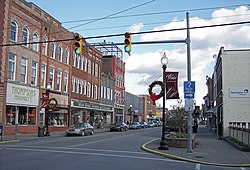
Buckhannon is the only incorporated city in, and the county seat of, Upshur County, West Virginia, United States.[6] Located along the Buckhannon River, the population was 5,299 as of the 2020 census.[3] The city is 46 miles (74 km) southwest of Morgantown, 88 miles (142 km) northeast of the capital city of Charleston, and 100 miles (160 km) south of Pittsburgh, Pennsylvania. It is home to West Virginia Wesleyan College and the West Virginia Strawberry Festival, held annually during the third week of May.[7]
Key Information


History
[edit]_(14738560576).jpg)
According to tradition, the first settlers in the Buckhannon River Valley were brothers John and Samuel Pringle. John and Samuel were soldiers serving in the British army during the French and Indian War (Seven Years' War) who, in 1761, deserted their posts at Fort Pitt (present-day Pittsburgh, Pennsylvania). They traveled southward and upstream along the Monongahela and Tygart Valley rivers, continuing up what is now called the Buckhannon River. John and Samuel are said to have arrived in present-day Upshur County in 1764 and took up residence in the hollow stump of an American sycamore tree. They lived there for three years, surviving on game and fish. When they ran out of bullets in 1765, John made the journey to settlements along the South Branch Potomac River to purchase more and found out from the locals that the war was over and the brothers were no longer wanted men. After his return, they moved to the South Branch settlements. John later went to Kentucky, but Samuel returned to the river valley in 1769 with his new wife Charity Pringle (née Cutright), her brother John Jr., friends Thomas Hughes, and John and Elizabeth Jackson with their sons George and Edward. (Edward was the grandfather of Thomas "Stonewall" Jackson).[8]
The City of Buckhannon was established on January 15, 1816, possible named for Buckongahelas[9] (1720-1805), the legendary Lenape Chief. A statue of Buckongahelas and his fallen son, crafted by Buckhannon sculptor Ross Straight, was erected in Buckhannon West Virginia’s Jawbone Park in 2000.[10] Most historians think it more likely that the community and river were both named for John Buchannon, a missionary to the area in the 1780s.[11] The city was chartered by the Virginia General Assembly in 1852, and remained part of the Commonwealth of Virginia until the secession of West Virginia on June 20, 1863, during the American Civil War. Because of its near-central geographic location, Buckhannon was long considered a prospective site for the state capital. In 1866, the legislature approved a bill including Buckhannon among the choices for capital, but officials decided the river was not wide enough to accommodate desired commerce and ultimately settled with Charleston as the state capitol.
The first courthouse was built in 1854. It served multiple functions, including as an opera house and town hall. Electricity was installed in 1891 to replace oil lamps, but the building suffered fire damage in the first six months of electrical service, eventually being razed in 1898. In its place, a Classical Revival style courthouse, designed by Charleston architect Harrison Albright, begun construction in 1899 and was completed in 1901. An annex of the same style was added in 1995. In the cornerstone of the main building is a time capsule filled with turn of the 19th century artifacts.
The Sago Mine Disaster, January 2, 2006, killed 12 and left one survivor. Officials said that a lightning strike in the coal caused the explosion. It was the worst mining disaster in the US since a 2001 disaster in Alabama killed 13 people, and the worst disaster in West Virginia since a 1968 incident that killed 78 people. National and international news crews were in the area for upwards of three days to cover rescue and recovery efforts.
Geography
[edit]The city lies in the foothills of the Allegheny Mountains. It is in the Mountain Lakes tourism region.[12]
According to the United States Census Bureau, the city has a total area of 2.83 square miles (7.33 km2), all land.[13]
Climate
[edit]The climate in this area has mild differences between highs and lows, and there is adequate rainfall year-round. According to the Köppen Climate Classification system, Buckhannon has a humid continental climate using the 0 °C (32 °F) isotherm, or a humid subtropical climate using the −3 °C (26.6 °F) isotherm.[14]
| Climate data for Buckhannon, West Virginia (1991–2020 normals, extremes 1891–present) | |||||||||||||
|---|---|---|---|---|---|---|---|---|---|---|---|---|---|
| Month | Jan | Feb | Mar | Apr | May | Jun | Jul | Aug | Sep | Oct | Nov | Dec | Year |
| Record high °F (°C) | 79 (26) |
80 (27) |
86 (30) |
93 (34) |
95 (35) |
96 (36) |
99 (37) |
99 (37) |
100 (38) |
92 (33) |
82 (28) |
79 (26) |
100 (38) |
| Mean maximum °F (°C) | 65.3 (18.5) |
67.4 (19.7) |
75.2 (24.0) |
83.9 (28.8) |
86.8 (30.4) |
89.6 (32.0) |
91.4 (33.0) |
91.0 (32.8) |
89.8 (32.1) |
82.3 (27.9) |
75.2 (24.0) |
66.1 (18.9) |
92.9 (33.8) |
| Mean daily maximum °F (°C) | 40.8 (4.9) |
44.3 (6.8) |
53.2 (11.8) |
65.9 (18.8) |
74.1 (23.4) |
81.0 (27.2) |
84.3 (29.1) |
83.8 (28.8) |
78.6 (25.9) |
66.8 (19.3) |
54.6 (12.6) |
45.0 (7.2) |
64.4 (18.0) |
| Daily mean °F (°C) | 31.0 (−0.6) |
33.5 (0.8) |
41.2 (5.1) |
51.9 (11.1) |
61.4 (16.3) |
69.2 (20.7) |
73.1 (22.8) |
72.0 (22.2) |
65.8 (18.8) |
53.8 (12.1) |
42.9 (6.1) |
35.4 (1.9) |
52.6 (11.4) |
| Mean daily minimum °F (°C) | 21.1 (−6.1) |
22.8 (−5.1) |
29.2 (−1.6) |
37.9 (3.3) |
48.6 (9.2) |
57.4 (14.1) |
62.0 (16.7) |
60.2 (15.7) |
53.0 (11.7) |
40.8 (4.9) |
31.2 (−0.4) |
25.9 (−3.4) |
40.8 (4.9) |
| Mean minimum °F (°C) | −2.3 (−19.1) |
1.3 (−17.1) |
11.7 (−11.3) |
23.6 (−4.7) |
33.2 (0.7) |
43.7 (6.5) |
51.5 (10.8) |
50.0 (10.0) |
39.1 (3.9) |
27.4 (−2.6) |
17.0 (−8.3) |
7.8 (−13.4) |
−5.9 (−21.1) |
| Record low °F (°C) | −30 (−34) |
−31 (−35) |
−13 (−25) |
5 (−15) |
19 (−7) |
29 (−2) |
35 (2) |
34 (1) |
26 (−3) |
11 (−12) |
−2 (−19) |
−28 (−33) |
−31 (−35) |
| Average precipitation inches (mm) | 3.61 (92) |
3.29 (84) |
4.15 (105) |
3.82 (97) |
5.18 (132) |
5.10 (130) |
5.31 (135) |
4.21 (107) |
3.76 (96) |
3.82 (97) |
3.03 (77) |
3.93 (100) |
49.21 (1,250) |
| Average snowfall inches (cm) | 11.9 (30) |
11.3 (29) |
6.7 (17) |
0.7 (1.8) |
0.0 (0.0) |
0.0 (0.0) |
0.0 (0.0) |
0.0 (0.0) |
0.0 (0.0) |
0.1 (0.25) |
1.8 (4.6) |
6.9 (18) |
39.4 (100) |
| Average precipitation days (≥ 0.01 in) | 17.3 | 14.5 | 14.4 | 14.1 | 15.6 | 14.4 | 13.6 | 12.2 | 11.0 | 11.7 | 11.9 | 15.9 | 166.6 |
| Average snowy days (≥ 0.1 in) | 8.4 | 6.2 | 3.6 | 0.6 | 0.0 | 0.0 | 0.0 | 0.0 | 0.0 | 0.1 | 1.5 | 4.9 | 25.3 |
| Source: NOAA[15][16] | |||||||||||||
Demographics
[edit]| Census | Pop. | Note | %± |
|---|---|---|---|
| 1860 | 427 | — | |
| 1870 | 475 | 11.2% | |
| 1880 | 761 | 60.2% | |
| 1890 | 1,403 | 84.4% | |
| 1900 | 1,589 | 13.3% | |
| 1910 | 2,225 | 40.0% | |
| 1920 | 3,785 | 70.1% | |
| 1930 | 4,374 | 15.6% | |
| 1940 | 4,450 | 1.7% | |
| 1950 | 6,016 | 35.2% | |
| 1960 | 6,386 | 6.2% | |
| 1970 | 7,261 | 13.7% | |
| 1980 | 6,820 | −6.1% | |
| 1990 | 5,909 | −13.4% | |
| 2000 | 5,725 | −3.1% | |
| 2010 | 5,639 | −1.5% | |
| 2020 | 5,186 | −8.0% | |
| 2021 (est.) | 5,265 | [3] | 1.5% |
| U.S. Decennial Census[17] | |||
2020 census
[edit]As of the 2020 census, there were 5,186 people and 2,084 households residing in the city. There were 2,431 housing units in Buckhannon. The racial makeup of the city was 90% White, 3.2% African American, 1% Asian, 0.07% Native American, 0.8% from other races, and 4.5% from two or more races. Hispanics or Latinos of any race were 2.6% of the population.
There were 2,084 households, of which 37.2% were married couples living together, 37.2% had a female householder with no spouse present, 21.8% had a male householder with no spouse present. The average household and family size was 2.97. The median age in the city was 37.8 years with 14.5% of the city's population under 18. The median income for a household in the city was $46,602 and the poverty rate was 19.5%.[18]
2010 census
[edit]As of the census[19] of 2010, there were 5,639 people, 2,148 households, and 1,149 families living in the city. The population density was 1,992.6 inhabitants per square mile (769.3/km2). There were 2,398 housing units at an average density of 847.3 per square mile (327.1/km2). The racial makeup of the city was 94.5% White, 2.1% African American, 0.2% Native American, 0.9% Asian, 0.4% from other races, and 1.9% from two or more races. Hispanic or Latino of any race were 2.5% of the population.
There were 2,148 households, of which 22.6% had children under the age of 18 living with them, 38.5% were married couples living together, 11.6% had a female householder with no husband present, 3.4% had a male householder with no wife present, and 46.5% were non-families. 39.9% of all households were made up of individuals, and 18.2% had someone living alone who was 65 years of age or older. The average household size was 2.13 and the average family size was 2.84.
The median age in the city was 33.1 years. 16.1% of residents were under the age of 18; 25.5% were between the ages of 18 and 24; 18.9% were from 25 to 44; 22.5% were from 45 to 64; and 17.1% were 65 years of age or older. The gender makeup of the city was 47.5% male and 52.5% female.
2000 census
[edit]As of the census[4] of 2000, there were 5,725 people, 2,159 households, and 1,180 families living in the city. The population density was 2,314.2 people per square mile (894.9/km2). There were 2,424 housing units at an average density of 979.8 per square mile (378.9/km2). The racial makeup of the city was 96.16% White, 2.01% African American, 0.10% Native American, 0.84% Asian, 0.02% Pacific Islander, 0.28% from other races, and 0.59% from two or more races. Hispanic or Latino of any race were 0.96% of the population.
There were 2,159 households, out of which 22.6% had children under the age of 18 living with them, 41.1% were married couples living together, 10.9% had a female householder with no husband present, and 45.3% were non-families. 40.0% of all households were made up of individuals, and 19.1% had someone living alone who was 65 years of age or older. The average household size was 2.08 and the average family size was 2.78.
In the city, the population was spread out, with 15.5% under the age of 18, 28.1% from 18 to 24, 19.2% from 25 to 44, 19.8% from 45 to 64, and 17.4% who were 65 years of age or older. The median age was 31 years. For every 100 females, there were 81.3 males. For every 100 females age 18 and over, there were 78.4 males.
The median income for a household in the city was $23,421, and the median income for a family was $36,975. Males had a median income of $30,691 versus $18,041 for females. The per capita income for the city was $12,959. About 15.8% of families and 24.8% of the population were below the poverty line, including 32.7% of those under age 18 and 11.2% of those age 65 or over.
Government
[edit]
Upshur County and Buckhannon have maintained a Republican majority since the days of the American Civil War.[citation needed] On May 23, 1861, the voters of Upshur County voted 7 to 3 against secession from the United States.[20] The majority of soldiers from Upshur served in the Union Army, while over 180 soldiers enlisted in the Confederate Army.[21] In the 1864 presidential election, incumbent President Lincoln won the county handily against General McClellan.
The City of Buckhannon is under a Mayor-council government system. The Mayor of the City of Buckhannon serves as a Strong Mayor. He has a seat on the City Council, which includes five additional elected council members. The City Recorder is also an official. The election of the Mayor occurs every four years in the same year as the presidential elections. By law, the City Recorder succeeds to the Office of Mayor acting as the Chief Executive in the event of the sitting Mayor's death or vacancy. The City Recorder also administers the Mayoral Oath of Office.
The City Council for the City of Buckhannon:
- Robbie Skinner - Mayor (2020–2024)
- Randy Sanders - City Recorder (2019-2022)
- David W. McCauley - Council Member - (2022–2026)
- Pamela M. Cuppari Bucklew - Council Member - (2016–2024)
- Jack Reger - Council Member - (2020–2024)
- CJ Rylands - Council Member - (2020–2024)
- David Thomas - Council Member - (2016–2022)
Education
[edit]
The institutions of public primary and secondary learning serving the community of Buckhannon are operated by Upshur County Schools. West Virginia Wesleyan College is a private liberal arts college located in Buckhannon.
High schools
[edit]- Buckhannon-Upshur High School
- Fred W. Eberle Technical Center
Middle schools
[edit]- Buckhannon-Upshur Middle School
Elementary schools
[edit]- Buckhannon Academy Elementary School
- French Creek Elementary School
- Hodgesville Elementary School
- Rock Cave Elementary School
- Tennerton Elementary School
- Union Elementary School
- Washington District Elementary School[22]
Media
[edit]There are a few radio stations and television stations located in Buckhannon. Some transmitters reach to Weston, WV, Elkins, WV, Parkersburg, WV, Morgantown, WV, Martinsburg, WV and Clay, WV.
Buckhannon is also home to a local Leased access Cable television station, Channel 3, which is available to Suddenlink cable subscribers. The station features a community bulletin board with local television advertising and events, as well as religious broadcasting and family television programming.
Buckhannon's main newspaper is the Record Delta.[23]
Notable people
[edit]- Kyle Andrews, jazz drummer[citation needed]
- Stephen Coonts, American thriller and suspense novelist
- Scott Munson Cutlip, pioneer in public relations education
- Alston G. Dayton, U.S. Representative, West Virginia 2nd District
- Floyd Farnsworth (1869–1946), politician
- Charley Harper, American Modernist artist
- Olive Ireland Hodges, American missionary teacher in Japan
- Weijia Jiang, White House correspondent and morning anchor for CBS News
- Jean Lee Latham, American writer
- Pare Lorentz, pioneering documentary filmmaker, with film added to the National Film Registry
- Irene McKinney, Poet Laureate of West Virginia, appointed 1994 until her death in February 2012
- Ace Mumford, college football head football coach
- Jayne Anne Phillips, Pulitzer-Prize winning novelist and short story writer
- Kimberly A. Reed, former Chairman and President of the Export–Import Bank of the United States
- Edward Gay Rohrbough, Republican United States Representative
- Cebe Ross, former West Virginia Wesleyan coach
- Chris Wallace, general manager of the Memphis Grizzlies
In other media
[edit]- "Ballet for a Girl in Buchannon" (song cycle by Chicago from their 1970 album Chicago II; writer James Pankow misspelled the town name)
- The town was featured in the 2017 German television documentary "Auslandsjournal", as an example of the growing problem of illegal drug use in the US.[24]
See also
[edit]References
[edit]- ^ a b c West Virginia Legislature (2018). "Section Ten: Municipalities". West Virginia Blue Book, 2017-2018 (PDF). Charleston, West Virginia: West Virginia Legislature. p. 956.
- ^ "2019 U.S. Gazetteer Files". United States Census Bureau. Retrieved August 7, 2020.
- ^ a b c d "City and Town Population Totals: 2020-2021". Census.gov. US Census Bureau. Retrieved July 3, 2022.
- ^ a b "U.S. Census website". United States Census Bureau. Retrieved January 31, 2008.
- ^ "US Board on Geographic Names". United States Geological Survey. October 25, 2007. Retrieved January 31, 2008.
- ^ "Find a County". National Association of Counties. Archived from the original on May 31, 2011. Retrieved June 7, 2011.
- ^ "West Virginia Strawberry Festival". West Virginia Strawberry Festival. 2021. Retrieved August 15, 2022.
- ^ "Samuel and John Pringle were the first Englishmen to set foot in present-day Upshur County". www.eg.bucknell.edu. Retrieved January 8, 2021.
- ^ "Buckhannon / Frontier Days Historical Marker".
- ^ "E-WV | Buckongahelas".
- ^ "Upshur County History", West Virginia University
- ^ "Travel Regions". Almost Heaven - West Virginia. Retrieved March 2, 2023.
- ^ "US Gazetteer files 2010". United States Census Bureau. Archived from the original on July 2, 2012. Retrieved January 24, 2013.
- ^ Climate Summary for Buckhannon, West Virginia
- ^ "NOWData – NOAA Online Weather Data". National Oceanic and Atmospheric Administration. Retrieved November 12, 2023.
- ^ "Summary of Monthly Normals 1991–2020". National Oceanic and Atmospheric Administration. Retrieved November 12, 2023.
- ^ "Census of Population and Housing". Census.gov. Retrieved June 4, 2015.
- ^ "Explore Census Data". data.census.gov. Retrieved February 21, 2023.
- ^ "U.S. Census website". United States Census Bureau. Retrieved January 24, 2013.
- ^ Curry, Richard O. "A House Divided", Univ. of Pittsburgh Press, 1964
- ^ Linger, James Carter "Confederate Military Units from West Virginia", pg. 72
- ^ "WV School Directory". wvde.state.wv.us. Retrieved February 13, 2023.
- ^ News, W. V. "Record Delta - Buckhannon WV News". WV News. Retrieved March 22, 2023.
{{cite web}}:|last=has generic name (help) - ^ "Das auslandsjournal vom 06. September" (in German). Archived from the original on September 8, 2017. Retrieved September 7, 2017.
- https://web.archive.org/web/20070219145012/http://members.citynet.net/warner/upshur.html
- Images of America: Upshur County by The Upshur County Historical Society, pages 07, 09, and 10.
External links
[edit]

Municipalities and communities of Upshur County, West Virginia, United States | ||
|---|---|---|
| City |  | |
| CDPs | ||
| Other communities |
| |
| Ghost town | ||
| Footnotes | ‡This populated place also has portions in an adjacent county or counties | |
| International | |
|---|---|
| National | |
| Geographic | |
| Other | |

Buckhannon, West Virginia
View on GrokipediaHistory
Early Settlement and Founding
The region encompassing present-day Buckhannon was historically utilized as hunting grounds by Native American tribes, including the Delaware (Lenape), with evidence of earlier Adena mound-builder activity dating to prehistoric times.[6] European pioneer settlement commenced in the 1760s amid the broader frontier expansion into northwestern Virginia, marked by isolation, rudimentary living conditions, and vulnerability to attack. John and Samuel Pringle, British deserters from Fort Pitt, are documented as the earliest known settlers, taking refuge in 1764 within a massive hollow sycamore tree at Turkey Run, approximately two miles north of the modern town site along the Buckhannon River.[7][8] By around 1770, additional families—including the Hackers, Cutrights, and Hughes—had coalesced into a nascent community in Buckhannon Valley, constructing basic fortifications such as Bush's Fort for defense against Native American incursions.[9] The river's name derives most plausibly from Buckongahelas (c. 1720–1805), a prominent Delaware chief and British ally during the Revolutionary War who led migrations westward and conducted hunts in the vicinity, though some accounts posit a local indigenous term for the waterway.[10][11] Settlers endured profound hardships, including food scarcity, exposure to harsh Appalachian weather, and persistent violence from tribal raids, which were exacerbated by intertribal displacements and European encroachment; for instance, Bush's Fort was razed by Native warriors in 1782 during a broader wave of frontier assaults tied to post-Revolutionary tensions.[12] These conflicts, part of conflicts like Dunmore's War (1774), compelled residents to maintain vigilance, with notable scouts such as Jesse Hughes aiding in reconnaissance against Shawnee and other groups.[3] The community achieved formal recognition when the Virginia General Assembly incorporated Buckhannon as a town on January 15, 1816, following a 1815 platting of the site by Colonel Edward Jackson, grandfather of Stonewall Jackson.[10][3] This step followed stabilization after the Treaty of Greenville (1795) and subsequent pacts that curtailed large-scale raids, enabling gradual population growth. In 1851, the Virginia legislature created Upshur County from portions of Lewis, Nicholas, and Barbour counties, designating Buckhannon the seat due to its central location and established infrastructure.[9]19th Century Development
During the antebellum era, Buckhannon's development was anchored in subsistence agriculture and nascent extractive industries, including small-scale logging and grain milling powered by local water sources along the Buckhannon River. Farmers cultivated crops such as corn and livestock on hilly terrain unsuitable for large plantations, supplemented by rudimentary timber harvesting for construction and fuel, which relied on overland trails and river flatboats for transport to markets in nearby counties. Upshur County's formation on March 26, 1851, from portions of Barbour, Lewis, and Randolph counties, elevated Buckhannon's status as the prospective county seat, spurring modest infrastructure improvements like improved county roads to connect isolated farms.[3] [13] [14] The Civil War profoundly shaped local trajectories, with Upshur County's predominant Unionist orientation—rooted in economic self-sufficiency and aversion to eastern Virginia's planter dominance—positioning Buckhannon as a key Union staging point in spring 1861, from which federal troops advanced toward the Battle of Philippi on June 3. Home Guard militias repelled early Confederate probes, including a June 1861 skirmish involving cavalry clashes that highlighted divided local loyalties despite overall pro-Union control. Confederate forces briefly recaptured the town on April 28, 1863, amid guerrilla disruptions, but Union dominance prevailed, contributing causally to voter approval of West Virginia's statehood constitution on May 23, 1863, effective June 20; these events caused temporary economic halts through troop requisitions, bridge burnings, and supply shortages, though slavery's limited local footprint (under 7% enslaved population regionally) minimized plantation-scale devastation.[15] [16] [17] [3] Postwar recovery emphasized institutional consolidation and commerce revival, with Buckhannon leveraging its county seat role to host the Upshur County Courthouse (established circa 1851) for legal and administrative functions, fostering trade in agricultural goods and milled products via restored river routes. Basic mercantile growth ensued, supported by Republican-leaning governance that prioritized stability over reconstruction-era federal interventions, enabling gradual population influx and farm expansions without reliance on external capital; by the 1870s, residential districts began coalescing around Main Street, reflecting incremental prosperity from local resource utilization rather than industrial booms.[3] [18] [15]20th Century Growth and Challenges
In the early 1900s, Buckhannon and surrounding Upshur County saw economic expansion fueled by resource extraction, particularly timber, oil, and natural gas. Timber operations, bolstered by railroad access established in 1883, contributed to a statewide logging peak around 1910, with hundreds of sawmills operating across West Virginia and supporting job growth in lumber processing.[7] [19] The discovery of oil and gas reserves in the region introduced new drilling and production activities, drawing workers and stimulating local prosperity through energy exports.[20] This period aligned with Buckhannon's population rising from 1,589 in the 1900 census to higher levels by mid-century, as employment in these extractive sectors attracted migrants seeking resource-based livelihoods.[21] The World Wars provided temporary surges in demand for West Virginia's natural resources, including timber for construction and fuel from oil and gas for military needs, temporarily elevating production and employment in Upshur County.[22] Post-World War II, however, mechanization transformed extractive industries, with technologies like continuous miners and advanced drilling rigs reducing labor intensity; by 1950, agreements in coal (analogous to oil and gas operations) permitted widespread machine adoption, cutting workforce needs despite steady output.[23] [24] Timber harvesting similarly shifted toward efficiency gains, diminishing manual jobs as forests regenerated but operations consolidated.[19] By the late 20th century, deindustrialization hit Buckhannon amid declining oil and gas output—statewide production peaked around 1970 before falling due to exhausted fields and competition from lower-cost sources elsewhere—leading to job losses and outmigration.[22] Population growth stalled, peaking at 6,612 in the 1990 census before modest declines, as extractive employment contracted from mechanization and market shifts, trapping the area in Appalachian poverty patterns driven by rugged terrain limiting diversification and resident skills mismatched for emerging non-manual sectors.[25] These dynamics reflected broader causal factors like resource depletion and technological displacement over policy interventions.[20]Recent Developments
Buckhannon's population declined from 5,299 in the 2020 census to an estimated 5,144 by 2023, with projections indicating a further drop to approximately 4,971 by 2025 at an annual rate of -0.84%.[5] [2] This trend reflects broader rural depopulation pressures in north-central West Virginia, though West Virginia Wesleyan College has bolstered local stability through enrollment increases, including its largest mid-year incoming class since at least 2017 and student-led service projects contributing nearly 10,000 volunteer hours—equivalent to $85,400 in economic value based on state minimum wage—in the 2023-2024 academic year.[26] [27] The institution's growth, supported by initiatives like first-responder tuition discounts and high financial aid penetration (over 95% of students), has helped sustain retail and service sector activity amid outmigration.[28] In October 2025, timber company Weyerhaeuser announced a $1 million multi-year investment in Buckhannon via its THRIVE program, partnering with local officials, businesses, and nonprofits to fund community projects enhancing workforce development and infrastructure tied to regional timber operations.[29] This commitment, distributed over several years, underscores adaptive economic strategies in a county reliant on natural resources, with early planning sessions focusing on self-sustaining initiatives rather than short-term aid.[30] Local responses to the opioid crisis have emphasized targeted recovery efforts, including the North-Central West Virginia Community Opioid Response consortium serving Upshur County through resource coordination for prevention and treatment.[31] Buckhannon City Council has allocated opioid abatement funds to support West Virginia Wesleyan College's new certificate program in addiction counseling, aiming to build endogenous capacity for substance use disorder management without heavy external dependency.[32] These measures align with 2025 county priorities for infrastructure upgrades, such as a $33 million water treatment plant, to foster resilience in core services.[33] [34]Geography
Physical Features and Location
Buckhannon is located in north-central West Virginia within Upshur County, serving as the county seat and positioned along the Buckhannon River, a tributary of the Tygart Valley River. The city occupies a site at the river's approximate elevation of 1,310 feet above sea level, where the waterway drops from higher headwaters reaching 3,750 feet. This positioning places Buckhannon in a valley setting amid the Appalachian Plateau's dissected landscape.[35] The surrounding terrain consists of rolling hills, narrow valleys, and dense forests typical of the Allegheny Plateau portion of the Appalachian region, with sedimentary bedrock dominated by Paleozoic-era shale, sandstone, and associated strata that underlie the area's surface. These geological formations contribute to the region's hydrology, including periodic flood risks from the river's meandering course through the valley, while the valleys and forested uplands historically support timber resources and limited agriculture.[36] [10] Regionally, Buckhannon lies approximately 27 miles south of Clarksburg, facilitating access to broader north-central West Virginia networks, though the hilly terrain constrains direct connectivity. The Appalachian setting underscores potentials for extractive activities tied to the underlying shale and sandstone layers, which have shaped local landforms through erosion and deposition over geological time.[37][36]
Climate
Buckhannon has a humid continental climate (Köppen Dfb), featuring warm, humid summers and short, cold, snowy winters influenced by its Appalachian elevation around 1,400 feet. Average high temperatures reach 83°F in July, while January lows average 21°F, with an annual mean of 51.4°F.[38] [39] These conditions support a growing season of about 170 days, enabling seasonal agriculture such as corn and hay production, though frost risks persist into late spring.[40] Annual precipitation measures 49 inches, evenly distributed but peaking at 5.2 inches in May and June, contributing to lush vegetation and river-fed water supplies vital for local farming and forestry economies.[41] Snowfall averages 40 inches yearly, concentrated in winter months, which can disrupt transportation but allows for limited winter outdoor pursuits like hunting when conditions permit.[41] Humidity remains high year-round, averaging 75-80%, fostering comfortable summers for residents but increasing mold risks in poorly ventilated structures.[42] The city's riverside setting exacerbates flood vulnerability during heavy rains, as seen in the November 1985 Election Day floods that inundated parts of Buckhannon, damaging homes and infrastructure amid statewide losses exceeding $700 million. Similar risks materialized in June 2016, when intense downpours caused localized overflows, though primary devastation struck southern counties; these events underscore the need for resilient floodplain management to protect agriculture and residences.[43] Variability in precipitation patterns, rather than long-term trends, drives such episodic impacts on daily life and economic stability.[44]Demographics
Population Trends and Projections
Buckhannon's population peaked at 6,612 residents in 1990, reflecting mid- to late-20th-century stability tied to regional resource industries.[25] Subsequent decennial censuses documented consistent erosion: 5,639 in 2010 and 5,299 in 2020. By 2023, estimates placed the figure at 5,144, marking a -0.84% annual decline rate over recent years.[2]| Year | Population |
|---|---|
| 1990 | 6,612 |
| 2000 | 5,905 |
| 2010 | 5,639 |
| 2020 | 5,299 |
| 2023 | 5,144 |
Composition and Socioeconomic Indicators
Buckhannon exhibits a racially and ethnically homogeneous population. The 2020 United States Census reported that 86.6% of residents identified as White (non-Hispanic), 5.9% as Black or African American (non-Hispanic), 3.8% as two or more races, 1.3% as Asian, and smaller shares for other groups.[2][45][49]| Race/Ethnicity | Percentage |
|---|---|
| White (non-Hispanic) | 86.6% |
| Black or African American (non-Hispanic) | 5.9% |
| Two or more races | 3.8% |
| Asian | 1.3% |
| Other groups | smaller shares |
Economy
Key Industries and Employers
The primary resource-based industry in Buckhannon is timber and wood processing, anchored by Weyerhaeuser's engineered wood products facility, which has operated in the city for over 25 years and consistently ranks among the company's highest performers.[29] [53] In October 2025, Weyerhaeuser committed $1 million to local community development through its THRIVE program, partnering with businesses, nonprofits, and officials to bolster workforce and infrastructure stability.[54] Complementing this sector, Prime 6 announced a $35 million investment in September 2024 to establish a manufacturing facility specializing in sustainable wood products, enhancing processing capabilities and local supply chain resilience.[55] Education stands as a cornerstone employer, with West Virginia Wesleyan College, a private liberal arts institution, supporting approximately 787 positions across administrative, academic, and support roles. This institution contributes to economic steadiness by fostering skilled labor and retaining talent in a region with small-scale agriculture, specialty manufacturing, and retail operations that primarily serve local consumption and tie into broader service ecosystems.[56] Buckhannon's economy has oriented toward diversification into services and light industries since the late 1990s, as outlined in the city's 2025 Comprehensive Plan, which prioritizes agribusiness, innovation hubs like the IDEA Center, broadband expansion, and entrepreneurial networks to mitigate volatility from traditional sectors.[57] Energy extraction remains limited relative to West Virginia's statewide reliance on coal and natural gas, with planning efforts instead emphasizing renewables such as solar to promote sustainable growth without heavy dependence on volatile extractives.[57]Employment, Income, and Challenges
The unemployment rate in Upshur County, where Buckhannon serves as the county seat, stood at 4.6% in 2024, aligning with regional figures of approximately 4-5% amid broader West Virginia labor market trends.[58] Median household income in Buckhannon reached $48,720 in 2023, reflecting modest growth from prior years but remaining well below the national median of $78,538.[59][60] This stagnation underscores income disparities, with local per capita income at $25,259 and a poverty rate of 24.6%, exceeding national averages.[50] Key challenges include persistent outmigration, which has contributed to West Virginia's workforce shrinkage by over 80,000 residents in the past decade, exacerbating labor shortages in Buckhannon's rural context.[61] Skill gaps persist in declining sectors like traditional energy and manufacturing, where transitions demand enhanced competencies in areas such as reading comprehension and technical proficiencies, limiting adaptation without targeted training.[62] These factors compound over-reliance on public sector employment, which data indicate fosters inefficiencies through lower productivity relative to private alternatives in comparable Appalachian regions.[63] Adaptation strategies emphasize private sector partnerships and college-aligned job pipelines, leveraging institutions like West Virginia Wesleyan College to address skill mismatches via workforce-aligned programs.[64] Empirical resilience counters Appalachian stereotypes of high welfare dependency; while West Virginia exhibits elevated federal aid reliance, Buckhannon's poverty metrics reflect structural economic pressures more than entrenched non-participation, with private investments signaling viability.[65] Notably, Weyerhaeuser announced a $1 million multi-year commitment in October 2025 through its THRIVE program to bolster community economic initiatives in Buckhannon, prioritizing timber-related sustainability over public subsidies.[29]Government and Politics
Local Governance Structure
Buckhannon employs a mayor-council form of municipal government as authorized under West Virginia Code §8-3-2.[66] The mayor functions as the chief executive, overseeing administrative operations and delivering annual addresses on city priorities, while the city council handles legislative duties including budget approval.[67] As the Upshur County seat, Buckhannon administers county-level functions through the county commission, which manages fiscal and administrative responsibilities outlined in West Virginia Code Chapter 7.[68] The Upshur County Courthouse in Buckhannon hosts the Circuit Court and shares Family Court jurisdiction with Lewis County in the seventeenth circuit.[69] The city's fiscal year 2025-26 general fund budget totals $6.86 million, down from $7.59 million the prior year due to diminished one-time grant inflows such as FEMA reimbursements.[70] Revenue derives mainly from property taxes, municipal business and occupation taxes, and variable state or federal grants, with recent incentives including partial property tax rebates for targeted developments.[71] [72] Allocations prioritize public safety via police and volunteer fire services, alongside utility operations managed by semi-autonomous water and sewer boards.[73] Municipal infrastructure maintenance draws from dedicated funds, with $200,000 annually committed to street paving amid broader needs exceeding 100,000 square yards of resurfacing.[74] The 2025 Comprehensive Plan, adopted following public input and planning commission review in 2019, establishes goals for sustained infrastructure upgrades, parks improvements, and economic alignment without new revenue mandates.[57] [75] This framework addresses deferred maintenance realities, emphasizing cost-effective preservation over expansion.[76]Political Orientation and Elections
Upshur County, home to Buckhannon, demonstrates a consistent strong preference for Republican candidates in federal and state elections, aligning with broader rural West Virginia trends favoring limited government intervention and resource industry interests. In the 2020 presidential election, Donald Trump secured 7,721 votes (75.0%) against Joe Biden's 2,247 (21.8%), with minor candidates receiving the remainder, out of approximately 10,300 total votes cast countywide.[77] This margin reflected a 53.2-point Republican advantage, exceeding the statewide Republican lead of 38.9 points.[78] Similarly, in the 2024 presidential contest, Trump captured 77.4% of the vote in Upshur County, compared to 20.6% for Kamala Harris, yielding a 56.8-point margin amid 23,875 total votes.[79]| Year | Republican Candidate | Votes | Percentage | Democratic Candidate | Votes | Percentage |
|---|---|---|---|---|---|---|
| 2020 | Donald Trump | 7,721 | 75.0% | Joe Biden | 2,247 | 21.8%[77] |
| 2024 | Donald Trump | ~18,480* | 77.4% | Kamala Harris | ~4,916* | 20.6%[79] |