


Community hub
Recent from talks
Contribute something
Nothing was collected or created yet.
Bunad
View on Wikipedia
Bunad (Norwegian: [ˈbʉ̂ːnɑd], plural: bunader/bunadar) is a Norwegian umbrella term. In a broader sense, the term encompasses household, householding equipment, and livestock as well as both traditional rural clothes (mostly dating to the 18th and 19th centuries) and modern 20th-century folk costumes.[1] In its narrowest sense, the word bunad refers only to clothes designed in the early 20th century that are loosely based on traditional costumes.
The bunad movement has its root in 19th-century national romanticism, which included an interest for traditional folk costumes not only in Norway, but also in neighbouring countries such as Denmark and notably Germany. However, in Norway, national romanticist ideas had a more lasting impact, as seen in the use of folk-inspired costumes.
History
[edit]
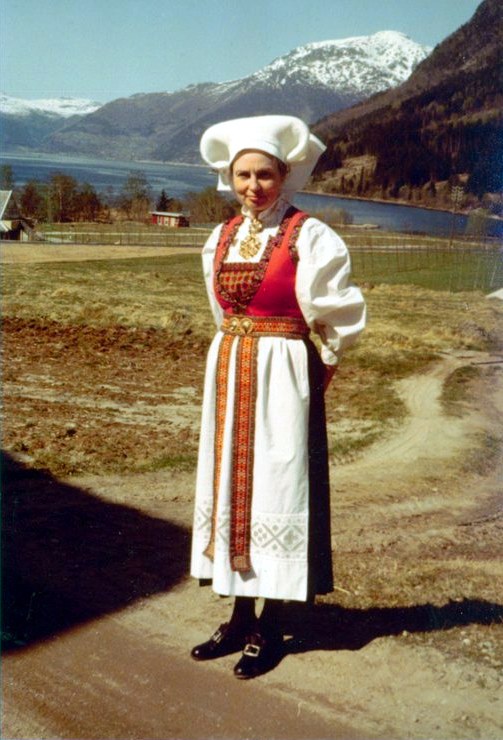
The bunad movement has been carried forward by enthusiasts all over the country and new bunad variations are frequently created and proposed for approval. Designers such as Lise Skjåk Bræk have developed entire lines of costumes based on the bunad tradition. In the field of folk costumes it is common to differentiate between bunad and folk costume, the latter being the local dress in previous times with all its variations and use. Modern interpretations of these costumes have often modified or done away with completely parts of the traditional dresses in order to align them with a more conventional idea of beauty and fashion. For example, few Norwegians still use the headdresses and headpieces that were a part of the traditional costumes, preferring instead to show their hair, in accord with modern, Western fashions. These headdresses, like the one in the photo at the top of this article, were often seen as the most important part of the costume for native practitioners of the customs as the headdress often indicated an individual's social or marital status.
There is a continuing debate about the extent to which bunads must conform to the standards, or whether it is acceptable to vary or improvise based on general themes. Some groups (sometimes derisively referred to as the bunad police) argue that bunads must be sewn and worn according to strict standards; others advocate a more creative, lenient approach. Traditionally it is correct for women to wear proper bunad shoes and purses, and to avoid wearing sunglasses, earrings, and heavy makeup when dressed in a bunad.
Bunads are nowadays often viewed as a status symbol, ranging in the price of $2,000−10,000, depending on the desired design, material, embroidery, gold, silver and accessories. The price also depends on whether the customer buys from a well-established company like Husfliden, from local sewers or decides to sew or do part of the embroidery themselves. It usually takes up to a year to finish making the bunad, and it has become a tradition for parents to give their children a bunad as a confirmation gift, which they will wear on their confirmation day.
-
 Hardanger bunad with a bridal crown (brudekrone)
 -
 Hulda Garborg in bunad
 -
 Hulda Garborg in bunad
 -
 Norwegian immigrants in the U.S. wearing their traditional bunads
 -
 Budeia - painting by Gerhard Munthe (1890)
 -
 Frieriet – painting by Nils Bergslien (1853–1928)
 -
 Kven er størst måttru – painting by Nils Bergslien (1853–1928)
 -
 Folkedrakter fra Gran i Telemark – painting by Johannes Flintoe
 -
 Two young women in bunad in Trøndelag
 -
 Young girls in different national costumes at Akershus
 -
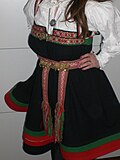 Setesdalsbunad from Setesdal (female)
 -
 Setesdalsbunad (male)


_(5180708385).jpg)


Traditions
[edit]
In Norway in the postwar era, especially in more recent times, it is common, but by no means mandatory, to wear bunad at various celebrations such as: folk dances, weddings, baptisms, confirmations, Christmas, graduations and especially the May 17 National Day celebrations. In recent years, its use has reached far outside folk dancing, folk music, and particular holidays. Accepted as proper gala attire, it is increasingly common to see people, and especially women, dressed in bunad. The former Norwegian foreign minister, Thorvald Stoltenberg, made history by presenting his accreditation as ambassador to Margrethe II of Denmark dressed in a bunad.[2] Bunads were also conspicuous among those present at the Blessing of the Reign of King Harald and Queen Sonja, demonstrating that the bunad is now considered acceptable as an alternative form of formal wear even on the most solemn public occasions.
There is ongoing debate about the official status of various outfits, and what allowed variations are. Due to ongoing discussions on the status of bunads, it is not possible to state accurately the number of different types of bunads in Norway, but most estimates place the number at around 200.[3] In 1947 an official institution, the National Committee for Bunad-related Questions (Landsnemnda for Bunadspørsmål) was organized to act in an advisory capacity on all questions dealing with bunads in Norway. That function is presently assigned to the Norwegian Institute for Costume and Folk Costume (Norsk institutt for bunad og folkedrakt), a national institution dealing with documentation and research of folk costumes as a cultural expression. Since 2008, the institution's management has operated in cooperation with the Valdres Folkemuseum (Valdresmusea) with which it shares facilities in Fagernes. The institute has established an archive of costume registrations, photo, cut patterns and sketches, and writings of traditional material from various districts.[4]
From the late 19th century until quite recently the image which was most commonly used to represent the Norwegian traditional rural dress in general was that of the Hardanger woman's bunad, but in more recent times this image is being increasingly superseded by that of the East Telemark woman's bunad. As the bunad most often is based upon older designs from specific areas, the particular bunad will get its name from that area. Most people with roots from an area will choose (if not the same) bunads from their own area or their (grand)parents birthplace. People in general will expect that your bunad represents an area that you have a strong connection to. However, there is no specific rule that states your choice, and you are free to pick whatever kind you like. In the meantime, local bunad-sellers might have some difficulties with getting the right bunad if it is not from their area.[citation needed]
Origins
[edit]
The various bunads have been designed through different means. Some of them are based on old local customs; other models are constructions made in the 20th century, relying (often very loosely) on local and historical material. The interest for bunads dates back to Norwegian romantic nationalism and gained increasing interest with the folk-dance movement at the beginning of the 20th century.
While the contemporary bunad tradition has most of its roots in folk costumes from the 18th and 19th centuries, records documenting the use of folk costumes go as far back as the Middle Ages. Setesdal in Southern Norway, for example, had a folk costume tradition dating back to the 14th century that remained relatively untouched until the middle of the 20th century. Norwegians from Setesdal still wear this time-honored traditional costume as a bunad today.[5] Such long-standing folk costume traditions can be found all over Norway, but not all regions have retained these traditions as well as areas like Setesdal. In Trøndelag in central Norway, for example, the traditional costumes fell by the wayside in favor of modernized versions, but are now starting be revived in the local populations and used as conventional bunad again. The names of these traditional bunads are based on their geographic origin, and traditionally, people choose their bunad based on their own or their ancestors’ origin.
Hulda Garborg (1862–1934) and Klara Semb (1884–1970) are cited as pioneers in bringing bunads into mainstream culture. With Garborg's publication of the pamphlet Norsk Klædebunad in 1903, the focus moved from the creation of a single national costume to the development of several regional bunads. Although bunads are based on traditions in various areas, these designs are embellished by additions such as embroidery. The overarching sense of bunad design is to preserve the way people dressed for festive occasions in one particular era. This has led local and national councils to impose official constraints on various details in the bunad, including colors, fabric, embroidery, jewellery, cut, and allowable headwear.[6][7]
Designs and popularity
[edit]The designs are typically elaborate, with embroidery, scarves, shawls and hand-made silver or gold jewelry known as sølje. There are bunads both for men and women, although women's bunads are more diverse and popular.[8] However, according to daily manager Turid Liss Agersborg at Husfliden Oslo, they now produce and sell more men's bunads than women's for the first time in history. The male customers are often characterized as urban and modern, and range between the ages of 20 and 40 years old.[9]
See also
[edit]References
[edit]- ^ Aasen, Ivar (1873). Norsk ordbog. Christiania: P. T. Mallings Boghandel. p. 90.
- ^ Draktskikk i Østerdalen i tida rundt napoleonskrigene (Trond Bækkevold) Archived July 16, 2011, at the Wayback Machine
- ^ History of Bunad og Folkedraktrådet (Bunad og Folkedraktrådet) Archived 2007-06-16 at the Wayback Machine
- ^ Bunad- og folkedraktrådet (Norsk institutt for bunad og folkedrakt)
- ^ Stakkeklede i Setesdal : byklaren og valldølen, Aagot Noss
- ^ "Hulda Garborg (Store norske leksikon)". Archived from the original on 2012-06-06. Retrieved 2010-08-11.
- ^ Klara Semb (Store norske leksikon)
- ^ "Bunad (Store norske leksikon)". Archived from the original on 2018-12-01. Retrieved 2010-08-11.
- ^ "Barsk i Bunad" Aftenposten Archived May 20, 2010, at the Wayback Machine
- Fossnes, Heidi Norges bunader og samiske folkedrakter (Cappelen. Oslo: 1993) ISBN 82-02-13874-4 [1]
- Noss, Aagot Adolph Tidemand and the Norwegian Folk Costumes (Universitetsforlaget. 1981) ISBN 82-00-05712-7
- Scheel, Ellen Wigaard Norske drakter, stakker og bunader (N.W. Damm. 2001) ISBN 82-512-0585-9
- Noss, Aagot Stakkeklede i Setesdal : byklaren og valldølen (Universitetsforlaget.)
External links
[edit]- [2] The Norwegian Institute of bunad and folk costume, file in English
- https://web.archive.org/web/20181201005216/https://www.norskebunader.no/en Norske bunader (+ short films at YouTube) (in English)
- Bunad jewelry and accessories from all regions
- Pictures of Bunads
- Telemarksbunads Bunads from Telemark
- Oslobunaden[permanent dead link]
- Bunad pictures in Nasjonalbibliotekets
- Digitaltmuseum.no: A database of artifacts from Norwegian museums all over the country. The database contains a large collection of images of folk costumes and other pieces of folk art.
- Magasinet bunad ("The Bunad Magazine"): a Norwegian publication showcasing folk costume traditions and techniques. Magasinet bunad focuses mainly on the revival and celebration of "reconstructed" folk costumes (historically accurate costumes made with traditionally produced materials and patterns). They are folk costume purists.
Bunad
View on GrokipediaOverview and Definition
Etymology and Core Characteristics
The term bunad originates from Old Norse búnaðr, denoting "dress," "attire," or "equipment," and was adopted into modern Norwegian via Nynorsk as a designation for formalized folk costumes.[7] [8] A bunad constitutes a regionally distinct Norwegian folk costume, with more than 450 variants tied to specific locales, reflecting local agrarian traditions adapted into standardized festive garments.[9] [10] These outfits are primarily worn for ceremonial occasions, including Constitution Day celebrations on May 17, weddings, and confirmations, serving as markers of national and regional identity rather than everyday apparel.[9] [6] Key characteristics encompass woolen or silken fabrics in vibrant colors, tight-fitting silhouettes, and elaborate decorations such as hand-embroidered patterns derived from historical motifs, woven elements, lace, and accessories including metal buckles, buttons, and traditional silver jewelry like sølje pendants symbolizing protection and heritage.[6] [11] [5] Construction emphasizes durability, featuring generous seam allowances for adjustments and heirloom longevity, distinguishing bunads from looser historical folk dress.[4]Distinction from Historical Folk Dress
The bunad differs from historical folk dress, or folkedrakt, in its constructed nature as a product of 19th-century national romanticism rather than an organic evolution of pre-industrial attire. Folkedrakt consisted of regionally varied garments used in rural Norway's agrarian society, adapting to local materials, social contexts, and gradual fashion shifts, with many variants persisting into the early 20th century in isolated areas.[1] In contrast, bunads emerged from deliberate revival efforts amid industrialization's decline of everyday folkedrakt, formalized as festive symbols of regional and national identity.[12] This revival, accelerating in the 1840s and led by nationalists like Hulda Garborg around 1900, involved reconstructing designs from sparse sources such as preserved artifacts, paintings, and oral traditions, often idealizing or standardizing elements absent in historical practice.[1] Unlike the practical, mutable folkedrakt, bunads are governed by strict patterns approved by regional committees and the Norsk Institut for Bunad og Folkedrakt, which categorizes them by authenticity: Category 1 denotes unbroken living traditions (fewer than 20 types), while Categories 2–5 reflect reconstructions from memory or artifacts (Categories 2–3), partial historical bases with additions (Category 4), or innovative designs drawing on motifs (Category 5, 10–20 types).[12] Most bunads, developed post-1900, thus prioritize ceremonial uniformity and cultural symbolism over precise replication of any single historical era or variant.[12] The distinction underscores bunads' role as modern cultural artifacts, blending verifiable historical inspiration with interpretive license to foster unity during Norway's independence from Sweden in 1905, rather than serving as unaltered continuations of daily rural dress.[1] This regulated evolution ensures bunads evoke heritage while accommodating contemporary wear, such as for Constitution Day parades, diverging from folkedrakt's unstandardized, utilitarian origins.[10]
Historical Development
Pre-19th Century Folk Costumes
Pre-19th century Norwegian folk costumes, known as folkedrakt, comprised the regionally distinct garments worn by rural peasants in the agrarian society preceding industrialization. These outfits served practical purposes for daily work, church attendance, and local festivities, featuring elements like woolen skirts, linen shirts, vests, and breeches tailored to Norway's harsh climate and local resources. Documentation of these costumes began in the mid-18th century through surveys assessing peasant income and assets, revealing locally specific styles that varied by valley, fjord, or province without national uniformity.[1][13] Earliest visual evidence includes a 1699 portrait from Hallingdal depicting a farmer and his family in Renaissance-influenced rural attire, indicating continuity from earlier European styles adapted to Norwegian contexts. By the 18th century, regional variations proliferated, with embroidered woolen skirts documented in eastern Norway and silver accessories—such as brooches, belts, and buttons—prevalent in western districts like Hardanger and Setesdal for both adornment and status display. Materials emphasized durability, including homespun wool dyed with natural pigments and linen for undergarments, often incorporating local weaving techniques and rudimentary embroidery patterns symbolizing community ties or natural motifs.[13][14] These folk costumes declined in the early 19th century as urban fashion and factory-produced clothing spread, yet preserved examples in museums—primarily from the 1700s—demonstrate their role as markers of social and geographic identity. Unlike the later romanticized bunads, pre-19th century variants evolved organically, influenced by trade, migration, and economic conditions, with scant artifacts from before 1700 due to textile perishability and rural poverty limiting elaborate preservation. In regions like Telemark, distinct cuts and motifs persisted, providing templates for subsequent revivals, while northern and coastal areas featured simpler, fur-trimmed designs suited to harsher environments.[15][1]19th Century Romantic Nationalism and Revival
Norwegian romantic nationalism, peaking from the 1840s to the 1860s, emphasized the value of rural peasant culture as a core element of national identity, distinct from Danish and Swedish influences during the union with Sweden established in 1814. This movement spurred interest in traditional folk costumes, then termed folkedrakt, which were increasingly viewed as authentic symbols of Norwegian heritage rather than mere rural attire. Artists and intellectuals began documenting regional variations through sketches, paintings, and collections, transforming these garments into emblems of cultural pride amid efforts to assert independence.[1][5] Painters like Adolph Tidemand (1814–1876) played a pivotal role by depicting folk costumes in romanticized scenes of everyday rural life, such as in his 1848 work Brudeferd i Hardanger, which highlighted Hardanger attire and bridal traditions. Tidemand amassed approximately 80 examples of folk costumes, later donated to what became the Norwegian Folk Museum, aiding preservation and scholarly study. These artistic endeavors, aligned with the broader romantic nationalist agenda, elevated folk dress from practical wear to inspirational motifs in literature, music, and visual arts, fostering public appreciation by mid-century.[16][17] By the late 19th century, organized revival gained traction as nationalists sought to counteract urbanization and industrialization's erosion of traditional practices. Hulda Garborg (1862–1934), a key proponent, initiated efforts in the 1880s to collect, reconstruct, and promote folk costumes, integrating them into cultural organizations like Noregs Ungdomslag to revive associated dances and customs. This work positioned bunads as tools for cultural policy, blending documentation of 18th- and early 19th-century garments with adaptations for contemporary festive use, setting the stage for regional standardization post-1905 independence.[1][5]20th Century Standardization and National Integration
Following Norway's dissolution of the union with Sweden in 1905, the bunad movement accelerated, driven by heightened cultural nationalism and efforts to revive regional folk attire as symbols of independent Norwegian identity.[5] Activist and author Hulda Garborg played a pivotal role, publishing the pamphlet Norsk Klædebunad in 1903 to advocate for regionally distinct costumes over a singular national design, drawing on historical peasant clothing to foster local pride within a unified national framework.[18] Her initiatives, alongside those of Klara Semb, mainstreamed bunads by the early 1900s, shifting focus from 19th-century uniform national costumes like the Nasjonaldrakt to standardized yet varied regional forms.[6] In the mid-20th century, formal standardization emerged through state-backed institutions. The National Bunad Board (Statens bunadsnemnd), established under the Ministry of Agriculture's Home Crafts Office, provided guidelines for authentic designs based on archival evidence, textiles, and local traditions.[19] A 1950 meeting in Trondheim empowered the board to officially recognize bunads, ensuring new variants adhered to historical precedents while allowing innovations approved via rigorous review; by the 1960s, it operated with a dedicated secretariat emphasizing cultural preservation.[19] Local bunad committees proliferated, designing over 450 variants by the late 20th century, each tied to specific districts but vetted nationally to maintain consistency in craftsmanship and symbolism.[20] This standardization facilitated national integration by embedding bunads in collective rituals, particularly the May 17 Constitution Day parades and folk dance revivals starting in the early 1900s.[18] Over 500,000 Norwegians owned bunads by the late 20th century, worn for confirmations, weddings, and state events, symbolizing a decentralized yet cohesive national heritage that reconciled regional diversity with post-independence unity.[4] The Norwegian Institute for Bunad and Folk Costume, evolving from the board in 2010, continues this legacy, registering designs and promoting bunads as enduring markers of cultural continuity amid modernization.[19]Regional Origins and Variations
Geographical Distribution and Types
Bunads exhibit a highly localized geographical distribution across Norway, with over 450 distinct types tied to specific counties, districts, valleys, and villages, each embodying regional cultural identities and historical practices.[9] This variation stems from the country's diverse topography and settlement patterns, where even neighboring locales may feature unique embroidery patterns, color schemes, and accessories.[21] Northern regions, such as Finnmark and Troms, produce bunads with motifs reflecting Sami influences and harsher climates, often incorporating red wool and geometric designs.[21] In Western Norway, types like the Sunnmøre bunad and Hardanger variant prevail, characterized by elaborate silverwork—such as belts and brooches—and intricate white-on-black embroidery derived from local weaving traditions.[9] [2] Central areas, including Trøndelag, feature the Floanbunad with its apron skirts and silver buttons, while eastern districts like Gudbrandsdalen offer male-specific versions with embroidered vests and knee breeches suited to inland farming communities.[9] Southern Norway hosts prominent examples such as the Setesdalsbunad, known for its black wool base, colorful bands, and geometric silver clasps, and the Telemark beltestakk, distinguished by vibrant red fabrics and belt accents.[2]| Region | Representative Bunad Types | Key Features |
|---|---|---|
| Northern Norway | Finnmark, Lofoten, Nordland | Red wool, geometric patterns, Sami motifs |
| Western Norway | Sunnmøre, Hardanger | Silver jewelry, black embroidery |
| Central Norway | Trøndelag (Floan), Selbu | Aprons, silver buttons |
| Eastern Norway | Gudbrandsdalen, Hallingdal | Embroidered vests, short bodices |
| Southern Norway | Setesdal, Telemark | Geometric silver, red textiles |
Influences from Local Traditions
Bunads incorporate distinctive elements from the folk dress traditions of specific Norwegian rural districts, or bygder, preserving pre-industrial garment styles, embroidery techniques, and accessory designs tied to local agrarian societies. These influences manifest in regionally specific cuts for skirts (stakk) and bodices (liv), often derived from 18th- and early 19th-century peasant attire documented in paintings and artifacts from areas like Telemark and Hallingdal.[4][14] Embroidery patterns, a core decorative feature, directly reflect local artistic traditions such as rosemåling (rose painting), a folk art style characterized by symmetrical floral motifs adapted from woodcarving and painted furniture in eastern Norway. In Hallingdal, for example, bunad embroidery employs vivid, contrasting colors on dark wool fabrics, echoing the region's historical decorative practices on household items. Similarly, Hardanger variants feature intricate white-on-white cutwork and embroidery inspired by traditional Hardanger needlework, symbolizing the fjord region's textile heritage.[9][22][23] Silver jewelry, including filigree brooches (sølje) and belt buckles, varies by district to incorporate local metalsmithing techniques and motifs, such as spoon-shaped pendants in western Norway or geometric designs in Setesdal, which denote marital status and regional identity through heirloom-quality craftsmanship passed down in families. Fabric choices, like handwoven wool or linen, further align with historical availability in upland valleys versus coastal areas, ensuring each bunad variant embodies the environmental and cultural context of its origin. Over 450 documented bunad types exist, each standardized by committees to faithfully reconstruct these local traditions while allowing minor personal variations.[3][24][25]Design Elements and Construction
Materials and Craftsmanship
Bunads are primarily constructed from natural fibers, including wool for skirts, bodices, and outer garments; linen for shirts and underlayers; and silk for accents or finer elements such as ribbons and linings.[26] Wool fabrics vary by type and region, encompassing medium-weight fulled plainwoven wool, jacquard-patterned wool, wool satin, and high-twist plainwoven wool, selected for durability and ability to hold embroidery.[27] Lighter cotton checkered weaves may appear in skirts for summer variants, while embroidery threads often match the base fabric in wool or linen for cohesion.[25] Craftsmanship emphasizes hand-tailoring and meticulous detailing to ensure longevity, with garments featuring generous seam allowances for alterations across generations.[4] Techniques include intricate embroidery—such as regional styles drawing from rosemaling folk painting patterns in areas like Hallingdal—applied directly to wool or linen surfaces, alongside weaving for integrated motifs in jacquard fabrics and occasional lace or knitting for accessories.[22][28] In regions like Sunnmøre, full embroidery coverage on wool creates densely decorated suits, reflecting historical practices adapted for festive wear.[9] Production often involves specialized artisans, with each bunad comprising separate components assembled via precise stitching to preserve traditional forms while accommodating the wearer's measurements.[2] Silver elements, though not fabric, integrate via clasps and brooches, enhancing structural integrity.[26]Key Components and Symbolism in Design
Norwegian bunads consist of tailored garments constructed from wool, linen, or silk, featuring layered elements that vary by gender and region. Women's bunads typically include a bodice (liv) or under-bodice dress (livkjole), a pleated skirt, an embroidered blouse, and often an apron in trasebunad styles, complemented by a vest, jacket, and shawl. Men's attire comprises a shirt, breeches or trousers, vest, and jacket, with regional hats or caps. These components draw from 18th- and 19th-century folk dress, standardized in the 20th century to preserve local aesthetics.[6][12] Embroidery forms a central design element, with patterns executed in colored threads or whitework, inspired by regional rosemaling folk painting and woodcarving motifs such as acanthus leaves, tulips, and geometric forms. These motifs serve primarily as markers of geographic origin, enabling identification of the wearer's ancestral district, as designs differ distinctly between valleys, coastal areas, and inland regions—over 450 variants exist across Norway. While not encoding explicit narrative symbolism, the stylistic consistency reflects historical textile practices tied to agrarian life and local craftsmanship.[9][22][3] Aprons in apron-style bunads (trasebunader) carry practical and symbolic weight; the rear apron is uniformly white, while the front apron's color or embroidery—white for unmarried women, red, black, or patterned for married women—signals marital status in many variants, such as those from Sunnmøre or Hallingdal. This convention underscores social roles within community traditions.[3][9] Silver accessories, including sølje brooches, buttons, and chains, adorn shirts and bodices, with designs featuring dangling spoons or filigree that originated as functional closures but evolved into ornate heirlooms. Sølje silver holds protective symbolism, historically believed to ward off evil spirits and supernatural threats, rooted in pre-Christian and Christian folk beliefs associating the metal with purity and divine safeguarding. The quantity and quality of silver pieces traditionally denoted family wealth and social standing, though modern usage emphasizes heritage continuity.[29][30] Belts, knives (often with decorated sheaths), and purses complete the ensemble, with knife positioning or belt clasps varying regionally to reinforce identity. Collectively, these elements encode not overt ideological meanings but empirical ties to locality, lifecycle events, and communal bonds, distinguishing bunads from generic national dress.[12][25]Cultural Significance and Traditions
Occasions for Wear
Bunads are worn exclusively for festive and ceremonial purposes in modern Norway, distinguishing them from historical everyday folk attire. The primary occasion is the national Constitution Day on May 17, when participants across the country, including in parades and public gatherings, don regional variants to express national unity and cultural heritage; this tradition has become ubiquitous, with thousands participating annually in urban centers like Oslo.[31][32] Other significant life events also prompt bunad usage, including weddings, confirmations, and baptisms, where the costume symbolizes familial and communal ties. Graduates may wear bunads during ceremonies, and they appear at Christmas celebrations or folk dances to honor traditions.[33][13][31] Since the late 19th century, bunads have evolved into acceptable alternatives to Western formal wear for solemn public events, reflecting their integration into broader social norms while retaining ceremonial exclusivity. This widespread adoption for diverse occasions underscores their role in marking transitions and collective identity over nearly 150 years.[33][10]Role in Identity and Community
The bunad functions as a marker of both regional affiliation and national unity in Norway, embodying connections to specific locales through its varied designs while contributing to a collective sense of Norwegian heritage during public gatherings.[9][10] Its use reinforces social bonds by visually signaling shared cultural roots, particularly in rural and traditional communities where regional variants distinguish local identities.[26] Widespread participation in wearing bunads on Constitution Day, observed annually on May 17, exemplifies its communal role, as participants join parades and festivities that promote cohesion and collective pride in Norwegian sovereignty established in 1814.[9] Approximately 70 percent of Norwegian women and 20 percent of men own a bunad, reflecting its embedding in everyday cultural practices beyond mere formality.[9][18] In family and local contexts, bunads link generations through transmission of craftsmanship and traditions, worn at lifecycle events such as weddings, christenings, and confirmations, thereby sustaining community networks tied to pre-industrial agrarian societies.[34][26] This practice underscores causal ties between attire, ritual, and identity formation, where the act of donning a bunad affirms personal ties to ancestral locales and fosters interpersonal recognition within social groups.[6]Controversies and Debates
Authenticity and Constructed Tradition
The bunad draws from regional folk costumes worn in Norway's pre-industrial agrarian society, primarily from the 17th to 19th centuries, but its modern form emerged during the national romanticism period of the mid-19th century amid efforts to assert Norwegian cultural identity separate from Danish and Swedish influences under the unions of 1380–1814 and 1814–1905.[1][4] Figures like author Hulda Garborg played a pivotal role in reviving and standardizing these garments through writings and designs that idealized rural attire as symbols of national heritage, often blending extant pieces with artistic reconstructions based on paintings, photographs, and museum artifacts from the 18th and early 19th centuries.[6][9] This constructed nature stems from the deliberate adaptation of disparate local variations into codified regional types, influenced by the industrial revolution's homogenization of clothing and the push for independence, resulting in over 450 recognized variants today, many of which postdate the 19th century in their finalized specifications.[5] While proponents emphasize continuity with historical festive dress—evidenced by surviving garments and contemporary depictions like those in Johannes Flintoe's paintings of Telemark folk costumes—the process involved selective emphasis on archaic elements, exclusion of everyday wear, and occasional invention to evoke a romanticized past, as critiqued in debates over fidelity to original sources.[1][2] Authenticity disputes, often termed "bunad police" enforcement by the Norwegian Bunad and Folk Costume Council (Norges Bunad- og Folkedraktråd, established 1932), center on adherence to approved patterns, materials, and accessories derived from archival research, with variations arising from regional committees' interpretations of historical evidence versus modern preferences for elaboration in embroidery or silverwork.[20] These tensions highlight the bunad's evolution as a living tradition, where empirical reconstruction from primary sources like probate inventories and portraits prioritizes causal links to pre-1850 rural practices over unbroken medieval continuity, which lacks direct garment evidence.[12][35]Ethnic Belonging and Multicultural Inclusion
The bunad functions as a potent symbol of ethnic belonging for individuals of Norwegian descent, linking wearers to specific regional ancestries and the broader national narrative forged during the 19th-century romantic nationalism movement. With approximately 450 distinct variants tied to historical districts, the garment enables precise expressions of heritage, often selected based on family lineage to evoke continuity with pre-industrial folk traditions adapted into modern festive attire. This practice reinforces communal bonds during events like the May 17 Constitution Day celebrations, where ethnic Norwegians don bunads to affirm shared cultural roots amid Norway's historical push for independence from Denmark and Sweden.[5][10] In Norway's increasingly multicultural society, where non-Western immigrants and their descendants numbered over 800,000 by 2020, some minorities have embraced the bunad to signal integration and national loyalty, prompting debates over inclusive versus ethnically bounded belonging. Academic analysis of media coverage from 2010 onward documents cases such as Sahfana M. Ali, a Sri Lankan-Norwegian who wore a Telemark bunad paired with a hijab on May 17, 2016, facing online death threats and accusations of inauthenticity, and Diako Mavlodi, a Kurdish-Norwegian who invested in a costly bunad in 2018 despite public disapproval questioning his "Norwegian enough" status. While supporters, including King Harald V in public statements emphasizing immigrants' place in Norway, frame such adoption as evidence of successful assimilation, critics contend it dilutes the garment's ties to ancestral lineage, with polls indicating majority preference for ethnicity-based eligibility.[36][36][36] These tensions underscore causal disconnects in multicultural inclusion: economic and civic integration does not automatically confer cultural legitimacy in symbols like the bunad, which originated as ethnic Norwegian markers rather than universal national attire, leading to persistent rancor despite official endorsements of diversity. The Norwegian Institute of Bunad and Folk Costume maintains no formal restrictions on purchasers, yet social norms prioritize heritage, highlighting how constructed traditions resist rapid redefinition amid immigration-driven demographic shifts.[36][37]Modern Popularity and Economic Impact
Ownership and Usage Statistics
Nearly 70 percent of Norwegian women own at least one bunad, while approximately 20 percent of men do.[38][9] These figures, reported by the Norwegian Institute for Bunad and Folk Costume, reflect widespread personal ownership tied to regional heritage, with many individuals acquiring their first bunad around age 18 for events like confirmation.[38] Estimates indicate that Norwegian households contain around 2.5 million bunads in total, equating to roughly one per two residents given the country's population of approximately 5.6 million.[11][10] This volume underscores the garment's integration into modern Norwegian life, with the collective value exceeding 30 billion Norwegian kroner based on production and market assessments.[39] Bunads see peak usage on Constitution Day (May 17), when hundreds of thousands are worn during parades and celebrations across the country, though exact annual participation figures vary by locality and are not centrally tracked.[9] They are also commonly used for weddings, graduations, and cultural festivals, with ownership enabling repeated wear across generations as items are often inherited.[38]Production, Market Dynamics, and Globalization
Bunads are produced using natural materials including wool, silk, and linen, with embellishments such as embroidery, ribbons, and silver accessories crafted by specialized artisans.[26] The handmade process, often spanning months, involves multiple craftspeople and relies on knowledge transmitted within families, typically from elders like grandmothers who also handle repairs.[26] This labor-intensive approach ensures longevity, with garments designed for lifetime use and inheritance across generations, though full industrialization remains infeasible due to design complexity.[10] The bunad market in Norway sustains an estimated 2.5 million costumes valued at over 40 billion Norwegian kroner as of 2018, driven by high demand for festive occasions amid national prosperity.[10] Prices for complete sets range from 20,000 to 100,000 kroner or more, reflecting artisanal labor and small-scale production that resists mass manufacturing.[10] Dominant retailers like Husfliden navigate tensions between preserving traditional methods and commercial pressures, with urbanization boosting ownership rates.[10] Rising costs have prompted globalization in production, with much sewing and assembly outsourced to low-wage regions including China—such as Shanghai seamstresses employed by firms like Norske Bunader—and Baltic countries by 2012.[40][10] This shift lowers expenses but ignites authenticity debates, as core Norwegian craftsmanship yields to foreign labor while maintaining regulated designs.[10] Bunads also extend globally via the Norwegian diaspora, notably in the United States, where emigrants and descendants don them for cultural events, preserving traditions despite production changes.[41]References
- https://en.wiktionary.org/wiki/bunad