Burrell Collection
Burrell Collection
Main page
2109424

Burrell Collection

logo
Community Hub0 subscribers
Read side by side
from Wikipedia

The Burrell Collection is a museum in Glasgow, Scotland, managed by Glasgow Museums. It houses the art collection of Sir William Burrell and Constance, Lady Burrell. The museum opened in 1983 and reopened on 29 March 2022 following a major refurbishment.[1] It was announced as the winner of the Art Fund Museum of the Year in July 2023.[2] It is the only non-national museum to be the outright winner twice.[citation needed]

Key Information

History

[edit]
Assyrian Royal Attendant from Nimrud, Mesopotamia

The eclectic collection was acquired over many years by Sir William Burrell, a wealthy Glasgow shipping magnate and art collector, and his wife Constance, Lady Burrell, who then gave it to the city of Glasgow Corporation in 1944.[3] Throughout his collecting career, Burrell lent many of the works in his collection to special exhibitions and for display in museums. Sometime c. 1930, he decided that he was going to donate his entire collection to the public.[4]

Burrell then began the process of finding a home for the remaining 6,000 items. He initially wanted it to go to London, which he saw as the centre of the art world. He approached the Westminster government with the idea that he would leave his collection to the nation as a separate government institution, like the Wallace Collection. Although the government took the offer seriously, it had more pressing wartime priorities. Burrell then approached London County Council with a similar offer. Negotiations got to an advanced stage, but in the end the cost of maintaining the collection proved too much and the offer was declined.[4]

Burrell then turned to Glasgow. He had already gifted 48 paintings and 30 prints to the Kelvingrove Art Gallery and Museum in 1925, and much of his collection was already on semi-permanent display there, particularly the Chinese works. The museum had recently appointed Tom Honeyman as director, a man whom Burrell admired and trusted. His influence was instrumental in Burrell's final decision to offer his collection to the city of Glasgow.[4][5]

Finding a home for the collection

[edit]

A memorandum of agreement between William and Constance and the Corporation of Glasgow was signed in April 1944. Burrell had clear intentions regarding the collection's location, contents and display, and the agreement stated that the collection was to be housed by Glasgow Corporation "in a suitable distinct and separated building" that was to be "within four miles [six kilometres] of Killearn, Stirlingshire, and not less than sixteen miles [26 kilometres] from Glasgow Royal exchange."[4]

Burrell donated £450,000 for the construction of a museum for his collection, but finding a suitable site for it was not easy. The city had immediately started making investigations, and by the late 1940s, at least eight different sites were considered. Mugdock Castle Estate, near Milngavie, was seriously considered, even though it was much closer to Glasgow than the stipulated 16 miles (26 km). In 1951, the Dougalston estate, also near Milngavie, was gifted to Glasgow by the widow of a Glasgow shipbuilder on the condition that the Burrell Collection be constructed on the site. Preparations got to an advanced stage, but in 1955, the National Coal Board announced plans to sink a coal mine nearby. All plans for the Burrell Collection were abandoned and the collection remained in storage for many years.[4]

The ideal solution finally arrived with the offer of Pollok House and its estate to the city of Glasgow. This was the ancestral home of the Stirling-Maxwells on the south side of Glasgow. It was only three miles (five kilometres) from the city centre, but its 360-acre (150-hectare) parkland made it an ideal rural setting that was within the spirit of Burrell's ambitions for his museum. After long and protracted negotiations, the government stepped in with financial support of £250,000 for the museum. In 1967, the Pollok estate was transferred to the city, and preparations to build the Burrell Collection finally got underway.[4]

Building

[edit]

In 1970, an architectural competition was launched to identify a suitable architect for the museum. The competition brief made it clear that whilst the competitors were to comply with Burrell's exacting conditions, they were at liberty to design "a fine modern building" which would make the most out of both the collection and the site. The closing date for the competition for the museum building in 1971 was delayed by a postal strike, allowing time for the eventual winning architect Barry Gasson to complete his entry, designed in collaboration with John Meunier and Brit Andresen, all tutors at Cambridge University's School of Architecture.[6]

As the project progressed, the costs increased, and this jeopardized the museum. Glasgow Corporation approached the government for additional support. The Secretary of State for Scotland promised to meet 50 per cent of the estimated £9.6 million cost in recognition that the Burrell Collection was not just important for Glasgow, but was a national treasure that would benefit the country as a whole.

Construction work commenced on 3 May 1978[7][8] and continued over the next five years. The building was influenced by Scandinavian design. The architects used the orientation of the building to bring in as much natural light as possible, while still protecting the vulnerable parts of the collection. The integration of the building, its rural setting, and the collection was central to the architects' thinking,[9] and the way in which the objects were built into the structure ensured that the museum became a part of the collection rather than simply being a space in which Burrell's objects were housed.

The building is L-shaped in plan and is tailored to house and display the collection, with larger pieces such as Romanesque doorways built into the structure, at the same time giving views out into the park over formal grassed areas to the south and into adjacent woodland to the north.

The entrance, through a 16th-century stone archway built into a modern red sandstone gable, leads to a shop and other facilities, then on to a central courtyard under a glazed roof, adjacent to the reconstructions of three rooms from the Burrells' home, Hutton Castle near Berwick-on-Tweed:[9] the wood-panelled drawing room, hall, and dining room complete with their furnishings. Galleries on two levels house various smaller artefacts, over a basement storage level, and at the lower level a restaurant gives views over the lawn to the south.[3]

The museum was opened by Queen Elizabeth II on 21 October 1983. More than a million visitors passed through its doors in the first year, and the Burrell Collection quickly established itself as one of Glasgow's most-loved buildings. It was named as Scotland's second greatest post-war building (after Gillespie, Kidd & Coia's St Peter's Seminary, now derelict) in a poll of architects by Prospect magazine in 2005.[10]

Awards for the original building

[edit]

The Burrell Collection received the following awards after it first opened in 1983:[11][12][13]

The building was awarded A-listed status by Historic Scotland in February 2013 in recognition of its position as one of the country's finest examples of 1970s architectural design.[14][15]

2016–2022 refurbishment

[edit]

In 2016, the museum was closed for refurbishments.[16] The £68.25 million project aimed to repair the building, make it more sustainable, and increase gallery space.[17] On 29 March 2022, the museum reopened to the public,[1] with King Charles III visiting on 13 October 2022 to officially re-open the venue.[18]

Awards following refurbishment

[edit]

The Burrell Collection has received the following awards following the refurbishment in 2022:

  • British Construction Industry Awards, 2022, Cultural & Leisure Project of the Year[19]
  • British Construction Industry Awards, 2022, Project of the Year Award[19]
  • Façade Design and Engineering Awards, 2023, Project of the Year, Refurbishment[20]
  • AJ Architecture Awards, 2022, Cultural Award[21]
  • AJ Architecture Awards, 2022, Heritage Award[21]
  • Cultural Enterprises Awards, 2023, Best shop[22]
  • AJ Retrofit Awards, 2023, Cultural and Religious Building (£5 million and over)[23]
  • Civic Trust Awards, 2023, Michael Middleton Special Award[24]
  • Civic Trust Awards, 2023, Award[24]
  • Art Fund Museum of the Year, 2023, Winner[25]
  • Scottish Design Awards, 2023, Judges' Grand Prix Award[26]
  • Scottish Design Awards, 2023, Gold Award: Design for Good[26]
  • Scottish Design Awards, 2023, Gold Award: Architecture: Public Building[26]
  • Scottish Design Awards, 2023, Gold Award: Moving Imagery Design[26]
  • Scottish Design Awards, 2023, Gold Award: Experiential, Incorporating Audiovisual, Graphic and Object-based Displays[26]
  • RIAS Architectural Heritage Award 2024[27]

Collection

[edit]

Containing over 9,000 objects, the Burrell contains an important collection of medieval art including stained glass and tapestries, oak furniture, medieval weapons and armour, Islamic art, artefacts from ancient Egypt and China, Impressionist works by Degas and Cézanne, modern sculpture and a host of other artefacts from around the world, all collected by Burrell.[3] Paintings from five centuries and artworks spanning six millennia are found in the collection.

Chinese art

[edit]

Burrell started collecting Chinese antiques c. 1910. He acquired items from all periods of Chinese history; including Neolithic burial urns, carved jades, porcelain from the Tang dynasty, bronze ritual vessels, earthenware figures, and antique furniture.[28] The collection now includes one of the most significant holdings of Chinese art in the UK.[3]

Islamic art

[edit]

Islamic antiques donated by Burrell to the museum include: Hispano-Moresque lustreware, ceramics and carpets from Iran and the Mughal Empire, as well as embroideries and textiles from Turkey and Uzbekistan.[29] One highlight is The Wagner Garden Carpet from 17th century Iran as one of the most remarkable garden carpets to have survived to the present.[30]

Medieval art

[edit]

Gothic art

[edit]

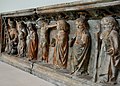
The museum has a collection of religious art from the medieval period. This includes wood and stone sculptures, wooden church furnishings and architectural fragments.[31] One of these items is the Temple Pyx.

Thinker, Auguste Rodin 1880 CE

Tapestries

[edit]

The collection has over 200 tapestries and carpets.[32]

Stained glass

[edit]

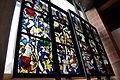
The museum is home to more than 700 stained glass panels from across Europe in the collection, including many examples of Gothic, Renaissance, and Romanesque styles.[33] Much of the glass has heraldic motifs.

In 2013, a project was commenced to conserve and research the museum's collection of stained glass from the Carmelite church at Boppard-am-Rhein, Germany. The 34 panels that make up the Burrell collection of Boppard windows have a combined surface area of 14 square metres.[34]

French art

[edit]

The collection includes an array of French art from Realist painting to Impressionism, including works by François Bonvin, Eugène Boudin, Jean-Baptiste-Camille Corot, Gustave Courbet, Charles-François Daubigny, Honoré Daumier, Edgar Degas, Henri Fantin-Latour, Édouard Manet and Jean-François Millet.[35]

Burrell had a particular appreciation for Degas and with more than 20 works by the artist,[35] the museum now holds one of the greatest collections of Degas's works in the world.[36]

Claims for Nazi-looted art

[edit]

During the 1930s and 1940s, many artworks came onto the market as a result of forced auction sales of works belonging to Jewish collectors by the Nazis. Burrell acquired works from a number of dealers during this time. Although he was not aware of it at the time, subsequent research shows that a number of works originated from forced sales.[37] Following the establishment of the UK government's Spoliation Advisory Panel in 2000, Glasgow Museums listed works from the Burrell Collection on the official spoliation website whose provenance had gaps between 1933 and 1945. This has enabled two cases to be successfully resolved by the Spoliation Advisory Panel:

  • A still life by Jean-Baptiste-Siméon Chardin from the sale of the stock of A. S. Drey, a Jewish-owned gallery in Munich. The panel agreed in 2004 that the painting had been subject to a forced sale and that it should be restituted to its rightful owners. The heirs accepted an ex gratia payment of £10,000 from Glasgow City Council and the painting remains in the collection.[38][39]
  • A Swiss early 16th-century tapestry, The Visitation, from the collection of Emma Budge, a Jewish art collector from Hamburg, The panel concluded in 2014 that Burrell's acquisition was the result of a forced sale. Glasgow City Council agreed to make an ex gratia payment to Budge's Estate that reflected the current market value of the tapestry. In consideration of this payment, Budge's Estate released any claim over the tapestry and it remains in the collection.[40][41][42]
[edit]

The nearest railway station to the Burrell Collection is Pollokshaws West (approximately a 10-minute walk), with trains to Glasgow Central normally operating four times per hour (three times an hour on Sundays).

Pollok House, administered by the National Trust for Scotland, is also situated in Pollok Country Park.

A free shuttle bus is also available, linking key points in the park from the Burrell Collection to Pollok House. One of the stops is located inside the park, nearby Pollokshaws Road, entrance and continues in a loop throughout the park.[43]

[edit]

See also

[edit]

References

[edit]
[edit]

Further reading

[edit]
Revisions and contributorsEdit on WikipediaRead on Wikipedia
from Grokipedia
The Burrell Collection is an art museum in Pollok Country Park, Glasgow, Scotland, displaying over 9,000 objects primarily amassed by shipping magnate Sir William Burrell (1861–1958) and his wife Constance, which they donated to the city in 1944 with conditions for public display.[1][2] The collection encompasses art and artifacts spanning more than 6,000 years across multiple continents and cultures, including ancient Near Eastern antiquities, Chinese ceramics from the Tang to Ming dynasties, medieval European stained glass, tapestries, arms and armor, Persian carpets, and modern works such as paintings by Édouard Manet, Paul Cézanne, and Edgar Degas, alongside sculptures by Auguste Rodin.[1][3][4] Originally opened to the public in 1983 after delays due to postwar building restrictions stipulated in the bequest, the museum underwent a major refurbishment and reopened in March 2022, enabling display of a greater proportion of the holdings and earning the Art Fund Museum of the Year award in 2023 for its innovative presentation and accessibility.[1][5]

Historical Background

Sir William Burrell's Life and Acquisition of the Collection

Sir William Burrell was born in Glasgow on 9 July 1861, the third of nine children to William Burrell, a shipping agent, and his wife Isabella.[3] The family shipping firm, Burrell & Son, had been established by his grandfather in 1856, initially focusing on canal boats before expanding into steamships and broader maritime trade.[6] Burrell joined the business in 1875 at age 14 and became a partner a decade later, leveraging economic fluctuations such as post-World War I shipping slumps to acquire vessels at low prices, which built substantial wealth enabling his art pursuits.[7][8] Burrell's interest in art developed early, influenced by artworks in his childhood home, and he began systematic collecting in the late 1880s, continuing for over 70 years until amassing approximately 9,000 objects spanning 6,000 years of history.[2][3] His acquisitions emphasized quality over quantity, guided by personal discernment rather than trends, with a focus on medieval European items like stained glass and tapestries, comprehensive Chinese ceramics and bronzes from every major dynasty, and 19th-century French works including multiple pieces by Edgar Degas.[9][2] He sourced items primarily through established London and Paris dealers, auction houses, and private sales, often tracing purchases via dealers' records and catalogues; notable examples include three stained-glass panels bought from dealer William Drake in September 1945 and "A Portrait of a Gentleman" by Frans Hals acquired at auction for £14,500 on 5 April 1948, his most expensive single purchase.[10][11][2] Burrell married Constance Mary Lumsden in 1902; the couple, who had one daughter, Marion, collaborated on the collection, with her sharing his aesthetic preferences.[8] He was knighted in 1931 for services to shipping and philanthropy. Burrell died on 29 March 1958 at age 96, leaving the bulk of his amassed holdings intact for public benefit.[2][6]

Donation to Glasgow and Initial Challenges

In 1944, during the final year of World War II, Sir William Burrell and his wife, Lady Constance Burrell, donated their extensive collection of approximately 8,000 artworks and artifacts—spanning objects from ancient civilizations to modern European pieces—to Glasgow Corporation through a formal memorandum of agreement.[3][12][13] The gift included provisions for a dedicated museum, with Burrell contributing significant funds toward its construction, estimated at £450,000 in contemporary value, to ensure the collection's proper display and preservation.[14] Key conditions stipulated that the items remain within the United Kingdom, with loans permitted only to other British institutions to minimize risks of damage during transport—a concern rooted in Burrell's experiences with fragile artifacts—and that the museum be sited in a rural setting near his Hutton Park residence in Pollok Country Park, at least 16 miles from Glasgow's city center to shield the works from industrial smoke and pollution.[15][13][16] The wartime context immediately complicated implementation, as resource shortages and national priorities halted construction and planning efforts, leaving the collection dispersed across storage facilities and temporary exhibitions in Glasgow's existing museums for years.[13] Postwar reconstruction demands further protracted progress, with site selection emerging as a primary obstacle due to the stringent locational requirements, which conflicted with urban expansion pressures and accessibility needs for public visitation.[1][16] By 1966, parliamentary discussions highlighted the ongoing frustration, noting that over two decades had elapsed without a permanent home, resulting in suboptimal storage conditions and limited public access that risked deterioration of sensitive items like tapestries and porcelains exposed to suboptimal environments.[13] These delays underscored tensions between Burrell's protective stipulations—intended to preserve the collection's integrity amid Glasgow's then-prevalent atmospheric pollution—and the practicalities of municipal governance, ultimately requiring compromises in design and eventual legislative adjustments decades later to adapt to changing circumstances.[15][16]

Site Selection and Original Establishment

Sir William Burrell stipulated in the 1944 deed of gift to Glasgow that his collection be housed in a purpose-built museum situated in a rural environment, specifically at least 16 miles from the city center or within four miles of the village of Killearn in Stirlingshire, to allow public appreciation amid natural surroundings.[17][18] Postwar financial constraints and the stringent location requirements delayed site identification, with the collection remaining in storage or temporary displays for decades after Burrell's death in 1958.[3] In 1966, the 360-acre Pollok Country Park, previously part of the Maxwell estate, was donated to Glasgow by its last private owner, Anne Maxwell Macdonald, providing a large wooded area on the city's southern outskirts approximately three to six miles from the center.[3][19] Although Pollok deviated from the precise geographic stipulations, authorities deemed it compliant with the intent of a countryside setting conducive to viewing the artworks, leading to its selection after prolonged searches.[20][1] Following the park's acquisition, an international architectural competition ensued, culminating in the commissioning of a dedicated structure in the 1970s; the museum formally opened to the public in 1983, drawing over one million visitors in its inaugural year.[3][1]

The Museum Building

Architectural Design and Construction (1970s)

In 1970, Glasgow Corporation launched an international competition to design a purpose-built museum for the Burrell Collection in Pollok Country Park.[21] The competition sought a structure that would harmonize with the park's landscape while accommodating the collection's diverse artifacts, including large-scale items like tapestries and architectural fragments.[22] The winning entry, selected in 1971, was submitted by architect Barry Gasson in collaboration with Brit Andresen and John Meunier, all Cambridge-educated academics.[7][23] Their modernist design featured a low-profile pavilion of brick and glass, emphasizing modular construction, extensive natural daylighting through glazed walls, and sightlines integrating indoor displays with the surrounding woodland.[24] This approach reflected 1970s Brutalist influences adapted to create a "walk in the woods" experience, prioritizing the symbiotic relationship between architecture, art, and nature over overt monumentality.[25] Construction commenced following a tender process in November 1977, with site work beginning in April 1978.[26] The project employed traditional procurement under JCT '63 contracts and culminated in completion by March 1983, spanning 14,430 square meters at a total cost of £16.5 million.[26] The building opened to the public on October 21, 1983, after formal inauguration by Queen Elizabeth II, marking a significant achievement in post-war Scottish museum architecture as a rare megastructure tailored for cultural preservation.[27][28]

Refurbishment Project (2016–2022)

The Burrell Collection closed to visitors in October 2016 to initiate a comprehensive refurbishment addressing structural deterioration, limited accessibility, and outdated environmental controls in the 1970s-era building.[29] The project, designed by John McAslan + Partners, expanded gallery space by 35% to accommodate 24 reconfigured galleries displaying 225 exhibits, including long-term installations like the Wagner garden carpet and digital interpretive elements for enhanced object context.[30][29] Architectural modifications included a new central concrete stairway linking all three floors—previously inaccessible to the public—additional entrances for better circulation, and a dedicated temporary exhibition space, while preserving the original Brutalist elements.[31] Sustainability upgrades featured a replacement roof, removal of 3,120 m² of inefficient double glazing (achieving a U-value of 1.6 W/m²K), improved airtightness, and mechanical systems that halved heat load and reduced cooling demand by 20%, resulting in a BREEAM Excellent rating placing it among the top 10% of UK energy-efficient buildings.[32][33] The total cost reached £68.25 million, exceeding initial 2015 estimates of £60–66 million, with funding comprising nearly 50% from Glasgow City Council, over 25% from the National Lottery Heritage Fund, £5.75 million from the Scottish Government, and the balance from UK Government grants, trusts, and private donors.[34][29] The refurbishment concluded with the museum's reopening on 29 March 2022, incorporating tactile and child-friendly displays, a learning centre, expanded outdoor piazza with café seating, and park enhancements like improved paths, signage, and electric shuttles for better site integration.[35][29]

Awards, Sustainability Features, and Post-Reopening Reception

The Burrell Collection's refurbishment earned multiple accolades, including the Art Fund Museum of the Year 2023 prize, which carried a £120,000 award and recognized the venue's transformation and enhanced visitor experience.[36][37] In 2024, it received the Royal Incorporation of Architects in Scotland (RIAS) Andrew Doolan Award for Best Building in Scotland, honoring the project's architectural retrofit and integration of heritage with modern functionality.[38][39] Additional honors included five Scottish Design Awards, with a gold in the Design for Good category and the judges' grand prize, as well as the AJ Retrofit Award in 2023 for exemplary adaptive reuse.[40][41] Sustainability was a core focus of the 2016–2022 refurbishment, achieving a BREEAM Excellent rating that placed the building in the top 10% of UK energy-efficient structures through measures like improved airtightness, new low-emission glazing, and enhanced insulation reducing reliance on fossil fuels for climate control.[42] All demolished materials, including stainless steel cladding, were recycled onsite, diverting waste and saving an estimated 27 tons of carbon dioxide emissions.[43][44] The design prioritized low-carbon operations, such as passive ventilation and efficient HVAC systems tailored to artifact preservation needs, while expanding gallery space by 35% without proportional energy increases.[45][46] Following its reopening on 29 March 2022, the Burrell Collection attracted over 500,000 visitors in the first year, reaching its 1 millionth visitor by 13 February 2024 and generating £20 million in economic impact for Glasgow.[47][48] King Charles III officially reopened the venue on 13 October 2022, underscoring its cultural significance. Visitor surveys indicated 97% satisfaction rates, with praise for expanded displays, improved accessibility, and contextual storytelling around the collection's origins.[49] Reviews highlighted the refurbished building's spaciousness and user-friendliness, though some noted the eclectic arrangement could feel disjointed; overall reception affirmed its status as a revitalized destination blending heritage conservation with contemporary engagement.[50][51]

The Art Collection

Overview of Scope and Composition

The Burrell Collection comprises approximately 9,000 objects, primarily amassed by shipping magnate Sir William Burrell and his wife Lady Constance from the 1880s until 1944, when they donated it to Glasgow.[52][53] These holdings span over 6,000 years of human history, from Neolithic Chinese ceramics dating to around 4000 BCE to early 20th-century European paintings and sculptures, reflecting Burrell's preference for objects that evoked atmospheric and textural qualities suited to domestic display.[3][1] The collection's composition emphasizes decorative and applied arts over fine art paintings, with strengths in ceramics, textiles, metalwork, and ivories across multiple civilizations.[54] European holdings dominate numerically, featuring late medieval and Gothic pieces such as tapestries, stained glass, and limestone sculptures from France and Burgundy, alongside Renaissance silver and 18th-19th century furniture.[1] Asian art forms a core pillar, particularly Chinese stoneware and porcelain from the Tang to Qing dynasties, including export wares influenced by European trade, as well as Japanese netsuke and bronzes.[55] Middle Eastern and Islamic contributions include Persian carpets, Fatimid glass from Egypt, and Mesopotamian ivories from sites like Nimrud.[52] Smaller but notable segments cover ancient Egyptian artifacts, such as chariot fittings from the 19th Dynasty, and modern Western works, including Impressionist oils by Édouard Manet and sculptures by Auguste Rodin, acquired through Burrell's dealings with dealers like Alexander Reid.[3] This eclectic assembly avoids comprehensive coverage of any single school or period, prioritizing rarity, craftsmanship, and aesthetic harmony over systematic representation, with objects selected for their potential integration into Burrell's Hutton Park home.[1] Post-donation additions by Glasgow Museums have been minimal, preserving the original donor's vision.[49]

Medieval and Gothic European Art

The Burrell Collection features extensive holdings of medieval and Gothic European art, emphasizing late medieval and early Renaissance works from regions including France, England, and the Low Countries. Key categories encompass over 200 tapestries, more than 600 stained glass panels, Gothic stone sculptures, ivories, alabaster carvings, and medieval arms and armor. These artifacts, acquired by Sir William Burrell primarily in the early 20th century, reflect technical mastery in weaving, glazing, and stonework characteristic of Gothic aesthetics, with themes spanning religious devotion, heraldry, and daily life.[3][52][56] Tapestries form one of the collection's premier strengths, numbering around 200 pieces mostly from the late 15th to early 16th centuries, ranking among the world's finest ensembles of medieval and Renaissance textiles. Woven primarily in wool and silk from workshops in Tournai, Brussels, and the Rhineland, they depict diverse motifs such as hunts, banquets, saints, and mythological scenes. Notable examples include the Franco-Netherlandish Fight Between a Falcon and a Heron (c. 1525), portraying huntsmen observing avian combat, and a Tournai banquet tapestry (c. 1510) illustrating an open-air meal in a garden of love setting. German Rhineland tapestries feature standing saints, exemplifying expressive figural groups.[3][56][57] Stained glass represents another cornerstone, with over 600 panels varying from small roundels to full tracery lights, sourced from ecclesiastical sites across medieval Europe. English examples include a Canterbury Cathedral Royal Window panel (c. 1483–1484) portraying Princess Cecily of York, daughter of Edward IV, in vibrant blue, burgundy, and yellow hues. Norwich School panels depict angels, showcasing intricate narrative and symbolic elements typical of Perpendicular Gothic style. These works highlight advancements in pot-metal glass and leading techniques for luminous, didactic church decoration.[3][58] Gothic sculpture includes painted limestone retables and figural carvings, such as a Burgundian Calvary retable (c. 1450–1500) depicting Christ crucified between the Virgin Mary, Saint John the Evangelist, and attendant saints, underscoring Eucharistic themes central to late Gothic piety. Alabaster and wood sculptures from England and the Continent further illustrate devotional iconography, while arms and armor—swords, helmets, and plate—provide insight into medieval military material culture. Ivories and bronzes complement these, offering portable expressions of Gothic naturalism and piety.[59][52] These holdings demonstrate Burrell's discerning eye for Gothic-era craftsmanship, prioritizing completeness and provenance over mere rarity, with many pieces restored to reveal original polychromy and detailing.[60][61]

Chinese and Asian Art

The Chinese holdings in the Burrell Collection represent one of the most significant assemblages of Chinese art in the United Kingdom, encompassing over 1,800 objects that span from the Neolithic period to the Qing dynasty (1644–1912).[62] These artifacts include ceramics, bronzes, jades, and stoneware, reflecting Sir William Burrell's discerning acquisition strategy focused on dynastic-era works of exceptional quality.[10] The collection features approximately 200 pieces of pottery ranging from prehistoric times to the Tang dynasty (618–907 CE), alongside later porcelain exemplars.[17] Porcelain forms a cornerstone of the Chinese section, with 208 vases documented, many adorned in the blue-and-white style characteristic of Qing production, acquired through Burrell's targeted purchases in the early 20th century.[63] Notable among the stoneware and porcelain items gifted to Glasgow in 1944 are vessels exemplifying technical mastery in glazing and form, such as those from the Song (960–1279) and Ming (1368–1644) dynasties.[64] A standout sculpture is a limestone ram's head carved during the Tang dynasty, evidencing the period's advancements in naturalistic animal representation and funerary art traditions. Beyond Chinese works, the Burrell Collection incorporates select Asian holdings, particularly from Japan, including around 30 Ukiyo-e woodblock prints produced between 1720 and 1868, which capture scenes from kabuki theater and daily life.[65] One such print depicts the demon-queller Shoki, dated circa 1849–1853, highlighting the collection's representation of Edo-period (1603–1868) graphic arts amid its predominantly Chinese focus.[66] These Japanese items, donated alongside the Chinese corpus in 1944, complement the broader East Asian scope managed by Glasgow Museums, which totals approximately 4,620 objects but attributes its strength to Burrell's bequest.[67]

Islamic, French, and Other Holdings

The Islamic holdings in the Burrell Collection derive from Sir William Burrell's acquisitions of textiles, ceramics, glassware, and metalwork spanning the Middle East, North Africa, and Spain. Key items include pile carpets and prayer rugs from Persian, Mughal, and Turkish origins, featuring motifs such as arabesques, animal designs, garden paradises, and hunting scenes that reflect Islamic cultural themes.[68] Specific examples encompass the 17th-century Wagner Garden Carpet from Persia, a Mughal grotesque animal carpet fragment, and classic Persian arabesque carpets, with 46 highlights documented in thematic displays on weaving techniques, pilgrimage, and women's roles in production.[68] Complementary objects feature Iranian and Turkish ceramics, Mudejar pottery from Spain, and a green-tinted moulded glass dish from Fatimid Egypt (11th century CE).[69][70] French holdings emphasize 19th-century paintings alongside medieval works, showcasing Burrell's focused purchases from Parisian dealers. The Impressionist and Post-Impressionist selections include oils and pastels by Édouard Manet, such as Women Drinking Beer (c. 1878), Paul Cézanne's Chateau de Medan, and pieces by Edgar Degas, forming one of the UK's notable private assemblages of these artists outside major national institutions.[52][71] Earlier French art comprises Gothic-era sculptures, exemplified by a painted limestone retable from Burgundy (c. 1450–1500 CE) depicting Christ crucified flanked by saints.[52] Other holdings extend to ancient civilizations beyond Europe, Asia, and Islamic regions, incorporating artifacts from Mesopotamia, Egypt, and Rome acquired through antiquities markets. Mesopotamian reliefs include a gypsum alabaster head of a royal attendant from Nimrud's North-West Palace, dating to the reign of Ashurnasirpal II (883–859 BCE).[72] Egyptian items feature a statue of Paraherwenemef, Chief Charioteer, inscribed with cartouches of Ramesses II from the 19th Dynasty (1290–1224 BCE), alongside pottery exceeding 2,000 years in age.[73] Roman sculptures round out this category, contributing to the collection's span across five millennia.[52]

Notable Objects and Their Significance

![Statue of The Thinker, 1880 CE.][float-right] The Burrell Collection houses Auguste Rodin's The Thinker, a bronze sculpture cast between 1880 and 1881, depicting a muscular male figure in a tense, contemplative pose originally conceived as Dante Alighieri pondering the Inferno.[58] This work stands as one of the most recognizable sculptures globally, embodying themes of introspection and human intellect, and forms part of the collection's significant holdings of 14 Rodin bronzes, second in scale only to those at the Victoria and Albert Museum in the United Kingdom.[74] A premier example of medieval stained glass is the panel portraying Princess Cecily of York (1469–1507), daughter of King Edward IV, dated circa 1483–1484 and originating from the Royal Window at Canterbury Cathedral.[75] This vividly colored piece exemplifies late-15th-century English glassmaking artistry through its intricate detailing and heraldic elements, contributing to the collection's internationally important assemblage of over 800 stained glass items that highlight Gothic technical and aesthetic achievements.[3][76] Among Chinese ceramics, the Meiping vase from the Ming Dynasty's Hongwu period (1368–1398) features a rare five-clawed dragon motif and the inscription "Chun Shou," marking it as an exceptionally scarce early imperial porcelain vessel produced at Jingdezhen and discovered in Kaifeng.[58] Its survival underscores the collection's strength in pre-15th-century Chinese art, one of the foremost such groupings in the UK, valued for demonstrating advancements in underglaze blue decoration and symbolic imperial iconography.[52] The Warwick Vase, a 2nd-century CE Roman marble vessel restored in 1774, was excavated from Emperor Hadrian's Villa at Tivoli, Italy, representing classical antiquity's grandeur in its Bacchic reliefs and proportions adapted from Greek prototypes.[58] This artifact exemplifies the collection's ancient holdings, which include Egyptian pottery over 2,000 years old and Mesopotamian ivories, providing tangible links to civilizations spanning six millennia.[52] Edgar Degas's pastel The Red Ballet Skirts (circa 1900) captures three exhausted dancers in crimson attire during a momentary rest, offering insight into the performer's physical demands and backstage reality through Degas's impressionistic technique.[58] As part of robust 19th-century French holdings, including works by Manet and Cézanne, it highlights Burrell's preference for modern European painting that prioritizes candid observation over idealization.[52]

Controversies and Provenance Issues

Nazi-Looted Art Claims and Resolutions

The Burrell Collection has been the subject of spoliation claims under the UK's Spoliation Advisory Panel (SAP), established in 2000 to address Nazi-era losses of cultural property. Glasgow City Council, as custodian, conducted provenance reviews identifying items acquired by Sir William Burrell in the 1930s from sales coerced by Nazi persecution of Jewish owners. Due to the 1944 bequest agreement's prohibitions on deaccessioning or exporting works, resolutions have favored ex gratia compensation over restitution, preserving the collection's integrity while addressing moral claims.[77] One resolved case concerns the still life painting Le Pâté de Jambon, attributed to a follower of Jean-Baptiste-Siméon Chardin. The work originated from a Munich gallery owned by Jewish shareholders, who faced extortionate tax demands from Nazi-aligned officials, leading to a forced sale at a Berlin auction on 16–17 June 1936. Burrell purchased it in June 1936 from dealer Julius Böhler for £647.15s. Heirs of the shareholders submitted a claim following the council's 2001 publication of 232 items with uncertain provenance. The SAP's report determined a strong moral and legal basis for restitution, recommending urgent return despite legal hurdles from the bequest terms. The council acknowledged the moral obligation but, citing funding needs and restrictions, pursued compensation—estimated at £20,000 for a follower of Chardin or up to £100,000 if authentic—rather than transfer.[78][79] A second case involved the 16th-century Swiss tapestry fragment The Visitation, depicting the Virgin Mary and Saint Elizabeth. It belonged to Emma Ranette Budge, a Jewish art collector from Hamburg whose estate faced Nazi confiscation and forced sale at auction in 1937 to fund the regime. Burrell acquired the piece on 8 August 1938 for £315. Budge's heirs filed a claim in 2004. The SAP upheld it in 2014, confirming spoliation and a valid moral claim, but recommended compensation given the bequest's constraints. In August 2015, Glasgow City Council approved an ex gratia payment of tens of thousands of pounds (based on auction house valuations), securing release of the ownership claim; the tapestry remains on display with provenance annotation.[80][81] Further scrutiny in 2022, coinciding with the collection's refurbishment reopening, highlighted two additional works traced to 1930s German forced sales from Jewish owners, including items in storage. Advocates urged ethical deaccessioning, but no equivalent SAP proceedings ensued, with the council emphasizing continued provenance research and transparency over removal. These cases reflect broader challenges in applying Nazi-era restitution principles to restricted bequests, prioritizing financial redress where physical return contravenes donor intent.[82][83]

Broader Ethical Concerns in Acquisition

The acquisition of artifacts for the Burrell Collection, amassed by Sir William Burrell primarily between 1900 and 1944 through purchases at auctions and from dealers, has prompted ethical scrutiny in light of modern standards on colonial-era trade and provenance. While Burrell's methods were legal and conventional for affluent collectors of the period, many items trace origins to imperial networks where unregulated excavations and sales of antiquities from regions like Mesopotamia, Egypt, and China supplied European markets.[84] For instance, Assyrian reliefs from Nimrud, acquired via 19th- and early 20th-century dealers, reflect a broader antiquities trade often detached from originating communities' consent or benefit.[85] A significant subset of holdings, including European decorative arts, connects indirectly to the transatlantic slave trade through creators or prior owners who derived wealth from plantations and commerce in enslaved labor. Examples include stained glass panels linked to Scottish merchants profiting from Caribbean sugar estates and Dutch glassware commissioned by traders active in the African slave routes, highlighting how Glasgow's mercantile economy—tied to tobacco, sugar, and shipping—intersected with Burrell's acquisitions.[11] These ties, while not implying Burrell's direct involvement (as slavery had ended decades prior), underscore debates on whether collections funded or sourced via exploitative empires perpetuate historical inequities without restitution.[86] In response, Glasgow Life Museums, stewards of the collection since its 1944 bequest, conducted extensive provenance reviews during the 2016–2022 refurbishment, integrating slavery and colonial narratives into displays for over 300 objects with identified links.[87] This includes decolonial trails and contextual labels emphasizing transparency, community consultations with 15,000 participants, and commitments to ongoing research without documented repatriation claims for non-Nazi items.[88] Critics argue such acknowledgments, while progressive, fall short of returning artifacts to source cultures, but proponents note the absence of evidence for illicit sourcing by Burrell himself, positioning the approach as ethically responsible within legal constraints of the donation's terms.[89][3]

Public Access and Cultural Impact

The Burrell Collection is situated within Pollok Country Park, accessible primarily via 2060 Pollokshaws Road, with a postcode of G43 1AT for satellite navigation.[90] Parking is available in two surface lots within the park— one via Pollokshaws Road and another via Lochinch Road—with charges of £5 for up to four hours and £10 for all-day stays, applicable from 10:00 a.m. to 6:00 p.m. and payable via the RingGo app.[90] Nineteen designated accessible bays are provided free of charge for blue badge holders, without requiring advance booking, on a tarmac surface near the museum entrance.[90][91] Public transport options include direct bus services from Glasgow city centre, such as routes 57 and 57A to Pollokshaws Road, route 3 to Shawbridge Street, and routes 34 and 34A to Dumbreck Road, with services departing frequently.[90] Train access is via ScotRail services from Glasgow Central Station to Pollokshaws West (four trains per hour) or Shawlands stations, followed by a walk through the park, which can take 20-30 minutes.[90] A free electric shuttle bus operates daily from 10:00 a.m. to 6:15 p.m., running a 20- to 30-minute loop connecting the main park entrance at 2060 Pollokshaws Road to the museum and other park facilities.[90][91] Visitor facilities emphasize accessibility and convenience, with the museum open Monday to Thursday and Saturday from 10:00 a.m. to 5:00 p.m., and Friday and Sunday from 11:00 a.m. to 5:00 p.m.[90] A cafe operated by Benugo provides hot and cold drinks, snacks, cakes, and light meals, with indoor and outdoor seating; full menu service ends at 3:15 p.m., after which limited options remain available until closing.[92] A gift shop offers merchandise related to the collection, and amenities include two Changing Places toilets, nine accessible toilets, an accessible lift, hearing loops, a quiet room with baby feeding facilities, step-free entrances with ramps, and loaned wheelchairs for those with limited mobility.[93][94][90]

Economic and Educational Influence Post-Reopening

Following its reopening on March 29, 2022, the Burrell Collection generated an estimated £19.9 million in economic benefits for Glasgow and £21.1 million for Scotland in the first six months through visitor spending, tourism, and related activities.[95] By the end of its first year, the museum had attracted over 500,000 visitors, contributing approximately £20 million to the local economy via direct expenditures on admissions, retail, and hospitality, as well as indirect effects from increased tourism.[37] These figures reflect a strong recovery from pandemic disruptions, with the refurbished site serving as a catalyst for broader cultural and economic revitalization in Glasgow, including heightened international profile that sustained visitor inflows.[96] Visitor numbers continued to grow post-reopening, reaching 600,000 within 12 months and surpassing 1 million by February 2024, underscoring sustained economic momentum despite no entry fees for most patrons.[48] The 2023 Art Fund Museum of the Year award, carrying a £100,000 prize, further amplified economic impacts by enhancing marketing and drawing additional tourists, with interim analyses confirming the site's role in bolstering Glasgow's post-refurbishment tourism sector.[47] Educationally, the reopened Burrell Collection expanded access through curriculum-linked school visits and resources tailored for nursery, primary, and secondary groups, emphasizing hands-on engagement with its global holdings to foster learning in art history, cultural diversity, and interdisciplinary topics.[97] Programs include themed guided tours, creative workshops, and family trails that integrate collection objects into educational narratives, supporting formal curricula while promoting inclusive outreach to diverse audiences via community co-curation and accessibility initiatives.[98] These efforts have re-engaged local schools and underserved groups, enhancing public understanding of historical artifacts and global interconnections, though quantitative impact metrics on participant outcomes remain limited in available reports.[96]

References

User Avatar
No comments yet.