Hubbry Logo
ButtocksButtocksMain
Open search
Buttocks
Community hub
Buttocks
logo
8 pages, 0 posts
0 subscribers
Be the first to start a discussion here.
Buttocks
Buttocks
from Wikipedia

Buttocks
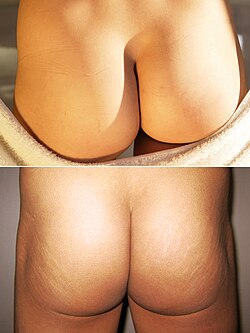
Buttocks of a human female (upper) and a human male (lower)
Details
ArterySuperior gluteal artery, inferior gluteal artery
NerveSuperior gluteal nerve, inferior gluteal nerve, superior cluneal nerves, medial cluneal nerves, inferior cluneal nerves
Identifiers
Latinclunis
MeSHD002081
TA98A01.1.00.033
A01.2.08.002
TA2157
FMA76446
Anatomical terminology

The buttocks (sg.: buttock) are two rounded portions of the exterior anatomy of humans, located on the posterior of the pelvic region. The buttocks are located between the lower back and the perineum. They are composed of a layer of exterior skin and underlying subcutaneous fat superimposed on a left and right gluteus maximus and gluteus medius muscles. The two gluteus maximus muscles are the largest muscles in the human body. They are responsible for movements such as straightening the body into the upright (standing) posture when it is bent at the waist; maintaining the body in the upright posture by keeping the hip joints extended; and propelling the body forward via further leg (hip) extension when walking or running.[1]

In many cultures, the buttocks play a role in sexual attraction.[2] Many cultures have also used the buttocks as a primary target for corporal punishment,[3] as the buttocks' layer of subcutaneous fat offers protection against injury while still allowing for the infliction of pain.

Structure

[edit]

The buttocks are formed by the masses of the gluteal muscles or "glutes" (the gluteus maximus muscle and the gluteus medius muscle) superimposed by a layer of fat. The superior aspect of the buttock ends at the iliac crest, and the lower aspect is outlined by the horizontal gluteal crease. The gluteus maximus has two insertion points: 13 superior portion of the linea aspera of the femur, and the superior portion of the iliotibial tractus. The masses of the gluteus maximus muscle are separated by an intermediate intergluteal cleft or "crack" in which the anus is situated.

The analogous anatomical structures known as ischial callosities allow primates to sit upright without resting their weight on their feet as four-legged animals do. The pads enable the monkeys to sleep sitting upright on thin branches, beyond reach of predators, without falling. Humans do not possess ischial callosities due to the gluteal muscles being large enough to provide the same cushioning.[4] Females of certain species of baboon have red callosities that blush to attract males. In the case of humans, females tend to have proportionally wider and thicker buttocks due to higher subcutaneous fat and proportionally wider hips. In humans they also have a role in propelling the body in a forward motion and aiding bowel movement.[5][6]

Some baboons and all gibbons, though otherwise fur-covered, have characteristic naked ischial callosities on their rears. While human children generally have smooth buttocks, mature males and females have varying degrees of hair growth, as on other parts of their body. Females may have hair growth in the gluteal cleft (including around the anus), sometimes extending laterally onto the lower aspect of the cheeks. Males may have hair growth over some or all of the buttocks.

Names

[edit]

The Latin name for the buttocks is nates (English pronunciation /ˈntz/ NAY-teez,[7] classical pronunciation nătes [ˈnateːs][8]) which is plural; the singular, natis (buttock), is rarely used. There are many colloquial terms for them.

[edit]
[edit]
Buttocks of a male
Buttocks of a female

See also

[edit]

References

[edit]
[edit]
Revisions and contributorsEdit on WikipediaRead on Wikipedia
from Grokipedia
The buttocks, also known as the gluteal region, consist of two rounded, fleshy prominences on the posterior aspect of the human , primarily composed of thick layers of muscle and subcutaneous fat that provide cushioning and support during sitting. These structures lie posterior to the bony , bounded superiorly by the and inferiorly by the gluteal fold, and play essential roles in locomotion, posture, and pelvic stability. The primary musculature of the buttocks comprises the gluteal muscle group, including the , , and . The , the largest and most superficial, originates from the ilium, , and related structures and inserts into the and of the . The and minimus originate from the ilium and insert into the of the . The forms the bulk of the buttock's contour and functions as the chief extensor and external rotator of the , aiding in activities such as rising from a seated position, climbing stairs, and controlling trunk flexion during running. The and minimus, located deeper and more laterally, primarily act as hip abductors and stabilizers, preventing pelvic drop during walking and single-leg stance by compressing the into the . In , the enlargement of the distinguishes hominids from other and is linked to enhanced bipedal capabilities, particularly in running, where it decelerates the swing leg and stabilizes the pelvis against high-impact forces. Medically, the gluteal region's is critical for lower limb function, with injuries or weaknesses in these muscles often leading to conditions like or , underscoring their importance in overall mobility and balance.

Anatomy

Muscular Composition

The buttocks are primarily composed of the gluteal muscles, which form the prominent rounded contours of the posterior pelvis and upper thigh. These muscles include the gluteus maximus, gluteus medius, and gluteus minimus, collectively responsible for the structural bulk and shape of the region. The gluteus maximus is the largest and most superficial of the gluteal muscles, constituting the majority of the buttock's mass and giving it its characteristic prominence. It originates from the posterior aspect of the ilium behind the posterior gluteal line, the dorsal surface of the sacrum and coccyx, and the sacrotuberous ligament. Its fibers insert primarily into the iliotibial tract and the gluteal tuberosity of the proximal femur. The gluteus medius lies deep to the maximus and originates from the external surface of the ilium between the anterior and posterior gluteal lines, inserting into the lateral surface of the greater trochanter of the femur. The gluteus minimus, the smallest and deepest of the trio, arises from the outer surface of the ilium between the anterior and inferior gluteal lines, with insertions on the anterior border of the greater trochanter and a small portion blending into the iliofemoral ligament. The muscular composition exhibits a layered , with the forming the superficial layer that covers the posterior . Beneath it lies the middle layer, consisting of the and minimus, which fan out laterally. The deep layer includes smaller rotator muscles such as the piriformis, which originates from the anterior and and inserts on the , and the obturator internus, arising from the pelvic walls and obturator membrane before passing through the lesser sciatic foramen to attach to the . These deep structures contribute to the overall stability of the gluteal region without dominating its external contour. The , particularly the , consist of a mixture of muscle types, including slow-twitch (type I) fibers for and fast-twitch (type II) fibers for power generation, with the latter comprising a predominant proportion in the maximus to support explosive movements. This composition varies slightly across individuals but generally balances sustained postural support with rapid force production.

Skeletal and Adipose Elements

The skeletal framework of the buttocks is primarily provided by the , a bony structure formed by the fusion of the ilium, , and pubis on each side, which articulate posteriorly with the and . The ilium forms the broad, superior portion of the , contributing to the lateral flare of the and serving as an attachment site for surrounding tissues; the constitutes the posterior-inferior part, including the tuberosities that support sitting; and the pubis forms the anterior aspect, completing the ring-like pelvic girdle. Posteriorly, the —a triangular formed by five fused vertebrae—anchors the to the spine, while the , or tailbone, consisting of three to five rudimentary vertebrae, provides additional posterior support and flexibility. Stability in this region is maintained by a complex network of ligaments, particularly those of the , which connects the to the ilium bilaterally. The interosseous sacroiliac ligament, the strongest of these, lies deep within the joint and resists shear forces, while the posterior sacroiliac ligaments reinforce the dorsal aspect, and the anterior and inferior ligaments provide additional ventral and caudal support. These ligaments collectively limit excessive motion, ensuring the transfer of loads from the upper body to the lower limbs. Overlying the skeletal elements, forms a prominent subcutaneous layer in the buttocks, contributing to contour, cushioning, and functional roles. This gluteal fat is predominantly , specialized for in the form of triglycerides, which can be mobilized during periods of . It also aids in through insulation, helping to maintain core body temperature by reducing heat loss, particularly in the lower body. Distribution varies significantly by sex, with females exhibiting thicker gluteal-femoral subcutaneous fat layers—often 1.5 to 2 times greater than in males—due to estrogen-driven deposition, an adaptation linked to reproductive demands such as supporting and by providing a readily accessible energy reserve. Anatomical variations in these elements influence buttock morphology across populations. Ethnic differences in adipose deposition are evident, with, for example, individuals showing greater peripheral (gluteal) fat accumulation compared to individuals, who tend toward more central distribution, potentially affecting metabolic profiles. Similarly, pelvic tilt angles exhibit ethnic variability; the average anterior is approximately 14 degrees overall, but studies indicate subtle differences, such as slightly higher values in Asian cohorts (around 14 degrees) compared to Caucasian (around 13 degrees) or African American groups (around 12 degrees), influencing posture and load distribution.

Innervation and Blood Supply

The innervation of the buttocks primarily arises from branches of the sacral plexus, formed by the anterior rami of spinal nerves L4 through S3. The superior gluteal nerve, originating from the posterior divisions of L4, L5, and S1, exits the pelvis superior to the piriformis muscle via the greater sciatic foramen and provides motor innervation to the gluteus medius, gluteus minimus, and tensor fasciae latae muscles. The inferior gluteal nerve, derived from the posterior divisions of L5 through S2, emerges inferior to the piriformis and supplies motor innervation exclusively to the gluteus maximus muscle. Additionally, the sciatic nerve, the largest branch of the sacral plexus (from L4-S3), passes through the gluteal region inferior to the piriformis muscle, contributing to the overall neural framework without direct muscular innervation in this area. Sensory innervation to the skin of the buttocks is provided by the posterior femoral cutaneous nerve, a sensory branch of the sacral plexus arising from S1 through S3, which emerges inferior to the piriformis and distributes branches to the posterior thigh and inferior gluteal skin. The arterial blood supply to the buttocks derives mainly from branches of the internal iliac artery. The superior gluteal artery, the largest branch of the posterior division of the internal iliac, enters the gluteal region superior to the piriformis muscle and supplies the gluteus medius, gluteus minimus, and overlying tissues via deep and superficial branches. The inferior gluteal artery, from the anterior division of the internal iliac, passes inferior to the piriformis and provides blood to the gluteus maximus, sciatic nerve, and posterior thigh structures. Venous drainage occurs via accompanying venae comitantes: the superior gluteal veins drain the upper gluteal region and empty into the internal iliac vein, while the inferior gluteal veins collect blood from the lower buttocks and posterior thigh before similarly converging into the internal iliac vein. Lymphatic vessels from the gluteal tissues drain primarily to the internal iliac lymph nodes, which lie along the internal iliac vessels and receive afferents from the pelvic viscera, , and gluteal region, facilitating the spread of infections if compromised.

Functions

Biomechanical Roles

The plays a primary role in extension, particularly during the action of rising from a seated position, where it contracts powerfully to extend the and elevate the trunk against . This muscle, in coordination with the hamstrings, generates substantial force to overcome the body's weight, with contact forces during sit-to-stand movements reaching approximately 3.5 times body weight depending on seat height and technique. The , meanwhile, facilitates abduction and provides lateral stability, essential for maintaining balance during transitional movements like standing from sitting. In the gait cycle, the buttocks contribute significantly to propulsion and pelvic equilibrium. During the push-off phase, the gluteus maximus activates to extend the hip, propelling the body forward and facilitating efficient stride progression, particularly in activities involving acceleration or incline walking. Concurrently, the gluteus medius and minimus stabilize the pelvis in the frontal plane during the stance phase, contracting to counteract the downward pull of body weight on the contralateral side and preventing pelvic drop, which would otherwise result in a Trendelenburg gait pattern. The and overlying also aid in shock absorption during dynamic impacts, such as those encountered in running or jumping. Eccentric contractions of the and medius dissipate vertical forces upon ground contact, reducing stress transmission to the and spine, while the subcutaneous layer in the buttocks provides additional viscoelastic cushioning to attenuate peak loads. studies demonstrate that activation peaks at 50-100% of maximum voluntary isometric contraction (MVIC) during squat exercises, which mimic the eccentric demands of and in these activities.

Physiological Support

The buttocks play a crucial role in physiological support during sitting and weight-bearing activities, primarily through the combined action of gluteal and the underlying ischial tuberosities. When seated, the ischial tuberosities, the bony prominences of the , bear a substantial portion of body weight—approximately 60-70% distributed across the tuberosities and adjacent thighs—while the overlying gluteal layer helps redistribute this load to prevent localized concentrations that could lead to tissue damage. Studies on seated posture indicate that interface pressures at these sites can reach 20–30 kPa (150–225 mmHg) due to the small contact area, underscoring the importance of gluteal in cushioning and equalizing forces for sustained comfort and tissue viability. This distribution mechanism is essential for maintaining postural stability over prolonged periods, as thicker gluteal correlates with reduced peak pressures and improved load dissipation. Beyond mechanical support, the muscular and adipose padding of the buttocks provides vital protection to underlying pelvic structures, including the and reproductive organs. The , particularly the , form a robust posterior barrier that absorbs impacts and shields sensitive viscera from external trauma, while the subcutaneous layer adds compliant cushioning to mitigate compressive forces on the and posterior pelvic wall. This protective role is particularly evident in activities involving direct pressure on the posterior , where the combined mass of muscle and prevents direct transmission of forces to delicate structures like the , , and rectal wall. The adipose tissue in the buttocks also contributes to thermoregulation by serving as an insulating layer that helps maintain core body temperature. Subcutaneous fat in the gluteofemoral region, which is notably thick in this area, acts as a thermal barrier, reducing heat loss in cooler environments and stabilizing internal temperatures through its low thermal conductivity. This insulation is especially adaptive in humans, where the buttocks' fat depot complements overall body fat distribution to support homeostasis without compromising mobility. Metabolically, gluteofemoral fat functions as a key energy reserve with distinct sex-specific adaptations that enhance physiological resilience. In women, this depot accumulates higher proportions of subcutaneous compared to men, serving as a buffered store for excess that protects against metabolic disorders like . Notably, gluteofemoral fat is enriched in long-chain polyunsaturated fatty acids, such as omega-3s (e.g., DHA), which are preferentially mobilized during and to support fetal development and production, reflecting an evolutionary prioritization of this region for reproductive demands. These sex differences highlight the buttocks' role in long-term , with women's greater gluteofemoral stores providing a metabolic advantage during periods of nutritional stress.

Cultural and Linguistic Aspects

Terminology Across Languages

In English, the term "buttocks" refers to the two protuberances forming the rump and dates to around 1300, derived from buttuc, meaning "end" or "short ridge of land," ultimately from Proto-Germanic butaz and the bhau- "to strike," evoking a blunt or rounded shape. Colloquial variants include "bum," which emerged in the late as a term for the posterior, possibly an onomatopoeic formation or shortening related to "bottom," though its precise origin remains uncertain among linguists. "Rear," often as "rear end," stems from the 17th century, with "rear" itself from riere "behind," borrowed into to denote the hindmost part of the body. like "ass" for the buttocks traces to ærs "rump" or "," from Proto-Germanic arsoz, a distinct root from the unrelated donkey term "ass" borrowed from Latin asinus around the 8th century; the "ass" evolved as a phonetic variant of British "arse." Historically, terminology for the buttocks evolved from ancient languages with roots in anatomy and everyday description. In , the word pygē (πυγή) denoted the buttocks or rump, as seen in compounds like kallipygos (καλλίπυγος), meaning "having beautiful buttocks," combining kallos "" with pygē; this term influenced later artistic and . In Latin, formal terms included clunes (plural of clunis, "buttock" or "haunch") and nates (buttocks, literally "haunches"), used in classical texts for the gluteal region, with clunes appearing in medical and literary contexts to describe the rounded muscular masses. These ancient terms shifted over time toward more anatomical precision in European languages, reflecting influences from Greco-Roman scholarship. Across modern languages, words for buttocks vary in formality and cultural nuance. In French, fesses (plural) is the standard term for the buttocks, derived from fessa related to "haunches." German uses Gesäß, a neutral anatomical word from gesæz meaning "seat" or "placement," emphasizing the seated position. Spanish employs nalgas as the standard term for the buttocks, derived from Latin clunis, with glúteos used in formal medical contexts. In Japanese, oshiri (お尻) is the common term, a polite compound from o (honorific prefix) and shiri "rear" or "bottom," rooted in descriptors of the body's hind part. features matako (plural) for buttocks, from Bantu roots denoting the rear or hindquarters, with kitako as a regional variant in East African dialects. Shifts in formality have led to widespread use of euphemisms to avoid . Medical and polite English contexts favor "gluteal region," from Latin gluteus (buttock muscle), or "posterior," borrowed from Latin posterior "coming after" or "hind." Similarly, "behind" serves as a neutral indirect term, evolving from behindan "at the back," to denote the buttocks without explicitness in formal or familial speech. These euphemisms parallel patterns in other languages, where anatomical precision (e.g., French région fessière) contrasts with colloquial directness to maintain .

Symbolism and Social Perceptions

In various African societies, particularly among the peoples of , pronounced buttocks associated with —a genetic accumulation of fat in the buttocks and thighs—have historically symbolized , , and , serving as desirable traits in mate selection and cultural . This trait, evident in ancient representations like Upper Paleolithic Venus figurines dating back up to 38,000 years, reflects an evolutionary adaptation linked to in resource-scarce environments. Similarly, in Polynesian cultures, full hips and buttocks have been emphasized in traditional body ideals as markers of and , often associated with and prosperity. In Western societies, ideals of rounded, curvaceous buttocks gained prominence after the , influenced by post-war cultural shifts toward the exemplified by figures like , where a -to-hip emphasizing fuller hips and buttocks became a standard of feminine allure. This preference aligns with cross-cultural patterns where ideal buttock circumference is approximately 1.4 times the , a proportion observed consistently in beauty standards from the mid-20th century onward. Victorian-era society in 19th-century Britain and America exemplified prudishness toward the body, including the buttocks, with public discourse avoiding direct references to avoid associations with indecency or immorality, as was confined to underground markets amid widespread moral repression. In contrast, modern media and have normalized humor around buttocks, using terms like "booty," "badonkadonk," and "gyatt" in comedic contexts to highlight exaggeration or appeal, often in pop culture references that blend levity with sexual . differences in symbolism persist: female buttocks are frequently portrayed as symbols of sensual allure and , while male buttocks evoke connotations of physical power and dominance, as seen in athletic or authoritative depictions. From an perspective, attraction to certain buttock proportions in females is tied to and reproductive indicators, particularly a waist-to-hip ratio (WHR) of approximately 0.7, which signals optimal levels, lower risk, and higher across diverse populations. Seminal studies demonstrate that this ratio remains a consistent cue for mate preferences, independent of overall body size, underscoring its role as an adaptive signal of genetic fitness. Since the 2010s, movements have challenged Eurocentric standards favoring slender, straight silhouettes by promoting acceptance of curvaceous forms, including fuller buttocks, as valid expressions of diverse beauty, drawing from feminist to counter racialized thinness ideals in media and fashion. These efforts, amplified on social platforms, emphasize intersectional representation, critiquing how traditional norms marginalized non-white body types and advocating for broader inclusivity in cultural perceptions of desirability.

Representations in Art and Media

Historical Artistic Depictions

The depiction of buttocks in often emphasized symbolic fertility and idealized beauty. The , a limestone figurine from the era dating to around 25,000 BCE, exemplifies this through its exaggerated buttocks, breasts, and hips, which scholars interpret as representations of reproductive abundance and maternal power in prehistoric societies. Similarly, in , ' (circa 350 BCE) introduced a revolutionary nude female form with balanced, harmonious proportions, including gently curved hips and buttocks that highlighted natural grace in the stance, setting a standard for subsequent Western art. During the , artistic focus shifted toward anatomical precision and humanism, rendering buttocks with greater muscular detail and sensual softness. Michelangelo's marble statue of , completed in 1504, showcases the male buttocks as firm and dynamically tensed, contributing to the overall portrayal of heroic vitality and anatomical realism derived from classical models. In contrast, Sandro Botticelli's (circa 1485) presents the goddess's buttocks in profile with flowing, ethereal contours, evoking a delicate, almost weightless inspired by sources and Neoplatonic ideals of divine . Non-Western traditions also prominently featured buttocks in artistic expressions of and cultural values. In Japanese prints from the (1603–1868), particularly in erotic genres, artists like and accentuated rounded buttocks in intimate scenes to convey sensuality and pleasure, often within woodblock compositions that celebrated the human form's vitality. African tribal sculptures and masks, such as those from the or Baga peoples, frequently incorporated prominent, exaggerated buttocks alongside breasts to symbolize and communal prosperity, reflecting spiritual beliefs in life's generative forces. By the era, depictions evolved from earlier symbolic exaggeration toward more naturalistic and voluptuous realism, capturing the play of light on flesh. ' paintings, such as The Three Graces (circa 1635), portray female nudes with full, dimpled buttocks that emphasize tactile abundance and dynamic movement, marking a departure from ideality toward a sensory celebration of the body's imperfections and vitality. This stylistic progression underscored a broader artistic trend from abstract symbolism in antiquity to lifelike sensuality by the .

Contemporary Media and Fashion

In contemporary media, the portrayal of buttocks has often centered on objectification, particularly in Hollywood films and television from the late 20th century onward. During the 1980s, action movies frequently employed "butt shots" to sexualize female characters, reinforcing spectacle over narrative depth and contributing to the era's emphasis on idealized female forms. This trend extended to fitness videos, where aerobics programs promoted toned glutes as a symbol of health and attractiveness, influencing public perceptions of body standards through visual media. By the 2000s, music videos amplified this focus; Jennifer Lopez's performances, such as in "I'm Real" (2001) and later collaborations like "Booty" (2014) with Iggy Azalea, popularized "booty culture" by celebrating curvaceous figures, marking a shift toward embracing Latina body ideals in mainstream pop entertainment. Fashion trends in the 2010s further highlighted buttocks through designed to accentuate shape and curves. The resurgence of high-waisted pants, popularized around 2010 and peaking mid-decade, elongated the legs while cinching the to emphasize the hip-to-buttock , making them a staple for creating a flattering . Concurrently, body contouring techniques using makeup gained traction as a hack, with tutorials demonstrating how to apply bronzer and to enhance glute definition for a lifted appearance, often shared via social platforms. wear, exemplified by from brands like Lululemon since the early 2000s, revolutionized casual apparel by offering form-fitting designs that sculpted and showcased the buttocks, blending functionality with aesthetic appeal during the boom. Digital media in the mid-2010s introduced playful yet objectifying trends like "belfies," or butt selfies, which exploded on platforms such as following Kim Kardashian's 2014 Paper magazine cover, encouraging users to photograph their posteriors for viral sharing. Advertising campaigns, including those from , often centered buttocks in promotions; a 2015 ad sparked backlash for digitally altering a model's butt cheek, underscoring the brand's historical reliance on idealized, airbrushed imagery to sell fantasy. These portrayals contributed to widespread digital filters and edits that prioritized enhanced glute shapes. In adult content platforms, detailed search queries such as "big round booty cheeks in black fishnets and thong from behind" are common for erotic imagery featuring large, round buttocks viewed from behind, with the subject wearing black fishnet stockings and a thong; this term is frequently used to access photos, videos, and AI-generated images matching the description. By the 2020s, shifts toward inclusivity in media and began countering earlier , with campaigns featuring diverse body types to promote . , responding to criticism, relaunched its in 2024 with models of varying sizes, ages, and ethnicities, including curvier figures, and continued this approach in the 2025 show (held October 15, 2025) as part of a broader emphasizing representation over perfection. Brands like Aerie and Girlfriend Collective extended this by showcasing unretouched images of diverse buttocks and hips in and intimates ads, challenging airbrushing norms and fostering acceptance of natural variations in shape and size.

Medical and Health Considerations

Common Pathologies

Common pathologies affecting the buttocks encompass a range of musculoskeletal, dermatological, infectious, and traumatic conditions, often arising from anatomical positioning, repetitive stress, or external factors. These disorders can lead to , , or tissue damage in the gluteal region, with varying by demographic and risk factors. Musculoskeletal issues include , a form of nerve entrapment where the compresses the , contributing to 0.3% to 6% of cases. This condition typically presents with buttock exacerbated by hip movements. Gluteal tendinopathy, involving degeneration of the gluteal tendons, commonly results from overuse, such as in repetitive activities or altered gait patterns. Skin and soft tissue disorders feature pilonidal cysts, which form from ingrown hairs in the sacrococcygeal area and have an incidence of 26 per 100,000 individuals, predominantly affecting young males. , characterized by dimpled subcutaneous , impacts 80% to 90% of post-pubertal women, particularly on the buttocks and thighs due to structural changes in . Infectious conditions often stem from bacterial entry, such as abscesses developing from , where inflamed hair follicles in the buttocks progress to pus-filled collections. Pressure ulcers, also known as sacral decubitus ulcers from prolonged sitting, range from Stage I (non-blanchable ) to Stage IV (full-thickness tissue loss exposing or muscle), commonly occurring in immobile individuals. Traumatic injuries frequently involve contusions and hematomas in the buttocks following falls, where direct impact causes bleeding into muscle or , leading to swelling and bruising. , involving irritation of the , often radiates pain from the lower back into the gluteal area, mimicking local .

Surgical and Cosmetic Interventions

Surgical interventions for the buttocks encompass both reconstructive procedures to address pathological or traumatic defects and cosmetic enhancements for aesthetic improvement. for pilonidal sinus disease typically involves wide excision of the affected tissue followed by flap closure to promote healing and reduce recurrence. Common techniques include the Limberg rhomboid flap, which rotates adjacent gluteal skin to cover the defect, achieving recurrence rates as low as 2-5% in long-term follow-up studies. Other options, such as the V-Y advancement fasciocutaneous flap, provide tension-free closure for larger excisions in the sacrococcygeal region, minimizing . Gluteal reconstruction following trauma or tissue loss often utilizes muscle flaps to restore volume and function. The muscle flap, either as a full or partial turnover, is frequently employed for coverage of deep defects, supplying robust vascularized tissue to prevent and promote integration. In cases of combined soft tissue and bony involvement, propeller perforator flaps combined with gluteus maximus augmentation have demonstrated reliable outcomes, with low flap failure rates under 5% in reported series. These approaches prioritize preserving hip abductor function while achieving aesthetic symmetry. Cosmetic procedures focus on augmentation to enhance shape and projection. The Brazilian butt lift (BBL), involving autologous fat grafting from donor sites like the , has surged in popularity, with 29,466 procedures performed by American of Plastic Surgeons (ASPS) members in 2024, following stabilization after a peak in the early . Fat is harvested via , purified, and injected into the gluteal subcutaneous and intramuscular planes for natural contouring. Recent advancements, such as ultrasound-guided injection, have been reported to reduce risks, including fatalities, in initial studies. Alternatively, silicone implants placed in the submuscular pocket offer volume addition for patients lacking sufficient reserves, though they carry risks of migration and extrusion if positioning is suboptimal. Non-surgical options provide temporary enhancements with minimal downtime. Hyaluronic acid-based fillers, such as stabilized gels, are injected into the gluteal and subcutaneous layers to increase volume, with clinical studies reporting sustained results for 12-18 months and high patient satisfaction rates exceeding 80%, alongside a favorable profile with rare adverse events. Exercises like squats effectively tone the buttocks by activating the muscle, with evidence showing peak activation levels up to 100% of maximum voluntary contraction during deep squat variations, contributing to improved firmness over consistent training periods. Botox injections into the can address by inducing temporary , reducing bulk in cases of disproportionate enlargement, with effects lasting 3-6 months and reversible outcomes. Despite their benefits, these interventions carry notable risks. BBL procedures have an overall complication rate of approximately 6.8%, including fat embolism, which can lead to pulmonary issues and has prompted urgent warnings from societies since 2017 due to mortality rates estimated at 1 in 3,000. Infection rates for gluteal augmentations range from 1.9% to 5%, often managed with antibiotics but potentially requiring implant removal or graft revision. Implants exhibit higher complication incidences, up to 31%, encompassing , , and migration. Patient selection, surgeon expertise, and adherence to safety guidelines, such as avoiding deep intramuscular fat injection, are critical to mitigating these outcomes.

References

Add your contribution
Related Hubs
User Avatar
No comments yet.