


Community hub
Recent from talks
Contribute something
Nothing was collected or created yet.
Communist Party of the Russian Federation
View on Wikipedia |
The Communist Party of the Russian Federation (CPRF; Russian: Коммунистическая партия Российской Федерации, КПРФ, romanized: Kommunisticheskaya partiya Rossiyskoy Federatsii, KPRF) is a communist political party in Russia that officially adheres to Marxist–Leninist philosophy.[3] It is the second-largest political party in Russia after United Russia. The youth organisation of the party is the Leninist Young Communist League.
Key Information


The CPRF can trace its origin to the Russian Social Democratic Labour Party (RSDLP) which was established in March 1898. The party split in 1903 into a Menshevik (minority) and Bolshevik (majority) faction; the latter, led by Vladimir Lenin, is the direct ancestor of the Communist Party of the Soviet Union (CPSU) and is the party that seized power in the October Revolution of 1917. After the CPSU was banned in 1991 by Russian President Boris Yeltsin in the aftermath of a failed coup attempt, the CPRF was founded at the Second Extraordinary Congress of Russian Communists on 14 February 1993 as the successor organisation of the Communist Party of the Russian Soviet Federative Socialist Republic (CPRSFSR). It was the ruling party in the State Duma, the lower house of the Russian Federal Assembly from 1998 to 1999.
The party's stated goal is to establish a new, modernized form of socialism in Russia through peaceful means.[7][8] Immediate goals of the party include the nationalisation of natural resources, agriculture, and large industries within the framework of a mixed economy, with socialist relations of production that allow for the growth of small and medium enterprises in the private/non-state sector.[9]
History
[edit]| Part of a series on |
| Communist parties |
|---|
 |

The CPRF was founded on 14 February 1993 at the Second Extraordinary Congress of Russian Communists, where it declared itself to be the successor of the Communist Party of the Russian Soviet Federative Socialist Republic (CPRSFSR).[10] It formed through the merger of successor groups to the Communist Party of the Soviet Union (CPSU), including Roy Medvedev's Socialist Party of the Working People (of left-socialist orientation), Alexei Prigarin's Union of Communists; and much of the membership of the Stalinist Russian Communist Workers Party (although party leader Viktor Anpilov rejected the new party).[11] The CPRF quickly became the largest party in Russia, with 500,000 members soon after its founding, more than double all the other parties membership combined.[12]
Gennady Zyuganov, a co-founder of the party along with senior former Soviet politicians Yegor Ligachev, Anatoly Lukyanov, Andrew Konstant and others, was elected to be party leader at the Second Extraordinary Congress.[13] Zyuganov had been a harsh critic of Alexander Yakovlev, the so-called "godfather of glasnost", on the CPSU Central Committee. After the collapse of the Soviet Union in 1991, he became active in the Russian "national-patriotic" movement,[14][15] being the chairman of the National Salvation Front (some authors call him a nationalist).[16]
Following the CPRF's success in the 1995 legislative election, it emerged as the primary opposition to incumbent President Boris Yeltsin for the 1996 presidential election, whose approval rating was in single digits.[17] In order to oppose Yeltsin, Zyuganov organised a "popular-patriotic bloc" of nationalist organisations to support his candidacy.[17] After the election—which Yeltsin won with 54% of the vote—on 7 August 1996 the coalition supporting Zyuganov was transformed into an official organisation, the People's Patriotic Union of Russia (NPSR), consisting of more than 30 left-wing and nationalist organisations, including the Russian All-People's Union, led by Sergey Baburin. Zyuganov was its chairman. It went on to support Zyuganov in the 2000 presidential election. The NPSR was meant to form the basis of a two-party system, with the NPSR opposing the ruling "party of power".[17] Yeltsin appointed a Yuri Maslyukov to his Cabinet, improve his testy relations with CPRF-dominated legislature.[18]
The party suffered a sharp decline in the 2003 legislative election, going from 113 seats to 52. Zyuganov called the 2003 elections a "revolting spectacle" and accused the Kremlin of setting up a "Potemkin party", Rodina, to steal its votes. The CPRF was endorsed by Sergey Baburin's People's Union for the 2007 Russian parliamentary elections.[19]
In the 2012 presidential election, Zyuganov denounced election irregularities in the 2011 legislative election, but he also expressed his opposition to the organisers of the mass demonstrations of December 2011, which he viewed as orchestrated by ultra-liberals exploiting unrest. The party played only a minor role as a catalyst in the protests. Party rallies on 18 December 2011 in protest of election irregularities in Moscow and Saint Petersburg were attended by only a few thousand, mostly elderly, party supporters.[20]
In 2014, the party called for Russia to formally recognise the separatist Donetsk People's Republic and the Luhansk People's Republic, something that would happen in 2022 preceding Russia's invasion of Ukraine.[21]
After Russia was sanctioned for systematic doping in the run-up to the 2018 Winter Olympics, Gennady Zyuganov, leader of the Communist Party of the Russian Federation, proposed sending Russian fans to the Games with a Soviet Victory Banner.[22]
In 2021, the party's headquarters were raided by Russian authorities and a party official was barred from entering his office in the State Duma after it refused to accept the results of an online parliamentary election vote and attempting to file a lawsuit against the results.[23]
Following the 2022 Russian invasion of Ukraine, the CPRF published a statement in support of the invasion and accused NATO of planning "to enslave Ukraine" and thus creating "critical threats to the security of Russia". It called for the "demilitarization and denazification" of Ukraine.[24] The party framed the conflict as that between the Ukrainian Banderites and fascists, who have been perpetrating genocide against Russian speakers, and liberating Russian forces.[25][26] The CPRF also accused the United States and NATO of deploying European fascist sympathizers and Middle Eastern terrorists to Ukraine to fight the Russian army.[27] Two members out of 57 of CPRF's Duma caucus, Vyacheslav Markhaev and Mikhail Matveev, have expressed opposition to the war, although they support the "protection of the people of Donbass".[28]
A few younger members of the CPRF spoke publicly against the war in Ukraine, although their criticisms only refer to Russia's military campaign outside of Donbass, while they fully support the narrative that Ukraine is governed by "neo-Nazis".[29]
As a result of the party's actions of endorsing the invasion of Ukraine, 55 of the 57 CPRF lawmakers, including Zyuganov, have been sanctioned by the United States Department of Treasury, HM Treasury of the United Kingdom, Global Affairs Canada, Japan, Australia and the European Commission.[30][31][32][33][34]
In July 2022, CPRF leader Gennady Zyuganov allowed the party to propose a merger with the left-conservative party A Just Russia — For Truth, but only if the new party adopted the communist program.[35] The day before, the leader of the A Just Russia Sergey Mironov said that he "does not see any obstacles to the creation in Russia of a large coalition of left-wing patriotic forces".[36]
On 6 July 2025 a CPRF congress adopted a resolution calling the 1956 report "On the Cult of Personality and Its Consequences" made by Nikita Khrushchev erroneous.[37]
Ideology
[edit]
The party advocates for a socialist transformation of Russia through peaceful means within a pluralistic political framework. The CPRF considers the multi-sector socialist market system as developed in China to be a model which should be emulated within Russia. The party supports state ownership over major industries, the renationalization of businesses privatized after the collapse of the Soviet Union, giving out subsidies to currently existing state-owned firms and maintaining large welfare benefits. The CPRF has also maintained stable relationships with many businesses, including small and large private companies, worker cooperatives, and organizations which trace their lineage to the Soviet era.[8] In 2002, it was described as left-wing nationalist.[13]
The CPRF's current programme was adapted in 2008, where the CPRF declared that it is the only political organisation that consistently upholds the rights of the workers and national interests. According to the programme, the strategic goal of the party is to build in Russia a "renewed socialism, Socialism of the 21st century".[38] The program of the Communist Party declared that the party is guided by Marxism–Leninism, based on the experience and achievements of domestic and world science and culture. According to the party, there comes a "confrontation between the New World Order and the Russian people with its thousand-year history, and with its qualities", "communality and great power, deep faith, undying altruism and decisive rejection of lures mercantile bourgeois liberal-democratic paradise".[39]
According to its program,[40] the CPRF considers it necessary to reform the country in three phases. In the first phase, it is needed to achieve workers' power through representation by a coalition led by the CPRF. Achieving this goal will help eliminate the devastation from the standpoint of the party, the consequences conducted in the past decade of reforms, in particular by the nationalisation of property privatised in the 1990s. However, in this case small producers will remain and moreover will be organised to protect them from robbery by "big business, bureaucrats, and mafia groups". It is planned to reform the management of enterprises through the creation of councils at various levels. The party also plans to transform Russia into a Soviet republic.[citation needed] In the second stage, the role of councils and trade unions will increase even more. A gradual transition in the economy will be made to a socialist form of economic activity, but a small private equity is still retained. Finally, the third phase is to build socialism.
The First Secretary Gennady Zyuganov also expressed that they should learn from China's successful example and build Russian socialism. He also encouraged all party members to read "Selected works of Deng Xiaoping". He said during his visit to China in 2008: "Had we learned from the success of China earlier, the Soviet Union would not have dissolved".[41][42]
Party programme
[edit]
Under the present conditions in the Russian Federation, the CPRF calls for the following proposals:[40]
- Stop the extinction of the country, restore benefits for large families, reconstruct the network of public kindergartens and provide housing for young families.
- Nationalise natural resources in Russia and the strategic sectors of the economy; revenues in these industries are to be used in the interests of all citizens.
- Return to Russia from foreign banks the state financial reserves and use them for economic and social development.
- Break the system of total fraud in the elections.[failed verification]
- Create a truly independent judiciary.[failed verification]
- Carry out an immediate package of measures to combat poverty and introduce price controls on essential goods.
- Not raise the retirement age.
- Restore government responsibility for housing and utilities, establish fees for municipal services in an amount not more than 10% of family income, stop the eviction of people to the streets and expand public housing.
- Increase funding for science and scientists to provide decent wages and all the necessary research.
- Restore the highest standards of universal and free secondary and higher education that existed during the Soviet era.
- Ensure the availability and quality of health care.
- Vigorously develop high-tech manufacturing.
- Ensure the food and environmental security of the country and support the large collective farms for the production and processing of agricultural products.
- Prioritise domestic debt over foreign debt
- Introduce progressive taxation; low-income citizens will be exempt from paying taxes.
- Create conditions for development of small and medium enterprises.
- Ensure the accessibility of cultural goods, stop the commercialisation of culture, defend Russian culture as the foundation of the spiritual unity of multinational Russia, the national culture of all citizens of the country.
- Stop the slandering of the Russian and Soviet history.
- Take drastic measures to suppress corruption and crime.
- Strengthen national defense and expand social guarantees to servicemen and law enforcement officials.
- Ensure the territorial integrity of Russia and the protection of compatriots abroad.
- Institute a foreign policy based on mutual respect of countries and peoples to facilitate the voluntary restoration of the Union of States.
The party is in favour of cooperation with the Russian Orthodox Church.[43] According to the words of Zyuganov, the CPRF is a party of scientific, but not militant atheism. Propaganda of any religion is banned inside the party.[44] The CPRF celebrates the rule of Joseph Stalin.[45] Zyuganov and the party support social conservatism and voted in favor of the ban on the "promotion of non-traditional sexual relations to minors", commonly known as the Russian gay propaganda law.[46][47][48] During the Russian invasion of Ukraine, the party has taken a pro-war stance.[citation needed] The party leader, Gennady Zyuganov, called in the Duma for a general mobilization.[49][50]
Internal factions
[edit]Since its founding the CPRF has had several distinct internal factions:[51]
- Left-wing nationalists – This faction supports Russian nationalism and national communism; CPRF leader Gennady Zyuganov is from this tendency. The left-wing nationalists in the party identify socialism historically with Russia and Russia culturally with socialism. They are influenced by the writings of historian Lev Gumilyov and see class struggle as having evolved into struggle between civilisations.[13]
- Marxist–Leninists – The Marxist–Leninist faction of the party has a traditional Leninist understanding of class struggle and socialism. They are against both nationalism and party reformers. This tendency is heavily reflected in the party's rank-and-file membership. Richard Kosolapov was a prominent member of this group.[52]
- Reformers – The party's reformist faction is composed of Eurocommunists and social democrats, who have a generally critical view of the Soviet Union. This faction had a majority at the Second Extraordinary Congress, but has declined since then.[13] The faction also has members that adhere to democratic socialism[53] and anarcho-communism.[54] Jeff Monson was a prominent anarcho-communist within the CPRF and served as the Special Representative for International Cooperation of the party's sport club.[55][56][57][58]
Party structure
[edit]
The CPRF is legally registered in Russia.[59] In organisational terms, it largely mirrors the CPSU, with the party being led by a Central Committee with a commitment to democratic centralism.[60] It has regional offices in 81 federal subjects. Each regional office is controlled by the local (oblast, city, etc.) committee, headed by the First Secretary. The headquarters of the party is in Moscow. The Leninist Komsomol of the Russian Federation is the youth organisation of the party.
International cooperation
[edit]In 1993, the party founded the Union of Communist Parties – Communist Party of the Soviet Union. The Union was originally led by Oleg Shenin, but in 2001 Zyuganov was elected Chairman in his place, a position he holds to this day; Shenin did not accept his removal and split away from the organisation to re-establish the Communist Party of the Soviet Union.[61]
The party has friendly relations with the Party of the European Left, but it is not a member of it.[62] The party also has friendly relations with the Chinese Communist Party.[63]
On 24 March 2017, the party sent a delegation to North Korea and signed a "protocol on cooperation" with the Workers' Party of Korea.[64] During the visit, a stone was placed in the Juche Tower.
In October 2017 the party hosted the 19th International Meeting of Communist and Workers Parties in the city of Saint Petersburg, marking the centenary of the October Revolution, with an attendance of over 100 parties from around the globe.[65]
Media
[edit]Pravda is the newspaper of the Communist Party;[66] it has 81 regional editions.
Left-wing nationalist newspaper Sovetskaya Rossiya has also friendly ties with the Communist Party, but is not officially affiliated with it. Ultra-nationalist newspaper Zavtra used to support the Communist Party, but in 2005 it switched its support to Rodina.[67]
Finances
[edit]According to the financial report of the CPRF, in 2006 the party received ₽127,453,237 rubles (3,998,835 US$):
- 29% – membership fees
- 30% – the federal budget
- 6% – donations
- 35% – other incomes
In 2006, the party spent 116,823,489 rubles (3,665,328 US$):
- 5% – for the maintenance of regional offices
- 21% – on promotion (information, advertising, publishing and printing)
- 10% – the content of the governing bodies
- 7% – the preparation and conduct of elections and referendums
- 36% – content publishers, media and educational institutions
On 19 October 2008, the leader of the party Gennady Zyuganov appealed to the citizens of Russia to financially support the party to implement its policy goals.[68][69]
Popular support and electoral results
[edit]The CPRF is strong in large cities and major industrial and scientific centers ("naukograds") as well as in the small towns and cities around Moscow.[70] One of the few polling stations that gave a success to the CPRF during the 2007 Russian legislative election was at Moscow State University.[71] The CPRF is also strong in the far east of Russia, in Siberia, and the Ural.[72] Supporters of the CPRF include those who suffered economically and politically from the collapse of the Soviet Union. The party is considered to depend on the nostalgia for the Soviet Union, having the largest poll of voters among the elderly.[8]
Presidential elections
[edit]In all presidential elections that have been held in the Russian Federation, the CRPF's candidate has finished second. In 2012, several opposition politicians, including Boris Nemtsov, posited that Dmitry Medvedev admitted to them that Zyuganov would actually have won the 1996 Russian presidential election if not for fraud in favor of Boris Yeltsin.[73][74][75] According to the official results, Zyuganov received 17.18% of the votes in the 2012 Russian presidential election. According to independent observers, there was large-scale fraud in favor of Vladimir Putin.[76][77] Zyuganov called the election "one of thieves, and absolutely dishonest and unworthy".[78]
| Election | Candidate | First round | Second round | Result | ||
|---|---|---|---|---|---|---|
| Votes | % | Votes | % | |||
| 1991[a] | Nikolai Ryzhkov | 13,359,335 | 17.22 | Lost | ||
| 1996 | Gennady Zyuganov | 24,211,686 | 32.03 | 30,102,288 | 40.31 | Lost |
| 2000 | 21,928,468 | 29.21 | Lost | |||
| 2004 | Nikolay Kharitonov | 9,513,313 | 13.69 | Lost | ||
| 2008 | Gennady Zyuganov | 13,243,550 | 17.72 | Lost | ||
| 2012 | 12,318,353 | 17.18 | Lost | |||
| 2018 | Pavel Grudinin | 8,659,206 | 11.77 | Lost | ||
| 2024 | Nikolay Kharitonov | 3,768,470 | 4.37 | Lost | ||
Parliamentary elections
[edit]| Election | Leader | Votes | % | Seats | +/– | Rank | Government |
|---|---|---|---|---|---|---|---|
| 1993 | Gennady Zyuganov | 6,666,402 | 12.40 | 42 / 450
|
3rd | Opposition | |
| 1995 | 15,432,963 | 22.30 | 157 / 450
|
 115 115
|
1st
|
Opposition (1995–1998) | |
| Coalition (1998–1999) | |||||||
| Opposition (1999) | |||||||
| 1999 | 16,196,024 | 24.29 | 113 / 450
|
 44 44
|
 1st 1st
|
Opposition | |
| 2003 | 7,647,820 | 12.61 | 51 / 450
|
62
|
2nd
|
Opposition | |
| 2007 | 8,046,886 | 11.57 | 57 / 450
|
6
|
2nd
|
Opposition | |
| 2011 | 12,599,507 | 19.19 | 92 / 450
|
35
|
2nd
|
Opposition | |
| 2016 | 7,019,752 | 13.34 | 42 / 450
|
50
|
2nd
|
Opposition | |
| 2021 | 10,660,599 | 18.93 | 57 / 450
|
15
|
2nd
|
Opposition |
Regional elections
[edit]In February 2005, the CPRF defeated the ruling pro-Kremlin party United Russia in elections to the regional legislature of Nenets Autonomous Okrug, obtaining 27% of the popular vote.
In the Moscow Duma election held on 4 December 2005, the party won 16.75% and 4 seats, the best ever result for the CPRF in Moscow. In the opinion of some observers,[which?] the absence of the Rodina party contributed to the Communists' success.
On 11 March 2007, elections took place for 14 regional and local legislatures. The CPRF performed very well and increased its votes in most of the territories; it came second in Oryol Oblast (23.78%), Omsk Oblast (22.58%), Pskov Oblast (19.21%) and Samara Oblast (18.87%), Moscow Oblast (18.80%), Murmansk Oblast (17.51%) and Tomsk Oblast (13.37%).[79] These results testify that the CPRF is the most significant opposition party in Russia.
On 21 May 2007, the CPRF obtained an important success in the Volgograd's mayoral election. Communist candidate Roman Grebennikov won election as mayor with 32.47% of the vote and became the youngest mayor of a regional capital. In 2008, Roman Grebennikov switched his allegiance to United Russia, angering many Communists who accused him of using the CPRF as a tool to become elected.
On 7 April 2011, the CPRF candidate Ilya Potapov won the mayoral election in the town of Berdsk with a landslide victory over the United Russia candidates.
In 2015 gubernatorial elections, party's nominee Sergey Levchenko won the gubernatorial election in Irkutsk Oblast.[80]
In the 2018 gubernatorial elections, Communist Party candidates Andrey Klychkov and Valentin Konovalov won the gubernatorial elections in the Oryol Oblast and Khakassia, respectively.[81][82] In addition, in the election in Primorsky Krai, the party's candidate Andrey Ishchenko could pass in the second round of election in which lost, by official results. The result of those elections was declared invalid due to a large number of violations in connection with which recall election were scheduled for December 2018, but the Communist Party decided not to nominate its candidate for the new election.[83]
In the 2018 elections to the regional parliaments, the Communist Party took first place in the voting on party lists in three regions. However, in two regions, United Russia still managed to get a relative majority in regional parliaments at the expense of deputies-single-mandate holders. Nevertheless, in Irkutsk Oblast, the party received a relative majority and is the largest faction in the Legislative Assembly.[84]
Criticism
[edit]Marxist theoretician Boris Kagarlitsky wrote in 2001: "It is enough to recall that within the Communist movement itself, Zyuganov's party was at first neither the sole organisation, nor the largest. Bit by bit, however, all other Communist organisations were forced out of political life. This occurred not because the organisations in question were weak, but because it was the CPRF that had received the Kremlin's official approval as the sole recognised opposition".[85] Andrei Brezhnev, grandson of Soviet leader Leonid Brezhnev, has criticised the CPRF's Zyuganov's rapprochement with the Russian Orthodox Church.[86]
Gallery
[edit]-
 Zyuganov with members of the Leninist Komsomol of the Russian Federation
 -
 Demonstration of communists on the Red Square
 -
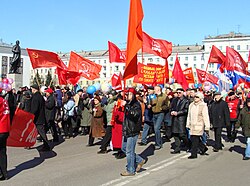 Communists marching on International Workers' Day in 2009, Severodvinsk
 -
 The Communist Party holds a demonstration on Triumfalnaya Square in Moscow
 -
 Demonstration of the party
 -
 Party members lay down flowers at the tomb of Joseph Stalin
 -
 Party membership card


See also
[edit]


Notes
[edit]References
[edit]- ^ "The Communist Party of the Russian Federation today". Communist Party of the Russian Federation. 3 November 2024.
- ^ Bozóki, András; Ishiyama, John T. (2002). The Communist Successor Parties of Central and Eastern Europe. M. E. Sharpe. p. 241. ISBN 978-0-7656-1389-9. Retrieved 19 October 2022.
- ^ a b c Nordsieck, Wolfram (2016). "Russia". Parties and Elections in Europe. Retrieved 20 August 2018.
- ^ Carrasco, Charles (4 November 2013). "Qui sont les ultranationalistes russes ?" [Who are the Russian ultranationalists?]. Europe 1 (in French). Archived from the original on 20 April 2023. Retrieved 30 September 2025.
- ^ Klußmann, Uwe (18 February 2008). "Far-Left Prepares for Russia's Election: Campaigning Communists Evoke Ghost of Stalin". Der Spiegel. Retrieved 28 February 2018.
- ^ Mccauley, Martin (2014). The Rise and Fall of the Soviet Union. Taylor & Francis. p. 513. ISBN 978-1-317-86782-1.
- ^ Rapoza, Kenneth (6 December 2011). "Can Russia's Communist Party Make A Comeback?". Forbes. Retrieved 11 August 2013.
- ^ a b c "Communist Party of the Russian Federation (KPRF)". Encyclopædia Britannica. Retrieved 21 June 2023.
- ^ Bennetts, Marc (22 November 2012). "Socialism may be waning, but not for young Russians". The Washington Times. Retrieved 11 August 2013.
- ^ American University (Washington, D.C.), and Moskovskiĭ gosudarstvennyĭ universitet im. M. V. Lomonosova. Demokratizatsiya: The Journal of Post-Soviet Democratization, volume 4. Washington, D.C.: Quality Press of the Southern Tier, 1996. p. 174.
- ^ Richard Sakwa, Russian Politics and Society, Routledge, 1996, p. 85.
- ^ Bozóki & Ishiyama, p. 242.
- ^ a b c d Bozóki, A and Ishiyama, J (2002). The Communist Successor Parties of Central and Eastern Europe. p. 245.
- ^ "Research". The Heritage Foundation. Archived from the original on 23 December 2009. Retrieved 16 March 2009.
- ^ March, Luke (2002). The Communist Party in Post-Soviet Russia. Manchester University Press. ISBN 9780719060441. Retrieved 19 February 2011.
- ^ Sakwa, Richard (2002). Russian Politics and Society. Psychology Press. p. 179. ISBN 978-0-415-22753-7.
- ^ a b c Bozóki and Ishiyama, p. 249.
- ^ "Yeltsin Names Communist to Cabinet Post". Chicago Tribune. 24 July 1998. Retrieved 30 November 2024.
- ^ Andrey Shabaev. "Партинформ. Материал последнего номера". partinform.ru. Archived from the original on 9 March 2011. Retrieved 19 February 2011.
- ^ David M. Herszenhorn (20 December 2011). "Where Communists See an Opening, Many Russians See a Closed Door". The New York Times. Retrieved 22 December 2011.
He, [Gennadi A. Zyuganov], has joined in popular protests against Mr. Putin's government, while seeking to block the rise of the liberal reformers leading those rallies by denouncing them as a subversive threat to Russia's future.
- ^ "TASS: Russia – Communist Party urges Russian leadership to recognise Novorossiya". TASS.
- ^ "Зюганов предложил отправить на Олимпиаду болельщиков со знаменем Победы". mk.ru (in Russian). 30 January 2018. Retrieved 5 February 2018.
- ^ "Police Search Communist Party Offices as Online Voting Controversy Continues". The Moscow Times. 28 September 2021. Archived from the original on 28 September 2021. Retrieved 25 November 2021.
- ^ "The People of Ukraine Must Not Be a Victim of World Capital and Oligarchic Clans. Statement of the CPRF CC Presidium – Communist Party of the Russian Federation". Retrieved 28 February 2022.
- ^ "Новые акты нацистского террора на Украине". Kprf.ru. 6 March 2022. Retrieved 15 March 2022.
- ^ Зюганов Геннадий Андреевич (4 March 2022). "Г.А. Зюганов: Нет фашизму на нашей земле!". Kprf.ru. Retrieved 15 March 2022.
- ^ Зюганов Геннадий Андреевич (5 March 2022). "Фашисты из Европы и террористы с Ближнего Востока поддерживают нацистов-бандеровцев. Заявление Председателя ЦК КПРФ Г.А. Зюганова". Kprf.ru. Retrieved 15 March 2022.
- ^ "Third member of Derzhavna Duma condemns the war against Ukraine". Ukrayinska Pravda. 26 February 2022. Retrieved 2 March 2022.
- ^ "'Defending the Donbas is one thing. Bombing Kyiv is another'. Russia's Communist Party officially supports the war against Ukraine. But its younger members are speaking out". Meduza. 10 June 2022.
- ^ Flatley, Daniel; Follain, John; Morales, Alex (31 March 2022) [28 February 2022]. "The Sanctions Imposed So Far on Russia From the U.S., EU and U.K." Bloomberg. Retrieved 5 April 2022.
- ^ From: Global Affairs Canada (24 February 2022). "Canada imposes additional economic measures on Russia in response to Russia's attack on Ukraine". Canada.ca. Retrieved 5 April 2022.
- ^ "Autonomous Sanctions (Designated Persons and Entities and Declared Persons—Ukraine) Amendment (No. 4) Instrument 2022". Legislation.gov.au. 25 February 2022. Retrieved 5 April 2022.
- ^ "Gennady Zyuganov and Viktor Vekselberg are sanctioned by Japan". En.newizv.ru. 15 March 2022. Retrieved 5 April 2022.
- ^ Office of Foreign Assets Control. "Notice of OFAC Sanctions Actions" published 17 March 2022. 87 FR 15305
- ^ Жуковский, Иван (6 August 2022). "Зюганов согласился на объединение КПРФ и "Справедливой России". При одном условии". Gazeta.Ru. Retrieved 6 August 2022.
- ^ "Зюганов допустил объединение КПРФ и СРЗП". www.kommersant.ru (in Russian). 6 August 2022. Retrieved 2 August 2022.
- ^ "В КПРФ приняли резолюцию о признании доклада Хрущева о Сталине ошибкой". Газета.ru (in Russian). 6 July 2025. Retrieved 25 July 2025.
- ^ "Party Program – Communist Party of the Russian Federation".
- ^ Зюганов Г. А. Кадры партии в действии. — М.: ИТРК, 2001. — с. 11. — ISBN 5-88010-083-9.
- ^ a b "Программа партии". Archived from the original on 2 January 2005. Retrieved 13 March 2015.
- ^ "久加诺夫:俄共党员应好好学习《邓小平文选》(图)_中国经济网——国家经济门户". ce.cn. Archived from the original on 23 September 2015. Retrieved 22 April 2014.
- ^ "俄共主席访华自称只求公平一战". sina.com.cn.
- ^ "Г.А. Зюганов о кончине Патриарха Алексия Второго: Он внес огромный вклад в дело возрождения церкви". kprf.ru.
- ^ Актуальные вопросы совершенствования идейно-теоретической работы партии (2012).
- ^ "Зюганов отреагировал на слова генсека НАТО о Сталине – РИА Новости, 03.03.2020". Ria.ru. 4 April 2019. Retrieved 2 March 2022.
- ^ "В КПРФ предложили арестовывать совершивших каминг-аут гомосексуалистов". 23 October 2015.
- ^ Antonova, Natalia (29 January 2014). "Russian State Duma: 'Possessed printer' or executor of the people's will?". themoscownews.com. Archived from the original on 1 March 2014.
- ^ "Russian MPs vote overwhelmingly to outlaw gay 'propaganda'". EuroNews. 11 June 2013. Archived from the original on 12 November 2020. Retrieved 19 December 2020.
- ^ Cuesta, Javier G. (15 September 2022). "Putin's entourage demands 'full mobilization' for the war in Ukraine". EL PAÍS English Edition. Retrieved 26 September 2022.
- ^ ""It's a war, not a special operation. We need mobilization," Russian Communist Party leader says". The Insider (in Russian). Retrieved 26 September 2022.
- ^ Bozóki & Ishiyama, p. 244.
- ^ Andrey Shabaev. "Российская многопартийность. Глава 5". www.partinform.ru. Retrieved 19 February 2011.
- ^ Budraitskis, Ilya (2 October 2021). "Russia Has a New Socialist Movement". Jacobin.
- ^ Buzgalin, Aleksandr (11 July 1997). "THE RUSSIAN COMMUNIST PARTY: THE VIEW FROM THE LEFT". Jamestown Foundation.
- ^ Zidan, Karim (7 June 2023). "Monson, a self-proclaimed anarchist, stepped into Russia's political ring in 2016 when he joined the Communist Party of the Russian Federation". The Guardian. Retrieved 7 June 2023.
Monson, a self-proclaimed anarchist, stepped into Russia's political ring in 2016 when he joined the Communist Party of the Russian Federation
- ^ An Interview with Anarchist Jeff "The Snowman" Monson of the Ultimate Fighting Championship – Infoshop News Archived 17 March 2006(Date mismatch) at the Wayback Machine. Infoshop.org. 07 March 2006.
- ^ Marson, James. (12 September 2016) 'U.S.-Born Fighter Is New Face of Russia's Communist Party' Archived 4 January 2017 at the Wayback Machine. Wall Street Journal. Retrieved on 21 December 2016.
- ^ Communist Party of the Russian Federation . (21 June 2016) 'Jeff Monson appointed special representative of the Communist Party Sport Club' Archived 21 December 2016 at the Wayback Machine. Communist Party of the Russian Federation Official Website. Retrieved on 21 December 2016.
- ^ "Список зарегистрированных политических партий". minjust.ru. Archived from the original on 3 April 2018. Retrieved 12 August 2012.
- ^ Bozóki & Ishiyama, p. 243.
- ^ March, Luke (2002). The Communist Party in Post-Soviet Russia. Manchester University Press. p. 20. ISBN 978-0-7190-6044-1.
- ^ "И.И. Мельников встретился с делегацией Европарламента". kprf.ru.
- ^ "90 лет Коммунистической партии Китая. "Круглый стол" в редакции газеты "Правда"". kprf.ru.
- ^ "Russian dignitaries visit DPRK". Naenara.
- ^ "Partidos comunistas e operários assinalam centenário da Revolução de Outubro". pcp.pt. 9 November 2017.
- ^ "Г.А. Зюганов в "Интерфаксе": КПРФ – реальная политическая сила, способная вывести страну из тяжелого кризиса". kprf.ru.
- ^ "Party Number Four", Rodina: Whence and Why? Archived 2013-11-26 at the Wayback Machine, by Alexei Titkov, Panorama Centre, Moscow, 2006, ISBN 5-94420-021-9, p. 24-25.
- ^ "Коммунисты просят россиян материально поддержать партию". РИА Новости. 19 October 2008.
- ^ "Коммунисты просят россиян материально поддержать партию". Новости Mail. Ru. Archived from the original on 14 January 2012. Retrieved 12 August 2012.
- ^ Оренбургский Областной Комитет КПРФ (in Russian). Archived from the original on 28 August 2009. Retrieved 5 February 2009.
- ^ Агентство Политических Новостей. Agency of Political News (in Russian). Retrieved 14 December 2007.
- ^ Bozóki & Ishiyama, p. 253.
- ^ "Nieuws". PVDA. Archived from the original on 14 December 2013. Retrieved 6 August 2012.
- ^ "Russia: Did Yeltsin Steal the 1996 Presidential Vote?". Time. 24 February 2012. Archived from the original on 24 February 2012.
- ^ "How The West Helped Invent Russia's Election Fraud: OSCE Whistleblower Exposes 1996 Whitewash – By Alexander Zaitchik and Mark Ames – The eXiled". exiledonline.com.
- ^ "Fraude bij verkiezing Rusland". BNR Nieuwsradio. Archived from the original on 14 April 2012. Retrieved 6 August 2012.
- ^ "Fraudeberichten uit Rusland". nos.nl. 4 March 2012.
- ^ "Oppositie noemt stembusgang oneerlijk". De Standaard. 4 March 2012.
- ^ "Официальный сайт КПРФ". Cprf.ru. Archived from the original on 23 March 2007. Retrieved 19 February 2011.
- ^ "Иркутский проигрыш "Единой России"". Газета.Ru. 6 April 2024.
- ^ "Коновалов набирает 57,5% на выборах главы Хакасии". ТАСС. Retrieved 11 November 2018.
- ^ Новости, Р. И. А. (10 September 2018). "Клычков вступит в должность главы Орловской области 14 сентября". РИА Новости (in Russian). Retrieved 29 July 2022.
- ^ "Выборы губернатора Приморья пройдут без участия КПРФ". Коммерсантъ. 3 November 2018 – via Kommersant.
- ^ "КПРФ побеждает по партийным спискам на выборах в заксобрания трех регионов из 16". ТАСС.
- ^ Kagarlitsky, Boris (17 January 2001). "RUSSIA: Is there life for KPRF after Yeltsin?". Green Left Weekly. Retrieved 6 March 2022.
- ^ "The Saturday Profile; A Different Kind of Brezhnev in the Making". The New York Times. 10 August 2002. Retrieved 28 March 2010.
Further reading
[edit]- Syed Mohsin Hashim (March 1999). KPRF ideology and its implications for democratization in Russia. Communist and Post-Communist Studies. Vol. 32. Iss. 1. pp. 77–89.
- Lisa Horner (23 January 2009). "Communism and the CPRF in Modern Russia" • The School of Russian and Asian Studies.
- Miriam Elder (14 October 2009) (updated 30 May 2010). "Communism: a love affair? The tyranny of daily bribes has many Russians nostalgic for Soviet social services" • The Global Post.
- Bozóki, András; Ishiyama, John T. (2020). The Communist Successor Parties of Central and Eastern Europe. Taylor & Francis. ISBN 978-1-000-16140-3.
External links
[edit]
| |||||||||||||||||||||||||||||||||||||||||||||||||||||||


| International | |
|---|---|
| National | |
| Other | |

Communist Party of the Russian Federation
View on GrokipediaOrigins and Early History
Soviet Legacy and Dissolution
The Communist Party of the Russian Federation (CPRF) traces its origins to the Communist Party of the Soviet Union (CPSU), the monolithic ruling entity that governed the USSR from its inception in 1917 until the early 1990s. The CPRF inherited the CPSU's Marxist-Leninist doctrine, organizational structure modeled on democratic centralism, and reverence for Soviet leaders such as Vladimir Lenin, emphasizing state-directed socialism, proletarian internationalism, and anti-capitalist rhetoric as countermeasures to perceived Western imperialism. This legacy provided the CPRF with a ready cadre of experienced apparatchiks, extensive grassroots networks from the CPSU's 19 million members at its 1990 peak, and a narrative framing the Soviet era as an era of industrial triumphs, social welfare expansion, and geopolitical strength, despite the systemic inefficiencies and authoritarianism that precipitated the USSR's collapse. The CPSU's dissolution accelerated after the failed hardline coup attempt against Mikhail Gorbachev on August 19–21, 1991, which exposed the party's internal fractures and loss of control over security forces. On August 23, 1991, Russian President Boris Yeltsin decreed the suspension of the Communist Party of the Russian Soviet Federative Socialist Republic (CP RSFSR), the CPSU's largest republican branch, citing its complicity in the coup.[8] Gorbachev resigned as CPSU General Secretary on August 24, 1991, urging the Central Committee to cease operations and dissolving party cells within the military, KGB, and state apparatus to prevent further subversion.[9] These steps dismantled the CPSU's command hierarchy, with its assets—estimated at billions in property and funds—seized by republican governments. On November 6, 1991, Yeltsin escalated by banning all CPSU activities on Russian territory and nationalizing its remaining holdings, a move upheld amid investigations revealing the party's role in economic privileges and repression.[10] The USSR's formal dissolution on December 25, 1991, rendered the CPSU obsolete, as its all-union framework evaporated with the 15 republics' independence declarations. In the chaotic interregnum of 1991–1993, surviving CPSU loyalists operated clandestinely or through ephemeral alliances, evading bans while capitalizing on public disillusionment with Yeltsin's shock therapy reforms, which triggered hyperinflation exceeding 2,500% in 1992 and widespread poverty. Regional communist initiatives, drawing from CP RSFSR holdovers, coalesced into the CPRF at its founding congress on February 14, 1993, in Moscow, where delegates from 60 regional branches elected Gennady Zyuganov—a former CPSU Central Committee member—as chairman.[11] The party explicitly invoked CPSU continuity in its charter, rejecting Gorbachev's perestroika as a betrayal while adapting Soviet orthodoxy to Russian nationalism, thus positioning itself as the primary vehicle for rehabilitating communist influence amid the Russian Federation's nascent multiparty system. This reconstitution preserved approximately 5% of the CPSU's pre-dissolution membership base, enabling electoral resurgence by 1993.Formation in 1993 and Legal Challenges
The Communist Party of the Soviet Union (CPSU) faced immediate suppression in Russia following the failed August 1991 coup attempt, with President Boris Yeltsin issuing decrees on August 23 and November 6, 1991, suspending and then banning its activities on Russian territory, citing the party's role in the Soviet system's failures and the coup.[12] This prohibition extended to the CPSU's Russian Republic branch, leading to the dissolution of its central structures and the emergence of fragmented communist groups operating semi-legally or underground.[13] The Russian Constitutional Court addressed these measures in a protracted case from July to November 1992, ruling on November 30 that the CPSU's all-union leadership bodies, including the Politburo and Central Committee, had wielded unconstitutional state power and supported the coup, justifying their dissolution, but that the blanket ban on all CPSU entities, including local organizations uninvolved in the coup, was unlawful.[14] This decision partially upheld Yeltsin's decrees while permitting the revival of regional communist associations, creating the legal foundation for a new national successor party.[15] On February 13–14, 1993, the Second Extraordinary Congress of Russian Communists convened in Moscow, formally establishing the Communist Party of the Russian Federation (CPRF) as the unified heir to the CPSU's Russian branch, absorbing key factions from prior splinter organizations.[16] Gennady Zyuganov, a CPSU veteran from the party's ideological apparatus, was elected first chairman, emphasizing continuity with Marxist-Leninist principles adapted to post-Soviet conditions.[17] The CPRF's prompt formation tested the boundaries of the court's ruling amid the intensifying constitutional crisis, as its emerging networks aligned with parliamentary opposition against Yeltsin's reforms, though authorities did not move to dissolve the nascent party before its successful registration and electoral debut in December 1993.[1]Evolution Under Post-Soviet Russia
1990s Expansion and Peak Influence
The Communist Party of the Russian Federation (CPRF) underwent significant expansion in the mid-1990s, capitalizing on public discontent with President Boris Yeltsin's neoliberal reforms, which included rapid privatization and price liberalization that led to a GDP contraction of approximately 40% between 1991 and 1995, alongside hyperinflation peaking at over 2,500% in 1992.[18] Party membership swelled to an estimated 500,000 by the mid-decade, establishing it as Russia's largest political organization and drawing primarily from former Soviet Communist Party cadres, pensioners, and rural residents nostalgic for state-provided social welfare and employment security.[19] This growth was fueled by the CPRF's positioning as a defender of Soviet-era achievements against perceived Western-imposed "shock therapy," which exacerbated inequality and eroded living standards for much of the population.[20] The party's electoral breakthrough came in the December 17, 1995, State Duma elections, where it emerged as the leading force, securing the largest number of seats in the 450-member chamber through a combination of proportional representation and single-mandate districts.[21] Early returns showed the CPRF ahead with strong support in industrial regions and among older voters, reflecting opposition to ongoing economic turmoil and corruption in privatization processes.[22] This victory granted the CPRF the dominant position in the Duma, enabling it to block some reformist legislation and advocate for restoring elements of the Soviet social safety net, thereby solidifying its role as the primary parliamentary opposition. Peak influence manifested in the June 16 and July 3, 1996, presidential election, where CPRF leader Gennady Zyuganov advanced to the runoff against incumbent Yeltsin, underscoring the party's national viability amid Yeltsin's health issues and the Chechen War's unpopularity.[23] Yeltsin ultimately prevailed with 53.82% in the second round, but Zyuganov's strong showing—bolstered by alliances with nationalist groups—demonstrated the CPRF's ability to mobilize anti-reform sentiment, particularly in non-urban areas.[24] The election's competitiveness, despite allegations of irregularities favoring Yeltsin, marked the zenith of CPRF influence, as it positioned the party as a credible alternative capable of challenging the post-Soviet liberal order.[25]2000s Adaptation to Putin's System
Following Vladimir Putin's victory in the March 26, 2000, presidential election, where he secured 52.94% of the vote against Communist Party of the Russian Federation (CPRF) leader Gennady Zyuganov's 28.97%, the party initially maintained its role as the primary organized opposition to the emerging centralized executive power.[26] The CPRF criticized Putin's rapid consolidation of authority, including the handling of the Second Chechen War, though Zyuganov personally endorsed the military approach as necessary for restoring order.[27] This period marked the onset of the party's electoral erosion, as state-aligned forces like Unity (later United Russia) capitalized on public fatigue with 1990s instability, drawing away CPRF voters through promises of stability and economic recovery. The CPRF's adaptation intensified after the December 2003 State Duma elections, in which its vote share fell to 12.61%—down from 24.29% in 1999—yielding only 40 seats compared to 113 previously, amid allegations of ballot irregularities and media bias favoring pro-Kremlin parties.[28] Facing Putin's "vertical of power" reforms, which curtailed regional autonomy and independent media, the party shifted rhetorically toward national-patriotic themes, emphasizing anti-Western sovereignty and state interventionism over pure Marxist-Leninist internationalism to align with broader public sentiments on restoring Russia's great-power status.[2] This pivot allowed survival within the managed democracy framework, positioning the CPRF as a "systemic opposition" that critiqued neoliberal excesses and oligarch influence—echoing Putin's own narratives—while avoiding direct confrontation with core Kremlin policies like security service expansions. By the mid-2000s, interpersonal ties underscored this accommodation: Zyuganov met periodically with Putin, including discussions on legislative cooperation, and the party supported measures against perceived 1990s-era corruption, such as asset nationalizations.[29] In the 2004 presidential race, the CPRF nominated Nikolai Kharitonov, who garnered 13.69%, signaling diminished competitiveness as voters migrated to United Russia amid improving economic conditions from oil revenues.[30] The 2007 Duma elections further halved representation to 11.57% and 57 seats, attributed to the party's ideological rigidity—its refusal to abandon Soviet-era orthodoxy alienated younger demographics—and structural factors like electoral threshold manipulations and dominant state media narratives portraying CPRF positions as outdated.[11] Despite internal debates on modernization, Zyuganov's leadership preserved organizational continuity by framing opposition as constructive patriotism, enabling the party to retain a Duma foothold as a controlled vent for dissent rather than a revolutionary threat.[31] This strategy ensured institutional persistence but entrenched the CPRF's marginalization, with its vote base eroding from protest against Yeltsin-era reforms to reluctant endorsement of Putin's stability model.2010s Decline and Recent Developments (2010-2025)
The Communist Party of the Russian Federation (CPRF) saw its electoral influence wane in the 2010s, transitioning from a position of relative prominence in the 1990s to that of a consistent but marginalized systemic opposition force under President Vladimir Putin's United Russia-dominated system. In the 2011 State Duma elections, the CPRF obtained 19.19% of the proportional representation vote, translating to 92 seats in the 450-seat chamber, including gains in single-mandate districts amid widespread protests against alleged electoral fraud. By the 2016 Duma elections, however, the party's proportional share dropped to 13.09%, yielding only 42 seats, primarily from the party list as it failed to secure single-mandate victories. This contraction reflected broader challenges, including the absorption of patriotic and statist rhetoric by United Russia, which diluted the CPRF's appeal among nostalgic Soviet-era voters and nationalists.[32][33] Analysts have attributed the decline to the party's strategic loyalty to the Kremlin, positioning it as a controlled outlet for dissent rather than a genuine challenger, which eroded its radical credentials and failed to attract younger or protest voters during events like the 2011-2012 Bolotnaya Square demonstrations. Under long-serving leader Gennady Zyuganov, who retained the chairmanship through multiple congresses in the decade, the CPRF emphasized continuity in Marxist-Leninist ideology blended with Russian nationalism but struggled with internal stagnation and an aging membership base, limiting organizational renewal. The party's cooperation with the government on key votes, such as foreign policy alignments, further blurred its oppositional identity, contributing to voter disillusionment as economic grievances mounted without corresponding mobilization.[34][35] In the 2020s, the CPRF maintained its role as the second-largest Duma faction, securing 18.93% of the proportional vote and 57 seats in the 2021 elections amid accusations of irregularities that disproportionately affected opposition gains, though the party benefited from anti-incumbent sentiment without breaking systemic constraints. The 2022 invasion of Ukraine marked a pivotal alignment, with Zyuganov publicly endorsing the "special military operation" as a fight against Nazism and imperialism, aligning the party with Kremlin narratives on denazification and fraternal solidarity, which stabilized but did not expand its base amid wartime mobilization.[36][37][38] The 2024 presidential election underscored ongoing marginalization, with CPRF nominee Nikolai Kharitonov, a State Duma deputy, registering as the party's candidate after Zyuganov declined to run for an eighth time; Kharitonov campaigned on economic protectionism and social welfare but garnered limited traction in a contest dominated by Putin. By mid-2025, polls indicated CPRF support hovering around 10-20%, with the party convening its 19th congress in July to reaffirm leadership amid calls for ideological adaptation, though Kremlin praise for its patriotic contributions highlighted its co-opted status rather than resurgence. This period has seen no significant membership growth or factional splits challenging the status quo, as the party's embedded position in the managed democracy framework perpetuated electoral ceilings enforced by administrative controls and media dominance.[39][35][40]Ideology and Program
Marxist-Leninist Foundations and Russian Adaptations
The Communist Party of the Russian Federation (CPRF) declares its ideological foundation in Marxism-Leninism, which it portrays as the scientific doctrine guiding the transition from capitalism to socialism through proletarian revolution and the dictatorship of the proletariat. The party's program, adopted at its II Congress on November 17, 2001, states that the CPRF "proceeds from the Marxist-Leninist doctrine which it is developing creatively," emphasizing the exploitation inherent in capitalist relations of production and the historical mission of the working class to establish public ownership of the means of production.[41] This adherence includes upholding classical tenets such as the materialist conception of history, surplus value theory, and Lenin's analysis of imperialism as monopoly capitalism's highest stage, which the program cites as validated by contemporary financial crises and transnational corporate dominance.[41] Core Marxist-Leninist elements in CPRF doctrine encompass advocacy for a planned economy, collectivization of labor, and the elimination of private appropriation of social wealth, with socialism defined as "a society free of exploitation of man by man, based on public ownership of the means of production and effective systems of worker self-management."[41] The party positions itself as the heir to the Bolshevik tradition, critiquing revisionist deviations within historical communism while affirming the October Revolution of 1917 as a model of successful socialist construction, albeit one requiring rectification of later errors like bureaucratic over-centralization.[42] Leninist organizational principles, including democratic centralism and vanguard party structure, remain central, as articulated in congress resolutions that stress ideological cohesion against "distortion and vulgarization" of Marxist classics.[43] In adapting Marxism-Leninism to post-Soviet Russia, the CPRF proposes a "renewed socialism cleansed of the mistakes and delusions of the past," incorporating phased transitions: initial democratic consolidation via people's power institutions, followed by socialist economic management, and culminating in advanced communist relations.[41] This framework addresses Russia's specific post-1991 context of economic collapse, oligarchic privatization, and national fragmentation, blaming the 1991 Soviet dissolution—termed the "Belovezhskaya Pushcha collusion"—on elite betrayal and Western interference, which divided the Russian people into the largest ethnic diaspora globally.[41] The program calls for restoring the USSR as a voluntary union of socialist republics, prioritizing nationalization of strategic industries and resource sovereignty to leverage Russia's vast natural wealth for equitable distribution.[41] Russian adaptations notably blend orthodox internationalism with patriotic imperatives, framing socialism as intertwined with defending Russian state integrity, cultural heritage, and geopolitical independence against liberal-globalist encroachment.[41] Under leader Gennady Zyuganov since 1993, the ideology has emphasized the "Russian question," promoting national unity and sovereignty as prerequisites for socialist revival, which analysts describe as shifting emphasis from pure class struggle to conservative nationalist motifs like glorification of imperial and Soviet history.[44] [45] This evolution, while officially rooted in creative Marxist-Leninist development, has drawn criticism for diluting proletarian universalism in favor of ethno-patriotic appeals tailored to Russia's multi-ethnic federation and post-imperial identity challenges.[46]Key Policy Positions on Economy, Nationalism, and Social Issues
The Communist Party of the Russian Federation (CPRF) advocates for a socialist economic model centered on extensive state ownership and centralized planning. The party's program calls for the nationalization of natural resources and strategic industries as an initial step toward restoring public control over key means of production, explicitly opposing further privatization and seeking the return of assets privatized under post-Soviet reforms deemed unlawful.[41] This approach aims to establish a planned economy to address inequalities exacerbated by market liberalization, including support for large-scale agricultural enterprises and worker protections against oligarchic dominance.[41] In practice, CPRF platforms have criticized Yeltsin's 1990s privatization as leading to economic collapse and wealth concentration, proposing instead reintegration of former Soviet economic ties for self-sufficiency.[1] On nationalism and patriotism, the CPRF emphasizes restoring Russia as a sovereign great power, rejecting what it terms imperialist globalization and NATO expansionism. The program prioritizes the "unity, integrity, and independence" of the Russian state, including efforts to reintegrate former Soviet republics and counter perceived colonial dependencies.[41] Under leader Gennady Zyuganov, the party has incorporated national-patriotic rhetoric, framing socialism as intertwined with Russian statehood and historical revival, which has led to alliances with pro-sovereignty forces while maintaining Marxist-Leninist internationalism in theory.[1] This stance manifests in opposition to Western influence and support for military assertions of Russian interests, such as in Ukraine, positioning the CPRF as a defender of national dignity against liberal cosmopolitanism.[41] In social issues, the CPRF promotes policies reinforcing traditional family structures and moral order, viewing the family as society's backbone and countering demographic decline through state incentives. The program proposes expanded benefits for large families, reconstruction of public kindergartens, and subsidized housing for young families to halt population extinction and foster reproduction rates.[41][47] It commits to free universal education and healthcare while shielding society from cultural "vulgarity" and historical denigration, attributing moral decay to post-Soviet media and advocating protections for Russian spiritual and ethical foundations.[41][48] The party supports enhanced social aid for pensioners and veterans, aligning with conservative emphases on collective welfare over individualist liberalism, though without explicit endorsements of abortion restrictions or anti-LGBTQ measures in core documents.[1]Internal Factions and Ideological Tensions
The Communist Party of the Russian Federation (CPRF) encompasses multiple ideological tendencies, including orthodox Marxist-Leninists adhering strictly to revolutionary principles, left-wing nationalists emphasizing patriotic Soviet revival, and more pragmatic social-democratic elements focused on electoral reforms and social welfare.[49] These factions generate tensions, as the party's 1995 program blends Marxism-Leninism with nationalist rhetoric on the "Russian question" and Soviet reunification, creating incoherence between purist ideology and adaptive politics.[49] [50] Leader Gennady Zyuganov, associated with the nationalist-patriotic wing, has maintained centralized control since 1993 to mediate these divides, but regional branches often push for sharper opposition to the regime, diverging from Moscow's pragmatic loyalty.[49] [5] A primary cleavage pits the central leadership's regime accommodation—evident in Zyuganov's September 25, 2021, meeting with President Putin—against regional activists' radicalism, as seen in support for 2021 Navalny protests in areas like Khabarovsk and Novosibirsk, despite central denials.[49] This center-regions divide intensified after dissolutions of non-compliant Moscow and St. Petersburg branches between 2008 and 2010, and during the 2018 pension reform protests, where 41 of 42 CPRF State Duma deputies opposed the measure, highlighting rank-and-file resistance to compromises.[49] Ideological debates further strain unity, with orthodox factions critiquing nationalist dilutions of class struggle, while pragmatists prioritize anti-corruption and inequality issues over doctrinal purity, contributing to a generational shift where younger leaders like Valentin Konovalov (elected Khakassia governor in 2018 at age 33) advocate bolder tactics.[49] [5] Historical splits underscore these tensions, such as the 2004 challenge by the Semigin faction, which contested Zyuganov's leadership and was resolved via Ministry of Justice intervention, and ongoing fragmentation where some radicals defected to form parties like Communists of Russia in 2012.[49] The 2021 legislative elections amplified cleavages, yielding 18.9% of votes and 57 seats amid candidate bans and coercion, yet exposing limits of the party's "dual commitment" to opposition and systemic loyalty.[49] These dynamics reflect broader ideological incoherence, where only about 40% of CPRF voters in 2021 aligned with core leftist views per Levada Center polling, pressuring Zyuganov to balance orthodoxy against electoral survival.[49] [51]Organizational Framework
Leadership Structure and Key Figures
The Communist Party of the Russian Federation (CPRF) maintains a hierarchical structure modeled on the Communist Party of the Soviet Union, with the Chairman of the Central Committee serving as the paramount leader responsible for strategic direction and representation.[52] Gennady Andreyevich Zyuganov has held this position since the party's establishment on February 14, 1993, following the reconstitution of communist organizations after the Soviet dissolution.[53] Zyuganov's leadership was reaffirmed unanimously at the 19th Party Congress on July 5, 2025, where delegates reviewed activities and elected central organs.[53] [52] The Central Committee, elected by party congresses, functions as the supreme governing body between congresses, comprising representatives from regional branches and handling policy formulation and cadre appointments.[52] A Presidium, drawn from Central Committee members and secretaries, oversees operational matters, including coordination of factions in legislative bodies and internal discipline.[52] First Deputy Chairmen Ivan Ivanovich Melnikov and Yuri Vyacheslavovich Afonin assist the Chairman; Melnikov focuses on ideological education and parliamentary affairs, while Afonin manages organizational expansion and youth engagement.[54] [55] Deputy Chairmen such as Vladimir Lvovich Kashin (international relations), Dmitry Georgievich Novikov (foreign policy), and Leonid Ivanovich Kalashnikov (social policy) handle specialized portfolios.[52] Nikolay Ivanov chairs the Central Control and Auditing Commission, ensuring compliance with party statutes.[52] Zyuganov, born June 26, 1944, in Mymrino, Oryol Oblast, rose through Komsomol and CPSU ranks before leading the CPRF amid post-1991 fragmentation.[56] His tenure, spanning over three decades, has centralized authority, with congresses periodically endorsing his continued role despite calls from reformist factions for renewal.[5] Key figures like Melnikov, a physicist elected deputy in 1995, and Afonin, son of a prominent communist, exemplify the blend of veteran ideologues and younger administrators sustaining the leadership core.[57]Membership, Youth Wings, and Internal Operations
The Communist Party of the Russian Federation (CPRF) reports approximately 160,000 members organized across 81 regional branches and about 14,000 primary party organizations as of recent official statements.[16] This figure reflects a contraction from earlier peaks, such as claims of over 500,000 members around 2015, amid broader declines in party support and electoral performance.[58] Membership recruitment emphasizes ideological commitment to Marxist-Leninist principles, with primary organizations serving as grassroots units for local agitation, propaganda, and candidate selection. The party's primary youth wing is the Leninist Komsomol of the Russian Federation (LKSM RF), which functions as the successor to the Soviet-era All-Union Leninist Young Communist League, targeting individuals aged 14 to 30 for political education, mobilization, and indoctrination in communist ideology. The LKSM RF engages in activities such as demonstrations, youth congresses, and ideological training, often aligning closely with CPRF campaigns; for instance, CPRF leader Gennady Zyuganov has participated in induction ceremonies reviving Soviet-style Young Pioneers traditions for younger participants.[59] While exact membership numbers for the LKSM RF are not publicly detailed in verifiable sources, it operates as an auxiliary structure to cultivate future party cadres and expand influence among younger demographics resistant to mainstream narratives. Internal operations of the CPRF are hierarchical and congress-driven, with the highest authority vested in party congresses held periodically—such as the 19th Congress in July 2025, which addressed political reports and elections.[60] The Central Committee, elected by congresses, manages day-to-day affairs through plenums, as seen in the joint plenum of May 2024 focusing on strategic tasks.[61] Decision-making emphasizes vertical structures including ideological coherence, organizational discipline, and control commissions to enforce party line, though tensions arise from factions balancing orthodox Marxism-Leninism with patriotic adaptations. Primary organizations handle local implementation, ensuring alignment with central directives on policy and electoral strategy.[43]Media Outlets, Finances, and Resource Allocation
The Communist Party of the Russian Federation (KPRF) operates Pravda as its official newspaper, which became the party's organ in April 1997 following a decree from its IV Congress.[62] Published continuously since May 5, 1912, Pravda serves as a primary vehicle for disseminating the party's Marxist-Leninist ideology, policy critiques, and calls to action.[63] The KPRF also maintains the social and political journal Politicheskoye Prosveshcheniye (Political Enlightenment), founded by the party to promote ideological education and analysis.[16] Additionally, its regional branches publish 81 local newspapers, enabling tailored outreach on issues like economic inequality and opposition to neoliberal reforms.[16] The party's central website, cprf.ru, hosts media sections with articles, videos, and archival materials, functioning as a digital platform for propaganda and mobilization.[64] KPRF finances rely predominantly on state allocations distributed proportionally to parties' vote shares in parliamentary elections, as stipulated by Russian federal law on political party funding.[65] This system provides the bulk of resources, with private donations and membership dues forming smaller portions; for instance, in a recent fiscal period, the party reported total receipts of 2.6 billion rubles (approximately $33 million USD), of which only 170 million rubles came from non-state sources.[66] Such dependency on government funding, which totaled around 772 million rubles for the KPRF in 2016 after a reduction, underscores the party's integration into the state-managed electoral framework, limiting financial autonomy.[67] Resource allocation prioritizes sustaining media operations, electoral campaigns, and organizational infrastructure, including support for youth wings and regional committees. Funds cover production costs for Pravda and regional publications, as well as events like rallies and ideological training, though detailed breakdowns remain opaque due to limited public disclosures in party financial reports.[16] State funding caps on private contributions—set at 10% of total income from any single donor—further channel expenditures toward approved activities, aligning with regulatory oversight by Russia's Central Election Commission.[65] This structure sustains the KPRF's visibility as the largest opposition party while constraining independent revenue streams.[66]Electoral History and Popular Support
Performance in National Parliamentary Elections
The Communist Party of the Russian Federation (CPRF) has participated in every State Duma election since 1993, consistently ranking as the second- or third-largest party by seats won, though its share of the proportional representation vote has fluctuated between approximately 11% and 24%. Early successes reflected nostalgia for Soviet-era stability amid economic turmoil in the 1990s, while later results coincided with the consolidation of power under United Russia and changes in electoral systems, including a shift to full proportional representation in 2007. Official results from Russia's Central Election Commission, as reported by international observers, show peaks in the late 1990s followed by stabilization at lower levels, with the party never exceeding 20% of the national vote after 1999.| Election Year | Proportional Vote % | Total Seats (out of 450) |
|---|---|---|
| 1993 | 11.6 | 48 |
| 1995 | 22.3 | 157 |
| 1999 | 24.3 | 113 |
| 2003 | 12.6 | 52 |
Results in Presidential Contests
In the 1996 presidential election, CPRF leader Gennady Zyuganov advanced to the second round, receiving 32.03% of the vote in the first round on June 16 and 40.31% (30.1 million votes) in the runoff on July 3 against incumbent Boris Yeltsin, who secured 53.82%.[73][24] Zyuganov's campaign emphasized restoration of Soviet-era social guarantees and opposition to Yeltsin's economic reforms, drawing support from those nostalgic for the USSR amid post-Soviet economic turmoil. The party's performance peaked in 1996 but declined in subsequent contests as Vladimir Putin's popularity rose following his 1999 appointment as prime minister and handling of the Second Chechen War. In 2000, Zyuganov received 29.21% on March 26, finishing second to Putin, who won with 52.94%.[26] The CPRF did not field a candidate in 2008, when Dmitry Medvedev won with 70.28%; party leader Zyuganov criticized the election as lacking competition but did not nominate an alternative.[74]| Year | Candidate | Votes | Percentage | Position |
|---|---|---|---|---|
| 1996 (1st round) | Gennady Zyuganov | 24,211,686 | 32.03% | 1st (advanced to runoff) |
| 1996 (runoff) | Gennady Zyuganov | 30,113,968 | 40.31% | 2nd[73] |
| 2000 | Gennady Zyuganov | 21,840,866 | 29.21% | 2nd[75][26] |
| 2004 | Nikolai Kharitonov | 9,513,313 | 13.69% | 2nd[30] |
| 2012 | Gennady Zyuganov | 12,318,035 | 17.18% | 2nd[76] |
| 2018 | Pavel Grudinin | 8,659,342 | 11.77% | 2nd[77] |
| 2024 | Nikolai Kharitonov | ~3.7 million | 4.31% | 2nd[78] |
Regional and Local Election Outcomes
The Communist Party of the Russian Federation (CPRF) has contested regional gubernatorial and legislative assembly elections since the mid-1990s, typically securing second-place finishes behind United Russia but rarely translating vote shares into executive control. In the immediate post-Soviet era, the party won several governorships through direct popular vote, including in regions like Bryansk and Smolensk, reflecting residual Soviet-era support among older voters and rural populations. However, following the 2004 abolition and 2012 reinstatement of direct gubernatorial elections under stricter federal oversight, CPRF candidates have failed to win any such contests since 2010, with outcomes dominated by Kremlin-endorsed incumbents or appointees who garner 50-80% in runoffs or single-round victories. This pattern persisted in the 2023-2025 cycles, where United Russia affiliates swept all 20+ gubernatorial races amid wartime mobilization and restricted opposition campaigning. In regional legislative assemblies, the CPRF maintains consistent representation as the leading systemic opposition force, often holding 10-30% of seats in entities where turnout and nostalgia for state socialism bolster its base. The party's strongest performances cluster in the "Red Belt" of central and eastern Russia, with notable gains in the Far East; for example, in the 2021 Primorsky Krai assembly election, it captured 31.02% of the proportional vote, up over 10 points from 2016, enabling multiple single-mandate wins and challenging Liberal Democratic Party dominance in the region. Similar upticks occurred in 34 regions during the same cycle, driven by economic discontent and anti-corruption appeals, though absolute seat totals remained subordinate to United Russia's majorities. By contrast, in western and urbanized areas like Moscow Oblast, shares hovered below 15%, limited by youth abstention and administrative filtering of candidates. Local municipal elections yield fragmented CPRF gains, primarily in council seats within sympathetic districts, but overall influence is curtailed by resource disparities and hybrid voting systems favoring incumbents. In the 2023 unified voting day across 14 regions and numerous municipalities, the party reported securing mandates despite alleged barriers like candidate disqualifications and ballot irregularities, yet final tallies showed marginal advances overshadowed by pro-regime consolidation. The CPRF has repeatedly contested results in strongholds, filing protests over purported fraud—such as in 2021 regional races where pre-election polls suggested higher support—attributing shortfalls to manipulated turnout and invalid votes that disproportionately affect opposition tallies. These claims align with independent analyses of systemic biases in Russia's electoral autocracy, where invalid ballots spike in competitive areas, though courts routinely uphold official outcomes.[80]Political Role and Government Relations
Dynamics of Opposition and Cooperation with United Russia
The Communist Party of the Russian Federation (KPRF) functions as the principal parliamentary opposition to United Russia, the ruling party aligned with President Vladimir Putin, but its opposition is selective and often rhetorical, giving way to cooperation on core national security and foreign policy matters. In the State Duma, where the KPRF holds 57 seats following the 2021 elections, the party critiques United Russia's dominance and domestic policies like economic inequality and corruption, yet rarely musters sufficient votes to obstruct legislation due to United Russia's constitutional majority of over 300 seats. This arrangement allows the KPRF to maintain visibility as a "systemic opposition" party tolerated by the Kremlin, providing limited pluralism without posing existential threats.[4][31] Instances of overt opposition include the KPRF's mobilization against the 2018 pension reform, which raised the retirement age to 65 for men and 60 for women; the party organized nationwide protests on September 2, 2018, drawing thousands in Moscow and other cities, and demanded a referendum on the measure, framing it as an assault on workers' rights. Despite such domestic pushback, which contributed to Putin's partial concessions like exemptions for certain professions, the KPRF's criticisms remain confined to socioeconomic grievances and do not extend to systemic challenges against the executive.[81][82] Cooperation manifests prominently in foreign policy alignment, as evidenced by the KPRF's endorsement of the 2014 annexation of Crimea, which party leader Gennady Zyuganov justified as defending Russian interests against Ukrainian nationalism, mirroring United Russia's narrative. Similarly, the KPRF supported the February 24, 2022, special military operation in Ukraine, with Zyuganov affirming backing from its inception during a July 7, 2022, Kremlin meeting, portraying it as essential for "denazification" and safeguarding Russian speakers; the party also endorsed referendums in annexed Donetsk and Luhansk regions. Even amid battlefield setbacks, Zyuganov advocated mobilization on September 13, 2022, while upholding the operation's objectives, underscoring ideological convergence with the Kremlin over anti-Western and territorial claims.[83][84][85] Regionally, dynamics tilt toward competition, with United Russia actively diminishing KPRF influence; in the 2023 and 2024 gubernatorial and legislative elections, the KPRF lost runner-up status in multiple federal subjects, reflecting Kremlin strategies to consolidate power amid wartime priorities. Internal KPRF factions occasionally push for sharper confrontation, but leadership prioritizes institutional survival, resulting in tactical alliances—such as joint votes on defense budgets—that reinforce the hybrid regime's stability over adversarial reform.[86][49]Stance on Major National Policies, Including the Ukraine Conflict
The Communist Party of the Russian Federation (CPRF) advocates for a state-directed economy emphasizing nationalization of key industries, reversal of privatizations from the 1990s, and expanded social welfare provisions, positioning itself against neoliberal market reforms.[43] It has consistently opposed reductions in public spending, such as the 2018 pension reform that raised the retirement age to 65 for men and 60 for women, organizing protests and Duma filibusters that delayed implementation until 2019, arguing the changes burdened working-class citizens amid stagnant wages.[87] On fiscal policy, the party supports progressive taxation and subsidies for agriculture and heavy industry, criticizing reliance on oligarchic capital as detrimental to labor interests.[88] In foreign policy, the CPRF endorses a multipolar world order resistant to Western dominance, viewing NATO's post-1991 enlargement—incorporating 14 former Soviet or Warsaw Pact states by 2023—as an existential security threat that necessitated Russia's military responses.[89] It condemns Western sanctions imposed since 2014 as economic warfare aimed at regime change, urging counter-sanctions and alliances with China and BRICS nations to mitigate isolation.[89] Domestically, the party promotes social conservatism, opposing liberal expansions in family law and favoring policies reinforcing traditional values, state secularism tempered by alliances with the Russian Orthodox Church against perceived cultural decay.[90] Regarding the Ukraine conflict, the CPRF's leadership, under Gennady Zyuganov, has affirmed support for Russia's "special military operation" launched on February 24, 2022, framing it as a defensive necessity to counter NATO encroachment, protect Russian-speaking populations in Donbas, and eradicate alleged neo-Nazi elements in Ukraine's governance.[91] The party had advocated since 2014 for recognizing the independence of Donetsk and Luhansk People's Republics, following referendums in May 2014, and praised the September 2022 annexations of these territories plus Kherson and Zaporizhzhia oblasts as restoring historical justice.[89] Zyuganov described the operation in March 2022 as fulfilling "the will of the people" against "globalist forces," aligning with Kremlin narratives while calling for negotiated peace on terms including Ukraine's demilitarization and neutrality.[92] Although rank-and-file dissent emerged in 2022, with some regional branches protesting escalation toward Kyiv, the Central Committee enforced unity, expelling critics and maintaining parliamentary backing for war funding.[93] This position reflects the party's broader anti-imperialist lens, attributing the conflict's origins to U.S.-led regime change in Kyiv in 2014 rather than Russian revanchism.[89]Influence on Legislation and Public Discourse
The Communist Party of the Russian Federation (CPRF) exerts limited direct influence on legislation due to its minority status in the State Duma, where it held 57 seats following the 2021 elections, compared to United Russia's dominant 326 seats.[37] Despite this, the party frequently proposes amendments focused on social protections, labor rights, and opposition to privatization, though most fail to pass without broader support. For instance, CPRF deputies have advocated for enhanced state control over key industries and restrictions on foreign ownership in strategic sectors, aligning with broader statist tendencies but rarely driving policy shifts independently.[94] In key legislative votes, the CPRF has demonstrated selective opposition, particularly against measures perceived as eroding local autonomy or accelerating centralization. The party unanimously opposed a 2025 bill reforming local government structures, arguing it further diminished regional self-governance in favor of Kremlin oversight.[95] Conversely, it has supported or abstained on security-related restrictions, including post-2003 laws curbing civil society activities after liberal factions were marginalized from the Duma, reflecting a pattern of endorsing state-strengthening measures while critiquing economic liberalism.[94] On constitutional amendments in 2020, 43 CPRF members abstained, yet the faction ultimately facilitated passage by not mounting unified resistance, prioritizing systemic stability over outright blockade.[96] Regarding public discourse, the CPRF sustains a niche promoting Soviet-era nostalgia, anti-oligarchic critiques, and calls for expanded welfare provisions, appealing primarily to older demographics disillusioned with post-1991 market reforms. Through organized rallies and statements, it frames inequality and Western influence as core threats, often echoing state narratives on national sovereignty while injecting leftist populism.[35] During the COVID-19 pandemic, the party leveraged public health debates to protest inadequate government responses and advocate for state-led economic interventions, thereby amplifying opposition voices within permitted channels without challenging core power structures.[97] This pragmatic approach has preserved its rhetorical space amid constrained media environments, though it rarely shifts dominant narratives beyond reinforcing managed pluralism.[98]Criticisms and Controversies
Accusations of Being Controlled or Loyal Opposition
The Communist Party of the Russian Federation (CPRF) has faced accusations from political analysts, opposition figures, and independent media of functioning as a "systemic opposition" party, tolerated by the Kremlin to simulate democratic competition while avoiding substantive challenges to the ruling regime.[99] This label implies that the CPRF, alongside parties like the Liberal Democratic Party of Russia, receives administrative allowances to participate in elections, secure parliamentary seats, and voice limited socioeconomic grievances, but refrains from criticizing core Kremlin priorities such as foreign policy or centralized power structures.[100] Critics argue this dynamic upholds an "illusion of choice," enabling the regime to legitimize outcomes without risking power transfer. Prominent examples include the CPRF's consistent support for President Vladimir Putin's foreign policy initiatives, such as the 2014 annexation of Crimea and the 2022 invasion of Ukraine, where party leader Gennady Zyuganov publicly endorsed military actions and recognition of Donetsk and Luhansk republics' sovereignty, framing them as defenses of Russian interests.[31] Despite nominal opposition to domestic reforms like the 2018 pension age increase—labeled "genocide" by Zyuganov—the party ultimately voted unanimously in favor, prioritizing regime stability over protest.[31] Zyuganov's direct engagements with Putin, including a February 2023 Kremlin meeting and appeals in October 2021 to halt crackdowns on CPRF members amid election disputes, underscore this perceived alignment, as the leader opted for dialogue over street mobilization.[29][101] Analysts like Vladimir Gelman have characterized the CPRF as "paper tigers" of opposition, arguing its leadership—dominated by Zyuganov since 1995—prioritizes self-preservation and Kremlin convenience over ideological renewal or systemic challenge, as evidenced by historical pacts like supporting Sergei Kirienko's 1998 prime ministerial nomination and suppressing internal reformers.[102] In the 2021 State Duma elections, while CPRF protests against electronic voting and fraud drew arrests, the party's refusal to boycott or ally with non-systemic forces like Alexei Navalny's networks reinforced claims of controlled boundaries, with subsequent Kremlin actions—such as felony charges against deputies Valery Rashkin (elk poaching probe, 2021) and Artyom Samsonov (molestation allegations, 2021)—interpreted as efforts to "sterilize" the party by installing more compliant figures.[103] Academic assessments describe this as a "dual commitment" of loyalty amid intra-party tensions, where regional branches occasionally diverge but central control maintains regime compatibility.[5] These accusations persist despite episodic frictions, such as 2021 post-election rallies leading to around 60 detentions, which some Kremlin-aligned commentators framed as bolstering the party's oppositional credentials rather than eroding loyalty.[104] Liberal critics, including those from Navalny's circle, contend the CPRF's electoral gains—such as 18.9% in the 2021 Duma vote—stem partly from regime orchestration to siphon protest votes, ensuring United Russia's dominance while marginalizing genuine alternatives.[31] The party's ideological pivot toward patriotism and Orthodoxy, downplaying pure Marxism-Leninism, further aligns it with state narratives, fueling perceptions of co-optation over autonomy.[105]Electoral Fraud Claims and Protest Responses
The Communist Party of the Russian Federation (CPRF) has alleged electoral fraud in multiple Russian parliamentary and regional contests, asserting that manipulations such as ballot stuffing, coerced voting, and discrepancies between paper and electronic counts systematically undermine opposition gains.[106] These claims intensified after the September 2021 State Duma elections, where CPRF candidates reported losing single-mandate districts despite leading in manual tallies, attributing reversals to electronic voting protocols that favored United Russia.[71] Party leader Gennady Zyuganov described the irregularities as "colossal," refusing to recognize results from Moscow's e-voting system, which showed a 70% turnout anomaly compared to national averages.[107] In response, the CPRF organized protests including unauthorized rallies and pickets in Moscow and other cities, drawing thousands to demand recounts and transparency; these actions led to police interventions, with over 100 communists detained on September 24-25, 2021, for defying assembly restrictions.[108] The party coordinated with independent monitors like Golos, citing statistical evidence of fraud such as uniform turnout digits indicative of fabrication, though Russian courts dismissed most CPRF challenges, upholding official outcomes.[109] Similar patterns emerged in regional elections, as in Rostov-on-Don in September 2025, where a CPRF candidate filed prosecutorial complaints over alleged ballot stuffing, reflecting ongoing institutional recourse amid limited judicial success.[110] Earlier, following the December 2011 State Duma elections—where CPRF secured 19% amid widespread fraud allegations confirmed by turnout anomalies in up to 25% of precincts—the party criticized falsifications but adopted a more restrained protest stance, prioritizing legal appeals over mass mobilization led by liberal groups.[111] Zyuganov demanded investigations into violations like carousel voting, yet CPRF's participation in subsequent street demonstrations remained peripheral, with the party framing itself as a systemic opposition rather than revolutionary actor.[112] This approach contrasted with 2021, highlighting tactical shifts toward direct confrontation when fraud appeared to erode CPRF's protest vote share.[113]Ideological Hypocrisy, Nostalgia for Soviet Failures, and Authoritarian Tendencies
The Communist Party of the Russian Federation (CPRF) exhibits ideological hypocrisy by professing adherence to Marxist-Leninist internationalism and class struggle while pragmatically aligning with the nationalist, state-capitalist policies of the Putin regime. For instance, despite condemning oligarchic exploitation in rhetoric, the party has cooperated with United Russia on legislative matters, including budget approvals and foreign policy initiatives that bolster Russia's centralized power structure rather than advancing proletarian revolution. This contradiction intensified during the Ukraine conflict, where the CPRF endorsed the "special military operation" as a defensive anti-fascist struggle, diverging from orthodox Marxist views on imperialism by prioritizing Russian state interests over global anti-capitalist solidarity—a stance criticized by international communists as chauvinist abandonment of Leninist principles.[114][115][116] CPRF nostalgia for the Soviet Union selectively romanticizes its achievements while ignoring empirical evidence of systemic failures that precipitated its 1991 collapse. Party leader Gennady Zyuganov has lauded the Stalin era for industrial feats, such as post-war recovery where national income rose 64% by the early 1950s compared to 1940 levels, framing it as a model of socialist efficiency without addressing the human costs or structural flaws.[117] Yet Soviet economic data reveal chronic stagnation: after initial post-war growth, GDP per capita growth averaged under 2% annually in the 1970s-1980s, hampered by central planning inefficiencies, technological lag behind the West, and shortages that eroded productivity and living standards, ultimately rendering the command economy unsustainable.[118][119] This selective memory sustains voter appeal among older demographics but overlooks causal factors like resource misallocation and innovation deficits, as documented in analyses of the Brezhnev-era decline. Authoritarian tendencies within the CPRF manifest in endorsements of repressive state mechanisms, echoing Soviet practices over democratic socialism. The party has advocated for "total mobilization" of society and economy during the Ukraine war, invoking Stalinist war communism models that historically involved forced labor and suppression of dissent to prioritize state goals.[90] This aligns with support for Russian laws curbing "extremism" and foreign agents, which critics from leftist perspectives argue enable the regime's consolidation of power at the expense of genuine opposition, including intra-communist rivals.[35] Such positions prioritize hierarchical control and national sovereignty over individual rights or intra-class internationalism, reflecting a pragmatic adaptation to Russia's hybrid totalitarian framework rather than ideological purity.[120]References
- https://en.prolewiki.org/wiki/Communist_Party_of_the_Russian_Federation
- https://www.wikidata.org/wiki/Q192187