Hubbry Logo
Religious order (Catholic)Religious order (Catholic)Main
Open search
Religious order (Catholic)
Community hub
Religious order (Catholic)
logo
8 pages, 0 posts
0 subscribers
Be the first to start a discussion here.
Religious order (Catholic)
from Wikipedia
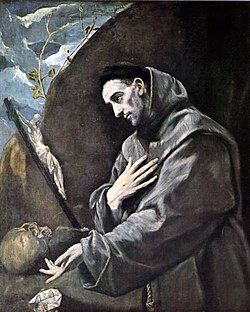
Saint Francis of Assisi, founder of the mendicant Order of Friars Minor, as painted by El Greco.

In the Catholic Church, a religious order is a community of consecrated life with members who profess solemn vows. They are classed as a type of religious institute.[1]

Subcategories of religious orders are:

Catholic religious orders began as early as the 500s, with the Order of Saint Benedict being formed in 529. The earliest orders include the Cistercians (1098), the Premonstratensians (1120), the Poor Clares founded by Francis of Assisi (1212), and the Benedictine reform movements of Cluny (1216). These orders were confederations of independent abbeys and priories, who were unified through a loose structure of leadership and oversight.

Later the mendicant orders such as the Carmelites, the Order of Friars Minor, the Order of Preachers, the Order of the Most Holy Trinity and the Order of Saint Augustine formed. These Mendicant orders did not hold property for their religious communities, instead begging for alms and going where they were needed. Their leadership structure included each member, as opposed to each abbey or house, as subject to their direct superior.

In the past, what distinguished religious orders from other institutes was the classification of the vows that the members took as solemn vows. According to this criterion, the last religious order founded was that of the Bethlehemite Brothers in 1673.[2] Nevertheless, in the course of the 20th century, some religious institutes outside the category of orders obtained permission to make solemn vows, at least of poverty, thus blurring the distinction.[citation needed]

Essential distinguishing mark

[edit]

Solemn vows were originally considered indissoluble. As noted below, dispensations began to be granted in later times, but originally not even the Pope could dispense from them.[3] If for a just cause a member of a religious order was expelled, the vow of chastity remained unchanged and so rendered invalid any attempt at marriage, the vow of obedience obliged in relation, generally, to the bishop rather than to the religious superior, and the vow of poverty was modified to meet the new situation but the expelled religious "could not, for example, will any goods to another; and goods which came to him reverted at his death to his institute or to the Holy See."[4]

Weakening of the distinction in 1917

[edit]

The former 1917 Code of Canon Law reserved the term religious order for institutes in which the vows were solemn, and used the term religious congregation (or simply congregation) for institutes with simple vows. The members of a religious order for men were called regulars, those belonging to a religious congregation were simply religious, a term that applied also to regulars. For women, those with simple vows were called religious sisters, with the term nun reserved in canon law for those who belonged to an institute of solemn vows, even if in some localities they were allowed to take simple vows instead.[5]

The Hieronymite monks

However, it abolished the distinction according to which solemn vows, unlike simple vows, were indissoluble. It recognized no totally indispensable religious vows and thereby abrogated for the Latin Church the special consecration that distinguished orders from congregations, while keeping some juridical distinctions.[4]

In practice, even before 1917 dispensations from solemn religious vows were being obtained by grant of the Pope himself, while departments of the Holy See and superiors specially delegated by it could dispense from simple religious vows.[6]

The 1917 Code maintained a juridical distinction by declaring invalid any marriage attempted by solemnly professed religious or by those with simple vows to which the Holy See had attached the effect of invalidating marriage,[7] while stating that no simple vow rendered a marriage invalid, except in the cases in which the Holy See directed otherwise.[8] Thus members of orders were barred absolutely from marriage, and any marriage they attempted was invalid. Those who made simple vows were obliged not to marry, but if they did break their vow, the marriage was considered valid.

Another difference was that a professed religious of solemn vows lost the right to own property and the capacity to acquire temporal goods for themselves, but a professed religious of simple vows, while being prohibited by the vow of poverty from using and administering property, kept ownership and the right to acquire more, unless the constitutions of the religious institute explicitly stated the contrary.[9]

After publication of the 1917 Code, many institutes with simple vows appealed to the Holy See for permission to make solemn vows. The Apostolic Constitution Sponsa Christi of 21 November 1950 made access to that permission easier for nuns (in the strict sense), though not for religious institutes dedicated to apostolic activity. Many of these latter institutes of women then petitioned for the solemn vow of poverty alone. Towards the end of the Second Vatican Council, superiors general of clerical institutes and abbots president of monastic congregations were authorized to permit, for a just cause, their subjects of simple vows who made a reasonable request to renounce their property except for what would be required for their sustenance if they were to depart.[10] These changes resulted in a further blurring of the previously clear distinction between orders and congregations, since institutes that were founded as congregations began to have some members who had all three solemn vows or had members that took a solemn vow of poverty and simple vows of chastity and obedience.[citation needed]

Further changes in 1983

[edit]

The current 1983 Code of Canon Law maintains the distinction between solemn and simple vows,[11] but no longer makes any distinction between their juridical effects, including the distinction between orders and congregations. Instead, it uses the single term religious institute to designate all such institutes.[12][13]

While solemn vows once meant those taken in what was called a religious order, "today, in order to know when a vow is solemn it will be necessary to refer to the proper law of the institutes of consecrated life."[14]

The Annuario Pontificio continues to distinguish between Ordini (Orders) and Congregazioni Religiose Clericali (Clerical Religious Congregations). Some other authors use the terms religious order and religious institute as synonyms; canon lawyer Nicholas Cafardi, commenting on the fact that the canonical term is religious institute, write that religious order is a colloquialism.[15]

Authority structure

[edit]
Thomas Schoen, 1903, OCist

A religious order is characterized by an authority structure where a superior general has jurisdiction over the order's dependent communities. An exception is the Order of Saint Benedict which is not a religious order in this technical sense, because it has a system of independent houses, meaning that each abbey is autonomous. However, the constitutions governing the order's global independent houses and its distinct Benedictine congregations (of which there are twenty) were approved by the pope. Likewise, according to rank and authority, the abbot primate's "position with regard to the other abbots [throughout the world] is to be understood rather from the analogy of a primate in a hierarchy than from that of the general of an order like the Dominicans and the Jesuits."[16]

The Canons Regular of Saint Augustine are in a situation similar to that of the Benedictines. They are organized in eight congregations, each headed by an abbot general, but also have an Abbot Primate of the Confederated Canons Regular of Saint Augustine. And the Cistercians are in thirteen congregations, each headed by an abbot general or an abbot president, but do not use the title of abbot primate.

List of religious orders of men in the Annuario Pontificio

[edit]
Religious orders in the Annuario Pontificio
Saint Bruno of Cologne, founder of the Order of Carthusians, as painted by Nicolas Mignard
A genealogical tree of the Order of the Immaculate Conception with the foundress, Saint Beatrice of Silva, and other remarkable Conceptionist nuns
Maria Vittoria De Fornari Strata was the foundress of the Order of the Most Holy Annunciation.

The Annuario Pontificio presents the list of male religious institutes in an Elenco Storio-Giuridico di Precedenza ("Historical-juridical list of precedence"). This list gives priority to certain types of institutes: Orders (divided into Canons Regular, monastics, mendicant orders, clerics regular), clerical religious congregations, lay religious congregations, Eastern religious congregations, secular institutes, societies of apostolic life.[17] The list is found in the 1964 edition of the Annuario Pontificio, pp. 807–870, where the heading is "States of Perfection (of pontifical right for men)". In the 1969 edition the heading is "Religious and Secular institutes of Pontifical Right for Men", a form it kept until 1975. Since 1976, when work was already advanced on revising the Code of Canon Law, the list has been qualified as "historical-juridical".

Historical-Juridical List of Precedence[18]
Canons regular
Name Abbreviation Founded Members Priest members
Augustinian Canons (Canons Regular) CRSA 4th century 561 470
Norbertines (Premonstratensians) OPraem 1120 1,127 853
Canons Regular of the Holy Cross of Coimbra ORC 1131 141 83
Teutonic Order OT 1190 79 62
Canons Regular of the Order of the Holy Cross (Crosier Fathers and Brothers) OSC 1211 347 227
Knights of the Cross with the Red Star OCr 1237 18 18
Canons Regular of the Mother of God CRMD 1969 37 21
Monastic orders
Name Abbreviation Founded Members Priest members
Order of Saint Benedict OSB 6th century 6,667 3,297
Camaldolese Hermits of Mount Corona (Camaldolese) ECMC 1025 66 38
Order of Cistercians OCist 1098 1,600 657
Order of Cistercians of the Strict Observance (Trappists) OCSO 1098 1,608 590
Carthusians OCart 1084 275 142
Order of Saint Paul the First Hermit (Pauline Fathers) OSPPE 1215 493 366
Hieronymites OSH 14th century 6 4
Mendicant orders
Name Abbreviation Founded Members Priest members
Order of Preachers OP 13th century 5,545 4,147
Order of Friars Minor OFM 1209 12,476 8,512
Order of Friars Minor Conventual OFMConv 1209 3,981 2,777
Order of Friars Minor Capuchin OFMCap 1525 10,355 6,796
Third Order Regular of St. Francis of Penance TOR 1221 813 581
Order of Saint Augustine OSA 4th century 2,500 1,826
Order of Augustinian Recollects OAR 1588 955 815
Order of Discalced Augustinians OAD 1592 227 144
Order of the Brothers of the Blessed Virgin Mary of Mount Carmel (Carmelites) OCarm 2,041 1,303
Order of the Discalced Brothers of the Blessed Virgin Mary of Mount Carmel (Discalced Carmelites) OCD 1562 3,978 2,897
Order of the Most Holy Trinity and of the Captives (Trinitarians) OSsT 1198 612 426
Order of the Blessed Virgin Mary of Mercy (Mercedarians) OdeM 1218 649 483
Discalced Mercedarians OMD 1603 34 29
Order of Servants of Mary (Servite Order) OSM 1233 786 522
Order of Minims OM 1435 161 118
Brothers Hospitallers of Saint John of God OH 1537 995 115
Bethlehemite Brothers OFB 1653 13 1
Clerics regular
Name Abbreviation Founded Members Priest members
Theatines (Congregation of Clerics Regular Clerics Regular) CR 1524 161 124
Barnabites (Clerics Regular of Saint Paul) B, Obarn, CRSP 1530 335 279
Society of Jesus (Jesuits) SJ 1540 14,839 10,721
Somaschi Fathers (Order of Clerics Regular of Somasca) CRS 1534 520 327
Camillians M.I. 1582 1,125 825
Clerics Regular Minor (Clerics Regular Ministers to the Sick) CRM 1588 180 106
Clerics Regular of the Mother of God OMD 1574 115 87
Piarists (Order of Poor Clerics Regular of the Mother of God of the Pious Schools) SchP 1617 1,356 945

Religious orders of women in the Annuario Pontificio

[edit]

The list of religious institutes for women in the Annuario Pontificio does not distinguish between orders (with solemn vows) and congregations (with simple vows). Many of the religious orders for men listed above have comparable religious institutes for women with solemn vows.

See also

[edit]

References

[edit]
[edit]
Revisions and contributorsEdit on WikipediaRead on Wikipedia
from Grokipedia
In the , a , formally known as a , is a stable society of faithful Christians who profess public vows of , , and obedience in accordance with their proper law, thereby embracing the to live a life of fraternal communion and apostolic mission under the authority of the Church. These institutes are canonically erected and approved by ecclesiastical authority, distinguishing them from other forms of by their structured communal life, which manifests the mystery of the Church and serves as a sign of God's kingdom. Rooted in the example of Christ and the early Christian communities, religious orders represent a profound gift of the to the Church, fostering holiness and contributing to evangelization through diverse charisms. The historical development of Catholic religious orders traces back to the apostolic era, where called disciples to follow him radically, evolving into organized forms during the early Church with the emergence of in the Eastern and Western traditions as early as the third and fourth centuries. In the West, St. founded the Benedictine Order in the sixth century, establishing a rule that emphasized prayer, work, and stability, which became foundational for monastic life and helped spread across while advancing , , and manuscript preservation. The saw the rise of reform movements, such as the under St. in the twelfth century, and mendicant orders like the (founded by St. Francis of Assisi in 1209) and Dominicans (founded by St. Dominic in 1216), which focused on poverty, preaching, and urban ministry amid growing cities and heresies. The in the sixteenth century produced influential orders like the , established by St. in 1540, who prioritized , intellectual rigor, and global missions, playing a pivotal role in the Church's renewal and expansion to the , , and . In modern times, particularly after the and industrialization, new congregations emerged to address social needs, including teaching, healthcare, and service to the poor, adapting to contemporary challenges while preserving their foundational charisms. Catholic religious orders encompass various types, including monastic orders centered on contemplation and enclosure, such as and ; dedicated to preaching and active , like and Dominicans; and clerical institutes like the , which combine priestly ministry with specific missions. They may be of , directly under the , or diocesan right, approved by local bishops, and include both male and female branches, often with lay brothers or sisters alongside priests. These orders play an essential role in the Church's life by witnessing to the transcendent, supporting the sacraments and , engaging in , and promoting , education, and , thereby enriching the universal mission of the .

Definition and Canonical Basis

Core Definition

A , traditionally known as a when members profess solemn vows, is a stable society of the Christian faithful who, under the inspiration of the and following Christ more closely, profess public vows of the , , and obedience—either perpetual or temporary (to be publicly renewed), and live a communal life governed by a proper rule or constitutions approved by the competent ecclesiastical authority. Traditionally, religious institutes are divided into orders, where members profess solemn vows, and congregations, with simple vows, though the treats them uniformly as religious institutes. This consecration dedicates the members totally to through these vows, which are recognized and confirmed by the Church, creating a bond that incorporates them into the institute and imposes specific rights and obligations. Religious institutes are distinguished from other forms of consecrated life and ecclesial associations by their emphasis on stable community life and separation from the world, which fosters a shared family spirit in Christ and enables members to pursue perfection of charity in a structured, withdrawn environment. In contrast, secular institutes involve members living in the world with a focus on apostolic activity through private commitments rather than public vows and communal separation; hermits embrace eremitic solitude with stricter withdrawal under a bishop's direction; and lay associations, such as movements or third orders, lack the public profession of vows and formal consecration, remaining within the lay state. Within the , religious institutes fulfill a vital role as an outstanding sign in the Church, witnessing to through their communal profession and observance of the , thereby foretelling the glory of the heavenly kingdom and inspiring the faithful toward eschatological hope. These foundational elements are elaborated in the Code of Canon Law's provisions for institutes of .

Key Canonical Requirements

Under the (CIC), a must involve the public profession of the through vows, either perpetual or temporary, which are publicly pronounced and bind members to follow Christ more closely in a stable manner. This profession, as defined in Can. 573 §2 and Can. 607 §2, consecrates the whole person to and integrates members into a society structured for communal witness to . Additionally, the institute requires a hierarchical structure, wherein superiors and chapters exercise authority over members as outlined in and the institute's proper law, ensuring that promotes the and fidelity to the charism. Written constitutions are essential, serving as the fundamental code that details norms on , discipline, incorporation, formation, and the observance of the counsels, subject to approval by the competent ecclesiastical authority. Religious institutes are classified by right as either pontifical or diocesan, a distinction that determines the level of oversight and autonomy. An institute of pontifical right is erected or formally approved by the Apostolic See through a decree, granting it direct dependence on the Holy See for major decisions, such as elections of superiors and modifications to constitutions. In contrast, an institute of diocesan right is validly established by a diocesan bishop via formal decree without prior Apostolic See approval, remaining under the bishop's vigilance while enjoying relative autonomy in internal affairs, though it may seek pontifical status later upon demonstrating maturity. Papal or episcopal approval is thus integral to legitimacy, with the Apostolic See holding ultimate competence for approving constitutions of pontifical institutes and providing written permission for diocesan erections under Can. 579. The process of erecting a religious institute begins with the competent authority issuing a formal decree after assessing its suitability for the Church's needs and the institute's ability to foster religious life, as per Can. 579 and Can. 610. This includes establishing a hierarchical framework with a superior general—or supreme moderator—for institutes spanning multiple dioceses, who exercises authority over the entire body according to the constitutions under Can. 622. General chapters form a key element, holding supreme authority within the institute to elect the superior general, safeguard the patrimony, and promulgate binding norms, as stipulated in Can. 631 §1, thereby ensuring participatory governance and adaptation to contemporary needs while preserving the founding charism. For individual houses, erection requires the written consent of the local ordinary, with additional Apostolic See approval needed for monasteries of nuns to guarantee enclosure and stability.

Historical Origins and Evolution

Early Christian Roots

The roots of Catholic religious orders trace back to the early Christian communities described in the New Testament, particularly the communal life of the apostles and first believers in Jerusalem. Acts 4:32-35 portrays the early Church as a model of unity, where "the multitude of those who believed were of one heart and soul," holding all possessions in common, selling property to distribute proceeds to the needy, and ensuring no one lacked under apostolic leadership. This biblical vision of shared poverty and obedience to authority inspired later ascetic practices, emphasizing detachment from material goods and submission to communal discipline as essential to following Christ. In the 3rd and 4th centuries, this scriptural ideal manifested in the ascetic movement of the and Mothers, early Christian hermits who withdrew to the Egyptian wilderness to pursue intense prayer, fasting, and renunciation of worldly attachments. Influenced by figures like the prophets and , as well as ' own desert temptations, these ascetics—both men and women—sought spiritual purification through solitude and manual labor, forming loose associations that fostered mutual support without formal structures. Women such as Amma Syncletica exemplified this tradition, teaching that involved not only physical withdrawal but also inner vigilance against vices, promoting a life of and charity that prefigured organized religious communities. The development of monasticism crystallized through key figures like St. Anthony the Great (c. 251–356), often called the father of , who sold his possessions around age 20 to live as a in the Egyptian desert, battling temptations through and austerity. His life, detailed in Athanasius of Alexandria's , attracted disciples who clustered around him, blending eremitic solitude with informal communal guidance. Complementing this, St. Pachomius (c. 292–348) founded the first cenobitic near Tabennisi in 320, organizing hundreds of monks into a structured community with shared , work, and a rule enforcing equality in food, clothing, and obedience to superiors—marking the shift from isolated s to regulated group living. These innovations laid the groundwork for enduring monastic traditions that later evolved into formalized religious orders.

Medieval and Post-Medieval Development

The institutionalization of Catholic religious orders gained momentum in the medieval period with the establishment of Benedictine , which provided a foundational model for communal religious life in . In the , St. Benedict of Nursia (c. 480–547) composed his Rule around 530 AD while founding the monastery at in , emphasizing a balanced life of prayer (), manual labor, communal worship through the Divine Office, and obedience to an . This document, addressed to monks seeking to renounce personal will for obedience to Christ, offered a moderate and adaptable framework compared to earlier ascetic traditions, promoting stability, enclosure, and self-sufficiency within monasteries. Promoted by Pope Gregory the Great (r. 590–604) through his Dialogues and later enforced by (r. 768–814) via imperial legislation, the Rule spread rapidly from to , Anglo-Saxon , and beyond, influencing the establishment of thousands of Benedictine houses that preserved classical learning, agriculture, and amid the collapse of Roman infrastructure and barbarian invasions. By the 13th century, the evolving socio-economic landscape of , marked by rapid , commercial growth, and rising , prompted the emergence of that diverged from the cloistered Benedictine model by prioritizing itinerant preaching and . The Franciscan Order, founded by St. in 1209 and approved by in 1210, responded to urban poverty and spiritual renewal by embracing radical simplicity, manual work among the laity, and care for the marginalized in burgeoning cities like and . Complementing this, the , established by St. Dominic de Guzmán in 1216 and confirmed by in 1217, focused on intellectual rigor and combating heresies such as and Waldensianism through systematic preaching, theological education, and inquisitorial roles, establishing studia generales that evolved into universities. These orders addressed the challenges of urban expansion—where traditional seemed remote—by integrating into civic life, fostering devotion among the middle classes, and reinforcing ecclesiastical authority against dualist and anti-clerical movements that threatened social order. The post-medieval era, particularly the , revitalized and reformed religious orders in response to the Protestant , leading to new foundations and stricter disciplines. The Society of Jesus, or , founded by St. Ignatius of Loyola and approved by via the bull Regimini militantis Ecclesiae on September 27, 1540, exemplified this renewal by emphasizing education, missionary outreach, and unwavering obedience to the pope, establishing colleges and seminaries across and beyond to counter Protestant inroads. The (1545–1563), convened by and spanning 25 sessions under multiple popes, mandated reforms for existing orders by enforcing enclosure for nuns, regular visitations, and clerical formation, while prohibiting commendatory abbots and addressing abuses like to restore monastic discipline and apostolic zeal. These measures, alongside the Jesuits' global apostolate, halted Protestant expansion in regions like Poland and the , reinvigorating orders like the and through internal renewals and contributing to a more centralized, doctrinally unified .

Classification and Types

Monastic and Contemplative Orders

Monastic and contemplative orders within the are religious communities primarily dedicated to a life of , separation from worldly affairs, and , fostering an interior focus on union with through . These orders emphasize stability, whereby members commit to a specific for life, promoting a deep-rooted and spiritual continuity. The , particularly the Divine Office, forms the core of their daily rhythm, with extensive time devoted to communal and personal as an offering of praise and intercession for the Church and the world. Manual labor, often simple and self-sustaining, complements this contemplative existence, ensuring humility and detachment from material concerns while supporting the community's needs. The historical charisms of these orders highlight their unique spiritual orientations toward . The , following the Rule of St. Benedict established in the sixth century, embody the principle of —prayer and work—as an integrated approach to seeking God in both liturgical devotion and productive labor, fostering balance and hospitality within stable monastic life. The , a reform branch of the founded in the eleventh century, intensify this charism through greater austerity, solitude, and simplicity, emphasizing manual work in harmony with nature to purify the soul and deepen . The trace their origins to a thirteenth-century hermitic tradition on , with a charism centered on contemplative prayer and mystical union with God, often expressed through interior silence and devotion to the Blessed Virgin Mary. The , established in the eleventh century, pursue an eremitical charism of strict solitude, where monks live primarily in individual cells for prayer and study, emerging only for communal liturgy, to cultivate profound detachment and divine intimacy. During turbulent periods such as the , monastic and contemplative orders played a pivotal role in preserving cultural and theological knowledge amid societal upheaval, invasions, and the decline of classical learning. meticulously copied ancient manuscripts in scriptoria, safeguarding texts of Scripture, patristic writings, and secular works that would otherwise have been lost, thereby transmitting the intellectual heritage of antiquity to . Through their stable communities and liturgical scholarship, these orders also advanced theological reflection, compiling glosses, commentaries, and liturgical innovations that enriched the Church's doctrinal understanding and spiritual practices. This preservative function underscored their contemplative as a quiet yet essential service to the broader ecclesial and cultural legacy. In contrast to and apostolic orders, which engage actively in preaching and ministry, monastic communities prioritize this enclosed withdrawal to sustain the Church's prayerful foundation.

Mendicant and Apostolic Orders

in the emerged in the 13th century as religious communities emphasizing a life of evangelical , mobility, and active engagement with the world through preaching and service, distinguishing them from more stable contemplative traditions. These orders, such as the founded by St. in 1209 and the Dominicans established by St. Dominic in 1216, adopted a lifestyle of for sustenance to witness Christ's while itinerantly proclaiming in urban settings. The , formalized as friars in the 13th century under the Rule of St. Augustine, similarly prioritized communal and apostolic outreach, fostering intellectual and pastoral ministries. This mobility allowed mendicants to address societal needs directly, reintegrating marginalized groups into the Church and inspiring lay devotion. For historical roles, played pivotal parts in combating heresy and promoting education and social welfare. The Dominicans were entrusted by in 1231 to investigate and prosecute heresies, particularly in and , forming the backbone of the through their preaching expertise and theological rigor. In education, while mendicants contributed to universities, apostolic orders like the —founded in 1540 by St. as clerks regular—expanded this mission globally; they opened their first school in Messina, , in 1548, and by Ignatius's death in 1556, operated 35 institutions emphasizing humanistic formation for leadership and service. Social welfare efforts included Franciscan initiatives for the poor and, in later evolution, modern apostolic congregations like the Salesians, established in 1859 by St. John Bosco to support at-risk youth through vocational training and evangelization amid industrialization. Over time, and apostolic orders adapted to contemporary challenges, broadening their while retaining core commitments to and mission. The Salesians, for instance, developed models that integrated , , and , influencing global Catholic efforts for vulnerable populations. These orders' emphasis on worldly engagement contrasted with contemplative monasticism's focus on , enabling dynamic responses to , , and social inequities throughout .

Governance and Authority

Internal Structures

The internal structures of Catholic religious orders are characterized by a hierarchical framework designed to foster communal life, obedience, and the pursuit of the order's charism, as outlined in the Code of Canon Law. At the apex is the superior general, who exercises authority over the entire institute, including all provinces, houses, and members, in accordance with the order's constitutions. This role is typically held for a fixed term, often six or twelve years, and involves both and administrative oversight to ensure fidelity to the . Below the superior general are provincials, who govern specific geographic provinces comprising multiple houses and members, acting as major superiors with delegated powers defined by the institute's proper law. Local superiors, in turn, manage individual communities or houses, residing there to promote daily observance and fraternal charity, unless the constitutions permit otherwise. Leadership positions are filled through deliberative processes emphasizing collegiality and representation, primarily via the general chapter, which serves as the supreme governing body of the order. Composed of the superior general, council members, provincials, and elected delegates proportional to the institute's membership, the general chapter convenes periodically—typically every six to twelve years—to elect the superior general and other key officers, as well as to address major policy matters and adapt the constitutions within canonical bounds. Elections require a secret ballot and adherence to norms ensuring validity, such as eligibility and a two-thirds majority where specified by proper law. Provincial and local chapters similarly elect or confirm provincials and local superiors, maintaining a layered system of accountability. Communal within orders relies on collaborative mechanisms to balance with shared responsibility, all guided by the order's constitutions, which constitute the proper law detailing internal norms. Superiors at every level must consult their respective councils—composed of at least four members for general and provincial councils, and fewer for local ones—for on significant decisions and for acts like alienation of goods or major personnel changes. Regular visitations, conducted by the superior general, provincials, or their delegates, ensure adherence to the constitutions by inspecting houses, interviewing members, and addressing deviations, typically occurring every three to six years. These elements promote a model rooted in service rather than domination, with superiors bound to exercise their office in a spirit of fraternal dialogue. Variations exist among orders in the degree of centralization versus federation, reflecting their historical and spiritual identities. Centralized models, such as that of the Society of Jesus (), concentrate authority in the superior general and curia in , enabling unified direction for global apostolates with provincials implementing central policies. In contrast, federated structures, like those of the Benedictine Confederation, emphasize autonomy of individual abbeys under elected abbots, coordinated loosely through a primate or congress without a single superior general, preserving local adaptation of the Rule of St. Benedict. These differences, while internally diverse, ultimately align with broader Church oversight to safeguard the institute's mission.

Relationship to Church Hierarchy

Religious orders in the Catholic Church operate within a structured relationship to the broader ecclesiastical hierarchy, balancing internal with external accountability to ensure alignment with universal Church norms. Institutes of , approved directly by the , fall under its immediate authority, with governance, discipline, and major decisions subject to oversight by the for Institutes of and Societies of Apostolic Life. This dicastery promotes and regulates the practice of the , supervises formation, government, and through periodic reports and visitations, and handles approvals for constitutions, mergers, or suppressions. In contrast, institutes of diocesan right, established with the approval of the local , remain primarily accountable to him, including in matters of apostolic works, public worship, and financial reporting, though they must also submit quinquennial reports to the . Clerics belonging to diocesan right institutes are subject to the bishop's jurisdiction and may require his consent for certain ministries, while those in pontifical right institutes are incardinated into the institute itself and exercise orders under its superior's authority, subject only to limited episcopal oversight in the . This hierarchical integration reflects provisions that subordinate religious life to the supreme authority while respecting the distinct charism of each institute. For instance, bishops exercise visitation rights over diocesan right houses and autonomous monasteries, ensuring compliance with local needs and norms, whereas institutes enjoy greater independence but must coordinate with bishops on matters. Recent modifications to , such as the 2022 requirement for Vatican approval before bishops erect new public associations of the faithful that could evolve into institutes, underscore the Holy See's role in maintaining uniformity and preventing fragmentation. Historically, the relationship evolved from significant autonomy in the medieval period, where many religious houses received papal exemptions from episcopal authority—beginning as early as the and proliferating to shield monasteries from local interference—to a more integrated framework post-Trent. The (1545–1563), responding to critiques and internal abuses, reformed religious life by curtailing excessive exemptions, mandating enclosure for nuns, regular visitations by bishops, and submission to episcopal oversight in apostolic activities, thereby strengthening hierarchical unity without abolishing all privileges for established orders. These Tridentine decrees laid the groundwork for the 1983 Code of Canon Law's balanced approach, preserving papal supremacy for international orders while embedding local accountability for others.

Vows, Lifestyle, and Formation

Evangelical Counsels and Vows

The evangelical counsels of chastity, poverty, and obedience form the core of consecrated life in Catholic religious orders, representing a radical following of Christ through the profession of vows. Chastity, often expressed as celibacy for the sake of the Kingdom of Heaven, involves forgoing marriage and sexual relations to dedicate one's undivided heart to God and the Church, fostering spiritual fruitfulness and charity toward all. Poverty entails detachment from material possessions and worldly securities, imitating Christ's own renunciation of riches to embrace simplicity and dependence on divine providence. Obedience requires submission to superiors and the institute's rule as a means of conforming one's will to God's, mirroring Christ's filial obedience to the Father even unto death. These counsels have their theological foundation in the life, teachings, and example of Jesus Christ, as articulated in the Gospels and confirmed by the Church's . They originate from Christ's invitation to perfection, such as in Matthew 19:21, where he counsels the rich young man: "If you wish to be perfect, go, sell what you have and give to [the] poor, and you will have treasure in heaven. Then come, follow me," underscoring poverty as a path to heavenly treasure. Similarly, chastity draws from Matthew 19:12, acknowledging those who "have renounced marriage for the sake of the kingdom of heaven," while obedience echoes Philippians 2:8, portraying Christ as "obedient to the point of death." The Second Vatican Council emphasizes that these counsels, prompted by the , configure the religious to Christ and signify the eschatological kingdom, enhancing the Church's witness to divine love. In religious institutes, the are professed through public vows, which incorporate members into the community and bind them to a stable form of . Vows may be temporary, lasting a specified period and renewable upon expiration, or perpetual, constituting a lifelong commitment to the counsels according to the institute's constitutions. They are further distinguished as solemn or simple: solemn vows are irrevocable and publicly recognized by the Church, typically in monastic orders, while simple vows, often used in apostolic congregations, allow for dispensation under certain conditions but still entail serious moral obligation. Through these vows, individuals are fully incorporated into the institute, receiving a special consecration that builds upon their baptismal grace.

Daily Life and Constitutions

The daily life of members in Catholic religious orders revolves around the horarium, a structured schedule that sanctifies the day through the , integrates manual or apostolic work, and allocates time for communal recreation and rest. This rhythm, prescribed by the institute's proper law, emphasizes the in practice and varies by the order's charism; for instance, Benedictine communities often follow the principle of (prayer and work), with the —comprising offices like Vigils (night prayer), (morning prayer), and (evening prayer)—bookending periods of , communal meals, and labor such as gardening or scholarly pursuits. In contrast, Franciscan orders incorporate simplicity in their horarium, prioritizing minimalistic routines that include shorter prayer cycles, itinerant ministry, and fraternal gatherings to foster and in everyday activities. Religious are obliged to celebrate the daily, either fully in common or partially individually, as determined by their institute's norms, ensuring that prayer permeates the entire day from rising to retiring. A typical horarium in contemplative orders might begin at 4:00 or 5:00 a.m. with Vigils, followed by personal meditation, around dawn, , work until midday prayer (), a simple meal, and afternoon offices like None, culminating in , supper, and before 9:00 p.m. recreation or silence. Apostolic orders adapt this for external apostolates, condensing communal prayer to allow flexibility for teaching or service while maintaining core hours like prayer. Recreation periods, often brief and moderated, promote bonds without detracting from the contemplative focus. The constitutions and rules of a religious institute form its fundamental proper law, approved by the competent ecclesiastical authority—such as the for institutes of or the for those of diocesan right—detailing the specific charism, governance, and lifestyle elements to guide members' observance of the . These texts, revised periodically to align with universal , prescribe practices like the wearing of habits to signify consecration and communal identity, norms for to protect contemplative prayer (with papal enclosure for monasteries of women requiring full-time except for essential exits), and regulations that exceed general Church precepts, such as abstaining from meat on more days or limiting meals to promote detachment. For example, the constitutions of the emphasize stability and obedience in monastic routines, while those of like the Dominicans outline itinerancy and preaching alongside austerity in and simplicity of dress. Approval ensures fidelity to and Church , with the supreme rule of life being the following of Christ as expressed therein. Formation into religious life occurs in distinct stages, preparing candidates progressively for full incorporation into the institute through discernment, , and assimilation of its . The initial phase, often called postulancy, lasts six months to a year and introduces candidates to community life, , and basic formation under a director's guidance. This is followed by the , a period of at least twelve months (extendable to two years maximum) in a dedicated novitiate house, focused on intensive spiritual training, study of the constitutions, and testing suitability, during which novices withdraw from external work to deepen and virtues. Upon completion, suitable novices make temporary of vows for three to six years, entering the juniorate or post-novitiate phase, where formation continues systematically with apostolic experience, theological studies, and integration into the institute's mission, allowing gradual assumption of responsibilities. Perpetual or solemn follows, marking definitive commitment and full membership, after which ongoing formation persists through annual retreats, , and renewal programs to sustain fidelity to the charism amid life's demands. These stages, governed by canons 641-661, ensure holistic development—human, spiritual, intellectual, and pastoral—tailored to the institute's end.

Modern Developments and Challenges

Reforms in Canon Law

The 1917 Code of Canon Law marked a significant codification effort in the , introducing a unified legal framework for religious institutes that began to erode traditional distinctions between mendicant and monastic orders. While earlier ecclesiastical law had emphasized rigid separations—such as mendicants' focus on and apostolic mobility versus monastics' emphasis on stability and —the 1917 Code standardized regulations across all institutes, applying uniform rules on vows, , and formation without privileging one type over another. This weakening of distinctions was evident in provisions like Canon 580, which allowed for the adaptation of particular rules with papal approval, enabling modifications to traditional practices such as mendicant or monastic . Similarly, Canon 618 permitted religious to undertake external ministries, further blurring the lines between contemplative and active . A key innovation in the 1917 Code was the formal introduction of exemptions for certain religious institutes, granting them from diocesan bishops' ordinary jurisdiction. Canon 615 explicitly exempted clerical orders, including mendicants and select monastics, from local episcopal oversight in internal affairs, subjecting them instead to direct papal authority via the Sacred Congregation of Religious. This reform centralized control in , enhancing administrative efficiency amid early 20th-century challenges like and rising secular influences, while Canon 198 designated major superiors of exempt institutes as ordinaries for their subjects, reinforcing their quasi-episcopal powers. However, exemptions were not absolute; Canon 617 allowed local ordinaries to intervene in cases of abuse, balancing with accountability. The , promulgated by following Vatican II, built on these foundations by further integrating and blurring distinctions between traditional religious orders and emerging congregations, while prioritizing the preservation of each institute's founding charism in an era of accelerating . Unlike the 1917 Code's binary categorization based on vow solemnity, the unified oversight under the broader umbrella of "institutes of " (Canons 573–746), encompassing religious institutes, secular institutes, hermits, and consecrated virgins without rigid hierarchies. This approach, influenced by Vatican II's emphasis on renewal, allowed congregations—previously seen as secondary—with simple vows to operate on par with orders, fostering adaptability to modern pastoral needs. Central to the 1983 reforms was an explicit mandate to safeguard the charism amid secular pressures, as outlined in Canon 578, which requires institutes to faithfully observe their founders' spirit, purpose, and traditions as approved by the Church. Canon 586 affirms each institute's right to autonomy in preserving its patrimony, including and , while Canon 587 mandates constitutions that protect vocational identity and permit adaptations to contemporary circumstances, such as demographic shifts or cultural changes. These provisions addressed secularization by encouraging innovative expressions of without diluting core identities. Canons 573–746 also facilitated greater lay involvement by recognizing diverse forms of consecration beyond clerical models, promoting collaboration in apostolic works. Canon 588 §3 defines lay institutes as those oriented toward non-ordained functions, enabling to participate more actively in the mission of religious communities. Canon 587 §4 allows norms to evolve with the "needs of places and times," opening doors for lay associates in formation, , or ministries, while Canon 605 empowers bishops to discern and support new consecrated forms, including those integrating lay elements under approval. These changes reflect a broader ecclesial response to 20th-century societal transformations, though ongoing challenges like declining vocations persist.

Contemporary Issues and Adaptations

The Second Vatican Council (1962–1965), through its Decree on the Adaptation and Renewal of Religious Life Perfectae Caritatis, called for religious orders to undergo profound renewal by returning to the sources and the original spirit of their founders while adapting to the needs of the contemporary world. This document outlined five key principles for such adaptation: fidelity to Christ as the supreme rule, preservation of each institute's founding charism, alignment with the Church's evolving biblical, liturgical, and social initiatives, attentiveness to modern societal conditions, and prioritization of interior spiritual renewal over mere external changes. It emphasized revising constitutions and practices to better serve apostolic demands, fostering a dynamic religious life responsive to global shifts. One pressing contemporary challenge for Catholic religious orders is the decline in vocations and the aging of membership, trends that intensified following Vatican II. According to the Vatican's Central Office of Church Statistics in the 2025 Pontifical Yearbook (data as of 2023), the number of professed women religious decreased from 599,228 in 2022 to 589,423 in 2023, a global drop of 1.6%, continuing declines in , the , and while growth persists in and . Similarly, professed religious men (non-priests) have seen ongoing reductions, reflecting a post-Vatican II vocational crisis, particularly in the West; globally, the number of Catholic religious sisters has declined from over 1 million in 1970 to 589,423 as of 2023, with particularly steep drops in the United States, from approximately 180,000 in 1965 to about 36,000 in 2022, compounded by an aging demographic that has led to order mergers and property consolidations to support elderly members. In response, religious orders have pursued adaptations aligned with Perfectae Caritatis, including deepened engagement in , , and inter-congregational collaborations. Vatican II's emphasis on unity prompted orders to participate actively in ecumenical dialogues and joint initiatives with other Christian denominations, as guided by the Council's and subsequent directories from the Pontifical Council for Promoting Christian Unity. On , many orders, especially in , have been influenced by , which interprets the Gospel through the lens of the poor's struggles and has mobilized nuns and brothers to advocate for , alleviation, and structural reform since the . This prophetic stance, rooted in Vatican II's call to serve the world's needs, has seen orders like the and Missionaries integrate advocacy against oppression into their missions. Inter-congregational efforts have also surged, with coalitions such as the Intercommunity Peace and Justice Center sponsoring collaborative advocacy on issues like and climate justice, while shared programs and resource pooling help smaller orders sustain formation amid declining numbers. These adaptations underscore a shift toward communal witness in a pluralistic era, balancing tradition with relevance.

Prominent Examples and Lists

Major Orders of Men

The major religious orders of men in the include several prominent and monastic communities that have shaped the Church's mission through preaching, education, and . These orders, approved by papal authority, embody distinct charisms while adhering to the of poverty, chastity, and obedience. Key examples are the Society of Jesus (Jesuits), the Order of Friars Minor (Franciscans), the Order of Preachers (Dominicans), and the Benedictines (Order of Saint Benedict), each with a global footprint and significant membership as reported in recent directories. The Society of Jesus, founded in 1540 by St. Ignatius of Loyola and approved by , is an apostolic order dedicated to , intellectual pursuits, and missionary work worldwide. Its charism emphasizes "finding God in all things" through discernment and service to the Church, particularly in schools, universities, and evangelization efforts. As of December 31, 2023, the number approximately 13,995 professed members, including 10,159 priests, operating in over 100 countries with a strong emphasis on and interreligious dialogue. The , established in 1209 by St. Francis of Assisi and formally approved by in 1223, follows a lifestyle centered on radical poverty, humility, and care for creation. The Franciscan charism promotes fraternity, peace, and ecological stewardship, inspiring ministries among the poor and in environmental advocacy. Current membership stands at about 11,984 professed friars, with 8,093 priests, present in nearly every continent through various branches like the Conventuals and Capuchins. The Order of Preachers, founded in 1216 by St. Dominic and confirmed by , focuses on intellectual preaching, study, and combating through theological formation. Dominican friars live in community, balancing with active in teaching and , guided by the motto "to contemplate and to give to others the fruits of ." As of the latest data, the order has around 5,369 professed members, including 4,073 priests, with houses and provinces spanning the globe. The Order of Saint Benedict, originating around 529 with St. Benedict of Nursia's Rule at , represents the monastic tradition emphasizing stability, prayer, and manual labor under the principle "" (pray and work). Benedictine communities prioritize liturgical life, hospitality, and scholarship in autonomous abbeys, fostering spiritual renewal. Membership totals approximately 6,382 professed monks, with 3,176 priests, organized in confederations across more than 50 countries. These male orders parallel female branches, such as the Poor Clares for Franciscans and Dominican Sisters, which adapt similar charisms to contemplative or active vocations.

Major Orders of Women

The Order of Poor Ladies of St. Clare, commonly known as the Poor Clares, was founded in 1212 by St. Clare of Assisi in Assisi, Italy, under the inspiration of St. Francis of Assisi, marking one of the earliest enclosed contemplative communities for women in the Catholic Church. Their charism emphasizes strict enclosure, radical poverty, and perpetual adoration through prayer and simple manual labor, serving as a profound witness to evangelical poverty within the Franciscan tradition. As of recent estimates, the Poor Clares number approximately 20,000 sisters worldwide across more than 70 countries, organized into federations that maintain their cloistered lifestyle. The , established in 1535 by St. Angela Merici in , , represent the first dedicated specifically to the and formation of young women, initially operating without formal to allow active ministry in homes and schools. Their charism focuses on fostering , charity, and intellectual growth among girls, evolving into a global network that combines teaching with spiritual guidance. Today, Ursuline communities, part of the Roman Union, continue this in and , with membership distributed across various provinces, though exact global figures fluctuate with regional demographics. Founded in 1633 by St. Vincent de Paul and St. Louise de Marillac in , , the Daughters of Charity (often referred to as Sisters of Charity in their active branches) emerged as a pioneering congregation for women serving the poor through corporal and spiritual , including and care for the marginalized. Unlike more contemplative orders, their charism prioritizes mobility and direct apostolic work in hospitals, schools, and shelters, adapting to societal needs while living simply among the people they serve. The order maintains a significant presence internationally, with approximately 16,000 sisters worldwide, contributing to healthcare and missions. The for women trace their reform to 1562, when St. Teresa of founded the first reformed in , , to restore the Carmelite tradition of contemplative prayer, austerity, and detachment from the world, distinguishing it from the more mitigated ancient observance. Their charism centers on interior silence, mystical union with God, and intercessory prayer, typically in cloistered monasteries that emphasize the "nothing but " spirituality. As part of the broader Discalced Carmelite Order, women's communities number in the thousands globally, focused on and limited external apostolates. Women's religious orders in the , as cataloged in the , exhibit a spectrum of charisms, with many like the and leaning toward contemplative , while others such as the and Sisters of Charity engage actively in education and . Overall, the global population of women religious stood at 589,423 as of December 31, 2023, reflecting a 1.6% decline (9,805 fewer) from 2022 but underscoring their enduring role in the Church's mission amid contemporary challenges like aging membership.

References

Add your contribution
Related Hubs
User Avatar
No comments yet.