Hubbry Logo
Feodor ChaliapinFeodor ChaliapinMain
Open search
Feodor Chaliapin
Community hub
Feodor Chaliapin
logo
8 pages, 0 posts
0 subscribers
Be the first to start a discussion here.
Contribute something
Feodor Chaliapin
Feodor Chaliapin
from Wikipedia

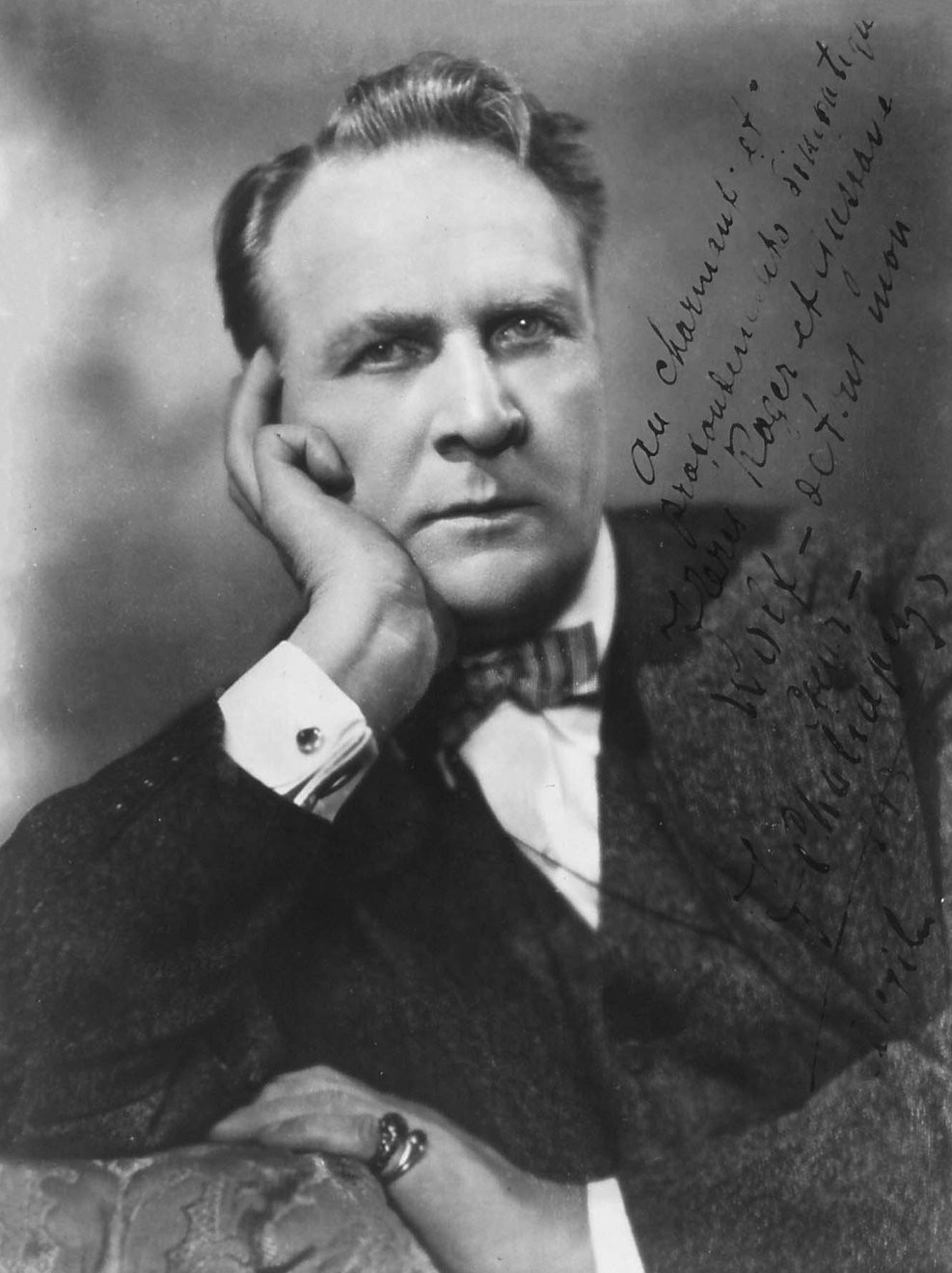
Feodor Ivanovich Chaliapin (Russian: Фёдор Ива́нович Шаля́пин, romanized: Fyodor Ivanovich Shalyapin, IPA: [ˈfʲɵdər ɨˈvanəvʲɪtɕ ʂɐˈlʲapʲɪn]; 13 February [O.S. 1 February] 1873 – 12 April 1938) was a Russian opera singer. Possessing a deep and expressive bass voice, he enjoyed an important international career at major opera houses and is often credited with establishing the tradition of naturalistic acting in his chosen art form.[1]

Key Information

Spelling note

[edit]

He himself spelled his surname, French-style, Chaliapine in the West,[2] and his name even appeared on early His Master's Voice 78s as Theodore Chaliapine.[3] In English texts, his given name is most usually rendered as Feodor or Fyodor, and his surname is most usually seen as Chaliapin. However, in the Russian pronunciation the initial consonant Ш is pronounced like sh in shop, not as ch in chop, and in reference books the surname is sometimes given a strict romanization as Shalyapin. This spelling also better reflects the fact that the name is pronounced with three syllables (Sha-LYA-pin), not four.

Early life

[edit]

Feodor Chaliapin was born into a peasant family on 1 February (OS), 1873 in Kazan, in the wing of merchant Lisitzin's house on Rybnoryadskaya Street (now Pushkin Street) 10. This wing no longer exists, but the house with the yard where the wing was situated is still there. The next day, Candlemas (The Meeting of Our Lord), he was baptized in Epiphany (Bogoyavlenskaya) Church on Bolshaya Prolomnaya street (now Bauman Street). His godparents were his neighbors: the shoemaker Nikolay Tonkov and Ludmila Kharitonova, a 12-year-old girl. The dwelling was expensive for his father, Ivan Yakovlevich, who served as a clerk in the Zemskaya Uprava (Zemstvo District Council), and in 1878 the Chaliapin family moved to the village of Ametyevo (also Ometyevo, or the Ometyev settlements, now a settlement within Kazan) behind the area of Sukonnaya Sloboda, and settled in a small house.

Early career

[edit]

His vocal teacher was Dmitri Usatov. Chaliapin began his career at Tbilisi and at the Imperial Opera in Saint Petersburg in 1894. He was then invited to sing at the Mamontov Private Opera (1896–1899); he first appeared there as Mephistopheles in Gounod's Faust, in which role he achieved considerable success.

At Mamontov Chaliapin met Sergei Rachmaninoff, who was serving as an assistant conductor there and with whom he remained friends for life. Rachmaninoff taught him much about musicianship, including how to analyze a music score, and insisted that Chaliapin learn not only his own roles but also all the other roles in the operas in which he was scheduled to appear. With Rachmaninoff he learned the title role of Mussorgsky's Boris Godunov, which became his signature character.[4] Chaliapin returned the favor by showing Rachmaninoff how he built each of his interpretations around a culminating moment or "point". Regardless of where that point was or at which dynamic within that piece, the performer had to know how to approach it with absolute calculation and precision; otherwise, the whole construction of the piece could crumble and the piece could become disjointed. Rachmaninoff put this approach to considerable use when he became a full-time concert-pianist after World War I.[5]

On the strength of his Mamontov appearances, the Bolshoi Theatre in Moscow engaged Chaliapin, and he appeared there regularly from 1899 until 1914. During the First World War, Chaliapin also appeared regularly at the Zimin Private Opera in Moscow. In addition, from 1901, Chaliapin began touring in the West, making a sensational debut at La Scala that year as the devil in a production of Boito's Mefistofele, under the baton of one of the 20th century's most dynamic opera conductors, Arturo Toscanini. At the end of his career, Toscanini observed that the Russian bass was the greatest operatic talent with whom he had ever worked. The singer's Metropolitan Opera debut in the 1907 season was disappointing due to the unprecedented frankness of his stage acting; but he returned to the Met in 1921 and sang there with immense success for eight seasons, New York's audiences having grown more broad-minded since 1907. In 1913 Chaliapin was introduced to London and Paris by the brilliant entrepreneur Sergei Diaghilev (1872-1929), at which point he began giving well-received solo recitals in which he sang traditional Russian folk-songs as well as more serious fare. Such folk songs included "Along Peterskaya" (which he recorded with a British-based Russian folk-instrument orchestra) and the song which he made famous throughout the world: "The Song of the Volga Boatmen". In 1925, when he performed in New York, his piano accompanist was a young Harry Lubin, later to become a composer of music for the television series The Outer Limits.[6]

Feodor Chaliapin in his dressing room, drawing by Manuel Rosenberg 1924

Later life

[edit]
Chaliapin creating his self-portrait in 1912
Chaliapin and Tornaghi

Chaliapin toured Australia in 1926, giving a series of recitals which were highly acclaimed. Privately, Chaliapin's personal affairs were in a state of disarray as a consequence of the Russian Revolution of 1917. At first he was treated as a revered artist of the newly emerged Soviet Russia. However, the harsh realities of everyday life under the new regime, and the unstable climate which followed because of the ensuing Civil War, combined with, reportedly, the encroachment on some of his property by the Communist authorities,[7] caused him to remain perpetually outside Russia after 1921. Chaliapin initially moved to Finland and later lived in France. Cosmopolitan Paris, with its significant Russian émigré population, became his base, and ultimately, the city of his death. He was renowned for his larger-than-life carousing during this period, but he never sacrificed his dedication to his art.

Chaliapin's attachment to Paris did not prevent him from pursuing an international operatic and concert career in England, the United States, and further afield. In May 1931 he appeared in the Russian Season directed by Sir Thomas Beecham at London's Lyceum Theatre. His most famous part was the title role of Boris Godunov (excerpts of which he recorded 1929–31 and earlier). He is remembered also for his interpretations of Ivan the Terrible in Rimsky-Korsakov's The Maid of Pskov and Salieri in Mozart and Salieri, Mephistopheles in Gounod's Faust, Don Quixote in Massenet's Don Quichotte, and King Philip in Verdi's Don Carlos.

Largely owing to his advocacy, Russian operas such as Mussorgsky's Boris Godunov and Khovanshchina, Glinka's Ivan Susanin, Borodin's Prince Igor and Rimsky-Korsakov's The Tsar's Bride and Sadko, became well known in the West.

Chaliapin made one sound film for the director G. W. Pabst, the 1933 Don Quixote. The film was made in three different versions – French, English, and German, as was sometimes the prevailing custom. Chaliapin starred in all three versions, each of which used the same script, sets, and costumes, but different supporting casts. The English and the French versions are the most often seen, and both were released in May 2006 on a DVD. Pabst's film was not a version of the Massenet opera but a dramatic adaptation of Miguel de Cervantes' novel, with music and songs by Jacques Ibert.

In 1932, Chaliapin published a memoir, Man and Mask: Forty Years in the Life of a Singer. While touring Japan in 1936 he was suffering from a toothache, and a hotel chef devised a way to cook a steak to be extra tender for him. This dish is known in Japan as a Chaliapin steak [ja] to this day.[8]

Chaliapin's last stage performance took place at the Monte Carlo Opera in 1937, as Boris Godunov. Chaliapin lived in Paris, at 22 Avenue d'Eylau, where he died of leukemia. Buried in Paris, Chaliapin rested in the Batignolles cemetery until 1984, when his remains were transferred to the Novodevichy cemetery in Moscow.

He owned a beautiful villa on the Sainte-Barbe hill in Saint-Jean-de-Luz, overlooking the Bay of Biscay.[9]

Personal life

[edit]

Chaliapin was married twice. He met his first wife, Italian ballerina Iola Tornaghi (1873–1965), in Nizhny Novgorod. They married in Russia in 1898 and had six children: Igor, Boris (1904–1979), Irina, Lidia and twins Feodor Jr. (1905–1992) and Taniya. Igor died aged four. Feodor Jr. was a character actor featured in Western motion pictures including Moonstruck and The Name of the Rose opposite Sean Connery.[10] Boris was a well-known graphical artist, who painted the portraits used on 414 covers of the Time magazine between 1942 and 1970.[11]

While married to Tornaghi, Chaliapin lived with Marina Petsold (1882–1964), a widow who already had two children from her first marriage. She had three daughters with Chaliapin: Marfa (1910–2003), Marina [ru] (1912–2009),[12] and Dasya (1921–1977). Chaliapin's two families lived separately, one in Moscow and the other in Saint Petersburg, and did not interact. Chaliapin married Petsold in 1927 in Paris.[13][14]

Chaliapin had his portrait painted a number of times by the Russian artist Konstantin Korovin. They had been introduced to each other in 1896 and became close friends.[15]

[edit]

Honours and awards

[edit]
Chaliapin's star on the Hollywood Walk of Fame
Chaliapin (center) with fellow members of the Moscow Sreda in 1902

Autobiographical works

[edit]

Chaliapin's autobiographical collaboration with Maxim Gorky occurred in 1917. He had already begun writing his autobiography long before, in the Crimea. In 1917, while he was in the south of France, he was urged to write such a work by a French journalist who hoped to ghost-write it. Gorky, who was his intimate friend and was then living in Capri, persuaded Chaliapin to stay with him there and with the help of a secretary a great deal of information was taken down which Gorky fashioned into a long manuscript, published in Russia in 1917 as a series of articles in the journal Letopis. Meanwhile, Chaliapin attempted to sell it to an American publisher, who refused it on learning that it had been published in Russian. There was a rift with Gorky, and Chaliapin worked with another editor to produce a 'new' version of his original text. The new book, published in America as Pages of My Life (Harper and Brothers, New York 1927), took the story only up to 1905, and lacked the depth, style and life of Gorky's version. Then, in 1932, Chaliapin published Man and Mask (Alfred A. Knopf, New York) to celebrate the fortieth anniversary of his first stage appearance. The original manuscript of the Gorky version was first translated and published in English in 1967, by Nina Froud and James Hanley, as Chaliapin: An autobiography as told to Maxim Gorky (Stein and Day, New York), and included an appendix of original correspondence including a section relating to Gorky.[21]

Recordings

[edit]

Chaliapin possessed a high-lying bass voice with an unmistakable timbre which recorded clearly. He cut a prolific number of discs for the Gramophone Company, beginning in Russia with acoustical recordings made at the dawn of the 20th Century, and continuing through the early electrical (microphone) era. Some of his performances at the Royal Opera House, Covent Garden, in London were recorded live in the 1920s, including a haunting version of the "Death of Boris" from Boris Godunov. His last disc, made in Tokyo in 1936, was of the famous The Song of the Volga Boatmen. Many of his recordings were issued in the United States by RCA Victor. His legacy of recordings is available on CDs issued by EMI, Preiser, Naxos and other commercial labels. In 2018 his complete recordings were issued on 13 CDs by Marston Records. They consist of songs as well as a range of arias from Italian, French and, Russian opera.

Portrait photograph of Fyodor Chaliapin, 1922

Opinions on his art

[edit]
  • Opera commentator/historian Michael Scott avers that: "Chaliapin ranks with Caruso and Maria Callas as one of the three greatest singers and most potent and influential artists of the twentieth century."[22]
  • "At the Met he sang the role of Basilio in Rossini's The Barber of Seville as a vulgar, unctuous, greasy priest, constantly picking his nose and wiping his fingers onto his cassock. Audiences were appalled. Defending himself, Chaliapin said in an interview that Basilio 'is a Spanish priest. It is a type I know well. He is not the modern American priest, clean and well-groomed; he is dirty and unkempt, he is a beast, and this is what I make him, a comic beast.' " (Harold C. Schonberg)[23]
  • Some accused Chaliapin of brawling backstage. Rachmaninoff agreed. "Feodor is a brawler. They are all scared of his very spirit. He shouts suddenly or even hits someone! And Feodor's fist is powerful ... He can take care of himself. And how else should one behave? Backstage at our own theater it's just like a saloon. They shout, they drink, they swear in the foulest language."[4] In a letter from November 1910 to the editor of Utro Rossii, the publication which supposedly quoted the above remarks and which attributes them to Rachmaninoff, the composer categorically denies the quotation and wrote "The article publishes without my knowledge words of mine about the Bolshoi Theater and Chaliapin...I said that we often have regrettable confusion backstage at the Bolshoi Theater...I also said that I had heard rumors that since Chaliapin had been appointed régisseur of those operas in which he sings, there is more quiet backstage. That is all I said... S. Rachmaninoff".[24]
  • Met diva Geraldine Farrar said Chaliapin had a voice like "melodious thunder" but warned of his unannounced antics to hog the limelight onstage. "Chaliapin was a wonderful opera partner, but one had to be watchful for sudden departures from the rehearsal plan, and the touches of originality favorable only for the aggrandizement of Chaliapin."[25]
  • Dale Carnegie, referencing a story by impresario Sol Hurok, says that Chaliapin was often temperamental, even acting like a “spoiled child.” On hearing the concert basso's complaint that his throat was raw and that he would not be able to sing at a scheduled performance at the Metropolitan Opera, Hurok agreed immediately to cancel the engagement, commenting: “It will only cost you a couple of thousand dollars, but that is nothing in comparison to your reputation.” Chaliapin left open the possibility that he might nevertheless perform if he felt better later, and Hurok dutifully checked on him twice before the concert time. Finally he agreed to perform, provided that Hurok would announce to the audience that Chaliapin “had a very bad cold and was not in good voice.” Carnegie comments approvingly: “Mr. Hurok would lie and say he would do it, for he knew that was the only way to get the basso out on the stage.”[26]

References

[edit]
[edit]
Revisions and contributorsEdit on WikipediaRead on Wikipedia
from Grokipedia
Feodor Ivanovich Chaliapin (Russian: Фёдор Иванович Шаля́пин; 13 February 1873 – 12 April 1938) was a Russian opera singer of basso profundo timbre, acclaimed for combining vocal prowess with profound dramatic acting. Born into a poor peasant family near Kazan, he rose from provincial theater troupes to stardom at the Mariinsky Theatre in Saint Petersburg starting in 1894 and the Mamontov Private Russian Opera, where he honed his interpretive style under innovative directors. Chaliapin achieved international renown through performances at , the , and , excelling in roles such as in Mussorgsky's opera of the same name, in Gounod's , and Dosifei in , which showcased his ability to embody characters psychologically and physically through self-designed costumes and makeup. Initially supportive of the 1917 Revolution and briefly directing the Imperial Opera, he grew disillusioned with the Bolshevik regime, emigrated in 1922, rejected Soviet overtures, and settled in , where he was stripped of citizenship in 1927 for failing to return but continued touring until illness halted his career. His legacy endures as a pinnacle of operatic artistry, influencing generations with recordings and films that captured his expressive depth.

Early Life

Childhood and Family Background

Feodor Ivanovich Chaliapin was born on February 13, 1873, in , , into a family originating from Vyatka province. His father, Ivan Yakovlevich Chaliapin, worked as a clerk in the District Council, a position that provided modest income but strained the family's resources in the urban setting of Kazan. His mother, Evdokia Mikhailovna (née Prozorova), came from a rural background in the same province, contributing to the household through traditional labor amid ongoing financial hardship. The family endured significant , marked by and instability, which defined Chaliapin's early years in a cramped dwelling that proved unaffordable, prompting a relocation within around 1878. His father's descent into exacerbated these conditions, creating an abusive environment that fostered Chaliapin's early and instilled a drive for independence, as the elder Chaliapin struggled with personal failings that burdened the family. This dynamic, detailed in Chaliapin's own memoirs, highlighted the causal pressures of rural-to-urban migration and limited means, compelling young Chaliapin to navigate without paternal stability. Chaliapin received only four years of formal education before leaving school around age 10 to contribute to the household through apprenticeships and odd jobs. He was apprenticed to a cobbler, performing manual labor that exposed him to the rigors of working-class existence and reinforced a practical amid familial turmoil. These experiences, free from structured learning, laid the groundwork for his later autodidactic pursuits, as and domestic strife necessitated immediate economic contribution over prolonged schooling.

Initial Exposure to Music

Chaliapin, born into a poor peasant family in in 1873, began his musical exposure at age nine by joining the of the local , where he sang as an due to his clear voice. There, he acquired fundamental vocal discipline, learned to read , and earned a modest , marking his initial structured contact with Russian Orthodox liturgical music, which emphasized collective harmony and melodic purity over individual . Beyond the , Chaliapin's intuitive development drew from informal sources, including exposure to Russian folk songs prevalent in his rural upbringing and performances by wandering theatrical troupes that passed through . These encounters instilled an instinctive feel for expressive, narrative-driven singing, prioritizing emotional conveyance through and phrasing rather than rigorous technical training, which he largely lacked in his early years. By age 17 in 1890, demonstrating raw determination unguided by formal education or elite patronage, Chaliapin ran away from home to join itinerant performing groups, where he first experimented with imitating operatic roles observed in makeshift productions. These episodes honed his self-taught of dramatic characterization through voice, foreshadowing his later fusion of vocal power with theatrical depth, though still rudimentary and far from professional polish.

Professional Beginnings

Debut Performances

Chaliapin's professional debut occurred in 1890 when, at age 17, he joined the chorus of the Semenov-Samarsky private theater in , a provincial Russian city. There, his voice—having matured into a robust bass after earlier struggles—enabled rapid advancement to minor solo parts, marking his entry into staged amid itinerant troupes. His first documented solo role came in late March 1890 as Zaretsky in Tchaikovsky's Eugene Onegin, a brief but pivotal appearance that showcased emerging dramatic instincts. By December 18 of that year, he substituted for an ill singer as Stolnik in Stanisław Moniuszko's Halka, earning local notice for his resonant delivery despite limited preparation. These Ufa performances built foundational experience in Russian repertory, though contemporary accounts describe his phrasing as raw and breath control inconsistent, traits honed through subsequent practice. In 1891, Chaliapin toured with a Ukrainian opera ensemble, performing in secondary theaters across provinces and expanding into Italian works like selections from Gounod and . Relocating to in 1892–1893, he sang supporting bass roles at the local opera, including figures from and Russian classics, where his innate charisma—evident in expressive gestures and audience rapport—drew crowds despite technical unevenness. Mentorship from retired tenor Dmitri Usatov, encountered in 1892, began addressing these gaps, setting the stage for metropolitan breakthroughs. Provincial critics, such as those in Tbilisi reviews, praised his visceral appeal but urged vocal discipline, reflecting a performer of raw promise amid the era's nomadic opera circuits.

Association with Private Operas

Chaliapin joined Savva Mamontov's Private Russian Opera Company in in 1896, serving as a soloist until 1899 and marking a crucial phase in his early professional development. Sponsored by the industrialist philanthropist Mamontov, this enterprise emphasized with innovative staging and collaborations involving composers like , who contributed to musical direction and production oversight. Unlike the rigid protocols of imperial theaters, the company's enabled experimental approaches to roles, prioritizing integrated vocal-dramatic expression over isolated technical display. A pivotal debut occurred in Rimsky-Korsakov's on January 26, 1897, when Chaliapin first portrayed the Varangian Guest (also known as the Viking Merchant), a seafaring trader whose demands both resonant power and narrative intensity. This role, performed amid the opera's premiere season under Mamontov, showcased Chaliapin's emerging ability to embody character through physicality and timbre modulation, as evidenced by contemporaneous accounts of his commanding stage presence. The production's focus on mythological depth and orchestral color further honed his interpretive skills, fostering a holistic artistry that integrated voice with gestural realism. The private opera's structure—free from state bureaucratic oversight—causally advanced Chaliapin's star quality by allowing rehearsal flexibility and role customization, which contrasted sharply with the formulaic demands of public institutions and directly cultivated his reputation for psychologically layered performances. During this period, he tackled diverse parts, including in Glinka's , refining techniques that emphasized causal links between textual motivation and vocal delivery over mere virtuosity. These experiences laid the groundwork for his distinctive bass style, rooted in empirical refinement through repeated, unhindered exploration.

Rise to Prominence in Russia

Work with Imperial Theatres

In 1899, Chaliapin secured principal positions at both the Mariinsky Theatre in Saint Petersburg and the Bolshoi Theatre in Moscow, marking his formal integration into the Imperial Theatres, Russia's premier state-funded opera institutions. These appointments followed his rising acclaim from private opera engagements and elevated his status within the tsarist cultural establishment, where the theatres served as showcases for national artistic excellence under imperial oversight. At the Mariinsky, Chaliapin performed alongside prominent figures such as the bass , whose tenure overlapped with Chaliapin's early years there, contributing to a collaborative environment among leading Russian vocalists. His regular appearances at extended through 1914, encompassing a broad expansion of roles that reinforced the theatres' repertoires and his centrality to their operations. Chaliapin's work garnered direct imperial recognition, exemplified by an incident in 1911 at the Mariinsky during a performance attended by Tsar Nicholas II, where the audience's demand for him to sing the Russian national anthem—subsequently fulfilled—highlighted his perceived embodiment of cultural prestige and to the monarchy. This tsarist favor underscored the empirical validation of his contributions, solidifying his fame as a cornerstone of Russia's elite scene prior to the revolutionary upheavals.

Breakthrough Roles

Chaliapin's portrayal of the title role in Modest Mussorgsky's marked a pivotal moment in his career, with his debut in the part occurring in 1898 at Moscow's Solodovnikov Theatre. This performance showcased his ability to merge commanding vocal resonance with deep psychological characterization, capturing the tsar's tormented conscience through expressive delivery and physical embodiment. In the Rimsky-Korsakov revised edition, presented in 1904 under conductor Feliks Blumenfeld with Chaliapin in the lead, the opera gained renewed prominence in Russian theatrical circles, highlighting his interpretive dominance. Beyond the titular role, Chaliapin embodied other Mussorgsky characters from , including the boisterous Varlaam and the contemplative Pimen, during his engagements with the Moscow Private Opera in the late 1890s. These interpretations emphasized raw dramatic realism over polished techniques, prioritizing textual fidelity and historical in vocal phrasing and stage presence. His approach involved innovations in staging, such as authentic period costumes designed by Alexander Golovin, which enhanced the opera's immersive quality and authenticity. Contemporary Russian critics in the early lauded Chaliapin's rejection of superficial vocal display for profound emotional and psychological depth, crediting him with elevating Mussorgsky's work through histrionic intensity and narrative conviction. This acclaim underscored his role in advancing operatic realism, influencing subsequent interpretations of these characters in Russian repertoire.

Artistic Style and Innovations

Vocal Technique

Chaliapin's bass voice exhibited a deep, marked by exceptional richness and power, with an even quality across its range that facilitated lyrical flexibility. His acoustic recordings from the , such as those preserved in complete discographies, reveal a broad dynamic spectrum, allowing controlled shifts from intimate whispers to forceful outbursts without apparent interruption in phrasing or breath support. This capability stemmed from precise breath management and utilization—employing nasal, palatal, and cavities for varied coloration—prioritizing communicative depth over ornamental agility. His technique favored innate, unforced production, characterized by free vocal fold and economical projection, which avoided the tension often associated with formalized training regimens. Rooted in Russian church choral practices and folk vocalism encountered in his early provincial experiences, this method integrated organic with operatic demands, diverging from the stricter appoggio and emphases of Italian to emphasize adaptive expressivity. Peers and analysts noted his voice's as an instrument molded for emotional realism, where technical means subserved interpretive nuance rather than isolated prowess. Critiques in his later career highlighted intermittent gravelly qualities and relative weakness in the lowest register, linked to physiological wear from prolonged exertion and lifestyle factors like heavy use, though these did not undermine his core or upper-mid control. Electrical-era recordings confirm sustained technical integrity into , with dynamic sovereignty preserved amid these changes.

Dramatic Interpretation

Feodor Chaliapin revolutionized performance by integrating vocal artistry with profound physical and psychological embodiment of characters, diverging from the era's prevalent static singing conventions. He insisted on personal control over makeup and costumes to enhance authenticity, employing broad gestures, elastic movements, and expressive facial adaptations to convey inner turmoil, as seen in his portrayals of tormented figures like . This approach created a "total theater" experience, where the singer fully became the role through deep psychological study and naturalistic acting, predating exaggerated modern interpretations. Chaliapin's method drew on and influenced Konstantin Stanislavski's emphasis on psychological realism, with Stanislavski modeling aspects of his on Chaliapin's fusion of music, voice, and ; contemporaries noted Chaliapin's ability to explore characters' emotional depths, adding exclamations and declamatory elements to heighten realism in roles such as Boris. Eyewitness accounts, including those from Victor Borovsky, praised his mobile features and character immersion, which made performances dynamically compelling beyond mere vocal display. While lauded for immersive power that transformed into vivid theatrical events, Chaliapin's dramatic intensity drew criticism from vocal purists for occasionally prioritizing histrionics over purity and technical smoothness, introducing idiosyncratic flourishes that some viewed as overshadowing the voice's inherent beauty. Nonetheless, his pioneering synthesis elevated , inspiring subsequent performers to integrate physicality with .

Signature Repertoire

Chaliapin's signature repertoire centered on profound, dramatic bass roles that highlighted his vocal power and interpretive depth, particularly in Russian operas by Mussorgsky and Rimsky-Korsakov. In Mussorgsky's , he debuted as the Old Believer leader Dosifei in 1897 during a production by the Russian Private Opera, a role that demanded authoritative resonance and spiritual fervor. His portrayal of the title character in Mussorgsky's , first undertaken in the late 1890s under the guidance of at the Mamontov Opera, established him as the definitive interpreter of the usurping tsar's psychological torment and decline. Other staple Russian roles included in Glinka's , Khan Konchak in Borodin's , and in Rimsky-Korsakov's The Maid of , all performed extensively from the 1890s onward at Moscow's . In 1909, he took on King Dodon in Rimsky-Korsakov's at its premiere, embodying the tyrannical monarch's buffoonish yet menacing authority. Chaliapin deliberately eschewed lighter parts, prioritizing characters of historical and tragic weight to align with his commitment to operatic gravitas. Turning to Western repertory, Chaliapin infused roles with a distinctive Slavic intensity, adapting them to his robust and dramatic style. His debut as in Gounod's occurred in 1895 at the , where the devil's cynical allure was rendered with mocking grandeur. Similarly, as Don Basilio in Rossini's , a role he performed from the early 1900s, he transformed the scheming music master into a figure of sly, ominous power rather than mere .

International Career

European Engagements

Chaliapin's international expansion began with his debut at Milan's on December 18, 1901, portraying in Arrigo Boito's under the baton of Toscanini, a performance that elicited immediate and widespread acclaim for his commanding vocal depth and theatrical intensity. He returned to in subsequent seasons, including acclaimed renditions of in Mussorgsky's opera, which showcased his ability to merge Russian operatic tradition with Italian precision, validating his innovative dramatic approach across cultural boundaries. Further European milestones included annual appearances at Monte Carlo's Opéra from 1905 onward, where he performed a range of bass roles, and his Paris Opéra debut in as Oroveso in Bellini's Norma, followed by and , drawing enthusiastic audiences and critical praise for his interpretive authenticity. In London, Chaliapin debuted at House, , in 1913 as during the 1913–1914 seasons, performing to sold-out houses and earning recognition for revitalizing Russian repertoire in Western theaters through collaborations with local ensembles. These engagements featured pivotal interactions with maestros like Toscanini, whose partnership at and beyond affirmed Chaliapin's artistry; Toscanini later described him as the finest talent he had ever conducted, highlighting the compatibility of Chaliapin's expressive realism with rigorous orchestral discipline. Contractual terms for such tours commanded premium fees—often exceeding standard rates for leading basses—reflecting his draw and enabling acquisitions like custom costumes and properties that supported his opulent personal habits, though his unorthodox stage mannerisms, rooted in folk traditions, sometimes provoked murmurs among audiences accustomed to more restrained Continental conventions.

American and Global Tours

Chaliapin debuted at the in New York on November 9, 1907, as in Mussorgsky's opera of the same name, marking his entry into American audiences, though initial reviews criticized his intense dramatic gestures as excessive for Western opera conventions. He performed four operas during the 1907–1908 season, including , but did not return immediately due to the mixed reception. Renewed engagements began in 1921, where he received rapturous acclaim for roles like , leading to annual seasons at the Met through the , with sold-out performances underscoring his commercial draw despite persistent critiques of over-emphatic acting in English-language press. Beyond the Met, Chaliapin undertook extensive concert tours across the in the 1920s, adapting Russian arias and folk songs for non-Russian audiences while maintaining performances in his native language, which highlighted his vocal power and drew large crowds to venues like in 1926. These tours demonstrated his global appeal, with repeated North American engagements reflecting box-office viability evidenced by full houses and promoter demands for returns. In 1926, Chaliapin toured and , delivering 25 concerts over three months: 10 in , eight in , three in , and four others, earning high praise for his interpretive depth and earning substantial fees that affirmed his international stature. South American tours followed in , including a 1930 itinerary covering , , , and , where he staged full productions of to accommodate local houses, balancing dramatic flair with audience acclimation through familiar repertory excerpts. These expeditions, totaling dozens of performances amid logistical challenges like transoceanic travel, empirically quantified his reach, with attendance figures implying sold-out status akin to European successes, even as some reviewers noted adaptations needed for non-Slavic sensibilities.

Political Views and Emigration

Pre-Revolutionary Patriotism

Feodor Chaliapin expressed his allegiance to the through dedicated service at the Imperial Theatres, where he performed leading roles in operas glorifying national history and the , such as in Mikhail Glinka's , a work depicting the sacrifice of a peasant to protect Mikhail Romanov. His interpretations emphasized the heroic and patriotic elements inherent in these compositions, aligning with the cultural imperatives of the pre-revolutionary era. In 1911, at the during a attended by , Chaliapin responded to audience acclaim by singing the Russian imperial anthem from the stage, a bold public demonstration of loyalty amid growing political tensions. This act underscored his commitment to the autocratic order, contrasting with contemporaries who viewed the tsar as reactionary, and later complicated his standing after the revolution. Chaliapin received recognition from the imperial court, including appointment as a soloist of His Majesty's Imperial Theatres and the Order of Saint Stanislaus, third class, for his contributions to elevating Russian operatic tradition. These honors symbolized his role in fostering cultural continuity and national pride under the . His enduring friendship with Sergei Rachmaninoff, forged during collaborations at the Mamontov Private Opera and sustained through mutual artistic endeavors, reflected shared adherence to Russia's Orthodox and imperial heritage, avoiding entanglement with emerging radical movements.

Reactions to the Russian Revolution

Chaliapin, born to impoverished parents in 1873, initially viewed the of 1917—which overthrew Tsar Nicholas II—as a welcome end to autocratic oppression, aligning with his own experiences of social hardship and his friendship with , who enthusiastically supported the . This sympathy reflected widespread sentiment among Russia's lower classes for reform, though Chaliapin avoided deep political entanglement, focusing instead on cultural continuity amid uncertainty. By late 1917, following the Bolshevik coup, his stance shifted toward disillusionment with the radicals' violent tactics and ensuing anarchy. In correspondence dated September 7, 1917, he lamented the "painful" state of Russian affairs, signaling early reservations about the revolutionary trajectory that disrupted traditional order. During the in August 1917, Chaliapin attended a meeting where conservative elements openly hailed General Lavr Kornilov's attempted restoration of discipline against weakness, indicating his preference for stability over escalating radicalism. He rejected Bolshevik utopianism, which he saw as favoring ideological experiments over empirical governance and cultural preservation, as evidenced by his lukewarm post-October assessment of the regime despite Gorky's initial advocacy. Throughout 1917–1918, Chaliapin persisted with performances in Petrograd's theaters amid shortages and unrest, channeling proceeds from select concerts toward immediate relief efforts for famine-stricken areas, while decrying the mob rule that supplanted legal authority. This pragmatic response underscored his rejection of Bolshevik excesses, prioritizing and artistic duty over partisan alignment, though he briefly accepted administrative roles like oversight of the former Imperial theaters before resigning amid ideological clashes.

Exile and Soviet Relations

Following his 1922 tour of the and Europe, Chaliapin chose permanent emigration, departing the and establishing residence in , where he purchased a villa in . This decision reflected his growing disillusionment with the Bolshevik regime's cultural policies and economic hardships, though he continued to send financial support to family members remaining in . In 1927, Chaliapin donated proceeds from performances to aid children of Russian émigrés—many associated with the anti-Bolshevik forces—in , prompting the Soviet government to revoke his title as People's Artist of the Republic and strip him of Soviet citizenship as punishment for perceived support of elements. The action underscored the regime's intolerance for independent gestures abroad, interpreting his charity as disloyalty rather than . Despite pressures to repatriate and endorse Soviet propaganda, Chaliapin refused, publicly criticizing the suppression of and the regime's prioritization of ideological conformity over creative expression in memoirs like Man and Mask (1932). Relations remained strained into , with Soviet authorities leveraging family in —such as Chaliapin's first wife and children—to coerce compliance, yet he resisted full alignment, performing selectively during brief visits but declining to serve as a propagandist. His son Feodor Chaliapin Jr., who emigrated westward and later facilitated family reunifications amid Soviet restrictions, exemplified the personal distrust engendered by the regime's tactics, including detentions of relatives as leverage. Upon Chaliapin's death on April 12, 1938, the Soviet newspaper —a mouthpiece of official —published an denouncing him for "trading his homeland for caviar," framing his exile as betrayal rather than principled opposition to authoritarian cultural controls. This rhetoric, reflective of the era's state-driven narratives, ignored his empirical critiques of Soviet policies, which prioritized class warfare over artistic merit and causal drivers of cultural vitality.

Personal Life

Marriages and Children

Chaliapin married the Italian ballerina Iola Tornaghi on July 27, 1898, in . The couple had six children: Igor (1899–1903, died in childhood), (1900–1978), Boris (1904–1979), Feodor Jr. (1905–1992), Lidiya, and (twin to Feodor Jr.). Their marriage, strained by Chaliapin's extensive international touring and demanding career, ended in divorce on November 3, 1927. Following the divorce, Chaliapin entered a long-term relationship with Maria Valentinovna Petsold (1882–1964), a widow, beginning around 1910 while still married to Tornaghi; they had three daughters together: Dassia, Marfa, and Marina. Petsold, who already had two children from a prior , remained with Chaliapin until his death, though their union was not formalized as a legal . The family dynamics were further complicated by the 1917 and Chaliapin's 1922 emigration, which led to separations: sons Boris, a painter who settled , and Feodor Jr., an who pursued careers in American and Italian , accompanied or joined him in exile, while daughters Irina, Lidiya, and remained in the , facing political pressures and limited contact with their father. The daughters from Petsold also largely stayed in with their mother after Chaliapin's departure from .

Personality Traits and Lifestyle

Chaliapin exhibited a boisterous and eccentric personality, often described by contemporaries as larger-than-life and theatrical even offstage, traits rooted in his peasant origins and self-made rise that shaped his interactions in artistic circles. His loyalty to close friends was profound, as evidenced by his lifelong bond with writer Maxim Gorky, forged in 1900 and sustained through mutual artistic exchanges despite political divergences, with Chaliapin assisting Gorky in Capri during the latter's exile. Yet this fidelity coexisted with a quarrelsome streak, earning him a reputation for feuds with critics and colleagues, such as his rare but intense friendships amid frequent disputes over professional matters. His lifestyle reflected extravagant habits, including lavish entertaining with sumptuous feasts featuring luxuries like , which contributed to financial strains despite his earnings from international tours. Heavy , a well-documented vice where he could consume up to two bottles of in a sitting as recounted in his own words, alongside , accelerated vocal beyond age-related decline, impacting the stamina required for his demanding bass roles later in life. In after 1922, Chaliapin aligned with right-leaning communities, expressing and disillusionment with Bolshevik rule, rejecting revolutionary ideals he had briefly sympathized with pre-1917 and prioritizing traditional Russian artistic values over ideological conformity. While his fueled dramatic self-presentation that sometimes alienated peers, it also drove of younger talents through informal guidance, underscoring a complex character whose flaws did not negate his influence but rather humanized the mythologized genius narrative.

Later Career and Death

Final Performances and Recordings

Chaliapin's stage appearances diminished in frequency during the 1930s owing to advancing age, though he maintained engagements in amid ongoing demand for his interpretive prowess in Russian roles. His final operatic performance occurred on February 14, 1937, at the Opera, portraying in Mussorgsky's opera of the same name. In 1933, Chaliapin expanded his dramatic presence beyond live through the sound film Don Quichotte, directed by and adapted from Massenet's . He starred as the , delivering vocal performances that integrated his signature style with , including scenes of knightly quests and monologues. The production, shot in multiple languages, showcased his ability to sustain emotional depth in a new medium, reaching audiences unable to attend his stage works. Chaliapin's recording activity persisted into the via () sessions, transitioning to electrical methods that better captured vocal nuances compared to earlier acoustic efforts. Notable outputs included arias from , such as Pimen's narration and Varlaam's drinking song, recorded in and Hayes studios during the late and early 1930s, reflecting his deepened characterization of Mussorgsky's tormented figures. These electric discs, part of over 450 total sides made across his career, extended to 1936, preserving late interpretations prized for dramatic intensity.

Health Issues and Passing

In the early , Chaliapin developed problems stemming from diabetes mellitus, which progressed to recurrent and episodes of urosepsis, compounded by cardiovascular issues. He pursued annual treatments at European spas and resided for extended periods at his in to manage the recurrent trouble. These measures provided temporary relief but failed to halt the underlying decline. By the late 1930s, emerged as the dominant factor in Chaliapin's deteriorating health, alongside persistent ailments. The disease culminated in his death on April 12, 1938, at his residence on Avenue d'Eylau. Chaliapin's funeral drew massive crowds of Russian émigrés to the on Rue Daru in , where services emphasized his artistic legacy without reference to Soviet authorities. He was initially interred at Batignolles Cemetery in . In October 1984, amid shifting Soviet policies under , his remains were exhumed and reburied with state honors at Moscow's , marking official rehabilitation after decades as an ideological outcast.

Legacy and Influence

Impact on Opera Singers

Chaliapin's performances revolutionized the expectations for bass singers by integrating profound dramatic acting with vocal mastery, establishing him as a model for the "actor-singer" archetype in opera. Prior to his era, bass roles often emphasized vocal resonance and steadiness over characterization, but Chaliapin applied psychological realism—drawing from emerging methods akin to those of Konstantin Stanislavsky—to roles like the tormented Tsar Boris in Mussorgsky's Boris Godunov, where he conveyed inner conflict through nuanced phrasing, gesture, and timbre shifts. This approach raised standards for interpretive depth, compelling subsequent basses to embody characters' emotional and narrative arcs rather than deliver isolated arias, as evidenced by his influence on the evolution of operatic acting techniques that prioritized total immersion. His impact fostered a generational shift toward singers who balanced vocal technique with theatrical vitality, particularly in Russian and international repertory houses, where basses post-1920 increasingly emulated his commitment to realism over mere bel canto polish. For instance, his emphasis on natural, unmannered delivery in declamatory passages inspired a reevaluation of how bass voices could drive dramatic propulsion in works by Mussorgsky and , influencing performers to view the voice as an extension of the psyche rather than a standalone instrument. While this legacy promoted more holistic interpretations, some accounts note that later adherents occasionally moderated his signature intensity to prioritize vocal conservation, yielding polished but less visceral renditions in comparison to his raw, character-driven ferocity.

Enduring Recordings

Chaliapin produced over 200 recorded sides between 1907 and 1936, encompassing arias, songs, and operatic excerpts, with early sessions yielding notable captures such as scenes from Mussorgsky's . These included Pimen's narration and other passages from the title role, recorded acoustically in St. Petersburg, preserving his interpretive depth in the work he championed. The 2018 Marston Records 13-CD compilation assembles all extant takes from original 78 rpm shellacs, demonstrating their viability for modern restoration through advanced and equalization techniques that retain surface as a historical artifact while enhancing playability. Acoustic-era shellacs, reliant on mechanical horns without electrical amplification, prioritized frequencies, allowing Chaliapin's resonant bass and verbal inflections to emerge with striking immediacy despite narrow ; lower registers conveyed his vocal heft effectively, though high notes frequently exhibited constriction, sibilance, or truncated harmonics owing to the technology's insensitivity to upper above approximately 3,000 Hz. Post-1922 exile recordings, made primarily in , , and New York for labels like and Victor, enabled widespread distribution of Russian repertoire interpretations unbound by Bolshevik cultural oversight, which curtailed operatic exports and live exchanges, thus extending Chaliapin's influence to phonograph owners in the West and facilitating opera's penetration into non-theatrical households.

Honors and Cultural Recognition

Chaliapin received several honors from Tsarist Russia, including designation as Soloist to His Majesty in 1911 by , the highest such title for a performer. Following the Bolshevik Revolution, the Soviet government initially awarded him the title of People's Artist of the Republic in 1918, recognizing his contributions to . However, in 1927, amid accusations of supporting White Russian exiles through charitable contributions, the Soviet Artists' Union denounced him and urged revocation of the title, which was subsequently withdrawn due to his refusal to return to the USSR and perceived anti-Bolshevik stance. In contrast, Chaliapin garnered significant Western recognition independent of political ideologies, including promotion in the in 1933, culminating in Commander rank by 1934. His extensive engagements at the from 1921 onward, where he was rapturously received after an initial 1907 appearance, underscored his international acclaim, free from the politicization that marred Soviet honors. Posthumously, despite earlier ideological conflicts, the reinterred Chaliapin's remains from to Moscow's in 1984 with full state honors, an act interpreted as a reclamation of his cultural legacy amid thawing relations. This gesture highlighted ongoing tensions between his Tsarist-era prestige and Soviet-era repudiation, balanced by enduring Western tributes such as a star on the .

Writings

Autobiographical Publications

Chaliapin's principal autobiographical work, Pages from My Life, originally appeared in serialized form in Russian periodicals during the 1920s before its full publication in Leningrad in 1926, followed by an authorized English translation in 1927 by Harper & Brothers. The memoirs chronicle his impoverished childhood in , early struggles in provincial theaters, and rise to operatic prominence, while incorporating reflections on the 1917 Revolution shaped by his proletarian background. Initially viewing the upheaval with sympathy, Chaliapin documented growing disillusionment with Bolshevik cultural policies, including and the erosion of artistic autonomy, which prompted his permanent in 1922 amid disputes over confiscated properties and ideological pressures. The narrative privileges raw personal candor, with Chaliapin admitting flaws such as impulsiveness and professional rivalries, eschewing propagandistic gloss in favor of unvarnished self-assessment and defenses of individualistic artistry against collectivist . Translations, including H. M. Buck's version revised by Katharine Wright, preserved this directness, diverging from subsequent Soviet editions that excised anti-regime passages to align with official narratives. A complementary autobiographical account, compiled from conversations with between 1916 and 1922 and published posthumously as Chaliapin: An Autobiography as Told to Maxim Gorky in 1967, further elucidates his pre-emigration worldview, reiterating critiques of revolutionary excesses through transcribed dialogues and correspondence that highlight tensions between personal liberty and Bolshevik . These works collectively reject sanitized , grounding insights in experiential realism over ideological conformity.

Other Literary Contributions

Chaliapin's correspondence with , a close friend and collaborator, extended beyond their joint work on his and offered glimpses into his intellectual and political reflections. Published selections of these letters, spanning the early Soviet period, document Chaliapin's initial sympathy for the 1917 Revolution—rooted in his populist background and disdain for —but reveal a growing disillusionment with Bolshevik cultural policies by the early , including restrictions on artistic expression that he viewed as stifling genuine creativity. In one exchange, Chaliapin expressed frustration over state interference in theater, arguing it prioritized ideology over artistic integrity, a critique echoed in his decision to emigrate permanently in 1922 after brief returns. These letters also touched on broader themes in Russian music, with Chaliapin advocating for the unadulterated folk roots of operas like Mussorgsky's , emphasizing causal links between authentic peasant traditions and profound dramatic expression, free from later editorial dilutions. Gorky's responses, while supportive, occasionally defended Soviet aims, highlighting tensions in their relationship that underscored Chaliapin's independent realism over ideological loyalty. No extensive essays or standalone articles by Chaliapin appear in émigré periodicals, though his epistolary style—direct, anecdotal, and laced with vivid observations—mirrored his performative persona, blending folklore-inspired anecdotes with pointed commentary on censorship's erosive effects on .

References

Add your contribution
Related Hubs
Contribute something
User Avatar
No comments yet.