


Community hub
Recent from talks
Contribute something
Nothing was collected or created yet.
Chelan, Washington
View on Wikipedia
Chelan (/ʃəˈlæn/ shə-LAN) is a city in Chelan County, Washington, United States. The estimated population was 4,222 at the 2020 census.[5] It lies on the southeast tip of Lake Chelan, where the lake flows into the Chelan River.
Key Information


Chelan is part of the Wenatchee−East Wenatchee Metropolitan Statistical Area.
History
[edit]The original inhabitants of the Chelan area were the Chelan, a tribe of Salish-speaking Native Americans. Relatively little is known about the culture and lifestyle of the early Chelan, as the tribe had adopted the dress, beadwork, and equestrian culture of the Plains Indians by the time of European contact. Infectious diseases including smallpox and measles arrived sometime prior to white settlement of the area, and had killed an estimated 90% of the Indians by the time explorer David Thompson arrived on the Columbia in 1811.[6]
Until this point tribal decision-making had been carried out by small family groups as opposed to a single chief. But as whites began to settle in the area, the Indians recognized that consolidation of power in a single representative would help them maintain control of their ancestral lands. Though not a Chelan Indian himself, Chief Moses (a Shahaptin, not Salish speaker from the Columbia Basin and Okanagan) agreed to represent the tribe and was nearly successful in securing them a large Indian reservation. However, the tribe's relatively low population meant that they were largely unable to defend their territory from the ever-increasing number of miners looking for riches in the mountains.[citation needed] As the unrest continued into the 1870s, Lt. Colonel Henry Clay Merriam of the United States Army established Camp Chelan at the foot of Lake Chelan to control and safeguard the Indian population on the Moses Columbia Reservation. The lake was largely inaccessible because of its sheer cliffs on most sides, so a makeshift road was built from the fort to the Columbia River where a courier and mail service from Walla Walla were established and the small village of Chelan Falls would later develop. The fort operated for about a year and was abandoned in October 1880 when the troops relocated to Fort Spokane.
The first European settlers in the area were William Sanders (after whom one of main streets in Chelan is named) and Henry Dumpke, who arrived in 1886. After traversing several cliffs and streams and losing their horse, they safely arrived at the foot of the lake and were welcomed by the natives who encouraged them to stake claims. The presence of these settlers paved the way for more settlers to move to the valley. In 1888, Minneapolis realtor and lumber broker L.H. Woodin, after whom another street is now named, arrived in the valley and paddled up the lake in a skiff. Impressed by the area, Woodin constructed a sawmill at the foot of the lake. At the same time, local ranchers were beginning to discover that orchards could be planted without the need of irrigation.
The town was platted and lots sold quickly. A post office was established in 1890. A school was built in 1892, followed by a resort hotel which took advantage of the area's natural beauty. Following the Panic of 1893, Chelan fell on hard times but fared better than some other towns.[citation needed] The town's first bank was established in 1893. Chelan was officially incorporated on May 7, 1902. In 1903, the city gained electric lights and water service via nearby Donaldson Springs. Chelan's first town hall was constructed in 1904 and destroyed by fire in 1927. The town continues to grow as an agricultural center and resort community which helps it thrive to this day.
Geography
[edit]According to the United States Census Bureau, the city has a total area of 6.35 square miles (16.45 km2), of which, 6.29 square miles (16.29 km2) is land and 0.06 square miles (0.16 km2) is water.[7]
Climate
[edit]Chelan's climate is typical for Eastern Washington. Located behind the rain shadow of the Cascade Mountains, it receives a near-desert amount of precipitation each year.
| Climate data for Chelan, Washington (1991–2020 normals, extremes 1891–present) | |||||||||||||
|---|---|---|---|---|---|---|---|---|---|---|---|---|---|
| Month | Jan | Feb | Mar | Apr | May | Jun | Jul | Aug | Sep | Oct | Nov | Dec | Year |
| Record high °F (°C) | 62 (17) |
63 (17) |
74 (23) |
88 (31) |
98 (37) |
111 (44) |
109 (43) |
106 (41) |
97 (36) |
88 (31) |
72 (22) |
65 (18) |
111 (44) |
| Mean maximum °F (°C) | 47.8 (8.8) |
52.1 (11.2) |
63.4 (17.4) |
74.9 (23.8) |
86.4 (30.2) |
90.3 (32.4) |
98.5 (36.9) |
98.6 (37.0) |
89.2 (31.8) |
75.0 (23.9) |
57.9 (14.4) |
48.3 (9.1) |
100.1 (37.8) |
| Mean daily maximum °F (°C) | 34.3 (1.3) |
41.7 (5.4) |
51.9 (11.1) |
62.1 (16.7) |
71.9 (22.2) |
77.9 (25.5) |
86.6 (30.3) |
87.0 (30.6) |
77.2 (25.1) |
62.2 (16.8) |
45.7 (7.6) |
34.9 (1.6) |
61.1 (16.2) |
| Daily mean °F (°C) | 28.0 (−2.2) |
33.0 (0.6) |
41.1 (5.1) |
49.8 (9.9) |
59.0 (15.0) |
65.4 (18.6) |
72.8 (22.7) |
72.5 (22.5) |
63.2 (17.3) |
50.5 (10.3) |
37.6 (3.1) |
28.7 (−1.8) |
50.1 (10.1) |
| Mean daily minimum °F (°C) | 21.6 (−5.8) |
24.3 (−4.3) |
30.3 (−0.9) |
37.5 (3.1) |
46.2 (7.9) |
53.0 (11.7) |
59.1 (15.1) |
58.1 (14.5) |
49.2 (9.6) |
38.8 (3.8) |
29.5 (−1.4) |
22.6 (−5.2) |
39.2 (4.0) |
| Mean minimum °F (°C) | 10.7 (−11.8) |
16.0 (−8.9) |
23.5 (−4.7) |
32.1 (0.1) |
38.7 (3.7) |
46.6 (8.1) |
52.4 (11.3) |
51.7 (10.9) |
42.4 (5.8) |
30.2 (−1.0) |
21.0 (−6.1) |
13.8 (−10.1) |
6.8 (−14.0) |
| Record low °F (°C) | −18 (−28) |
−15 (−26) |
4 (−16) |
21 (−6) |
28 (−2) |
33 (1) |
35 (2) |
42 (6) |
26 (−3) |
3 (−16) |
−3 (−19) |
−18 (−28) |
−18 (−28) |
| Average precipitation inches (mm) | 1.52 (39) |
1.22 (31) |
1.09 (28) |
0.75 (19) |
1.05 (27) |
0.87 (22) |
0.42 (11) |
0.32 (8.1) |
0.34 (8.6) |
1.04 (26) |
1.51 (38) |
1.83 (46) |
11.96 (304) |
| Average snowfall inches (cm) | 7.7 (20) |
2.0 (5.1) |
0.7 (1.8) |
0.0 (0.0) |
0.0 (0.0) |
0.0 (0.0) |
0.0 (0.0) |
0.0 (0.0) |
0.0 (0.0) |
0.0 (0.0) |
1.4 (3.6) |
8.7 (22) |
20.5 (52) |
| Average precipitation days (≥ 0.01 inch) | 9.3 | 7.2 | 7.1 | 5.1 | 6.2 | 4.6 | 2.7 | 2.0 | 2.4 | 6.3 | 8.5 | 9.5 | 70.9 |
| Average snowy days (≥ 0.1 in) | 5.0 | 1.9 | 0.8 | 0.0 | 0.0 | 0.0 | 0.0 | 0.0 | 0.0 | 0.0 | 1.5 | 5.4 | 14.6 |
| Source: NOAA[8][9] | |||||||||||||
Demographics
[edit]| Census | Pop. | Note | %± |
|---|---|---|---|
| 1910 | 682 | — | |
| 1920 | 896 | 31.4% | |
| 1930 | 1,403 | 56.6% | |
| 1940 | 1,738 | 23.9% | |
| 1950 | 2,157 | 24.1% | |
| 1960 | 2,402 | 11.4% | |
| 1970 | 2,837 | 18.1% | |
| 1980 | 2,802 | −1.2% | |
| 1990 | 2,969 | 6.0% | |
| 2000 | 3,522 | 18.6% | |
| 2010 | 3,890 | 10.4% | |
| 2020 | 4,222 | 8.5% | |
| U.S. Decennial Census[10] 2015 Estimate[11] | |||

2010 census
[edit]As of the 2010 census,[4] there were 3,890 people, 1,602 households, and 1,031 families residing in the city. The population density was 618.4 inhabitants per square mile (238.8/km2). There were 2,516 housing units at an average density of 400.0 per square mile (154.4/km2). The racial makeup of the city was 80.1% White, 0.4% African American, 1.4% Native American, 0.9% Asian, 0.1% Pacific Islander, 14.1% from other races, and 3.1% from two or more races. Hispanic or Latino of any race were 24.2% of the population.
There were 1,602 households, of which 29.2% had children under the age of 18 living with them, 49.1% were married couples living together, 10.6% had a female householder with no husband present, 4.7% had a male householder with no wife present, and 35.6% were non-families. 28.8% of all households were made up of individuals, and 13.1% had someone living alone who was 65 years of age or older. The average household size was 2.39 and the average family size was 2.91.
The median age in the city was 44.1 years. 22.4% of residents were under the age of 18; 7.6% were between the ages of 18 and 24; 20.9% were from 25 to 44; 30.2% were from 45 to 64; and 18.9% were 65 years of age or older. The gender makeup of the city was 49.9% male and 50.1% female.
2000 census
[edit]As of the 2000 census, there were 3,522 people, 1,471 households, and 939 families residing in the city. The population density was 933.9 people per square mile (360.7/km2). There were 2,058 housing units at an average density of 545.7 per square mile (210.8/km2). The racial makeup of the city was 85.69% White, 0.11% African American, 1.53% Native American, 0.48% Asian, 0.11% Pacific Islander, 9.23% from other races, and 2.84% from two or more races. Hispanic or Latino of any race were 14.45% of the population.
There were 1,471 households, out of which 29.6% had children under the age of 18 living with them, 49.8% were married couples living together, 10.1% had a female householder with no husband present, and 36.1% were non-families. 30.5% of all households were made up of individuals, and 14.8% had someone living alone who was 65 years of age or older. The average household size was 2.35 and the average family size was 2.93.
In the city, the age distribution of the population shows 25.3% under the age of 18, 6.2% from 18 to 24, 24.6% from 25 to 44, 25.7% from 45 to 64, and 18.2% who were 65 years of age or older. The median age was 41 years. For every 100 females, there were 92.8 males. For every 100 females aged 18 and over, there were 88.4 males.
The median income for a household in the city was $28,047, and the median income for a family was $33,662. Males had a median income of $31,900 versus $21,397 for females. The per capita income for the city was $16,511. About 17.3% of families and 20.9% of the population were below the poverty line, including 31.3% of those under age 18 and 12.5% of those age 65 or over.
Transportation
[edit]Chelan is served by two state highways: U.S. Route 97 Alternate, which runs south to Wenatchee, and State Route 150, which runs west to Manson. Bus services to the city are operated by Link Transit.
Newspaper
[edit]Gallery
[edit]-
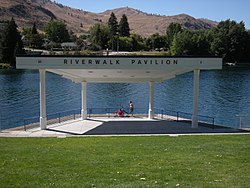 Riverwalk Pavilion
 -
 R. W. Little Building
 -
 Campbell's
 -
 Native women on horseback, 1912
 -
 Woodin Avenue


References
[edit]- Specific
- ^ "Chelan County November 7, 2023 General Election".
- ^ "2019 U.S. Gazetteer Files". United States Census Bureau. Retrieved August 7, 2020.
- ^ a b U.S. Geological Survey Geographic Names Information System: Chelan, Washington
- ^ a b "U.S. Census website". United States Census Bureau. Retrieved December 19, 2012.
- ^ "Explore Census Data". data.census.gov. Retrieved March 23, 2022.
- ^ J. Gottfred; A. Gottfred. "The Life of David Thompson". Northwest Journal. ISSN 1206-4203.
- ^ "US Gazetteer files 2010". United States Census Bureau. Archived from the original on January 25, 2012. Retrieved December 19, 2012.
- ^ "NowData – NOAA Online Weather Data". National Oceanic and Atmospheric Administration. Retrieved August 7, 2022.
- ^ "U.S. Climate Normals Quick Access". National Oceanic and Atmospheric Administration. Archived from the original on August 12, 2023. Retrieved August 12, 2023.
- ^ United States Census Bureau. "Census of Population and Housing". Retrieved August 29, 2013.
- ^ "Population Estimates". United States Census Bureau. Archived from the original on October 19, 2016. Retrieved June 30, 2016.
- General
- Hull, Lindley M., ed. (1929). A History of Central Washington: Including the Famous Wenatchee, Entiat, Chelan and the Columbia Valleys, with an Indexed Eighty Scenic Historical Illustrations (Print). Spokane, Washington: Shaw & Borden Company.
External links
[edit]

Municipalities and communities of Chelan County, Washington, United States | ||
|---|---|---|
| Cities |  | |
| CDPs | ||
| Other communities | ||
| Indian reservation | ||
| Ghost towns | ||
| Footnotes | ‡This populated place also has portions in an adjacent county or counties | |
| International | |
|---|---|
| National | |
| Geographic | |
| Other | |

Chelan, Washington
View on GrokipediaHistory
Indigenous Peoples and Pre-Settlement Era
The region encompassing modern Chelan, Washington, was long inhabited by the Chelan people, an Interior Salish tribe whose territory centered on the southern end of Lake Chelan, the Chelan River outlet, and adjacent Columbia River stretches. Speaking a dialect of the Interior Salishan language closely related to Wenatchi, the Chelan occupied this area for millennia prior to European contact, with their name deriving from Salish terms denoting "deep water," reflecting the lake's prominence in their landscape. Archaeological evidence, including pictographs, indicates sustained human presence, though detailed pre-contact records are scarce due to reliance on oral traditions and the tribe's small size.[8][9] The Chelan economy revolved around seasonal resource exploitation suited to the mountainous terrain: fishing for lake species like bull trout and cutthroat, supplemented by limited salmon runs; hunting deer, mountain goats, and bears; and gathering roots such as bitterroot and camas, berries, and seeds using earth ovens and basketry techniques. They resided in mat-covered longhouses during winter in semi-permanent villages—up to eight documented around the lake—and dispersed to summer camps for foraging and fishing, fostering a semi-nomadic lifestyle. Horses, acquired in the late 18th century via trade, facilitated expanded mobility before widespread European influence.[8][9] Socially, the Chelan operated without rigid hierarchies, guided by village chiefs and communal resource management, including shared fishing weirs; they maintained peaceful trade relations with neighboring tribes like the Wenatchi, Entiat, and Methow at sites such as Kettle Falls and along interconnecting trails. The broader Lake Chelan watershed also served as hunting and gathering grounds for these allied Interior Salish groups, underscoring regional interconnectedness in pre-settlement times. Limited ethnographic data highlights their adaptation to the plateau environment, with no evidence of large-scale agriculture or permanent fortifications prior to the 19th century.[8][9]European Settlement and Early Economy
European exploration of the Lake Chelan region began in the early 19th century, with fur trappers visiting sporadically from the 1810s to 1840s to trade beaver pelts with local tribes.[9] Systematic non-Native settlement commenced later, following the arrival of Chinese placer miners around 1863 who prospected for gold along the Chelan River and established a temporary village with a store and garden, though they largely departed after conflicts in the 1870s.[9] The U.S. Army briefly operated Camp Chelan from 1879 to 1880 to monitor Native American activities, but permanent European-American settlement began in 1886 when William Sanders and Henry Domke traversed the mountains from the Methow Valley to reach the lake's southern shore.[10][9] Sanders persisted in the area, while Domke soon left; that same year, Ignatius A. Navarre and Lewis H. Spader also arrived, with Elizabeth Navarre becoming the first white woman settler.[10] The town of Chelan was formally platted in July 1889 by C. H. Ballard, with legal title confirmation from Congress in 1892, enabling further homesteading.[10][9] A post office opened in 1890, reflecting growing permanence, and the community incorporated as a city in May 1902 under Mayor Amos Edmunds.[10] Initial growth was modest, driven by the harsh terrain and isolation, but settlers adapted by constructing rudimentary homes and carving paths, such as Sanders and Domke's cedar-log canoe for lake navigation after losing their horse.[10] The early economy relied on resource extraction and rudimentary agriculture. Mining drew prospectors seeking gold, silver, and copper from the 1860s onward, though yields were inconsistent and overshadowed later by other pursuits.[10] Logging emerged prominently with a sawmill established at Lake Park in 1888 by L. H. Woodin and A. F. Nichols, supplying timber for local construction amid abundant forests.[10] Agriculture focused on fruit orchards and vineyards, supported by irrigation systems tapping mountain runoff from the 1870s and 1880s; by 1902, the valley shipped 225 carloads of produce, including apples and pears.[9] Early tourism supplemented these, leveraging the lake's scenic allure, with the Campbell Hotel opening in 1901 to accommodate visitors.[10]20th Century Expansion and Infrastructure
The construction of the Lake Chelan Dam represented a pivotal infrastructure project in the 1920s, enabling hydroelectric power generation and stabilizing the lake for irrigation and recreation. Washington Water Power Company obtained a federal license in early 1926 to erect a concrete gravity dam and powerhouse on the Chelan River, with work peaking at 1,250 laborers and culminating in completion by May 1928; the structure raised the lake's surface elevation by 21 feet, creating a reservoir spanning 38 miles long and 52 square miles in area.[5][11] This followed earlier, flood-prone wooden dams from the 1890s that had intermittently attempted similar level control but failed, underscoring the engineering advancements in concrete construction and federal oversight that ensured longevity.[5] Dam-related employment and ancillary road improvements drove rapid early-20th-century population expansion, elevating Chelan's census count from 896 residents in 1920 to 1,403 by 1930, the largest decadal gain in its history up to that point. Concurrent upgrades to wagon trails and the construction of a permanent concrete bridge across the Chelan River in 1927 enhanced overland access from Wenatchee, supplanting prior log-and-plank spans vulnerable to seasonal floods.[5][5] These developments, tied to hydropower demands and emerging tourism, laid groundwork for sustained growth, with the population reaching 2,445 by 1950 amid orchard expansion and visitor influxes facilitated by the enlarged lake.[5] Mid-century infrastructure maturation included the 1955 acquisition of the Lake Chelan Dam by Chelan County Public Utility District No. 1, which expanded generating capacity to 47.6 megawatts and integrated it into regional power grids. Paving of the primary highway corridor—initially designated State Road 10 and later U.S. Route 97 Alternate—progressed through the 1930s, fully surfacing the route to Okanogan by decade's end and reducing isolation that had persisted from rudimentary 19th-century trails.[11][5] Such enhancements correlated with steady demographic rises to 2,802 by 1980, reflecting causal links between reliable transport, energy supply, and economic viability in an agrarian-tourist economy rather than exogenous policy-driven booms.[5]Post-2000 Developments and Challenges
Since 2000, Chelan has experienced steady population growth, with the city's population increasing from 3,526 in 2000 to 4,314 in 2023, reflecting an average annual growth rate of approximately 1.1%.[5][12] This expansion has been driven largely by tourism, which dominates the local economy and attracts over 2 million visitors annually, generating more than $417 million in total spending.[6] The seasonal influx swells the effective population to around 25,000 during summer months, boosting hospitality and related sectors but straining local resources.[13] Infrastructure investments have supported this growth, including the development of the Riverwalk Park and ongoing Lakeside Trail project, which adds a 12-foot-wide shared-use path along Highway 150 for pedestrians and cyclists.[14] In 2025, the city initiated a $3 million wildfire-resilient water system upgrade, featuring a one-million-gallon reservoir, booster pump, and transmission lines to enhance supply during emergencies.[15] Housing developments, such as Weidner Apartment Homes' planned 400-plus unit complex near Walmart, aim to address residential needs amid rising demand.[16] The city's 2025 Strategic Plan outlines further priorities, including $16.1 million in infrastructure projects and zoning revisions to expand affordable housing options.[17] Key challenges include acute housing affordability issues, with Chelan County projecting a need for 10,032 additional homes by 2044 to meet demand, as 75% of households at 70% of area median income struggle with payments.[18] Nearly one-quarter of homeowners and renters are housing cost-burdened, spending over 30% of income on shelter, exacerbated by tourism-driven price increases that disadvantage local workers.[19] Rapid visitor growth has led to community concerns over traffic congestion, seasonal staffing mismatches—with city staffing up 25% over the past decade versus 11% population growth—and erosion of small-town character.[20] Wildfires pose a persistent threat, with notable incidents including the 2015 fires that impacted 765 buildings in Chelan and covered significant acreage nearby, alongside larger regional events like the 2014 Carlton Complex and 2020 Cold Springs fires.[21] In 2025, expanding blazes such as the Labor Mountain Fire, nearing 30,000 acres, prompted evacuations and highlighted vulnerabilities in the wildfire-prone Cascade foothills.[22] Climate trends, including rising temperatures and altered precipitation, have intensified fire frequency and severity since the early 2000s, necessitating resiliency measures like the aforementioned water projects.[23]Geography
Location and Topography
Chelan is situated in north-central Washington state within Chelan County, at the southeastern outlet of Lake Chelan, where the lake discharges into the Chelan River.[24] The city's geographic coordinates are approximately 47.8410° N, 120.0165° W.[25] This positioning places Chelan approximately 55 miles north of Wenatchee and 180 miles east of Seattle, in a region influenced by the Cascade Range's rain shadow.[25] The elevation of Chelan averages 1,129 feet (344 meters) above sea level, with the adjacent Lake Chelan maintaining a surface elevation that fluctuates between 1,079 and 1,100 feet, except during peak summer drawdown periods when it may rise slightly higher due to regulated dam operations.[25][26] The local terrain consists of a relatively flat valley floor along the Chelan River, which flows southward for about 8 miles to join the Columbia River, providing a narrow alluvial plain suitable for urban development and agriculture.[27] Topographically, Chelan lies within a glacial-carved valley in the foothills of the Cascade Mountains, bordered by steep escarpments and ridges rising to elevations exceeding 5,000 feet in the nearby Chelan Mountains to the east and the Sawtooth Ridge to the west.[28] Lake Chelan itself forms a prominent fjord-like feature extending 50.5 miles northward, with a maximum depth of 1,486 feet, making it the third-deepest lake in the United States and reflecting the erosive power of Pleistocene glaciers that overdeepened the basin.[29] The surrounding landscape transitions from the valley's gentle slopes to rugged, forested highlands in the adjacent Lake Chelan-Sawtooth Wilderness, where elevations reach up to 9,000 feet, creating a dramatic relief that channels local winds and influences microclimates.[30] This topography, shaped by Cordilleran ice sheets, confines the city to a linear corridor along the watercourse, limiting lateral expansion while exposing it to avalanche risks and seismic activity from fault lines in the Cascades.[28]Climate and Natural Features
Chelan lies in the rain shadow of the Cascade Mountains, resulting in a cold semi-arid climate (Köppen classification BSk) with hot, dry summers and cold, snowy winters. Annual precipitation averages about 9 inches, primarily falling as winter rain or snow, while summers are notably arid with frequent clear skies.[31] [32] Average high temperatures peak at 88°F in July, with lows around 23°F in January; snowfall totals approximately 25 inches annually, concentrated from November to March.[31] The lake's presence provides some moderation, reducing extreme temperature swings compared to surrounding inland areas, though diurnal ranges remain wide due to elevation and low humidity.[31] The city's natural features are dominated by Lake Chelan, a glacially carved, fjord-like body of water stretching 50.5 miles north from the city, with a maximum depth of 1,486 feet, ranking it as the third deepest lake in the United States.[33] [34] Surrounding steep Cascade Mountain slopes, rising sharply to over 7,000 feet, enclose the narrow valley, with the Chelan River emerging from the lake's outlet to irrigate downstream orchards and farmlands.[33] The area's geology reflects Pleistocene glaciation, featuring overdeepened basins and moraine deposits that shape the rugged topography and support diverse microclimates for agriculture and recreation.[28]Demographics
Population Trends and Census Data
As of the 2020 United States decennial census, Chelan had a population of 4,222 residents.[35] The 2010 census recorded 3,929 residents, reflecting a growth of 7.4% over the decade, while the 2000 census counted 3,435 residents, indicating an 14.4% increase from 2000 to 2010.[35] [36]| Census Year | Population | Decade Growth Rate |
|---|---|---|
| 2000 | 3,435 | - |
| 2010 | 3,929 | 14.4% |
| 2020 | 4,222 | 7.4% |
Ethnic Composition and Immigration Patterns
According to the 2020 United States Census, Chelan's population of 4,222 residents was predominantly White non-Hispanic at 74.9%, with Hispanic or Latino residents of any race comprising 21.1%.[12] Smaller groups included Asian non-Hispanic at 1.5%, two or more races (primarily Hispanic) at approximately 1.5%, and other races (Hispanic) at 4.9%.[12] Black or African American residents accounted for less than 0.5%, American Indian and Alaska Native for about 0.7%, and Native Hawaiian or Pacific Islander for negligible shares.[38]| Ethnic Group | Percentage of Population |
|---|---|
| White (Non-Hispanic) | 74.9% |
| Hispanic or Latino (any race) | 21.1% |
| Asian (Non-Hispanic) | 1.5% |
| Two or More Races (Hispanic) | 15.4% (subset of Hispanic) |
| Other Race (Hispanic) | 4.9% (subset of Hispanic) |
| All Others | <2% combined[12] |
Socioeconomic Indicators
As of 2023, the median household income in Chelan stood at $71,996, reflecting a 4.13% decline from $75,099 in 2022, amid broader economic pressures including inflation and a tourism-dependent labor market.[12] This figure trails the Washington state median of approximately $91,000 and the national median of $77,719 for the same period, highlighting Chelan's reliance on seasonal industries that contribute to income volatility. Per capita income in the city was estimated at $50,781, supporting a modest standard of living tied to agriculture, retail, and visitor services.[35] The poverty rate in Chelan reached 9.46% in 2023, up 5.56% from the prior year, remaining below the national average of 11.5% but indicative of challenges for lower-wage workers in hospitality and farming sectors.[12] Homeownership rates were 58.4%, lower than the U.S. average of 65%, with median property values at $428,200 driven by demand from second-home buyers and retirees rather than local affordability.[12] Educational attainment data at the city level is limited, but in encompassing Chelan County, 30.2% of adults aged 25 and older held a bachelor's degree or higher in 2023, up from 25.8% in 2019, reflecting gradual improvements possibly linked to remote work influxes post-pandemic.[46] High school completion rates exceed 90% county-wide, aligning with state norms but constrained by vocational emphases in trades over advanced degrees.[47] Unemployment in Chelan County, which dominates local employment patterns, was 4.1% as of August 2025, down from 4.9% the prior year, with labor force participation influenced by seasonal tourism peaks that mask underemployment in off-seasons.[1]| Indicator | Chelan/Chelan County (2023 unless noted) | Washington State | United States |
|---|---|---|---|
| Median Household Income | $71,996 | $91,306 | $77,719 |
| Poverty Rate | 9.46% | 9.4% | 11.5% |
| Homeownership Rate | 58.4% | 62.4% | 65.0% |
| Bachelor's Degree or Higher (25+) | 30.2% | 36.7% | 34.3% |