


Community hub
Recent from talks
Contribute something
Nothing was collected or created yet.
Compsognathidae
View on Wikipedia
| Compsognathidae | |||
|---|---|---|---|

| |||
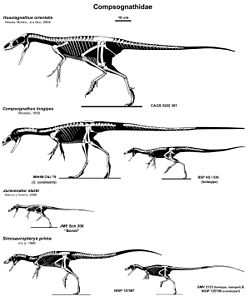
| Compsognathid skeletons to scale | |||
Scientific classification 
| |||
| Kingdom: | Animalia | ||
| Phylum: | Chordata | ||
| Class: | Reptilia | ||
| Clade: | Dinosauria | ||
| Clade: | Saurischia | ||
| Clade: | Theropoda | ||
| Clade: | Neocoelurosauria | ||
| Family: | †Compsognathidae Cope, 1871 | ||
| Type species | |||
| †Compsognathus longipes Wagner, 1861
| |||
| Genera[1][2] | |||
| |||
| Synonyms | |||
| |||
Compsognathidae is a potentially polyphyletic family of coelurosaurian theropod dinosaurs. Compsognathids were small carnivores, generally conservative in form, hailing from the Jurassic and Cretaceous Periods. The bird-like features of these species, along with other dinosaurs such as Archaeopteryx inspired the idea for the connection between dinosaur reptiles and modern-day avian species.[4] Compsognathid fossils preserve diverse integument — skin impressions are known from four genera commonly placed in the group, Compsognathus, Sinosauropteryx, Sinocalliopteryx and Juravenator.[5] While the latter three show evidence of a covering of some of the earliest primitive feathers over much of the body, Juravenator and Compsognathus also show evidence of scales on the tail or hind legs. "Ubirajara jubatus", informally described in 2020, had elaborate integumentary structures on its back and shoulders superficially similar to the display feathers of a standardwing bird-of-paradise, and unlike any other non-avian dinosaur currently described.
The first member of the group, Compsognathus, was discovered in 1861, after Johann A. Wagner published his description of the taxon.[6][7][8] The family was created by Edward Drinker Cope in 1875.[9] This classification was accepted by Othniel Charles Marsh in 1882, and added to the Coelurosauria clade by Friedrich von Huene in 1914 after additional fossils had been found.[6] With further discoveries, fossils have been uncovered across three different continents, in Asia,[5][6][7][8][10] Europe,[11] and South America.[7][9] Assignment to Compsognathidae is usually determined through examination of the metacarpal, which is used to separate Compsognathidae from other dinosaurs.[12] However, classification is still complicated due to similarities to the body of several other theropod dinosaurs, as well as the lack of unifying, diagnostic features that are shared by all compsognathids.[9][13] Some authors have proposed that Compsognathidae is not a monophyletic group, and at least some compsognathids represent juvenile specimens of larger tetanuran theropods, such as carnosaurs and tyrannosaurs.[14][15][16]
History of discovery
[edit]
The first significant fossil specimen of Compsognathidae was found in the Bavaria region of Germany (BSP AS I 563) and given to collector Joseph Oberndorfer in 1859.[17] The finding was initially significant because of the small size of the specimen. In 1861, after an initial period of review, Johann A. Wagner presented his analysis of the specimen to the public and named the fossil Compsognathus longipes ("elegant jaw").[18] In 1868, Thomas Henry Huxley, an early supporter of Charles Darwin and his theory of evolution, used Compsognathus in a comparison to similar feathered dinosaur Archaeopteryx in order to propose the origin of birds. Huxley noticed that these dinosaurs shared a similar layout to birds and proposed an exploration of the similarities. He is credited as being the first person to do so.[19] This initial comparison sparked the interest into the origin of birds and feathers. In 1882, Othniel Charles Marsh named a new family of dinosaurs for this species Compsognathidae and officially recognized the species as part of Dinosauria.[20]
Notable Specimens
[edit]
In 1971, a second nearly complete specimen of Composgnathus longipes was found in the area of Canjuers, which is located in the southeast of France near Nice.[6] This specimen was much larger than the original German specimen, but similarities led to experts categorizing the fossil as an adult Compsognathus longipes and leading to the further classification of the German specimen as a juvenile.[21] This specimen also contained a lizard in the digestive region, further solidifying the theory that compsognathids consumed small vertebrate species.
The holotype of Juravenator is the only known specimen of the species. Though Juravenator has previously been accepted as a member of Compsognathidae, recent research has led some experts to believe that Juravenator does not belong in this group. This is because Juravenator could also be classified into a similar group within Coelurosauria, Maniraptoriformes. Maniraptoriforms share many similarities with compsognathids and, because there has been only one verified specimen of Juravenator, experts have disagreed on exactly where to place this genus. Since 2013, Juravenator is still commonly classified as a coelurosaur, but near the group Maniraptoriformes instead of Compsognathidae.[22]
A compsognathid specimen consisting of a single finger bone has been described from Late Jurassic (Tithonian Age, about 150 million years ago) sediments at Port Waikato, New Zealand. It is the first and so far, only dinosaur specimen known from Jurassic New Zealand, as well as being the first New Zealand dinosaur fossil to have been found outside of the Cretaceous marine sediments at Mangahouanga Stream. Possible coprolites have been referred to this specimen, however it is still not an officially classified species.
Description
[edit]Compsognathids share a variety of characteristics. The genera in this family demonstrate traits that are characteristic of theropods, such as smaller forelimbs than hind legs. Size, feathers and metacarpal size are among the most important classifying common characteristics.
Size
[edit]
Compsognathids are considered to be among the smallest dinosaurs ever discovered. Compsognathus longipes was formerly the smallest known dinosaur. It was around the size of a chicken when fully grown: around 1 m (3 ft 3 in) long and weighing 2.5 kg (5.5 lb).[23] However, recently discovered adult specimens of other dinosaurs are smaller than Compsognathus, including Caenagnathasia, Microraptor and Parvicursor, all of which are estimated to be less than 1 m long.[24] However, most of these specimens are incomplete, so these sizes remain estimates.
The other genera in this family are slightly larger than Compsognathus longipes, but generally similar in size. The largest compsognathid is Huaxiagnathus, which is estimated from its holotype to be around 1.8 m (5 ft 11 in) long,[25] while Sinocalliopteryx measures around 2.4 m (7 ft 10 in) long.[26] Sinosauropteryx is the most similar to Compsognathus, measuring at most 1.07 m (3 ft 6 in) long.[27]
Feathers
[edit]
The phylogeny of Compsognathidae organizes this family near the development of feathers in dinosaurs. In 1998, evidence of filamentous protofeathers was presented in a study on Sinosauropteryx, marking the first time that any sort of feather structure was found outside of birds and their related species.[28] After this, more evidence of feather structure was found in other genera of Compsognathidae. Evidence of protofeathers bearing resemblance to Sinosauropteryx was found on Sinocalliopteryx specimens, including on the foot of the specimen.[29] There have been signs of basic feather structures on Juravenator, but evidence of this is still not definite. Samples of Juravenator skin show scales instead of feathers, leading into debates about Juravenator's place within the family Compsognathidae.[30] However, a 2010 examination of Juravenator under UV light showed filaments similar to those seen on other compsognathid specimens, indicating that it is likely that these dinosaurs had some sort of feathering.[31] A 2020 study concluded the "scales" were actually adipocere, though the same study defended Juravenator was a megalosauroid and not a compsognathid.[32]
Metacarpals
[edit]Another way of classification of Compsognathidae is shared metacarpal morphology. A 2007 study found similarities between compsognathid genera in certain metacarpal I morphologies. The conclusion of this study found that Composgnathidae had a distinct manual morphology where, like theropods, the first digit of the manus is larger than the other digits, but with a distinct metacarpal I morphology where the metacarpal is stocky and short. Compsognathidae also has a projection from the manus that is on this metacarpal.[12]
Classification
[edit]The Compsognathidae are a group of mostly small dinosaurs from the late Jurassic and early Cretaceous periods of China, Europe and South America.[33] For many years, Compsognathus was the only member known, but in recent decades paleontologists have discovered several related genera. The clade includes Aristosuchus,[34] Huaxiagnathus,[35] Mirischia,[36] Sinosauropteryx,[37][38] and perhaps Juravenator[39] and Scipionyx.[40] At one time, Mononykus was proposed as a member of the family, but this was rejected by Chen and co-authors in a 1998 paper; they considered the similarities between Mononykus and the compsognathids to be an example of convergent evolution.[41] The position of Compsognathidae within the coelurosaur group is uncertain. Some, such as theropod expert Thomas Holtz Jr. and co-authors Ralph Molnar and Phil Currie in the landmark 2004 text Dinosauria, hold the family as the most basal of the coelurosaurs,[42] while others as part of the Maniraptora.[43][44]
Below is a simplified cladogram showing Compsognathidae by Senter et al. in 2012.[45]
.png)


A number of authors have suggested that Compsognathidae is not a monophyletic group as currently defined, and that at least some "compsognathids" represent the juveniles of other tetanurans, including carnosaurs and tyrannosaurs.[14][15][16]
Here is a simplified version of Cau (2024), which does recover Compsognathidae as a polyphyletic group. Putative compsognathid specimens are in bold.
| Tetanurae |
| |||||||||||||||||||||||||||||||||||||||||||||||||||
Palaeobiology
[edit]Diet
[edit]Compsognathids were carnivores and certain specimens have contained the remains of their diet. The German specimen of Compsognathus included remains in the digestive region, which was initially thought to be an unborn embryo.[46] However, further analysis found that the remains belong to a lizard with an elongated tail and stretched legs.[20][47] Other compsognathids, such as Sinosauropteryx, have been shown to eat lizards.[27]
References
[edit]- ^ Hendrickx, C.; Hartman, S.A.; Mateus, O. (2015). "An Overview of Non- Avian Theropod Discoveries and Classification". PalArch's Journal of Vertebrate Palaeontology. 12 (1): 1–73.
- ^ Hartman, Scott; Mortimer, Mickey; Wahl, William R.; Lomax, Dean R.; Lippincott, Jessica; Lovelace, David M. (2019). "A new paravian dinosaur from the Late Jurassic of North America supports a late acquisition of avian flight". PeerJ. 7 e7247. doi:10.7717/peerj.7247. PMC 6626525. PMID 31333906.
- ^ Qiu, Rui; Wang, Xiaolin; Jiang, Shunxing; Meng, Jin; Zhou, Zhonghe (2025-02-22). "Two new compsognathid-like theropods show diversified predation strategies in theropod dinosaurs". National Science Review. 12 (5) nwaf068. doi:10.1093/nsr/nwaf068. ISSN 2095-5138. PMC 11970238. PMID 40191255.
- ^ Etnier, Michael A. "Neptune's Ark: From Ichthyosaurs to Orcas." (2008): 25.
- ^ a b Xu, Xing (2006). "Palaeontology: Scales, feathers and dinosaurs". Nature. 440 (7082): 287–288. Bibcode:2006Natur.440..287X. doi:10.1038/440287a. PMID 16541058.
- ^ a b c d Peyer, Karin (2006). "A reconsideration of Compsognathus from the Upper Tithonian of Canjuers, southeastern France". Journal of Vertebrate Paleontology. 26 (4): 879–896. doi:10.1671/0272-4634(2006)26[879:AROCFT]2.0.CO;2.
- ^ a b c Sales, Marcos AF; Cascon, Paulo; Schultz, Cesar L. (2014). "Note on the paleobiogeography of Compsognathidae (Dinosauria: Theropoda) and its paleoecological implications". Anais da Academia Brasileira de Ciências. 86 (1): 127–134. doi:10.1590/0001-37652013100412. PMID 24676159.
- ^ a b Wagner, A (1861). "Neue Beiträge zur Kenntnis der urweltlichen Fauna des lithographischen Schiefers; V. Compsognathus longipes Wagner". Abhandlungen der Bayerischen Akademie der Wissenschaften. 9: 30–38.
- ^ a b c Naish, D.; Martill, David M.; Frey, Eberhard (2004). "Ecology, systematics and biogeographical relationships of dinosaurs, including a new theropod, from the Santana Formation (?Albian, Early Cretaceous) of Brazil" (PDF). Historical Biology. 16 (2–4): 57–70. Bibcode:2004HBio...16...57N. CiteSeerX 10.1.1.394.9219. doi:10.1080/08912960410001674200. S2CID 18592288. Archived (PDF) from the original on 2017-08-09. Retrieved 2021-03-09.
- ^ Shu'an, Ji; et al. (2007). "New material of Sinosauropteryx (Theropoda: Compsognathidae) from western Liaoning, China". Acta Geologica Sinica (English Edition). 81 (2): 177–182. Bibcode:2007AcGlS..81..177J. doi:10.1111/j.1755-6724.2007.tb00942.x.
- ^ Dal Sasso C., Maganuco S. "Scipionyx samniticus (Theropoda: Compsognathidae) from the Lower Cretaceous of Italy: osteology, ontogenetic assessment, phylogeny, soft tissue anatomy, taphonomy and palaeobiology." Memorie, XXXVI-I (2011): 1-283.
- ^ a b Gishlick, Alan D.; Gauthier, Jacques A. (2007). "On the manual morphology of Compsognathus longipes and its bearing on the diagnosis of Compsognathidae". Zoological Journal of the Linnean Society. 149 (4): 569–581. doi:10.1111/j.1096-3642.2007.00269.x.
- ^ Brett-Surman, Michael K., Thomas R. Holtz, and James O. Farlow, eds. The complete dinosaur. Indiana University Press, 2012 pp 360.
- ^ a b Cau, Andrea (2021). "Comments on the Mesozoic theropod dinosaurs from Italy". Atti della Società dei Naturalisti e Matematici di Modena. 152: 81–95.
- ^ a b Cau A. (2024). A Unified Framework for Predatory Dinosaur Macroevolution Archived 2024-12-20 at the Wayback Machine. Bollettino della Società Paleontologica Italiana, 63(1): 1-19.
- ^ a b Foth, Christian; Haug, Carolin; Haug, Joachim T.; Tischlinger, Helmut; Rauhut, Oliver W. M. (2020), Foth, Christian; Rauhut, Oliver W. M. (eds.), "Two of a Feather: A Comparison of the Preserved Integument in the Juvenile Theropod Dinosaurs Sciurumimus and Juravenator from the Kimmeridgian Torleite Formation of Southern Germany", The Evolution of Feathers, Cham: Springer International Publishing, pp. 79–101, doi:10.1007/978-3-030-27223-4_6, ISBN 978-3-030-27222-7, retrieved 2024-04-18
- ^ Wellnhofer, P. (2008). "Dinosaurier". Archaeopteryx — der Urvogel von Solnhofen. Munich: Verlag Dr. Friedrich Pfeil. p. 256. ISBN 978-3-89937-076-8.
- ^ Wagner, Johann Andreas (1861). "Neue Beiträge zur Kenntnis der urweltlichen Fauna des lithographischen Schiefers; V. Compsognathus longipes Wagner". Abhandlungen der Bayerischen Akademie der Wissenschaften. 9: 30–38.
- ^ Switek, B (2010). "Thomas Henry Huxley and the reptile to bird transition". Geological Society, London, Special Publications. 343 (1): 251–263. Bibcode:2010GSLSP.343..251S. doi:10.1144/SP343.15.
- ^ a b Ostrom, J. H. (1978). The osteology of Compsognathus longipes Wagner. Zitteliana.
- ^ Callison, G.; Quimby, H. M. (1984). "Tiny dinosaurs: Are they fully grown?". Journal of Vertebrate Paleontology. 3 (4): 200–209. Bibcode:1984JVPal...3..200C. doi:10.1080/02724634.1984.10011975.
- ^ Godefroit, Pascal; Cau, Andrea; Hu, Dong-Yu; Escuillié, François; Wu, Wenhao; Dyke, Gareth (2013). "A Jurassic avialan dinosaur from China resolves the early phylogenetic history of birds". Nature. 498 (7454): 359–362. Bibcode:2013Natur.498..359G. doi:10.1038/nature12168. PMID 23719374.
- ^ "What was the biggest dinosaur? What was the smallest? Archived 2017-10-02 at the Wayback Machine" (May 17, 2001)
- ^ Paul, G.S., 2010 The Princeton Field Guide to Dinosaurs, Princeton University Press p. 152
- ^ Hwang SH, Norell MA, Ji Q, Gao K-Q (2004) A large compsognathid from the Early Cretaceous Yixian Formation of China. J Syst Pal 2: 13–30. doi:10.1017/S1477201903001081.
- ^ Therrien, F.; Henderson, D. M. (2007). "My theropod is bigger than yours... or not: estimating body size from skull length in theropods". Journal of Vertebrate Paleontology. 27 (1): 108–115. doi:10.1671/0272-4634(2007)27[108:MTIBTY]2.0.CO;2.
- ^ a b Black, Riley (2012-08-31). "Stomach Contents Preserve Sinocalliopteryx Snacks". Smithsonian Magazine. Archived from the original on 2024-12-04. Retrieved 2024-12-03.
- ^ Chen, P.; Dong, Z.; Zhen, S. (1998). "An exceptionally well-preserved theropod dinosaur from the Yixian Formation of China". Nature. 391 (8): 147–152. Bibcode:1998Natur.391..147C. doi:10.1038/34356.
- ^ Ji, S.; Ji, Q.; Lu, J.; Yuan, C. (2007). "A new giant compsognathid dinosaur with long filamentous integuments from Lower Cretaceous of Northeastern China". Acta Geologica Sinica. 81 (1): 8–15.
- ^ Goehlich, U.B.; Tischlinger, H.; Chiappe, L.M. (2006). "Juravenator starki (Reptilia, Theropoda) ein neuer Raubdinosaurier aus dem Oberjura der Suedlichen Frankenalb (Sueddeutschland): Skelettanatomie und Weichteilbefunde". Archaeopteryx. 24: 1–26.
- ^ Chiappe, L.M.; Göhlich, U.B. (2010). "Anatomy of Juravenator starki (Theropoda: Coelurosauria) from the Late Jurassic of Germany". Neues Jahrbuch für Geologie und Paläontologie - Abhandlungen. 258 (3): 257–296. Bibcode:2010NJGPA.258..257C. doi:10.1127/0077-7749/2010/0125.
- ^ Foth, Christian; Haug, Carolin; Haug, Joachim T.; Tischlinger, Helmut; Rauhut, Oliver W. M. (2020), Foth, Christian; Rauhut, Oliver W. M. (eds.), "Two of a Feather: A Comparison of the Preserved Integument in the Juvenile Theropod Dinosaurs Sciurumimus and Juravenator from the Kimmeridgian Torleite Formation of Southern Germany", The Evolution of Feathers: From Their Origin to the Present, Fascinating Life Sciences, Cham: Springer International Publishing, pp. 79–101, doi:10.1007/978-3-030-27223-4_6, ISBN 978-3-030-27223-4, S2CID 216245045
- ^ Peyer, K. (2006). "A reconsideration of Compsognathus from the Upper Tithonian of Canjuers, southeastern France". Journal of Vertebrate Paleontology. 26 (4): 879–896. doi:10.1671/0272-4634(2006)26[879:AROCFT]2.0.CO;2. S2CID 86338296.
- ^ Seeley, H.G. (1887). "On Aristosuchus pusillus (Owen), being further notes on the fossils described by Sir. R. Owen as Poikilopleuron pusillus, Owen". Quarterly Journal of the Geological Society of London. 43 (1–4): 221–228. Bibcode:1887QJGS...43..221S. doi:10.1144/GSL.JGS.1887.043.01-04.22. S2CID 131237500.
- ^ Hwang, S. H.; Norell, M. A.; Qiang, J.; Keqin, G. (2004). "A large compsognathid from the Early Cretaceous Yixian Formation of China" (PDF). Journal of Systematic Palaeontology. 2 (1): 13–39. Bibcode:2004JSPal...2...13H. doi:10.1017/S1477201903001081. S2CID 86321886. Archived (PDF) from the original on 2023-04-09. Retrieved 2023-01-22.
- ^ Naish, D.; Martill, David M.; Frey, Eberhard (2004). "Ecology, systematics and biogeographical relationships of dinosaurs, including a new theropod, from the Santana Formation (?Albian, Early Cretaceous) of Brazil" (PDF). Historical Biology. 16 (2–4): 1–14. Bibcode:2004HBio...16...57N. CiteSeerX 10.1.1.394.9219. doi:10.1080/08912960410001674200. S2CID 18592288. Archived (PDF) from the original on 2017-08-09. Retrieved 2021-03-09.
- ^ Currie, Philip J. and Chen, Pei-ji (2001). "Anatomy of Sinosauropteryx prima from Liaoning, northeastern China" (PDF). Canadian Journal of Earth Sciences. 38 (12): 1705–1727. Bibcode:2001CaJES..38.1705C. doi:10.1139/cjes-38-12-1705. Archived (PDF) from the original on 2024-12-04. Retrieved 2024-12-03.
- ^ Ji, Q.; Ji S.A. (1996). "On discovery of the earliest bird fossil in China and the origin of birds (in Chinese)". Chinese Geology. 233: 30–33.
- ^ Göhlich, Ursula B. & Chiappe, Luis M. (2006). "A new carnivorous dinosaur from the Late Jurassic Solnhofen archipelago" (PDF). Nature. 440 (7082): 329–332. Bibcode:2006Natur.440..329G. doi:10.1038/nature04579. PMID 16541071. S2CID 4427002. Archived (PDF) from the original on 2019-04-26. Retrieved 2024-12-03.
- ^ Dal Sasso, C.; M. Signore (1998). "Exceptional soft-tissue preservation in a theropod dinosaur from Italy" (PDF). Nature. 392 (6674): 383–387. Bibcode:1998Natur.392..383D. doi:10.1038/32884. S2CID 4325093. Archived (PDF) from the original on 2016-09-20. Retrieved 2023-01-22.
- ^ Chen, P.; Dong, Z.; Zhen, S. (1998). "An exceptionally well-preserved theropod dinosaur from the Yixian Formation of China". Nature. 391 (6663): 147–152. Bibcode:1998Natur.391..147C. doi:10.1038/34356. S2CID 4430927.
- ^ Holtz TR, Molnar RE, Currie PJ (2004). "Basal Tetanurae". In Weishampel DB, Osmólska H, Dodson P (eds.). The Dinosauria (2nd ed.). University of California Press. p. 105. ISBN 978-0-520-24209-8.
- ^ Gauthier, J.A. (1986). "Saurischian monophyly and the origin of birds". In Padian, K. (Ed.) the Origin of Birds and the Evolution of Flight, Memoirs of the California Academy of Sciences. 8: 1–55.
- ^ Forster, C.A.; Sampson, S.D.; Chiappe, L.M.; Krause, D.W. (1998). "The theropod ancestry of birds: new evidence from the Late Cretaceous of Madagascar". Science. 279 (5358): 1915–1919. Bibcode:1998Sci...279.1915F. doi:10.1126/science.279.5358.1915. PMID 9506938.
- ^ Senter, P.; Kirkland, J. I.; Deblieux, D. D.; Madsen, S.; Toth, N. (2012). Dodson, Peter (ed.). "New Dromaeosaurids (Dinosauria: Theropoda) from the Lower Cretaceous of Utah, and the Evolution of the Dromaeosaurid Tail". PLOS ONE. 7 (5) e36790. Bibcode:2012PLoSO...736790S. doi:10.1371/journal.pone.0036790. PMC 3352940. PMID 22615813.
- ^ Report of the 65th Meeting of the British Association for the Advancement of Science, Ipswich, 1895, London, 1895, 743
- ^ Nopcsa, Baron F (1903). "Neues ueber Compsognathus". Neues Jahrbuch für Mineralogie, Geologie und Palaeontologie (Stuttgart). 16: 476–494.
.jpg)


.jpg)


.png)


.jpg)


| National | |
|---|---|
| Other | |

Compsognathidae
View on GrokipediaHistory of discovery
Initial discoveries
The first specimen of Compsognathus longipes was discovered in 1859 by quarry workers in the Upper Jurassic Solnhofen limestone deposits near Gunzenhausen (or Kelheim), Bavaria, southern Germany, and subsequently acquired by the local physician and avid fossil collector Joseph Oberndorfer.[7] Johann Andreas Wagner, a paleontologist at the University of Munich and curator of the Bavarian State Collection of Paleontology, briefly named the taxon Compsognathus longipes in a short announcement that year, interpreting the nearly complete skeleton—preserved on a limestone slab measuring about 35 cm long—as that of a small, bird-like lizard akin to an iguana, rather than a dinosaur.[7] Wagner provided a more detailed description in 1861, just before his death, emphasizing its slender build and long hindlimbs but maintaining the lacertilian (lizard) classification, which reflected the era's limited understanding of small theropod anatomy and the prevailing view that such delicate fossils were reptilian rather than dinosaurian.[7] This initial interpretation persisted into the late 19th century, with early paleontologists like Edward Drinker Cope still grouping Compsognathus among lizards in some classifications, though its avian-like proportions began drawing comparisons to the contemporaneous Archaeopteryx fossils from the same Solnhofen deposits—both small, bipedal forms with long tails and grasping hands that fueled Thomas Henry Huxley's arguments for dinosaur-bird evolutionary links in the 1870s.[7] By 1881, American paleontologist Othniel Charles Marsh reexamined the specimen during a visit to Munich and firmly established its dinosaurian affinities, noting the preserved remains of a small lizard (Bavarisaurus) within its ribcage as evidence of its carnivorous habits, thus solidifying Compsognathus as one of the earliest well-known theropod dinosaurs and a key example of the group's small-bodied members.[7] No additional Compsognathus specimens were found for over a century until the early 1970s, when quarry owner Louis Ghirardi uncovered a second, larger and more complete skeleton in the Portlandian (Upper Jurassic) lithographic limestones of Canjuers, near Nice in southeastern France. Described in 1972 by Armand Bidar and colleagues as a potential new species (C. corallestris) based on subtle proportional differences, this specimen—housed at the Musée National d'Histoire Naturelle in Paris—confirmed the genus's presence beyond Germany and highlighted its rarity, though later analyses synonymized it with C. longipes. These early European discoveries laid the foundation for recognizing Compsognathidae as a family of basal coelurosaurs, with brief later expansions to Asian taxa underscoring their broader Jurassic distribution.[7]Notable specimens and recent finds
One of the most significant discoveries in compsognathid paleontology occurred in 1996 with the unearthing of Sinosauropteryx prima from the Lower Cretaceous Yixian Formation in Liaoning Province, China, by Qiang Ji and Shuan Ji, marking the first non-avian theropod known to preserve evidence of filamentous protofeathers and revolutionizing understandings of dinosaur integument. This specimen, a nearly complete juvenile skeleton approximately 1 meter long, provided early insights into the feathered nature of coelurosaurs and was initially announced in Chinese literature before formal description. In 1998, the exceptional Scipionyx samniticus was described from the Lower Cretaceous (Albian) Piancogno Limestones of Benevento, Italy, representing the most complete European compsognathid skeleton at over 90% preservation and uniquely featuring fossilized soft tissues including the liver, intestines, and muscles of a juvenile individual roughly 50 cm long. The gut contents of this specimen revealed half-digested remains of fish and lizards, offering direct evidence of its diet as an opportunistic predator of small vertebrates.[8] Subsequent finds expanded the family's known diversity in Asia and Europe. Huaxiagnathus orientalis, a larger compsognathid estimated at 1.5–1.8 meters, was described in 2004 from the Yixian Formation based on a nearly complete subadult skeleton that highlighted elongated manual digits.[9] Sinocalliopteryx gigas, named in 2007 from the same formation, is known from two specimens up to 2.3 meters long, with one preserving protofeathers and abdominal contents including feathers from bird-like prey, indicating specialized predation.[10] In 2006, Juravenator starki was reported from the Late Jurassic (Tithonian) Solnhofen Limestone of Bavaria, Germany, based on two juvenile skeletons about 80 cm long, one with preserved skin impressions suggesting a mix of scales and filaments, bridging European and Asian compsognathids. The French Compsognathus corallestris, a larger subadult specimen around 1.3 meters discovered in 1971 from the Tithonian Canjuers locality, complements the German holotype by showing ontogenetic growth patterns in the genus.[11] Recent 2025 discoveries from the Lower Cretaceous Yixian Formation in western Liaoning, China, have further enriched the record and prompted reevaluations of family relationships. Sinosauropteryx lingyuanensis, a new species described from a 1.2-meter-long holotype, exhibits morphological variations suggesting ecological specialization in hunting smaller prey like lizards.[6] Huadanosaurus sinensis, a new genus and species based on a 1-meter specimen, preserves direct evidence of dinosaur-mammal predation through a mammal in its abdominal cavity, the first such instance for compsognathids, and phylogenetic analyses indicate diversified predatory strategies that challenge the monophyly of Compsognathidae by supporting a broader Sinosauropterygidae clade.[6] These finds underscore the rapid diversification of small theropods in Early Cretaceous Asia.[12]Description
Size and general build
Compsognathids were small-bodied theropods characterized by adult body lengths typically ranging from 0.7 to 1.3 meters, with some genera like Sinocalliopteryx reaching up to 2.3 meters in length.[13] Their build was slender and bipedal, featuring elongated hindlimbs that comprised a significant portion of the overall proportions, with the femur measuring approximately 15-20% of total body length and the tibia often exceeding it in size to facilitate agile locomotion; forelimbs were notably reduced in comparison, emphasizing a lightweight frame suited for speed.[7][11] Variations in size occurred among genera, with Sinocalliopteryx representing the larger end of the spectrum at up to 2.3 meters in length, in contrast to the more diminutive Compsognathus, which attained about 1 meter. Recent discoveries, such as Sinosauropteryx lingyuanensis (~1.2 m) and Huadanosaurus sinensis (~1 m), from Early Cretaceous China, further illustrate this size variation among compsognathid-like taxa.[6] This lightweight construction included pneumatized, hollow long bones in the limbs and vertebrae, a trait shared with other basal coelurosaurs that minimized mass while maintaining structural integrity.[11] In genera preserving integumentary structures, such as simple filaments, these added insulation but did not substantially impact skeletal-based size estimates.[13]Skull and dentition
The skulls of compsognathids were small and narrow, typically measuring 10-15 cm in length in adults, with a low profile, sharply tapered snout, and large orbits that provided keen binocular vision for detecting and pursuing small prey.[7] In Compsognathus longipes, the holotype skull reaches about 7.5 cm but the larger "Nice" specimen measures 11 cm, featuring nearly circular orbits around 19-27 mm in diameter that occupy a significant portion of the cranium.[7] Similarly, the juvenile Scipionyx samniticus exhibits an elongated, low skull of approximately 45 mm with prominent oval orbits dominating the dorsal surface, a condition exaggerated by its ontogenetically immature state.[14] Compsognathid dentition reflects adaptations for grasping agile, small-bodied prey, consisting of 15-20 slender, conical teeth per maxillary bone that are recurved and exhibit heterodonty, with anterior teeth more procumbent and lacking serrations while posterior ones bear fine denticles on their rear carinae.[15] In Compsognathus longipes, the maxilla holds 15-16 teeth and the dentary 18, showing a gradational shift from strongly recurved anterior crowns inclined 30-40° backward to smaller, less curved posterior ones with subtle serrations.[7] The Scipionyx samniticus holotype preserves numerous teeth in situ, confirming 4 premaxillary and 15-16 maxillary teeth that are conical and recurved, with premaxillary examples unserrated and maxillary ones featuring sparse posterior denticles, highlighting early ontogenetic development of this grasping morphology.[14][15] These cranial features parallel those in other basal coelurosaurs, such as the slender, fenestrated skulls of ornithomimids, but compsognathids differ in retaining sharper, recurved tooth tips suited to piercing rather than the reduced dentition seen in later ornithomimosaurs.[15] This lightweight skull structure integrated with the family's gracile postcranial build to enable rapid, agile locomotion during hunts.[7]Postcranial skeleton
The postcranial skeleton of compsognathids is characterized by an axial column adapted for flexibility and a lightweight build, with the cervical series consisting of 10 elongated vertebrae that provide neck mobility.[7] These vertebrae feature low neural arches and small, posteriorly directed epipophyses, contributing to the group's slender, agile overall morphology.[7] The dorsal series comprises 13 vertebrae, with amphicoelous centra and prominent neural spines that decrease in height posteriorly, supporting a compact torso.[7] Similar vertebral counts and proportions are observed in related genera such as Sinosauropteryx, where the cervical and dorsal regions exhibit comparable elongation and pneumatization.[16] The forelimbs are notably reduced relative to the body size, with a short humerus and radius that together measure less than the hindlimb elements, emphasizing the bipedal specialization of these theropods.[7] The metacarpals are elongate, with metacarpal II being the longest and most robust at approximately 38% of humerus length, while metacarpal III is slender and about 75% the length of metacarpal II, forming a three-fingered manus suited for grasping small prey.[17] In Compsognathus longipes, the hand length reaches 84% of the combined humerus and radius length, with digits I and II robust and digit III reduced but still functional.[17] The hindlimbs display a gracile construction, featuring a tibia longer than the femur and a slender fibula that splints the tibia distally, adaptations indicative of cursorial habits.[7] The foot exhibits an arctometatarsal condition, with metatarsal III proximally recessed between metatarsals II and IV, enhancing stability and speed during locomotion; this feature is subarctometatarsal in basal members like Compsognathus but more pronounced in derived forms.[18] Metatarsals are elongated overall, with the combined length of the tibia and metatarsus exceeding the femur, as seen in Sinosauropteryx.[16] The pelvic girdle follows the typical basal theropod pattern, with a long and low ilium, an elongated pubis that is markedly longer than the ischium and distally expanded into a boot-like structure, and a straight, rod-like ischium.[7] In Compsognathus corallestris, the pubis shows anterior projection followed by posterior recurvature, reinforcing the lightweight pelvic architecture.[11] These elements collectively underpin the family's agile, terrestrial lifestyle.[7]Integument and feathers
The integument of compsognathids is best known from exceptionally preserved specimens of Asian taxa, where filamentous structures interpreted as protofeathers are evident. In Sinosauropteryx, these consist of simple, unbranched filaments forming a downy covering along the body, neck, and tail, with lengths reaching up to 40 mm.[19] The filaments exhibit a ginger-colored appearance due to preserved melanosomes, including both eumelanosomes and phaeomelanosomes, indicating chestnut to reddish-brown pigmentation in life.[20] Similarly, Sinocalliopteryx preserves protofeathers as simple filamentous structures up to 40 mm long, distributed across the body, including the hips, tail base, and thighs, suggesting a comparable fuzzy integument.[21] Recent finds of Sinosauropteryx lingyuanensis and Huadanosaurus sinensis (2025) also preserve such filamentous integument, reinforcing the presence of protofeathers in compsognathid-like theropods.[6] Evidence from Juravenator reveals a more complex, mosaic integument, with both scales and filaments preserved primarily on the tail. Short monofilamentous protofeathers (~4 mm long) occur dorsally and ventrally along the mid-tail (caudal vertebrae 9–20), while the tail also bears diverse scales, including scutate types for protection and ornamented scales with circular nodes interpreted as integumentary sense organs analogous to those in crocodylians.[22][23][24] No scales are evident elsewhere, and the skin appears otherwise smooth, highlighting regional variation in covering.[23] In contrast, European compsognathids such as Compsognathus and Scipionyx show no preserved feathers or filaments, despite exceptional soft-tissue preservation in the latter, including viscera.[25][26] This absence may reflect preservational bias in Solnhofen-type limestones, where feathers are rare outside of avialans, or ontogenetic factors, as known specimens are juveniles.[21] Across compsognathids, the documented protofeathers represent insulating downy structures rather than flight adaptations, likely aiding thermoregulation while contributing to an overall lightweight build.[21]Classification
Historical perspectives
The family Compsognathidae was initially established by Othniel Charles Marsh in 1878 as a subgroup of megalosaurid theropods, encompassing small, lightly built carnivores characterized by their diminutive size and long tails, distinct from larger predatory forms like Megalosaurus.[27] This placement reflected the limited fossil material available at the time, primarily the Bavarian specimen of Compsognathus longipes described by Wagner in 1861, and positioned the family within the broader Theropoda alongside Megalosauridae and Coeluridae.[27] Marsh's classification emphasized anatomical similarities in the skull and limb proportions to megalosaurs, though the small scale of compsognathids set them apart as a specialized lineage of agile predators.[27] By the mid-20th century, views shifted toward recognizing compsognathids as members of Coelurosauria, a group of more gracile theropods, with Friedrich von Huene incorporating the family into this infraorder in 1914 based on shared features like elongated hindlimbs and reduced forelimbs.[27] John H. Ostrom's detailed osteological redescription of Compsognathus in 1978 confirmed its coelurosaurian affinity through features like the lightweight build and long tail implying bird-like agility, while noting a unique manus structure that distinguished it from other theropods, including early birds like Archaeopteryx.[7] Pre-1996 classifications varied, with some analyses grouping compsognathids alongside ornithomimids in broader coelurosaurian assemblages due to shared traits like slender snouts and cursorial adaptations, as seen in early 20th-century schemes by Huene.[28] Others proposed them near the origins of Tyrannosauroidea based on cladistic assessments of cranial and pelvic features, despite their small size contrasting with later tyrannosaurids. The family was generally defined to include small, long-tailed theropods with unserrated premaxillary teeth and a subnarial foramen, prior to the feathered discoveries that would refine these boundaries. The advent of Asian fossils, such as Sinosauropteryx in 1996, prompted reevaluations by confirming integumentary filaments and solidifying coelurosaurian ties, though recent studies have raised doubts about the monophyly of the group as traditionally conceived.[5]Modern phylogenetic position
In modern cladistic analyses, Compsognathidae is consistently recovered as a basal clade within Coelurosauria, positioned outside Maniraptora and representing an early-branching radiation of small-bodied theropods during the Late Jurassic to Early Cretaceous. This placement stems from comprehensive phylogenetic studies that emphasize shared primitive features with other early coelurosaurs while distinguishing compsognathids from more derived groups like tyrannosauroids and maniraptorans.[29] Although some earlier analyses proposed a more derived position within Paraves, contemporary consensus supports their basal coelurosaurian affinity based on character optimization across extensive theropod matrices.[30] Defining synapomorphies for Compsognathidae include an elongate metacarpal III relative to other basal theropods, a reduced fibula that tapers distally without reaching the tarsals, and a short metacarpal I comprising less than one-third the length of metacarpal II. These traits, combined with opisthocoelous cervical vertebrae and the absence of a fourth trochanter on the femur, underscore their conservative morphology within the theropod tree.[29][31] Within the broader Jurassic-Cretaceous theropod radiation, Compsognathidae occupies a pivotal role as the sister taxon to Ornithomimosauria in several parsimony-based trees, highlighting their contribution to the diversification of lightweight, agile predators.[32] However, recent phylogenetic analyses, including a 2024 study by Cau, challenge the monophyly of Compsognathidae, proposing that it is polyphyletic or an artificial grouping comprising juvenile semaphoronts (ontogenetic stages) scattered across various early theropod lineages, such as megalosaurids, rather than a natural clade.[5] Another 2025 study erects the clade Sinosauropterygidae for compsognathid-like theropods from the Early Cretaceous Jehol Biota of China, including Sinosauropteryx and close relatives as basal coelurosaurs, with core Jurassic taxa like Compsognathus outside this group and Huadanosaurus nested within Sinosauropterygidae, indicating paraphyly of the traditional family.[6]Included genera and validity
The family Compsognathidae traditionally comprises a small assemblage of basal coelurosaurian theropod genera characterized by slender builds and small body sizes, though recent phylogenetic analyses have challenged its monophyly, proposing instead that it represents a polyphyletic or unnatural grouping of ontogenetically immature specimens, often juvenile semaphoronts, from diverse theropod lineages.[5][6] This debate stems from the prevalence of juvenile or subadult material among described taxa, which has raised concerns about the family serving as a "wastebasket" for small, early theropods with convergent juvenile morphologies, potentially leading to taxonomic inflation.[5] As of 2025, approximately 6 to 8 genera are assigned to or closely associated with Compsognathidae, with ongoing revisions reflecting new discoveries and refined phylogenetic placements that emphasize qualifiers for their debated affinities.[6] The core valid genera include the type genus Compsognathus, represented by the species C. longipes from the Late Jurassic Solnhofen Limestone of Germany, which provides the foundational morphology for the family and remains unequivocally valid despite debates on broader relationships and suggestions that it may represent a juvenile megalosaurid.[5] Sinosauropteryx, known from multiple specimens in the Early Cretaceous Yixian Formation of China including the recently described species S. lingyuanensis, is valid and notable for preserving filamentous integument interpreted as primitive feathers, marking it as one of the earliest known feathered non-avian dinosaurs; however, it is placed in the new clade Sinosauropterygidae rather than traditional Compsognathidae, reflecting doubts on the family's monophyly.[6] Sinocalliopteryx, also from the Yixian Formation, is a valid larger-bodied taxon (up to 2.4 meters long) with preserved gut contents indicating piscivory, supporting its compsognathid-like affinities in traditional classifications, though its exact placement remains debated in light of recent polyphyly hypotheses.[10] Scipionyx samniticus, a remarkably preserved juvenile from the Early Cretaceous of Italy, is valid but has been reinterpreted in some analyses as an immature carcharodontosaur rather than a true compsognathid, highlighting ontogenetic biases in family assignments and supporting the view of Compsognathidae as an assemblage of juvenile forms from varied lineages.[33] Juravenator starki, from the Late Jurassic of Germany, is valid and closely resembles Compsognathus, though its integument—initially described with both scales and filaments—remains debated, with filaments potentially representing collagen fibers rather than feathers, and its compsognathid status qualified by potential juvenile morphology.[34] Other genera exhibit more uncertain placements within Compsognathidae. Huaxiagnathus orientalis, from the Yixian Formation, is considered valid but closely related to Sinosauropteryx and Sinocalliopteryx, with some analyses suggesting potential synonymy due to overlapping traits, though it is retained as distinct in recent phylogenies and treated as compsognathid-like amid monophyly doubts.[6] Mirischia asymmetrica, based on fragmentary pelvic material from the Early Cretaceous of Brazil, has uncertain validity owing to its incomplete preservation, but is often included as a compsognathid or closely allied taxon in broader coelurosaurian trees, with qualifiers for its debated affinity given recent polyphyly proposals.[35] Recent additions, such as Huadanosaurus sinensis from the Lower Cretaceous of China (Sinosauropteryx lingyuanensis also from the same formation), are described as compsognathid-like based on robust cranial features and preserved gut contents including mammals, and placed within Sinosauropterygidae in the describing analysis, further indicating the paraphyly of traditional Compsognathidae.[6]| Genus | Taxonomic Status | Key Notes | Primary Source |
|---|---|---|---|
| Compsognathus | Valid (accepted as distinct taxonomic unit per paleontological nomenclature) | Foundational taxon; Late Jurassic, Germany; potentially juvenile megalosaurid | Cau 2024 |
| Sinosauropteryx | Valid (accepted as distinct taxonomic unit per paleontological nomenclature) | Feathered; Early Cretaceous, China; includes S. lingyuanensis in Sinosauropterygidae | Qiu et al. 2025 |
| Sinocalliopteryx | Valid (accepted as distinct taxonomic unit per paleontological nomenclature) | Larger form; Early Cretaceous, China; compsognathid-like affinities debated | Ji et al. 2007 |
| Scipionyx | Valid but debated placement (accepted as distinct taxonomic unit per paleontological nomenclature) | Juvenile; Early Cretaceous, Italy; possibly immature carcharodontosaur | Dal Sasso & Signore 1998 |
| Juravenator | Valid (accepted as distinct taxonomic unit per paleontological nomenclature) | Integument debated; Late Jurassic, Germany; potential juvenile morphology | Göhlich et al. 2006 |
| Huaxiagnathus | Valid with possible synonymy (accepted as distinct taxonomic unit per paleontological nomenclature) | Related to Sinosauropteryx; Early Cretaceous, China; compsognathid-like | Qiu et al. 2025 |
| Mirischia | Uncertain due to fragmentary material (not fully accepted as distinct taxonomic unit per paleontological nomenclature) | Pelvic remains; Early Cretaceous, Brazil; debated affinity | Kellner et al. 2011 |
| Huadanosaurus | Valid (accepted as distinct taxonomic unit per paleontological nomenclature) | Compsognathid-like in Sinosauropterygidae; Early Cretaceous, China | Qiu et al. 2025 |