Hubbry Logo
PycnonemosaurusPycnonemosaurusMain
Open search
Pycnonemosaurus
Community hub
Pycnonemosaurus
logo
8 pages, 0 posts
0 subscribers
Be the first to start a discussion here.
Pycnonemosaurus
Pycnonemosaurus
from Wikipedia

Pycnonemosaurus
Temporal range: Late Cretaceous
~72 Ma
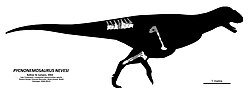
Skeletal restoration showing known material
Scientific classification Edit this classification
Kingdom: Animalia
Phylum: Chordata
Class: Reptilia
Clade: Dinosauria
Clade: Saurischia
Clade: Theropoda
Family: Abelisauridae
Clade: Furileusauria
Genus: Pycnonemosaurus
Kellner & Campos, 2002
Species:
P. nevesi
Binomial name
Pycnonemosaurus nevesi
Kellner & Campos, 2002
Synonyms
  • Pycnoneosaurus nevesi Paul, 2010 lapsus calami

Pycnonemosaurus (meaning 'dense forest lizard') is a genus of carnivorous theropod dinosaur that belonged to the family Abelisauridae. It was found in the Upper Cretaceous red conglomerate sandstones of the Cachoeira do Bom Jardim Formation, Mato Grosso, Brazil, and it lived during the late Campanian to early Maastrichtian stage of the Late Cretaceous.[1]

Discovery and naming

[edit]

The type species, Pycnonemosaurus nevesi, was scientifically described by Kellner and Campos in 2002.[2][3] The only known specimen (DGM 859-R) was found in a red conglomeratic sandstone at the Jangada Roncador locality (then known as Fazenda Roncador), in Mato Grosso State that is exposed close to Paulo Creek, which is currently referred to the Cachoeira do Bom Jardim Formation. During 1952-1953, Llewellyn Ivor Price visited a farm named "Roncador" in the state of Mato Grosso and collected several dinosaur bones. These remains were found by the owner of the farm, Max de Barros Erhart, and his hired workers at the Paulo Creek site. The most important specimen found was the incomplete skeleton of a large abelisaurid theropod, which was found near several titanosaurid sauropod bones.[3][4]

Pycnonemosaurus nevesi was named from the Greek word pycnós meaning dense, némos meaning pastures and woods, and saûrus meaning reptile or lizard. This naming was an allusion to Mato Grosso State, where the remains were found. The specific name was named after the late Dr. Iedo Batista Neves, who passed in 2000, who encouraged the pursuit of paleontological studies, particularly of Alexander Kellner.[3]

Description

[edit]
Size comparison of Pycnonemosaurus (dark green) with other related carnotaurins

Thus far, the remains of Pycnonemosaurus have been fragmentary. No elements were well preserved, and the bone surface is well abraded that indicates the elements were partially exposed at the discovery location before being collected.[3] The type specimen, housed at the Earth Sciences Museum, Rio de Janeiro, consists of five incomplete teeth, parts of seven caudal vertebrae, the distal part of a right pubis, a right tibia, and the distal articulation of the right fibula. The small pubic foot and hatchet-shaped cnemial crest of the tibia distinguishes this species within the abelisaurs. The caudal vertebra has distinct abelisaurid features, such as a fan-shaped transverse process and a cranial projection. However, these awl-like projections are somewhat unlike related abelisaurids, such as Aucasaurus, in that they diminish more towards the distal caudals. All remains were found associated and are presently regarded as belonging to the same individual.[3]

Life restoration

The type specimen of Pycnonemosaurus belongs to an immature individual of uncertain ontogenetic stage, probably a subadult.[1] Initial size estimates of this specimen put the animal at 6–7 metres (20–23 ft) in length and 1.2 tonnes (1.3 short tons) in weight,[3][2] but later analyses have found that it was likely larger, being about 8.9 metres (29.2 ft) long.[5] This new size estimate currently makes Pycnonemosaurus the largest formally described member of the Abelisauridae thus far. Another estimation gave a length of 9 metres (29.5 ft) and a weight of 3.6 tonnes (4.0 short tons).[6]

Classification

[edit]

The following cladogram follows an analysis of 2021 during the description of Llukalkan.[7]

Abelisauridae

Paleoecology

[edit]
Restoration of the head; while the skull is unknown, the illustration serves to show the soft-tissue thought to have covered abelisaurid heads

Pycnonemosaurus is the best known abelisaurid from Brazil, where most theropod material is presently rare besides preserved teeth and footprints. Even though only a few species are known from Brazil, it is one of the most informative countries concerning the Lower Cretaceous period. Initially, the deposits in which this dinosaur was found were assigned to the Bauru Group, and later more specifically to the Cambambe Formation, with a possible temporal range spanning from the Campanian to the Maastrichtian stages.[3][8][9] However, these deposits have since been reassigned to the Campanian-aged Cachoeira do Bom Jardim Formation.[10] This formation is believed to have been deposited in a semi-arid climate, representing the intermediate parts of alluvial fans.[4][11]

Pycnonemosaurus was a predator, probably preying on titanosaurs found in the same locality.[4] Its teeth were small yet sharp, and were used to get a hold of struggling prey as the abelisaur shook and tore them apart.[3]

See also

[edit]

References

[edit]
[edit]
Revisions and contributorsEdit on WikipediaRead on Wikipedia
from Grokipedia
Pycnonemosaurus is a of large abelisaurid theropod dinosaur known from the period of , representing one of the largest members of its family. The type and only , Pycnonemosaurus nevesi, was formally described in 2002 based on an incomplete skeleton (specimen DGM 859-R) that includes five incomplete teeth, portions of two sacral vertebrae, several caudal vertebrae and centra, chevrons, rib fragments, a distal right pubis, a complete right , a distal right , and other fragmentary elements. The remains were discovered in the Jangada Roncador community near Chapada dos Guimarães in Mato Grosso state, within sediments of the Bauru Group (specifically correlated to the Adamantina Formation or equivalent units in the Cambambe Basin), dating to the Campanian–Maastrichtian stages of the Upper Cretaceous, approximately 70 million years ago. This locality is part of a fossil-rich region in central-western Brazil, associated with other Gondwanan dinosaurs including titanosaurian sauropods, highlighting a diverse Late Cretaceous terrestrial ecosystem. Named after Iedo Batista Neves, a Brazilian physician who supported paleontological studies, with the generic name deriving from Greek words meaning "dense forest lizard" in reference to the wooded Chapada dos region, P. nevesi exhibits characteristic abelisaurid traits such as robust limb bones and specialized vertebral morphology. Key diagnostic features include a pubis with a small rounded foot and ventrally bowed anterior distal end, hook-shaped transverse processes on posterior caudal vertebrae, and a massive with a well-developed, ventrally expanded lateral , indicating skeletal immaturity based on unfused sutures. Size estimates place it at approximately 8.9 meters (29 feet) in length, surpassing other abelisaurids like sastrei, and potentially weighing several tons, positioning it as a dominant carnivorous predator in its environment. Phylogenetically, Pycnonemosaurus nevesi is nested within , closely allied with derived taxa such as and in cladistic analyses, supporting its placement among advanced ceratosaurian theropods endemic to . As the first named abelisaurid from the Group, it provides critical insights into the diversity and evolution of South American theropods during the final stages of the Mesozoic era, though its fragmentary preservation limits detailed reconstructions of its skull and full anatomy.

History of research

Initial discovery

The specimen of Pycnonemosaurus, cataloged as DGM 859-R, was discovered in 1952 by Brazilian paleontologist Llewellyn Ivor Price during fieldwork at the Jangada Roncador locality (formerly known as Fazenda Roncador), near Paulo Creek in Querência, state, central-western . Price collected the associated remains, which included several vertebrae, a , and portions of the , from exposures of red conglomerate sandstones. These sediments were initially attributed to the Group, a widespread Upper unit in . Subsequent stratigraphic revisions reassigned the locality to the Cachoeira do Bom Jardim Formation within the Group, dating to the stage of the , approximately 72 million years ago. Following collection, the specimen was stored at the National Department of Mineral Production (DNPM, now part of the Brazilian Geological Service) in Rio de Janeiro, where it received no preliminary descriptions or publications for nearly five decades. The remains languished unstudied until the late , when renewed interest in Brazilian theropod fossils led to its formal analysis and naming in 2002.

Naming and subsequent studies

The genus Pycnonemosaurus was formally named and described in 2002 by Alexander W. A. Kellner and Diogenes de Almeida Campos as Pycnonemosaurus nevesi, based on fragmentary remains from the Upper Bauru Group of , . The generic name combines the Greek words pyknos (dense) and nemos (forest or pasture), alluding to the dense forests of the region where the was discovered, with the suffix sauros (lizard); the specific epithet honors Dr. Iedo Batista Neves, a key supporter of Brazilian paleontology who died in 2000. The original description appeared in the Anais da Academia Brasileira de Ciências and emphasized the taxon's abelisaurid affinities, inferred from features such as robust caudal vertebrae and a strong tibia, while noting the challenges posed by its fragmentary preservation, which included teeth, several caudal vertebrae, a partial pubis, and a complete tibia. Subsequent research has focused on refining size estimates and morphological details. In 2017, Orlando N. Grillo and Rafael Delcourt analyzed allometric scaling in abelisauroids and estimated P. nevesi at 8.9 ± 0.3 meters in body length, positioning it as the largest known abelisaurid based on comparisons with taxa like Carnotaurus and Abelisaurus. That same year, Rafael Delcourt offered a comprehensive morphological revision in Zootaxa, incorporating three previously undescribed caudal transverse processes and clarifying diagnostic traits such as a small, rounded pubic foot and hook-shaped caudal processes, while reinforcing its placement within Abelisauridae as a member of Furileusauria, a derived South American abelisaurid clade defined by elongated neural spines and a stiffened tail for enhanced stability. Despite these advances, no new specimens have been referred to Pycnonemosaurus since 2002, leaving the (DGM 859-R) as the sole associated material; isolated teeth and vertebrae from the Group have been tentatively linked in broader abelisauroid studies, but none have been formally assigned as of November 2025. Additionally, no dedicated cladistic analyses of the have appeared since 2017, though it continues to feature in regional abelisaurid reviews.

Description

Preserved material

The holotype specimen of Pycnonemosaurus nevesi, cataloged as DGM 859-R, consists of five incomplete teeth, portions of two incomplete caudal vertebrae, four isolated caudal centra, transverse processes, rib fragments, the distal right pubis, the complete right , and the distal right . All elements are fragmentary and incomplete, with the teeth exhibiting fine serrations along the carinae and D-shaped cross-sections characteristic of abelisaurid theropods; the vertebrae display pneumatic features such as pleurocoels; the pubis is straight and robust; and the and suggest robust construction. The specimen is housed in the collections of the Museu de Ciências da Terra in Rio de Janeiro, . No paratypes or referred specimens have been designated as of 2025. Taphonomic analysis indicates that the remains experienced significant and prior to and during discovery, resulting in fragmentation and abrasion of surfaces, particularly on the vertebral elements; notably, no cranial material is preserved, necessitating comparative methods for anatomical reconstructions.

Size and osteology

Based on allometric scaling from the length using comparative data from other abelisauroids, Pycnonemosaurus nevesi is estimated to have reached a total body length of 8.9 meters (with a standard deviation of 0.3 meters). This estimate revises earlier projections, such as the 7–8 meters proposed in the original , by accounting for disproportionate limb scaling in large theropods. Weight estimates for P. nevesi range from 1.2 to 3.6 tonnes, with the upper bound representing the maximum for the largest known abelisaurids based on skeletal proportions. The individual's mass likely fell toward the lower end of this spectrum, as evidenced by unfused sutures in preserved elements like the and astragalus, indicating a subadult ontogenetic stage with potential for further growth in mature specimens. Allometric corrections in recent analyses address prior underestimations by incorporating ontogenetic immaturity and robust morphology. Osteological features of P. nevesi highlight its adaptations as a large abelisaurid. The caudal vertebrae exhibit elongation with hook-shaped transverse processes and reduction in neural arch height, contributing to a flexible structure typical of the . The pubis measures approximately 700 mm in length, suggesting a deep pelvic girdle that supported powerful locomotion. The , at around 800 mm long, is robust and straight-shafted with a ventrally expanded lateral malleolus, features indicative of cursorial capabilities despite the animal's size. Preserved teeth reach up to 70 mm in crown height and bear well-developed carinae, aligning with the dentition of carnivorous abelisaurids.

Classification

Phylogenetic analyses

Pycnonemosaurus nevesi was initially classified as a member of Abelisauridae incertae sedis upon its description in 2002, with this placement supported by diagnostic dental characters such as strongly labiolingually compressed, ziphodont teeth with fine serrations, and vertebral features including moderately pneumatic caudal centra with hook-shaped transverse processes. Subsequent phylogenetic analyses from 2016 to 2021 incorporated Pycnonemosaurus into expanded cladistic matrices comprising over 100 taxa, refining its position within the family. A key 2017 study revised the morphology of the known material and conducted a phylogenetic analysis that recovered Pycnonemosaurus as a derived abelisaurid closely related to Carnotaurus and Aucasaurus based on shared derived traits in postcranial anatomy. Subsequent studies have placed it within the Furileusauria clade of Abelisaurinae. This result aligns with broader updates in abelisaurid systematics, including a 2021 analysis employing a modified matrix with 169 characters that confirmed its placement in the same subclade, emphasizing vertebral pneumaticity and dental morphology for scoring. These analyses primarily utilized maximum parsimony methods, often with implied weighting to handle in theropod morphological data, implemented in software such as TNT. Bootstrap support for Pycnonemosaurus's placement was moderate, ranging from 50% to 70% across analyses, reflecting the challenges of scoring fragmentary specimens. Key characters influencing its positioning included the morphology of maxillary teeth (inferred from isolated ) and the degree of caudal vertebral pneumaticity, which aligned it with other Gondwanan abelisaurines. The fragmentary nature of the limits comprehensive character coding, particularly for cranial features, as no material is preserved, resulting in numerous missing entries in phylogenetic matrices. As of late 2024, recent analyses incorporating new Patagonian taxa (e.g., Koleken inakayali) continue to support its placement as a derived abelisaurid, though fragmentary material limits precise resolution; further rescoring may refine interrelationships.

Relationships within Abelisauridae

Pycnonemosaurus nevesi occupies a derived position within , exhibiting close phylogenetic relationships with other advanced members of the family, particularly sastrei from and garridoi. In broader analyses, it is nested within Furileusauria, a of derived South American abelisaurids including , , and others. This placement reflects the broader Gondwanan radiation of abelisaurids during the , linking South American taxa with those from other southern continents through shared evolutionary history. Like other abelisaurids, Pycnonemosaurus shares traits indicative of specialized locomotion and , including robust hindlimbs with a hatchet-shaped cnemial crest on the for enhanced leverage and inferred reduced forelimbs typical of the , which likely served limited functions despite their diminutive size. Distinctive to Pycnonemosaurus, however, are its posterior caudal vertebrae, characterized by moderate elongation and hook-shaped transverse processes that project laterally, adaptations suggesting an agile tail function for counterbalance and maneuverability during predatory pursuits. In comparison to other abelisaurids, Pycnonemosaurus stands out for its greater overall size, estimated at approximately 8.9 meters in body length, surpassing smaller South American relatives such as Ilokelesia schisitocephalus (around 4–5 meters) and lapiderus (about 6 meters). These differences underscore variations in ecological roles within , with Pycnonemosaurus potentially occupying a top predator niche in its Brazilian environment. As a representative of end-Cretaceous abelisaurid diversity, Pycnonemosaurus highlights the clade's success across , from to and , amid the fragmentation of the . Recent phylogenetic revisions have refined internal relationships among abelisaurids, emphasizing the potential for additional Brazilian fossil referrals to expand understanding of this group's evolutionary dynamics and regional variations.

Paleoecology

Geological context

The of Pycnonemosaurus nevesi was recovered from the Cachoeira do Bom Jardim Formation (formerly the Adamantina Formation), which forms part of the Bauru Group within the Cambambe Basin of central-western . This unit is composed mainly of red sandstones and polymictic conglomerates, reflecting deposition in settings associated with continental rift tectonics during the . The formation is dated to the late to early stages (approximately 72 Ma), a determination supported by biostratigraphic correlations and recent magnetostratigraphic analyses of Bauru Group sediments that identify characteristic polarity zones consistent with this interval. Sedimentological indicates a semi-arid paleoenvironment with seasonal fluvial systems, aeolian fields, and limited cover, as inferred from the coarse-grained, poorly sorted sediments and development typical of the Bauru Group's upper sequences. Stratigraphically, the Cachoeira do Bom Jardim Formation lies in the upper portion of the Supergroup and correlates with the Argentine Anacleto Formation based on shared assemblages and lithofacies, reinforcing the late to early temporal framework. Post-2020 stratigraphic revisions, including magnetostratigraphic correlations across the basin, have solidified this age assignment, though no site-specific seismic or studies have been published as of 2025.

Inferred biology and environment

Pycnonemosaurus nevesi is inferred to have been a carnivorous , occupying the top in its Late . As a large abelisaurid theropod estimated at around 8-9 meters in length, it likely preyed on sizable herbivores, particularly titanosaurian sauropods such as , using its robust skull and dentition to deliver penetrating bites and tear flesh. The morphology of abelisaurid teeth, including those referred to Pycnonemosaurus, features thick, triangular crowns with fine serrations suited for gripping and dismembering large prey, supporting a diet focused on active predation rather than scavenging, though opportunistic feeding cannot be ruled out given the fragmentary of the remains. Locomotion in Pycnonemosaurus would have been primarily terrestrial, with robust hindlimbs featuring a prominent cnemial crest indicating powerful acceleration and capabilities for short bursts during ambushes or pursuits. The tail, reinforced by accessory articulations in the caudal vertebrae, provided stability and propulsion, aiding in maneuvers against struggling prey in open terrains. Behavioral inferences suggest solitary , as there is no osteological or for pack dynamics in abelisaurids, though possible intraspecific interactions like head-butting may have occurred based on reinforcements observed in related taxa. In the Cambambe Basin's floodplains of , Pycnonemosaurus coexisted with a limited known assemblage including titanosaurian sauropods that formed the base of the , as well as other notosuchian crocodylomorphs filling mid-sized carnivorous niches. This ecosystem, characterized by warm conditions with seasonal fluvial and semi-arid influences, supported Pycnonemosaurus as the dominant large theropod. However, the fragmentary and sparse faunal record limit direct paleoecological insights, and as of 2025, no stable isotope analyses have confirmed dietary specifics or environmental adaptations.

References

Add your contribution
Related Hubs
User Avatar
No comments yet.