Hubbry Logo
DoliolidaDoliolidaMain
Open search
Doliolida
Community hub
Doliolida
logo
8 pages, 0 posts
0 subscribers
Be the first to start a discussion here.
Doliolida
Doliolida
from Wikipedia

Doliolida
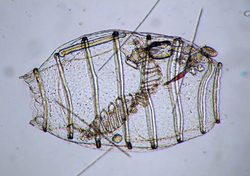
Unidentified species of Doliolum about 1.4 mm long
Scientific classification Edit this classification
Kingdom: Animalia
Phylum: Chordata
Subphylum: Tunicata
Class: Thaliacea
Order: Doliolida
Delage & Hérouard, 1898
Suborders

The Doliolida are an order of small marine chordates of the subphylum Tunicata. They are in the class Thaliacea, which also includes the salps and pyrosomes.[1][2] The doliolid body is small, typically 1–2 mm long, and barrel-shaped; it features two wide siphons, one at the front and the other at the back end, and eight or nine circular muscle strands reminiscent of barrel bands.

Like all tunicates, except for the predatory tunicate, they are filter feeders. Unlike the related class Ascidiacea, which are sessile, but like the class Appendicularia, they are free-swimming plankton; cilia pump water through the body which drives them forward. As the water passes through, small particles and plankton on which the animal feeds are strained from the water by the gill slits. Doliolids can also move by contracting the muscular bands around the body creating a temporary water jet that thrusts them forward or backward quite quickly.

The Doliolida have a complicated life cycle that includes sexual and asexual generations. They are nearly exclusively tropical animals, although a few species do occur as far to the north as northern California.

Life cycle

[edit]
Sexual generation, from the left side: m1-m8: muscle bands; at) atrial apertures; br) branchial apertures; br s) branchial sac; sg) stigmata; st) stomach; ng) nerve ganglion; so) sense organs
Asexual generation (nurse) carrying developing zooids on its dorsal stalk

Doliolids alternate through sexual and asexual generations. The sexual generation consists of individuals featuring eight muscle bands, each having male or female gonads. These individuals are called gonozooids. Fertilized eggs produce slightly different individuals, featuring nine muscle bands, no gonads, and two stalks growing from each individual's body: the shorter one at the ventral side, and the longer one growing from the dorsal edge of the posterior siphon. These asexual individuals are informally called "nurses", and each one produces an astonishing number of mature progeny asexually; such progeny include both sexual and asexual zooids in three sequential "generations".[3]

The nurse produces buds (which grow into new zooids) in its ventral stalk, but the buds grow and mature on its dorsal stalk. Each bud is an aggregate of a few dozen cells, and the way it gets to its final place is the first peculiarity of doliolid reproduction. Buds are immobile, but are actively carried by special mobile cells, called phorocytes, which literally means "carrier cells", shaped like amoebae. Each bud is transported by several phorocytes, which follow a clearly defined path across the nurse's body: up the ventral stalk, in a spiral along the left side of the "barrel", and finally onto and along the dorsal stalk.

The first buds grow in pairs on either side of the dorsal stalk. They develop into zooids not unlike the nurse, each attached to its dorsal stalk with its own dorsal stalk. These zooids differ from the individual independent adult; their intake siphons are so much wider than the rear that the individual zooid is spoon-shaped rather than barrel-shaped. The spoon-shaped zooids supply food for the whole colony via a common blood circulation along two blood-filled sinuses that extend from the nurse along the whole length of the dorsal stalk. As this first generation grows, the nurse's feeding role is gradually diminished, and at the point where the colony's nutrition is supplied by the stalk zooids the nurse loses most of its organs, becoming a purely generative and propulsive agent, dragging its huge grape-like stalk behind it.

As the dorsal stalk grows and more zooids grow along its sides, the phorocytes begin to grow a second batch of buds in two more rows between the first two, on the dorsal side of the stalk. These grow into asexual zooids that are smaller, are barrel-shaped like the nurse, and are attached to the nurse's stalk with their ventral stalks. They do not have a dorsal stalk themselves. Because of their later function, members of this generation are called phorozooids, which means "carrier zooids".

Finally, when the two phorozooid rows on the nurse's stalk are filled up and the first phorozooids grow big enough, the phorocytes begin to plant subsequent buds on the stalks of phorozooids, which are still attached to the main colony at this point. Only this third batch of buds eventually grows into gonozooids - the sexual generation.

As phorozooids mature, their stalks detach from the nurse's stalk, and they swim away on their own, carrying budding gonozooids on their own stalks. The nurse and its battery of feeding zooids goes on until all carriers leave, and then the whole colony dies off. The carriers go on as long as it is required for the gonozooids on their stalks to grow and detach, and then they die off too.

Gonozooids detached from the phorozooid swim free, mate, and produce fertilized eggs - from which spring the next generation of asexual zooid "factories", and the cycle repeats. The total number of zooids produced by a single nurse colony can reach tens of thousands - explosive growth unusual in the animal kingdom.

Natural enemies

[edit]

The gelatinous doliolid Dolioletta gegenbauri is preyed upon by the copepod Sapphirina nigromaculata that chews through and enters its body cavity and then ingests its internal tissues.[4]

See also

[edit]

References

[edit]
Revisions and contributorsEdit on WikipediaRead on Wikipedia
from Grokipedia
Doliolida is an order of small, gelatinous, pelagic belonging to the class within the and Chordata. These marine animals are distinguished by their transparent, barrel-shaped bodies, which lack a distinct visceral except for a simple heart, and are equipped with 8–9 circular muscle bands that enable jet propulsion through water. Doliolids are filter-feeders that consume a wide range of particles, from to eggs, using a mucous net in their . The life cycle of Doliolida is notably complex, involving an between sexual gonozooids—solitary, hermaphroditic individuals that produce eggs and sperm—and asexual nurse (oozoid) stages that bud off chains of specialized zooids for rapid clonal . This polymorphism includes at least six distinct stages, such as phorozooids and larval forms, allowing doliolids to achieve exponential under favorable conditions, often leading to massive blooms. Their is adapted to environmental cues like and availability, with nurses producing up to hundreds of offspring in linear or cyclic chains. Taxonomically, Doliolida comprises two suborders, Doliolidina and Doliopsidina, with the primary family Doliolidae including genera such as , Dolioletta, Doliolina, and Dolioloides, encompassing around 20–30 valid species worldwide. Phylogenetic studies place Doliolida as a basal group within , sister to Salpida and Pyrosomatida, reflecting their evolutionary derivation from sessile ascidian-like ancestors. Distribution is cosmopolitan in marine waters, but they are most abundant in neritic and shelf-break zones of subtropical and temperate regions, serving as key components of the community and indicators of or nutrient-rich conditions. Ecologically, doliolids influence carbon cycling and food webs by grazing and serving as prey for , gelatinous predators, and other , with blooms capable of rivaling those of salps in . Their high , rich in polyunsaturated fatty acids, underscores their role in supporting higher trophic levels, though their patchy distribution and sensitivity to environmental changes make them challenging to study. Ongoing research highlights their underappreciated diversity and evolutionary significance in understanding adaptations to pelagic life.

Taxonomy and Classification

Etymology and History

The name Doliolida derives from the genus Doliolum, which in turn originates from the Latin doliolum, a diminutive form of dolium meaning "small barrel" or "small cask," alluding to the barrel-shaped, gelatinous body of these tunicates. Early observations of doliolids emerged in the 19th century through plankton collections in marine expeditions, with the first formal description in 1823 by A.W. Otto, who named Doliolum mediterraneum (later considered an artifact). Subsequent discoveries included Doliolum denticulatum and D. caudatum described by Quoy and Gaimard in 1835 from Indonesian and Melanesian waters, marking initial recognition of their pelagic, colonial nature. By the 1850s, Thomas Huxley initiated detailed anatomical studies in 1851, followed by Krohn in 1852, who linked doliolids to ascidians within Ascidiacea based on shared morphological traits. The order Doliolida was formally established by and Hérouard in 1898 within the class , building on the family Doliolidae proposed by Bronn in 1862; this classification highlighted their position as under the subphylum and phylum Chordata. Recognition of their complex alternating life cycles advanced in the 1880s, with Kowalevsky and Barrois documenting developmental stages in Anchinia in 1883, following Gegenbaur's 1856 proposal of alternation between sexual and asexual phases. Major taxonomic revisions occurred in the , including Garstang's 1933 systematization of Doliolidae genera and Godeaux's 1996 proposal of suborders Doliolidina and Doliopsidina along with four families. A significant modern update came in 2019 with a revision of Doliolidae from Malaysian coastal waters, incorporating five new species records and refining global distributions based on morphological and distributional data.

Families and Genera

Doliolida is an order within the class Thaliacea, Tunicata, and Chordata, encompassing small, gelatinous marine known for their complex life cycles. The order is divided into two suborders: Doliolidina, characterized by barrel-shaped bodies with 8–9 muscle bands and a vibratile organ positioned in front of the , and Doliopsidina, featuring globulous bodies with 5 muscle bands and the vibratile organ behind the . These suborders distinguish the major lineages based on morphological traits such as body form, muscle band count, and internal organ placement, which are critical for taxonomic identification. The suborder Doliolidina includes two families: Doliolidae, the primary family comprising pelagic, barrel-shaped forms, and the less common Doliopsoididae. The Doliolidae, established by Bronn in 1862, contains four genera: Doliolum (e.g., D. nationalis Borgert, 1893, a widespread species with numerous gill slits), Dolioletta (e.g., D. gegenbauri Uljanin, 1884, common in tropical waters with a coiled digestive tube), Doliolina (e.g., D. muelleri Krohn, 1852, featuring U- or S-shaped digestive tubes and adaptations for colonial chain formation), and Dolioloides (e.g., D. rarum (Grobben, 1882), with an elongated digestive tube). This family accounts for approximately 20 species, diagnosed by 9 muscle bands in the oozooid (nurse) stage and 8 in blastozooids, along with a dorsal spur in the oozooid and typical siphon arrangements for filter-feeding. In contrast, the Doliopsoididae, described by Godeaux in 1996, includes the genus Doliopsoides with three species (e.g., D. meteori Godeaux, 1996), marked by 8 incomplete muscle bands, a thin tunic, and U-shaped digestive tube, often in deeper or specialized pelagic habitats. The suborder Doliopsidina encompasses two families: Doliopsidae and Paradoliopsidae, both representing specialized, globulous forms adapted to distinct niches. The Doliopsidae, also established by Godeaux in 1996, features the genus Doliopsis with three species (e.g., D. rubescens Vogt, 1854, noted for pigmented spots and a thick tunic in localized areas), diagnosed by 5 muscle bands with a sigmoid third band (M III) and solitary to loosely colonial forms via a stolon. The Paradoliopsidae, described in the same work, is a monotypic family with the genus Paradoliopsis and species P. harbisoni Godeaux, 1996, characterized by a rectangular body, 5 muscle bands with sigmoid M III, 24 tunic lobes, and solitary forms bearing buds on a ventral stalk, with white pigmented cells and unique siphon positioning for deep-sea environments. Overall, Doliolida includes approximately 26 valid species across these taxa as of 2023 (including recent additions like Dolioletta advena sp. nov. in 2022), with classification emphasizing differences in muscle band number, body shape, and siphon configurations to differentiate solitary and colonial life stages.

Morphology and Anatomy

External Features

Doliolids exhibit a distinctive barrel-shaped or cylindrical body form, adapted for a planktonic lifestyle, with individual zooids typically ranging from 1 to 8 mm in length. The exterior is covered by a thin, elastic, gelatinous composed primarily of and proteins, which provides structural support while remaining flexible for movement. This is highly translucent, enhancing the organism's transparency and allowing it to blend seamlessly into the marine to evade predators. Positioned at opposite ends of the body are the inhalant buccal at the anterior and the exhalant atrial at the posterior, both wide openings that enable efficient filter feeding and jet-propelled locomotion through muscular contractions. The buccal is fringed with approximately 10 lobes, while the atrial features about 12 lobes, facilitating the and expulsion of . Encircling the body wall are 8 to 9 transverse circular muscle bands, which contract sequentially to produce a peristaltic motion; the variation in band number—typically 9 in oozooids and nurses, and 8 in phorozooids and gonozooids—reflects differences across life cycle stages. In the asexual phase, doliolids form linear colonial chains composed of multiple interconnected zooids attached via a dorsal spur, with chain lengths commonly reaching 8 to 15 cm. These colonies enhance feeding efficiency and dispersal in the . While predominantly transparent, some doliolids display subtle pigmentation, such as small, irregularly shaped orange spots on certain zooids, which may serve visual or protective functions.

Internal Structure

The internal of doliolids is compact, with organs arranged along the posterior ventral surface of the barrel-shaped body to support their pelagic lifestyle. The digestive system is specialized for filter feeding on and small particles. Water enters through the oral siphon and passes into the branchial basket, a large pharyngeal chamber perforated by numerous (gill slits) that expand across the entire pharyngeal cavity, allowing efficient filtration while directing water flow to the atrial cavity. The , a ventral glandular structure extending from near the anterior end to the mid-body, secretes that forms a fine net to trap particles as small as 0.7 μm, which are then transported posteriorly by ciliary action into the and subsequently to the . The is typically oval or elongate, followed by an intestine that forms a simple U- or S-shaped loop ventrally, with wastes expelled through the atrial ; this system enables high feeding efficiency in nutrient-poor oceanic waters. The is open and simple, lacking true blood vessels and relying on the primary body cavity (pericardial and atrial spaces) as blood sinuses for circulation. A small heart, formed by muscular differentiation of epithelial cells, lies ventral to and anterior to the , pumping in a bidirectional manner by periodically reversing flow direction to distribute nutrients and oxygen to organs. The is rudimentary, consisting of a single dorsal located in the anterior third of the body, which coordinates opening/closing and muscle contractions via radiating fibers. Locomotion in adult zooids relies on , achieved through rapid, sequential contractions of 8–9 encircling circular muscle bands that compress the body, expelling water from the atrial to generate speeds up to several body lengths per second. Gonadal structures are hermaphroditic and located in specific s, with ovaries positioned ventrally in the mid- to posterior body (e.g., near muscle bands V–VII) and testes as elongated, or ribbon-like organs extending along the ventral or left side, supporting production for the complex life cycle.

Life Cycle and Reproduction

Asexual Phase

The asexual phase of the Doliolida life cycle is dominated by the nurse , also known as the oozooid, which serves as the primary unit for clonal reproduction. These zooids are barrel-shaped, pelagic featuring 8-9 circumferential muscle bands that enable through water. The nurse zooid can function solitarily or initiate formation, lacking gonads but possessing a prominent ventral for new individuals. This stage allows for rapid population expansion without . Budding occurs asexually on the ventral of the nurse , where precursor blastozooids develop from epithelial and mesenchymal contributions. Amoeboid phorocytes then transport these buds around the body to a dorsal , where they attach and mature into a chain of . This process is highly efficient, with the nurse continuing to produce buds as its internal organs degenerate, focusing resources on . Colonies form as linear chains originating from the nurse, comprising specialized members: feeding trophozooids, which are spoon-shaped and absorb nutrients to sustain the aggregate (up to 50 gill slits in some species like Dolioletta gegenbauri), and non-feeding phorozooids, which facilitate dispersal and produce sexual stages. Under optimal conditions, a single nurse can generate up to 10,000 zooids through this clonal multiplication. Nutrient-rich coastal or shelf waters trigger accelerated clonal expansion, with and release rates increasing in response to elevated concentrations (e.g., 20–60 µg C l⁻¹), promoting dense blooms within 1–2 weeks. This environmental dependence enhances the nurse's reproductive output during productive periods.

Sexual Phase

The sexual phase of the Doliolida life cycle is dominated by solitary gonozooids, which are hermaphroditic blastozooids characterized by eight muscle bands and the presence of gonads, lacking the outgrowths seen in other stages. These gonozooids develop asexually from phorozooids in the preceding phase and function primarily for , with ovaries located ventrally behind the stomach and testes positioned near the anterior edge of the ovary; they exhibit protogynous hermaphroditism, maturing eggs before . Gonozooids release eggs into the cloacal cavity where they are fertilized internally by , developing into embryos that are brooded briefly before release as free-swimming larvae. The resulting offspring are free-swimming, tadpole-like larvae measuring 0.6–1.2 mm, featuring a in the tail for propulsion and a trunk containing the developing viscera, enclosed in a membranous ; these larvae remain planktonic for a short period, typically days, before undergoing in the , resorbing the tail and while transforming directly into young oozoids (nurses) with nine muscle bands. The young oozoids then develop a (cadophore) for new zooids to initiate the asexual phase. This larval transition links the sexual and asexual generations, allowing larvae to found new nurse colonies. The completion of the cycle through the sexual phase underscores the exceptional complexity of doliolid reproduction among , involving six distinct morphs: gonozooid, , oozoid, mature nurse (with trophozooids), phorozooid, and returning gonozooid, enabling to variable oceanic conditions. Each gonozooid typically produces 2–6 larvae over its 10–14 day lifespan, releasing them at approximately 2-day intervals alongside intermittent sperm emission, a modest sexual output that contrasts with the explosive asexual amplification but supports population booms by seeding diverse genetic lines during favorable blooms. This strategy ensures cycle renewal, with larvae dispersing to establish independent asexual colonies that can rapidly expand under nutrient-rich conditions.

Ecology and Distribution

Habitat Preferences

Doliolids are exclusively planktonic that inhabit the epipelagic zone of the , primarily between 0 and 200 meters depth, where light penetration supports their filter-feeding lifestyle. This depth preference aligns with the distribution of their primary food source, , in the sunlit upper . They thrive in warm, oligotrophic waters characterized by low nutrient levels but occasional influxes that trigger blooms, with temperatures typically ranging from 15 to 25°C and salinities of 31 to 35 ppt. Doliolids exhibit sensitivity to environmental disturbances, particularly high , which can disrupt their delicate colonial structures and feeding efficiency; intense events, for instance, have been observed to limit their development by increasing mixing and reducing conditions. Doliolids frequently associate with large-scale oceanographic features such as anticyclonic gyres and moderate zones, where convergent currents facilitate nutrient access without overwhelming turbulence, enabling rapid population growth during favorable periods. Many species, such as Doliolum muelleri, display patterns, ascending toward the surface at night and descending during the day to follow diel fluctuations in abundance and avoid predation. Their habitat preferences show a strong bias toward tropical and warm temperate regions, reflecting adaptations to consistently warm conditions.

Global Distribution

Doliolids exhibit a predominantly in marine environments, with the majority of occurring across the world's tropical and subtropical oceans. The order is well-represented in the Indo-Pacific, Atlantic tropics, and western Pacific regions, where warm surface waters facilitate their pelagic lifestyle. For instance, such as Doliolum nationalis are recorded from the North and Central , , , subtropical southwestern Atlantic, tropical , and western Pacific. Similarly, Dolioletta gegenbauri shows a broad presence in subtropical neritic zones globally, including the tropical western and southwestern Atlantic, , and Pacific. Occurrences in temperate zones are rare and typically associated with anomalous warm conditions. The northern distributional limits of doliolids extend into temperate waters during periods of elevated sea surface temperatures, with records of Doliolum denticulatum and other species in the system up to latitudes. These incursions are more frequent during warm phases of oceanographic cycles, such as El Niño events. In the , doliolids reach the Subtropical Convergence (also known as the or ), with species like Doliolina intermedium documented south of this boundary in and waters. Beyond this front, sightings become sporadic and are limited to a few forms. Recent climate-driven range expansions have been observed, attributed to ongoing warming and shifts in current systems. A notable example is the northward incursion of Dolioletta gegenbauri into , (36°N), during autumn 2019–2020, facilitated by record-high water temperatures and transport via the Yellow Sea Warm Current—a subtropical branch of the Kuroshio. Such shifts indicate potential poleward migrations, with blooms of Dolioletta tritonis reported in the southeastern following the 2014–2016 , marking an extension beyond typical subtropical cores. These patterns align with broader community restructuring under global warming. Species-specific patterns highlight ecological partitioning within Doliolida. The family Doliolidae dominates open-ocean habitats across tropical and subtropical realms, with cosmopolitan species like Doliolum denticulatum forming swarms in epipelagic layers of the Atlantic, Indian, and Pacific Oceans. In contrast, the Doliopsoididae family, including Doliopsis rubescens and Doliopsis bahamensis, is more restricted to coastal and neritic tropical zones, with records from , , and tropics.

Ecological Interactions

Predation and Natural Enemies

Doliolids face predation from a variety of marine organisms, including larval , cnidarians, ctenophores, pteropods, and specialized copepods. Among these, chaetognaths are notable as voracious predators of planktonic like doliolids, contributing to their mortality in oceanic communities. Gelatinous , such as cnidarians and ctenophores, also prey on doliolids, often capturing them during blooms when densities are high. A particularly specialized interaction involves the Sapphirina nigromaculata, which actively preys on the doliolid Dolioletta gegenbauri by penetrating its gelatinous body and consuming internal tissues, including reproductive structures. This predation targets larger gonozooids, potentially disrupting colony formation. larvae, including species in coastal and pelagic zones, opportunistically consume doliolids, with gut content analyses confirming their role in thaliacean mortality. Parasitic infections pose another threat to doliolid populations, with fungi, euglenozoans, and amoeboids commonly detected in association with D. gegenbauri colonies during blooms in the South Atlantic Bight. These parasites are common in wild populations and may influence bloom dynamics. Doliolids employ physical defenses to mitigate predation risks, primarily relying on their transparent gelatinous bodies, which provide camouflage in open water and reduce visibility to visual hunters like fish larvae. Additionally, their jet-propelled swimming, achieved through muscular contractions that expel water from the atrial siphon, enables rapid evasion maneuvers, allowing escape from slower predators such as gelatinous zooplankton. Predation exerts significant control on doliolid populations, particularly during blooms, where high densities attract specialized predators like S. nigromaculata, potentially limiting accumulation to less than 1% daily loss in some regions. This top-down pressure, combined with parasitic burdens, prevents unchecked proliferation in nutrient-rich coastal areas, maintaining ecological balance.

Role in Food Webs

Doliolids serve as key in marine planktonic food webs, primarily consuming , , and other small particles through mucous nets that capture a wide size range from less than 5 μm to over 100 μm. This grazing activity transfers from the to higher trophic levels, with individual gonozooids clearing up to 275 mL of per day at 16.5°C and ingesting approximately 15 μg C L⁻¹. During blooms, dense aggregations—reaching densities of 3,000–3,800 individuals m⁻³—can filter entire water volumes in under 50 hours, consuming carbon at rates exceeding mean daily (e.g., 0.045 g C m⁻³ day⁻¹ compared to 0.017 g C m⁻³ day⁻¹ in late summer conditions). Such high clearance rates position doliolids as efficient intermediaries, shunting microbial production into fecal pellets that support detrital pathways. As prey, doliolids provide a vital food source for various higher trophic levels, including larval and , , and seabirds, thereby indirectly sustaining fisheries and top predators. For instance, they constitute up to 90% of the diet by weight for juvenile in the , enhancing survival during critical early life stages. Their gelatinous bodies and rapid population growth during blooms make them an abundant, nutrient-rich resource, with predation observed from larval species and potentially from foraging on aggregates. Recent research as of 2024 has shown that doliolids are associated with a range of prokaryotic microbial functional groups, including free-living pelagic and SAR11, during blooms in productive coastal regions, further linking them to microbial dynamics. Periodic doliolid blooms significantly influence dynamics by altering carbon cycling and oxygen levels through intense and pellet production. These events package into rapidly sinking fecal pellets, facilitating vertical carbon export and potentially intensifying oxygen minimum zones in underlying waters. For example, a 2016 bloom in the southeastern , documented in surveys up to 2021, demonstrated how warm anomalies drove swarms that exceeded rates, shifting carbon flux and microbial processing. Similar outbreaks restructure microbial communities by selectively removing key prokaryotes like SAR11 and picocyanobacteria, thereby modulating nutrient regeneration and bacterial diversity. By controlling phytoplankton and microzooplankton abundances, doliolids enhance overall in plankton assemblages, promoting a structured that favors diverse microbial and metazoan interactions. Their blooms create pulsed resources that prevent dominance by single taxa, fostering resilience in coastal and shelf ecosystems through trophic cascading effects. This structuring role underscores their importance in maintaining ecological balance, particularly in upwelling-influenced regions where they integrate primary and secondary production.

References

Add your contribution
Related Hubs
User Avatar
No comments yet.