Hubbry Logo
Dolomite (mineral)Dolomite (mineral)Main
Open search
Dolomite (mineral)
Community hub
Dolomite (mineral)
logo
8 pages, 0 posts
0 subscribers
Be the first to start a discussion here.
Dolomite (mineral)
Dolomite (mineral)
from Wikipedia
Dolomite
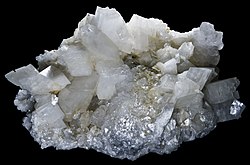
Dolomite (white) on talc
General
CategoryCarbonate minerals
FormulaCaMg(CO3)2
IMA symbolDol[1]
Strunz classification5.AB.10
Crystal systemTrigonal
Crystal classRhombohedral (3)
H–M symbol: (3)
Space groupR3
Unit cella = 4.8012(1),
c = 16.002 [Å]; Z = 3
Identification
ColorWhite, grey to pink, reddish-white, brownish-white; colourless in transmitted light
Crystal habitTabular crystals, often with curved faces, also columnar, stalactitic, granular, massive.
TwinningCommon as simple contact twins
Cleavage3 directions of cleavage not at right angles
FractureConchoidal
TenacityBrittle
Mohs scale hardness3.5–4.0
LusterVitreous to pearly
StreakWhite
Specific gravity2.84–2.86
Optical propertiesUniaxial (−)
Refractive indexnω = 1.679–1.681
nε = 1.500
Birefringenceδ = 0.179–0.181
SolubilityPoorly soluble in dilute HCl
Other characteristicsMay fluoresce white to pink under UV; triboluminescent.
Ksp values vary between 10−19 and 10−17
References[2][3][4][5][6]
Dolomite and calcite look similar under a microscope, but thin sections can be etched and stained in order to identify the minerals. Photomicrograph of a thin section in cross and plane polarised light: the brighter mineral grains in the picture are dolomite, and the darker grains are calcite.

Dolomite (/ˈdɒl.əˌmt, ˈd.lə-/) is an anhydrous carbonate mineral composed of calcium magnesium carbonate, ideally CaMg(CO3)2. The term is also used for a sedimentary carbonate rock composed mostly of the mineral dolomite (see Dolomite (rock)). An alternative name sometimes used for the dolomitic rock type is dolostone.

History

[edit]
Cristallo in the Dolomites mountain range near Cortina d'Ampezzo, Italy. The Dolomite Mountains were named after the mineral.

As stated by Nicolas-Théodore de Saussure[7] the mineral dolomite was probably first described by Carl Linnaeus in 1768.[8] In 1791, it was described as a rock by the French naturalist and geologist Déodat Gratet de Dolomieu (1750–1801), first in buildings of the old city of Rome, and later as samples collected in the Tyrolean Alps. Nicolas-Théodore de Saussure first named the mineral (after Dolomieu) in March 1792.

Properties

[edit]

The mineral dolomite crystallizes in the trigonal-rhombohedral system. It forms white, tan, gray, or pink crystals. Dolomite is a double carbonate, having an alternating structural arrangement of calcium and magnesium ions. Unless it is in fine powder form, it does not rapidly dissolve or effervesce (fizz) in cold dilute hydrochloric acid as calcite does.[9] Crystal twinning is common.

Solid solution exists between dolomite, the iron-dominant ankerite and the manganese-dominant kutnohorite.[10] Small amounts of iron in the structure give the crystals a yellow to brown tint. Manganese substitutes in the structure also up to about three percent MnO. A high manganese content gives the crystals a rosy pink color. Lead, zinc, and cobalt also can substitute in the structure for magnesium. The mineral dolomite is closely related to huntite Mg3Ca(CO3)4.

Because dolomite can be dissolved by slightly acidic water, areas where dolomite is an abundant rock-forming mineral are important as aquifers and contribute to karst terrain formation.[11]

Formation

[edit]

Modern dolomite formation has been found to occur under anaerobic conditions in supersaturated saline lagoons such as those at the Rio de Janeiro coast of Brazil, namely, Lagoa Vermelha and Brejo do Espinho. There are many other localities where modern dolomite forms, notably along sabkhas in the Persian Gulf,[12] but also in sedimentary basins bearing gas hydrates[13] and hypersaline lakes.[14] It is often thought that dolomite nucleates with the help of sulfate-reducing bacteria (e.g. Desulfovibrio brasiliensis),[15] but other microbial metabolisms have been also found to mediate in dolomite formation.[12] In general, low-temperature dolomite may occur in natural supersaturated environments rich in extracellular polymeric substances (EPS) and microbial cell surfaces.[12] This is likely the result from the complexation of both magnesium and calcium by carboxylic acids comprising EPS.[16]

Vast deposits of dolomite are present in the geological record, but the mineral is relatively rare in the Cenozoic (Tertiary Era representing the last 66 million years of Earth's history) and in modern environments. Reproducible, inorganic low-temperature syntheses of dolomite are yet to be performed. Usually, the initial inorganic precipitation of a metastable "precursor" (such as magnesium calcite) can easily be achieved. The precursor phase will theoretically change gradually into a more stable phase (such as partially ordered dolomite) during periodical intervals of dissolution and re-precipitation. The general principle governing the course of this irreversible geochemical reaction has been coined "breaking Ostwald's step rule".[17] High diagenetic temperatures, such as those of groundwater flowing along deeply rooted fault systems affecting some sedimentary successions or deeply buried limestone rocks allocate dolomitization.[18] Dolomite is also found in continental saline lakes in Australia.[19] The geochemical conditions considered to be favourable to the precipitation of dolomite in these lakes are their high salinity, high Mg/Ca ratios, and high alkalinity.[19] However, dolomite can be volumetrically important in some Neogene platforms never subjected to elevated temperatures. Under such conditions of diagenesis, the long-term activity of the subsurface biosphere could play a role in dolomitization, since diagenetic fluids of contrasting composition are mixed as a response to long-term climate changes controlled by Milankovitch cycles.[20][clarification needed].

A recent biotic synthetic experiment claims to have precipitated ordered dolomite when anoxygenic photosynthesis proceeds in the presence of manganese(II).[21] A still perplexing example of an organogenic origin is that of the reported formation of dolomite in the urinary bladder of a Dalmatian dog, possibly as the result of an illness or infection.[22]

Uses

[edit]

Dolomite is used as an ornamental stone, a concrete aggregate, and a source of magnesium oxide, as well as in the Pidgeon process for the production of magnesium. It is an important petroleum reservoir rock, and serves as the host rock for large strata-bound Mississippi Valley-Type (MVT) ore deposits of base metals such as lead, zinc, and copper. Where calcite limestone is uncommon or too costly, dolomite is sometimes used in its place as a flux for the smelting of iron and steel. Large quantities of processed dolomite are used in the production of float glass.

In horticulture, dolomite and dolomitic limestone are added to soils and soilless potting mixes as a pH buffer and as a magnesium source. Pastures can be limed with dolomitic lime to raise their pH and where there is a magnesium deficiency.

Dolomite is also used as the substrate in marine (saltwater) aquariums to help buffer changes in the pH of the water.

Calcined dolomite is also used as a catalyst for destruction of tar in the gasification of biomass at high temperature.[23] Particle physics researchers like to build particle detectors under layers of dolomite to enable the detectors to detect the highest possible number of exotic particles. Because dolomite contains relatively minor quantities of radioactive materials, it can insulate against interference from cosmic rays without adding to background radiation levels.[24]

In addition to being an industrial mineral, dolomite is highly valued by collectors and museums when it forms large, transparent crystals. The specimens that appear in the magnesite quarry exploited in Eugui, Esteribar, Navarra (Spain) are considered among the best in the world.[25]

See also

[edit]

References

[edit]

Further reading

[edit]
[edit]
Revisions and contributorsEdit on WikipediaRead on Wikipedia
from Grokipedia
Dolomite is with the chemical formula CaMg(CO₃)₂, consisting of calcium magnesium in a 1:1 ratio. It typically forms transparent to translucent rhombohedral crystals or massive aggregates, often appearing white, gray, pink, or buff in color, and is a key component of dolostone, a sedimentary rock predominantly composed of the mineral. Physically, dolomite exhibits a vitreous to pearly luster, a white streak, and perfect rhombohedral cleavage in three directions, producing characteristic saddle-shaped or curved crystal forms. It has a Mohs hardness of 3.5 to 4, making it relatively soft, and a specific gravity of approximately 2.85, which feels light compared to many other minerals. Iron substitutions can occur, leading to ferroan dolomite variants with darker hues such as brown or black. Geologically, dolomite forms primarily through the diagenesis of limestone or hydrothermal metasomatism, where magnesium-rich fluids replace calcium in calcite, though it is rare in modern marine sediments and hypersaline environments despite its abundance in ancient rock records. It occurs worldwide in sedimentary sequences, hydrothermal veins, marbles, and altered mafic igneous rocks, with significant deposits in regions like the , , and . The "dolomite problem" refers to the ongoing scientific challenge of explaining its formation mechanisms under surface conditions, though recent laboratory synthesis at near-ambient temperatures and pressures has been achieved through cyclic dissolution-reprecipitation processes. Dolomite has diverse industrial applications, serving as a source of magnesium and calcium in fertilizers, antacids, and mineral supplements, while also being used as aggregate in concrete, flux in steel production, and raw material in glass and ceramics manufacturing. In construction, dolostone is valued for building stones and road base due to its durability and availability.

Nomenclature and History

Etymology and Naming

The mineral dolomite derives its name from the Dolomite Mountains in , where specimens were first systematically studied and described. In 1791, French Déodat de Dolomieu published observations on the unusual rock forming these mountains, noting its resistance to acid compared to ordinary . The term "dolomie" was coined in 1792 by Swiss naturalist and Nicolas-Théodore de Saussure, who chemically analyzed samples collected by Dolomieu and named the mineral in his honor. This French term was soon anglicized to "dolomite" by Irish Richard Kirwan in 1794, based on de Saussure's descriptions and analyses, establishing the modern nomenclature. Dolomite is officially recognized as a distinct species by the International Mineralogical Association (IMA), classified within the class with the ideal CaMg(CO₃)₂. The IMA status underscores its double- composition, distinguishing it from related minerals like (CaCO₃) and (MgCO₃). In , "dolomite" specifically refers to the , while "dolostone" denotes the primarily composed of it, a distinction formalized in the mid-20th century to avoid ambiguity in geological . Early naming conventions often led to confusions, with the initially described as a variety of "magnesian limestone" or mistaken for impure due to its similar appearance and reactivity, only later resolved through chemical differentiation from and .

Discovery and Early Studies

The mineral now known as dolomite was initially observed and described in the late as a variant of , with Swedish naturalist providing the earliest known account in , referring to it as "marmor tardum" due to its slow reaction with acids compared to typical calcite-rich limestones. These early observations often misidentified the rock as an impure or altered form of common , lacking recognition of its unique mineralogical identity. In 1791, French geologist and mineralogist Déodat Gratet de Dolomieu identified distinctive rocks during his studies in the southern Tyrol of the Italian , noting their resistance to acid and magnesium content, which set them apart from surrounding limestones. Throughout the , further chemical analyses by prominent chemists refined the understanding of its composition as a double of calcium and magnesium, solidifying its status as a unique . Early scientific debates centered on whether dolomite represented a true separate mineral or merely a mechanical mixture or altered form of calcite, with resolution emerging from accumulating chemical data that highlighted consistent stoichiometric differences in magnesium content. These 19th-century advancements, relying on observational crystallography and wet chemical methods as precursors to modern diffraction techniques, laid the groundwork for distinguishing dolomite in geological contexts.

Chemical Composition and Crystal Structure

Molecular Formula and Stoichiometry

The ideal molecular formula of dolomite is \ceCaMg(CO3)2\ce{CaMg(CO3)2}, consisting of one calcium ion, one magnesium ion, and two ions, with a of 184.40 g/mol. In this structure, the atomic arrangement features alternating layers of ions (\ceCO32\ce{CO3^2-}) with layers containing calcium and magnesium cations, distinguishing it from related carbonates. Dolomite exhibits a stoichiometric ratio of 1:1 for Ca:Mg in its ideal form, but natural samples frequently show deviations, such as excess calcium up to 0.25 atoms per (apfu), resulting in non-stoichiometric compositions like \ceCa1+xMg1x(CO3)2\ce{Ca_{1+x}Mg_{1-x}(CO3)2} where xx ranges from 0.10 to 0.12 in many sedimentary occurrences. These deviations arise from incomplete ordering during formation, leading to slightly disordered cation sites. Common impurities in dolomite include substitutions by iron and manganese, which replace magnesium in the lattice; for instance, ferroan dolomite incorporates up to 10 mol% Fe²⁺ for Mg²⁺, forming solid solutions toward (\ceCaFe(CO3)2\ce{CaFe(CO3)2}), while minor elements like Mn²⁺ or Zn²⁺ can occur at trace levels up to several percent. Such substitutions alter the mineral's stability and reactivity without fundamentally changing the overall framework. The composition of dolomite is typically determined through wet chemical methods, such as acid dissolution followed by or for major cations, or spectroscopic techniques like (XRF) and optical emission spectrometry (ICP-OES) for precise quantification of elements including Ca, Mg, Fe, and Mn. These approaches ensure accurate assessment, with detection limits below 0.1% for impurities. Dolomite represents an ordered double intermediate between the isomorphous end-members (\ceCaCO3\ce{CaCO3}) and (\ceMgCO3\ce{MgCO3}), sharing the rhombohedral but featuring unique Ca-Mg ordering that prevents complete across the series. This positions dolomite as a distinct phase in the carbonate group, with limited miscibility gaps at the end-members due to ionic radius differences.

Crystal System and Unit Cell

Dolomite crystallizes in the trigonal , specifically within the rhombohedral subclass, with R-3 (No. 148). The hexagonal parameters are approximately a = 4.80 Å and c = 16.00 Å, with a c/a ratio of about 3.33, and Z = 3 formula units per cell, corresponding to a calculated volume of roughly 322 ų. These dimensions reflect the layered arrangement derived from its composition, where the structure accommodates alternating cation layers along the c-axis. The atomic structure of dolomite is highly ordered at ambient conditions, featuring distinct octahedral coordination sites: smaller Mg²⁺ ions occupy one set of sites with Mg-O distances around 2.10 Å, while larger Ca²⁺ ions fill the alternate sites with Ca-O distances of approximately 2.37 Å. This cation ordering, with Mg and Ca in separate planes perpendicular to the threefold axis, results in a lower symmetry compared to calcite (space group R-3c). In contrast, high-Mg calcite exhibits random substitution of Mg for Ca without such layering, leading to a more disordered distribution. The carbonate groups (CO₃²⁻) are planar and slightly rotated relative to the cation octahedra, contributing to the overall stability of the lattice. Dolomite exhibits polymorphism, with the common low-temperature form being the ordered phase described above; high-temperature variants, formed above approximately 800–1000°C, show partial or complete disorder in the cation sites, approaching the structure of high-Mg . These high-temperature polymorphs are rare in nature due to the typical formation conditions of dolomite but have been observed in synthetic studies and certain metamorphic contexts. The transition involves increased thermal motion and randomization of Mg and Ca occupancy, reversible upon cooling in some cases. For mineral identification, X-ray diffraction (XRD) patterns of dolomite display characteristic peaks, including strong reflections at d-spacings of 2.90 Å (104 plane, relative intensity 100), 2.19 Å (113, 30), 2.03 Å (110, 20), and 1.79 Å (202, 25), which distinguish it from closely related carbonates like or . These patterns arise from the rhombohedral lattice and confirm the ordered structure when analyzed via .

Physical and Optical Properties

Morphology, Cleavage, and Twinning

Dolomite crystals typically exhibit rhombohedral habits, with dominant faces on {1011} or {4041}, often appearing prismatic along {1120} or tabular parallel to {0001}. These crystals frequently display curved or striated faces, resulting in characteristic saddle-shaped or bent "nailhead" forms, particularly in cavity fillings and veins. In formations, dolomite commonly occurs as granular aggregates, massive beds, or fibrous and pisolitic masses. In natural occurrences, dolomite grain sizes vary widely, from varieties (<10 µm) in sedimentary dolostones to euhedral rhombohedral crystals up to 20 cm in length within veins and replacement zones. Dolomite displays perfect rhombohedral cleavage on {1011}, yielding three directions that intersect at angles of approximately 60° and 120°, a feature directly influenced by its trigonal symmetry. In massive or granular forms, it instead shows subconchoidal to uneven fracture. Twinning in dolomite is common and includes contact twins on {0001} often with re-entrant angles, lamellar twinning parallel to {0221}, as well as penetration twins on {1010} and {1120} that can mimic higher symmetry. In deformed samples from metamorphic or tectonically altered rocks, polysynthetic twinning develops on planes such as {0221}, reflecting mechanical deformation processes.

Hardness, Density, and Thermal Behavior

Dolomite exhibits a Mohs hardness of 3.5 to 4.0, rendering it slightly harder than calcite despite the incorporation of magnesium, which influences its lattice strength. This range positions dolomite as a relatively soft mineral, susceptible to scratching by common tools like a steel knife. Its specific gravity typically falls between 2.84 and 2.86 g/cm³, reflecting a density that makes it feel moderately light compared to many silicates, with variations attributable to minor iron substitutions in some samples. Under thermal stress, dolomite undergoes an endothermic decomposition known as calcination, beginning around 700–900°C, where it releases carbon dioxide to form calcium oxide and magnesium oxide according to the reaction: CaMg(CO3)2CaO+MgO+2CO2\text{CaMg(CO}_3)_2 \rightarrow \text{CaO} + \text{MgO} + 2\text{CO}_2 This process occurs in two stages, with the initial decarbonation of the magnesium component at lower temperatures, enhancing its utility in high-heat applications but requiring careful control to avoid incomplete reactions. Dolomite displays anisotropic thermal expansion, with linear coefficients of approximately 25.8 × 10⁻⁶ K⁻¹ parallel to the c-axis and 6.2 × 10⁻⁶ K⁻¹ perpendicular to it, leading to differential strain that can influence fracture patterns during heating. Overall, its thermal behavior is characterized by stability up to moderate temperatures, beyond which decomposition dominates, producing reactive oxides. Dolomite reacts slowly with cold dilute hydrochloric acid, producing a mild effervescence due to the release of CO₂, in contrast to the vigorous reaction observed with ; this subdued reactivity persists even when the mineral is powdered, aiding in its field identification. Its cleavage planes contribute to a moderate fracture toughness, as the rhombohedral structure allows controlled breaking under mechanical stress. Electrically, dolomite is non-conductive, behaving as an insulator with low resistivity typical of anhydrous carbonates, which limits its role in conductive geological formations. Magnetically, it is weakly diamagnetic, exhibiting a small negative susceptibility that results in repulsion by magnetic fields, consistent with its lack of ferromagnetic components.

Color, Luster, and Optical Indices

Dolomite typically occurs in colorless, white, gray, pink, or pale yellow to brown varieties, with colors often influenced by trace impurities such as iron, which can impart reddish or greenish hues in rare cases. In transmitted light, pure dolomite crystals appear colorless, highlighting its transparency in thin sections or when faceted. The mineral's luster varies from vitreous on crystal faces to pearly on cleavage surfaces, contributing to its distinctive appearance in both hand specimens and polished rocks. This pearly sheen arises from the mineral's rhombohedral cleavage and slight internal reflections. Optically, dolomite is uniaxial negative (–), occasionally showing anomalous biaxial traits, with refractive indices of nω = 1.679–1.681 and nε = 1.500–1.503. This yields a strong birefringence of δ = 0.179–0.181, producing vivid high-order interference colors in polarized light microscopy, often exceeding fifth order white. The mineral is transparent to translucent, exhibits very strong dispersion (r > v), and lacks notable , making it identifiable by its high relief against common mounting media.

Formation and Geological Processes

Primary Precipitation in Sedimentary Settings

Primary precipitation of dolomite occurs directly from supersaturated magnesium-rich aqueous solutions in sedimentary environments, particularly in evaporative basins and sabkhas where intense evaporation concentrates ions and elevates the Mg/Ca molar ratio to levels exceeding 5:1, often reaching 10:1 or higher in hypersaline conditions. This process is facilitated by the mineral's stoichiometric composition, CaMg(CO₃)₂, which enables crystallization when magnesium availability surpasses calcium, typically in marine or lacustrine settings with restricted water circulation. In such environments, progressive evaporation of seawater or brine leads to the removal of calcium through prior precipitation of gypsum or other sulfates, thereby increasing the relative abundance of magnesium ions and promoting dolomite nucleation without prior calcite formation. Biochemical plays a crucial role in overcoming kinetic barriers to dolomite formation at ambient temperatures, with sulfate-reducing bacteria (SRB) enhancing magnesium uptake by degrading and reducing concentrations, which otherwise inhibit precipitation through ion pairing with Mg²⁺. These microbes, active in anoxic sediments of peritidal zones, produce extracellular polymeric substances (EPS) that provide sites and via generation, enabling protodolomite crystallization from evaporites to modern hypersaline lagoons. Examples include SRB isolated from coastal sabkha-like settings, where bacterial activity raises local and supersaturation, fostering idiomorphic in fine-grained muds. Methanogenic have also been implicated in similar low-energy microbial consortia, further supporting primary dolomite as a microbially influenced precipitate across geological time. Textural evidence for primary precipitation includes the presence of idiomorphic, euhedral dolomite crystals embedded within mudstones, indicating direct rather than replacement, often as fine-grained rhombs or spherulites less than 10 μm in size that preserve primary sedimentary fabrics. Stable isotope analyses further corroborate low-temperature formation, with δ¹⁸O values typically ranging from -2‰ to +4‰ (VSMOW) and δ¹³C from 0‰ to +5‰ (VPDB), consistent with at 20–50°C in equilibrium with meteoric-influenced or evaporative brines, as confirmed by clumped isotope thermometry (Δ₄₇). These signatures reflect incorporation of ambient and oxygen from surface waters, without of high-temperature alteration. Modern analogs for primary dolomite precipitation remain rare but are documented in hypersaline lacustrine systems, such as Deep Springs Lake in , where co-precipitation with Mg-rich clays occurs in alkaline, silica-bearing brines under evaporative conditions, yielding disordered protodolomite. Similarly, the Coorong region in features hydrous proto-dolomite (coorongite) forming in ephemeral lakes through microbial sulfate reduction, providing direct evidence of low-temperature, primary in peritidal mudflats. These settings highlight the persistence of the process today, albeit at limited scales due to kinetic constraints.

Dolomitization and Secondary Formation

Dolomitization represents a key secondary diagenetic process in which precursor carbonate minerals, primarily calcite or aragonite, are replaced by dolomite through the interaction with magnesium-rich fluids, fundamentally altering the mineralogy of sedimentary rocks. This replacement typically occurs post-depositionally during early to late diagenesis, converting limestone into dolostone and influencing reservoir properties in hydrocarbon systems. The process is driven by the diffusion of magnesium ions into the carbonate lattice, often requiring specific hydrological and geochemical conditions to overcome inherent kinetic barriers. Several models explain the mechanisms of dolomitization, each tied to distinct fluid sources and flow regimes. The seepage reflux model involves dense, magnesium-enriched brines derived from the evaporation of that percolate downward through underlying limestones in supratidal or sabkha environments, facilitating pervasive replacement. In the mixing zone model, also known as the Dorag model, dolomitization occurs at the interface where freshwater mixes with , creating a chemically reactive environment with elevated magnesium-to-calcium ratios and increased that promotes the reaction. The burial diagenesis model posits deeper subsurface conditions where evolved formation waters, heated and enriched in magnesium through or dissolution of evaporites, drive replacement during progressive burial. The hydrothermal model involves the circulation of hot, magnesium-bearing fluids—often from deep basinal or mantle sources—along faults or fractures, leading to localized dolomitization at temperatures typically above 100 °C, and is commonly associated with the formation of Valley-type deposits. These models often overlap, with fluid migration along fractures or permeability contrasts enhancing the process in heterogeneous carbonates. The kinetics of dolomitization are notoriously slow, primarily due to the high required for the of the strongly hydrated magnesium ion (Mg²⁺), which forms a stable octahedral coordination shell in aqueous solutions that resists incorporation into the dolomite lattice. This kinetic inhibition necessitates catalysts, such as clay minerals that provide sites or that lowers the barrier through adsorption and surface-mediated reactions, to facilitate the process at ambient to moderate . Effective dolomitization can occur over a range from near-ambient conditions in surficial diagenetic settings to 150–200 °C in deeper burial and hydrothermal environments, depending on the model and catalysts involved. During replacement, dolomitization often proceeds via mimetic or fabric-preserving mechanisms, where dolomite crystals selectively substitute the original carbonate grains while retaining depositional textures such as ooids, peloids, or biogenic structures, allowing paleoenvironmental interpretations to persist. The volumetric difference between and dolomite—arising from the denser packing in the dolomite structure—commonly results in increased intercrystalline , enhancing permeability in otherwise tight limestones, though subsequent cementation can reduce this gain. Evidence for these processes is gleaned from fluid inclusions trapped within dolomite crystals, which reveal the composition and thermal history of the dolomitizing fluids. These inclusions frequently contain saline brines with salinities exceeding modern , indicative of evaporative concentration or interaction with evaporites, and homogenization temperatures aligning with the ranges for each model. Stable isotope analyses of these fluids show shifts in δ¹⁸O values, often toward more positive compositions in burial settings due to water-rock interactions or fluid evolution during migration, providing tracers for the progressive geochemical changes during .

Occurrence and Distribution

Major Deposits and Formations

Dolomite occurs in significant formations, such as the Helena Formation within the Belt Supergroup in the , where it forms extensive layers of buff-weathering, dark gray aphanitic dolomite deposited in a spanning , , and parts of . Similarly, the Vindhyan Basin in central India hosts dolomite formations like the Tirohan Dolomite, part of a intracratonic sequence with thick unmetamorphosed carbonates and associated mineral deposits. In settings, notable examples include dolomitized reefs in , such as those in the Leduc and formations of the Basin, where pinnacle and platform reefs have undergone extensive replacement dolomitization, creating porous reservoirs. European Permian deposits are exemplified by the Main Dolomite (Haupt dolomite) of the Zechstein Group, forming widespread carbonate platforms and basin-margin sequences across northern Germany, , and the , with thicknesses exceeding 100 meters in places. Key economic deposits include the Mississippian Madison Formation in , , where dolomitized intervals yield high-purity industrial dolomite used in and refractories, with productive gas reservoirs in areas like the Wind River Basin. The and Italian Dolomites serve as classic type localities for dolomite, with the latter's Triassic carbonate platforms providing the eponymous exposure of massive dolostone that inspired the mineral's naming in the late . Global resources of dolomite are vast, estimated in the billions of tons and sufficient to meet demand for thousands of years, though specific quantified estimates often focus on high-purity variants. Leading producers include the , , and , which together account for a substantial share of annual output, estimated at approximately 300 million metric tons globally for industrial applications as of 2024. Exploration for dolomitized reservoirs commonly employs seismic profiling to delineate reef margins and structural highs, combined with geochemical logging to identify magnesium enrichment and porosity variations in carbonate sequences.

Association with Other Minerals

Dolomite commonly occurs in association with and clay minerals such as and within sedimentary dolostones, where these silicates form detrital components or authigenic phases in -dominated sequences. is frequently present as disseminated grains or nodules in these dolostones, often comprising up to 16% of the rock volume and serving as an indicator of reducing conditions during deposition or early . Evaporite minerals like and are also associated with dolomite in or lagoonal environments, where they interbed or replace carbonates in hypersaline settings. In hydrothermal settings, dolomite is paragenetically linked to minerals including and , particularly in Valley-Type (MVT) deposits hosted within platforms, where these sulfides precipitate in fractures or vugs alongside gangue . In altered ultramafic rocks, dolomite associates with , forming part of metasomatic assemblages during serpentinization and , where develops from the breakdown of magnesium silicates. Paragenetic sequences involving dolomite often feature early replacement by , which dedolomitizes the mineral through dissolution-reprecipitation in meteoric or fluids, followed by late-stage silica veining where infills fractures crosscutting the carbonates. These sequences reflect evolving fluid compositions and are informed by stability fields in phase diagrams, such as the CaCO₃-MgCO₃ system, where dolomite stabilizes between and fields at temperatures above approximately 400°C under low CO₂ conditions. Diagnostic assemblages aid in distinguishing dolomite occurrences; for instance, the dolomite-quartz-calcite triad is typical in contact or regional metamorphic marbles, where quartz persists as a phase from protoliths, contrasting with dolomite-magnesite pairings in carbonatites, which indicate primary magmatic enrichment in MgCO₃ components. In carbonatites, dolomite coexists with and in zoned textures, reflecting fractional crystallization in alkaline magmatic systems.

Applications and Economic Significance

Industrial and Construction Uses

Dolomite serves as a primary material for and aggregate in , particularly in production and base applications, owing to its high and abrasion resistance. In the United States, and dolomite account for approximately 70% of total crushed stone output, with an estimated 1.5 billion tons produced in 2024, of which about 72% is utilized in construction aggregates for such as highways and buildings. For instance, dolomite aggregate enhances the durability of asphalt mixes and provides a base for ways, contributing significantly to projects like where it comprises a substantial portion of the material volume. As dimension stone, dolomite is quarried for building facades and architectural elements due to its weather resistance and aesthetic appeal, offering a balance of that withstands environmental exposure better than softer marbles. Its Mohs hardness of 3.5–4 and low make it suitable for exterior cladding in commercial and residential structures, where it maintains structural integrity over decades. Typical pricing for dolomite aggregates ranges from $10 to $20 per ton, reflecting its abundance and transport costs, which supports widespread adoption in large-scale . In , dead-burned dolomite—produced by calcining the mineral at high temperatures to form and lime—is widely used in refractories for , where its high MgO content (around 20–22%) provides resistance to basic erosion in furnace linings. This application is critical in basic oxygen furnaces and furnaces, extending lining life and reducing operational downtime in production. Dolomite also plays a key role in glass manufacturing as a source of CaO and MgO fluxes, which lower the of silica batches and improve the of and . In production, it constitutes up to 10–15% of the raw mix, enhancing viscosity control and reducing energy consumption during fusion. For ceramics, finely ground dolomite acts as a filler and flux in whitewares such as tiles and sanitaryware, promoting at lower temperatures while imparting whiteness and resistance to the final products. Globally, dolomite production reaches approximately 190 million tons annually, driven largely by demand in and industrial sectors, underscoring its economic importance as a versatile, low-cost resource.

Agricultural and Environmental Applications

Dolomitic lime, derived from the dolomite, is widely used in to neutralize acidic soils and supply essential calcium (Ca) and magnesium (Mg) nutrients. By raising , it reduces the solubility of toxic elements like aluminum and , thereby improving availability and crop yields. Typical application rates range from 1 to 5 tons per , depending on soil buffering capacity and target pH, often applied as a finely ground powder or pelletized form for even distribution. In , calcined dolomite serves as a cost-effective magnesium supplement in animal feeds, addressing deficiencies that can impair growth, , and production in ruminants. The process converts dolomite into , which provides bioavailable Mg while also contributing calcium, enhancing overall balance in diets. Regulatory assessments confirm its safety for use in feeds for cows, pigs, and other at concentrations up to 0.5-1% of the total diet. Dolomite also plays a role in , particularly in where its carbonate structure facilitates adsorption of such as lead, , and through and mechanisms. In these applications, powdered or calcined dolomite acts as a low-cost , achieving removal efficiencies of 50-90% for targeted metals under neutral pH conditions. Additionally, dolomite supports via , where its application to soils accelerates CO2 dissolution into forms that can be stabilized in or oceans, contributing to atmospheric CO2 reduction. Post-2020 research highlights dolomite's integration into sustainable materials, including its use as a partial replacement in green cement production to lower clinker content and associated CO2 emissions by 10-20%. Waste dolomite powder enhances hydration kinetics and durability while reducing the environmental footprint of . Pilot projects exploring CO2 mineralization with dolomite focus on cycles, where the mineral reacts with captured CO2 to form stable carbonates, demonstrating feasibility for industrial-scale sequestration in cement facilities.

References

Add your contribution
Related Hubs
User Avatar
No comments yet.