


Community hub
Recent from talks
Contribute something
Nothing was collected or created yet.
Venezuelan diaspora
View on Wikipedia


The Venezuelan diaspora refers to Venezuelan citizens living outside Venezuela. In times of economic and political crisis since the 2010s, Venezuelans have often fled to other countries in the Americas and beyond to establish a more sustainable life.
History
[edit]19th century
[edit]In 1827, a group of Jews moved from Curaçao and settled in Coro, Venezuela.[34] In 1855, rioting in the area forced the entire Jewish population, 168 individuals, back to Curaçao.[34] Assimilation of Jews in Venezuela was difficult, though small communities could be found in Puerto Cabello, Villa de Cura, Carupano, Rio Chico, Maracaibo, and Barquisimeto.[34]
20th century
[edit]During World War II, the Venezuelan government broke relations with the Axis powers in 1942, with many groups consisting of hundreds of German-Venezuelans leaving Venezuela to be repatriated into Nazi Germany.[35]
In the early 1980s, the Venezuelan government had invested much into the country's infrastructure and communications, though by the mid-1980s when Venezuela faced economic difficulties and inequality increased, some Venezuelans emigrated.[36] Again, at the peak of Venezuela's socioeconomic difficulties in the late 1990s, Venezuelans began to emigrate once more, with some attempting to enter the United States legally and illegally.[37]
21st century
[edit]Venezuelan refugee crisis
[edit]During the Bolivarian Revolution, many Venezuelans have sought residence in other countries. According to Newsweek, the "Bolivarian diaspora is a reversal of fortune on a massive scale" as compared to the 20th century, when "Venezuela was a haven for immigrants fleeing Old World repression and intolerance".[32] El Universal explained how the "Bolivarian diaspora" in Venezuela has been caused by the "deterioration of both the economy and the social fabric, rampant crime, uncertainty and lack of hope for a change in leadership in the near future".[31]
In 1998, the year Chavez was first elected, only 14 Venezuelans were granted U.S. asylum. By September 1999, 1,086 Venezuelans were granted asylum according to the U.S. Citizenship and Immigration Services.[38] It has been calculated that from 1998 to 2013, over 1.5 million Venezuelans (between 4% and 6% of the Venezuela's total population) left the country following the Bolivarian Revolution.[39] Former Venezuelan residents have been driven by lack of freedom, high levels of insecurity, and inadequate opportunities in the country, risking their lives sometimes walking the Darien Gap.[39][40] It has also been reported that some parents in Venezuela encourage their children to leave the country because of the insecurities Venezuelans face.[40][41] This has led to significant human capital flight in Venezuela.[31][39][42]
Brazil's Operation Welcome
[edit]In 2018, the Brazilian Army launched Operation Welcome to help Venezuelan immigrants arriving in the state of Roraima, which borders Venezuela.[43][44][45]
See also
[edit]References
[edit]- ^ "Venezuela's Nicolás Maduro survives 2019 despite U.S. insistence he'd fall". Axios. Archived from the original on 4 December 2020. Retrieved 20 December 2019.
We have more than 1.7 million refugees, that's the official number and I think it's under-reported. Bogota has 375,000 — that's like the size of New Orleans
- ^ Leon, Adriana (19 October 2017). "Driven by unrest and violence, Venezuelans are fleeing their country by the thousands". Los Angeles Times. Retrieved 19 October 2017.
- ^ "Venezolanos en Perú: Migración se redujo en más de 90% en julio, según Migraciones". Perú.21 (in Spanish). 14 August 2019. Retrieved 15 August 2019.
- ^ "Refugiados y migrantes de Venezuela | R4V".
- ^ "Brazil recalls diplomats, officials from Venezuela". Al Jazeera. 6 March 2020. Retrieved 7 March 2020.
- ^ "UNHCR welcomes Brazil's decision to recognize thousands of Venezuelans as refugees". United Nations High Commissioner for Refugees. United Nations. 6 December 2019. Retrieved 15 December 2019.
- ^ Eluniversal.com
- ^ "Cómo los venezolanos se están convirtiendo en el chivo expiatorio por las protestas en Sudamérica". BBC News. 28 November 2019. Retrieved 15 December 2019.
- ^ Arostegui, Martin (18 February 2018). "Spain Has Pivotal Role in Pressuring Venezuela's Maduro". Voice of America. Retrieved 19 February 2018.
- ^ a b "Refugees and migrants from Venezuela top 4 million: UNHCR and IOM". UNHCR. UNHCR, IOM. 7 June 2019. Retrieved 10 June 2019.
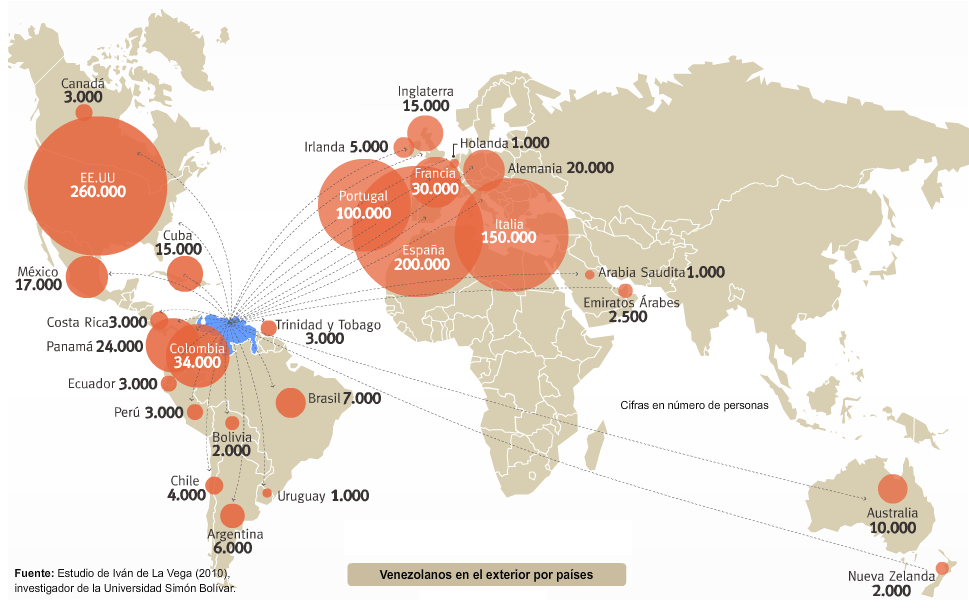
- ^ "Venezolanos en el exterior".
- ^ a b c d e f g h i "Últimas Noticias (2014), Venezolanos en el exterior".
- ^ a b "El desgarrador éxodo de los venezolanos, en números". Infobae (in European Spanish). 3 September 2019. Retrieved 18 June 2019.
- ^ ""Más de 90 mil venezolanos ingresaron a RD por diferentes aeropuertos en 2019". Listin Diario. Retrieved 17 January 2020.
- ^ "¿ Cuántos venezolanos hay en Canadá y en Québec?". Archived from the original on 2007-11-21. Retrieved 2007-12-18.
- ^ "REPORTE DE FLUJOS MIGRATORIOS EN CENTROAMÉRICA, NORTEAMÉRICA Y EL CARIBE" (PDF). International Organization for Migration. June 2018. Retrieved 18 June 2019.
- ^ "Venezolanos en Paraguay: Hay 828 con radicación y 58 piden refugio". Última Hora (in European Spanish). 15 January 2019. Retrieved 18 June 2019.
- ^ Ebus, Bram (13 November 2018). "Venezuelan migrants live in shadows on Caribbean's sunshine islands". The Guardian. Retrieved 18 June 2019.
- ^ "En 2019 crecerá un 30% la llegada de venezolanos". El País (in Spanish). 20 December 2018. Retrieved 18 June 2019.
- ^ Data Basical Immigrants. "Immigration to Vietnam". databasicalimmigrants.weebly.com. Retrieved 8 March 2023.
- ^ "As crisis deepens, more Venezuelans are emigrating to Lebanon". NBC News.
- ^ "En 2019 crecerá un 30% la llegada de venezolanos". El País (in Spanish). 20 December 2018. Retrieved 18 June 2019.
- ^ a b c d e f g h i j k "United Nations Population Division: Department of Economic and Social Affairs". United Nations Population Division. Archived from the original on 2016-01-18. Retrieved 17 March 2017.
- ^ "Over 5000 Venezuelan migrants in Guyana". Guyana Times. 27 February 2019. Retrieved 18 June 2019.
- ^ "Guatemala exigirá visa a los migrantes venezolanos". El Nacional (in Spanish). 19 March 2018. Retrieved 18 June 2019.
- ^ "Más de 4 mil venezolanos llegaron a Bolivia en 2018, el doble que en 2017". Los Tiempos (in Spanish). 15 February 2019. Retrieved 18 June 2019.
- ^ "Folkmängden efter födelseland, ålder och kön. År 2000 - 2021". SCB. Retrieved 2 March 2022.
- ^ Approximate of Venezuelans living in Japan
- ^ "Venezolanos en El Salvador respaldan a Juan Guaidó y exigen la salida de Maduro". EFE (in Spanish). 30 April 2019. Retrieved 18 June 2019.
- ^ "Venezolanos residentes en Honduras piden a sus compatriotas no dejar la lucha". La Prensa (in Spanish). 23 January 2019.
- ^ a b c Olivares, Francisco (13 September 2014). "Best and brightest for export". El Universal. Retrieved 24 September 2014.
- ^ a b "Hugo Chavez is Scaring Away Talent". Newsweek. 30 June 2009. Retrieved 24 September 2014.
- ^ "Ten percent of Venezuelans are taking steps for emigrating". El Universal. 16 August 2014. Retrieved 26 April 2015.
- ^ a b c Krusch, David. "The Virtual Jewish World: Venezuela". Jewish Virtual Library. American–Israeli Cooperative Enterprise. Retrieved 15 January 2015.
- ^ "More Germans Quit Venezuela: Page 22". The New York Times. 27 December 1942.
- ^ Jones, Richard C (April 1982). "Regional Income Inequalities and Government Investment in Venezuela". Regional Income Inequalities and the Journal of Developing Areas. 16 (3): 373.
- ^ Paulin, David (6 April 1997). "Venezulans in US fleeing poverty: Rising crime, inflation spur emigration: A, 10:3". The Boston Globe.
- ^ Brown, Tom (16 July 2007). "Venezuelans, fleeing Chavez, seek U.S. safety net". Reuters. Archived from the original on December 8, 2015. Retrieved 22 September 2014.
- ^ a b c Maria Delgado, Antonio (28 August 2014). "Venezuela agobiada por la fuga masiva de cerebros". El Nuevo Herald. Archived from the original on 27 August 2014. Retrieved 28 August 2014.
- ^ a b "El 90% de los venezolanos que se van tienen formación universitaria". El Impulso. 23 August 2014. Retrieved 28 August 2014.
- ^ Montilla K., Andrea (4 July 2014). "Liceístas pasan de grado sin cursar varias materias". El Nacional. Archived from the original on 4 July 2014. Retrieved 9 July 2014.
- ^ "Venezuela, migraciones y desplazamientos humanos". 23 May 2003.
- ^ "Operação Acolhida, realizada na fronteira com a Venezuela, terá apoio do quartel de Caxias do Sul | Pioneiro". GZH (in Brazilian Portuguese). 2019-04-08. Retrieved 2022-08-16.
- ^ Desideri, Leonardo. "O que é a Operação Acolhida, que recebe venezuelanos no Brasil". Gazeta do Povo (in Brazilian Portuguese). Retrieved 2022-08-16.
- ^ [https://tallerdeletras.letras.uc.cl/index.php/TL/article/view/56511/45813 Guerrero, Javier,.2 Review. Pais Portatil. Review : Literature and Arts of the Americas, Volumen 54, Número 2 (2021)
External links
[edit]
| Americas |  | |
|---|---|---|
| Europe | ||
| Asia & Oceania | ||
| History | ||

Venezuelan diaspora
View on GrokipediaHistorical Overview
Early Emigration Waves
In the 19th century, Venezuelan emigration consisted primarily of small-scale political exiles amid the turbulence of independence wars (1810–1823) and caudillo-dominated conflicts, with dissidents fleeing to Caribbean islands like Trinidad and Tobago or European destinations such as Spain. These movements involved elite figures and their supporters rather than broad population displacements, as the country's agrarian economy and regional isolation limited widespread outflows.[10] Early 20th-century emigration remained constrained, featuring political opponents of dictator Juan Vicente Gómez (r. 1908–1935) who sought asylum in the United States, Europe, and Caribbean nations, often with foreign government aid. Amid preparations for the oil boom starting in the 1920s, some skilled Venezuelans pursued temporary migration to the U.S. and Europe for technical training, but these were elite, return-oriented flows that did not exceed 1% of the population.[11] Pre-1990s emigration rates stayed below 0.5% annually, with the total emigrant stock in the 1980s numbering just over 45,000—a stark contrast to later crises in scale and drivers, as Venezuela experienced net immigration during much of this period due to economic opportunities.[8][12]20th-Century Movements
During the mid-20th century, Venezuela experienced net immigration rather than significant outflows, driven by the oil prosperity that attracted workers from Europe, Colombia, and other Latin American countries between the 1950s and 1970s.[13] This period saw minimal Venezuelan emigration, with the country serving as a destination for semiskilled and skilled labor amid rising petroleum revenues, particularly following the global oil price surge in the 1970s.[14] Exceptions included small-scale political exiles after the November 24, 1948, military coup that ousted democratically elected President Rómulo Gallegos, forcing figures like Gallegos and opposition leader Rómulo Betancourt into exile abroad.[15] These ideological outflows were limited to elites and dissidents opposing the subsequent dictatorship of Marcos Pérez Jiménez (1948–1958), totaling in the hundreds rather than masses, and many returned after the regime's fall in 1958.[16] Emigration began to rise episodically in the late 1980s and 1990s amid economic contraction following the mid-1980s oil price collapse and the implementation of neoliberal adjustment policies under President Carlos Andrés Pérez, which sparked the Caracazo riots starting February 27, 1989. These events prompted outflows primarily of middle-class professionals and business owners, who relocated to destinations such as Miami in the United States and Spain, seeking stability amid hyperinflation and banking crises like "Black Friday" in 1983.[17] By 2000, the stock of Venezuelan emigrants abroad had reached approximately 317,000, a sharp increase from just over 45,000 in the 1980s, though still modest compared to later waves.[8] Unlike the sustained 21st-century exodus, these 20th-century movements were reversible, with repatriation common during brief economic recoveries, such as in the early 1990s, reflecting episodic responses to policy shocks rather than systemic collapse.[12] The emigrants were often highly educated, including former oil sector employees, but the scale remained contained, with many maintaining ties to Venezuela through dual nationality or temporary stays abroad.[18]21st-Century Mass Exodus
The mass exodus from Venezuela accelerated markedly after Nicolás Maduro assumed the presidency in April 2013, transitioning from modest annual outflows of fewer than 100,000 individuals prior to 2014 to a sustained surge exceeding 400,000 departures per year by 2016, driven by escalating shortages and instability.[19] By early 2019, the International Organization for Migration (IOM) estimated that over 3.4 million Venezuelans had left since the mid-2010s, with peak annual flows approaching 700,000 to 1 million during 2017-2018 amid widespread desperation.[20] This period marked a shift from sporadic migration to a humanitarian-scale displacement, with families increasingly abandoning homes en masse via land routes, boats, and air travel despite logistical barriers. Key milestones underscored the crisis's intensification. In August 2015, Maduro ordered the temporary closure of major border crossings with Colombia following an attack on Venezuelan soldiers that killed three, a measure extended into a de facto partial shutdown across multiple points, which strained informal migration channels and prompted mass expulsions of over 1,000 Colombians while highlighting cross-border tensions.[21] Between 2017 and 2019, hyperinflation spiraled to annual rates surpassing 1 million percent in 2018—peaking at over 344,000 percent in early 2019—eroding purchasing power and fueling record outflows as basic goods became unattainable for millions.[22] These events compounded logistical challenges, including improvised treks through the Darién Gap and perilous sea crossings to Caribbean islands, with documented increases in migrant fatalities from exhaustion, violence, and exposure. By October 2025, the United Nations High Commissioner for Refugees (UNHCR) reported nearly 7.9 million Venezuelan refugees and migrants dispersed globally, equivalent to roughly 25-27 percent of the country's estimated 29 million population in 2013.[1] The Regional Inter-Agency Coordination Platform for Refugees and Migrants from Venezuela (R4V) corroborated this scale within Latin America and the Caribbean, tracking over 6.8 million in the region alone as of mid-2025, reflecting sustained outflows even after partial economic stabilization attempts.[5] This exodus, documented through government registries, asylum claims exceeding 1.3 million pending cases, and IOM mobility tracking, represents one of the largest displacement events in Latin American history, with flows persisting at hundreds of thousands annually into the mid-2020s.[23]Causal Factors
Economic Mismanagement and Policy Failures
Under the administration of Hugo Chávez (1999–2013), the Venezuelan government pursued extensive nationalizations of key industries, including oil, telecommunications, steel, cement, agriculture, and food processing, particularly intensifying between 2007 and 2013.[24] These interventions expropriated private assets without adequate compensation, leading to a sharp decline in productivity as foreign and domestic investors withdrew amid uncertainty and reduced incentives for efficiency.[24] Oil production, for instance, fell from approximately 3 million barrels per day in the early 2000s to under 2 million by 2013, as state control prioritized political objectives over operational expertise.[24] Concurrently implemented price controls, intended to curb inflation and ensure affordability, distorted market signals by capping prices below production costs, discouraging suppliers and fostering black markets.[24] These policies culminated in widespread scarcity by 2016, with food shortages affecting 50–80% of basic goods and medicine availability dropping to 20% or less in public facilities.[25] Under Nicolás Maduro's continuation of these measures from 2013 onward, the central bank resorted to monetizing fiscal deficits through excessive currency issuance, triggering hyperinflation that peaked at over 1,000,000% annually by late 2018 according to International Monetary Fund projections signaling the crisis's severity.[26] This eroded real wages dramatically; the minimum wage, nominally increased in 2018, equated to roughly $30 USD monthly at official rates but plummeted to $1–3 in purchasing power amid black-market exchange realities and rapid devaluation.[27] The combined effects manifested in a profound economic contraction, with gross domestic product shrinking by approximately 75% between 2013 and 2021, surpassing the scale of most historical peacetime collapses.[24] Expropriations and regulatory controls dismantled private sector incentives, as firms faced arbitrary seizures and unprofitable mandates, while overprinting money decoupled fiscal spending from productive output, amplifying scarcity in a resource-dependent economy.[24] This state-led interventionism, rather than external factors alone, directly precipitated the conditions driving mass emigration, as households confronted unsustainable declines in living standards verifiable through output metrics and import dependency.[24]Political Repression and Security Breakdown
In March 2017, Venezuela's Supreme Tribunal of Justice, aligned with President Nicolás Maduro, issued rulings effectively stripping the opposition-controlled National Assembly of its legislative powers, a move widely described as dissolving the assembly and consolidating executive control.[28] Maduro responded by convening a loyalist Constituent Assembly in May, which assumed legislative authority in August, bypassing constitutional processes and triggering widespread protests that resulted in over 120 deaths and thousands of arbitrary arrests documented by human rights monitors.[29] [30] The consolidation of power intensified political repression, with Venezuelan authorities detaining opposition leaders, activists, and protesters on charges of rebellion and conspiracy; by 2019, the nongovernmental organization Foro Penal had recorded more than 13,100 arbitrary arrests linked to anti-government demonstrations since 2014, including over 2,000 during the January-August 2019 protest wave following Maduro's disputed inauguration after the 2018 election.[31] These actions created a climate of fear, prompting many Venezuelans—particularly professionals, journalists, and political figures—to flee to avoid prosecution or disappearance, as evidenced by spikes in asylum applications correlating with peak detention periods.[32] Repression escalated further after the July 28, 2024, presidential election, which international observers deemed fraudulent due to withheld tally sheets and opposition evidence of victory; authorities arrested over 2,400 protesters in the ensuing weeks, with Foro Penal reporting enforced disappearances and torture in detention facilities, leading human rights groups to warn of an imminent new exodus driven by targeted persecution.[33] [34] By late 2024, political prisoners numbered around 1,900, many held without trial, underscoring authoritarian governance as a direct catalyst for emigration among those perceived as threats to the regime.[35] Parallel to political arrests, a broader security collapse exacerbated flight, with homicide rates surpassing 60 per 100,000 inhabitants in the early 2010s and peaking above 90 by 2016, according to data compiled by the independent Observatorio Venezolano de Violencia from media, NGO, and official sources unavailable to the public.[36] This violence, often involving state security forces and paramilitary groups in suppressing dissent or controlling territories, resulted in family separations as survivors sought safety abroad, with urban areas like Caracas recording rates over 100 per 100,000 amid gang warfare and extrajudicial killings.[37] Empirical patterns reveal emigration surges temporally aligned with repressive escalations rather than preceding economic pressures alone: outflows accelerated post-2017 constitutional maneuvers, during the 2018-2019 election crises, and immediately after the 2024 vote, with migration data from regional trackers showing thousands departing monthly amid protest crackdowns, indicating governance-induced insecurity as a primary accelerator of the diaspora.[38] [39] Official Venezuelan claims attributing departures to foreign interference lack substantiation against these independent timelines, highlighting repression's causal role in depleting the population of dissidents and violence victims.[40]Empirical Evidence vs. Official Narratives
The Venezuelan government under President Nicolás Maduro has attributed the country's economic crisis primarily to an external "economic war" orchestrated by the United States and its allies, particularly emphasizing sanctions imposed starting in 2017 as the main cause of hyperinflation, shortages, and production declines.[41][42] However, empirical data indicate that the severe contraction predated these measures, with gross domestic product per capita falling approximately 40% between 2013 and 2016 due to domestic policy failures, including price controls, currency mismanagement, and expropriations that deterred investment.[43][24] Oil production by state-owned Petróleos de Venezuela (PDVSA), which accounted for over 90% of exports, halved from 3 million barrels per day in 2008 to about 1.5 million by 2016, driven by corruption scandals involving billions in embezzled funds, politicized hiring that sidelined expertise, and underinvestment rather than external blockades.[44][45] Regarding political repression as a migration driver, official narratives portray arrests and detentions as responses to common criminality or threats to public order, with the regime denying the existence of political prisoners and claiming judicial independence.[46] In contrast, nongovernmental organizations such as Foro Penal have documented over 15,700 politically motivated arbitrary detentions between 2014 and 2023, including opposition figures, journalists, and protesters, with approximately 1,900 individuals classified as political prisoners as of late 2024 based on criteria like lack of due process and charges tied to dissent.[47][48] On emigration scale, Venezuelan authorities have minimized outflows, often portraying migrants as temporary economic opportunists influenced by foreign media or incentives abroad, while avoiding publication of comprehensive official statistics and occasionally promoting narratives of mass returns.[49] Surveys of emigrants, however, reveal economic factors as the predominant motivator, with over 80% in regional polls citing hyperinflation, food and medicine shortages, and job scarcity as key reasons, outweighing political violence for the majority despite its role in high-profile cases.[50][51] This discrepancy underscores how policy-induced economic implosion, rather than isolated external pressures, forms the causal core of the diaspora, as corroborated by production and fiscal data independent of sanction timelines.[52]Demographic Profile and Distribution
Emigration Scale and Temporal Patterns
As of mid-2025, the total number of Venezuelan refugees and migrants worldwide reached approximately 7.9 million, with projections estimating up to 8.4 million by year's end according to baseline scenarios from international organizations.[1][53] Of these, over 85% were concentrated in Latin American and Caribbean countries, reflecting regional proximity and policy responses.[19] This figure represents a sharp increase from about 700,000 in 2015, underscoring the scale of the exodus.[19] Emigration flows intensified starting in 2015, with annual departures surging to peaks between 2017 and 2019, when millions exited amid escalating crises, as documented by displacement tracking data.[4] Flows temporarily declined post-2020 due to global mobility restrictions from the COVID-19 pandemic but resumed afterward, stabilizing at lower yet persistent levels through 2024 and into 2025.[53] Recent monitoring indicates ongoing outflows alongside modest returns, with over 12,000 documented repatriations in early 2025 linked to domestic policy adjustments and improved perceptions of stability.[54] Demographically, the diaspora is characterized by a predominance of working-age adults, with surveys showing most migrants falling between 18 and 45 years old and a high share of educated professionals.[55] International Organization for Migration (IOM) assessments reveal that more than 40% of Venezuelan migrants possess tertiary-level education, highlighting a brain drain of skilled labor.[56] Women constitute nearly half of the migrant population, often traveling with families or independently, further emphasizing the exodus's composition of productive-age individuals.[55]Primary Destinations and Population Breakdowns
The majority of Venezuelan emigrants have settled in Latin American countries, which host over 85% of the diaspora due to geographic proximity, shared language, and initially permissive entry policies. Colombia leads as the primary destination with 2.81 million Venezuelans registered as of June 2025, many entering irregularly through the Táchira border crossing amid porous controls.[57] Peru follows with 1.66 million, where early waves arrived via regular air and land routes before visa restrictions prompted more clandestine entries.[7] Other key Latin American hosts include Ecuador (approximately 500,000), Chile (around 400,000), and Brazil (over 500,000), each exhibiting distinct reception mechanisms. Brazil's Operation Acolhida program has facilitated structured border processing and interior relocation for arrivals from the north, contrasting with Chile's post-2018 visa impositions that shifted flows toward irregular crossings. Argentina and smaller nations like Panama (over 90,000) also absorb significant numbers, often through temporary visas or asylum claims.[5]| Country | Estimated Venezuelan Population (2025) | Notes on Migration Patterns |
|---|---|---|
| Colombia | 2.81 million | Predominantly irregular border entries |
| Peru | 1.66 million | Mix of regular and irregular post-restrictions |
| Brazil | ~500,000 | Structured via Operation Acolhida |
| Ecuador | ~500,000 | Visa-free initial entry, later asylum surges |
| Chile | ~400,000 | Tightened visas leading to overland treks |