Hubbry Logo
Indirect fireIndirect fireMain
Open search
Indirect fire
Community hub
Indirect fire
logo
8 pages, 0 posts
0 subscribers
Be the first to start a discussion here.
Indirect fire
Indirect fire
from Wikipedia

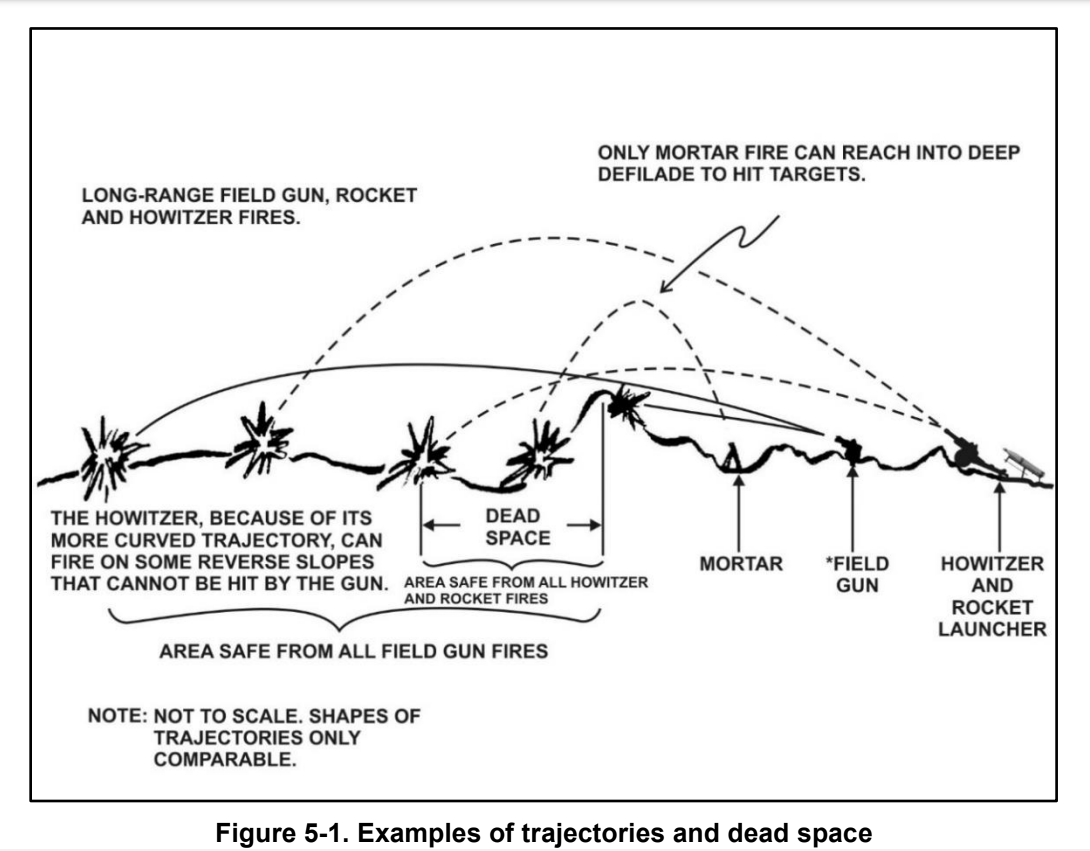
Indirect fire trajectories for rockets, howitzers, field guns and mortars

Indirect fire is aiming and firing a projectile without relying on a direct line of sight between the gun and its target, as in the case of direct fire. Aiming is performed by calculating azimuth and inclination, and may include correcting aim by observing the fall of shot and calculating new angles.

Description

[edit]

Indirect fire is most commonly used by field artillery and mortars (although field artillery was originally and until after World War I a direct fire weapon, hence the bullet-shields fitted to the carriages of guns such as the famous M1897 75 mm). It is also used with missiles, howitzers, rocket artillery, multiple rocket launchers, cruise missiles, ballistic missiles, naval guns against shore targets, sometimes with machine guns, and has been used with tank and anti-tank guns and by anti-aircraft guns against surface targets.

There are two dimensions in aiming a weapon:

  • In the horizontal plane (azimuth); and
  • In the vertical plane (elevation), which is governed by the distance (range) to the target and the energy of the propelling charge.

The projectile trajectory is affected by atmospheric conditions, the velocity of the projectile, the difference in altitude between the firer and the target, and other factors. Direct fire sights may include mechanisms to compensate for some of these. Handguns and rifles, machine guns, anti-tank guns, tank main guns, many types of unguided rockets, and guns mounted in aircraft are examples of weapons primarily designed for direct fire.

NATO defines indirect fire as "Fire delivered at a target which cannot be seen by the aimer."[1] The implication is that azimuth and/or elevation 'aiming' is done using instrumental methods. Hence indirect fire means applying 'firing data' to azimuth and elevation sights and laying these sights. Longer range uses a higher trajectory, and in theory maximum range is achieved with an elevation angle of 45 degrees.[2][3][4]

Calling and adjusting indirect artillery fire on a target unseen to the soldiers manning the guns, a modern United States example

It is reasonable to assume that original purpose of indirect fire was to enable fire from a 'covered position', one where gunners can not be seen and engaged by their enemies (that and as the range of artillery lengthened, it was impossible to see the target past all the intervening terrain). The concealment aspect remains important, but from World War I equally important was the capability to concentrate the fire of many artillery batteries at the same target or set of targets. This became increasingly important as the range of artillery increased, allowing each battery to have an ever-greater area of influence, but required command and control arrangements to enable concentration of fire. The physical laws of ballistics means that guns firing larger and heavier projectile can send them farther than smaller-calibre guns firing lighter shells. By the end of the 20th century, the typical maximum range for the most common guns was about 24 to 30 km, up from about 8 km in World War I.

During World War I, covered positions moved farther back and indirect fire evolved to allow any point within range to be attacked, firepower mobility, without moving the firers. If the target cannot be seen from the gun position, there has to be a means of identifying targets and correcting aim according to fall of shot. The position of some targets may be identified by a headquarters from various sources of information (spotters): observers on the ground, in aircraft, or in observation balloons. The development of electrical communication immensely simplified reporting, and enabled many widely dispersed firers to concentrate their fire on one target.

The trajectory of the projectile could not be altered once fired, until the introduction of smart munitions.

History

[edit]

Indirect arrow fire by archers was commonly used by ancient armies. It was used during both battles and sieges.[5]

For several centuries Coehorn mortars were fired indirectly because their fixed elevation meant range was determined by the amount of propelling powder. It is also reasonable conjecture that if these mortars were used from inside fortifications their targets may have been invisible to them and therefore met the definition of indirect fire.[original research?]

It could also be argued[according to whom?] that Niccolò Tartaglia's invention of the gunner's quadrant (see clinometer) in the 16th century introduced indirect fire guns because it enabled gunlaying by instrument instead of line of sight.[6] This instrument was basically a carpenter's set square with a graduated arc and plumb-bob placed in the muzzle to measure an elevation. There are suggestions,[7] based on an account in Livre de Canonerie published in 1561 and reproduced in Revue d'Artillerie of March 1908, that indirect fire was used by the Burgundians in the 16th century. The Russians seem to have used something similar at Paltzig in 1759 where they fired over trees, and their instructions of the time indicate this was a normal practice.[8] These methods probably involved an aiming point positioned in line with the target.[citation needed] The earliest example of indirect fire adjusted by an observer seems to be during the defence of Hougoumont in the Battle of Waterloo where a battery of the Royal Horse Artillery fired an indirect Shrapnel barrage against advancing French troops using corrections given by the commander of an adjacent battery with a direct line of sight.[9]

Modern indirect fire dates from the late 19th century. In 1882 a Russian, Lt Col K. G. Guk, published Field Artillery Fire from Covered Positions that described a better method of indirect laying (instead of aiming points in line with the target). In essence, this was the geometry of using angles to aiming points that could be in any direction relative to the target. The problem was the lack of an azimuth instrument to enable it; clinometers for elevation already existed. The Germans solved this problem by inventing the lining-plane in about 1890. This was a gun-mounted rotatable open sight, mounted in alignment with the bore, and able to measure large angles from it. Similar designs, usually able to measure angles in a full circle, were widely adopted over the following decade. By the early 1900s the open sight was sometimes replaced by a telescope and the term goniometer had replaced "lining-plane" in English.

The first incontrovertible, documented use of indirect fire in war using Guk's methods, albeit without lining-plane sights, was on 26 October 1899 by British gunners during the Second Boer War.[10] Although both sides demonstrated early on in the conflict that they could use the technique effectively, in many subsequent battles, British commanders nonetheless ordered artillery to be "less timid" and to move forward to address troops' concerns about their guns abandoning them.[10] The British used improvised gun arcs with howitzers;[7] the sighting arrangements used by the Boers with their German and French guns is unclear.

The early goniometric devices suffered from the problem that the layer (gun aimer) had to move around to look through the sight. This was very unsatisfactory if the aiming point was not to the front, particularly on larger guns. The solution was a periscopic panoramic sight, with the eyepiece to the rear and the rotatable top of the sight above the height of the layer's head. The German Goertz 1906 design was selected by both the British and the Russians. The British adopted the name "Dial Sight" for this instrument; the US used "Panoramic Telescope"; the Russia used "Goertz panorama".

Elevations were measured by a clinometer, a device using a spirit level to measure a vertical angle from the horizontal plane. These could be separate instruments placed on a surface parallel to the axis of the bore or physically integrated into some form of sight mount. Some guns had clinometers graduated in distances instead of angles. Clinometers had several other names including "gunner's level", "range scale", "elevation drum" and "gunner’s quadrant" and several different configurations. Those graduated in ranges were specific to a type of gun.

These arrangements lasted for most of the 20th century until robust, reliable and cost-effectively accurate gyroscopes provided a means of pointing gun or launcher in any required azimuth and elevation, thereby enabling indirect fire without using external aiming points. These devices use gyros in all three axes to determine current elevation, azimuth and trunnion tilt.

[edit]
A United States Marine lance corporal plots the direction and elevation of a mortar before firing.

Before a gun or launcher can be aimed, it must be oriented towards a known azimuth, or at least towards a target area. Initially, the angle between the aiming point and target area is deduced, or estimated, and set on the azimuth sight. Each gun is then laid on the aiming point, with this angle in order to keep them aimed roughly parallel to each other. However, for artillery another instrument, called either a director (United Kingdom) or aiming circle (United States), became widespread and eventually the primary method of orienting guns in most if not all armies. After being oriented and pointed in the required direction a gun recorded angles to one or more aiming points. Such early directors were the progenitors of the later general class of directors.

Indirect fire needs a command and control arrangement to allot guns to targets and direct their fire. The latter may involve ground or air observers or technical devices and systems. Observers report where shots fall so that aim may be corrected. In the First World War an important task for aircraft — both heavier-than-air or balloons — was artillery spotting. In naval use several ships may be shooting at the same target, making identifying the fall of shot from a particular ship difficult; different-coloured dyes for each ship were often used to help with spotting.[11]

Fire may be "adjusted" or "predicted". Adjusting (originally "ranging") means some form of observation is used to correct the fall of shot onto the target; this may be required for several possible reasons:

  • geospatial relationship between gun and target is not accurately known;
  • good quality data for prevailing conditions is unavailable; or
  • the target is moving or expected to move.

Predicted fire, originally called "map shooting", was introduced in World War I. It means that firing data is calculated to include corrections for the current prevailing conditions. It requires the target location to be precisely known relative to the gun location.

Adjusted and predicted fire are not mutually exclusive, the former may use predicted data and the latter may need adjusting in some circumstances.

There are two approaches to the azimuth that orients the guns of a battery for indirect fire. Originally "zero", meaning 6400 mils, 360 degrees or their equivalent, was set at whatever the direction the oriented gun was pointed. Firing data was a deflection or switch from this zero.

The other method was to set the sight at the actual grid bearing in which the gun was oriented, and firing data was the actual bearing to the target. The latter reduces sources of mistakes and made it easier to check that the guns were correctly laid. By the late 1950s, most armies had adopted the bearing method, the notable exception being the United States.

See also

[edit]

Footnotes

[edit]

References

[edit]
Revisions and contributorsEdit on WikipediaRead on Wikipedia
from Grokipedia
Indirect fire is fire delivered at a target that is not visible to the firing unit, typically employing artillery, mortars, rockets, or missiles to engage enemy positions beyond line-of-sight, often guided by forward observers, radar, or predictive calculations to provide suppressive, destructive, or neutralizing effects in support of ground maneuver forces. This method contrasts with direct fire, where the weapon system has a visible line of sight to the target, and has become a cornerstone of modern combined arms operations due to its ability to deliver massed effects over extended ranges. Historically, indirect fire evolved from direct-fire tactics prevalent in the , where light field guns were maneuvered close to targets for line-of-sight engagement with effective ranges of about 500-1,000 meters. The shift to indirect techniques gained prominence during the (1904–1905), demonstrating the potential of elevated-angle trajectories to strike hidden or distant targets, which influenced subsequent developments like heavier howitzers in . in that conflict necessitated advanced methods, including forward observers and adjustments for weather and terrain, transforming into a decisive force that inflicted the majority of casualties—earning it the moniker "King of Battle." By and beyond, doctrines emphasized its integration with and armor, as seen in operations like Desert Storm (1991), where massed indirect fires from multiple launch rocket systems (MLRS) and cannons destroyed numerous enemy vehicles. Key weapons systems for indirect fire include cannon artillery (e.g., 155-mm howitzers like the M109 Paladin), mortars for high-angle urban engagements, and rocket/missile platforms such as the MLRS, High Mobility Artillery Rocket System (HIMARS), and Army Tactical Missile System (ATACMS), which extend ranges to 300 kilometers. Modern enhancements incorporate precision-guided munitions like the Excalibur GPS-guided shell and Precision Guidance Kit (PGK), with circular error probable (CEP) as low as 4 meters, enabling effects in contested environments through digital fire direction systems. Types of indirect fire encompass observed (adjusted by spotters) and unobserved (pre-planned) variants, as well as suppressive (temporary neutralization of enemy fires), destructive (permanent elimination of targets), and interdiction (disruption of enemy logistics), all coordinated via coordination measures to synchronize with air and maneuver elements. In contemporary doctrine, indirect fire support is orchestrated by fire support coordinators within joint fire support coordination centers, integrating from radars, drones, and to achieve effects across deep, close, and rear battlespaces, as demonstrated in recent conflicts like the Russo-Ukrainian War where systems such as HIMARS and ATACMS have been employed against deep targets (as of 2025). Its strategic importance lies in amplifying maneuver lethality—historically responsible for most battlefield fatalities—while minimizing risk to friendly forces through standoff delivery, though challenges like counterbattery threats and urban masking require ongoing advancements in mobility and survivability.

Fundamentals

Definition

Indirect fire is fire delivered at a target not visible to the firing unit, relying on external aiming data such as maps, coordinates, or inputs from forward observers to direct the . This method employs trajectory-based aiming, where ballistic calculations determine the and direction needed for the to reach its intended impact point, often incorporating factors like , , and type. In contrast to , which requires a line-of-sight to the target as the point of aim for the weapon or its director, indirect fire eliminates the need for visibility, enabling engagement of hidden or distant objectives over obstacles or at ranges exceeding visual . This capability enhances its foundational role in operations by providing suppressive, neutralizing, or destructive effects without exposing the firing unit to immediate counterfire. The core components of indirect fire systems consist of the firing unit responsible for launching the projectiles, the observer who locates and adjusts fire based on target data, and communication links that facilitate coordination between these elements and fire direction centers. Integration with broader fire support coordination ensures that indirect fire aligns with maneuver elements and other assets for synchronized effects on the battlefield.

Principles of Operation

Indirect fire operates on the principles of , which describe the 's motion from the moment it exits the muzzle until impact. The follows a curved path primarily due to , which accelerates the downward at approximately 9.81 m/s², creating a parabolic arc in a but modified in atmosphere. Air resistance, or drag, opposes motion and reduces , with effects increasing at higher velocities and altitudes, necessitating adjustments in firing tables to predict actual range. influences both range (headwinds shorten it, tailwinds extend it) and deflection (crosswinds cause lateral drift), while differences between the firing position and target require site corrections to the quadrant for proper clearance over . Firing data essential for indirect fire are computed from target coordinates relative to the weapon position, incorporating factors like charge and projectile type. provides the horizontal direction in mils (a unit where 6400 mils equals 360 degrees), measured clockwise from a reference line to align the weapon. , or quadrant elevation, sets the vertical angle in mils to achieve the desired range, adjusted for vertical interval (height difference) and site. Range denotes the horizontal distance in meters, influencing and charge selection, while fuze settings determine burst timing or impact mode (e.g., quick for surface impact or variable time for airburst), calibrated to ensure effects match the target. These data are derived using graphical firing tables or ballistic computers for precision. Effective indirect fire requires coordination with other forces to synchronize effects and avoid . Fire support integrates with and armor through direct support missions, where units provide responsive fires to maneuver elements, and general support for broader operations. Air assets, including , are incorporated via joint fire support elements that deconflict airspace using measures like coordinated fire lines. doctrines standardize this via the joint fires process, encompassing target identification, request, allocation, execution, and assessment to ensure across land, air, and naval components. Errors in indirect fire arise from environmental and mechanical sources, impacting accuracy. Meteorological effects, such as wind speed and direction or air density variations, alter trajectory by changing drag and drift, with corrections applied from met messages to adjust range by up to several percent. Weapon dispersion results from inherent variations in projectile weight, muzzle velocity, and tube wear, leading to spread in impact points. This is quantified by probable error in range (one-half the range within which 50% of rounds fall) and probable error in deflection (lateral equivalent), typically 15-33 meters in range and 3-6 mils in deflection for standard artillery, depending on charge and distance.

Historical Development

Origins and Early Use

The earliest developments of indirect fire emerged in the late with the introduction of mortars and howitzers in European siege warfare, designed to lob projectiles over obstacles such as walls without a direct line of sight to the target. These weapons fired at high angles, typically starting at 45 degrees of elevation, allowing high-arcing trajectories to strike behind fortifications. By the , smaller, more mobile mortars on cart-like mounts became common in European armies, refining this indirect approach for both offensive and defensive roles in sieges. Doctrinal shifts in the late 18th and early 19th centuries transitioned from static roles to mobile field units supporting , with Napoleon Bonaparte pioneering the massed battery tactic to concentrate firepower at decisive points. Napoleon's organized into batteries of six to eight guns, often including howitzers for indirect support, allowing rapid repositioning to deliver overwhelming volleys that disrupted enemy formations before assaults. This innovation emphasized 's role in , moving away from isolated pieces toward integrated field operations that enhanced mobility and tactical flexibility on open battlefields. In the , advancements like rifled barrels and shrapnel shells significantly improved the accuracy and effectiveness of lobbing fire, enabling indirect engagements at greater ranges. , introduced in the , imparted spin to projectiles for enhanced stability and precision, with examples like the achieving ranges up to 8,453 yards. Shrapnel shells, invented by British Lieutenant in 1784 and widely adopted by mid-century, exploded in mid-air to scatter metal fragments, proving devastating in indirect barrages against troop concentrations. During the (1861-1865), these technologies were employed extensively; Union forces at the of Fort Pulaski in 1862 used rifled guns to breach Confederate walls from positions beyond effective counter-battery range, while shrapnel and case shot supported field battles by arcing over terrain to target hidden . Early indirect fire systems suffered from significant limitations, including poor accuracy in ranging without forward spotters, which often resulted in high expenditure to achieve any meaningful effect. Pre-20th-century weapons like mortars were effective only at short to medium ranges—typically under 2,000 yards—due to imprecise ballistic calculations and environmental factors, leading to dispersed impacts that wasted projectiles on unobserved targets. This inaccuracy necessitated voluminous salvos, straining and exposing crews to during adjustments. The transition to more systematic indirect fire techniques accelerated in the late 19th and early 20th centuries. During the (1904–1905), Japanese forces demonstrated the effectiveness of elevated-angle trajectories with howitzers to strike hidden or distant targets, particularly at the Siege of Port Arthur, where indirect fire from 120mm and 150mm howitzers neutralized Russian defenses beyond . This influenced global doctrines, leading to the adoption of heavier, more mobile artillery systems before .

World Wars and Modernization

During , indirect fire underwent significant innovations, particularly through the development of creeping barrages and predicted fire techniques by British and French forces. The creeping barrage involved coordinated fire that advanced in stages ahead of assaults, creating a protective curtain of explosions to suppress enemy defenses while minimizing exposure for advancing troops. This tactic was notably employed at the in July 1916, where over 1.5 million shells were fired in the initial bombardment, though execution challenges like inaccurate ranging led to mixed results in supporting advances. Predicted fire, or map shooting, allowed guns to target positions without prior registration by using pre-surveyed coordinates, reducing the time needed to engage and enhancing surprise; French regulations formalized these procedures by November 1915, influencing Allied doctrine throughout the war. In , advancements in indirect fire included the widespread adoption of , radar-based , and enhanced counter-battery capabilities, alongside specialized systems like the German rockets. , such as the U.S. (a 105mm on an chassis), provided greater mobility and protection, enabling rapid repositioning to support fast-moving armored operations, as seen in the Normandy campaign of 1944. The U.S. , a radar-activated device developed by the and first combat-tested in 1943, dramatically increased artillery lethality by detonating shells 30-50 feet above ground targets, proving devastating against infantry and in counter-battery roles during the in December 1944, where it inflicted heavy casualties on German positions. German forces utilized the series, including the 15cm NbW 41 introduced in 1941, for high-volume indirect fire that delivered psychological impact through its distinctive screeching trajectory, though its inaccuracy limited precision applications on fronts like the Eastern Front. Counter-battery efforts benefited from improved fire-control radars and sound-ranging techniques, allowing U.S. forces to locate and neutralize enemy guns more effectively, contributing to Allied superiority in artillery duels. Post-World War II developments during the emphasized nuclear-capable artillery and automated fire control systems to counter potential Soviet threats, marking a shift toward massed, high-impact fires integrated with . The U.S. introduced options, such as the M65 280mm atomic cannon tested in 1953, capable of delivering tactical nuclear rounds with yields up to 15 kilotons, influencing doctrine to incorporate in potential European theaters. The TACFIRE (Tactical Fire Direction) system, fielded in the , automated ballistic computations and using digital processors, reducing manual errors and enabling faster response times for battalion-level operations, as demonstrated in exercises simulating invasions. These innovations prioritized scalability and integration with air and armored assets. Doctrinal impacts from these eras underscored a transition to integration, where indirect fire supported synchronized maneuvers across infantry, armor, and aviation. In the (1950-1953), U.S. provided critical counter-battery and interdiction fires during defensive stands like the Pusan Perimeter, adapting tactics to mountainous terrain and emphasizing rapid massing of fires. The (1955-1975) further evolved this approach, with "fire support bases" enabling mobile to integrate with airmobile operations, though challenges like dense jungles highlighted the need for precise coordination to avoid friendly casualties. These conflicts reinforced the centrality of indirect fire in joint operations, shaping and U.S. Army manuals through the late .

Methods of Direction and Control

Observation Techniques

Forward observers serve as the primary "eyes" for indirect systems, positioned close to the forward line of troops to detect, locate, and designate within their assigned zone of . Their roles include transmitting initial requests, adjusting rounds onto , and assessing battle damage to ensure effective engagement. Typically led by a in units like the U.S. (MOS 0802), forward observer teams operate in pairs or small groups, coordinating with units to integrate seamlessly. These observers rely on specialized equipment for precise . , such as the Fujinon Stabiscope S-40, provide visual spotting with angular accuracy up to ±5 mils for measuring deviations. rangefinders like the AN/GVS-5 enable distance measurements up to 9,990 meters with ±10-meter accuracy, while GPS devices such as the AN/PSN-11 deliver exact grid coordinates for positioning and targeting. Additional tools, including the M2 compass (±10 mils accuracy) and the MULE (AN/PAQ-3) designator (effective up to 5,000 meters for stationary targets), support polar plot methods and night operations. Aerial observation enhances indirect fire by providing elevated, real-time surveillance over obscured or expansive terrain. Manned aircraft, such as observation helicopters, relay video feeds and coordinates to fire control centers, allowing observers to spot targets beyond line-of-sight limitations. Unmanned aerial vehicles (UAVs) have revolutionized this domain since the early ; the U.S. MQ-1 Predator (retired in 2018), introduced for in 1995 and integrated into joint by 2001, used electro-optical/ sensors to identify targets and cue strikes with near-real-time data transmission via links. Its successor, the MQ-9 Reaper, continues these capabilities with enhanced endurance and sensor suites. This integration, as seen in operations in and , enables persistent overwatch and precise adjustments without exposing ground personnel. As of 2025, smaller tactical UAVs, such as the RQ-20 Puma and tethered systems like the Spectre and Sentry UAS integrated with the Bradley Fire Support Team vehicle, further support rapid and AI-assisted fire direction in contested environments. Ground-based methods complement direct observation by passively locating enemy firing positions, particularly for . involves multiple observation posts using angular measurements from compasses or aiming circles to plot target lines of bearing and intersect them on maps for coordinate determination. Sound-ranging employs arrays of seismic sensors or microphones to detect acoustic signatures from enemy guns, calculating position by measuring time differences in wave arrival (e.g., along a baseline with multiple pick-up stations). Flash spotting detects muzzle flashes at night, using the flash-to-bang method—where is estimated by timing the interval at 350 meters per second—to confirm ranges and triangulate positions from fixed observation points. Adjustment procedures refine indirect fire based on observer spottings to achieve hits. establishes an initial over- and short pattern around the target, with range corrections starting at 100 meters and halving successively until the bracket narrows to 100 meters or less. Successive corrections involve repeated single-round adjustments, splitting deviations (50 meters left/right) and ranges (100 meters add/drop) to creep fire onto the target, ideal for inexperienced observers or precision missions. For multiple batteries, convergence aligns firing data so all rounds impact at a single point, enhancing massed effects by setting a common convergence grid rather than each battery's individual orientation. Ballistic adjustments based on observer data, such as height-of-burst (±50 meters), further refine trajectories for optimal impact.

Fire Direction Procedures

Fire direction procedures encompass the systematic processes by which artillery units compute and issue firing data to deliver indirect fire accurately and safely. These procedures, managed primarily by the fire direction center (FDC), integrate tactical and technical elements to convert observer inputs into executable fire commands, ensuring responsive support to ground operations. The core workflow begins with receiving observer data, such as target location, description, and method of engagement, typically transmitted via digital systems, voice, or call-for-fire messages. This data is then analyzed to determine the appropriate method of attack, followed by applying corrections for meteorological (MET) conditions, nonstandard ballistic factors, and observed effects from prior rounds. Next, the FDC computes essential firing elements, including quadrant , deflection, charge, and settings, before issuing fire commands to the battery or . These commands specify the settings and sequence, often verified through a to confirm accuracy. Plotting and calculation methods vary between manual and automated approaches to accommodate operational environments. Manual techniques rely on firing tables for ballistic computations under standard conditions, graphical firing tables (GFTs) for range and elevation plotting, and tools like the M17 plotting board or DA Form 4201 for burst location determination. In automated systems, such as the U.S. Army's Advanced Tactical Data System (AFATDS), real-time processing handles , MET integration, and data transmission, reducing computation time while maintaining precision; backups include degraded-mode operations using charts if digital systems fail. Mission types dictate procedural adaptations, with adjust fire missions refining accuracy through sequential observer corrections until the target is bracketed, often using high-angle trajectories for defilade positions or low-angle for open terrain to optimize coverage. Fire-for-effect missions, conversely, deliver massed volleys post-adjustment to saturate the target area, prioritizing rapid execution over initial precision. High-angle employs steeper trajectories to clear obstacles or engage in restricted spaces, while low-angle maintains flatter paths for extended range in unobstructed settings. Error mitigation integrates probabilistic models and safety protocols to minimize risks. Circular error probable (CEP) quantifies targeting accuracy, with categories from 0-20 feet (Category I) to over 1,000 feet (Category VI), improved via precise observer inputs, MET data, and registrations that account for cumulative errors like muzzle velocity variations. Safety measures enforce minimum safe distances, crest clearance computations ensuring trajectories avoid friendly forces, and fire support coordination measures (FSCMs) such as restrictive fire lines or no-fire areas; all computations undergo independent verification to prevent fratricide.

Types of Weapons and Systems

Conventional Artillery

Conventional artillery systems for indirect fire primarily consist of towed and self-propelled howitzers, which provide sustained, long-range fire support to ground forces. Towed systems, such as the M777 howitzer, are lightweight and air-transportable, weighing under 10,000 pounds, and fire 155mm projectiles with a standard range of 24 to 30 kilometers, extendable to 40 kilometers using rocket-assisted or base-bleed munitions. These systems emphasize rapid deployment and precision, supported by digital fire control systems that enable accurate targeting with minimal crew exposure. Self-propelled variants, like the M109 Paladin, offer enhanced mobility on tracked chassis, achieving speeds up to 38 miles per hour and an operational range of 186 miles, while featuring semi-automatic loading for a sustained rate of fire up to two rounds per minute. The Paladin's 155mm/L39 gun delivers projectiles to 30 kilometers, with ongoing U.S. Army efforts as of 2025 focusing on new howitzer competitions and precision munitions to achieve extended ranges beyond 40 kilometers. Calibers in conventional artillery span 105mm for lighter towed guns like the M119 to 155mm as the standard, with legacy systems up to 203mm for heavier bombardment, though 155mm dominates modern inventories for its balance of lethality and logistics. Ammunition types include high-explosive rounds such as the M107 for fragmentation and blast effects, smoke projectiles for obscuration and signaling, and illumination rounds for night operations, all compatible across these calibers. Extended-range options like base-bleed projectiles, exemplified by the , reduce drag to increase reach by 20-30% without rocket assistance, enhancing tactical flexibility in contested environments. These systems fulfill critical operational roles at the level, delivering responsive to shape the , suppress enemy defenses, and enable maneuver through integrated effects. Towed howitzers provide flexible positioning for close support in varied terrain, while self-propelled platforms ensure via rapid displacement and armored protection against . missions leverage these assets to neutralize hostile using sensor-to-shooter networks, prioritizing high-payoff targets to protect friendly forces and maintain operational tempo. Mobility features, including quick emplacement times of three minutes or less, and enhancements like dispersed position areas spanning 1-4 square kilometers, allow sustained operations under threat. Since 2022, adaptations in the conflict have accelerated modern updates, integrating autonomous resupply via unmanned ground vehicles to deliver under fire, reducing logistical vulnerabilities for towed and self-propelled units. AI-enhanced targeting, primarily through drone-based acquisition systems, has improved precision and response times for indirect fire, enabling real-time adjustments amid electronic warfare challenges. These developments, observed in NATO-supplied systems like the M777 and M109, emphasize hybrid human-machine operations to counter saturation attacks and enhance overall system resilience as of 2025.

Mortars and Rockets

Mortars are lightweight, man-portable indirect fire weapons typically ranging from 60mm to 120mm in caliber, designed for close support of infantry units with high-angle trajectories that enable fire over obstacles and into urban environments. The U.S. Army's M224 60mm mortar, for instance, offers a maximum range of 3,490 meters and a minimum range of 70 meters, while the M252 81mm mortar extends to 5,700 meters maximum, providing flexible, rapid-response fire for light infantry operations. Larger systems like the M120 120mm mortar achieve up to 7,200 meters, utilizing a drop-fire mechanism where rounds are dropped down the muzzle, igniting at the base to propel them on steep arcs ideal for negating buildings and terrain in built-up areas. Mortar ammunition features adjustable propellant increments—typically gauze pads or charges attached to the tail fin—that are removed or added to fine-tune range and , allowing crews to adapt to varying distances without changing the weapon's configuration. These systems emphasize portability, with the M224 weighing about 21 pounds in handheld mode for quick deployment by small teams, delivering high-explosive, illumination, or rounds at rates up to 30 per minute initially. Rocket systems for indirect fire, such as multiple-launch rocket systems (MLRS), provide area saturation capabilities distinct from mortars' precision close support, with unguided variants like the M270 launching clusters of rockets for suppressive barrages. The M270, a tracked launcher, fires pods of rockets including cluster munitions for wide-area effects, while its lighter wheeled counterpart, the , enhances mobility for rapid integration. These systems support saturation fire doctrines, overwhelming enemy positions with volleys that cover large zones, as seen in their design for high-volume, short-duration strikes. Rocket ammunition has evolved to include precision-guided options, such as the Guided Multiple Launch (GMLRS), introduced in the early 2000s, which extends effective range beyond 70 kilometers with GPS guidance for reduced compared to unguided clusters. Both mortars and rockets excel in deployment advantages, offering quick setup—mortars emplaced in minutes by a few soldiers, and HIMARS repositioned via truck in under five minutes—for immediate support, tracing evolutions from area-saturation systems like the Soviet Katyusha to today's integrated platforms.

Missiles

Missile systems extend indirect fire capabilities to deep-strike ranges, often launched from MLRS or HIMARS platforms for precision engagement of high-value targets. The Tactical Missile System (ATACMS) provides ranges up to 300 kilometers with unitary warheads, supporting suppression of enemy air defenses and logistics disruption. As of 2025, the (PrSM) is entering service, offering incremental ranges beyond 400 kilometers in early variants, with plans for hypersonic boosts to exceed 500 kilometers, enhancing long-range lethality while phasing out older ATACMS stocks.

Tactical Applications

Planning and Integration

Planning for indirect fire involves the pre-engagement design of missions to support joint force objectives, emphasizing the allocation of fire support assets through detailed fire plans that outline targets, timing, and effects. Common mission types include preparatory fires, which shape the operational environment by neutralizing enemy defenses prior to a maneuver; suppressive fires, intended to protect friendly forces by neutralizing enemy weapons during an ; and interdiction fires, aimed at disrupting enemy , command, or reinforcements to delay or degrade their capabilities. These missions are integrated into broader fire support plans that prioritize assets based on commander intent and operational tempo, ensuring synchronized effects across the joint force. Coordination processes rely on dedicated personnel and structures to integrate indirect fire with other elements, including liaison officers such as liaison elements (SOLEs) and joint air component coordination elements (JACCEs) who facilitate communication between ground forces and air or naval commands. Joint fires observers (JFOs), often serving as forward observers, provide critical input for and adjustments while embedded with maneuver units. Under frameworks like U.S. Joint Publication 3-09, this integration occurs through the joint fires element (JFE) near the operations center, synchronizing fires with via the (JFACC) and employing fire support coordination measures (FSCMs) such as coordinated fire lines (CFLs) and fire support coordination lines (FSCLs) to deconflict operations with air and naval support. Resource factors in planning encompass ammunition forecasting to sustain prolonged operations, often using automated systems to predict expenditure based on mission intensity and target density; battery positioning to optimize range, survivability, and responsiveness while minimizing exposure; and risk assessments to mitigate incidents through combat identification protocols and estimation. These elements ensure efficient , with areas (FSAs) designated for positioning and safety zones applied to reduce risks during multi-domain engagements. In the 2020s, modern planning tools enhance precision and interoperability, including digital mapping software within the Advanced Field Artillery Tactical Data System (AFATDS) for terrain analysis and target pairing, alongside simulations in the Artillery Execution Suite (AXS) for virtual rehearsals. These capabilities have been demonstrated in multinational exercises, such as Dynamic Front 22, Flaming Thunder 24, and Crystal Arrow 2025, where forces integrated fires using digital kill-chains to coordinate indirect support across battalions and above.

Execution in Combat

The execution of indirect fire in combat follows a structured fire mission cycle that ensures rapid and accurate delivery while minimizing risks to friendly forces. The process begins with a call for fire, initiated by a forward observer who transmits essential elements including observer identification, a warning order (such as "adjust fire" or "fire for effect"), target location (via grid or polar coordinates), target description, method of engagement, and method of fire and control. This is followed by verification from the fire direction center (FDC), which issues a message to the observer confirming the firing unit, any adjustments to the call, the number of rounds, and a unique target number for tracking. Adjustment then occurs through observer spotting and corrections, using terms like "over" or "short" for range and "left" or "right" for deviation, typically in increments of 100 meters for range and 30 meters for deviation during to refine impact. The mission concludes with refinement, recording the target if needed, and an end-of-mission report, often including surveillance notes on effects. A critical element in this cycle is the "Danger Close" code, invoked when the target is within 600 meters of friendly troops for mortars or , signaling heightened precautions to the FDC. Upon announcement in the call for fire's third transmission, the FDC employs creeping fire adjustments—small, incremental shifts—to bracket the target, ensuring a 99% probability of no casualties beyond 600 meters while accepting calculated risks closer in. This procedure integrates with broader fire support execution, where commanders synchronize delivery through automated systems like the Advanced Field Artillery Tactical Data System (AFATDS) to pair weapons with targets dynamically. Effects assessment during and after execution evaluates the mission's impact on enemy capabilities, primarily through battle damage assessment (BDA) conducted by observers using visual confirmation or collection assets. This includes physical damage assessment (e.g., observing destroyed vehicles), functional damage assessment (e.g., estimating repair times or degraded mission performance), and target system assessment (e.g., overall disruption to enemy networks). Observers report outcomes like "neutralized" or "destroyed," informing decisions on shifting fire to new targets or conducting total attack missions that saturate areas with sustained barrages to overwhelm defenses. Continuous combat assessment links these tactical results to operational objectives, using measures of effectiveness to recommend reattacks if initial fires fall short. In , indirect fire execution adapts to dense environments by prioritizing precision-guided munitions and restrictive coordination measures to minimize to civilians and infrastructure. For instance, during the 2004 Battle of Fallujah, U.S. Marine forces integrated batteries with enhanced target identification, limiting barrages to verified enemy positions and reducing unintended impacts compared to broader area fires. Night operations further demand adaptations like offset illumination rounds to light targets without compromising goggles, or pointers for spotting, enabling observers to mark positions up to 4 kilometers away for adjustment without visible light. These techniques, such as using graze-burst markers or laser designators compatible with , maintain fire superiority while exploiting technological edges in low-visibility conditions. Historical examples illustrate these principles in action. In the 1991 , U.S. near the Kuwait-Saudi border unleashed their heaviest barrage to date, with three batteries of 155mm howitzers firing on Iraqi positions six miles into occupied , demonstrating massed indirect fire's role in suppressing defenses during early ground preparations. By 2025, drone-assisted execution has evolved this further, as seen in ongoing conflicts where unmanned aerial systems reconnoiter, direct, and adjust indirect fires in real-time, extending observer reach and precision beyond traditional lines of sight.

Advantages and Challenges

Strategic Benefits

Indirect fire offers extended reach and coverage, allowing military forces to engage targets beyond line-of-sight, strike deep into enemy territory, protect advancing units, and disrupt without exposing crews to direct combat risks. Systems such as the U.S. Army Tactical Missile System (ATACMS) provide ranges up to approximately 300 kilometers, enabling strikes across regions like the or against mainland threats from standoff positions. Similarly, Guided Multiple Launch Rocket Systems (GMLRS) extend effective engagement beyond 80 kilometers, supporting wide-area coverage through kill boxes that facilitate coordinated attacks without additional clearance in three-dimensional battlespaces. This capability is particularly valuable in joint operations, where indirect fire complements maneuver elements to neutralize high-value targets and maintain operational momentum. In terms of , indirect fire batteries deliver equivalent to multiple direct-fire units, leveraging through massed volleys that amplify overall combat power. A single can synchronize with maneuver forces to defeat larger enemy formations, as seen in doctrinal emphasis on integrating fires to concentrate effects at decisive points. For instance, prepositioned systems like HIMARS in coalition scenarios enhance rapid response, allowing one unit to project effects comparable to several or armored platoons in suppression and attrition roles. This scalability is evident in echeloned across tactical to strategic levels, where responsive indirect fires provide against peer adversaries in multi-domain operations. Indirect fire also exerts psychological and suppressive effects, enabling area denial that demoralizes enemies and disrupts cohesion through sustained barrages. Doctrinal analyses highlight how such fires achieve surprise and psychological shock, immobilizing enemy groupings and repelling counterattacks by limiting maneuver and imposing constant threat. In practice, these effects manifest as broad suppression of enemy air defenses (SEAD) or , forcing adversaries to disperse and reducing their operational tempo. Modern enhancements, particularly precision-guided munitions developed and fielded post-2010, have further elevated these benefits by minimizing and enabling surgical strikes in . Munitions like the GPS-guided projectile, with ranges up to 40-48 kilometers and accuracy reducing target location errors to under 10 meters, allow precise engagements in urban environments against non-state actors, as demonstrated in operations against ISIL. Similarly, advanced GMLRS variants support "any sensor, best shooter" paradigms with AI-enabled targeting, facilitating low-collateral interventions in complex terrains while preserving . These innovations ensure indirect fire remains a cornerstone of joint superiority, adapting to high-threat environments where precision offsets vulnerabilities.

Operational Limitations

Indirect fire systems are inherently vulnerable to enemy , as firing positions can be rapidly detected and targeted by advanced radars and precision munitions, exposing batteries to retaliatory strikes and increasing casualty risks. This vulnerability is exacerbated by the need for forward positioning to achieve effective range, particularly when outranged by adversary systems, as observed in conflicts like the and in 2003. Dependence on robust communication lines for coordination between observers, fire direction centers, and firing units further compounds risks, as disruptions can delay or prevent fire missions, with historical examples from and highlighting the criticality of reliable networks for techniques like time-on-target fires. Weather and mobility constraints add additional layers of exposure; in mountainous or cold environments, , , and reduce visibility and ground trafficability, limiting repositioning and increasing reliance on vulnerable road networks or helicopter displacements for towed . Rapidly changing meteorological conditions also degrade unobserved fire accuracy and extend round flight times due to high-angle trajectories. Logistical demands pose significant challenges for sustaining indirect fire operations, with high ammunition consumption rates—up to 75% of a force's resupply effort in scenarios—straining resources during large-scale combat. Batteries may expend thousands of rounds in preparation fires or salvos of 24-48 shells per target, necessitating controlled supply rates to balance immediate needs against future availability. Supply chain vulnerabilities are acute, as convoys and storage dumps become prime targets for , with large stockpiles offering high-value, detectable objectives that can cripple operations if disrupted. Prolonged engagements amplify crew fatigue, with performance degrading after 24-48 hours without rest, requiring "hot/cold" cycles for maintenance and recovery amid continuous repositioning and threat monitoring. Enemy countermeasures have evolved to exploit these weaknesses, particularly through electronic warfare that jams GPS signals guiding precision munitions, rendering systems like or GMLRS ineffective in contested environments. Developments such as ' IGAS receiver aim to mitigate this by providing anti-jamming capabilities for dual-frequency navigation, but widespread adoption remains ongoing as of 2025. Drone swarms represent another proliferating threat, with low-cost, autonomous groups—such as China's planned million-unit fleet—capable of overwhelming defenses to target batteries, radars, and launchers, as simulated in potential scenarios where depleted missile stocks heighten vulnerability. Active protection systems, including counter-rocket, , and mortar (C-RAM) setups like those integrated into U.S. forward operating bases, further counter incoming indirect fire by intercepting projectiles, though their effectiveness diminishes against massed or swarming attacks. Contemporary issues as of 2025 underscore the risks of indirect fire proliferation in urban settings, where post-2022 conflicts in and Gaza have demonstrated how explosive weapons with wide-area effects cause extensive civilian infrastructure damage, disrupting essential services like electricity and water. In , Russian has inflicted the majority of casualties through sustained strikes, while in Gaza, satellite data reveals reverberating harms from building collapses and contamination, amplifying long-term socio-economic impacts. Ethical concerns arise from the proportionality of precision-guided munitions in densely populated areas, with underreporting and attribution challenges in data collection raising questions about foreseeability and mitigation under . These conflicts highlight the need for enhanced policies to reduce indirect effects, though implementation lags amid ongoing tactical demands.

References

Add your contribution
Related Hubs
User Avatar
No comments yet.