Hubbry Logo
Faust, Part OneFaust, Part OneMain
Open search
Faust, Part One
Community hub
Faust, Part One
logo
8 pages, 0 posts
0 subscribers
Be the first to start a discussion here.
Faust, Part One
Faust, Part One
from Wikipedia

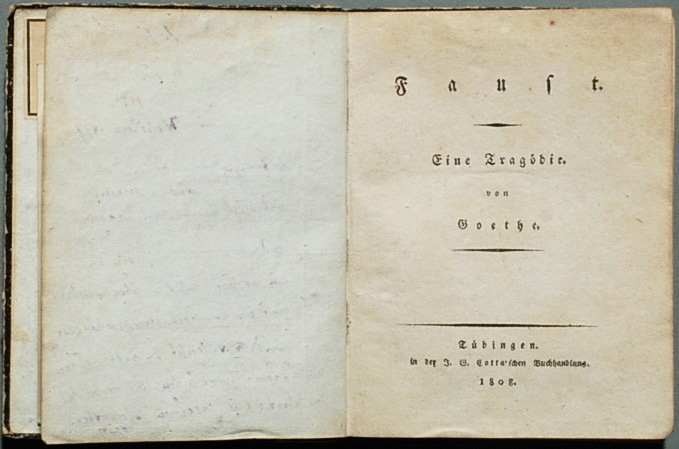
Faust: A Tragedy (German: Faust. Eine Tragödie, pronounced [faʊ̯st ˈaɪ̯nə tʁaˈɡøːdi̯ə] , or Faust. Der Tragödie erster Teil [Faust. The tragedy's first part]) is the first part of the tragic play Faust by Johann Wolfgang von Goethe, and is considered by many as the greatest work of German literature.[1] It was first published in 1808.

Key Information

Synopsis

[edit]

The first part of Faust is not divided into acts, but is structured as a sequence of scenes in a variety of settings. After a dedicatory poem and a prelude in the theatre, the actual plot begins with a prologue in Heaven, where the Lord bets Mephistopheles, an agent of the Devil, that Mephistopheles cannot lead astray the Lord's favourite striving scholar, Dr. Faust. We then see Faust in his study, who, disappointed by the knowledge and results obtainable by science's natural means, attempts and fails to gain knowledge of nature and the universe by magical means. Dejected in this failure, Faust contemplates suicide, but is held back by the sounds of the beginning Easter celebrations. He joins his assistant Wagner for an Easter walk in the countryside, among the celebrating people, and is followed home by a poodle. Back in the study, the poodle transforms itself into Mephistopheles, who offers Faust a contract: he will do Faust's bidding on earth, and Faust will do the same for him in Hell (if, as Faust adds in an important side clause, Mephistopheles can get him to be satisfied and to want a moment to last forever). Faust signs in blood, and Mephistopheles first takes him to Auerbach's tavern in Leipzig, where the devil plays tricks on some drunken revellers. Having then been transformed into a young man by a witch, Faust encounters Margaret (Gretchen) and she excites his desires. Through a scheme involving jewellery and Gretchen's neighbour Marthe, Mephistopheles brings about Faust's and Gretchen's liaison.

After a period of separation, Faust seduces Gretchen, who accidentally kills her mother with a sleeping potion given to her by Faust. Gretchen discovers that she is pregnant, and her torment is further increased when Faust and Mephistopheles kill her enraged brother in a sword fight. Mephistopheles seeks to distract Faust by taking him to a Witches' Sabbath on Walpurgis Night, but Faust insists on rescuing Gretchen from the execution to which she was sentenced after drowning her newborn child while in a state of madness. In the dungeon, Faust vainly tries to persuade Gretchen to follow him to freedom. At the end of the drama, as Faust and Mephistopheles flee the dungeon, a voice from heaven announces Gretchen's salvation.

Prologues

[edit]

Prologue in the Theatre

Prologue in Heaven (1854) by Engelbert Seibertz

In the first prologue, three people (the theatre director, the poet and an actor) discuss the purpose of the theatre. The director approaches the theatre from a financial perspective, and is looking to make an income by pleasing the crowd; the actor seeks his own glory through fame as an actor; and the poet aspires to create a work of art with meaningful content. Many productions use the same actors later in the play to draw connections between characters: the director reappears as God, the actor as Mephistopheles, and the poet as Faust.[2]

Prologue in Heaven: The Wager

The play begins with the Prologue in Heaven. In an allusion to the story of Job, Mephistopheles wagers with God for the soul of Faust.

God has decided to "soon lead Faust to clarity", who previously only "served [Him] confusedly." However, to test Faust, he allows Mephistopheles to attempt to lead him astray. God declares that "man still must err, while he doth strive". It is shown that the outcome of the bet is certain, for "a good man, in his darkest impulses, remains aware of the right path", and Mephistopheles is permitted to lead Faust astray only so that he may learn from his misdeeds.

Faust's tragedy

[edit]

Night

Dusk. On Goethe's Faust (1837) by Carl Gustav Carus

The play proper opens with a monologue by Faust, sitting in his study, contemplating all that he has studied throughout his life. Despite his wide studies, he is dissatisfied with his understanding of the workings of the world, and has determined only that he knows "nothing" after all. Science having failed him, Faust seeks knowledge in Nostradamus, in the "sign of the Macrocosmos", and from an Earth-spirit, still without achieving satisfaction.

As Faust reflects on the lessons of the Earth-spirit, he is interrupted by his famulus, Wagner. Wagner symbolizes the vain scientific type who understands only book-learning, and represents the educated bourgeoisie. His approach to learning is a bright, cold quest, in contrast to Faust, who is led by emotional longing to seek divine knowledge.

Dejected, Faust spies a phial of poison and contemplates suicide. However he is halted by the sound of church bells announcing Easter, which remind him not of Christian duty but of his happier childhood days.

Outside the town gate

Faust and Wagner take a walk into the town, where people are celebrating Easter. They hail Faust as he passes them because Faust's father, an alchemist himself, cured the plague. Faust is in a black mood. As they walk among the promenading villagers, Faust reveals to Wagner his inner conflict. Faust and Wagner see a poodle, who they do not know is Mephistopheles in disguise, which follows them into the town.

Study

Faust and Mephistopheles (1848) by Ary Scheffer

Faust returns to his rooms, and the dog follows him. Faust translates the Gospel of John, which presents difficulties, as Faust cannot determine the sense of the first sentence (specifically, the word Logos (Ancient Greek: Λὀγος) – "In the beginning was the Logos, and the Logos was with God, and the Logos was God" – currently translated as The Word). Eventually, he settles upon translating it with a meaning Logos does not have, writing "In the beginning was the deed".

The words of the Bible agitate the dog, which shows itself as a monster. When Faust attempts to repel it with sorcery, the dog transforms into Mephistopheles, in the disguise of a travelling scholar. After being confronted by Faust as to his identity, Mephistopheles proposes to show Faust the pleasures of life. At first Faust refuses, but the devil draws him into a wager, saying that he will show Faust things he has never seen. They sign a pact agreeing that if Mephistopheles can give Faust a moment in which he no longer wishes to strive, but begs for that moment to continue, he can have Faust's soul:

Faust. Werd ich zum Augenblicke sagen:
Verweile doch! Du bist so schön!
Dann magst du mich in Fesseln schlagen,
Dann will ich gern zugrunde gehn!
Dann mag die Totenglocke schallen,
Dann bist du deines Dienstes frei,
Die Uhr mag stehn, der Zeiger fallen,
Es sei die Zeit für mich vorbei!

Faust. If the swift moment I entreat:
Tarry a while! You are so fair!
Then forge the shackles to my feet,
Then I will gladly perish there!
Then let them toll the passing-bell,
Then of your servitude be free,
The clock may stop, its hands fall still,
And time be over then for me![3]

Auerbach's Cellar in Leipzig

False image and word... (1913) by Hans Best

In this, and the rest of the drama, Mephistopheles leads Faust through the "small" and "great" worlds. Specifically, the "small world" is the topic of Faust I, while the "great world", escaping also the limitations of time, is reserved for Faust II.

These scenes confirm what was clear to Faust in his overestimation of his strength: he cannot lose the bet, because he will never be satisfied, and thus will never experience the "great moment" Mephistopheles has promised him. Mephistopheles appears unable to keep the pact, since he prefers not to fulfill Faust's wishes, but rather to separate him from his former existence. He never provides Faust what he wants, instead he attempts to infatuate Faust with superficial indulgences, and thus enmesh him in deep guilt.

In the scene in Auerbach's Cellar, Mephistopheles takes Faust to a tavern, where Faust is bored and disgusted by the drunken revelers. Mephistopheles realizes his first attempt to lead Faust to ruin is aborted, for Faust expects something different.

Gretchen's tragedy

[edit]

Witch's Kitchen

Mephistopheles takes Faust to see a witch, who—with the aid of a magic potion brewed under the spell of the Hexen-Einmaleins [de] (witch's algebra)—turns Faust into a handsome young man. In a magic mirror, Faust sees the image of a woman, presumably similar to the paintings of the nude Venus by Italian Renaissance masters like Titian or Giorgione, which awakens within him a strong erotic desire. In contrast to the scene in Auerbach's Cellar, where men behaved as animals, here the witch's animals behave as men.

Street

Marguerite Leaving Church (1838) by Ary Scheffer

Faust spies Margarete, known as "Gretchen", on the street in her town, and demands Mephistopheles procure her for him. Mephistopheles foresees difficulty, due to Margarete's uncorrupted nature. He leaves jewellery in her cabinet, arousing her curiosity.

Evening

Margarete brings the jewellery to her mother, who is wary of its origin, and donates it to the Church, much to Mephistopheles's fury.

The Neighbour's House

Mephistopheles leaves another chest of jewellery in Gretchen's house. Gretchen innocently shows the jewellery to her neighbour Marthe. Marthe advises her to secretly wear the jewellery there, in her house. Mephistopheles brings Marthe the news that her long absent husband has died. After telling the story of his death to her, she asks him to bring another witness to his death in order to corroborate it. He obliges, having found a way for Faust to encounter Gretchen.

Garden

At the garden meeting, Marthe flirts with Mephistopheles, and he is at pains to reject her unconcealed advances. Gretchen confesses her love to Faust, but she knows instinctively that his companion (Mephistopheles) has improper motives.

Forest and Cave Faust's monologue is juxtaposed with Gretchen's soliloquy at the spinning wheel in the following scene. This monologue is connected thematically with Faust's opening monologue in his study; he directly addresses the Earth Spirit.

Gretchen's Chamber

Margarete at the Spinning Wheel (c. 1840-50) by Ary Scheffer

Gretchen is at her spinning wheel, thinking of Faust. The text of this scene was notably put to music by Franz Schubert in the lied Gretchen am Spinnrade, Op. 2, D. 118 (1814).

Marthe's Garden

Gretchen presents Faust with the famous question "What is your way about religion, pray?"[4] She wants to admit Faust to her room, but fears her mother. Faust gives Gretchen a bottle containing a sleeping potion to give to her mother. Catastrophically, the potion turns out to be poisonous, and the tragedy takes its course.

"At the Well" and "By the City Wall"

In the following scenes, Gretchen has the first premonitions that she is pregnant as a result of Faust's seduction. Gretchen and Lieschen's discussion of an unmarried mother, in the scene at the Well, confirms the reader's suspicion of Gretchen's pregnancy. Her guilt is shown in the final lines of her speech: "Now I myself am bared to sin! / Yet all of it that drove me here, / God! Was so innocent, was so dear!"[5] In "By the City Wall", Gretchen kneels before the statue of the Virgin and prays for help. She uses the opening of the Stabat Mater, a Latin hymn from the thirteenth century thought to be authored by Jacopone da Todi.

Night: Street in Front of Gretchen's Door

Valentine, Gretchen's brother, is enraged by her liaison with Faust and challenges him to a duel. Guided by Mephistopheles, Faust defeats Valentine, who curses Gretchen just before he dies.

Cathedral

Gretchen seeks comfort in the church, but she is tormented by an Evil Spirit who whispers in her ear, reminding her of her guilt. This scene is generally considered to be one of the finest in the play.[citation needed] The Evil Spirit's tormenting accusations and warnings about Gretchen's eternal damnation at the Last Judgement, as well as Gretchen's attempts to resist them, are interwoven with verses of the hymn Dies irae (from the traditional Latin text of the Requiem Mass), which is being sung in the background by the cathedral choir. Gretchen ultimately falls into a faint.

Walpurgis Night and Walpurgis Night's Dream

Faust in the Walpurgis Night (c. 1840-50) by Ary Scheffer

A folk belief holds that during the Walpurgis Night (Walpurgisnacht) on the night of 30 April—the eve of the feast day of Saint Walpurga—witches gather on the Brocken mountain, the highest peak in the Harz Mountains, and hold revels with the Devil. The celebration is a Bacchanalia of the evil and demonic powers.

At this festival, Mephistopheles draws Faust from the plane of love to the sexual plane, to distract him from Gretchen's fate. Mephistopheles is costumed here as a Junker and with cloven hooves. Mephistopheles lures Faust into the arms of a naked young witch, but he is distracted by the sight of Medusa, who appears to him in "his lov'd one's image": a "lone child, pale and fair", resembling "sweet Gretchen".

"Dready Day. A Field" and "Night. Open Field"

The first of these two brief scenes is the only section in the published drama written in prose, and the other is in irregular unrhymed verse. Faust has apparently learned that Gretchen has drowned the newborn child in her despair, and has been condemned to death for infanticide. Now she awaits her execution. Faust feels culpable for her plight and reproaches Mephistopheles, who however insists that Faust himself plunged Gretchen into perdition: "Who was it that plunged her to her ruin? I or you?" However, Mephistopheles finally agrees to assist Faust in rescuing Gretchen from her cell.

Dungeon

Faust and Mephisto in the dungeon (1848), coloured lithograph by Joseph Fay

Mephistopheles procures the key to the dungeon, and puts the guards to sleep, so that Faust may enter. Gretchen is no longer subject to the illusion of youth upon Faust, and initially does not recognize him. Faust attempts to persuade her to escape, but she refuses because she recognizes that Faust no longer loves her and only pities her. When she sees Mephistopheles, she is frightened and implores to heaven: "Judgment of God! To thee my soul I give!". Mephistopheles pushes Faust from the prison with the words: "She now is judged!" (Sie ist gerichtet!). Gretchen's salvation, however, is proven by voices from above: "Is saved!" (Ist gerettet!).

References

[edit]
[edit]
Revisions and contributorsEdit on WikipediaRead on Wikipedia
from Grokipedia
Faust, Part One is a dramatic poem written by the German author , first published in 1808, that explores the legend of a scholar who sells his soul to the in pursuit of boundless knowledge and experience. The work centers on Heinrich Faust, a brilliant but restless intellectual disillusioned with the limitations of human learning, who enters into a wager with the cynical demon : if Mephistopheles can provide Faust with a moment of complete satisfaction, Faust's soul will be his; otherwise, the devil serves Faust in his quest for ultimate fulfillment. This leads to Faust's young woman Margarete (Gretchen), whose tragic downfall—marked by , , and condemnation to death—forms the emotional core of the narrative, highlighting themes of love, guilt, and redemption. Goethe (1749–1832), a renowned as a , , , and statesman, drew from the medieval legend while infusing it with Enlightenment ideals, Romantic individualism, and his own philosophical inquiries into human striving (Streben) and the divine order of the universe. He began composing in the 1770s during his period but revised it extensively over decades, completing Part One as a more classical, structured drama divided into prologues, such as the "Prologue in Heaven," and titled scenes like "Night" and "." Unlike earlier versions of the tale, such as Christopher Marlowe's Doctor Faustus (c. 1592), Goethe's portrayal emphasizes Faust's eternal aspiration toward the infinite rather than mere damnation, positioning the work as a cornerstone of and a profound on the human condition. The play's significance lies in its blend of , mythology, and contemporary science, influencing subsequent explorations of ambition, morality, and the Faustian bargain in .

Background and Composition

Historical Context

, born in 1749 in , emerged as a central figure in during the late 18th century, a period marked by the movement, which he helped shape in the 1770s alongside and others. This literary and cultural revolt emphasized intense emotion, individualism, and a rejection of Enlightenment rationalism's constraints, influencing Goethe's early works like (1774). By 1775, Goethe had relocated to the court of , where he assumed administrative roles that tempered his youthful passions, yet the movement's spirit of striving and inner turmoil informed the initial conception of . Goethe's transformative Italian journey from 1786 to 1788 marked a pivotal shift, exposing him to and , which inspired a move toward greater formal discipline and harmony in his writing. This experience, detailed in his later Italian Journey (1816–1817), helped him transition from the exuberant to , a collaborative aesthetic with from the late to Schiller's death in 1805, blending emotional depth with classical balance and universality. The journey's reflective influence matured Goethe's perspective, fostering a synthesis of passion and reason that permeated his mature works. The broader European intellectual climate during this era intertwined Enlightenment ideals of reason and progress with emerging Romantic emphases on subjective experience and the infinite, reactions amplified by the of 1789. Goethe, while admiring revolutionary aspirations for liberty, grew wary of its chaotic excesses, participating in campaigns against in 1792–1793 as part of the Duke of Weimar's entourage, which reinforced his preference for moderated reform over radical upheaval. This tension between rational inquiry's limits and the soul's boundless quest resonated in , reflecting the era's philosophical debates. Goethe began Faust, Part One in the early 1770s as prose fragments known as the Urfaust, capturing intensity, but shelved the project amid other pursuits and administrative duties. Revived during and after his Italian journey in the late , he revised it into verse, publishing a fragment in 1790 before completing and issuing the full Part One in 1808, a process embodying his evolution from youthful fragmentation to classical cohesion.

Development and Sources

The Faust legend originated in 16th-century , drawing from tales of a historical figure, (c. 1480–1540), a wandering and astrologer whose exploits were sensationalized in popular . The earliest printed version appeared in the anonymous Historia von D. Johann Fausten, published in 1587, which recounts Faust's mastery of sciences leading to a demonic pact for knowledge and power, culminating in his . This , a compact Volksbuch of moral cautionary tales, spread widely across and inspired adaptations, including itinerant plays that dramatized the story for audiences in and beyond during the late 16th and 17th centuries. A significant literary predecessor was Christopher Marlowe's The Tragical History of Doctor Faustus (c. 1592), which adapted the chapbook's narrative into a emphasizing Faust's intellectual ambition and inevitable damnation through his bargain with the . Marlowe's portrayal, influenced by English translations of the German legend, reinforced the theme of eternal punishment for , contrasting sharply with Goethe's later redemptive trajectory for , where the protagonist's quest evolves toward spiritual renewal rather than outright condemnation. Goethe began his engagement with the Faust material in the 1770s during his Sturm und Drang period, producing the fragmentary "Urfaust" manuscript—a rough, incomplete draft comprising about 1,500 lines that sketches key scenes like Faust's nocturnal monologue and pact with Mephistopheles. This early version integrated Enlightenment ideas, reflecting influences from Baruch Spinoza's pantheistic philosophy, which Goethe admired for equating with nature and emphasizing a unified , as well as Gotthold Ephraim Lessing's dramatic theories and his own fragmentary Faust sketch that critiqued rational limits in pursuit of deeper truths. Goethe set aside the project amid personal and political upheavals but revived it in the during a period of relative seclusion in , following his transformative Italian journey (1786–1788), where he absorbed classical antiquity's forms. He completed Part One around 1806, blending classical dramatic structure—such as balanced verse and mythological allusions—with romantic elements like emotional intensity and individual striving, resulting in a work that transcends its folkloric roots.

Structure and Form

Prologues

The Prologues of Goethe's Faust, Part One establish the dramatic framework through two distinct introductory sequences, framing the human narrative within broader cosmic and theatrical contexts. In the Prologue in Heaven, the scene opens with the three archangels—, , and Michael—praising the eternal order and splendor of God's creation. extols the sun's harmonious song among the spheres, marvels at the earth's swift, unending rotation in divine glory, and Michael describes the balancing forces of storms and celestial light that sustain the world's vitality, all underscoring the perfection of the divine . This choral hymn is interrupted by , who approaches the with cynical mockery of human progress, portraying humanity as perpetually striving yet mired in error, dissatisfaction, and futile pursuits: "Men, as I view them, soon or late / Torment themselves and curse their fate." The , however, defends humankind's restless nature as a pathway to growth, viewing even temptation as a means to elevate the spirit, and specifically mentions his servant as an example of noble, if misguided, aspiration. This celestial dialogue culminates in a wager between the and , wherein the is permitted to tempt during his earthly life in an effort to corrupt him, with the outcome hinging on whether Mephistopheles can lead Faust to a moment of complete satisfaction—if he succeeds, the claims Faust's soul; if Faust remains in perpetual dissatisfaction and striving under the , his soul is granted to the divine. The Lord's allowance of this trial positions not as mere destruction but as a mechanism for human development, echoing biblical precedents while setting the stage for Faust's earthly drama. The narrative then transitions to the Prologue in the Theatre (or Prelude on the ), shifting from the cosmic to the earthly of , which introduces an ironic layer of divine oversight mirrored in human artistry. Here, the Director, the , and the the of theatrical creation: the Director demands a that captivates with and variety to fill seats and ensure popular success; the champions pure, idealistic that elevates the soul through profound imagination and timeless beauty, scorning commercial compromises; and the advocates for practicality, humor, and relatable vitality to engage audiences without alienating them. Their discourse resolves in the selection of the story for its inherent dramatic potential, blending profound human striving with elements of , romance, and to bridge the ideal and the popular. This metatheatrical prelude grounds the lofty heavenly wager in the tangible world of , highlighting the irony of a divine plan unfolding through human endeavor and imperfection, before the action descends to Faust's study and the unfolding pact.

Scene Divisions and Dramatic Elements

Goethe's Faust, Part One is divided into 25 scenes without traditional act divisions, relying instead on location-based titles such as "Night," "Study," and "" to guide transitions and maintain a fluid, episodic structure. This organization allows for a seamless progression from intimate, introspective settings to broader, more dynamic locales, emphasizing the play's hybrid nature as a dramatic poem rather than a strictly theatrical piece. The dramatic form blends verse and , with the majority composed in various metrical forms including Knittelvers—a rhymed derived from medieval theater—and occasional unrhymed iambic lines, creating a rhythmic variety that mirrors the thematic contrasts between high and earthy . Lyric interludes, such as the of the Earth Spirit, interrupt the with poetic intensity, while appears in mundane or satirical exchanges, like those involving ' witty banter. This mix fuses tragic elements in Faust's and the with comic relief and philosophical discourse, defying the rigid unities of French in favor of Shakespearean freedom in time, place, and action. Theatrical innovations include the use of choral elements and spectacle to heighten the , as seen in the Walpurgis Night scene where witches and demons form a singing, dancing chorus amid a chaotic of infernal figures, evoking a sense of overwhelming, revelry. Such moments prioritize visual and auditory extravagance over linear plot, underscoring Goethe's experimental approach to as a multimedia experience blending , , and modernity. Spanning over 4,600 lines, the play's pacing builds gradually from Faust's solitary reflections in early study scenes to escalating action in the urban and episodes, culminating in emotional and moral climaxes that propel the narrative toward redemption's faint promise.

Characters

Protagonists

, the titular protagonist of Johann Wolfgang von Goethe's Faust, Part One, is depicted as an aging overwhelmed by an insatiable thirst for that leaves him in profound existential despair. Having devoted his life to academic pursuits, he finds traditional disciplines—, , , and —inadequate for grasping the of , prompting a rejection of bookish learning in favor of direct experiential understanding. This inner torment manifests as a restless Streben (striving), the core of his character, driving him to seek transcendence beyond human limits despite repeated frustrations. Mephistopheles, the demonic antagonist and foil to Faust, serves as a sophisticated tempter who embodies philosophical negation, irony, and cynicism toward human endeavor. Portrayed not as a grotesque fiend but as a cultivated, witty figure with sarcastic dialogue, he preaches materialism and nihilism, viewing all movement and striving as ultimately futile and devoid of meaning. His skepticism renders him incapable of believing in anything transcendent, positioning him as a force of destruction that mocks idealism while inadvertently spurring action through his provocations. The dynamic between Faust and inverts the traditional master-servant hierarchy, with the bound to serve the scholar following a fateful agreement, while their relationship originates from Mephistopheles' wager with that frames Faust's journey as a divine test of . This bet highlights the tension between Faust's ceaseless Streben—an affirmative pursuit of meaning through engagement with the world—and Mephistopheles' corrosive cynicism, which seeks to exploit Faust's despair but ultimately underscores the resilience of human aspiration. Through this interplay, Mephistopheles acts as both adversary and catalyst, reflecting Faust's darker impulses while challenging his capacity for growth.

Supporting Figures

Gretchen, also known as Margarete, serves as the central female figure whose seduction and subsequent downfall propel the narrative toward tragedy. Introduced as a modest and pious young woman from a bourgeois family, she becomes the object of 's desire after he encounters her on the street, facilitated by ' schemes. Through gifts, flattery, and deception, wins her affection, leading to their and her . Gretchen's arc culminates in horror: she administers a sleeping potion provided by to her mother, who dies from an overdose, and in a state of desperation, drowns her newborn child before descending into madness and imprisonment. Her execution is implied at the play's close, underscoring the irreversible consequences of 's pursuit. Valentine, Gretchen's brother and a soldier returning from war, embodies familial protectiveness and societal honor, acting as a catalyst for her further isolation. Upon learning of his sister's liaison and pregnancy, he publicly shames her outside their home and challenges the disguised Faust to a duel in the street. Mortally wounded by Mephistopheles' underhanded intervention—where the devil steps in to deliver the fatal blow while Faust hesitates—Valentine dies cursing Gretchen as a source of family disgrace, which intensifies her guilt and social ostracism. His death removes a key familial barrier but accelerates the tragic momentum by alienating Gretchen from her community. Marthe Schwerdtlein, Gretchen's gossipy neighbor and a middle-aged , provides practical support and a venue for the lovers' meetings, unwittingly aiding ' manipulations. Residing next door, she offers Gretchen advice on household matters and encourages her budding romance with , who delivers jewels to the household under the guise of a from Marthe's absent husband. In the scene behind her home, Marthe hosts the couples, where distracts her with fabricated tales of her husband's death in to prevent interference in Faust's seduction. Her role highlights the everyday social fabric that enables the affair's progression while exposing vulnerabilities in domestic life. The Witch in the "Witch's Kitchen" scene functions as a intermediary, brewing a rejuvenating that transforms into a youthful form, essential for his pursuit of . Amid cauldrons, grotesque familiars, and incantations, she follows ' instructions to prepare the elixir from exotic ingredients, which drinks despite his initial disdain for such "senseless juggling ." This act not only physically alters but also marks his deeper entanglement with demonic forces, propelling the plot from intellectual discontent to sensual corruption. 's mother, though not directly appearing onstage, represents the intrusion of bourgeois domesticity into the ; her from the sleeping —intended to allow and privacy—eliminates a guardian and burdens with compounded guilt. The Earth Spirit, evoked by Faust in his study through a magical , embodies dynamic natural forces and briefly appears as a visionary flame, rejecting Faust's grasp as he deems the "too small" for true communion with its boundless activity. This encounter catalyzes Faust's frustration with human limitations, driving him toward the pact with . In the study scenes, the Angels externalize Faust's inner turmoil: the Good Angel, amid a of heavenly spirits, urges toward divine , while the Evil Angel tempts with visions of earthly power and denial, foreshadowing the moral conflicts that unfold through the supporting figures' interactions.

Plot Summary

Prologues

The Prologues of Goethe's Faust, Part One establish the dramatic framework through two distinct introductory sequences, framing the human narrative within broader cosmic and theatrical contexts. In the Prologue in Heaven, the scene opens with the three archangels—, , and Michael—praising the eternal order and splendor of God's creation. extols the sun's harmonious song among the spheres, marvels at the earth's swift, unending rotation in divine glory, and Michael describes the balancing forces of storms and celestial light that sustain the world's vitality, all underscoring the perfection of the divine cosmos. This choral hymn is interrupted by , who approaches the with cynical mockery of human progress, portraying humanity as perpetually striving yet mired in error, dissatisfaction, and futile pursuits: "Men, as I view them, soon or late / Torment themselves and curse their fate." The , however, defends humankind's restless nature as a pathway to growth, viewing even temptation as a means to elevate the spirit, and specifically mentions his servant as an example of noble, if misguided, aspiration. This celestial dialogue culminates in a wager between the and , wherein the is permitted to tempt during his earthly life by serving him and providing experiences aimed at corruption, with the outcome hinging on whether Mephistopheles can lead Faust to perdition and claim his soul; the , confident in humanity's potential, trusts that Faust's striving will ultimately guide him toward salvation. The Lord's allowance of this trial positions temptation not as mere destruction but as a mechanism for human development, echoing biblical precedents while setting the stage for Faust's earthly drama. The narrative then transitions to the Prologue in the Theatre (or Prelude on the Stage), shifting from the cosmic to the earthly of , which introduces an ironic layer of divine oversight mirrored in human istry. Here, the Director, the , and the debate the essence of theatrical creation: the Director demands a that captivates with and variety to fill seats and ensure popular success; the champions pure, idealistic that elevates the soul through profound imagination and timeless beauty, scorning commercial compromises; and the advocates for practicality, humor, and relatable vitality to engage audiences without alienating them. Their discourse resolves in the selection of the story for its inherent dramatic potential, blending profound human striving with elements of , romance, and to bridge the ideal and the popular. This metatheatrical prelude grounds the lofty heavenly wager in the tangible world of , highlighting the irony of a divine plan unfolding through human endeavor and imperfection, before the action descends to Faust's study and the unfolding pact.

Faust's Pact and Study Scenes

In the initial "Night" scene set in Faust's study, the scholar laments the futility of his lifelong pursuit of knowledge through , , , and , declaring that all human learning has left him feeling confined and unfulfilled, akin to a prisoner in his own chamber. This underscores Faust's intellectual despair, as he contemplates by but is interrupted by the distant tolling of Easter bells, which evoke memories of his youthful and a brief sense of renewal, momentarily halting his desperate act. Returning to his study after an outing, Faust notices a large black that has followed him, which begins to howl restlessly; employing a spell from an ancient book of , he compels the animal to reveal its true form, transforming into , a traveling scholar in noble attire who admits to being a spirit of negation serving the powers of hell. In the subsequent "Study II" scene, Faust attempts to conjure the Earth Spirit by gazing upon the Sign of the Macrocosm in his magical tome, experiencing a fleeting sensation of infinite connection to the universe's forces, yet the vision overwhelms him without granting lasting enlightenment. Undeterred, he invokes the Earth Spirit directly, which briefly manifests as a fiery, seething presence, acknowledging Faust's kinship but dismissing him as too small for true communion, leaving the scholar in deepened anguish and reinforcing his sense of human limitation. Despairing further, Faust again reaches for the poison cup, but reappears in a more elaborate costume—a jester's attire with rooster plumes and bells—to mock and tempt him, proposing a companionship where the will serve on in exchange for his soul in the . The ensuing negotiation culminates in a blood-signed contract: pledges to provide with every earthly pleasure and adventure, acting as his (often disguised as the ), but if ever experiences a moment of such supreme satisfaction that he wishes time to stand still, declaring "Linger on, thou art so fair!", his soul becomes forfeit to . agrees, pricking his finger to sign the deed in blood, which hails as a binding "spirit's bond," symbolizing the irreversible wager on human striving. To initiate their adventures, Mephistopheles leads Faust to Auerbach's Cellar in Leipzig, a raucous tavern where a group of drunken students—Altmayer, Frosch, Brander, and Siebel—carouse with songs and crude jests about love and wine, satirizing the superficiality and folly of youthful academia. Mephistopheles amuses the revelers with illusory tricks, such as making wine flow from a hole in the table and transforming it into flames, or causing the drinkers to believe they are riding out on horseback amid thunderous illusions, highlighting the devil's mocking disdain for human excess while Faust observes in detached contempt. This episode serves as an early demonstration of the pact's promise of worldly experiences, though it only heightens Faust's alienation from ordinary society. Next, in the "Witch's Kitchen" scene, Mephistopheles takes Faust to visit a grotesque witch in her foul lair, where amid cauldrons, familiars, and incantations, the witch brews a potent potion that rejuvenates Faust, restoring his youthful vigor and appearance to better pursue sensual pleasures and his infatuation with Gretchen. The chaotic, satirical depiction of witchcraft underscores themes of transformation and the devil's facilitation of earthly desires.

The Gretchen Tragedy

The Gretchen Tragedy unfolds as the central romantic subplot in Faust, Part One, tracing the seduction and downfall of the innocent Margarete, known as , through a series of intimate and catastrophic scenes set in a provincial German town. In the "Street" scene, Faust encounters as she returns from church, immediately captivated by her purity and beauty; he offers to escort her home, but she modestly refuses, citing her mother's strictness. , observing Faust's infatuation, schemes to facilitate the seduction by disguising himself as a traveler and later leaving a casket of exquisite jewels at Gretchen's doorstep in the "Evening" scene. Gretchen discovers the gift and, though initially enchanted, shares it with her mother, who—alarmed by its unexplained origin—sends it to a priest, thwarting the immediate ploy but deepening Gretchen's curiosity about the mysterious donor. The romance progresses in the "" scene, where , aided by ' illusions to dismiss Gretchen's family, confesses his ardent love to her amid blooming flowers and seclusion. , torn between her and emerging affection, reciprocates tentatively, allowing Faust to kiss her and foreshadowing their intimate union. To enable their liaison without interruption, Faust provides Gretchen with a sleeping potion for her mother in the "A Neighbor's House" interlude, but the dose proves fatal, leading to the mother's and Gretchen's mounting guilt. Tragedy escalates with familial confrontation in the "Promenade" and "The Neighbor's Garden" scenes, where Gretchen's brother Valentine, returning from military service, duels to defend her honor; intervenes with a magical diversion, enabling to mortally wound Valentine, who dies cursing his sister as a seduced outcast. Disowned by the community and tormented by remorse, seeks solace in the "At the Well" and "In the " scenes, where gossip spreads about her , and an evil spirit haunts her during , amplifying her despair with visions of damnation. The climax diverges briefly in the "" scene on the Mountains, where distracts Faust with a revelry, delaying his return as Gretchen's plight worsens in isolation. Upon Faust's eventual vision of her suffering, he rushes back, but it is too late: in a fit of madness, Gretchen has drowned her illegitimate child in , leading to her and for and . The tragedy resolves offstage in the "" scene, where , raving in her cell, rejects Faust's attempt to free her, preferring death over flight with him; as guards approach for her execution, ethereal voices of angels proclaim her soul's redemption, contrasting with the mocking Lemurs urging to flee, thus parting the lovers eternally.

Themes and Motifs

Knowledge, Striving, and Limits

In the opening "Night" scene of , Part One, the , a renowned , articulates a profound unrest born from his exhaustive pursuit of across , , , and . Having delved into these disciplines, declares that they have only deepened his sense of limitation, reducing the infinite mysteries of to mere words and signs without revealing truth. This critique underscores the inadequacy of and empirical science, which views as fragmented and ultimately futile in achieving wholeness or absolute understanding. Central to the play's philosophy is the concept of Streben (striving), portrayed as the essence of human existence. In the "Prologue in Heaven," the Lord affirms Faust's restless pursuit, stating, "Es irrt der Mensch, solang er strebt" (Man errs as long as he strives), yet this very striving leads toward clarity, bloom, and fruitfulness, despite inevitable errors. This divine endorsement contrasts sharply with Mephistopheles' static negation, embodied in his role as the spirit of perpetual denial, who seeks to trap Faust in complacency rather than propel him forward. Streben thus represents an endless, dynamic force driving humanity beyond finite bounds, though it remains fraught with the risk of disillusionment. The motif of limits permeates Faust's encounters, most strikingly in his invocation of the Earth Spirit, a manifestation of nature's vital forces. When the Spirit appears and rejects Faust's plea for union, proclaiming, "Du gleichst dem Geist, den du begreifst, / Nicht mir!" (You resemble the spirit you comprehend, not me!), it symbolizes the unattainable wholeness Faust craves, highlighting the chasm between human aspiration and the elusive totality of the cosmos. The subsequent pact with Mephistopheles, transformed by Faust into a wager against ever finding satisfaction, further illustrates this futile quest: Mephistopheles' aid promises expanded horizons but ultimately reinforces the boundaries of mortal striving, offering no true resolution. These themes reflect Goethe's pantheistic worldview, where divinity permeates nature and human endeavor, influenced by Johann Gottfried Herder's emphasis on organic development and . Herder's ideas, encountered during Goethe's formative years in , shaped the play's vision of striving as a harmonious, albeit conflicted, participation in the world's ceaseless becoming, without the rigid dualism of traditional . In Part One, this philosophical tension yields no closure, deferring Faust's potential transcendence to the unresolved horizons of Part Two.

Love, Guilt, and Redemption

In Goethe's Faust, Part One, the theme of love manifests primarily through Faust's relationship with Gretchen (Margarete), portraying it as a transient illusion that serves as an escape from his existential striving, ultimately precipitating her destruction. Faust's passion begins as a diversion from his dissatisfaction with intellectual pursuits, drawing him into a seductive encounter facilitated by , but it quickly spirals into as Gretchen faces societal ostracism, the death of her mother and brother, and her own . This , while momentarily fulfilling for Faust, underscores its illusory nature, as his wager with Mephistopheles—tied to perpetual dissatisfaction—prevents lasting commitment, leaving Gretchen to bear the full weight of their liaison. The mechanics of guilt in the Gretchen storyline highlight Faust's indirect responsibility, mediated through ' manipulations, which enable Faust to evade personal reckoning while Gretchen confronts profound penitence. orchestrates events such as the poisoning of Gretchen's mother and the murder of her brother , allowing Faust to distance himself from the consequences, yet his abandonment exacerbates her isolation and descent into . In contrast, Gretchen's guilt drives her toward genuine repentance, as seen in her prison scene where she rejects Faust's rescue attempt, embracing divine judgment over earthly evasion, a dynamic that critiques Faust's moral detachment. Hints of redemption emerge through Gretchen's by , which foreshadows Faust's eventual arc and incorporates imagery to symbolize renewal amid despair. As heavenly voices declare "Gretchen is saved!", announcing her by , which prefigures the broader theme of striving rewarded by grace in Part Two. motifs, evoking Christ's , frame Gretchen's penitence as a path to spiritual rebirth, contrasting Faust's ongoing evasion and suggesting that redemption transcends human striving through feminine and . Gender dynamics in the Gretchen tragedy position her as a vessel for the fallout of male ambition, offering a of patriarchal where women's is sacrificed for men's pursuits. embodies the passive victim under the patriarchal "," her virtue exploited and discarded by Faust's volatile desires, reflecting 19th-century ideologies that immobilized women while privileging male agency. This portrayal subverts traditional roles, as 's ultimate agency in and challenges the disposability of women, highlighting how Faust's unchecked ambition perpetuates inequities.

Literary Analysis

Language and Style

Goethe's is renowned for its innovative versification, employing over 26 distinct meters to mirror the emotional and thematic shifts across scenes, from philosophical to comic . predominates in elevated, lofty passages, such as Faust's soliloquies, providing a sense of and rhythmic that underscores his striving. In contrast, rhymed forms appear in lighter or dramatic exchanges, enhancing the play's dynamic expressiveness. A hallmark of the work is the use of Knittelvers, an irregular rhymed derived from the carnival plays of , which imparts a loose, proverbial tone with alternating and minimal . This meter is particularly suited to comic and ironic elements, appearing frequently in ' banter to convey his cynical wit and satirical edge. The Gretchen scenes draw on folk ballad influences, incorporating simple, song-like structures that lend a lyrical, popular intimacy to her monologues and dialogues, evoking traditional German Volkslieder. Dialogue styles further distinguish the characters: Faust's speeches favor elevated in formal, often unrhymed or intricately structured verse, reflecting his aspirational and tormented mindset, while employs a more prosaic irony through adaptable, rhythmic patterns that others' forms for manipulative effect. uniquely masters the play's diverse verse forms, using them to heighten dramatic tension and underscore his role as tempter. Goethe innovates by blending high literary German with lower, colloquial registers and archaic 16th-century elements, creating a legendary atmosphere that bridges classical and folk traditions without rigid adherence to neoclassical norms. The play's language prioritizes accessibility for both stage performance and private reading, with its varied s fostering a natural, unconscious flow that aids and theatrical delivery. As Goethe himself observed, "The ... is an unconscious result of the poetic mood," ensuring the text's supports its dramatic intent.

Symbolism and

In Goethe's Faust, Part One, the study scenes symbolize Faust's perilous quest for , representing a space of mystical and magical experimentation where human ambition borders on the divine. Faust's dissatisfaction with empirical leads him to invoke the Earth Spirit, embodying his hubristic drive to transcend natural limits through forbidden arts, akin to alchemical transmutation of base matter into or spirit. This motif underscores the dangers of unchecked intellectual pursuit, as the study becomes a site of isolation and near-madness, foreshadowing Faust's pact with . The episode further illustrates chaotic forces, portraying a on the mountain as an eruption of the primal, unrestrained , where revelry disrupts rational order. This nocturnal gathering, filled with grotesque apparitions and elemental frenzy, symbolizes the Dionysian undercurrents of , contrasting Faust's striving for enlightenment with raw, instinctual that tempts him toward dissolution. In this scene, the chaotic id manifests as a critique of Enlightenment rationalism, revealing the turmoil beneath civilized facades. In the cathedral scene during Gretchen's torment, the provides a momentary barrier against encroaching evil, as demonic voices assail her amid the choir's "," highlighting the tension between and infernal corruption, and emphasizing Gretchen's tragic purity amid guilt. Philosophically, the play centers on a between activity and passivity, with embodying the that propels human progress by countering stagnation. As the spirit of negation, drives from contemplative isolation into active engagement with the world, illustrating Goethe's view that evil, though destructive, serves a catalytic role in dialectical advancement toward . This tension posits activity—Faust's ceaseless striving—as essential to overcoming passivity, yet fraught with peril, aligning with broader themes of human limitation. The work draws on biblical allusions, particularly the wager in the , where the in Heaven reimagines God's permission for Satan's testing of the righteous as a divine endorsement of Faust's trials, shifting focus from passive suffering to active moral evolution. Alchemical motifs permeate the narrative, symbolizing transformation through the (darkening) implied in Faust's despair and magical pursuits in his study, reflecting Goethe's interest in chemical processes as metaphors for spiritual renewal. Part One's open-ended conclusion, with Gretchen's ambiguous and Faust's unresolved quest, critiques the of by exposing its inability to fully comprehend or control existential chaos, leaving the protagonist's striving perpetually incomplete. This philosophical underscores Goethe's that true emerges from tension between aspiration and limitation, rather than triumphant resolution.

Publication and Reception

Initial Publication

Goethe completed Faust, Part One in after decades of intermittent work on the , with the text first appearing in 8 of his collected works, edited by J.G. Cotta and issued between and 1810. A standalone edition of the complete Faust: Eine Tragödie followed in 1808, published by Cotta in as a corrected and reset version of the integrated text. This marked the work's debut in its full form for Part One, comprising 309 pages in German and establishing the dramatic structure that blended classical and romantic elements. Prior to this, Goethe had released an incomplete version titled Faust: Eine Tragödie, published as a fragment in within the fourth volume of his collected writings. This early iteration included key scenes such as the pact with and elements of the tragedy but lacked the later expansions on philosophical motifs. The manuscript for an even earlier draft, known as the Urfaust, originated around 1772–1775 during Goethe's phase and was not discovered until 1887, when scholar Erich Schmidt identified a contemporary copy among archival materials. Although Faust, Part One encountered no significant censorship during its release, the ongoing created logistical challenges for printing and distribution across German states. The work did not receive a full stage premiere until January 19, 1829, at the Weimar Court Theatre, where it was adapted into acts for performance to celebrate Goethe's eightieth birthday.

Critical Legacy

Upon its publication, Faust, Part One garnered significant praise from Romantic critics, who viewed it as a pinnacle of European , embodying the era's emphasis on individual striving, emotion, and the sublime. , a key English Romantic admirer, published influential essays and partial translations in the and , which helped popularize the work abroad and highlighted its themes of human aspiration and moral complexity. However, not all reception was unqualified; critiqued the play's form as chaotic and overly romantic, contrasting it with his dialectical while acknowledging its philosophical depth in exploring negation and spirit. In the 20th century, interpretations shifted toward existential themes, with scholars drawing parallels between Faust's restless quest and modern alienation. Thomas Mann's novel Doctor Faustus (1947) explicitly reimagines Goethe's protagonist as a metaphor for artistic genius and moral compromise amid Germany's cultural decline, influencing existential readings of striving and damnation. Franz Kafka's works, such as The Trial, echo Faustian motifs of bureaucratic absurdity and futile rebellion against higher powers, though Kafka's engagement was more indirect through shared themes of existential dread. Feminist critiques, emerging prominently post-1970s, reexamined Gretchen's role, portraying her not as a passive ideal of redemption but as a victim of patriarchal violence and infanticide stigma, challenging the play's gender dynamics. 21st-century scholarship has expanded to ecological and postcolonial lenses, analyzing the nature scenes as critiques of human domination over the environment, where Faust's earth spirit invocation symbolizes disenchantment and exploitation. Postcolonial readings interpret Faust's land reclamation projects as allegories of imperialism, linking his "striving" to colonial expansion and displacement. As of 2025, digital editions, such as the University of Frankfurt's interactive platform, enable layered textual analysis, while AI-driven projects like "Faust goes AI" explore thematic evolution through machine learning, revealing patterns in motifs of ambition and ethics. The play's influence extends to opera, with Charles Gounod's Faust (1859) and Hector Berlioz's La Damnation de Faust (1846) adapting its core pact and tragedy, shaping Romantic music's dramatic conventions. It has inspired numerous films, from F.W. Murnau's silent Faust (1926) to modern interpretations, reinforcing its visual motifs of temptation and redemption. As a cultural icon, Faust, Part One has profoundly shaped German identity, symbolizing national striving and self-reflection, particularly in the Romantic era's construction of a unified cultural heritage.

References

Add your contribution
Related Hubs
User Avatar
No comments yet.