



Community hub
First Conte government
View on Wikipedia
First Conte government | |
|---|---|
 65th Cabinet of Italy | |
 | |
| Date formed | 1 June 2018 |
| Date dissolved | 5 September 2019 (462 days) |
| People and organisations | |
| Head of state | Sergio Mattarella |
| Head of government | Giuseppe Conte |
| Deputy head of government | Luigi Di Maio Matteo Salvini |
| No. of ministers | 19 (incl. Prime Minister) |
| Ministers removed | 1 resigned |
| Total no. of members | 20 (incl. Prime Minister) |
| Member parties | M5S, Lega |
| Status in legislature | Coalition (Majority) |
| Opposition parties | PD, FI, FdI, LeU |
| History | |
| Election | 2018 election |
| Legislature term | XVIII Legislature (2018–2022) |
| Incoming formation | 2018 government formation |
| Predecessor | Gentiloni government |
| Successor | Second Conte government |
| ||
|---|---|---|
|
Political officies Prime Minister of Italy (2018–2021) President of the M5S (2021–present) Prime Minister of Italy President of M5S  |
||
.jpg)
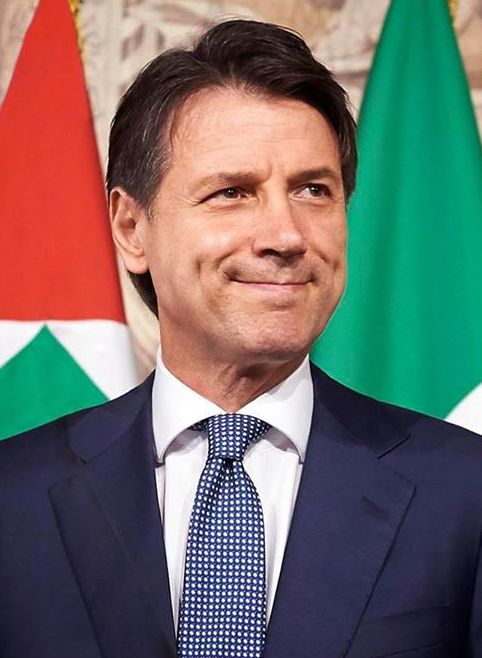
The first Conte government was the 65th government of the Italian Republic.[1] It was led by Giuseppe Conte, an independent, and it was in office from 1 June 2018 to 5 September 2019.
The cabinet was formed by a coalition between the Five Star Movement and the League, but it also contained some independents proposed by each party (including the Prime Minister). It was referred to as the "government of change" (Italian: governo del cambiamento) after the title of the political agreement signed by the two parties,[2][3] or the "yellow-green government" (governo gialloverde), based on their customary colours,[4] even if the League originally preferred "yellow-blue government" (governo gialloblu), due to its new campaign colour under Salvini's leadership.[5]
The government has often been described as "populist" (the first of that kind in Europe according to several sources)[6][7] and its policies (and more specifically those of the League) have been described by Italian newspapers as "souverainist".[8][9][10][11]
Supporting parties
[edit]The government is supported and most of its members are provided by the two following parties.
| Party | Main ideology | Leader | |
|---|---|---|---|
| Five Star Movement (M5S) | Populism, direct democracy | Luigi Di Maio | |
| League (Lega) | Right-wing populism, federalism | Matteo Salvini | |
At its birth, the government was also supported by the Associative Movement Italians Abroad (MAIE), five deputies and two senators previously expelled from the M5S, one dissident senator from the South American Union Italian Emigrants (USEI)[12] who later joined the MAIE and one deputy of Forza Italia (FI) who sarcastically voted in favour of it.[13] Ricardo Merlo, the leader of MAIE, was also named Undersecretary to the Ministry of Foreign Affairs on 12 June 2018. The government is also supported by the National Movement for Sovereignty, the Sardinian Action Party and the Italian Liberal Party (whose senators sit in the League group).
Brothers of Italy (FdI),[14] the parties representing linguistic minorities (Valdostan Union, South Tyrolean People's Party and Trentino Tyrolean Autonomist Party) and one deputy from USEI do not support the government, but affirmed their willingness to vote for measures that reflect their respective ideologies.[15]
History
[edit]Background and formation
[edit]
The March 2018 general election resulted in a hung parliament.[16] The Five Star Movement (M5S) led by Luigi Di Maio resulted as the party with the largest number of votes and parliamentary seats, whereas the centre-right coalition in which Matteo Salvini's League emerged as the main political force won a plurality of seats both in the Chamber of Deputies and in the Senate. The centre-left coalition, built around the Democratic Party (PD) led by former Prime Minister Matteo Renzi, came third.[17]
On 9 May, after weeks of political deadlock and failing attempts to form a cabinet, including possible M5S–Centre-right and M5S–PD coalitions, Di Maio and Salvini officially requested President Sergio Mattarella to concede them 24 hours more to strike a government agreement between their two parties.[18] In the evening, Silvio Berlusconi publicly announced that Forza Italia (FI) would not support a M5S–League government on a vote of confidence, but it would still maintain the centre-right alliance nonetheless, thus opening the door to a possible majority government between the two parties.[19]
On 13 May, the M5S and the League reached an agreement on a government program, however they did not find an agreement regarding their proposal for the Prime Minister and the Ministers. M5S and League leaders met with President Mattarella on 14 May and asked for an additional week of negotiations.[20] Both parties announced they would ask their respective members to vote on the government agreement by the following weekend.[21][22]
On 21 May, private law professor and M5S advisor Giuseppe Conte was proposed by Di Maio and Salvini for the role of Prime Minister.[23][24][25] Despite reports in the media suggesting that President Mattarella had significant reservations about the direction of the new government,[26] Conte was invited at the Quirinal Palace to receive the presidential mandate to form a new cabinet on 23 May.[27][28] In his statement after the appointment, Conte said that he would be the "defense attorney of Italian people".[29] The next day, Conte held talks with all the parliamentary parties, but the government formation was soon stuck on the appointment of Paolo Savona as Minister of Economy and Finance, which was unfavoured by President Mattarella,[30] who considered his alleged support for Italy's covert exit from the euro as an overwhelming risk for the country's economy. On 27 May, President Mattarella refused to appoint Savona, and Conte renounced his task after days of negotiation and an ultimatum by the two party leaders on Savona's nomination.[31][32][33]

On 28 May, President Mattarella summoned Carlo Cottarelli (a former director of the International Monetary Fund) and gave him the task to form a new government.[34][35] On the same day, the PD announced that it would abstain from voting the confidence to Cottarelli while the M5S, the League, FI and the Brothers of Italy (FdI) announced that they would have voted against.[36][37] Cottarelli was expected to submit his list of ministers for approval to President Mattarella on 29 May. However, he held only informal consultations with the President on 29 and 30 May, awaiting the possible formation of a "political government".[38][39] Meanwhile, Di Maio and Salvini announced their willingness to restart negotiations to form a "political" government and Giorgia Meloni (FdI leader) gave them her support.[38][39][40]
On 31 May, the M5S and the League announced their new agreement on a Conte-led government with Giovanni Tria as Minister of Economy and Finance and Savona as Minister of European Affairs.[41][42] Subsequently, President Mattarella summoned for the second time Conte, who announced the list of ministers.[43][44] On 1 June, Prime Minister Conte and his ministers took their oaths of office and were sworn in.[45] On 5 June the Italian Senate approved the new government in a vote of confidence.[46] On 6 June the government was confirmed following the vote of confidence in the Chamber of Deputies.[47]
On 12 June, the cabinet appointed 6 deputy ministers and 39 undersecretaries.[48][49][50][51] Of all these appointments, 25 were M5S members, 17 League members, two non-party independents and one member of the Associative Movement Italians Abroad (MAIE).[52] The M5S received four deputy ministers while the League received two.[53]
Investiture votes
[edit]On 5 June 2018, the Conte I Cabinet was granted the confidence of the Senate by receiving 171 votes in favor and 117 votes against (25 senators abstained; 7 senators did not vote, among which 6 were absent).[54] Senators for life Elena Cattaneo, Mario Monti and Liliana Segre abstained while senators for life Carlo Rubbia, Renzo Piano and Giorgio Napolitano did not vote. On 6 June 2018, the so-called Government of Change received the confidence of the Chamber of Deputies by receiving 350 votes in favor and 236 votes against (35 deputies abstained; 8 deputies did not vote, among which 5 were absent).[55]
5–6 June 2018
Investiture votes for Conte I Cabinet | |||
|---|---|---|---|
| House of Parliament | Vote | Parties | Votes |
| Senate of the Republic (Voting: 313[a] of 320, Majority: 145) |
 Yes Yes |
M5S (109), Lega (58), MAIE (2), Others (2) | 171 / 313
|
 No No |
FI (57), PD (52), LeU (4), Aut (2), PSI (1), +Eu (1) | 117 / 313
| |
| Abstention | FdI (18), Aut (5), Others (2) | 25 / 313
| |
| Chamber of Deputies (Voting: 621[b] of 628, Majority: 294) |
Yes |
M5S (219), Lega (124), MAIE (6), FI (1) | 350 / 621
|
| No |
PD (110), FI (102), LeU (14), CP–AP–PSI–AC (4), NcI (3), +Eu–CD (3) | 236 / 621
| |
| Abstention | FdI (30), SVP–PATT (4), USEI (1) | 35 / 621
| |
Resignation
[edit]Conte announced his resignation on August 20, 2019, averting a no-confidence vote promoted by Matteo Salvini.[56] The same day, President of Italy Sergio Mattarella accepted Conte's resignation and announced consultations with party leaders for the next two days.[57] On August 22, Mattarella said some parties were trying to form "a solid majority" and he gave these political parties until August 27 to report back to him, after which he would hold two more days of consultations.[58]
On August 29, Mattarella tasked Conte with the formation of a new cabinet, a coalition of Five Star Movement and Democratic Party. As customary, the premier-designate reserved the right to accept the mandate, pending further talks with both parties.[59]
Party breakdown
[edit]Beginning of term
[edit]Ministers
[edit]8
| |
5
| |
6
|
Ministers and other members
[edit]- Five Star Movement (M5S): 8 ministers, 4 deputy ministers, 21 undersecretaries
- League (Lega): 5 ministers, 3 deputy ministers, 15 undersecretaries
- Associative Movement Italians Abroad (MAIE): 1 undersecretary
- Independents: Prime minister, 5 ministers, 2 undersecretaries
End of term
[edit]Ministers
[edit]8
| |
6
| |
5
|
Ministers and other members
[edit]- Five Star Movement (M5S): 8 ministers, 4 deputy ministers, 21 undersecretaries
- League (Lega): 6 ministers, 3 deputy ministers, 15 undersecretaries
- Associative Movement Italians Abroad (MAIE): 1 undersecretary
- Independents: Prime minister, 4 ministers, 2 undersecretaries
Geographical breakdown
[edit].svg)
Beginning of term
[edit]- Northern Italy: 9 ministers
- Central Italy: 2 ministers
- Lazio: 2 ministers
- Southern and Insular Italy: 8 ministers (including Conte)
End of term
[edit]- Northern Italy: 10 ministers
- Central Italy: 2 ministers
- Lazio: 2 ministers
- Southern and Insular Italy: 7 ministers (including Conte)
Council of Ministers
[edit]- ^ a b Proposed by the Five Star Movement.
- ^ Replacing in the second selection original candidate Luca Giansanti (independent).
- ^ Chosen after original candidate Paolo Savona was rejected by the President.
- ^ Replacing in the second selection original candidate Mauro Coltorti (M5S).
- ^ Proposed by the League.
Composition
[edit]| Office | Portrait | Name | Term of office | Party | |
|---|---|---|---|---|---|
| Prime Minister | .jpg)
|
Giuseppe Conte | 1 June 2018 – 5 September 2019 | Independent | |
|
Undersecretaries
| |||||
| Deputy Prime Minister | .jpg)
|
Matteo Salvini | 1 June 2018 – 5 September 2019 | League | |

|
Luigi Di Maio | 1 June 2018 – 5 September 2019 | Five Star Movement | ||
| Minister of Foreign Affairs | 
|
Enzo Moavero Milanesi | 1 June 2018 – 5 September 2019 | Independent | |
|
Deputy Minister
Undersecretaries
| |||||
| Minister of the Interior |
|
Matteo Salvini | 1 June 2018 – 5 September 2019 | League | |
|
Deputy Minister
Undersecretaries
| |||||
| Minister of Justice | 
|
Alfonso Bonafede | 1 June 2018 – 5 September 2019 | Five Star Movement | |
|
Undersecretaries
| |||||
| Minister of Defence | .jpg)
|
Elisabetta Trenta | 1 June 2018 – 5 September 2019 | Five Star Movement | |
|
Undersecretaries
| |||||
| Minister of Economy and Finance | 
|
Giovanni Tria | 1 June 2018 – 5 September 2019 | Independent | |
|
Deputy Ministers
Undersecretaries
| |||||
| Minister of Economic Development, Labour and Social Policies |
|
Luigi Di Maio | 1 June 2018 – 5 September 2019 | Five Star Movement | |
|
Deputy Minister
Undersecretaries
| |||||
| Minister of Agriculture and Tourism | .jpg)
|
Gian Marco Centinaio | 1 June 2018 – 5 September 2019 | League | |
|
Undersecretaries
| |||||
| Minister of the Environment | 
|
Sergio Costa | 1 June 2018 – 5 September 2019 | Independent | |
|
Undersecretaries
| |||||
| Minister of Infrastructure and Transport | .jpg)
|
Danilo Toninelli | 1 June 2018 – 5 September 2019 | Five Star Movement | |
|
Deputy Minister
Undersecretaries
| |||||
| Minister of Education, University and Research | .jpg)
|
Marco Bussetti | 1 June 2018 – 5 September 2019 | Independent | |
|
Deputy Minister
Undersecretaries
| |||||
| Minister of Cultural Heritage and Activities | .jpg)
|
Alberto Bonisoli | 1 June 2018 – 5 September 2019 | Five Star Movement | |
|
Undersecretaries
| |||||
| Minister of Health | 
|
Giulia Grillo | 1 June 2018 – 5 September 2019 | Five Star Movement | |
|
Undersecretaries
| |||||
| Minister for Parliamentary Relations and Direct Democracy (without portfolio) |

|
Riccardo Fraccaro | 1 June 2018 – 5 September 2019 | Five Star Movement | |
|
Undersecretaries
| |||||
| Minister of Public Administration (without portfolio) |
.jpg)
|
Giulia Bongiorno | 1 June 2018 – 5 September 2019 | League | |
|
Undersecretaries
| |||||
| Minister of Regional Affairs and Autonomies (without portfolio) |
.jpg)
|
Erika Stefani | 1 June 2018 – 5 September 2019 | League | |
|
Undersecretaries
| |||||
| Minister for the South (without portfolio) |
.jpg)
|
Barbara Lezzi | 1 June 2018 – 5 September 2019 | Five Star Movement | |
|
Undersecretaries
| |||||
| Minister for Family and Disability (without portfolio) |

|
Lorenzo Fontana | 1 June 2018 – 10 July 2019[a] | League | |
.jpg)
|
Alessandra Locatelli | 10 July 2019 – 5 September 2019 | League | ||
|
Undersecretaries
| |||||
| Minister of European Affairs (without portfolio) |

|
Paolo Savona | 1 June 2018 – 8 March 2019[b] | Independent | |
|
|
Giuseppe Conte (Acting) |
8 March 2019 – 10 July 2019 | Independent | ||
|
|
Lorenzo Fontana | 10 July 2019 – 5 September 2019 | League | ||
|
Undersecretaries
| |||||
| Secretary of the Council of Ministers | 
|
Giancarlo Giorgetti | 1 June 2018 – 5 September 2019 | League | |
- ^ Fontana resigned to become Minister of European Affairs.
- ^ Savona resigned to become President of the Italian Companies and Exchange Commission, the government authority responsible for regulating the Italian securities market.
Program
[edit]The two parties signed a contract on a shared program on various measures.[60] During his speech before the investiture vote in the Italian Senate on 5 June, Conte announced his willingness to reduce illegal immigration and increase the contrast to human traffickers and smugglers. He also advocated a fight against political corruption, the introduction of a law which regulates the conflict of interests, a new bill which expands the right of self-defense, a tax reduction and a drastic cut to politics' costs, thanks to the annuities' abolition.[61][62][63] Conte also proposed to lift off the international sanctions against Russia.[64]
Immigration
[edit]The coalition's immigration policy is led by Interior Minister and Deputy Prime Minister Matteo Salvini, a strong opponent of illegal immigration.[65] Salvini laid out a three-point program to contrast illegal immigration, including increasing the number of repatriation centers, reducing immigration and increasing deportations of those who don't qualify for asylum.[66] The policy document calls for the deportation of Italy's estimated 500,000 undocumented immigrants "as a priority".[67]
On 10 June 2018, Salvini announced the closure of Italian ports, stating that "everyone in Europe is doing their own business, now Italy is also raising its head. Let's stop the business of illegal immigration".[68] The following day, the ships Aquarius and SOS Méditerranée that were requesting to dock at an Italian port to disembark the rescued migrants were turned away by Italy and Malta.[69] On the following day, Spain accepted the passengers of the Aquarius.[70]
On 18 June 2018, Salvini announced the government would conduct a census of Romani people in Italy for the purpose of deporting all who are not in the country legally.[71][72][73] However, this measure was criticized as unconstitutional and was attacked by the opposition and also by some members of the M5S.[74]
Taxes
[edit]The Government of Change pledged to reform the Italian tax system by introducing flat taxes for businesses and individuals, with a no-tax area for low-income households and corrections to keep some degree of tax progression (as required by the Constitution).
Politicians' salaries and pensions
[edit]The parties intend to cut the pensions and annuities of members of the Parliament, regional councillors and those employed by constitutional bodies. They also intend to review all monthly pensions exceeding the amount contributed while working by more than 5,000 euros.[75]
Direct democracy
[edit]The coalition has pledged to use direct democracy via referendum. Riccardo Fraccaro, a M5S long-time advocate of such votes, became the world's first Minister for Direct Democracy, advocating a lowering of the 50% participation quorum for referendum to be valid and the introduction of citizens' initiatives for new laws.[76]
Public health
[edit]The parties have pledged to reform the public health system to minimize inefficiencies and wastefulness of resources. The government contract features the digitalization of the public health system, enhanced transparency, improved governance in the pharmaceutical sector, centralization of purchases, fight against corruption, new procedures for the accreditation of private clinics, implementation of tele-medicine and improvement of home care. The parties envisioned a health system mostly supported by the fiscal system, with minimal contribution from the patients. They also pledged to reduce the waiting times for a specialist visit or for emergency care in public hospitals.[60]
Public water
[edit]The parties intend to practically implement the result of the 2011 referendum on public water, which resulted in the repeal of the law allowing the privatization of water services. The parties pledged to guarantee the quality of public water in all the municipalities by improving the water transport network, minimizing the leaks and replacing old pipelines that may still contain asbestos and lead.[60]
Agriculture, fishing and Made in Italy
[edit]The coalition intends to promote a reform of the Common Agricultural Policy of the European Union in a way that supports the Italian agriculture, but at the same time protects landscape and water resources and guarantees food safety. Small-scale agriculture and fishing should also be protected and the typical and traditional local productions should be safeguarded. Furthermore, the parties intend to promote the national productions within the trading treaties between the European Union and other countries and to protect the Made in Italy brand through proper labeling.[60]
Environment, green economy and circular economy
[edit]The parties pledged to increase the public awareness about environmental issues and enforce measures of prevention and maintenance of the environment in order to mitigate the risk related to landslides, hydrogeology and floods. They also plan to devote special attention to the issues raised by climate change and pollution. They intend to promote a green economy and support research, innovation and training for ecology-related employment to increase the competitiveness and sustainability of the industry and reduce the dependence on fossil fuels. They also intend to promote a circular economy for a sustainable waste management based on enhanced recycling and regeneration. Finally, the parties plan to arrest land consumption through strategies of urban renewal, retrofit of private and public buildings and infrastructure, with increase of energy efficiency and the promotion of distributed energy generation.[60]
References
[edit]- ^ Borghese, Livia; Vonberg, Judith (1 June 2018). "New prime minister sworn in to lead populist Italian government". CNN. Retrieved 15 October 2019.
- ^ "Italy: Conte to lead 'government of change'". ANSAmed. 1 June 2018. Archived from the original on 25 February 2021. Retrieved 5 June 2018.
- ^ "M5S and League agree contract for Italy's 'government of change'". The Local. 17 May 2018. Retrieved 5 June 2018.
- ^ "IItaly's New Government Is Steve Bannon's Dream Come True". Newsweek. 1 June 2018. Retrieved 5 June 2018.
- ^ "Il governo è giallo-blu (non giallo-verde) e 'legastellato'. Ora è ufficiale". Agi.
- ^ "Di Maio-Salvini: "governo populista che scuote la vecchia Europa". Si teme per l'economia". Il Sole 24 ORE.
- ^ "Il governo populista M5S -Lega non convince i media stranieri". www.iltempo.it.
- ^ "La Lega sovranista di Salvini non è quella federalista e liberista di Miglio". Il Foglio. Retrieved 26 August 2018.
- ^ "Il matrimonio inevitabile tra sovranismo e statalismo". Il Sole 24 ORE.
- ^ "Estate sovranista di Salvini e Di Maio, il nuovo potere che abbraccia il vecchio". l'Espresso. 8 August 2018.
- ^ "La verità su Salvini". ilGiornale.it.
- ^ "Si rafforzano i numeri di Conte al Senato, tocca quota 171 sì".
- ^ "Sgarbi vota la fiducia a Conte" Archived 12 June 2018 at the Wayback Machine.
- ^ "Meloni: «Astensione sulla fiducia, ma voteremo i provvedimenti buoni»".
- ^ "Governo Conte, i numeri dei voti di fiducia: la maggioranza senza pensieri (anche grazie a ex M5s e sudamericani)".
- ^ Sala, Alessandro (2018). "Elezioni 2018: M5S primo partito, nel centrodestra la Lega supera FI". Corriere della Sera (in Italian).
- ^ "Elezioni politiche: vincono M5s e Lega. Crollo del Partito democratico. Centrodestra prima coalizione. Il Carroccio sorpassa Forza Italia". la Repubblica (in Italian). 4 March 2018. Retrieved 26 May 2018.
- ^ "Italy's populist parties given 24 hours to avert fresh elections". Financial Times. 9 May 2018. Retrieved 9 May 2018.
- ^ "Governo M5S-Lega, Berlusconi: nessun veto all'intesa ma no alla fiducia". La Repubblica (in Italian). GEDI Gruppo Editoriale. 9 May 2018. Retrieved 9 May 2018.
- ^ "Italy's populist 5 Star, League parties reach deal on government program". MarketWatch. 13 May 2018.
- ^ "Giuseppe Conte, un giurista per governo del cambiamento. Di Maio: Premier sarà un amico del popolo". RAInews (in Italian). 21 May 2018.
- ^ "M5s e Lega da Mattarella. Di Maio: "Conte premier di governo politico". Salvini: "Interesse italiani al centro"" [M5s & League visit Mattarella. Di Maio: 'Conte will be prime minister of a political government'. Salvini: 'The Italian people's profit in the centre']. La Repubblica (in Italian). GEDI Gruppo Editoriale. 21 May 2018. Retrieved 24 May 2018.
- ^ "Chi è Giuseppe Conte, scelto da Luigi Di Maio per la possibile squadra di governo" Archived 12 June 2018 at the Wayback Machine.
- ^ "Italy populist government pact: Candidate for prime minister named".
- ^ "Italian president in talks as populist parties put forward novice for PM".
- ^ "Italy's Populists Move Closer to Power, With Little-Known Pick for Prime Minister".
- ^ "The Latest: Populists' premier gets presidential mandate" Archived 24 May 2018 at the Wayback Machine.
- ^ "Conte giunto al Quirinale per l'incarico".
- ^ "Governo, Mattarella conferisce a Conte l'incarico: "Sarò l'avvocato difensore degli italiani".
- ^ "Italy president under pressure to accept euroskeptic minister". CNBC. 27 May 2018. Retrieved 27 May 2018.
- ^ "Italy PM-designate Conte gives up bid for government". BBC News. 27 May 2018. Retrieved 27 May 2018.
- ^ "Dichiarazione del Presidente della Repubblica Sergio Mattarella al termine del colloquio con il professor Giuseppe Conte".
- ^ "Governo, Conte rimette l'incarico. M5S: "Il Colle ha posto veto su Savona". Il leader leghista: "Torniamo al voto".
- ^ "Governo, Carlo Cottarelli convocato al Colle lunedì mattina" (in Italian). TGCom. 27 May 2018. Retrieved 27 May 2018.
- ^ "Cottarelli accetta l'incarico: "Senza fiducia il Paese al voto dopo agosto"". la Repubblica (in Italian). 28 May 2018. Retrieved 28 May 2018.
- ^ "Berlusconi: "No alla fiducia e centrodestra unito al voto". Ma Salvini: "Alleanza con Fi? Ci penserò"". la Repubblica (in Italian). 28 May 2018. Retrieved 29 May 2018.
- ^ "Pd, Martina: "Fiducia a Cottarelli". Renzi: "Salviamo il Paese". E i dem: manifestazione nazionale a Roma il 1° giugno". la Repubblica. (in Italian). 28 May 2018. Retrieved 29 May 2018.
- ^ a b Online, Redazione. "Incontro informale in corso tra Cottarelli e MattarellaI tre scenari possibili". Corriere della Sera (in Italian). Retrieved 30 May 2018.
- ^ a b "Governo, Cottarelli vede Mattarella. Ora al lavoro alla Camera. Riparte la trattativa giallo-verde". la Repubblica (in Italian). 30 May 2018. Retrieved 30 May 2018.
- ^ "Di Maio: "Impeachment non più sul tavolo". E si riapre l'ipotesi di un governo Lega-M5s". la Repubblica (in Italian). 29 May 2018. Retrieved 30 May 2018.
- ^ "Lega-5Stelle, intesa sui ministri. Di Maio-Salvini: "Ci sono le condizioni per un governo politico". Tria all'Economia".
- ^ "Nasce il governo Conte. Presentata a Mattarella la lista dei ministri. Di Maio e Salvini vicepremier". RaiNews (in Italian). 1 June 2018. Retrieved 1 June 2018.
- ^ "Di Maio e l'impeachment "Abbiamo sbagliato tutto"". LaStampa.it. 30 May 2018.
- ^ "Tre ministeri ballerini (di G. Cerami e A. Mauro)". L’Huffington Post. 24 May 2018.
- ^ "Italy swears in first fully populist government".
- ^ "Italy's new government wins first confidence vote in Senate".
- ^ "Italy's New Government Wins Confidence Vote in Chamber of Deputies".
- ^ "Governo, sei viceministri e 39 sottosegretari: ecco i nomi". la Repubblica (in Italian). 12 June 2018. Retrieved 13 June 2018.
- ^ "Governo Conte: Castelli (M5S) e Garavaglia (Lega) vice di Tria al Mef. In tutto 39 sottosegretari e 6 viceministri".
- ^ "Giurano i sottosegretari. Ora il governo è al completo (11 donne su 65)".
- ^ "Governo Conte, le nomine di 39 sottosegretari e 6 viceministri".
- ^ "La squadra di governo è completa: tutte le nomine fatte da Lega e M5s".
- ^ "Lega-M5S: Di Maio si tiene le telecomunicazioni".
- ^ "Legislatura 18ª - Aula - Resoconto stenografico della seduta n. 009 del 05/06/2018". www.senato.it (in Italian). 5 June 2018. Retrieved 31 July 2019.
- ^ "Resoconto stenografico dell'Assemblea Seduta n. 12 di mercoledì 6 giugno 2018 (Definitivo)". Camera dei Deputati (in Italian). 6 June 2018. Retrieved 6 June 2018.
- ^ "Italy's Prime Minister, Giuseppe Conte, Resigns, Turning Chaos Into Uncertainty". The New York Times. 20 August 2019. Retrieved 20 August 2019.
- ^ "Italy's president accepts Conte's resignation, calls for consultations". Reuters. 20 August 2019. Retrieved 22 August 2019.
- ^ "Italy's president gives parties to Tuesday to build majority". Reuters. 22 August 2019. Retrieved 22 August 2019.
- ^ "Mattarella gives Conte mandate". ANSA. 29 August 2019. Retrieved 29 August 2019.
- ^ a b c d e "Contratto per il Governo del Cambiamento" (PDF).
- ^ "Governo alla prova. Conte: "Basta business dei migranti, daspo per corrotti e corruttori".
- ^ "Conte: tasse eque, salario minimo e giù debito con la crescita".
- ^ "Comunicazioni del Presidente del Consiglio dei ministri. Senato della Repubblica – seduta del 5 giugno 2018. Resoconto stenografico" (PDF). Full text of his speech.
- ^ "Italy diverges with Western European allies and voices support for Russia after populist party takes power". The Independent. Retrieved 23 June 2018.
- ^ Harlan, Chico (4 June 2018). "The Torchbearer of Italy's Far Right is Now in Power and Wants to Make Good on Anti-Migrant Promises". The Washington Post. Retrieved 10 June 2018.
- ^ "La mia linea d'azione da ministro: aumentare numero centri rimpatri, in modo che immigrati stiano dentro e non girino per le città facendo confusione, ridurre numero sbarchi e aumentare numero espulsioni. Immigrati regolari non hanno nulla da temere. Mi sembra solo buonsenso".
- ^ "Italy 'to shut ports' to boat carrying over 600 refugees".
- ^ "Migranti, l'Italia sfida Malta. Salvini: chiudiamo i porti". La Stampa (in Italian). Retrieved 23 June 2018.
- ^ "Malta and Spain offer safe port to stranded migrant ship". Sky News. Retrieved 23 June 2018.
- ^ "Spain to accept disputed migrant ship". BBC News. 12 June 2018. Retrieved 23 June 2018.
- ^ "Italy to compile 'register' of Roma people: Matteo Salvini". 18 June 2018. Retrieved 23 June 2018.
- ^ Rome, Tom Kington (19 June 2018). "Matteo Salvini wants Gypsy census in Italy". The Times. Retrieved 23 June 2018.
- ^ Kirchgaessner, Stephanie (19 June 2018). "Far-right Italy minister vows 'action' to expel thousands of Roma". The Guardian. Retrieved 23 June 2018.
- ^ "Salvini shock: "Censimento sui rom, quelli italiani purtroppo ce li dobbiamo tenere". Scontro nel governo, Di Maio: "Incostituzionale". la Repubblica (in Italian). 18 June 2018. Retrieved 23 June 2018.
- ^ "Here are the main things Italian PM Giuseppe Conte said in his first speech".
- ^ "Italy gets the world's first minister for direct democracy".
External links
[edit]| Constituent Assembly (1946–1948) | | |
|---|---|---|
| Legislature I (1948–1953) | ||
| Legislature II (1953–1958) | ||
| Legislature III (1958–1963) | ||
| Legislature IV (1963–1968) | ||
| Legislature V (1968–1972) | ||
| Legislature VI (1972–1976) | ||
| Legislature VII (1976–1979) | ||
| Legislature VIII (1979–1983) | ||
| Legislature IX (1983–1987) | ||
| Legislature X (1987–1992) | ||
| Legislature XI (1992–1994) | ||
| Legislature XII (1994–1996) | ||
| Legislature XIII (1996–2001) | ||
| Legislature XIV (2001–2006) | ||
| Legislature XV (2006–2008) | ||
| Legislature XVI (2008–2013) | ||
| Legislature XVII (2013–2018) | ||
| Legislature XVIII (2018–2022) | ||
| Legislature XIX (2022–present) | ||
Conte I Cabinet (2018–19) | ||
|---|---|---|
Prime Minister
| | |
Deputy Prime Ministers
| ||
First Conte government
View on GrokipediaFormation
Political context leading to the 2018 election
Italy's political landscape in the lead-up to the 2018 general election was marked by chronic instability, with the country experiencing multiple government transitions amid fragmented parliaments and declining trust in traditional parties. The 2013 general election, held on February 24–25, resulted in a hung parliament, as the center-left Italia. Bene Comune coalition secured a plurality in the Chamber of Deputies but failed to achieve a Senate majority, while the anti-establishment Five Star Movement (M5S), led by Beppe Grillo, captured 25.6% of the vote in the lower house without entering coalitions.[7][8] This impasse prompted President Giorgio Napolitano's re-election in April 2013 and the formation of Enrico Letta's grand coalition government, comprising the Democratic Party (PD), People of Freedom (PdL), and Union of the Center (UdC), which lasted until February 2014.[9] Matteo Renzi's ascension to prime ministership on February 22, 2014, following an intra-party challenge to Letta, introduced ambitious reforms including the Jobs Act for labor market flexibility and the Italicum electoral law aimed at stabilizing majorities, alongside a failed constitutional overhaul to streamline bicameral powers.[10] However, Renzi's defeat in the December 4, 2016, constitutional referendum—where 59% voted against the changes—led to his resignation on December 7, ushering in Paolo Gentiloni's interim administration on December 12, which largely continued PD-led policies amid waning public support.[11][12] These successive changes without fresh electoral mandates exacerbated perceptions of elite detachment, as voter turnout declined and anti-system sentiment grew, setting the stage for populist challenges.[13] Socio-economic pressures intensified discontent, with Italy's economy stagnating post-2008 crisis: annual GDP growth averaged below 1% from 2013 to 2017 (e.g., -1.7% in 2013, 0.2% in 2014), public debt exceeding 130% of GDP, and youth unemployment hovering around 35–40%.[14][15] The 2015–2017 Mediterranean migrant crisis further strained resources, as Italy became the primary entry point for Europe, receiving over 100,000 asylum seekers in 2015 alone and 171,635 sea arrivals in 2017, amid limited EU burden-sharing.[16] Euroscepticism rose against perceived austerity impositions from Brussels, fueling criticism of fiscal constraints and banking vulnerabilities. This backdrop propelled the rise of populist forces: the M5S consolidated as an anti-corruption, direct-democracy movement appealing to disillusioned voters, while Matteo Salvini repositioned the Northern League (rebranded Lega) into a national anti-immigration, Eurosceptic party, expanding southward.[17] Traditional parties eroded, with PD support plummeting due to reform fatigue and scandals, and Silvio Berlusconi's Forza Italia aging without renewal, culminating in populist parties garnering nearly 70% of votes in polls by 2018.[18][19]Election results and coalition negotiations
The 2018 Italian general election, held on 4 March, resulted in a hung parliament as no political bloc achieved a majority in both the Chamber of Deputies (requiring 316 of 630 seats) and the Senate (requiring 159 of 315 elective seats).[20] The centre-right coalition—comprising Matteo Salvini's League (Lega), Silvio Berlusconi's Forza Italia (FI), and Giorgia Meloni's Brothers of Italy (FdI)—emerged with the largest share of seats but lacked the numbers for governance without additional partners.[20] The Five Star Movement (M5S), an anti-establishment party led by Luigi Di Maio, became the single largest party by vote share, capitalizing on voter discontent with traditional politics.[20]| Bloc/Party | Vote share (Chamber) | Seats (Chamber of Deputati) | Seats (Senate) |
|---|---|---|---|
| Centre-right coalition (Lega, FI, FdI) | 37.0% | 265 | 158 |
| Five Star Movement | 32.7% | 227 | 109 |
| Centre-left coalition (PD-led) | 22.8% | 113 | 59 |
Selection of Giuseppe Conte and investiture process
Following prolonged negotiations after the 4 March 2018 general election, leaders of the Five Star Movement (M5S) and Lega, Luigi Di Maio and Matteo Salvini respectively, agreed on 18 May 2018 to nominate Giuseppe Conte, a 53-year-old law professor from the University of Florence with no prior political experience, as prime minister to lead their populist coalition government.[30][31] Conte was selected as a compromise figurehead acceptable to both parties, intended to oversee implementation of their shared program while Di Maio and Salvini held key deputy prime minister roles.[32] On 23 May 2018, President Sergio Mattarella, after consultations with party leaders, formally conferred an exploratory mandate on Conte to form the government, marking the first such appointment of a political novice to lead Italy's executive.[33] Conte submitted a proposed cabinet list including Paolo Savona, a Eurosceptic economist critical of the euro, as economy minister, alongside the coalition's policy outline emphasizing tax cuts, citizen's income, and immigration restrictions. Mattarella rejected the appointment of Savona, citing risks to Italy's European Union commitments and financial stability, invoking his constitutional prerogative to ensure ministerial suitability.[34][35] This veto triggered a constitutional crisis, with M5S and Lega accusing Mattarella of subverting democratic will and calling for his impeachment, while supporters argued it preserved Italy's international obligations.[36] Conte surrendered his mandate on 27 May 2018, but negotiations resumed, resulting in Savona's reassignment to industry minister and the nomination of Giovanni Tria, a milder fiscal conservative, for economy.[37][38] On 31 May, Mattarella accepted the revised cabinet list, reappointing Conte.[32] Conte was sworn in as prime minister on 1 June 2018 at the Quirinal Palace, with the full Council of Ministers taking office shortly thereafter.[39][40] The investiture process concluded with confidence votes in parliament: the government secured approval in the Senate on 5 June 2018 by 171 votes to 117, and in the Chamber of Deputies on 6 June by 350 to 322, confirming its parliamentary majority despite opposition from centrist and left-wing parties.[28]Composition
Coalition parties and ideological alignment
The First Conte government (1 June 2018 – 20 August 2019) was sustained by a parliamentary coalition between the Five Star Movement (M5S) and the Lega (formerly Lega Nord), which together secured 343 seats in the Chamber of Deputies and 171 in the Senate following the 4 March 2018 general election results of 32.7% for M5S and 17.4% for Lega.[3] The coalition agreement, formalized on 14 May 2018 as a "Contract for Government of Change," bridged these parties despite their distinct origins, enabling Giuseppe Conte's investiture by President Sergio Mattarella on 31 May 2018.[41] The M5S, founded in 2009 by Beppe Grillo and Gianroberto Casaleggio, embodied anti-establishment populism with emphases on direct democracy via online platforms, anti-corruption measures, environmental sustainability, and opposition to traditional party politics; it rejected rigid left-right categorization, prioritizing transversal issues like universal basic income and infrastructure investment over ideological purity.[42] In 2018, under leader Luigi Di Maio, the party exhibited moderate Euroscepticism, critiquing EU fiscal constraints while avoiding outright exit advocacy, and appealed to disillusioned voters across socioeconomic lines through promises of citizen empowerment and technocratic governance.[43] The Lega, reoriented under Matteo Salvini's leadership from 2013, transitioned from northern regionalism and federalism to a national conservative platform stressing immigration restrictions, law-and-order policies, and protectionist economics; by 2018, it advocated deporting up to 500,000 undocumented migrants, flat-tax reforms, and a "Italians first" nativism that expanded its base southward.[44] Salvini's strategy integrated cultural conservatism with economic nationalism, positioning the party as Eurosceptic on migration and sovereignty while pragmatically engaging EU institutions for concessions.[45] Ideologically, the coalition converged on anti-elite populism, institutional reform (e.g., reducing parliament seats), and challenging EU-imposed austerity, yet diverged on dimensions like economic redistribution—M5S favoring expansive welfare—and security priorities favoring Lega's restrictiveness; spatial analyses frame this as alignment on a GAL-TAN (libertarian-authoritarian) axis over pure left-right economics, enabling compromise on shared grievances against "invasive" Brussels policies and domestic corruption.[46] This hybridity reflected pragmatic power-sharing rather than doctrinal unity, with M5S providing broader electoral weight and Lega ideological drive on sovereignty, though tensions emerged over fiscal spending and foreign alignments.[41]Council of Ministers and key appointments
The First Conte government was sworn in on 1 June 2018, comprising 18 ministers plus the prime minister, with two deputy prime ministers and several ministers without portfolio.[1] Key appointments included independents in sensitive economic and foreign roles to address concerns over fiscal stability and international relations, reflecting compromises during coalition negotiations; for instance, economist Giovanni Tria was named Minister of Economy and Finance, jurist Enzo Moavero Milanesi took Foreign Affairs, and eurosceptic Paolo Savona was assigned European Affairs after an initial impasse over his potential economy posting.[47] The coalition partners, the Five Star Movement (M5S) and Lega, dominated the remainder, with M5S securing superministry roles like Luigi Di Maio's combined Economic Development and Labour portfolio, while Lega's Matteo Salvini controlled the Interior ministry pivotal for security and migration enforcement.[1] The composition balanced populist priorities with technocratic elements, including five women among the ministers and Giancarlo Giorgetti (Lega) as undersecretary to the Presidency of the Council.[47] Subsequent minor reshuffles occurred, such as Lorenzo Fontana replacing Savona in European Affairs by March 2019, but the initial lineup defined the government's early dynamics.[1]| Position | Minister | Affiliation |
|---|---|---|
| Prime Minister | Giuseppe Conte | Independent |
| Deputy Prime Minister / Interior | Matteo Salvini | Lega |
| Deputy Prime Minister / Economic Development, Labour and Social Policies | Luigi Di Maio | M5S |
| Economy and Finance | Giovanni Tria | Independent |
| Foreign Affairs and International Cooperation | Enzo Moavero Milanesi | Independent |
| Justice | Alfonso Bonafede | M5S |
| Defence | Elisabetta Trenta | M5S |
| Education, University and Research | Marco Bussetti | Independent (Lega-aligned) |
| Health | Giulia Grillo | M5S |
| Cultural Heritage and Activities | Alberto Bonisoli | M5S |
| Environment and Energy Security | Sergio Costa | Independent (M5S-aligned) |
| Infrastructures and Transport | Danilo Toninelli | M5S |
| Agriculture, Food and Forestry Policies | Gian Marco Centinaio | Lega |
| European Affairs (Minister without portfolio) | Paolo Savona | Independent |
| Family and Disabilities (Minister without portfolio) | Lorenzo Fontana | Lega |
| Public Administration (Minister without portfolio) | Giulia Bongiorno | Lega |
| Regional Affairs and Autonomies (Minister without portfolio) | Erika Stefani | Lega |
| Southern Affairs (Minister without portfolio) | Barbara Lezzi | M5S |
| Relations with Parliament (Minister without portfolio) | Riccardo Fraccaro | M5S |