
Formula Two
View on Wikipedia
Formula Two (F2) is a type of open-wheel formula racing category first codified in 1948. It was replaced in 1985 by Formula 3000, but revived by the FIA from 2009 to 2012 in the form of the FIA Formula Two Championship. The name returned again in 2017 when the former GP2 Series became known as the FIA Formula 2 Championship.
History
[edit]While Formula One has generally been regarded as the pinnacle of open-wheeled auto racing, the high-performance nature of the cars and the expense involved in the series has always meant a need for a path to reach this peak. For much of the history of Formula One, Formula Two has represented the penultimate step on the motorsport ladder.
Pre-war
[edit]Prior to the Second World War, there usually existed a division of racing for cars smaller and less powerful than Grand Prix racers. This category was usually called voiturette ("small car") racing and provided a means for amateur or less experienced drivers and smaller marques to prove themselves. By the outbreak of war, the rules for voiturette racing permitted 1.5 L supercharged engines; Grand Prix cars were permitted 3.0 L supercharged or 4.5 L naturally aspirated.
Official beginnings (post war–1953)
[edit].jpg)
In 1946, the 3.0 L supercharged rules were abandoned and Formulas A and B (later 1 and 2) introduced, effective from 1 January 1947. Formula A permitted the old 4.5 L naturally aspirated cars, but as the 3.0 L supercharged cars were more than a match for these (and the pre-War German and Italian cars were no longer available), the old 1.5 L voiturette formula replaced 3.0 L supercharged cars in an attempt to equalise performance.
This left no category below Formula A/Formula One, so Formula Two (originally known as Formula B) was first formally codified by the FIA as a smaller and cheaper complement to the Grand Prix cars of the era to be effective from 1 January 1948. Among the races held in this first year of Formula Two was the 1948 Stockholm Grand Prix.
In 1948 Scuderia Ferrari built the Ferrari 166 F2, which made its racing debut at the Florence Grand Prix on September 26, 1948.
The rules limited engines to two-litre naturally aspirated or 500 cc supercharged (an option very rarely used). As a result, the cars were smaller, lighter, and cheaper than those used in Formula One. This encouraged new marques such as Cooper to move up to Formula Two, before competing against large manufacturers like Alfa Romeo and Maserati.
In fact, Formula One in its early years attracted so few entrants that in 1952 and 1953 all World Championship Grand Prix races, except the unique Indianapolis 500, were run in Formula Two (there were, however, non-championship Formula One events).
1.5-litre era (1957–1960)
[edit]
F2 went into decline with the arrival of the 2.5 L F1 in 1954 (with small-capacity sports car racing becoming particularly popular), but a new Formula Two was introduced for 1957, for 1.5 L cars. This became dominated by rear-engined Coopers drawing on their Formula 3 and "Bobtail" sports car, with Porsches based on their RSK sports cars enjoying some success. Ferrari originally developed their "Sharknose" Dino 156 as a Formula Two car, while still racing front-engined Grand Prix cars. The dominant engine of this formula was the Coventry Climax FPF four-cylinder, with the rare Borgward sixteen-valve unit enjoying some success.
A slightly enlarged version of the F2 Cooper won the first two Formula One Grands Prix in 1958, marking the beginning of the rear-engined era in Formula One. The 1.5 L formula was short-lived, with Formula Junior effectively replacing first Formula Three and then Formula Two until 1963—but the 1961 1.5 L Formula One was effectively a continuation of this Formula Two. For 1960, in preparation for the new Formula One, two international championships were held, the Formula Two Constructors' Championship and the Formula Two Drivers' Championship. The Drivers' Championship was won by Jack Brabham, while the Manufacturers' Championship ended in a tie between Porsche and Cooper.[1]
Formula Junior (1961–1963) and 1-litre Formula Two (1964–1966)
[edit]Formula Junior was introduced in 1959, an attempt to be all things to all people (both a training formula replacing Formula Three and a high-level international category below Formula One replacing Formula Two), and it was soon realised that there was a need to split it into two new formulae; Formula Two and Formula Three were reintroduced for the 1964 season, with Formula Three requiring one-litre production-based engines, which were similar to Formula Junior with very restricted tuning, and Formula Two also having a 1.0 L engine size, but permitting pure-bred racing engines. Formula Two was largely the domain of Formula One stars on their days off. Engines were mostly by Cosworth (based on Ford blocks) and Honda, though some other units appeared, including various Fiat based units and dedicated racing engines from BMC and BRM.
1.6-litre era and driver grading (1967–1971)
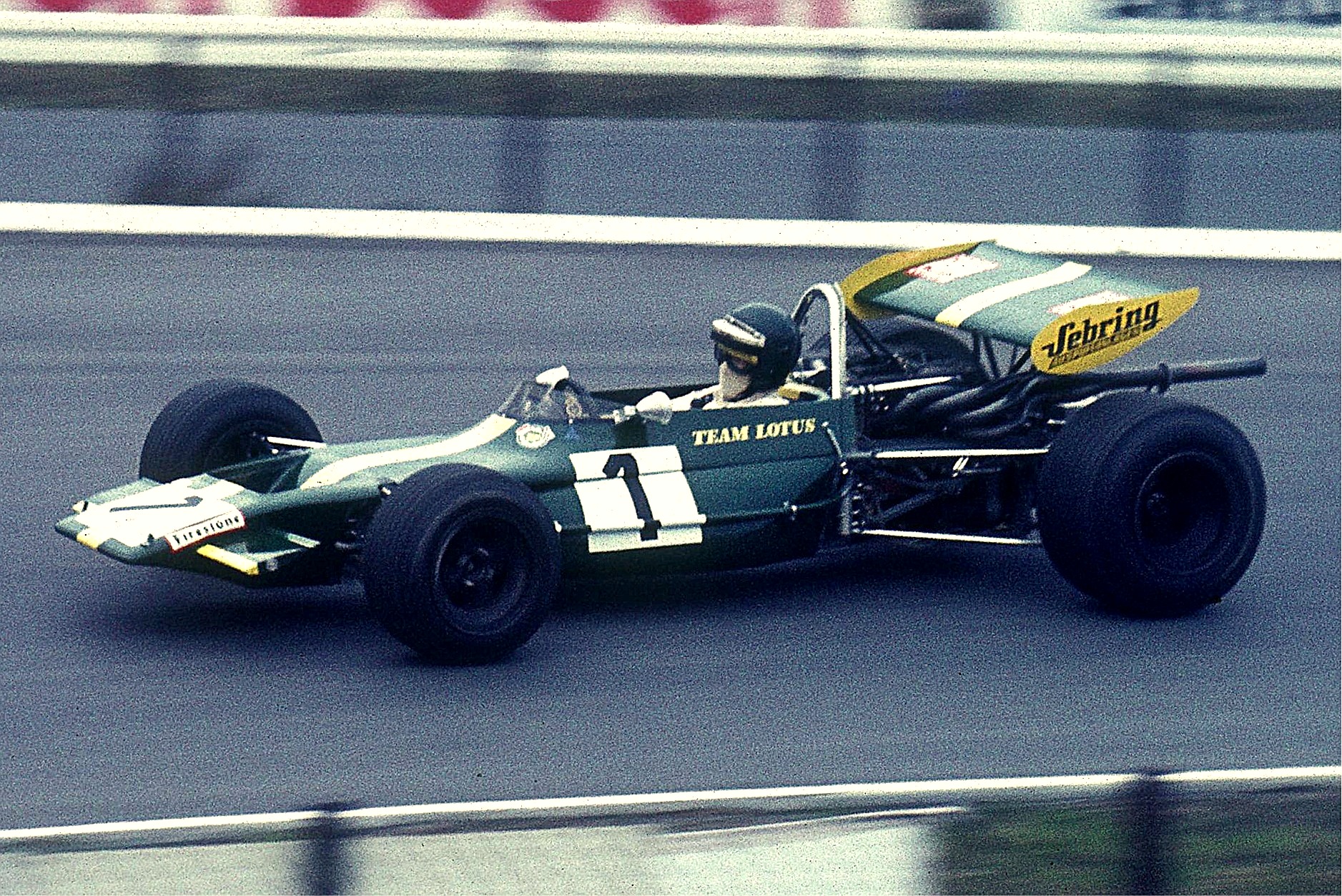
[edit]For 1967, the FIA increased the maximum engine capacity to 1600cc.[2] With the "return to power" of Formula One the gap between Formula One and Formula Two was felt to be too wide, and the introduction of new 1600cc production-based engine regulations for Formula Two restored the category to its intended role as a feeder series for Formula One. The FIA also introduced the European Formula Two Championship in 1967. Ickx, driving a Matra MS5, won the inaugural championship by 11 points from the Australian, Frank Gardner.
The most popular 1600cc engine was the Cosworth FVA, the sixteen-valve head on a four-cylinder Cortina block that was effectively the "proof of concept" for the legendary DFV. The 1967 FVA gave 220 bhp (160 kW; 220 PS) at 9000 rpm. Other units also appeared, including a four-cylinder BMW and a V6 Dino Ferrari.
Nevertheless, many Formula One drivers continued to drive the smaller and lighter cars on non-championship weekends, and some Grand Prix grids (notably in Germany, where the long circuit at the Nürburgring could cope with large entries) would be a mix of Formula One and Formula Two cars. Jacky Ickx made his Grand Prix debut at the Nürburgring in a Formula Two car in 1966. The following year Ickx qualified with the third fastest time overall but was forced to start behind the slower Formula One cars. Ickx quickly forced his way back into a points position, only to be forced to retire with broken suspension. Jim Clark, regarded as one of the greatest race drivers of all time, was killed in a Formula Two race early in 1968, at the Hockenheimring. A year later Gerhard Mitter was killed at the Nürburgring while practising for the 1969 German Grand Prix in a Formula Two car.
The "invasion" of Formula One drivers in Formula Two ranks (a situation similar to that of buschwhacking in modern-day NASCAR) was permitted because of the unique grading system used. Any driver with an A grading was not permitted to score championship points. A driver gained an A rating via various means which changed somewhat over the years, such as finishing in the points in two Grand Prix events or the top three in two World Sports Car events. The annual Formula Two champion was also granted an A rating for one year, and a Formula One World Champion was A graded for five. This system permitted less experienced drivers to work towards the championship and forward their careers, while allowing senior drivers to keep their hand in during the long breaks between Grands Prix of the time.
In the early years of the 1600cc formula, Brabham and Lotus were the most numerous constructors, although Ferrari intermittently entered a works team, as did BMW (with Lola and Dornier-built chassis). A number of smaller constructors such as Matra and Tecno were successful. Chevron also provided cars. The French firm Matra won the three first editions of the European championship, with Tecno winning the fourth.

2.0-litre era (1972–1984)
[edit]In 1972, the formula was changed to increase power by permitting 2.0 L production-based engines—Cosworth BDs and BMW four-cylinder engines dominated the early years, with BMW-powered Marches gradually establishing dominance. For 1976, engines developed purely for racing were permitted to compete, with Renault developing a particularly potent V6; allied to a sponsorship scheme from oil company Elf the formula was briefly dominated by French teams and drivers; BMW started to back a works March team and raised the stakes in the late-Seventies. Even the Ferrari engine returned briefly with minimal success. The Hart 420R (ultimately derived from the Cosworth BDA) was briefly successful in Marches and Team Surtees won the European F2 Championship in 1972 with Hart engines, driver Mike Hailwood, but most notably in the works Toleman team's cars. Dominant chassis of this era were generally from March and Ralt, with Chevron, the French Elf and Martinis and German Maurers being briefly successful.
Honda returned to Formula Two in the early 1980s with a powerful V6, but this was very much a works engine and the cost of competing with the works Ralt-Honda team became prohibitive. As a result, grids diminished in size and declining interest in the series threatened it with extinction.
Superseded
[edit]After the 1984 season, the FIA replaced Formula Two with the newly created Formula 3000 category, which was designed to cut the cost of competition. The initial regulations joined F2-style chassis with the naturally aspirated 3000 cc Cosworth DFV V8 engines, that were by then obsolete in the all-turbocharged Formula One. The premier series was the FIA Formula 3000 International Championship, though a number of other championships were also run to Formula 3000 regulations.
Revival (2009–2012)
[edit]
Following an absence of 25 years, a Formula Two championship was re-established by the FIA in 2009.[3] Unlike the previous incarnation, the FIA Formula Two Championship was a one make series, with the competitors all using the same chassis and engine. Jonathan Palmer's MotorSport Vision company managed the championship and also operated and maintained the cars on behalf of the drivers.[4] There were no teams in the championship – unlike other professional motorsport series each driver instead worked with engineers supplied by MotorSport Vision. The cars were designed by Williams Grand Prix Engineering, and were powered by a 1.8L turbocharged Audi engine developed by Mountune Racing, with 480 brake horsepower (358 kW; 487 PS). The cars fell between Formula One and Formula Three in performance, and cost each driver £195,000 for a season.[5]
The 2009 championship comprised eight events in Europe between the months of May and November. There were two races per weekend – each 110 km long (around 40 minutes). Two 30-minute practice sessions and two 30-minute qualifying sessions preceded both races.[6] The inaugural championship was won by Andy Soucek although was marred by the death of Henry Surtees during the fourth round at Brands Hatch.[7]
The series was discontinued by the FIA and MSV after the 2012 season.[8] The championship had struggled to attract enough drivers in the final year, with the single team concept proving to be unpopular compared to championships run on a more conventional basis.[9] Despite being marketed as a feeder series for Formula One, the competing GP2 and Formula Renault 3.5 series had significantly more powerful cars,[9] and no Formula Two driver had managed to progress to a Formula One team until Jolyon Palmer in 2016 with Renault Sport F1 Team.
Second revival (2017)
[edit]In 2015, the FIA announced plans to overhaul the Super Licence system, streamlining the qualification criteria and weighting the various feeder series to allow drivers a more linear progress system. Included with this were plans for a revival of the Formula Two category, which was given priority over all other categories of competition. Further details were published by the World Motorsport Council, revealing plans to model the new Formula Two championship along the same lines as the revived European Formula 3 Championship and the newly introduced Formula 4 category.[10] The series will be a part of the FIA Global Pathway.
Rather than reviving the series by creating a new one where none had previously existed, the FIA chose to rebrand the GP2 Series as the FIA Formula 2 Championship in early 2017. However, like the series that lasted from 2009 to 2012, there has been a fatality, that being Frenchman Anthoine Hubert who was killed at the 2019 Spa-Francorchamps round after being struck by Juan Manuel Correa at a near-90° angle. Since the inception of FIA Formula 2, drivers to have graduated to F1 include Charles Leclerc, George Russell, Oscar Piastri and Gabriel Bortoleto. All eleven teams run the Dallara F2 2024 chassis, powered by a Mecachrome engine.
Other Formula Two series
[edit]Soviet Formula 2 Championship
[edit]The Central Automotoclub of the USSR (CAMK) joined the FIA in October 1956, aiming to develop Soviet motorsport after seeing international races like the British F1 GP. In 1959, CAMK introduced a new classification system for racing cars in the USSR. However, F2 cars were not part of the 1960 Soviet motorsport championship because there were no suitable stock engines available, and the Soviet Union did not produce specialized racing engines at that time. Consequently, it wasn't until 1962 that the F2 category made its debut in Soviet autosport championships. Two years later, updated F2 regulations were introduced. It wasn't until 1971 that F2 cars started to regularly appear on Soviet tracks, and F2 series were included in Soviet motorsport championships until 1977.[11]
Japanese Formula Two
[edit]Prior to the Formula Nippon, during the 1.6 L 1967–1971 era, a Formula 2 series championship existed in Japan. Japanese teams were building their own cars and engines. As for races ran in Europe, the series was simply called Formula 2. Amongst the makes, the best known was the Mitsubishi Colt. Cars raced with parallel FIA rules, using 1600 cc displacement engines, from 1967 to 1970.
Japan ran a series known as "Japanese Formula 2000 championship" to rules similar to two-litre F2 between 1973 and 1977. Production-based single-cam engines were permitted to run at 2.4 L, but they soon came into line with FIA rules in the mid-1970s. The Japanese Formula 2 championship ran between 1978 and 1986, before Japan too adopted a set of regulations very similar to F3000 rules, with the series being known as Japanese Formula 3000 from 1987. The series is now known as Super Formula, after using the name Formula Nippon from 1996 to 2012. Japan also ran a series for full-bodied versions of F2 cars called Fuji Grand Champion Series—somewhat akin to the F5000-based revival of Can-Am.
Australian Formula 2
[edit]Australia has had its own Australian Formula 2 category since 1964.[12] From 1978, the formula has specified that cars be powered by a production-based single-cam engine with a capacity between 1100 cc and 1600 cc.[13] Induction must be by means of carburettor/s, the engine must be naturally aspirated and an 8500 rpm rev limit is applied.[14]
An Australian Formula 2 Championship was sanctioned by the Confederation of Australian Motor Sport in the years from 1964 to 1965, from 1969 to 1977 and from 1979 to 1988.[15]
Mexican Formula Two
[edit]Mexico ran its own Formula Two series (previously known as Formula K) for 12 years in the early 1990s. The cars were similar to Formula Atlantic vehicles, fitted with 2.2 L Chrysler engines.
British Formula Two
[edit]Formula Two racing was popular in the United Kingdom in the late 1940s and early 1950s. During the 2.0 litre engine era, HWM, Connaught and Cooper were among the constructors who built cars for the class, usually powered by Bristol. When F2 was brought back in 1.5 litre form in 1956, Cooper and Lotus were the first to build cars to the new specification, taking advantage of the availability of Coventry Climax engines.
Championships were held from 1956 to 1960, 1964 to 1967 and again in 1972.[16] Stirling Moss,[17] Jack Brabham, Jim Clark and Niki Lauda won titles.
The British Formula 3000 series was briefly known as "Formula Two" in an attempt to make its status more apparent to casual spectators. However, the series was in terminal decline and the change of name did not help. At one point the use of 4.2 L TVR engines cars in F3000 chassis was discussed as a possible British F2, but this did not materialise.
Trophées de France
[edit]Prior to formation of the European Championship, France held its own championship between 1964 and 1967. Despite only running for four seasons, the Brabham marque won three titles, with the drivers title going to Jack Brabham (twice), Jim Clark and Jochen Rindt. Races were held at Pau, Clermont-Ferrand and Reims.
However once the European Championship had successfully completed its first season, the French version was abandoned.
Formula Two champions
[edit]


See also
[edit]References
[edit]- ^ Autocourse Review of International Motor Sport 1960 Part Two. 1961. pp. 110–122.
- ^ Formula 2 (1967–1984) Retrieved from www.oldracingcars.com on 1 February 2011
- ^ "World Motor Sport Council – Decisions". Fédération Internationale de l'Automobile. 25 June 2008. Archived from the original on 28 June 2008. Retrieved 22 January 2015.
- ^ "Palmer's MSV wins F2 contract". ITV-F1.com. ITV Sport. 15 September 2008. Archived from the original on 24 July 2009. Retrieved 22 January 2015.
- ^ Butcher, Lawrence (3 December 2008). "F2: A closer look". Racecar Engineering. Chelsea Magazines. Archived from the original on 7 December 2008. Retrieved 22 January 2015.
- ^ "How Formula 2 can work". grandprix.com. 18 July 2008.
- ^ "Henry Surtees dies after F2 crash". Autosport. Haymarket Media. 19 July 2009.
- ^ Elizalde, Pablo (6 December 2012). "MotorSport Vision cancels Formula 2 championship". Autosport.com. Haymarket Media. Retrieved 24 January 2015.
- ^ a b "Formula 2 cancelled for 2013". ESPN F1. ESPN. 7 December 2012. Retrieved 24 January 2015.
- ^ "FIA begins work on new Formula 2 feeder category for Formula 1". autosport.com. Archived from the original on 2016-03-03. Retrieved 2015-03-21.
- ^ "Soviet Formula 2". teamdan.com. Archived from the original on 13 October 2018. Retrieved 1 July 2023.
- ^ Racing Car News, December 1963, page 23
- ^ Pedr Davis, The Macquarie Dictionary of Motoring, 1986, page 172
- ^ Specifications of Automobiles – Australia Formula 2 Archived 2009-08-06 at the Wayback Machine Retrieved from www.camsmanual.com.au on 2 August 2009
- ^ Australian Titles Archived 2009-03-02 at the Wayback Machine Retrieved from www.camsmanual.com.au on 2 August 2009
- ^ "British F1, F2, F3000, F5000 & F.Atlantic – 1957–1994". speedfreaks.org.
- ^ Romito, Alessio (2020-08-07). "The story of Stirling Moss' participation in the first ever F1 race weekend". www.insideF2.com. Retrieved 2021-12-28.
Further reading
[edit]- A Record of Grand Prix and Voiturette racing Volume 9 1970-1973 Paul Sheldon ISBN 0-9526050-0-7
- A Record of Grand Prix and Voiturette racing Volume 10 1974-1978 Paul Sheldon.
External links
[edit]Formula Two
View on GrokipediaOverview
Definition and role in motorsport
Formula Two (F2), officially known as the FIA Formula 2 Championship, is an open-wheel, single-seater motor racing category sanctioned by the Fédération Internationale de l'Automobile (FIA). It features high-performance cars designed exclusively for circuit racing, emphasizing speed, agility, and driver skill in a controlled technical environment.[7] Positioned as the primary feeder series to Formula One (F1), F2 serves as the immediate stepping stone below the pinnacle of motorsport, above entry-level categories like Formula Three. Historically, it was created to offer emerging drivers a competitive platform with reduced costs and technical demands compared to F1, fostering talent development without the financial barriers of the top tier. Today, it functions as a proving ground for drivers, teams, and innovative technologies, where participants hone skills essential for professional racing careers.[5][8] A core aspect of F2's role is providing direct pathways to F1 through the FIA Super Licence system, where strong performances earn points toward the 40 required for an F1 seat. For instance, the top three finishers in the F2 championship receive 40 Super Licence points each, making it a critical arena for aspiring F1 drivers to qualify. This structure ensures F2 remains integral to the motorsport ecosystem, bridging junior formulae and the elite level.[9] Key characteristics of F2 include its spec-series format, utilizing a fixed chassis supplier—Dallara Automobili for the current generation introduced in 2024—and standardized engines, such as the 3.4-liter turbocharged V6 units assembled by Mecachrome. These elements promote parity among the 22 identical cars fielded by 11 teams, shifting focus to driver and team strategy. The championship follows a global calendar, primarily as support events alongside F1 and Formula 3 races, enhancing visibility and competitive intensity.[5]Evolution and relation to Formula One
The Fédération Internationale de l'Automobile (FIA) conceived Formula Two in October 1947 as a category positioned directly below Formula One, designed to succeed the pre-war voiturette formulae and address post-World War II economic challenges by offering a more accessible racing platform with 2.0-litre naturally aspirated engines.[10] This initial framework, sometimes referred to as Formula B, aimed to stimulate manufacturer participation and driver development without the high costs associated with Formula One's supercharged powerplants.[1] Formula Two's technical specifications evolved closely alongside Formula One to preserve its feeder role and facilitate technology transfer. In 1957, engine displacement was reduced to 1.5 litres to create a clearer performance differential from Formula One while enabling teams to repurpose surplus Formula One components affordably.[1] Later adjustments, including a return to 2.0-litre production-derived engines in 1972, further synchronized the categories, allowing Formula Two cars to incorporate Formula One-inspired chassis and aerodynamic advancements in a controlled, cost-capped environment.[11] Integration with Formula One has been a cornerstone of Formula Two's structure, with races traditionally scheduled as support events on Formula One Grand Prix weekends to immerse young drivers in high-level operations.[8] During the early 1950s, economic pressures led the Formula One World Championship to adopt Formula Two regulations outright for several seasons, blurring the lines between the series and emphasizing their mutual dependence.[1] In later eras, mandatory Formula Two participation became a de facto requirement for Formula One rookies seeking experience in competitive single-seaters. In the modern era, Formula Two's ties to Formula One are fortified by the FIA Super Licence system, introduced in 2016 and refined thereafter, which awards the bulk of qualification points for Formula Two results—requiring drivers to accumulate at least 40 points over three years, often necessitating strong performances in the series.[12] Since the FIA Formula 2 Championship's 2017 relaunch, it has served as the premier talent pipeline, with 21 graduates advancing to Formula One grids and shared event weekends ensuring regulatory alignment under FIA oversight.[13]History
Pre-war origins
The origins of Formula Two trace back to the interwar period in European motorsport, particularly the 1920s and 1930s, when Grand Prix racing evolved to include a supporting class known as the voiturette category. These were smaller, lighter racing cars designed as a more accessible alternative to the dominant full-sized Grand Prix machines, often featuring supercharged engines limited to around 1.5 liters in displacement, such as those in the Maserati 4CM or ERA Type A models. This class emerged from earlier cyclecar and lightweight racing trends post-World War I, providing a platform for emerging manufacturers and drivers to compete without the immense costs of unlimited Grand Prix entries.[14] Throughout the 1930s, voiturette races gained prominence as informal junior formulae, serving as a talent feeder to the elite Grand Prix scene dominated by German marques like Mercedes-Benz and Auto Union. Key events included support races at established circuits, such as the voiturette class at the Pau Grand Prix, where 1.5-liter cars raced on street circuits, showcasing intense competition among privateers and works teams. Figures like Enzo Ferrari played a pivotal role through his management of Alfa Romeo's Scuderia Ferrari, which developed influential voiturette racers like the 1938 Alfetta 158, a 1.5-liter V8 that blurred the lines between junior and senior formulae and helped transition the category toward modern single-seater standards. These races operated without unified international governance, relying on ad hoc regulations from national clubs under the AIACR (the predecessor to the FIA), emphasizing small-displacement machinery to encourage broad participation.[15][16] Lacking a formal championship or points system, the voiturette era functioned as a de facto stepping stone for drivers like Tazio Nuvolari and Rudolf Caracciola, who honed skills before advancing to Grand Prix victories. By the late 1930s, the class's 1.5-liter formula had become so competitive that it effectively supplanted the larger GP cars under the 1938 AIACR regulations, setting the stage for post-war standardization. The disruption of World War II halted these developments, but the 1946 reorganization of the AIACR into the FIA directly drew upon the voiturette legacy to establish official Formula One and Formula Two categories, with F2 adopting similar engine limits to revive the junior role.[14][17]Post-war establishment (1948–1956)
In October 1947, the predecessor to the Fédération Internationale de l'Automobile (FIA) established Formula Two—initially designated as Formula B—alongside Formula One, stipulating engine capacities of up to 2.0 litres naturally aspirated or 0.5 litres supercharged to encourage broader manufacturer participation and create a more cost-effective international racing category.[10] The 1948 season marked Formula Two's formal launch, comprising seven major rounds across Europe that highlighted the category's potential despite its nascent status. The opening event, the Grand Prix du Roussillon at Perpignan on 25 April, was won by Maurice Trintignant in a Gordini-Simca, setting a precedent for competitive racing under the new rules.[10] Subsequent key races included the Geneva Grand Prix on 2 May, the Rome Grand Prix on 16 May, and the Bari Grand Prix on 6 September, where Scuderia Ferrari debuted its 166 F2 chassis.[18] British venues played a pivotal role early on, with Goodwood hosting its inaugural motor race on 18 September—a Formula Libre event that incorporated F2 machinery—and Silverstone emerging as a hub for domestic F2 activity on converted RAF runways.[19] Formula Two's initial years were hampered by low entry numbers, often resulting in fields of fewer than 20 cars per event, which underscored the category's struggle for widespread adoption outside Europe and prompted heavy reliance on British-organized races for viability.[10] Emerging talents began to shine amid these constraints; Stirling Moss made his Formula Two debut in 1950 with the HWM team, rapidly proving his skill in international competition and attracting interest from manufacturers like Ferrari after impressive performances that rivaled established stars such as Giuseppe Farina.[20] Regulatory adjustments in 1950 briefly experimented with more flexible engine interpretations for Formula One, but Formula Two's specifications stabilized at the 2.0-litre limit to maintain its distinct identity as a developmental series.[21] This era's framework proved instrumental, as the FIA adopted Formula Two rules for the World Championship in 1952–1953 due to a scarcity of Formula One entrants following Alfa Romeo's exit, with Alberto Ascari dominating all six rounds in 1952 aboard a Ferrari 500.[10] By 1954, Formula One reverted to a 2.5-litre formula, allowing Formula Two to refocus on its core role through 1956.1.5-litre era (1957–1960)
In 1957, the FIA introduced a new Formula Two formula limiting engines to 1.5 litres naturally aspirated, with a maximum of six cylinders, as a means to standardize specifications ahead of Formula One's shift to the same displacement in 1961 and to help control escalating speeds and development costs in the junior category.[22][23] This regulation change promoted smaller, more accessible powerplants, prominently featuring the Coventry Climax FPF four-cylinder engine, which produced around 140 horsepower and became the benchmark for reliability and performance in the class.[24] The adoption of these engines by British constructors like Cooper marked a pivotal step in making Formula Two a cost-effective proving ground for technology that would soon transition to the top tier.[25] The seasons from 1957 to 1960 were overwhelmingly dominated by Cooper chassis, which secured all British Formula Two titles during this period and highlighted the category's competitive intensity through national and international events. In 1957, Tony Marsh claimed the British championship driving a Marsh-prepared Cooper-Climax.[26] Jack Brabham followed in 1958 with a works Cooper-Climax, leveraging the car's superior handling.[26] Stirling Moss won the 1959 title in a Rob Walker-entered Cooper-Borgward, showcasing the viability of alternative engines like the German flat-four.[26] The era concluded in 1960 with Jack Lewis taking the crown in an H&L Special/Alan Brown Cooper-Climax, underscoring Cooper's unchallenged supremacy across four seasons.[26] This period accelerated the shift toward rear-engine layouts in open-wheel racing, with Cooper's T43 model of 1957 pioneering the configuration in Formula Two and influencing broader adoption due to improved weight distribution and traction.[25] The formula also saw growing international engagement, particularly from European manufacturers like Porsche, whose 718 RSK models challenged British dominance in continental races and fostered a more diverse grid.[22] By 1960, Formula Two began to wane as the newly established Formula Junior category, introduced in 1958 with even smaller 1.1-litre engines, gained traction as a more affordable training series, drawing away privateers and overlapping with Formula Two's role in driver development.[27] This overlap contributed to reduced entries and events, setting the stage for Formula Two's temporary evolution into a 1.0-litre specification intertwined with Junior regulations.[1]1.0-litre era and Formula Junior overlap (1961–1966)
In 1961, the FIA reduced the Formula Two engine capacity limit to 1.0 litre, aligning it closely with the specifications of Formula Junior, which had emerged as an affordable entry-level category using production-based 1.0-litre push-rod engines.[28] This change aimed to control costs following the 1.5-litre era's emphasis on affordability, but it effectively sidelined official Formula Two events, as Formula Junior rapidly filled the void with its lower barriers to entry and widespread adoption across Europe and North America.[1] Formula Junior's chassis designs were simple and lightweight, often derived from scaled-down Formula One concepts, making it an unofficial equivalent to Formula Two for nurturing young talent while keeping expenses low through standardized production engines.[28] During the overlap period from 1961 to 1963, Formula Junior overshadowed Formula Two in popularity, attracting hundreds of entrants per season due to its accessibility and role as a direct feeder to Formula One.[27] Prominent juniors like John Love secured multiple victories in 1962, including at Roskilde Ring, Magny-Cours, and Karlskoga, highlighting the category's appeal for emerging drivers seeking competitive experience without the higher costs of purpose-built racing engines.[29] Meanwhile, the limited Formula Two activity served primarily as a testing ground for Formula One teams, with 1.0-litre cars providing a platform for engine development and driver evaluation under similar displacement constraints to the junior formula.[1] Formula Two revived in 1964 following the FIA's decision to phase out Formula Junior at the end of 1963, introducing a new 1.0-litre specification that permitted four-cylinder, naturally aspirated engines up to 1,000 cc without superchargers and a minimum weight of 420 kg.[28] Constructors Lotus and Brabham quickly dominated, with Lotus's Type 32—evolved from its Formula Junior designs—securing strong results through agile chassis and Cosworth SCA engines producing around 116 bhp.[30] Brabham's BT10 and subsequent BT16 models similarly excelled, powering drivers like Mike Spence to the 1964 British Formula Two title.[30] By 1966, Jacky Ickx clinched the European Formula Two championship in a Matra MS5, underscoring the category's role in launching top talents amid intense manufacturer rivalry.[31] Although Formula Two regained its status as the primary junior series post-1964, grids remained small—often under 20 cars—due to the 1.0-litre engines' modest power output compared to the 1.5-litre Formula One machinery, limiting its appeal until further regulatory adjustments.[1] This era marked a transitional phase, bridging the cost-focused innovations of Formula Junior with the more specialized racing of subsequent Formula Two developments.[28]1.6-litre era with driver grading (1967–1971)
In 1967, the FIA increased the Formula Two engine capacity limit from 1.0 litre to 1.6 litres to address the low power outputs of the previous era and align with the "return to power" philosophy in Formula One, while introducing the European Formula Two Championship as a structured series.[32] This change also implemented a driver grading system, classifying participants into categories such as A (top professionals, including Formula One regulars), B, and C licenses, with graded A-drivers ineligible to score championship points to promote opportunities for emerging talents and balance the fields against established stars.[33] The regulations aimed to foster competition by limiting professional dominance, allowing non-graded drivers to vie for titles while still permitting graded drivers to participate in races for experience or team support.[22] The 1.6-litre formula quickly saw the dominance of the Ford Cosworth FVA engine, a 1.6-litre four-cylinder unit producing around 200 horsepower, which powered the majority of competitive cars and contributed to victories in most championships from 1967 to 1971, except 1970 when alternatives like the BMW 1.6-liter engine briefly challenged.[34] Notable successes included Jacky Ickx's 1967 title in a Matra MS5-FVA, Jean-Pierre Beltoise's 1968 win with a Matra MS7-FVA, Johnny Servoz-Gavin's 1969 championship in another Matra-FVA, Clay Regazzoni's 1970 triumph in a Tecno-Ford, and Ronnie Peterson's 1971 victory driving a March 712M-FVA.[35] Key events, such as the rounds at Brands Hatch, showcased intense racing with fields often exceeding 20 cars, where drivers like Jochen Rindt—despite being graded and thus point-ineligible—secured multiple wins, including five in 1967.[32] The driver grading system significantly impacted the series by restricting top professionals, enabling amateurs and rising stars to gain visibility and championship contention, which boosted careers such as that of Jackie Stewart, who, as a graded driver, won races like the 1967 Pau Grand Prix but focused on development rather than points.[22] This approach helped nurture talents transitioning to Formula One, with non-graded drivers like Peterson benefiting from more equitable scoring opportunities. By 1971, however, the era faced challenges with gradually declining race entries, partly due to increasing costs and the impending shift to unrestricted 2.0-litre engines, marking the final season before the formula's evolution.[36]2.0-litre era (1972–1984)
The 2.0-litre era of Formula Two, spanning from 1972 to 1984, marked a significant evolution in the category's technical and competitive landscape, emphasizing professional racing with enhanced power outputs. In 1972, the FIA revised the regulations to increase the engine displacement limit from 1.6 litres to 2.0 litres, requiring engines to be production-based with a minimum production run of 1,000 units to maintain accessibility and cost control.[37][11] This shift built on the driver grading system from the prior 1.6-litre period, which continued to restrict championship points to non-graded drivers while permitting graded professionals—such as established Formula One talents—to participate in full fields, fostering intense and diverse grids without dominating the title hunt.[38] The era saw the European Formula Two Championship expand internationally, incorporating challenging venues like the Nürburgring Nordschleife for events such as the 1973 Eifelrennen, which added prestige and tested driver skills on demanding public roads.[39] Chassis and engine manufacturers thrived during this period, with March Engineering emerging as a dominant force through models like the 722 and 732, securing multiple constructors' successes and powering drivers to victory. BMW's M12 inline-four engine, derived from the production M10 block but tuned for racing, became a benchmark for reliability and performance, propelling March and other chassis to numerous wins and championships starting in 1973.[22][40] Prominent drivers exemplified the era's competitiveness; for instance, Jochen Mass achieved a strong runner-up finish in 1973 with a Surtees TS15 equipped with a Hart Ford BDA engine, highlighting the blend of emerging talent and veteran presence.[41] Champions like Mike Hailwood in 1972 aboard a Surtees TS10 and Jean-Pierre Jarier in 1973 with a March-BMW underscored the category's role as a vital stepping stone to Formula One, with many title winners progressing to grand prix success.[35] Midway through the era, regulatory changes in 1976 further professionalized the series by permitting pure racing engines untethered from strict production requirements, boosting power outputs beyond 300 horsepower and intensifying on-track battles.[22] Renault's introduction of its 2.0-litre V6 engine in Alpine-Renault chassis marked early experiments with advanced designs, though turbocharging remained limited until later F1 crossovers; these developments, including BMW's refined M12/7 variant, elevated performance while keeping costs manageable compared to the top formula.[42] Into the 1980s, economic growth and influx of sponsorship—particularly from tobacco and automotive brands—fueled larger teams and grids, with constructors like Ralt and Lola joining March in dominating, as seen in Bruno Giacomelli's back-to-back titles in 1977 and 1978 using a March 772-BMW.[22] The era peaked in competitiveness by 1984, with the championship featuring up to 11 high-stakes rounds across Europe, drawing fields of over 30 cars and showcasing intense rivalries among drivers like Mike Thackwell, who clinched the final title in a Ralt RT3-Honda.[43] However, escalating costs and the rising popularity of Formula Three in Europe began eroding F2's dominance as a feeder series, while the impending launch of Formula 3000 loomed as a standardized successor.[44] Despite these pressures, the 2.0-litre period solidified Formula Two's legacy as a proving ground for future stars, including Alain Prost and Keke Rosberg, who honed their skills amid this golden age of open-wheel development.[35]Decline and supersession (1985–2008)
The European Formula Two Championship concluded its final race on September 23, 1984, at Brands Hatch, where heavy rain forced an early stop after 31 of 50 laps, with Philippe Streiff winning for the AGS team.[44] Escalating costs during the 2.0-litre era had driven up expenses for teams and engines, leading to sponsor reluctance and diminished media coverage, while small crowds further eroded viability.[45] Grids became increasingly fragmented and uncompetitive, marked by dominance from Ralt-Honda entries and limited variety, such as only six March-BMW cars in the finale.[44] Concurrently, Formula Three's rise as a direct feeder to Formula One—exemplified by drivers like Alain Prost and Ayrton Senna bypassing F2 entirely—diminished F2's relevance as an intermediate step.[44] In response to these challenges, the FIA decided in 1985 to supersede Formula Two with the new Formula 3000 category, aimed at controlling costs through standardization and utilizing redundant Cosworth DFV engines from Formula One.[45] The series mandated 3-litre normally aspirated V8 engines limited to 9,000 rpm, with all teams initially using Cosworth units, alongside rules for standardized wings and tyres to balance performance and reduce development expenses.[45] This initiative, driven by FOCA president Bernie Ecclestone, positioned F3000 as a more affordable bridge from F3 to F1, complete with a $100,000 prize fund per race to incentivize participation.[45][44] From 1985 to 2008, no official FIA-sanctioned Formula Two series existed, creating a hiatus during which its legacy persisted through de facto successors: Formula 3000 from 1985 to 2004, followed by GP2 from 2005 to 2016.[46] Minor non-FIA efforts, such as regional or national open-wheel events, occurred sporadically but failed to coalesce into a unified international championship comparable to the original F2.[44]FIA Formula Two revival (2009–2012)
In June 2008, the FIA announced the revival of Formula Two as a low-cost feeder series to Formula One, intended to offer a more affordable alternative to the GP2 Series amid rising costs in junior formulae.[47] The championship was organized by MotorSport Vision (MSV) under FIA sanction, featuring a spec series with identical chassis designed and built by Williams Grand Prix Engineering—the JPH1 model in 2009, upgraded to the JPH1B for 2012—and powered by a 1.8-litre turbocharged four-cylinder Audi engine producing approximately 400 bhp on standard boost and up to 450 bhp with overboost.[48][49][50] The format emphasized driver talent over financial backing, with no private teams involved; MSV and the FIA managed a fleet of 24 cars, assigning them to selected participants based on resumes, prior results, and performance during pre-season evaluation sessions, such as the initial test at Snetterton Circuit in May 2009.[48] Each event weekend included two 45-minute practice sessions, two 30-minute qualifying sessions, and two 40-minute races, held primarily on European circuits with support billing at select Formula One Grands Prix like Silverstone, Spa-Francorchamps, and Monza.[50] The top three championship finishers earned an FIA Super Licence, while the overall winner received an F1 test with Williams, and second and third place secured GP2 tests.[50] The series ran for four seasons, crowning Andy Soucek as the 2009 champion after seven victories, Dean Stoneman in 2010 with six wins, Mirko Bortolotti in 2011, and Luciano Bacheta in 2012.[51][52] Despite its innovative spec format aimed at reducing costs to around €400,000 per season, the championship failed to attract sufficient interest from drivers and sponsors, remaining in the shadow of the more established GP2 Series.[1] In December 2012, MSV promoter Jonathan Palmer announced the series' discontinuation after 2012, citing declining entrant numbers and lack of viability for continuation.[53]Modern FIA Formula 2 Championship (2017–present)
The FIA Formula 2 Championship was launched in 2017 as the official successor to the GP2 Series, rebranded under FIA oversight to serve as the premier feeder category to Formula One.[54] The inaugural season featured 11 teams competing with a standardized specification, including the Dallara GP2/16 chassis and a 4.0-litre naturally aspirated V8 Mecachrome engine producing approximately 600 horsepower.[55] This setup emphasized cost control and parity, with all entrants using Pirelli tires, aligning the series closely with Formula One's developmental pathway.[5] The race format consists of a sprint race and a feature race per weekend, designed to promote close competition and overtaking opportunities. The sprint race grid is set by reversing the top 10 qualifying positions from Friday practice, while the feature race follows the full qualifying order, with mandatory pit stops for tire changes in the longer event.[5] Drag Reduction System (DRS) has been available since the GP2 era, continuing into F2 to aid passing within designated zones after the initial laps.[55] In 2024, Pirelli introduced Forest Stewardship Council (FSC)-certified tires across Formula One support series, including F2, to enhance sustainability by ensuring natural rubber sourcing meets environmental and social standards.[56] The 2017 season marked a dominant debut for Charles Leclerc, who secured the drivers' championship with seven wins and eight pole positions driving for Prema Racing, clinching the title with three rounds remaining.[57] More recent champions include Gabriel Bortoleto in 2024 with Invicta Racing, who secured the title with consistent podiums and progressed to Formula One. By 2025, the championship had expanded to 14 rounds, all integrated as support events on the Formula One calendar, spanning 13 countries and featuring 28 races to maximize exposure and logistical efficiency.[58] This alignment facilitates shared facilities and promotes talent progression, with F2 weekends typically including free practice, qualifying, and the dual-race structure alongside F1 activities.[59] The COVID-19 pandemic significantly disrupted the 2020 and 2021 seasons, forcing a complete overhaul of schedules to prioritize health protocols and regional travel restrictions. In 2020, the original 12-round calendar was condensed to eight European double-headers starting in July at the Red Bull Ring, omitting the Bahrain opener and international venues to contain costs and risks.[60] The 2021 season adopted a split calendar with Formula 3, reducing rounds to eight while introducing three races per weekend across all events to offset financial pressures on teams, with the Bahrain round postponed but ultimately held as a season finale.[61] Recent developments include a shift to 100% advanced sustainable fuels in 2025, derived from bio-sourced waste to reduce carbon emissions without compromising performance.[62] Diversity efforts align with FIA core values, emphasizing inclusivity through programs like the FIA Girls on Track initiative to encourage female participation and broader access to the series.[63]Regulations
Technical specifications
The technical specifications of the FIA Formula 2 Championship are designed to create a cost-effective, high-performance feeder series to Formula 1, with standardized components ensuring parity among competitors while emphasizing engineering innovation within defined limits. Since its modern revival in 2017, the series has mandated a spec chassis and powertrain to control costs and development, evolving from the earlier 2.0-litre naturally aspirated engines of the 1972–1984 era to a more advanced turbocharged setup. These regulations, outlined in the FIA's technical rules, prioritize safety, sustainability, and performance consistency, with updates in 2024 introducing enhanced aerodynamics and safety features aligned with Formula 1 standards.[64][65] The chassis is a mandatory Dallara F2 2018 model, updated for the 2024 season to the Dallara F2 2024 specification, constructed as a carbon fiber monocoque survival cell with an aluminum honeycomb structure and Zylon anti-intrusion panels for enhanced crash protection. This design measures 5285 mm in length, 1900 mm in width, and 3135 mm in wheelbase, incorporating full FIA Formula 1 2024 safety standards, including a titanium halo device mounted above the cockpit. The minimum weight of the car, including the driver with racing apparel but excluding fuel, is 788 kg (as of 2025), which must be maintained at all times during competitions and tests to ensure fairness and safety.[65][64][66][7] Power is provided by a standardized 3.4-litre V6 turbocharged internal combustion engine supplied by Mecachrome, delivering 620 hp at 8750 rpm and a maximum torque of 570 Nm at 6000 rpm, with fuel sourced from Aramco's 100% advanced sustainable blend limited to 125 litres per race.[64][67][65][62] The engine operates under strict homologation rules, prohibiting modifications except by the supplier, and includes a mandatory rebuild after 8000 km of usage to balance reliability and cost. This setup accelerates the car from 0 to 100 km/h in 2.9 seconds and achieves top speeds exceeding 320 km/h on straights, emphasizing turbo efficiency over raw power.[64][67][65] Aerodynamics feature fixed-specification carbon fiber front and rear wings designed by Dallara, with limited adjustability as per the supplier manual to maintain competitive equality, complemented by a Drag Reduction System (DRS) for overtaking that hydraulically adjusts the rear wing flap. Ground effect is regulated through a mandatory plank assembly at the car's reference plane (Z=0), measuring 5 mm thick to control ride height and prevent excessive downforce generation, while the halo integrates with aerodynamic fairings for minimal drag penalty. These elements produce balanced downforce levels suitable for the series' intermediate tracks, prioritizing driver skill over extreme aero dependency.[65][64] Electronics are governed by a single standardized Marelli ECU, sealed and non-modifiable, which manages engine mapping, data logging, and telemetry without allowances for traction control, anti-lock brakes, or launch control to heighten the challenge for drivers. The power unit adheres to lifespan rules, with the ECU and associated fly-by-wire accelerator and paddle-shift gearbox (Marelli electro-hydraulic) designed for durability across multiple events, ensuring all teams operate identical electronic architectures that transmit real-time data to the FIA for compliance verification.[65][64]Sporting rules and safety
The FIA Formula 2 Championship operates under a structured race weekend format designed to simulate Formula 1 conditions while promoting competitive racing. Each event weekend typically includes a 45-minute free practice session on Friday, followed by a 30-minute qualifying session that determines the grid for the feature race based on the fastest lap times.[5] The season comprises 14 rounds (as of 2025), featuring one sprint race and one feature race per round, for a total of 14 sprint and 14 feature races. The sprint race covers approximately 120 km or 45 minutes, whichever comes first, with points awarded to the top eight finishers (10, 8, 6, 5, 4, 3, 2, 1 points); its grid is set by reversing the top 10 qualifying results to encourage close racing among midfield drivers.[68][59] The feature race spans about 170 km or 60 minutes, includes a mandatory pit stop for a full set of tyre changes (unless wet conditions apply), and awards points to the top 10 (25, 18, 15, 12, 10, 8, 6, 4, 2, 1 points), plus 2 points for pole position and 1 point for the fastest lap if the driver finishes in the top 10.[5] Both races use standing starts after a formation lap, with options for pit-lane starts if mechanical issues arise during the pre-race checks.[68] To aid overtaking, the Drag Reduction System (DRS) has been available since the series' inception in 2017, allowing drivers to open a rear-wing flap for increased straight-line speed when within one second of the car ahead in designated zones, typically after the second lap or following a safety car period.[5] Penalties for infractions such as track limits violations, unsafe pit releases, or on-track collisions are enforced by stewards and include reprimands, time penalties (5 or 10 seconds), drive-through penalties, stop-go penalties (10 or 20 seconds), grid position drops, lap time deletions, or disqualifications.[68] Track limits are strictly monitored, with repeated breaches—defined as all four wheels crossing the white line at the track edge—resulting in escalating penalties to maintain fair competition.[68] Championship standings contribute to FIA Super Licence eligibility, with the Formula 2 champion awarded 40 points toward the 40-point threshold required over three seasons for a Formula 1 seat.[9] Safety protocols in Formula 2 align closely with Formula 1 standards, emphasizing driver protection through mandatory equipment and rigorous vehicle testing. The Head and Neck Support (HANS) device is compulsory for all drivers to reduce the risk of basilar skull fractures during impacts.[69] Following the fatal crash of driver Anthoine Hubert in 2019, the FIA implemented post-2020 enhancements including upgraded front and side impact structures, anti-intrusion panels, and a titanium halo system for head protection, with crash tests increased by 30% in deceleration loads for the survival cell.[69] All cars are equipped with FIA-approved accident data recorders to analyze incidents, and scrutineering ensures compliance with these standards at every event.[68] Virtual Safety Car and full Safety Car deployments are standard for neutralizing races during hazardous conditions, further prioritizing participant welfare.[68]Equipment
Chassis and aerodynamics
In the formative years of Formula Two during the 1950s, chassis designs primarily relied on tubular spaceframe constructions, exemplified by Cooper's innovative models such as the T23, which featured a lightweight steel tube frame for enhanced rigidity and handling in open-wheel racing.[70] These spaceframes, often clad in aluminum panels, provided a balance of strength and low weight, allowing cars like the Cooper T45 to dominate F2 events with their compact, driver-centric layout. By the 1970s, the series transitioned to monocoque chassis, with Lotus introducing the groundbreaking Lotus 69 in 1970—a fully integrated aluminum monocoque that improved torsional stiffness and safety while reducing overall weight compared to traditional tube frames.[71] This shift marked a pivotal advancement, enabling better aerodynamic integration and performance under the era's 1.6-litre and later 2.0-litre regulations. Aerodynamic development in Formula Two began modestly in the late 1960s with the adoption of basic wing elements, inspired by early experiments in Formula One, where simple inverted aerofoils were added to generate downforce without excessive drag.[72] Over decades, these evolved into more sophisticated systems; by the modern era, the Drag Reduction System (DRS), introduced to GP2 (F2's predecessor) in 2015 and retained in the FIA Formula 2 Championship, allows drivers to temporarily flatten the rear wing flap within designated zones, reducing drag by up to 25% to facilitate overtaking.[73] The 2024 chassis update further refined aerodynamics with ground-effect underbody designs and an optimized rear diffuser, enhancing downforce efficiency while maintaining close racing dynamics.[74] Since the 2017 revival of the FIA Formula 2 Championship, Dallara has served as the sole chassis supplier, delivering standardized carbon-fiber monocoque structures that prioritize safety, performance, and cost control.[75] The current Dallara F2 2018 model, used from 2018 to 2023, featured a carbon-Kevlar honeycomb bodywork for superior impact absorption and lightweight construction.[76] Updates occur approximately every five to six years; the Dallara F2 2024, introduced for the 2024 season and planned for use until at least 2029, incorporates aerodynamic tweaks for improved efficiency, including a revised floor and diffuser to boost downforce-to-drag ratios without increasing overall weight.[77] Key innovations in recent F2 chassis include the integration of the Halo cockpit protection system in 2018, a titanium structure designed to withstand over 12 tons of impact force, seamlessly incorporated into the carbon monocoque for enhanced driver safety.[78] The wheelbase has been standardized at 3135 mm across all models since the 2018 specification, ensuring consistent handling and setup parity among teams while aligning with broader FIA safety and performance guidelines.[64]Engines and powertrains
The development of engines and powertrains in Formula Two has been shaped by regulatory changes aimed at controlling costs, enhancing performance, and ensuring parity among competitors. In the category's formative years from 1948 to the early 1960s, regulations permitted up to 2.0L naturally aspirated engines, but the Coventry Climax FPF 1.5L inline-4 became the benchmark power unit, delivering around 141 hp at 7,300 rpm through twin Weber carburetors and a robust cast-iron block. This engine powered numerous successful chassis, including those from Cooper and Lotus, contributing to the series' growth as a stepping stone to Grand Prix racing.[79] The 1.6L era from 1967 to 1971 introduced production-block restrictions to curb escalating costs, leading to the dominance of the Cosworth FVA, a 1.6L inline-4 with a 16-valve DOHC head on a Ford Kent block, producing approximately 225 hp at 9,000 rpm. This engine's high-revving nature and reliability made it the choice for most teams, powering drivers like Jochen Rindt to multiple championships and serving as a testbed for Cosworth's V8 designs. Transitioning to the 2.0L period from 1972 to 1984, powertrains shifted to larger production-derived units, with the BMW M12/7—a 2.0L inline-4 based on the M10 block—emerging as a key supplier in the 1980s, offering over 300 hp at more than 9,000 rpm through electronic fuel injection and advanced tuning.[80] The Cosworth BD series also played a prominent role, providing similar outputs in a compact package suited to the era's monocoque chassis. Late in this period, regulations briefly permitted turbocharging with boost limits, though adoption was limited due to reliability concerns and the impending shift to Formula 3000.[81] The FIA's 2009 revival of Formula Two emphasized cost control through a spec series format, utilizing a standardized 1.8L turbocharged Audi inline-4 tuned by Mountune Racing to produce 425 hp, ensuring equal performance across all entries while minimizing development expenses. This approach carried into the modern FIA Formula 2 Championship from 2017 onward, where the Mecachrome V634—a 3.4L V6 turbocharged direct-injection unit—serves as the sole powertrain, rated at 620 hp at 8,750 rpm and 570 Nm of torque at 6,000 rpm, with a mandatory rebuild every 8,000 km to maintain durability. The engine's fly-by-wire throttle and single turbocharger configuration prioritize efficiency and safety, aligning with broader FIA goals to standardize components and reduce barriers for emerging talent.[64]Tyres and other components
In the modern FIA Formula 2 Championship, Pirelli serves as the sole tyre supplier, a role it has held since the series' inception in 2017 following the rebranding from GP2 Series.[82] The tyres feature four dry slick compounds—supersoft (purple sidewall), soft (red), medium (yellow), and hard (white)—with selections varying by circuit to optimize grip and durability based on track characteristics and weather conditions.[83] Since 2020, Formula 2 has utilized 18-inch wheels, aligning with Formula 1's specifications to facilitate driver transition and testing of future technologies, though tyre widths remain narrower than those in the premier series.[82] Wet-weather tyres, also supplied by Pirelli, include intermediates and full wets, with mandatory usage rules during qualifying and races to ensure safety on damp tracks. Braking systems in Formula 2 are highly standardized to maintain competitive parity and control costs. The cars employ 6-piston monobloc Brembo calipers paired with carbon-carbon discs and pads from Carbone Industrie, providing exceptional heat resistance and modulation under high-speed braking demands.[64] Anti-lock braking systems (ABS) are prohibited, a rule consistent with open-wheel racing regulations to emphasize driver skill in managing lock-ups and optimizing stopping distances.[7] Other key components include a standardized 6-speed longitudinal sequential gearbox supplied by Hewland, featuring electro-hydraulic paddle-shift actuation from the steering wheel and a ZF Sachs carbon clutch for rapid, precise gear changes without on-the-fly adjustments.[64] Fuels adhere to a 102 RON unleaded specification provided by Elf, transitioning to advanced sustainable blends: 55% sustainable content from 2023 to 2024, increasing to 100% bio-sourced fuel in 2025 to reduce carbon emissions while maintaining performance compatibility with the Mecachrome V6 engine.[62] Historically, Dunlop dominated tyre supply in the 1960s Formula Two era, powering multiple championships with innovative nylon-cased slicks that enhanced grip on the era's high-powered 1.6-litre engines.[84] By the 1980s, regulations mandated a shift to radial-ply construction, introduced around 1982 to improve sidewall stability and handling predictability, though this change contributed to rising costs and the series' eventual decline.[85]Teams and participants
Team structure and entry
In the modern FIA Formula 2 Championship, the series operates with a fixed grid of 11 teams, each required to enter two cars for a total of 22 competitors, mirroring the structure of Formula 1 to facilitate shared logistics and support during race weekends.[5] Teams must adhere to strict eligibility criteria, including FIA approval through an annual selection process managed by the championship's steering committee and promoter, Formula Motorsport Limited.[86] The entry process begins with applications submitted by December 24 of the preceding year, accompanied by a €60,000 entry fee, a completed entry form, and a binding competitor contract.[86] The FIA evaluates submissions based on performance history, compliance, and operational capability, with retention prioritized for incumbent teams that demonstrate consistent results in the Team Championship; new entrants face competitive scrutiny, and the total number of teams is capped at a maximum of 13 to maintain grid quality and series stability.[86] Any significant changes in team ownership or structure require prior FIA consent to preserve the championship's economic and sporting integrity.[86] Formula 2 teams function primarily as privateer operations, independently funded and managed without direct manufacturer backing, though many receive indirect support from Formula 1 teams through driver development programs. For instance, Prema Racing has a longstanding partnership with the Ferrari Driver Academy, providing technical and logistical assistance to academy members competing in the series.[87] This model allows teams to nurture talent pipelines for F1 while covering operational costs through sponsorships and driver contributions. Historically, the Formula Two landscape in the 1970s exemplified flexible entry structures, with teams like March Engineering entering multiple cars and dominating through innovative chassis designs paired with BMW engines, securing numerous championship wins and influencing junior racing economics.[88] However, the high financial barriers persist today, with teams facing seasonal operating costs estimated at €4-6 million, largely offset by driver funding requirements of €2-3 million per seat to cover equipment, travel, and personnel.[89] These demands underscore the series' role as a rigorous proving ground, where financial viability often hinges on securing backed drivers from F1 academies.Notable drivers and careers
Formula Two has long served as a proving ground for elite racing talent, with numerous champions leveraging their success to ascend to Formula One and beyond. One of the earliest standout figures was Jim Clark, who dominated the 1960 Formula Two season, securing multiple victories and establishing himself as a rising star before transitioning to Formula One, where he claimed two world championships in 1963 and 1965.[90] Similarly, Niki Lauda captured the 1972 John Player British Formula Two Championship driving a March 722, a pivotal achievement that propelled him into a full-time Formula One seat the following year, ultimately leading to three world titles in 1975, 1977, and 1984.[38] These early successes underscored Formula Two's role in honing drivers capable of adapting to the highest levels of open-wheel racing. In the 1980s and 1990s, as Formula Two evolved into its International Formula 3000 successor series, drivers like Mika Häkkinen and Mark Webber emerged as key talents. Häkkinen, fresh from his dominant 1990 British Formula Three campaign, competed in Formula 3000 in 1991, finishing fifth overall and gaining invaluable experience in high-stakes single-seater combat that prepared him for his Formula One debut with Lotus that same year, where he later secured back-to-back championships in 1998 and 1999.[91] Webber entered Formula 3000 in 1998 with Alan Docking Racing before moving to Super Nova Racing, achieving podium finishes and a runner-up championship position in 2000, which earned him Formula One tests and a debut with Minardi in 2002, culminating in a nine-year career with nine Grand Prix victories.[92] The modern FIA Formula 2 Championship, reintroduced in 2017, continues this tradition of nurturing future Formula One stars. George Russell clinched the 2018 title as a rookie with ART Grand Prix, recording seven wins and 11 podiums en route to the championship, which directly led to his Formula One entry with Williams in 2019 and his current role at Mercedes, where he has achieved multiple podiums including a victory in the 2022 Brazilian Grand Prix.[93] Oscar Piastri dominated the 2021 season with Prema Racing, winning the title with six podiums despite no poles, paving the way for his contentious move to McLaren in 2023 and subsequent Formula One successes, including his maiden win at the 2024 Hungarian Grand Prix.[94] In 2024, Gabriel Bortoleto secured the title with Invicta Racing through consistent podiums and a runner-up finish in the Abu Dhabi Feature Race, positioning him as a strong prospect for Formula One amid growing academy interest.[95] In 2025, Leonardo Fornaroli claimed the championship with Invicta Racing, becoming a leading candidate for an F1 reserve or development role in 2026.[96] Standouts like Gabriele Minì, who achieved a podium in his F2 debut at the 2024 Baku Sprint Race with Prema Racing before committing full-time in 2025 as part of the Alpine Academy, highlight the series' depth in developing young talent.[97] Formula Two's status as a launchpad is evident in its track record, bolstered by the series' design emphasizing close, wheel-to-wheel racing that sharpens overtaking skills and race management under pressure.[98] This format, featuring reduced dirty air and innovative aerodynamics, fosters the adaptability required for Formula One's diverse circuits and strategies, as seen in the seamless transitions of drivers like Russell and Piastri.[99]Results and records
Championship structure
The FIA Formula 2 Championship operates on a points-based system across a season typically comprising 12 to 14 rounds, each featuring a sprint race and a feature race, with additional points for pole position and fastest laps. In the sprint race, points are awarded to the top eight classified finishers as follows: 10 for first, 8 for second, 6 for third, 5 for fourth, 4 for fifth, 3 for sixth, 2 for seventh, and 1 for eighth. The feature race awards points to the top 10 finishers: 25 for first, 18 for second, 15 for third, 12 for fourth, 10 for fifth, 8 for sixth, 6 for seventh, 4 for eighth, 2 for ninth, and 1 for tenth. Two points are given to the driver securing pole position in qualifying for the feature race, while one point is awarded for the fastest lap in each race, provided the driver finishes among the top 10 and the race covers at least 50% of its scheduled distance. Reduced points scales apply if races are interrupted and do not complete specified lap thresholds, such as no points for fewer than two laps completed.[68] The driver's championship is decided by the competitor accumulating the highest total points over the season, with a separate teams' championship determined by summing the points scored by a team's two drivers in each session. In the event of a tie on points, the classification prioritizes the driver or team with the most first-place finishes in feature races; if unresolved, it proceeds to sprint race wins, followed by countback through second places, third places, and so on across all races until a difference emerges. Should a tie persist after all positions are compared, the championship promoter selects the winner based on additional criteria. These rules ensure clear resolution while emphasizing race victories.[68] Historically, the points system has evolved since the series' relaunch as the FIA Formula 2 Championship in 2017, following the GP2 Series era (2005–2016) which featured variable scoring influenced by its alignment with Formula One support events. In 2017, the inaugural season used a higher sprint race scale of 15-12-10-8-6-4-2-1 points for the top eight, pole position awarded 4 points, and fastest laps granted 2 points each. The sprint race grid was set by reversing the top eight qualifiers, differing from the current top-10 reverse. By 2021, the format expanded to three races per round (one feature and two sprints) with a reduced calendar of eight rounds due to scheduling constraints. For 2022, points were reduced to the current sprint scale of 10-8-6-5-4-3-2-1, pole to 2 points, and fastest laps to 1 point each, while the sprint grid expanded to reverse the top 10 qualifiers to promote closer racing among midfield drivers, returning to two races per round. These adjustments aimed to balance reward structures and enhance competitiveness without altering the overall dual-race format.[100][101][102] Notable records underscore the championship's intensity, with George Russell holding the highest single-season points total at 287 in 2018, achieved through consistent podiums and wins across 24 races. Charles Leclerc set the benchmark for most pole positions in a season with 8 in 2017, leveraging superior qualifying pace to dominate starts. These achievements highlight how the points system rewards both outright speed and reliability in a highly competitive field.[103][57]List of champions
The Formula Two championship, in its various forms, has crowned drivers' champions across multiple eras, reflecting the series' evolution from national and international cups in the post-World War II period to structured European and global competitions. Prior to the establishment of the official European Formula Two Championship in 1967, there was no single unified title; instead, success was measured through prestigious events like the International Trophy or national series, with British drivers often dominating due to the strength of domestic racing. No driver secured multiple titles in the pre-2017 F2 iterations, highlighting the series' competitiveness. The following table summarizes key champions from the major F2 series, focusing on the European era (1967–1984), the short-lived FIA Formula Two (2009–2012), and the current FIA Formula 2 Championship (2017–present).[104]| Year | Driver | Nationality | Team/Chassis | Engine |
|---|---|---|---|---|
| 1967 | Jacky Ickx | Belgian | Tyrrell Racing Organisation (Matra MS5) | Cosworth |
| 1968 | Jean-Pierre Beltoise | French | Matra Sports (Matra MS7) | Cosworth |
| 1969 | Johnny Servoz-Gavin | French | Tyrrell Racing Organisation (Matra MS7) | Cosworth |
| 1970 | Clay Regazzoni | Swiss | Tecno Racing Team (Tecno TF70) | Cosworth |
| 1971 | Ronnie Peterson | Swedish | March Engineering (March 712M) | Cosworth |
| 1972 | Mike Hailwood | British | Team Surtees (Surtees TS10) | Cosworth |
| 1973 | Jean-Pierre Jarier | French | March Engineering (March 732) | BMW |
| 1974 | Patrick Depailler | French | March Engineering (March 742) | BMW |
| 1975 | Jacques Laffite | French | Automobiles Martini (Martini MK16) | BMW |
| 1976 | Jean-Pierre Jabouille | French | Equipe Elf (Elf 2J) | Renault |
| 1977 | René Arnoux | French | Automobiles Martini (Martini MK22) | Renault |
| 1978 | Bruno Giacomelli | Italian | March Engineering (March 782) | BMW |
| 1979 | Marc Surer | Swiss | March Engineering (March 792) | BMW |
| 1980 | Brian Henton | British | Toleman Group Motorsport (Toleman TG280) | Hart |
| 1981 | Geoff Lees | British | Ralt Racing (Ralt RT4) | Honda |
| 1982 | Corrado Fabi | Italian | March Engineering (March 822) | BMW |
| 1983 | Jonathan Palmer | British | Ralt Racing (Ralt RT3) | Honda |
| 1984 | Mike Thackwell | New Zealander | Ralt Racing (Ralt RT3) | Honda |
| 2009 | Andy Soucek | Spanish | Williams (JPH1) | Audi |
| 2010 | Dean Stoneman | British | Williams (JPH1) | Audi |
| 2011 | Mirko Bortolotti | Italian | Williams (JPH1) | Audi |
| 2012 | Luciano Bacheta | British | Williams (JPH1) | Audi |
| 2017 | Charles Leclerc | Monegasque | Prema Racing (Dallara F2 2017) | Mecachrome |
| 2018 | George Russell | British | ART Grand Prix (Dallara F2 2018) | Mecachrome |
| 2019 | Nyck de Vries | Dutch | Prema Racing (Dallara F2 2018) | Mecachrome |
| 2020 | Mick Schumacher | German | Prema Racing (Dallara F2 2018) | Mecachrome |
| 2021 | Oscar Piastri | Australian | Prema Racing (Dallara F2 2018) | Mecachrome |
| 2022 | Felipe Drugovich | Brazilian | MP Motorsport (Dallara F2 2022) | Mecachrome |
| 2023 | Théo Pourchaire | French | ART Grand Prix (Dallara F2 2022) | Mecachrome |
| 2024 | Gabriel Bortoleto | Brazilian | Invicta Racing (Dallara F2 2024) | Mecachrome |