


Community hub
Recent from talks
Contribute something
Nothing was collected or created yet.
Freedom fries
View on Wikipedia

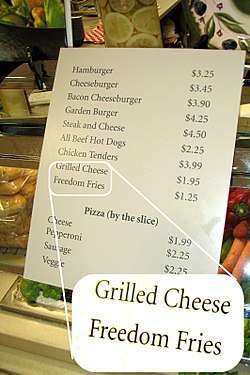
Freedom fries was a politically motivated renaming of french fries in the United States. The term was coined in February 2003 in a North Carolina restaurant, and was widely publicized a month later when the then Republican Chairman of the Committee on House Administration, Bob Ney, renamed the menu item in three Congressional cafeterias. The political renaming occurred in context of France's opposition to the proposed invasion of Iraq. Although some restaurants around the nation adopted the renaming, the term became unpopular, in part due to decreasing popularity of the Iraq War. After Ney's resignation as Chairman in 2006, the change of name in Congressional cafeterias was reverted.
Background
[edit]French opposition to the Iraq war
[edit]After the September 11 attacks by Al-Qaeda and the declaration of a "War on Terror" by President George W. Bush, an invasion of Iraq was proposed, based on false arguments about Iraq owning weapons of mass destruction.[1] During the United Nations Security Council deliberations, French Minister of Foreign Affairs Dominique de Villepin made it clear France would neither support nor participate in the invasion, and that it would veto any resolution that mandates an invasion of Iraq.[2] Though Russia and China also opposed the invasion, they had not threatened to use their veto power on the Security Council; as such, France was perceived as the main barrier to the American and British effort to secure a UN mandate for invasion. This caused some Americans to accuse France of betrayal, reigniting prior anti-French sentiment in the United States.[3]
Initial renaming
[edit]Renaming was initiated in February 2003 by Beaufort, North Carolina, "Cubbie's" restaurant owner Neal Rowland, who said he was motivated by similar actions against Germany in World War I, when "sauerkraut was called liberty cabbage, and frankfurters were renamed hot dogs."[4][5] In an interview about the name change, Rowland commented, "since the French are backing down [from the war], French fries and French everything needs to be banned."[6] In March 2007, Rowland obtained a trademark registration for the term "freedom fries", which was cancelled in November 2013.[7]
U.S. House adoption
[edit]
On March 11, 2003, Republican U.S. Representatives Bob Ney and Walter B. Jones directed the three House cafeterias to change all references to French fries, French toast, and French bread on menus, and replace them with Freedom fries, Freedom toast, and Freedom bread, respectively.[8][9] Jones chose to follow Cubbie's example by circulating a letter to his colleagues advocating their renaming because, he said, "the French were 'sitting on the sidelines.'"[5][10] As Ney was Chairman of the United States House Committee on House Administration, the action did not require any vote, as the Committee has authority over House cafeterias. According to a statement released by Ney, the renaming was intended to express displeasure with France's "continued refusal to stand with their U.S. allies." The statement further read: "This action today is a small but symbolic effort to show the strong displeasure many on Capitol Hill have with our so-called ally, France."[11] When asked about his view on the change, Jones said it was a "lighthearted gesture."[12] This also came to apply to dining halls for the Coalition Provisional Authority and the Multi-National Force – Iraq during the U.S. occupation of Iraq.[13]
Reactions
[edit]In response to the change, French Embassy spokeswoman Nathalie Loiseau commented "It's exactly a non-issue ... we focus on the serious issues"[14] and noted that fries originated in Belgium.[15] She then remarked that France's position on the change was that they were "in a very serious moment dealing with very serious issues, and we are not focusing on the name [Americans] give to potatoes."[16] After the name reversal, an embassy spokeswoman said: "our relations are definitely much more important than potatoes ... and our relations are back on track."[5]
In a 2005 opinion poll by Gallup, participants were asked if they felt the renaming of French fries and toast was "a silly idea or a sincere expression of patriotism;" 66% answered it was silly, 33% answered it was patriotic, and 1% had no opinion. However, only 15% of participants actually considered using the term "freedom fries"; 80% said they would continue to call them "french fries".[17] Several restaurants followed the House's change.[10][18] As of 2020, several American restaurants still used the name "freedom fries".[19] Opposing the name change, Saturn Cafe in Santa Cruz, California, changed their menu to "Impeach George W. Bush fries."[20] Meanwhile, Reckitt Benckiser, maker of French's mustard, were sufficiently concerned about the movement to publicly clarify that its brand derived from a family name.[21]

Massachusetts Democratic Congressman Barney Frank noted that the change made "Congress look even sillier than it sometimes looks,"[22] New York Democratic Congressman José Serrano characterized the renaming as "petty grandstanding," and urged fellow legislators to concentrate on more pressing issues.[23]
The French American indie band Freedom Fry chose their name based on the Freedom Fries phenomenon.[24] In 2005, Robert Plant and his band Strange Sensation released the album Mighty ReArranger, which contains the track '"Freedom Fries," an anti-war song whose lyrics contains the words "Freedom fries and burns and scars, the liberator goes too far."[25]
Policy reversal
[edit]On August 2, 2006, the House cafeteria menus were changed back without any announcement.[5] The change was made by the new House Administration Committee Chairman, Vern Ehlers, who replaced Ney following his resignation due to a scandal. When asked about his decision, Ehlers responded, "It's no big deal ... It's not news."[26] When asked in 2005 about his opinion on the "freedom fries" episode, Walter B. Jones responded, "I wish it had never happened."[27]
See also
[edit]References
[edit]- ^ Pidd, Helen; Chulov, Martin (15 February 2011). "Defector admits to WMD lies that triggered Iraq war". The Guardian.
- ^ "France and Germany unite against Iraq war". The Guardian. January 22, 2003. Retrieved April 1, 2013.
- ^ Max Fisher (April 23, 2012). "Beyond Freedom Fries: The Roots of American Francophobia". The Atlantic. Retrieved April 2, 2013.
- ^ "French fries back on House menu". BBC News. August 2, 2006. Retrieved February 5, 2013.
- ^ a b c d Christina Bellantoni (August 2, 2006). "Hill fries free to be French again". The Washington Times. Retrieved September 12, 2012.
- ^ "Americans Just Say 'Non' to French Products". Fox News Channel. February 19, 2003. Archived from the original on 2013-05-14. Retrieved April 2, 2013.
- ^ "Latest Status Info, TM Reg. 3220999". United States Patent and Trademark Office. March 11, 2003. Retrieved December 22, 2022.
- ^ Entertainment team (2003-03-19). "Why stop there? Being mad at the French means renaming more than just fries". Daily Press. Newport News, Virginia. p. D1.
- ^ "Chef Todd Misener began his career as a dishwasher". Northwest Florida Daily News. 2004-08-11. p. D5.
- ^ a b Sean Loughlin (March 12, 2003). "House cafeterias change names for 'french' fries and 'french' toast". CNN. Retrieved March 20, 2008.
- ^ "House Now Serving 'Freedom Fries'". Fox News. March 11, 2003. Archived from the original on 2013-02-01. Retrieved February 5, 2013.
- ^ Sheryl Gay Stolberg (March 12, 2003). "An Order of Fries, Please, but Do Hold the French". The New York Times. Retrieved March 20, 2013.
- ^ Chandrasekaran, Rajiv (2007). Imperial life in the emerald city : inside Iraq's green zone. Internet Archive. New York: Vintage Books. ISBN 978-0-307-27883-8.
- ^ Greg Wright (March 12, 2003). "French fries? Mais non, Congress calls em freedom fries". Gannett News Service. Archived from the original on September 24, 2015. Retrieved March 27, 2013.
- ^ Iacocca, Lee, Where Have All the Leaders Gone?, p. 62. (Scribner Book Company, 2008) ISBN 978-141-653-2491.
- ^ "Freedom toast, French Fries and French Freedom Fries". CNN. March 11, 2003. Retrieved September 13, 2013.[dead link]
- ^ Gallup, Alec, The Gallup Poll: Public Opinion 2005, p. 71. (Rowman & Littlefield Publishers, 2006) ISBN 978-074-255-2586.
- ^ "French fries get new name in House". USA Today. March 11, 2003. Retrieved February 12, 2013.
- ^ "Why are these American restaurants still serving "freedom fries"?". The Face. 2020-01-28. Retrieved 2024-02-13.
- ^ Dan White (September 7, 2003). "Santa Cruz Makes Its Mark On The World". Santa Cruz Sentinel. Cannabis News. Retrieved February 8, 2013.
- ^ "French's mustard denies French connection". Canadian Broadcasting Corporation. March 27, 2003. Archived from the original on October 17, 2006. Retrieved September 9, 2012.
- ^ Alexandra Silver (March 28, 2011). "French Fries to "Freedom" Fries". Time. Archived from the original on April 18, 2011. Retrieved February 8, 2013.
- ^ "US Congress opts for "freedom fries"". BBC. March 12, 2003. Retrieved March 8, 2013.
- ^ "About Freedom Fry". Freedom Fry. Retrieved February 5, 2013.
- ^ "Robert Plant & The Strange Sensation Freedom Fries Lyrics". Retrieved February 8, 2013.
- ^ Michael Viqueira (August 2, 2006). "Fries are French again on Capitol Hill". NBC News. Retrieved February 5, 2013.
- ^ Jamie Wilson (May 25, 2005). "French fries protester regrets war jibe". The Guardian. Washington, D.C. Retrieved September 11, 2012.
External links
[edit]
- "House restaurants change name of 'french fries' and 'french toast'", CNN.com, March 11, 2003
- Johnny Depp on the Freedom Fries incident, "U.S. is like a stupid puppy", CNN.com, September 3, 2003


Freedom fries
View on GrokipediaEtymology and Precedents
Origins of "French Fries"
The practice of deep-frying strips of potatoes, now known globally as French fries, is most commonly traced to the Meuse Valley region in what is now Belgium, during the late 17th century. Local lore attributes the invention to villagers in areas like Namur and Dinant, who traditionally fried small fish from the Meuse River but substituted potatoes—introduced to Europe from the Americas in the 16th century—during winter when the river froze, preventing fishing. This adaptation reportedly occurred around 1680 in the Spanish Netherlands, predating Belgium's independence in 1830.[11][12] However, the Belgian origin narrative has been challenged as potentially mythical, with some historians arguing that while Belgians refined techniques like double-frying for crispiness, earlier fried potato preparations existed in France. Potatoes reached France via explorers like Bernard de Jussieu in the 1730s, and recipes for fried potatoes appear in French cookbooks by the early 19th century, such as one from Paris in 1817 describing thin potato slices fried in oil. A 2025 analysis by Belgian historian Pierre Lebecq posits that "frites" as a distinct dish faded in France by the 20th century but were preserved and popularized in Belgium, fueling nationalistic claims. Despite these debates, no definitive pre-1680 evidence confirms the strip-cut frying method outside the Low Countries.[13][14] The term "French fries" emerged in American English, with "French fried potatoes" first documented in 1856, likely referring not to national origin but to the "French" culinary technique of frenchage—cutting food into thin, uniform strips before frying for even cooking. This usage predates widespread U.S. association with France, appearing in recipes emphasizing the julienne-style preparation akin to other "French" methods like French dressing or French toast. By 1903, the shortened "French fries" gained traction, though the dish's popularity in America surged post-World War I via soldiers encountering it in Europe. The name's persistence despite Belgian claims reflects linguistic convention rather than strict geography, with "frites" in French-speaking regions underscoring the cultural overlap.[15]Wartime Renamings in US History
During World War I, intense anti-German sentiment in the United States, fueled by the nation's entry into the conflict on April 6, 1917, led to widespread efforts to excise German cultural influences from American language and daily life, including the renaming of food items associated with Germany.[16][17] Sauerkraut, a fermented cabbage dish originating in Germany, was rebranded as "liberty cabbage" to align with patriotic themes and avoid associations with the enemy.[18][19] This renaming gained traction among producers; for instance, New York sauerkraut manufacturers petitioned the Federal Food Administration in 1918 to adopt the term, following its use by health officials at Camp Dix, New Jersey.[20] Similar changes affected other German-linked foods: frankfurters became "liberty sausages," hamburgers were dubbed "liberty steaks," and sauerkraut producers marketed their product as "victory cabbage" in some instances to emphasize triumph over Germany.[19] These efforts were voluntary and promoted by industry groups and media, reflecting a broader campaign by the government-backed Committee on Public Information to foster national unity, though they often proved temporary and faded after the Armistice on November 11, 1918.[16] World War II saw fewer comparable food renamings in the U.S., with focus shifting to rationing and production drives rather than linguistic purges, though anti-Japanese sentiment occasionally targeted items like Japanese beetles relabeled as "Berlin beetles" in a nod to Axis alliances.[21] Such wartime renamings underscored a recurring pattern of using nomenclature changes to express geopolitical disdain, typically targeting adversaries rather than allies like France prior to the early 21st century.[22]Geopolitical Context
France's Stance on the 2003 Iraq Invasion
France, under President Jacques Chirac, opposed the United States-led invasion of Iraq that commenced on March 20, 2003, prioritizing multilateral diplomacy through the United Nations over unilateral military action. Chirac's administration argued that Iraq posed no immediate threat warranting war, emphasizing the effectiveness of ongoing UN weapons inspections, which had reportedly destroyed more Iraqi weapons of mass destruction than the 1991 Gulf War.[23] On March 18, 2003, Chirac explicitly stated that "Iraq does not represent an immediate threat that would justify an immediate war," underscoring France's commitment to exhausting peaceful verification processes before considering force.[23] A pivotal moment came on February 14, 2003, when Foreign Minister Dominique de Villepin delivered a speech to the UN Security Council, defending the inspections regime's progress—over 400 on-site visits and 1,000 interviews conducted since November 2002—and cautioning that military intervention risked broader regional instability, proliferation of weapons, and humanitarian crises without a clear UN mandate.[24] De Villepin stressed multilateralism, asserting that "the option of force should remain the last resort" only after inspectors confirmed their inability to proceed further.[24] This position aligned with France's coordination with Germany, announced on January 22, 2003, to jointly resist war absent compelling evidence of non-compliance.[25] On March 11, 2003, Chirac confirmed France's intent to veto any second UN resolution authorizing invasion, declaring that inspectors had not exhausted their mandate and that war would undermine international legitimacy.[26][27] French officials viewed the proposed action as a "dangerous venture," potentially exacerbating terrorism and ethnic conflicts in the Middle East, a perspective later echoed in inquiries noting Chirac's pre-war reservations about the operation's feasibility and consequences.[28] France's stance reflected a broader Gaullist tradition of strategic autonomy, though critics attributed it partly to economic interests, as France was Iraq's leading European trading partner with billions in contracts at stake prior to the war.[29]US-Franco Alliance Strains
France's opposition to the US-led invasion of Iraq, articulated by President Jacques Chirac on January 20, 2003, when he stated that military action would only be justified with explicit UN Security Council authorization, precipitated significant diplomatic friction with the United States.[23] Chirac's position, emphasizing multilateralism and the absence of conclusive evidence for Iraq's weapons of mass destruction, clashed with President George W. Bush's determination to proceed unilaterally if necessary, leading to a breakdown in bilateral consultations by early February 2003.[30] This discord eroded the post-Cold War cohesion in US-France security cooperation, with US officials viewing France's stance as undermining the credibility of prior UN resolutions against Saddam Hussein's regime.[31] A pivotal strain emerged within NATO on February 10, 2003, when France, alongside Germany and Belgium, vetoed a US-backed proposal to deploy NATO Airborne Warning and Control System (AWACS) aircraft and Patriot missile defenses to protect alliance member Turkey from potential Iraqi retaliation.[32] This blockage, justified by Paris as premature absent a formal war decision, marked the first use of NATO's Article 4 consultation veto in a crisis, fracturing alliance unity and prompting US Defense Secretary Donald Rumsfeld to publicly deride France and Germany as representing "Old Europe" in contrast to supportive Eastern European states.[33] The episode exposed vulnerabilities in NATO's consensus-based decision-making, with France's actions perceived in Washington as prioritizing anti-war solidarity over collective defense obligations.[34] Post-invasion tensions intensified in April 2003 when US Secretary of State Colin Powell declared that France would face "consequences" for its refusal to support the military campaign, including exclusion from key postwar Iraq planning forums such as the Defense Planning Committee, from which France was sidelined due to its non-participation.[35] French diplomats countered that such punitive measures undermined transatlantic trust, while public sentiment in the US, fueled by perceptions of French betrayal, manifested in congressional actions like the renaming of "French fries" to "freedom fries" on March 11, 2003.[36] These developments strained the broader US-Franco alliance, historically anchored in shared WWII liberation narratives and mutual defense pacts, by highlighting irreconcilable divergences on preemptive force and UN primacy.[37] Efforts at reconciliation, such as Bush and Chirac's June 1, 2003, meeting at the G8 summit in Evian where Bush urged moving "beyond Iraq wrangling," yielded superficial détente but failed to fully mend underlying rifts, as France pledged no reconstruction aid at the October 2003 Madrid conference while criticizing US unilateralism.[38][39] The episode contributed to a reevaluation of alliance dynamics, with subsequent analyses noting how France's veto threats and NATO obstructions diminished its influence in US-led coalitions for years.[40]Emergence of the Term
Coining in Private Sector
The term "freedom fries" originated in the private sector at Cubbie's, a restaurant in Beaufort, North Carolina, in February 2003. Restaurant owner Neal Rowland introduced the renaming by replacing "French fries" with "freedom fries" on the menu, prompted by France's opposition to the impending U.S.-led invasion of Iraq.[1][41] Rowland, whose establishment caters primarily to U.S. military personnel from nearby bases, attributed the change to a suggestion from a customer and later stated that "it was never about politics."[41] Despite this claim, the timing aligned directly with escalating U.S. frustrations over France's refusal to support the war effort without further United Nations authorization, reflecting a broader sentiment among some American businesses and patrons to express patriotic disapproval through symbolic consumer actions.[1] This initial private initiative marked the term's debut outside official channels, predating its adoption by U.S. congressional cafeterias by approximately one month and serving as a grassroots precursor to wider commercial and political uptake.[1]Early Spread Among Businesses and Individuals
Following its debut at Cubbie's restaurant in Beaufort, North Carolina, in February 2003, the term "freedom fries" quickly disseminated among other private businesses as a symbolic rebuke to France's opposition to the U.S.-led invasion of Iraq. Owner Neal Rowland, whose establishment primarily served military personnel from nearby bases, noted strong customer approval for the menu change, with the item proving popular among patrons.[42][1] By early March 2003, prior to the U.S. House of Representatives' formal adoption on March 11, the renaming inspired scattered implementations in eateries nationwide, fueled by media reports of Cubbie's initiative. National chain Fuddruckers, with over 200 locations, promptly announced it would excise "French fries" from menus, aligning with the burgeoning protest movement.[41][43] Independent restaurants and diners further propagated the term, often through owner-led efforts to reframe offerings patriotically; for example, staff at various establishments began redirecting customer orders for "French fries" to "freedom fries," reflecting voluntary alignment with anti-French boycotts. This private-sector uptake paralleled a measurable dip in demand for French-associated products, underscoring causal links between geopolitical tensions and consumer behavior.[44][45] Among individuals, early adoption manifested in informal public discourse and personal preferences, with reports of diners embracing the nomenclature during meals and discussions on talk radio amplifying its visibility. Such grassroots endorsement, independent of governmental prompts, evidenced organic cultural resonance amid widespread frustration with France's stance, as captured in contemporaneous surveys showing elevated negativity toward French imports.[46]Governmental Adoption
US House of Representatives Directive
In March 2003, the U.S. House of Representatives' Administration Committee, responsible for overseeing congressional dining facilities, directed cafeterias in the three House office buildings to rename "French fries" as "freedom fries" and "French toast" as "freedom toast" on their menus.[5] This administrative action, announced on March 11, 2003, by House Republicans, served as a symbolic protest against France's opposition to the U.S.-led invasion of Iraq.[6] Committee Chairman Representative Bob Ney (R-OH) explicitly ordered the removal of the word "French" from all relevant menu items, framing the change as a rebuke to French foreign policy rather than a legislative mandate requiring a floor vote.[47] The directive did not extend to the Senate or other federal branches and lacked the force of a binding resolution, applying solely to House-operated food services.[48] Ney, who initiated the menu alterations alongside Representative Walter B. Jones (R-NC)—who had earlier popularized the term in a February 2003 letter to Ney—described the move as a "small but symbolic effort" to express congressional displeasure with France's stance.[6] Implementation occurred swiftly, with updated menus reflecting the change by March 12, 2003, amid heightened anti-French sentiment in Washington.[5] No budgetary or operational impacts were reported from the renaming, which critics within Congress dismissed as performative but supporters viewed as a legitimate expression of patriotic solidarity.[48] The action aligned with Ney's broader push for symbolic gestures, though he later faced unrelated corruption charges unrelated to this event.[47]Implementation and Related Renamings
On March 11, 2003, U.S. Representatives Bob Ney (R-Ohio), chairman of the House Administration Committee, and Walter B. Jones (R-North Carolina) directed the cafeterias in the three House office buildings to replace all references to "French fries" with "freedom fries" on their menus.[5] This directive, issued under Ney's authority over House food services, took effect immediately, with the updated menus appearing as early as March 12, 2003.[47] The change was announced during a news conference in the Longworth House Office Building cafeteria, where Ney presented the new terminology as a symbolic protest against France's opposition to the Iraq War.[49] In conjunction with the fries renaming, "French toast" was similarly rebranded as "freedom toast" across the same House facilities.[6] This parallel adjustment extended the gesture to other menu items associated with France, maintaining consistency in the cafeterias serving House members and staff. The implementation did not alter the food preparation or sourcing but focused solely on nomenclature, reflecting a targeted administrative action rather than a broader policy shift.[5] The renamings were confined to the House of Representatives' dining operations and did not extend to the Senate or other federal entities.[47] While primarily a congressional initiative, the move inspired sporadic adoptions in private sector venues, such as restaurants and food services, though these were independent of the governmental directive.[41] No other official federal renamings of French-associated terms occurred in direct relation to this event.[7]Contemporary Reactions
Arguments in Favor
Proponents argued that renaming French fries to "freedom fries" constituted a symbolic act of patriotism, demonstrating support for U.S. military actions in Iraq amid France's vocal opposition to the invasion.[50] Representative Bob Ney, a Republican from Ohio who directed the change in U.S. House of Representatives cafeterias on March 11, 2003, framed the initiative as a rebuke to France for undermining American efforts, stating it reflected "strong displeasure of many on Capitol Hill with the actions of our so-called ally."[51] This gesture aimed to rally public sentiment behind President George W. Bush's policy without direct confrontation, substituting "freedom" to evoke core American ideals of liberty and resolve.[1] The term's originator, Neal Rowland, owner of a restaurant in Beaufort, North Carolina, introduced "freedom fries" in February 2003 as a private-sector protest, explicitly citing historical parallels like the World War I renaming of sauerkraut to "liberty cabbage" to oppose German aggression.[52] Rowland emphasized that the change was not an attack on the French populace but a patriotic affirmation of loyalty to U.S. leadership and troops, intended to foster national unity during a time of international discord.[1] Supporters contended this linguistic shift highlighted the importance of alliance reliability, pressuring France through cultural and consumer awareness rather than economic coercion alone.[53] Advocates further maintained that the rename amplified awareness of geopolitical stakes, portraying France's stance—rooted in demands for more United Nations inspections before military action—as a betrayal of post-World War II transatlantic bonds forged in mutual defense.[6] By aligning everyday language with pro-war resolve, it served as a morale booster for Americans, reinforcing that domestic expressions could signal resolve to allies and adversaries alike, much like wartime propaganda efforts in prior conflicts.[54]Arguments Against
Critics characterized the "freedom fries" renaming as a petty and immature response to France's opposition to the 2003 Iraq invasion, arguing that it trivialized serious geopolitical disagreements and projected an image of American petulance rather than principled resolve.[55] The gesture, initiated in the U.S. House of Representatives cafeteria on March 11, 2003, by Representatives Bob Ney and Walter Jones, was seen by detractors as diverting attention from substantive policy debates toward symbolic posturing that strained the longstanding U.S.-France alliance without yielding diplomatic gains.[5] France's veto threat in the UN Security Council remained unchanged, underscoring the protest's ineffectiveness in influencing foreign policy.[56] Even proponents later disavowed the action; Representative Walter Jones, a key architect of the House directive, expressed deep regret by 2005, stating, "I wish it had never happened," as his support for the Iraq War eroded amid mounting U.S. casualties and evidence of flawed intelligence.[56] Jones's reversal highlighted broader criticisms that the renaming exemplified misguided patriotism, prioritizing culinary rebukes over addressing the war's strategic miscalculations, which by 2005 had resulted in over 1,700 American military deaths.[57] The initiative also faced rebuke for its factual imprecision, as "French fries"—deep-fried potato strips—trace their origins to 17th-century Belgium, not France, with early references in Namur region recipes predating French association; the term gained U.S. currency in the early 20th century via American soldiers in World War I, rendering the anti-French framing ahistorical. Economically, associated boycotts of French products, such as a 20-30% dip in French wine imports during early 2003, proved short-lived, recovering fully by mid-year without compelling policy shifts in Paris.[58] By 2006, the House cafeteria reverted to "French fries," reflecting waning public and political enthusiasm as Iraq War approval ratings plummeted from 72% in March 2003 to 39% by 2006.[59]Reversal and Legacy
Return to Original Naming
In August 2006, the U.S. House of Representatives cafeterias quietly reverted to listing "French fries" and "French toast" on their menus, ending the three-year use of "freedom fries" and "freedom toast" that had been implemented in March 2003.[59] The change occurred without a formal announcement or directive akin to the original renaming, coinciding with the resignation of Rep. Bob Ney (R-OH), the House Administration Committee chairman who had overseen the cafeterias and supported the 2003 switch amid his involvement in unrelated lobbying scandals.[60] This reversal reflected diminished public and political fervor over France's opposition to the Iraq War, as U.S. casualties mounted and domestic support for the conflict waned by mid-decade.[59] Rep. Walter B. Jones (R-NC), who alongside Ney had initiated the 2003 renaming, publicly expressed regret for the action as early as 2005, citing his evolving views on the Iraq War after visiting troops and learning of over 1,500 U.S. military deaths by that point; however, the menu adjustment followed the shift in cafeteria oversight rather than Jones's personal stance.[7] The move underscored the transient nature of the protest, with no comparable reversals mandated in other federal facilities, though private vendors and restaurants that had adopted "freedom fries"—such as a North Carolina eatery in 2003—largely discontinued the term by the late 2000s as consumer demand evaporated.[1] Isolated holdouts persisted in some U.S. establishments into the 2010s, but the congressional reversion marked the effective end of the renaming's institutional prominence.[43]Enduring Cultural and Political Symbolism
The term "freedom fries" has persisted as a cultural shorthand for hyperbolic patriotic gestures in response to international disagreements, particularly illustrating the tension between symbolic domestic actions and substantive foreign policy. Coined amid widespread frustration with France's refusal to endorse the U.S.-led invasion of Iraq on March 19, 2003, the renaming symbolized a broader wave of consumer boycotts targeting French goods, which peaked in early 2003 but yielded negligible economic impact on France, as evidenced by unchanged import volumes reported in subsequent analyses.[61] This episode underscores how such renamings often prioritize emotional signaling over measurable outcomes, with public support waning as the Iraq War's costs mounted, leading to a House cafeteria reversal on August 2, 2006.[59] Politically, "freedom fries" exemplifies the risks of conflating alliance disputes with existential threats, a tactic employed by proponents like Rep. Walter Jones (R-NC), who initially championed the change but later renounced the Iraq War by 2006, reflecting shifting conservative views on interventionism.[59] It has been invoked in retrospective critiques of post-9/11 nationalism, such as in discussions of similar rebrandings like "Freedom Tower" for One World Trade Center, which also faded from common usage despite initial fervor.[62] Media outlets continue to reference it as a cautionary tale against performative outrage, notably during U.S.-Europe tensions under the Trump administration, where echoes of anti-French sentiment resurfaced in debates over NATO commitments.[63] Culturally, the phrase endures as a meme for absurd politicization of everyday items, with sporadic ironic revivals in eateries or online discourse but no sustained adoption; by 2025, consumer preferences overwhelmingly favor "French fries," as confirmed by menu analyses and Gallup polling on U.S.-France relations recovering to favorable levels by 2014.[46][64] Academic studies, such as those examining boycott efficacy, cite it as a case of low-cost signaling that fails to alter adversary behavior, reinforcing lessons in causal realism about the limits of cultural diplomacy. Its legacy thus highlights the ephemeral nature of such symbols, often ridiculed in hindsight for prioritizing rhetoric over enduring alliances.[41]References
- https://en.wiktionary.org/wiki/freedom_fries
- https://en.wikisource.org/wiki/French_address_on_Iraq_at_the_UN_Security_Council