


Community hub
Recent from talks
Contribute something
Nothing was collected or created yet.
Firewood
View on Wikipedia | This article may require copy editing for grammar, style, cohesion, tone, or spelling. (September 2025) |


Firewood is any wooden material that can be used for fuel. Firewood usually refers to wood fuel that is not industrially processed like wood pellets, instead taking the form of a recognizable log or branch. Firewood can be heat-treated and seasoned (dry) or unseasoned (fresh/wet). Two classes of firewood exist, which are either hardwood or softwood, depending on the species of tree that was cut.
Firewood is a renewable resource, although demand for this fuel can quickly outpace its ability to regenerate on a local or regional level. Good forestry practices and improvements in devices that use firewood can improve local wood supplies.
Smoke from burning wood can cause respiratory issues and other diseases.[1][2] Also, transporting firewood long distances can potentially spread plant pests, diseases and invasive species.[3]
History
[edit]
For most of human history, firewood was the main fuel, until the use of coal spread during the Industrial Revolution.[4] As such, access to firewood was a valued resource, with wood botes, or the right to gather firewood, being a significant aspect of many medieval leases.[5] As late as 19th century America, Henry David Thoreau considered that it was "remarkable what a value is still put upon wood even in this age and this country...the prince and the peasant, the scholar and the savage, equally require still a few sticks from the forest to warm them and cook their food".[6]
Harvesting
[edit]Harvesting or collecting firewood varies by region and culture. Different places have specific areas for firewood collection, while other places organize firewood collecting as a field rotation process to allow environmental rebound. Collection can be a group or an individual activity, and different tools and methods for harvesting firewood vary by region.
-
 Firewood collector in Mozambique
 -
 Firewood transportation from farm to home in Maroua, Cameroon


North America
[edit]Some firewood is harvested in "woodlots" managed for that purpose,[7] but in heavily wooded areas, it is more often harvested as a byproduct of natural forests. Deadfall that has not started to rot is preferred, since it is already partly seasoned. Standing dead timber is considered better still, for it has less humid organic material on the trunk, allowing tools to stay sharper longer, as well as being both seasoned and less rotten. Harvesting this form of timber reduces the speed and intensity of bushfires, but it also reduces habitat for snag-nesting animals such as owls, bats, and some rodents.
Harvesting timber for firewood is normally carried out by hand with chainsaws. Thus, longer pieces, requiring less manual labour and less chainsaw fuel, are less expensive and only limited by the size of the firebox. In most of the United States, the standard measure of firewood is a cord, or 128 cubic feet (3.6 m3); however, firewood can also be sold by weight. The heating value can affect the price. Prices also vary considerably with the distance from woodlots and the quality of the wood.
Buying and burning firewood that was cut only a short distance from its final destination helps prevent the accidental spread of invasive tree-killing insects and diseases.[8][9]
Nigeria
[edit]Due to its affordability, firewood in Nigeria is used for various purposes, such as for the preparation of food, particularly in traditional stoves, as well as for heating, charcoal production, and cultural and religious practices.[10][11][12][13][14][15] Firewood is also often used in small-scale and artisanal production processes.[16][17]
Preparing
[edit]In most parts of the world, firewood is only prepared for transport at the time it is harvested. Then it is moved closer to the place where it will be used as fuel and prepared (split, seasoned, etc.) there. The process of making charcoal from firewood can take place at the place where the firewood is harvested.
Most firewood also requires splitting, which allows for faster seasoning by exposing more surface area. Today, most splitting is done with a hydraulic splitting machine, but it can also be split with a splitting maul or a wedge and sledge hammer. Some steel wedges have an angled blade so the mechanical advantage increases with depth. More unusual, and dangerous, is a tapered screw-style design that augers into the wood, splitting it, and can be powered by either a power take-off drive, a dedicated internal combustion engine, or a rugged electric pipe-threading machine, which is safer than the other power sources because the power can be shut off more easily if necessary. Another method is to use a kinetic log splitter, which uses a rack and pinion system powered by a small motor and a large flywheel used for energy storage.
-
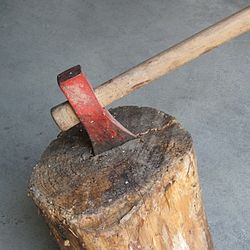 Italian-style splitting axe
 -
 Hydraulic wood splitting machine
 -
 Steel wedge for splitting firewood


Storing
[edit] | The examples and perspective in this article may not represent a worldwide view of the subject. (December 2023) |
There are many ways to store firewood. These range from simple piles to free-standing stacks, to specialized structures. Usually, the goal of storing wood is to keep water away from it and to continue the drying process.
Stacks: The simplest stack is where logs are placed next to and on top of each other, forming a line the width of the logs. The height of the stack can vary, generally depending upon how the ends are constructed. Without constructing ends, the length of the log and the length of the pile help determine the height of a free-standing stack.
There is debate about whether wood will dry more quickly when covered. There is a trade-off between the surface of the wood getting wet vs. allowing as much wind and sun as possible to access the stack. A cover can be almost any material that sheds water – a large piece of plywood, sheet metal, terracotta tiles, or an oiled canvas cloth, even cheap plastic sheeting may also be used. Wood will not dry when completely enclosed. Ideally, pallets or scrap wood should be used to raise the wood from the ground, reducing rot and increasing air flow.
There are many ways to create the ends of a stack. In some areas, a crib end is created by alternating pairs of logs to help stabilize the end. A stake or pole placed in the ground is another way to end the pile. A series of stacked logs at the end, each with a cord tied to it and the free end of the cord wrapped around the log in the middle of the pile, is another way.
Under a roof: Under a roof, there are no concerns about the wood being subjected to rain, snow, or run-off, but ventilation needs to be provided if the wood is stored green so that moisture released from the wood does not recondense inside. The methods for stacking depend on the structure and layout desired. Whether split or in 'rounds' (flush-cut and unsplit segments of logs), the wood should be stacked lengthwise, which is the most stable and practical method. Again, though, if the wood needs further seasoning, there should be adequate air flow through the stack.
Storing outdoors: Firewood should be stacked with the bark facing upwards. This allows the water to drain off, and standing frost, ice, or snow to be kept from the wood. Storing wood near a dwelling increases the likelihood that insects such as termites can become established indoors.
Storing firewood indoors for any extended period of time is not recommended, for it increases the risk of introducing insects such as termites into the home.
Round stacks can be made in many ways. Some are piles of wood with a stacked circular wall around them. Others, like the American Holz Hausen, are more complicated. A Holz hausen, or "wood house", is a circular method of stacking wood; proponents say it speeds up drying on a relatively small footprint. A traditional holz hausen has a 10-foot diameter, stands 10 feet high, and holds about 6 cords of wood. The walls are made of pieces arranged radially and tilted slightly inward for stability. The inside pieces are stacked on end to form a chimney for air flow. The top pieces are tilted slightly outward to shed rain and are placed bark side up.[18]
-
 Firewood stacks at Pühtitsa Convent in Estonia are about 6 metres (20 ft) high.
 -
 Stacked with crib end, in eastern France, covered by terracotta tiles.
 -
 Stacking firewood in a shed


Heating value
[edit]

The moisture content of firewood determines how it burns and how much heat is released. Unseasoned (green) wood moisture content varies by the species; green wood may weigh 70 to 100 percent more than seasoned wood due to water content. Typically, seasoned (dry) wood has 20% or less moisture content. Use of the lower heating value is advised as a reasonable standard way of reporting this data.[citation needed]
The energy content of a measure of wood depends on the tree species.[19] For example, it can range from 15.5 to 32 million British thermal units per cord (4.5 to 9.3 GJ/m3).[20] The higher the moisture content, the more energy that must be used to evaporate (boil) the water in the wood before it will burn. Dry wood delivers more energy for heating than green wood of the same species.
The Sustainable Energy Development Office (SEDO), part of the Government of Western Australia states that the energy content of wood is 4.5 kWh/kg or 16.2 gigajoules/tonne (GJ/t).[21]
Here are some examples of energy content of several species of wood:
| Wood Species | Heating value (million BTU per cord) | Heating value (GJ per m3) |
|---|---|---|
| Tamarack | 22.3 | 6.5 |
| Birch | 21.3 | 6.2 |
| Red Fir | 20.6 | 6.0 |
| White Fir | 16.7 | 4.9 |
Kiln (oven) dried firewood
[edit]To reduce the drying time to a number of days from the normal one to three years, an external heating source such as a kiln or oven can be used. The process of kiln or oven drying firewood was invented by Anthony Cutara, for which a successful US patent was filed in 1983.[22] In 1987 the US Department of Agriculture replicated the method and published a detailed procedure for the production of kiln dried firewood, citing the higher heat output and increased combustion efficiency as a key benefit of the process.[23]
Measurement
[edit]

Usually firewood is sold by volume. While a specific volume term may be used, there can be a wide variation in what this means and what the measure can produce as a fuel. A measure of green unseasoned wood with 65% moisture contains less usable energy than when it has been dried to 20%. Regardless of the term, firewood measurement is best thought of as an estimate.
Traditional English
[edit]Early modern England measured firewood in terms of billets and bavins. A billet,[24] like a bavin, was a piece of kindling wood.[25] The 16th C standardised a billet as three foot four inches in length, and ten inches around (for open fires); and a bavin as three foot long and two feet round (a chunkier log, often used for ovens).[26]
Metric
[edit]In the metric system, firewood is usually sold by the stère, equivalent to a volume of 1 cubic meter (0.276 cord). The most common firewood piece length are 33 cm (13 in) and 50 cm (20 in). Wood can also be sold by the kilogram or by the tonne, as in Australia.
North America
[edit]In the United States and Canada, firewood is usually sold by the full cord, face cord or bag. A cord which is made from 4-foot (1.22 m) logs will not be a cord when it has been cut into 1 foot logs and then split so each piece will fit through a 3-inch (7.6 cm) circle.
- A full cord or bush cord has a volume of 128 cubic feet (3.6 m3), including wood, bark, and air space in a neatly stacked pile.[27] The actual wood volume of a cord may be in the range of 80 to 100 cubic feet (2.3 to 2.8 m3) as stacked wood takes up more space than a piece of solid wood. The most common firewood piece length is 16 inches (41 cm).[28]
- The volume of a face cord or a rick[29] depends on the length of the logs that are stacked in a 4 by 8 ft (1.22 by 2.44 m) pile. When 16 in (41 cm) logs are used, the volume is 42+2⁄3 cubic feet (1.21 m3) which is one third of a full or bush cord stack of wood.[28]
Damage to health and environment
[edit]Burning firewood causes respiratory and other illnesses.[2] Along with clearance for agriculture collecting firewood is a cause of deforestation.[30]
In popular culture
[edit]- Jane Austen in 1814 complained to her sister that "My Mother's Wood is brought in-but by some mistake, no Bavins. She must therefore buy some". (Contemporary charges were between 6 and 15 shillings per hundred bavins).[31]
- In Norway, the non-fiction book Hel Ved (In English: Solid Wood: All About Chopping, Drying and Stacking Wood – and the Soul of Wood-Burning) by Lars Mytting became a bestseller in 2011–2012, selling 150,000 copies. A version of the book has also been published in Sweden, selling 50,000 copies.[32]
- In February 2013, the Norwegian state broadcast NRK sent a 12-hour live program on the topic of firewood, where a large part of the program consisted of showing firewood burning in a fireplace. More than one million people, 20% of Norway's population, saw part of the program.[33]
See also
[edit]References
[edit]- ^ "Women using firewood face increasing health risks". WHO | Regional Office for Africa. 2022-04-07. Retrieved 2024-01-29.
- ^ a b US EPA, OAR (2013-05-28). "Wood Smoke and Your Health". www.epa.gov. Retrieved 2024-01-29.
- ^ "Protect the Trees You Love From Tree-killing Bugs". Retrieved 2020-11-18.
- ^ S Pinker, Enlightenment Now (2019) p. 143
- ^ R Fortey, The Wood for the Trees (2016) p. 127 and p. 207
- ^ H D Thoreau, Walden (OUP 2008) p. 225
- ^ "Where does firewood come from?". extension.unh.edu. Archived from the original on 2007-11-27.
- ^ "Don't Move Firewood - Trees and forests are threatened by invasive foreign insects and diseases". dontmovefirewood.org.
- ^ "Firewood". www.inspection.gc.ca. Government of Canada, Canadian Food Inspection Agency, Plant Health and Biosecurity Directorate. 2015-04-14. Archived from the original on 2011-07-06. Retrieved 2011-03-03.
- ^ Matemilola, Saheed; Elegbede, Isa O.; Kies, Fatima; Yusuf, Gbolahan A.; Yangni, Ganbobga N.; Garba, Ibrahim (2019-01-01). "An Analysis of the Impacts of Bioenergy Development on Food Security in Nigeria: Challenges and Prospects". Environmental and Climate Technologies. 23 (1): 64–83. Bibcode:2019SJRUE..23...64M. doi:10.2478/rtuect-2019-0005. hdl:10281/236662. ISSN 2255-8837. S2CID 198964019.
- ^ Ijeomah, HM; Ijeomah, UD; Okagbare, OH (2013-11-08). "Ecological Survey of Avifaunal Resources in University of Port Harcourt, Nigeria". Ethiopian Journal of Environmental Studies and Management. 6 (6). doi:10.4314/ejesm.v6i6.8. ISSN 1998-0507.
- ^ Bowyer, J. L. (2001-01-01), "Wood: Future Availability", in Buschow, K. H. Jürgen; Cahn, Robert W.; Flemings, Merton C.; Ilschner, Bernhard (eds.), Encyclopedia of Materials: Science and Technology, Oxford: Elsevier, pp. 9637–9641, Bibcode:2001emst.book.9637B, doi:10.1016/b0-08-043152-6/01746-0, ISBN 978-0-08-043152-9, retrieved 2023-05-21
- ^ "Wood energy". www.fao.org. Retrieved 2023-05-21.
- ^ Wood, T S; Baldwin, S (1985). "Fuelwood and Charcoal Use in Developing Countries". Annual Review of Energy. 10 (1): 407–429. doi:10.1146/annurev.eg.10.110185.002203. ISSN 0362-1626.
- ^ Akintan, Oluwakemi; Jewitt, Sarah; Clifford, Mike (2018). "Culture, tradition, and taboo: Understanding the social shaping of fuel choices and cooking practices in Nigeria". Energy Research & Social Science. 40: 14–22. Bibcode:2018ERSS...40...14A. doi:10.1016/j.erss.2017.11.019. S2CID 115739869.
- ^ Sola, Phosiso; Cerutti, Paolo Omar; Zhou, Wen; Gautier, Denis; Iiyama, Miyuki; Schure, Jolien; Chenevoy, Audrey; Yila, Jummai; Dufe, Vanessa; Nasi, Robert; Petrokofsky, Gillian; Shepherd, Gill (2017-02-13). "The environmental, socioeconomic, and health impacts of woodfuel value chains in Sub-Saharan Africa: a systematic map". Environmental Evidence. 6 (1): 4. Bibcode:2017EnvEv...6....4S. doi:10.1186/s13750-017-0082-2. hdl:10568/94158. ISSN 2047-2382.
- ^ Morgan, W.B. (1978). "Development and the fuelwood situation in Nigeria". GeoJournal. 2 (5): 437. Bibcode:1978GeoJo...2..437M. doi:10.1007/bf00156221. ISSN 0343-2521. S2CID 154561400.
- ^ "Seasoning Firewood How and When". thechimneysweep.ca. Archived from the original on 2008-11-05. Retrieved 2008-09-22.
- ^ "Northidahofirewood.com". Archived from the original on 2009-02-06.
- ^ John Gulland. "A non-commercial service in support of responsible home heating with wood - Firewood". woodheat.org.
- ^ "Office of Energy - Clean Energy". Sedo.energy.wa.gov.au. 2010-01-01. Archived from the original on October 13, 2009. Retrieved 2010-07-29.
- ^ "Packaged kiln dried firewood".
- ^ Simpson, William T.; Boone, R. Sidney; Chern, Joseph; Mace, Terry (August 1987). "Kiln-Drying Time of Split Oak Firewood" (PDF). Madison, WI: U.S. Department of Agriculture, Forest Service, Forest Products Laboratory. Archived from the original (PDF) on 2006-02-24.
- ^ [Billet | Definition of Billet by Merriam-Webster (merriam-webster.com) Definition of Billet]
- ^ [Bavin | Definition of Bavin at Dictionary.com Definition]
- ^ R Fortey, The Wood for the Trees (2016) p. 154 and p. 207
- ^ "Buying Firewood? Don't Get Burned!". Measurement Canada. Retrieved 2013-08-15.
- ^ a b "What is a Cord? And How to Avoid Paying Too Much for One". Woodheat.org. Retrieved 2013-08-16.
- ^ "Rick Of Firewood [Definition, Value, Weight, Tips For Buying]". WoodsMan Report. 2019-01-25. Retrieved 2019-02-15.
- ^ Bakehe, Novice Patrick; Hassan, Roukiya (2023-09-01). "The Effects of Access to Clean Fuels and Technologies for Cooking on Deforestation in Developing Countries". Journal of the Knowledge Economy. 14 (3): 2561–2577. doi:10.1007/s13132-022-00913-2. ISSN 1868-7873.
- ^ D Le Faye ed., Jane Austen's Letters (OUP 1995) p. 264 and p. 432
- ^ Norsk ved-TV vekker oppsikt i USA Aftenposten, February 20, 2013
- ^ Sarah Lyall: Bark Up or Down? Firewood Splits Norwegians The New York Times, February 19, 2013
External links
[edit]
- Website which compares qualities of American wood species in cord measurements.
- A Graph showing Fuelwood & Firewood Production in Canada since 1940 Archived 2016-03-13 at the Wayback Machine
| Lumber/ timber | |
|---|---|
| Engineered wood | |
| Fuelwood | |
| Fibers | |
| Derivatives | |
| By-products | |
| Historical | |
| See also | |


| International | |
|---|---|
| National | |
| Other | |

Firewood
View on GrokipediaDefinition and Properties
Physical and Chemical Characteristics
Firewood consists primarily of lignocellulosic material, with dry wood cell walls comprising 65-75% carbohydrates—mainly cellulose (40-50%) and hemicelluloses (20-35%)—along with 18-35% lignin, and 5-10% extractives such as resins, tannins, and minerals.[9][10] Cellulose provides structural rigidity through crystalline microfibrils, while hemicelluloses form amorphous matrices binding fibers, and lignin acts as a polyphenolic binder imparting rigidity and resistance to biodegradation.[9] These polymers determine pyrolysis behavior: hemicelluloses decompose first at 200-300°C, releasing volatiles, followed by cellulose at 300-400°C, and lignin forming char above 400°C.[11] Moisture content profoundly influences combustibility, as water absorbs heat during evaporation, reducing net energy release; green (freshly cut) wood typically exceeds 50% moisture by weight (wet basis), while seasoned firewood below 20% enables efficient ignition and minimizes smoke production.[12][13] Optimal levels of 10-20% balance ignition ease with sustained burning, as excessively dry wood (<10%) ignites rapidly but may burn too quickly, whereas higher moisture (>20%) yields incomplete combustion and lower thermal efficiency.[12] This threshold arises from the latent heat of vaporization (approximately 2260 kJ/kg for water), which can consume up to 50% of the wood's calorific value if moisture exceeds 30%.[14] Physical density, varying from 20-50 lb/ft³ across species (e.g., pine ~25 lb/ft³, oak ~45 lb/ft³ at 12% moisture), correlates directly with energy density per volume, as denser woods store more mass—and thus more combustible polymers—per unit space.[15] Grain structure, characterized by longitudinal tracheids or vessels in softwoods versus diffuse-porous vessels in hardwoods, affects internal porosity and airflow during charring, influencing flame propagation; finer-grained hardwoods often sustain slower, hotter burns due to lower permeability.[16] These traits enable firewood to deliver 7000-8600 BTU/lb on a dry basis, surpassing many herbaceous biomass fuels (e.g., straw at ~6000 BTU/lb) owing to lignin's higher carbon content and char-forming stability, which prolongs combustion over rapid volatilization in less lignified materials.[14][17] Volatile organic compounds, comprising 70-80% of wood's mass loss during initial heating, derive from hemicellulose depolymerization and extractives, facilitating low-temperature ignition (around 250-300°C) by providing flammable gases like methanol, acetic acid, and hydrocarbons.[11] In contrast to pelleted or chipped biomass, firewood's intact cellular structure controls volatile release rates, promoting staged pyrolysis—initial gas-phase flaming followed by surface char oxidation—for efficient heat output without excessive particulate formation.[14] This distinguishes firewood's causal burning dynamics from uniform, high-surface-area biomass, yielding empirically higher sustained BTU delivery in log stoves (up to 100,000 BTU/hr peak).[18]Historical Use
Prehistoric to Pre-Industrial Eras
The earliest archaeological evidence for controlled fire use by hominins dates to approximately 1 million years ago, with traces of burnt bones, reddened sediments, and wood ash found at sites such as Wonderwerk Cave in South Africa and Gesher Benot Ya'aqov in Israel, attributed to Homo erectus.[19] [20] Habitual fire maintenance and systematic firewood gathering emerged around 400,000 years ago, as indicated by hearth structures and repeated burning patterns at European sites like Bolomor Cave in Spain, reflecting a shift from opportunistic scavenging of natural fires to deliberate collection and tending.[21] [20] In hunter-gatherer societies, firewood procurement underpinned survival by enabling cooking, which improved nutrient absorption, reduced gut size, and supported larger brains; provided warmth for occupying colder latitudes during migrations out of Africa; and facilitated tool-making through fire-hardening of wooden spears and processing of hides.[22] [23] Charred remains and heated artifacts from sites across Africa and Eurasia demonstrate these applications, with fire also serving defensive and signaling roles in small bands.[24] By the Upper Paleolithic, around 40,000 years ago, evidence from hearths shows firewood was gathered in sufficient quantities for sustained camps, integrating with foraging economies.[25] The Neolithic transition, beginning around 10,000 years ago in the Near East and spreading to Europe and Asia, intensified firewood demand with permanent settlements, leading to localized deforestation for fuel alongside agricultural clearing, as pollen records and charcoal assemblages from sites like Çatalhöyük in Turkey reveal shifts in woodland composition.[26] [27] In regions like the Western Isles of Scotland and southeastern Europe, early farmers exploited secondary woodlands post-clearing for firewood, contributing to soil degradation and turf harvesting for dual fuel and building uses.[26] [28] Pre-industrial societies in Europe and Asia remained heavily dependent on firewood for 90% or more of heating and cooking needs until the 18th century, prompting woodland management practices such as coppicing—periodic cutting to regenerate shoots for fuel—that trace back to at least the Bronze Age, with anthracological evidence from Polish sites showing selective harvesting around 2100–1650 BCE.[29] [30] By 1000 BCE, rising populations in Europe and the Near East drove systematic exploitation, as reconstructed from regional databases indicating up to 50% forest loss in densely settled areas, balanced by regulated gathering to sustain supplies. In Asia, similar patterns emerged in southwest regions, where charcoal from fire installations documents diverse fuel species selection amid agrarian expansion.[31]Industrial Era to Present
The advent of the Industrial Revolution in the 19th century marked a pivotal decline in firewood's dominance as a primary fuel source in developed economies, as coal and later natural gas offered denser energy yields and scalability for urban and industrial applications. In the United States, firewood accounted for nearly 100% of energy consumption in 1800 but saw total usage peak around 1870 before plummeting, supplanted by coal's efficiency in steam engines and heating.[32] By 1900, fuelwood supplied only about one-fifth of the nation's energy needs, dropping further to 7.5% by 1920 amid widespread adoption of fossil fuels.[33] This shift was driven by deforestation pressures in accessible woodlands and the economic advantages of coal mining, though firewood persisted in rural areas where local wood remained cheaper and more accessible than imported coal.[34] Throughout the 20th century, firewood's role diminished further with electrification and piped gas, yet it retained niche utility in residential heating, particularly in forested regions. U.S. residential wood energy consumption fluctuated but trended downward overall until mid-century stabilization at lower levels, reflecting broader energy transitions while underscoring firewood's reliability for decentralized, self-reliant heating in remote or off-grid settings.[35] In recreational contexts like camping, firewood continued as a staple for cooking and warmth, emphasizing its portability and renewability compared to fossil alternatives. A resurgence in firewood demand emerged in the 21st century, amplified by the 2022 energy crisis in Europe following Russia's invasion of Ukraine, which disrupted natural gas supplies and prompted households to revert to wood for heating amid soaring prices.[36] Countries like Germany, Poland, and the Czech Republic reported unprecedented surges in firewood sales from state forests, with prices spiking as consumers stockpiled supplies for winter.[37] This revival integrated with advancements in stove technology, including secondary combustion systems that achieve efficiencies up to 80% by reburning gases, reducing emissions and maximizing heat output from limited wood volumes.[38] Firewood thus serves as a supplementary fuel in off-grid lifestyles and energy-independent homesteads, where it provides resilient, low-infrastructure heating decoupled from volatile grid dependencies.[39]Wood Selection
Hardwoods versus Softwoods
Hardwoods, derived from angiosperm trees, generally exhibit greater density than softwoods from gymnosperms, leading to higher mass per unit volume and thus superior energy yield when measured by cord—a standard volume of 128 cubic feet.[40] This density translates to an average of approximately 21 million British thermal units (BTUs) per cord for hardwoods, compared to 15 million BTUs for softwoods, enabling more efficient heat production per stack.[41] Softwoods, while less dense, often contain higher resin content, which can yield slightly more BTUs per pound of dry wood—around 9,000 BTUs versus 8,600 for hardwoods—but their lower overall mass per cord diminishes this advantage in practical use.[40] In combustion, hardwoods ignite more slowly due to their structure but sustain longer-lasting coals and steadier heat output, reducing the need for frequent reloading in heating applications.[42] Softwoods kindle rapidly, making them suitable for initial fire starting, yet they burn faster and cooler, potentially leading to incomplete combustion and elevated creosote buildup in chimneys from volatile resins.[41] Empirical observations confirm hardwoods provide more consistent thermal efficiency over extended periods, as their denser cellular composition resists rapid degradation during oxidation.[42] Seasoning times reflect these structural differences: hardwoods require 12 to 18 months of air-drying to reach optimal moisture content below 20%, owing to slower moisture migration through tight grain, whereas softwoods typically season in 6 to 12 months.[43] This extended drying for hardwoods ensures minimal energy loss to evaporation during burning, prioritizing them for primary fuel where sustained output outweighs quick ignition needs, though softwoods serve as complementary kindling to mitigate ignition challenges.[41]Recommended Species and Qualities
Hardwoods generally outperform softwoods for firewood due to their higher density, which correlates with greater energy content per cord, typically yielding 20-30 million BTU for seasoned samples compared to 10-20 million BTU for equivalent softwoods.[44] Density, measured as weight per cord, directly influences heating value, with denser species like hickory weighing up to 4,300 pounds per cord and providing sustained burns.[45] Key qualities include low resin content to minimize creosote buildup in chimneys, straight grain for ease of splitting, and resistance to rot during storage, prioritizing species that season to below 20% moisture content for optimal combustion efficiency.[46] Hickory, particularly shagbark varieties, ranks among the top performers with approximately 27.7 million BTU per cord and high density, offering long-burning coals ideal for heating.[45] Oak species, such as red oak at around 24 million BTU per cord, provide similar high heat output with steady flames and minimal sparking when dry.[47] Ash, including white ash at 23.6 million BTU per cord, excels in straight grain for straightforward splitting and produces low smoke, though susceptibility to pests like emerald ash borer can affect availability.[47] These hardwoods, when seasoned, achieve up to 70-80% combustion efficiency in modern stoves, versus 20-30% for green wood due to evaporative heat loss from high initial moisture.[46] Softwoods like spruce should be avoided for indoor use owing to high resin content, which promotes creosote formation and excessive smoke, despite faster ignition.[48] In European contexts, beech offers comparable performance to oak at about 24 million BTU per cord, with dense wood that resists decay and burns cleanly.[47] Selection should emphasize local availability to minimize transport emissions, but empirical priority remains on verifiable metrics like BTU density over subjective preferences.| Species | Approximate BTU per Cord (millions) | Key Qualities |
|---|---|---|
| Hickory (Shagbark) | 27.7 | High density, long burn, good coals |
| Red Oak | 24.0 | Steady flame, low sparking |
| White Ash | 23.6 | Easy splitting, low smoke |
| European Beech | 24.0 | Rot-resistant, clean burn |
Harvesting
Techniques and Equipment
Manual felling of trees for firewood traditionally employs axes or adzes to notch the trunk, followed by back-cutting to direct the fall, applying leverage principles to minimize effort against wood fiber resistance.[49] Wedges inserted during cutting control direction and prevent binding, reducing the risk of uncontrolled drops.[50] Crosscut saws, operated by one or two people, offer precision for bucking felled trees into transportable lengths, with efficiency scaling to log diameter but limited by human endurance to smaller-scale operations.[51] Chainsaws revolutionized firewood harvesting by enabling solo operators to fell and buck trees 5 to 20 times faster than manual methods, depending on tree size and terrain, through high-speed rotary cutting that overcomes wood density with mechanical torque.[52] Essential equipment includes properly tensioned chains, guide bars suited to tree diameter (e.g., 16-20 inches for most firewood species), and felling levers for leverage in binding scenarios.[53] Safety demands personal protective equipment such as chaps, helmets, gloves, and boots, alongside techniques like directional notching to avoid kickback, where the bar tip contacts wood and propels the saw backward with force up to 10-15 times the operator's weight.[54] [55] Chain sharpness is critical, as dull teeth increase frictional drag and kickback probability by 50-100% per operator reports from extension services.[56] Alternative low-risk techniques prioritize deadfall collection, where naturally fallen trees are limbed and bucked without felling hazards, yielding dry wood suitable for firewood if elevated from ground contact to prevent rot.[57] Coppicing involves periodic cutting of multi-stem regrowth from tree stools, typically every 5-15 years, to harvest straight poles minimizing waste from branching; yields average 1 cord per acre annually in managed stands.[58] [59] Smallholder operations, common for personal use on 1-50 acre parcels, rely on manual tools or chainsaws for 0.5-2 cords per acre yearly, emphasizing portability and low capital.[60] Commercial firewood harvesting scales to mechanized skidders and processors on larger tracts, boosting output to 5-10 cords per acre but requiring maintenance to sustain equipment uptime above 80%.[6]Sustainable Harvesting Practices
Sustainable harvesting of firewood emphasizes selective thinning, where only 10-20% of the mature or defective trees are removed from a stand to enhance overall forest growth and health, rather than uniform volume targets that could overlook site-specific conditions. This approach, often aligned with certifications like those from the Forest Stewardship Council (FSC), targets poor-quality, diseased, or overcrowded trees, thereby reducing competition for resources and promoting vigor in remaining stems. Empirical studies indicate that such thinning increases diameter growth rates in residual trees by up to 50% in the decade following harvest, as light and nutrients become more available, countering narratives of inevitable depletion by demonstrating managed yield potential.[61][62] Coppice systems represent another evidence-based method, particularly suited for firewood production from species like alder, willow, or oak, where stems are cut back to the stump, prompting vegetative regeneration from root collars in cycles of 7-15 years depending on climate and soil. Regeneration success rates exceed 80% in well-managed coppices, with sprout biomass yields reaching 7-12 oven-dry tonnes per hectare in initial rotations, enabling repeated harvests without soil depletion when rotation lengths match local growth increments. This contrasts with high-grading or overexploitation, as coppicing maintains carbon stocks and biodiversity by preserving understory and root systems, with long-term viability confirmed through plot monitoring showing sustained productivity over decades.[63][64] Practices explicitly avoid clear-cutting, which risks erosion and delayed regeneration in uneven-aged forests typical for firewood sources, opting instead for monitoring via inventory models that project allowable cuts based on periodic growth surveys—ensuring annual removals do not exceed mean annual increment. In the United States, such strategies have contributed to stable forest land area since 1910 (approximately 765 million acres as of 2017) alongside a more than doubling of growing stock volume since the mid-20th century, despite ongoing fuelwood extraction averaging 2-3% of total roundwood harvest. This empirical stability underscores that regulated selective practices, informed by growth-yield models rather than scarcity assumptions, support indefinite supply when integrated with replanting and natural regeneration.[65][66][67]Preparation
Cutting and Splitting Methods
Firewood preparation begins with cross-cutting felled logs into manageable lengths, typically 16 to 18 inches for standard fireplaces and wood stoves, though lengths up to 24 inches may suit larger appliances or open hearths.[68] [69] This sizing facilitates handling, fitting into burners, and subsequent splitting while minimizing waste from overly short pieces. Chainsaws are commonly employed for precise, efficient cross-cuts, with cuts made perpendicular to the log axis to avoid binding.[70] Splitting follows to divide rounds into smaller pieces, exploiting wood's anisotropic structure where separation along the longitudinal grain requires significantly less force than transverse cutting due to weaker radial and tangential fiber bonds.[71] Manual methods use a splitting maul or axe swung onto the end grain, often aided by driving steel wedges into initial cracks to propagate fractures with minimal material deformation and waste.[72] For larger diameters exceeding 12-18 inches, hydraulic splitters apply controlled pressure via pistons rated at 10-30 tons, enhancing efficiency and reducing physical exertion compared to purely manual labor.[72] These devices position logs horizontally or vertically, forcing a wedge through the grain to yield uniform splits that optimize piece geometry for further processing. Safety protocols are essential, including eye and hand protection, stable footing on level ground, and securing one log at a time to prevent glancing blows or kickback.[72] [73] Operators should align strikes with natural grain checks, avoiding knots where fibers interlock and resist splitting, to maximize yield and minimize tool rebound risks. Empirical practices emphasize producing pieces of consistent diameter (3-6 inches) to ensure structural integrity during handling and uniform exposure for processing efficiency.[70]Natural Seasoning Processes
Natural seasoning of firewood relies on air-drying, where moisture evaporates from split wood exposed to ambient conditions, reducing content from typically 40-60% in green wood to below 20% (ideally 15-20% or lower) for efficient burning, reduced creosote buildup, and efficient combustion.[74][75] This process is governed by diffusion of water vapor from saturated wood cells to drier surrounding air, accelerated by splitting to increase surface area and airflow.[76] Proper ventilation prevents microbial growth, such as fungi, which thrive above 20-25% moisture and can degrade wood quality.[13] Firewood is stacked off the ground on pallets or rails to avoid soil moisture uptake and promote cross-ventilation, with logs arranged loosely or in crisscross patterns to maximize air circulation around all sides.[70] For stacks without a top cover, seasoning often takes longer (6-12+ months depending on species, climate, and stacking) and risks re-wetting from rain or snow, debris accumulation, or rot. Reliable sources recommend covering the top of the stack (e.g., with tarp or metal roofing) while leaving sides open for airflow, elevating off the ground, and ensuring good sun and air exposure to reach the target moisture more reliably.[77] The stack should be sheltered from direct rain but exposed to wind, ideally in areas with moderate temperatures of 50-70°F (10-21°C) and relative humidity below 60% to optimize evaporation rates without excessive warping.[78] Ends of split pieces are left exposed to facilitate end-grain drying, while avoiding ground contact limits fungal colonization.[79] Seasoning typically requires 6-12 months depending on species, piece size, and climate, achieving the target moisture through approximately 30-50% weight loss from initial green values as water is shed.[75] Moisture content is verified using pin-type meters inserted into the wood's center, aiming for readings under 20%, or by comparative weighing before and after oven-drying samples for precise calculation on a dry-weight basis.[80][81]Artificial Drying Techniques
Artificial drying techniques accelerate moisture reduction in firewood beyond natural air seasoning by using controlled heat, ventilation, and sometimes mechanical dehumidification, primarily for commercial producers seeking faster turnaround or pest control. These methods contrast with air drying's reliance on ambient conditions, which requires 6-12 months for split wood to reach 15-20% moisture content with no external energy input. Kiln systems, whether conventional or solar-powered, dominate, targeting equilibrium moisture contents of 10-15% suitable for efficient combustion.[82][83] Conventional kiln drying for firewood uses heated chambers, often with steam or electric sources, at temperatures of 120-260°F to evaporate water rapidly from green (fresh-cut) split logs. High-temperature variants achieve 10-20% moisture in 2 days or less, while low-temperature systems (using hot water heat) require 5-7 days, depending on wood species density—softwoods dry in 3-5 days, medium hardwoods in 5-10 days, and dense hardwoods in 10-14 days. This process circulates heated air via fans to prevent mold and cracking, but demands significant energy: approximately 0.5-1 kWh per cubic foot of green firewood, translating to $0.05-0.10 per cord at average U.S. electricity rates, far exceeding air drying's zero added cost.[84][83][85] Solar kilns offer a low-energy alternative for small-scale operations, enclosing split firewood in plastic-covered frames with vents and fans to harness sunlight, maintaining 120-130°F interiors for faster drying than open air—often reducing moisture to 6-10% in weeks rather than months. Dehumidifier-assisted kilns, suitable for enclosed spaces, employ heat pumps to condense moisture from air, speeding drying by 20-50% over basic solar setups when combined, though initial equipment costs range from $500-2,000 for DIY systems. These variants minimize fossil fuel use but remain weather-dependent and less scalable than conventional kilns.[86][87][88] Practically, kiln-dried firewood yields 10-20% higher effective heating value per volume due to lower residual moisture, as less energy is expended evaporating water during burning compared to partially seasoned air-dried wood at 20% moisture. However, for non-commercial use, the energy and setup costs often render artificial methods unnecessary, as properly air-seasoned firewood achieves comparable moisture levels without added inputs, avoiding potential over-drying that can embrittle wood or increase ignition risks. Commercial viability persists where rapid processing offsets expenses, such as in regions with high demand for immediately usable fuel.[85][89]Storage
Optimal Conditions and Stacking
Seasoned firewood must be stored off the ground on elevated platforms such as pallets, rails, or purpose-built racks to minimize contact with soil moisture and promote drainage.[90][12] Stacks should be arranged in configurations that ensure maximum airflow, including A-frames, single rows, or crib-style ends, with logs oriented to allow wind penetration and spaced to prevent condensation buildup.[91][92] Storage locations should be outdoors in dry, well-ventilated areas away from structures to avoid trapping humidity, with stacks ideally under partial shade to reduce excessive solar exposure while maintaining air circulation.[93][94] Only the top of the stack requires covering with tarps, roofs, or breathable materials once fully seasoned, as enclosing the sides impedes drying and fosters mold growth.[12][93] For households using firewood as a primary heating source, maintaining a supply of 4 to 6 cords accommodates typical annual needs, with stacks rotated by consuming the oldest wood first to preserve overall quality and prevent degradation.[95][96] Improper storage exposes wood to reabsorption of ambient moisture, elevating content from seasoned levels below 20% to over 40%, which can halve effective heating efficiency by diverting energy to evaporation rather than useful heat output.[97][98]Protection from Moisture and Pests
To prevent moisture ingress that fosters fungal decay and reduces combustibility, firewood stacks should be elevated above ground level on pallets, rails, or crushed stone to inhibit capillary wicking from soil.[99] Only the top surface requires covering with tarpaulins, thatch, or sloped roofs to deflect precipitation, while sides must remain uncovered to facilitate convective airflow and evaporative drying, thereby maintaining wood moisture content below 20%.[12] Enclosing sides or storing under fully impermeable covers traps humidity, accelerating rot as relative humidity exceeds 30% within the stack.[13] Pest prevention emphasizes structural and locational barriers against wood-boring insects such as cerambycid beetles and anobiids, as well as subterranean termites. Elevating stacks deters soil-contact vectors like termites and ants, which cannot bridge gaps exceeding 18 inches without mud tubes.[100] Positioning stacks at least 30 feet from buildings minimizes invasion risks from emergent adults, while harvesting and splitting in late fall disrupts borer life cycles by preceding oviposition peaks.[101] In regions prone to termites, treated barriers or gravel moats under stacks provide additional deterrence without chemical residues.[102] Early detection relies on visual and tactile inspections for indicators of activity: frass—fine, pelletized excrement from powderpost beetles—or sawdust-like bore dust signals active larval galleries; round exit holes (1-2 mm diameter) denote adult emergence; and spongy texture or darkened streaks denote incipient rot from associated fungi.[103] Probing suspect logs with a screwdriver reveals softened interiors compromised by decay or tunneling. In temperate zones, sub-zero temperatures during prolonged winters naturally terminate exposed larvae and pupae of many xylophagous species, reducing viable populations by up to 90% in surface layers.[101] Sustained inventory rotation—prioritizing consumption of oldest cordwood first—limits exposure duration, confining cumulative losses from combined biotic agents to under 10% over multi-year storage when conjoined with vigilant practices.[93] This first-in-first-out protocol ensures fresher material predominates, preserving bulk integrity against progressive degradation gradients.Combustion and Heating Value
Energy Content and Efficiency Metrics
The energy content of firewood, also known as its heating value or calorific value, quantifies the amount of heat released during complete combustion, primarily through the oxidation of cellulose, hemicellulose, and lignin into carbon dioxide and water, requiring sufficient oxygen and minimal moisture for maximal efficiency.[40] This value is typically expressed on a dry weight basis in megajoules per kilogram (MJ/kg) or British thermal units per pound (BTU/lb), where most oven-dry woods yield approximately 8,000 to 9,500 BTU per pound, with hardwoods averaging around 8,600 BTU/lb and softwoods slightly higher at 9,000 BTU/lb due to resin content.[40] [104] On a volumetric basis, such as per cord (128 cubic feet of stacked wood), values range from 15 to 30 million BTU (MMBTU) for air-dried wood at 20% moisture content, varying primarily with wood density rather than inherent chemical composition, as denser species pack more mass per volume.[105] [104] Weight-based metrics provide a more consistent comparison across species because they normalize for density differences, whereas cord-based figures favor heavy hardwoods like hickory (up to 29.1 MMBTU/cord) over lighter softwoods like cottonwood (around 16 MMBTU/cord).[105] [106]| Wood Species | Approximate Dry BTU/lb | Approximate MMBTU per Cord (Air-Dried) |
|---|---|---|
| Hickory | 8,600 | 29.1 |
| Oak | 8,600 | 24.0 |
| Birch | 8,600 | 23.6 |
| Pine (Softwood) | 9,000 | 15.0 |
| Cottonwood | 8,000 | 16.0 |