Hubbry Logo
search
logo

Function of several real variables

logo
Community Hub0 Subscribers
Read side by side
from Wikipedia

In mathematical analysis and its applications, a function of several real variables or real multivariate function is a function with more than one argument, with all arguments being real variables. This concept extends the idea of a function of a real variable to several variables. The "input" variables take real values, while the "output", also called the "value of the function", may be real or complex. However, the study of the complex-valued functions may be easily reduced to the study of the real-valued functions, by considering the real and imaginary parts of the complex function; therefore, unless explicitly specified, only real-valued functions will be considered in this article.

The domain of a function of n variables is the subset of for which the function is defined. As usual, the domain of a function of several real variables is supposed to contain a nonempty open subset of .

General definition

[edit]
n = 1
n = 2
n = 3
Functions f(x1, x2, …, xn) of n variables, plotted as graphs in the space Rn + 1. The domains are the red n-dimensional regions, the images are the purple n-dimensional curves.

A real-valued function of n real variables is a function that takes as input n real numbers, commonly represented by the variables x1, x2, …, xn, for producing another real number, the value of the function, commonly denoted f(x1, x2, …, xn). For simplicity, in this article a real-valued function of several real variables will be simply called a function. To avoid any ambiguity, the other types of functions that may occur will be explicitly specified.

Some functions are defined for all real values of the variables (one says that they are everywhere defined), but some other functions are defined only if the value of the variable are taken in a subset X of Rn, the domain of the function, which is always supposed to contain an open subset of Rn. In other words, a real-valued function of n real variables is a function

such that its domain X is a subset of Rn that contains a nonempty open set.

An element of X being an n-tuple (x1, x2, …, xn) (usually delimited by parentheses), the general notation for denoting functions would be f((x1, x2, …, xn)). The common usage, much older than the general definition of functions between sets, is to not use double parentheses and to simply write f(x1, x2, …, xn).

It is also common to abbreviate the n-tuple (x1, x2, …, xn) by using a notation similar to that for vectors, like boldface x, underline x, or overarrow x. This article will use bold.

A simple example of a function in two variables could be:

which is the volume V of a cone with base area A and height h measured perpendicularly from the base. The domain restricts all variables to be positive since lengths and areas must be positive.

For an example of a function in two variables:
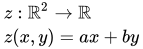
where a and b are real non-zero constants. Using the three-dimensional Cartesian coordinate system, where the xy plane is the domain R2 and the z axis is the codomain R, one can visualize the image to be a two-dimensional plane, with a slope of a in the positive x direction and a slope of b in the positive y direction. The function is well-defined at all points (x, y) in R2. The previous example can be extended easily to higher dimensions:

for p non-zero real constants a1, a2, …, ap, which describes a p-dimensional hyperplane.

The Euclidean norm:

is also a function of n variables which is everywhere defined, while
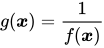
is defined only for x ≠ (0, 0, …, 0).

For a non-linear example function in two variables:
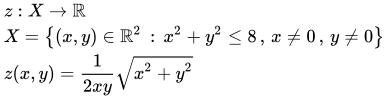
which takes in all points in X, a disk of radius 8 "punctured" at the origin (x, y) = (0, 0) in the plane R2, and returns a point in R. The function does not include the origin (x, y) = (0, 0), if it did then f would be ill-defined at that point. Using a 3d Cartesian coordinate system with the xy-plane as the domain R2, and the z axis the codomain R, the image can be visualized as a curved surface.

The function can be evaluated at the point (x, y) = (2, 3) in X:

However, the function couldn't be evaluated at, say

since these values of x and y do not satisfy the domain's rule.

Image

[edit]

The image of a function f(x1, x2, …, xn) is the set of all values of f when the n-tuple (x1, x2, …, xn) runs in the whole domain of f. For a continuous (see below for a definition) real-valued function which has a connected domain, the image is either an interval or a single value. In the latter case, the function is a constant function.

The preimage of a given real number c is called a level set. It is the set of the solutions of the equation f(x1, x2, …, xn) = c.

Domain

[edit]

The domain of a function of several real variables is a subset of Rn that is sometimes, but not always, explicitly defined. In fact, if one restricts the domain X of a function f to a subset YX, one gets formally a different function, the restriction of f to Y, which is denoted . In practice, it is often (but not always) not harmful to identify f and , and to omit the restrictor |Y.

Conversely, it is sometimes possible to enlarge naturally the domain of a given function, for example by continuity or by analytic continuation.

Moreover, many functions are defined in such a way that it is difficult to specify explicitly their domain. For example, given a function f, it may be difficult to specify the domain of the function If f is a multivariate polynomial, (which has as a domain), it is even difficult to test whether the domain of g is also . This is equivalent to test whether a polynomial is always positive, and is the object of an active research area (see Positive polynomial).

Algebraic structure

[edit]

The usual operations of arithmetic on the reals may be extended to real-valued functions of several real variables in the following way:

  • For every real number r, the constant function is everywhere defined.
  • For every real number r and every function f, the function: has the same domain as f (or is everywhere defined if r = 0).
  • If f and g are two functions of respective domains X and Y such that XY contains a nonempty open subset of Rn, then and are functions that have a domain containing XY.

It follows that the functions of n variables that are everywhere defined and the functions of n variables that are defined in some neighbourhood of a given point both form commutative algebras over the reals (R-algebras). This is a prototypical example of a function space.

One may similarly define

which is a function only if the set of the points (x1, …,xn) in the domain of f such that f(x1, …, xn) ≠ 0 contains an open subset of Rn. This constraint implies that the above two algebras are not fields.

Univariable functions associated with a multivariable function

[edit]

One can easily obtain a function in one real variable by giving a constant value to all but one of the variables. For example, if (a1, …, an) is a point of the interior of the domain of the function f, we can fix the values of x2, …, xn to a2, …, an respectively, to get a univariable function

whose domain contains an interval centered at a1. This function may also be viewed as the restriction of the function f to the line defined by the equations xi = ai for i = 2, …, n.

Other univariable functions may be defined by restricting f to any line passing through (a1, …, an). These are the functions

where the ci are real numbers that are not all zero.

In next section, we will show that, if the multivariable function is continuous, so are all these univariable functions, but the converse is not necessarily true.

Continuity and limit

[edit]

Until the second part of 19th century, only continuous functions were considered by mathematicians. At that time, the notion of continuity was elaborated for the functions of one or several real variables a rather long time before the formal definition of a topological space and a continuous map between topological spaces. As continuous functions of several real variables are ubiquitous in mathematics, it is worth to define this notion without reference to the general notion of continuous maps between topological space.

For defining the continuity, it is useful to consider the distance function of Rn, which is an everywhere defined function of 2n real variables:

A function f is continuous at a point a = (a1, …, an) which is interior to its domain, if, for every positive real number ε, there is a positive real number φ such that |f(x) − f(a)| < ε for all x such that d(x a) < φ. In other words, φ may be chosen small enough for having the image by f of the ball of radius φ centered at a contained in the interval of length 2ε centered at f(a). A function is continuous if it is continuous at every point of its domain.

If a function is continuous at f(a), then all the univariate functions that are obtained by fixing all the variables xi except one at the value ai, are continuous at f(a). The converse is false; this means that all these univariate functions may be continuous for a function that is not continuous at f(a). For an example, consider the function f such that f(0, 0) = 0, and is otherwise defined by
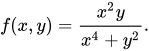
The functions xf(x, 0) and yf(0, y) are both constant and equal to zero, and are therefore continuous. The function f is not continuous at (0, 0), because, if ε < 1/2 and y = x2 ≠ 0, we have f(x, y) = 1/2, even if |x| is very small. Although not continuous, this function has the further property that all the univariate functions obtained by restricting it to a line passing through (0, 0) are also continuous. In fact, we have
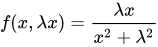
for λ ≠ 0.

The limit at a point of a real-valued function of several real variables is defined as follows.[1] Let a = (a1, a2, …, an) be a point in topological closure of the domain X of the function f. The function, f has a limit L when x tends toward a, denoted
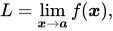
if the following condition is satisfied: For every positive real number ε > 0, there is a positive real number δ > 0 such that

for all x in the domain such that

If the limit exists, it is unique. If a is in the interior of the domain, the limit exists if and only if the function is continuous at a. In this case, we have
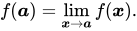
When a is in the boundary of the domain of f, and if f has a limit at a, the latter formula allows to "extend by continuity" the domain of f to a.

Symmetry

[edit]

A symmetric function is a function f that is unchanged when two variables xi and xj are interchanged:

where i and j are each one of 1, 2, …, n. For example:

is symmetric in x, y, z since interchanging any pair of x, y, z leaves f unchanged, but is not symmetric in all of x, y, z, t, since interchanging t with x or y or z gives a different function.

Function composition

[edit]

Suppose the functions

or more compactly ξ = ξ(x), are all defined on a domain X. As the n-tuple x = (x1, x2, …, xn) varies in X, a subset of Rn, the m-tuple ξ = (ξ1, ξ2, …, ξm) varies in another region Ξ a subset of Rm. To restate this:

Then, a function ζ of the functions ξ(x) defined on Ξ,
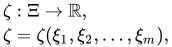
is a function composition defined on X,[2] in other terms the mapping

Note the numbers m and n do not need to be equal.

For example, the function

defined everywhere on R2 can be rewritten by introducing

which is also everywhere defined in R3 to obtain

Function composition can be used to simplify functions, which is useful for carrying out multiple integrals and solving partial differential equations.

Calculus

[edit]

Elementary calculus is the calculus of real-valued functions of one real variable, and the principal ideas of differentiation and integration of such functions can be extended to functions of more than one real variable; this extension is multivariable calculus.

Partial derivatives

[edit]

Partial derivatives can be defined with respect to each variable:

Partial derivatives themselves are functions, each of which represents the rate of change of f parallel to one of the x1, x2, …, xn axes at all points in the domain (if the derivatives exist and are continuous—see also below). A first derivative is positive if the function increases along the direction of the relevant axis, negative if it decreases, and zero if there is no increase or decrease. Evaluating a partial derivative at a particular point in the domain gives the rate of change of the function at that point in the direction parallel to a particular axis, a real number.

For real-valued functions of a real variable, y = f(x), its ordinary derivative dy/dx is geometrically the gradient of the tangent line to the curve y = f(x) at all points in the domain. Partial derivatives extend this idea to tangent hyperplanes to a curve.

The second order partial derivatives can be calculated for every pair of variables:

Geometrically, they are related to the local curvature of the function's image at all points in the domain. At any point where the function is well-defined, the function could be increasing along some axes, and/or decreasing along other axes, and/or not increasing or decreasing at all along other axes.

This leads to a variety of possible stationary points: global or local maxima, global or local minima, and saddle points—the multidimensional analogue of inflection points for real functions of one real variable. The Hessian matrix is a matrix of all the second order partial derivatives, which are used to investigate the stationary points of the function, important for mathematical optimization.

In general, partial derivatives of higher order p have the form:

where p1, p2, …, pn are each integers between 0 and p such that p1 + p2 + ⋯ + pn = p, using the definitions of zeroth partial derivatives as identity operators:

The number of possible partial derivatives increases with p, although some mixed partial derivatives (those with respect to more than one variable) are superfluous, because of the symmetry of second order partial derivatives. This reduces the number of partial derivatives to calculate for some p.

Multivariable differentiability

[edit]

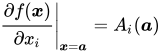
A function f(x) is differentiable in a neighborhood of a point a if there is an n-tuple of numbers dependent on a in general, A(a) = (A1(a), A2(a), …, An(a)), so that:[3]

where as . This means that if f is differentiable at a point a, then f is continuous at x = a, although the converse is not true - continuity in the domain does not imply differentiability in the domain. If f is differentiable at a then the first order partial derivatives exist at a and:

for i = 1, 2, …, n, which can be found from the definitions of the individual partial derivatives, so the partial derivatives of f exist.

Assuming an n-dimensional analogue of a rectangular Cartesian coordinate system, these partial derivatives can be used to form a vectorial linear differential operator, called the gradient (also known as "nabla" or "del") in this coordinate system:

used extensively in vector calculus, because it is useful for constructing other differential operators and compactly formulating theorems in vector calculus.

Then substituting the gradient f (evaluated at x = a) with a slight rearrangement gives:

where · denotes the dot product. This equation represents the best linear approximation of the function f at all points x within a neighborhood of a. For infinitesimal changes in f and x as xa:

which is defined as the total differential, or simply differential, of f, at a. This expression corresponds to the total infinitesimal change of f, by adding all the infinitesimal changes of f in all the xi directions. Also, df can be construed as a covector with basis vectors as the infinitesimals dxi in each direction and partial derivatives of f as the components.

Geometrically f is perpendicular to the level sets of f, given by f(x) = c which for some constant c describes an (n − 1)-dimensional hypersurface. The differential of a constant is zero:

in which dx is an infinitesimal change in x in the hypersurface f(x) = c, and since the dot product of f and dx is zero, this means f is perpendicular to dx.

In arbitrary curvilinear coordinate systems in n dimensions, the explicit expression for the gradient would not be so simple - there would be scale factors in terms of the metric tensor for that coordinate system. For the above case used throughout this article, the metric is just the Kronecker delta and the scale factors are all 1.

Differentiability classes

[edit]

If all first order partial derivatives evaluated at a point a in the domain:

exist and are continuous for all a in the domain, f has differentiability class C1. In general, if all order p partial derivatives evaluated at a point a:
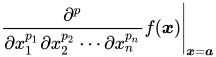
exist and are continuous, where p1, p2, …, pn, and p are as above, for all a in the domain, then f is differentiable to order p throughout the domain and has differentiability class C p.

If f is of differentiability class C, f has continuous partial derivatives of all order and is called smooth. If f is an analytic function and equals its Taylor series about any point in the domain, the notation Cω denotes this differentiability class.

Multiple integration

[edit]

Definite integration can be extended to multiple integration over the several real variables with the notation;

where each region R1, R2, …, Rn is a subset of or all of the real line:

and their Cartesian product gives the region to integrate over as a single set:

an n-dimensional hypervolume. When evaluated, a definite integral is a real number if the integral converges in the region R of integration (the result of a definite integral may diverge to infinity for a given region, in such cases the integral remains ill-defined). The variables are treated as "dummy" or "bound" variables which are substituted for numbers in the process of integration.

The integral of a real-valued function of a real variable y = f(x) with respect to x has geometric interpretation as the area bounded by the curve y = f(x) and the x-axis. Multiple integrals extend the dimensionality of this concept: assuming an n-dimensional analogue of a rectangular Cartesian coordinate system, the above definite integral has the geometric interpretation as the n-dimensional hypervolume bounded by f(x) and the x1, x2, …, xn axes, which may be positive, negative, or zero, depending on the function being integrated (if the integral is convergent).

While bounded hypervolume is a useful insight, the more important idea of definite integrals is that they represent total quantities within space. This has significance in applied mathematics and physics: if f is some scalar density field and x are the position vector coordinates, i.e. some scalar quantity per unit n-dimensional hypervolume, then integrating over the region R gives the total amount of quantity in R. The more formal notions of hypervolume is the subject of measure theory. Above we used the Lebesgue measure, see Lebesgue integration for more on this topic.

Theorems

[edit]

With the definitions of multiple integration and partial derivatives, key theorems can be formulated, including the fundamental theorem of calculus in several real variables (namely Stokes' theorem), integration by parts in several real variables, the symmetry of higher partial derivatives and Taylor's theorem for multivariable functions. Evaluating a mixture of integrals and partial derivatives can be done by using theorem differentiation under the integral sign.

Vector calculus

[edit]

One can collect a number of functions each of several real variables, say

into an m-tuple, or sometimes as a column vector or row vector, respectively:

all treated on the same footing as an m-component vector field, and use whichever form is convenient. All the above notations have a common compact notation y = f(x). The calculus of such vector fields is vector calculus. For more on the treatment of row vectors and column vectors of multivariable functions, see matrix calculus.

Implicit functions

[edit]

A real-valued implicit function of several real variables is not written in the form "y = f(…)". Instead, the mapping is from the space Rn + 1 to the zero element in R (just the ordinary zero 0):
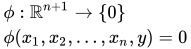
is an equation in all the variables. Implicit functions are a more general way to represent functions, since if:

then we can always define:

but the converse is not always possible, i.e. not all implicit functions have an explicit form.

For example, using interval notation, let

Choosing a 3-dimensional (3D) Cartesian coordinate system, this function describes the surface of a 3D ellipsoid centered at the origin (x, y, z) = (0, 0, 0) with constant semi-major axes a, b, c, along the positive x, y and z axes respectively. In the case a = b = c = r, we have a sphere of radius r centered at the origin. Other conic section examples which can be described similarly include the hyperboloid and paraboloid, more generally so can any 2D surface in 3D Euclidean space. The above example can be solved for x, y or z; however it is much tidier to write it in an implicit form.

For a more sophisticated example:

for non-zero real constants A, B, C, ω, this function is well-defined for all (t, x, y, z), but it cannot be solved explicitly for these variables and written as "t =", "x =", etc.

The implicit function theorem of more than two real variables deals with the continuity and differentiability of the function, as follows.[4] Let ϕ(x1, x2, …, xn) be a continuous function with continuous first order partial derivatives, and let ϕ evaluated at a point (a, b) = (a1, a2, …, an, b) be zero:

and let the first partial derivative of ϕ with respect to y evaluated at (a, b) be non-zero:
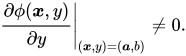
Then, there is an interval [y1, y2] containing b, and a region R containing (a, b), such that for every x in R there is exactly one value of y in [y1, y2] satisfying ϕ(x, y) = 0, and y is a continuous function of x so that ϕ(x, y(x)) = 0. The total differentials of the functions are:


Substituting dy into the latter differential and equating coefficients of the differentials gives the first order partial derivatives of y with respect to xi in terms of the derivatives of the original function, each as a solution of the linear equation
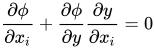
for i = 1, 2, …, n.

Complex-valued function of several real variables

[edit]

A complex-valued function of several real variables may be defined by relaxing, in the definition of the real-valued functions, the restriction of the codomain to the real numbers, and allowing complex values.

If f(x1, …, xn) is such a complex valued function, it may be decomposed as

where g and h are real-valued functions. In other words, the study of the complex valued functions reduces easily to the study of the pairs of real valued functions.

This reduction works for the general properties. However, for an explicitly given function, such as:

the computation of the real and the imaginary part may be difficult.

Applications

[edit]

Multivariable functions of real variables arise inevitably in engineering and physics, because observable physical quantities are real numbers (with associated units and dimensions), and any one physical quantity will generally depend on a number of other quantities.

Examples of real-valued functions of several real variables

[edit]

Examples in continuum mechanics include the local mass density ρ of a mass distribution, a scalar field which depends on the spatial position coordinates (here Cartesian to exemplify), r = (x, y, z), and time t:

Similarly for electric charge density for electrically charged objects, and numerous other scalar potential fields.

Another example is the velocity field, a vector field, which has components of velocity v = (vx, vy, vz) that are each multivariable functions of spatial coordinates and time similarly:

Similarly for other physical vector fields such as electric fields and magnetic fields, and vector potential fields.

Another important example is the equation of state in thermodynamics, an equation relating pressure P, temperature T, and volume V of a fluid, in general it has an implicit form:

The simplest example is the ideal gas law:

where n is the number of moles, constant for a fixed amount of substance, and R the gas constant. Much more complicated equations of state have been empirically derived, but they all have the above implicit form.

Real-valued functions of several real variables appear pervasively in economics. In the underpinnings of consumer theory, utility is expressed as a function of the amounts of various goods consumed, each amount being an argument of the utility function. The result of maximizing utility is a set of demand functions, each expressing the amount demanded of a particular good as a function of the prices of the various goods and of income or wealth. In producer theory, a firm is usually assumed to maximize profit as a function of the quantities of various goods produced and of the quantities of various factors of production employed. The result of the optimization is a set of demand functions for the various factors of production and a set of supply functions for the various products; each of these functions has as its arguments the prices of the goods and of the factors of production.

Examples of complex-valued functions of several real variables

[edit]

Some "physical quantities" may be actually complex valued - such as complex impedance, complex permittivity, complex permeability, and complex refractive index. These are also functions of real variables, such as frequency or time, as well as temperature.

In two-dimensional fluid mechanics, specifically in the theory of the potential flows used to describe fluid motion in 2d, the complex potential

is a complex valued function of the two spatial coordinates x and y, and other real variables associated with the system. The real part is the velocity potential and the imaginary part is the stream function.

The spherical harmonics occur in physics and engineering as the solution to Laplace's equation, as well as the eigenfunctions of the z-component angular momentum operator, which are complex-valued functions of real-valued spherical polar angles:

In quantum mechanics, the wavefunction is necessarily complex-valued, but is a function of real spatial coordinates (or momentum components), as well as time t:

where each is related by a Fourier transform.

See also

[edit]

References

[edit]
Revisions and contributorsEdit on WikipediaRead on Wikipedia
from Grokipedia
A function of several real variables, also known as a multivariable function, is a mapping from a subset of Euclidean space Rn\mathbb{R}^n (where n2n \geq 2) to Rm\mathbb{R}^m, where the input is an ordered tuple or vector of nn real numbers and the output is either a single real number (scalar-valued) or a tuple of mm real numbers (vector-valued).[1] These functions extend the ideas of single-variable calculus to higher dimensions, allowing the modeling of phenomena that depend on multiple independent factors, such as temperature distributions in a room or profit maximization in economics.[2] In mathematical analysis, they form the foundation for studying limits, continuity, differentiability, and integration in multiple dimensions.[3] The domain of such a function is typically a region in Rn\mathbb{R}^n, often visualized as a 2D area for n=2n=2 or generalized to higher-dimensional volumes, while the graph of a scalar-valued function f:RnRf: \mathbb{R}^n \to \mathbb{R} forms a hypersurface in Rn+1\mathbb{R}^{n+1}.[4] For instance, in two variables, the graph is a surface in 3D space, and tools like level curves (sets where f(x,y)=cf(x,y) = c) or traces (intersections with coordinate planes) aid in understanding its shape.[2] Continuity at a point aRna \in \mathbb{R}^n requires that the limit of f(x)f(x) as xx approaches aa (in the Euclidean norm) equals f(a)f(a), independent of the approach path, generalizing the single-variable notion.[3] Differentiability extends to partial derivatives (with respect to each variable, holding others fixed) and the total derivative, represented by the Jacobian matrix for vector-valued functions, which provides the best linear approximation at a point.[5] A function is differentiable at aa if limh0f(a+h)f(a)Df(a)hh=0\lim_{h \to 0} \frac{\|f(a + h) - f(a) - Df(a) \cdot h\|}{\|h\|} = 0, where Df(a)Df(a) is the linear transformation (Jacobian).[6] This concept is crucial for optimization, where critical points are found by setting partial derivatives to zero, with applications in physics (e.g., velocity fields) and engineering (e.g., constraint satisfaction).[7] Integration of functions of several variables involves multiple integrals over regions in Rn\mathbb{R}^n, such as double integrals for area under surfaces or triple integrals for volume, enabling computations like mass or center of gravity in applied settings.[8] These integrals, often evaluated using iterated integrals via Fubini's theorem, underpin advanced topics like vector calculus theorems (Green's, Stokes', divergence) and partial differential equations.[9] Overall, functions of several real variables are indispensable in modeling real-world multivariable dependencies across mathematics, science, and economics.[10]

Definition and Fundamentals

Formal Definition

A function of several real variables is formally defined as a mapping $ f: D \subseteq \mathbb{R}^n \to \mathbb{R}^m $, where $ n \geq 2 $ and $ m \geq 1 $, with $ D $ denoting a nonempty subset of the Euclidean space $ \mathbb{R}^n $. This setup encompasses both scalar-valued functions (when $ m = 1 $) and vector-valued functions (when $ m > 1 $), providing a framework for analyzing dependencies among multiple inputs. Unlike functions of a single real variable, which map from subsets of $ \mathbb{R} $ to $ \mathbb{R} $ or $ \mathbb{R}^m ,functionsofseveralrealvariablesoperateoverhigherdimensionaldomains,enablingthestudyofphenomenainspaceslikeplanes(, functions of several real variables operate over higher-dimensional domains, enabling the study of phenomena in spaces like planes ( n=2 )orvolumes() or volumes ( n=3 $), where interactions between variables introduce new geometric and analytical complexities.[11] In the vector-valued case, the function takes the general form $ f(x_1, x_2, \dots, x_n) = (f_1(x_1, x_2, \dots, x_n), \dots, f_m(x_1, x_2, \dots, x_n)) $, where each component $ f_i: D \to \mathbb{R} $ is a real-valued function of the $ n $ variables, and $ x = (x_1, \dots, x_n) \in D $.[12] The origins of this concept trace back to the 18th century, when Leonhard Euler and Joseph-Louis Lagrange extended analytical methods to functions depending on multiple variables, particularly in their foundational work on the calculus of variations.[13]

Domain and Codomain

In the context of functions of several real variables, the domain of a function f:DRmf: D \to \mathbb{R}^m, where DRnD \subseteq \mathbb{R}^n, is the set DD from which the inputs are drawn, typically chosen as a nonempty subset of Rn\mathbb{R}^n to ensure the function is well-defined.[14] Often, DD is taken to be an open subset of Rn\mathbb{R}^n to facilitate analysis such as differentiability, though closed or other subsets may be used depending on the application.[15] Common examples include open balls B(a,r)={xRnxa<r}B(a, r) = \{ x \in \mathbb{R}^n \mid \|x - a\| < r \}, which are bounded and connected regions centered at a point aa with radius r>0r > 0, and rectangular domains such as products of open intervals, like (a1,b1)××(an,bn)(a_1, b_1) \times \cdots \times (a_n, b_n), which provide simple Cartesian structures for computation.[16] More generally, domains can be open sets in Rn\mathbb{R}^n that form manifolds without boundary, allowing for smooth extensions of single-variable concepts to higher dimensions.[17] The codomain of ff is specified as Rm\mathbb{R}^m, the target space in which the outputs reside, though in some contexts it may extend to Cm\mathbb{C}^m if complex values are considered, but for real-variable functions, Rm\mathbb{R}^m is standard.[14] The actual outputs form the image (or range) f(D)Rmf(D) \subseteq \mathbb{R}^m, which is the subset of the codomain attained by applying ff to elements of DD, and this image may be proper if ff is not surjective.[14] This distinction ensures that the codomain provides an upper bound on possible values, while the image captures the function's effective reach, as seen in examples like the projection functions where the image fills the entire codomain.[15] Domains for functions of several real variables often exhibit specific topological and measure-theoretic properties that influence their suitability for further study, such as integration or optimization. Connectedness means DD cannot be partitioned into disjoint nonempty open subsets, ensuring a single "piece" for global behavior analysis, and is commonly assumed for open domains like balls or rectangles.[16] Boundedness requires DD to fit within some ball of finite radius, which aids in compactness arguments when combined with closure, as in closed balls that are compact in Rn\mathbb{R}^n.[16] For readiness in Riemann integration, domains are frequently required to be Jordan measurable, meaning their boundary has Jordan measure zero; bounded open sets with piecewise smooth boundaries, such as rectangles or balls, satisfy this property.[16] The graph of ff is the set Γf={(x,y)Rn×Rmy=f(x),xD}\Gamma_f = \{ (x, y) \in \mathbb{R}^n \times \mathbb{R}^m \mid y = f(x), \, x \in D \}, a subset of Rn+m\mathbb{R}^{n+m} that embeds the function's behavior, and for sufficiently regular ff, it forms a hypersurface of dimension nn in this higher-dimensional space.[18] This contrasts with the domain DD, which is solely the input space, as the graph incorporates both inputs and outputs to visualize the mapping relation introduced formally elsewhere. Level sets, for scalar-valued functions (m=1m=1), are the subsets Lc={xDf(x)=c}L_c = \{ x \in D \mid f(x) = c \} for constants cRc \in \mathbb{R}, which partition the domain into regions of constant output and typically form hypersurfaces of dimension n1n-1 within DD, distinct from both the domain and graph by focusing on preimages rather than the full mapping or product structure.[15]

Notation and Graphical Representation

Functions of several real variables are typically denoted using subscripted variables for scalar-valued functions, such as f(x1,x2,,xn)f(x_1, x_2, \dots, x_n) where x=(x1,x2,,xn)Rn\mathbf{x} = (x_1, x_2, \dots, x_n) \in \mathbb{R}^n and f:RnRf: \mathbb{R}^n \to \mathbb{R}.[2] This notation emphasizes the independent variables explicitly. For vector-valued functions f:RnRm\mathbf{f}: \mathbb{R}^n \to \mathbb{R}^m, boldface is often used, as in f(x)\mathbf{f}(\mathbf{x}), to distinguish the output as a vector. Coordinate-free forms, such as f(x)f(\mathbf{x}) without explicit components, are also common in more abstract contexts to highlight vector space structure.[19] Graphical representation aids in understanding these functions, particularly for low dimensions. For scalar functions f:R2Rf: \mathbb{R}^2 \to \mathbb{R}, the graph is a surface in R3\mathbb{R}^3, plotted as z=f(x,y)z = f(x, y) to visualize height variations over the domain.[15] Contour plots, or level curves, depict sets where f(x,y)=kf(x, y) = k for constant kk, providing a 2D projection that reveals gradients and critical points without full 3D rendering.[20] For vector-valued functions f:RnRn\mathbf{f}: \mathbb{R}^n \to \mathbb{R}^n, such as vector fields, visualization uses arrow plots where each arrow at point x\mathbf{x} represents f(x)\mathbf{f}(\mathbf{x}), illustrating direction and magnitude; streamlines may trace integral curves for flow interpretation.[21] Visualizing functions for n>3n > 3 faces inherent limitations due to human perception confined to three spatial dimensions, making direct graphs impossible.[22] Common techniques include slicing, where some variables are fixed to reduce dimensionality (e.g., traces by setting x3=cx_3 = c), or projections onto lower-dimensional subspaces to approximate behavior.[15] Level sets generalize contours to higher dimensions as hypersurfaces where f(x)=kf(\mathbf{x}) = k.[23] Software tools facilitate these representations; for instance, MATLAB supports surface and quiver plots for 3D surfaces and vector fields, while Python's Matplotlib library offers similar capabilities for contour and arrow visualizations without requiring custom code for basic rendering.[24][25]

Basic Properties

Continuity and Limits

In the context of functions from Rn\mathbb{R}^n to Rm\mathbb{R}^m, the limit of a function f:DRnRmf: D \subseteq \mathbb{R}^n \to \mathbb{R}^m as xa\mathbf{x} \to \mathbf{a} (where aRn\mathbf{a} \in \mathbb{R}^n and a\mathbf{a} may or may not be in DD) is defined using the ϵ\epsilon-δ\delta criterion. Specifically, limxaf(x)=L\lim_{\mathbf{x} \to \mathbf{a}} f(\mathbf{x}) = L if for every ϵ>0\epsilon > 0, there exists δ>0\delta > 0 such that if 0<xa<δ0 < \|\mathbf{x} - \mathbf{a}\| < \delta, then f(x)L<ϵ\|f(\mathbf{x}) - L\| < \epsilon, where \|\cdot\| denotes the Euclidean norm.[26] This definition generalizes the single-variable case by considering neighborhoods in Rn\mathbb{R}^n as open balls centered at a\mathbf{a}, excluding a\mathbf{a} itself to focus on approaching behavior.[27] A function ff is continuous at aD\mathbf{a} \in D if limxaf(x)=f(a)\lim_{\mathbf{x} \to \mathbf{a}} f(\mathbf{x}) = f(\mathbf{a}), which, by the ϵ\epsilon-δ\delta definition, means for every ϵ>0\epsilon > 0, there exists δ>0\delta > 0 such that if xa<δ\|\mathbf{x} - \mathbf{a}\| < \delta and xD\mathbf{x} \in D, then f(x)f(a)<ϵ\|f(\mathbf{x}) - f(\mathbf{a})\| < \epsilon.[27] Continuity is pointwise, holding at individual points, but uniform continuity strengthens this to apply across the entire domain: for every ϵ>0\epsilon > 0, there exists δ>0\delta > 0 such that for all x,yD\mathbf{x}, \mathbf{y} \in D with xy<δ\|\mathbf{x} - \mathbf{y}\| < \delta, f(x)f(y)<ϵ\|f(\mathbf{x}) - f(\mathbf{y})\| < \epsilon, independent of the specific points.[28] Pointwise continuity does not imply uniform continuity on unbounded domains, though continuous functions on compact subsets of Rn\mathbb{R}^n are uniformly continuous.[28] Unlike single-variable limits, multivariable limits can depend on the path taken to approach a\mathbf{a}, complicating existence. For instance, consider f(x,y)=xyx2+y2f(x,y) = \frac{xy}{x^2 + y^2} as (x,y)(0,0)(x,y) \to (0,0). Along the x-axis (y=0y=0), the limit is 0; along the y-axis (x=0x=0), it is also 0; but along y=xy=x, it is 12\frac{1}{2}. Since different paths yield different values, the limit does not exist.[29] Such path dependence arises because Rn\mathbb{R}^n for n2n \geq 2 allows infinitely many approach directions, requiring consistency across all for the limit to exist.[29] An equivalent sequential characterization states that limxaf(x)=L\lim_{\mathbf{x} \to \mathbf{a}} f(\mathbf{x}) = L if and only if for every sequence {xk}k=1\{\mathbf{x}_k\}_{k=1}^\infty in D{a}D \setminus \{\mathbf{a}\} with xka\mathbf{x}_k \to \mathbf{a}, we have f(xk)Lf(\mathbf{x}_k) \to L.[27] This is useful for proving non-existence: if two sequences approaching a\mathbf{a} give subsequences of ff converging to different limits, the overall limit fails. Limits are unique when they exist, and for vector-valued functions, the limit holds if and only if it holds componentwise.[27]

Symmetry Properties

In the context of functions f:RnRf: \mathbb{R}^n \to \mathbb{R}, symmetry properties generalize concepts from single-variable calculus to higher dimensions, capturing invariances under geometric transformations such as reflections and translations. These properties are fundamental in analysis, aiding in simplification of integrals, Fourier representations, and understanding function behavior over symmetric domains.[30] An even function satisfies f(x)=f(x)f(-x) = f(x) for all xRnx \in \mathbb{R}^n, where x=(x1,,xn)-x = (-x_1, \dots, -x_n) denotes componentwise negation; this condition implies symmetry under reflection through the origin, extending the one-dimensional notion to invariance across the origin in all directions or, more generally, reflections over coordinate hyperplanes.[30] For example, the function f(x)=x2f(x) = \|x\|^2 is even, as f(x)=i=1n(xi)2=i=1nxi2=f(x)f(-x) = \sum_{i=1}^n (-x_i)^2 = \sum_{i=1}^n x_i^2 = f(x), reflecting rotational symmetry combined with evenness. This property preserves under addition and multiplication of even functions, facilitating decompositions in harmonic analysis.[30] An odd function, in contrast, obeys f(x)=f(x)f(-x) = -f(x) for all xRnx \in \mathbb{R}^n, corresponding to antisymmetry with respect to the origin, such that the graph is invariant under 180-degree rotation about the origin.[30] A key implication is that f(0)=0f(0) = 0 if the origin is in the domain, assuming continuity at the origin; for instance, f(x)=x1x2xnf(x) = x_1 x_2 \cdots x_n is odd in Rn\mathbb{R}^n, as negating all components yields the negative value. Products of odd and even functions yield odd functions, and sums of odd functions remain odd, which is useful for parity arguments in integration over symmetric regions.[30] Radial symmetry arises when a function depends solely on the Euclidean norm x=i=1nxi2\|x\| = \sqrt{\sum_{i=1}^n x_i^2}, expressed as f(x)=g(x)f(x) = g(\|x\|) for some scalar function g:[0,)Rg: [0, \infty) \to \mathbb{R}; such functions are constant on spheres centered at the origin, exhibiting full rotational invariance in Rn\mathbb{R}^n.[31] An example is the Coulomb potential f(x)=1xf(x) = \frac{1}{\|x\|} for x0x \neq 0, which models distance-dependent interactions and simplifies to one-dimensional integration in spherical coordinates. Radial functions often appear in solutions to Laplace's equation and are positive definite in certain contexts, supporting approximations via basis expansions.[31] Periodic functions in multiple variables extend periodicity along lattice directions, such as f(x+2πei)=f(x)f(x + 2\pi e_i) = f(x) for each standard basis vector ei=(0,,1,,0)e_i = (0, \dots, 1, \dots, 0) with 1 in the ii-th position, where i=1,,ni = 1, \dots, n; this defines double-periodicity in each coordinate, making the function invariant under translations by multiples of 2π2\pi along the axes, suitable for domains like the nn-torus.[32] For instance, f(x)=sin(x1)cos(x2)f(x) = \sin(x_1) \cos(x_2) in R2\mathbb{R}^2 satisfies the condition, as each term is periodic with period 2π2\pi independently. This structure underpins multivariate Fourier series, where expansions use products of single-variable trigonometrics, enabling analysis of signals on periodic grids.[32]

Function Composition

In the context of functions of several real variables, the composition of two functions f:RnRmf: \mathbb{R}^n \to \mathbb{R}^m and g:RmRpg: \mathbb{R}^m \to \mathbb{R}^p, denoted gfg \circ f, is defined by (gf)(x)=g(f(x))(g \circ f)(\mathbf{x}) = g(f(\mathbf{x})) for all xRn\mathbf{x} \in \mathbb{R}^n such that the expression is well-defined.[33] The domain of the composite function gfg \circ f is the subset of the domain of ff consisting of those points x\mathbf{x} for which f(x)f(\mathbf{x}) lies in the domain of gg, ensuring that the output of ff serves as a valid input for gg.[33] This restriction arises naturally from the need to match the codomain of ff with the domain of gg, and it highlights how composition imposes additional constraints compared to the individual domains of ff and gg. A concrete example illustrates this process: consider a projection function f:R3R2f: \mathbb{R}^3 \to \mathbb{R}^2 defined by f(x,y,z)=(x,y)f(x, y, z) = (x, y), which discards the zz-coordinate, followed by a scalarization g:R2Rg: \mathbb{R}^2 \to \mathbb{R} given by g(u,v)=u2+vg(u, v) = u^2 + v. The composition gf:R3Rg \circ f: \mathbb{R}^3 \to \mathbb{R} then yields (gf)(x,y,z)=x2+y(g \circ f)(x, y, z) = x^2 + y, with domain all of R3\mathbb{R}^3 since the domain of gg is R2\mathbb{R}^2 and ff maps onto it fully.[33] Such compositions are common in reducing dimensionality, as in projecting spatial data before applying a norm or distance metric. Function composition is associative, meaning that for compatible functions f:RnRmf: \mathbb{R}^n \to \mathbb{R}^m, g:RmRpg: \mathbb{R}^m \to \mathbb{R}^p, and h:RpRqh: \mathbb{R}^p \to \mathbb{R}^q, we have (hg)f=h(gf)(h \circ g) \circ f = h \circ (g \circ f), allowing unambiguous chaining without parentheses./07%3A_Functions/7.03%3A_Function_Composition) Regarding differentiability, if ff and gg are differentiable at the relevant points, the chain rule provides a preview of how the derivative of the composition relates to those of the components: the derivative of gfg \circ f at x\mathbf{x} is the composition of the derivatives, (gf)(x)=g(f(x))f(x)(g \circ f)'(\mathbf{x}) = g'(f(\mathbf{x})) \cdot f'(\mathbf{x}), where the multiplication denotes the appropriate linear map composition (detailed in later sections on multivariable differentiability).[34] For invertibility, the composition gfg \circ f is bijective (and thus invertible) if and only if both ff and gg are bijective, with the inverse given by f1g1f^{-1} \circ g^{-1}; this links directly to the functions being bijections between their respective Euclidean spaces.[35]

Algebraic and Analytic Structures

Associated Scalar Functions

In the study of functions of several real variables, associated scalar functions are obtained by reducing the multivariable function to a single-variable form through specific operations, such as restrictions and projections. These scalar functions provide insights into the behavior of the original function along particular directions or subsets of the domain.[36] One common way to derive a scalar function is by restricting the multivariable function to a line in the domain. For a function f:RnRf: \mathbb{R}^n \to \mathbb{R} and a fixed direction vector aRn\mathbf{a} \in \mathbb{R}^n with a=1\|\mathbf{a}\| = 1, the restriction along the line through the origin in direction a\mathbf{a} is given by g(t)=f(ta)g(t) = f(t \mathbf{a}) for tRt \in \mathbb{R}, yielding a univariate function g:RRg: \mathbb{R} \to \mathbb{R}. More generally, the restriction along a line through a point x0\mathbf{x}_0 is g(t)=f(x0+ta)g(t) = f(\mathbf{x}_0 + t \mathbf{a}). This construction allows analysis of how ff varies linearly in specific directions, such as examining monotonicity or boundedness along paths. For instance, in two variables, restricting f(x,y)f(x, y) along the line y=mxy = mx by substituting y=mxy = mx produces h(x)=f(x,mx)h(x) = f(x, mx), which can reveal directional properties.[29] Partial evaluations, also known as partial functions, arise by fixing all but one variable to constant values. For f:RnRf: \mathbb{R}^n \to \mathbb{R}, fixing variables x2=c2,,xn=cnx_2 = c_2, \dots, x_n = c_n yields the scalar function g(x1)=f(x1,c2,,cn)g(x_1) = f(x_1, c_2, \dots, c_n), defined on an appropriate interval for x1x_1. In two dimensions, for example, fixing y=y0y = y_0 gives g(x)=f(x,y0)g(x) = f(x, y_0). These partial functions represent "slices" of the graph of ff, facilitating the study of variation with respect to a single input while holding others constant, which aids in understanding local behavior like increases or decreases in specific coordinates.[36] Coordinate projections provide another class of associated scalar functions inherent to the domain Rn\mathbb{R}^n. The ii-th coordinate projection πi:RnR\pi_i: \mathbb{R}^n \to \mathbb{R} is defined by πi(x1,,xn)=xi\pi_i(x_1, \dots, x_n) = x_i, extracting the ii-th component as a univariate function. These projections are linear and continuous, serving as fundamental tools to decompose vector inputs into scalar components for analyzing how ff depends on individual variables. Together, restrictions to lines, partial evaluations, and coordinate projections enable detailed examination of multivariable functions by breaking them down into manageable scalar forms, often highlighting aspects like path-dependent monotonicity.[37]

Algebraic Operations on Functions

Algebraic operations on functions of several real variables are defined pointwise, operating independently at each point in the common domain. For functions f:DRnRf: D \subseteq \mathbb{R}^n \to \mathbb{R} and g:ERnRg: E \subseteq \mathbb{R}^n \to \mathbb{R}, the domain of any combined function is the intersection DED \cap E.[9] Addition and subtraction are defined as (f+g)(x)=f(x)+g(x)(f + g)(\mathbf{x}) = f(\mathbf{x}) + g(\mathbf{x}) and (fg)(x)=f(x)g(x)(f - g)(\mathbf{x}) = f(\mathbf{x}) - g(\mathbf{x}), respectively, for all xDE\mathbf{x} \in D \cap E. These operations form an abelian group structure on the set of functions with a fixed domain, excluding the zero function for subtraction in certain contexts. Scalar multiplication by a constant cRc \in \mathbb{R} yields (cf)(x)=cf(x)(c f)(\mathbf{x}) = c \cdot f(\mathbf{x}), preserving the domain DD.[9][9] Multiplication of two functions is the pointwise product (fg)(x)=f(x)g(x)(f g)(\mathbf{x}) = f(\mathbf{x}) \cdot g(\mathbf{x}) for xDE\mathbf{x} \in D \cap E, which extends to the ring structure on the space of functions under addition and multiplication. These operations are bilinear and distributive: for scalars a,bRa, b \in \mathbb{R}, (af+bg)(x)=af(x)+bg(x)(a f + b g)(\mathbf{x}) = a f(\mathbf{x}) + b g(\mathbf{x}).[9][9] Polynomial functions in several variables are finite sums of monomials of the form ci1inx1i1xninc_{i_1 \dots i_n} x_1^{i_1} \cdots x_n^{i_n}, where ci1inRc_{i_1 \dots i_n} \in \mathbb{R} are coefficients and the exponents ij0i_j \geq 0 are non-negative integers; the total degree is the maximum of jij\sum_j i_j over the terms. A special case is homogeneous polynomials, where all monomials have the same total degree dd, satisfying p(tx)=tdp(x)p(t \mathbf{x}) = t^d p(\mathbf{x}) for tRt \in \mathbb{R} and xRn\mathbf{x} \in \mathbb{R}^n. Examples include the quadratic form p(x,y)=x2+xy+y2p(x, y) = x^2 + xy + y^2 in two variables (degree 2) or the cubic q(x,y,z)=x3+y3+z33xyzq(x, y, z) = x^3 + y^3 + z^3 - 3xyz in three variables (degree 3). The space of homogeneous polynomials of degree dd in nn variables has dimension (n+d1d)\binom{n + d - 1}{d}.[9][38] These pointwise operations preserve continuity: if ff and gg are continuous on an open set ORnO \subseteq \mathbb{R}^n, then so are f+gf + g, fgf - g, fgf g, and cfc f. Similarly, limits are preserved; if limxaf(x)=L\lim_{\mathbf{x} \to \mathbf{a}} f(\mathbf{x}) = L and limxag(x)=M\lim_{\mathbf{x} \to \mathbf{a}} g(\mathbf{x}) = M for aO\mathbf{a} \in O, then limxa(f+g)(x)=L+M\lim_{\mathbf{x} \to \mathbf{a}} (f + g)(\mathbf{x}) = L + M, limxa(fg)(x)=LM\lim_{\mathbf{x} \to \mathbf{a}} (f - g)(\mathbf{x}) = L - M, limxa(fg)(x)=LM\lim_{\mathbf{x} \to \mathbf{a}} (f g)(\mathbf{x}) = L M, and limxa(cf)(x)=cL\lim_{\mathbf{x} \to \mathbf{a}} (c f)(\mathbf{x}) = c L. Polynomial functions, being finite combinations of continuous power functions xjxjkx_j \mapsto x_j^k, are continuous everywhere on Rn\mathbb{R}^n.[9][9][9]

Differentiation

Partial Derivatives

In multivariable calculus, the partial derivative of a function f:RnRf: \mathbb{R}^n \to \mathbb{R} with respect to the ii-th variable xix_i at a point x=(x1,,xn)\mathbf{x} = (x_1, \dots, x_n) is defined as the limit
fxi(x)=limh0f(x+hei)f(x)h, \frac{\partial f}{\partial x_i}(\mathbf{x}) = \lim_{h \to 0} \frac{f(\mathbf{x} + h \mathbf{e}_i) - f(\mathbf{x})}{h},
provided the limit exists, where ei\mathbf{e}_i is the ii-th standard unit vector in Rn\mathbb{R}^n with 1 in the ii-th position and 0 elsewhere.[39] This definition captures the instantaneous rate of change of ff along the direction of the xix_i-axis while holding all other variables fixed. For instance, consider f(x,y)=x2yf(x, y) = x^2 y; then fx(x,y)=2xy\frac{\partial f}{\partial x}(x, y) = 2x y, obtained by differentiating with respect to xx and treating yy as a constant.[40] The collection of all first-order partial derivatives forms the gradient vector of ff, denoted f(x)=(fx1(x),,fxn(x))\nabla f(\mathbf{x}) = \left( \frac{\partial f}{\partial x_1}(\mathbf{x}), \dots, \frac{\partial f}{\partial x_n}(\mathbf{x}) \right), which is a vector in Rn\mathbb{R}^n.[41] This notation emphasizes the multivariable nature of the derivative, aggregating the directional sensitivities in each coordinate direction. Partial derivatives obey basic rules analogous to those in single-variable calculus. Linearity holds: for scalar constants a,ba, b and functions g,h:RnRg, h: \mathbb{R}^n \to \mathbb{R},
xi(ag+bh)=agxi+bhxi. \frac{\partial}{\partial x_i} (a g + b h) = a \frac{\partial g}{\partial x_i} + b \frac{\partial h}{\partial x_i}.
[40] The product rule applies similarly: for f=ghf = g h,
fxi=ghxi+hgxi. \frac{\partial f}{\partial x_i} = g \frac{\partial h}{\partial x_i} + h \frac{\partial g}{\partial x_i}.
[40] These rules facilitate computation by allowing treatment of other variables as constants during differentiation. Geometrically, the partial derivative fxi(x)\frac{\partial f}{\partial x_i}(\mathbf{x}) represents the slope of the tangent line to the graph of ff at x\mathbf{x} when traversing parallel to the xix_i-axis, providing insight into the function's behavior along individual coordinate directions.[42] For example, in the case of f(x,y,z)=xy+z2f(x, y, z) = x y + z^2, fy=x\frac{\partial f}{\partial y} = x indicates the rate of change in the yy-direction depends linearly on xx.[40]

Multivariable Differentiability

In multivariable calculus, a function $ f: \mathbb{R}^n \to \mathbb{R}^m $ is differentiable at a point $ a \in \mathbb{R}^n $ if there exists a linear map $ Df(a): \mathbb{R}^n \to \mathbb{R}^m $ such that
limh0f(a+h)f(a)Df(a)(h)h=0. \lim_{h \to 0} \frac{\| f(a + h) - f(a) - Df(a)(h) \|}{\| h \|} = 0.
Equivalently, this can be expressed as $ f(a + h) = f(a) + Df(a)(h) + o(| h |) $ as $ h \to 0 $, where the error term $ o(| h |) $ approaches zero faster than $ | h | $.[43][44] This condition generalizes the single-variable derivative by requiring a best linear approximation that works uniformly in all directions from $ a $. If it exists, the total derivative $ Df(a) $ is unique.[45] The total derivative $ Df(a) $ is represented in coordinates by the Jacobian matrix $ J_f(a) $, an $ m \times n $ matrix whose $ (i,j) $-entry is the partial derivative $ \frac{\partial f_i}{\partial x_j}(a) $, where $ f = (f_1, \dots, f_m) $ are the component functions and $ x = (x_1, \dots, x_n) $ are the input variables.[43] The action of the linear map is then $ Df(a)(h) = J_f(a) h $, providing the first-order Taylor approximation $ f(a + h) \approx f(a) + J_f(a) h $. For differentiability at $ a $, all partial derivatives must exist in a neighborhood of $ a $ and satisfy the limit condition above; their existence at $ a $ alone is necessary but insufficient.[44][45] A standard counterexample illustrating insufficiency is the function defined by $ f(x,y) = \frac{xy}{x^2 + y^2} $ for $ (x,y) \neq (0,0) $ and $ f(0,0) = 0 $. The partial derivatives at the origin are $ f_x(0,0) = 0 $ and $ f_y(0,0) = 0 $, since $ f(x,0) = 0 $ and $ f(0,y) = 0 $ for all $ x,y $. However, the function is not differentiable at $ (0,0) $, as the proposed linear approximation $ L(h,k) = 0 $ fails: along the path $ (t,t) $, $ f(t,t) = \frac{1}{2} $, so
f(t,t)f(0,0)L(t,t)t2+t2=1/22t \frac{|f(t,t) - f(0,0) - L(t,t)|}{\sqrt{t^2 + t^2}} = \frac{1/2}{\sqrt{2} |t|} \to \infty
as $ t \to 0 $, violating the limit condition. Differentiability supports composition via the chain rule: if $ f: \mathbb{R}^n \to \mathbb{R}^m $ is differentiable at $ a $ and $ g: \mathbb{R}^m \to \mathbb{R}^p $ is differentiable at $ f(a) $, then $ g \circ f $ is differentiable at $ a $ with total derivative
D(gf)(a)=Dg(f(a))Df(a). D(g \circ f)(a) = Dg(f(a)) \circ Df(a).
In matrix form, $ J_{g \circ f}(a) = J_g(f(a)) J_f(a) $.[43][44] This rule extends the single-variable chain rule to multivariable settings, enabling approximations for composite maps.

Higher-Order Derivatives and Smoothness

Higher-order partial derivatives of a function f:RnRf: \mathbb{R}^n \to \mathbb{R} are obtained by differentiating the first-order partial derivatives with respect to the variables. For a second-order partial derivative, one computes 2fxixj\frac{\partial^2 f}{\partial x_i \partial x_j} for i,j=1,,ni, j = 1, \dots, n, where the order of differentiation may differ for mixed partials when iji \neq j. These mixed partial derivatives satisfy 2fxixj=2fxjxi\frac{\partial^2 f}{\partial x_i \partial x_j} = \frac{\partial^2 f}{\partial x_j \partial x_i} provided the second partial derivatives are continuous in a neighborhood of the point, as established by Clairaut's theorem (also known as Young's theorem or Schwarz's theorem), originally stated in the 18th century and rigorously proved in the 19th century under the continuity assumption.[46][47] The Hessian matrix Hf(x)H_f(\mathbf{x}) collects all second-order partial derivatives into an n×nn \times n symmetric matrix, with entries (Hf)i,j=2fxixj(H_f)_{i,j} = \frac{\partial^2 f}{\partial x_i \partial x_j}, where symmetry follows from the equality of mixed partials. This matrix plays a central role in the second-order Taylor expansion of ff around a point a\mathbf{a}, approximating f(a+h)f(a)+f(a)h+12hTHf(a)hf(\mathbf{a} + \mathbf{h}) \approx f(\mathbf{a}) + \nabla f(\mathbf{a}) \cdot \mathbf{h} + \frac{1}{2} \mathbf{h}^T H_f(\mathbf{a}) \mathbf{h}, which captures the quadratic curvature of the function and is essential for analyzing local extrema and optimization.[48][49] Functions are classified by their smoothness based on the existence and continuity of higher-order derivatives. A function ff belongs to the class Ck(Ω)C^k(\Omega) for an open set ΩRn\Omega \subseteq \mathbb{R}^n and integer k0k \geq 0 if all partial derivatives of ff up to order kk exist and are continuous on Ω\Omega; here, C0C^0 denotes continuous functions, and C(Ω)C^\infty(\Omega) (or smooth functions) requires derivatives of all orders to exist and be continuous. These classes extend the single-variable notion to multiple variables, ensuring uniform behavior across directions, and are foundational for theorems requiring repeated differentiability, such as those in differential geometry and analysis.[50] The multivariable Taylor theorem generalizes the single-variable expansion using multi-index notation to handle higher orders compactly. For a multi-index α=(α1,,αn)N0n\alpha = (\alpha_1, \dots, \alpha_n) \in \mathbb{N}_0^n with α=αi|\alpha| = \sum \alpha_i, the kk-th order partial derivative is Dαf=αfx1α1xnαnD^\alpha f = \frac{\partial^{|\alpha|} f}{\partial x_1^{\alpha_1} \cdots \partial x_n^{\alpha_n}}, and α!=α1!αn!\alpha! = \alpha_1! \cdots \alpha_n!. If fCk(Ω)f \in C^k(\Omega), then for x,aΩ\mathbf{x}, \mathbf{a} \in \Omega with x\mathbf{x} sufficiently close to a\mathbf{a},
f(x)=αkDαf(a)α!(xa)α+Rk(x,a), f(\mathbf{x}) = \sum_{|\alpha| \leq k} \frac{D^\alpha f(\mathbf{a})}{\alpha!} (\mathbf{x} - \mathbf{a})^\alpha + R_k(\mathbf{x}, \mathbf{a}),
where the remainder RkR_k satisfies limxa0Rk(x,a)xak=0\lim_{|\mathbf{x} - \mathbf{a}| \to 0} \frac{|R_k(\mathbf{x}, \mathbf{a})|}{|\mathbf{x} - \mathbf{a}|^k} = 0, often expressed in Lagrange or integral form for precise error bounds. This expansion approximates ff by a polynomial of degree at most kk and is crucial for local analysis, numerical methods, and asymptotic studies in several variables.[51][52]

Integration

Multiple Integrals

In multivariable calculus, the multiple integral extends the concept of the single-variable integral to functions defined on domains in Rn\mathbb{R}^n. For a bounded domain DRnD \subseteq \mathbb{R}^n and a continuous function f:DRf: D \to \mathbb{R}, the multiple Riemann integral DfdV\int_D f \, dV is defined as the limit of Riemann sums over partitions of DD. Specifically, a partition PP of DD divides it into subregions with volumes ΔVk\Delta V_k, and the Riemann sum is kf(xk)ΔVk\sum_k f(\mathbf{x}_k) \Delta V_k, where xk\mathbf{x}_k is a sample point in the kk-th subregion; the integral exists and equals this limit as the norm of the partition (maximum diameter of subregions) approaches zero.[53] This construction generalizes the one-dimensional case, approximating the "volume under the graph" of ff over DD.[53] The volume element dVdV in Cartesian coordinates is expressed as dV=dx1dx2dxndV = dx_1 \, dx_2 \cdots dx_n, reflecting the product measure on the coordinate axes.[53] For continuous functions on compact domains, the Riemann integral is well-defined and coincides with more advanced theories, but it requires the domain DD to be Jordan measurable (with boundary of measure zero). While the Riemann approach suffices for continuous integrands, Lebesgue integration provides a robust framework for measurable functions on Lebesgue measurable sets in Rn\mathbb{R}^n, where measurability ensures the set can be approximated by unions of rectangles with negligible boundary contributions.[54] Multiple Riemann integrals exhibit key properties that facilitate computation and analysis. Linearity holds: for constants cc and functions f,gf, g integrable over DD, D(cf+g)dV=cDfdV+DgdV\int_D (c f + g) \, dV = c \int_D f \, dV + \int_D g \, dV.[55] Additivity over disjoint domains applies: if D=D1D2D = D_1 \cup D_2 with D1D2=D_1 \cap D_2 = \emptyset, then DfdV=D1fdV+D2fdV\int_D f \, dV = \int_{D_1} f \, dV + \int_{D_2} f \, dV.[53] Additionally, the integral preserves order for monotone functions: if fgf \geq g on DD, then DfdVDgdV\int_D f \, dV \geq \int_D g \, dV, and nonnegativity follows for nonnegative integrands.[55] These properties mirror those of the one-dimensional integral and underpin applications in probability, physics, and optimization.[53]

Iterated Integrals and Fubini's Theorem

In the context of functions of several real variables, an iterated integral reduces a multiple integral over a domain in Rn\mathbb{R}^n to a sequence of single-variable integrals by integrating successively with respect to each variable over appropriate projections of the domain. For a function f:DRnRf: D \subset \mathbb{R}^n \to \mathbb{R} where DD is a product domain D=D1××DnD = D_1 \times \cdots \times D_n with each DiRD_i \subset \mathbb{R}, the iterated integral is defined as
Df(x1,,xn)dx1dxn=Dn[[D1f(x1,,xn)dx1]dxn1]dxn, \int_D f(x_1, \dots, x_n) \, dx_1 \cdots dx_n = \int_{D_n} \left[ \cdots \left[ \int_{D_1} f(x_1, \dots, x_n) \, dx_1 \right] \cdots dx_{n-1} \right] dx_n,
where the inner integrals are taken over the respective projections while treating the outer variables as fixed. This construction leverages the product structure of the domain and aligns with the Riemann or Lebesgue integral in each step, providing a practical method to evaluate multiple integrals computationally.[56] Fubini's theorem establishes the equivalence between the multiple integral and its iterated form under suitable conditions, originally formulated by Guido Fubini for multiple integrals in 1907. In the measure-theoretic setting relevant to functions of several real variables, consider Lebesgue measure spaces (Rn,B,λn)(\mathbb{R}^n, \mathcal{B}, \lambda^n) where λn\lambda^n is the product Lebesgue measure, which is σ\sigma-finite. For a measurable function f:RnRf: \mathbb{R}^n \to \mathbb{R} on a measurable set DRnD \subset \mathbb{R}^n, if f0f \geq 0 or if Dfdλn<\int_D |f| \, d\lambda^n < \infty (i.e., ff is absolutely integrable), then ff is integrable over DD, the sections fx(xi)=f(x1,,xn)f_{x'} (x_i) = f(x_1, \dots, x_n) are integrable for almost every fixed coordinates xx' in the other variables, and the multiple integral equals the iterated integrals in any order:
Dfdλn=Dn[D1f(x1,,xn)dx1dxn1]dxn==D1[Dnf(x1,,xn)dx2dxn]dx1. \int_D f \, d\lambda^n = \int_{D_n} \left[ \cdots \int_{D_1} f(x_1, \dots, x_n) \, dx_1 \cdots dx_{n-1} \right] dx_n = \cdots = \int_{D_1} \left[ \cdots \int_{D_n} f(x_1, \dots, x_n) \, dx_2 \cdots dx_n \right] dx_1.
This holds more generally for σ\sigma-finite product measure spaces, ensuring the theorem's applicability to Euclidean domains.[57] The absolute integrability condition is crucial; without it, the iterated integrals may exist but differ or one may fail to converge, even if the multiple integral does. A classic counterexample involves an oscillating function on [0,1]×[0,1][0,1] \times [0,1] constructed as f(x,y)=n=1[gn(x)gn+1(x)]gn(y)f(x,y) = \sum_{n=1}^\infty [g_n(x) - g_{n+1}(x)] g_n(y), where each gng_n is a continuous function supported on shrinking intervals (δn,δn+1/n2)( \delta_n, \delta_n + 1/n^2 ) with gn(t)dt=1\int g_n(t) \, dt = 1 and δn0\delta_n \to 0. Here, 01(01f(x,y)dy)dx=\int_0^1 \left( \int_0^1 |f(x,y)| \, dy \right) dx = \infty, so absolute integrability fails; the iterated integral 01dx01f(x,y)dy=1\int_0^1 dx \int_0^1 f(x,y) \, dy = 1, but 01dy01f(x,y)dx=0\int_0^1 dy \int_0^1 f(x,y) \, dx = 0. Such examples highlight the necessity of the theorem's hypotheses for non-negative or L1L^1 functions.[57] Fubini's theorem facilitates practical computations in multivariable calculus, particularly for volumes and averages over regions in Rn\mathbb{R}^n. For instance, the volume of a solid region DR3D \subset \mathbb{R}^3 bounded by z=g(x,y)z = g(x,y) above the xyxy-plane is D1dV=abcdg(x,y)dydx\int_D 1 \, dV = \int_a^b \int_c^d g(x,y) \, dy \, dx via iteration, assuming gg is continuous and non-negative. Similarly, the average value of ff over DD is 1vol(D)DfdV\frac{1}{\mathrm{vol}(D)} \int_D f \, dV, computed as an iterated integral to yield quantities like mass centers or expected values in probability distributions on multiple variables. These applications underscore the theorem's role in reducing abstract multiple integrals to tractable single integrals./15%3A_Multiple_Integrals/15.04%3A_Applications_of_Double_Integrals)

Key Theorems in Multivariable Calculus

Implicit and Inverse Function Theorems

The inverse function theorem provides a local invertibility condition for differentiable mappings between Euclidean spaces of the same dimension. Specifically, consider a mapping f:RnRnf: \mathbb{R}^n \to \mathbb{R}^n that is continuously differentiable (C1C^1) on an open set containing a point aRna \in \mathbb{R}^n. If the Jacobian matrix Df(a)Df(a) is invertible, then there exist open neighborhoods UU of aa and VV of f(a)f(a) such that ff restricts to a diffeomorphism from UU onto VV, meaning ff is bijective with a continuously differentiable inverse f1:VUf^{-1}: V \to U. Moreover, the Jacobian of the inverse satisfies D(f1)(b)=[Df(f1(b))]1D(f^{-1})(b) = [Df(f^{-1}(b))]^{-1} for all bVb \in V. This theorem relies on the invertibility of the Jacobian, which ensures that the linear approximation at aa is bijective and preserves the structure locally. The C1C^1 smoothness condition is necessary to guarantee the existence and differentiability of the inverse, as weaker continuity may fail to yield a differentiable inverse.[58] The implicit function theorem extends this idea to solve systems of equations defining dependent variables implicitly in terms of independent ones. Let F:Rn+mRmF: \mathbb{R}^{n+m} \to \mathbb{R}^m be C1C^1 on an open set containing a point (x0,y0)Rn×Rm(x_0, y_0) \in \mathbb{R}^n \times \mathbb{R}^m such that F(x0,y0)=0F(x_0, y_0) = 0 and the partial Jacobian DyF(x0,y0)D_y F(x_0, y_0) (an m×mm \times m matrix) is invertible. Then, there exist open neighborhoods UU of x0x_0 in Rn\mathbb{R}^n and VV of y0y_0 in Rm\mathbb{R}^m, and a unique C1C^1 function g:UVg: U \to V such that F(x,g(x))=0F(x, g(x)) = 0 for all xUx \in U and g(x0)=y0g(x_0) = y_0. Furthermore, the partial Jacobian of gg is given by
Dg(x)=[DyF(x,g(x))]1DxF(x,g(x)) Dg(x) = - [D_y F(x, g(x))]^{-1} D_x F(x, g(x))
for all xUx \in U.
The invertibility of DyF(x0,y0)D_y F(x_0, y_0) plays a role analogous to the full Jacobian invertibility in the inverse function theorem, ensuring that the implicit relation defines a well-behaved local graph. Again, C1C^1 smoothness is required for the existence and differentiability of gg.[58] These theorems originated in the late 19th century, with Ulisse Dini providing the first rigorous proofs for the multivariable cases in his 1878–1879 lectures on infinitesimal analysis, establishing priority over earlier informal treatments by figures like Lagrange and Cauchy.[59] Subsequent refinements, including global versions under additional convexity or properness conditions, were developed by Jacques Hadamard in 1906, extending local results to larger domains when the mapping satisfies suitable boundedness properties.[60]

Fundamental Theorems of Vector Calculus

The fundamental theorems of vector calculus provide essential connections between line integrals, surface integrals, and volume integrals in the context of functions of several real variables, particularly through vector fields derived from scalar potentials or curls. These theorems generalize the one-dimensional fundamental theorem of calculus to higher dimensions, allowing the evaluation of integrals over paths or surfaces by relating them to values at boundaries or divergences within regions. They are pivotal in analyzing conservative fields and flux in multivariable settings, assuming the underlying functions and domains satisfy appropriate regularity conditions such as C¹ smoothness. A cornerstone result is the fundamental theorem for line integrals, which applies to conservative vector fields. If a vector field F\mathbf{F} is the gradient of a scalar potential function ff, expressed as F=f\mathbf{F} = \nabla f where ff is C¹, then for a piecewise smooth curve CC parameterized from point aa to bb, the line integral simplifies to Cfdr=f(b)f(a)\int_C \nabla f \cdot d\mathbf{r} = f(b) - f(a). This independence from the specific path CC holds provided the domain is simply connected and F\mathbf{F} is conservative, meaning its curl vanishes. The theorem underscores that work done by such a field depends only on endpoints, mirroring the antiderivative property in single-variable calculus./16%3A_Vector_Calculus/16.03%3A_The_Fundamental_Theorem_of_Line_Integrals)[61] Green's theorem extends this idea to two dimensions, relating a line integral around a closed curve to a double integral over the enclosed region. For a positively oriented, piecewise smooth, simple closed curve D\partial D bounding a region DD in the plane, and a C¹ vector field F=(P,Q)\mathbf{F} = (P, Q), the theorem states DPdx+Qdy=D(QxPy)dA\int_{\partial D} P \, dx + Q \, dy = \iint_D \left( \frac{\partial Q}{\partial x} - \frac{\partial P}{\partial y} \right) dA. The integrand QxPy\frac{\partial Q}{\partial x} - \frac{\partial P}{\partial y} represents the two-dimensional curl of F\mathbf{F}, linking circulation around the boundary to the field's rotation within DD. Originally formulated by George Green in 1828, this result applies under conditions where DD has piecewise smooth boundaries and F\mathbf{F} is continuously differentiable on an open set containing DD.[62] These theorems generalize further to higher dimensions through Stokes' theorem and the divergence theorem, which connect surface integrals of curls to line integrals over boundaries and volume integrals of divergences to flux through enclosing surfaces, respectively. Stokes' theorem, posed by George Gabriel Stokes in 1850 and published in 1851, equates the integral of the curl of a vector field over an oriented surface to the line integral of the field around the surface's boundary, for piecewise smooth surfaces and C¹ fields. The divergence theorem, independently developed by Joseph-Louis Lagrange in 1762, George Green in 1828, Mikhail Ostrogradsky in 1828, and Carl Friedrich Gauss in 1833, states that the flux of a vector field through a closed surface equals the triple integral of its divergence over the enclosed volume, assuming the volume has a piecewise smooth boundary. Detailed formulations and proofs of these higher-dimensional extensions appear in subsequent sections on vector calculus.

Vector Calculus Extensions

Vector Fields and Operators

In multivariable calculus, a vector field is a mapping that assigns a vector to each point in a domain within Rn\mathbb{R}^n, formally defined as F:RnRn\mathbf{F}: \mathbb{R}^n \to \mathbb{R}^n, where F(x)=(F1(x),,Fn(x))\mathbf{F}(\mathbf{x}) = (F_1(\mathbf{x}), \dots, F_n(\mathbf{x})) for x=(x1,,xn)\mathbf{x} = (x_1, \dots, x_n).[21] This structure is commonly used to model phenomena such as velocity fields in fluid dynamics, where the vector at each point represents the local flow direction and magnitude.[63] The gradient operator applied to a scalar-valued function f:RnRf: \mathbb{R}^n \to \mathbb{R} produces a vector field f=(fx1,fx2,,fxn)\nabla f = \left( \frac{\partial f}{\partial x_1}, \frac{\partial f}{\partial x_2}, \dots, \frac{\partial f}{\partial x_n} \right), which indicates the direction of the greatest rate of increase of ff and whose magnitude equals that rate.[64] This operator relies on partial derivatives, transforming the scalar field into a vector field that points toward local maxima of the function.[65] For a vector field F:RnRn\mathbf{F}: \mathbb{R}^n \to \mathbb{R}^n with components FiF_i, the divergence is the scalar divF=F=i=1nFixi\operatorname{div} \mathbf{F} = \nabla \cdot \mathbf{F} = \sum_{i=1}^n \frac{\partial F_i}{\partial x_i}, quantifying the net rate at which the field acts as a source or sink at a point by measuring the expansion or contraction of the field lines.[66] A positive divergence indicates a source, where field lines emanate outward, while a negative value suggests a sink.[67] In three dimensions, the curl of a vector field F=(F1,F2,F3)\mathbf{F} = (F_1, F_2, F_3) is the vector field curlF=×F=(F3x2F2x3,F1x3F3x1,F2x1F1x2)\operatorname{curl} \mathbf{F} = \nabla \times \mathbf{F} = \left( \frac{\partial F_3}{\partial x_2} - \frac{\partial F_2}{\partial x_3}, \frac{\partial F_1}{\partial x_3} - \frac{\partial F_3}{\partial x_1}, \frac{\partial F_2}{\partial x_1} - \frac{\partial F_1}{\partial x_2} \right), which captures the rotational tendency of the field around each point, with its direction aligned to the axis of rotation via the right-hand rule.[66] The magnitude of the curl reflects the intensity of this rotation.[68] This operator generalizes in higher dimensions through the exterior derivative in the theory of differential forms, where the curl corresponds to the exterior derivative of a 1-form, yielding a 2-form that measures antisymmetric parts of the field.[69]

Line, Surface, and Volume Integrals

In multivariable calculus, line, surface, and volume integrals extend the concept of integration to higher dimensions, allowing the accumulation of quantities along curves, over surfaces, or throughout regions in Rn\mathbb{R}^n. These integrals are essential for quantifying properties of scalar fields f:RnRf: \mathbb{R}^n \to \mathbb{R} and vector fields F:RnRn\mathbf{F}: \mathbb{R}^n \to \mathbb{R}^n, such as total mass, work, or flux. For scalar fields, they compute weighted measures of length, area, or volume; for vector fields, they evaluate directional effects like circulation or flow.[70][71][72] Line integrals operate along a curve CC in Rn\mathbb{R}^n. For a scalar function ff, the line integral Cfds\int_C f \, ds sums the values of ff weighted by infinitesimal arc lengths dsds along CC, generalizing the arc length Cds\int_C ds (where f1f \equiv 1) to compute quantities like total charge distribution along a wire.[73][74] For a vector field F\mathbf{F}, the line integral CFdr\int_C \mathbf{F} \cdot d\mathbf{r} measures the work done by F\mathbf{F} along CC, where drd\mathbf{r} is the infinitesimal displacement vector tangent to the curve; this is analogous to abF(r(t))r(t)dt\int_a^b \mathbf{F}(\mathbf{r}(t)) \cdot \mathbf{r}'(t) \, dt in one dimension but accounts for path direction in higher dimensions.[75][71] To evaluate these, parametrize the curve as r(t)\mathbf{r}(t) for t[a,b]t \in [a, b], yielding Cfds=abf(r(t))r(t)dt\int_C f \, ds = \int_a^b f(\mathbf{r}(t)) \|\mathbf{r}'(t)\| \, dt for scalars and CFdr=abF(r(t))r(t)dt\int_C \mathbf{F} \cdot d\mathbf{r} = \int_a^b \mathbf{F}(\mathbf{r}(t)) \cdot \mathbf{r}'(t) \, dt for vectors, with the norm r(t)\|\mathbf{r}'(t)\| providing the speed factor.[74][76] Surface integrals extend this to a surface SS in R3\mathbb{R}^3. For a scalar ff, SfdS\iint_S f \, dS integrates ff over the surface area element dSdS, reducing to the surface area SdS\iint_S dS when f1f \equiv 1 and useful for mass of a thin shell.[77][78] For a vector field F\mathbf{F}, SFdS\iint_S \mathbf{F} \cdot d\mathbf{S} computes the flux through SS, where dS=ndSd\mathbf{S} = \mathbf{n} \, dS and n\mathbf{n} is the unit normal, representing net flow like fluid passing a membrane.[79][72] Evaluation often uses parametrizations r(u,v)\mathbf{r}(u,v) over a domain DD, transforming to Df(r(u,v))ru×rvdudv\iint_D f(\mathbf{r}(u,v)) \|\mathbf{r}_u \times \mathbf{r}_v\| \, du \, dv for scalars and DF(r(u,v))(ru×rv)dudv\iint_D \mathbf{F}(\mathbf{r}(u,v)) \cdot (\mathbf{r}_u \times \mathbf{r}_v) \, du \, dv for flux, with the cross product magnitude giving the area element.[78][72] Volume integrals apply to a region VR3V \subset \mathbb{R}^3, defined as VfdV\iiint_V f \, dV for a scalar ff, which accumulates ff over the volume element dVdV and equals the volume VdV\iiint_V dV when f1f \equiv 1, directly linking to multiple integrals over VV.[80][81] For vector fields, while scalar volume integrals suffice for totals like mass, vector components can be integrated separately as VFidV\iiint_V F_i \, dV for i=1,2,3i=1,2,3, though full vector volume integrals are less common without divergence considerations. These build on iterated multiple integrals, as discussed earlier.[80][82]

Advanced Topics

Implicit Functions and Surfaces

In multivariable calculus, an implicit function is defined by an equation of the form $ F(x_1, \dots, x_n) = 0 $, where $ F: \mathbb{R}^n \to \mathbb{R} $ is a smooth function, and this equation describes a hypersurface in $ \mathbb{R}^n $.[83] Such hypersurfaces represent the zero level set of $ F $, which generalizes level sets from the domain and codomain discussions to geometric objects embedded in higher-dimensional space.[84] At any point on this hypersurface, the gradient vector $ \nabla F $ provides the direction normal to the surface, as it is orthogonal to all tangent vectors lying in the surface.[85] This normality arises because the directional derivative along any path tangent to the hypersurface must be zero, ensuring $ \nabla F $ points perpendicular to the surface.[86] A point on the hypersurface is regular if $ \nabla F \neq 0 $ at that point, meaning the gradient is non-vanishing and the surface is smooth locally.[83] At regular points, the implicit function theorem guarantees that the hypersurface can be locally represented as an explicit function graph, such as solving for one variable in terms of the others near that point.[84] A classic example is the unit sphere in $ \mathbb{R}^3 $, defined implicitly by $ F(x, y, z) = x^2 + y^2 + z^2 - 1 = 0 $.[83] Here, $ \nabla F = (2x, 2y, 2z) $ is normal to the sphere at every point, pointing radially outward (or inward if considering the negative), and every point on the sphere is regular since $ \nabla F = 0 $ only at the origin, which is not on the surface.[85] Locally, near a point like $ (1, 0, 0) $, the sphere can be expressed explicitly as $ z = \pm \sqrt{1 - x^2 - y^2} $.[84] The tangent space at a regular point on the hypersurface is the set of all vectors orthogonal to $ \nabla F $, forming a hyperplane of dimension $ n-1 $.[86] The differential of $ F $ at that point, $ dF = \nabla F \cdot dx $, vanishes on this tangent space, capturing the first-order approximation of how $ F $ changes along directions tangent to the surface.[83] For the unit sphere example, at $ (1, 0, 0) $, the tangent space is the plane $ x = 1 $, with normal $ (2, 0, 0) $.[85]

Complex-Valued Functions of Real Variables

A complex-valued function of several real variables is a mapping f:RnCf: \mathbb{R}^n \to \mathbb{C}, where the codomain C\mathbb{C} is identified with R2\mathbb{R}^2 via the standard isomorphism. Such a function can be expressed as f(x)=u(x)+iv(x)f(\mathbf{x}) = u(\mathbf{x}) + i v(\mathbf{x}), where x=(x1,,xn)Rn\mathbf{x} = (x_1, \dots, x_n) \in \mathbb{R}^n and u,v:RnRu, v: \mathbb{R}^n \to \mathbb{R} are real-valued functions representing the real and imaginary parts, respectively. This decomposition allows the study of ff using tools from multivariable real analysis, such as partial derivatives, while incorporating complex structure when nn is even and the variables can be paired into complex coordinates.[87] When n=2mn = 2m for some integer mm, the domain R2m\mathbb{R}^{2m} can be identified with Cm\mathbb{C}^m by grouping variables into pairs (xj,yj)(x_j, y_j) corresponding to complex variables zj=xj+iyjz_j = x_j + i y_j, j=1,,mj = 1, \dots, m. In this setting, ff is said to be C\mathbb{C}-holomorphic (or holomorphic in the complex sense) if it satisfies the generalized Cauchy-Riemann equations: for each jj, uxj=vyj\frac{\partial u}{\partial x_j} = \frac{\partial v}{\partial y_j} and uyj=vxj\frac{\partial u}{\partial y_j} = -\frac{\partial v}{\partial x_j}, assuming the relevant partial derivatives exist and are continuous. These equations ensure that ff behaves like a holomorphic function under the complex structure, implying properties such as the maximum modulus principle in suitable domains.[88] The Wirtinger derivatives provide a compact way to express these conditions. For each complex variable zj=xj+iyjz_j = x_j + i y_j, define zj=12(xjiyj)\frac{\partial}{\partial z_j} = \frac{1}{2} \left( \frac{\partial}{\partial x_j} - i \frac{\partial}{\partial y_j} \right) and zˉj=12(xj+iyj)\frac{\partial}{\partial \bar{z}_j} = \frac{1}{2} \left( \frac{\partial}{\partial x_j} + i \frac{\partial}{\partial y_j} \right). A function ff is C\mathbb{C}-holomorphic if and only if fzˉj=0\frac{\partial f}{\partial \bar{z}_j} = 0 for all j=1,,mj = 1, \dots, m, which is equivalent to the Cauchy-Riemann system. These operators facilitate computations in complex analysis by treating holomorphic functions as having vanishing anti-holomorphic derivatives, aiding in the detection of non-holomorphic behavior.[89] In the case of several complex variables (m2m \geq 2), Hartogs' theorem establishes a key rigidity property: if a complex-valued function on an open set in Cm\mathbb{C}^m is holomorphic in each variable separately (i.e., fixing the others), then it is jointly holomorphic on the entire domain. This result, proved by Friedrich Hartogs in the early 1920s, highlights a fundamental difference from the one-variable case and implies that separate holomorphy automatically yields full multivariable holomorphy, with applications to extension problems and singularity analysis.[90]

Applications and Examples

Real-Valued Functions in Physics and Engineering

In physics, real-valued functions of several variables are fundamental for modeling scalar potentials and energies. The electrostatic potential due to a point charge $ q $ at position $ \mathbf{r}_0 $ is a function $ \phi: \mathbb{R}^3 \to \mathbb{R} $ given by
ϕ(r)=14πϵ0qrr0, \phi(\mathbf{r}) = \frac{1}{4\pi \epsilon_0} \frac{q}{\|\mathbf{r} - \mathbf{r}_0\|},
where $ \mathbf{r} $ is the observation point, $ \epsilon_0 $ is the vacuum permittivity, and $ |\cdot| $ denotes the Euclidean norm.[91] This potential describes the work per unit charge to bring a test charge from infinity to $ \mathbf{r} $, and the associated electric field, which determines the force on charges, is the negative gradient of $ \phi $. Similarly, in classical mechanics, the kinetic energy of a particle with mass $ m $ and velocity components $ (v_x, v_y, v_z) $ is a quadratic form $ T: \mathbb{R}^3 \to \mathbb{R} $ expressed as
T(vx,vy,vz)=12m(vx2+vy2+vz2). T(v_x, v_y, v_z) = \frac{1}{2} m (v_x^2 + v_y^2 + v_z^2).
This function quantifies the energy associated with motion in three-dimensional space, arising from the dot product of momentum and velocity. In engineering and thermal physics, solutions to the heat equation provide examples of functions depending on both time and multiple spatial variables. The heat equation $ u_t = \alpha (u_{xx} + u_{yy}) $ in two spatial dimensions models temperature distribution $ u: [0, \infty) \times \mathbb{R}^2 \to \mathbb{R} $, where $ t $ is time, $ (x, y) $ are spatial coordinates, and $ \alpha > 0 $ is the thermal diffusivity. Explicit solutions, often obtained via separation of variables, take forms such as $ u(t, x, y) = \sum_{n=1}^\infty \sum_{m=1}^\infty c_{nm} \sin\left(\frac{n\pi x}{L}\right) \sin\left(\frac{m\pi y}{L}\right) e^{-\alpha \pi^2 (n^2 + m^2) t / L^2} $ for a rectangular domain with appropriate boundary conditions, illustrating how initial temperature distributions evolve over time and space.[92] Optimization problems in engineering frequently involve minimizing real-valued multivariable functions to fit models to data. A canonical example is the least squares minimization of the quadratic function $ f: \mathbb{R}^2 \to \mathbb{R} $ defined by $ f(x, y) = x^2 + y^2 $, which represents the squared Euclidean distance from the origin and achieves its global minimum at $ (0, 0) $ with value 0./Multivariable_Calculus/3:Topics_in_Partial_Derivatives/The_Method_of_Least_Squares_Regression(as_an_Application_of_Optimization)) This simple form underlies more complex least squares fittings, such as regressing multivariable data to linear or polynomial models by minimizing the sum of squared residuals, a technique widely used in parameter estimation for physical systems.[93]

Complex-Valued Functions in Signal Processing

In signal processing, complex-valued functions of several real variables arise naturally when representing multidimensional signals, such as images or volumetric data, where the real and imaginary parts encode amplitude and phase information across spatial dimensions. These functions extend the one-dimensional analytic signal concept, which combines a real signal with its Hilbert transform to form a complex representation that eliminates negative frequency components, facilitating operations like envelope detection and instantaneous frequency estimation. For several real variables, say x=(x1,,xn)Rn\mathbf{x} = (x_1, \dots, x_n) \in \mathbb{R}^n, a complex-valued function z(x)=u(x)+iv(x)z(\mathbf{x}) = u(\mathbf{x}) + i v(\mathbf{x}), with u,v:RnRu, v: \mathbb{R}^n \to \mathbb{R}, models phenomena like oriented textures or vector fields in images, where the phase provides directional cues.[94] The multidimensional analytic signal generalizes the 1D case by applying transforms that suppress unwanted frequency components in higher dimensions, often using the Riesz transform or Clifford/Fourier multipliers instead of the Hilbert transform, which is ill-defined in multiple dimensions. For instance, the monogenic signal, a 2D extension, is defined as fm(x)=f(x)+iR[f](x)f_m(\mathbf{x}) = f(\mathbf{x}) + i \mathcal{R}[f](\mathbf{x}), where R\mathcal{R} is the Riesz transform, yielding a complex function whose local phase and amplitude capture isotropic features like edges in images without directional bias. This framework unifies earlier hypercomplex approaches, where quaternions represent 3D signals, enabling applications in computer vision such as orientation estimation and feature extraction. Seminal work by Felsberg and Sommer introduced the monogenic signal, demonstrating its utility in texture analysis by providing rotation-invariant attributes.[95][96][97] In practical signal processing, these functions are pivotal for multidimensional Fourier analysis, where the transform of a real-valued image f(x)f(\mathbf{x}) yields a complex-valued spectrum F(ω)F(\boldsymbol{\omega}), allowing filtering in the frequency domain across multiple variables. For example, in radar imaging, complex-valued functions model synthetic aperture data as s(x,y,t)s(x, y, t), incorporating spatial coordinates x,yx, y and time tt, to reconstruct scenes via phase-coherent processing. Similarly, complex Gabor wavelets, formed by tensor products of 1D Gabor functions, serve as bases for approximating nonlinear multidimensional signals; a network with complex weights can equalize communication channels for quadrature amplitude modulation (QAM) signals, achieving lower mean squared error than real-valued counterparts in simulations with 5000 samples. Gabor's original 1946 theory laid the foundation, extended to 2D by Daugman for optimal resolution in spatial-frequency domains.[98][99][100] Applications extend to array signal processing, where complex-valued functions of spatial variables describe beamforming in sensor arrays; for nn sensors, the response is z(θ)=k=1nakeiϕk(θ)z(\boldsymbol{\theta}) = \sum_{k=1}^n a_k e^{i \phi_k(\boldsymbol{\theta})}, with θRm\boldsymbol{\theta} \in \mathbb{R}^{m} as direction parameters, enabling direction-of-arrival estimation in non-circular signals like those in wireless communications. Widely linear processing, which treats the signal and its conjugate as augmented vectors, handles impropriety in such functions, improving performance in blind source separation for multidimensional data. Mandic et al. emphasized this in their overview, citing augmented statistics for better modeling of real-world complex signals in optics and biomedicine. Overall, these representations enhance computational efficiency and physical interpretability in processing high-dimensional data from sources like medical imaging or seismic analysis.[101][102]

References

User Avatar
No comments yet.