Recent from talks
International Career
Club Career
Personal Life and Relationships
Early Life and Education
Achievements and Records
Main milestones
Nothing was collected or created yet.
Gerard Piqué
View on Wikipedia
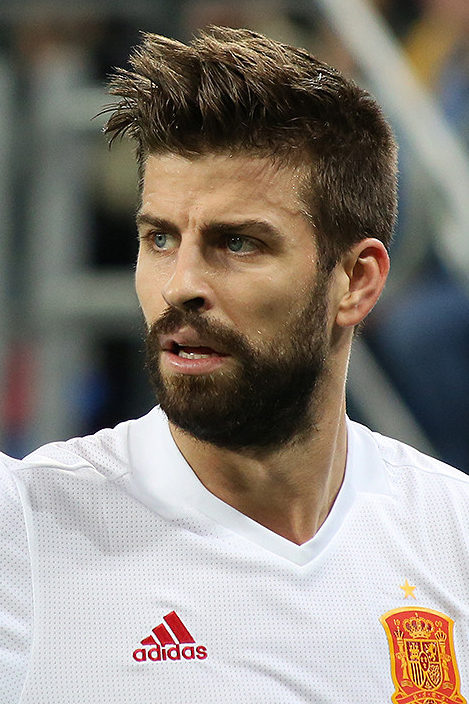
Gerard Piqué Bernabeu (born 2 February 1987) is a Spanish former professional footballer who played as a centre-back. He is considered to be one of the greatest defenders of his generation[2][3][4] and is one of the most decorated players with 37 trophies.[5][6] In 2022, he founded the Kings League sports league based in Spain and eventually in the world.
Key Information
Initially a talented student athlete at Barcelona's La Masia academy, Piqué began his professional career with Manchester United in 2004. He returned to Barcelona in 2008 and helped the club win trebles in 2008–09 and 2014–15. He appeared in 616 competitive matches for the club and won 31 major club titles, including nine La Liga trophies and three UEFA Champions League titles. He is one of only four players to have won the Champions League two years in a row with different teams, the others being Marcel Desailly, Paulo Sousa, and Samuel Eto'o.
Piqué also represented Spain 102 times, making his debut on 11 February 2009. He played an integral role on the Spanish teams that won the 2010 FIFA World Cup and UEFA Euro 2012. He retired from the national team after the 2018 FIFA World Cup.
Club career
[edit]Early life and career
[edit]Gerard Piqué Bernabeu[7] was born on 2 February 1987[8] in Barcelona, Catalonia.[1] He started his career playing for FC Barcelona's youth teams as a defensive midfielder, but before he signed his first professional contract with the club, he decided to join Manchester United. The Premier League club did not pay a fee for Piqué as he was too young to have a professional contract.[9]
Manchester United
[edit]Piqué made his debut for Manchester United in October 2004, as a centre-back, a 67th minute replacement for John O'Shea in a 3–0 League Cup victory at Crewe Alexandra.[10] He made his full debut in January 2005 in a 0–0 FA Cup draw with Exeter City. Piqué made his Premier League debut on 15 October 2005, again as a substitute for O'Shea, in a 3–1 win over Sunderland. His first league start came on 29 March 2006 against West Ham United at Old Trafford, playing at right-back, as Gary Neville was unavailable due to injury.[11]
His performances, most notably in the reserve team, earned him a new contract, which he signed in February 2005, to run until the summer of 2009. On 4 August 2006, however, La Liga club Real Zaragoza secured Piqué on a season-long loan. The terms of the loan required Piqué to feature in at least 20 games for the Aragonese club,[12] which he did, as he made 22 first team appearances in a successful spell, alongside Argentine Gabriel Milito, either as a centre-back or a defensive midfielder.[citation needed]
On 5 May 2007, it was announced that Piqué would be staying at Old Trafford for the following season. Manager Alex Ferguson had intended to assess Piqué's form at La Romareda on 6 May, prior to a meeting where the two parties would discuss Piqué's future prospects with the club. However, Ferguson was unable to attend because of airline difficulties.[13]
Piqué's return to Old Trafford saw him make nine league appearances during the 2007–08 season. In his first start in the UEFA Champions League, a 4–0 home win against Dynamo Kyiv on 7 November 2007, Piqué scored the first of Manchester United's four goals in that match.[14] In doing so, he became the 450th player to score at least one goal for the club.[15] His second goal for the club also came in the Champions League, in an away match against Roma on 12 December 2007.[16]
Return to Barcelona
[edit]
On 27 May 2008, Piqué signed a four-year contract with Barcelona, with a €5 million buy-out clause.[17] Barcelona paid a £5 million fee for the player.[18] He expressed his joy at re-signing with his boyhood club, although he admitted he had enjoyed his spell at Manchester United:
I am very happy to be back, I didn't think I would be here again but this is very good for me. Manchester United is a great club and I enjoyed winning things. To play with world class players has helped me and now I want to continue this at Barça.
Piqué's first goal for Barcelona came in the club's 5–2 2008–09 UEFA Champions League group stage win at Sporting CP on 26 November.[19][20] His first domestic goal for the club followed two months later, on 29 January 2009, in a Copa del Rey match against local rivals Espanyol. The goal, which came from a corner kick in the 57th minute, turned out to be the game winner in a 3–2 victory for Barcelona.[21][22] On 2 May, Piqué scored Barcelona's sixth goal in a 6–2 El Clásico win against Real Madrid at the Santiago Bernabéu.[23][24]
On 13 May, he picked up the first trophy of his Barcelona career as he helped his club to a 4–1 victory over Athletic Bilbao in the Copa del Rey Final.[25] Three days later, Barcelona clinched the 2008–09 La Liga title after Real Madrid lost 3–2 to Villarreal, with two games left in the season.[26] On 27 May, Piqué played against his former club Manchester United in the 2009 Champions League Final, which Barcelona won 2–0 in Rome,[27] completing a historic treble and becoming the first Spanish club to achieve this feat.[28]
On 19 December 2009, Piqué was in the Barcelona team which beat Argentine club Estudiantes 2–1 in the 2009 FIFA Club World Cup Final at Abu Dhabi to complete an unprecedented sextuple. Piqué assisted Pedro's 89th minute equalising goal which took the match to extra-time.[29] On 26 February 2010, Piqué signed a contract extension to keep him at Barcelona until at least summer 2015.[30][31] On 28 April, Piqué scored in Barcelona's 1–0 Champions League semi-final second leg victory against Inter Milan, though his team went out 3–2 on aggregate.[32]
On 7 December 2010, Piqué captained his first match for Barcelona, a 5–0 victory against Russian club Rubin Kazan at Camp Nou in the last Champions League group stage match, in the absence of regular captain Carles Puyol and vice-captain Xavi.[33] On 28 May 2011, Piqué played in his second Champions League Final. Barcelona defeated Manchester United 3–1 at Wembley Stadium to lift the UEFA Champions League for the second time in three seasons.[34]

Piqué started in Barcelona's 4–0 victory against Brazilian club Santos in the 2011 FIFA Club World Cup Final in Yokohama on 18 December.[35]
On 20 May 2014, Piqué signed a contract extension with Barcelona, keeping him at the club until 2019.[36]
Piqué started for Barcelona in the 2015 UEFA Champions League Final on 6 June, as the club won its fifth European Cup/Champions League title by beating Juventus 3–1 at Berlin's Olympiastadion.[37] This made Barcelona the first club in history to win the treble of domestic league, domestic cup, and European Cup twice.[38] Piqué, Xavi, Lionel Messi, Andrés Iniesta, Sergio Busquets, Dani Alves, and Pedro are the only players to have been a part of both treble-winning teams.[38]
On 20 December 2015, Piqué played in the 2015 FIFA Club World Cup Final against Argentine club River Plate in Yokohama, with Barcelona winning 3–0.[39]
Piqué extended his contract again on 18 January 2018, this time until 2022.[40] On 25 August 2019, he played for a full 90 minutes in a 5–2 win against Real Betis, his 500th game for the club.[41]
On 20 October 2020, Piqué signed a contract extension that would keep him at the club until 20 June 2024, setting his buy-out clause at €500 million.[42] On 3 March 2021, Piqué scored a last-minute header in the Copa del Rey semi-finals against Sevilla, tying the aggregate score to send the game to extra time. Barcelona won the game 3–0 in extra time and advanced to the 2021 Copa del Rey Final,[43] which the team won.[44]
On 3 November 2022, Piqué announced that he would retire following Barcelona's La Liga match against Almería on 5 November.[45] Starting as captain,[citation needed] he was substituted off to a standing ovation in the 83rd minute of Barcelona's 2–0 win. For the celebrations, Barcelona players wore special shirts with Piqué's name and number 3 on the back and "SEMPR3" printed on the front (sempre, Catalan for always).[46] La Liga president Javier Tebas stated he had no doubt that Piqué would one day return and become a "great president of Barcelona".[47] Piqué was still on the squad list, named as a substitute, for the final match before the 2022 FIFA World Cup, away against Osasuna on 8 November; he was given a straight red card from the bench at half time after arguing with the referee over the second-yellow red card given to teammate Robert Lewandowski in the first half.[48]
International career
[edit]Youth teams
[edit]Piqué was a member of the Spain under-19 team that won the 2006 UEFA European Under-19 Championship in Poland.[49] In a 2–1 final win against Scotland, Piqué put in a strong performance in defence and also contributed in attack, hitting the crossbar with a header and providing the assist for striker Alberto Bueno to score Spain's second goal.[50]
Subsequently, he played in the 2007 FIFA U-20 World Cup, starting all six of Spain's matches and scoring a goal in the team's come-from-behind 4–2 victory over Brazil in the round of 16.[51] However, Piqué missed the deciding penalty in the shoot-out against the Czech Republic, and Spain was eliminated at the quarter-final stage.[52]
Senior side
[edit]

On 6 February 2009, Piqué was called up to the senior squad for the friendly against England on 11 February.[53] He played the entire match in a 2–0 win, in Seville.[54] In his second match as an international on 28 March 2009, he was called up as a replacement for injured teammate Carles Puyol and he scored the only goal in Spain's victory in the 2010 World Cup qualifier against Turkey at the Santiago Bernabéu Stadium in Madrid.[55] Four days later, he started in Istanbul in a 2–1 win, also in the group stage.[56] Piqué made his tournament debut for Spain at the 2009 FIFA Confederations Cup, starting in four of the team's five matches as La Roja finished in third place.[citation needed]
Piqué was Spain's first-choice centre-back at the 2010 World Cup finals in South Africa, playing alongside Puyol. He started all seven matches as Spain won the tournament, defeating the Netherlands 1–0 in the final.[57] Piqué's partnership with Puyol saw Spain concede only twice in seven World Cup matches and keep four consecutive clean sheets in the knockout stage. In Spain's 1–0 group stage defeat to Switzerland, just before Gelson Fernandes scored the only goal of the game, Swiss striker Eren Derdiyok tumbled over Spain goalkeeper Iker Casillas and accidentally kicked Piqué in the face, knocking him over and leaving him with a deep cut beside his right eye.[58]
Piqué played every minute of Spain's UEFA Euro 2012 campaign, partnering Sergio Ramos in the centre of defence. He successfully converted the team's third penalty in a semi-final shoot-out win over Portugal. In the final, Spain recorded a fifth consecutive clean sheet in a 4–0 win over Italy.[59] Piqué was one of three Spanish defenders included in UEFA's Team of the Tournament as La Roja conceded only one goal in six matches.[60]
At the 2013 FIFA Confederations Cup, Piqué was the third of Spain's seven successful takers in a 7–6 shootout win over Italy at the semi-final stage. On 30 June 2013, Piqué was sent off during the final against Brazil. He received a straight red card in the 68th minute for a violent tackle on recently signed Barcelona teammate Neymar. The match finished 3–0 to Brazil, ending Spain's world record 29 match unbeaten run in competitive internationals.[61]
Piqué later participated in the 2014 FIFA World Cup, with Spain seen as a favourite to win again. The squad would underperform greatly, losing 5-1 in their opening game, a rematch with the Netherlands. This would be his only appearance in the tournament as he suffered a facial injury during the match and was kept on the bench indefinitely. Spain would be eliminated in the group stage marking the beginning of the end for the Spanish national teams golden generation.
In Spain's opening group game of UEFA Euro 2016 on 13 June, Piqué scored his fifth goal for his country, a late header in a 1–0 victory against the Czech Republic.[62]
In Spain's second group match of the 2018 FIFA World Cup on 20 June, a 1–0 win against Iran, Piqué made his 100th international appearance.[63]
On 11 August 2018, Piqué announced his retirement from international football.[64]
On 25 March 2019, Piqué won his 10th cap for Catalonia in a friendly match against Venezuela, a few months after he had retired from the Spanish national team and led the team to a 2–1 victory.[65]
Style of play
[edit]Piqué was a modern and commanding defender, who combined strength and tackling ability with passing. Although he was primarily deployed as a centre-back, he was a tactically versatile player who was capable of playing as a defensive midfielder, a position in which he was initially deployed in his youth; he was also deployed as a sweeper on occasion, showing similarities to German legend Franz Beckenbauer, thus earning the sobriquet "Piquénbauer".[9][66][67] He was also occasionally known to use his height as an additional attacking threat by advancing into more offensive positions, often functioning as an auxiliary striker, particularly if his team were trailing late on during matches.[67][68][69] His ball-playing ability and capacity to read the game enabled him to form an effective central-defensive partnership with the more physical Carles Puyol, both with Barcelona and Spain.[70][71] Despite his talent in his youth, he was initially accused by certain pundits of being error-prone defensively,[72][73] and has been criticised on occasion for his inconsistency and lack of pace.[74][75] Considered to be one of the best defenders in world football by pundits,[76] in 2018, Piqué's former defensive partner Puyol described him as "the best centre-back in the world" due to his personal development as a player in terms of his intelligence, leadership, positional sense, composure, and anticipation.[77]
Personal life
[edit]Piqué was raised in a Catalan family. His father, Joan, is a businessman, and his mother, Montserrat, is the director of a spinal injuries hospital in Barcelona. He has a younger brother, Marc.[78][79] His grandfather, Amador Bernabeu, is a former vice-president of FC Barcelona.[80] During the 2017 Catalan independence referendum, he was seen by many as one of the public faces of the pro-independence movement, voting and tweeting his support in Catalan.[81] He subsequently faced backlash from some Spanish fans for his support of the Catalan independence referendum.[82]
From 2011 to 2022, Piqué was in a relationship with Colombian singer Shakira.[83] They met when he appeared in the music video for her single "Waka Waka (This Time for Africa)", the official song of the 2010 FIFA World Cup.[84] Piqué and Shakira share the same birthday, ten years apart. They have two sons together,[85][86] named Milan[87] and Sasha.[88] Amid allegations of infidelity on Piqué's part,[89] the couple confirmed in a joint statement that they were separating in June 2022.[90] Piqué has been in a relationship with Clara Chía Martí since 2022.[91][92][93]
Piqué was the face of Mango's men's line HE for four consecutive campaign seasons between 2011 and 2012.[94][95] In 2012, he lent his voice to the Catalan version of The Pirates! In an Adventure with Scientists! as the Pirate King.[citation needed]
Media and business interests
[edit]Piqué is the founder and president of Kosmos Holding (Kosmos Global Holding S.L.), a sports and media investment group he founded with Hiroshi Mikitani (founder and chairman of Japanese e-commerce firm Rakuten, Inc.), Edmund Chu, Nullah Sarker, and Mike Evans.[96] Kosmos struck a deal with the International Tennis Federation for a 25-year, $3 billion partnership to transform the Davis Cup and generate substantial revenues for global tennis development.[97] In August 2018, U.S. billionaire Larry Ellison publicly stated his support of Kosmos and his intention to invest in the Kosmos-ITF partnership.[98] In January 2023 however, the International Tennis Federation removed Piqué and Kosmos from the partnership.[99]
Piqué is the owner of Spanish second division football club FC Andorra, which he bought in December 2018 through his firm Kosmos Holding. On 21 May 2022, the team was promoted to the Segunda División after beating already relegated UCAM Murcia 1–0 at home, thus ascending to the second tier for the first time in their history. In July 2019, Piqué took over a majority stake in another Spanish football club – Gimnàstic Manresa. The acquisition was completed through Kosmos.[100]
In December 2020, Piqué invested in the fantasy football game Sorare.[101] Kosmos bought the Spanish broadcasting rights for the 2021 Copa América in a partnership with streamer Ibai Llanos,[102] and in 2021 he and Ibai founded and became co-owners of the esports team KOI.[103] The esports team later acquired a majority interest in Rogue, which resulted in Piqué's team competing in the League of Legends European Championship.[104] As of 11 November 2022, he is president and owner of the Kings League, a new format football league in Barcelona, made up of teams whose owners are content creators from Twitch, YouTube, TikTok and Instagram.[105]
Philanthropy
[edit]In 2020, in response to the COVID-19 pandemic Piqué (along with teammates, including Lionel Messi) committed to a 70% salary cut throughout the crisis. They further committed to donating to the salaries of all employees at the club during the state of emergency.[106]
Tax fraud
[edit]On 10 July 2019, Piqué was ordered by a Spanish court to pay €2.1 million to the tax authorities following his conviction for image rights fraud. He had been convicted by Spain's National Court in 2016 for faking the sale of his image rights to his Kerad Project company to evade taxes from 2008 to 2010.[107]
Corruption investigation
[edit]In May 2024, Pique was placed under official investigation by a court in Spain over his alleged involvement in a deal which saw the Spanish Super Cup moved to Saudi Arabia (then-RFEF president Luis Rubiales had been arrested and his successor Pedro Rocha was also under investigation).[108]
Poker tournament results
[edit]On 27 August 2019, Piqué took part in the EPT Barcelona €25,000 Single-Day High Roller Event. He finished in second place and won a prize of €352,950.[109]
Career statistics
[edit]Club
[edit]| Club | Season | League | National Cup[a] | League Cup[b] | Europe | Other | Total | |||||||
|---|---|---|---|---|---|---|---|---|---|---|---|---|---|---|
| Division | Apps | Goals | Apps | Goals | Apps | Goals | Apps | Goals | Apps | Goals | Apps | Goals | ||
| Manchester United | 2004–05[110] | Premier League | 0 | 0 | 1 | 0 | 1 | 0 | 1[c] | 0 | 0 | 0 | 3 | 0 |
| 2005–06[111] | Premier League | 3 | 0 | 2 | 0 | 2 | 0 | 0 | 0 | — | 7 | 0 | ||
| 2006–07[112] | Premier League | 0 | 0 | 0 | 0 | 0 | 0 | 0 | 0 | — | 0 | 0 | ||
| 2007–08[113] | Premier League | 9 | 0 | 0 | 0 | 1 | 0 | 3[c] | 2 | 0 | 0 | 13 | 2 | |
| Total | 12 | 0 | 3 | 0 | 4 | 0 | 4 | 2 | 0 | 0 | 23 | 2 | ||
| Real Zaragoza (loan) | 2006–07[112] | La Liga | 22 | 2 | 6 | 1 | — | — | — | 28 | 3 | |||
| Barcelona | 2008–09[114] | La Liga | 25 | 1 | 6 | 1 | — | 14[c] | 1 | 0 | 0 | 45 | 3 | |
| 2009–10[115] | La Liga | 32 | 2 | 1 | 0 | — | 12[d] | 2 | 4[e] | 0 | 49 | 4 | ||
| 2010–11[116] | La Liga | 31 | 3 | 7 | 0 | — | 12[c] | 1 | 1[f] | 0 | 51 | 4 | ||
| 2011–12[117] | La Liga | 22 | 2 | 8 | 0 | — | 5[c] | 0 | 3[g] | 0 | 38 | 2 | ||
| 2012–13[118] | La Liga | 28 | 2 | 4 | 1 | — | 10[c] | 0 | 2[f] | 0 | 44 | 3 | ||
| 2013–14[119] | La Liga | 26 | 2 | 2 | 0 | — | 9[c] | 2 | 2[f] | 0 | 39 | 4 | ||
| 2014–15[120] | La Liga | 27 | 5 | 6 | 1 | — | 11[c] | 1 | — | 44 | 7 | |||
| 2015–16[121] | La Liga | 30 | 2 | 5 | 2 | — | 8[h] | 1 | 3[i] | 0 | 46 | 5 | ||
| 2016–17[122] | La Liga | 25 | 2 | 7 | 0 | — | 8[c] | 1 | 1[f] | 0 | 41 | 3 | ||
| 2017–18[123] | La Liga | 30 | 2 | 8 | 1 | — | 9[c] | 1 | 2[f] | 0 | 49 | 4 | ||
| 2018–19[124] | La Liga | 35 | 4 | 5 | 0 | — | 11[c] | 2 | 1[f] | 1 | 52 | 7 | ||
| 2019–20[125] | La Liga | 35 | 1 | 2 | 0 | — | 7[c] | 0 | 1[f] | 0 | 45 | 1 | ||
| 2020–21[126] | La Liga | 18 | 0 | 2 | 1 | — | 3[c] | 2 | 0 | 0 | 23 | 3 | ||
| 2021–22[127] | La Liga | 27 | 1 | 2 | 0 | — | 10[j] | 2 | 1[f] | 0 | 40 | 3 | ||
| 2022–23[128] | La Liga | 6 | 0 | — | — | 4[c] | 0 | — | 10 | 0 | ||||
| Total | 397 | 29 | 65 | 7 | — | 133 | 15 | 21 | 1 | 616 | 52 | |||
| Career total | 431 | 31 | 74 | 8 | 4 | 0 | 137 | 17 | 21 | 1 | 667 | 57 | ||
- ^ Includes FA Cup, Copa del Rey
- ^ Includes Football League Cup
- ^ a b c d e f g h i j k l m n Appearance(s) in UEFA Champions League
- ^ One appearance in UEFA Super Cup, eleven appearances and two goals in UEFA Champions League
- ^ Two appearances in Supercopa de España, two in FIFA Club World Cup
- ^ a b c d e f g h Appearance(s) in Supercopa de España
- ^ Two appearances in Supercopa de España, one in FIFA Club World Cup
- ^ One appearance in UEFA Super Cup, seven appearances and one goal in UEFA Champions League
- ^ One appearance in Supercopa de España, two in FIFA Club World Cup
- ^ Five appearances and one goal in UEFA Champions League, five appearances and one goal in UEFA Europa League
International
[edit]| National team | Year | Apps | Goals |
|---|---|---|---|
| Spain | 2009 | 13 | 4 |
| 2010 | 16 | 0 | |
| 2011 | 8 | 0 | |
| 2012 | 11 | 0 | |
| 2013 | 11 | 0 | |
| 2014 | 6 | 0 | |
| 2015 | 8 | 0 | |
| 2016 | 12 | 1 | |
| 2017 | 9 | 0 | |
| 2018 | 8 | 0 | |
| Total | 102 | 5 | |
- Spain score listed first, score column indicates score after each Piqué goal[129]
| No. | Date | Venue | Cap | Opponent | Score | Result | Competition |
|---|---|---|---|---|---|---|---|
| 1 | 28 March 2009 | Santiago Bernabéu Stadium, Madrid, Spain | 2 | 1–0 | 1–0 | 2010 FIFA World Cup qualification | |
| 2 | 12 August 2009 | Philip II Arena, Skopje, Macedonia | 8 | 2–2 | 3–2 | Friendly | |
| 3 | 5 September 2009 | Estadio Riazor, A Coruña, Spain | 9 | 3–0 | 5–0 | 2010 FIFA World Cup qualification | |
| 4 | 14 October 2009 | Bilino Polje, Zenica, Bosnia and Herzegovina | 12 | 1–0 | 5–2 | 2010 FIFA World Cup qualification | |
| 5 | 13 June 2016 | Stadium Municipal, Toulouse, France | 78 | 1–0 | 1–0 | UEFA Euro 2016 |
Honours
[edit]
Manchester United
- Premier League: 2007–08[131]
- Football League Cup: 2005–06[132]
- FA Community Shield: 2007[133]
- UEFA Champions League: 2007–08[132]
Barcelona[1]
- La Liga: 2008–09, 2009–10, 2010–11, 2012–13, 2014–15, 2015–16, 2017–18, 2018–19, 2022–23[134]
- Copa del Rey: 2008–09, 2011–12, 2014–15, 2015–16, 2016–17, 2017–18, 2020–21
- Supercopa de España: 2009, 2010, 2011, 2013, 2016, 2018
- UEFA Champions League: 2008–09, 2010–11, 2014–15
- UEFA Super Cup: 2009, 2015
- FIFA Club World Cup: 2009, 2011, 2015

Spain[1]
Individual
- La Liga Breakthrough Player of the Year: 2008–09[citation needed]
- La Liga Best Defender: 2009–10[citation needed]
- La Liga Team of the Season: 2014–15, 2015–16[135]
- UEFA Champions League Team of the Season: 2014–15[136]
- UEFA La Liga Team of the Season: 2016–17[137]
- UEFA European Championship Team of the Tournament: 2012[138]
- UEFA Team of the Year: 2010, 2011, 2012, 2015, 2016
- FIFA FIFPro World11: 2010, 2011, 2012, 2016[139]
- ESM Team of the Year: 2010–11, 2013–14, 2014–15, 2015–16[140][141][142]
- Footballer of the Year in Catalonia: 2019[143]
Decorations
See also
[edit]References
[edit]- ^ a b c d "Gerard Piqué profile". FC Barcelona. Archived from the original on 15 December 2018. Retrieved 10 September 2019.
- ^ "Ranking The 50 Best Soccer Defenders Of All Time". si.com. 7 February 2025. Retrieved 29 July 2025.
- ^ "Ranked! The 10 best centre-backs in the world". fourfourtwo.com. 29 January 2021. Archived from the original on 6 May 2021. Retrieved 9 May 2021.
- ^ Potts Harmer, Alfie (26 December 2019). "7 Best Centre-Backs of the Decade". HITC. Archived from the original on 10 May 2021. Retrieved 9 May 2021.
- ^ "Top ten players with most trophies ever". talksport.com. 21 May 2025. Retrieved 29 July 2025.
- ^ "16 Most Decorated Players in Football History Ranked by Trophies Won". givemesport.com. 9 July 2025. Retrieved 29 July 2025.
- ^ "Gerard Piqué". L'Équipe. Paris. Archived from the original on 20 May 2022. Retrieved 10 March 2019.
- ^ "Gerard Piqué: Overview". ESPN. Archived from the original on 15 July 2021. Retrieved 30 April 2020.
- ^ a b Hayward, Ben (1 July 2011). "Made in La Masia: From Lionel Messi to Cesc Fabregas, the extraordinary array of talent to emerge from Barcelona's fabled farmhouse". Goal. Archived from the original on 18 August 2020. Retrieved 16 May 2020.
- ^ "Crewe 0–3 Man Utd". BBC Sport. 26 October 2004. Archived from the original on 30 July 2017. Retrieved 27 May 2008.
- ^ "Man Utd 1–0 West Ham". BBC Sport. 29 March 2006. Archived from the original on 7 January 2007. Retrieved 16 January 2015.
- ^ "Zaragoza's Piqué: My future is with Man Utd". OnTheMinute.com. 30 January 2007. Archived from the original on 6 October 2007. Retrieved 30 January 2007.
- ^ Hibbs, Ben (4 May 2007). "Piqué set for OT return". Manchester United F.C. Archived from the original on 10 September 2023. Retrieved 16 January 2015.
- ^ McNulty, Phil (7 November 2007). "Man Utd 4–0 Dynamo Kiev". BBC Sport. Archived from the original on 8 November 2007. Retrieved 3 May 2010.
- ^ "All Goalscorers in all Competitive Matches". The Website of Dreams. StretfordEnd.co.uk. November 2007. p. 5. Archived from the original on 27 August 2011. Retrieved 8 November 2007.
- ^ Herbert, Ian (13 December 2007). "Roma 1 Manchester United 1: Piqué's joy on pitch marred by violence off it". The Independent. London. Archived from the original on 17 May 2012. Retrieved 25 June 2010.
- ^ "Piqué comes back home". FC Barcelona. Archived from the original on 27 June 2010. Retrieved 25 June 2010.
- ^ Lowe, Sid (25 May 2009). "Gerard Piqué is back at Camp Nou, the man with Barcelona in his DNA". The Guardian. Archived from the original on 2 August 2021. Retrieved 30 November 2010.
- ^ "Sporting Lisbon 2–5 Barcelona". ESPN FC. 26 November 2008. Archived from the original on 10 September 2023. Retrieved 12 March 2013.
- ^ "Jose Mourinho's Inter Milan progress despite defeat to Panathinaikos". The Daily Telegraph. London. 26 November 2008. Archived from the original on 11 January 2022. Retrieved 12 March 2013.
- ^ "Barcelona 3–2 Espanyol". ESPN FC. 29 January 2009. Archived from the original on 1 February 2009. Retrieved 2 July 2009.
- ^ "Barcelona into Copa del Rey semis". The Daily Telegraph. London. 29 January 2009. Archived from the original on 11 January 2022. Retrieved 12 March 2013.
- ^ "Real Madrid-Barcelona: Celebrations in enemy territory". Marca. 24 April 2017. Archived from the original on 10 October 2018. Retrieved 16 October 2018.
- ^ "REAL MADRID – FC BARCELONA 2–6". FC Barcelona. 2 May 2009. Archived from the original on 28 February 2014. Retrieved 10 August 2013.
- ^ "Barcelona defeat Athletic Bilbao to win Copa del Rey". The Daily Telegraph. London. 14 May 2009. Archived from the original on 11 January 2022. Retrieved 12 March 2013.
- ^ "Real Madrid loss hands La Liga title to Barcelona". The Daily Telegraph. London. 16 May 2009. Archived from the original on 11 January 2022. Retrieved 12 March 2013.
- ^ "Barcelona 2–0 Man Utd". BBC Sport. 27 May 2009. Archived from the original on 29 May 2009. Retrieved 12 March 2013.
- ^ "Guardiola salutes his treble winners". UEFA. 28 May 2009. Archived from the original on 4 December 2012. Retrieved 12 March 2013.
- ^ "Barcelona add world title to trophy haul". CNN. 19 December 2009. Archived from the original on 10 September 2023. Retrieved 10 August 2013.
- ^ "Piqué signs new Barcelona deal". Mirror Football. 26 February 2010. Archived from the original on 10 September 2023. Retrieved 12 March 2013.
- ^ "Piqué extends Barcelona contract". UEFA. 26 February 2010. Archived from the original on 10 September 2023. Retrieved 12 March 2013.
- ^ Barcelona 1–0 Internazionale Archived 2 May 2010 at the Wayback Machine ESPN Soccernet, 28 April 2010
- ^ Mirza, Razwan (8 December 2010). "Barca end Rubin hoodoo". Sky Sports. Archived from the original on 10 September 2023. Retrieved 10 December 2020.
- ^ Dunn, Alex (28 May 2011). "No answer to Barca genius". Sky Sports. Archived from the original on 10 September 2023. Retrieved 10 December 2020.
- ^ Gardener, Alan (18 December 2011). "Club World Cup final: Santos 0–4 Barcelona – as it happened". The Guardian. Archived from the original on 29 March 2019. Retrieved 10 December 2020.
- ^ "Gerard Piqué signs on till 2019". FC Barcelona. 20 May 2014. Archived from the original on 10 September 2023. Retrieved 22 May 2014.
- ^ Haslam, Andrew (6 June 2015). "Barcelona see off Juventus to claim fifth title". UEFA. Archived from the original on 31 March 2019. Retrieved 7 June 2015.
- ^ a b "Barça make history with second treble!". FC Barcelona. 6 June 2015. Archived from the original on 7 June 2015. Retrieved 7 June 2015.
- ^ Jones, Matt (20 December 2015). "Barcelona vs. River Plate: Score, Reaction for 2015 FIFA Club World Cup Final". Bleacher Report. Archived from the original on 16 April 2021. Retrieved 10 December 2020.
- ^ "Gerard Piqué and FC Barcelona renew contract through to 2022". FC Barcelona. 18 January 2018. Archived from the original on 1 October 2018. Retrieved 18 January 2018.
- ^ "Gerard Piqué reaches 500 games for FC Barcelona". FC Barcelona. 25 August 2019. Archived from the original on 26 August 2019. Retrieved 26 August 2019.
- ^ "Agreement for contract extensions for Piqué, Ter Stegen, De Jong and Lenglet". FC Barcelona. 21 October 2020. Archived from the original on 7 December 2022. Retrieved 10 December 2020.
- ^ "Barcelona vs. Sevilla score: Barca reach Copa del Rey final as Pique, Braithwaite rescue trophy chance". CBSSports.com. 4 March 2021. Archived from the original on 10 September 2023. Retrieved 4 March 2021.
- ^ "Barca thrash Athletic to win Copa del Rey". BBC Sport. Archived from the original on 10 September 2023. Retrieved 26 September 2021.
- ^ "Pique announces he will retire from football after Barcelona's next La Liga game". Goal. 3 November 2022. Archived from the original on 10 September 2023. Retrieved 3 November 2022.
- ^ "'I was born here and I will die here' – Emotional Pique promises Barca fans he will be back despite retirement". Yahoo Sports. 5 November 2022. Archived from the original on 27 November 2022.
- ^ "Gerard Pique retirement: LaLiga chief tips defender to be great Barcelona president". ESPN. 4 November 2022. Archived from the original on 10 September 2023. Retrieved 6 November 2022.
- ^ "Osasuna 1–2 Barcelona". BBC Sport. 8 November 2022. Archived from the original on 10 December 2023. Retrieved 10 December 2023.
- ^ Meléndez's mind focused on final UEFA, 27 July 2006
- ^ "This defeat feels like a victory". UEFA. 30 July 2006. Archived from the original on 10 September 2023. Retrieved 12 March 2013.
- ^ "Spain-Brazil Match Report". FIFA. Archived from the original on 14 February 2008. Retrieved 2 April 2008.
- ^ "Spain – Czech Republic Match Report". FIFA. 14 July 2007. Archived from the original on 18 July 2007. Retrieved 22 June 2013.
- ^ "Lista de convocados para el amistoso ante Inglaterra" (in Spanish). Real Federación Española de Fútbol. 6 February 2009. Archived from the original on 10 February 2009. Retrieved 6 February 2009.
- ^ Iliev, Nick (12 February 2009). "International Friendly: Spain completely outclass England". The Sofia Echo. Archived from the original on 26 March 2010. Retrieved 25 June 2010.
- ^ "Del Bosque Analyses Spain's Turkey Win". Goal. 29 March 2009. Archived from the original on 1 April 2009. Retrieved 25 June 2010.
- ^ "Turkey 1–2 Spain: Riera earns comeback victory". ESPN FC. 1 April 2009. Archived from the original on 22 June 2011. Retrieved 25 June 2010.
- ^ McCarra, Kevin (11 July 2010). "World Cup 2010 final: Andrés Iniesta finds key for Spain to beat Holland". The Guardian. London. Archived from the original on 12 June 2018. Retrieved 12 March 2013.
- ^ Sheringham, Sam (16 June 2010). "Spain 0–1 Switzerland". BBC Sport. Archived from the original on 10 August 2020. Retrieved 16 January 2015.
- ^ McNulty, Phil (1 July 2012). "Spain 4–0 Italy". BBC Sport. Archived from the original on 10 January 2016. Retrieved 11 July 2012.
- ^ "Ten Spain players in Team of the Tournament". UEFA. 2 July 2012. Archived from the original on 18 April 2014. Retrieved 2 July 2012.
- ^ "Brazil Caps Confederations Cup Marked by Protests With Title". Bloomberg News. 1 July 2013. Archived from the original on 10 September 2023. Retrieved 10 August 2013.
- ^ Saffer, Paul (13 June 2016). "Piqué pounces for late Spain win". UEFA. Archived from the original on 18 June 2016. Retrieved 14 June 2016.
- ^ "Diego Costa Guides Spain Past Impressive Iran". beinsports.com. 20 June 2018. Archived from the original on 10 September 2023. Retrieved 23 June 2018.
- ^ "Gerard Piqué retires from international football". One Football. 11 August 2018. Retrieved 11 August 2018.[permanent dead link]
- ^ "Gerard Pique plays for Catalonia in friendly against Venezuela". BBC Sport. 25 March 2019. Archived from the original on 10 September 2023. Retrieved 29 August 2019.
- ^ Simpson, Christopher (6 July 2016). "Gerard Pique Has 'Piquenbauer' Beer Named After Him in Barcelona Tribute". Bleacher Report. Archived from the original on 7 September 2017. Retrieved 30 April 2017.
- ^ a b "A closer look at Spain's Euro 2012 squad". The Globe and Mail. 6 June 2012. Archived from the original on 8 March 2021. Retrieved 17 May 2020.
- ^ "Gerard Piqué Bernabeu". arxiu.fcbarcelona.cat. Archived from the original on 1 July 2015. Retrieved 2 February 2015.
- ^ "Hierro: 'Piquenbauer' has striker's soul". FourFourTwo. 3 May 2010. Archived from the original on 4 March 2016. Retrieved 7 January 2016.
- ^ Hawkey, Ian (11 July 2010). "Defending the caveman". The Times. Archived from the original on 27 July 2020. Retrieved 17 May 2020.
- ^ Atkins, Christopher (30 July 2013). "Ranking the 20 Best Defenders in World Football". Bleacher Report. Archived from the original on 10 September 2023. Retrieved 17 May 2020.
- ^ Cox, Michael (5 May 2015). "The differences between Guardiola's Barcelona vs. Guardiola's Bayern". ESPN. Archived from the original on 10 September 2023. Retrieved 16 May 2020.
- ^ "World Class Defenders Are Lacking in Number at the Top Level". beIN Sports. 9 May 2016. Archived from the original on 19 January 2021. Retrieved 6 July 2020.
- ^ Peters, Jerrad (6 October 2014). "Unlocking the mystery that is Gerard Pique". Sportsnet. Archived from the original on 1 August 2020. Retrieved 16 May 2020.
- ^ Sobral, Vitor (14 May 2014). "How the Socceroos' World Cup opponents fared". The World Game. Retrieved 17 May 2020.
- ^ MacGregor, Gregor (3 January 2017). "The 6 best centre-backs in the world". FourFourTwo. Archived from the original on 27 January 2021. Retrieved 17 May 2020.
- ^ Marsden, Sam (6 April 2018). "Barcelona's Gerard Pique the best defender in the world – Carles Puyol". ESPN. Archived from the original on 10 September 2023. Retrieved 16 May 2020.
- ^ "Familia sólo hay una". El Periódico de Aragón (in Spanish). 5 August 2006. Archived from the original on 10 July 2011. Retrieved 15 March 2011.
- ^ "Gerard Piqué – World Cup 2010". ESPN Soccernet. Archived from the original on 11 November 2012. Retrieved 15 March 2011.
- ^ Lowe, Sid (25 May 2009). "Gerard Piqué is back at Camp Nou, the man with Barcelona in his DNA". The Guardian. London. Archived from the original on 2 August 2021. Retrieved 31 May 2009.
- ^ West, Andy (1 October 2017). "Catalan referendum: How FC Barcelona found themselves at centre of issue". BBC Sport. Archived from the original on 1 October 2017. Retrieved 2 October 2017.
- ^ "Spain fans boo Barcelona's Pique at football training". BBC News. 3 October 2017. Archived from the original on 3 October 2017. Retrieved 3 October 2017.
- ^ "Piqué confirms Shakira relationship on request from Barcelona coach Guardiola". tribalfootball.com. Archived from the original on 9 February 2011. Retrieved 7 February 2011.
- ^ "Antonio de la Rúa, Shakira's Ex-Boyfriend, Sues Star For $250 Million". Huffington Post. 6 September 2012. Archived from the original on 1 December 2012. Retrieved 24 January 2013.
- ^ "First picture: Shakira and Gerard Piqué's two-week-old baby Milan". Daily Mirror. 4 February 2013. Archived from the original on 12 March 2013. Retrieved 12 March 2013.
- ^ "Shakira baby: The name of the little boy revealed". Hello!. 30 January 2015. Archived from the original on 2 February 2015. Retrieved 30 January 2015.
- ^ "Shakira welcomes baby boy Milan Piqué Mebarak". NBC Latino. 22 January 2013. Archived from the original on 7 April 2016. Retrieved 26 January 2023.
- ^ "Sasha Piqué Mebarak". Shakira. Archived from the original on 30 January 2023. Retrieved 26 January 2023.
- ^ "Shakira reveals emotional toll of her split from Gerard Piqué: I believed in 'till death do us part'". Los Angeles Times. 22 September 2023. Archived from the original on 16 April 2024. Retrieved 16 April 2024.
- ^ Rebaza, Claudia; Sottile, Zoe (4 June 2022). "Shakira and footballer Gerard Piqué announce split". CNN. Archived from the original on 13 February 2023. Retrieved 5 June 2022.
- ^ Gomez, Shirley (4 October 2022). "Gerard Piqué is reportedly having issues with his employees at Kosmos". HOLA. New York, NY. Archived from the original on 10 September 2023. Retrieved 18 December 2022.
- ^ "Gerard Pique Posts Rare Photo With Girlfriend Clara Chia After Shakira Split: See the Pic". YAHOO!. 25 January 2023. Archived from the original on 26 January 2023. Retrieved 26 January 2023.
- ^ "Gerard Piqué y Chía estarían juntos desde hace año y medio, según medios españoles". infobae (in European Spanish). 11 December 2022. Retrieved 10 March 2025.
- ^ Wray, Michelle (15 March 2011). "Gerard Pique Launches He by Mango Spring/Summer 2011 Collection Pictures". Monsters and Critics. Archived from the original on 24 March 2011. Retrieved 29 March 2011.
- ^ "Gerard Pique, Mango image for the fourth time". La Vanguardia. 23 July 2012. Archived from the original on 10 September 2023. Retrieved 2 August 2012.
- ^ "El dueño de Rakuten da apoyo a Gerard Piqué para la expansión de la plataforma The Players Tribune" [The owner of Rakuten supports Gerard Piqué for the expansion of The Players Tribune platform]. Palco 23 (in Spanish). 17 April 2018. Archived from the original on 10 December 2023. Retrieved 10 December 2023.
- ^ "ITF announces plans for transformation of Davis Cup". ITF Tennis. 26 February 2018. Archived from the original on 10 September 2023. Retrieved 8 August 2018.
- ^ "American billionaire Larry Ellison backs Indian Wells to host revamped Davis Cup". Reuters. 7 August 2018. Archived from the original on 10 September 2023. Retrieved 8 August 2018.
- ^ "ITF ends $3bn deal with Gerard Pique's company to run Davis Cup after less than five years". BBC Sport. 13 January 2023. Archived from the original on 10 December 2023. Retrieved 10 December 2023.
- ^ "Barcelona defender Gerard Pique buys another football club". Football España. Archived from the original on 10 September 2023. Retrieved 28 July 2018.
- ^ "Gerard Piqué Joins Sorare To Help Reinvent Fantasy Soccer Worldwide". Forbes. Archived from the original on 10 September 2023. Retrieved 7 February 2021.
- ^ Dixon, Ed (21 June 2021). "Kosmos turns to Twitch for Copa America broadcasts in Spain". SportsPro. Archived from the original on 21 June 2021. Retrieved 28 August 2021.
- ^ "¿Quién es Ibai Llanos? Conoce al reconocido streamer de G2 Esports". Movistar eSports (in Spanish). 20 March 2020. Archived from the original on 10 September 2023. Retrieved 25 January 2021.
- ^ "KOI and Rogue Join Forces". Rogue. Archived from the original on 6 October 2022. Retrieved 6 October 2022.
- ^ elEconomista.es. "Qué es la Kings League: la liga de fútbol de Piqué e Ibai que asusta a las competiciones profesionales – elEconomista.es". El Economista (in Spanish). Archived from the original on 13 January 2023. Retrieved 13 January 2023.
- ^ Settimi, Christina (30 March 2020). "Lionel Messi's Coronavirus Wage Cut Could Cost Him $50 Million". Forbes. Archived from the original on 20 June 2020. Retrieved 31 March 2020.
- ^ "Gerard Pique handed €2.1 million tax bill". France 24. 10 July 2019. Archived from the original on 10 July 2019. Retrieved 10 July 2019.
- ^ "Gerard Pique: Ex-Barcelona and Manchester United defender under investigation in corruption case". 30 May 2024.
- ^ "FC Barcelona Star Gerard Piqué Wins €352,950 at EPT Barcelona, Arturo Vidal Cashes €134,460". pokernews.com. 27 August 2019. Archived from the original on 28 August 2019. Retrieved 27 August 2019.
- ^ "Games played by Gerard Piqué in 2004/2005". Soccerbase. Centurycomm. Retrieved 14 March 2018.
- ^ "Games played by Gerard Piqué in 2005/2006". Soccerbase. Centurycomm. Retrieved 14 March 2018.
- ^ a b "Games played by Gerard Piqué in 2006/2007". Soccerbase. Centurycomm. Retrieved 14 March 2018.
- ^ "Games played by Gerard Piqué in 2007/2008". Soccerbase. Centurycomm. Retrieved 14 March 2018.
- ^ "Games played by Gerard Piqué in 2008/2009". Soccerbase. Centurycomm. Retrieved 14 March 2018.
- ^ "Games played by Gerard Piqué in 2009/2010". Soccerbase. Centurycomm. Retrieved 14 March 2018.
- ^ "Games played by Gerard Piqué in 2010/2011". Soccerbase. Centurycomm. Retrieved 14 March 2018.
- ^ "Games played by Gerard Piqué in 2011/2012". Soccerbase. Centurycomm. Retrieved 14 March 2018.
- ^ "Games played by Gerard Piqué in 2012/2013". Soccerbase. Centurycomm. Retrieved 14 March 2018.
- ^ "Games played by Gerard Piqué in 2013/2014". Soccerbase. Centurycomm. Retrieved 14 March 2018.
- ^ "Games played by Gerard Piqué in 2014/2015". Soccerbase. Centurycomm. Retrieved 14 March 2018.
- ^ "Games played by Gerard Piqué in 2015/2016". Soccerbase. Centurycomm. Retrieved 14 March 2018.
- ^ "Games played by Gerard Piqué in 2016/2017". Soccerbase. Centurycomm. Retrieved 14 March 2018.
- ^ "Games played by Gerard Piqué in 2017/2018". Soccerbase. Centurycomm. Retrieved 14 March 2018.
- ^ "Games played by Gerard Piqué in 2018/2019". Soccerbase. Centurycomm. Retrieved 7 September 2022.
- ^ "Games played by Gerard Piqué in 2019/2020". Soccerbase. Centurycomm. Retrieved 7 September 2022.
- ^ "Games played by Gerard Piqué in 2020/2021". Soccerbase. Centurycomm. Retrieved 7 September 2022.
- ^ "Games played by Gerard Piqué in 2021/2022". Soccerbase. Centurycomm. Retrieved 7 September 2022.
- ^ "Games played by Gerard Piqué in 2022/2023". Soccerbase. Centurycomm. Retrieved 7 September 2022.
- ^ a b "Piqué, Gerard". National Football Teams. Benjamin Strack-Zimmermann. Retrieved 4 March 2016.
- ^ "Gerard Piqué – national football team player". EU-Football.info. 11 October 2015. Archived from the original on 17 March 2015. Retrieved 11 October 2015.
- ^ "Gerard Piqué: Overview". Premier League. Archived from the original on 17 April 2018. Retrieved 17 April 2018.
- ^ a b "Gerard Pique: A legend bids farewell". FIFA. Archived from the original on 14 March 2023. Retrieved 14 March 2023.
With Manchester United, he won the League Cup in 2006, the FA Community Shield in 2007, followed by the Premier League and Champions League in 2008.
- ^ Cheese, Caroline (5 August 2007). "Chelsea 1–1 Man Utd". BBC Sport. Archived from the original on 24 January 2020. Retrieved 17 April 2018.
- ^ "FC Barcelona, Liga champions 2022/23!". FC Barcelona. 14 May 2023. Archived from the original on 22 May 2023. Retrieved 29 May 2023.
- ^ "The 2014/15 Liga BBVA Ideal XI". LFP. 15 June 2015. Archived from the original on 15 September 2018. Retrieved 17 June 2015.
- ^ "UEFA Champions League squad of the season". UEFA. 9 June 2015. Archived from the original on 11 June 2015. Retrieved 9 June 2015.
- ^ "Once ideal de LaLiga para UEFA: 4 del Madrid, 3 del Barça..." AS.com. 22 May 2017. Archived from the original on 17 August 2017. Retrieved 22 May 2017.
- ^ "EURO 2012 Team of the Tournament". UEFA. 1 January 2022. Archived from the original on 22 April 2024. Retrieved 12 April 2024.
- ^ "The Best named at FIFA Football Awards". FIFA. 9 January 2017. Archived from the original on 9 January 2017. Retrieved 12 January 2017.
- ^ "ESM Team of the season". World Soccer. Archived from the original on 19 December 2014. Retrieved 5 June 2012.
- ^ "Die ESM-Topelf der Saison 2013/14 – ein Deutscher ist dabei". Kicker (in German). Archived from the original on 9 September 2014. Retrieved 15 June 2014.
- ^ "Die ESM-Topelf der Saison 2014/15 – ein Deutscher ist dabei". Kicker (in German). Archived from the original on 1 October 2018. Retrieved 11 June 2015.
- ^ "Pique: My priorities are football, football, football". Marca. Madrid. 3 December 2019. Archived from the original on 10 September 2023. Retrieved 5 December 2019.
- ^ "Las campeones del mundo de fútbol ya tienen la Real Orden del Mérito Deportivo". Mundo Deportivo (in Spanish). 5 October 2011. Archived from the original on 23 October 2020. Retrieved 28 October 2011.
External links
[edit]- Profile at the FC Barcelona website
- Profile at the Royal Spanish Football Federation website (in Spanish)
- Gerard Piqué – FIFA competition record (archived)
- Gerard Piqué – UEFA competition record (archive)
- Gerard Piqué at Global Sports Archive
Gerard Piqué
View on GrokipediaGerard Piqué i Bernabéu (born 2 February 1987) is a Spanish former professional footballer who primarily played as a centre-back for FC Barcelona and the Spain national team.[1][2]
Rising through Barcelona's youth academy, Piqué began his senior career at Manchester United, where he contributed to three consecutive Premier League titles from 2007 to 2009, before returning to Barcelona in 2008 to form a pivotal defensive partnership with Carles Puyol.[1][3]
At Barcelona, he secured 29 major trophies, including four UEFA Champions League titles, nine La Liga championships, and two trebles in 2009 and 2015, establishing himself as a key figure in the club's dominant era under managers like Pep Guardiola.[1][2]
Internationally, Piqué was instrumental in Spain's golden generation, starting in their victories at UEFA Euro 2008, the 2010 FIFA World Cup, and UEFA Euro 2012, retiring from national duty in 2018 amid tensions over his Catalan independence sympathies.[3][1]
Piqué announced his retirement from club football on 3 November 2022, following a La Liga match against Almería, transitioning to business pursuits via his firm Kosmos Holding, which includes ownership of FC Andorra and organization of the Davis Cup tennis event.[4][5]
His involvement in relocating the Spanish Super Cup to Saudi Arabia through Kosmos has drawn scrutiny, with Piqué placed under official investigation in 2024 for potential corruption and illicit payments to the Royal Spanish Football Federation.[6][7][8]
Early Life
Childhood and Family Background
Gerard Piqué Bernabéu was born on 2 February 1987 in Barcelona, Catalonia, Spain, into a Catalan family with deep ties to FC Barcelona.[9] His father, Joan Piqué, worked as a businessman and lawyer, while his mother, Montserrat Bernabéu, served as the director of a spinal injuries hospital in Barcelona.[1][10] The family belonged to the upper-middle or wealthy class, providing Piqué with a stable upbringing without material hardships.[11] He has a younger brother, Marc Piqué, who also pursued a career in professional football.[1] Piqué's maternal grandfather, Amador Bernabéu, held positions as a director and vice-president of FC Barcelona, fostering an early familial connection to the club; Piqué was registered as a member from birth.[12] This environment immersed him in Catalan culture and football from a young age, though his immediate family emphasized education alongside athletic development.[13] The household maintained a Catholic background, reflecting broader Catalan societal norms of the era.[11]Youth Football Development
Gerard Piqué joined FC Barcelona's La Masia youth academy at the age of 10 in 1997, beginning a formative period that shaped his technical and tactical foundations as a defender.[14][15] Born in Barcelona on February 2, 1987, to a family with strong ties to the club—his father Joan managed its legal department—Piqué immersed himself in the academy's rigorous training regimen, emphasizing possession-based play and ball control from an early age.[13] This environment fostered his growth into a composed center-back capable of initiating attacks from the back, though specific team-level progressions through infantiles, cadets, and juveniles remain less documented beyond general advancement.[16] During his seven years at La Masia, Piqué captained several youth sides and trained alongside emerging talents such as Lionel Messi and Cesc Fàbregas, contributing to dominant performances in internal and competitive youth matches.[17][18] He later reflected on the academy's culture of overwhelming victories, attributing much of the offensive ease to Messi's exceptional scoring from distance, which allowed defenders like himself to focus on build-up play without constant pressure.[19] Despite the academy's reputation for producing technically proficient players, Piqué's path highlighted a common La Masia challenge: limited pathways to first-team integration for non-attackers, prompting his departure in 2004 at age 17 to join Manchester United's youth system for greater exposure to senior-level competition.[20] This move, scouted by Sir Alex Ferguson, marked a pivotal shift, enabling Piqué to adapt his ball-playing style to the Premier League's physical demands while continuing development through reserve matches.[13]Club Career
Early Professional Steps at Barcelona and Zaragoza
Piqué advanced from FC Barcelona's La Masia academy to the club's reserve team, Barcelona B, for the 2003–04 season in Spain's Tercera División, representing his initial involvement in senior competitive football.[1] This stint allowed him to gain experience as a center-back in regular matches against adult opposition, bridging his youth development to professional environments before his transfer to Manchester United in mid-2004.[15] Seeking greater first-team exposure, Piqué was loaned from Manchester United to La Liga club Real Zaragoza on 4 August 2006 for the 2006–07 season.[3] The arrangement provided him with top-division minutes in Spain, where he primarily operated as a defensive midfielder rather than in his natural central defensive role.[15] In La Liga, Piqué recorded 22 appearances, including 18 starts, accumulating 1,568 minutes on the pitch.[21] Across all competitions, he totaled 28 matches and netted three goals, marking his initial professional strikes; the first came on 28 February 2007 in a 2–1 Copa del Rey defeat to Barcelona.[15] [22] Zaragoza finished 18th and suffered relegation, but Piqué's performances demonstrated versatility and composure in midfield duels, aiding his maturation ahead of further opportunities at Manchester United.[3]Manchester United Tenure
Piqué signed with Manchester United from FC Barcelona's youth system on 30 June 2004 for a transfer fee of €5 million. Immediately following the transfer, he was loaned to Real Zaragoza for the 2004–05 La Liga season, where he made 26 league appearances and scored once.[23] Upon his return to Manchester United in summer 2005, Piqué made his competitive debut for the club on 26 October 2004 in a 3–0 League Cup win against Crewe Alexandra, entering as a substitute.[3] His Premier League debut came on 15 October 2005 in a 3–1 away victory over Sunderland, where he started alongside Rio Ferdinand in central defense.[24] Over the next two seasons, Piqué struggled for consistent first-team opportunities amid competition from established defenders Ferdinand and Nemanja Vidić, accumulating 12 Premier League appearances without scoring.[25] He featured more prominently in cup competitions, including starting in the 2006 League Cup final win against Wigan Athletic (4–0).[3] In the 2007–08 UEFA Champions League, Piqué scored his first goal for United in a 4–0 group stage win over Dynamo Kyiv on 7 November 2007, heading in a corner from Cristiano Ronaldo; he made four appearances in the competition that season, contributing to the club's overall triumph.[26] Piqué's tenure coincided with Manchester United's successes under Alex Ferguson, including the 2006–07 Premier League title (where he made substitute appearances) and the 2007–08 double of the Premier League and Champions League.[23] In total, he recorded 34 competitive appearances and two goals for United across all competitions from 2004 to 2008.[3] Despite these achievements, limited playing time—often behind Ferdinand and Vidić—prompted Piqué to seek a return to Barcelona, where he desired greater involvement and familiarity; after discussions with Ferguson, who prioritized squad depth, United agreed to sell him back to his former club on 27 May 2008 for £5 million.[27][28] Piqué later described his United stint as a "masters degree" in professional development, crediting the physical demands of English football for honing his defensive resilience.[27]Return to FC Barcelona
In July 2008, FC Barcelona signed Gerard Piqué from Manchester United for a transfer fee of €5 million on a four-year contract expiring June 30, 2012, with a €50 million buy-out clause.[29][30] Initially positioned as a backup center-back behind established defenders like Carles Puyol and Gabriel Milito, Piqué quickly established himself under manager Pep Guardiola, forming a pivotal partnership with Puyol that anchored Barcelona's defense during the club's dominant era.[13] Piqué contributed to Barcelona's treble-winning 2008–09 season, securing La Liga, Copa del Rey, and UEFA Champions League titles, with his ball-playing ability from the back enhancing the team's possession-based style.[31] Over his 14-year second stint at the club, he made 615 official appearances, scoring 52 goals—impressive for a defender—and helped win nine La Liga titles, seven Copa del Rey trophies, three UEFA Champions League titles (2009, 2011, 2015), and three FIFA Club World Cups.[32][31] His versatility allowed occasional forward surges, including late-game goals that proved decisive in tight matches. As a vice-captain and occasional skipper after Puyol's retirement in 2014, Piqué adapted to various defensive pairings, including with Javier Mascherano and later Samuel Umtiti, though his form fluctuated amid injuries and Barcelona's transitional periods post-Guardiola.[33] By the 2021–22 season, despite the club's financial struggles, he remained a starter, captaining the side to the La Liga title. Piqué announced his retirement on November 3, 2022, following a 1–0 league win over Almería, citing diminished physical condition and a desire to step aside for younger players.[34][35]Retirement and FC Andorra Ownership
Piqué announced his retirement from professional football on November 3, 2022, at the age of 35, stating via social media that his final match would be FC Barcelona's La Liga game against Almería on November 5, 2022.[36][37] He cited an inability to reverse declining performance and playing time, noting he did not wish to occupy a bench role or burden the club.[38][39] Additional factors reportedly included personal marital difficulties following his separation from Shakira, pressure from Barcelona to depart amid financial constraints, and his expanding business commitments.[38][40] Following retirement, Piqué shifted focus to his business ventures, prominently including ownership of FC Andorra through his investment firm Kosmos Holding. Kosmos acquired the Andorran club in December 2018 for an undisclosed sum, converting it into a public limited company and injecting capital when it competed in Spain's fifth-tier regional leagues.[41][42] Under Piqué's oversight, FC Andorra achieved rapid promotions: ascending to the third tier (Segunda Federación) by 2020-21 and securing promotion to the second tier (Segunda División) on May 21, 2022, via a 1-0 playoff victory over UCAM Murcia.[43] The club's ascent stalled post-promotion, with relegation from Segunda División in the 2023-24 season due to poor performance, followed by a return to the second tier via playoffs in June 2025.[44] Ownership has faced challenges, including disputes with the Andorran government over access to Estadi Nacional, prompting Piqué in October 2023 to threaten relocation and rebranding of the club outside Andorra if stadium usage rights were not resolved.[45] Despite these tensions, FC Andorra continues to operate in the Spanish football pyramid, leveraging Kosmos' resources for infrastructure and player investments aimed at long-term sustainability.[46]International Career
Youth International Appearances
Piqué began his international youth career with the Spain under-16 team, earning 7 caps and scoring 2 goals between 2002 and 2003.[47] He progressed to the under-17 side in 2004, where he made 8 appearances and netted 3 goals, including participation in the UEFA European Under-17 Championship that year. Spain advanced to the final in Faro-Loulé, Portugal, but lost 3-0 to France, with Piqué featuring alongside future senior teammates like Cesc Fàbregas.[47][48] At under-19 level, Piqué secured 8 caps and 3 goals from 2005 to 2006, playing a pivotal role in Spain's victory at the 2006 UEFA European Under-19 Championship in Poland. He scored twice in a 4-0 group-stage win over Scotland and started in the 2-1 final triumph against the same opponent on 29 July 2006, contributing defensively in a match where Spain overcame an early deficit.[47][49][50] Piqué represented the under-20 team in 2007, accumulating 5 caps and 1 goal, most notably during the FIFA U-20 World Cup in Canada. He started all six matches for Spain, who exited in the round of 16 after a 1-0 loss to Chile, and scored in a 4-2 group-stage victory over Brazil on 10 July 2007.[47] Finally, he earned 12 caps and 1 goal for the under-21 team from 2006 to 2008, aiding qualification efforts for the 2009 UEFA European Under-21 Championship, though he transitioned to senior duty before the tournament.[47]Senior Spain National Team
Gerard Piqué made his senior debut for the Spain national team on 11 February 2009 in a friendly match against England.[47] Over his international career spanning 2009 to 2018, he accumulated 102 caps and scored 5 goals.[51] Piqué quickly established himself as a key centre-back, partnering effectively with Sergio Ramos in defence.[52] Piqué played an integral role in Spain's successes during the early 2010s, including victory at the 2010 FIFA World Cup in South Africa, where he featured in every match as part of the backline that conceded only two goals en route to the title.[52] He also contributed to the 2013 FIFA Confederations Cup win and was a starter in the UEFA Euro 2012 triumph on home soil, helping maintain Spain's possession-based style and defensive solidity.[47] These achievements formed part of Spain's dominant era, securing three consecutive major tournament titles.[52] In later years, Piqué participated in the 2014 FIFA World Cup (round of 16 exit), UEFA Euro 2016—where he scored in a 1–0 group stage win over the Czech Republic—and the 2018 FIFA World Cup, ending in a round of 16 penalty shootout loss to Russia.[47] Despite his contributions, Piqué faced persistent fan hostility, including jeers during national team events, largely attributed to his public support for Catalan independence, which intensified after the 2017 referendum.[51] Piqué announced in October 2016 that the 2018 World Cup would be his last international tournament, citing a desire to end amid ongoing criticism and a preference for some fans that he not represent Spain.[51] He confirmed his retirement from the national team on 11 August 2018, following the World Cup, to focus on his club career at Barcelona and avoid further controversy.[51]Playing Style and Technical Attributes
Defensive Strengths and Weaknesses
Gerard Piqué's defensive strengths centered on his game-reading ability and anticipation, enabling him to execute interceptions effectively, with rates improving from 1.3 per game in the 2011-12 La Liga season to 2.2 by 2015.[53] His positioning allowed for proactive defensive interventions, contributing to Barcelona's high defensive line under managers like Pep Guardiola.[53] Piqué also excelled in tackling, averaging 2.1 tackles per game in his evolved role, and clearances, rising to 4.4 per match during the same period, underscoring his growing solidity as a centre-back.[53] Player ratings highlighted very strong aerial duels and strong concentration, aiding his reliability in contested situations.[54] Despite these attributes, Piqué exhibited weaknesses in discipline, often receiving bookings due to tactical fouls or verbal confrontations.[54] He could be vulnerable in one-on-one scenarios against quick dribblers, getting beaten approximately 0.8 times per match in some seasons, relying more on anticipation than reactive speed.[55] Concentration lapses occurred without a robust defensive partner like Carles Puyol, leading to positional errors and exposure on counter-attacks, particularly when paired with less complementary defenders such as Jérémy Mathieu or Thomas Vermaelen.[53] [55] Early scouting noted surprising deficiencies in aerial dominance relative to his 6'4" frame, occasionally costing goals despite overall physical presence.[55]
Contributions to Team Tactics
Gerard Piqué played a pivotal role in FC Barcelona's possession-oriented tactics during the late 2000s and early 2010s, particularly under Pep Guardiola, where he functioned as a ball-playing center-back essential to the tiki-taka style. His ability to initiate attacks from deep positions allowed Barcelona to maintain high possession rates, with Piqué often advancing with the ball to support midfield overloads. In the 2009-2012 period, he achieved an 87% passing accuracy in La Liga matches, contributing to structured build-up play that emphasized short passes and triangular formations involving the goalkeeper and full-backs.[53] This tactical integration enabled Barcelona's high defensive line by providing reliable distribution under pressure, reducing turnovers in vulnerable areas.[56] Defensively, Piqué's game-reading prowess complemented Barcelona's aggressive pressing system, as evidenced by his interceptions increasing from 1.6 per game in the 2009-10 season to 2.2 by 2015, allowing the team to regain possession high up the pitch without resorting to desperate tackles.[53] In partnership with Carles Puyol, Piqué adopted a more composed, positioning-focused role, sweeping behind the aggressive leader to cover spaces and launch counters through long balls to under-loaded zones, such as passes to Jordi Alba.[56] Over the 2010s, he attempted the most passes (18,457) among La Liga defenders, underscoring his centrality in transitioning from defense to attack while minimizing fouls and maintaining aerial duels at 3.8 per game in Champions League play during the 2018-19 season.[57][56] For the Spain national team, Piqué mirrored this approach during their 2010 World Cup and 2012 European Championship triumphs, forming a defensive pivot with Sergio Ramos that supported midfield dominance through precise passing—reaching 90% accuracy by 2016—and proactive interceptions that neutralized transitions.[53] His tactical evolution later involved a more static positioning alongside partners like Samuel Umtiti, prioritizing clearances (5.1 per game in 2018-19 Champions League) over forward surges to adapt to evolving threats, ensuring Spain and Barcelona's backline remained integral to possession retention even as styles shifted toward greater verticality.[53][56]Post-Retirement Football Involvement
Media Commentary and Analysis
Media outlets have highlighted Piqué's ownership of FC Andorra as a case study in ambitious club transformation, noting the club's rapid progression from Spain's fifth tier in 2019 to the Segunda División by 2022, positioning it one promotion away from facing his former club Barcelona in La Liga.[43] This ascent has been attributed to strategic investments via Kosmos Holding and bold recruitment, with analysts praising the venture's potential to elevate Andorran football despite the principality's small population and limited infrastructure.[58] However, commentary has increasingly focused on operational hurdles, including a protracted stadium dispute with the Andorran government over the Estadi Nacional, which displaced the club and prompted Piqué in October 2023 to announce plans to relocate operations and rebrand the team outside Andorra.[45] Critics in Spanish media have scrutinized Piqué's hands-on management style, exemplified by his February 2025 public rebuke of the Andorran authorities for insufficient support, arguing it hampers the club's sustainability amid ongoing infrastructure deficits.[59] A October 2025 incident, where Piqué was cited in a match report for directing profanity at a referee—"a f*cking disgrace"—following a 2-1 loss, drew backlash for potentially undermining his authority as owner and echoing his playing-era confrontations, with outlets questioning whether such impulses align with effective stewardship.[60] Earlier, in 2020, anonymous Barcelona board-linked criticisms targeted Andorra's governance as emblematic of Piqué's divided loyalties, though these were framed as politically motivated amid club tensions.[61] Piqué's launch of the Kings League in late 2022 has elicited more uniformly positive analysis as a post-retirement innovation in football entertainment, blending seven-a-side play with unconventional rules, celebrity presidents, and live streaming to engage Generation Z audiences alienated by traditional formats.[62] Media evaluations, including from CBS Sports, describe it as a "parallel ecosystem" that prioritizes spectator interactivity and rapid pacing, achieving viral success through Twitch integrations and global expansions like the 2025 World Cup of Nations, while generating substantial media rights revenue without diluting professional leagues.[63] Academic and industry commentary underscores its "sportainment" model as a blueprint for revitalizing fan interest, contrasting it with stagnant elite football by emphasizing accessibility and novelty, though some note risks of oversaturation if it fails to evolve beyond novelty.[64] Overall, analysts portray Piqué's ventures as emblematic of a business-savvy pivot, leveraging his fame for disruption, yet tempered by governance critiques that test his transition from player to executive.Ownership Challenges at FC Andorra
Gerard Piqué acquired a majority stake in FC Andorra through his company Kosmos Holding in December 2019, with the aim of professionalizing the club and achieving promotion through Spain's football leagues.[43] The club rapidly ascended, securing promotion to the Segunda División in 2022 after winning the Primera División RFEF playoff, but faced immediate infrastructural hurdles in Andorra's limited facilities.[43] A primary challenge emerged from disputes with the Andorran government over stadium rights and public investment. In October 2023, Piqué announced plans to relocate the club outside Andorra and rename it, citing the government's refusal to grant exclusive use of the Estadi Nacional for FC Andorra matches and training, despite the club's investments exceeding €20 million in infrastructure.[45] By February 2025, he escalated threats to withdraw support entirely unless the government matched funding levels provided to other national sports, highlighting unequal treatment and delays in stadium agreements. These tensions persisted into September 2025, when a provisional deal for a new stadium was reached, though conflicts over advertising rights and relocation costs remained unresolved, complicating the club's long-term stability in the principality.[65] On the field, FC Andorra's 2023–24 relegation from the Segunda División to the Primera División RFEF underscored operational and competitive difficulties, ending a three-year stint in Spain's second tier after finishing 19th with 46 points from 42 matches.[66] Post-relegation, the club paid €452,022 in June 2025 to occupy a vacated spot in the third tier, reflecting administrative maneuvering amid financial commitments but no reported insolvency.[67] Piqué's direct involvement has drawn scrutiny through disciplinary incidents. In September 2025, following a 1–0 loss to Mirandés, the club was fined €15,000 for post-match disturbances involving staff, with Piqué facing a potential 12-match ban for alleged intimidation of officials.[68] A week later, after a 2–1 defeat to Leganés on October 5, 2025, Piqué confronted the referee, reportedly shouting "this is a f*cking disgrace," leading to his inclusion in the official match report and risking further sanctions from the Royal Spanish Football Federation.[69][70] These events highlight tensions in club management under Piqué's ownership, potentially exacerbating reputational and regulatory pressures.Business Ventures
Founding of Kosmos Holding
Gerard Piqué established Kosmos Global Holding S.L., commonly known as Kosmos Holding, in Barcelona in 2017 as a sports and media investment group.[71] The firm was created to build a portfolio of high-quality assets in sports, entertainment, and related media ventures, leveraging Piqué's prominence in football to pursue global opportunities.[71] Piqué, who served as the company's president and CEO, partnered with Hiroshi Mikitani, chairman and CEO of Rakuten, providing significant backing from the Japanese technology conglomerate.[72] From its inception, Kosmos aimed to innovate in sports management and events, with early emphasis on tennis and football investments.[73] The holding structure, registered under Spanish tax ID B67112656, positioned Piqué at the helm alongside board members including Mikitani and others tied to Rakuten.[74] This foundation enabled subsequent high-profile deals, though the core establishment reflected Piqué's transition from active playing to entrepreneurial pursuits in sports business.[58]Davis Cup Reforms and Other Investments
In 2018, Gerard Piqué's company Kosmos Holding entered into a 25-year partnership with the International Tennis Federation (ITF) valued at $3 billion to reform and commercialize the Davis Cup, the premier international team competition in men's tennis.[75] Under the agreement, Kosmos committed to investing up to $2 billion in promotion and organization, aiming to transform the event's traditional home-and-away ties—played over multiple weekends—into a condensed, end-of-season "World Cup of Tennis" format held in a single neutral venue over one week.[75] [76] The inaugural edition under this model occurred in Madrid in November 2019, featuring 18 nations competing in group stages and knockouts, with Canada defeating Spain in the final.[77] The reforms sought to boost global appeal and revenue by centralizing matches, attracting top players through higher prize money—reportedly $10 million for the 2019 winners—and aligning the event with the ATP Finals calendar end.[75] However, the changes drew criticism from players and traditionalists for diminishing national team rivalries and travel burdens, with figures like John McEnroe publicly opposing the shift away from bilateral series.[76] Despite initial events generating attendance and viewership—such as 2019's 150,000 spectators in Madrid—the partnership faltered amid financial disputes, leading the ITF to terminate it prematurely in January 2023, citing Kosmos's failure to fulfill payment obligations, including a missed $8.5 million installment.[75] [78] Legal proceedings ensued, with Kosmos seeking $510 million in compensation for breach of contract, but the dispute was resolved amicably in March 2025 through settlement, allowing both parties to move forward without further litigation.[79] [80] Piqué later reflected on the venture in 2025 interviews, defending the vision's intent to modernize tennis while proposing additional structural changes, such as unified governance across ATP, WTA, and ITF to address format fragmentation.[81] The episode highlighted Kosmos's aggressive entry into non-football sports but underscored risks in high-stakes international deals reliant on unproven revenue streams like sponsorships and broadcasting rights. Beyond the Davis Cup, Kosmos Holding diversified into media and esports investments, launching Kosmos Studios in 2020 as a content creation arm producing documentaries and series on sports figures, including Piqué's own projects.[71] In 2022, the firm established Kosmos Global Capital, a dedicated vehicle to fund innovative sports initiatives worldwide, with Piqué as a key partner alongside Japanese investor Hiroshi Mikitani of Rakuten, who provided initial backing for Kosmos.[82] [72] This included stakes in esports organizations like KOI, co-founded with streamer Ibai Llanos, which fields teams in competitive gaming leagues and has expanded into talent management.[71] These ventures complemented Kosmos's core sports focus, emphasizing scalable digital and entertainment synergies over traditional athletics infrastructure.Financial Successes and Criticisms
Piqué's investment firm, Kosmos Holding, founded in 2018, facilitated significant financial inflows through high-profile sports event negotiations. A key success was the 2019 agreement to relocate the Spanish Super Cup to Saudi Arabia, where Kosmos earned a €24 million commission over six years—€4 million annually—as a 10% fee on the €40 million yearly payment from Saudi organizers to the Royal Spanish Football Federation (RFEF).[83][84] This deal generated €240 million total for Spanish football, bolstering Kosmos's revenue stream and contributing to Piqué's estimated net worth of $80 million, derived from football earnings, endorsements, and ventures like Kosmos.[85][86] Another venture, the Kings League—launched post-retirement in 2022—involved innovative seven-a-side football formats with celebrity teams, attracting millions of online viewers and securing sponsorships, which enhanced Piqué's business portfolio without relying solely on traditional sports governance.[62] Kosmos also diversified into esports and club ownership, such as acquiring FC Andorra in 2019, positioning Piqué as a multifaceted investor beyond his playing career.[87] Criticisms of these financial maneuvers center on perceived conflicts of interest and unsustainable models. The Super Cup commission drew scrutiny for Piqué's dual role as Barcelona player and Kosmos principal, with leaked audio suggesting aggressive lobbying, raising questions about impartiality in deal-making despite the RFEF's approval.[88][89] The Davis Cup partnership, a $3 billion 25-year commitment where Kosmos invested to overhaul the format, collapsed in 2023 amid low attendance and player dissatisfaction, prompting ITF termination and a Court of Arbitration for Sport dispute settled in March 2025 without disclosed terms.[79][90] Detractors argued the influx failed to deliver long-term value, accelerating the event's decline rather than revitalizing it, though Piqué described it as a "project of my life."[91][92] Overall, while yielding short-term gains, these initiatives faced accusations of prioritizing quick profits over structural integrity in sports commercialization.Political Views
Stance on Catalan Independence
Gerard Piqué has consistently advocated for the right of Catalans to hold a referendum on independence, emphasizing democratic self-determination while maintaining his commitment to the Spanish national team. During the unauthorized 2017 Catalan independence referendum on October 1, which was declared illegal by the Spanish government, Piqué publicly encouraged participation, stating on Twitter that Catalans should go vote despite the risks, and later expressed pride in the "behavior of the people of Catalonia," describing voting as "a right that must be defended." He criticized the police intervention that resulted in nearly 900 injuries, becoming emotional in post-match interviews and fighting back tears while asserting, "We aren't the bad guys, all we want to do is vote."[93][94][95] In response to backlash from Spanish fans, who jeered him during national team sessions, Piqué offered to retire from international duty before the 2018 World Cup if his pro-referendum stance made him a "problem" for coach Julen Lopetegui, though he reiterated his loyalty to Spain and refused to be "driven out." He analogized the Spain-Catalonia relationship to "a father and son where the son is 18 years old and wants to leave home," suggesting independence would weaken both but underscoring the need for dialogue and respect rather than suppression. Piqué avoided explicitly endorsing independence at the time, stating, "I won't say if I'm in favour of independence or not," but framed his position as defending democratic expression available to all citizens, regardless of profession.[94][96][97] Piqué's views evolved toward clearer compatibility between Catalan independence and Spanish representation; in a 2022 interview, he argued it was "compatible to be independent and play with Spain," citing naturalized players as precedent. He condemned the 2019 trial of Catalan independence leaders as "super unjust" and participated in a 2019 friendly match for the Catalonia national team against Venezuela, further signaling alignment with separatist sentiments. In 2025, he reaffirmed his pro-independence stance while discussing Barcelona's fanbase, emphasizing Catalan identity without disavowing his Spanish career, which included 102 caps and major tournament triumphs. Critics, including teammate Sergio Ramos, accused him of divisiveness, but Piqué maintained that Catalans are "not against Spain" and called for mutual respect, including rebuking Catalan fans for insulting the Spanish anthem.[98][99][100][101][102]Public Statements and Backlash
Piqué publicly affirmed his Catalan identity and support for the October 1, 2017, Catalan independence referendum, stating after the vote that he felt "Catalan, today more than ever" and offering to retire from the Spanish national team before the 2018 World Cup if his pro-referendum stance created issues for the squad.[94] He emphasized that his position centered on the right to a democratic vote on self-determination rather than explicit endorsement of independence, arguing that individuals favoring separation could still represent Spain absent a Catalan national team.[103] In response to criticism, he defended footballers' freedom of expression, questioning why they should face greater scrutiny than journalists or mechanics for voicing political opinions.[96] These statements provoked widespread backlash from Spanish nationalists and fans, particularly during Spain national team activities. On October 3, 2017, he was jeered and whistled by supporters at an open training session in Alicante, with chants of "Piqué, out" echoing amid broader hostility toward perceived pro-independence figures following the referendum's violence and constitutional invalidation.[104] Similar boos greeted him in subsequent matches and sessions, fueled by petitions and media calls for his removal, with some attributing squad tensions to his views despite his denials of internal discord.[105] Earlier controversies amplified the hostility. In October 2016, Piqué faced accusations of disrespecting Spanish symbols after reportedly shortening his national team shirt sleeves to excise red-and-yellow flag colors, prompting him to threaten resignation and decry it as the "final straw" amid ongoing scrutiny of his Catalan leanings.[106] He also dismissed 2016 reports of gesturing offensively during the Spanish anthem as "stupid," attributing fan vitriol to his prior calls for a Catalan referendum.[107] The pattern persisted, with relentless booing at events like the 2018 World Cup, leading him to declare it his international finale due to a "vocal minority" of detractors.[108] Piqué reiterated support in February 2019, labeling the trial of jailed Catalan independence leaders as "super unjust" and criticizing the judicial process.[99] This drew further ire from unionist sectors, including Real Madrid affiliates, who viewed his commentary as partisan interference, though he maintained it reflected democratic principles over separatism. The cumulative backlash, often conflated with his Barcelona allegiance and on-pitch provocations, underscored divisions between Catalan regionalism and Spanish centralism, yet he persisted with the national team until retiring in November 2022 post-World Cup qualifiers.[109]Legal Issues and Controversies
Tax Evasion Conviction
In July 2019, Spain's National Court rejected an appeal by Gerard Piqué and upheld a decision requiring him to pay €2.1 million in back taxes and fines for tax irregularities related to his image rights income during the years 2008 to 2010.[110][111] The case centered on Piqué's failure to declare certain revenues in Spain despite generating them while resident there, instead routing them through declarations in the United Kingdom.[110] This stemmed from a 2006 arrangement in which Piqué simulated the ceding of his image rights to Kerad Projects, a entity purportedly established to manage such income but which authorities deemed structured to reduce his Spanish tax liability.[110][112] The Tribunal Económico-Administrativo Central initially determined that Piqué owed the arrears for the three-year period, classifying the undeclared image rights payments as taxable in Spain under residency rules.[111] No prison sentence was imposed, consistent with Spanish practice for tax offenses resolved via financial penalties without aggravating factors warranting incarceration.[110] Piqué retained the option to appeal further to the Supreme Court, though no public record indicates a successful challenge or reversal.[110][111] The resolution aligned with broader Spanish enforcement against high-profile athletes for similar image rights schemes, which have been scrutinized for enabling tax avoidance through offshore or misdeclared structures.[112]Spanish Super Cup Corruption Probe
In 2019, the Royal Spanish Football Federation (RFEF), under president Luis Rubiales, agreed to relocate the Spanish Super Cup to Saudi Arabia beginning with the 2020 edition, establishing a four-year contract valued at €40 million annually paid by Saudi organizers to the RFEF.[113] [114] Gerard Piqué's company, Kosmos Holding, facilitated the negotiations as intermediary, earning a €4 million commission per tournament—equivalent to 10% of the annual payment—from the Saudi side, totaling approximately €24 million over the initial term.[89] [115] The deal was later extended, with the tournament continuing in Saudi Arabia through at least 2029 under a €320 million agreement.[116] Suspicions of irregularities surfaced in April 2022 following leaked audio recordings in which Piqué discussed the commission structure and his role in persuading Rubiales to accept the Saudi proposal, prompting initial questions about potential conflicts of interest and undue influence.[117] [88] These revelations led to formal scrutiny, with investigators probing whether the commissions involved improper asset management, business corruption, or kickbacks to RFEF officials.[113] The investigation intensified in March 2024 when police raided RFEF headquarters in Madrid, Rubiales' apartment in Granada, and other sites, arresting seven individuals in connection with broader allegations of corruption during Rubiales' tenure, including the Super Cup deal.[118] In April 2024, a Madrid judge ordered the freezing of Kosmos Holding's bank accounts to preserve evidence amid concerns over money laundering and illicit payments.[114] By May 30, 2024, Piqué was placed under official investigation for his alleged role in facilitating potentially illegal commissions, with the court citing evidence of non-transparent financial flows between Kosmos, the RFEF, and Saudi entities.[8] [118] Piqué testified before a Madrid court on March 14, 2025, for over two hours, denying any criminal conduct and asserting that all payments to Kosmos were legitimate services rendered without bribes or illicit transfers to Rubiales or the RFEF.[119] [120] He maintained that his involvement stemmed from business opportunities presented to the federation, which Rubiales independently approved.[121] The public prosecutor's office has accused Rubiales of related offenses including corporate corruption and money laundering, though Piqué faces no formal charges at this stage and the case remains in the pre-trial investigative phase, where dismissal or advancement to trial is possible.[122] [123] As of mid-2025, the probe continues to examine financial records and witness statements for evidence of collusion, with both Piqué and Rubiales rejecting the allegations.[124][7]Referee Confrontations and Allegations
Gerard Piqué has a history of publicly confronting referees and alleging bias in La Liga officiating, often claiming favoritism toward Real Madrid. In February 2021, following Barcelona's Copa del Rey semifinal loss to Real Sociedad, Piqué stated that referees favor Real Madrid, prompting the Royal Spanish Football Federation (RFEF) to open disciplinary proceedings against him for comments perceived as damaging to the sport's integrity.[125][126] He referenced a former referee's claim that 85% of La Liga officials support Real Madrid, arguing this influences decisions even subconsciously. During the April 2021 El Clásico, which Barcelona lost 2-1 to Real Madrid on a late penalty, Piqué approached referee Jesús Gil Manzano post-match to dispute the VAR-awarded spot-kick, expressing frustration over perceived inconsistencies in penalty calls.[127] Piqué later expanded on such allegations, asserting in interviews that minor refereeing decisions—like throw-ins, soft fouls, and corners—accumulate to disadvantage Barcelona, and that questioning officials often results in cards for players. In January 2023, he reiterated that all La Liga referees are Real Madrid supporters, reigniting debates over officiating impartiality.[128] Piqué's confrontations extended to his ownership of FC Andorra in Spain's second division. On September 22, 2025, after a match, he allegedly confronted an assistant referee aggressively at close range, shouting in an intimidating manner, leading the RFEF to launch a confidential inquiry.[129][130] In an October 8, 2025, loss to Leganés, Piqué was added to the referee's official report after shouting "This is a f*cking disgrace!" at official Saúl Ais Reig amid disputes involving Andorra staff, potentially facing a five-figure fine.[60][70] In February 2025, Piqué criticized Real Madrid's formal complaint to the RFEF about referees following their loss to Espanyol, calling it a "smokescreen" and accusing the club of habitual pressure tactics spanning 120 years to influence officiating.[131] These incidents reflect Piqué's pattern of vocal challenges to referee decisions, often framed as systemic bias against Barcelona, though such claims have drawn backlash for undermining trust in Spanish football arbitration.[132]Personal Life
Relationships and Breakups
Piqué's early romantic relationships included a partnership with British model Lisa Lazarus from 2008 until around 2009.[133] He then dated Spanish actress Nuria Tomás from 2009 to 2011.[134] In 2010, Piqué met Colombian singer Shakira during the filming of her World Cup anthem "Waka Waka (This Time for Africa)," leading to a relationship that began in 2011.[135] The couple, who never married, welcomed their first son, Milan, on January 22, 2013, followed by their second son, Sasha, on January 8, 2016.[135] They resided primarily in Barcelona, where Piqué played professionally, and Shakira relocated from the Bahamas to support his career.[136] The relationship ended amid reports of Piqué's infidelity, with Shakira publicly stating in 2023 that she discovered the betrayal through subtle household changes, such as a jar of jam she rarely used being consumed in her absence.[137] Separation was announced on June 4, 2022, after 11 years together, with both parties confirming an amicable split focused on co-parenting.[135] A custody agreement for their sons was reached in November 2022, allowing them to split time between Spain and Miami.[138] Piqué later suggested in October 2024 that the full truth of the breakup had not been disclosed publicly.[139] Following the split, Piqué began a relationship with Clara Chía Martí, a 23-year-old public relations employee at his company Kosmos, with whom he was first linked in May 2022.[140] They went public in August 2022, appearing together at events and sharing photos on social media.[141] Reports of tension surfaced in April 2025, including unconfirmed breakup rumors, but the couple affirmed their status through public outings as recently as July 2025.[142][143]Philanthropic Efforts
Piqué has participated in charitable initiatives primarily through collaborations with international aid organizations and sports-related fundraisers, often leveraging his public profile and family events. In January 2013, Piqué and his then-partner Shakira partnered with UNICEF—a United Nations agency focused on child welfare—for a "World Baby Shower" campaign tied to the birth of their son Milan, inviting fans to donate "inspired gifts" that funded essential supplies; this effort protected over 80,000 children from polio and provided nearly 200,000 sachets of oral rehydration salts for dehydration treatment.[144] A comparable UNICEF drive in early 2015, ahead of their second child Sasha's arrival, secured donations for therapeutic food to combat severe child malnutrition, vaccine carriers for health workers, and midwifery kits to support maternal and newborn care in underserved regions.[145] These virtual events directed proceeds explicitly to UNICEF's programmatic needs rather than general appeals, emphasizing tangible health interventions.[146] In April 2020, amid Spain's COVID-19 outbreak, Piqué joined fellow footballer Sergio Ramos in a La Liga-organized online music festival featuring celebrity participants, which generated over $1 million to procure medical equipment and provide aid to homebound residents.[147] More recently, in July 2023, Piqué's Kings League—a seven-a-side football competition he founded—teamed with the Port of Barcelona to donate 4,500 liters of milk to the Barcelona Food Bank, addressing immediate shortages in food distribution for vulnerable populations.[148] Piqué has occasionally supported auctions offering fan experiences, such as attending FC Barcelona matches with him, with net proceeds directed to public charities like the Pledgeling Foundation for broader social causes.[149] His involvement remains episodic, centered on high-visibility sports and family-linked appeals rather than a dedicated personal foundation.Poker Tournament Participation
Gerard Piqué has competed in numerous live poker tournaments since his first recorded cash in 2011, with a focus on high-stakes events at the European Poker Tour (EPT) and predecessor PokerStars Championship (PSC) festivals in his hometown of Barcelona.[150] His total live earnings stand at $738,611 across multiple cashes, ranking him 4,607th on the all-time money list, with his largest score of $392,515 coming from a runner-up finish.[151] Key results include a 19th-place finish in an EPT Barcelona event during Season X (2013–2014), earning $27,878.[152] In August 2017, he placed fifth in the €25,500 No Limit Hold'em #31 at PSC Barcelona, collecting €129,350.[153] Piqué achieved his career-best result on August 26, 2019, finishing second in the €25,000 Single-Day High Roller at EPT Barcelona for €352,950 (approximately $392,515), heads-up against Juan Pardo, with former Barcelona teammate Arturo Vidal also cashing in the event.[154][150] More recently, Piqué finished sixth in the €50,000 No-Limit Hold'em event at EPT Barcelona on August 30, 2023, winning $70,200.[155] He entered the €20,000 buy-in high roller at EPT Barcelona in August 2024 but busted early without cashing.[150] Piqué has also appeared at the World Series of Poker (WSOP) in Las Vegas as early as 2014, though without notable cashes reported from those events.[150] He has described poker as a competitive outlet akin to football, participating recreationally while leveraging his profile for events like PokerStars promotions.[150]| Date | Tournament/Event | Buy-in | Finish | Earnings |
|---|---|---|---|---|
| August 2013 | EPT Barcelona (Season X) | Unspecified | 19th | $27,878 |
| August 24, 2017 | PSC Barcelona #31 NLHE | €25,500 | 5th | €129,350 |
| August 26, 2019 | EPT Barcelona €25k Single-Day HR | €25,000 | 2nd | €352,950 |
| August 30, 2023 | EPT Barcelona €50k NLHE | €50,000 | 6th | $70,200 |
Career Statistics and Honours
Club and International Statistics
Gerard Piqué's professional club career spanned Manchester United, Real Zaragoza (on loan), and FC Barcelona, accumulating 667 appearances and 58 goals across all competitions.[156]| Club | Years | Appearances | Goals |
|---|---|---|---|
| Manchester United | 2004–2008 | 23 | 2 |
| Real Zaragoza | 2006–2007 | 28 | 3 |
| FC Barcelona | 2008–2022 | 616 | 53 |
| Total | 667 | 58 |