

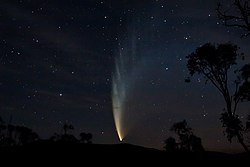

Great comet
View on Wikipedia | This article needs additional citations for verification. (January 2015) |

A great comet is a comet that becomes exceptionally bright, and easily observable to the naked eye.[1] There is no official definition; often the term is attached to comets such as Halley's Comet, which during certain appearances are bright enough to be noticed by casual observers who are not looking for them, and become well known outside the astronomical community. Typically, they are as bright or brighter than a second magnitude star and have tails that are 10 degrees or longer under dark skies.[2] Great comets appear at irregular, unpredictable intervals, on average about once per decade. Although comets are officially named after their discoverers, great comets are sometimes also referred to by the year in which they appeared great, using the formulation "The Great Comet of ...", followed by the year. It can also be used as a generic name when a very bright comet is discovered by many observers simultaneously.[3]
Causes
[edit]_boven_Rotterdam_-_11028-A-B_-_Museum_Rotterdam.jpg)
The vast majority of comets are never bright enough to be seen by the naked eye, and generally pass through the inner Solar System unseen by anyone except astronomers. However, occasionally a comet may brighten to naked eye visibility, and even more rarely it may become as bright as or brighter than the brightest stars. The requirements for this to occur are: a large and active nucleus, a close approach to the Sun, and a close approach to the Earth. A comet fulfilling all three of these criteria will certainly be very bright. Sometimes, a comet failing on one criterion will still be bright. For example, Comet Hale–Bopp did not approach the Sun very closely, but had an exceptionally large and active nucleus. It was visible to the naked eye for several months and was very widely observed. Similarly, Comet Hyakutake was a relatively small comet, but appeared bright because it passed very close to the Earth.
Size and activity of the nucleus
[edit]Cometary nuclei vary in size from a few hundreds of metres across or less to many kilometres across. When they approach the Sun, large amounts of gas and dust are ejected by cometary nuclei, due to solar heating. A crucial factor in how bright a comet becomes is how large and how active its nucleus is. After many returns to the inner Solar System, cometary nuclei become depleted in volatile materials and thus are much less bright than comets which are making their first passage through the Solar System.

The sudden brightening of Comet Holmes in 2007 showed the importance of the activity of the nucleus in the comet's brightness. On October 23–24, 2007, the comet underwent a sudden outburst which caused it to brighten by factor of about 480,000 times. It unexpectedly brightened from an apparent magnitude of about 17 to about 2.8 in a period of only 42 hours, making it visible to the naked eye. All these temporarily made comet 17P the largest (by radius) object in the Solar System although its nucleus is estimated to be only about 3.4 km in diameter.
Close perihelion approach
[edit]The brightness of a simple reflective body varies with the inverse square of its distance from the Sun. That is, if an object's distance from the Sun is halved, its brightness is quadrupled. However, comets behave differently, due to their ejection of large amounts of volatile gas which then also reflect sunlight and may also fluoresce. Their brightness varies roughly as the inverse cube of their distance from the Sun, meaning that if a comet's distance from the Sun is halved, it will become eight times as bright.
This means that the peak brightness of a comet depends significantly on its distance from the Sun. For most comets, the perihelion of their orbit lies outside the Earth's orbit. Any comet approaching the Sun to within 0.5 AU (75 million km) or less may have a chance of becoming a great comet.
Close approach to the Earth
[edit]For a comet to become very bright, it also needs to pass close to the Earth. Halley's Comet, for example, is usually very bright when it passes through the inner Solar System every seventy-six years, but during its 1986 apparition, its closest approach to Earth was almost the most distant possible. The comet became visible to the naked eye, but was unspectacular. On the other hand, the intrinsically small and faint Comet Hyakutake (C/1996 B2) appeared very bright and spectacular due to its very close approach to Earth at its nearest during March 1996. Its passage near the Earth was one of the closest cometary approaches on record with a distance of 0.1 AU (15 million km; 39 LD).
List of great comets
[edit] |
Great comets of the past two millennia include the following below. This list includes multiple bright apparitions of Halley's Comet since 86 BC:
| Comet | |||||||
|---|---|---|---|---|---|---|---|
| Designation | Name | Image | Dimensions (km)(a) |
Total magnitude (M1)(b) |
Maximum brightness |
Perihelion date |
Remarks |
| X/-371 | Great Comet of 371 BC | - | - | - | 371 BC | A winter comet reported by Aristotle and Ephorus[4] | |
| P/-86 Q1 | Halley | 11 km | 5.5 | 2.0 | 6 August 87 BC | Recorded by ancient Babylonians and Chinese[4] | |
| C/-43 K1 | Caesar | - | –4.0 | –9.0 | 25 May 44 BC | Named after Julius Caesar[5] | |
| P/-11 Q1 | Halley | 11 km | 5.5 | –5.0 | 10 October 12 BC | Visible to the naked eye for 5 months[4] | |
| X/-4 G1 | Star of Bethlehem? | - | - | - | 15 April 4 BC | ||
| P/66 B1 | Halley | 11 km | 5.5 | –7.0 | 26 January 66 | Possibly recorded on Josephus' book, The Jewish War | |
| P/141 F1 | Halley | 11 km | 5.5 | –4.0 | 22 March 141 | ||
| X/178 R1 | Great Comet of 178 AD | - | - | - | September 178 | [4] | |
| X/191 T1 | Great Comet of 191 AD | - | - | - | 20 October 191 | ||
| P/218 H1 | Halley | 11 km | 5.5 | –4.0 | 17 May 218 | ||
| C/240 V1 | Great Comet of 240 AD | - | 4.5 | - | 30 November 240 | ||
| X/254 | Great Comet of 254 AD | - | - | - | November–December 254 | Reported tail length to be several tens of degrees. Possible progenitor/apparition of 322P/SOHO[6] | |
| P/295 J1 | Halley | 11 km | 5.5 | –3.0 | 20 April 295 | ||
| P/374 E1 | Halley | 11 km | 5.5 | –3.0 | 17 February 374 | Passed within 13.5 million km from Earth | |
| C/390 Q1 | Great Comet of 390 AD | - | 7.0 | –1.0 | 5 September 390 | ||
| C/400 F1 | Great Comet of 400 AD | - | 6.0 | 0.0 | 25 February 400 | ||
| C/442 V1 | Great Comet of 442 AD | - | 1.5 | 1.0–2.0 | 15 December 442 | ||
| P/451 L1 | Halley | 11 km | 5.5 | –3.0 | 24 June 451 | Appeared before the defeat of Attila the Hun at the Battle of Chalons | |
| P/530 Q1 | Halley | 11 km | 5.5 | –3.0 | 26 September 530 | ||
| C/565 O1 | Great Comet of 565 AD | - | 1.5 | 0.0 | 15 July 565 | ||
| C/568 O1 | Great Comet of 568 AD | - | 5.0 | 0.0 | 25 September 568 | ||
| P/607 H1 | Halley | 11 km | 5.5 | –4.0 | 13 March 607 | Passed within 13 million km from Earth[4] | |
| X/676 P1 | Great Comet of 676 AD | - | - | - | August–September 676 | Reported tail length about 7 to 8 degrees. Possibly an earlier apparition of C/1743 X1[7] | |
| P/684 R1 | Halley | 11 km | 5.5 | –2.0 | 28 October 684 | [4] | |
| P/760 K1 | Halley | 11 km | 5.5 | –2.0 | 22 May 760 | ||
| C/770 K1 | Great Comet of 770 AD | - | 3.2 | 1.0–2.0 | 5 June 770 | ||
| P/837 F1 | Halley | 11 km | 5.5 | –3.0 | 28 February 837 | Closest known approach to Earth by Halley at 5 million km | |
| C/905 K1 | Great Comet of 905 AD | - | 4.5 | 0.0 | 26 April 905 | ||
| P/912 J1 | Halley | 11 km | 5.5 | –2.0 | 9 July 912 | ||
| P/989 N1 | Halley | 11 km | 5.5 | –1.0 | 9 September 989 | ||
| P/1066 G1 | Halley |  |
11 km | 5.5 | –4.0 | 23 March 1066 | Recorded in the Bayeux tapestry |
| X/1106 C1 | Great Comet of 1106 | - | - | - | 1106 | Parent body of the Kreutz sungrazers | |
| C/1132 T1 | Great Comet of 1132 | - | 4.5 | –1.0 | 30 August 1132 | [4] | |
| P/1145 G1 | Halley | 11 km | 5.5 | –2.0 | 21 April 1145 | Depicted on the Eadwine Psalter[4] | |
| P/1222 R1 | Halley | 11 km | 5.5 | –1.0 | 30 September 1222 | [4] | |
| C/1240 B1 | Great Comet of 1240 | - | 2.5 | 0.0 | 21 January 1240 | [4] | |
| C/1264 N1 | Great Comet of 1264 |  |
- | 3.0–4.0 | 0.0 | 20 July 1264 | [8] |
| P/1301 R1 | Halley |  |
11 km | 5.5 | –1.0 | 24 October 1301 | Depicted on the Adoration of the Magi by Giotto di Bondone[4] |
| P/1378 S1 | Halley | 11 km | 5.5 | –1.0 | 9 November 1378 | [4] | |
| C/1402 D1 | Great Comet of 1402 |  |
- | 0.0–1.0 | –3.0 | 21 March 1402 | Possibly an earlier apparition of C/1743 X1[7][9] |
| P/1456 K1 | Halley | 11 km | 5.5 | 0.0 | 9 June 1456 | ||
| C/1468 S1 | Great Comet of 1468 | - | 3.2 | 1.0–2.0 | 7 October 1468 | [4] | |
| C/1471 Y1 | Great Comet of 1471 |  |
- | 2.0 | –3.0 | 1 March 1472 | Passed within 10 million km from Earth on January 1472[10] |
| P/1531 P1 | Halley | ,_p.89v_(comet_illustration).jpg) |
11 km | 5.5 | –1.0 | 25 August 1531 | [4] |
| C/1532 R1 | Great Comet of 1532 | - | 1.8 | –1.0 | 18 October 1532 | [4] | |
| C/1533 M1 | Great Comet of 1533 | - | 3.0 | 0.0 | 15 June 1533 | [4] | |
| C/1556 D1 | Great Comet of 1556 |  |
- | 3.0 | –2.0 | 22 April 1556 | [11] |
| C/1577 V1 | Tycho | .png) |
- | –1.8 | –3.0 | 27 October 1577 | |
| P/1607 S1 | Halley | 11 km | 5.5 | 0.0 | 27 October 1607 | Apparition seen by Johannes Kepler | |
| C/1618 W1 | Great Comet of 1618 |  |
- | 4.6 | 0.0–1.0 | 6 December 1618 | |
| C/1664 W1 | Great Comet of 1664 | - | 2.4 | –1.0 | 4 December 1664 | [12] | |
| C/1665 F1 | Great Comet of 1665 | - | 4.9 | –1.0 | 24 April 1665 | [4] | |
| C/1668 E1 | Great Comet of 1668 | - | 6.0 | 1.0–2.0 | 28 February 1668 | [4] | |
| C/1680 V1 | Kirch | |
- | 4.0 | 1.0–2.0 | 18 December 1680 | Also known as Newton's Comet |
| P/1682 Q1 | Halley | .png) |
11 km | 5.5 | –1.0 | 15 September 1682 | Apparition seen by its namesake, Sir Edmond Halley |
| C/1686 R1 | Great Comet of 1686 | - | 5.0 | 1.0–2.0 | 16 September 1686 | [4] | |
| C/1743 X1 | Klinkenberg–Chéseaux | .jpg) |
- | 0.5 | –7.0 | 1 March 1744 | |
| P/1758 Y1 | Halley | .png) |
11 km | 5.5 | –1.0 | 13 March 1759 | First successfully predicted return of Halley |
| C/1760 A1 | Great Comet of 1760 | - | 7.6 | 2.0 | 17 December 1759 | Passed within 10.2 million km from Earth | |
| C/1769 P1 | Messier |  |
- | 3.2 | 0.0 | 8 October 1769 | [4] |
| C/1807 R1 | Great Comet of 1807 |  |
- | 1.6 | 1.0 | 19 September 1807 | [4] |
| C/1811 F1 | Flaguergues |  |
30–40 km | - | 0.0 | 12 September 1811 | Visible to the naked eye for 8.55 months |
| C/1819 N1 | Tralles |  |
- | 4.0 | 1.0–2.0 | 28 June 1819 | |
| C/1823 Y1 | de Bréauté–Pons |  |
- | 6.5 | 0.0 | 9 December 1823 | |
| C/1831 A1 | Herapath | - | 6.2 | 2.0 | 28 December 1830 | ||
| P/1835 P1 | Halley |  |
11 km | 5.5 | 0.0 | 16 November 1835 | |
| C/1843 D1 | Great Comet of 1843 |  |
15.8 km[13] | 4.9 | –3.0 | 27 February 1843 | Kreutz sungrazer |
| C/1844 Y1 | Great Comet of 1844 | - | 4.9 | 2.5 | 14 December 1844 | [14] | |
| C/1845 L1 | Great Comet of 1845 |  |
- | 4.0 | –2.0 | 6 June 1845 | [15][16] |
| C/1854 F1 | Great Comet of 1854 | - | 7.0 | 2.0 | 24 March 1854 | [17] | |
| C/1858 L1 | Donati |  |
- | 3.3 | 0.0–1.0 | 30 September 1858 | First comet to be photographed |
| C/1861 J1 | Tebbutt |  |
- | 3.9 | 0.0 | 12 June 1861 | |
| C/1865 B1 | Great Southern Comet of 1865 |  |
- | 3.8 | 1.0 | 14 January 1865 | [4] |
| C/1874 H1 | Coggia |  |
- | 5.7 | 0.0–1.0 | 9 July 1874 | |
| C/1880 C1 | Great Southern Comet of 1880 |  |
2.2 km[13] | 7.1–8.9 | 3.0 | 28 January 1880 | Kreutz sungrazer |
| C/1881 K1 | Tebbutt |  |
- | 4.1 | 1.0 | 16 June 1881 | |
| C/1882 R1 | Great Comet of 1882 |  |
61.4 km[13] | 0.7 | –17.0 | 17 September 1882 | Kreutz sungrazer, brightest comet ever recorded in history |
| C/1887 B1 | Thome |  |
- | 6.3 | - | 11 January 1887 | Kreutz sungrazer |
| C/1901 G1 | Viscara |  |
- | 9.0 | –1.5 | 24 April 1901 | |
| P/1909 R1 | Halley |  |
11 km | 5.5 | 0.0 | 20 April 1910 | |
| C/1910 A1 | Great January Comet of 1910 |  |
- | 5.0 | –5.0 | 17 January 1910 | Appeared about four months before the 1910 apparition of Halley |
| C/1927 X1 | Skjellerup–Maristany |  |
- | 5.2 | –4.0 | 18 December 1927 | |
| C/1947 X1 | Southern Comet of 1947 |  |
- | 6.0 | –5.0 | 2 December 1947 | [18] |
| C/1948 V1 | Eclipse Comet of 1948 |  |
- | 9.0 | –1.0 | 27 October 1948 | [18] |
| C/1956 R1 | Arend–Roland |  |
- | 5.9 | –0.5 | 8 April 1957 | |
| C/1957 P1 | Mrkos |  |
- | 4.17 | 1.0 | 1 August 1957 | |
| C/1962 C1 | Seki–Lines |  |
- | - | –1.5 | 1 April 1962 | [17] |
| C/1965 S1 | Ikeya–Seki |  |
8.6 km[13] | - | –10.0 | 21 October 1965 | Kreutz sungrazer. Brightest comet of the 20th century |
| C/1969 Y1 | Bennett |  |
7.52 km[19] | 4.6 | 0.0 | 20 March 1970 | [4] |
| C/1975 V1 | West |  |
- | 4.4 | –3.0 | 26 February 1976 | [4] |
| C/1995 O1 | Hale–Bopp |  |
60 km | –1.3 | –1.8 | 1 April 1997 | Visible to the naked eye for 18 months |
| C/1996 B1 | Hyakutake | .jpg) |
4.2 km | 7.4 | 0.0 | 1 May 1996 | Passed within 0.1 AU from Earth |
| C/2006 P1 | McNaught | |
25 km? | 5.4 | –5.5 | 12 January 2007 | Brightest comet of the 21st century so far |
| C/2011 W3 | Lovejoy |  |
0.2–0.5 km | 15.3 | –4.0 | 16 December 2011 | Kreutz sungrazer |
| C/2020 F3 | NEOWISE | _on_Jul_14_2020_aligned_to_stars.jpg) |
5 km | 7.5 | 0.5–1.0 | 3 July 2020 | [20][21][22][23][24] |
| C/2023 A3 | Tsuchinshan–ATLAS | .jpg) |
11.8 km[25] | 6.5 | –4.9 | 27 September 2024 | [26][27] |
| C/2024 G3 | ATLAS | _from_the_ISS_by_D._Pettit,_11-1-2025_(crop).jpg) |
- | 7.6 | –3.8 | 13 January 2025 | [28] |
Notes:
| |||||||
Notes
[edit]- ^ Michael E. Bakich (18 May 2023). "15 greatest comets of our time". Astronomy. Retrieved 2 December 2025.
- ^ Seargent, David A. J. (2009). The greatest comets in history: broom stars and celestial scimitars. New York: Springer. p. vii. ISBN 978-0-387-09512-7.
- ^ "IAU Comet-naming Guidelines". www.cbat.eps.harvard.edu. Retrieved 8 December 2024.
- ^ a b c d e f g h i j k l m n o p q r s t u v w x D. K. Yeomans (April 2007). "Great Comets in History". ssd.jpl.nasa.gov. Jet Propulsion Laboratory. Retrieved 2 February 2011.
- ^ Ramsey, John T. & Licht, A. Lewis (1997), The Comet of 44 B.C. and Caesar's Funeral Games, Atlanta, ISBN 0-7885-0273-5
{{citation}}: CS1 maint: location missing publisher (link). - ^ J. Cui; G. Li; Y. Zhao (2025). "322P/SOHO: The Counterpart of a Historical Comet in 254 CE?". Icarus. 429 116382. Bibcode:2025Icar..42916382C. doi:10.1016/j.icarus.2024.116382.
- ^ a b M. Meyer; G. W. Kronk (2025). "The Great Comet C/1743 X1: Possible Identification in Historic Records of 1402, 1032, 676, and 336". Journal of Astronomical History and Heritage. 28 (1): 29–49. doi:10.3724/SP.J.140-2807.2025.01.02.
- ^ The Living Age, Volume 58. Lithotyped by Cowles and Company, 17 Washington St., Boston. Press of Geo. C. Rand & Avery. 1858. p. 879.
- ^ D. A. J. Seargent (2009). The Greatest Comets in History: Broom Stars and Celestial Scimitars. Springer Science + Business Media. p. 99. ISBN 978-0-387-09512-7.
- ^ "Great Comet of 1471". Atlas of Great Comets. Cambridge University Press: 49–50. 2015. doi:10.1017/CBO9781316145166.010. ISBN 978-1-107-09349-2.
- ^ S. K. Vsekhsvyatsky (1958). Physical Characteristics of Comets. Moscow, USSR: Fizmatgiz. p. 102.
- ^ "Great Comet of 1664". Atlas of Great Comets. Cambridge University Press: 72–77. 2015. doi:10.1017/CBO9781316145166.016. ISBN 978-1-107-09349-2.
- ^ a b c d M. M. Knight; M. F. A'Hearn; D. A. Biesecker; G. Faury; et al. (2010). "Photometric Study of the Kreutz Comets Observed by SOHO from 1996 to 2005". The Astronomical Journal. 139 (3): 926–949. Bibcode:2010AJ....139..926K. doi:10.1088/0004-6256/139/3/926.
- ^ Bond, G.P. (1850). "On the great comet of 1844–45". The Astronomical Journal. 1: 97. Bibcode:1850AJ......1...97B. doi:10.1086/100067.
- ^ R. L. Branham Jr. (2009). "Orbits of Comets C/1845 L1 (Great June Comet) and C/1846 D1 (de Vico)". Astronomische Nachrichten. 330 (4): 346–350. Bibcode:2009AN....330..346B. doi:10.1002/asna.200811033.
- ^ H. A. Peck (1904). "Definitive Orbit of Comet 1845 III". Astronomical Journal. 24 (555): 17–25. Bibcode:1904AJ.....24...17P. doi:10.1086/103530.
- ^ a b Bortle, J., "The Bright Comet Chronicles", harvard.edu, retrieved 2008-11-18
- ^ a b "Brightest comets seen since 1935". www.icq.eps.harvard.edu. Retrieved 17 January 2024.
- ^ A. H. Delsemme; D. A. Rud (1973). "Albedos and Cross-sections for the Nuclei of Comets 1969 IX, 1970 II and 19711". Astronomy & Astrophysics. 28: 1–6. Bibcode:1973A&A....28....1D.
- ^ "Weekly Information about Bright Comets (2020 July 18: North)". Seiichi Yoshida. July 18, 2020. Archived from the original on July 19, 2020. Retrieved July 18, 2020.
- ^ "Seiichi Yoshida's Diary of Comet Observations (2020)". Seiichi Yoshida. July 19, 2020. Archived from the original on July 20, 2020. Retrieved July 19, 2020.
- ^ "Comet NEOWISE Updtae: Easy To See In The Evening! When And How To See Comet NEOWISE". Farmer's Almanac. July 18, 2020. Archived from the original on July 19, 2020. Retrieved July 19, 2020.
- ^ "APOD: 2022 July 26 - Comet NEOWISE Rising over the Adriatic Sea". NASA. July 26, 2022. Retrieved October 17, 2024.
- ^ "Great Comets: What Are They, And When Will the Next Comet Be Visible?". Star Walk. October 16, 2024. Retrieved October 17, 2024.
- ^ B. Liu; M. T. Hui; X. Liu (2025). "Great comet C/2023 A3 (Tsuchinshan–ATLAS): Dust loss before perihelion" (PDF). Astronomy & Astrophysics. 698: 95. arXiv:2507.12756. Bibcode:2025A&A...698A..95L. doi:10.1051/0004-6361/202554632.
- ^ 2024 October 21 - Comet Tsuchinshan-ATLAS over California. APOD Podcast. Event occurs at 6m00s – via YouTube.
- ^ 2024 November 11 - The Unusual Tails of Comet Tsuchinshan ATLAS. APOD Podcast. Event occurs at 0m19s – via YouTube.
- ^ "Why Comet G3 (ATLAS) will be 'remembered as the Great Comet of 2025' (photos)". Space.com. January 27, 2025. Retrieved January 27, 2025.
External links
[edit]- The bright-comet chronicles. John E. Bortle (W. R. Brooks Observatory)
- Memorable Comets of the Past Gary W. Kronk.
- Brightest comets seen since 1935

.png)


Great comet
View on GrokipediaDefinition and Criteria
Brightness Standards
The apparent magnitude scale, used to quantify the brightness of celestial objects as observed from Earth, is logarithmic and inverted: lower or negative values indicate brighter objects, with each step of 5 magnitudes representing a 100-fold difference in brightness. For comets, this scale applies to the total visual magnitude, encompassing the nucleus, coma, and tail; naked-eye visibility typically begins around magnitude 6 under dark skies, but great comets surpass this dramatically, often reaching magnitudes brighter than 0 to rival or exceed the planet Venus at magnitude -4.[5][6] A common threshold for classification as a great comet is an apparent magnitude of -1 or brighter at peak, ensuring exceptional naked-eye prominence across wide sky regions.[1] The term "great comet" emerged in astronomical literature during the 16th and 17th centuries to describe comets of extraordinary brightness and visibility, with early usage tied to events like the Great Comet of 1577 (C/1577 V1), which was visible in daylight and prompted extensive observations across Europe.[1] By the 18th century, astronomers such as Edmond Halley applied the descriptor to the Great Comet of 1682 (1P/1682 Q1), noting its brilliance around magnitude 0 and using it to refine orbital theories, marking a shift toward scientific rather than omenic interpretations.[1][7] This nomenclature evolved through the 19th century with systematic magnitude estimates, as in the Great Comet of 1882 (C/1882 R1), which reached magnitude -17 near the Sun but appeared at -5 from Earth, influencing catalogs that formalized brightness as a key descriptor.[1] Distinguishing absolute from relative brightness is crucial for comet assessment: apparent magnitude reflects observer-dependent factors like distance and geometry, while absolute magnitude (often H10) standardizes brightness to hypothetical conditions of 1 AU from both the Sun and Earth at zero phase angle, isolating intrinsic luminosity from positional effects.[8] The overall luminosity of great comets derives not solely from the nucleus but significantly from the coma—a gaseous envelope—and tail, where dust scattering and gas fluorescence amplify total output by factors of 10 to 100 times the nuclear brightness alone.[8] For instance, Comet Hale-Bopp (C/1995 O1) achieved a peak apparent magnitude of about -1 in 1997, driven by its expansive coma and dual tails, making it one of the most luminous in recorded history.[9] Modern criteria for designating great comets remain informal, lacking strict International Astronomical Union (IAU) guidelines, but are guided by catalogs from bodies like the Jet Propulsion Laboratory (JPL) and the International Comet Quarterly (ICQ), which prioritize peaks brighter than magnitude 0 alongside tail lengths exceeding 10 degrees for naked-eye spectacle.[1][10] These standards emphasize total integrated brightness over isolated nuclear measurements, ensuring the classification captures comets that achieve widespread cultural and scientific impact through superior visibility.[10]Visibility and Observability
The observability of great comets to the unaided eye relies heavily on clear atmospheric conditions, which minimize scattering of light by aerosols, dust, and water vapor, allowing the comet's coma and tail to stand out against the night sky. In pristine skies, such as those with low humidity and minimal cloud cover, even moderately bright comets can appear vivid, but haze or pollution can reduce contrast and dim their apparent magnitude by up to several tenths. Light pollution from urban artificial lighting further exacerbates this, washing out faint details in the tail and limiting visibility to only the brightest heads in Bortle class 6-9 skies (urban to inner-city environments). Hemispheric factors also play a key role; comets near the ecliptic are often better positioned for northern or southern observers depending on their orbital inclination, with examples like Comet Hale-Bopp (C/1995 O1) visible prominently in both hemispheres due to its favorable trajectory.[1][11][12] Temporal aspects significantly influence a great comet's window of prominence, with visibility durations typically spanning weeks to months as the comet approaches and recedes from Earth and the Sun. Optimal viewing often occurs near perihelion, when solar heating maximizes outgassing and brightness, or during opposition, when the comet is opposite the Sun in the sky for all-night observation. For instance, Comet Hyakutake (C/1996 B2) was observable for about 17 days in March-April 1996, peaking in late March near its closest Earth approach, while Hale-Bopp remained naked-eye visible for an exceptional 18 months from mid-1996 to late 1997, allowing extended global observation. These periods are finite, as the comet fades post-perihelion due to diminishing activity.[13][11] The comet's angular elongation from the Sun—its separation in degrees—is crucial for practical visibility, with elongations greater than 30 degrees enabling safe observation in the evening or morning sky without interference from twilight glare. At smaller elongations, the comet hugs the horizon near sunset or sunrise, complicating sightings due to atmospheric extinction, but this can enhance tail visibility if the geometry aligns. Exceptional great comets have achieved daytime visibility when exceptionally bright and at low elongations; Comet McNaught (C/2006 P1) was seen in broad daylight at magnitude -5.5 in January 2007, only 6 degrees from the Sun, due to its intense dust reflection. Such cases are rare, occurring in fewer than ten historically recorded instances.[1][11] In the modern era, urban light pollution presents substantial challenges compared to historical rural observations, where darker skies allowed widespread naked-eye detection across populated regions. Global sky brightness has increased by an average of 9.6% annually from 2011 to 2022, affecting 83% of the world's population and reducing comet visibility in cities to brief windows or requiring binoculars. Historically, great comets like the 1811 Comet were visible for up to 260 days to rural observers worldwide with minimal interference, whereas today, even prominent events like Hale-Bopp reached only about 81% of American adults, largely in less polluted areas. For past great comets, global visibility percentages varied; Hale-Bopp was estimated observable to over 80% of the global population in suitable conditions, but urban dwellers saw it at reduced quality.[12][14][13]Causes of Prominence
Nucleus Characteristics
The nuclei of great comets are generally larger than those of typical comets, with diameters often exceeding 10 km, enabling greater volatile reservoirs and sustained high activity; for example, Comet Hale-Bopp (C/1995 O1) possesses a nucleus approximately 60 km across.[15] These nuclei are composed primarily of frozen volatiles such as water ice (H₂O), carbon monoxide (CO), carbon dioxide (CO₂), and other ices like ammonia and methane, intermixed with dust grains and refractory organics that constitute about 30-50% of the mass.[16] The abundance of hypervolatiles like CO, which correlates positively with nucleus size, promotes intense sublimation and outgassing upon solar heating, distinguishing great comets from less active ones.[17] High activity levels in great comet nuclei arise from elevated dust and gas production rates, frequently driven by asymmetric jets and episodic outbursts that eject material at speeds up to several km/s, expanding the coma to diameters of 10⁶ km or more.[18] In such events, gas production can reach 10²⁹-10³⁰ molecules per second near perihelion, far surpassing average comets, while dust output forms extensive tails visible from Earth.[19] These outbursts often stem from the sudden exposure of subsurface ices, amplifying the nucleus's overall brightness and visibility. A non-volatile crust, formed by backfall of dust and refractory residues from prior sublimation, covers much of the nucleus surface and acts as a thermal insulator, potentially throttling outgassing; however, devolatilization—through progressive loss of ices and periodic crust disruption via thermal stresses or impacts—exposes fresh active areas, allowing activity to persist over orbital passages spanning years to millennia.[20] This process is modeled in outgassing rates, where the total gas production $ Q $ approximates $ Q \propto A \times (1/r)^2 $, with $ A $ as the active surface fraction and $ r $ the heliocentric distance in AU, emphasizing how fractional active area and solar insolation govern sustained emission.[21] Compared to Jupiter-family comets from the Kuiper Belt, which experience frequent inner Solar System passages causing volatile depletion and lower activity, Oort Cloud-sourced long-period comets remain relatively pristine due to their distant, undisturbed origins, retaining higher fractions of unaltered ices that fuel exceptional outbursts and brightness upon first dynamical return.[22]Orbital and Proximity Factors
The brightness of a great comet is significantly enhanced when its perihelion distance—the closest point to the Sun in its orbit—is less than 1 astronomical unit (AU), as this proximity intensifies solar heating and drives increased sublimation of ices from the nucleus, leading to greater dust and gas ejection.[1] The rate of sublimation follows the inverse square law for solar insolation, where the energy flux received by the comet is proportional to $ \frac{1}{d^2} $, with $ d $ being the heliocentric distance, resulting in exponentially higher activity near perihelion.[23] For instance, comets reaching perihelia under 0.3 AU, such as C/1965 S1 (Ikeya-Seki) at 0.007 AU, exhibit dramatic outbursts of material that amplify their visibility.[1] A comet's apparent brightness from Earth is further boosted when its minimum geocentric distance is less than 1 AU, as the inverse square law governs the dilution of light over distance, making the coma and tail appear larger and more luminous.[24] Optimal viewing geometry also involves favorable phase angles—the angle between the Sun, comet, and observer—typically greater than 90° (approaching 180°), which enhances forward scattering of sunlight by dust particles in the tail, increasing overall illumination.[25] Comets like C/1996 B2 (Hyakutake), which passed within 0.1 AU of Earth, demonstrated this effect through exceptionally prominent tails visible to the naked eye.[1] Most great comets originate from the Oort Cloud and follow long-period orbits with high eccentricities (e > 0.9), enabling deep incursions into the inner Solar System that maximize solar heating and activity.[26] These orbits often feature high inclinations relative to the ecliptic plane, up to nearly 180 degrees, with retrograde orbits (inclination > 90 degrees) providing additional visibility advantages by aligning the comet's path against the night sky for extended periods from Earth's perspective.[27][28] Orbital paths can be altered by gravitational perturbations from planets, particularly Jupiter, which can deflect Oort Cloud comets inward or modify their trajectories to achieve smaller perihelia, thereby enhancing prominence.[29] Additionally, the solar wind—a stream of charged particles from the Sun—interacts with the ejected material, accelerating and stripping dust to form the comet's type II (dust) tail, which contributes to the overall brightness through extended, illuminated structures.[30]Historical Observations
Ancient and Pre-Modern Records
Evidence of prehistoric comet observations is suggested by ancient rock carvings and petroglyphs, potentially recording significant celestial events. At Göbekli Tepe in modern-day Turkey, carvings on the Vulture Stone pillar, dated to approximately 10,950 BCE, have been proposed to depict symbols representing a comet swarm impacting Earth, coinciding with the onset of the Younger Dryas cooling period; these include vulture and scorpion motifs interpreted as aligned with constellations like Scorpio and the Taurid meteor stream. This interpretation remains controversial and is not widely accepted. In Australia, Aboriginal oral traditions preserved in rock paintings, such as those at 'Comet Rock' near Kalumburu in Western Australia, illustrate comets as fiery objects with tails, reflecting observations embedded in cultural lore that may date back thousands of years, though specific petroglyphs around 11,000 BCE remain unconfirmed.[31] Ancient civilizations maintained detailed records of bright comets, often interpreting them as omens. Chinese annals document numerous apparitions, including the great comet of 44 BCE, observed with a tail spanning 8° to 10° and visible during the funeral games for Julius Caesar, which Romans linked to his deification.[32] Babylonian astronomical tablets, such as those from the British Museum, record Halley's Comet in 164 BCE, noting its path through constellations like Aries and providing positional data that aided later orbital studies.[33] In Greek and Roman accounts, Aristotle described comets in his Meteorologica (circa 340 BCE) as sublunary phenomena formed by combustible exhalations from Earth igniting in the upper atmosphere, rejecting earlier views of them as wandering stars.[34] Medieval European chronicles captured comet sightings amid political turmoil, with the Bayeux Tapestry (circa 1070s) illustrating Halley's Comet of 1066 CE as a starry apparition with a trailing beard, witnessed over England and interpreted as a portent of the Norman Conquest and King Harold's defeat at Hastings.[35] Islamic astronomers contributed systematic observations during this era, compiling records of over 100 comets between 700 and 1600 CE in Arabic chronicles; these included descriptions of brightness, tail length, and motion, often integrated into broader astronomical treatises like those influenced by al-Sufi's star cataloging methods.[36] By the 17th and 18th centuries, telescopic observations enhanced accuracy, marking a shift toward scientific analysis. Edmond Halley observed the comet's 1682 CE apparition through improved instruments and, in his 1705 Synopsis of the Astronomy of Comets, predicted its return around 1758 based on orbital calculations from prior sightings (1531, 1607, and 1682), confirming its periodicity of approximately 76 years and challenging Aristotelian views.[37] This prediction, verified upon the comet's reappearance in 1758, established comets as predictable solar system bodies rather than transient atmospheric events.[38]19th to 21st Century Sightings
The 19th century marked a transition in comet observations from naked-eye accounts to instrumental records, with the Great Comet of 1811 (C/1811 F1) exemplifying this shift. Discovered in March 1811 by Honoré Flaugergues, it became visible to the unaided eye by September and remained observable for about 260 days, reaching a peak apparent magnitude of 0 in October when 1.22 AU from Earth.[1] Its long, bright tail, spanning up to 30 degrees, was sketched by numerous astronomers across Europe and North America, providing early systematic data on cometary morphology.[39] Later in the century, Donati's Comet (C/1858 L1) further advanced techniques; discovered by Giovanni Battista Donati in June 1858, it peaked at magnitude 0-1 in October, with a prominent curved tail extending 50 degrees.[1] This comet holds historical significance as the first to be photographed, with William Usherwood capturing an image on September 27 using a collodion plate, though the original is lost; subsequent attempts at Harvard Observatory on September 28 confirmed the feasibility of astro-photography for faint objects.[40] Early spectroscopic efforts also began around this era, though Donati's own spectrum of a comet came in 1864, laying groundwork for analyzing cometary composition.[41] Entering the early 20th century, observations benefited from improved telescopes and photography, as seen with Morehouse's Comet (C/1908 R1). Discovered by Delavan Morehouse in September 1908, it reached magnitude 0-1 by late October, displaying unusual twisted and multiple tails due to magnetic interactions in its ion tail, documented in detailed photographs from observatories like Yerkes.[42] These images revealed cyclonic structures and streamers, advancing understanding of tail dynamics.[43] Halley's Comet (1P/Halley) in 1910 provided a spectacular daylight display; visible from April to June and peaking at magnitude 0-1 near its May perigee of 0.15 AU, it was observed in broad daylight on multiple occasions, particularly around May 20 when only 12 degrees from the Sun.[1][44] Widespread photography and telescopic tracking from global sites, including solar eclipse expeditions, yielded high-resolution data on its nucleus and cyanogen-rich tail.[45] The late 20th century saw comets like Kohoutek (C/1973 E1), discovered by Luboš Kohoutek in 1973, which generated immense public interest but underperformed expectations. Hyped as the "comet of the century" due to early brightness estimates, it peaked at around magnitude 0 in December near perihelion but faded rapidly, becoming visible only to instruments post-perihelion and disappointing naked-eye viewers.[46][47] In contrast, Comet West (C/1975 V1) in 1976 delivered a brilliant show, reaching magnitude -1 in March with a 30-degree tail that split into four fragments; visible even in daylight from southern latitudes, it was extensively studied via ground-based spectroscopy revealing enhanced sodium emissions.[1][48] The 1990s brought Hyakutake (C/1996 B2), discovered in January 1996, which passed 0.10 AU from Earth in March, peaking at magnitude 0 and displaying a 100-degree ion tail; SOHO's LASCO coronagraph captured its perihelion passage in May, providing unprecedented views of sungrazing dynamics.[49] Similarly, Hale-Bopp (C/1995 O1) was visible for 18 months from 1996 to 1997, peaking at magnitude -1 in March 1997 with dual dust and ion tails up to 40 degrees long; SOHO's SWAN instrument observed its vast hydrogen coma spanning over 60 degrees, enabling measurements of water production rates exceeding 10^40 molecules per second.[1][50] In the 21st century, space-based monitoring has dominated, as with McNaught (C/2006 P1) in 2007, discovered by Robert McNaught and peaking at magnitude -5.5 near its January perihelion of 0.17 AU. Primarily a southern hemisphere event, its 30-degree dust tail created aurora-like displays during twilight, captured by observatories like Paranal; SOHO observations confirmed it as the brightest comet in over 40 years.[51][52] Comet Lovejoy (C/2011 W3), a Kreutz sungrazer discovered by Terry Lovejoy in November 2011, defied predictions by surviving perihelion on December 16 at 0.001 AU from the Sun; SOHO's LASCO imaged its fragmentation and reformation, with the remnant reaching magnitude -4 and visible to southern observers for weeks.[53][54] Most recently, C/2023 A3 (Tsuchinshan-ATLAS), co-discovered by Chinese and Chilean surveys in 2023, peaked at approximately magnitude 0 in October 2024 near perihelion, becoming globally visible to the naked eye in late 2024 with a prominent tail up to 15 degrees long during its evening apparition, but faded rapidly thereafter.[1] Ground and space telescopes, including Hubble, documented its dust production and orbital path at 0.41 AU from Earth in October, highlighting advances in automated detection.[55][56][3]Catalog of Great Comets
Pre-Telescopic Examples
Pre-telescopic observations of great comets, dating back to antiquity, were predominantly recorded by literate civilizations in the Northern Hemisphere, including China, Europe, and the Middle East, resulting in a geographical bias that favors events visible from those latitudes.[1] Verification of these accounts is complicated by the interpretive nature of ancient texts, requiring cross-referencing between Chinese annals, European chronicles, and Middle Eastern records to distinguish factual descriptions from omens or exaggerations.[57] Despite these hurdles, historians and astronomers have compiled reliable catalogs of notable apparitions, estimating parameters like brightness and tail length based on qualitative reports of visibility and appearance. The following table presents representative pre-telescopic great comets, focusing on well-documented examples with estimated visual magnitudes (where available) derived from historical descriptions and modern reconstructions. Magnitudes below 0 indicate exceptional brightness, often rivaling Venus; durations typically spanned weeks to months, depending on orbital proximity.| Year | Name/Designation | Estimated Peak Magnitude | Tail Length | Notes and Duration |
|---|---|---|---|---|
| 240 BC | 1P/Halley | ~1 | Not specified | First confirmed historical sighting, recorded as a "broom star" in Chinese annals (Shiji); visible for about 2 months in the Northern Hemisphere.[37] [58] |
| 87 BC | 1P/Halley | 2 | Not specified | Naked-eye visibility reported in Roman and Chinese sources; observed for several weeks.[1] |
| 837 AD | 1P/Halley | -3.5 | >90° | One of the brightest recorded apparitions, visible in daylight across Europe and Asia; duration approximately 3 months, with extensive Chinese and European records.[1] [37] |
| 1066 AD | 1P/Halley | -1 | ~30° (apparent >100° in some accounts) | Prominently depicted in the Bayeux Tapestry; visible for about 2 months, associated with the Norman Conquest; long tail noted in Anglo-Saxon Chronicle.[1] [35] [59] |
| 1264 AD | C/1264 N1 | 0 | 100° | Striking tail length reported in Chinese texts; visible for over a month in the Northern Hemisphere.[1] |
| 1471 AD | C/1471 Y1 | -3 | Not specified | Exceptionally bright, observed across Europe and Asia; duration around 2 months, with reports from multiple regions confirming visibility.[1] |
| 1556 AD | C/1556 D1 | -2 | Not specified | Bright naked-eye object noted in European and Asian records; visible for several weeks.[1] |
Post-1900 Discoveries
The era following 1900 has witnessed numerous great comets, defined here as those achieving a peak apparent magnitude brighter than 0 (visible to the naked eye under dark skies) or exhibiting exceptional observational significance, such as extended visibility or dramatic events. These discoveries span visual sightings by amateur astronomers, photographic detections at observatories, and detections by space telescopes, often yielding detailed orbital and compositional data. Key examples include sungrazers and long-period visitors from the Oort Cloud, with some surviving close solar approaches while others, like Comet ISON, disintegrate as near-misses.| Comet Name | Year of Apparition | Discovery Method | Peak Magnitude | Perihelion Date | Notable Features |
|---|---|---|---|---|---|
| C/1910 A1 (Great January Comet) | 1910 | Photographic, by Max Wolf using a 16-inch astrograph at Heidelberg Observatory on January 12 | 0 | January 17, 1910 | Visible near the Sun for several days; tail extended 20 degrees; approached within 0.13 AU of the Sun, making it a prominent daytime object briefly.[1] |
| 1P/Halley | 1910 | Periodic comet, rediscovered photographically by Max Wolf on September 11, 1909 | 0 | May 19, 1910 | Visible to the naked eye for about 80 days; notable for its historical recurrence and brightness rivaling Venus; passed 0.09 AU from Earth.[1] |
| C/1965 S1 (Ikeya-Seki) | 1965 | Independent visual discoveries by amateur astronomers Kōsei Ikeya (Japan) and Tsutomu Seki (Japan) on October 1 using 10.5-cm and 15-cm refractors | -10 | October 21, 1965 | Extreme sungrazer at 0.008 AU from the Sun; split into multiple fragments; produced a 104-degree antitail and was visible in daylight; one of the brightest 20th-century comets.[11] |
| C/1975 V1 (West) | 1976 | Photographic discovery by Richard M. West using a 1-m Schmidt telescope at La Silla Observatory (ESO, Chile) on August 10, 1975 | -1 | February 25, 1976 | Nucleus fragmented into four pieces near perihelion at 0.20 AU; developed a 30-degree fan-shaped dust tail with striae; visible for months and reached daylight visibility briefly.[60][1] |
| C/1995 O1 (Hale-Bopp) | 1997 | Independent visual discoveries by Alan Hale (New Mexico) and Thomas Bopp (Arizona) on July 23, 1995, using 41-cm and backyard telescopes | -1 | April 1, 1997 | Exceptionally long visibility (18 months total, 6 months naked-eye); at 0.91 AU perihelion with prominent dual tails up to 40 degrees; studied extensively for its large, active nucleus.[1] |
| C/2012 S1 (ISON) | 2013 | Photographic discovery by Vitali Nevski and Artyom Novichonok using the International Scientific Optical Network (ISON) telescope in Russia on September 21, 2012 | -1 (pre-disintegration) | November 28, 2013 | Expected to be extremely bright as a sungrazer at 0.01 AU but nucleus disintegrated near perihelion; remnants produced a brief bright tail observed by SOHO; highlighted risks of close solar passages. |
| C/2020 F3 (NEOWISE) | 2020 | Space-based detection by NASA's NEOWISE infrared telescope on March 27, 2020 | 0 | July 3, 2020 | Survived perihelion at 0.29 AU; visible to naked eye for weeks with a 5-degree dust tail; first major bright comet of the 21st century, widely photographed from Earth.[61] |
| C/2023 A3 (Tsuchinshan–ATLAS) | 2024 | Independent discoveries: photographic by Purple Mountain Observatory (China) on January 17, 2023, and ATLAS survey (South Africa) on July 14, 2023 | -4 | September 27, 2024 | Oort Cloud comet at 0.39 AU perihelion; reached naked-eye visibility globally with a 50-degree ion tail; peaked post-perihelion near Earth approach on October 12.[62] |
| C/1996 B2 (Hyakutake) | 1996 | Visual discovery by Japanese amateur astronomer Yuji Hyakutake on January 30, 1996, using binoculars | 0 | May 1, 1996 | Long-period comet with an exceptionally long ion tail up to 80 degrees; visible to the naked eye for weeks; passed 0.10 AU from Earth, allowing detailed study of its composition.[1] |
| C/2006 P1 (McNaught) | 2007 | Photographic discovery by Robert H. McNaught using the Uppsala Southern Schmidt Telescope at Siding Spring Observatory, Australia, on August 7, 2006 | -5.5 | January 12, 2007 | Brightest comet in over 40 years; visible in daylight from the Southern Hemisphere with a split tail up to 35 degrees; sungrazing approach at 0.17 AU from the Sun.[1] |
| C/2024 G3 (ATLAS) | 2025 | Photographic discovery by the ATLAS survey telescope in Chile on April 5, 2024 | -3.8 | January 13, 2025 | Extreme sungrazer at 0.093 AU perihelion; survived perihelion but nucleus fragmented shortly after, producing a spectacular headless tail visible in SOHO coronagraphs; achieved naked-eye and daytime brightness primarily in the Southern Hemisphere, marking it as the Great Comet of 2025.[63][64]</PROBLEMATIC_TEXT> |