



Community hub
Recent from talks
Contribute something
Nothing was collected or created yet.
HSAB theory
View on WikipediaHSAB is an acronym for "hard and soft (Lewis) acids and bases". HSAB is widely used in chemistry for explaining the stability of compounds, reaction mechanisms and pathways. It assigns the terms 'hard' or 'soft', and 'acid' or 'base' to chemical species. 'Hard' applies to species which are small, have high charge states (the charge criterion applies mainly to acids, to a lesser extent to bases), and are weakly polarizable. 'Soft' applies to species which are big, have low charge states and are strongly polarizable.[1]
The theory is used in contexts where a qualitative, rather than quantitative, description would help in understanding the predominant factors which drive chemical properties and reactions. This is especially so in transition metal chemistry, where numerous experiments have been done to determine the relative ordering of ligands and transition metal ions in terms of their hardness and softness.
HSAB theory is also useful in predicting the products of metathesis reactions. In 2005 it was shown that even the sensitivity and performance of explosive materials can be explained on basis of HSAB theory.[2]
Ralph Pearson introduced the HSAB principle in the early 1960s[3][4][5] as an attempt to unify inorganic and organic reaction chemistry.[6]
Theory
[edit]

Essentially, the theory states that soft acids prefer to form bonds with soft bases, whereas hard acids prefer to form bonds with hard bases, all other factors being equal.[7] It can also be said that hard acids bind strongly to hard bases and soft acids bind strongly to soft bases. The HSAB classification in the original work was largely based on equilibrium constants of Lewis acid/base reactions with a reference base for comparison.[8]
| Property | Hard acids and bases | Soft acids and bases |
|---|---|---|
| atomic/ionic radius | small | large |
| oxidation state | high | low or zero |
| polarizability | low | high |
| electronegativity (bases) | high | low |
| HOMO energy of bases[9][10] | low | higher |
| LUMO energy of acids[9][10] | high | lower (but more than soft-base HOMO) |
| affinity | ionic bonding | covalent bonding |
| Acids | Bases | ||||||
|---|---|---|---|---|---|---|---|
| hard | soft | hard | soft | ||||
| Hydronium | H3O+ | Mercury | CH3Hg+, Hg2+, Hg22+ | Hydroxide | OH− | Hydride | H− |
| Alkali metals | Li+, Na+, K+ | Platinum | Pt2+ | Alkoxide | RO− | Thiolate | RS− |
| Titanium | Ti4+ | Palladium | Pd2+ | Halogens | F−, Cl− | Halogens | I− |
| Chromium | Cr3+, Cr6+ | Silver | Ag+ | Ammonia | NH3 | Phosphine | PR3 |
| Boron trifluoride | BF3 | Borane | BH3 | Carboxylate | CH3COO− | Thiocyanate | SCN− |
| Carbocation | R3C+ | P-chloranil | C6Cl4O2 | Carbonate | CO32− | Carbon monoxide | CO |
| Lanthanides | Ln3+ | Bulk metals | M0 | Hydrazine | N2H4 | Benzene | C6H6 |
| Thorium, uranium | Th4+, U4+ | Gold | Au+ | ||||
Borderline cases are also identified: borderline acids are trimethylborane, sulfur dioxide and ferrous Fe2+, cobalt Co2+ caesium Cs+ and lead Pb2+ cations. Borderline bases are: aniline, pyridine, nitrogen N2 and the azide, chloride, bromide, nitrate and sulfate anions.
Generally speaking, acids and bases interact and the most stable interactions are hard–hard (ionogenic character) and soft–soft (covalent character).
An attempt to quantify the 'softness' of a base consists in determining the equilibrium constant for the following equilibrium:
- BH + CH3Hg+ ⇌ H+ + CH3HgB
where CH3Hg+ (methylmercury ion) is a very soft acid and H+ (proton) is a hard acid, which compete for B (the base to be classified).
Some examples illustrating the effectiveness of the theory:
- Bulk metals are soft acids and are poisoned by soft bases such as phosphines and sulfides.
- Hard solvents such as hydrogen fluoride, water and the protic solvents tend to dissolve strong solute bases such as fluoride and oxide anions. On the other hand, dipolar aprotic solvents such as dimethyl sulfoxide and acetone are soft solvents with a preference for solvating large anions and soft bases.
- In coordination chemistry soft–soft and hard–hard interactions exist between ligands and metal centers.
Chemical hardness
[edit]| Acids | Bases | ||||
|---|---|---|---|---|---|
| Hydrogen | H+ | ∞ | Fluoride | F− | 7 |
| Aluminium | Al3+ | 45.8 | Ammonia | NH3 | 6.8 |
| Lithium | Li+ | 35.1 | hydride | H− | 6.8 |
| Scandium | Sc3+ | 24.6 | carbon monoxide | CO | 6.0 |
| Sodium | Na+ | 21.1 | hydroxyl | OH− | 5.6 |
| Lanthanum | La3+ | 15.4 | cyanide | CN− | 5.3 |
| Zinc | Zn2+ | 10.8 | phosphine | PH3 | 5.0 |
| Carbon dioxide | CO2 | 10.8 | nitrite | NO2− | 4.5 |
| Sulfur dioxide | SO2 | 5.6 | Hydrosulfide | SH− | 4.1 |
| Iodine | I2 | 3.4 | Methane | CH3− | 4.0 |
In 1983 Pearson together with Robert Parr extended the qualitative HSAB theory with a quantitative definition of the chemical hardness (η) as being proportional to the second derivative of the total energy of a chemical system with respect to changes in the number of electrons at a fixed nuclear environment:[11]
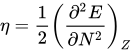
The factor of one-half is arbitrary and often dropped as Pearson has noted.[12]
An operational definition for the chemical hardness is obtained by applying a three-point finite difference approximation to the second derivative:[13]
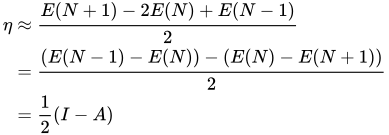
where I is the ionization potential and A the electron affinity. This expression implies that the chemical hardness is proportional to the band gap of a chemical system, when a gap exists.
The first derivative of the energy with respect to the number of electrons is equal to the chemical potential, μ, of the system,
- ,
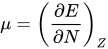
from which an operational definition for the chemical potential is obtained from a finite difference approximation to the first order derivative as
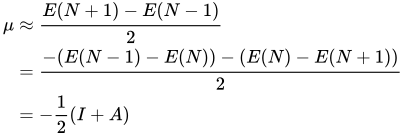
which is equal to the negative of the electronegativity (χ) definition on the Mulliken scale: μ = −χ.
The hardness and Mulliken electronegativity are related as
- ,
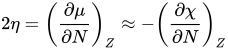
and in this sense hardness is a measure for resistance to deformation or change. Likewise a value of zero denotes maximum softness, where softness is defined as the reciprocal of hardness.
In a compilation of hardness values only that of the hydride anion deviates. Another discrepancy noted in the original 1983 article are the apparent higher hardness of Tl3+ compared to Tl+.
Modifications
[edit]If the interaction between acid and base in solution results in an equilibrium mixture the strength of the interaction can be quantified in terms of an equilibrium constant. An alternative quantitative measure is the heat (enthalpy) of formation of the Lewis acid-base adduct in a non-coordinating solvent. The ECW model is quantitative model that describes and predicts the strength of Lewis acid base interactions, -ΔH . The model assigned E and C parameters to many Lewis acids and bases. Each acid is characterized by an EA and a CA. Each base is likewise characterized by its own EB and CB. The E and C parameters refer, respectively, to the electrostatic and covalent contributions to the strength of the bonds that the acid and base will form. The equation is
- -ΔH = EAEB + CACB + W
The W term represents a constant energy contribution for acid–base reaction such as the cleavage of a dimeric acid or base. The equation predicts reversal of acids and base strengths. The graphical presentations of the equation show that there is no single order of Lewis base strengths or Lewis acid strengths.[14] The ECW model accommodates the failure of single parameter descriptions of acid-base interactions.
A related method adopting the E and C formalism of Drago and co-workers quantitatively predicts the formation constants for complexes of many metal ions plus the proton with a wide range of unidentate Lewis acids in aqueous solution, and also offered insights into factors governing HSAB behavior in solution.[15]
Another quantitative system has been proposed, in which Lewis acid strength toward Lewis base fluoride is based on gas-phase affinity for fluoride.[16] Additional one-parameter base strength scales have been presented.[17] However, it has been shown that to define the order of Lewis base strength (or Lewis acid strength) at least two properties must be considered.[18] For Pearson's qualitative HSAB theory the two properties are hardness and strength while for Drago's quantitative ECW model the two properties are electrostatic and covalent .
Kornblum's rule
[edit]HSAB theory is commonly, but misleadingly, applied to predict the reactions of ambident nucleophiles (nucleophiles that can attack from two or more places). In 1954, Nathan Kornblum et al proposed that the more electronegative atom reacts when the reaction mechanism is SN1 and the less electronegative one in a SN2 reaction.[19] Kornblum's rule was later rationalized through HSAB theory, as follows: in a SN1 reaction the carbocation (a hard acid) reacts with a hard base (high electronegativity) and in a SN2 reaction tetravalent carbon (a soft acid) reacts with soft bases.
However, Kornblum's theory predicts the actual behavior of ambident nucleophiles quite poorly. Violations occur with cyanide, cyanate, thiocyanate, nitrite, nitronates, amide enaminols, and phenylsulfinate. Instead, the determining factor is whether the reaction exhibits a kinetic barrier. Barrier-free reactions are (initially) unselective or (subsequently) determined by equilibrium thermodynamics. Reactions with a barrier tend to involve attack on atoms from later groups and in accordance with the principle of least motion.[20]
See also
[edit]References
[edit]- ^ Jolly, W. L. (1984). Modern Inorganic Chemistry. New York: McGraw-Hill. ISBN 978-0-07-032760-3.
- ^ [1] E.-C. Koch, Acid-Base Interactions in Energetic Materials: I. The Hard and Soft Acids and Bases (HSAB) Principle-Insights to Reactivity and Sensitivity of Energetic Materials, Prop., Expl., Pyrotech. 30 2005, 5
- ^ Pearson, Ralph G. (1963). "Hard and Soft Acids and Bases". J. Am. Chem. Soc. 85 (22): 3533–3539. Bibcode:1963JAChS..85.3533P. doi:10.1021/ja00905a001.
- ^ Pearson, Ralph G. (1968). "Hard and soft acids and bases, HSAB, part 1: Fundamental principles". J. Chem. Educ. 1968 (45): 581–586. Bibcode:1968JChEd..45..581P. doi:10.1021/ed045p581.
- ^ Pearson, Ralph G. (1968). "Hard and soft acids and bases, HSAB, part II: Underlying theories". J. Chem. Educ. 1968 (45): 643–648. Bibcode:1968JChEd..45..643P. doi:10.1021/ed045p643.
- ^ [2] R. G. Pearson, Chemical Hardness – Applications From Molecules to Solids, Wiley-VCH, Weinheim, 1997, 198 pp
- ^ Muller, P. (1994-01-01). "Glossary of terms used in physical organic chemistry (IUPAC Recommendations 1994)". Pure and Applied Chemistry. 66 (5): 1077–1184. doi:10.1351/pac199466051077. ISSN 1365-3075.
- ^ Pearson, Ralph G. (1963). "Hard and Soft Acids and Bases". Journal of the American Chemical Society. 85 (22): 3533–3539. Bibcode:1963JAChS..85.3533P. doi:10.1021/ja00905a001. ISSN 0002-7863.
- ^ a b IUPAC, Glossary of terms used in theoretical organic chemistry, accessed 16 Dec 2006.
- ^ a b Miessler G.L. and Tarr D.A. "Inorganic Chemistry" 2nd ed. Prentice-Hall 1999, p.181-5
- ^ a b Robert G. Parr & Ralph G. Pearson (1983). "Absolute hardness: companion parameter to absolute electronegativity". J. Am. Chem. Soc. 105 (26): 7512–7516. Bibcode:1983JAChS.105.7512P. doi:10.1021/ja00364a005.
- ^ Ralph G. Pearson (2005). "Chemical hardness and density functional theory" (PDF). J. Chem. Sci. 117 (5): 369–377. CiteSeerX 10.1.1.693.7436. doi:10.1007/BF02708340. S2CID 96042488.
- ^ Delchev, Ya. I.; A. I. Kuleff; J. Maruani; Tz. Mineva; F. Zahariev (2006). Jean-Pierre Julien; Jean Maruani; Didier Mayou (eds.). Strutinsky's shell-correction method in the extended Kohn-Sham scheme: application to the ionization potential, electron affinity, electronegativity and chemical hardness of atoms in Recent Advances in the Theory of Chemical and Physical Systems. New York: Springer-Verlag. pp. 159–177. ISBN 978-1-4020-4527-1.
- ^ Vogel G. C.; Drago, R. S. (1996). "The ECW Model". Journal of Chemical Education. 73 (8): 701–707. Bibcode:1996JChEd..73..701V. doi:10.1021/ed073p701.
- ^ Hancock, R. D.; Martell, A. E. (1989). "Ligand design for the selective complexation of metal ions in aqueous solution". Chemical Reviews. 89 (8): 1875–1914. doi:10.1021/cr00098a011.
- ^ Christe, K.O.; Dixon, D.A.; McLemore, D.; Wilson, W.W.; Sheehy, J.A.; Boatz, J.A. (2000). "On a quantitative scale for Lewis acidity and recent progress in polynitrogen chemistry". Journal of Fluorine Chemistry. 101 (2): 151–153. Bibcode:2000JFluC.101..151C. doi:10.1016/S0022-1139(99)00151-7. ISSN 0022-1139.
- ^ Laurence, C. and Gal, J-F. Lewis Basicity and Affinity Scales, Data and Measurement, (Wiley 2010) p 51 ISBN 978-0-470-74957-9
- ^ Cramer, R. E., and Bopp, T. T. (1977) Great E and C plot. Graphical display of the enthalpies of adduct formation for Lewis acids and bases. Journal of Chemical Education 54 612-613
- ^ The Mechanism of the Reaction of Silver Nitrite with Alkyl Halides. The Contrasting Reactions of Silver and Alkali Metal Salts with Alkyl Halides. The Alkylation of Ambident Anions Nathan Kornblum, Robert A. Smiley, Robert K. Blackwood, Don C. Iffland J. Am. Chem. Soc.; 1955; 77(23); 6269-6280. doi:10.1021/ja01628a064
- ^ Mayr, Herbert (2011). "Farewell to the HSAB Treatment of Ambident Reactivity". Angewandte Chemie International Edition. 50 (29): 6470–6505. Bibcode:2011ACIE...50.6470M. doi:10.1002/anie.201007100. PMID 21726020, an excerpt from Breugst, Robert Martin (2010). A Marcus-Theory-Based Approach to Ambident Reactivity (PDF) (PhD dissertation). Ludwig Maximilian University of Munich. pp. 317–.
{{cite thesis}}: CS1 maint: extra punctuation (link)
HSAB theory
View on GrokipediaHistorical Development
Origins and Formulation
The conceptualization of HSAB theory emerged from foundational ideas in valence bond theory during the early 20th century, which emphasized the sharing of electron pairs in chemical bonds, and from Irving Langmuir's explorations of acid-base interactions in the 1920s. Langmuir, building on Gilbert N. Lewis's electron-pair bonding model, described in his 1920 work how atoms or molecules could function as acids by accepting electron pairs or as bases by donating them, often in the context of achieving stable octet configurations. This donor-acceptor framework provided an early qualitative lens for understanding non-electrostatic interactions in chemical associations, influencing later developments in Lewis acid-base chemistry. By the mid-20th century, scattered observations highlighted inconsistencies in metal-ligand complex stabilities that electrostatic models, such as those based solely on charge density, failed to explain. For instance, certain metal ions showed preferential binding to specific donor atoms—such as halides or pseudohalides—independent of ionic size or charge. A key contribution came in 1958 when Sten Ahrland, Joseph Chatt, and Neville R. Davies classified metal ions into "class a" (preferring hard donors like oxygen or fluorine) and "class b" (favoring soft donors like sulfur or iodine), based on empirical stability trends in coordination compounds. This dichotomy, published in a comprehensive review, underscored the need for a broader theoretical framework beyond traditional acid-base paradigms. The formal proposal of HSAB theory was introduced by Ralph G. Pearson in 1963, who coined the terms "hard" and "soft" to describe Lewis acids and bases exhibiting similar preferences in reactivity. Pearson's seminal paper in the Journal of the American Chemical Society presented the hard-soft dichotomy as a qualitative principle to predict the relative strengths of acid-base interactions, motivated by anomalies in stability constants for complexes where ionic models predicted stability but observed preferences favored like-with-like pairings (e.g., hard acids with hard bases). This formulation unified prior classifications, such as Ahrland's, into a cohesive guideline for interpreting Lewis acid-base behavior without relying on quantitative electrostatics alone.Key Contributors and Evolution
Ralph G. Pearson was the primary architect of HSAB theory, authoring multiple influential papers between 1963 and 1973 that expanded its scope and applications. His foundational 1963 article in the Journal of the American Chemical Society formally proposed the classification of Lewis acids and bases as hard or soft, building on earlier observations of metal ion behaviors to predict stability in acid-base interactions. Pearson further elaborated the core principles in a 1968 publication in the Journal of Chemical Education, emphasizing the qualitative rules governing hard-hard and soft-soft preferences. In 1969, he provided a detailed synthesis of the theory's implications in a review chapter within Survey of Progress in Chemistry, which served as an early compendium for researchers.[5] Robert S. Mulliken's contributions in the 1960s, particularly his development of molecular orbital theory and charge-transfer complex concepts, indirectly shaped HSAB by providing a framework for understanding soft acid behaviors through orbital interactions and electron donation-acceptance processes. These ideas, detailed in Mulliken's 1952 work on covalent bonding, informed Pearson's extension of HSAB to systems involving polarizable species. Early experimental validations, such as those exploring coordination preferences in metal complexes, reinforced the theory's predictive power during this period. By the late 1960s, HSAB evolved from a predominantly qualitative tool to semi-quantitative methods, incorporating initial empirical scales for acid-base hardness based on experimental stability constants (e.g., log K values) to better quantify preferences.[5] Concurrently, theoretical support emerged from frontier molecular orbital theory, with Gilles Klopman providing a quantum mechanical interpretation in 1968 that explained HSAB preferences through interactions between the highest occupied molecular orbital (HOMO) of the base and the lowest unoccupied molecular orbital (LUMO) of the acid.[6] This progression facilitated broader adoption, with HSAB principles appearing in coordination chemistry textbooks by the early 1970s, such as those emphasizing ligand-metal stability. The 1970s also saw debates on extending HSAB to organic systems, where its utility in predicting reaction pathways was both championed and critiqued for limitations in covalent contexts.Core Principles
Classification of Acids and Bases
In the Hard-Soft Acid-Base (HSAB) theory, Lewis acids are classified as hard or soft primarily based on their size, charge, and polarizability. Hard acids possess a high charge-to-radius ratio, resulting in high charge density and low polarizability; they are typically small ions in high oxidation states, such as H⁺, Al³⁺, and Fe³⁺. In contrast, soft acids have low charge density and high polarizability, often due to larger size, lower oxidation states, or d¹⁰ electron configurations, exemplified by species like Hg²⁺, Cu⁺, and I⁺. Lewis bases are similarly categorized by the properties of their donor atoms. Hard bases feature donor atoms with high electronegativity and low polarizability, leading to strong electrostatic interactions and a preference for ionic bonding; representative examples include F⁻, NH₃, and H₂O. Soft bases, however, involve donor atoms that are highly polarizable and of lower electronegativity, facilitating covalent interactions, as seen in I⁻, CN⁻, and RS⁻ (where R is an alkyl group). A comprehensive classification of common acids and bases according to HSAB theory is provided in the following tables, drawn from the foundational work. These lists are not exhaustive but illustrate the key patterns observed in experimental stability constants and reactivity trends.Hard Acids
| Ion/Molecule | Examples |
|---|---|
| Alkali and alkaline earth metals | H⁺, Li⁺, Na⁺, K⁺, Be²⁺, Mg²⁺, Ca²⁺ |
| Higher oxidation state transition metals | Al³⁺, Sc³⁺, Cr³⁺, Co³⁺, Fe³⁺ |
| Lanthanides and actinides | La³⁺, Gd³⁺, Th⁴⁺ |
| Others | BF₃, CO₂, Cr(VI), Ti(IV) |
Soft Acids
| Ion/Molecule | Examples |
|---|---|
| Low oxidation state coinage metals | Cu⁺, Ag⁺, Au⁺, Hg⁺ |
| Other soft metal ions | Pd²⁺, Pt²⁺, Cd²⁺, Hg²⁺, Tl³⁺ |
| Halogen and pseudohalogen species | I⁺, Br⁺, I₂, Br₂, ICN |
| Organic and boron species | BH₃, trinitrobenzene, quinones |
Hard Bases
| Ion/Molecule | Examples |
|---|---|
| Halides and oxides | F⁻, Cl⁻, O²⁻, OH⁻ |
| Nitrogen and oxygen donors | NH₃, H₂O, RO⁻ (alkoxides), NO₃⁻ |
| Others | CO₃²⁻, SO₄²⁻, PO₄³⁻ |
Soft Bases
| Ion/Molecule | Examples |
|---|---|
| Sulfur and heavier chalcogen donors | RS⁻, R₂S, SO₃²⁻, S₂O₃²⁻ |
| Carbon donors | CN⁻, CO, R₃P, C₆H₅⁻ (phenyl) |
| Others | I⁻, SCN⁻, R₃As, olefins, H⁻ |
Fundamental Rules and Predictions
The fundamental principle of HSAB theory, often referred to as the HSAB principle, posits that hard acids form stronger and more stable bonds with hard bases, while soft acids preferentially interact with soft bases. This qualitative rule provides a framework for predicting the affinity between Lewis acids and bases based on their classifications, emphasizing a "like prefers like" tendency in acid-base interactions.[7] Secondary predictions extend this principle to the nature of the resulting bonds and their environmental dependence. Hard-hard interactions typically exhibit greater ionic character due to the high charge density and low polarizability of the species involved, rendering them more stable in polar protic solvents like water, which can effectively solvate the charged components through hydrogen bonding.[7] In contrast, soft-soft interactions are predominantly covalent, arising from better orbital overlap and electron sharing, and these pairs demonstrate enhanced stability in polar aprotic solvents such as acetone or dimethyl sulfoxide, where solvation is weaker and does not disrupt the covalent bonding.[7] The underlying stability of matched pairs can be explained through the concept of frontier orbital energy matching. In hard-hard associations, the interaction is largely electrostatic, with minimal orbital overlap, leading to low energy changes; mismatched pairs, however, incur higher energy costs due to unfavorable charge transfer or distortion. For soft-soft pairs, the closeness in energy between the highest occupied molecular orbital (HOMO) of the base and the lowest unoccupied molecular orbital (LUMO) of the acid facilitates efficient covalent bonding without significant charge separation. This avoidance of destabilizing charge transfer in like-with-like pairings underpins the theory's predictive power. Qualitative examples illustrate these rules effectively. Consider the hard acid Na⁺, which forms a more stable interaction with the hard base Cl⁻ than with the soft base I⁻ in aqueous environments due to better solvation of the ionic pair.[7] Ambidentate ligands like thiocyanate (SCN⁻) further demonstrate selectivity: the soft sulfur end binds preferentially to soft acids such as Pt²⁺, forming Pt-SCN, while the hard nitrogen end coordinates to hard acids like Co³⁺, yielding Co-NCS.[7]Quantitative Measures
Chemical Hardness and Softness
In the context of HSAB theory, chemical hardness () is defined as the resistance of a chemical species' electron cloud to deformation or polarization under the influence of an external electric field or interaction with another species. This concept quantifies the stability of the electron distribution, where harder species exhibit lower polarizability and greater rigidity in their electronic structure. Conversely, chemical softness () is the inverse of hardness, representing the ease with which the electron cloud can be distorted, often associated with higher polarizability and greater reactivity toward soft counterparts.[8] Qualitative scales for hardness and softness in HSAB theory are established based on trends in ionization potentials (high for hard species) and electron affinities (low for hard species), reflecting the energy required to alter the electron configuration. Hard acids and bases typically possess large HOMO-LUMO energy gaps, indicating low susceptibility to electron transfer or excitation, whereas soft species feature smaller gaps and higher ease of electron cloud adjustment.[8] Hardness is formally related to electronegativity through operational definitions derived from frontier orbital theory, where absolute electronegativity () is the average of the ionization energy () and electron affinity (), and hardness is half their difference: This formulation bridges the qualitative hard-soft dichotomy of HSAB's core principles to a quantitative measure, with and approximated from vertical ionization processes at constant nuclear configuration.[8] Softness follows directly as , emphasizing its role as a measure of global reactivity.[8] While global hardness and softness describe the overall properties of a molecule or ion, local variants apply to specific atomic sites within a molecule, allowing assessment of site-specific interactions in more complex systems.[8]Calculation Methods and Parameters
Theoretical methods for calculating absolute hardness within the framework of HSAB theory primarily rely on density functional theory (DFT), where hardness η is approximated from frontier molecular orbital energies as η = (εLUMO - εHOMO)/2, based on Koopmans' theorem. This approximation stems from the exact DFT definition of absolute hardness as η = (1/2)(∂²E/∂N²)v, where E is the total energy, N is the number of electrons, and v is the external potential, but the orbital energies provide a practical computational route for molecules and ions.[8] Early theoretical approaches in the 1970s and 1980s used semi-empirical methods or Hartree-Fock calculations for εHOMO and εLUMO, but these suffered from limitations such as overestimation of band gaps and poor handling of electron correlation, leading to less accurate η values before the widespread adoption of DFT in the 1990s.[9] Experimental proxies for hardness often derive from ionization potential (IP) and electron affinity (EA), with η ≈ (IP - EA)/2, where IP and EA are measured via electrochemical techniques like cyclic voltammetry to obtain oxidation and reduction potentials, respectively.[10] Spectroscopic methods, such as UV-Vis spectroscopy, provide indirect estimates through excitation energies that approximate the HOMO-LUMO gap (≈ 2η) or assess polarizability α, which inversely correlates with hardness since softer species exhibit higher polarizability.[11] Related parameters extend hardness to local and global reactivity descriptors. The Fukui function f(r) = (∂ρ(r)/∂N)v quantifies local reactivity, enabling computation of local softness s(r) = S · f(r), where S = 1/η is the global softness and ρ(r) is the electron density; this localizes the HSAB principle to specific atomic sites.[12] The electrophilicity index ω = μ²/(2η) further integrates hardness with the chemical potential μ ≈ (εHOMO + εLUMO)/2, measuring a species' capacity to acquire electrons and aligning with HSAB preferences for hard-hard or soft-soft interactions. Representative computed hardness values illustrate the scale; note that for H⁺, which has no electrons, hardness is theoretically infinite, emphasizing its extreme hardness. The following table summarizes standard absolute hardness values (in eV) for select common species from Pearson's scale, highlighting the hard-to-soft gradient:[13]| Species | Type | η (eV) | Reference |
|---|---|---|---|
| H⁺ | Acid | ∞ | [8] |
| Li⁺ | Acid | 35.1 | [13] |
| F⁻ | Base | 7.0 | [13] |
| Cl⁻ | Base | 4.7 | [13] |
| I⁻ | Base | 3.7 | [13] |
| CH₃⁺ | Acid | 11.0 |