


Community hub
Haiphong
View on Wikipedia | This article needs to be updated. (June 2025) |
Haiphong or Hai Phong (Vietnamese: Hải Phòng, pronounced [hǎːj fɔ̀ŋ] ⓘ) is the third-largest city in Vietnam and is the principal port city of the Red River Delta.[7] The municipality has an area of 1,526.52 km2 (589.39 sq mi).[1] The city includes Bạch Long Vĩ and Cát Hải islands in the Gulf of Tonkin. It has a population of 2,130,898 in 2023.[8][9] The city's economy has strength in manufacturing, as evidenced by large industrial parks and numerous smaller traditional handicraft villages. Historically, Haiphong was the first place in Vietnam and Mainland Southeast Asia to get electricity.
Key Information


.jpg)


In the imperial era of Đại Việt, the Bạch Đằng River in Haiphong was a place of many legendary victories, led by now-legendary commanders Ngô Quyền and Trần Hưng Đạo. In the 16th century, Mạc dynasty promoted the coastal settlement as a secondary capital, growing to become an important port town of Đàng Ngoài. After the French conquest of Vietnam, in 1888, the president of the French Third Republic, Sadi Carnot, promulgated a decree to establish Haiphong as one of the principal cities of French Indochina. From 1954 to 1975, Haiphong served as the most important maritime city of North Vietnam. It was one of the directly controlled municipalities of a reunified Vietnam with Hanoi and Ho Chi Minh City in 1976.
Haiphong is a popular seaside vacation spot and known for biological reserves in Cát Bà Island. For its extensive port, the city hosts the headquarters of the Vietnam People's Navy. Royal poinciana are commonly associated with Haiphong in Vietnamese culture.
History
[edit]Dynastic Vietnam
[edit]Modern-day Haiphong was the home of Lê Chân, one of the female generals under the command of the Trưng Sisters who rose against Chinese domination in 40 AD and ruled until their defeat in 43 AD. Lê Chân was known to have established the Hải tần Phòng thủ (“Defenced Sea-coast”) during the war against general Ma Yuan of the Han dynasty.[10][11] Centuries later under the reign of Nguyễn Emperor Tự Đức, the area earned the appellation: Hải-Dương thương-chính quan-phòng ("The trading defensive area of Hải Dương Province").

By the 19th century, at the end of Tự Đức's reign, the Hang Kenh Communal House in what is now the city's Le Chan District was made the administrative seat of An Dương District, restoring its regional importance.[12] The area by then had developed into a sizable commercial port.
At the eve of the French conquest in 1881, a typhoon ravaged the area, killing about 3,000 people in and around Haiphong. Despite the damages, Haiphong was developed by the French to serve as Indochina's main naval base over the ensuing decades.
Democratic Republic of Vietnam and the Vietnam War
[edit]Following the defeat of Japan in World War II, Vietnamese nationalists agitated for independence against French return. French forces landed in Haiphong and encountered resistance which resulted in the deaths of three French soldiers. In retaliation, the French ships, among them the cruiser Suffren, shelled the city, setting it ablaze[13] and precipitating the First Indochina War.[14][15] French infantry forces under the command of Jean-Étienne Valluy entered the city, fighting house to house with the support of armored units and airplanes.[16]
Late in the Vietnam War, Haiphong was subjected to heavy bombing by US Navy and Air Force strike aircraft because it was North Vietnam's only major port. U.S. Admiral Thomas H. Moorer ordered the mining of Haiphong harbor on 8 May 1972, effectively sealing the port. Until it was lifted, the mining caused no casualty.[17][18] Despite being targeted, the physical structure of the city was mostly unaffected by the war as the US had a self-imposed prohibition zone for the city. After the war, the city recovered its role as a significant industrial center.[12]
21st century
[edit]On 20 February 2025 the Vietnamese parliament approved an $8 billion railroad investment to upgrade under Xi Jinping's Belt and road initiative the old French-built Kunming–Haiphong railway, which serves the Chinese border city Hekou Yao, Lao Cai, Hanoi and Haiphong.[19]
On 12 June 2025, the National Assembly issued Resolution No. 202/2025/QH15[2] on the arrangement of provincial-level administrative units (the resolution took effect on June 12, 2025). Accordingly, Hải Dương Province was merged into Hai Phong City.
Geography
[edit]Haiphong is a coastal city located at the mouth of the Cấm River, in Vietnam's north-eastern coastal area, 120 kilometres or 75 miles east of Hanoi. The Bính Bridge crosses the Cam and connects the city with Thủy Nguyên District. It has a total natural area of 152,318.49 hectares or 376,387 acres (2001). It borders Quảng Ninh Province to the north, Hải Dương Province to the west, Thái Bình Province to the south, and the Gulf of Tonkin to the east. Bach Long Vi island, Cat Ba Island and the Long Châu islands, located in the Gulf, are also administered as part of the city. Tidal flat ecosystems occur adjacent to the city, however, many have been reclaimed for agriculture or development purposes.[20]
Climate
[edit]Haiphong features a humid subtropical climate (Koppen: Cwa) with hot, humid summers and warm, dry winters. The city is noticeably wetter from April through October; roughly 90% of the city's annual rainfall (which totals approximately 1,700 millimetres or 67 inches) typically falls during these months. There is a noticeable difference in temperatures between the city's winters and summers. Haiphong's coolest months, January and February, sees average high temperatures reach 20 °C (68 °F) and average low temperatures at around 14 °C (57.2 °F). Its warmest months, June and July, sees average high temperatures hover around 33 °C (91.4 °F) and average low temperatures at around 26 °C (78.8 °F). Sea temperatures range from a low of 21 °C (70 °F) in February to a high of 30 °C (86 °F) during the months of July and August.[21]
| Climate data for Haiphong (Phù Liễn, Kiến An district) | |||||||||||||
|---|---|---|---|---|---|---|---|---|---|---|---|---|---|
| Month | Jan | Feb | Mar | Apr | May | Jun | Jul | Aug | Sep | Oct | Nov | Dec | Year |
| Record high °C (°F) | 31.0 (87.8) |
34.1 (93.4) |
35.4 (95.7) |
37.4 (99.3) |
41.5 (106.7) |
39.5 (103.1) |
38.5 (101.3) |
39.4 (102.9) |
37.4 (99.3) |
36.6 (97.9) |
33.1 (91.6) |
30.0 (86.0) |
41.5 (106.7) |
| Mean daily maximum °C (°F) | 19.8 (67.6) |
20.1 (68.2) |
22.2 (72.0) |
26.4 (79.5) |
30.6 (87.1) |
32.0 (89.6) |
32.1 (89.8) |
31.5 (88.7) |
30.8 (87.4) |
29.0 (84.2) |
25.8 (78.4) |
22.1 (71.8) |
26.9 (80.4) |
| Daily mean °C (°F) | 16.3 (61.3) |
17.0 (62.6) |
19.4 (66.9) |
23.1 (73.6) |
26.6 (79.9) |
28.2 (82.8) |
28.4 (83.1) |
27.8 (82.0) |
26.9 (80.4) |
24.7 (76.5) |
21.5 (70.7) |
18.1 (64.6) |
23.2 (73.8) |
| Mean daily minimum °C (°F) | 14.2 (57.6) |
15.2 (59.4) |
17.7 (63.9) |
21.1 (70.0) |
24.1 (75.4) |
25.6 (78.1) |
25.9 (78.6) |
25.3 (77.5) |
24.3 (75.7) |
22.0 (71.6) |
18.8 (65.8) |
15.5 (59.9) |
20.8 (69.4) |
| Record low °C (°F) | 4.5 (40.1) |
4.5 (40.1) |
6.1 (43.0) |
10.4 (50.7) |
15.5 (59.9) |
18.4 (65.1) |
20.3 (68.5) |
20.4 (68.7) |
15.6 (60.1) |
12.7 (54.9) |
9.0 (48.2) |
4.9 (40.8) |
4.5 (40.1) |
| Average rainfall mm (inches) | 28.0 (1.10) |
27.4 (1.08) |
48.5 (1.91) |
85.3 (3.36) |
201.6 (7.94) |
238.1 (9.37) |
238.1 (9.37) |
353.0 (13.90) |
257.1 (10.12) |
136.3 (5.37) |
43.0 (1.69) |
22.8 (0.90) |
1,679.3 (66.11) |
| Average rainy days | 8.4 | 12.8 | 17.1 | 12.9 | 12.6 | 14.1 | 14.2 | 17.5 | 13.8 | 9.7 | 6.4 | 5.5 | 145.2 |
| Average relative humidity (%) | 84.4 | 88.5 | 90.9 | 90.7 | 87.5 | 86.8 | 86.6 | 88.4 | 86.3 | 82.3 | 79.8 | 79.5 | 86.0 |
| Mean monthly sunshine hours | 82.0 | 46.6 | 41.3 | 85.0 | 183.7 | 181.3 | 199.1 | 169.5 | 179.1 | 179.8 | 148.5 | 126.8 | 1,624.8 |
| Source 1: Vietnam Institute for Building Science and Technology[22] | |||||||||||||
| Source 2: The Yearbook of Indochina (1930-1931)[23] | |||||||||||||
| Month | Jan | Feb | Mar | Apr | May | Jun | Jul | Aug | Sep | Oct | Nov | Dec | Year |
|---|---|---|---|---|---|---|---|---|---|---|---|---|---|
| Average temperature °C (°F) | 22 °C (72 °F) | 21 °C (70 °F) | 22 °C (72 °F) | 24 °C (75 °F) | 27 °C (81 °F) | 29 °C (84 °F) | 30 °C (86 °F) | 30 °C (86 °F) | 29 °C (84 °F) | 28 °C (82 °F) | 26 °C (79 °F) | 23 °C (73 °F) | 26 °C (79 °F) |
Administration
[edit]Hai Phong is subdivided into 45 wards, 67 communes and 2 special zones (Bạch Long Vĩ and Cát Hải).

Before 2025, Haiphong was subdivided into 15 district-level sub-divisions, consisting of 8 urban districts, 6 rural districts and 1 municipal city (sub-city):
- 8 urban districts:
- 6 rural districts:
- 1 municipal city:
They are further subdivided into 10 commune-level towns (or townlets), 148 communes, and 72 wards.
Table of local government districts
[edit]| District | Number of wards (communes and towns) |
Area (km2) (2025) |
Population (2025) |
Density (people/km2) |
|---|---|---|---|---|
| An Dương | 10 wards | 78.96 | 171,227 | 2,169 |
| Dương Kinh | 6 wards | 48.85 | 60,319 | 1,235 |
| Đồ Sơn | 6 wards | 46.32 | 54,175 | 1,169 |
| Hải An | 8 wards | 97.64 | 144,256 | 1,477 |
| Hồng Bàng | 10 wards | 39.77 | 177,820 | 4,471 |
| Kiến An | 7 wards | 29.6 | 118,047 | 3,988 |
| Lê Chân | 7 wards | 11.9 | 261,854 | 22,004 |
| Ngô Quyền | 8 wards | 11.33 | 186,683 | 16,477 |
| Sub-total (urban districts) | 62 wards | 364.37 | 1,174,381 | 3,223 |
| Thủy Nguyên | 17 wards + 4 communes | 269.1 | 397,570 | 1,477 |
| Sub-total (municipal city) | 17 wards, 4 communes | 269.1 | 397,570 | 1,477 |
| An Lão | 2 towns + 15 communes | 114.58 | 146,712 | 1,280 |
| Bạch Long Vĩ | - | 3.16 | 624 | 197 |
| Cát Hải | 2 towns + 10 communes | 325.6 | 32.090 | 98 |
| Kiến Thụy | 1 town + 15 communes | 108.87 | 160,239 | 1,471 |
| Tiên Lãng | 1 town + 18 communes | 195 | 185,619 | 951 |
| Vĩnh Bảo | 1 town + 19 communes | 183.16 | 224,813 | 1,227 |
| Sub-total (rural districts) | 7 towns + 77 communes | 930.37 | 750,097 | 806 |
| Total | 79 wards, 7 towns, 81 communes | 1,563.84 | 2,322,048 | 1,484 |
Economy
[edit]Haiphong is a major economic center of the North in particular and Vietnam in general both. Under French domination, Haiphong was level 1 city, equal to Saigon and Hanoi. The last years of the 19th century, the French had proposed to build Haiphong into the economic capital of Indochina.[24] Today, Haiphong is still one of the most important economic centers of Vietnam. In 2009, Haiphong state budget revenue reached 34,000 billion Vnd. In 2011, budget revenues in the city reached 47,725 billion, increase 19% compared to 2010.[25] In 2015, total revenues of the city reached 56 288 billion. Government plans that to 2020, Haiphong's revenues will be over 80,000 billion and the domestic revenue reach 20.000 billion. In the ranking of the Provincial Competitiveness Index (PCI) 2013 of Vietnam, Haiphong city ranked at No. 15/63 provinces.[26] Haiphong has relationship of trading goods with more than 40 countries and territories around the world. Haiphong is striving to become one of the largest commercial centers of the country.[27]
On Vietnam's Provincial Competitiveness Index 2023, a key tool for evaluating the business environment in Vietnam’s provinces, Hai Phong received a score of 70.34. This was an improvement from 2022 in which the province received a score of 70.76. In 2023, the province received its highest scores on the 'Labor Policy' and 'Time Costs' criterion and lowest on 'Policy Bias' and ‘Transparency’.[28]
Industry
[edit]Industry is a key sector in Haiphong including food processing, light industries and heavy industries. Major products include fish sauce, beer, cigarettes, textiles, paper, plastic pipes, cement, iron, pharmaceuticals, electric fans, motorbikes, steel pipes and ships and out-sourcing software implementation.[29] Most of these industries have been growing significantly between 2000 and 2007, with the exceptions of the cigarette and pharmaceutical industries. Shipbuilding, steel pipes, plastic pipes and textiles are among the industries with the most rapid growth.[29]
There are also growing industries supplying products used by existing industries in the city. PetroVietnam set up a joint-venture PVTex with textile manufacturer Vinatex to build Vietnam's first polyester fiber plant in Haiphong. The factory will use by-products from oil-refining and reduce reliance on imported materials.[30] 270,600 people were employed in Haiphong's industry. 112,600 industrial jobs were created between 2000 and 2007.[29]
Agriculture, forestry and fishery
[edit]Despite its status as a city, around one third of Haiphong's area or 52,300 ha (as of 2007) are used for agriculture. Rice is the most important crop, taking up around 80% of the agricultural land with an output of 463,100 tons in 2007.[29] Other agricultural products include maize, sugar and peanuts.[29]
Haiphong has a relatively large fishing sector with an output of 79,705 tons (2007). Gross output has almost doubled between 2000 and 2007, mostly due to fast growth in aquaculture, which made up 60% of gross output in 2007. Despite its coastal location, sea fish contribute relatively little to the sector (around one fourth). Nam Định Province and Thái Bình Province have much larger fishing sectors and even the inland Hải Dương Province has a larger gross output from fishing than Haiphong.[29]
As of 2007, 315,500 were employed in agriculture and fishery, a significant decrease from 396,300 in 2000. However, these sectors still account for almost a third of total employment in Haiphong, a larger share than industry.[29] However, gross output in both agriculture and fishery have been growing significantly between 2000 and 2007.
Demographics
[edit]Haiphong is the third most populous city in Vietnam, with a population of 2.103.500 for the metropolitan area (2015), encompassing an area of 1,507.57 km2 (582.08 sq mi), 46,1% of population reside in the urban districts.[31] The gender distribution is half female (50.4%).[32]
Population growth
[edit]As of the 2009 census, Haiphong's average annual population growth rate was given as 4.0%. Haiphong's crude birth rate was recorded at 18.1 live births per 1000 persons vs the crude death rate of 7.6 per 1000 persons. Life expectancy at birth was estimated at 77.1 years for women and 72.0 years for men, or 74.5 years overall. Infant mortality rate was measured at 11.8 infant deaths per 1000 live births, just over two points above the nation's average for urban areas. In the same census, the city's out-migration was 1.9% vs in-migration of 2.8% and, for a net migration rate of 0.9%.[32]
Education
[edit]In 2012, Hải Phòng had 4 universities and academies, 17 colleges, 26 professional secondary schools, 56 high schools, and hundreds of other educational institutions ranging from elementary to preschool levels. Trần Phú High School in Hải Phòng holds a Vietnamese record for being the only school with students winning international prizes for 21 consecutive years.

Universities in Hải Phòng
[edit]- Vietnam Maritime University - A national key university specializing in transport and maritime studies
- Hai Phong University - A multidisciplinary university, formerly Hai Phong College of Education
- Hai Phong Medical University - Trains general and specialized doctors, nurses, and serves as a medical research center
- Hai Phong Management and Technology University - A private multidisciplinary university
High schools in Hải Phòng
[edit]- Tran Phu Gifted High School: Ranked third nationally in terms of achievements in national student competitions, holds a record for 21 consecutive years of international awards
- Ngô Quyền High School: Formerly known as Bonnal School, the oldest in Hải Phòng, with French architectural influence, established in 1920
- Thái Phiên High School: A top non-specialized high school in the city, in the top 100 nationwide
- Lê Ích Mộc High School: Named after the first scholar of Hải Phòng, located in Kỳ Sơn, Thủy Nguyên
- Lê Quý Đôn High School: Another prominent high school in Hải Phòng
- Trần Nguyên Hãn High School: Known for students achieving high results in university entrance exams and fostering creative students
- An Lão High School: Located at 43 Lê Lợi Street, An Lão town, An Lão district, known for high teaching quality
- Vĩnh Bảo High School: Recognized for having many students achieve top results in university entrance exams
- Kiến An High School: The second oldest high school in Hải Phòng, known for its high-quality education
- Tiên Lãng High School: The first school in Hải Phòng with a student winning the national final of the "Road to Mount Olympia" competition
- Mạc Đĩnh Chi High School: Located in Dương Kinh district, known for a high university entrance rate
- Haiphong Maritime High School: Internationally named by alumnus Trần Bảo Sơn, affiliated with Vietnam Maritime University
- Lương Thế Vinh High School: Formerly Toa Xe Private High School, one of the first four private high schools in Hải Phòng
- Hồng Bàng High School
- Lê Hồng Phong High School
- An Dương High School
- Hải An High School
- Lê Chân High School
- Thăng Long High School
- Kiến Thụy High School
- Nguyễn Đức Cảnh High School
- Bạch Đằng High School
- Trần Hưng Đạo High School
- Nguyễn Trãi High School
Transport
[edit]
Roads
[edit]Haiphong is located at the junction of two National Highways: Route 5, leading west to Hanoi, and Route 10, leading south to Nam Định and onward to connect with National Route 1 at Ninh Bình. Highway 356 passes west–east from the Route 5/10 junction through Haiphong's city center all the way to the coast. A connecting road from route 5 to route 18 links Haiphong with Quảng Ninh Province. In 2015, the new highway connecting Haiphong with Hanoi was completed; this is the most modern highway in Vietnam and reduces the trip by one hour as compared to the previous route.[33]
Within the city there are several long-distance bus depots: Niem Nghia, Vinh Niem, and Thuong Ly.
A new highway route was completed in 2016. From Hanoi to Haiphong and back, it now takes less than two hours to reach. It has also shortened the distance from Haiphong to Thai Binh, Hai Duong, Hung Yen.
Tourists can easily catch a coach from Niem Nghia bus station to Hanoi or Cat Ba island, either Quang Ninh, or South of Vietnam.
Airports
[edit]The main airport serving Haiphong is Cat Bi International Airport with three flights daily to Ho Chi Minh city. In April 2011, Vietnam Airlines launched routes to Da Nang with 5 flights a week. An international airport for Haiphong, situated in Tien Lang district, is in the planning stages; if realized it would become the largest airport in northern Vietnam.
Seaports
[edit]
Haiphong port is one of the largest ports in Vietnam and south-east Asia as a whole. The Port of Haiphong on the Cấm River is divided into three main docks: Hoang Dieu (Central terminal) located near the city's center, Chua Ve, and Dinh Vu both farther downstream to the east.[34] Several ferry terminals connect Haiphong with the neighboring Cát Hải and Cát Bà Islands; Ben Binh Ferry terminal is located near the city center while Dinh Vu Ferry is located on a spit of land on the coast. The government had approved the plans to build an international port in Lach Huyen – 15 kilometers from the current port. Once completed this will be one of the deepest ports in Vietnam, with a draft of 14m, capable of receiving ships up to 100.000 DWT.
Railway
[edit]Haiphong station built in 1902 is the eastern terminus of the Kunming–Hai Phong Railway, also known as the Yunnan–Vietnam Railway. Built at by the French during their occupation, the railway once connected Haiphong to the city of Kunming in Yunnan, China, although service along the Chinese portion of the line is currently suspended. Rail travel from Haiphong with connections to the rest of the Vietnamese railway network is via Hanoi.
Passenger trains run daily from 6AM until 6PM from Hai Phong city to the capital Hanoi and back. The travel time between the two cities by rail is approximately three hours.
Cuisine
[edit] |
Hai Phong specialties are known throughout Vietnam for their seafood dishes. Seafood restaurants in the Do Son area are famous for having very fresh shrimp, crab, fish, and squid at affordable prices. The seafood processing style in Hai Phong is simple, emphasizing the essence and freshness of ingredients, not spices.
Dishes such as bánh đa cua (red noodle soup with crab), bún cá (fish rice noodle soup), bánh mỳ que cay (spicy stick-bread), cơm cháy hải sản (crispy rice cracker with seafood), nem cua bể (square crab spring rolls) are notable and popular dishes. These dishes can be found on the streets of other places like Ho Chi Minh City, Hanoi, but enjoying them on the Flamboyant City (the other name of Haiphong City) is still the most ideal because of the choice of raw ingredients and cooking secrets of local chefs. Hai Phong cuisine has been promoted to Europe at the Brest Maritime Festival 2008 (France) and resonated greatly.
Hai Phong also has many other dishes such as mantis shrimp hot pot, bean sprouts salad, sủi dìn, bánh bèo (Haiphong's version, which is different from Hue's version).
Notable people
[edit]- Mạc Đăng Dung (1483–1541), king of Đại Việt country, the founder of the Mạc dynasty
- Nguyễn Bỉnh Khiêm (1491–1585), thinker, poet, prophet, Cao Dai religion saint
- Mai Trung Thu (1906–1980), painter
- Thẩm Thúy Hằng (1939–2022), actress
- Trần Văn Cẩn (1910–1994), painter
- Văn Cao (1923–1995), musician, poet, painter and composer of the national anthem of Vietnam Tiến Quân Ca
- Quang Thắng (born 1968), actor and comedian
- Wong Kwok-hing (born 1949), Hong Kong trade unionist and a former member of the Legislative Council of Hong Kong (2004–2016)
- Ốc Thanh Vân (born 1984), actor and television host
- Phan Thị Hà Thanh (born 1991), artistic gymnast, first gymnast to win a world medal for Vietnam gymnastics (2011)
- Thu Phương (born 1972), pop singer and Haiphong native; now lives in the U.S.
Twin towns
[edit]


Gallery
[edit]-
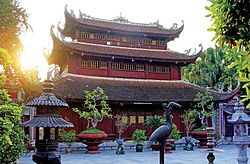 Du Hang Pagoda
 -
 Du Hang Pagoda architecture
 -
 The city's Opera House
 -
 A Buddhist temple in Haiphong.
 -
 Haiphong Cathedral (2007)
 -
 Haiphong City International Exhibition Center


.jpg)


See also
[edit]References
[edit]- ^ a b Biểu số 4.2: Hiện trạng sử dụng đất vùng Đồng Bằng Sông Hồng năm 2022 [Table 4.2: Current land use status in the Red River Delta in 2022] (PDF) (Decision 3048/QĐ-BTNMT) (in Vietnamese). Ministry of Natural Resources and Environment (Vietnam). 18 October 2023. – the data in the report are in hectares, rounded to integers
- ^ a b c "Nghị quyết số 202/2025/QH15 về việc sắp xếp đơn vị hành chính cấp tỉnh" [Resolution No. 202/2025/QH15 on the arrangement of provincial-level administrative units]. National Assembly of Vietnam Portal. 2025-06-12. Archived from the original on 2025-06-12. Retrieved 2025-06-12.
- ^ General Statistics Office of Vietnam (2023). Niên giám Thống kê Việt Nam năm 2022 [Statistical Yearbook of Vietnam 2022] (PDF). Statistical Publishing House (Vietnam). p. 105. Archived (PDF) from the original on 2024-04-03. Retrieved 2024-04-03.
- ^ General Statistics Office of Vietnam (2019). "Completed Results of the 2019 Viet Nam Population and Housing Census" (PDF). Statistical Publishing House (Vietnam). ISBN 978-604-75-1532-5.
- ^ "TelluBase—Viet Nam Fact Sheet" (PDF). Tellusant Public Service Series. Retrieved 31 July 2024.
- ^ "Human Development Index by province(*) by Cities, provincies and Year". General Statistics Office of Vietnam. Retrieved September 28, 2024.
- ^ "DEEP C - Living and Working in Vietnam". Archived from the original on 2020-06-25. Retrieved 2020-06-22.
- ^ "Hưởng ứng ngày Dân số Việt Nam: Hải Phòng hoàn thành vượt mức các chỉ tiêu Trung ương và thành phố giao". giadinh.suckhoedoisong.vn (in Vietnamese). Retrieved 2024-10-27.
- ^ "Đẩy mạnh các hoạt động nâng cao chất lượng dân số". anhp.vn (in Vietnamese). Retrieved 2024-10-27.
- ^ "Nữ tướng Lê Chân và dấu ấn Hải Tần Phòng Thủ".
- ^ "Chương trình Famtrip"Hải tần Phòng thủ - Góc nhìn mới" tiếp tục giới thiệu nhiều địa danh lịch sử và ẩm thực Hải Phòng | Cổng Thông tin điện tử thành phố Hải phòng".
- ^ a b Haiphong's Culture Archived 2017-06-29 at the Wayback Machine. HaiphongTourism.gov.vn
- ^ Vietnam by Spencer C. Tucker, page 47. "On 23 November DebeS delivered an ultimatum to the Vietnamese at Haiphong, ordering them to withdraw from the French section of the city, the Chinese quarter, and the port. He gave them only two hours to reply. When the time was up the French subjected the Vietnamese positions to air, land, and sea bombardment, the bulk of the firepower coming from the three- and eight-inch guns of the French Navy Cruiser Suffren. Only military targets were destroyed and not the Vietnamese quarter as some have claimed. Estimates of the number killed in the shelling and ensuing panic vary widely. Casualties up to 20,000 have been cited. French Admiral Battet later said that no more than 6,000 Vietnamese had died, but in 1981 Vu Quoc Uy, then chairman of the Haiphong municipal committee, told Stanley Karnow that the figure was only 500 to 1,000 dead. Others have put the figure as low as 200".
- ^ (in French) Maurice Vaïsse, L'Armée française dans la guerre d'Indochine (1946–1954) : Adaptation ou inadaptation, 2000, p. 276
- ^ Plon, Le General de Gaulle et l'Indochine 1940–1946, page 210. "In connection with the naval bombardment, let us note that only the ships of small tonnage could go up the river of Haiphong. On November 23, two colonial sloops supported for the first time the French troops with their artillery to a limited effect: the Chevreuil with its double turret, with its two pairs of 100mm, Savorgnan de Brazza with its four turrets each of one 138mm. No battleship was present. On November 27 on that the evening, the cruiser Suffren was in the Bay d' Along, its tidal water prohibiting it access of the Cua Cam. It transported troops in reinforcement..."
- ^ Phillippe Devillers, Histoire du Viêt-Nam de 1940 à 1952. Editions du Seuil, Paris. Third edition,1952, pp. 331–340
- ^ "Vietnam: A Television History; Interview with Thomas H. Moorer, 1981". openvault.wgbh.org. Archived from the original on 4 March 2016. Retrieved 19 March 2018.
- ^ Forbes, Andrew, and Henley, David: Vietnam Past and Present: The North (History and culture of Hanoi and Tonkin). Chiang Mai. Cognoscenti Books, 2012. ASIN: B006DCCM9Q.
- ^ "Vietnam parliament approves $8 billion rail link to China". Yahoo. AFP. 20 February 2025. Archived from the original on 21 February 2025. Retrieved 20 February 2025.
- ^ Murray, N.J.; Clemens, R.S.; Phinn, S.R.; Possingham, H.P.; Fuller, R.A. (2014). "Tracking the rapid loss of tidal wetlands in the Yellow Sea" (PDF). Frontiers in Ecology and the Environment. 12 (5): 267–272. Bibcode:2014FrEE...12..267M. doi:10.1890/130260.
- ^ a b Haiphong Climate Guide, Retrieved 9 August 2012.
- ^ "Vietnam Institute for Building Science and Technology" (PDF).
- ^ The Yearbook of Indochina (1930-1931)
- ^ "Liên kết phát triển giữa Hà Nội và Hải Phòng đóng vai trò quan trọng". Archived from the original on 2011-09-05. Retrieved 2016-03-07.
- ^ "Tin Bộ Tài Chính". Bộ Tài Chính (in Vietnamese). Retrieved 9 May 2025.
- ^ "General Ranking". www.pcivietnam.org. Archived from the original on 2012-12-05. Retrieved 2017-09-14.
- ^ "Sở Ngoại vụ". Archived from the original on 2016-03-05. Retrieved 2016-03-07.
- ^ the-shiv (2024-08-17). "Doing Business in Hai Phong, Vietnam 2024". the-shiv. Retrieved 2024-08-24.
- ^ a b c d e f g General Statistics Office (2009): Socio-economic Statistical Data of 63 Provinces and Cities, Vietnam. Statistical Publishing House, Hanoi
- ^ "PVTex to operate first polyester fiber project early 2011". The Saigon Times. 2010-05-14. Archived from the original on 2011-10-06. Retrieved 2011-07-06.
- ^ Bureau of East Asian and Pacific Affairs (May 27, 2010). "Background Note: Vietnam". U.S. Department of State. Retrieved 2010-06-21.
- ^ a b The 2009 Vietnam Population and Housing census: Major findings. General Statistics Office of Vietnam.
- ^ Administrator. "Hanoi – Hai Phong Expressway Project". www.vidifi.vn.
- ^ "Haiphong Port: Maps". Archived from the original on 2011-08-21. Retrieved 2011-04-09.
- ^ "Đà Nẵng và Hải Phòng 60 năm tình nghĩa". haiphong.gov.vn (in Vietnamese). Haiphong. 2020-08-05. Retrieved 2021-01-08.
- ^ ""Sister Cities & Affiliated Cities"". incheon.go.kr. Incheon Metropolitan City. Retrieved 2021-01-08.
- ^ "DEEP C shakes hand with City of Kitakyushu to promote investment". deepc.vn. DEEP C Industrial Zones. 2019-05-13. Retrieved 2021-01-07.[permanent dead link]
- ^ "Il canale dei Navicelli, la via d'acqua tra Pisa e Livorno ponte per un gemellaggio?". pressmare.it (in Italian). Press Mare. 2016-02-24. Retrieved 2021-01-07.
- ^ "Il 南宁市国际友城名单及分布图". nanning.gov.cn (in Chinese). Naning. Archived from the original on 2020-07-11. Retrieved 2020-07-11.
- ^ ""Международные и межрегиональные связи"". gov.spb.ru (in Russian). Federal city of Saint Petersburg. Retrieved 2020-11-12.
- ^ "Seattle's Sister Cities". City of Seattle. Archived from the original on 2022-02-25. Retrieved 2021-09-16.
- ^ "天津友好城市一览表". tj.gov.cn (in Chinese). Tianjin. Retrieved 2021-01-07.
Notes
[edit]External links
[edit]

- Official Website of Haiphong City
- Official Website of Haiphong Tourism.
- History of Haiphong: interactive Google Map with specific sites and historic views of the city from French colonial times.
Places adjacent to Haiphong | |
|---|---|


| International | |
|---|---|
| National | |
| Geographic | |
| Other | |

Haiphong
View on GrokipediaHistory
Pre-Colonial and Colonial Foundations
Prior to French colonization, the area now known as Haiphong comprised small fishing villages and rudimentary ports along the northern Vietnamese coast, centered around sites like Ninh Hai port in what was then Hai Duong province.[7] These settlements supported local agriculture, fishing, and limited coastal trade within the Red River Delta region, but lacked significant urban development or infrastructure for large-scale maritime commerce.[8] Following the French conquest of Tonkin in the 1880s, authorities identified the site's potential as a deep-water harbor and began its transformation into a strategic seaport in 1874.[9] By 1885, French engineers expanded existing waterways, including the Lien Khe Canal originating from An Bien Village, to enable deeper vessel access and port operations.[8] In 1887, colonial administrators detached coastal districts from Hai Duong to form Hai Phong province, formalizing administrative focus on the emerging hub.[7] The city's official establishment occurred on July 19, 1888, via decree from French President Sadi Carnot, designating Haiphong as a key port for Indochina.[10] Under subsequent French investment, it evolved into the southeastern terminus of the Hanoi-Haiphong railway, completed in 1902, fostering export of coal, rice, and other goods while integrating it into the colonial economy as Tonkin's primary maritime gateway.[9] By the early 20th century, Haiphong had become one of French Indochina's largest industrial and shipping centers, with wharves, warehouses, and European-style urban planning supplanting prior village layouts.[11]Independence Struggles and the Haiphong Incident
![Rue chinoise, Haiphong, Tonkin][float-right] Following the August Revolution of 1945, the Viet Minh under Ho Chi Minh seized control in northern Vietnam, including Haiphong, declaring the Democratic Republic of Vietnam on September 2, 1945.[12] As a major northern port, Haiphong became a focal point for tensions between Vietnamese nationalists seeking independence and French forces aiming to reestablish colonial authority after World War II.[13] French attempts to negotiate accords, such as the March 6, 1946, agreement allowing limited French troop presence in northern cities, failed to resolve underlying conflicts over sovereignty and port control.[14] Escalating disputes in Haiphong centered on customs enforcement and alleged arms smuggling by the Viet Minh. On November 20, 1946, Vietnamese authorities arrested a French customs officer amid claims of illicit shipments, prompting French demands for his release and access to port facilities.[15] Tensions boiled over on November 23 when a French patrol clashed with Vietnamese forces near the port, leading High Commissioner Georges Thierry d'Argenlieu to authorize a naval bombardment by the cruiser Suffren and supporting vessels targeting Vietnamese-held districts.[16] The shelling lasted approximately two hours, devastating residential and commercial areas in the native quarters. Casualty estimates from the bombardment vary significantly, reflecting partisan reporting: French General Jean Étienne Valluy claimed around 300 deaths, while U.S. consular reports cited approximately 2,000, and Vietnamese sources, including Ho Chi Minh, asserted up to 20,000 killed, with broader figures ranging from 6,000 to 20,000 including subsequent fighting.[15] [13] French forces suffered 29 fatalities in reclaiming the city over the following week against Viet Minh resistance.[15] The incident solidified French military control over Haiphong but provoked widespread outrage, contributing directly to the Viet Minh's retaliatory assault on Hanoi on December 19, 1946, marking the onset of the First Indochina War.[17]Role in the Vietnam War
Haiphong served as North Vietnam's principal port during the Vietnam War, facilitating the entry of approximately 85 percent of the country's imports, including critical military supplies from the Soviet Union and China, which sustained the North Vietnamese Army's operations against South Vietnam.[18] The harbor's capacity supported up to 4,000 tons of general cargo per day, underscoring its logistical centrality despite U.S. efforts to interdict shipments.[19] Under Operation Rolling Thunder, the sustained U.S. bombing campaign from March 1965 to October 1968, Haiphong faced restricted attacks due to its proximity to Hanoi and concerns over Soviet or Chinese involvement; initial sanctuary zones of 10 miles around the port limited strikes to avoid broader escalation.[20] While some port facilities and supply routes were targeted intermittently, the overall flow of materiel persisted, as evidenced by continued Soviet resupply efforts.[21] Escalation occurred in 1972 amid North Vietnam's Easter Offensive, when President Richard Nixon authorized Operation Pocket Money on May 8, sowing aerial mines in Haiphong's approaches and channels to blockade incoming shipments, an action announced in a national address that effectively halted maritime traffic for months.[22] Complementing this, Operation Linebacker strikes from May onward bombed port infrastructure, followed by Linebacker II in December, which dropped over 20,000 tons of ordnance on Hanoi and Haiphong areas, severely disrupting logistics and pressuring Hanoi toward the Paris Peace Accords.[23] The mining campaign, in particular, demonstrated naval interdiction's efficacy in denying North Vietnam seaborne aid without ground invasion, though it drew international criticism for targeting neutral shipping.[24] Mines were later cleared during Operation End Sweep starting in 1973 as part of ceasefire implementation.[25]Post-War Reconstruction and Economic Reforms
Following the Vietnam War's conclusion in April 1975, Haiphong confronted extensive infrastructure damage, particularly to its port, which had endured repeated U.S. bombings aimed at severing supply routes to Hanoi.[26] Initial reconstruction prioritized restoring port operations and industrial facilities amid resource shortages, yet progress remained constrained by centralized planning, inadequate mechanization, and prolonged cargo handling times, limiting throughput in the late 1970s and 1980s.[27] National economic stagnation, characterized by collectivized agriculture, fixed prices, and hyperinflation exceeding 700% annually by 1986, impeded Haiphong's recovery until the Communist Party's Sixth National Congress in December 1986 introduced Đổi Mới reforms.[28] These policies dismantled collectives, liberalized prices, encouraged private enterprise, and opened doors to foreign investment, enabling Haiphong to leverage its port for export-led growth and industrial expansion.[29] Post-Đổi Mới, Haiphong established economic and industrial zones, attracting USD 11 billion in foreign direct investment across 450 projects by early 2016, with 69% targeting manufacturing.[29] Port cargo volume expanded from 7.7 million tonnes in 2002 to 41.4 million tonnes in 2014, while container throughput rose from 219,200 TEUs in 2000 to 2.55 million TEUs in 2014 at a 19.16% annual rate, accounting for 25% of Vietnam's northern container traffic.[29] These developments, bolstered by official development assistance exceeding USD 212 million for port upgrades between 2002 and 2014, drove annual GDP growth of 8.91% from 2010 to 2015, elevating per capita GDP to USD 3,940 by 2015.[29]Contemporary Developments
In the years following Vietnam's accession to the World Trade Organization in 2007, Haiphong emerged as a pivotal industrial and logistics hub, leveraging its port facilities to support the nation's export-driven economy. Foreign direct investment surged into manufacturing sectors, with the establishment of large-scale industrial parks such as VSIP and Nomura Haiphong, fostering assembly operations for electronics and automotive components primarily from Japanese and South Korean firms. This period marked a shift from traditional port activities to integrated supply chain roles, contributing to Haiphong's designation as a key node in northern Vietnam's economic corridor.[30] By the mid-2010s, Haiphong recorded Vietnam's highest urban growth rate, with population increases exceeding national averages and rapid urbanization transforming former agricultural lands into industrial zones. The city's marine economy, centered on its seaports, accounted for approximately 30% of Vietnam's coastal GDP, underscoring its dominance in shipping and related industries. Infrastructure expansions, including deep-water port developments at Lach Huyen, enabled handling of larger container vessels, boosting throughput capacity and positioning Haiphong as a competitive alternative to regional ports like those in China.[31][32][33] Entering the 2020s, Haiphong set ambitious targets amid global supply chain shifts, aiming for annual GRDP growth of at least 14.5% during 2020-2025 through diversified sectors including high-tech manufacturing and logistics. In 2025, the city pursued a 12.5% GRDP increase, with industry and construction projected at 15.67% and services at 9.2%, supported by a 66 trillion VND (approximately 2.6 billion USD) port upgrade plan approved for completion by 2030. These initiatives, coupled with ongoing FDI inflows, reflect Haiphong's strategy to evolve into a modern maritime economic center, though challenges like urban sprawl and pollution persist as noted in policy assessments.[34][35][36][29]Geography and Environment
Location and Physical Features
Haiphong is a coastal city situated in northeastern Vietnam, approximately 102 kilometers east of Hanoi.[1] It borders Quang Ninh Province to the north, Hai Duong Province to the west, and Thai Binh Province to the south, extending eastward to the Gulf of Tonkin.[1] The city's central coordinates are roughly 20.87°N latitude and 106.68°E longitude.[37] The municipality covers a total land area of 1,519 square kilometers, incorporating offshore islands such as Cát Hải and Bạch Long Vĩ Districts.[38] Its terrain lies on the northeastern fringe of the Red River Delta, featuring predominantly flat, low-lying alluvial plains with elevations near sea level.[38] Approximately 15% of the area consists of hills and low mountains, concentrated in the northern regions, while the coastal zone forms a shallow, muddy curve along 125 kilometers of shoreline in the Gulf of Tonkin.[1][38] These features support extensive riverine and estuarine systems, including distributaries of the Thái Bình River system that drain into the sea near the urban core.[39] Physically, Haiphong's landscape reflects deltaic sedimentation, with fertile plains interspersed by waterways and limited relief, rendering much of the interior suitable for agriculture and port infrastructure development.[40] The offshore islands contribute karst formations and higher elevations, such as peaks reaching 322 meters on Cát Bà Island, contrasting the mainland's subdued topography.[41]Climate and Natural Hazards
Haiphong has a humid subtropical climate classified as Cwa under the Köppen-Geiger system, characterized by distinct wet and dry seasons.[42] The average annual temperature stands at 23.7 °C, with typical yearly variations ranging from a low of 15 °C in winter to a high of 32 °C in summer; extremes rarely fall below 11 °C or exceed 35 °C.[42][43] Winters, from November to March, are mild and relatively dry with occasional drizzle, while summers, from May to September, are hot, humid, and dominated by the East Asian monsoon, bringing heavy rainfall averaging 1,600 to 1,800 mm annually.[44] The city's coastal position moderates temperatures, making it approximately 1 °C warmer than inland Hanoi in winter and 1 °C cooler in summer.[44] Natural hazards in Haiphong primarily stem from its exposure to tropical cyclones in the northwestern Pacific basin, which frequently impact the northern Vietnamese coast during the June-to-November typhoon season.[45] The cyclone risk is rated high, with over a 20% chance of damaging wind speeds (exceeding 90 km/h) occurring in any given 10-year period, often accompanied by storm surges up to several meters and intense rainfall triggering flash floods and riverine inundation.[45] Historical events underscore this vulnerability; for instance, Super Typhoon Yagi struck in September 2024, generating widespread flooding, landslides, and infrastructure damage in Haiphong, with reported economic losses surpassing 10.8 trillion VND (about 440 million USD).[46] Such storms exacerbate coastal erosion and saltwater intrusion, compounded by the city's low-lying deltaic terrain and proximity to the Gulf of Tonkin.[47] Seismic activity remains low, with no major earthquakes recorded in recent decades, though minor tremors from regional faults occasionally occur.[48]Environmental Challenges
Haiphong faces significant environmental pressures from rapid industrialization and its coastal location, including air and water pollution primarily driven by port activities, manufacturing, and untreated industrial effluents. Monthly average PM2.5 concentrations in the city ranged from 14 to 37 μg/m³ between 2020 and 2023, exceeding World Health Organization guidelines and contributing to health risks for residents, with sources including vehicular emissions, shipping, and nearby power plants.[49] Water pollution is acute in coastal and riverine areas, where discharges from over 120 industrial facilities, craft villages, and healthcare units have contaminated waterways with heavy metals, nutrients, and organic waste, leading to eutrophication and harm to aquatic ecosystems as documented in 2014 assessments.[50] Industrial zones like Dinh Vu have been identified through hydrodynamic modeling as key contributors to degraded water quality in adjacent bays, with pollutants spreading via tidal currents and affecting marine biodiversity and fisheries.[51] Flooding poses a recurrent threat, intensified by climate change-induced sea level rise and extreme rainfall events. The city experiences intense downpours of 100–250 mm, often overwhelming drainage systems and causing urban inundation, as seen in repeated incidents requiring comprehensive infrastructure upgrades.[52] Relative sea level in the Haiphong coastal area has risen by approximately 21.4 cm over the past 60 years, with an accelerated rate of 14.7 cm in the last 19 years, compounding flood risks through higher storm surges and tidal influences in this low-lying deltaic region.[53] These trends align with broader Vietnamese coastal vulnerabilities, where subsidence from groundwater extraction in urban-industrial hubs further elevates exposure, though site-specific subsidence rates in Haiphong remain understudied compared to southern deltas.[54] Mitigation efforts, such as green growth initiatives, target waste management and emissions reduction but face challenges from enforcement gaps and rapid urban expansion.[29]Government and Administration
Administrative Structure
Haiphong operates as a centrally administered municipality in Vietnam, equivalent in status to a province and directly governed by the central government.[55] In June 2025, Vietnam's administrative reforms merged Haiphong with Hai Duong province, expanding the city's area to 3,194.72 square kilometers and its population to over 4.66 million as of that year.[56][57] This restructuring implemented a two-tier governance model, abolishing the district level and establishing direct administration from the municipal level to 114 commune-level units, comprising wards (phường) in urban zones and communes (xã) in rural areas, along with special zones where applicable.[56][57] The Haiphong People's Council, elected by local representatives, functions as the highest legislative authority, overseeing policy and electing the People's Committee, which executes administrative and executive duties including public services, urban planning, and economic management.[1] Prior to the 2025 merger, Haiphong's structure included 15 district-level subdivisions—eight urban districts, six rural districts, and one sub-city (Đồ Sơn)—further divided into 217 wards and communes, but these intermediate layers were streamlined to enhance efficiency and reduce bureaucratic layers.[58][59]Political System and Governance Issues
Haiphong operates within Vietnam's unitary socialist republic framework, dominated by the Communist Party of Vietnam (CPV), which maintains a monopoly on political power at all levels, including municipal governance.[60][61] The city's highest authority is the Haiphong City Party Committee, led by a Secretary who directs policy and personnel decisions in alignment with central CPV directives; as of 2024, this role emphasizes anti-corruption and economic development under national campaigns.[62][63] Executive functions are handled by the People's Committee, chaired by an appointed or elected official who implements Party policies on administration, urban planning, and public services, while the unicameral People's Council, comprising around 75 members as of recent terms, approves budgets and ordinances but operates under CPV oversight with limited independent deliberation.[64][65] Local elections occur every five years, but candidates are vetted by the Party, ensuring no opposition representation.[66] Governance in Haiphong has been marked by systemic challenges, including entrenched corruption, particularly in land allocation and urban development, which have sparked public discontent and occasional protests. Land management is perceived as highly corrupt, with officials often implicated in irregular seizures for industrial or port expansion, as evidenced by the 2012 Dong Tranh eviction case where farmer Doan Van Vuon resisted forceful land clearance, leading to a deadly clash and subsequent government acknowledgment of procedural violations by local authorities.[67][68][69] In that incident, Haiphong police chief Do Huu Ca was later indicted in 2024 for bribery tied to the eviction, highlighting judicial delays and political interference in accountability processes.[69] Nationwide anti-corruption drives under CPV leadership, such as the "Blazing Furnace" campaign, have resulted in investigations in Haiphong, including probes into bribery and abuse of power, yet critics argue these efforts selectively target rivals while preserving Party control and failing to address root causes like opaque decision-making.[70][71] Political dissent remains tightly constrained, with no legal avenues for multi-party competition or independent civil society oversight, leading to sporadic unrest over governance failures such as environmental neglect in port areas or unequal resource distribution. Protests, like those in 2012 against corrupt land grabs in Haiphong, underscore tensions between rapid industrialization and resident rights, often met with suppression rather than reform.[68][72] Despite economic growth, transparency deficits persist, as local media and officials prioritize Party narratives over critical reporting, contributing to inefficiencies in public service delivery and investor confidence.[71][61]Economy
Economic Overview and Growth Metrics
Haiphong functions as a pivotal economic center in northern Vietnam, leveraging its strategic port position to drive activity in manufacturing, logistics, and trade-related services. The city's gross regional domestic product (GRDP) totaled nearly VNĐ288.5 trillion (approximately US$11.4 billion) in 2024, reflecting its status as one of Vietnam's leading provincial economies.[73] This output underscores Haiphong's integration into global supply chains, particularly through export-oriented industries supported by foreign direct investment.[74] GRDP growth in Haiphong has exhibited sustained momentum, achieving double-digit rates for ten consecutive years through 2024. The 2024 expansion reached 11 percent year-over-year, building on 10.3 percent growth in 2023.[73][74] This performance positioned Haiphong among Vietnam's top localities for economic expansion, outpacing the national GDP growth of around 6 percent in recent years.[75] Such consistent high growth stems from infrastructure investments and policy reforms enhancing business competitiveness, as evidenced by the city's top ranking in the 2024 Provincial Competitiveness Index.[76] These metrics highlight Haiphong's resilience amid global economic fluctuations, with non-state sector investments surging 20.3 percent in 2024 to contribute substantially to overall expansion.[77]Major Industries and Sectors
The manufacturing and construction sectors dominate Haiphong's economy, accounting for 53.34 percent of the city's GDP in 2024.[74] The service sector contributes 37.76 percent, while agriculture, forestry, and fisheries make up the remaining approximately 8.9 percent.[74] This structure underscores the city's transition to an industrial hub, with manufacturing processing driving much of the growth amid surging foreign direct investment.[78] Within manufacturing, electronics and high-tech assembly represent key subsectors, supported by industrial parks like VSIP Haiphong, which target information technology, electronics, and pharmaceuticals.[79] Automotive production has emerged as a priority, with proximity to suppliers facilitating assembly operations in areas like Hai Phong and nearby Bac Ninh.[80] Shipbuilding, a traditional strength, has entered recovery following global industry challenges, with local yards producing cargo vessels for domestic and export markets.[81][82] The city plans to bolster supporting industries for autos and shipbuilding through targeted policies.[83] Other significant manufacturing areas include chemicals, petrochemicals, food and beverage processing, and heavy industries housed in parks such as Deep C Haiphong, which accommodate light manufacturing and energy-related production.[84][85] These sectors benefit from 14 operational industrial parks, attracting over $50 billion in cumulative FDI by 2024, primarily in processing and manufacturing.[86]Port Economy and International Trade
The Port of Haiphong functions as northern Vietnam's principal maritime hub, managing substantial volumes of containerized and bulk cargo essential to regional and national trade. In 2024, the port's operator recorded a throughput of 39.9 million tons, fulfilling 109.3% of its annual target and reflecting a 5.1% year-over-year increase. Container handling at the facility reached 7.1 million TEUs, elevating its global ranking to 29th among container ports and demonstrating a 12.8% growth from 2023. These figures underscore the port's recovery and expansion amid fluctuating global shipping dynamics. Key exports routed through Haiphong include electronics, textiles, and agricultural goods, while imports predominantly feature machinery, mechanical appliances, and raw materials for manufacturing. Principal trading partners encompass China, South Korea, Japan, the United States, and ASEAN nations, with the port serving as a conduit for Vietnam's integration into supply chains shifted from higher-cost regions. In the first half of 2024 alone, the Haiphong seaport area processed 46 million tons of cargo, highlighting its operational scale despite occasional throughput dips in prior years due to economic slowdowns.[87] Recent infrastructure upgrades at the Lach Huyen deep-water terminal cluster have enhanced capacity for larger vessels, with a new smart container terminal inaugurated in April 2025 to improve efficiency and connectivity. Foreign investments, such as CMA CGM's $600 million commitment for a terminal adding 1.9 million TEUs annually by 2028, signal sustained growth potential. Additionally, Vingroup's planned $14 billion port and logistics complex, set to commence in 2026, aims to further bolster multimodal integration and handle escalating trade volumes driven by Vietnam's manufacturing surge. The port's activities contribute significantly to Haiphong's gross regional domestic product, supporting the city's 10.55% growth estimate for 2024 and reinforcing its role in Vietnam's export-led economy.[88][89][90][91]Foreign Investment, Corruption, and Regulatory Challenges
Haiphong has attracted significant foreign direct investment (FDI), particularly in manufacturing and logistics sectors leveraging its port infrastructure. In 2023, the city received US$3.4 billion in FDI, ranking second nationally after Ho Chi Minh City, with cumulative FDI exceeding US$50 billion across 1,724 projects as of recent reports.[74][86] Key projects include LG Electronics' factory complex, which has driven electronics manufacturing growth, alongside investments from South Korean, Japanese, and Singaporean firms in industrial parks.[92] For 2025, Haiphong targets US$3-3.5 billion in FDI inflows to industrial zones, focusing on high-tech and green industries to sustain growth amid Vietnam's overall FDI surge.[93] Despite these inflows, regulatory challenges persist, including bureaucratic delays in licensing, inconsistent enforcement of investment laws, and complex administrative procedures that hinder business operations. Foreign investors often face protracted approval processes for land use rights and environmental permits, exacerbated by Vietnam's fragmented regulatory framework at local levels like Haiphong.[94][95] Stringent foreign exchange controls limit repatriation of profits, while frequent policy changes—such as updates to foreign ownership limits in May 2025—create uncertainty for long-term planning.[96][97] These issues, rooted in centralized decision-making and overlapping jurisdictions, reduce Haiphong's competitiveness despite its strategic port advantages, prompting calls for streamlined reforms to align with international standards.[98] Corruption further complicates the investment environment, with Haiphong's customs and port operations particularly vulnerable due to high trade volumes. In October 2025, 14 former Hai Phong Customs officers were sentenced for bribery and abuse of power, highlighting systemic graft in import-export facilitation that inflates costs for legitimate businesses.[99] Such cases, including earlier seizures of smuggled goods like ivory at the port, underscore risks of facilitation payments and favoritism in regulatory approvals, deterring transparent FDI.[100] Vietnam's broader anti-corruption campaign has led to prosecutions, but enforcement remains uneven, with local officials in port cities like Haiphong facing incentives for rent-seeking amid opaque procurement and land allocation processes.[101] Investors report that while preferential policies exist for FDI zones, corruption erodes trust and efficiency, contributing to higher operational risks compared to regional peers.[94]Demographics
Population Trends and Urbanization
Haiphong's population reached 2,088,020 in 2022, encompassing the city's administrative area of approximately 1,527 square kilometers. By 2023, population density had risen to 1,379 people per square kilometer, up slightly from prior years, indicating sustained demographic expansion amid northern Vietnam's economic hubs. Official estimates placed the figure at around 2.12 million as of early 2024, reflecting an annual growth rate of about 0.8 percent in recent periods.[102][103][104] Historical trends show accelerated growth post-2000, with the average annual rate exceeding 4 percent in the late 2000s, driven by a natural increase of roughly 2.3 percent and net in-migration contributing about 0.9 percent annually during that era. More recently, growth has moderated to around 1-2 percent yearly, bolstered by positive net migration of 4.2 per 1,000 residents, primarily from rural areas within Vietnam seeking industrial and logistics jobs. This influx aligns with Haiphong's role as a key recipient of inter-provincial migrants, though less pronounced than in Hanoi or Ho Chi Minh City.[104][105] Urbanization has progressed rapidly, with the urban population share rising from 34 percent in 2000 to 47 percent by 2015, outpacing national averages due to port expansion, foreign direct investment in manufacturing zones, and associated employment opportunities. This shift continues, fueled by rural-to-urban migration patterns documented in national surveys, where Haiphong ranks among Vietnam's primary urban destinations alongside Hanoi, Da Nang, and Ho Chi Minh City. Overall, Vietnam's urban population grew to about 40 percent by 2024, but Haiphong's industrial focus sustains higher localized densities and urban sprawl in districts like Hong Bang and Le Chan.[29][106][107]| Year | Population (millions) | Urban Share (%) | Annual Growth Rate (%) |
|---|---|---|---|
| 2000 | ~1.4 (est.) | 34 | - |
| 2015 | ~1.8 (est.) | 47 | ~3-4 (2000s avg.) |
| 2022 | 2.09 | >47 (est.) | ~0.8-2 |
| 2023 | ~2.13 (est.) | - | ~0.8 |
Ethnic and Religious Composition
Haiphong's population is overwhelmingly ethnic Kinh (Vietnamese), comprising approximately 99.6% of residents according to the 2019 census data, with 2,020,998 individuals identified as Kinh out of a total of 2,028,514. Minority ethnic groups, including Tay, Thai, Muong, and Hoa (ethnic Chinese), account for the remaining 0.4%, totaling around 7,516 persons, reflecting the city's urban-industrial character and limited rural ethnic diversity compared to inland provinces. These figures align with national trends where Kinh dominate coastal and urban areas, though Haiphong's historical port role once supported a small Hoa community in its former Chinatown quarter.[104] Religiously, Haiphong's composition mirrors Vietnam's syncretic patterns, with the majority practicing Vietnamese folk religion that integrates ancestor worship, Confucianism, Taoism, and Mahayana Buddhism, though formal affiliation rates remain low due to state secularism and cultural blending. Buddhism, the most prominent organized faith, is evident in temples like Du Hang Pagoda, but precise city-level adherent numbers are unavailable from censuses, as many residents identify as non-religious while participating in folk rituals. A notable minority follows Christianity, primarily Roman Catholicism, stemming from French colonial missionary activity; the Haiphong Diocese, encompassing the city and surrounding areas with a total population of 5,317,960, reports 144,890 Catholics as of recent statistics, equating to about 2.7% regionally.[108] Within Haiphong proper (population approximately 2.1 million in 2023), Catholic presence is concentrated around landmarks like Haiphong Cathedral, likely exceeding the diocesan average due to urban historical ties, though still a minority amid predominant folk practices.[108] Other faiths, such as Protestantism or Cao Dai, have negligible representation in the city.[109]Social Indicators and Quality of Life
Haiphong has achieved a multidimensional poverty rate of 0% as of 2024, placing it among the top Vietnamese localities alongside Hanoi, Quang Ninh, and Bac Ninh in eradicating poverty through targeted social programs and economic growth.[110] This outcome reflects sustained reductions from prior years, with earlier estimates around 5% in the Red River Delta region, driven by industrial expansion and urban development that have lifted households above poverty thresholds.[111] Unemployment remains low, indicative of robust labor absorption in port-related and manufacturing sectors. In 2023, the urban female unemployment rate stood at 3.06%, up slightly from 1.99% in 2022, while rural working-age unemployment was 1.20%, down from 1.58%.[112][113] These figures align with national trends but underscore Haiphong's advantage as an industrialized hub, where job creation outpaces national averages in urban areas.| Indicator | Value (Recent) | Source |
|---|---|---|
| Multidimensional Poverty Rate | 0% (2024) | Ministry of Labour, Invalids and Social Affairs report[110] |
| Urban Female Unemployment | 3.06% (2023) | General Statistics Office via CEIC[112] |
| Rural Working-Age Unemployment | 1.20% (2023) | General Statistics Office via CEIC[113] |
Infrastructure and Transportation
Road Networks and Connectivity
Haiphong's road network integrates national highways, expressways, and urban arterials, facilitating connectivity to Hanoi, regional ports, and industrial zones. The Hanoi–Haiphong Expressway (CT.01), spanning 105 kilometers with a 33-meter width, serves as the primary high-speed link to the capital, reducing travel time from over two hours on parallel routes to approximately 60-90 minutes, with design speeds up to 100 km/h and features including interchanges and toll systems.[118] This infrastructure, completed with an investment of 44,600 billion VND, parallels National Highway 5, which historically handled much of the freight and passenger traffic between the two cities but has faced congestion issues prompting upgrades.[118] Within Haiphong, ongoing developments emphasize east-west connectivity to alleviate urban bottlenecks and support port access. In 2025, the city allocated over 19 trillion VND (approximately 722 million USD) for a new east-west expressway, designated as a major arterial with 4-6 lanes, projected to shorten intra-city travel times and accommodate 3.5-5% annual traffic growth by linking eastern districts to western industrial areas.[119] [120] Complementary projects include a 7.3-kilometer connector from Bui Vien Street to the Hanoi–Haiphong Expressway, featuring a 50.5-meter roadbed and multiple bridges, and the renovation of National Highway 10's Da Bac to Kien Bridge section at a cost exceeding 1,220 billion VND to enhance reliability for coastal freight.[121] [122] Bridge expansions and new constructions bolster regional linkages, with Haiphong targeting 100 additional bridges by 2025 at a total investment nearing 1.52 billion USD to integrate rural districts like Thủy Nguyên and improve access to export-oriented zones.[75] Between 2020 and 2024, the city added 35.27 kilometers of national highways, 30.78 kilometers of provincial roads, and 55.49 kilometers of district roads, contributing to a denser urban grid that supports logistics but continues to grapple with traffic density in core areas.[123] Further extensions, such as the 1.8-kilometer link to Lach Huyen Port terminals (with initial 900 meters under construction from 2023-2025 at 309 billion VND), prioritize multimodal integration for container traffic.[124]Air and Rail Transport
Cat Bi International Airport (IATA: HPH), located approximately 5 kilometers southeast of central Haiphong, serves as the city's primary gateway for air travel, handling both domestic and limited international flights primarily to destinations in Southeast Asia.[125] The airport's current infrastructure includes a single runway and two terminals, with Terminal T2 focused on international operations, though post-COVID-19 recovery has seen routes drop from 16 to nine, prompting local proposals for incentives to attract new carriers and diversify connections.[126] Expansion efforts are underway, including a May 2025 groundbreaking for Phase 2 of the apron project to enhance aircraft parking and operational efficiency for domestic and international services.[127] By 2030, capacity is projected to reach 13 million passengers annually with a new terminal, scaling to 18 million passengers and 500,000 tons of cargo by 2050 under upgrades to ICAO Category 4E standards.[125] A new cargo terminal, funded at over 720 billion VND (approximately $28 million USD), is under construction with an initial capacity of 250,000 tons per year, expandable to support growing logistics demands tied to Haiphong's port economy.[128] Rail transport in Haiphong centers on the Haiphong Railway Station, a key node in Vietnam's colonial-era North-South line, providing connections to Hanoi (about 100 kilometers southwest) with travel times of around 2-3 hours for passenger services and freight links extending southward. Existing infrastructure supports both passenger and cargo movements, though it faces capacity constraints from aging tracks and mixed traffic. A transformative development is the approved $8.3 billion Lao Cai-Hanoi-Haiphong railway project, spanning 390.9 kilometers from the China border at Lao Cai through Hanoi to a new Lach Huyen station in Haiphong, with construction slated to begin by December 2025.[129] [130] This line, featuring three branch connections, aims to double-track and electrify routes for speeds up to 160-200 km/h, reducing logistics costs and enhancing cross-border freight with China while integrating with Haiphong's seaports.[131] The project, part of broader Vietnam-China rail diplomacy, is expected to create a $4.4 billion construction market and streamline regional trade corridors upon completion in the early 2030s.[132]Seaports and Logistics Developments
![Container Ship at the Hai Phong International Container Terminal 01.jpg][float-right] The Port of Hai Phong serves as the principal seaport for northern Vietnam, handling significant cargo volumes that support regional trade and industrial activities. In the first three quarters of 2024, the port processed over 30 million tons of cargo, reflecting its critical role in the national logistics network.[133] The port system includes traditional terminals along the Cua Cam River and the modern Lach Huyen deep-water port area, which enables access for larger vessels and reduces reliance on transshipment through southern hubs.[88] Lach Huyen, located approximately 15 kilometers east of central Hai Phong, has undergone substantial expansions to accommodate ultra-large container ships. By 2025, the area features six operational terminals, with ongoing construction of terminals 9 through 12 to further enhance capacity for vessels up to 18,000 TEU.[134] In May 2025, Hai Phong inaugurated two new terminals in Lach Huyen valued at nearly $270 million, positioning the area to support 13 to 16 berths by 2030 with annual cargo throughput exceeding specified targets.[135] A new smart container terminal at Lach Huyen welcomed its first vessel, the ESL Dubai (319,000 DWT), in February 2025, integrating advanced automation for efficiency.[88] Logistics infrastructure around Lach Huyen has attracted nearly $1 billion in investments for container terminals and supporting facilities as of July 2025, establishing it as a burgeoning hub for northern Vietnam.[136] International partnerships, such as the May 2025 agreement between CMA CGM and Saigon Newport Corporation, commit $600 million to a new deep-water terminal with 1.9 million TEU annual capacity, slated for operation in 2028.[137] Additionally, Vingroup announced an ambitious $14.3 billion port and logistics center project in August 2025, spanning 11,000 acres in three phases through 2040, aiming to bolster Hai Phong's container handling and multimodal connectivity.[138] These developments are complemented by road and rail enhancements, including preparations for roads behind terminals 3 to 6, to streamline inland logistics.[139]Education and Health
Educational Institutions and Attainment
Haiphong operates a comprehensive education system under the oversight of the Hai Phong Department of Education and Training, which implements Vietnam's national curriculum emphasizing STEM integration and digital tools to enhance teaching efficacy. Public primary and secondary schools predominate, providing compulsory education from ages 6 to 15, with recent initiatives incorporating AI and technology to address urban-rural disparities in instructional quality. International schools, such as the QSI International School of Haiphong, supplement this landscape by offering English-medium programs from preschool through secondary levels, catering to expatriate and local families seeking global curricula.[140][141][142] At the tertiary level, Haiphong hosts several specialized universities aligned with its maritime and industrial economy. Vietnam Maritime University, established to train professionals in shipping, logistics, and naval architecture, enrolls thousands annually and maintains international partnerships for vocational certification. The Hai Phong University of Medicine and Pharmacy focuses on healthcare education, producing graduates for regional hospitals and contributing to public health advancements through clinical training programs. Hai Phong University provides multidisciplinary degrees in economics, engineering, and social sciences, while Hai Phong Private University offers flexible undergraduate options in business and technology. Enrollment in higher education has expanded with government incentives, reflecting Haiphong's role as a northern hub for skilled labor development.[143][144][145][146] Educational attainment in Haiphong mirrors Vietnam's national trends, where adult literacy exceeds 96% as of 2022, driven by widespread access to basic schooling and adult literacy campaigns. Youth literacy rates reach approximately 97%, with urban centers like Haiphong benefiting from higher secondary completion rates due to economic opportunities in port-related industries. However, disparities persist in vocational training uptake, with only targeted programs addressing skill gaps in advanced manufacturing and logistics. Ongoing reforms prioritize competency-based assessments to elevate post-secondary progression, though precise city-level data on upper secondary or tertiary completion remain integrated into provincial aggregates.[147][148]Healthcare System and Public Health
Haiphong's healthcare system is predominantly public, aligning with Vietnam's national structure where public hospitals constitute approximately 86% of facilities nationwide, though the city has seen rapid expansion in private providers to alleviate pressure on state-run institutions. Key public hospitals include Viet Tiep Friendship Hospital, established over 120 years ago and recognized for its role in emergency care and comprehensive treatments despite persistent overcrowding and specialist shortages. Provincial-level facilities handle advanced care, while district hospitals serve primary needs, supported by ongoing infrastructure upgrades such as new multi-functional buildings at the Tropical Diseases Hospital.[149][150][151][152] Private sector growth has introduced modern alternatives, including Vinmec Hai Phong International Hospital, opened in July 2018 with 30,000 square meters of facilities offering specialized services across multiple departments. Other notable non-public entities encompass Hai Phong - Vinh Bao International General Hospital and the International Obstetrics and Children Hospital, contributing to diversified access amid rising demand. In September 2025, Vinmec Healthcare System formalized a strategic partnership with Viet Tiep Hospital to enhance care quality through shared expertise and resources.[153][154][155] Public health efforts emphasize preventive measures and system modernization, with the sector described as developing synchronously to integrate advanced technologies and international standards. Challenges persist, including resource strains in public facilities, prompting policy adjustments for projects like the renovation of the Pulmonary Hospital and Chi Linh Leprosy Hospital to bolster capacity in infectious disease management. While city-specific metrics are limited in public data, Haiphong benefits from Vietnam's broader improvements, such as high health insurance coverage exceeding 89% nationally by 2021, which supports equitable access.[154][152][156]Culture and Society
Local Traditions and Festivals
Haiphong's local traditions are deeply rooted in Vietnamese agrarian and maritime customs, emphasizing communal rituals, ancestor veneration, and prayers for prosperity, often centered around temples, pagodas, and coastal districts. These practices reflect the city's historical role as a port hub, blending Kinh majority customs with influences from ethnic minorities and historical Chinese communities, including offerings at communal houses like Hang Kenh for harvest blessings.[157][158] The Do Son Buffalo Fighting Festival stands as Haiphong's most prominent traditional event, originating centuries ago as an agricultural rite to honor water deities and buffaloes vital to rice cultivation, with rituals seeking bountiful harvests and communal harmony. Held annually on the 9th day of the 8th lunar month (typically late September in the Gregorian calendar), it features selections of robust water buffaloes from local wards, ritual processions, and staged fights judged on ferocity and endurance, culminating in feasts and folk performances; the 2025 edition commenced on September 30 with representatives from across the city.[159][157][160] Another key observance is the Red Flamboyant Flower Festival (Lễ hội Hoa Phượng Đỏ), celebrated in May to honor Haiphong's iconic flame tree blooms symbolizing the city's vibrancy, featuring parades, music, dance exhibitions, and floral displays that draw thousands for cultural immersion.[161][160] This event ties into broader spring customs, including temple visits for incense offerings and boat races in coastal areas, reinforcing seasonal renewal themes.[162] Additional local customs include annual pagoda festivals at sites like Du Hang, involving vegetarian feasts, lantern releases, and chants during lunar observances, preserving Buddhist-influenced rites amid the city's urban growth.[163]Cuisine and Culinary Traditions
Haiphong's cuisine is characterized by its emphasis on fresh seafood, reflecting the city's status as a major port on Vietnam's northern coast, where proximity to the Gulf of Tonkin enables "sea-to-table" practices with ingredients like crabs, mantis shrimp, and fish sourced daily from local waters.[164] This tradition draws from northern Vietnamese culinary foundations, incorporating rice-based noodles, herbs, and bold flavors, often spicier than in inland regions due to chili-infused preparations.[165][166] A signature dish is bánh đa cua, a noodle soup featuring wide, red-hued rice noodles made from lowland rice varieties, simmered in a pork-and-crab broth enriched with fresh field crab meat, fish cakes, pork, and herbs like cilantro and perilla.[165][167] This dish, central to local food tours, highlights Haiphong's crab abundance, with the broth's depth derived from simmering crab shells for hours.[168][169] Another hallmark is nem cua bể, deep-fried spring rolls stuffed with minced sea crab meat, pork, mushrooms, and cellophane noodles, wrapped in rice paper and fried to a crisp exterior, served with nuoc cham dipping sauce.[170] Exclusive to Haiphong among Vietnamese regions, it underscores the city's specialization in crab-based appetizers, with the crab's firm, sweet flesh prized for its coastal freshness.[171][168] Street foods like bánh mì cay exemplify Haiphong's fusion of French colonial baguette influences with local spice, consisting of a small, crusty loaf filled with pate, chili paste, cucumber, and sometimes sausage or egg, offering a portable, fiery snack popular since the early 20th century adaptations of bánh mì.[172][173] Seafood noodles such as bún bể bể with mantis shrimp further emphasize the tradition's reliance on shellfish, boiled or stir-fried in tomato-based broths with lemongrass and garlic.[168][174] Culinary practices in Haiphong prioritize simplicity and seasonality, with home cooks and vendors using minimal processing to preserve seafood's natural flavors, often garnished with lime, vinegar, and fresh greens to balance richness.[175] This approach, rooted in the city's fishing heritage dating to its 1874 establishment as a French concession port, sustains a vibrant street food culture where dishes like spicy fish noodle soup (bún cá cay) incorporate river and sea fish filleted on-site.[165][173]Notable Landmarks and Heritage Sites
Haiphong preserves a blend of French colonial architecture and traditional Vietnamese sites as its key heritage landmarks. The Haiphong Opera House, erected between 1904 and 1912 by French architects, exemplifies neoclassical design with its symmetrical facade and columns, serving as a venue for performances and public gatherings.[176] Located on Tran Hung Dao Street in Hong Bang District, it witnessed significant historical events during the colonial era and post-independence period.[177] The Cathedral of the Diocese of Hai Phong, constructed in the early 20th century, features Gothic Revival elements including pointed arches and a 47-meter-long nave, reflecting European influence amid Vietnam's Catholic history.[178] Situated 1 kilometer from Haiphong Railway Station, the structure's grey stone exterior and stained-glass windows draw visitors for its architectural detail and role in local religious life since the 1920s expansions.[179] Du Hang Pagoda, founded in the 17th century during the Lê Dynasty, represents enduring Buddhist heritage with its wooden architecture, intricate carvings of guardians and deities, and a bell tower.[180] Rebuilt several times, the site at 121 Du Hang Street in Le Chan District includes tranquil gardens and ancient artifacts, designated as a national cultural relic for its historical continuity.[181] The Statue of Madam Lê Chân honors the 1st-century warrior who supported the Trưng sisters' rebellion against Chinese rule from 40 to 43 AD, symbolizing regional resistance.[182] Standing 7.5 meters tall and weighing 19 tons, the bronze monument in central Haiphong features the figure in battle attire, erected to commemorate her legacy in local folklore and history.[183] Other sites include the Hang Kenh Communal House, a wooden assembly hall from the 19th century showcasing Đông Sơn bronze drum motifs and village governance traditions.[184] French Quarter remnants, such as preserved villas and the Haiphong City Museum in a 1910s colonial building, highlight the port's development under Indochinese Union administration.[185]Notable Individuals
Historical Figures
, born in Cổ Trai village in Nghi Dương district (now Kiến Thụy district within Haiphong), originated from a fisherman's family and ascended through military ranks to usurp the Lê dynasty throne in 1527, founding the Mạc dynasty as Emperor Minh Đức.[190] His rule, marked by relocation of the capital to Thanh Hóa and administrative reforms, lasted until his abdication in 1533, though he briefly resumed power amid dynastic conflicts.[191] Memorial sites in Haiphong preserve artifacts and inscriptions linked to his early life and lineage, reflecting regional ties to the Mạc heritage.[192]