Hubbry Logo
Herman BavinckHerman BavinckMain
Open search
Herman Bavinck
Community hub
Herman Bavinck
logo
8 pages, 0 posts
0 subscribers
Be the first to start a discussion here.
Herman Bavinck
Herman Bavinck
from Wikipedia

Key Information

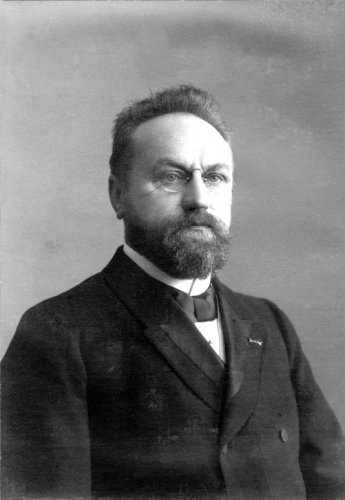
Herman Bavinck (13 December 1854 – 29 July 1921) was a Dutch Calvinist theologian and churchman. He was a significant scholar in the Calvinist tradition, alongside Abraham Kuyper, B. B. Warfield, and Geerhardus Vos.

Biography

[edit]

Background

[edit]

Bavinck was born on 13 December 1854 in the town of Hoogeveen in the Netherlands to a German father, Jan Bavinck (1826–1909), who was the minister of theologically conservative, ecclesiastically separatist Christian Reformed Church (Christelijke Gereformeerde Kerk). After his high school education, Bavinck first went to the Theological School in Kampen in 1873, but then moved on to Leiden for further training after one year in Kampen. He wrote in his student journal notes that he was motivated to transfer his studies by the preaching of the pastor Johannes Hendricus Donner [nl], who was also ministering in Leiden by that time. He studied under prominent faculties such as Johannes Scholten and Abraham Kuenen, and finally graduated in 1880 from the University of Leiden having completed a dissertation on the ethics of Ulrich Zwingli.

A year later, Bavinck was appointed Professor of Dogmatics at Theological School in Kampen. While serving there, he also assisted his denomination that had formed out of the withdrawal of orthodox Calvinists earlier from the state Hervormde Kerk, a withdrawal movement called the "Afscheiding" (Secession) in its merger with a second and subsequent larger breakaway movement that also left the Hervormde Kerk, this time under the leadership of Abraham Kuyper, a movement called the "Doleantie" (the Complaint: a historical reference to the term used by orthodox Reformed ministers who opposed Arminianism prior to the National Synod of Dordt, 1618–19).

The now-united Church combined the "Afgescheidenen" and "Dolerenden" into the Gereformeerde Kerken in Nederland (GKiN). As a result of the merger, GKiN inherited the denominational seminary of the Afscheiding churches and that seminary became the denominational seminary of the GKiN, where Bavinck stayed put, so as to ease the transition of his colleagues and people within the much larger new Church. Already, when the Afgescheidenen merged with the Dolerenden, there was a minority of the Seceders who stayed out of the union; they formed their new denomination as the Christelijke Gereformeerde Kerken (CGK), and they established their own theological seminary in the town of Apeldoorn.

Move to Amsterdam

[edit]

Amidst all these developments, Bavinck stayed put and pursued his class lectures, research, writing, and publication – making his distinctive mark as an orthodox Calvinist theologian and churchman.

The recently founded Free University in Amsterdam (VU), under the leadership of Abraham Kuyper, was meant to be a bastion of Reformed learning in all fields of thought. The Free University including its Theology Faculty for training clergy, unlike Kampen Seminary, was independent of both the state and all church denominations. But, of course, theology was the VU's initial leading concern for some decades. So, Bavinck, when he was first invited to join the VU Faculty, had to weigh the merits of teaching what concerned him in his theological research, in such a seemingly independent environment. With Kuyper in the same faculty, he might have come to feel quite crowded.

After refusing the invitation of Abraham Kuyper several times to come to Amsterdam, finally Bavinck accepted Kuyper's plea. In 1902 he succeeded Kuyper as Professor of Theology at the Free University in Amsterdam. Kuyper himself had developed other workloads, and simply wanted the best man available to replace himself. Thus, Bavinck moved to the big city, with his first edition of multi-volume Gereformeerde Dogmatiek already in publication. He arrived well-credentialed and well-respected. He remained at VU for the remainder of his teaching career. In 1906 he became a member of the Royal Netherlands Academy of Arts and Sciences.[14] In 1911, he was named to the Senate of the Netherlands Parliament. He assisted in the encouragement of the Gereformeerde people to build their own Christian schools, without state financial help, until such a time as the 80-years "School War" was brought to an end by the granting of government assistance to all schools.

In 1908 he visited the United States and gave the Stone Lectures at Princeton Theological Seminary.

Bavinck died on 29 July 1921 in Amsterdam.

Bavinck and Kuyper

[edit]

Bavinck has been compared with his contemporary Abraham Kuyper. J. H. Landwehr, Bavinck's first biographer, had this to say of the two:

Bavinck was an Aristotelian, Kuyper had a Platonic spirit. Bavinck was the man of clear concept, Kuyper the man of the fecund idea. Bavinck worked with the historically given; Kuyper proceeded speculatively by way of intuition. Bavinck's was primarily an inductive mind; Kuyper's primarily deductive.

One major difference in ideas between Bavinck and Kuyper is formulated largely in theological terms contrasting a doctrine called "Common Grace" with a doctrine called "the Antithesis". Bavinck emphasized Common Grace, while Kuyper emphasized (sometimes severely) the Antithesis. A comparison of the two positions, which came to designate two interwoven and contentious traditions in the GKiN and the neo-Calvinist Christian social movements that flowed from its membership, is presented in Jacob Klapwijk's important work of Reformational philosophy, entitled Bringing into Captivity Every Thought (English, 1986).

Theology

[edit]

Much work has been done considering the methods, principles, and characteristics of Bavinck's dogmatic theology. Jan Veenhof had earlier considered a "two Bavinck" hypothesis, the Bavinck of nineteenth century philosophy versus the Reformed dogmatician, arguing partly from Bavinck's adoption of an organic motif in his thinking.[15] The hypothesis was later challenged by James Eglinton, who posited that organicism was, for Bavinck, a theological category of unity-in-diversity rooted primarily in the Trinity, Eglinton writing that, for Bavinck, “Trinity ad intra leads to organism ad extra.”[16] Subsequently, this has been challenged by Bruce Pass, who has attempted to restate Veenhof's diagnosis and assert an origin to Bavinck's organicism in German idealism and F.W.J. Schelling.[17] Regardless, organicism functions as an important conceptual device for Bavinck, and is seen in other theologians from the period, e.g. Norwegian theologian Gisle Johnson. Other works have attempted to locate the center of Bavinck's thought in a grace-restores-nature structure: “...the essence of the Christian religion consists in the reality that the creation of the Father, ruined by sin, is restored in the death of the Son of God and the re-created by the grace of the Holy Spirit into a kingdom of God.”[18][19] Fundamentally, Bavinck's concern was to overcome philosophical dualisms by an assertion of a worldview distinctly Trinitarian, Reformed, and organic, and the fact of his life-long confessional standing as a minister within the Dutch Christian Reformed Church should not be overlooked.[19]

Principles of Dogmatics

[edit]

Bavinck's dogmatic corpus is structured around classical theological conversations concerning the principles of systematic theology. Bavinck holds dogmatic theology to be a scientific exercise based on foundations of thought and reality. From these primary assumptions and principles method necessarily follows. For Bavinck, there are three fundamental principles in theology as a science: 1. God and the Trinity is the essential foundation (principium essendi) of dogmatics; 2. Scripture is the external cognitive principle (principium cognoscendi externum); and 3. the Holy Spirit is the internal cognitive principle (principium cognoscendi internum).[18]

Doctrine of Revelation

[edit]

A dogmatic theologian, Bavinck was concerned with reordering categories of human thought in relation to God as first principle. This means that, for Bavinck, the broadest epistemological category is revelation. In other words, for Bavinck, everything is revelatory of God - including the faculties of the subjective self - and thus must assume God as its primary referent: "Revelation, while having its center (middelppunt) in the Person of Christ, in its periphery extends to the uttermost ends of creation ... The world itself rests on revelation; revelation is the presupposition, the foundation (grondslag), the secret (geheim) of all that exists in all its forms."[20] Bavinck considers this an organic view of revelation, integrative of the individual subject in relation to creation in relation to God, a grand unity-in-diversity that integrates ontology and epistemology.[18][21]

Theology Proper & Knowability

[edit]

Bavinck was part of the movement known as Neo-Calvinism, and thus held to high views of theology proper and divine sovereignty as extending from the Calvinist tradition. For Bavinck, God as Creator implies a categorical distinction with the creation (i.e. 'the Categorical Distinction' or 'infinite qualitative distinction'): "The distinction between God and us is the gulf between the Infinite and the finite, between eternity and time, between being and becoming, between the All and the nothing. However little we know of God, the faintest notion implies that he is a being who is infinitely exalted above every creature." As such, his initial category for considering the nature of God is that of incomprehensibility and mystery: "Mystery is the lifeblood of dogmatics."[18] Thus does not mean that God is unknowable, but simply that he is not exhaustively knowable mediately and through created forms:

...[H]uman beings have an ineradicable sense of that existence and a certain knowledge of God's being. This knowledge does not arise from their own investigation and reflection, but is due to the fact that God on his part revealed himself to us in nature and history, in prophecy and miracle, by ordinary and by extraordinary means. In Scripture, therefore, the knowability of God is never in doubt even for a moment. The fool may say in his heart, "There is no God," but those who open their eyes perceive from all directions the witness of his existence, of his eternal power and deity (Isa. 40:26; Acts 14:17; Rom. 1:19-20). The purpose of God's revelation, according to Scripture, is precisely that human beings may know God and so receive eternal life (John 17:3; 20:31). [18]

In other words, for Bavinck, the idea of God's essence is thus tied to finite reality as revealing him, a nexus of ontology and epistemology.

Bavinck sees proofs for God's existence as unnecessarily limiting of the divine being and revelation, reversing the fundamental assumption of knowing: "The proofs, as proofs, are not the grounds but rather the products of faith." Echoing Calvin, he writes, "to the believer all things speak of God; the whole universe is the mirror of his perfections. There is not an atom of the universe in which his everlasting power and deity are not clearly seen."[18] Again echoing Calvin, Bavinck adopts language of accommodation to explain how God reveals himself to humanity, expanding the idea of accommodation to consider that all of creation, having been created to mirror God, is thus an anthropomorphism, including human speech about the divine: "…God, not the creature, is primary. He is the archetype; the creature is the ectype … God, therefore, is not really named after things present in creatures, but creatures are named after that which exists in an absolute sense in God.”[18] Bavinck believes that human language was designed by God and for theological expression ("...it is a human language in which God speaks to us of himself. For that reason the words he employs are human words..."; "Scripture ... is anthropomorphic through and through..."), bearing a unique relationship to Christ as Word and Word incarnate ("We have the right to use anthropomorphic language because God himself came down to the level of his creatures and revealed his name in and through his creatures").[18] As such he holds to a complex view of the relationship between language and God, seeing it as both epistemologically analogical yet ontologically univocal via causation: theological language and concepts are "ectypal or analogical," yet "All our knowledge is from and through God ... The possibility of his condescension cannot be denied since it is given with creation..."[18]

Considering this view of the divine nature, Bavinck holds to classical high theological concepts surrounding the essence and attributes, holding to divine simplicity: "...God is 'simple,' that is, sublimely free from all composition, and that therefore one cannot make any real distinction between his being and his attributes. Each attribute is identical with God's being: he is what he possesses."[18] Bavinck will also discuss God's independence, immutability, infinity, and unity as interrelated concepts.

The Trinity

[edit]

The entire Reformed Dogmatics is structured on the Trinitarian formula of Father, Son, and Holy Spirit, with the exception of volume 1 as a prolegomena. Bavinck held that the Trinity was the essential principle of theology and structures his worldview according to the unity-in-diversity of the Trinity: "The Trinity reveals God to us as the fullness of being, the true life, eternal beauty. In God, too, there is unity in diversity, diversity in unity. Indeed, this order and harmony is present in him absolutely. In the case of creatures we see only a faint analogy of it."[18] For Bavinck, the predication of personhood onto the divine essence obtains uniquely in God via the analogy of being, and he warns against wrongly-ordered concepts of personhood in relation to deity:

Human nature as it exists in different people is never totally and quantitatively the same. For that reason people are not only distinct but also separate. In God all this is different. The divine nature cannot be conceived as an abstract generic concept nor does it exist as a substance outside of, above, and behind the divine persons. It exists in the divine persons and is totally and quantitatively the same in each person ... The glory of the confession of the Trinity consists above all in the fact that that unity, however, absolute, does not exclude but includes diversity. God's being is not an abstract unity or concept, but a fullness of being, an infinite abundance of life, whose diversity, so far from diminishing the unity, unfolds to its fullest extent[18].

In other words, importantly for Bavinck, God is personal: "...The persons are not three revelational modes of the one divine personality; the divine being is tripersonal, precisely because it is the absolute divine personality."[18]

Theological Anthropology

[edit]

Bavinck held that humanity profoundly reflects God, believing that humanity not only contains God's image, but personally and uniquely is God's image:

The essence of human nature is its being the image of God. The entire world is a revelation of God, a mirror of his attributes and perfections. Every creature in its own way and degree is the embodiment of a divine thought. But among creatures, only man is the image of God, God's highest and richest self-revelation and consequently the head and crown of the whole creation, the imago Dei and the epitome of nature, both mikrotheos (microgod) and mikrokosmos (microcosm).[18]

As such, Bavinck holds to what could be considered a maximalist or holistic definition of what constitutes the image of God in humanity, "the idea that a human being does not bear or have the image of God but that he or she is the image of God," where "God himself, the entire deity, is the archetype of man."[18] Bavinck holds that this image of God extends into five capacities: 1. the human soul, 2. the human heart (that is, in an affective and psychological sense), 3. human morality and holiness, i.e. original righteousness, 4. the human body, and 5. humanity's social completion as a race in future blessedness.[18] Bavinck thus fuses substantive concepts traditionally ascribed to image of God theology in the Reformed tradition with social and progressive concepts of anthropology bound up in his organic motif, devoting a separate section to the topic of "Human Destiny":

The image of God is much too rich for it to be fully realized in a single human being, however richly gifted that human being may be. It can only be somewhat unfolded in its depth and riches in a humanity counting billions of members ... Only humanity in its entirety—as one complete organism, summed up under a single head, spread out over the whole earth, as prophet proclaiming the truth of God, as priest dedicating itself to God, as ruler controlling the earth and the whole of creation—only it is the fully finished image, the most telling and striking likeness of God.[18]

Publications

[edit]

This section only includes Bavinck's writings which are available in English (alphabetical order).

  • The Certainty of Faith. Translated by Harry der Nederlanden. St. Catharines, Ontario, Canada: Paideia Press, 1980. (Original: 1901; English version translated from the third edition of 1918).
  • Christian Worldview. Translated and edited by Nathaniel Gray Sutanto, James Eglinton, and Cory C. Brock. Wheaton: Crossway, 2019. (Original: 1904; English version translated from the second edition).
  • Essays on Religion, Science, and Society. Translated by Harry Boonstra, Gerrit Sheeres. Edited by John Bolt. Grand Rapids: Baker Academic, 2008.
  • Guidebook for Instruction in the Christian Religion. Translated by Gregory Parker Jr. and Cameron Clausing. Peabody: Hendrickson, 2022.
  • Herman Bavinck on Preaching & Preachers. Translated and edited by James P. Eglinton. Peabody: Hendrickson, 2017.
  • In the Beginning: Foundations of Creation Theology. Edited by John Bolt. Translated by John Vriend. Grand Rapids: Baker, 1999.
  • Our Reasonable Faith. Translated by Henry Zylstra. Grand Rapids: Eerdmans, 1956. (Original: 1909)
    • Updated version: The Wonderful Works of God: Instruction in the Christian Religion according to the Reformed Confession. Translated by Henry Zylstra and Nathaniel Gray Sutanto (Foreword). Glenside: Westminster Seminary Press, 2019.
  • Reformed Dogmatics. Edited by John Bolt. Translated by John Vriend. 4 vols. Grand Rapids: Baker, 2003-2008. (Original: Gereformeerde Dogmatiek,[22] 1895–1901)
    • Vol. 1 Prolegomena
    • Vol. 2 God and Creation
    • Vol. 3 Sin and Salvation
    • Vol. 4 Holy Spirit, Church, and New Creation
  • Reformed Dogmatics: Abridged in One Volume. Edited by John Bolt. Grand Rapids: Baker Academic, 2011.
  • Reformed Ethics. Edited by John Bolt. 3 vols. Grand Rapids: Baker Academic, 2019-ongoing.
    • Vol. 1 Created, Fallen, and Converted Humanity
    • Vol. 2 The Duties of the Christian Life
    • Vol. 3
  • Saved By Grace: The Holy Spirit's Work in Calling and Regeneration. Translated by Nelson D. Kloosterman. Edited by J. Mark Beach. Grand Rapids: Reformation Heritage Books, 2013.
  • The Doctrine of God. Translated and edited by William Hendriksen. Edinburgh: Banner of Truth, 1977.
  • The Christian Family. Translated by Nelson D. Kloosterman. Grand Rapids: Christian's Library Press, 2012. (Original: 1908)
  • The Last Things: Hope for This World and the Next. Edited by John Bolt. Translated by John Vriend. Grand Rapids: Baker, 1996.
  • The Philosophy of Revelation: The Stone Lectures for 1908–1909, Princeton Theological Seminary. New York: Longmans, Green, and Co., 1909.
    • Updated version: Philosophy of Revelation: A New Annotated Edition. Edited by Cory Brock and Nathaniel Gray Sutanto. Peabody: Hendrickson, 2018.
  • The Sacrifice of Praise: Meditations Before and After Receiving Access to the Table of the Lord. Translated by John Dolfin. Grand Rapids: Louis Kregel, 1922. (Original: 1901)
    • Updated Version: The Sacrifice of Praise. Translated and edited by Cameron Clausing and Gregory Parker. Peabody, Hendrickson: 2019.

Articles:

  • Bavinck, Herman (1892). "Recent Dogmatic Thought in the Netherlands (Translated by Geerhardus Vos)". The Presbyterian and Reformed Review. 3 (10): 209–28.
  • Bavinck, Herman (1894). "The Future of Calvinism (Translated by Geerhardus Vos)". The Presbyterian and Reformed Review. 5 (17): 1–24.
  • Bavinck, Herman (1910). "The Reformed Churches in the Netherlands". The Princeton Theological Review. 8 (3): 433–60.
  • Bavinck, Herman (1992). "The Catholicity of Christianity and the Church" (PDF). Calvin Theological Journal. 27 (2): 220–251.
  • Bavinck, Herman (2017). "My Journey to America". Edited by George Harinck. Translated by James Eglinton. Dutch Crossing: Journal of Low Countries Studies. 41 (2):180–93.

See also

[edit]

References

[edit]

Resources

[edit]
[edit]
Revisions and contributorsEdit on WikipediaRead on Wikipedia
from Grokipedia
Herman Bavinck (1854–1921) was a Dutch Reformed theologian and philosopher whose systematic exposition of Christian doctrine in the multi-volume Reformed Dogmatics remains a cornerstone of twentieth-century Reformed thought. Born into a family of Secession Church ministers amid the religious and cultural upheavals following the 1834 Afscheiding in the , Bavinck pursued theological education at both orthodox institutions like Kampen and liberal ones such as , emerging as a defender of confessional Reformed orthodoxy against modernist challenges. Bavinck's contributions extended beyond academia; as professor at Kampen Theological Seminary and later the Free —founded by his neo-Calvinist colleague —he integrated theological rigor with cultural engagement, advocating an "organic" view of revelation that affirmed the unity of , science, and society without succumbing to or . His work emphasized the sovereignty of in all spheres of life, influencing global Reformed theology through translations and abridgments like Our Reasonable Faith, while his helped shape the Gereformeerde Kerken in Nederland following the 1886 Doleantie. Bavinck's irenic yet uncompromising stance bridged traditional piety and modern scholarship, earning him recognition as a key figure in resisting theological without isolating from broader intellectual currents.

Early Life and Education

Family and Upbringing

Herman Bavinck was born on 13 December 1854 in , in the Dutch province of , as the second of seven children and eldest son to Jan Bavinck (1826–1909), a minister in the Christelijke Gereformeerde Kerk, and Gesina Magdalena . His father, originally lacking formal theological training but deeply versed in Reformed , had aligned with the 1834 Afscheiding—a secession from the liberalizing Nederlandse Hervormde Kerk that protested rationalist influences and state control over , aiming to restore confessional purity in worship and polity. The Bavinck household exemplified the Secessionist commitment to orthodox , immersing young Herman in a disciplined religious milieu centered on scriptural exposition and the church's confessional standards, including the and . Of modest means, the family prioritized piety over worldly pursuits, with Jan Bavinck's pulpit ministry modeling gospel-centered devotion and his wife's forthright faith reinforcing familial resilience against external pressures. This environment, amid broader Dutch ecclesiastical fractures, cultivated Bavinck's early aversion to and , as the Secession's emphasis on ecclesiastical autonomy from state interference provided a direct counter to the Hervormde Kerk's accommodations. Parental example thus played a pivotal causal role in embedding resistance to doctrinal dilution, evident in the churches' insistence on uncompromised adherence to the despite marginalization, setting the trajectory for Bavinck's enduring stance.

Theological Studies at Kampen and Leiden

Bavinck enrolled at the Theological School in Kampen in 1870, where he received foundational training in Reformed orthodoxy through the study of , including Hebrew and Greek, as well as historical and the standards of the Dutch churches, such as the and . This education, rooted in the pietistic and of the Afscheiding movement, emphasized scriptural and against emerging rationalistic trends in Dutch . Although specific professors from this period are sparsely documented, the institution's small faculty maintained strict adherence to Reformed doctrines amid the broader cultural shifts toward modernism. In 1873, Bavinck transferred to to fulfill requirements for formal accreditation in the ' state-supervised ecclesiastical system, completing his studies there by 1874. At , a hub of liberal , he encountered prominent figures like Abraham Kuenen, whose higher criticism dissected the into documentary sources and undermined traditional authorship and historicity. Bavinck also grappled with Kantian , which prioritized subjective reason over divine , and the implications of Darwinian evolution, which challenged biblical accounts of creation and human origins—ideas pervasive in the university's curriculum. This exposure precipitated a personal of , as Bavinck diary-recorded doubts about sustaining his orthodox convictions in such an environment, questioning on September 23, 1874, "Will I remain standing?" Despite the intellectual pressures, Bavinck rejected these modernist paradigms, reaffirming Reformed principles through an appeal to Scripture's internal self-attestation and the causal priority of divine revelation over autonomous human reason. He graduated in 1874, demonstrating resilience in his subsequent commitment to confessional theology, evidenced by his avoidance of liberal compromises and early engagements that prioritized ecclesiastical unity under biblical norms over rationalistic fragmentation.

Career in Ministry and Academia

Pastoral Ministry in Franeker

In 1881, shortly after completing his doctoral studies at , Herman Bavinck accepted a call to serve as pastor of the Christian Reformed Church in , , a congregation rooted in the Afscheiding () movement of 1834 that had separated from the liberalizing Dutch Reformed State Church. Ordained on March 13, 1881, by his father Jan Bavinck, he ministered there until 1882, when he transitioned to a professorship at Kampen Theological . The church, adhering strictly to the and the , had endured internal divisions under prior ministers, fostering a confessional but somewhat isolated community amid broader ecclesiastical fragmentation. Bavinck's preaching emphasized core Reformed doctrines, delivering expository sermons on Scripture in morning services and catechetical instruction from the Heidelberg Catechism in the afternoons, with recurrent themes of human sinfulness, divine grace, and the covenant of redemption. His pastoral approach included annual elder visitations to assess spiritual conditions, rigorous catechism classes for youth aged 12 to 18, and efforts to integrate marginalized members, such as admitting disabled individuals to the Lord's Supper following consistory examinations of their faith. These activities exposed him to the practical realities of congregational life, including the enforcement of discipline for moral failings and evangelism through home visits, which empirically underscored the pervasive effects of human depravity even among professing believers while highlighting the transformative power of covenantal grace. During this period, Bavinck edited the periodical De Vrije Kerk and contributed initial writings on ecclesiastical matters, addressing church polity and ethical concerns in a context independent of emerging neo-Calvinist influences like those of . These efforts revealed his early commitment to orthodox Reformed governance and moral formation, anticipating a firm opposition to modernist dilutions of , while his experiences in Franeker's post-Afscheiding setting deepened his reflections on the challenges of church unity amid denominational isolation.

Professorship at Kampen Theological Seminary

In 1882, at the age of 28, Herman Bavinck was appointed by the synod of the Christian Reformed Church to the chair of at its Theological School in Kampen, filling a vacancy and commencing his duties with an inaugural address titled "The Science of Sacred Theology" on January 10, 1883. He served in this role for two decades, teaching not only dogmatics but also the encyclopedia of sacred theology, , and , thereby shaping the education of future Reformed ministers amid the seminary's commitment to confessional orthodoxy. Bavinck's lectures during this period laid the groundwork for his Gereformeerde Dogmatiek (Reformed Dogmatics), a four-volume whose first edition appeared serially from 1883 to 1901, systematically expounding Reformed doctrine through a methodology that prioritized biblical —beginning with scriptural texts—and integration with historical theological development, in deliberate contrast to the speculative and higher prevalent in Dutch state universities like . This approach underscored scriptural authority as the norming norm, subordinating philosophical speculation to the historical-grammatical interpretation of the and the creedal heritage of the . Concurrently, Bavinck contended with acute denominational divisions, particularly the debates over union between the churches of the 1834 Afscheiding () and the 1886 Doleantie movement initiated by Abraham Kuyper's withdrawal from the state church. As a voice from the tradition, he advocated cautious confessionalism, promoting unity grounded in shared adherence to the while resisting premature merger that might dilute scriptural fidelity or introduce unvetted innovations; his efforts contributed to the 1892 union of these groups into the Gereformeerde Kerken, though not without opposition from stricter separatists wary of Kuyper's broader cultural engagements. In a pivotal 1888 address on "The Catholicity of Christendom and the Church," Bavinck articulated a vision of Reformed catholicity that balanced particular confessional identity with the universal claims of Christian doctrine, prioritizing empirical fidelity to Scripture over institutional expediency.

Transition to Free University of Amsterdam

In 1902, Herman Bavinck accepted the chair of dogmatics at the Free University of Amsterdam, succeeding and marking his fourth such invitation after prior refusals while at Kampen Theological Seminary. This transition aligned with Bavinck's advocacy for pursued in a university setting, prioritizing scholarly rigor and "free study" principles over seminary-style ecclesiastical control, thereby enabling deeper engagement with philosophical and societal issues. He began lecturing on December 17, 1902, with an inaugural address entitled "Religion and ," which explored the integration of doctrinal with broader intellectual inquiry. Bavinck's role complemented the Free University's emphasis on public theology by systematizing dogmatics amid Amsterdam's urban academic environment, where he confronted modern challenges to Reformed principles through lectures on , , and cultural application. Under his tenure from 1902 to 1921, the institution expanded significantly, achieving the second-highest student enrollment in the by 1920, second only to . He mentored a generation of students, including and , whose subsequent ministries propagated neo-Calvinist ideas across Europe and North America.

Political and Public Engagement

Alliance with Abraham Kuyper

Bavinck's alliance with emerged through their shared efforts to unite the churches stemming from the 1834 Afscheiding and Kuyper's 1886 Doleantie secession from the state-dominated , culminating in the formation of the (Gereformeerde Kerken in Nederland, ) in 1892. This partnership bridged Bavinck's roots in the earlier secession tradition with Kuyper's broader reform movement, fostering a collaborative front against modernist encroachments in and culture. Together, they co-edited the denominational periodical De Bazuin (The Clarion), using it to advance a comprehensive Calvinist that integrated faith across societal domains, countering secular neutralism with assertions of Christ's lordship over every sphere of life. Their complementary roles strengthened this alliance: Kuyper's dynamic activism and political leadership contrasted with Bavinck's methodical theological depth, enabling a synergistic promotion of neo-Calvinist principles. While Kuyper founded the (ARP) in 1879 to oppose ideologies and advocate Christian influence in governance, Bavinck contributed intellectual rigor to its platforms, later serving as party chairman from 1905 to 1907 and emphasizing divine sovereignty as the causal foundation for rejecting autonomous . Kuyper's review of Bavinck's 1883 inaugural address in De Heraut on highlighted early mutual respect, praising its undivided attention to Reformed doctrine. Subtle differences persisted in their emphases, with Bavinck favoring rigorous university-based theological training for academic precision, while Kuyper prioritized "free study" accessible beyond ecclesiastical oversight, though they reconciled these in joint endeavors like Bavinck's 1902 succession to Kuyper's dogmatics chair at the Free University of Amsterdam. Their united critique privileged God's creational order over modern pretensions to neutrality, asserting that no domain escapes divine authority—a stance Bavinck systematized theologically while Kuyper applied politically. This partnership underscored a causal realism wherein secular ideologies failed to account for the sovereignty undergirding all human spheres, without subsuming Bavinck as mere follower of Kuyper.

Involvement in Anti-Revolutionary Politics

In 1911, Herman Bavinck was elected to the First Chamber of the Dutch parliament as a representative of the (ARP), serving until his death in 1921. Prior to this, he had held leadership roles within the ARP, including acting as president of its from 1904 to 1905 and formally as chairman from 1905 to 1907, succeeding . In these capacities, Bavinck advocated for the integration of Christian principles into , countering the secular individualism inherited from the Enlightenment and the absolutist tendencies of state expansion. During his tenure in the First Chamber, Bavinck delivered speeches addressing key policy areas such as , , and foreign missions. On education, he opposed the establishment of neutral public schools, arguing that state-enforced neutrality amounted to "coerced unbelief" and failed to respect the confessional diversity evident in Dutch society. In labor debates, he critiqued overly egalitarian social legislation, prioritizing hierarchical authority rooted in divine order over radical leveling. Regarding missions, he emphasized the religious dimensions of colonial policy, linking political decisions to broader Christian responsibilities. These interventions drew on empirical observations from Dutch history, where attempts at Enlightenment-style secular unification had led to social fragmentation rather than cohesion, underscoring the practical superiority of confessional pluralism over imposed uniformity. Bavinck's parliamentary contributions reinforced the ARP's commitment to a governance model that acknowledged multiple confessional spheres without theocratic overreach or liberal neutralization, influencing subsequent Christian Democratic alignments in Dutch . His measured, principle-driven approach earned respect across divides, providing intellectual ballast for the party's endurance amid rising socialist and liberal pressures.

Views on Sphere Sovereignty and Church-State Relations

Bavinck articulated as a principle rooted in the creational order, wherein distinct social institutions—such as the family, church, and state—derive their authority directly from rather than from one another or human derivation. He grounded this in biblical motifs like Genesis 1:11–12, interpreting "each according to its kind" as establishing autonomous spheres under Christ's lordship, preventing hierarchical absorption by any single entity. Unlike Abraham Kuyper's more explicit political application, Bavinck treated as an underlying Reformed motif, emphasizing organic interconnections among spheres while affirming their independent mandates from creation ordinances sustained by . In church-state relations, Bavinck advocated for the church's institutional independence from , viewing both as parallel kingdoms under divine sovereignty: the spiritual kingdom expressed in the church and the civil kingdom in the state. He drew on Reformed distinctions between these realms to oppose state domination, critiquing historical precedents where civil powers subordinated ecclesiastical governance, as seen in the 19th-century Dutch Reformed Church's synodal structures tied to state oversight. This stance aligned with the Afscheiding of 1834 and Doleantie of 1886, movements Bavinck supported, which rejected state-controlled synods in favor of self-governing Reformed congregations accountable solely to Scripture and Christ. Bavinck's framework countered totalitarian tendencies by limiting state encroachment into creational spheres, thereby resisting ideologies like that subordinated family and church to collective control. However, it permitted confessional pluralism within society, potentially fostering fragmentation where competing religious claims vied for influence without unified civil enforcement of . He balanced this by affirming the state's in maintaining order through accessible via , ensuring spheres operated in harmonious tension rather than isolation. This approach, while preserving institutional autonomy, underscored the eschatological priority of the spiritual kingdom over the temporal.

Theological Methodology

Neo-Calvinist Framework

Bavinck adopted and refined neo-Calvinism as a comprehensive Christian worldview that applies Reformed principles to every sphere of human existence, countering the fragmenting influences of modernity. Influenced by Abraham Kuyper's initiatives, Bavinck articulated this framework in works such as his 1904 Christian Worldview, where he emphasized God's absolute sovereignty over creation, rejecting any dualism that confines faith to ecclesiastical or private domains while granting autonomy to secular culture. Instead, he viewed reality as an interconnected whole under divine governance, requiring believers to infuse biblical truth into politics, education, science, and the arts without synthesis or isolation. The framework hinges on the doctrines of and , which together explain both conflict and cooperation in a fallen world. denotes the fundamental opposition between the Christian mind, renewed by grace, and the natural person's suppression of truth due to sin's noetic corruption, ensuring no neutral ground in formation. , however, restrains depravity's full effects, permitting unbelievers to achieve real progress in diverse fields; as Bavinck observed, "an operation of God's Spirit and of his is discernible not only in science and , and law, but also in the religions." This balance enables cultural engagement: Christians critique unbelief's principial errors while gratefully utilizing general revelation's fruits, avoiding both cultural retreat and illegitimate alliances. Bavinck grounded these tenets in the scriptural progression from creation—where the Dei mandates stewardship of the cosmos—to fall, which exposes autonomous reason's illusions of neutrality, and redemption, which restores creation's purpose through Christ. This redemptive trajectory debunks pretensions of self-sufficient rationality by affirming sin's pervasive distortion, yet anticipates renewal where grace perfects nature. Diverging from classical Calvinism's heavier accent on soteriological mechanics and confessional boundaries, Bavinck's projected a forward-oriented vision of historical unfolding, urging proactive of in light of ultimate .

Organicism and Doctrinal Development

Bavinck conceptualized theology through an organic motif, portraying reality and doctrinal knowledge as a unified whole exhibiting unity-in-diversity, akin to a living organism governed by an underlying principle and vital force, rather than a static mechanism or fragmented aggregate. This approach countered rationalism's atomistic , which dissects truth into isolated propositions devoid of interconnected life, and relativistic evolutionism, which posits unbound historical flux without anchor. He described the world as "an organic whole, borne by a single thought, led by a single will, and intended for a single purpose," integrating mechanism and under divine . Influenced by German idealists like Schelling, whose emphasized self-generating entities with inherent purpose, Bavinck subjected these ideas to Reformed , synthesizing them with Trinitarian to affirm a theistic framework where organic unity reflects God's triunity rather than pantheistic . Scholars debate the motif's primacy—some trace it solely to Reformed sources like Calvin's organic ecclesiology, while others highlight idealist —but Bavinck's application subordinated philosophical borrowings to scriptural , rejecting dualistic separations of from . In dogmatics, this yielded a unified and form, where theological truths emerge not from subjective invention but from objective principles vivified by the , preserving objectivity against modernist . Doctrinal development, for Bavinck, mirrored this organic process: truths originate in seed-form within apostolic , germinate through historical ecclesial life, and mature while retaining fidelity to their constitutive norm—Scripture—ensuring causal continuity from origins rather than rupture or invention. He posited Scripture itself as dynamically inspired, with divine and human elements interweaving organically, as in the , to counter mechanical dictation views. Empirical church historical instances, such as the patristic era's creedal articulations, exemplified this: Nicene formulations (325 AD) unfolded Trinitarian principles from seeds without altering their essence, demonstrating bounded growth amid contextual pressures. This upheld doctrinal stability amid change, privileging empirical historical patterns over speculative philosophies.

Core Doctrinal Teachings

Revelation, Scripture, and General Revelation

Herman Bavinck viewed revelation as God's self-disclosure, distinguishing between general revelation in creation and history and special revelation centered on Christ's incarnation and recorded in Scripture. He maintained that special revelation holds epistemic priority, providing complete and sufficient knowledge for salvation, while general revelation, though foundational, remains inadequate due to sin's distorting influence. This organic unity underscores that grace perfects nature, with Scripture building upon and fulfilling the truths discernible in the created order. Bavinck affirmed Scripture as the definitive form of , describing it as the principium unicum of —the unique, authoritative source preserving God's word across history. Its inspiration involves an organic process uniting divine authorship with human agency: the speaks through the writers as organs, employing their individuality, styles, and historical contexts without error, resulting in a permanent theopneustia (God-breathed quality). He rejected higher criticism's portrayal of biblical narratives as mythical evolutions from pagan sources, such as Babylonian myths, arguing that such views deny elements like and while ignoring archaeological evidence for patriarchal and theological distinctions in Genesis (e.g., Yahweh's versus Marduk's chaos battles). Instead, Scripture's self-attestation and internal testimony of the provide verifiable certainty, surpassing evidential arguments alone, as faith apprehends its divine origin amid human opposition. General revelation manifests through creation's order (Psalm 19:1–2), providence, history, and (Romans 1:18–20; 5:22), disclosing God's eternal power, moral law, and partial truths accessible via reason. Post-fall, however, sin's noetic effects darken the , corrupting reception and leading to , , and distorted pagan religions despite remnants of true (semen religionis). mitigates these effects by restraining sin's full outbreak, sustaining moral and intellectual capacities, and enabling limited recognition of truth even among unbelievers, yet it neither regenerates nor suffices for redemptive —serving instead to prepare for special revelation's saving grace. Thus, points to but cannot replace Scripture's clarity.

Theology Proper and Divine Knowability

Bavinck's doctrine of God emphasizes divine self-existence (aseitas), simplicity, and infinity, positing that God's essence is a unified whole in which all attributes coinhere without composition or division. Unlike abstract theism, which isolates attributes into philosophical categories detached from personal revelation, Bavinck maintains that God's being is known concretely through scriptural disclosure, where attributes like eternity and immutability reveal a living God who acts in history. This approach critiques rationalistic reductions that portray God as an impersonal force, insisting instead on a personal deity whose attributes interpenetrate in perfect harmony. Central to Bavinck's account of divine knowability is the distinction between archetypal and ectypal knowledge. Archetypal theology constitutes God's own self-knowledge, comprehensive and identical with his essence, which remains incomprehensible to finite creatures. Ectypal theology, by contrast, is the creaturely participation in this knowledge, adapted to human capacities through divine revelation and analogy, enabling true but non-exhaustive understanding without equating human concepts to the divine essence. This framework upholds God's transcendence—his absolute otherness beyond creation—while affirming immanence through revelation, rejecting both agnostic denials of knowability and pantheistic conflations of God with the world. Bavinck argues that agnosticism, by limiting knowledge to empirical phenomena, inadvertently fosters pantheism, as it severs God from creation and reduces the divine to an unknowable abstraction. Bavinck's empirical realism extends this to the created order, where the reflects divine ideas as ectypes of the archetypal in God's mind, permitting genuine scientific despite human limitations. Creation, as a theater of divine glory, discloses God's attributes indirectly through its structures and processes, grounding reliable without pantheistic or deistic remoteness. This realism counters skeptical epistemologies by rooting human cognition in the Creator-creature relation, where bridges the analogical gap to yield that traces God's thoughts after him in unity and diversity. Thus, proper safeguards divine majesty against modern reductions, affirming that true knowability arises solely from God's .

The Doctrine of the Trinity

Bavinck regarded the doctrine of the as the foundational principle of , structuring all doctrine and undergirding reality itself. In his Reformed Dogmatics, he affirmed the orthodox formulation of one divine essence subsisting in three distinct persons—Father, Son, and —who are coequal, coeternal, and consubstantial, sharing the same undivided divine nature without composition or division. This ontology rejects both modalism, which collapses the persons into mere modes of a single subject, and , which implies inequality among the persons, insisting instead on real personal distinctions rooted in eternal relations. Bavinck synthesized patristic developments, particularly the Nicene emphasis on homoousios, with Reformed confessional standards like the and Westminster , viewing the not as an abstract puzzle but as the living God revealed in Scripture. Central to Bavinck's Trinitarianism is the doctrine of eternal generation, whereby the is eternally begotten of the , and spiration, whereby the Spirit proceeds from the and the , preserving the unity of essence while accounting for personal distinctions without temporal origin or ontological subordination. These intra-Trinitarian relations—generation, spiration, and their corresponding missions in creation and redemption—form the basis of divine self-communication, rendering dynamically relational rather than static or solitary. Bavinck critiqued modern liberal theology's drift toward , which, by dissolving personal distinctions, eroded the biblical essential to divine and reduced to an impersonal force, incompatible with scriptural witness to the 's sending of the and Spirit. This relational extends causally to creation and covenantal structures, with the serving as the of unity-in-diversity: the eternal fellowship of persons models the communal order of the , where created realities reflect Trinitarian patterns without exhausting them. Contra individualistic modern anthropologies that prioritize , Bavinck's Trinitarian framework posits as ontologically prior, derived from the self-giving life of the , thus providing a causal ground for relationality in human society and the covenantal bond between Creator and creation. This perspective counters unitarian reductions that foster impersonal mechanism, affirming instead a personal, covenantal realism rooted in the triune God's eternal being.

Creation, Providence, and Common Grace

Bavinck affirmed the doctrine of creatio ex nihilo, positing that the triune God brought the universe into existence from nothing as a free, sovereign act distinct from his eternal being and independent of any preexistent matter or eternity. This creation established an absolute creator-creature distinction, with the six-day framework described in Genesis serving as the foundational order for understanding human anthropology and the cosmos's teleological purpose toward God's glory. He rejected mechanisms of evolutionary continuity, such as those in theistic evolution, insisting instead on discontinuous special divine creative acts that prioritize supernatural agency over naturalistic processes, while allowing for secondary development within created kinds under God's ordinance. Bavinck's conception of encompassed God's continuous preservation of creation, concurrence with secondary causes, and governing rule over all events, maintaining meticulous without violating creaturely contingency. This concursus operates positively through accommodation to finite agents, enabling their actions while subordinating them to divine purposes, thus extending creation's initial act into ongoing sustenance. Providence governs both good and ill—permissively allowing and within the —yet remains a source of comfort, as it assures believers of God's fatherly hand amid apparent chaos, rooted in scriptural rather than mere rational inference. Common grace, for Bavinck, denotes God's general operative power restraining sin's total corruption, upholding natural and moral order, and bestowing benefits like , cultural progress, and scientific insight even upon the unregenerate. Distinct from regenerating special grace, it explains the persistence of truth, beauty, and societal stability post-fall, as the works immanently through creation's structures to curb and foster human flourishing under providence. This undergirds Christian participation in common spheres, affirming that unbelievers' accomplishments reflect residual creational goodness rather than autonomous merit.

Human Nature, Sin, and Image of God

Bavinck affirmed that humanity was created in the (imago Dei), encompassing the entire human person—body and soul, faculties and powers—as a reflection of the whole , rather than a detached addition to natural existence. This image includes structural elements, such as , , and relational capacity toward and others, which constitute humanity's essential nature. Functionally, it manifests in the cultural mandate of over creation, involving subduing the earth through labor, procreation, and stewardship, positioning humans as the crown and head of the visible order. Bavinck emphasized that this image is not realizable in a single individual but requires the organic unity of the entire human race across history to fully express its richness. The fall into sin, originating with Adam's disobedience as federal head of humanity, introduced , corrupting every aspect of human nature while leaving the structural intact in its essence. Under federal headship, Adam's guilt and were imputed to all descendants, rendering the human will ethically impotent toward , inclined wholly to evil, and incapable of originating good apart from grace. Bavinck supported this with empirical observations: universal moral failure evident in history's cycles of , , and self-destruction, corroborated by psychological insights into innate , , and guilt even in "civilized" societies. Though moral qualities like were lost, the persists as humanity's enduring humanness, marred yet not obliterated, preserving accountability before . Bavinck critiqued Pelagian optimism, which denies and , as ignoring scriptural testimony and observable human bondage to vice, reducing sin to mere imitation rather than inherited corruption. He likewise rejected materialist and evolutionary anthropologies for diluting accountability by portraying humans as emergent products of blind natural processes, without transcendent origin or purpose, thus explaining neither the qualitative leap from animals—evident in language, , and —nor the persistent sense of guilt and aspiration beyond . fails to account for life's origin or humanity's unique ethical dimension, Bavinck argued, positing instead a that upholds causal realism in divine intentionality over random variation. These views, he contended, foster that excuses sin as adaptive instinct, undermining the realism of human responsibility rooted in the imago Dei.

Christology, Atonement, and Soteriology

Bavinck upheld the orthodox doctrine of the , affirming that in the person of Christ, the divine and human natures are inseparably united without confusion, mixture, change, division, or separation, in full agreement with the in 451 AD. He emphasized that this union constitutes one person, not two, preserving the integrity of both natures while enabling Christ to serve as ; the divine nature remains immutable and omnipresent, while the assumes full humanity, including a rational soul and body. Bavinck rigorously critiqued kenotic theories, which posited that the eternal Son divested himself of divine attributes during the , arguing that such views undermine divine immutability and imply a temporary loss of deity incompatible with scriptural depictions of Christ's ongoing divine works, such as miracles and forgiveness of sins. In his doctrine of atonement, Bavinck articulated a substitutionary framework rooted in penal satisfaction, where Christ's active obedience—perfect fulfillment of the law under the covenant of works—and passive obedience—endurance of divine wrath on the cross—collectively satisfy the demands of justice and merit righteousness for believers. This dual obedience restores what Adam forfeited, imputing Christ's merit to the elect while propitiating God's holiness against sin's penalty, as evidenced in Old Testament sacrificial typology and New Testament passages like Isaiah 53 and Romans 3:25. Bavinck rejected moral influence or governmental theories of atonement prevalent in liberal theology, insisting on objective reconciliation achieved through Christ's priestly satisfaction rather than subjective example alone. Bavinck's soteriology followed a covenantal ordo salutis, commencing with effectual calling through the gospel's proclamation, followed by regeneration as the Holy Spirit's monergistic renewal of the will, enabling repentance and faith as instrumental responses. Justification occurs by faith alone, a forensic declaration of righteousness based solely on Christ's imputed obedience, excluding works or merit from the ground of acceptance before God, as articulated in Romans 4:5 and Galatians 2:16. Subsequent benefits include adoption, sanctification, and perseverance of the saints, secured by divine preservation against apostasy, in opposition to universalism's assumption of inevitable salvation or Arminianism's conditional perseverance. Critics, including some Arminian theologians, have characterized this framework as overly rigid for diminishing human agency in salvation's application, though Bavinck defended its scriptural basis as safeguarding grace's sovereignty without negating moral responsibility.

Ecclesiology, Sacraments, and Eschatology

Bavinck conceived of the church primarily as the covenant community of believers and their children, rooted in the covenant of grace that spans from the to the New, encompassing both the visible and invisible aspects of the . The invisible church consists of the elect known fully only to , while the visible church manifests this reality through its empirical, institutional form, marked by the pure preaching of the Word, proper administration of sacraments, and . These two dimensions are not separate entities but complementary perspectives on the same covenantal body: the human viewpoint perceives imperfection and mixture in the visible church, whereas 's infallible knowledge discerns the true spiritual reality beneath. Bavinck emphasized that the visible church's organic unity and demand confessional fidelity to Reformed standards, rejecting both sectarian —which fosters isolation and —and lax that compromises doctrinal purity. He critiqued excessive separatism for undermining the church's witness in broader society, while advocating unity among confessional Reformed bodies to preserve truth without diluting it through interdenominational alliances. In Bavinck's sacramental theology, and the Lord's Supper function as visible signs and seals of God's covenant promises, confirming inward grace to believers without conferring it mechanically. signifies initiation into the covenant community, sealing the washing away of sin through Christ's blood and the Spirit's renewal, administered to believers and their infant children as heirs of the covenant, yet its efficacy depends on the Spirit's regenerating work rather than the rite itself. The Lord's Supper, likewise, represents and seals the spiritual nourishment of Christ's body and blood, fostering communion with Christ and fellow believers, but Bavinck firmly rejected the Roman Catholic notion of ex opere operato efficacy, insisting that sacraments strengthen faith only when received in true piety and do not inherently regenerate or justify. This view aligns with the Reformed confessions, such as the and , which Bavinck expounded as that visibly attest to invisible realities, guarding against both sacramentalism and mere . Bavinck's adopted an amillennial framework, interpreting the of as the present church age between Christ's first and second comings, during which the kingdom is already inaugurated through the but not yet consummated. He rejected premillennial expectations of a future earthly , viewing the binding of as partial and ongoing, allowing progress amid tribulation, with ultimate victory at Christ's return in judgment and the renewal of creation. This underpinned Bavinck's optimistic outlook on cultural engagement, positing that sustains societal development even in a fallen world, enabling the church to fulfill its covenantal mandate without millennial illusions. His views influenced Dutch Reformed formations, such as the 1892 unification of churches into the Gereformeerde Kerken, where he balanced rigor against divisive , promoting a visible church equipped for until the parousia.

Engagement with Modernity

Critique of Theological Modernism

Bavinck's direct encounter with theological occurred during his theological studies at , the epicenter of liberal Dutch theology, from 1874 to 1880. There, under professors such as Abraham Kuenen and Jan Hendrik Scholten, he was immersed in rationalistic approaches that prioritized historical-critical methods and immanentist philosophies over supernatural revelation and scriptural authority. This experience, contrasting sharply with his earlier training at the orthodox Theological School in Kampen, deepened his resolve to defend Reformed confessionalism, viewing not as a mere academic trend but as a corrosive force that subordinated divine truth to human subjectivity. In response, Bavinck consistently championed scriptural inerrancy and the objective, supernatural character of against modernism's dilutions, as articulated in his Reformed Dogmatics (1895–1901) and Stone Lectures, The Philosophy of Revelation (1908–1909). He critiqued the historical-critical method for its presuppositional bias toward naturalism, which treated biblical and prophecies as mythical accretions rather than historical realities, thereby undermining the Bible's unity and divine origin. Against Kantian , which confined knowledge of God to moral postulates inaccessible via pure reason, and Hegelian dialectics, which absorbed into an evolving world-process devoid of transcendent interruption, Bavinck insisted that true originates in God's free, gracious act, knowable only through Scripture's self-attestation. Bavinck's highlighted modernism's —rooted in prioritizing and historical development over propositional divine speech—as inevitably fostering doctrinal and ethical , a pattern empirically observable in the late nineteenth-century fragmentation of Protestant confessions and the erosion of absolute moral norms across . For instance, liberal reductions of Christian to symbolic accommodations of correlated with declining church adherence and rising secular influences, as traditional doctrines of and were recast as outdated psychological projections. While acknowledging modernism's contributions, such as rigorous textual analysis and historical contextualization that enriched patristic and , Bavinck contended these gains faltered without revelation's normative priority, rendering liberal theology incapable of sustaining coherent truth-claims amid cultural flux.

Interaction with Science, Evolution, and Philosophy

Bavinck viewed as a legitimate pursuit compatible with Christian , grounded in the study of creation as a of God's wisdom and order, provided it recognizes its dependence on rather than autonomous naturalism. He affirmed that scientific inquiry begins with sensory experience and expands human knowledge, but insisted on its limits: methodological naturalism could describe secondary causes and regularities in creation, yet it must not exclude theistic or ultimate origins from , as all rational order presupposes a logical Creator. This balanced approach rejected both , which pits against , and , which elevates empirical methods to the exclusion of metaphysics, arguing instead for an organic worldview where serves without overstepping into . Regarding evolution, Bavinck accepted limited development or variation within fixed kinds or —akin to Aristotelian notions of potentiality realizing actuality under divine guidance—but firmly rejected full Darwinian or across kinds, citing the absence of transitional forms and evidence that animals have not demonstrably developed into humans. He critiqued Darwin's mechanism of and random variation as inherently atheistic, excluding divine intervention, purpose, and in favor of blind, material processes assuming eternal substance and immanent forces over providential oversight. For Bavinck, true development stood "between origin and end; under God’s providence it leads from the first to the last," affirming ex nihilo for distinct kinds, including humanity in 's image, while dismissing as a "magic formula" that conflates empirical data with unproven metaphysical claims. In , Bavinck synthesized Reformed epistemological realism—emphasizing direct correspondence between subject and object, illuminated by divine —with selective idealistic insights on the unity of thought and being, while mounting a sharp against 's claim to presuppositionless , which naively assumes sensory reliability and creation's logical order without acknowledging their theistic foundations. He argued that , by denying metaphysics, undermines its own basis, as all inquiry presupposes a consistent, rational creation that points to , predicting that godless would falter on ultimate questions like life's origin, where naturalistic explanations oversimplify irreducible complexities and fail to account for without teleological cause. This prioritist stance subordinated philosophical to scriptural , rejecting both rationalist and empiricist in favor of a theistic realism that integrates empirical rigor with causal purpose.

Publications

Reformed Dogmatics and Systematic Works

Bavinck's principal systematic theological contribution is Gereformeerde Dogmatiek, a four-volume work first published between 1895 and 1901 by J. H. Bos in Kampen. The initial volumes appeared as follows: Volume 1 in 1895, Volume 2 in 1896, Volume 3 in 1898, and Volume 4 in 1901, with a revised second edition issued from 1906 to 1911. This magnum opus systematically expounds Reformed doctrine, commencing with prolegomena on and theological principles (principia), progressing through loci on , creation, humanity, , Christ, salvation, the church, sacraments, and culminating in . Bavinck structured the work around a tripartite outline—introduction, principia, and —employing traditional Reformed loci in a logical sequence while integrating extensive . He innovated by adopting an "organic motif," portraying theological knowledge as developing holistically from , akin to living growth rather than mechanical assembly, which underscored unity-in-diversity rooted in the . This approach facilitated broad citations from patristic fathers, medieval scholastics, and Reformed forebears like Calvin and Turretin, synthesizing with against emerging modernist challenges. The result was a comprehensive defense of Reformed principles, emphasizing 's self-authenticating nature and the organic unity of special and . The Gereformeerde Dogmatiek revived confessional dogmatics in the by providing a rigorous, Scripture-grounded alternative to rationalistic prevalent in late-19th-century academia. Its depth and erudition, spanning thousands of pages across editions, established it as a for subsequent Reformed , though its exhaustive detail has been observed to demand substantial reader commitment. An English translation, edited by John Bolt and rendered by John Vriend, appeared in four volumes from Baker Academic between 2003 and 2008, rendering the original accessible to Anglophone scholars and . Bavinck produced several works aimed at disseminating Reformed theology to broader audiences beyond academic circles, emphasizing its relevance to everyday Christian life, , and cultural engagement. His Our Reasonable Faith (Dutch original De algemeene genade, published in 1909) served as a condensed, one-volume summary of his multi-volume Reformed Dogmatics, presenting systematic doctrine in an accessible format for lay readers and pastors. This text underscored the of Christian , drawing on empirical and philosophical reasoning to affirm doctrines like divine sovereignty and human responsibility without diluting their Reformed distinctives. In apologetic contexts, Bavinck's Philosophy of Revelation (delivered as the Stone Lectures at in 1908 and published in 1909) defended the supernatural character of biblical revelation against rationalistic philosophies and emerging modernism. He argued that revelation provides the foundational unity for all knowledge, integrating special and to counter secular worldviews, and positioned as intellectually robust rather than defensive. This work exemplified his strategy of positively articulating the organic coherence of Christian truth claims, applying dogmatic principles to philosophical challenges while avoiding speculative concessions to contemporary . Bavinck extended these themes into practical domains through essays and addresses on , women's roles, and missions. In pedagogical writings, he advocated for rooted in Christian principles, critiquing secular models like those of for neglecting the formative role of religion in character development and societal order. On women's societal participation, he supported equal access to and public roles, viewing such advancements as compatible with biblical complementarity, though he cautioned against ideologies eroding familial structures. These pieces, circulated widely in Dutch Reformed publications, influenced ethical discussions and missionary outreach by framing Reformed doctrine as a basis for cultural renewal and evangelistic engagement.

Recent Translations and Scholarly Editions

The complete English translation of Bavinck's Gereformeerde Dogmatiek (1895–1901), rendered as Reformed Dogmatics, was published by Baker Academic in collaboration with the Dutch Reformed Translation Society, with volumes appearing from 2003 to 2008. Translated by John Vriend and edited by John Bolt, the four-volume set—covering prolegomena (2003), God and creation (2004), sin and salvation in Christ (2006), and , church, and new creation (2008)—marked the first full English edition, enabling systematic access for non-Dutch scholars and readers. Subsequent translational efforts have extended to Bavinck's ethical writings, previously available only in fragmentary Dutch forms. Reformed Ethics, compiled from Bavinck's unpublished lecture manuscripts and edited by John Bolt, saw Volume 1 (Created, Fallen, and Converted Humanity) released in 2019, followed by Volume 2 (The Duties of the Christian Life) in 2021; a third volume on social dimensions appeared in 2022, with a supplementary Reformed Social Ethics slated for 2025. Scholarly editions have incorporated newly accessible archival materials. James Eglinton's Bavinck: A Critical (2020), drawing on previously unpublished personal letters and documents from Dutch archives, provides a revised of Bavinck's intellectual development amid , challenging earlier interpretive assumptions. Recent annotated editions, such as Philosophy of Revelation (2022), and fresh translations like The Certainty of Faith (2023) by Daniel Schrock, further evidence ongoing editorial scrutiny to clarify Bavinck's for contemporary contexts. In the , digital projects like Project Neo-Calvinism have digitized Bavinck's Dutch corpus, supporting critical textual analysis, while English editions have spurred interest in non-Western theological circles through accessible systematics addressing and cultural engagement.

Personal Life and Character

Family, Health, and Daily Piety

Bavinck married Johanna Adriana Schippers on July 2, 1891; she was ten years his junior and the union produced one child, a daughter named Johanna Geziena, born November 5, 1894. The Bavinck household functioned as a hub of Reformed , where responsibilities intertwined with devotional habits rooted in covenantal nurture, reflecting Bavinck's that Christian formation begins in the domestic as an extension of . Throughout his career, Bavinck contended with challenges stemming from chronic overwork, including the demands of prolific , , and duties that strained his physical in later years. Personal correspondence and reflections reveal a resilient, childlike amid such trials, characterized by unfeigned trust in God's providence rather than intellectual abstraction, as evidenced in his writings on spiritual assurance where he describes believers living in "childlike trust" of and . Bavinck's daily piety emphasized disciplined and Scripture engagement, practices drawn from his Seceder upbringing and sustained through routines that integrated biblical into family and , countering any portrayal of him as a purely academic figure detached from experiential devotion. Archival insights from biographer James Eglinton highlight how Bavinck's permeated home life, fostering holistic spiritual growth amid professional pressures.

Intellectual Temperament and Relationships

Bavinck's intellectual temperament was marked by an irenic disposition that balanced principled orthodoxy with openness to broader Reformed dialogue, earning him descriptions as a "Reformed eclectic" who integrated diverse insights without compromising doctrinal rigor. This contrasted with Abraham Kuyper's more polemical and visionary style, as Bavinck favored a sober, reflective approach over Kuyper's sparkling but often confrontational ideas. Their differing temperaments—Kuyper's drive for certainty versus Bavinck's measured eclecticism rooted in his Seceder upbringing—shaped collaborative yet distinct contributions to Neo-Calvinism, with Bavinck serving as a corrective influence through his emphasis on biblical theology. In his academic roles, Bavinck fostered deep relationships with students, particularly at Kampen Theological School from 1882 to 1902, where his modesty, eloquence, and vast knowledge made him a revered mentor who produced key Reformed works amid teaching duties. Over half of Kampen's student body followed him to the upon his 1902 appointment, reflecting the loyalty he inspired through personal guidance rather than charismatic flair. His firmness in ensured these ties advanced truth-seeking over mere popularity, avoiding personal controversies that plagued some contemporaries. Bavinck extended ecumenical overtures to Presbyterian and American Reformed circles, addressing the Holding the Presbyterian System in in 1892 during his first North American trip, advocating shared confessional commitments amid global Reformed fragmentation. This reflected his broader "catholic" vantage, positioning him as a milder alternative to Kuyper's sphere-sovereignty polemics, while maintaining defenses against through irenic yet unyielding engagements. His relationships thus exemplified a commitment to collaborative , prioritizing empirical fidelity to Scripture over partisan alliances.

Legacy and Criticisms

Influence on Reformed and Global Theology

Bavinck's emphasis on the between regenerate and unregenerate thought, coupled with his insistence that apologetics must presuppose dogmatic truths rather than autonomous reason, profoundly shaped the development of presuppositionalism through his influence on . Van Til, who studied under Dutch Reformed scholars steeped in Bavinck's tradition, credited Bavinck's Reformed Dogmatics (first published 1895–1901) as the most comprehensive Reformed , praising its integration of Scripture, confession, and critical engagement with . Similarly, Bavinck's philosophical groundwork on the organic unity of revelation and creation informed Herman Dooyeweerd's reformational philosophy, which extended neo-Calvinist principles of into modal aspects of reality, building directly on Bavinck's critiques of immanentist philosophies. In the realm of cultural engagement, Bavinck advocated a Reformed that viewed as a sphere for Christian obedience under , rejecting both pietistic withdrawal and secular neutrality in favor of redemptive transformation rooted in covenantal revelation. This framework, articulated in works like (1904), encouraged believers to participate in societal spheres—, politics, science—while subordinating them to divine sovereignty, influencing subsequent Reformed thought on holistic discipleship over dualistic compartmentalization. The English translation of Reformed Dogmatics by Baker Academic (2003–2008) catalyzed a surge in citations and scholarly interest within American , where Bavinck's synthesis of and cultural relevance revived neo-Calvinist emphases amid broader Reformed renewal. This revival, driven initially by international Reformed students including at Calvin Theological , elevated Bavinck's covenantal —emphasizing organic unity between creation, redemption, and —as a bulwark against fragmented . Globally, Bavinck's covenantal views gained traction in Korean Reformed churches through translations of Reformed Dogmatics (completed by 2011) and adoption in seminaries, where his doctrines of grace restoring nature informed and public theology amid rapid church growth. These translations, spurred by Korean demand in the , extended to Indonesian and other contexts, fostering covenant-centered frameworks that integrated Bavinck's into non-Western Reformed movements.

Key Achievements and Enduring Contributions

Bavinck's primary achievement lay in forging a synthesis between historic Reformed and critical engagement with , , and , thereby defending standards against liberal erosion. In his 1899 address on the inspiration of Scripture, he upheld the Bible's normative authority amid modernist , arguing that Reformed confessions faithfully reflected its catholic breadth. This stance enabled a robust that addressed industrial-era questions without capitulating to liberalism's accommodations, which often diluted supernatural elements like and . Unlike liberal adaptations that promised relevance but faltered in sustaining spiritual depth during early 20th-century upheavals, Bavinck's framework preserved doctrinal integrity while fostering cultural renewal. A cornerstone contribution was his elaboration of , positing God's post-Fall restraint of sin through , which accounts for unbelievers' virtues, scientific advances, and societal goods. This doctrine grounded Christian participation in public life—encompassing family, art, and politics—without conflating it with redemptive grace or risking , thus affirming creation's ongoing goodness under . By distinguishing common from particular grace, Bavinck provided a theological basis for neo-Calvinist cultural mandate, encouraging believers to "Christianize" rather than merely adapt to modernity. Bavinck's comprehensiveness extended Dutch Reformed isolation into universal renewal, exemplified by his Stone Lectures at Princeton , where he expounded revelation's to an international audience. As a leader in the neo-Calvinist movement alongside , he broadened Reformed theology's application beyond ecclesiastical confines to all life spheres, influencing global confessional thought by integrating biblical faith with societal transformation. This bridged confessional particularity with catholicity, positioning as viable for modern challenges and countering perceptions of conservatism as insular.

Theological and Ideological Critiques

critiqued Bavinck's affirmation of and as insufficiently Christocentric, arguing it risked blurring the ontological distinction between God and creation by allowing human reason an independent access to divine knowledge apart from in Christ. viewed Bavinck's of and grace as potentially anthropocentric, prioritizing human cultural development over the dialectical "No" of God's sovereign otherness, which saw as essential to avoid immanentism. Bavinck rebutted such charges by subordinating to Scripture's priority, insisting that confirms rather than competes with , grounded in the Trinity's self-disclosure rather than human autonomy; this maintains causal primacy of divine initiative without denying empirical evidences of order in creation. Bavinck's complementarian , which posits distinct yet equal roles for men and women rooted in creation ordinances, has faced modern critiques for reinforcing patriarchal structures and limiting women's authority, such as . He affirmed women's relational strengths and supported , but barred them from preaching or eldership, citing biblical texts like 1 Timothy 2:12 as normative for sexual dimorphism's functional complementarity. These views draw progressive objections, often from sources exhibiting toward cultural , which empirically correlates with higher rates and family instability without causal evidence overturning scriptural distinctions; Bavinck's position aligns with first-principles of Genesis 2's helper ontology, avoiding equity-driven erosion of role-based . Young-earth creationists criticize Bavinck's openness to theistic developmental theories as a compromise with Darwinian evolution, arguing it accommodates unproven macroevolutionary mechanisms against literal Genesis chronologies implying a recent creation around 4000 BCE via genealogical data. Bavinck rejected naturalistic evolution's , proposing instead a teleological development under divine sovereignty, but critics contend this concedes empirical ground unnecessarily, as records and genetic evidence lack transitional forms substantiating , prioritizing over Scripture's phenomenological primacy. Balanced assessment reveals Scripture's silence on secondary causes permits mechanisms like , yet Bavinck's framework risks diluting young-earth literalism's causal realism in origins without falsifiable Darwinist support. Bavinck's ethno-cultural affirmations, which recognized divinely ordained national particularities (Acts 17:26) while warning against idolatrous , attract critiques from universalists for insufficient emphasis on borderless equity, potentially enabling . He critiqued unchecked as incompatible with , yet upheld cultural distinctives as grace-restored expressions of creation's diversity, drawing fire from progressive sources biased toward that overlook empirical benefits of homogeneous societies in social cohesion. First-principles reasoning affirms nations as providential realities fostering , not erasure under equity narratives that causally undermine communal bonds without of superior outcomes in enforced .

References

Add your contribution
Related Hubs
User Avatar
No comments yet.