Hubbry Logo
search
logo
977906

Housebarn

logo
Community Hub0 Subscribers
Read side by side
from Wikipedia
A postcard photograph inside a maison landaise
Kliese Housebarn in Emmet, Wisconsin, U.S.A. Built ca. 1850 for Friedrich Kliese, an immigrant from Silesia

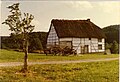
A housebarn (also house-barn or house barn) is a building that is a combination of a house and a barn under the same roof.[1][2] Most types of housebarn also have room for livestock quarters. If the living quarters are only combined with a byre, whereas the cereals are stored outside the main building, the house is called a byre-dwelling.

Styles

[edit]

There are several styles of housebarns. One style is a building where the barn portion shares a wall with the house portion.[3] Sometimes the house portion will extend into part of the loft on the second storey of the barn portion.[3]

Outside view of Woodhouses Bastle

Another style features the barn as the lower portion of the building and the house as the second floor[3] such as the Black Forest-style house.[why?] Similarly but for different reasons, some defensive house structures such as the bastle house[4] and some tower houses combine animals on the ground floor and living quarters above, a security measure against raids. For example, bastle houses are found along the Anglo-Scottish border, in areas formerly plagued by border Reivers.

History

[edit]
A model of a typical Israelite four-room house

Housebarns were built beginning in prehistoric times after people discovered that the body heat of animals helps to warm human living areas.[5] The ancient four room house is an Iron Age type highly identified with the ancient Israelites.[6]

Living with livestock in the combined building also allowed people to be able to prevent thieves from stealing their animals.[1] Housebarns were developed in western Europe, Scandinavia, and the British Isles[7] and continued being built into the 19th century. The first three designs in the 1839 edition of An Encyclopædia of Cottage, Farm, and Villa Architecture and Furniture... were for combined living space for the farm family and their animals.[8] Immigrants to North America rarely built housebarns; they typically divided the barn and house functions into separate buildings[7] although part of New England in particular is known for its connected farms.

Advantages and disadvantages

[edit]

Owners have stated that they find it convenient to not have to walk outside while feeding or watching a medical issue such as birth of animal young.[3] They often can hear the animal noises, which can be disruptive or helpful when an animal has problems.[3]

One American builder estimates that 5% of its buildings have an attached living area, some of which are small apartments.[3] They cite several concerns about building a housebarn. Since fewer people are interested in owning a living quarters attached to the house, housebarns have a more limited marketability.[3] This causes lending institutions to be less likely to grant a loan.[3] Bankers are less likely to accept housebarns as collateral.[3] Housebarns are more costly to insure since they are treated like barns, which have a higher risk of fire.[3] The house portion may get unwanted pests that are common in barns like mice, flies, and birds.[3]

Distribution

[edit]

Austria

[edit]
The Bregenzerwälderhaus. This specific building in Schwarzenberg, Vorarlberg (Austria) is listed as a protected building.
  • Zwerchhof is found in eastern and southeastern Austria. A brief description of similar house types is at the open-air museum Museumsdorf Niedersulz.
  • Engadinerhaus, see below in section on Switzerland.
  • Vierkanter or Vierkanthof are courtyard farms. The courtyard is formed by walls of a large building or the placement of several buildings creating an enclosed courtyard.
  • The Bregenzerwälderhaus is a housebarn from the Bregenz Forest in Vorarlberg[9]

Belgium

[edit]

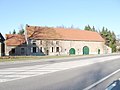
In Belgium, most of farms were housebarns, referred to as Langgevelboerderij (long-facade farm) in Dutch and simply cinse (farm) in Walloon, then ferme in French. They were located in the heart of the village until the early 1950s. At that time, barns, at first, then stables began to be built outside the main building, or even outside the village.

Canada

[edit]

Estonia

[edit]
Northern type of Estonian traditional farmhouse (Rehielamu põhjatüüp). 1. is the "kiln", 2 and 3 are living space, 4 is an entryway, 5 is the barn.
  • Rehielamu, The traditional Estonian farmhouse is a combined living space, "kiln" for cooking and drying crops, and threshing barn. The farmhouse is of two types, the põhjatüüp (northern type) and the Rehielamu lõunatüüp (southern type). No English article as of March 2013 but information is available at the Estonian Wikipedia written in Estonian.

France and Spain

[edit]
A baserri housebarn in Álava, Basque Country of Spain
  • Mas and called the masia in Catalonia (Spain). These are two storey farmhouses with room for animals on the ground floor.
  • Bresse Farmhouse (Ferme bressane, French; Bressehaus, German) - amed for the Bresse region of France. Sometimes the Bresse farmhouse is a housebarn but they may have separate farm buildings.
  • Maison landaise, the Landes house - has no uniformity but is sometimes a byre-dwelling. It is named for the region where it is found, the department of Landes in southwest France. For images see Category:Maison landaise.
  • Lorraine House - see below in section on Germany
  • Cabaña pasiega - Sometimes a house-barn, sometimes a warehouse and barn
  • Baserri - Aafarmhouse in the Basque Country in northern Spain and southern France

Germany

[edit]

Housebarns in Germany are generally called an einhaus (single-house or "all-in-one house"), eindachhof (one-roof-house) or wohnstallhaus (residential barn house).

The Middle German house group includes:

  • Ernhaus (hall house, hall kitchen house). Ern is a Frankish word for the hall.
  • Oberdeutsches Haus (Upper German house)
  • Thüringisches Haus (Thuringian house)
  • Fränkisches Haus (Frankish house)

The Middle German houses have a floor plan transverse to the walls where the Low German houses are longitudinal floor plan, three aisled buildings (dreischiffige).

The Low German house group extends from the Netherlands to East Prussia and includes:

  • Flett-Deelen-Haus - a hall house with a very common floor plan including an open kitchen (flett) to the side of the hall (deele)
  • Kübbungshaus - a hall house of two-post construction called a Zweiständerhaus, named after the side aisles called kübbungen
  • Niedersachsenhaus (Low Saxon house)
  • Sächsisches Haus (Saxon house)
  • Altsächsisches Bauernhaus (Old Saxon farmhouse)
  • Westfälisches Bauernhaus (Westphalian farmhouse)
  • Westfalenhaus (Westphalian house)

The Gulf house (Gulfhaus) is named for the storage area called a gulf. Its range extends across the North Sea coastal regions from West Flanders to Elbe-Weser Triangle. The Gulf house developed from the Old Frisian farmhouse.

The Geestharden house named for the geography of part of the region it is found, the geest, in Northern Germany, Denmark, and northern Netherlands. The Geestharden, Gulf house (including its variant, the Haubarg) and the Low German hall house are the three basic, historic farmhouse types in the German state of Schleswig-Holstein.

Other house types in southern Germany include:

  • Upper Swabian farmhouse (Oberschwäbischer Bauernhof) is found throughout Swabia (Bavaria) but mainly Upper Swabia.
  • Lorraine house (Lothringerhaus or Lothringer Bauernhaus) is found in the Lorraine (region), France and Saarland, Germany. This floor plan is arranged transversely, in German called quereinhaus. They are stone, two-storey buildings.

The Upper Lusatian house or Umgebinde is another barn-house type found in a region in part of Germany, Poland and the Czech Republic, a wider range than the historical region of Upper Lusatia. This is a transversely divided Middle German house with unique construction features.

The Black Forest house group are found in southwest Germany in the Black Forest region and include:

  • Heath house (Heidenhaus), or "hill house" (Höhenhaus), is by far the oldest form of Black Forest farmhouse, and is mostly found in the High Black Forest.
  • Heath house in its newer form (Heidenhaus in seiner neueren form)
  • Zarten house (Zartener Haus) tends to be found on level valley bottoms. Its name is derived from the villages of Zarten and Kirchzarten in the Dreisam Valley in the southern Black Forest.
  • Schauinsland house (Schauinslandhaus), named after the local hill of Freiburg, the Schauinsland, is located in the high regions, near the summits of the southern Black Forest.
  • Hotzen house (Hotzenhaus) found in the Hotzenwald
  • Gutacher house (Gutacher Haus) is found on the eastern perimeter of the Black Forest. It is possibly the most typical form of farmhouse that is linked to the Black Forest.
  • Kinzig Valley house (Kinzigtäler Haus)

Housebarns were common in the Schleswig-Holstein region of German in the 17th and 18th centuries.[10]

Great Britain and Ireland

[edit]
Higher Uppacott, Devon (c.1350) has been preserved as a definitive example of a Dartmoor longhouse with preserved medieval thatched roofing.
  • Longhouses such as the Dartmoor longhouse are found in southwestern England; Cornwall, Devon, Wales, and lowland Scotland.[11] A porched cross passage gave access to living quarters positioned on the upper slope with animal accommodation downslope to assist drainage.[12]
  • Bastle house, Scottish-English border. A two-storey building not found elsewhere in Britain. The ground floor used for animals, the upper floor for living space.[11]
  • Laithe house, upland Pennines. Barn, byre and living quarters combined into one building.[11]
  • Blackhouse (building), A traditional house-barn in the Scottish Highlands, the Hebrides, and Ireland.

Netherlands

[edit]

Combined farmhouses and barns in a number of different styles can be found in several areas of the Netherlands.[13] A general list of farm types in the Dutch language is here.

Hall-farmhouse group (hallenhuisboerderij) also known as the Low German house group:

  • Langsdeeltype aisled barn type
  • Dwarsdeeltype cross floor type
  • Hallenhuisboerderij (Hall house farmhouse)
  • Langgevelboerderij (long facade farmhouse) found in North Brabant, Limburg and neighboring parts of Belgium. These developed from the hall house and consist of a long building that faces the road, with the house at one end.
    • Krukboerderij L-shaped farm, found in Betuwe
    • T-boerderij or betuwse boerderij, found in Overijssel, Utrecht and South Holland, these combined houses and barns are similar to the kop-rompboerderijen, but the farmhouse forms the crossbar of a letter 'T', with the barn forming the stem.
  • Los hoes boerderij (loose house) are found around Twente, Overijssel. These buildings were originally open inside. The farmer and his family sharing the same space as the livestock, thus the name loose house.

Cross house group (dwarshuisgroep):

  • Separate buildings for housing, barn, stall, etc. arranged in an L shape U shape or courtyard.
  • Middenlimburgse (Middle Limburg type) developed two parallel buildings.
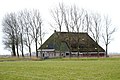
  • Drentse-boerderij, found in Drenthe and northern Overijssel. These elongated buildings are often thatched.

Northern house group (noordelijke huisgroep) also called the Frisian house group (Friese huisgroep):

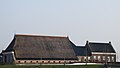
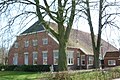
  • Kop-hals-rompboerderij (head-neck-rump farmhouse) is known in English as the Frisian farmhouse. Found in Friesland and western Groningen, these buildings consist of three sections, the kop (head) containing the house, the hals (neck) being a small linking section, and the romp (rump) being the barn; so-named from the similar appearance of a recumbent cow. This house type is descended from the Old Frisian longhouse.
    • Bildtse boerderij Bildts farmhouse is a Kop-hals-rompboerderij but with the house and neck turned to form an L-shaped farm and the cows face the middle aisle. The name id derived from this type being concentrated around the province of het Bildt.
  • Kop-rompboerderij (head-rump farmhouse) are found in Friesland and western Groningen. These farmhouses are similar to the kop-hals-rompborderijen, but the house is joined directly to the barn.
  • the Ameland and Terschelling development
  • Oldambtster boerderij, found in the Oldambt region of eastern Groningen (province). The house roof is usually tiled, while the barn roof is thatched.
  • Stolpboerderij, known as Haubarg in German. These consist of a square, pyramid roof building. The roofs of these buildings may be fully tiled or part tiled, part thatched. The house part of these buildings may present an ornate facade. This type of building is found in North Holland.
  • Stelpboerderij are very similar to the stolpboerderij but are rectangular and are found in Friesland.

Poland

[edit]
  • Mennonite settlers from The Netherlands settled in the Vistula Delta near Gdańsk (then part of Prussia) in the 16th century, where they built housebarns. Some moved to the Russian Empire, and later North America, where they continued this practice.

Switzerland

[edit]

Ukraine

[edit]
  • Mennonite settlers from Prussia immigrated to South Russia, now Ukraine, beginning in the 1770s. Many of them settled in reserves near what is now Zaporizhia and continued the practice of living in street villages and building housebarns, some of which are still extant today. Most of the Mennonites in this region immigrated to Canada and the United States beginning in the 1870s, where they continued to build housebarns.

United States

[edit]

Housebarns are more prevalent in areas that were settled by German immigrants. There are twelve historic housebarns in the United States.[2] Many of these housebarns are listed on the National Register of Historic Places:

See also

[edit]

References

[edit]
Revisions and contributorsEdit on WikipediaRead on Wikipedia
from Grokipedia
A housebarn is a vernacular building type that integrates human living spaces with areas for livestock, crop storage, and farm operations under one roof, designed for efficiency in rural, pre-industrial farming communities.[1][2][3] Originating in medieval northern Europe, particularly in regions like the Netherlands, Germany, and Switzerland, housebarns—known as Einhaus or Wohnstallhaus in German—developed as practical responses to harsh climates and limited resources. The Thirty Years' War (1618–1648) disrupted traditional farming settlements and spurred emigration, helping to spread this architectural tradition.[3][2] These structures allowed families to benefit from the warmth generated by animals during cold winters while centralizing daily farm activities, often featuring timber-frame (Fachwerk) construction with infills of brick, stone, or plaster, and layouts divided by a central hallway or Diele separating living areas from the barn.[2][3] European immigrants, including Pennsylvania Germans and Mennonites fleeing persecution or seeking economic opportunities, transported this architectural tradition to North America in the 17th and 18th centuries, adapting it to local materials like logs in frontier areas.[1][3] In the United States and Canada, housebarns became prominent among German-American and Mennonite settlers in the Midwest and Prairie provinces, with notable concentrations in places like Missouri's Rhineland region and Manitoba's Mennonite villages during the 19th century.[1][2] Examples include the Pelster Housebarn in Franklin County, Missouri (built between 1860 and 1864 by German immigrant Friedrich Wilhelm Pelster), which exemplifies multi-level Fachwerk design with a front porch and weatherboard siding, and the Chortitz Housebarn in Manitoba, a log structure built in 1892 reflecting communal village planning.[2][1][4][5] By the early 20th century, as farming practices modernized and families expanded homesteads, the integrated housebarn declined in favor of separate dwellings and outbuildings, though surviving examples preserve cultural heritage and inspire contemporary adaptations.[1][2]

Overview

Definition and Characteristics

A housebarn is a single building that integrates human living quarters with animal housing and crop storage, typically found in rural settings to facilitate mixed farming operations. This multifunctional structure allows families to reside in close proximity to their livestock and agricultural resources, promoting efficient daily management of farm activities. The design reflects practical adaptations to agrarian lifestyles where space and labor were limited, enabling the simultaneous sheltering of people, animals, and harvested goods under one roof.[6][1] Key characteristics of housebarns include a multi-level or partitioned layout, with livestock stalls often on the ground floor or adjacent sections and human residences above or alongside, separated by a central hallway or threshold for access control. Shared walls between living and animal areas were traditionally believed to enhance thermal efficiency, as the body heat from livestock was thought to provide natural warming to upper living spaces during cold seasons. Ventilation systems, such as dedicated pipes or high ceilings, address air quality needs for both humans and animals by mitigating odors and moisture from stalls. These features emphasize the structure's role in supporting sustainable, self-contained farming.[7][6] The English term "housebarn" describes structures equivalent to the German Wohnstallhaus, literally meaning "living-stall house," which highlights its combined residential and stabling functions; similar terms exist in other languages, such as the English "byre-dwelling," underscoring the universal emphasis on multifunctional use in vernacular architecture. In basic examples, the ground floor accommodates animal stalls and feed storage, while the upper floor serves as the family residence, often with a kitchen and sleeping areas arranged around a central hearth for cooking and heating. Regional variations may adapt these elements to local materials and climates, but the core integration remains consistent.[6][1]

Common Features

Housebarns typically feature a rectangular floor plan with partitioned interiors that separate human living areas from livestock quarters, allowing for efficient use of space under a single roof. The structure often employs a gable or pitched roof, designed to provide ample overhead space for hay storage in the upper levels or lofts, which also serves as grain or equipment storage. Thick walls, constructed with infill materials between timber frames, offer insulation against harsh weather, while separate entrances—one for the residence and another for the stable—help prevent contamination between living and animal spaces.[8][9][10] Functional integrations in housebarns emphasize practicality, with the stable's animal body heat traditionally believed to warm adjacent living quarters during cold seasons, reducing the need for additional heating sources. These designs promote dual-use efficiency by connecting living and working zones via internal doors or hallways, while maintaining hygiene through partitioned layouts.[11][9][10] Material preferences for housebarns prioritize locally sourced elements for durability and cost-effectiveness, commonly including timber for post-and-beam framing, stone or brick for foundations and lower walls, and clay or plaster infill for insulation in half-timbered sections. Roofs are typically thatched, shingled, or tiled to withstand regional climates, with wooden clapboard or plaster exteriors providing weather resistance.[8][9][10] Adaptations for efficiency include strategic placement of windows and doors to enable cross-ventilation, reducing moisture buildup in both living and stable areas, and the incorporation of lofts or attics that maximize vertical space for storage without expanding the footprint. Broad overhanging eaves protect entrances and walls from rain, while the overall compact design minimizes material use and maintenance in rural settings. These elements collectively support the housebarn's role as a multifunctional agricultural structure.[8][10][9]

History

Origins in Europe

The housebarn, known in German as Wohnstallhaus, first appeared in Central Europe during the 12th to 14th centuries, primarily in Germanic regions of southern and central Germany as well as Alpine areas like Austria and Switzerland. This integrated building type evolved from earlier farmstead designs to address land scarcity in feudal agrarian societies, where small peasant holdings demanded multifunctional structures combining human living spaces, livestock stalls, and storage under one roof. Archaeological evidence from sites in Bohemia, Moravia, and southern Germany confirms these three-compartment layouts—typically featuring a living room (jizba), byre for animals, and barn—as dominant by the late 13th century.[12] The feudal system played a pivotal role in this emergence, enforcing self-sufficient homesteads that enabled serfs to sustain families through subsistence farming while fulfilling labor obligations to lords. In the harsh climates of Germanic and Alpine zones, long winters necessitated sheltered livestock quarters to protect animals from cold and leverage their body heat for insulating human areas, a practice rooted in earlier medieval farmsteads from the 5th to 11th centuries. Economic pressures, including limited arable land in mountainous terrains, further compelled compact units that minimized exposure to weather and optimized space for mixed crop-livestock operations.[13][12] Notable early examples include 13th-century three-compartment houses in German villages like Oberstetten and Höfstetten, where timber-framed designs with stone foundations integrated stalls directly beneath living areas, as documented in regional archaeological surveys. In Swiss Alpine communities, medieval structures such as the 1568 Blatten dwelling in the Lötschental valley—preserved at the Ballenberg Open-Air Museum—illustrate this form, with agricultural records noting their role in sustaining high-altitude herding economies. These sites highlight the housebarn's adaptation to local terrains, often banked into hillsides for stability.[12][14]

Spread to North America

German and Swiss settlers introduced the housebarn tradition to North America in the early 18th century, bringing the concept from regions like the Palatinate, Baden-Württemberg, and Switzerland to colonial Pennsylvania. These immigrants, often referred to as Pennsylvania Dutch (from the German "Deutsch"), adapted the form amid the region's rolling hills. A related development was the bank barn, a hillside barn providing ground-level access to stables below and threshing floors above, which became widespread among these settlers but typically separate from living quarters. By the mid-18th century, the tradition spread to the Midwest through chain migration, as families moved westward along trade routes like the National Road, settling in areas such as Ohio, Illinois, and Minnesota to claim larger land grants under policies like the Homestead Act of 1862. Dutch settlers in New York and New Jersey contributed related gable-entry barn variants.[15][16][17] Mennonite immigrants fleeing persecution or seeking opportunities carried the housebarn to Canada, particularly Manitoba's Prairie provinces in the 1870s, where log structures like the Chortitz Housebarn reflected communal village planning.[1] In the United States, examples include the Pelster Housebarn in Franklin County, Missouri (built circa 1840s by German immigrant Friedrich Wilhelm Pelster), a multi-level Fachwerk design with weatherboard siding. Key adaptations accommodated vast prairies and frontier conditions, incorporating local materials like hand-hewn logs in wooded areas of Minnesota and Illinois, or stone foundations as prosperity grew; ramps facilitated upper-level access on flatter terrain. These modifications supported dairy and hay production central to the agricultural economy.[2][15][18][17] Housebarns and related structures played a pivotal role in 19th-century farming booms tied to westward expansion, supporting ethnic enclaves and dairy farming from the 1870s onward. Their prominence waned after the mid-19th century with industrialization, as steam-powered machinery and rail transport favored specialized buildings, leading to conversions or abandonment by the early 20th century.[15][19][20]

Architecture

Regional Styles

Housebarns exhibit distinct architectural styles shaped by cultural and environmental influences, primarily in European traditions that later influenced North American designs. One prominent style is the Fachwerk, or half-timbered construction, characterized by exposed wooden frameworks filled with brick, plaster, or wattle and daub, often integrating living quarters and livestock areas under a single roof.[21] This style emphasizes structural timber posts and beams, providing both durability and aesthetic appeal through visible joinery. Longhouse variants, such as the byre-house in British contexts, extend linearly to accommodate extended family living spaces alongside integrated livestock stalls, reflecting communal agrarian lifestyles where human and animal areas were partitioned but connected for practical oversight.[22] Design variations in housebarns adapt to local topography and climate, with highland styles typically incorporating steep, pitched roofs to shed heavy snow loads and facilitate hay storage in expansive lofts. In contrast, lowland adaptations often feature more moderate roof pitches suited to frequent rainfall, prioritizing ventilation and ease of thatching or shingling maintenance over extreme shedding. Ornamental elements, such as intricately carved beams or decorative infill patterns in Fachwerk frames, add visual distinction, evolving from functional bracing to symbolic displays of craftsmanship in prosperous farmsteads. These variations maintain core housebarn features like partitioned interiors for hygiene while enhancing regional identity through proportional adjustments. In North America, immigrants adapted these styles using local materials, such as logs for frontier housebarns among Pennsylvania Germans and Mennonites.[1] The evolution of housebarn styles traces from medieval simplicity, where basic timber frames sufficed for subsistence farming, to 18th-century elaborations that incorporated expanded living spaces and refined detailing amid growing agricultural prosperity. Early forms emphasized compact, multifunctional layouts for protection against raids or weather, but by the 1700s, stylistic shifts included taller gables, added wings for family growth, and symmetrical facades influenced by broader architectural trends, without altering the integrated house-livestock core. This progression balanced tradition with adaptation, as seen in the persistence of half-timbered motifs alongside emerging brick integrations for fire resistance. Comparative traits among housebarn styles often mirror local agricultural priorities, with dairy-focused designs allocating larger lower-level stalls for cattle and milking areas, alongside upper hay mows to support year-round fodder needs. Crop-oriented variants prioritize expansive threshing floors and granary lofts for grain processing and storage, reflecting arable farming's emphasis on harvest volume over livestock density. These layouts underscore how housebarns served as adaptive hubs, tailoring spatial divisions to sustain either pastoral or arable economies.

Construction Techniques

Housebarns were constructed using robust foundations tailored to support the weight of livestock and stored feed in the stable sections, often employing fieldstone bases laid directly on the ground to provide stability against settling caused by animal movement and moisture. In regions with wet climates, such as parts of the American Midwest or Swiss lowlands, these foundations were elevated slightly or combined with partial cellars using dirt floors and mud mortar to prevent water ingress and promote drainage in animal areas. Framing techniques primarily relied on post-and-beam or half-timber (fachwerk) methods, where hewn oak timbers were joined via mortise-and-tenon connections secured with wooden pegs, forming load-bearing bents in ∏- or H-shapes with diagonal braces from sill to plate for enhanced structural integrity.[21][23][24] Material selections emphasized locally sourced, durable woods like oak for primary framing due to its strength and resistance to decay, supplemented by pine for secondary elements such as rafters and sheathing; infill panels between timbers were typically filled with rye straw mixed with clay or later brick for insulation and weatherproofing. Stone, particularly sandstone or fieldstone, formed the lower bases in damp environments to resist erosion and support heavy loads, while walls above combined timber framing with stucco or plaster coatings. Roofing consisted of steeply pitched gable or hipped designs covered in wood shingles, slate, or historically thatch, with wide overhangs exceeding eight feet to shed rainwater effectively and protect the structure's base.[21][25][26][24] Specialized features included integrated drainage via sloped stable floors directing water away from living areas and steep roof pitches facilitating runoff, often augmented by gutters in later adaptations. Reinforcements for heavy loads from hay bales, grain storage, or machinery involved principal purlins, ridgepoles, and thick clay or wooden loft floors (up to nine inches) to distribute weight evenly, with longitudinal beams in attics supporting stored harvests. Safety measures incorporated separate central chimneys constructed from brick or stone to vent smoke from living quarters and specialized areas like the brick-lined "black kitchen" for meat smoking, minimizing fire risks in proximity to flammable hay stores; diagonal bracing and stone foundations further countered settling from livestock weight.[21][23][25][24]

Advantages and Disadvantages

Operational Benefits

Housebarns offer significant efficiency gains in daily farm operations by integrating living quarters with livestock and storage areas under a single roof, thereby reducing the time and effort required for farmers to move between home and barn. This centralized layout streamlines essential chores such as milking, feeding, and general animal care, particularly beneficial in harsh weather conditions where short distances minimize exposure to the elements. For instance, in traditional German Hausbarns, the proximity of family living spaces to the animal stalls allows for quick access, enhancing overall labor productivity on small-scale farms.[27][28] Resource sharing in housebarns further optimizes farm management through the direct utilization of animal waste as fertilizer, which is easily accessible from integrated stalls and can be applied to nearby fields without extensive transport. The design also enables passive heating from livestock body heat rising to upper living levels, reducing the need for additional fuel in cold climates, while shared walls between spaces contribute to natural temperature regulation. In Mennonite housebarns of Manitoba, this integration facilitated efficient handling of resources like hay, straw, and water in centralized yards and corrals, supporting both livestock and crop needs.[7][27][28] Economically, housebarns provide advantages by consolidating construction into one structure rather than separate buildings, lowering overall building and maintenance costs while maximizing land use on compact plots. This space-saving approach was particularly valuable for immigrant farming communities with limited acreage, allowing more room for cultivation. Examples include improved animal welfare via constant family oversight, which promotes timely health interventions, and simplified monitoring of stored crops in adjacent areas, reducing spoilage risks.[28][7]

Potential Drawbacks

Housebarns, by integrating living spaces with livestock areas, pose notable health risks primarily due to the proximity of humans and animals, which facilitates the spread of odors, pests, and potential pathogens. Persistent animal odors and noises from the barn section can significantly diminish the quality of life in the residential portion, creating an unpleasant living environment. Additionally, the shared structure increases the likelihood of pests, such as rodents and insects, migrating from the barn into living quarters, exacerbating infestations and related hygiene concerns. Sanitation issues arise from the combined use, as waste and moisture from livestock can infiltrate human areas, contributing to broader health hazards in poorly ventilated setups.[11][29] Safety concerns are amplified in housebarns, particularly regarding fire hazards, given the storage of flammable materials like hay and feed adjacent to living spaces. A fire originating in the barn can rapidly spread to the residence due to the unified roof and walls, potentially resulting in total loss of the homestead. Historical records highlight these dangers; for instance, in 1649, authorities in Reading, Massachusetts, prohibited the joining of barns and dwellings specifically to mitigate fire risks. Agricultural writer Thomas G. Fessenden echoed this in 1834, noting the heightened fire danger of connected farm buildings as a key deterrent to their continued use.[29] Maintenance burdens in housebarns are substantial, stemming from the wear of serving both residential and agricultural functions, which accelerates deterioration and elevates repair costs compared to separate structures. The integration complicates insurance, as providers often view the connected design as riskier, leading to higher premiums or coverage limitations. Modernizing these buildings for contemporary needs, such as installing electricity, plumbing, or improved ventilation, presents challenges due to the intertwined layouts and historic materials, often requiring specialized interventions to avoid compromising the original architecture.[11][30]

Distribution

Central Europe

Housebarns, known locally as Wohnstallhaus or Einhaus, are a hallmark of rural architecture in Germany, frequently built using the Fachwerk half-timbered technique that provides structural durability and aesthetic appeal. These buildings integrate living spaces with livestock quarters and storage under a single roof, often featuring the Flurküchenhaus layout with a central corridor-kitchen and three principal rooms, including a heated Stube for family gatherings. They are particularly concentrated in southern and western regions like rural Bavaria and the Rhineland, where early prototypes emerged from the 16th century onward, adapting to local agricultural needs such as cattle herding and grain storage.[3] In Austria, housebarns manifest as Alpine variants optimized for high-altitude farming, with steeply pitched roofs to prevent snow accumulation and wide overhangs for sheltering animals and tools. These structures have deep historical ties to Tyrolean agricultural traditions, where they supported mixed farming and pastoral economies in mountainous terrain. A notable protected example is the Wohnstallhaus at Jörgnalm in Kals am Großglockner, Lienz District, listed in the Tyrolean Art Cadastre as a cultural heritage object (ID 17610), preserving its original form for educational and touristic purposes. Switzerland's housebarns, also termed Wohnstallhaus, emphasize compactness to suit the rugged landscapes of cantons like Bern and Valais, combining human habitation, animal stalls, and haylofts in multifunctional designs that maximize limited flat land. Adapted from similar Germanic traditions, they prioritize ventilation and insulation against harsh winters, often using local stone bases and wooden upper stories. Preservation efforts focus on heritage sites, such as those in open-air museums like the Ballenberg Open-Air Museum, where restored examples illustrate 18th- and 19th-century rural life.[3] In Poland, housebarns reflect eastern architectural styles influenced by Germanic settlers, especially in Silesia and areas of historical German colonization, where timber-framed designs incorporated barns adjacent to or under the same roof as dwellings. These structures supported small-scale mixed farming but experienced a sharp decline after World War II due to communist collectivization policies initiated in 1948, which coerced private farmers into state cooperatives, resulting in the demolition, repurposing, or neglect of many traditional farm buildings. Protected examples persist in regional museums, such as the Silesian Museum of Folk Architecture in Chorzów, safeguarding remnants of this hybrid style.[31] Across Central Europe, current preservation initiatives have saved numerous housebarns as cultural assets, with hundreds documented and restored in museums and villages, though ongoing urbanization continues to threaten remaining examples; notable sites include Germany's Hessian Open-Air Museum in Neu-Anspach for Rhineland variants and Austria's Tyrolean Folk Art Museum for Alpine types.[3]

Western Europe

In Belgium and the Netherlands, housebarns are exemplified by the langgevelboerderij (long-wall farmhouse) and its Flemish counterpart, the langgevelhoeve, which integrate living quarters and livestock areas under a single long, gabled roof oriented toward roads or canals for convenient access.[32] These structures, prevalent in regions like North Brabant and the Kempen, were primarily constructed from the 17th to 19th centuries using brick and thatch, supporting mixed farming with a focus on dairy production where cows were housed adjacent to the family dwelling.[32] In the Netherlands' canal-side areas, such as those along the River Lek, these long barns facilitated efficient transport of dairy products and feed, with many examples still standing as historic monuments.[33] Polder regions in the Netherlands, like the UNESCO-listed Beemster Polder, feature housebarns adapted to flood-prone lowlands through the broader polder drainage system and elevated foundations, enabling sustained dairy farming on reclaimed land since the 17th century.[34] These adaptations, including geometric layouts of fields and ditches, protected against seasonal inundation while maintaining integrated housing and stabling for cattle.[35] In France, particularly Normandy, the longère represents a regional variant of the housebarn, consisting of a long, rectangular structure with adjoining livestock quarters and storage under a shared steep roof, often built from local stone or half-timbering to withstand harsh coastal weather.[36] Dating back several centuries, these multifunctional farmhouses back onto prevailing winds and front roads, with roof spaces historically used for hay insulation, supporting cider apple orchards and cattle rearing.[36] Mediterranean areas in southern France exhibit variants with open courtyards for ventilation, echoing designs in neighboring Spain. Spain's Mediterranean housebarns, notably the masia in Catalonia, incorporate central courtyards surrounded by living areas, barns, and wine cellars, constructed from stone with tiled roofs to manage the region's hot, dry climate.[37] These self-sufficient estates, evolved over centuries from Roman influences, feature vaulted interiors and arcades for livestock and crop storage, with examples like restored masies in the Empordà region preserving viticultural traditions.[38] In Great Britain and Ireland, housebarns are rarer, with stone-built longhouses in rural Wales and Scotland reflecting Celtic farming practices where humans and animals shared a single-roofed structure divided by a passage.[39] In Scotland's Perthshire, 19th-century cruck-framed examples like Moirlanich Longhouse survive intact, housing families and cattle in lime-washed stone to endure Highland winters.[39] Welsh variants, such as 17th-century longhouses in Powys, similarly combined hearths and byres, influenced by pastoral transhumance.[40] Irish examples, though scarce, appear in western counties with similar stone integrations tied to subsistence crofting. Modern trends in Western Europe show urban expansion encroaching on rural housebarn sites, particularly in densely populated areas like the Netherlands and Belgium, leading to conversions or demolitions, though preservation initiatives have saved numerous structures.[41] Preserved housebarns, such as those in open-air museums like Bokrijk in Belgium, now hold tourism value, attracting visitors to experience historical farming life and boosting local economies through agritourism.[41] Thousands of langgevelboerderijen survive in the Netherlands and Belgium, alongside thousands of longères in Normandy and over 20,000 registered masies in Catalonia, while longhouses remain rare in Wales and Scotland, with ongoing UNESCO and national efforts aiding conservation.[34][39][42]

Eastern Europe

In Estonia, the traditional housebarn, known as rehielamu, represents a distinctive Baltic wooden architectural form adapted to the region's harsh winters. These structures combined human living quarters with spaces for grain threshing, storage, and livestock sheltering, allowing families to manage farm operations indoors during extended cold periods. Typically constructed from round logs with packed soil floors and minimal windows to conserve heat, rehielamu featured a central threshing room (rehetuba), an unheated storage area (kamber), and a hearth for drying grain and providing warmth, often without a chimney in early versions. This integration supported rye cultivation and animal husbandry, emerging as early as the second millennium AD.[43] Estonian rehielamu also reflected cultural practices tied to sauna traditions, though saunas (suitsusaun) were typically separate buildings built first for ritual cleansing and social gatherings. Post-serfdom modernization in the mid-19th century introduced detached dwellings and glass windows to these structures, enhancing habitability while preserving their multifunctional core. Preservation efforts, such as the relocation of the 1891 Köstriaseme farm's barn-dwelling to the Estonian Open Air Museum in 1959–1962, highlight post-communist revival initiatives to maintain these as cultural artifacts, with the site opened to visitors in 1962 to demonstrate historical farm life.[43][44] In Ukraine, housebarn variants in the western Hutsul region formed compact, fortress-like complexes called grazhda, where dwellings were joined with farm buildings under a single roof, often enclosed by high fences for protection in mountainous terrain. These wooden or clay-based structures accommodated herding needs, integrating living spaces with stables and storage amid the Carpathian landscape. In the steppe and forest-steppe zones, adaptations for semi-nomadic herding emphasized lighter, thatched-roof constructions using unfired clay mixed with straw or reeds on wooden frames, prioritizing mobility and ventilation over permanent integration, though separate barns (stodola) and stables remained common. Soviet-era collectivization in the 1930s dismantled many family-owned housebarns, converting them into communal facilities on collective farms (kolkhozy), with post-WWII decrees leading to the construction of over 750,000 standardized rectangular buildings that prioritized collective efficiency over traditional designs.[45] Eastern Poland, particularly the Podlachia region, features wooden log housebarns known as chałupa z oborą, where living areas merge with cattle sheds (obora) in linear folk arrangements to support rural agrarian life. Built from hewn logs with decorative geometric and floral motifs carved into facades—often in colors like brown, green, and red—these structures symbolized self-sufficiency and were influenced by 19th-century Russian Empire patterns, peaking in ornamentation from post-WWI to the 1960s. In Podlachia, such as near Białystok, they embody cultural symbols in local folklore, representing ancestral resilience and harmony with nature, as seen in ethnographic tales of farmstead spirits and seasonal rituals. Examples like the protected chałupa z oborą i stajnią in Strzakły (Lubelskie Voivodeship, adjacent to Podlachia) illustrate log construction techniques adapted for livestock integration.[46] Post-communist revival efforts across Eastern Europe have focused on documenting and restoring housebarns through open-air museums and heritage registries, countering threats from modernization such as rural depopulation and replacement with concrete housing. In Estonia and Poland, initiatives like the Estonian Open Air Museum and Poland's National Heritage Board (zabytek.pl) emphasize legal protections, though many structures in Ukraine's steppe areas face decay due to agricultural intensification. Distribution patterns show high rural concentrations in Podlachia, Hutsul uplands, and Baltic lowlands, with near-total urban rarity as these vernacular forms remain tied to agrarian villages rather than cities.[44][45][47]

North America

In the United States, integrated housebarns trace their roots to European immigrant communities, with German and Swiss settlers adapting traditional designs to local conditions. While bank barns—multifunctional structures built into hillsides with lower levels for livestock and upper levels for storage—were introduced by Pennsylvania Germans in the 18th century and served as central agricultural hubs, they typically did not combine living quarters under the same roof. Surviving bank barns number in the thousands across Pennsylvania, many dating to the 19th and early 20th centuries with modifications like forebay enclosures.[48][16] In the Midwest, log variants of housebarns emerged among German and Mennonite settlers, utilizing locally abundant timber to create combined living and livestock spaces suited to the region's forested landscapes. These structures, common in areas like Wisconsin and Minnesota, featured simple log construction with attached barn sections for sheltering animals and storing crops, echoing Old World designs while accommodating American frontier conditions. Amish communities, concentrated in Pennsylvania and extending into the Midwest, continue to maintain and build similar barn forms, though often as separate but proximate structures to traditional homes, preserving the integrated farm ethic of their Anabaptist heritage. Notable concentrations persist in Lancaster County, Pennsylvania, where over 200 historic barns, including log types, are documented in preservation surveys.[49][50] In Canada, housebarns arrived with Swiss and Dutch Mennonite immigrants fleeing religious persecution, establishing communities in Ontario and Quebec before expanding westward. Early examples in Ontario, such as a 1908 wood-frame Mennonite housebarn, integrated residential and barn functions with gabled roofs and separate but adjoining sections for family and livestock, reflecting adaptations from Russian Mennonite villages. Quebec saw limited adoption, primarily among Swiss settlers in rural townships, where barn-like outbuildings occasionally adjoined homes but rarely formed full housebarns due to French-Canadian architectural dominance. In Manitoba's prairies, Dutch-Swiss Mennonites arriving in 1875 built extensive housebarn villages, modifying European designs with local sod, log, and later brick materials to suit flatlands and harsh winters; structures like the 1875 Neufeld Housebarn combined a 26-by-40-foot house with an 80-foot barn under one roof. Prairie adaptations emphasized linear street villages with narrow farmyards, facilitating communal farming.[51][52][53] The current landscape of housebarns in North America shows significant decline, driven by mechanized farming since the early 20th century, which favored larger, specialized buildings over integrated designs and led to farm consolidation. From over 6 million U.S. farms (most with barns) in 1935, fewer than 650,000 barns remained as of 2016, with housebarns particularly scarce outside preserved sites. In Canada, Manitoba retains the highest concentration, with fewer than 20 original Mennonite villages surviving and at least six intact housebarns in the Neubergthal National Historic Site. As of 2025, preservation efforts continue through public tours and educational programs at sites like Neubergthal. Protection efforts include National Register listings, such as a rare U.S. housebarn example, and heritage villages like Manitoba's Mennonite Heritage Village, which houses restored structures like the Chortitz Housebarn. While the Smithsonian Institution does not maintain a dedicated housebarn collection, its agricultural exhibits feature related artifacts from immigrant farmsteads.[54][20][1][55][56]

Cultural and Modern Aspects

Sociocultural Role

Housebarns served as central hubs for multigenerational family living in rural Europe, where extended families often shared living spaces with livestock to facilitate collective labor and resource management on small peasant holdings. In Alpine regions, families maintained multiple dispersed land parcels, with children contributing to farm tasks alongside elders, fostering intergenerational bonds and knowledge transmission essential for survival in harsh terrains. These structures also anchored rural community gatherings, reinforcing social cohesion and mutual aid networks. Culturally, housebarns embody symbolic representations of peasant resilience and ingenuity, prominently featured in art, literature, and festivals tied to agrarian traditions. In Switzerland, similar farm buildings highlight Alpine farming heritage, and appear in harvest festivals like Erntedankfest, where they evoke gratitude for bountiful yields and communal stewardship of the land.[57] These buildings further symbolize national identity, as seen in 19th-century European exhibitions (e.g., Paris 1867) and open-air museums like Skansen (1892), where Swiss chalets and German Wohnstallhäuser were displayed to promote romantic ideals of timeless rural heritage amid emerging national narratives.[58] In Germany, folklore around barn-building feasts, including rituals like mummifying an ox head for prosperity, underscores their role in harvest celebrations and communal identity.[59] Gender dynamics in housebarns reflected integrated labor roles, with women performing essential farm and household tasks alongside men, though often bearing additional domestic burdens. Medieval and early modern peasant women in Europe shared agricultural duties such as livestock tending and field work in combined living-barn setups, as evidenced in Alpine communities where women braved avalanche-prone paths to manage herds.[60][61] Ethnographic studies highlight housebarns as enduring markers of peasant heritage, often overlooked in architectural analyses but central to understanding social structures and cultural continuity. Research on byre-houses (Wohnstallhaus variants) in northern Europe reveals their role in multispecies intimacy, where cohabitation with animals shaped daily rituals and family hierarchies, preserving vernacular traditions against modernization.[7] In Switzerland and Germany, these structures in folk museums exemplify how peasant dwellings transitioned from functional spaces to symbols of ethnic and national pride, documented through material culture collections that emphasize their ethnographic value in reconstructing rural lifeways.[58]

Contemporary Uses and Preservation

In contemporary contexts, housebarns have been adapted for sustainable living and agritourism, transforming their multifunctional designs into eco-homes that integrate modern energy-efficient features while retaining historical integrity. For instance, a 1740 Wohnstallhaus in Saxony's Vogtland region, Germany, was restored as holiday accommodation, incorporating a wellness area with a Finnish sauna and bathtub beneath preserved exposed roof trusses and natural stone walls; the project emphasized material reuse to minimize environmental impact.[62] Similarly, in the UK, dilapidated stone barns—structurally akin to housebarns—have been converted into eco-friendly family homes using low-impact insulation and rainwater harvesting systems to achieve high energy efficiency ratings.[63] These adaptations support sustainable farming by enabling solar panel installations on expansive roofs, reducing operational costs for small-scale organic operations; for example, farmers in Europe and North America have integrated photovoltaic systems on barn roofs to power irrigation and livestock facilities, cutting energy expenses by up to 70% in some cases.[64] Preservation initiatives have gained momentum through heritage organizations, focusing on structural stabilization and cultural recognition to counter decline. In the United States, the Alex Seitaniemi Housebarn, a rare Finnish immigrant-built structure from 1907–1913 in Embarrass, Minnesota, underwent multi-phase restoration completed in 2015, involving timber replacement, foundation reinforcement, and roof reconstruction with original-style materials; this effort earned a 2016 Preservation Alliance of Minnesota Honor Award and National Register of Historic Places listing.[65] In Switzerland, the Swiss Heritage Society supports the conservation of traditional farm buildings, including Wohnstallhäuser, through funding for restorations that maintain regional architectural typologies in alpine parks, often repurposing them for educational tours.[66] Although no specific UNESCO listings exist for housebarns, these efforts align with broader European heritage protections, such as those under the Swiss Parks network, where historic Wohnstallhäuser provide insights into medieval agrarian life.[67] Challenges to housebarn preservation include urban expansion encroaching on rural sites and climate change exacerbating material degradation, such as increased moisture affecting timber frames. Urban sprawl has led to demolitions for development, with historic farm structures in North America facing higher risks due to zoning conflicts that prioritize new builds over heritage designations.[20] Climate impacts, including intensified storms and humidity shifts, threaten structural stability, prompting retrofits like elevated foundations and breathable insulation to enhance resilience without compromising authenticity; the National Park Service recommends such measures for agricultural outbuildings to extend service life amid rising temperatures.[68] Legal hurdles, including restrictive heritage laws, can delay restorations, though incentives like tax credits in the US and EU grants have facilitated barn renovations, favoring preservation over demolition in many regions.[69] Global trends reflect a revival of housebarns within organic farming movements, where preserved or retrofitted structures serve as hubs for agritourism, blending education on sustainable practices with visitor experiences. In Europe, conversions to guesthouses on organic farms have surged, supporting biodiversity initiatives by hosting workshops on regenerative agriculture.[70] In North America, similar repurposing for farm stays emphasizes low-carbon retrofits, such as passive solar designs, to align with climate goals; recent data indicates that resilient upgrades, like weatherproof sealants on historic farm buildings, have improved energy performance by 20–30% in pilot programs.[71] These efforts not only preserve cultural landscapes but also contribute to economic viability for rural communities facing agricultural shifts. As of 2023, interest in converting abandoned stables and barns into holiday apartments has grown in Switzerland due to land shortages and tourism demand.[72]

References

User Avatar
No comments yet.