Hubbry Logo
Houston Ship ChannelHouston Ship ChannelMain
Open search
Houston Ship Channel
Community hub
Houston Ship Channel
logo
8 pages, 0 posts
0 subscribers
Be the first to start a discussion here.
Houston Ship Channel
from Wikipedia

The Houston Ship Channel, in Houston, Texas, is part of the Port of Houston, one of the busiest seaports in the world.[1] The channel is the conduit for ocean-going vessels between Houston-area terminals and the Gulf of Mexico, and it serves an increasing volume of inland barge traffic.

Key Information

Overview

[edit]
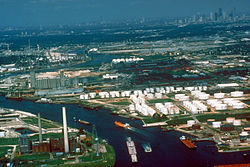
San Jacinto River in Channel - inset (white line top left) magnified as bottom photo showing the Texas and San Jacinto Monument

The channel is a widened and deepened natural watercourse created by dredging Buffalo Bayou and Galveston Bay.[2] The channel's upstream terminus lies about four miles east of downtown Houston, at the Turning Basin, with its downstream terminus at a gateway to the Gulf of Mexico, between Galveston Island and the Bolivar Peninsula.[3] Major products, such as petrochemicals and Midwestern grain, are transported in bulk together with general cargo. The original watercourse for the channel, Buffalo Bayou, has its headwaters 30 miles (48 km) to the west of the city of Houston. The navigational head of the channel, the most upstream point to which general cargo ships can travel, is at Turning Basin in east Houston.[4]

The channel has numerous terminals and berthing locations along Buffalo Bayou and Galveston Bay. The major public terminals include Turning Basin, Barbours Cut, and Bayport. Many private docks are there as well, including the ExxonMobil Baytown Complex and the Deer Park Complex.[5][6]

The channel, occasionally widened and deepened to accommodate ever-larger ships, is 530 feet (160 m) wide by 45 feet (14 m) deep by 50 miles (80 km) long.[1] The islands in the ship channel are part of the ongoing widening and deepening project. The islands are formed from soil pulled up by dredging, and the salt marshes and bird islands are part of the Houston Port Authority's beneficial use and environmental mitigation responsibilities.[1]

The channel has five vehicle crossings: Washburn Tunnel, Sidney Sherman Bridge, Sam Houston Ship Channel Bridge, popularly known as the Beltway 8 Bridge. Two Dollar bridge is another local nickname; Fred Hartman Bridge connecting La Porte and Baytown, Texas; and Lynchburg Ferry.

History

[edit]
Photo of the Houston Ship Channel in 1913

John Richardson Harris platted the town of Harrisburg, Texas on Buffalo Bayou at the mouth of Brays Bayou in 1826. He established a steam mill there, while making Harrisburg into a logistical center for the Austin's Colony. He plied his schooner The Rights of Man through the waters of Galveston Bay and Buffalo Bayou, importing supplies from the United States, and exporting cotton and hides. However, fewer people settled Buffalo Bayou than the fertile Brazos Valley, so Harrisburg remained a remote overland location from the critical mass of farmlands: about 20 miles from Fort Bend, Texas and about 40 miles from San Felipe de Austin, Texas. Travelling the Brazos River presented several hazards, most of all, its shifting, shallow sandbars at its mouth. Despite several interventions, the river remained hostile to navigation.[7] Nicholas Clopper acquired land downstream from Harrisburg, the eponymously named Clopper's Point. He recruited six men from Ohio to work as traders, who sailed the schooner Little Zoe from Cincinnati laden with supplies such as flour and spices, nails and other hardware, and whiskey and tobacco. Two of these hires were his sons, Edward and Joseph Clopper. They recorded their travels in a journal, reporting several hazards of Galveston Bay in route to Buffalo Bayou. They ran Little Zoe aground on Galveston Island and later observed two wrecked ships in the bay. They encountered the shallow Red Fish Bar, which they passed while dragging over it.[8]

The channel has been used to move goods to the sea since at least 1836. Buffalo Bayou and Galveston Bay were dredged during the late 19th and early 20th centuries to accommodate larger ships. In the wake of the 1900 Galveston hurricane, the inland Port of Houston was seen as a safer long-term option, and planning for a larger ship channel began.[9] By the mid 1900s the Port of Houston had established itself as the leading port in Texas, eclipsing the natural harbors at Galveston and Texas City.[10] The Turning Basin terminal in Harrisburg (now part of Houston) became the port's largest shipping point.

Postcard of the Houston Ship Channel, undated

On January 10, 1910, residents of Harris County voted 16 to 1 to fund dredging the Houston ship channel to a depth of 25 feet for the amount of $1,250,000, which was then matched by federal funds. On June 14, 1914 the first deepwater ship, steamship Satilla, arrived at the port of Houston, establishing steamboat service between New York City and Houston. On November 10, 1914, President Woodrow Wilson opened the Houston Ship Channel, part of the Port of Houston.[11] The onset of World War I and the first mechanized war's thirst for oil greatly increased use of the ship channel.

The United States Army Corps of Engineers increased the depth of the channel from 25 to 30 feet in 1922.[12]

In 1933, the United States Department of War and the United States House Committee on Rivers and Harbors approved a plan to increase the depth of the channel from 30 to 34 feet and widen the Galveston Bay section from 250 to 400 feet. The Public Works Administration provided $2,800,000 for the project, which was completed in late 1935.[13]

The proximity to Texas oilfields led to the establishment of numerous petrochemical refineries along the waterway, such as the ExxonMobil Baytown installation on the eastern bank of the San Jacinto River. Now the channel and surrounding area support the second-largest petrochemical complex in the world.[14]

While much of the Houston Ship Channel is associated with heavy industry, an icon of Texas history is also located along its length. The San Jacinto Monument commemorates the Battle of San Jacinto (1836) in which Texas won its independence from Mexico. From 1948 to 2022, also along the channel's path was the museum ship USS Texas (BB-35). She saw service during both world wars, and is the oldest remaining example of a dreadnought-era battleship in existence.[15] In 2022, the USS Texas was permanently relocated from her berth along the channel.

The US Army's San Jacinto Ordnance Depot was located on the channel from 1941–1964.[16]

During World War II, two large shipyards produced side-by-side at the confluence of Greens Bayou: Todd Houston Shipbuilding built mostly Liberty Ships and Brown Shipbuilding built a substantial number of destroyer escorts, submarine chasers and amphibious landing craft.

Currently, the channel is dredged to a depth of 43–45 feet. The channel was designated a National Civil Engineering Landmark by the American Society of Civil Engineers (ASCE) in 1987.[14]

The "Texas chicken" maneuver is known to mariners who regularly navigate large vessels on the Houston Ship Channel.[17]

Expansion

[edit]

In 2022, Port Houston began its channel expansion project, Project 11, in 2022. This project involves expanding the length of the channel from 530 feet to 700 feet, as well as deepening some segments to 46.5 feet deep. Other goals this project focuses on are: safety improvements, better environmental features, and increased economical benefits.[18]

Pollution

[edit]

On December 25, 2007, the Houston Ship Channel was featured on the CNN Special, Planet in Peril, as a potential polluter of nearby neighborhoods. That year, the University of Texas released a study suggesting that children living within 2 miles (3.2 km) of the Houston Ship Channel were 56% more likely to become sick with leukemia than the national average.[19]

On March 22, 2014, a barge carrying nearly a million gallons of marine fuel oil collided with another ship in the Houston Ship Channel, causing the contents of one of the barge's 168,000-gallon tanks to leak into Galveston Bay.[20]

On January 26, 2024, a report published by Amnesty International stated that more than 103,000 people live within 3 miles of those facilities, which were found to have violated air pollution regulations a total of 2,315 times during the last 20 years and 167 times since 2020.[21]

On March 5, 2025, an article Published by Public Health Watch stated that the Texas Department of State Health services found greater than expected rates of leukemia, cervix, lung and bronchus cancer on Harris counties industrial East side. [22]

[edit]

See also

[edit]

References

[edit]
[edit]
Revisions and contributorsEdit on WikipediaRead on Wikipedia
from Grokipedia
The Houston Ship Channel is a 52-mile-long dredged in , extending from the 's turning basin southeastward through to the , enabling deep-draft vessel navigation for commercial shipping. Constructed between 1912 and 1914 by the U.S. Army Corps of Engineers at the behest of local interests, it was initially dredged to a depth of 25 feet and width of 150 feet, officially opening to ocean-going traffic on November 10, 1914, which transformed into a major deep-water port despite its inland location. Today, maintained by Port Houston and the Corps to depths of 45 feet and widths up to 530 feet, the channel supports over 200 public and private terminals handling diverse cargoes including , bulk commodities, and containerized goods. It ranks as the busiest U.S. by waterborne , moving 309.5 million short tons in 2023—about 12% of the nation's total—and sustains 1.54 million jobs in while generating $439 billion in statewide economic value annually. This infrastructure underpins 's role as a global energy and chemicals hub, with ongoing expansions addressing vessel size increases and sedimentation to preserve navigational efficiency.

Physical Description

Route and Dimensions

The Houston Ship Channel comprises a dredged waterway extending 52 miles inland from its entrance in Galveston Bay to the Port of Houston Turning Basin along Buffalo Bayou. The route originates at the Galveston Bay Entrance Channel, proceeds northwest through Upper Galveston Bay past features such as Redfish Island and Morgan's Point, then transitions into the narrower confines of Buffalo Bayou, which meanders through industrial areas to the turning basin near downtown Houston. This path supports deep-draft navigation without locks, relying on tidal influences for vessel transit. The channel's authorized dimensions under the federal navigation project maintained by the U.S. Army Corps of Engineers include a depth of 45 feet and a bottom width of 530 feet from mile marker 0 at the entrance to mile 40 at Boggy Bayou. Upstream from Boggy Bayou to the turning basin, the channel narrows to accommodate traffic while preserving access for larger vessels at key terminals. Ongoing maintenance targets these specifications to counter , though actual depths can vary due to shoaling, with recent surveys indicating potential reductions to 40 feet in high-traffic segments without intervention. These dimensions enable passage of Suezmax-class tankers and container ships, with parallel lanes typically 200 feet wide to manage concurrent .

Engineering and Infrastructure Features

The Houston Ship Channel comprises a dredged, artificial waterway federally authorized and maintained by the U.S. Army Corps of Engineers, extending approximately 56 miles from near Carpenters Bayou Lock in Galveston Bay to the Houston Ship Channel Turning Basin. The channel's design prioritizes accommodating deep-draft oceangoing vessels, with authorized dimensions varying by reach: from mile 0 to 40 (to Boggy Bayou), a project depth of 45 feet and bottom width of 530 feet; from mile 40 to 50.6, a depth of 40 feet and width of 300 feet; and from mile 50.6 to 56, a depth of 34 feet and width of 150 feet. These specifications, established through progressive deepening and widening efforts completed by 2005, enable passage of vessels with drafts up to 45 feet in the primary commercial corridor. Infrastructure features include specialized turning basins for vessel maneuvering, such as the Houston Ship Channel Turning Basin at the upstream terminus, which provides expanded radius and depth for safe rotation of large ships exceeding the channel's linear constraints. Multiple bridges cross the channel, engineered with vertical clearances typically ranging from 75 feet (closed position for fixed spans) to over 135 feet (open position for lift bridges) to minimize interference with ; notable examples include the Houston Ship Channel Bridge, constructed with segmental to withstand seismic and vessel collision loads. The lacks locks in its , relying instead on open tidal flow and continuous to counter from upstream rivers and bay currents, with maintenance volumes exceeding millions of cubic yards annually. Recent engineering enhancements focus on capacity expansion to handle post-Panamax vessels and rising traffic volumes, including Project 11, which widens the reach from 530 feet to 700 feet over 8.3 miles (incorporating bend easers for improved hydrodynamics) and deepens select segments while reusing dredged material for ecosystem restoration. These modifications, initiated in the and ongoing as of , address hydrodynamic bottlenecks and safety risks from vessel interactions in narrower sections, supported by federal and local funding exceeding $1 billion.

Historical Development

Origins and Early Construction (1836–1914)

was established in 1836 by John K. Allen and Augustus C. Allen at the head of navigation on , a shallow, meandering waterway connecting the interior to . Early commerce relied on flat-bottomed barges and riverboats to transport downstream to seagoing vessels at Galveston, with upstream movement of goods and immigrants. The first , Laura, arrived on January 22, 1837, marking the onset of powered navigation despite the bayou's limitations of shallow depths and seasonal variability. The was formally established on January 29, 1842, and in 1843, the granted rights for bayou improvements to facilitate trade. Initial enhancement efforts began in the mid-19th century amid growing economic pressures. Between 1853 and 1857, the State of Texas appropriated $46,000 for the first navigation improvements on and , focusing on snag removal and minor deepening to support barge traffic. The Houston Direct Navigation Company, chartered on October 9, 1866, aimed to bypass reliance on Galveston by improving bayou transport, though progress was incremental. In 1869, the Ship Channel Company formed to pursue systematic dredging; acquired by steamship operator Charles Morgan in 1874, it extended dredging to the present-day area by 1876, achieving a channel of 6 feet deep and 100 feet wide as recommended by the U.S. Army Corps of Engineers. Federal oversight intensified after 1890, when the U.S. government assumed responsibility for major improvements. Congressman Thomas H. Ball secured initial appropriations in 1897, establishing the channel's terminus at Long Reach (later the Turning Basin) and initiating dredging to 18.5 feet by 1909. The "Houston Plan," a cost-sharing arrangement between local and federal interests, gained congressional approval, culminating in Harris County voters approving $1.25 million in bonds on November 7, 1911, to fund the local share and form the Harris County Houston Ship Channel Navigation District. Dredging reached the target 25-foot depth on September 7, 1914, enabling ocean-going vessels to access directly for the first time.

Major Expansions and Modernization (1914–2000)

Following the channel's opening in 1914 at a depth of 25 feet and width of 150 feet, early expansions focused on accommodating growing traffic amid the regional boom. Between 1921 and 1925, funded to increase the depth to 30 feet, enabling larger vessels to navigate safely. In 1932, federal approval initiated projects to deepen the channel to 32 feet while widening sections to 400 feet in and 300 feet at Morgan's Point, addressing navigational constraints from increasing industrial shipping. By 1935, the depth reached 34 feet, accompanied by straightening bends around Morgan's Point and installation of lights to support 24-hour operations. These improvements, driven by the proliferation of refineries—eight by —facilitated the channel's role as a key artery for crude oil imports and exports. World War II demands accelerated further modernization, with Congress authorizing in 1945 a widening to 300 feet from Fidelity Island to the turning basin to handle wartime vessel volumes and postwar recovery. In 1947, the U.S. Army Corps of Engineers recommended deepening to 36 feet, alongside construction of tunnels under the channel to manage crossing infrastructure for pipelines and roads. By the late 1950s, amid recommendations for uniform 40-foot depth, federal and local investments exceeded $90 million by 1964, achieving that depth across the channel and supporting expanded port facilities. This era also saw over $37 million in public wharf developments between 1957 and 1965, funded via long-term revenue bonds, which enhanced berthing capacity for bulk and general cargo. From the 1970s to 2000, modernization emphasized containerization and infrastructure integration. The Barbours Cut Container Terminal opened in 1977 along a 40-foot-deep segment, marking Texas's first dedicated container facility at a cost of $53 million and boosting intermodal efficiency. Bayport Terminal developments followed, with initial phases in the 1970s and voter approval in 1999 for $1.2 billion in expansions to handle growing container traffic. Widening efforts continued incrementally, reaching 300–400 feet in key areas by the 1990s, while ongoing countered to maintain operational depths. These projects, coordinated by the and the Army Corps, transformed the channel into a 52-mile supporting over 200 facilities by 2000, with trade volumes surging due to enhanced vessel access.

Recent Projects and Maintenance (2000–Present)

In the early 2000s, initiated development of the Bayport Container Terminal, with initial phases including construction and channel access improvements to handle growing container traffic, culminating in operational expansions by the mid-2010s. Concurrently, investments exceeded $1.6 billion over five years for expansions at both Barbours Cut and Bayport terminals, incorporating new berths, cranes, and infrastructure to boost capacity amid rising trade volumes. The Barbours Cut Channel improvements, completed in August 2015, enhanced access for container vessels, while the Bayport Ship Channel was deepened and widened from 300 feet to 400 feet by fall 2016, reducing transit times and accommodating larger ships. These efforts preceded the larger Houston Ship Channel Expansion—Project 11—which began detailed planning in 2010 in collaboration with the U.S. Army Corps of Engineers (USACE) and involves eight segments widening the reach by 170 feet (from 530 to 700 feet) and deepening upstream areas to 46 feet to improve vessel maneuverability and safety. Construction on Project 11 advanced steadily, with USACE allocating $33 million in fiscal year 2025 for ongoing work, alongside $98 million for operations and maintenance dredging to sustain channel depths. Maintenance dredging remains a continuous priority, with USACE overseeing routine operations to remove sediment accumulation and preserve the federal channel's authorized dimensions of up to 45 feet deep and 400-530 feet wide in key sections, utilizing hydraulic cutter dredges and beneficial use sites for dredged material placement. The associated Dredged Material Management Plan, updated in 2020, coordinates placement strategies for both federal and non-federal facilities, incorporating environmental assessments to minimize impacts while ensuring navigational reliability. Recent terminal enhancements include an $86 million Bayport Wharf 1 expansion completed around 2022, adding berthing capacity, and deployment of 20 hybrid-electric rubber-tire gantry cranes across Barbours Cut and Bayport by 2024 to support efficient cargo handling. Project 11 progressed on schedule and budget as of 2023, with full completion projected to future-proof the channel against increasing vessel sizes and trade demands.

Dredging and Channel Maintenance

The Houston Ship Channel requires ongoing to remove accumulation from natural shoaling processes, ensuring safe passage for deep-draft vessels. occurs primarily from riverine inputs, tidal currents, and vessel-induced , necessitating continuous to sustain the authorized federal channel dimensions of 45 feet in depth and 530 feet in width along key segments. The U.S. Army Corps of Engineers (USACE) manages federal , estimating an average annual removal of 1.42 million cubic yards of material under design conditions, though observed shoaling rates have historically demanded adjustments to this volume. Dredging operations employ hydraulic cutterhead and hopper dredges, with cutterheads used for targeted deep-channel excavation to minimize resuspension of finer sediments. occurs year-round, independent of expansion projects, as the manmade experiences persistent infilling even during periods of low activity. Dredged material is managed through designated placement areas, including confined disposal facilities and beneficial use sites for habitat creation, as outlined in the Houston Ship Channel Dredged Material Management Plan. Recent federal funding underscores the scale of these efforts, with USACE allocating $98 million in 2025 for operations and to prevent draft restrictions and support uninterrupted . supplements federal work with non-federal contracts, such as those awarded for channels and berth , ensuring overall channel reliability amid increasing volumes. These activities have evolved since the channel's 1914 deepening, when initial post-construction shoaling required intensified to accommodate larger vessels.

Safety Protocols and Navigation Guidelines

The (VTS) Houston-Galveston, operated by the and commissioned in 1975, oversees maritime safety in the Houston Ship Channel from the sea buoy to the Turning Basin, aiming to prevent groundings, allisions, and collisions through information sharing and . VTS participation is mandatory for vessels exceeding 131 feet in length, towing vessels over 26 feet, or those carrying more than 50 passengers, with operators required to report sailing plans, positions, and hazards via VHF-FM channels 5A (for initial contact), 11, 12, or 21A depending on sector. State-licensed Houston Pilots, drawing on collective experience, enforce recommended Navigation Safety Guidelines that prioritize safe transit, with discretion allowed for pilots in severe weather or fog; vessels must notify Pilot Dispatch of any safety defects upon requesting assistance. Pilotage is compulsory for deep-draft vessels, with two pilots required for widebody tankers above Buoy 18 or dead ship tows exceeding 450 feet in length, which are restricted to daylight hours and require 48-hour advance notice. Draft restrictions apply, such as a maximum of 40 feet above Boggy Bayou adjusted for tide and weather, ensuring minimum under-keel clearance; maximum length overall (LOA) is 1,100 feet below Morgan's Point. Meeting and overtaking protocols prohibit vessels over 105 feet in beam from meeting traffic above Boggy Bayou, with no meetings allowed in Bayport Channel; widebody vessels are limited to combined beams of 340 feet daytime or 310 feet nighttime between Buoys 18 and 61/62. Tow operators must utilize designated lanes (200 feet wide, 12 feet deep) to leave the main channel (530 feet wide, 45 feet deep) clear for deep-draft ships, while avoiding blind spots during overtakes and maintaining distances to mitigate hydraulic effects. operations display ball-diamond-ball daytime signals or red-white-red lights at night, requiring VHF Channel 13 confirmation for safe passage. The U.S. establishes temporary safety and security zones as needed, such as 100-yard radii around moving hazards or fixed zones near , with entry prohibited without of the Port authorization via VHF Channel 16 or phone. Mariners must report aids-to-navigation discrepancies or allisions immediately to VTS or Sector Houston-Galveston at (281) 464-4855, and schemes or special directives may be issued during high traffic, obstructions, or heavy weather. Anchorage in areas like Bolivar Roads is limited to 48 hours, with restrictions on shallow-draft vessels without approval.

Accidents and Risk Management

The Houston Ship Channel experiences periodic collisions and spills due to its high vessel , narrow dimensions in congested areas, and environmental factors such as strong tidal currents and frequent fog. Major incidents include the March 22, 2014, collision between the M/V and tank Kirby 27706, which released approximately 168,000 gallons of into near the channel's intersection with the Texas City Channel, closing sections of the waterway for cleanup and affecting wildlife habitats. On May 10, 2019, the carrier Genesis River struck tank 30015T at excessive speed near Texas City, spilling about 9,300 barrels of reformate—a blendstock—prompting a unified command response involving the U.S. Coast Guard (USCG) and environmental agencies to contain and recover the product. Risk management efforts emphasize preventive navigation protocols enforced by the USCG, Houston Pilots Association, and . Compulsory state-licensed pilots board deep-draft vessels to guide transits, applying guidelines that account for channel constraints like the 45-foot controlling depth and 500-foot width in critical bends, with recommendations to reduce speeds during low visibility or high traffic to mitigate allision risks from currents exceeding 2 knots. The USCG operates a (VTS) in the Houston-Galveston area, monitoring via , AIS, and VHF communications to sequence vessel movements and issue advisories, reducing collision probabilities in the channel's 50-mile length handling over 8,000 deep-draft calls annually. Post-incident analyses by the (NTSB) have driven enhancements, such as improved steering system redundancies following findings of mechanical failures in collisions and mandatory crew training on maneuvers. implements to maintain depths and installs aids like buoys and lighting, while industry-wide adoption of electronic charting and aids further addresses , which NTSB attributes to 70-80% of marine casualties in congested waterways. Regular USCG safety inspections and spill response drills, coordinated under the Area Contingency Plan, ensure rapid deployment of boom barriers and skimmers, as demonstrated in the 2014 and 2019 responses that limited long-term ecological damage despite initial closures.

Economic Role

Port of Houston Integration and Trade Volumes

The Houston Ship Channel functions as the essential waterway infrastructure enabling access to the 's terminals, with owning and operating eight public facilities spanning the channel's 52-mile length, including the region's largest breakbulk terminal. As the local non-federal sponsor, collaborates with the U.S. Corps of Engineers on channel deepening, widening, and maintenance projects to support vessel traffic and cargo handling efficiency. This integration positions the channel as a critical conduit for maritime commerce, accommodating over 8,300 large vessel calls and 231,000 barge movements annually, facilitating the port's role in handling diverse cargoes such as , containers, and bulk commodities. In 2024, achieved record cargo throughput of 53,066,219 short tons, reflecting a 6% increase from 2023, driven by sustained demand in energy exports and general cargo. volumes reached 4,139,991 twenty-foot equivalent units (TEUs), an 8% year-over-year gain, underscoring the channel's capacity to support growing intermodal traffic. The port maintained its ranking as the top U.S. port for foreign waterborne at 220.1 million short tons, highlighting the channel's dominance in , particularly with over 200 countries. These volumes are bolstered by ongoing channel improvements, such as Project 11, which deepens and widens segments to enhance transit for larger post-Panamax vessels and reduce congestion risks. Trade composition emphasizes energy-related bulk cargoes, with products comprising a significant share, alongside increasing containerized imports from and exports to ; for instance, Central American and trade lanes saw TEU volumes rise to 128,047 in late 2024. The channel's operational reliability, open 98% of the year, underpins these figures, with daily tug and movements averaging 400 tugs and 635 barges to sustain fluidity. Economic analyses attribute over $900 billion in annual U.S. to channel-facilitated activities as of 2022, a metric tied directly to throughput .

Job Creation and Broader Economic Impacts

The Houston Ship Channel, through its integration with the , sustains approximately 1.54 million jobs across , including direct employment in port operations, indirect roles in and supply chains, and induced positions from by workers. Nationwide, these activities support 3.37 million jobs, reflecting the channel's role in facilitating that underpins , production, and distribution sectors. A 2023 third-party economic analysis commissioned by estimated that channel-related commerce generated $906 billion in annual U.S. economic value as of 2022, a 13% rise from 2018 levels driven by increased cargo volumes and industrial output. In specifically, trade via the channel contributes an estimated $171 billion to the state's , affecting 1.3 million net jobs according to the 2024 analysis, which accounts for both positive multipliers from exports and offsets from imports. This impact stems primarily from the channel's dominance in handling , bulk commodities, and containers, which bolsters the region's refineries and chemical plants—the largest such complex in the United States—creating ripple effects in , maintenance, and ancillary services. For instance, marine cargo activity along the channel supported over 129,000 additional jobs among importers and exporters between prior studies and 2022, tied to volume growth exceeding 4 million TEUs annually. Broader economic contributions include substantial state and local tax revenues, with channel-dependent industries generating billions in property, sales, and ad valorem taxes that fund infrastructure and public services. The channel's efficiency in energy exports, such as crude oil and liquefied natural gas, enhances Texas's position as a global supplier, mitigating trade deficits and stabilizing regional employment amid energy market fluctuations. These effects underscore the channel's causal linkage to sustained growth in Houston's metropolitan economy, where port adjacency drives firm clustering in high-value industries rather than isolated port labor alone.

Strategic Importance to Energy and Commerce

The Houston Ship Channel functions as a primary conduit for the U.S. , enabling the movement of crude , refined products, and feedstocks to and from the extensive network of refineries and processing facilities along its 50-mile length. This infrastructure underpins Texas's position as the leading U.S. and producer, with the channel's complex representing the world's largest concentration of such operations, processing hydrocarbons derived from domestic and imported sources. In 2023, and related products ranked among the top export commodities handled via the , contributing to the channel's total cargo throughput of 309.5 million short tons—the highest volume among U.S. waterways and a 5.3% increase from the prior year. Beyond energy, the channel bolsters national commerce by serving as the backbone for bulk liquid and dry trade, including chemicals, minerals, and industrial goods that support and export markets. Integrated with the , it facilitated $222.5 billion in foreign value in 2023, securing the second-highest ranking among U.S. ports and capturing 44% of Texas's port by . This throughput sustains an estimated 3.37 million jobs across the U.S. and drives $906 billion in annual economic output, with ripple effects extending to supply chains for automotive, agricultural, and construction sectors reliant on channel-transported materials. Strategically, the channel's depth of 45 feet and capacity for large vessels enhance by enabling efficient distribution of fuels during periods of global supply disruptions, as demonstrated by its role in maintaining domestic refining capacity amid international conflicts and market volatility. Its location proximate to Gulf Coast production basins minimizes transport costs and latency, fostering causal linkages between upstream extraction in regions like the Permian Basin and downstream export terminals. Official port data and industry analyses affirm these contributions without evident distortion from institutional biases, given the reliance on verifiable and value metrics from federal and port authorities.

Environmental Aspects

Pollution Sources and Historical Incidents

The Houston Ship Channel hosts over 400 facilities, which are primary sources of and through permitted discharges, accidental releases, and fugitive emissions of volatile organic compounds (VOCs), , and hazardous air pollutants such as , 1,3-butadiene, and . Industrial wastewater from these operations has historically contributed to sediment contamination with mercury, polychlorinated biphenyls (PCBs), dioxins, and metals like , lead, and mercury, particularly in tributaries such as Patrick Bayou. activities to maintain the channel's depth resuspend contaminated sediments, releasing pollutants including per- and polyfluoroalkyl substances (PFAS) and dioxins into the column, exacerbating in fish tissues. Vessel traffic adds minor contributions via bilge , fuel leaks, and antifouling paints, but industrial sources dominate, with over 150 reported releases from facilities in 2018 alone. Notable historical incidents include the March 22, 2014, Kirby oil , where a collision between the M/V Summer Wind and Kirby 27706 in the Texas City Y area near the channel released approximately 168,000 gallons of bunker fuel oil into , impacting wetlands and fisheries over 12 miles of shoreline. The March 17, 2019, fire at the Intercontinental Terminals Company (ITC) facility in Deer Park involved a failure on a naphtha , igniting a blaze that burned for four days across 15 tanks holding over 2.4 million barrels of hydrocarbons, releasing , xylene, and other VOCs into the air and discharging contaminated water into the channel via a partial containment wall failure. On May 10, 2019, the Bayport Channel collision between tanker Genesis River and a tug-pushed capsized a , spilling 11,000 barrels (462,000 gallons) of reformate—a toxic, flammable precursor to —closing the channel for days and necessitating extensive cleanup in sensitive estuarine habitats. These events highlight recurring risks from equipment failures, vessel collisions, and over-pressurized storage, with at least 15 reported chemical explosions, fires, or toxic releases along the channel since 2021, including six fires in 2023 alone. Sediments post-incidents have shown elevated levels of , dioxins, and exceeding federal screening thresholds, prompting ongoing monitoring. A more recent example occurred on April 23, 2025, when a malfunction on a at Targa Resources in Galena Park released chemical vapors, though the spill was contained without significant waterway entry. Such incidents underscore the channel's vulnerability to cascading failures in a high-density , where proximity amplifies propagation risks.

Regulatory Measures and Compliance Achievements

The Houston Ship Channel is subject to federal regulations under the Clean Air Act and , administered by the U.S. Environmental Protection Agency (EPA), which mandate controls on emissions from industrial facilities and wastewater discharges, including fenceline monitoring for hazardous air pollutants at chemical plants implemented in recent years. At the state level, the Commission on (TCEQ) enforces air permitting, toxics monitoring, and enforcement programs to ensure concentrations of air toxics do not exceed levels of potential health concern, alongside Total Maximum Daily Loads (TMDLs) for impairments such as in the San Jacinto River Basin segments of the channel. These measures include adaptive strategies like Houston's historical challenges to federal air standards combined with local emission controls and evidentiary monitoring to address hazardous pollutants. Port Houston, responsible for channel management, maintains an ISO 14001-certified , first achieved in 2002 as the inaugural U.S. to do so, with recertifications in 2018 and 2024 emphasizing waste minimization, energy efficiency, and systematic pollution prevention integrated into operations. Compliance efforts have yielded recognitions, including the TCEQ Environmental Excellence Award for Control in 2024 and the North American Marine Environment Protection Association (NAMEPA) Port Award in 2024 for innovative solutions to environmental challenges. In , the EPA-approved withdrawal of nickel TMDLs in March 2021 reflected improved conditions, with data showing reduced threats compared to 1980s levels and overall enhancements in aquatic life support since the 1970s. Further achievements include Port Houston's ranking in the EPA's Top 20 Green Power Partners for procurement and a $3 million EPA Clean Ports Program grant in 2024 to advance planning, supporting goals like net-zero in via the Blue Sky Maritime Coalition, founded in 2021. These initiatives demonstrate sustained regulatory adherence amid industrial pressures, though enforcement relies on state-federal coordination.

Community Impacts and Criticisms

Communities adjacent to the Houston Ship Channel, including , Harrisburg, Baytown, , and eastern Harris neighborhoods, experience elevated exposure to industrial emissions such as fine particulate matter (PM2.5), coarse particulate matter (PM10), volatile organic compounds (VOCs), (SO2), and nitrogen oxides (NOx). These pollutants, primarily from facilities and shipping operations, contribute to respiratory diseases, cardiovascular conditions, and premature mortality, with PM2.5 alone linked to approximately 33 excess deaths annually in affected zip codes based on 2018 Commission on (TCEQ) emissions data modeled via AERMOD dispersion software. Pollution burdens in areas like Harrisburg/ are 28 to 61 times higher than regional averages for the period 2007–2016, exacerbating hospitalizations correlated with SO2 and NOx peaks. Socioeconomic and racial disparities amplify these impacts, with residents in facing about 50% higher burdens of PM and VOCs compared to wealthier households, and people of color encountering roughly twice the pollution load of white residents. Children within 2 miles of the channel show a 56% increased risk of acute lymphocytic (adjusted = 1.56, p=0.01), while elevated 1,3-butadiene levels (>1.15 ppbV) correlate with a 40% higher overall risk (p=0.02) in high-exposure zones. The annual economic cost of PM2.5-related exceeds $313 million, predominantly affecting communities of color in eastern Harris County. Criticisms from local residents and advocacy groups center on regulatory shortcomings, including insufficient air monitoring in Latino-heavy areas like Cloverleaf, where TCEQ stations are sparse despite high emissions. Zoning practices permitting industrial expansion near residential zones are faulted for prioritizing economic activity over health, as seen in opposition to Project 11, a dredging initiative proposing sediment disposal in nearby communities, which residents argue would compound contamination risks. Organizations like Amnesty International have labeled the area a "sacrifice zone," attributing daily toxic exposures to petrochemical operations and calling for stricter human rights-based oversight, though such characterizations reflect advocacy perspectives rather than neutral assessments. Environmental justice advocates highlight historical patterns of facility siting in low-income, minority neighborhoods as evidence of inequity, linking them to higher cancer and reproductive health issues, but causal attributions remain debated amid the region's provision of industrial employment opportunities.

Controversies and Debates

Environmental Justice Claims

advocates assert that low-income and minority communities adjacent to the Houston Ship Channel, such as those in Harrisburg-Manchester and Galena Park, endure disproportionate exposure to toxic air and water pollutants from facilities and shipping activities, exacerbating health disparities. A 2021 analysis by the Natural Resources Defense Council (NRDC), an environmental advocacy organization, concluded that pollution burdens from particulate matter (PM2.5, PM10) and volatile organic compounds are twice as high for people of color compared to white residents in the area, with over 25% rates correlating to 50% higher exposure overall; in Harrisburg-Manchester, a predominantly neighborhood, PM levels were reported 50-60 times the eight-county regional average based on 2007-2016 data. Similarly, Amnesty International's 2024 report labeled the Ship Channel a "sacrifice zone," citing resident testimonies of respiratory illnesses, cancers, and daily toxic emissions from hundreds of fossil fuel plants, though the document relies heavily on alongside air monitoring data. Empirical studies provide mixed support for causal links between proximity to channel-related facilities and adverse outcomes in these demographics. A in Galena Park, an community near petrochemical sites, found significantly lower general physical health scores (P<0.001) among residents in medium- and high-risk zones for toxic release inventory facilities, with non-significant elevations in odds (POR 1.91, 95% CI 0.82-4.39) and cancer diagnoses (POR 1.51, 95% CI 0.38-5.99) based on a sample of 130 participants using spatial risk scoring. Broader on U.S. , including the high-tonnage Houston Ship Channel (12.4 million metric tons annually), used instrumental variable methods with vessel traffic data to estimate that additional port activity increases respiratory and cardiovascular hospital visits disproportionately among Black residents—e.g., 3.1 visits per thousand Blacks vs. 1.1 for whites within 25 miles—attributed to higher baseline and exposure. Critics of framing argue that observed disparities often confound race with socioeconomic status, urban density, and historical land-use patterns, where facilities locate on affordable industrial-zoned land providing employment to nearby residents; for instance, operations support thousands of jobs in Harris , potentially offsetting costs through economic gains not quantified in pollution-focused studies. State air monitoring gaps, particularly in Latino-majority areas like Cloverleaf, have been documented as inadequate for capturing localized peaks, potentially understating risks but also complicating verifiable claims of systemic inequity. While associations between channel pollution and poorer metrics in minority communities hold in spatial analyses, small sample sizes and non-significant effect estimates in some cases limit inferences of direct causation independent of broader confounders like healthcare access.

Balancing Economic Growth and Regulation

The Houston Ship Channel's expansion projects, such as Project 11 initiated in 2022, exemplify efforts to accommodate growing vessel sizes and volumes while incorporating environmental safeguards. This $1.2 billion initiative, a collaboration between and the U.S. Army Corps of Engineers, widens the channel from 530 feet to 700 feet along its reach and deepens segments to handle post-Panamax ships, projecting reduced transit times by up to 20% and annual economic benefits exceeding $200 million through decreased congestion and enhanced safety. Dredged materials are repurposed for habitat restoration, including marshland reconstruction, bird islands, and reefs, which claims will bolster and coastal resilience against , thereby mitigating potential ecological disruptions from construction. Regulatory compliance in the petrochemical corridor along the channel involves state-level oversight by the Commission on Environmental Quality (TCEQ), which has implemented Total Maximum Daily Loads (TMDLs) for pollutants like since 2007 and assessed sources in fish tissue by 2025, aiming to curb industrial discharges without halting operations. Federal interventions, such as the EPA's Quad Zero emissions standards targeting nitrogen oxides and volatile organic compounds from refineries, impose retrofit costs estimated in the billions across channel facilities, prompting industry concerns over potential job losses—up to 10,000 regionally—if compliance timelines accelerate without technological offsets. 's post-2019 ITC Deer Park fire regulations, enacted in 2021, mandate safety upgrades for chemical storage tanks, including enhanced monitoring and spill prevention, reflecting a pragmatic approach that industry groups credit with improving hazard mitigation while preserving the channel's role in generating over $900 billion in U.S. economic output in 2022. Ongoing debates center on the trade-offs of stringent federal versus state regulations, with port authorities arguing that —averaging 10 million cubic yards annually—is essential to avert from , as unaddressed shallowing could slash cargo throughput by 20-30% and cost billions in lost revenue, while environmental mitigations in expansions like Project 11 demonstrate feasible coexistence. Critics, including environmental advocates, contend that lax in Texas's pro-industry framework exacerbates air and water toxics from over 400 plants, though empirical data from TCEQ monitoring shows compliance rates above 90% for major emitters post-TMDL . This balance sustains the channel's strategic primacy, handling 25% of U.S. containerized exports, but requires vigilant to avoid regulatory overreach that could undermine the empirical economic multipliers—estimated at 1.5 jobs per port position—derived from its operations.

Perspectives on Industrial Necessity

The Ship Channel's industrial , including over 200 facilities for , production, and handling, is defended by economists and port authorities as indispensable for U.S. and supply chains, given its handling of record 53,066,219 tons of cargo in —a 6% increase from 2023. This throughput, dominated by products accounting for 52.1% of trade value in the Houston/Galveston that year, enables the of domestic surpluses to global markets, stabilizing prices and funding further amid geopolitical volatility. Without such capacity, proponents contend, the U.S. would forfeit competitive advantages in (LNG) and chemical feedstocks, as alternative ports lack the channel's integrated cluster of refineries processing over 1.5 million barrels daily. Industry stakeholders, including the , highlight agglomeration economies from decades of private investments exceeding $50 billion, which concentrate raw materials, pipelines, and shipping terminals to minimize transport costs and enable efficient production of essentials like and fertilizers—outputs from the nation's largest complex. Displacing these operations inland or to distant sites would disrupt just-in-time and inflate expenses, as evidenced by the channel's role in sustaining $906 billion in annual national economic activity and $62.8 billion in federal . Economic modeling from Martin Associates attributes this to direct and induced effects, where channel-dependent sectors multiplier broader prosperity, contributing $171 billion to GDP in 2024 alone through 1.3 million net jobs. Critics of curtailment argue that regulatory overreach ignoring these causal linkages would cede to foreign producers, undermining ; for instance, the channel's expansion to accommodate larger vessels is projected to enhance and volumes, preventing bottlenecks from the 8,300+ deep-draft calls. Comptroller analyses reinforce this necessity, noting the waterway's evolution since into a for 28% of state economic value via links to over 200 countries, where byproducts underpin global industries without scalable U.S. substitutes. maintenance investments of $50-100 million are thus framed not as optional but as safeguards for this irreplaceable engine, prioritizing empirical data over speculative relocation feasibility.

References

Add your contribution
Related Hubs
User Avatar
No comments yet.