Hubbry Logo
Human scaleHuman scaleMain
Open search
Human scale
Community hub
Human scale
logo
8 pages, 0 posts
0 subscribers
Be the first to start a discussion here.
Human scale
Human scale
from Wikipedia
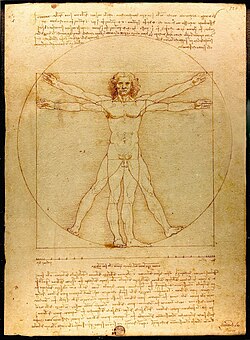
The Vitruvian Man, by Italian polymath Leonardo da Vinci, is based on the correlations of ideal human proportions with geometry described by the ancient Roman architect Vitruvius.

Human scale is the set of physical qualities, and quantities of information, characterizing the human body, its motor, sensory, or mental capabilities, and human social institutions.

Science vs. human scale

[edit]

Many of the objects of scientific interest in the universe are much larger than human scale (stars, galaxies) or much smaller than human scale (molecules, atoms, subatomic particles).

Similarly, many time periods studied in science involve time scales much greater than human timescales (geological and cosmological time scales) or much shorter than human timescales (atomic and subatomic events).

Mathematicians and scientists use very large and small numbers to describe physical quantities, and have created even larger and smaller numbers for theoretical purposes.

Human scale measurements, however, are more in the order of:

  • Distance: one to two metres (0.9–1.8 m or 3–6 ft – human arm's reach, stride, height)
  • Attention span: seconds to hours
  • Life span: 75 years (mean life expectancy at birth)
  • Mass: kilograms – most typically, for newborns from about 3–4 kg (7–9 lb) for a human adult their weight range is about 50–100 kg (100–200 lb)
  • Force: newtons (e.g. the weight of a human on Earth, on the order of several hundred newtons, or about 100–200 lbf)
  • Pressure: one standard atmosphere (average pressure on Earth at sea level, approximately 100 kPa or 30 inHg)
  • Temperature: around 300 K (27 °C; 80 °F) (room temperature); 250 to 320 K (−20 to 50 °C; −10 to 120 °F) (normal range of temperatures in most inhabited regions of Earth)
  • Energy: typical adult human energy intake is around 10 megajoules (2,400 kilocalories) per day

Human scale in architecture

[edit]
Le Corbusier's Modulor scale of proportions

Humans interact with their environments based on their physical dimensions, capabilities and limits. The field of anthropometrics (human measurement) has unanswered questions, but it's still true that human physical characteristics are fairly predictable and objectively measurable. Buildings scaled to human physical capabilities have steps, doorways, railings, work surfaces, seating, shelves, fixtures, walking distances, and other features that fit well to the average person.

Humans also interact with their environments based on their sensory capabilities. The fields of human perception systems, like perceptual psychology and cognitive psychology, are not exact sciences, because human information processing is not a purely physical act, and because perception is affected by cultural factors, personal preferences, experiences, and expectations. So human scale in architecture can also describe buildings with sightlines, acoustic properties, task lighting, ambient lighting, and spatial grammar that fit well with human senses. However, one important caveat is that human perceptions are always going to be less predictable and less measurable than physical dimensions.

Human scale in architecture is deliberately violated:

  • for monumental effect. Buildings, statues, and memorials are constructed in a scale larger than life as a social/cultural signal that the subject matter is also larger than life. One example is the Rodina (Motherland) statue in Volgograd.
  • for aesthetic effect. Many architects, particularly in the Modernist movement, design buildings that prioritize structural purity and clarity of form over concessions to human scale. This became the dominant American architectural style for decades. Some notable examples among many are Henry Cobb's John Hancock Tower in Boston, much of I. M. Pei's work including the Dallas City Hall, and Mies van der Rohe's Neue Nationalgalerie in Berlin.
  • to serve automotive scale. Commercial buildings that are designed to be legible from roadways assume a radically different shape. The human eye can distinguish about 3 objects or features per second.[citation needed] A pedestrian steadily walking along a 30-metre (100 ft) length of department store can perceive about 68 features; a driver passing the same frontage at 50 km/h (14 m/s; 31 mph) can perceive about six or seven features. Auto-scale buildings tend to be smooth and shallow, readable at a glance, simplified, presented outward, and with signage with bigger letters and fewer words. This urban form is traceable back to the innovations of developer A. W. Ross along Wilshire Boulevard in Los Angeles in 1920.

Common sense and human scale

[edit]

"Common sense" ideas tend to relate to events within human experience, and thus commensurate with these scales. There is thus no commonsense intuition of, for example, interstellar distances or speeds approaching the speed of light.

Weights and measures tend to reflect human scale, and many older systems of measurement featured units based directly on the dimensions of the body, such as the foot and the cubit. The metric system, which is based on precisely reproducible and measurable physical quantities such as the speed of light, still attempts to keep its base units within the range of human experience. Systems of natural units (such as Planck units) are useful in theoretical physics, but are not suitable for everyday purposes; because the SI units are defined in terms of constants of nature they can be thought of as natural units rescaled to human proportions.

See also

[edit]

References

[edit]
Revisions and contributorsEdit on WikipediaRead on Wikipedia
from Grokipedia
Human scale refers to the design principle in and that prioritizes dimensions, proportions, and spatial arrangements aligned with the physical and sensory capabilities of the , ensuring environments feel comfortable, navigable, and conducive to social interaction at a pace of approximately 5 km/h (3 mph). This concept emphasizes creating spaces that respect human perception limits, such as a social field of vision around 100 meters (110 yards) for observing in motion and 25 meters (27 yards) for recognizing expressions, thereby fostering intimate and interactions within defined distances: intimate (0-45 cm), personal (45 cm-1.2 m), social (1.2-3.7 m), and (beyond 3.7 m). Originating from observations in traditional urban forms, human scale counters the alienation of large-scale modern developments by promoting low-rise structures (typically up to five stories) and detailed, small-scale elements that enhance sensory richness and emotional . Key principles include integrating biophilic elements like trees and patterns for refuge and prospect, ensuring public spaces are walkable and interconnected within 200 meters of residences, and using that unconsciously influences behavior through safety and attractiveness. Advocated and popularized by urban designers such as , who advocated for "providing good city spaces for pedestrians that take into account the possibilities and limitations dictated by the human body," the approach has been applied in exemplary sites like Siena's (135x90 meters), where proportions align with human visual and social fields to encourage vibrant public life. In contemporary practice, human scale informs resilient urban policies, prioritizing pedestrian-oriented planning to mitigate the disconnect caused by towering architecture above street level.

Conceptual Foundations

Definition and Core Principles

Human scale refers to dimensions, distances, speeds, and durations that are comprehensible and relatable to the average and senses, emphasizing proportions and interactions that align with human to promote comfort, , and intuitive interaction. This concept encompasses spatial extents typically ranging from millimeters to kilometers and temporal spans from seconds to years, reflecting the scales at which humans directly experience and navigate their environment without relying on abstract tools or instruments. Unlike absolute or scientific scales, which are fixed and independent of biological constraints, human scale is inherently relative, grounded in the variability of human physical and perceptual capabilities to ensure environments feel natural and accessible. Central to human scale are anthropometric standards, which provide baseline measurements derived from population data to guide design proportions. For instance, the average adult —approximately 1.59 meters for women and 1.71 meters for men globally (born 1996 cohort)—serves as a fundamental reference for alignments, ensuring that structures and objects align ergonomically with bodily dimensions. Key principles include facilitating an intuitive grasp of space through unaided human actions, such as estimating near-field distances by arm's length (roughly 0.6–0.8 meters) or gauging moderate distances via walking pace (about 1.4 meters per second for comfortable locomotion). These principles prioritize sensory and motor familiarity, allowing individuals to interact seamlessly without cognitive overload or physical strain. Representative examples illustrate how human scale manifests in everyday design. Door handles, positioned at waist height around 0.9 meters (36 inches) from the , enable effortless reach for most adults, accommodating the typical range of and heights. Similarly, room sizes designed for 4–6 , such as a 4x5 meter space providing about 0.76 meters (30 inches) of personal clearance per occupant, support comfortable social interaction without crowding. These applications underscore human scale's role in creating environments that enhance by mirroring natural human proportions.

Historical Development

The concept of human scale originated in ancient , particularly in the work of the Roman architect and engineer Marcus Pollio. In his treatise , composed around 15 BCE, outlined principles of proportion derived directly from the human body, asserting that architectural elements should mirror bodily ratios for harmony and functionality, such as the foot being one-sixth of the body's height and the forearm one-fourth. These ideas emphasized in design, positioning the human form as the ideal measure for temples, columns, and urban structures to ensure they felt intuitive and proportionate to users. This Vitruvian framework gained renewed prominence during the , most iconically through Leonardo da Vinci's drawing, created circa 1490. Da Vinci illustrated a male figure inscribed within a circle and square, demonstrating how human limbs align with geometric ideals to embody and balance, directly inspired by Vitruvius's descriptions of bodily proportions as the basis for architectural . The work symbolized the humanist revival of , integrating art, , and to argue that buildings should scale to the for aesthetic and practical efficacy. During the Enlightenment in the 17th and 18th centuries, anthropocentric philosophies further entrenched human scale in scientific and architectural discourse. Thinkers like Galileo Galilei, in his Dialogues Concerning Two New Sciences (1638), explored scaling laws using the human body as a model, explaining how proportions affect strength and stability—for instance, why larger bodies require disproportionately thicker bones to support weight, a principle that influenced engineering views on human-adapted structures. This era's emphasis on empirical observation and human-centered metrics laid groundwork for modern design by linking bodily scale to universal principles of harmony. The 20th century saw the formalization of human scale as a deliberate counterpoint to industrialization and abstraction in design. Danish architect Steen Eiler Rasmussen, in his influential book Experiencing Architecture (1959), examined perceptual scales, arguing that architectural elements must relate to human dimensions and sensory experience to evoke comfort and familiarity, using examples from historical buildings to illustrate how deviations from bodily proportions disrupt user intuition. This perceptual focus complemented the urbanist critique by Jane Jacobs in The Death and Life of Great American Cities (1961), where she popularized human scale as essential to vibrant neighborhoods, decrying oversized modernist developments for eroding street-level diversity and pedestrian accessibility in favor of car-dominated, impersonal spaces. Jacobs's work shifted discourse toward community-oriented urbanism, insisting that buildings and streets succeed when calibrated to everyday human interactions rather than monumental abstraction. Post-World War II critiques of marked a pivotal milestone, positioning human scale against the era's megastructures and functionalist excesses. Architects and theorists challenged the International Style's emphasis on large-scale, uniform forms—like Le Corbusier's expansive urban visions—as alienating and dehumanizing, arguing they ignored bodily and social proportions in favor of machine-like efficiency. By the 1970s, movements amplified this opposition, integrating human scale with ecological concerns through responsive, adaptive spaces that prioritized pedestrian flow, natural light, and community integration over monolithic constructions, as seen in emerging patterns language approaches that favored intimate, body-relatable modules. These developments, influenced by Jacobs and , fostered a toward humane, context-sensitive design amid growing awareness of modernism's social failures.

Perception and Cognition

Sensory and Psychological Dimensions

In the context of human scale, the social field of vision extends to approximately 100 meters for observing in motion, where the eye's of about 1 arcminute enables distinguishing features as small as 3 cm. Beyond this distance, finer details blur due to acuity limits. For vastness, the horizon provides a of on clear days, extending up to 3 miles for an observer of average height (about 1.7 meters eye level) before Earth's curvature intervenes, though atmospheric conditions can extend this to stars visible across astronomical distances. Auditory spans from intimate detectable at 1 meter (around 20-30 dB) to distant thunder rumbling kilometers away (up to 120 dB at source, attenuating with distance), covering a of roughly 120 dB and frequencies from 20 Hz to 20 kHz in healthy adults. Tactile sensitivity on the skin, particularly at the , achieves resolutions of 2-3 mm for , allowing detection of textures and pressures down to thresholds of about 0.5-1 mm depth. Psychological scaling of these sensory inputs follows principles like the Weber-Fechner law, which posits that perceived magnitude is proportional to the logarithm of the physical stimulus intensity, rather than linear. Formulated by in 1834 and expanded by in 1860, this law explains why just-noticeable differences (JNDs) in stimuli remain proportional to the background intensity; for instance, a 2% change in weight (e.g., distinguishing 50 g from 51 g) or brightness is detectable across scales, but absolute differences grow larger as intensity increases. This logarithmic compression ensures efficient neural processing but compresses perception of extreme scales, such as equating a tenfold intensity increase to only a perceived doubling in many modalities. Human intuition falters beyond roughly 10^3 units, struggling to visualize or enumerate quantities like a million (10^6) as a tangible 1,000 by 1,000 grid, due to evolutionary adaptations tuned to immediate survival scales rather than abstract magnitudes. This limitation arises because the brain's quantity processing relies on approximate rather than exact representations for large numbers, leading to underestimation or compression of vast scales outside direct experience, such as national populations or geological time. Neurologically, scale estimation and spatial awareness are anchored in the , particularly the , which integrates sensory inputs for metric and topological representations of space. Lesions here impair distance judgment and size constancy, as seen in syndromes where patients misestimate object scales relative to body-centered coordinates. The posterior parietal cortex further modulates attention to spatial hierarchies, enabling seamless shifts from local details (e.g., grasping an object) to global contexts (e.g., navigating a ), underscoring its role in anchoring human-scale .

Cognitive Biases and Intuitions

The leads individuals to overestimate the likelihood of events that are more easily recalled due to their vividness or frequent portrayal in media, often distorting perceptions of scale in . For instance, people tend to fear dramatic but rare incidents, such as shark attacks, more than common causes of death like car crashes, because media coverage amplifies the mental accessibility of the former, creating an illusion of greater prevalence despite statistical rarity. This influences judgments of scale by prioritizing memorable, large-scale narratives over aggregated , as demonstrated in foundational work on how retrievability skews probability estimates. Anchoring bias further shapes scale comprehension by causing reliance on initial reference points, particularly those rooted in human-scale experiences, which then skew subsequent estimates. When assessing larger structures, such as a building's height, individuals often anchor to familiar human dimensions like door height (around 2 meters), leading to under- or overestimation if the is insufficiently adjusted for the broader context. This effect persists even when anchors are arbitrary, as shown in experiments where numerical starting points biased quantitative judgments toward them, applying to spatial scales where human-body analogies serve as default references. Sensory thresholds can underpin these biased judgments by limiting the precision of initial perceptual anchors. Intuitions in scale estimation often rely on powers-of-ten thinking, breaking down complex quantities into order-of-magnitude approximations starting from human-scale benchmarks, as seen in Fermi problems. For example, estimating the number of jellybeans in a jar involves approximating the container's (comparable to a or , around 10^{-3} m³) and dividing by the bean's (roughly 1 cm³ or 10^{-6} m³), yielding an order-of-magnitude guess of thousands without exact measurement. This facilitates quick reasoning about vastly different scales by leveraging logarithmic , though it introduces errors from imprecise analogies. Cultural variations in spatial affect scale , with Western approaches often favoring linear, analytic breakdowns and non-Western perspectives emphasizing holistic integration of environmental contexts. Western linear thinking segments into discrete units for , potentially leading to fragmented scale judgments, whereas some indigenous and East Asian views incorporate relational and embodied connections to place, fostering more integrated perceptions of environmental scales. These differences manifest in tasks like size , where cultural background influences perceived volume; for example, South Koreans showed less overestimation of sizes compared to in familiar settings.

Applications in Design

Architecture and Built Environment

In and the , human scale principles are applied through anthropometric to ensure spaces align with the physical dimensions and movements of the , promoting comfort and functionality. Standard heights typically range from 2.4 to 3 meters, providing adequate headroom above the standing of approximately 1.6 meters for adults, which prevents feelings of confinement while allowing efficient use of vertical space in interiors. Furniture further embodies this approach, with standard chair seat heights set at around 45 cm to support proper leg positioning and reduce strain during prolonged sitting, based on anthropometric data for length and angles. Proportional systems in design often draw from mathematical ratios scaled to human proportions to create harmonious and intuitive spaces. The , approximately 1:1.618, has been used in architectural layouts to proportion elements like room divisions and elevations in relation to human stride lengths, fostering a that feels natural to occupants. A seminal example is Le Corbusier's system, introduced in , which establishes a modular grid based on a 1.83-meter and arm reach, integrating human dimensions with the golden section to standardize building components for ergonomic fit. Case studies illustrate both successful and cautionary applications of human scale. In traditional , mats measure about 90 cm by 180 cm, dimensions derived from the average human body to accommodate sitting, kneeling, and sleeping postures seamlessly within room layouts. Conversely, the Brutalist , completed in 1968, has been critiqued for its overscaling, with massive concrete forms and elevated plazas that dwarf pedestrians and create an intimidating, anti-human environment despite intentions for civic openness. Accessibility standards reinforce human scale by mandating features that accommodate diverse abilities, particularly mobility. The Americans with Disabilities Act (ADA) guidelines specify a maximum ramp of 1:12, calibrated to the natural human and step to ensure safe, effortless without excessive fatigue. These principles in individual structures often extend briefly to integrate building entrances with adjacent street levels for seamless transitions.

Urban Planning and Public Spaces

In urban planning, human scale emphasizes designing streets, plazas, and public spaces to align with movement, sensory perception, and , typically at speeds of 3-5 km/h, fostering intimacy and over vehicular dominance. Narrow streets, typically 5-15 meters wide, promote community interaction by creating enclosed, protected environments where s feel secure and engaged, as observed in traditional European urban fabrics where such dimensions encourage casual encounters and reduce perceived isolation. In contrast, wide boulevards exceeding 20 meters can alienate s by overwhelming the and prioritizing high-speed , diminishing opportunities for spontaneous social exchanges. Plazas and public squares at human scale are similarly dimensioned to support group activities without vast emptiness; effective sizes range from 20-50 in diameter, allowing clear visibility across the space for and social oversight, as detailed in studies of successful urban plazas where smaller enclosures enhance perceived safety and congregation. Walkability metrics reinforce this approach, with the "5-minute walk rule"—distances under 400 to essential amenities like shops, schools, and transit—ensuring daily needs are met on foot, promoting and neighborhood cohesion in compact layouts. For bike-friendly integration, planning within 5-10 km radii accommodates comfortable commutes, layering modes while maintaining human-paced connectivity. New Urbanism exemplifies these principles through developments like Seaside, Florida, initiated in the 1980s by Andrés Duany and Elizabeth Plater-Zyberk, where narrow, pedestrian-oriented streets and mixed-use blocks create human-paced layouts that prioritize walking over driving, resulting in vibrant community life without expansive parking lots. This contrasts sharply with car-centric sprawl, characterized by low-density suburbs and wide arterials that isolate residents, increase travel times, and erode social ties by favoring automobile dependency over proximate, interactive spaces. Social benefits emerge from these designs, including enhanced through consistent, eye-level cues like varied facades and at 3-4 second intervals during walks, reducing cognitive overload in navigable environments. Interaction flourishes with elements like park benches spaced for conversational distances—ideally perpendicular to paths, allowing 1-2 meter separations for choice in or —drawing into lingering and communal activities, as evidenced in Copenhagen's public spaces where such placements boost occupancy by over tenfold compared to rigid seating.

Comparisons with Other Scales

Versus Scientific Scales

Human scale in spatial terms typically encompasses dimensions from about 0.1 meters (such as the width of a hand) to 10^5 meters (roughly the scale of a large or visible horizon), dimensions directly perceivable without technological aids. In contrast, scientific scales span extreme ranges: atomic and subatomic structures operate at 10^{-10} meters for atoms or 10^{-15} meters for atomic nuclei, as probed by electron microscopy, while cosmic scales reach 10^{26} meters for the , observed through telescopes like Hubble. These disparities highlight how human scale occupies a narrow band in the logarithmic spectrum of physical reality, bridging neither the quantum realm nor the vastness of galaxies and beyond. Temporally, human experiences unfold from milliseconds (10^{-3} seconds, as in reaction times) to lifetimes of approximately 2.3 × 10^9 seconds (about 73 years on average, as of 2025), aligning with daily activities, seasons, and generations. Scientific disciplines extend far beyond: involves femtoseconds (10^{-15} seconds) for interactions in accelerators like the LHC, while cosmology considers the universe's age at roughly 4 × 10^{17} seconds (13.8 billion years). Such mismatches underscore the inaccessibility of these timescales to direct intuition, requiring to measure events like proton collisions or the expansion of space over eons. Visualizing these extremes poses significant challenges, often necessitating logarithmic scales to compress the 61 orders of magnitude from Planck length (10^{-35} meters) to cosmic horizons. The 1977 film Powers of Ten by Charles and Ray Eames exemplifies this approach, starting at a human-scale picnic (10^0 meters) and zooming outward to 10^{24} meters (encompassing galaxy clusters) before inward to 10^{-16} meters (within a carbon atom's protons), demonstrating abrupt shifts across scales. This technique reveals the isolation of human perception amid broader physical hierarchies. In science communication, human scale serves as an anchor for conveying abstract concepts, using analogies to bridge gaps; for instance, the double helix structure of DNA, at 10^{-9} meters per base pair, is likened to a twisted ladder to evoke its helical form and stability, facilitating understanding of molecular biology. Such strategies ground esoteric measurements in familiar references, enhancing accessibility without distorting core principles.

Versus Technological and Industrial Scales

In industrial contexts, the introduction of exemplified a shift toward machine-optimized processes that often clashed with human-scale work rhythms. Henry Ford's 1913 moving for the Model T reduced vehicle production time from over 12 hours to about 1 hour and 33 minutes, prioritizing mechanical efficiency and over workers' natural pacing and skill variety. This approach led to worker boredom, high turnover rates exceeding 370% annually, and physical strain from repetitive tasks, contrasting sharply with human-paced crafts where artisans control the tempo and integrate personal judgment for holistic product creation. Digital technologies further highlight disparities between human-scale interfaces and vast infrastructural backends. Smartphone screens, typically measuring 5.5 to 7 inches diagonally to fit comfortably in the hand, serve as primary user touchpoints, yet they rely on enormous data centers—such as Meta's facility in , spanning the equivalent of 70 football fields—for processing and storage. In (VR), achieving immersive scale perception remains challenging due to limitations in spatial fidelity and user locomotion, often resulting in disorientation when simulating environments beyond human bodily dimensions. Megaprojects like China's , construction of which began in 1994, illustrate how industrial-scale disrupts localized, human-scale ecosystems. The dam's inundated over 600 square kilometers of diverse habitats, fragmenting riverine ecosystems and displacing more than 1.3 million people while exacerbating landslides and in surrounding riparian zones. These alterations degrade the intimate ecological balances that sustain human communities, such as traditional fishing grounds and flood-adapted agriculture. Efforts to humanize technology through ergonomic redesigns address these mismatches by scaling interfaces to bodily . User-centered UI design principles recommend touch targets of at least 9-10 mm to match average pad width, reducing errors and in mobile interactions. Such adaptations, as seen in iterative prototyping for apps and devices, bridge the gap between industrial-scale systems and intuitive human use.

Broader Implications

In Communication and Language

Human scale profoundly influences communication and language by anchoring abstract concepts in relatable, embodied experiences, allowing speakers to convey complex ideas through metaphors that evoke tangible physical dimensions. In cognitive linguistics, metaphors often draw from human-scale interactions, such as size and proximity, to make intangible phenomena comprehensible; for instance, entrepreneurs in business discourse use embodied metaphors like describing a service as "well shaped" with gestures mimicking object manipulation to scale down abstract processes to personal, bodily levels. These expressions reflect how language structures thought around human bodily experiences, as explored in studies of conceptual blending where gestures reinforce metaphorical mappings. Common idioms exemplify this, such as "elephant in the room" to denote an oversized, unavoidable issue dominating a space, or "drop in the bucket" for something minuscule relative to a larger whole, both rooted in everyday perceptions of physical scale. In narrative construction, human scale shapes storytelling arcs to align with attentional limits, compressing vast timelines or events into digestible segments that sustain engagement without overwhelming cognitive capacity. Research on narrative videos demonstrates that engaging stories elicit synchronized neural activity across viewers, predicting longer voluntary viewing times—typically around 200–300 seconds—by fostering shared attention and reducing perceptual variability in time estimates. This aligns with media formats like television episodes structured to match sustained human focus, enabling audiences to process epic narratives through episodic breaks that mimic natural attentional rhythms. Such scaling ensures narratives remain immersive, as higher inter-subject neural correlation correlates with behavioral commitment, illustrating how language and structure adapt to human cognitive boundaries. Linguistic relativity further highlights how languages encode scales attuned to human observational contexts, influencing perceptual categorization of the environment. For example, like exhibit lexical elaboration for snow types observable at human scales—such as falling flakes versus ground cover—far exceeding English equivalents, as confirmed by a 2025 computational analysis of bilingual dictionaries across 600 languages. This pattern supports a moderate , where vocabulary reflects cultural priorities, subtly shaping how speakers perceive and differentiate phenomena like in natural elements. The study counters earlier dismissals of the "Inuit words for snow" claim as a , showing proportional increases in terms for culturally salient features, thus tying linguistic structure to human-scale environmental interaction. Media adaptations in journalism leverage human scale to frame distant or abstract events, translating vast statistics into relatable terms to evoke empathy and comprehension. Reporters often humanize large numbers through analogies, such as equating U.S. COVID-19 deaths to the capacity of multiple stadiums or the combined casualties of major wars, making the magnitude graspable by invoking familiar spatial scales. For instance, The New York Times visualized 500,000 deaths as 500,000 dots alongside personal vignettes, comparing the toll to World War fatalities to bridge numerical abstraction with human impact. Similarly, investigations like ProPublica's maternal mortality series personalize data by profiling individuals, revealing preventable trends behind aggregated figures and prompting public response. These techniques counteract statistical numbness, ensuring discourse remains anchored in human proportions.

In Education and Knowledge Transmission

Educators leverage human scale to bridge abstract concepts with familiar experiences, making complex ideas accessible across disciplines. By anchoring lessons in everyday bodily sensations, social structures, or tangible interactions, teachers facilitate deeper comprehension of phenomena that operate beyond immediate . This approach emphasizes relatable analogies and hands-on activities to demystify scales from biological timelines to physical oscillations. Historical precedents underscore the efficacy of human-scale methods in . In 1907, established the first Casa dei Bambini in , introducing child-sized furniture and materials designed to match young learners' physical dimensions and sensory capabilities. These scaled-down tools, such as graspable blocks and sensory bins, enabled children to independently explore spatial relationships and proportions, fostering intuitive understanding of and proportion without adult mediation. This method, which spread globally by the 1920s, remains influential in promoting self-directed learning attuned to human developmental scales. Analogies rooted in human experiences effectively illustrate vast evolutionary timescales. For instance, phylogenetic trees are taught as extensions of family trees, where branching patterns represent shared ancestry across generations, helping students visualize deep-time relationships among . In biology classrooms, this analogy uses personal lineage diagrams to scale up to millions of years, clarifying without overwhelming learners with raw chronological data. Similarly, physics instruction employs human-scale demonstrations to connect mechanical principles to bodily rhythms. A common activity involves students timing a pendulum's oscillations using their own heartbeat as a , revealing the period's dependence on rather than or . This lab, inspired by Galileo's observations, equates the pendulum's swing—typically 1-2 seconds—to a resting of about 60-100 beats per minute, grounding in physiological familiarity and highlighting measurement precision at human tempos. Curriculum integration further embeds human-scale strategies in STEM education, particularly through programs addressing orders-of-magnitude jumps. NSF-funded workshops, such as those held at from 2015 to 2019, trained K-12 and teachers in estimation techniques that start from human-centric benchmarks—like arm spans for meters or heartbeats for seconds—to navigate exponential scales in science and engineering. These initiatives, part of broader NSF efforts to enhance quantitative literacy, equipped educators to teach phenomena from atomic to cosmic levels by iteratively scaling from the familiar. Despite these tools, human-scale intuitions can perpetuate misconceptions, necessitating targeted interventions. For example, the intuitive perception of Earth as flat arises from limited personal horizons, leading students to interpret spherical evidence through a "pancake" mental model where curvature is dismissed as optical illusion. Educators address this by contrasting local flatness with scaled models and activities, promoting conceptual change from naive to scientific models. Interactive manipulatives offer practical solutions to such challenges, allowing tactile engagement with scale. In science classes, physical models such as blocks or nested objects representing different sizes enable students to manipulate proportions directly, reinforcing abstract ratios through kinesthetic feedback. Research on these tools demonstrates improved retention of scale concepts, as hands-on interaction counters perceptual biases and builds accurate spatial reasoning.

References

Add your contribution
Related Hubs
User Avatar
No comments yet.